




Abstract
Young Black Muslim Women (BMW) have complex, intersectional identities and exist at the margins of various identity groupings. Given this, members of the community can face societal relegation across, not only race and gender lines, but across religious ones, too. This paper explores the lived experiences of intragroup discrimination, identity and belonging in 11 young Black Muslim Women in the United Kingdom. In-depth, semi-structured interviews were conducted with participants and thematically analysed through the lens of intersectionality. The use of an intersectional framework facilitated an understanding of the manner in which the sample was multiply marginalised. Two key themes emerged from the interviews: firstly, around experiences of intragroup and intersectional discrimination and, secondly, around the challenges of responding to and coping with the negative effects of such discrimination. Participants discussed the cross-cutting nature through which they faced discrimination: from within the Black community; from within the Muslim community; and as a result of their gender. The non-exclusivity of these three identities result in constant encounters of discrimination along different dimensions to their personal identity. They also developed diverse means of coping with this marginalisation including drawing from religious beliefs and mobile identifications, i.e. performing different aspects of their identities in different contexts. The present study contributes to existing knowledge in its focus on an under-researched group and emphasises the negative effects of intragroup discrimination. The paper importantly highlights the diversity within the Black community and considers the (in)visibility of Black Muslim Women within society.
Introduction
Brothers we’re not Black. Let’s stop talking like we’re Black. Let’s talk in a decent way with decent manners… We grew up in decent families. (AJ+, 2018).
In 2019, The Black Muslim Forum conducted a survey with 100 Black Muslims in Britain surrounding their experiences of discrimination (Black Muslim Forum, 2020). They found that 63.41% of Black Muslims felt they did not belong in the UK Muslim community; 53.95% felt they did not belong to their local Mosque and 84% felt they did not belong in Islamic societies at their university. Furthermore, with regard to anti-Black discrimination and colourism, 48.98% of participants had experienced this within a religious setting. These statistics, while drawn from a limited sample, indicate a collective intragroup experience of racism faced by Black Muslims, and are consistent with findings from similar academic research surrounding intragroup discrimination faced by Black Muslim Women (Karim, 2006; McGuire et al., 2016).
Intragroup discrimination describes the experience whereby individuals are excluded by an identity group they personally identify with (O’Brien et al., 2012). As this paper discusses, discrimination comes from both external sources (intergroup) and from within the communities of which BMW are members (Hersi, 2019). Given this, through a Black Feminist intersectional approach, we explore the lived experiences and feelings of identity and belonging in young Black Muslim Women in Britain. Findings are presented from a larger study highlighting the effects of both intergroup and intragroup discrimination on the lives of young BMW. Eleven in-depth narrative interviews were conducted with BMW living in the UK, aged 18–25, all studying at university. Here, we focus specifically on intragroup discrimination and its culminating effects on the wellbeing, identity construction and sense of belonging felt by this multiply marginalised group. Our main research question is: How do young Black Muslim Women in Britain experience and cope with intragroup discrimination?
Being young, Black and Muslim in the UK
According to recent census data, there are 3.37 million Muslims in the UK, with almost 50% being under the age of 25 (Ali, 2015; ONS, 2018). With regard to ethnic diversity, 68% are Asian/Asian British making them the largest group, and only 10% are Black (African/Caribbean/Black British) (see Table 1). The Muslim Council of Britain estimates that approximately 90% of these Black Muslims belong to the Somali community, making them the largest proportion of Black Muslims in the UK (Ali, 2015). Data also indicate that 47% of the Muslim population in Britain are born in the UK, with 73% considering British as their national identity (Ali, 2015). We note the heterogeneity of Muslim communities in Britain as well as the range of cultural interpretations within the practice of Islam. Here, we focus primarily on the experiences of BMW, and we begin by recognising the fact that members of the community have often been erased from master narratives.
The Black Muslim population in Britain (Ali, 2015).

The hidden history of Black Muslim women
While Blackness and Islam are intrinsically linked, anti-Black racism within certain ethnic Muslim communities has led to the systemic erasure of the contributions of Black people to the religion and the significance of Africa in Islam (Khan, 2018; Robert, 2020). In particular, Black women, who have been pivotal in Islamic history, have been overlooked. For example, Barakah (also known as Umm Ayman), a Black Abyssinian woman who accepted Islam, was central to the life of prophet Muhammad (peace be upon him) and his family. He described her as a woman of paradise, and as his mother after his own mother – yet her identity is consistently erased. Another pivotal BMW in Islamic history is Hajar, a Black Egyptian woman. It is in her footsteps, between Mount Safa and Mount Marwa, that millions of Muslims around the world follow every year in the pilgrimage to Makkah. While this is a key rite of Hajj, again, her identity as a Black Muslim woman is consistently erased.
Likewise, the significance of Islam is neglected within wider Black history (Austin, 1997). For example, during the transatlantic slave trade, a significant proportion of enslaved Africans were, in fact, Muslim. Despite threatening conditions, these Black Muslims held onto their faith and upheld Islamic practices. They used their faith and Arabic literacy to form networks, resist enslavement and seek emancipation (Amon, 2017). As a result of their influential standing within the ranks of rebels , specific legislation targeting African Muslims was created in an attempt to ultimately prohibit their introduction into the Americas. This indicates the extent to which Black Muslims contributed in pursuing freedom for all those who had been enslaved. However, this remains a part of Black history that is not taught (Diouf, 2013).
Additionally, the intersection of the female identity is overlooked within Black history. For instance, while the story of Malcolm X is well-known, the significant contributions of his sister Ella Collins to his life are not. Having converted to Islam before Malcolm, it was she who funded his famous pilgrimage to Makkah and she who instilled Black pride in him during his youth. We may learn about the men and institutions that shaped him – such as Elijah Muhammad and the Nation of Islam – but we hear little about the Black Muslim women who were pivotal in his life (Khan, 2018).
Identity, intersectionality and Black Muslim women
For BMW, identity is complex due to the numerous positions community members can hold (Johnson, 2018). In the UK, the label of ‘British Muslims’ has tacitly become associated with ethnicity, particularly Muslims of South Asian descent (e.g. Meer et al., 2010; Phillips, 2015; Runnymede Trust, 2018), while the discourse surrounding religious identity among the Black community focuses greatly on Christianity in terms of faith (Knowles, 2013). Samad (2018) therefore notes that the conceptualisation of the British Muslim identity is reductionist and eliminates the diversity within Black and Muslim communities. Furthermore, it undermines the power hierarchies related to race by assuming homogeneity.
An approach which comes close to recognising this diversity is that of Intersectionality (Crenshaw, 1989). Intersectionality was developed and used by Black feminist scholars as an anti-racist intervention (Bilge, 2013); it recognises the process whereby multiple axes of discrimination interact to influence the lived experiences of multiply marginalised communities (Crenshaw, 1991). Intersectionality has been a popular idea for conceptualising multiple experiences of difference and has been employed widely across scholarship (see Davis, 2020), however, there has been contention around the use of this approach. Davis (2020) describes how ‘Intersectionality has been whitened, depoliticized, and transformed into a product of the neoliberal academy rather than the helpmeet for social justice it was meant to be’ (114). Others have argued that, by using intersectionality as a lens to focus on the experiences of Black women, inadvertently academics are re-producing them as ‘the other’ and in a state of constant resistance (Puar, 2012).
Azeezat Johnson (2017) reflects on the debate around the use of intersectionality in a European setting. Johnson places the experiences of British BMW in the context of the historical events that have shaped the ‘British grammar of race’ (7), particularly Britain’s colonial past and legacy of slavery. In doing so, she asks us to consider the various scholarship that details how racialised bodies are viewed in British society (e.g. Blakely, 2009; Gilroy, 1987). Blackness is seen as marginal – a perpetual alien threat within a nation whose main aim is to unite white English class differences. Johnson recognises that identities are complex and dynamic when viewed against the idea of Britishness. Moreover, Mirza (2013) uses the notion of embodied intersectionality which combines ideas of intersectionality and racialised bodies. This approach intends to unpack the effect of historical and systemic discrimination through its culmination in individual practices and social relations, as mediated through Muslim women’s bodies. This notion provides the opportunity to understand the effects of raced or gendered discrimination through BMW’s embodied subjectivity. In our use of intersectionality in this paper, we are mindful of the history of the use of this approach, and our thinking particularly resonates with that of Mirza.
Feelings of (un)belonging for Black Muslim women
‘Intersectional discrimination’ is a term used to describe how discrimination can occur across the junctures of different identities (Feagin and Sikes, 1994). It recognises how cumulative discrimination can result in the frequent disruption of lives, exacerbate existing inequalities and create moments of crisis. Various studies have attempted to capture the effects of intersectional discrimination on young BMW’s sense of belonging, but mostly in an American context. For example, Byng (1998) conducted 20 in-depth interviews with African-American Muslim women assessing their experiences of intersectional discrimination. Participants described the multifaceted and inescapable nature of discrimination in both public and private spaces, and the negative impact this has had on their lives. McGuire et al. (2016), in their in-depth narrative study on the experiences of immigrant BMW on a predominantly white university campus in America, discuss the unique challenges one of their participants (Yasmin) faces with regard to her complex identity. Yasmin describes feeling excluded by the Black community due to her Islamic faith. She believed her blackness was ‘compromised’ and that her identity was constantly being questioned and even invalidated by members of the Black community. This resulted in her subsequent highlighting or downplaying certain aspects of her identity in different situations in order to fit the space she occupied. This idea of mobile identities across different contexts has been discussed by one of the authors in another article, particularly amongst young Muslims in order to establish a sense of belonging in mixed settings (Iqbal et al., 2017).
The feeling of belonging is not static and is dependent on the behaviour of others. It involves the construction of boundaries around and within communities resulting in the exclusion of certain individuals and groups (Skrbiš et al., 2007; Yuval-Davis, 2005). Hierarchies of belonging exist in the context of multiple intersections of identity, including race, gender and religion (Anthias, 2008). Related to this, Puwar’s (2004) concept of being a ‘space invader’ captures the sense of being an outsider that marginalised groups experience in spaces implicitly ingrained with histories of colonialism or whiteness. Meer (2012) has also discussed the significance of space to identity, noting its importance for self-definition and Valentine (2007) reflects on how, in different spaces, particular identities are weighted and given more importance by individuals or groups. This is particularly relevant for hierarchical locations steeped in power. Grosfoguel (2013) maintains that the legacy of colonialism present in western institutions, such as universities, perpetuates epistemic racism and sexism that are foundational to eurocentric knowledge production. This causes a dilemma for BMW; while these spaces are deemed secular, in reality their race and faith has been politicised and even criminalised. For example, the introduction of the UK PREVENT policy resulted in state-sanctioned Islamophobia and discriminatory surveillance of Muslims within public spaces including universities (Manzoor-Khan, 2018). Such policies perpetuate feelings of unbelonging among BMW who are already alienated from wider society and, as we see below, are further discriminated against within their own communities.
BMW and intra-group discrimination
Black Muslim Women can feel like outsiders within their own communities. Research by Karim (2006) on belonging and identity has focused specifically on Muslim women. In a conversation between her participants, Melanie (a BMW) discussed the discrimination she had experienced within Muslim communities which Tasneem (a South Asian Muslim) was dismissive of. Using this example, Karim (2006) discusses how different positions of privilege exist within the Muslim community, with South Asian groups in a position of greater authority. Wyche (2004) describes how cultural stratification centred around race, ethnicity and social class within certain communities has disrupted the unity and shared identity of Muslims, thereby increasing the avenues of discrimination for BMW. Such is also the case in a UK context, as discussed earlier (see Phillips, 2015).
Various studies have discussed the negative effects of intragroup discrimination on different communities. O’Brien et al. (2012) found that those experiencing perceived intragroup discrimination within the Hispanic community reported higher levels of rejection and betrayal when excluded by their own ethnic group in comparison to exclusion faced by other groups. Indeed, chronic discrimination has shown to be detrimental to wellbeing; it increases depressive symptoms, anxiety, stress and paranoia (Basáñez et al., 2014; Clark et al., 1999; Kessler et al., 1999; Sellers and Shelton, 2003). Furthermore, hypervigilance related to navigating discriminatory environments results in social withdrawal from one’s identity groups (Rippy and Newman, 2006). This is damaging for those facing intragroup discrimination as they are effectively isolated from their own communities, resulting in feelings of unbelonging. The effects of intragroup discrimination remain under-researched, despite its prevalence in many communities.
The present study
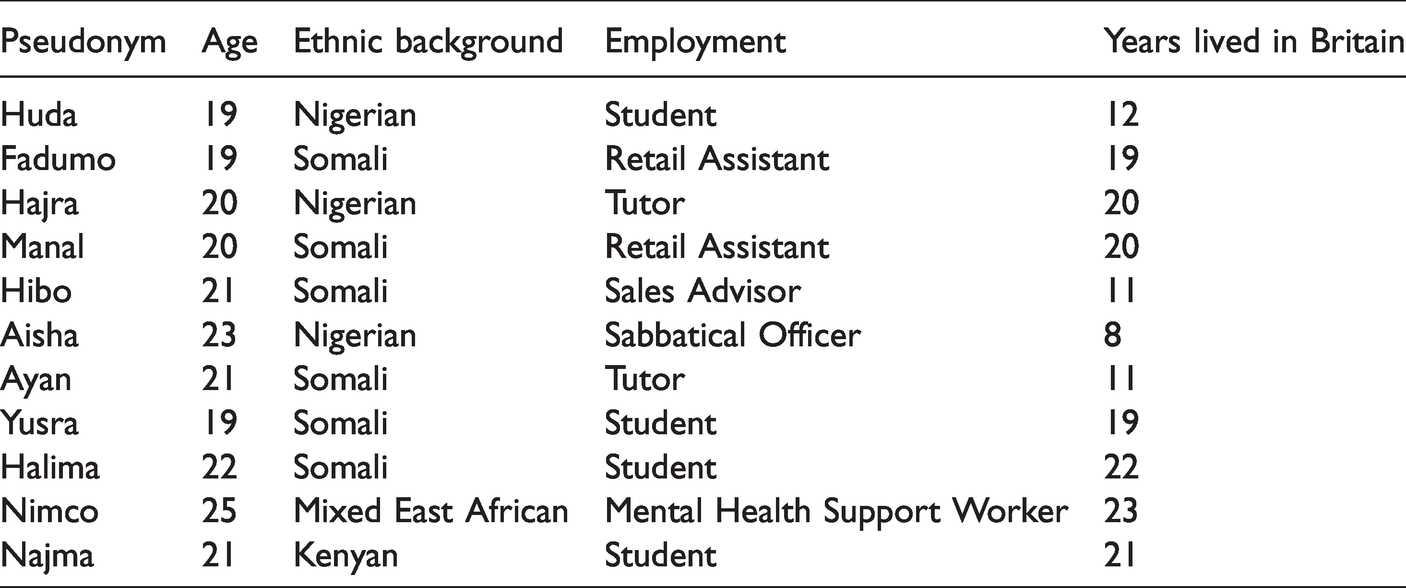
As shown in Table 2, our sample consists of 11 BMW living in London (six Somalis, one Kenyan, one mixed East African and three Nigerians). Of these women, six moved to Britain from their country of ethnic origin while the remaining five were born in Britain. All participants were aged 18–25. The sample is an educated one; 10 of the young women are studying for undergraduate degrees and one for a master’s degree at UK universities. Recruitment took place through student societies within universities; one of the authors (SN) attended events based at the universities and approached participants directly. A snowballing approach was then adopted to widen the pool of participants.
Participants by age, ethnic background, employment status and length of time living in the UK.
Methods
Semi-structured in-depth interviews were conducted to explore the effects of intersectional and intragroup discrimination. This allowed for the generation of a rich data set which included details of the day-to-day lived experiences of participants (Smith, 1995). As explored in qualitative research methods, lived experiences are a representation and understanding of human experiences and perceptions which can be influenced by individual facets of identity including race, religion, gender and social class (Given, 2008).
Our choice of methodology allowed us to engage with participants’ narratives and facilitated a meaningful understanding of their experiences. The semi-structured nature of the interview also promoted spaces for storytelling, reflection and meaning making (Given, 2008); it allowed the conversation to take different routes and for new ideas to be uncovered which may not have been pre-empted (Barriball and While, 1994). All interviews lasted between one and two hours and were digitally recorded and transcribed. Interviews took place in either university settings or quiet cafe spaces. Ethical approval was received from the Ethics Review Committee at the associated institute in which the researchers are based.
The interview guide consisted of six sections and aimed to explore the discriminatory experiences faced by BMW in Britain. The first section explored participants’ identity and sense of belonging. The following sections examined experiences of racism, Islamophobia and sexism, both outside and within their communities. This included questions such as ‘What have your experiences of discrimination been within the [Black/Muslim/Female] community?’ and ‘How do you feel Black men/Muslim men perpetuate or challenge gendered discrimination?’ The final sections of the interview probed on coping mechanisms towards discriminatory experiences. Our research covered sensitive issues and involved participants recalling their experiences with discrimination. Participants’ troubling emotions associated with such experiences were treated with great sensitivity. All interviews were conducted by one of the authors (SN) who identifies as a Black Muslim Woman. This shared identity facilitated open discussions, particularly around these sensitive topics (Bhopal, 2010) and enabled the interviewer to take an empathetic stance, grounding discussions in an ethics of caring (Collins, 2000).
Analysis
An intersectional approach was applied to data analysis, whereby the interrelation between race, religion and gendered discrimination were assessed within participant narratives. Earlier, we described the approach towards intersectionality that we have used in the study. The software NVivo was used to conduct the thematic qualitative analysis according to methods outlined by Braun and Clarke (2006). This involved coding the transcripts and organising them thematically into larger themes and sub-themes. The identification and analysis of patterns within lived experiences of the group could therefore be achieved and was grounded in responses from participants (Shaw, 2001), thereby allowing the research to remain true to the narratives told by each woman. To preserve the anonymity of the participants, the transcriptions include pseudonyms.
Findings
As a Black person, you are oppressed, you have racism…and then as a Muslim you have Islamophobia against you, you have people with certain agendas against you. As a woman there is patriarchy, people who hate you, misogyny. (Aisha, 23)
The above quote from Aisha summarises some of the different ways in which BMW experience discrimination both outside and within their communities. Here we focus specifically on intragroup discrimination exploring: (1) participants’ lived experiences of intragroup discrimination and (2) the challenges they face in responding to and coping with intragroup exclusion.
Black Muslim women and experiences of intragroup discrimination
There are a number of ways in which BMW experience intragroup discrimination. These include: (i) racism and anti-Blackness within the Muslim community; (ii) Islamophobia and exclusion in the wider Black community; and (iii) the intersection of gender with race and religion.
Racism and anti-Blackness in the Muslim community
When it’s coming from within, that’s the most painful. It really gets you. Mentally and emotionally. It is damaging. But what can you do? It’s your family, your community- if you leave them, who do you have left? It is isolating. It hurts. (Halima, 20)
Numerous participants discussed anti-Blackness and experiences of discrimination existing within wider Muslim communities. One space in which feelings of racial exclusion came up was during after-school religious classes or within faith schools. Najma, whose family is of Kenyan heritage, reflects on her experiences of attending a South Asian Islamic foundation for nine years, where the treatment she received was ‘damaging’. She described being ‘treated like absolute dirt’, of feeling ‘inferior and unvalued’ and said ‘I was constantly reminded I was a burden’. Multiple participants described how this derogatory treatment due to their Blackness tainted their opinion of Islam itself. Najma went on to reflect on how she felt unwelcome in Islam as a result of the hostility she encountered within ‘Islamic’ institutions. Manal, of Somali heritage, also describes her experience of the institutionalisation of anti-Blackness at her Islamic school. She recalls, when learning how to recite the Qur’an in Arabic, her teacher would consistently ignore her. [He said] ‘You’re Somali, you don’t need to read’… And because of that I didn’t read Qur’an for like 2/3/4 years after… I avoided Qur’an because I couldn’t read it.’
When discussing how to tackle anti-Blackness within Muslim communities, some participants described how their efforts were constantly silenced and even accused of being divisive. Aisha articulates: Even when people are being blatantly racist to Black people in the Muslim community, we can’t speak about it because otherwise we’re ‘dividing the Muslim community’. (Aisha, 23)
Several participants discussed how non-Black Muslims frequently used the example of Bilal ibn Rabah as a justification for the absence of anti-Blackness in Islam. Bilal was an enslaved Abyssinian man who accepted Islam and is known for being the first mu’adhin (person appointed to recite the call to prayer). One participant said, ‘All they know how to say is Islam isn’t racist, Bilal was Black. It’s tiring.’ The narrative of Bilal being incessantly tied to the position of a slave is inherently problematic. He later became the governor of Syria, yet this has been erased from his history, minimising his existence and status to that of ‘the Black slave’ (Khan, 2018). Furthermore, there are many esteemed Black prophets and prominent figures throughout Islamic history, yet they are rarely recalled (Briggs, 2020).
Islamophobia and exclusion in the wider Black community
When discussing feelings of belonging in the Black community, our participants discussed ideas surrounding the ‘ownership’ of the Black identity. This point was made particularly by the East African participants (Ali, 2015) who had experienced exclusion by the West African, Caribbean and wider Black communities. They discussed not feeling ‘Black enough’, mainly due to the intersection of their appearance and faith. Najma, of Kenyan heritage, states: East Africans are generally lighter-skinned, have softer hair, smaller noses. And on top of that, being Muslim can make them feel we’re less Black – not sure how, but they do. Like there’s been so many times I’ve been told to prove my Blackness or justify my identity and I’m just like, how – how can I prove I am Black? In fact, why do I even need to prove I am Black to them? Like I need their validation or something.
The notion of a shared past is another important aspect relating to shared Black identity. Ayan, of Somali heritage, recalls that she felt her Blackness had been invalidated by a West African person because of a lack of shared history around slavery: I had an incident with someone saying we’re not properly Black, Somalis were never slaves, we were never owned. But sis, that’s not what it means to be Black…
Another aspect around Blackness and exclusion in relation to BMW which came up in the interviews was in relation to the Black Lives Matter (BLM) movement. Multiple participants recalled various cases whereby when the victim of police violence or other injustices was a Black Muslim or a Black woman (such as Breonna Taylor), they believed the media and public paid less attention. As Najma puts it, ‘It’s like #BlackLivesMatterButSlightlyLessWhenIt’sAMuslim.’ Participants also felt that when the victim was a Black Muslim, less action is taken to achieve justice. This can be seen in examples such as the death of Shukri Yahya-Abdi, a young Black Muslim girl in 2019. Her case recently gained more exposure only after her name was amplified during the global protests following the murder of George Floyd in America – it took the outrage following the death of a Black man for Shukri’s story to be amplified (Taylor, 2020).
Gender also intersects within this debate (Andrews, 2020); the #SayHerName movement was established by the African American Policy Forum in 2015 to contest the invisibility and erasure of Black women’s fatal experiences of state violence (Crenshaw et al., 2015). Although set up in an American context, the relevance in British life is high. The public outcry and media coverage following the aggression towards and murdering of Black bodies has become almost reserved for men; Black women receive ‘at most whispers’ (Love, 2017: 202). This movement therefore serves as an extension of the BLM movement which alone has not mobilised in the same way for Black women as it has for Black men. It further addresses the lack of social and legal protection afforded to Black women and the lack of justice they receive (Battle, 2016).
The intersection of gender with race and religion
Our participants also discussed the impact gender had on their lives, particularly within their Muslim communities. Some commented on how they felt ‘policed’ by Muslim men, particularly around appearance. Najma stated: I feel like there’s – in a lot of communities- like a misogynistic interpretation and understanding of the religion that kind of oppresses women, even though Islam itself does not preach this. There’s become a blurred line between culture and religion and so men will find ways to justify sexist behaviours ingrained within the culture through the religion.
Another aspect of discrimination discussed by participants, particularly along gender lines, was feelings of exclusion directed towards them from other women within the workplace and at university (Cheeks, 2018). Throughout the interviews, there was a discussion surrounding how white women also discriminate or have prejudices against minoritised women. This could be expressed in various ways, including frequent microaggressions. Aisha, of Nigerian heritage, stated: They think we’re both women so we’re the same. It’s yes, but your experiences are not mine and, by saying they are, you are exercising your privilege over me and ignoring my issues. [These microagressions] build up. They are the worst. They play on your mind…you are filled with this frustration. Constantly. It becomes really hard to deal with. And then sometimes one small thing can be the one that breaks you. And [to white women] you look like the crazy Black woman being all mad at a minor comment but you’re not – you’re mad about all the comments that have built up over years, you silence yourself for so long until you can’t take it anymore. (Yusra, 19)
Responding to and coping with exclusion
Participants reported feeling a lack of belonging due to lived experiences of exclusion across multiple fronts. Manal, of Somali heritage, discusses this: I feel lonely, dismissed, not wanted… Happiness sometimes feels like a foreign concept to me. I want to go out and enjoy life, but outside there are people who hate me. Even inside- places I should belong – I am discriminated.
Strategies for coping – Faith and mobile identities
Faith was discussed as a coping mechanism and a means of coming to terms with negative experiences. Halima stated: Allah has made me a Black Muslim woman for a reason. The Qur’an tells us Allah does not burden a soul beyond that which they can bear. This is the struggle I’m meant to go through…I should see it through…that’s what Allah wants me to do.
The Black Muslim Woman Healing Collective (BMWHC, n.d.) is an organisation that recognises the need for such safe spaces and is dedicated towards supporting and empowering BMW, operating from the position that collective trauma requires collective healing. The organisation has created a therapeutic space rooted in Islamic healing practices while also reclaiming the narrative surrounding the esteemed position of Black people in Islamic history; it also addresses the issue of the erasure of identity and heritage, much of which stems from the legacy of colonialism. They tackle many things, including this notion of feeling unrooted and disconnected from our histories through conscious knowledge production in group settings.
Regarding coping mechanisms, another key theme noted throughout our interviews was that of mobile identities. Drawing from the theory of embodied intersectionality, it can be understood that BMW, through the conceptual reaffirmation or renegotiation of identities and embodied practices, are able to resist and regulate the effects of hegemonic racist, sexist or Islamophobic discrimination within intragroup settings (Mirza, 2013). Participants described adapting their behaviours to fit in with certain groups and of bringing certain attributes of their identity to the fore, in order to become, as one participant stated, more ‘palatable’. Fadumo articulates: I kind of play up or downplay certain parts of my identity. If, for instance, I'm around my Asian Muslim friends, I’ll kind of downplay my Blackness. When I’m around non-Muslim Black friends, I exaggerate my blackness in an attempt to sort of be accepted as Black, because you know as Somalis we aren’t always seen as ‘Black’ or Black enough… sometimes I don’t really know who I am.
In line with these changes to behaviour and appearance, our respondents also spoke about stresses related to behaving like model citizens. For example, Aisha felt she constantly needed to be ‘extra good’ so as to not give anyone ‘a reason to hate her’. In relation to the model citizen argument, Sotkasiira and Gawlewicz (2020) have recently discussed how in the UK, as a result of Brexit, migrants were eager to demonstrate they were upstanding citizens who contributed to the economy to ensure their right to remain in Britain. They emphasise the importance of linking behaviour to the political context in Britain surrounding anti-immigration with research already depicting an increase in racial discrimination, including Islamophobia (Benson and Lewis, 2019; Virdee and McGeever, 2018).
Concluding reflections
Societies have historically been characterised by power hierarchies which are maintained through structural injustice, societal discrimination and individual prejudices (McDonald and Coleman, 1999). However, these structures often neglect the complex intersections that exist in people’s identities and the power imbalances associated with them. For Black Muslim Women in Britain, who have been largely invisible from debates regarding race, religion and gender, recognising these complex intersections and the historical context in which they exist is incredibly important.
Our paper reveals the sexism, racism and Islamophobia that Black Muslim Women face, not only from wider society, but from within the communities we should belong in. It raises new questions about group ownership, group identification and exclusion. Despite being a focused and educated sample based in London, the findings are consistent with previous research which detail the negative effects of discrimination (Flores et al., 2010). This study has highlighted how intersectional and intragroup discrimination is associated with internal conflicts, negatively affecting one’s wellbeing and sense of belonging. We also highlight the importance of recognising the impact of oppression from dominant minority groups on non-dominant minority groups.
We note that the sample is limited both in numbers and in the ethnic backgrounds of participants, with most participants being Somali. This is a preliminary study originally conducted for undergraduate dissertation research and it is therefore difficult to generalise the findings to encompass the experiences of all BMW. However, we do believe that the findings are valuable, internally consistent, and are in line with existing research. Moreover, we would like to expand the research in the future to include a greater sample of BMW including those from a range of African and Caribbean ethnic backgrounds, as well as beyond London.
In the UK, presently under a Conservative government, increased exposure to racialised, religious and gendered forms of discrimination from both wider society and from within communities has led to negative impacts on the wellbeing, identity construction and sense of belonging felt by BMW. And with the murder of George Floyd in the United States, the Black Lives Matter movement has gained further momentum in the UK (Cheung, 2020). It has facilitated conversations surrounding the value placed on the lives and experiences of groups with intersecting Black identities such as Black women and Black Muslim Women. The need for change has been boldly asserted and action must be taken at all levels of society, from individual biases to systemic oppression.
Footnotes
Acknowledgements
We are so grateful to the young Black Muslim Women who undertook this research and openly shared deeply personal and challenging accounts of discrimination with us. Each of you are incredibly inspiring.
Declaration of conflicting interests
The author(s) declared no potential conflicts of interest with respect to the research, authorship, and/or publication of this article.
Funding
The author(s) received no financial support for the research, authorship, and/or publication of this article.
