




Abstract
To what extent do Swedish Samis identify their ethnicity as Sami, Swedish, or both? How do they meet various criteria for being allowed to register as voters to the Sami Parliament? What factors predict ethnicities? These questions are studied in randomised samples from the electoral roll for the Sami Parliament. Applying Berry’s model of acculturation, four types are constructed—separated, assimilated, integrated, and marginalised. The findings show that the integrated represent the great majority of Samis. The two groups who tend to choose one of the identities—Sami or Swedish—represent less than one third when combined and are about equal in size. Those marginalised with weak ethnic identities represent 2%. Although all meet the self-identification criterion of being Sami, few meet each of some ‘objective’ criteria, e.g. being involved in reindeer herding, having Sami as the home language or having parents or grandparents with Sami as the home language. The main predictors of a stronger Sami identity are cultural symbolic behaviours and heredity. The main negative predictor of a stronger Swedish identity among Samis is the use of cultural symbolic behaviours, and the main positive predictor is a positive estimate on the Swedish public opinion’s interest in Samis. The findings are discussed in relation to Sami debates on indigeneity.
Introduction
Some time ago, there was a heated media discussion when a member of the Swedish parliament, representing the ‘Sweden Democrats’ that was born from the ultra-right movement ‘Keep Sweden Swedish’, claimed that Jews and Samis do not belong to the Swedish nation, and argued that they should be seen as separate nations with different cultures. The question here is not whether Samis can be Swedish citizens—no-one disputes that. The question is rather whether one can have a double identity, i.e. whether one can belong to more than one ‘ethnic’ or ‘national’ community. More specifically, to what degree do Samis identify with, and have a sense of belonging to, both the Sami and the Swedish communities? This is an empirical question that can only be answered by the Samis themselves.
Is being Sami the same for different Sami identity groups, or does their Saminess relate to different ‘objective’ criteria? What factors predict identification as Sami and what factors predict identification as Swedish? These questions are in focus here.
Identity and acculturation
Based on a review of the literature on processes of ethnic identity development, Phinney (1990) described the development from a sense of belonging with an ethnic group to exhibiting the attitudes and behaviours associated with that group. Phinney (1998) sees identity as central to the psychological functioning of members of ethnic minority groups. Ethnic awareness is constructed when cultures meet other cultures, and as persons become more aware of both the other and the self (Hu and Taylor, 2016; Phinney, 1990). Ethnic identity thereby becomes part of the individual’s self-concept which derives from his knowledge of his membership of a group. We can belong to more than one group—e.g. a village, a religion, a profession, a sport—and all may contribute to our self-concept. That should also apply to identification with more than one ethnicity. Dual ethnic identities have been described since as early as 500 BC with regard to Jews in Aram (van der Toorn, 2016). Brubaker (2004) uses the concepts of ‘groupness’ and ‘category’. Ethnic groups are not constants, but fluid, captured with the word ‘groupness’ which is real life. Categories, on the other hand, are analytical tools. The sense of belonging to the group, and the influence of the group on the individuals in it, vary among members. The shared ethnicity may still have an identifying effect, binding members together as a group, even though their common ethnicity has different meanings for them. Various categories may pick up aspects that are important ingredients in the ethnicity for many, although not for all. While Phinney (1990) includes showing attitudes and behaviours associated with the more developed ethnic identity, e.g. a one-dimensional linear approach, Brubaker (2004) in his ‘fluid’ ethnic concept, presents a wider view on ethnic identity, one that accepts that shared ethnicity and sense of belonging can have different meanings for different members of the Sami community, not necessarily in a linear way.
Brubaker also emphasizes the role of conflict for ethnic identification and mobilization. Ethnicising conflicts may be chosen to serve interests and do not always reflect the views of group members. Ethnicities are thus not essentialist concepts, but shaped and reshaped from living near other cultures, both in friendly contact and in conflict (Welinder, 2008). Ethnicity studies are often concerned with how ethnicities change when encountering another ethnicity. This often concerns how minorities react to a dominant majority culture.
There are several concepts used in postcolonial studies on cultures emerging from such encounters, e.g. hybridisation, cultural interface and cultural métissage. We will use the concept ‘acculturation’, originally from sociology and often applied in epidemiological studies, focusing on how cultural identities relate to social adaption and health. Simplified, one-dimensional, linear interpretations of this concept should be replaced by multidimensional assessment specific and relevant to the cultural group studied (Berry, 1990a, 2002; Trimble, 2002). Such a multidimensional approach is relevant to studying the question of double identities, which provoked this study.
Berry (1990b) theorised on acculturative stress and its possible impact on health. Previous studies using his theory on the health of circumpolar peoples were conducted on Greenlanders living in Denmark (Koch et al., 2004) and on Samis and Kven peoples living in Norway (Kvernmo and Heyerdahl, 2003, 2004). Acculturation is described as changes that occur when peoples of different cultural descent are living in contact with each other. Berry describes four types in which the minority people react to the impact of the majority people—assimilation, separation, integration, and marginalisation. Assimilation is when the person gives up his minority cultural identity for the majority identity. Separation is the opposite, i.e. to hold on to one’s own identity and reject the identity of the majority. Integration refers to keeping onés minority identity but, at the same time, adapting and accepting the majority identity. In this study, this would refer to having both a Sami and a Swedish identity. Marginalisation is the opposite of integration, i.e. an alienated experience of not having any cultural identity, e.g. neither Sami, nor Swedish. Persons and groups in a minority showing these four reaction modes vary, according to Berry, in their sensitivity to acculturative stress, resulting in feelings of alienation, confusion concerning identity, anxiety, depression, alcohol use, and suicidal and abusive behaviour. He claims that marginalisation is probably the most problematic mode. A study on Native Americans found that ‘ethnic pride’ may provide some protection from psychosocial problems (Kulis et al., 2001).
Historic background
The Samis are indigenous people in the northern parts of Fenno-Scandinavia, i.e. Norway, Sweden, and Finland, and in the neighbouring Kola Peninsula in Russia. Although not legally defined, this large area is also called Sápmi, the land of Samis. In the absence of an official UN definition (UN, n.d.) of the term ‘indigenous people’, the Sami Parliament presented the following: Indigenous peoples are descendants from populations that lived in the country, or a region within the country, at the time of conquest or colonisation or the foundation of a state, and who kept social, economic, cultural and political institutions…Often you add that the people must consider themselves an indigenous people, so-called self-identification. (Sami Parliament, Sweden, 2020a)
Sami traditions revolve around reindeer, although this has applied differently to different Samis, both in historical and modern times. Long before the Swedish state had a presence up north, Samis followed herds of reindeer, first as hunters and then as herders, from fell areas in the summer to forests in the winter. Historically, this implied a nomadic way of life. Before 1751, there were no clear borders between the countries up north, i.e. the northern parts of Norway, Sweden, Finland, and Russia. The Samis followed reindeers in what was then a land without state control. In the treaty of 1751, when borders between Sweden and Norway were decided, Samis were granted the right to follow their herds irrespective of borders. In the following 150 years however, these rights were violated when the state's banned most herd transfers between countries. A new law on reindeer grazing lands in 1919 forced many Samis of the north to relocate their herds 600–1000 kilometres south, under severe conditions (Labba, 2020). The Samis arriving from the north encountered south Samis, who had not been consulted, resulting in frictions that are still present.
In 1751, the state also decided on taxation on herding, and therefore codified Sami rights to use lands (Hahn, 2000). This applied, however, more to the region of Lapponia (in Swedish Lappland; the word ‘Lapp’ was used as another word for Sami). The Samis living south of Lapponia—in the Jämtland region—had weaker legal rights to the land. In the early 19th century, they lost parts of their forest winter grazing (Lundmark, 2008; Sjölin, 2002).
Many foresters are also Samis. Before Swedish colonisation of the north in the 17th century, most Samis lived in forests, kept small herds of reindeer and combined this life with hunting, fishing and farming. When municipalities developed in the north, they included Samis of the forests as well as non-Samis (often with Sami majority), but they did not include the nomadic Samis of the fell areas (Sjölin, 2002). This state policy tended to divide Samis. Samis of the forests, members of municipalities, were to be assimilated, while Samis of the mountains were to be ‘preserved’. Swedish policies at that time were influenced by social Darwinism. Under the slogan ‘Lapp should remain Lapp’, the herders’ children were taught in separate Sami schools, which did not teach sciences and therefore blocked their pupils from higher education. Laws regulating reindeer herding made that a privilege of Samis belonging to Sami villages. All others, including other Samis, were denied the right to herd. You can only inherit the right from parents or grandparents. After two generations of not herding, you lose that right.
A Sami village (SV) is an economic association of reindeer herding in a specific geographic area. Today, there are 51 SVs in Sweden. Of these, 33 are primarily in fell areas with winter grazing in forests, while 18 are in forest areas. In 2008, when our study began, there were 2700 members of the 51 SVs. The total land area of all SVs covers about half of Sweden. The majority of Sami people are not members of SV, thereby making a sharp division between reindeer herders and non-herders, groups with significantly different rights (Kjellström, 2003).
Conflicts of interest
The situation has given rise to conflicts of interests between Samis and non-Samis, as well as within Samis. The most important conflict with the state concerns the right to the land, since the Swedish state claims ownership of all fell areas (one third of Sweden), while the Samis—SV-members in particular—claim the right to the same land according to the ILO convention 169, and based on historic rights to use it not only for reindeer herding but also for hunting and fishing. Wolves and wolverines cause great damage to herds but are under the protection of wildlife preservation authorities (Torp, 2001). There are also conflicts with tourist and mining industries concerning exploitation of land that curtails the reindeer herding. Non-SV members tend to value exploitation of land to increase jobs and to improve the municipal economy. Recently, one SV, Girjas, won a case in the Supreme Court against the Swedish state in relation to the right to hunting and fishing in the fell area of its grazing lands (T 853–18; 23 January 2020). The Samis were recognised as having legal rights immemorial, including the exclusive right to transfer these rights to others. This judgement is expected to have indicative significance for corresponding demands of other SVs, and at least one more SV has now opened a similar case against the state. At the same time, non-SV members (including other Samis) fear they will lose their hunting permits when this right is granted by the SV and not by the provincial government. After the court decision, Girjas SV faced aggressive threats and deeds (killing reindeers) (Jakt & Jägare, 2020).
Secondly, south Sápmi SVs have had more problems than Lapponia SVs with defending their rights to grazing lands in privately owned forests without official documents supporting their historic custom rights. This has led to long conflicts in court with foresters (Sameradion, 2012).
Thirdly, the problems of grazing also gave rise to within-Sami conflicts. The state's forced displacements of Samis from the north to south Sápmi in 1919 (see above) led to legal conflicts between two groups of reindeer-herding Samis (Lycksele District Court, T 329–17; 28 February 2020). In that case, the Samis from the north are organised in an SV, claiming the sole right to grazing lands, while the south Samis, who had been displaced by the migrated Samis, are organised in a ‘Lapp Village’, thereby using an older Swedish terminology, and claim having rights immemorial. The court acknowledged that both had rights.
Fourth, there was a strong tendency of assimilation among descendants of non-herders outside SVs. Since the Sami children were not allowed to speak the Sami languages in school, and faced other types of discrimination, many tried to hide their Sami origin and sometimes left Sápmi. In the last three decades, however, there has been a re-awakening of Sami culture, and many who found out that their grandparents were of Sami origin without ever talking about it, tried to regain contact with the Sami community (Uddenberg, 2000), parallel to the revitalisation of Sami identity reported among young Sami descendants in coastal areas of Norway (Lund et al., 2007). Åhrén (2008) interviewed young Samis and described a hierarchy of ‘Sami-ness’, where ‘new-born Samis’ with no knowledge of the Sami language and Sami culture and who were seeking contact with their heritage, were disrespected by young herders. A similar hierarchy among young Samis was found in Sami-dense areas in Norway (Nystad et al., 2017), with ethnic pride among those speaking Sami, coming from homo-ethnic Sami families, excluding those from mixed families, with poor Sami language skills, and lack of Sami traditions.
Who is a Sami?
How to define being Sami is discussed and disputed and it is no longer allowed to register ethnicities in population registers held by the state. Therefore, there are no reliable estimations of how many Samis there are. Often-repeated estimations are 17,000–20,000 Samis in Sweden; 30,000–35,000 in Norway; 5000–6000 in Finland and 2000–3000 in Russia (FHI, 2010; Kjellström, 2003; Lundmark, 1998). The estimation of the number of Swedish Samis derives from mathematical approximations of descendants of Samis in the last Sami census in Sweden, which took place in 1945 (Axelsson, 2011).
The census was based on two criteria: 1) being involved in reindeer herding, and/or 2) having Sami as the home language (Axelsson, 2011). If these criteria were applied today, there would be many fewer Samis, since skill in Sami languages has rapidly decreased. At the millennium, Sami-speakers in all Sápmi were estimated to number 23,000 persons, including 12,000 in Norway, 7000 in Sweden, less than 3000 in Finland and 1000 in Russia (Sammallahti, 1998). Most Sami languages are classified as endangered, since they are mostly spoken by the grandparent generation (Gordon and Grimes, 2005).
The present study is based on a randomised sample of Samis in the available register, i.e. the electorate to the Sami Parliament (SP). The SP is an elected representation of the Samis in Sweden and an authority under the Ministry of Farming. Its task is to develop the Sami culture, but it is not an organ for self-government. In 2008, at the time of our data collection, there were 6700 registered voters, a number that increased to 8766 in 2017 (Sami Parliament, Sweden, 2020b).
Finland established its first Sami representation in 1973. In 1996 it was reorganised as the SP in Finland. The first SP under that name was founded in Norway 1989, before Sweden in 1993. In all three countries, Samis more than 18 years old can register as voters. The criteria determining who is a Sami are stated in the laws of the respective country. They are quite similar, all starting with a mandatory self-recognition as Sami, and needing some of the objective criteria. These are personal linguistic, i.e. speaking Sami as the home language; or hereditary linguistic, i.e. having a parent or grandparent who spoke Sami as the home language; or parental electoral, i.e. a parent who was admitted to the SP electoral roll. Finland also has an additional hereditary registration criterion, i.e. ‘descendants of a person who was recorded as a “mountain, forest, or fishing Lapp” in the land or population registers’.
The latter has been a matter of dispute, since the majority of the Finnish SP would not recognise many of these as ‘real Samis’, claiming that the old registers were not always correct. Their proposal was, in such cases, to demand an explicit cultural criterion that the person ‘has acquired the Sami culture through relatives and maintained contact with this culture’ (RP 167/2014 rd). The government proposed a change of law accordingly, but this was not adopted by the Finnish Parliament. The disputed registration criterion (without the cultural addition) was tried in court in 2015. About 250 persons who had applied to the register were denied that by the SP, seemingly because they did not meet the proposed cultural criterion. A number of these appealed to the Supreme Court which decided against the SP. The court decision was criticised by the UN Human Rights Committee in 2019 for not respecting the Sami right to self-determination.
The dispute seems to concern descendants of forest Samis who have largely become assimilated into the majority culture, but still identify as Samis. Sarivaara (2012, cited in Valkonen et al., 2017) calls them ‘non-status Sami’ since their ancestors had often kept their Sami identity hidden to avoid discrimination. They are also called Lapps, i.e. the name used historically in the registers of that time. Their situation thereby resembles that of the forest Samis in Sweden who, as members of the municipalities, assimilated to the majority culture. Until 1809, Finland was a part of Sweden, and the same laws and state policies applied.
In a discussion between SP members of Finland and Norway, the Norwegian representative questioned the proposed ‘cultural criterion’ and concluded that the Norwegian SP had a more inclusive policy in relation to Samis who had lost traditions and language skills, but who tried to regain contact with their Sami heritage (Guttorm and Jääskö, n.d.).
Valkonen et al. (2017), claim to deconstruct the Finnish Sami dispute by separating ‘categories’ from ‘groups’. One group consists of those Samis with strong representation in the Finnish SP who have held on more to the Sami culture. They are connected and therefore a group, and they claim by that right to be ‘true indigenous’. Others who identify themselves as ‘Lapps’ or ‘forest Samis’ are less connected as a group, and do not hold traditions in the same way. Some, however, claim to be ‘true indigenous’ Samis, as descendants of the Samis who lived as residents in the Sami homelands in Finland before other Samis in more modern times immigrated from other parts of Sápmi, i.e. from Norway, Sweden or the Kola Peninsula. Both parties in the dispute can refer to interpretations of the ILO convention and both claim heritage, although they stress some other categorical aspects differently, i.e. culture vs territorial bonds. Valkonen et al. take the side of the Finnish SP in claiming that heritage is not enough to make an ethnic group, and indigeneity is therefore not applicable to those who call themselves Lapps, forest Samis and similar.
The present study does not intend to take sides in the Finnish Sami dispute. It is based on a general understanding of being Sami, but restricts its empirical body to the Swedish Samis drawn from the Sami electoral roll. However, the categories discussed by Valkonen et al. (2017) from the Finnish dispute are also present here, i.e. heritage, culture, and territory, although the study is not limited to these. One contribution here is therefore to empirically study how these and other objective aspects of Saminess, or ‘categories’, to use the concept of Brubaker, apply to Swedish Samis.
Aims
Since our study population is taken from the SP electoral roll, everyone had actively identified themselves as Samis. But to what degree did they also identify themselves as Swedish? How well did they meet the other proposed objective criteria? The aims are therefore to explore ethnic identities among Swedish Samis, their acculturation modes, and proposed objective legal criteria for being Sami, and to show how these relate to how they live their lives and perceive conflicts, threats, and prospects for Samis in Sweden.
Methods
Study population
To ensure variability in the living situation, the study population was chosen from the registry of voters to the Swedish SP in three regions: 1) Norrbotten county (with about 3300 registered voters at the time of data collection) is a core land where Samis historically are strong in numbers and in cultural heritage; 2) Jämtland county in South Sápmi (with about 500 registered), where Samis historically have a weaker legal positions and smaller numbers, and where reindeer herders in recent years have experienced more conflicts with foresters concerning grazing lands; and 3) Stockholm county (about 400 registered), outside of traditional Sápmi, with no reindeer industry, but to which Samis have migrated.
In 2008, 400 registered voters were randomised from each of these regions, but Stockholm could only provide 392 addresses. Of the 1192 mailed questionnaires, 44 did not reach the addressee (14 deceased, 30 unknown addresses). Questionnaires were in Swedish, which is now the common language for most Samis. Respondents who preferred one of the Sami languages were offered professional telephone translations. One person took up this offer.
Of the 1148 persons who received questionnaires, 613 returned completed forms (53.5% in all, Norrbotten 52.6%, Jämtland 52.8% and Stockholm 54.8%). More information concerning this population has been published in three previous studies (Abrahamsson et al., 2013; Gerdner and Carlson, 2020; Yan, 2014).
Measures
Scales for the ethnicity, cultural practices, and perceptions of the situation for Samis were constructed for the study with indispensable Sami participation. Faithful to the non-essentialist view on ethnicity, we chose not to force a choice of ethnic label on the respondents in our study, but instead let them rate their ethnicities in degrees, to reflect their sense of identification and belonging. Other attitudes and behaviours, sometimes included in a concept of developed ethnicity (see Phinney, 1990, referred to previously), were handled separately as ‘categories’ as in the terms of Brubaker (2004) to study their relevance for identity and acculturation modes.
All questions were first pilot studied among 47 adult Samis recruited in Sami cultural organizations, and by networking. The pilot showed that the questions were understood, relevant, and much appreciated by the responders. Items were mostly formulated as statements and responded to with Likert scales. A few items were answered using yes/no, or with a percentage (%). The final questionnaire (in Swedish) is available in online supplemental material. The items were used to create scales which are presented briefly below with their internal consistencies (Cronbach´s alpha, α). More comprehensive descriptions of scales, also including analyses of factorial structure, item loadings and skewness, are presented in an online supplemental material. In short and for all scales, the items were shown to load well on the same factor, but many scales were skewed.
Sami identity is an index scale constructed from five items: ‘I feel proud of being Sami’, ‘I feel connection to the Sami community’, ‘I feel safe within the Sami community’, ‘I see myself as Sami’, ‘I feel I belong to the Samis’. The scale had excellent internal consistency (α = 0.96).
Swedish identity has the same construction, but with ‘Swedish’ replacing ‘Sami’. The scale had excellent internal consistency (α
Sami heritage is a summary scale based on questions concerning whether the following six persons are Samis (yes = 1; no = 0): both parents, and all four maternal and paternal grandparents. Thus, the scale maximum was 6.
Family skills in Sami language is an index scale based on five questions concerning whether the following speak one of the Sami languages: mother, father, partner, self, children. Internal consistency was satisfactory (α = 0.81).
Frequency of Sami language use is an index scale based on three questions on how often the person ‘speaks’, ‘writes’ and ‘reads’ Sami. Internal consistency was satisfactory (α = 0.83).
Involvement in reindeer herding is an index based on three questions. Responders were asked to estimate the following in percentages (%): 1. Their working time spent on reindeer herding, 2. Their income from herding, and 3. Their engagement in herding. Internal consistency was excellent (α = 0.91).
Sami cultural symbolic behaviour is an index scale based on six questions on how often the person practices the following: wearing the kolt (traditional Sami clothes), participating in Sami gatherings (e.g. the Jokkmokk market, the Sami cup, etc.), listening to Sami music, watching Sami TV programmes, reading Sami magazines or books, eating Sami food. Internal consistency was satisfactory (α = 0.86).
Living in a Sami context is based on the following three items: the percentage of Samis within the personal close network (approximate %), the percentage of Samis living in the surrounding area (approximate %), frequency in socialising with other Samis. Internal consistency was acceptable (α = 0.63).
Estimation of Sami influence is based on the following three items: ‘I feel that Samis have much influence on issues related to them’, ‘I feel that Sami issues get the space they require in society’, ‘I feel that non-Samis have more power over their situation than Samis have’ (reversed scoring). Internal consistency was satisfactory (α = 0.72).
Prospects for Sami culture. This scale is based on four items, all starting with ‘I feel that … ’ followed by: ‘ … the Sami language is disappearing’ (reversed scoring), ‘ … the Sami culture is stronger than ever’, ‘ … the use of kolt [traditional clothes] among Samis is increasing’ and ‘ … the Sami are finding new forms of expression’. Internal consistency was acceptable (α = 0.65).
The Swedish public opinion on Samis is a scale based on six items answered with an agreement scale: ‘I feel that Sweden’s population is generally interested in Sami issues’, ‘I feel that non-Sami people are positive about the Sami culture’, ‘I feel that the media gives a truthful picture of what it means to be Sami’, ‘I feel that there are contradictions between Samis and non-Samis’ (reversed scoring), ‘I feel that Sweden is a Sami-hostile country’ (reversed scoring), ‘I feel that Samis are treated as well as non-Samis in society’. Internal consistency was satisfactory (α = 0.71).
Seven items on the situation for reindeer herding were organised into three subscales The first is Threats to reindeer herding, which included three items, all beginning with ‘I feel that the future of the reindeer industry is under threat … .’ followed by: ‘ … due to changes in the landscape’, ‘ … because of the threats to its legal status’, ‘ … due to unrealistic views of the role of predators in the reindeer grazing area’. The scale had satisfactory internal consistency (α = 0.82). The second is Significance of reindeer herding, based on two items: ‘I feel that reindeer herding is important for the Sami culture’ and ‘I feel that reindeer herders have a great responsibility to continue to carry out reindeer husbandry to pass on the tradition’. The scale had satisfactory internal consistency (α = 0.76). The third subscale is Prospects for reindeer herding, also based on two items: ‘I see reindeer herding as an economically sustainable industry’ and ‘I feel that the knowledge of reindeer herding and its conditions are widespread’. The scale had moderate internal consistency (α = 0.50).
Conflicts within the Sami community is based on four items with responses on an agreement scale: ‘I experience that there are conflicts of interest between Samis’, ‘I feel that Samis are very engaged in internal fighting’, ‘I feel that there are groups of Samis that have more influence than other groups of Samis’, and ‘I feel that some Samis are more privileged than other Samis’. Internal consistency was satisfactory (α = 0.80).
Reflexivity and ethical considerations
Readers should know whether the author is part of the population under study or has other interests that could affect interpretations. This is held to be important when the study concerns indigenous peoples. The author, coming from south Sweden, is not a Sami, nor related to Samis but became interested in the situation of Samis while holding a position as an academic in Mid Sweden University, Östersund, situated in the south Sápmi highlands. The project started with the important participation of a Sami student from the north, with a wide network in Sami cultural organisations, who decided to leave the project after completing the data collection. We agreed that I should pursue the project, which had financial and practical support from the Sami Parliament (Dnr K 2007–250) and was approved by the Regional Ethical Review Board in Umeå (Dnr 08-158Ö). The letter accompanying the questionnaire gave information about the purpose of the study, voluntary participation, confidentiality, and stated that the study was conducted with support from the SP. To ensure the confidentiality of the responders, the code key was destroyed after the data collection was completed. In the analysis phase, no responder was identifiable.
Results
Cultural identities and acculturation modes
How do the Samis describe their cultural identities? The outcomes of scales on Sami and Swedish identities are quite similar on group level. Both ranging from 0 to 10 and highly positively skewed, i.e. strong positive identities both with Sami and with Swedish communities (Sami: mean = 7.56, SD = 2.67; Swedish: mean = 7.39, SD = 2.69). Both scales were dichotomised, using 5+ for high and below that for low. These dichotomies are used to extract acculturation groups according to Berry’s four-field table (n = 604): Separated (Sami high, Swedish low) 107 (17.5%) Assimilated (Sami low, Swedish high) 90 (14.9%) Integrated (Sami high, Swedish high) 396 (64.6%) Marginalised (Sami low, Swedish low) 11 (1.8%)
Distributions of identity scales are shown in Figure 1.
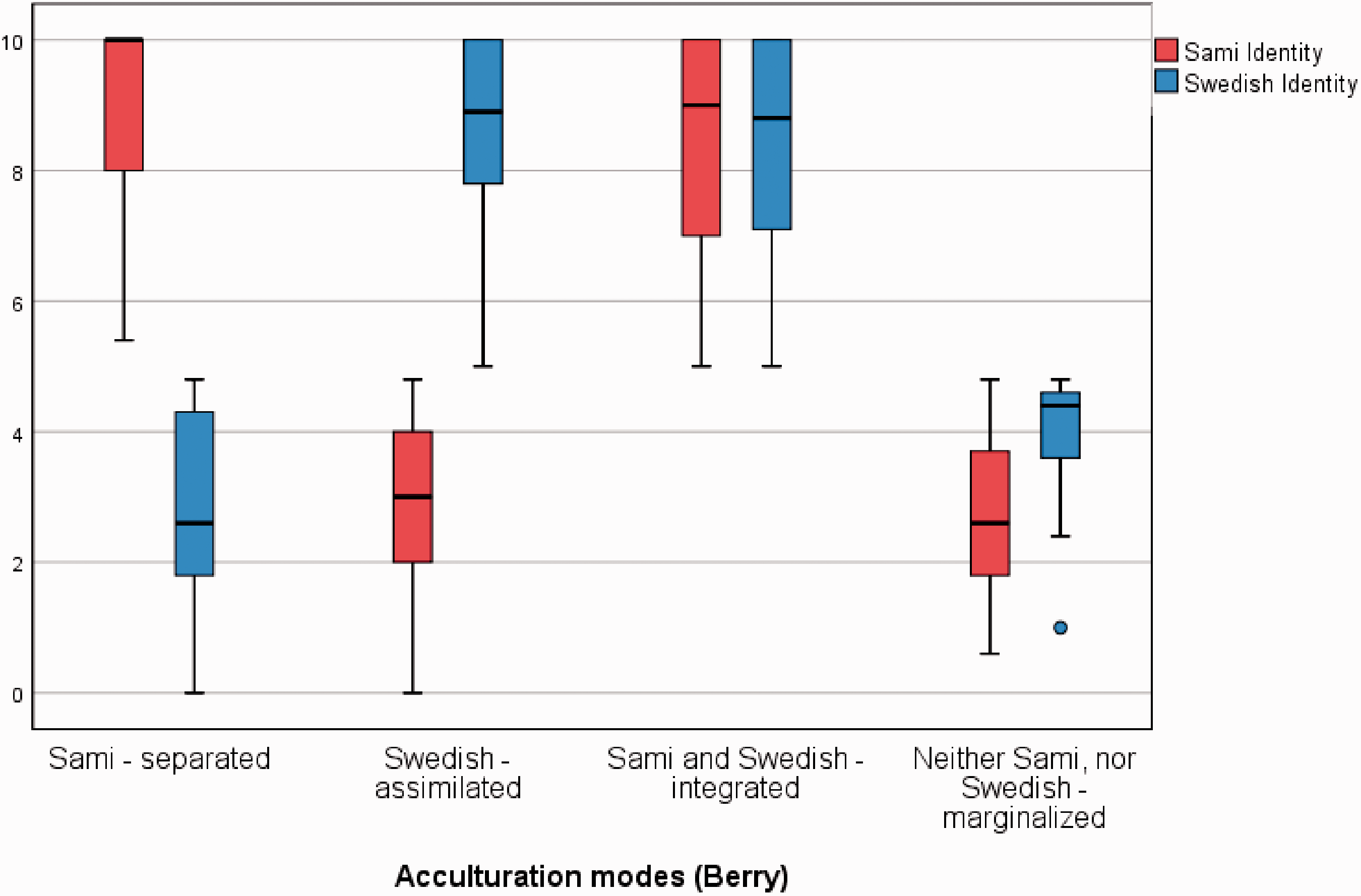
Boxplots on Sami and Swedish identities distributed on acculturation modes. The boxes include half the group with a black belt representing the median, and arms above and below representing the highest and the lowest quarters. The ring is an outlier.
These four groups can be further described as to gender, age, education, membership of SV, and region, as shown in Table 1.
Demography and background of participants, and description of acculturation groups (percentages within these groups).
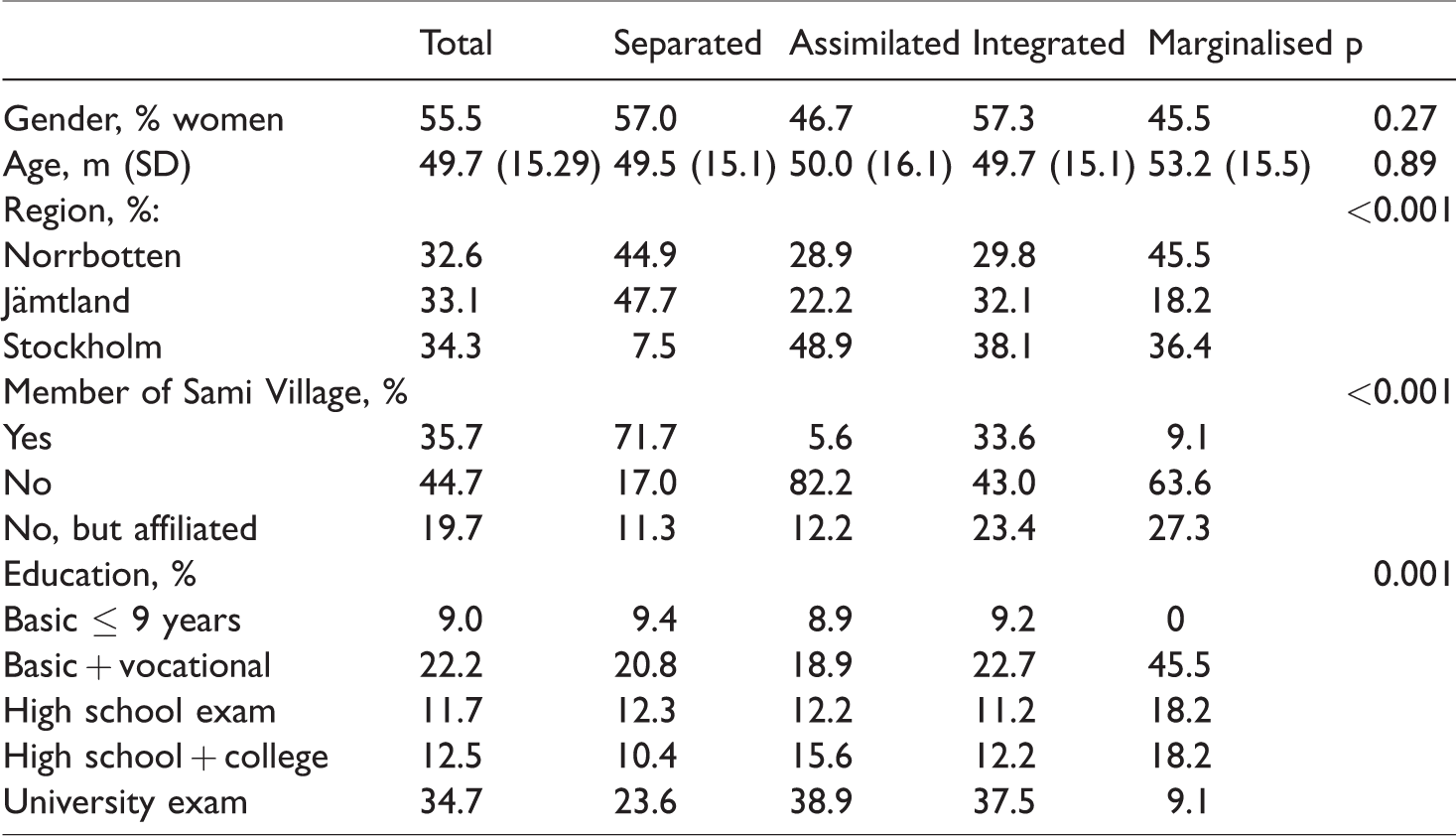
There are no significant gender or age differences between acculturation groups. The separated Samis are found more often in Sápmi, i.e. the Norrbotten and Jämtland regions, while the assimilated Samis are found more often in the Stockholm region. The separated Samis also more often belong to a Sami village, while the assimilated and marginalised do not. Assimilated and integrated Samis more often have a higher education.
Meeting objective criteria on being Sami
In addition to self-identification as a Sami, the person should meet one of the objective criteria. Being a reindeer herder was one of the objective criteria in the 1945 Census. How might that criterion apply to the present situation, and how would it apply if you extend the criterion to other Sami-related occupations, and if you also include having family members who are herders? Of all responders (n = 607), 13% report being reindeer herders, and another 6% report having previously been, but not now. If not herders themselves, 8% had family members that were, and if none of those, 4% currently or previously had other occupation related to the Sami culture. In all, 31% had an occupational life (or via family members) related to the Sami culture or reindeer herding.
Speaking Sami as the home language was another criterion in the census, and it is one of the possible criteria today for registration in the electoral roll. The law also accepts as criteria for registration if parents or grandparents spoke Sami as the home language. Speaking Sami as a home language can be interpreted as speaking it fluently. The items concerning Family language skills presents data on the person, the parents (but not grandparents) as well as the partner and children. Table 2 presents the data with ratings 0–10 collapsed into five categories.
Language skills of responder and his/her family members, percentages.
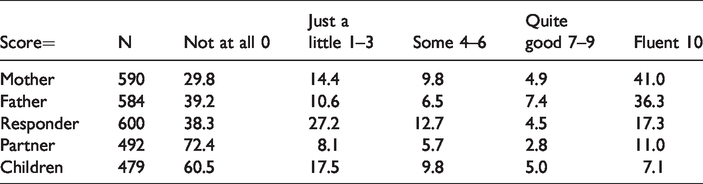
The table shows that only 17% of responders speak Sami fluently, and less than half report that their parents do. The partner less often speaks fluently, often not at all or very little, thus giving little opportunity to use it as the home language. In the next generation, only 7% speak it fluently. The frequencies of language use (speaking, writing, and reading) are shown in Table 3.
Frequency of practising Sami language, percentages.

About 26% practise speaking at least weekly, and another 18% at least yearly, while even fewer practise reading (8% at least weekly and another 17% yearly) and very few practise writing (4% at least weekly and another 10% yearly).
Having grandparents who spoke the Sami language as the home language was a criterion in the law but was not addressed in our questionnaire. However, we had questions on heritage, indicating that 76% had a maternal grandmother who were Sami, 73% a maternal grandfather, 68% a paternal grandmother and 67% a paternal grandfather, while 78% had a mother and 68% a father who were Sami.
Although there were some missing data, the table indicates that mothers more than fathers were Sami, and if so, their parents were almost always Sami. Intermarriages therefore seem to have occurred mostly in the parents’ generation and not in the grandparents’ generation.
Due to the proposal of the Finnish Sami Parliament concerning the cultural criterion, we present Table 4 that shows data on cultural symbolic behaviours and living in a Sami context.
Frequency of Sami cultural symbolic behaviours, and socialising with Samis, percentages.
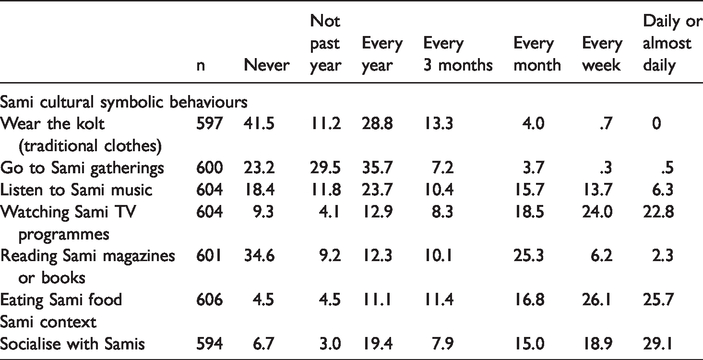
The most frequent expression of Sami culture was eating Sami food (52% at least weekly), watching Sami TV programmes (47% weekly), and listening to Sami music (20% weekly). Sami gatherings, e.g. the Sami Cup, Jockmock market, etc., occur more seldom but about half of the respondents took part in some of these events on at least a yearly basis. Wearing the kolt and reading Sami magazines or books were also less frequent.
Living in a Sami context includes socialising with other Samis, which 63% do at least monthly. Two other items are having Samis in one’s personal network and living nearby. The medians were 30% for the former (first quartile [Q1] = 10%; third quartile [Q3] = 60%) and 10% for the latter (Q1 = 1%; Q3 = 30%).
The above data were presented as items, not scales. When comparing acculturation modes, we turn to the index scales.
Samis’ characteristics, attitudes and situation in relation to acculturation modes
The scales on heritage and language, culture, and context as well as attitudes to threats, prospects, and conflicts (internal as well as external) are presented in Table 5. Comparisons between acculturation groups were tested for significance, using the Kruskall-Wallis H-test, since most scales were skewed.
Sami heritage, Sami language skills, Sami life indicators, and attitudes to threats, prospects and conflicts related to Samis among Samis, presented with means (standard deviations).
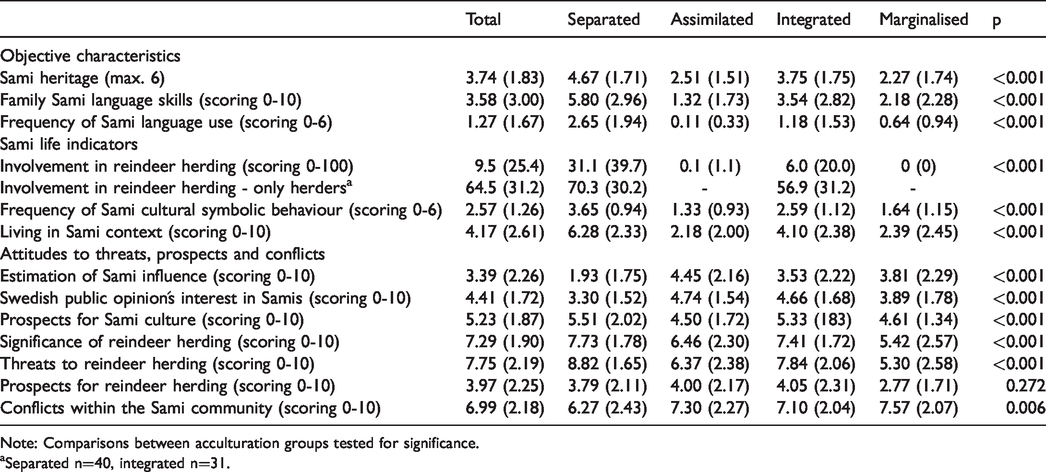
Note: Comparisons between acculturation groups tested for significance.
aSeparated n=40, integrated n=31.
The separated group had a stronger Sami heritage, with a mean of 4.7 of six ancestors being Sami, followed by 3.8 of integrated, while assimilated and marginalised had lower means. Sami language skills in the family and responders’ practice of Sami language followed the same pattern, although assimilated and marginalised sometimes shifted places at the bottom end. Reindeer herders were only found among separated and integrated, with a higher percentage for the separated. The pattern was repeated in Sami cultural symbolic behaviours and living in a Sami context.
Attitudes in general (2nd column) showed that most Samis judged Sami influence in society as rather low compared to the influence of other Swedes (3.4 on a scale from 0 to 10). Here the separated group were the most negative, while the assimilated were relatively more positive. The Swedish public opinion´s interest in Samis was also judged to be somewhat low (4.4), and here too, the separated Samis had the lowest estimate, followed by the marginalised, while assimilated and integrated were somewhat more positive. Still, the prospects for Sami culture were given a somewhat better estimate (5.2), and here separated and integrated took the lead.
Significance of reindeer herding had a high score in general (7.3), but so did threats to herding (7.8). The two groups most involved in herding, separated and integrated, took the lead according to the pattern we saw on involvement. But prospects for reindeer herding were less positively graded (below 4) and the picture was more blurred with no significant differences between groups.
Conflicts among Samis were generally recognised (mean almost 7 out of 10), although somewhat less among the separated.
Prediction of identities
Identities that form the acculturation modes were, as we have seen, related to many factors. But which factors are strongest as predictors of identities? To what extent is Sami identity predicted by the objective criteria, and do other factors add predictive power independently from these. The latter might be expected since identity is, as stated in the introduction, not an essentialist concept, but constructed when cultures meet, especially when threats and conflicts arise. Note that prediction should not be interpreted as causality, since all data are collected cross-sectionally. The predictive power of each factor is shown as the standardised β-coefficients in the model. Before multivariate analyses were conducted, the data were analysed for multicollinearity, but no indication of such was found (variation inflation factor [VIF] never approached critical values).
The model including all modes predicted more than half the variance of Sami identity (R2 = 0.52) (Table 6). When groups with different types of acculturation mode were analysed separately, the available cases decreased rapidly and the variation in Sami identity was cut in half. Still they also produced significant models.
Prediction of Sami identity (forward selection), for all responders (model 1) and separately for modes of acculturation. In all models, variables are reported in the order of inclusion.
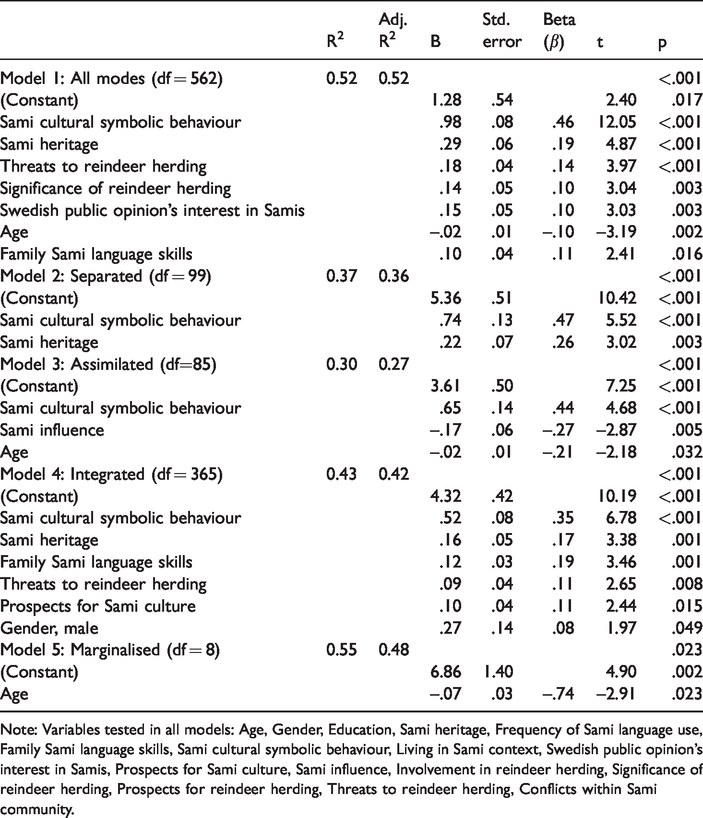
Note: Variables tested in all models: Age, Gender, Education, Sami heritage, Frequency of Sami language use, Family Sami language skills, Sami cultural symbolic behaviour, Living in Sami context, Swedish public opinion’s interest in Samis, Prospects for Sami culture, Sami influence, Involvement in reindeer herding, Significance of reindeer herding, Prospects for reindeer herding, Threats to reindeer herding, Conflicts within Sami community.
The first predictor to be included in the main model was Sami cultural symbolic behaviours. It had strong predictive power (β = .46) and was confirmed in separate analyses of the three larger modes. Note that this is not an explanatory model. Although cultural symbolic behaviours may enhance a feeling of belonging, they are also an expression of identity, and expression is a consequence rather than a cause. Sami heritage, i.e. how many of your ancestors are Sami, was the second strongest predictor with less than half the predictive power (β = .19) compared to cultural symbolic behaviours. This was found in both the separated and integrated modes. All other factors in the model had more modest strength (β = .10–.14). Linguistic skills in the family came last although confirmed for the integrated, while personal linguistic practice was not included in any model despite being a legal criterion for being registered as a Sami voter. The 1945 Census criterion of involvement in reindeer herding was also not selected. But two other herding-related factors were—threats to herding and the significance of herding. Threats to herding were also confirmed for the integrated mode. How responders estimated the Swedish public opinion’s interest in Samis was included in the main model but not confirmed in any mode model. Age was negatively related to Sami identity, i.e. Sami identity was stronger at a younger age.
Table 7 investigates in a similar way factors that predict Swedish identity among Samis, and for three modes of acculturation. For the marginalised mode, no model was produced.
Prediction of Swedish identity (forward selection) for all responders (model 1) and separately for three modes of acculturation.
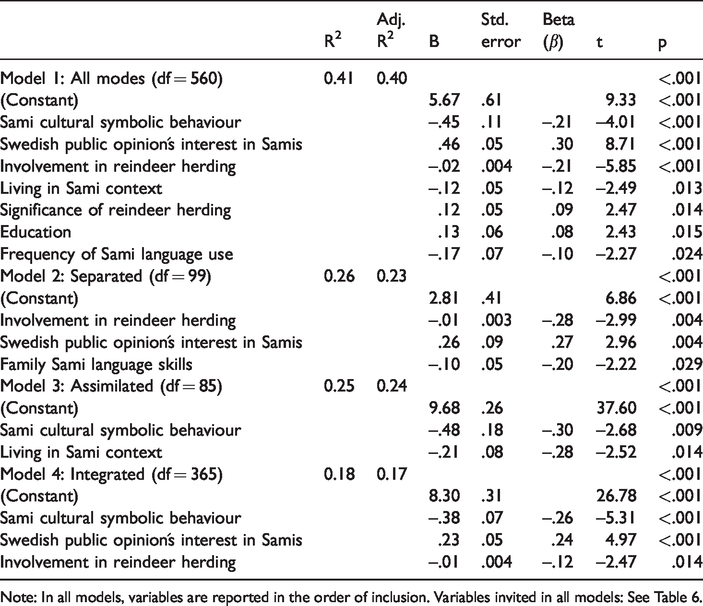
Note: In all models, variables are reported in the order of inclusion. Variables invited in all models: See Table 6.
The main model predicted about 40% of the variance in the Swedish identity among Samis, while the three mode models predicted about half that. Also for Swedish identity, cultural symbolic behaviour entered the main model, but now in the opposite direction. Engagement in symbolic cultural behaviours was negatively related to Swedish identity (β = −.21) and confirmed in models on integrated and assimilated Samis. Another factor negatively related to Swedish identity with the same predictive power was involvement in reindeer herding, confirmed for the separated and integrated. Two other factors also negatively related to Swedish identity were living in Sami context (β = −.12), confirmed in the assimilated model, and frequent use of Sami language (β = −.10) which was not confirmed in any mode model (although another linguistic factor—family skills—entered the model for the separated). The strongest factor positively related to Swedish identity was to have a positive estimate of the Swedish public opinion´s interest in Samis. It had the strongest predictive power (β = .30) of all and was confirmed in the models for separated and integrated. Other factors in the same positive direction were estimation of reindeer herding’s significance, and the responder’s own education, both however, with modest predictive power (.09 and .08), and not confirmed in any mode model.
Discussion
Obviously, most Samis in this study seem to have no problems in having double ethnic identities, i.e. feeling both Sami and Swedish. This integrated position is the most typical, since it is held by the great majority (64%) of Samis in our study. The two groups who tend to choose one of the identities—Sami or Swedish—represent one third when combined and being about equal in size (about 18% and 15%). Those who are marginalised who have weak ethnic identities of any kind represent less than 2%.
These percentages may not be representative for all Samis, since the randomisation concerned only three counties, two of which were in Sápmi, and with under-sampling from Norrbotten where many Samis live and where there are many reindeer herders. It should be noted, however, that the integrated mode is large also among reindeer herders (49%), and previous herders (62%). Only the assimilated and the marginalised are not found among herders. Another problem of representativeness is that the sample is taken from the year 2008, and in the nine years that followed, the number of registered voters increased by 31%. It is probable that many of those who registered most recently did so due to the tide of new ethnic awareness in Samis outside the SVs and outside Sápmi. This tide, with even larger growth in the parliamentary rolls, is also reported from Norway and Finland (Sami Parliament, Finland, 2020; Sami Parliament, Norway, 2020). The newly registered increase the numbers living outside Sápmi and should increase modes that acknowledge the ethnicities of the country’s majority, i.e. the integrated and assimilated. While the limitation of sampling to three counties may have overestimated the integrated, the time of the sampling may on the other hand have underestimated them compared to the present.
All respondents meet the mandatory self-identification criterion since they all registered as Samis in the electoral roll. But how do they meet the objective Sami criteria used in censuses and law? The 1945 Census had two such criteria: being involved in reindeer herding, and/or having Sami as the home language. Both these criteria are now met to a low degree. Only 13% of Samis are herders, and when previous herders and family members are included, they reach only 27%. The linguistic criterion of Sami as the home language is also met to a low degree, since less than 20% speak it daily and only 17% speak it fluently. Almost half (48%) never speak it, and 38% do not know it at all. Very few use it for reading and writing. The law also accepts parental and grandparental use of Sami as the home language as a criterion for registration. About 40% can lean on a parent's use of Sami, but for the coming generation, where only 7% speak it fluently, this possibility decreases. In 2000, the Sami language was declared as an official minority language receiving the support of the Swedish state. All Sami children have the right to be educated in a Sami language (Svonni, 2005). Of the estimated 1700 Sami children in compulsory school (aged 7–15) during 2006–2013, only 745 (mean) took such courses (Yan, 2014). Thus, most Sami children do not acquire skills in a Sami language despite the implementation of this policy. They may still regard themselves as Samis, due to their heritage, but heritage may to a lesser degree be possible to measure in terms of grandparents’ language. As intermarriages increase, reference to an ancestor’s registration may more often replace the language criterion in applications for new registrations.
What then predicts the Sami identity? Heritage, having most Sami parents or grandparents, is still a strong predictor, and may provide a sense of intergenerational belonging, while living in a Sami context, which previous research expected to be an important factor (Kvernmo and Heyerdahl, 2004), was significant only negatively for moderating Swedish identity, especially for those assimilated. Cultural symbolic behaviour is by far the strongest positive predictor of claiming a Sami identity. These behaviours are expressions of ethnic awareness and may also strengthen a sense of belonging and pride. At the same time, they seem to moderate Swedish identity among those for whom such an identity is relatively strong, i.e. the integrated and assimilated. Looking at specific such behaviours, we find that the most frequent behaviours can be carried out outside of Sápmi, such as eating Sami food, looking at Sami TV programmes (also in Swedish), and listening to Sami music. Other factors that may also add some sense of awareness and pride are positive opinions on prospects for the Sami culture and on the significance of reindeer herding and estimates of the Swedish public opinion’s interests in Samis. The latter factor is not only positively related to Sami identity, but more than that, it is also the strongest positive predictor of a Swedish identity. Possibly, an appreciation of such interest from parts of the Swedish community makes it more comfortable to identify as Swedish. Negative views such as high estimates of the level of threat to reindeer herding and low estimates of the extent of Sami influence moderate Swedish identity, possibly because such views trigger some sense of not belonging fully to the Swedish community. Demographics add some power to the prediction, since young age is associated with more Sami identity among assimilated and marginalised (young persons are perhaps more open to a cultural awakening), while more education is associated with more Swedish identity (perhaps due to careers).
Despite well-known internal conflicts of interest between Samis (herders vs non-herders, fell Samis vs forest Samis, those from the north who were forced to relocate with their herds vs those in the south who had to share grazing with them, etc.) some of which are expressed in different Sami parties in the Sami Parliament, and despite the internal hierarchy, described as Samis with strong ethnic self-confidence vs newly awakened Samis, these differences and conflicts within the Sami community were not found to be related to any ethnic identity, either Sami or Swedish. These within-Sami conflicts seem not to have been ethnicized, to use another concept from Brubaker. 1
As representativeness was discussed as a limitation above, we should also consider some strengths. The use of multidimensional scaling on ethnicities, using parallel items, made it possible to measure Sami and Swedish identities without labelling and to capture the varieties of the duality. This is directly inspired by Berry’s acculturation theory. Separating the ethnicity dimensions from proposed criteria, attitudes, and behaviours on Saminess made it possible to explore varieties in the individual importance of these categories for ethnic identification in regression analyses. This approach differs from Phinney (1990) who includes attitudes and behaviours associated with the group as indications of a more developed ethnic identity. Our approach is more in line with Brubaker (2004) who stresses the variety in ethnicities, and the possibility of different meanings for individuals and subgroups, not necessarily in a linear development. Behaviours and attitudes are important as predictors, but they operate in all acculturation modes, i.e. not specifically in those with the strongest Sami identity, thus not in a linear way.
Such a wider and more ‘fluid’ ethnic concept not only allows us to study varieties of Saminess in Samis in different circumstances and regions, as was done here, but also gives us the option to study variations over time. We can see from comparisons with the 1945 Census, that some ‘categories’ which were then used as accepted criteria for being Sami, would not be accepted today. Perhaps some of our operationalisations can also be used—if somebody chose to do that—for studying variations in Saminess over time and territories. The scales could, however, hardly have been constructed without the participation of Samis with direct knowledge of these divisions, and extending the studies in time and territory may need wider Sami participation.
Conclusions
The findings illustrate a growing sense of double ethnicity among Samis in Sweden—both Sami and Swedish. The Sami identity can no longer be defined by criteria limited to reindeer herding or speaking a Sami language. And even among the traditional core group—the reindeer herders—many identify themselves with two ethnicities. Intermarriages are more common and, when claiming heritage, the newly registered will need reference to an ancestor’s registration. Such a development will inevitably be more similar to that of the forest Sami in Finland, since in the absence of Sami language skills and a family link to reindeer husbandry, they will have to refer to the entry of their ancestors in registers, albeit the electoral register rather than land and population registers.
This more diverse Sami community can be experienced as a threat to traditional views, provoking demands for proof of having acquired a Sami culture and Sami traditions before registration is allowed, as tried by the Sami Parliament in Finland. It is, however, problematic to prove cultural competence in the absence of language skills, and perhaps living outside of Sápmi. And one may ask, for what purpose? Valkonen et al. (2017) argue that only a core group of Samis with personal strong connections to a live Sami culture can claim indigeneity. Although they refer to Brubaker, their position seems to be more in line with a linear identity concept since only those in a core cultural group are considered to have the more developed identity and, based on that, exclude others from indigeneity. From the point of view of the excluded, this could also be described as an example of ethnicizing a within-Sami conflict. This is quite contrary to the situation in Sweden, where both fell and forest Samis are accepted as Samis and represented by political parties in the Swedish SP. Therefore, proposals to question the indigeneity of descendants of forest Sami would hardly be possible in Sweden, and the SP definition of indigenous people on its website, cited earlier, is clearly inclusive. The situation seems to be similar in Norway with the coastal Samis. Norwegian SP members seem, instead, to argue for a more inclusive policy that welcomes the tide of Sami re-awakening. Such an approach may encourage newcomers to find their Sami identity, while the opposite position, i.e. sticking to narrower cultural and linguistic criteria, would—as shown in this article—lead to a sharp decrease in the number of Samis.
However, greater variation in Saminess entails a degree of conflict. As shown, there are many within-Sami conflicts of interest—not only the herding communities vs non-herders, but also between different herding communities. Our findings show that within-Sami conflicts are generally acknowledged. As shown here, however, they do not seem to constitute threats to the Sami community, as they do not predict a greater or lesser sense of belonging to Sami (or Swedish) identities.
One cannot help wondering why the policies differ that much between SPs in the Nordic countries despite other similarities. The variety in acculturation and the strong position of the integrated mode among Swedish Samis—also in the herding community—might be one factor. Could it also be that the party systems found in both the Norwegian and Swedish SPs help to channel the contradictions between different Sami interests into forms that contribute to an open exchange of views, negotiations and thus eventually to greater Sami tolerance for differences? As the forest Samis had lost previous rights to keep reindeer, they articulated their discomfort through various parties in the Sami Parliament. Other parties represent more the herding communities, for which the state's decision to deny them their hunting rights in the fell graze lands, has been an important issue. Although debates may sometimes be heated, all parties acknowledge that the divisions are result of their common colonial history and they may therefore include each other in their sense of ‘groupness’.
In Finland, there are no party elections to the SP. The absence of parties may strengthen the impact of kinship and clan rather than political debate. Kinship is an organizing factor in the herding life that is the basis of herders´ sense of ethnic belonging as is well described by Nykänen and Valkeapää (2019). As Brubaker (2004) points out, however, ethnic identification could bind groups together, even though their common ethnicity has very different meanings for their members. Resistance to the representation of forest Samis in the Finnish SP may instead ethnicize the conflict (Samis vs Lapps) and sharpen the division.
The Swedish Samis will also have to choose their responses to the present conflicts on hunting, a process that also depends on Swedish politics. For example: How will the Girjas SV administer its regained rights to decide on hunting and fishing in fell areas, and how will the Swedish political parties react to the decision of the Supreme Court? Are they prepared to change the law to make the Girjas case a new model? If so, how will both SVs and the state handle the interests of local non-SV-members (Sami and non-Sami)? These policies are central to the problems claimed necessary by the government investigator to solve before the ratification of the ILO convention (SOU 1999: 25).
Supplemental Material
sj-pdf-1-etn-10.1177_1468796820949284 - Supplemental material for Ethnic categorisation, identity and perceptions of life among Swedish Samis
Supplemental material, sj-pdf-1-etn-10.1177_1468796820949284 for Ethnic categorisation, identity and perceptions of life among Swedish Samis by Arne Gerdner in Ethnicities
Supplemental Material
sj-pdf-2-etn-10.1177_1468796820949284 - Supplemental material for Ethnic categorisation, identity and perceptions of life among Swedish Samis
Supplemental material, sj-pdf-2-etn-10.1177_1468796820949284 for Ethnic categorisation, identity and perceptions of life among Swedish Samis by Arne Gerdner in Ethnicities
Footnotes
Acknowledgements
The study benefited from grants from the Sami Parliament and from The Göran Gustafsson Foundation on Nature and Environment in Lapponia. The author thanks all participants for their cooperation. I am grateful to the person who took part in designing the study and excellently administered the Sami questionnaires but who wants to remain anonymous, and to the following for helping with the pilot study: Gaaltije Cultural Centre in Östersund, Ájtte Fell and Sami Museum in Jokkmokk, a Sámi organization in Norrbotten region, and individual Samis in Gällivare and Östersund. I am also grateful to the reviewers of a previous version of the manuscript for insisting on a more general discussion of the implications for the Nordic Sami debates, and to Professor Klas Borell for advice in the revision process.
Declaration of conflicting interests
The author(s) declared no potential conflicts of interest with respect to the research, authorship, and/or publication of this article.
Funding
The author(s) disclosed receipt of the following financial support for the research, authorship, and/or publication of this article: Financial support from The Sami Parliament (Dnr K 2007-250), and The Göran Gustafsson Foundation on Nature and Environment in Lapponia.

Note
References
Supplementary Material
Please find the following supplemental material available below.
For Open Access articles published under a Creative Commons License, all supplemental material carries the same license as the article it is associated with.
For non-Open Access articles published, all supplemental material carries a non-exclusive license, and permission requests for re-use of supplemental material or any part of supplemental material shall be sent directly to the copyright owner as specified in the copyright notice associated with the article.
