




Abstract
Fostering unity in diversity while ensuring spaces for disagreement is a key challenge for all liberal democracies with ethnic and religious diversity. Increasing polarization, not least due to the threat of terror attacks, exacerbates this challenge. Drawing on the case of Norway in the aftermath of the 2011 terror attacks motivated by ‘Eurabia’ sentiments, we find that both consensus and contestation are necessary to counter conflictual polarization. Consensus establishes a necessary common ground for interaction, while contestation permits diverging interpretations to emerge. Working with 21 semi-structured interviews with people in influential roles in Norway, we propose an analytical framework that draws on both political theory and empirically based analyses of interaction in diverse societies. We find that consensus-oriented approaches immediately following terror attacks can build unity and bridge divides across existing ethnic, religious, and political diversity. Over time, however, they may contribute to conflict, as they are perceived to conceal underlying disagreements. Perspectives founded on dualistic contestation can also cultivate conflict if opponents increasingly perceive each other as enemies in a hostile environment. A plurality of contestations, by contrast, can de-escalate conflict and thereby ease renewed cooperation. Thus, our findings point to the need for a perspective that transcends the dualism of “us” and “them”, and acknowledges the plurality of human beings in order to de-escalate the spiral of polarization.
Keywords
Introduction
The question of how to unite citizens across difference in increasingly diverse societies is recurring across Europe (see e.g. Cinalli and Giugni, 2013). In this article, we explore approaches to fostering unity in diversity, while upholding democratic principles. The question in the title, “Do we have to agree?”, highlights a key feature underlying efforts to foster unity in diversity. We use the case of Norway – a liberal democracy espousing public ideals of tolerance and equality, with respect for human rights and the rule of law as foundational principles. This is a country that has seen increasing levels of ethnic and religious diversity over the past century. On 22 July 2011, Norway experienced its most brutal acts of violence since Second World War. Having killed 77 people, the perpetrator claimed that he had wanted to protect Norway and Western Europe against increasing ethnic and religious diversity and political accommodation of Islam. In the aftermath of these attacks, questions of accommodating difference while fostering unity in diversity have been particularly pressing. Given that such questions are common in societies struck by terror (see e.g. Lynch, 2013), the ensuing discussion and analysis have relevance beyond this case.
Our point of departure is that in order to live together across ethnic, religious, and political differences, it is necessary to foster unity in diversity by accommodating disagreement. In such a “community of disagreement” (Iversen, 2012, 2014), there is scope to disagree within a frame about which, conversely, there is agreement. Unity in diversity, then, entails an acceptance of unity without uniformity, and diversity without fragmentation. The idea builds on an understanding that stretches beyond mere tolerance of difference. It is an acknowledgment that, as humans, we share some key dimensions of life. Agreements about the rule of law, alongside channels for expressing disagreement, are two such dimensions.
These are issues that face governments in liberal democracies when they try to manage diversity and foster social cohesion – whether under the guise of multiculturalism or other approaches to societal diversity and pluralism (Kraus, 2012; Malik, 2014; Meer and Modood, 2014). While the term “unity in diversity” may be criticized as celebratory, glossing over inequalities and differences, as a concept it deserves attention. So far in academic debates, it has received the most attention in literature on citizenship education. One area of research in this field has been to work through the ways in which unity and diversity are mutually constitutive, and explore how to apply this notion to teaching in schools characterized by ethnic and religious diversity (Banks, 2007; Parker, 2003). Meanwhile academic debates on diversity often refer to unity as a significant societal aim, without positioning it in a specific relationship to diversity (see e.g. Bygnes, 2013; Fox and Jones, 2013).
Our understanding of unity addresses “the willingness [and capacity] of members of a society to cooperate with each other in order to survive and prosper” (Stanley, 2003: 5). Following Hannah Arendt’s concept of plurality as an existential human condition (Lysaker, 2014), our aim is not to find a way “to unite diverse individuals in a common will” (Canovan, 1983: 300). Rather our quest is to explore how an acceptance which “provide[s] a way of holding people together while leaving them space in which to differ” (Canovan, 1983: 300) might be achievable in liberal, democratic societies. In practice, then, unity in diversity involves accepting both agreement and disagreement; it leads to approaches that welcome consensus, while embracing contestations in ways that do not entertain far-reaching, negative stereotypes that develop into enemy images (Petersson, 2009).
The 21 people we interviewed for this article all had influential roles in Norway and were able to provide top-down perspectives on collective identities and interaction in public debate. Their perspectives were simultaneously grounded in their own personal lived experiences in a diverse society. Concentrating on the interplay of consensus and contestations, the analysis of this data allows us to explore some of the possibilities and limitations of unity in a diverse society from both an empirical and theoretical vantage point.
Following our point of departure that in a diverse society, the state aims to accommodate unity in diversity, highlighting both the need for dialogue and for democratic spaces of disagreement,1 we ask: in a liberal democracy characterized by ethnic and religious diversity, under which conditions do consensus-oriented approaches and contestation-facilitating approaches build unity, and under which conditions do they contribute to conflict?
In what follows, we describe the post-terror case of Norway, before we turn to our analytical framework. After a presentation of the empirical data and methodological approach, we apply this framework to an analysis and discussion of the conditions for consensus and contestations. In the conclusion, we point to some implications for academic theorization and the everyday practice of unity in diversity.
The case of Norway
In Norway there is a widely held and influential narrative of ethnic and religious homogeneity, based on the idea of a uniformity that held sway until immigration flows2 from the 1960s onward led to increased ethnic and religious diversity (Gullestad, 2002: 59). This narrative is popular despite the existence of various national minorities, including the indigenous Sami population, and a history of seeking to control religious diversity – an acknowledgement that such diversity existed prior to these more recent immigration flows (Gullestad, 2002).
It was this diversity and the political management thereof that the now convicted perpetrator targeted on 22 July 2011, when he parked a car containing a bomb by the main government buildings in the centre of Oslo. A few hours later, he targeted the annual youth camp of the social democratic Norwegian Labour Party on the island of Utøya just outside of Oslo, where teenagers and young adults had gathered for political debate and social interaction. The perpetrator claims that his aim was to stop both future immigration and recruitment to political movements that he sees as responsible for increasing immigration since the late 1960s. In public debates in Norway, these joint attacks are most commonly described as “acts of terror,” which is the label we apply in this article.
Overall, the immediate societal response to the attacks was one of unity, manifested in public utterings and peaceful marches throughout Norway. However, the idea of a unified response to the ideological underpinnings of the acts of terror gradually dissipated. There were those who clearly continued to support anti-immigration and anti-Islam positions (Figenschou and Beyer, 2014: 15), often inspired by “Eurabia” theories. At the same time, the labelling of positions as far-right, conspiratorial, or “Eurabia”-inspired (Bangstad, 2013) became highly politicized.
One major point of discussion in the aftermath of the attacks has been about how to handle severe differences of opinion regarding immigration and diversity in public debates (Eide, 2012; Eide et al., 2013). This discussion has partly revolved around the role of political rhetoric. In Norway it is the Progress Party that has been the most known for its anti-immigration rhetoric (Wiggen, 2012) and agenda-setting role in immigration debates (Jupskås, 2013). Shortly after 22 July, it became known that the perpetrator had been an active member of the Progress Party during 2002 and 2003 (Seierstad, 2015). The party responded by distancing itself from the perpetrator’s extremist views (Figenschou and Beyer, 2014: 17). However, controversial utterings from some Progress Party politicians stirred public debate in the months that followed the attacks (see e.g. Dagbladet, 20 March 2012).3 The issue was raised again following parliamentary elections in 2013, when international media outlets reported that a political party with similar views as the 22 July perpetrator had entered a coalition government in Norway (Fangen and Vaage, 2014: 31). The international attention sparked debate and several high-ranking politicians from various political parties publicly distanced the Progress Party from the perpetrator’s views (Fangen and Vaage, 2014: 31–32).
The description of the Norwegian case indicates some of the understandings and contestations present in public debate, not unlike debates about immigration in other European liberal democracies (see e.g. Bertossi, 2012; Leddy-Owen, 2014). Before looking into some points of consensus and contestation in Norway based on our empirical data, we turn to the analytical framework for this article.
Analytical framework
In this article, we draw on selected theories about public interaction in liberal, democratic societies, in combination with empirically based theories on living together in diversity. In Jürgen Habermas’ (1995) theory of deliberative democracy, citizens reach agreement on the best collective results through open, rational, and argumentative public deliberation. Here there is an understanding among citizens that they need to respect one another as free and equal members of a shared political community (Habermas, 2006: 5). This understanding entails a civic solidarity that presupposes “consensus on constitutional principles,” where citizens have the duty to both explain their own views and reasoning to others, and to listen to others’ views and reasoning (Habermas, 2006: 13). Thus, this civic solidarity constitutes a uniting bond, which means every controversy can reach a solution (Pellizzoni, 2001: 60) through public deliberation. Such deliberation forms a system of rights that endures over time and through that protects citizens’ individual rights (Habermas, 1995). Individual citizens contributing to, and being protected by, the collective system of rights ensures that the principle of equality applies to all. With this line of argument, Habermas counters theorists who argue for a politics of recognition that adjusts to the differences between groups of people, most notably Charles Taylor (1994) in his seminal work on multiculturalism.
Various scholars have criticized Habermas for placing too much stress on consensus (for an overview, see Martin, 2005). Notable among them is John Rawls (1997), who proposes the idea of “overlapping consensus.” This idea is intended as a way to bridge the need indicated by Habermas to agree on the same norms for identical reasons, versus (in Rawls’ view) the need to agree on the same norms, but for different underlying reasons. Rawls, for his part, has been criticized for not being open enough to diversity, and not being sufficiently attentive to the inherent pluralism of humanity (Parekh, 2000).
Chantal Mouffe criticizes both Habermas and Rawls for failing to acknowledge that a consensus without exclusion is impossible. Mouffe (1999: 756) asserts that “pluralist democracy demands a certain amount of consensus”: it requires allegiance to the values that constitute its principles, while maintaining that there will always be conflicting interpretations of these principles. Mouffe’s agonistic democracy model is based on an understanding that politics aims at creating unity in diversity. While this involves “the creation of an ‘us’ by the determination of a ‘them’” (1999: 755) to Mouffe (2005: 20), it is essential that the two parties recognize themselves as belonging to the same political association, within which they recognize each other as legitimate opponents. The alternative to seeing each other as legitimate opponents is a us–them relation where the two sides see each other as enemies who do not share any common ground and who are out to destroy each other. Mouffe goes on to argue that an enemy-based conflict situation, which in its most developed form assumes a violent character, is “less likely to emerge as long as agonistic legitimate political channels for dissenting voices exist” (Mouffe, 2005: 21).
Meanwhile, theories about collective identities and ethnic and religious diversity assert that constructing and maintaining boundaries between “us” and “them” is an inherent aspect of social life (Barth, 1969; Winter, 2007), and need not lead to polarization and enemy images (Eriksen, 1995). However, in contemporary academic and public debates, us–them relations most commonly distinguish between “ethnic majorities” and “ethnic minorities” – a notion that buys into taken-for-granted “methodological nationalism” (Wimmer and Glick-Schiller, 2003). As a consequence, these debates often neglect other dividing lines of us and others, and focus on visible Others rather than on, for example, social and economic inequalities that also affect the white working-class (Skey, 2013).
Nira Yuval-Davis (2010: 277) argues that one way to evade enemy-like polarization is to move beyond a dualistic us–them distinction, where exclusion and negation, “often accompanied by the demonization of the Other,” tend to dominate. A pluralistic us–and the many others, by contrast, highlights the many distinctions people make between themselves and various others in their everyday lives. This latter notion thus serves as a reminder not to reduce “all others to the Other,” but rather to acknowledge both the multiplicity and the relationality of collective identities. Distinguishing between the dualistic us–them and the pluralistic us–and the many others, Yuval-Davis takes into account existing contestations, while indicating that a pluralistic perspective on the everyday lives of people may help in moving beyond the demonization of the Other.
Similarly, Ash Amin (2012: 7–11) emphasizes the plurality of lived experience, which renders “collective life a constant negotiation of difference.” The state’s provisions and institutions play a role in “gathering diversity into a functioning commons.” Starting from on-the-ground realities in the UK, Amin underlines that accepting difference, while rejecting indifference, is necessary to bring about well-functioning interaction between people in a democratic society with ethnic and religious diversity. He challenges the sedentary ways in which social ties are often conceptualised, (inadvertently) posing mobility and hybridity as a problem. Amin (2012: 11) therefore “defend[s] a politics of difference formed around the impersonal, the openly disrupted and the public,” where respectful distance and principled disagreement are seen as inherent to the negotiation of difference in a society of strangers.
Yuval-Davis and Amin address some of the same questions as Habermas’ and Mouffe’s political theories. While using somewhat different terminology, they all seek the conditions that allow for both necessary agreement and contestation with the aim of achieving well-functioning interaction in ethnically and religiously diverse, liberal democracies. Taking this scholarly work into account, we see two main axes of differentiation when it comes to accommodating matters of agreement and disagreement in these societies. One axis stretches along a continuum between the ideal types of consensus-oriented and contestation-facilitating approaches. The other axis stretches from a dualistic and binary perspective composed of us and them to a pluralistic perspective composed of many us and Others. Who falls within and outside us and them is not fixed in advance, but depends on the particular issue at hand. Figure 1 illustrates this analytical framework.
Analytical framework.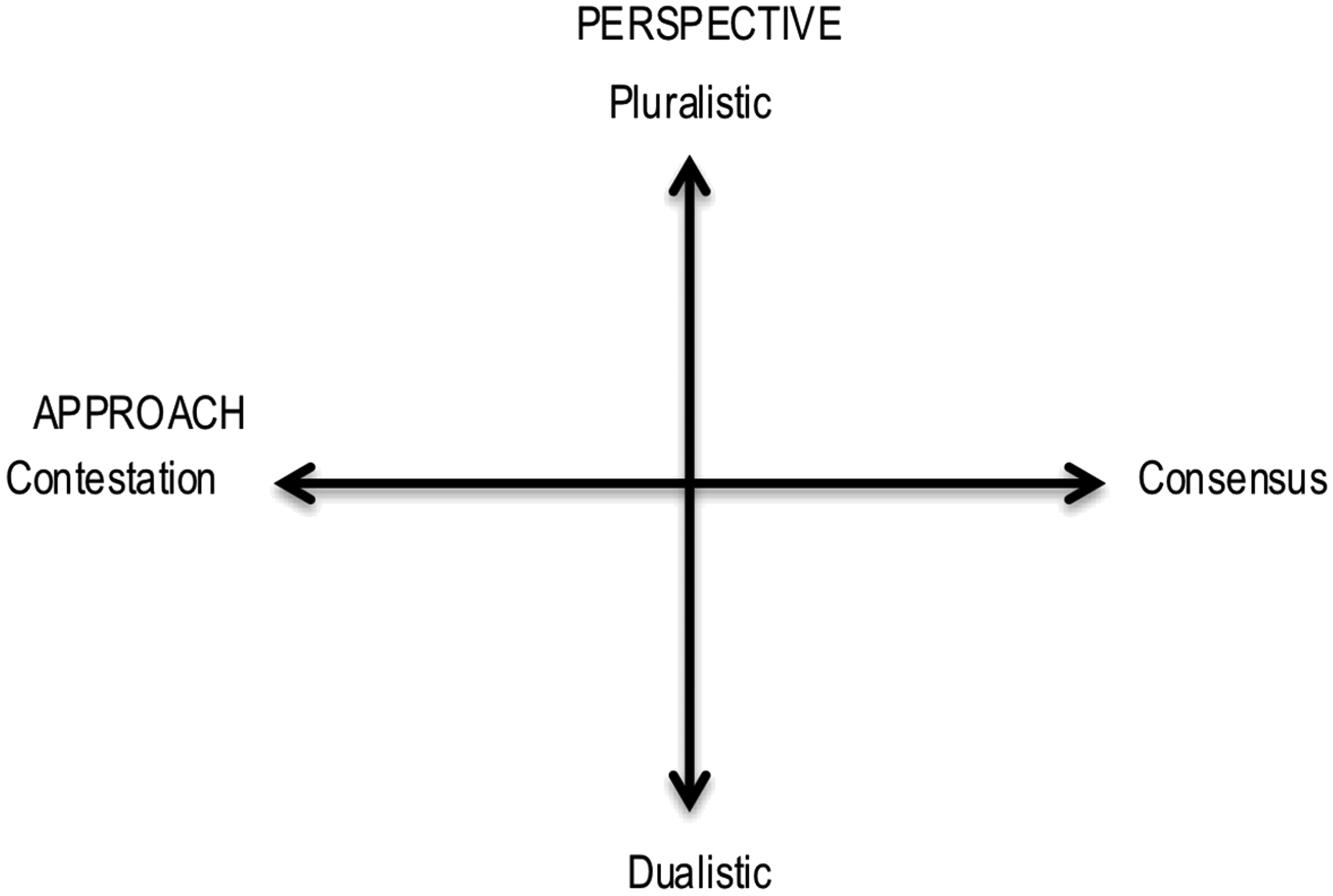
This analytical framework builds on the premise that if the aim is a politics marked by democratic interaction among equal citizens, a situation where citizens see each other as enemies entails a danger. This danger lies in the effect they can have on the development of dualistic perspectives on collective identities, and through this, on the functioning of democracy itself. Rather, recognizing difference beyond dualistic perspectives and enemy images entails the possibility of a “politics of care” among strangers (Amin, 2012). This recognition builds on a notion of collective identities as transversal, crossing borders and boundaries of membership. It underlines that various positionings entail different points of views (Yuval-Davis, 2010: 277–278). While grounded in the premise of equality (Habermas, 2006), transversal politics operates with an appreciation that differences are important but, at the same time, “should be contained by, rather than replace, notions of equality” (Yuval-Davis, 2010: 278). Thus, approaches to difference are central to the ways in which contestation- and consensus approaches can or cannot function within a liberal, democratic society. We return to this analytical framework below, after a discussion of our data and methodology.
Data and methodological approach
The 21 individuals we have interviewed for this article include politicians, senior civil servants, civil society representatives, and well-known voices in public debate. They have, in one way or another, dealt with the 22 July attacks through their jobs and/or personal engagement. While there is no single definition of the term “elite” (Harvey, 2011: 432–433), we characterize the interviewees as elites because they possess a certain level of power through, for example their participation in public debate.
Most of those we contacted agreed to an interview. Access was thus not a problem; in contrast to what is often the case with elite interviews (see e.g. Mikecz, 2012). At least two factors can explain this accessibility. First, Norway is a small country aiming for egalitarianism and proximity between elites and the masses, generally characterized by a high level of trust (Borgonovi, 2012: 148). Hence, people expect that parliamentary politicians and others in important public roles will contribute to societal debates. Second, a research interview about the implications of 22 July provides an opportunity to voice one’s views on a topic of high societal interest.
We based the selection of interviewees on, inter alia, an analysis of op-eds about 22 July printed in selected national newspapers (Ezzati, 2014). Our objective was to understand the experiences and reflections of individuals who operate within democratic boundaries, and we decided not to pursue interviews with individuals who in mainstream communication channels have endorsed violence as a means to achieve their goals.
Beyond the above point, our aim was to include a diversity of perspectives, one that acknowledges the plurality of political agents’ subject positions (Mouffe, 1992: 28). Such subject positions mean that the interviewees’ responses may be coloured by experiences based on their ethnicity, (non-)religious beliefs, gender, age, political views, and public roles. While most of the interviewees were born in Norway, a few were born elsewhere, in and outside of Europe. They identify themselves as Christian, Muslim, or Jewish, including converts to these religions, or as non-religious. And they identify with a broad spectrum of political views. Consequently, the empirical data amply the cross-cutting lines of collective identities: Someone who is part of what is seen as “the majority” (essentially, white skin colour and born in Norway with ancestors who are born in Norway) can also be part of a religious minority (for example a convert to Islam or Judaism). That very same person may belong to a political majority, or minority, depending on the political climate, which changes over time. These examples illustrate that one subject position does not necessarily exclude the other.
In line with the above, researchers have multiple subject positions as much as any political agent, and can to a certain extent control how they affect the interview situation through two-way communication (Carling et al., 2014). This communication includes acknowledging that it is the interviewee’s expertise on the particular topic the researcher wants to learn from, while establishing her own authority through, for example in-depth knowledge about the topic at hand.
Like any other sample, ours has its limitations. Firstly, out of the 21 interviewees, only six are women. Despite consciously aspiring for gender diversity, we identified many more men than women as potential interviewees even at the early mapping stage. To a certain extent, however, the data reflects the reality of public debate, given that fewer women are conspicuous in leading roles (Hirsch, 2010) and in public debate (Eide and Orgeret, 2015), and that most are white. Secondly, temporally situated data affect the interviewees, and through that, the content that any analysis is based on (Erdal and Ezzati, 2015). We conducted the interviews from November 2014 to April 2015, and those conducted after January typically include references to the Charlie Hebdo attacks in France. Furthermore, approaching the 22 July attacks three–four years after they occurred, our data are inevitably retrospective. However, although interviewees’ recollections and reporting may become more inaccurate with the passage of time (Jürges, 2007), people are more likely to remember unique and significant events better (Smith and Thomas, 2003: 24). Furthermore, we were not interested in the details of “what happened when.” Rather we sought the interviewees’ reflections on, and individual experiences of, the topic at the time of the interview. Thirdly, working with data from elites has its restrictions. For example, elites who participate in public debate may experience these debates differently to non-elites who do not participate. However, based on other data sets we are working on (e.g. Erdal and Strømsø, 2016), and other research conducted in Norway (Iversen, 2014), the question “Do we have to agree?” has relevance beyond this particular sample, reaching into the realms of everyday experiences. Interactions in public institutions, such as schools, are one example.
Many of the interviewees are well known in public debate, and our analysis is based mainly on their reflections in the interviews with us. We do not analyse other publicly available utterings in this article, unless they came up as a topic in the interviews. Due to their public roles, we offered all interviewees the choice between our best efforts to anonymise them or to refer to them by name and affiliation. In all but three cases, the interviewees chose the latter option and provided us with their written consent, in some cases with a request for quote checks.
Regarding the analysis, we first approached the data inductively. We then searched for theories that could help us analyse differences of opinion about unity in diversity, especially pertaining to ethnic and religious diversity. In the stages that followed, we went back and forth between the empirical data and the analytical framework, resulting in the analysis below.
From consensus to contestations
Although the immediate united response to the 22 July attacks was largely portrayed and perceived as uniquely Norwegian at the time (Wollebæk et al., 2012), such short-term tendencies are common following terror attacks (see e.g. Putnam, 2002). The long-term effects, however, vary over time (see e.g. Kolås, 2017). These tendencies are indicative of the inherent fluidity of time, whereby people experience and perceive temporal dimensions differently (Erdal and Ezzati, 2015). The fluidity of time emerges clearly in the empirical data: some of the interviewees mainly emphasized 22 July as the starting point for their reflections. Others placed the events on a longer historical timeline, for example on a temporal sequence following the 11 September 2001 attacks in New York or the Muhammad cartoon controversies starting in 2005. No matter the timeline they operated with, all interviewees pointed to positive effects of the immediate united response to the 22 July attacks, both top-down in national authority figures’ speeches (e.g. by Prime Minister Jens Stoltenberg, see Rafoss, 2015) and bottom-up through, for example, the so-called “rose marches” where several hundred thousand people participated throughout Norway to commemorate the victims (Botvar, 2013).
In retrospect a recurring question has been whether the authorities’ emphasis on unity would have been as strong, had the perpetrator been an Islamist terrorist. This issue was also brought up by some of the informants. However, Sindre Fossum Beyer, political advisor to the Prime Minister at the time, explained that this was their initial chosen strategy before they knew who was responsible for the attacks. Drawing on responses to terrorism elsewhere, the Prime Minister and his closest associates wished to emphasize unity rather than contribute to division in society. And indeed, top-down and bottom-up, a united response was largely portrayed and perceived to prevent the perpetrator from achieving what he had set out to do: to weaken Norwegian unity, democracy, and freedom (Ezzati, 2014). The immediate societal responses to the attacks on a national level can thus be characterized as consensus-oriented. Various societal actors contributed to this consensus. Interviews with debate editors, for example, reveal that Norwegian media actively postponed raising critical debate about security breaches and the police follow-up after the attacks (Figenschou and Thorbjørnsrud, 2016; Thorbjørnsrud and Figenschou, 2016). Meanwhile, although a united consensus may have been important as a national response, studies have shown that it was not as all-encompassing as it seemed at the time. Participation in the commemoration gatherings, for instance, varied along the lines of political preference (Botvar, 2013).
Nina Hjerpset-Østlie underlined the importance of the commemorations as a way of marking that there is a frame of national community around such a crisis, despite existing political divides and disagreements. On 22 July 2011, she worked for document.no, an online discussion forum that in Norwegian public debate usually is described as anti-immigration and right-wing. She explained: I think it was a great reaction, unity is good; although I must admit that I did not feel part of it because all of a sudden we felt that we were somewhat singled out as responsible for something we could not have done anything about.
Just as the interviewees agreed on the importance of the initial united response, they also welcomed the ensuing development where critical questions and debate could be raised. Some of these contestations were directly connected to 22 July, and included criticism of the authorities’ inability to prevent the attacks or their scope and scale4 (see Eriksen, 2014 for a discussion of narratives about the causes and possible consequences of the attacks). Other contestations re-emerged in light of the attacks. These included politicians and public authority figures’ responsibility for hardened rhetoric that contributes to enemy images, discrimination, and harassment of individuals and groups (see e.g. Bangstad, 2014).
For interviewees critical of immigration, the post 22 July political climate required some adjustments. On the one hand, the attacks raised further awareness about rhetoric in immigration debates. Kristian Norheim, a parliamentary politician for the Progress Party at the time of the interview, is a case in point. He explained that he became even more aware of the words he used “in already difficult debates about immigration,” as the mere thought of being associated with the perpetrator made him sick. On the other hand, some of the interviewees found it difficult to bring forward their perspectives on the challenges of immigration. For example, Ove Vanebo, leader of the Progress Party’s Youth organisation at the time of the attacks, experienced that for a while “it was only okay to speak about the positive” aspects of immigration. He found this to be “an apolitical period,” where the political differences between the parties were toned down. He was relieved that, with time, the debate opened up again, allowing more critical views on immigration to be discussed. He also pointed to the temporal dimension in public debate, indicating that the climate of debate had shifted somewhat after the attacks in Denmark and France in early 2015.5 He found that the debate in Norway had become more nuanced after these attacks.
These developments indicate that there is a time for orientation towards consensus, and a time for facilitating contestations. And that one approach may have an effect on the other. A majority of the interviewees agreed that most politicians did not attempt to exploit the attacks for their own political gain, which they saw as a positive outcome. Some did, however, question the long-term consequences of the initial united response. One example is Henrik Asheim, the leader of the Norwegian Young Conservatives at the time of the attacks, and a parliamentary politician for the Conservative Party at the time of the interview. He reflected on the consequences of the initial united response in the context of what he sees as a relatively small and close-knit political community in Norway. His impression was that the Labour Party, which had been the primary physical target of the attacks, did not wish to “take the grief away from the nation.” At the same time, he and his politician colleagues were conscious about not appearing to attempt to “take the grief away from the Labour Party.” Thinking back, he questioned whether this immediate solidarity had contributed to an atmosphere in which certain topics, such as whether the perpetrator’s motivations were linked to more widespread ideological currents in society, were difficult to debate publicly.
These reflections illustrate some of the difficulties in navigating the political landscape following terror attacks. They suggest that a prolonged atmosphere of (seeming) consensus can result in increased polarization, and underline the importance of a space for contestations in a long-term perspective. While such tendencies are nothing new in immigration debates in Norway, the 22 July case highlights the need for both consensus and contestations, and shows how the weight of one over the other is context dependent. It also points to the importance of a plurality of contestations, which we turn to below.
A plurality of us and others
The way we see ourselves – and others – is important to the development of collective identities (Yuval-Davis, 2010). In Norway, where 16% of the five million inhabitants are immigrants or children of immigrants (Population Statistics, 2016), questions of ethnic and religious diversity are salient in understandings of collective identities. Several interviewees pointed to the role rhetoric plays in the development of collective identities. Jonas Gahr Støre, the leader of the Labour Party at the time of the interview, pointed to the importance that politicians speak about what a collective “we” means, what it used to be, and how it has developed. Perhaps more than any other politician in Norway, Gahr Støre is known for his emphasis on an inclusive unity that cuts across ethnic and religious diversity, having coined the term “a larger Norwegian we” (Aftenposten, 29 April 2007) during his time as Minister of Foreign Affairs. While the effect of rhetoric such as this may be debated, several interviewees referred to it as important in creating a sense of belonging among immigrants and people of immigrant descent. Among those was the former leader of the Norwegian Centre against Racism, Kari Helene Partapuoli. Through her work with minority youth, she had seen the effect this type of rhetoric can have in reinforcing a sense of belonging to Norway.
The attacks motivated by anti-immigration, and particularly anti-Muslim, sentiments, further highlighted questions about who “we” as a collective are, and who “we” want to be. As the former Mayor of Oslo for the Conservative Party, Fabian Stang, put it: ‘in this state of crisis, we showed the sense of unity that, after all, lies in us’. Similarly, Jonas Gahr Støre, who was Minister of Foreign Affairs at the time of the attacks, recalled “the many great and forceful ‘we’ reactions” that manifested unity, including various commemorations and interreligious gatherings. He said: “This was such an extreme occurrence that we could say: ‘we disagree on many points, but we are against this.’” Although in the prolonged aftermath of the attacks, he would have liked to see more debate about the ideological currents the perpetrator was part of,6 he was “happy to live in a country where what we have in common trumped our differences” when faced with terror attacks. In these understandings, manifestations of a common “we” as a response to the attacks highlighted existing unity in diversity (Yuval-Davis, 2010).
The question of “who we are” also concerns “who we are not.” Some interviewees mainly saw the perpetrator as an insane individual and were reluctant for society to give him prolonged attention. Other interviewees thought that being who he was – one of us, and yet an Other – made it easier for society to carry on without truly taking issue with the ideological underpinnings of his actions. Anne Sender, Secretariat Leader of the Council for Religious and Life Stance Communities at the time of interview, and a convert to Judaism, thought that the perpetrator quickly “became a lunatic, a mentally ill child with a terrible family history.” Sender found that this focus came at the cost of more debate about the larger environment within which he grew up and later developed his ideas. For example, she found a lack of self-reflection from the majority Christian church as an actor in public debate in response to the attacks.
One of the main questions during the trial was indeed to establish whether the perpetrator was criminally accountable for his actions at the time of the crime. Consequently, his sanity became a heavily debated theme. Seeing the perpetrator as an insane individual or as part of broader currents in society has quite different implications. In the former case, he is an Other different than “us” due to an illness, and thus we can distance ourselves from him both figuratively and physically, through imprisonment. In the latter case, he is an Other who can be linked to yet more others, ranging from those who agree with his actions to those who agree with some of his arguments, but not with his actions. In this sense, the perpetrator challenged ideas of the individual and the collective.
Shoaib Sultan, Advisor on Extremism at the Norwegian Centre against Racism at the time of the interview, explained: When Muslims do something horrible in other countries, we think it’s because it’s part of their culture. But we know Norwegian culture, and knowing that Norwegian culture is not like that, we know that Breivik [the perpetrator] does not represent Norway in any way.
Meanwhile, several of the interviewees pointed out that the perpetrator’s anti-immigration ideology and his ethnic and religious background was a stark reminder that not all terrorists are Muslims. In consequence they had become even more conscious about not grouping people based on something one person has done. Arguably, then, the attacks underlined the marked heterogeneity within groups often portrayed as homogeneous, and exemplified the plurality of Others that cuts across ethnic, religious, and political lines. Such cross-cutting lines illustrate how a person who is part of the ethnic majority in a society may hold opinions that put her in the political minority. And someone who is part of a religious minority may identify with the political ideas shared by, for instance, non-religious, atheist segments of the population. These are example of the relational and situational nature of identities and how they differ from one set of circumstances to another, with constantly shifting and contested boundaries (Yuval-Davis, 2010: 275).
The relational and situational nature of collective identities means that images of “us” and “others” reflect and affect each other. At the time of the interview, Yousef Assidiq was organizing and participating in dialogue meetings with both Islamist and right-wing extremists through a think tank on minority issues (Minotenk). When he first converted to Islam in 2009, he experienced that family, friends, and others around him turned their backs. For a while, he felt he was the very symbol of the enemy images of a West that sees itself at war with Islam, and that Muslims would never be accepted in Norway. Six years on, and having received threats from both Islamist and right-wing extremists, he pointed to how both reflect and reinforce each other’s enemy images: “Islamist extremists confirm that Muslims are dangerous and right-wing extremists confirm that Muslims are worth less than others.” This is an illustrative example of how perceptions of the content of collective identities which one does or does not identify with, affect both public debate and the individuals who participate in such debate.
The above points illustrate that an acknowledgement of the cross-cutting lines of collective identities reflect the plurality of Others that are essential as participants in liberal, democratic societies. While the interviewees agreed on the importance of including a plurality of views in public debate, there was a discrepancy in their perceptions on the actual opportunities to participate. Several interviewees said that they were interested in discussing with those they disagreed with. But they experienced that those they disagree with did not see them as worthy opponents.
Thomas Hylland Eriksen, a well-known social anthropologist and familiar voice on issues of immigration and integration, found that he had “become a symbol for everything that has gone wrong in Norway.” “As soon as I show my face, it triggers so much rage that it forces people even deeper into the trench than if I hadn’t shown my face and said anything.” He thus felt that his participation contributed to increased polarization, and had deliberately tried to lay low in Norwegian immigration debates. With 22 July, he became even more conscious about this polarization, as the perpetrator repeatedly referred to Hylland Eriksen in his so-called manifesto.7 He then realized that the threats he receives on a regular basis perhaps are not as innocent as he thought, and that his participation could come at a cost. Consequently, at the time of the interview, he had withdrawn further from immigration debates in Norway.
Another interviewee, whose participation in public debate was affected by 22 July, is Ole Jørgen Anfindsen. Having written extensively about immigration and freedom of speech in blog posts and op-eds, Anfindsen found a rush of Norwegian and international journalists contacting him in the immediate aftermath of 22 July. In October 2011, he wrote an op-ed as a response to questions raised about where he stood in light of the attacks (Aftenposten, 13 October 2011). In the research interview three years later, he explained that with this op-ed, he had wanted to take criticism for his former, at times strong rhetoric, and express that he did not wish to contribute to extremism and hatred against immigrants or politicians. At the same time, he wanted to insist that freedom of speech was crucial. To him this meant that it was “necessary to dare to talk about some of the points in the perpetrator’s thinking,” most notably the topic of a lack of freedom of speech, “rather than writing it all off as idiocy.” However, due to continued strong reactions towards him in the aftermath of the attacks, he had made a conscious decision to withdraw from public debate, at least for the time being. He saw such reactions as a sign of a lack of “a healthy democracy” where individuals with opposing viewpoints are willing to listen to and speak with each other. Instead, he found that what he referred to as “the liberal elites,” a category in which he included politicians, journalists, and academics with non-conservative views, “define certain attitudes as hateful, or as expressions of hatred, and by that delegitimize viewpoints that belong in a democracy. Questions that we need to talk about become taboo.”
Several of the cases in this section illustrate that, even with the necessary knowledge and resources at hand, participation in public debates about immigration can be experienced as quite difficult. In some cases, 22 July intensified these experiences. As accurate or inaccurate the discrepancy between how we see ourselves and how others see us may be, one’s own experiences can affect the scope and modes of participation in public debate (Hagen, 2015). One possible result can be a conscious decision to withdraw from such debates, as some of the interviewees have done. If this is a widespread pattern, where some people withdraw or limit their participation, it can potentially harm public debate along the plurality–contestations line described in Figure 1, where dualistic us–them images reflect and reinforce each other, and contestations potentially become increasingly hostile. It is worth noting here that there is a discernible tension related to the evaluation of different types of statements and the role of freedom of speech, especially when it comes to debates about immigration and diversity. In other words, these debates – whether explicitly intended or not – centre around particular people who are living within the society such arguments are about. These utterances are not abstract; rather they are about particular human beings.
Discussion: In/exclusion
The previous sections pointed to the two axes in the analytical framework we presented earlier: one representing the continuum of consensus-oriented and contestation-facilitating approaches, the other going between dualistic and pluralistic perspectives. In terms of the former, the data indicates a clear development over time. Consensus-oriented approaches were the most striking in the immediate aftermath of the 22 July attacks, and played an important role in accommodating unity in a crisis setting. Although in Norway at the time it was presented as somewhat unique, such a response is common after terror attacks. It was, for example the case in New York following the 11 September 2001 attacks (Putnam, 2002). The temporal dimension also confirms findings elsewhere, which conclude that what matters most to the discursive context varies according to the time frame of study (Cinall and Giugni, 2013: 141): Whereas the interviewees perceived the consensus-oriented approaches as natural and necessary given the situation at hand, they welcomed a development that subsequently permitted a venting of disagreement, and thus more contestation-facilitating approaches. To different degrees, they found that a continued focus on consensus would, or in some cases did, narrow the space for contestations.
The empirical data also indicate that the attacks challenged widespread us–them dichotomies. On the one hand, they highlighted a need for unity across existing ethnic, religious, and political diversity. On the other hand, in addressing whether the perpetrator was “one of us” given his ethnicity and religion, they raised further consciousness about not grouping others based on something one person has done. In so doing, at least for a period in time, they challenged the idea of homogeneity among “the Other” by underlining the plurality that exists within categories of both “us” and “them.” This is in contrast to a more widespread dualistic perspective on “us” and “them,” taking ethnicity and religion as its starting point (Wimmer and Glick-Schiller, 2003). Arguably, this perspective underscores sameness and thereby maintains us–them as a dichotomy, with reference to an imagined homogeneous past (Gullestad, 2002). Such imaginaries can, in turn, further reinforce dichotomies. One example is when immigrants leave communities they perceive as non-tolerant and move to environments they perceive to be more similar to themselves (Borgonovi, 2012: 152). In contrast, a pluralistic perspective acknowledges existing difference (Arendt in Canovan, 1983), as a way of normalising diversity as a feature of everyday life rather than a problematic aberration (Tremlett, 2014). This acknowledgment affirms that the boundaries between the various elements of people’s identities, such as ethnicity, religion, and political views, constantly shift and are contested (Yuval-Davis, 2010: 275).
The interviewees also shared with us their perceptions on the degree to which various opinions about diversity and unity in light of 22 July are represented in public debate, encompassing both opinions they agreed and disagreed with. These reflections include their own and others’ possibilities to influence society through public debate. While they seem to agree on the necessity for a public debate that accommodates a plurality of views, disagreements emerge when they reflect on how best to engender such debate in practical terms. By and large, the interviewees have the competence and experience to express themselves through mainstream, traditional, and social media. Despite being in a position to influence others through their utterings in various public spheres, however, participation takes a strain on them as individuals. Some interviewees explicitly stressed that they strived to engage in public discussions with people they disagreed with. However, they felt that they were not always met in the same way. In Mouffe’s terms, they wanted to meet other participants in public debate as adversaries, but experienced that those others viewed them as enemies. This is where Mouffe’s (2005: 20) main concern lies: when contestations turn into enemy relations, and thus undermine the common bond that a democratic society is dependent on. According to Mouffe (2005), patterns of this kind can lead to dissatisfaction and distrust in institutions that carry out important societal functions, and must be countered.
While our reading of Habermas indicates a somewhat consensus-oriented approach to public debate, where all citizens are expected to be free and equal participants based on civic solidarity, Mouffe is more explicit in her acknowledgment of links between power dynamics, (lack of) contestations, and conflict. As our analysis indicates, power can reveal itself in excluding a person from communication or in disregarding their contribution (Pellizzoni, 2001: 60) in one or more public spheres (Fraser, 1990; Johannessen, 2013). Such exclusion or disregard may be real or perceived as real, and is inherent in all acts of politics (Mouffe, 2005).
Mouffe (2005: 21) claims further that “antagonistic conflicts are less likely to emerge as long as agonistic legitimate political channels for dissenting voices exist,”which leads us back to the analytical framework for this article. While consensus-oriented approaches tend towards the need for agreement, contestation-facilitating approaches rather prioritise the need for peaceful disagreement within the bounds of democracy. Both approaches reject the dualistic perspectives of enemy images that can contribute to polarization, and potentially to hostility that in some cases can escalate into violence.
Conclusions
Analysing semi-structured interviews with people in influential roles in post-terror Norway in light of our contestation–consensus and pluralistic–dualistic framework, we find that both consensus and contestations are important for accommodating unity in diversity in a liberal, democratic society. However, the role of consensus and contestation is dependent on several conditions. The Norwegian case exemplifies that societal response to acts of terror can highlight a unity at a national level that bypasses existing political, ethnic, and religious divides. Over time, however, a continued focus on dualistic consensus may advance conflict if many individuals feel that views they identify with are not sufficiently represented and acknowledged in public debate. Similarly, a dualistic contestation perspective can advance conflict if opponents increasingly perceive each other as enemies in a hostile environment. A plurality of contestations, by contrast, has the potential to de-escalate conflict, and thereby make possible continued collaboration and conversation.
Returning to the question we posed in the title of this article, our answer is two-dimensional: “No, we do not have to agree on everything,” and “Yes, we do have to agree on some things.” To an extent, agreement about some ground rules is necessary, reflecting the relevance of consensus-oriented approaches. At the same time, however, disagreements are inherent to both societal interaction and politics – all members of society simply do not, and cannot, agree. Therefore contestation-facilitating and consensus-oriented approaches need to complement each other. A combination of consensus-oriented and contestation-facilitating approaches can counter polarization, as the former points to a necessary common ground for interaction, and the latter allows for conflicting interpretations to emerge.
Meanwhile, across Europe, there is a widespread narrative on differences stemming from particular perceptions of how increased ethnic and religious diversity affects society. It is thus worth noting the existing and acknowledged differences and disagreements in any liberal democracy–preceding, alongside, and regardless of – current patterns of ethnic and religious diversity. This acknowledgment requires moving beyond narratives of a homogenous and uniform “us” in a dualistic and contrasting relation to “them.” Instead it underlines the plurality of “us” and “others” that marks interactions in everyday life. The insistence on a plurality of us and Others implies that any individual at any given time can agree on some matters with selected individuals, forming an “us” in relation to several Others, whilst disagreeing with those same individuals on other matters.
Our findings underline the ways in which everyday interactions complicate a simplistic minority–majority division. In research and in public debate about immigration, this divide is commonly grounded in ethnicity and religion. But what about a person whose Norwegian heritage goes back many generations (“ethnic majority”) and has converted to Judaism (“religious minority”)? Or the shifting political divides where certain opinions are in a minority at one point in time, and a majority at another. In this reading, there is a need for contestation-facilitating approaches, as opting only for consensus-oriented approaches results in strengthening binary “us” and “them” divisions, which can accelerate societal polarization. A promotion of contestations where interlocutors view each other as opponents and not as enemies, by contrast, can combat polarization. Such promotion is important in the context of contemporary everyday interactions in European societies, where polarization has become a great threat. Approaches to the management of disagreement in human interaction that resist turning to hostility and enemy images, are thus relevant in all societal arenas of interaction. This is as true for schools, hospitals, the grocery shop, and football pitch, as it is for social media, public debate, and politics.
Footnotes
Acknowledgements
We would like to thank the interviewees for taking the time to share their thoughts and reflections with us. We would also like to thank Grete Brochmann, Lars Laird Iversen, and Ana Roman, in addition to Odin Lysaker, Henrik Syse and the rest of the NECORE project team for their comments and contributions.
Declaration of conflicting interests
The author(s) declared no potential conflicts of interest with respect to the research, authorship, and/or publication of this article.
Funding
The author(s) disclosed receipt of the following financial support for the research, authorship, and/or publication of this article: This article is part of the project “Negotiating values: Collective identities and resilience after 22/7” (NECORE), funded by the Research Council of Norway.