



Abstract
In this paper some fundamental criticisms of Max Weber’s conception of the vocation of science are addressed. These well-known criticisms focus on his admission that science cannot demonstrate its own value, and his broader claim that there can be no rational basis for committing oneself to one set of ultimate values as against another. Instead, he insisted that the adoption of such values is necessarily a matter of individual decision. Influential critics have argued that this amounts to relativism, or even nihilism: that, if it were true, neither science nor anything else could have genuine value, all value-judgements would be arbitrary or entirely instrumental (e.g. a matter of self-interest). I will outline Weber’s position, and then examine the arguments of some of his critics: focussing particularly on Midgley and Strauss. This provides the basis for a careful reassessment of Weber’s position, and for some suggestions about how he could respond to these critics. It is argued that fundamental values operate in a dialectical relationship with specific evaluations, and that they arise naturally out of more or less universal features of human beings’ life experience. While this does not provide a compelling rational basis for commitment to those values, even less for prioritising one over another, it tells us why we often feel a need to uphold them. Furthermore, despite the fact that it does not guarantee agreement, rational clarification of these values and their implications, as well as appraisal of their relative significance in particular cases, is possible.
I hold the view that what dominates the sphere of values is the irresolvable conflict, and consequently the necessity of constant compromises; no one, except a religion based on ‘revelation’, can claim to decide in a binding form how those compromises should be made. (Weber, 2012: 406; quoted in Cerella, 2016: 272)
A little over a 100 years ago, in 1917, Max Weber gave a talk entitled ‘Science as a vocation’, at the invitation of a left-liberal ex-student association in Munich (see Schluchter, 1979; Tribe, 2018). This talk addressed contemporary preoccupations among intellectuals and students in Germany during the First World War. Weber was particularly concerned to respond to demands for a new ‘science’ or philosophical worldview that would provide direct guidance for political and personal life. These demands came from sections of the younger generation, with some among older generations – such as Max Scheler – offering to satisfy them. They arose from the clash between the effects of rapid industrialisation and urbanisation in Germany, along with associated materialistic ideas and attitudes, on the one hand, and a widespread traditional middle- and upper-class commitment to humanistic cultural ideals, in the form of Bildung, on the other. There was also a growing conflict within German society over ideas about its future: between those still committed to military victory versus those advocating an armistice and/or pacifism; and between those wishing for a return to older forms of community versus those wanting a socialist or communist revolution.
‘Science as a vocation’ went on to have considerable influence not just within Germany but beyond, not least in the United States. However, it also attracted much criticism (Lassman and Velody, 1989; Turner and Factor, 1984); to which Weber could not reply because he died in 1920, probably of ‘Spanish flu’ (Bruhns, 2020). His talk built on his earlier methodological writings where he had emphasised the logical distinction between factual and value conclusions; argued that fundamental values conflict in their implications; and insisted that there is no means of rationally adjudicating amongst them, in the sense of proving the priority of one over another. On this basis, he argued that scientific work must be directed solely at answering specific factual questions, rather than engaging in a futile and misleading attempt to provide definitive value conclusions or a comprehensive philosophical perspective on the world. He also discouraged the expression of ethical or political views by researchers and university teachers in the course of their work. And he stressed the prime importance of guarding against biases arising from researchers’ own value commitments and interests (Weber, 2012).
Criticism of Weber’s views came from diverse political directions: from the Left (Habermas, 1971; Lukács, 1980; Marcuse, 1971, see also Plotke, 1975), and from the Right (Freyer, 1930, see Muller, 1987: 172–175; Steding, 1932, see Turner and Factor, 1984: 140–143; Midgley, 1983; Strauss, 1953; Voegelin, 1952). This criticism raised quite fundamental philosophical questions, not least about the very nature of science and rationality, as well as those relating to what one critic (Leo Strauss) referred to as the theologico-political problem: the conflict between reason and revelation (see Meier, 2006). In crude terms, on the one hand there were those who believed that Weber’s views exemplified what was wrong with modernity, and who advocated a return to pre-modern ideas, even if these were seen as needing development to take account of new conditions. I will call these ‘rear-view critics’. On the other side were what might be called ‘onwards-and-upward critics’: those, mainly but not exclusively Marxists, who also saw Weber’s position as the apogee of liberal thought but argued that this political ideology needed to be replaced by a philosophy which recognised the potential for a new and better type of society. They argued that this is essential in order to avoid regressive deviations, such as fascism and national socialism. For these progressive critics, generally speaking the complaint was that Weber adopted too narrow and instrumental a conception of rationality, one that reflected the character of Western capitalism. They shared with the rear-view critics an insistence that Reason must address the issue of what are justifiable ends, not just the selection of means; they argued that to neglect this is to render social action substantively irrational. Most conceptualised Reason in Marxist-Hegelian terms; but, later, Habermas proposed an alternative approach, according to which impetus towards the achievement of true answers to both factual and value questions is built into the very foundations of human communication, even though obstructed by constraints on participation. 1
Both sets of critics focussed on Weber’s admission that science could not be rationally grounded, as well as his insistence that we must choose fundamental values and then do our best to live by them with integrity. Conservative critics, in particular, argued that this amounted to nihilism – if the adoption of ultimate values is necessarily a matter of non-rational choice, then all is arbitrary, nothing can be of genuine value. They also claimed that his position led to a distorted view of the social world which takes no account of the fundamental distinction between good and evil, and that it allowed social science to serve any cause, however undesirable. The example of Nazi science is clearly relevant here, including the sociologists who were part of this (see Klingemann, 1992; Muller, 1987). Furthermore, it meant that, despite increasingly being treated as the only source of genuine knowledge, science left people adrift in the world, telling them only that they must choose for themselves, rather than providing guidance about how best to do this; instead, the critics argued for a broader conception of science or philosophy that could serve this function. Furthermore, since Weber treated conflict between adherents of different values as inevitable and not open to rational resolution, the result seemed to be that both peace and justice were impossible. It was sometimes argued that this, along with his conception of democratic politics – in which charismatic leaders seek mass support and then rule on their own terms until the next election – paved the way for the rise of Nazism; though Nazi supporters like Freyer, Steding, and Schmitt also criticised Weber (Colliot-Thélène, 1999; Turner and Factor, 1984).
In this article, I focus primarily on what I have called ‘rear-view’ criticism – in particular on the arguments of Midgley and Strauss – because this offers an especially clear diagnosis of the issues I want to address. I will outline this criticism in more detail in the next section. After that I will try to show how Weber’s position can be interpreted in ways that counter this influential form of criticism. My main aim in this paper is to clarify the basis for a conception of social science as the disinterested pursuit of value-relevant knowledge; as against influential claims, in the past and today, to the effect that it is, and must be, committed to practical values, whether ‘conservative’ or ‘progressive’. Needless to say, I believe that there is much to be learned from Weber in this regard, and that this requires understanding his views accurately. However, I am not primarily concerned with trying to grasp ‘what Weber really meant’, or even what he ‘should have meant’, but rather to identify a position drawing on his work that resolves, for present purposes, the problems that his critics identify. Equally, my main aim is not to refute the views of those critics, simply to use their work to identify what I believe are genuine difficulties with his position, at least as commonly interpreted, and to outline solutions to them.
Conservative criticism of Weber
The key defects of Weber’s position according to conservative critics are his restriction of the focus of social science to factual matters – this producing a distorted picture of the world and distraction from the most important issues – and his claim that ultimate values are a matter of individual decision. Of course, much of the methodological position adopted by Weber was not unique to him, and his critics were aware of this. What was distinctive, though, was his single-minded emphasis on the implications of secular rationalism for the practice of social science, and indeed for personal life – thereby revealing what had previously usually remained implicit. For the critics, his position highlighted the deeply unsatisfactory – indeed, ethically and politically dangerous – character of modern thought. The central criticism put forward by all these writers was that this stance renders judgements about what is good or right irrational and arbitrary, so that one must either treat all of them as acceptable or oppose them simply because they are different from one’s own; in short, value relativism. As already noted, they argued that Weber’s irrationalism amounts to nihilism, in the sense that it undermines the very possibility of genuine belief in any value ideal, including those to which Weber was himself passionately attached. The critics also claimed that his position involves internal contradictions: for example, his argument for value neutrality is itself not value neutral, and therefore (it was claimed) rules itself out (see, for instance, Behnegar, 2003: 110, 1997). Similarly, if all perspectives on the world are based on fundamental value choices which are irrational, then this must be true of science itself.
Many of the rear-view critics start from the fact that Weber’s value pluralism involved rejection of natural law theory, or any conception of divine law, a rejection which they regarded as characteristic of modern philosophy, whether in the form of positivism or historicism (see Zuckert, 2018). Natural law theory had claimed to offer genuine, rational knowledge about what is good and what is evil, what is right and wrong; and the validity of this knowledge was treated as independent of the laws and moral codes of particular societies, and of the experiences and views of individuals (see Fink, 1981; Sigmund, 1971; Wollheim, 1967: ch2). By the 19th century, this theory had come to be widely abandoned in favour of the belief that what is good and right depends upon what a particular culture, legal tradition or system determines to be good and right; or, in more individualistic terms, what particular individuals decide is good and right for themselves – the latter position being ascribed to Weber. From this point of view, since cultures, legal traditions or systems, and individuals will differ about such matters, the result is fundamental conflict that is not rationally resolvable, because these modern views deny that there can be any overarching philosophical or religious framework to which appeal could be made. The critics argued that this reveals the fundamental error lying at the core of modernity. They saw Weber’s methodological writings, particularly his speech on ‘science as a vocation’, as displaying this in an especially revealing manner.
Not surprisingly, then, for some of these critics, the necessary remedy was a return to natural law theory. The clearest, and most developed, example of this position is a critique that appeared much later than the others: that of Midgley (1983). 2 He denounces Weber and his views from a Catholic, Thomist perspective, taking the writings of Jacques Maritain as the key 20th-century representative of this. Midgley argues that Weber adopts an ‘ideological’ position, by which he means one that is incompatible with ‘true philosophy’ (p. 20). Weber had failed to recognise that the problem of how ultimate values could be justified had already been solved by Aquinas, this failure resulting from the fact that his understanding of religion was Protestant rather than Catholic.
From a Thomist point of view, rationality plays an important but subordinate role in judgements, with revelation as the source of values and the ground for any understanding of the world. Revelation is God’s Word, as revealed in the Bible and interpreted by the Church, God’s appointed agent on Earth. Midgley argues that this tradition provides a coherent set of values and rules by which one should live: it specifies a hierarchy of goods, as well as precepts and counsels, accompanied by guidance from priests as to how these should be interpreted in difficult cases. Thus, theory and practice are integrated, but with the former governing the latter. On this basis Midgley insists, contrary to Weber, that there are no fundamental value conflicts, and indeed that ‘man cannot have fundamental inherent natural inclinations towards logically incompatible ends’ (p. 55).
Along with this, Midgley rejects Weber’s neo-Kantian argument about the non-rational character of reality and the inability of concepts fully to capture it, arguing that here he neglects ‘the truth that the entire universe is, in a profound sense, intelligible since it owes its contingent existence to the necessary existence of the prime intellect which is God’ (p. 20). In other words, Thomism relies on a teleological conception of the universe, whereas Weber rejects this. The potential application of Midgley’s criticism here is, of course, by no means restricted to Weber, it applies equally to the viewpoints of most modern philosophers and scientists, and certainly most social scientists. He specifically challenges the discipline of sociology, writing that: In view of the susceptibility of sociology to becoming contaminated by the admixture of errors from erroneous philosophies or ideologies, the question arises as to whether, and in what precise sense, one may properly speak of a legitimate discipline of sociology which may proceed without the explicit and formal employment of the metaphysics of being and the Thomist doctrine of natural law (p. 35)
3
Midgley adds that ‘Without a standard of natural morality, the ideological sociologist will very generally misunderstand the significance of those human social customs and habits which are morally evil’ (p. 37). The crux of the disagreement here is that, from Midgley’s point of view, what is evil is to be explained quite differently from what is good, whereas Weber’s principle of value-neutrality implies a symmetrical stance: the same types of cause can be responsible for both what we judge to be good and what we take to be evil. At issue is the difference between a conception of the world as normative in character, as a result of divine design, and one which treats it simply as a matter of fact, with evaluations of it being reflections of human concerns, and changing ones at that.
Midgley also claims that there is a fundamental antinomy in Weber’s position: that his claim that there is no rational way to justify fundamental values is self-undermining if it is also true, as Weber claims, that all scientific understanding is based on a fundamental, and overriding, commitment to the value of knowledge. Furthermore, it prevents him from truly understanding the philosophical views he does not share, such as Thomism, since he sees them from his perspective as founded on irrational choices, whereas that is not how Thomists view their own commitments. 4
While the criticisms that Midgley directs at Weber are similar to those of Strauss (1953) in his earlier and much better-known critique, there are significant differences in the alternatives that these authors propose. Indeed, Midgley (1983: ch1) explicitly challenges some aspects of Strauss’s position. For the latter, the error built into modern thought, and exemplified by Weber, is not a failure to adopt Thomist philosophy, or indeed any previous philosophy, but primarily its rejection of the very possibility that there can be normative knowledge of universal ethical and political principles. In other words, unlike Midgley, Strauss does not adopt one or other pre-modern philosophy, but rather seems to have regarded pursuit of such knowledge, through exploring pre-modern philosophical views, and especially mediaeval Jewish and Islamic interpretations of religion that drew on Plato, as constituting the vita contemplativa, treated as the highest form of human life. 5
By contrast with Midgley, Strauss was from an Orthodox Jewish background, and as a young man was strongly influenced by the arguments of Weber, Nietzsche, and Heidegger (Strauss, 1995). However, he became increasingly dissatisfied with these, coming to regard them as revealing fundamental problems with modern science and philosophy, which he viewed as the cause not just of political turmoil, exemplified by the fate of the Weimar Republic, but also of a spiritual deadness that was beginning to pervade Western societies, as compared with what was provided by religious traditions like Judaism or Christianity. He writes that: The reading of the morning prayer had been replaced by the reading of the morning paper: not every day the same thing, the same reminder of men’s absolute duty and exalted destiny, but every day something new with no reminder of duty and exalted destiny. Specialization, knowing more and more about less and less, practical impossibility of concentration upon the very few essential things upon which man’s wholeness entirely depends, this specialization compensated by sham universality, by the stimulation of all kinds of interests and curiosities without true passion, the danger of universal philistinism and creeping conformism. (Strauss, 1995: 307)
He argued that, while a return to these religious traditions was not possible, at least not for those committed to philosophical inquiry, it was essential to recognise the failure of modernity to provide an adequate substitute for them (Sheppard, 2006).
Strauss accuses Weber of combining the dominant modern philosophical tendencies – positivism and historicism – and thereby promoting relativism and nihilism, albeit in a ‘noble’ form (Strauss, 1953: 48). In the face of this, he advocates a return to the practice of philosophy on an ancient model, especially that of Plato’s Socrates. He devoted his career to studying a whole panoply of philosophers of the past – early modern, mediaeval, and ancient (Strauss and Cropsey, 1987) – seeking to identify what went wrong with modernity, and what can be learned about the most important questions – about how we should live our lives – that Weber had treated as beyond the scope of science and indeed of ultimately of all reasoning. For Strauss, Weber’s position amounted to an admission that the Enlightenment had failed. He writes that ‘modem science has not kept the promise which it held out from its beginning up to the end of the nineteenth century: that it would reveal to us the true character of the universe and the truth about man’. As a result, it has become ‘an enormous apparatus whose bulk is ever increasing, but which in itself has no meaning’ (Strauss, 1995: 308).
Strauss concluded that there is an ineradicable tension between philosophy and religious revelation, and that the former cannot rule out the latter. However, he regarded this tension not so much as a problem but as an essential stimulus to inquiry (Strauss, 1981). Indeed, unlike Midgley, he insists that tensions are characteristic of human life, and that we must learn to recognise and cope with them, since they are not always resolvable. His main conclusion was that Socratic questioning, the open-minded pursuit of inquiry into the source of values, is the epitome of rationality: for him, it seems, the journey was more important than reaching a destination (see Batnitzky, 2021).
Strauss (1953) insists that it is not possible to pursue social science in an authentic way without making evaluative judgements, and for this reason he rejected most of the scholarship that had developed under this heading in the 20th century, because it had failed explicitly to address this task, often declaring itself ‘value-neutral’. For example, he argues that in studying religions – a field, of course, in which Weber himself did considerable work – the starting point must be some notion of what is a genuine religion, by which putative religions could be identified (Strauss, 1953: 49–51). Similarly, human behaviour cannot be properly understood without making assumptions about the nature of morality. Here he uses the example of a value-neutral description of the behaviour of concentration camp guards that fails to acknowledge their cruelty, thereby denying an obvious fact about the situation being described (Strauss, 1953: 52). On this basis he rejects Weber’s notion of objectivity or value neutrality as incoherent, as a principle that could not be followed consistently in practice, and to which Weber himself does not fully adhere.
While Strauss’s criticisms of Weber are very similar to those of Midgley, he does not regard the problem of discovering what is the good life, and the most desirable form of political organisation, as having been already resolved. Indeed, in places he appears to regard this problem as irresolvable, in practical terms at least, because of the imperfection of the world (Strauss, 1981). Nevertheless, he believes that philosophical inquiry into these matters is of value in itself, as well as for informing practical judgements that necessarily take account of political reality not just political ideals. Despite the sharp differences, there are respects in which Strauss is closer to Weber than is Midgley. 6
In summary, then, both these critics take Weber to exemplify the intractable difficulties to which modern modes of thinking lead. 7 They insist that the political and social problems which they hold modernism to have caused can only be tackled by a return to a premodern orientation that is open to the possibility of religious revelation. Along with critics on the Left, they reject Weber’s claim that the adoption of fundamental values is necessarily an irrational, or at least a non-rational, matter of individual decision. Parallels are sometimes drawn here between Weber and the political philosopher and Nazi jurist Carl Schmitt, ascribing ‘decisionism’ to both of them (Habermas, 1971: 66). Decisionism is taken to imply value relativism, but it also has a deeper implication: not only that there will be competing value judgements about many issues that cannot be rationally reconciled, but also that each of these is in a significant sense arbitrary. Even if this does not necessarily force us to believe that nothing is worthwhile, or to resort to mere expediency, it does not provide much defence against those who do. Some of the critics also go on to point out that, if Weber’s argument here is applied to itself, then it too becomes simply one irrational perspective amongst others; and so it cannot offer a well-grounded critique of those perspectives – such as Thomism, Platonism and Marxism – which insist that commitment to ultimate values can be rationally justified.
Of course, the positions adopted by the two critics I have discussed are themselves open to fundamental questions, and they each propose a different solution to the problems they identify in Weber’s conception of science. Interestingly, Strauss (1953: 7–8) acknowledges what is perhaps the most fundamental problem with the positions of all the rear-view critics: they want to reinstate natural law theory, or some notion of divine law, seeing modernity as a kind of fall from grace; yet this depends upon the sort of teleological conception of the universe that modern science has undermined. 8 Moreover, while rejecting Weber’s position on the grounds that he fails to justify his value pluralism, both critics are concerned to find a set of first principles that must simply be accepted as given. And appeals to religious revelation have long been challenged, not least because there are competing claims about its source, as well as about what it prescribes and proscribes. Indeed, this has been true even within particular religious traditions: there has been continual tension within Christianity, for example, between attempts to eliminate heresy and the idea that there should be openness to divine revelation.
However, my task in this article is not to refute the positions of Midgley and Strauss, but to explore whether their diagnoses of Weber are correct and (if so) what remedies could be found for the problems they have identified. This will require returning to Weber’s arguments to examine them more closely.
Weber’s position revisited
A problem with understanding Weber’s discussions of the issues raised by these critics is that he does not spell out all of the key presuppositions that underpin his position. One reason for this may be that he assumed these would already be familiar to his audience at the time. For example, the sharp distinction he draws between facts and values, and the related idea of value spheres, are to be found in neo-Kantian philosophy. Another reason for leaving much of the philosophical background implicit is that he was a social scientist, concerned with understanding historical developments and contemporary conditions, rather than a philosopher (Bruun, 2010). He regarded the methodological reflections in which he engaged as a necessary evil – they were far from being his main interest. At the same time, there are places where he consciously departs from the neo-Kantian philosophical tradition, and at least one of these is directly relevant to the criticisms I have been discussing. 9 While Rickert, one source of his methodological assumptions (Burger, 1976; Oakes, 1988), believed that there is a coherent set of objective, universal values that can be rationally identified, Weber rejected this, insisting that values vary across societies and change over time, and that there are ineradicable conflicts amongst them (see Bruun, 2001). It has often been suggested that the main source for this aspect of Weber’s position was Nietzsche (Fleischmann, 1964; Löwith, 1993; Finkle, 1998; Owen and Strong, 2004), though it can perhaps also be found in the various forms of romanticism and historicism that were influential in 19th-century Germany. 10
Given that Weber leaves much implicit, an attempt will be made here to spell out the core of his position in some detail, before going on to try to elaborate his views in ways that respond to the criticisms outlined in the previous section.
Key distinctions
In his argument for the principle of value neutrality as central to science, Weber (2012) makes three important sets of distinctions (Bruun, 2007). First, he distinguishes between a theoretical and a practical orientation. Second, within the theoretical realm, he differentiates logical and empirical forms of argument. 11 Third, within the practical realm he distinguishes between fundamental values that serve as premisses and concrete value judgements derived from them about particular situations, actions, outcomes, etc. The character of, and relationships amongst, these distinctions are quite complex.
For Weber, an important difference between theoretical and practical realms of argument is that the first can be entirely rational, but the second only partially so – because practical judgements ultimately depend upon the adoption of particular values (from a set of conflicting ones); and, as we have seen, Weber believed that this can only be done on non-rational grounds. We should also note that, cross-cutting the theoretical/practical distinction, is a further one between normative arguments (logical or practical) and factual ones (empirical). So, within the theoretical realm, Weber differentiates logic, which is a normative enterprise and is assigned to philosophy, from science, whose goal is concerned solely with the pursuit of empirical facts (see Table 1).
An outline of Weber’s distinctions.
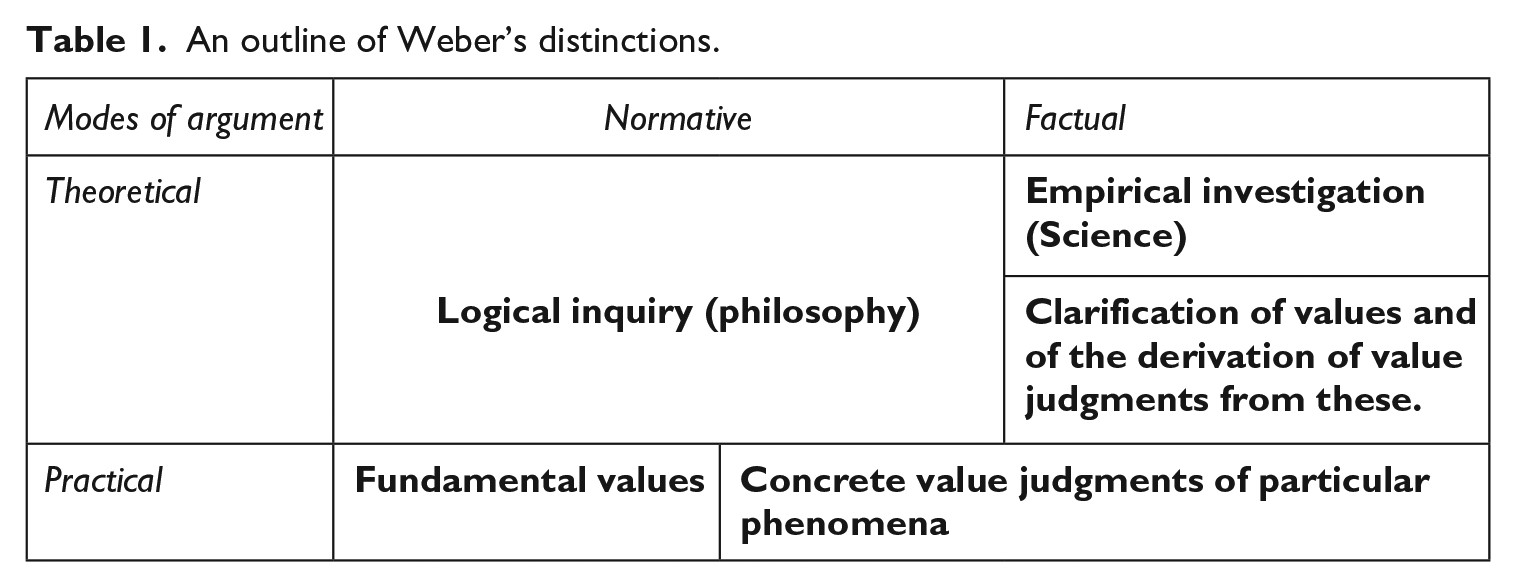
Windelband (1883) had treated logic as concerned with identifying the presuppositions necessary if we are to come to know anything. These presuppositions do not guarantee knowledge, but they make it possible; and it is in these teleological terms that they are justified (epistemological presuppositions that do not produce knowledge would be unjustified). A sceptic could, of course, challenge the presuppositions necessary to produce knowledge, but in doing so he or she would nevertheless be depending on them in claiming to know that knowledge is not possible. 12 Such self-contradiction breaches the requirements of rationality: Weber insists that logical distinctions must be recognised and abided by, as a matter of integrity.
By contrast, the empirical part of the theoretical realm refers to events and objects in the world and their characteristics, causes, and consequences; matters which scientific investigation can disclose, in principle at least. This is not a normative task, even though it does of course rely on logical, and therefore normative, assumptions; it also depends upon practical value assumptions to select value-relevant factual issues to investigate (Bruun, 2007; Hammersley, 2017). While the neo-Kantian position rejects the notion of things-in-themselves lying behind sense data, in practice this makes little difference for Weber since he clearly assumes that social science is concerned with discovering causal relationships in the world, including those operating between ideas and actions, through identifying ‘objective possibilities’ and ‘adequate causation’ (see Turner and Factor, 1981, 1994: chs 6 and 7). 13 Thus, his concept of ideal type is designed to facilitate the identification of such relationships, both those assumed by a particular ideal type and those which can be revealed when behaviour deviates from what this type would predict. Furthermore, while Weber’s notion of ‘value relevance’ may be thought to imply that those who adopt different value-relevance frameworks would come to different conclusions about what is empirically true, this only holds in a trivial sense: if we ask different questions, the knowledge produced will be different; but logic requires that true answers to different questions must not be contradictory. Furthermore, Weber argues that those who disagree necessarily share some assumptions about what is relevant to the disagreement, even when they interpret these differently. And relevant factual conclusions that are well-founded must be recognised irrespective of one’s value position; again, as a matter of integrity.
Turning to the practical realm, this relates to action in the world, to both the goals being pursued and the selection of means; and this is clearly normative, though it also involves factual assumptions. Of course, people’s goals and value commitments form part of the social world, and these can be investigated from an empirical (and, therefore, non-normative) perspective, where the aim is to understand rather than to evaluate them. But practical judgements cannot be deduced from factual knowledge alone, they necessarily depend upon ultimate value commitments. The relationship between goals and means can be studied theoretically, drawing both on clarification of the meaning of goal statements and their implications, and on empirical knowledge about the likely effects of particular means. However, while such theoretical assessment can inform practical judgement it is not equivalent to it: the latter needs to take into account other considerations, not least whether the goals should be adopted, and what ethical constraints there are on action. In the practical context, theoretical evaluations are conditional, along the lines of: if these particular value presuppositions were to be adopted, then these specifiable practical implications would follow.
To recapitulate, both logical and practical matters are normative: in the case of logic, a central concern is with what distinctions must be recognised and openly acknowledged; in the case of practical activity, the focus is on what is good or bad, right or wrong, who is to blame, what should be done, etc. In this respect, both contrast with empirical matters, which are simply about what exists in some situation, its characteristics, its causes and consequences; though Weber insists that these must be value-relevant. Furthermore, Weber seems to assume that, whereas we are all obliged to accept what has been shown to be true, in terms of logic or empirical fact, we are only required to accept practical judgements as sound if we are committed to the fundamental values on which they rely, and they have been properly derived from these: neither logic nor empirical fact on its own can compel us rationally to accept a practical judgement.
For Weber, it is a requirement of logic that researchers recognise the distinctions between logical, empirical, and practical judgements, and accept that practical value conclusions cannot be derived from factual and/or logical grounds alone. However, he insists that the question of whether researchers should draw practical value conclusions in research reports, or express their political views when teaching, is a practical (not a logical) judgement, one that cannot be determined entirely on rational (in other words, on logical and/or empirical) grounds. At the same time, Weber believed that, even though we may differ in our practical judgements about this matter, there are rational constraints that must be observed. In particular, the right to express practical judgements in research reports or in teaching, if claimed, must be extended to include all points of view, rather than being restricted to those we agree with or which are currently dominant. He treats this as a matter of integrity, and he notes that (in Wilhelmine Germany, at least) such tolerance rarely exists, and therefore the expression of personal opinions about value issues by academics should be minimised. The key reason for doing this is that it avoids any misleading implication that these conclusions are validated by empirical findings, given that science cannot answer value questions. Weber complains that: [We have] large numbers of officially certified prophets who do not do their preaching publicly: in the streets, or in churches, or in some other way; nor, if they [do it] privately, do they do so in personally selected, self-professed conventicles of faith. Instead, [these prophets] arrogate to themselves the right, “in the name of science”, to deliver themselves of authoritative rulings on world views from the academic platform, in the ostensibly objective, uncontrollable, discussionless and quiet [atmosphere] of the officially privileged lecture hall, and thus carefully shielded against any contradiction. (Weber, 2012: 306)
The third set of distinctions that Weber adopts is between fundamental values and concrete value judgements about particular situations, actions, people, etc. Value judgements are derived from fundamental values, though they also frequently rely on empirical assumptions, for example about the likely consequences of proposed actions, or in the case of past actions what consequences could reasonably have been anticipated. As noted earlier, while Weber insists that the adoption of particular practical values cannot be based solely on logical or empirical grounds, he argues that concrete value judgements can be appraised in theoretical, and therefore rational, terms: according to whether the set of values on which they rely is internally consistent, whether the value judgements have been derived properly from those values; and, empirically, as to whether the goals they indicate are feasible in the circumstances. But such appraisal cannot, on its own, tell us what practical judgement ought to be adopted. 14
Thus, while rational thinking is involved in making practical judgements, there is a sharp contrast with factual issues, where we can usually assume that there is a single correct answer. Practical inference will not automatically lead us to a single determinate conclusion; there are always likely to be different potential conclusions, some of which may be equally reasonable; even if we are inclined to choose one against another. It is important to distinguish this practical reasoning from the sort of thinking that is involved in science, but also to emphasise that it too can be more or less rational; and that rationality is desirable in this field just as much as in the determination of empirical facts.
Remaining problems
In my view these distinctions are sound ones that must be respected. Nevertheless, they do not entirely resolve the problems that Weber’s critics raise. One reason for this is that he seems to adopt a linear model of inference from fundamental values to concrete value judgements: so that the meaning content of these values must be treated as fixed a priori. However, this neglects the fact that the meaning of values is, to a large extent, determined by assumed exemplar situations to which we take them to apply. For instance, any declared commitment to social justice is associated mentally with particular sorts of situation that are held to exemplify justice and injustice; and which exemplars are adopted can alter the meaning of this value (equal distribution of resources to all members of a category, fair reward or punishment, and so on). Similarly, if we declare the value of freedom, much depends upon what we believe it is necessary to be free from and/or to be free to do: we could have in mind, say, on the one hand, emancipation from slavery, or, on the other, children being allowed to decide how to spend their time or their money however they wish. Depending upon which of these exemplars is assumed, different judgements may be reached about whether or not freedom exists in a particular situation, or ought to.
So, what abstract values mean varies according to the exemplars that are used to interpret them in making sense of particular situations. From this point of view, the meanings of these fundamental values do not exist independently of concrete evaluations; instead, they are embedded in the exemplars we deploy in making such evaluations. Moreover, these exemplars may not only differ somewhat between individuals but can also change over time or across contexts for the same person. Thus, what is involved in making practical judgements is not a matter of inference from fundamental values to specific conclusions, but a more dialectical process in which we interpret exemplars and the situations we are evaluating, and modify our interpretations of each in light of the other. One result of this is that people can share a commitment to stated values but differ regarding the exemplars through which they interpret them, and therefore disagree in their judgements about particular cases. Moreover, value conflict can also arise from the fact that our understanding of values may be revised in the process of applying them. 15
A second problem, in my view, is that while Weber was right to emphasise the limits of rationality, and to insist that neither philosophy nor science can authoritatively make practical judgements on their own, he sometimes seems to imply that rationality is restricted to logical and empirical matters; in other words, to the theoretical domain. One issue here concerns what the word ‘rational’ is taken to mean. Weber frequently treats it, in this particular context, as referring to a methodical procedure that can produce results that are compelling, in the sense that (if properly carried out) its results ought to be accepted by anyone acting with integrity. And I believe he is correct that in practical matters there is rarely any such procedure (whether there is one even in the theoretical realm is an interesting question that I will leave on one side). Yet this does not imply that practical decision-making can only be a matter of personal commitment. While in that realm there may be no arguments that force us to adopt one option rather than another, we can certainly make reasonable judgements about what are better or worse options. Not only is it possible to assess whether the values to which a person is committed are internally coherent, and to check whether the derivation of conclusions from these is logically sound, as Weber recognised, but also there are forms of argument about the meaning and priority of particular values in particular contexts that, while not conclusive, can be rationally persuasive, in the sense that most people would accept them, at least in principle. One argumentative strategy is to consider how a particular value might apply to situations that are similar to or different from the one being examined in relevant respects – this will sometimes lead to a modification of view. We can also make explicit the exemplars being relied upon in interpreting values, and consider alternatives with a view to which is more appropriate. In relation to actions, rational appraisal can be pursued by assessing how one would feel if the situation were reversed, if one were on the receiving end of the type of action concerned – a key principle in much moral theory. Furthermore, we can often point to implications of a value position that someone has adopted that they might not wish to accept: which ought to lead them to rethink their attitude. This is in addition to the way in which value conclusions may need to change if the factual assumptions on which they rely are shown to be false. For instance, perhaps it is possible to show that the pursuit of particular goals is (or is not) feasible given current circumstances. While deliberation about these matters does not produce conclusions whose validity can be demonstrated conclusively, the contrast involved here is one of degree, not a dichotomy. What is sought is what has sometimes been referred to as ‘reflective equilibrium’, an appropriate balance between all of the relevant considerations (see Daniels, 2020; Elgin, 1996; Turner and Factor, 1984: 231–232). While there may well be disagreement about what is the appropriate balance, very often there is considerable agreement about what is not. 16
A third issue that needs to be addressed is Weber’s agonistic treatment of conflicting value spheres (contrasting science or prudent politics with religious asceticism or political fundamentalism, for example, and insisting that we must simply ‘choose our daemons’). For example, at one point he writes: ‘Values are in fact, in the last resort, everywhere and always, not just alternatives; [they are] engaged in an irreconcilable struggle to the death [with each other] – as it were, between ‘God’ and the ‘Devil’. Between those [positions], no relativisation or compromise is possible’ (Weber, 2012: 314–315). While this may well be how opposing parties often view disputes, such formulations obscure the extent to which most human beings share a considerable range of fundamental values in common (see Moody-Adams, 1997). What varies is the priority given to these, as well as what are taken to be exemplars for their application. Furthermore, the fact that we all play multiple roles means that in different contexts we will prioritise different values, depending upon the distinctive responsibilities associated with the role concerned. So, usually, people are not faced with others whose value commitments are totally opposed to theirs, with no overlap, even though they may see it that way. Indeed, within Western societies, a common type of conflict arises between occupational practitioners who are required to prioritise particular values as part of their roles, and their clienteles or other stakeholders for whom other values may be more salient. Examples include doctors not disclosing to parents that they have had consultations with their children or what these consultations were about; lawyers defending clients who are regarded by the general population as beyond the pale; and Government ministers negotiating with foreign regimes whose values they and their publics deplore. Professions require dedication to a narrow set of values, and this means downplaying other considerations; indeed, this is precisely what objectivity requires, as Weber recognised (see Hammersley, 2011: ch4).
I suggest that, to a large extent, these shared values come out of common experience of human life, arising from feelings prompted by particular types of event, situation or action: a product both of human biology and of the various sorts of social activities and relationships in which human beings have always and everywhere been involved in one form or another, given the physical environments in which they live. For instance, a felt concern with fairness arises from the need both to cooperate and also to compete with others for scarce resources. While the shared source of values does not provide any rational basis for giving priority to one or other value, or one interpretation of a value rather than another, it does explain why we feel a commitment to many of the same values. My argument here is in line with some versions of intuitionism in ethics, it explains why we experience these values as existing independently of us rather than being a matter of personal invention. 17
Relating this refinement of Weber’s position to the criticisms I have discussed, we might refer to it as appealing, ultimately, to a secular form of revelation, this located in the phenomenology of human experience, albeit shaped by the particular social circumstances in which people live and their cultural backgrounds, as well as the roles they play. This position is at odds with those which insist on the possibility of some form of rationality that will produce a single coherent system of values, along with rules for their application, which can (or indeed should) lead to a consensus: what is sometimes referred to as ethical ‘principlism’ (Beauchamp, 2010). Of course, it is also at odds with any appeal to divine revelation, as championed by Midgley and acknowledged by Strauss. 18 Secular revelation avoids reliance upon theological assumptions: all that it requires is attention to common human experience, in terms of our reactions to particular situations, examination of the values that these imply, and then use of the sorts of moral argument I have outlined to refine or modify these in applying them back to those situations. It is important to note that what is involved here is revelation because, while no causal account of how situated reactions relevant to particular values arise can, in itself, provide a rational justification for adhering to those values, it would explain why we may feel a need to do so. Our (always potentially conflicting) situational responses, embodied in exemplars, that are the foundation of our value commitments, must initially be recognised, and rational appraisal must work on them: we find ourselves responding to actions, situations, or people in particular ways, and must then evaluate these, and perhaps change them. So, what is given, including the adoption of particular exemplars, is open to revision. For example, revulsion at some object or at some action may need to be rejected, on the grounds that attention must nevertheless be paid to the object, or that the action should be done. What is involved here is an extension of the kind of value clarification that Weber believed was demanded by integrity (see Bruun, 2007).
If we apply this line of argument to the task of justifying science, we can argue that discovering the truth about particular matters is an essential concern in human life; and that engaging in specialised forms of inquiry can be justified because they increase the likely validity of the conclusions reached, even though providing no guarantee. Of course, the specialised pursuit of inquiry involves costs as well as benefits; and there can be reasons for not wanting to know the truth, and even for pretence – these, too, coming out of the nature of human life (Shattuck, 1996). But, for better or worse, both natural and social science have become institutionalised in most societies today, and a great deal of modern life depends upon them.
Even if this clarification and development of Weber’s position is accepted, there is a further question that still must be addressed: his assumption that integrity – in the sense of recognising logical distinctions; being clear and coherent, as far as possible, in the evaluations made; and being consistent in the actions taken on different occasions – is a universal value that everyone has an obligation to try to live up to. This is an ideal that he probably inherited from Kant, even though he abandoned much of the rest of Kant’s philosophical system. So, the question arises: if, ultimately, we adopt particular fundamental values or give them priority over others on the basis of a reflective decision that cannot be entirely determinate in rational terms, why should integrity be treated as a value that imposes, or ought to impose, itself upon all of us as a first priority? Weber does not address this question, and I am not sure that any answer to it is to be found in what I believe is the main philosophical tradition on which he drew: the neo-Kantianism of Windelband, Rickert, and Lask. However, we should note that this is a value whose importance is accepted by most, if not all, of the critics of Weber whose work I have mentioned in this article– in practice even if not explicitly. I suggest that, given this, it can be treated as common ground. Whether we should take account of some potential alternative position that does not seek to adhere to internal consistency of argument and action is, I suppose, a question that might be raised – but, if we were to do this, in what way could we deal with it? To do so we would be forced to try to find some coherence in it, to treat any apparent inconsistencies as the result of error or deceit, and so on. We seem to be dealing with a very deep, and perhaps unavoidable, principle here. 19
In light of all this I suggest that Weber’s position, elaborated in the manner I have outlined here, can provide a sound understanding of the relationship between facts and values, and of the implications of this for social science. It can be defended against the arguments of his conservative critics.
Conclusion
In this article I have examined what is perhaps the most fundamental challenge to Weber’s conception of social science as a vocation, as devoted to the production of factual knowledge and governed by the ideal of objectivity. Various authors, from across the political spectrum, have argued that his position is fundamentally irrational and leads to nihilism, or at least amounts to a dangerous tendency to treat rationality as if it were merely an instrumental matter of finding the most effective means for achieving ends that are by their very nature irrational. The critics suggest that science is thereby turned into a technique, or even a weapon, that can serve any goal, evil as well as good; having no value in itself. I have shown that this is based on a misreading of Weber’s complex position; even if there are, nevertheless, problems remaining with that position.
Both of the critics whose work I have discussed in detail insist that there is or ought to be a rational means of uniquely determining what are and are not good and bad ends, and that scientists should only serve the former. However, as we have seen, these critics offer very different solutions to this problem: religious revelation and Church authority (Midgley), on the one hand, Socratic questioning of philosophical and religious views (Strauss), on the other; with other critics proposing yet other solutions, whether grounded in Marxism or in Habermas’s communicative ethics. However, none of these is without fundamental problems of its own. 20
In the second half of the paper I revisited Weber’s arguments, highlighting their subtleties. Furthermore, I argued that, while there are genuine problems with his position, there are ways in which it could be clarified or developed to address these. Weber certainly did not believe that value judgements must necessarily be entirely irrational. He argued that any value judgement can be rationally appraised in terms of whether it has been logically derived from a coherent set of fundamental values and whether the factual assumptions on which it relies are sound. In addition, I suggested that the relationship between values and specific valuations is dialectical rather than linear, and that there are forms of moral reasoning that can support judgements about the relevance and priority of particular values, and about the validity of particular interpretations of them on particular occasions. Nevertheless, as Weber insisted, there can be no conclusive or universally compelling rational demonstration of the validity of ultimate value commitments or of specific value judgements.
I suggested that, while Weber was surely right that fundamental values cannot be logically derived from empirical facts or from speculative metaphysics, many of the values we feel ourselves committed to are shared to a considerable degree by all human beings, because they arise from common experience of life on earth. And I proposed that we could usefully treat those values as a matter of secular revelation: their functionality can be recognised, even if it is always possible for a human being to deny the relevance of one or more of them, and even if there is always scope for disagreement about their priority and about how they are to be interpreted. Recognising that we start from a sense of what is good or right, bad or wrong, authentic or inauthentic, etc, in particular situations that will involve significant commonality, as well as differences, indicates that disagreements need not be as agonistic as Weber implies – though this is not to deny that sometimes they will be.
Above all, it seems to me that Weber’s aim was to emphasise the limits operating on rational adjudication of values, not to propose that commitment to them is entirely irrational. And he was surely right that there can be conflicts in the implications of different values for particular cases, and disagreements about their relative priority. We have to live with these, there can be no ultimate resolution. But there is, nevertheless, room for considerable rational deliberation about them, and so at least some prospect, sometimes, of reaching agreement. Above all, though, Weber was quite correct to insist that science cannot, on its own, answer value questions with any intellectual authority, and that there should be no pretence that it can.
Footnotes
Declaration of conflicting interests
The author declared no potential conflicts of interest with respect to the research, authorship and/or publication of this article.
Funding
The author received no financial support for the research, authorship and/or publication of this article.
