




Abstract
An important empirical basis for the interpretations of Theodor W. Adorno, Else Frenkel-Brunswik, Daniel J. Levinson and R. Nevitt Sanford in The Authoritarian Personality (TAP) were questionnaires and in-depth interviews conducted by William R. Morrow with prisoners at California’s San Quentin prison. A reconstruction of the historical approach exposes serious methodological shortcomings, some of which Morrow openly addressed in memoranda, revealing that the supposedly particularly authoritarian attitude of the prisoners was due, among other things, to their submission to the psychiatric authority in the authoritarian situation of the prison and due to the conditions of a hierarchical prisoner society. In TAP, the empirically inadequate survey was interpreted primarily in the context of psychoanalytic literature on crime at that time, in particular Robert Lindner’s Rebel Without A Cause, whose theory of pseudo rebellion permeated TAP. Focusing on the shortcomings of TAP, this article argues, enables its inspiring insights to be appreciated.
Keywords
Introduction
Several members of the Frankfurt School dealt with ‘criminality’ and social exclusion. One of the first books published by the Institute for Social Research in exile was Rusche and Kirchheimer’s (1939) Punishment and Social Structure, which shaped critical criminology (Kunz, 2017) not least due to its impact on Michel Foucault (Foucault, 1977: 35). Despite forming an important strand of research stretching from Kirchheimer and Franz Neumann to critical theorists of later generations like Heinz Steinert, ‘criminality’ was a side issue for many critical theorists, including Max Horkheimer and Theodor W. Adorno, who, for example, took note of Rusche and Kirchheimer’s supposedly empiricist work without paying it great attention (cf. Wiggershaus, 1988: 263–265). Accordingly, both worked with ascriptive ad-hoc-terms of ‘the criminal‘, rather jauntily comparing Nazi elites to Mafia-like ‘rackets’ in the Dialectic of Enlightenment (Horkheimer and Adorno, 1969: 162 and 182) – a theory developed as quickly as it was abandoned (cf. Ziege, 2009: 125f.; Wiggershaus, 1988: 356f.).
This intellectual tension between social theory and criminology or ‘criminality’ as a research topic can also be found in The Authoritarian Personality (Adorno et al., 1950). The study, organised and funded by the American Jewish Committee (AJC) from 1944 to 1949, was conducted by Theodor W. Adorno, Else Frenkel-Brunswik, Daniel J. Levinson and R. Nevitt Sanford. It was a remarkable manifestation of ‘transatlantic enrichment’ (Fleck, 2007), a cooperation between émigré and American social scientists that combined a wide variety of influences: not only the Marxist paradigm of critical theory but also Frenkel-Brunswik’s interest in the psychology of the Viennese ‘Bühler School’, the Vienna Circle’s positivism, together with Levinson’s and Sanford’s methodological knowledge of American social research and an interest in Freudian psychoanalysis shared by all. In this respect, the study is an impressive amalgamation of psychology, psychoanalysis and sociology, characterised by a high degree of self-reflexivity (cf. also Horkheimer and Adorno, 1975). It stimulated thousands of follow-up studies (for overviews, see Altemeyer, 1996; Stone et al., 1993). Today, as authoritarian politicians and regimes are on the rise in Europe, North and Latin America, the study is being re-discovered (Adorno, 2019; Gordon, 2018, 2019; Marasco, 2018; Ziege, 2009).
Using both questionnaires and in-depth interviews, the authors examined the socio-psychological susceptibility to and readiness for a potential fascism among America’s post-war population, studying the fertile ground formed by the ‘authoritarian personality’ outside Europe in which fascist propaganda could possibly take root after 1945. The questionnaires were initially given only to college students. Since their general middle-class background meant a bias in terms of social class, the authors began to consider sampling methods and decided to interview ‘key groups’ whom they considered particularly sensitive or dangerous in relation to a potential American fascism: upper class men in service clubs, patients of psychiatric clinics, and last but not least prisoners in San Quentin, California’s oldest prison. From the very beginning, the basic assumption was that there was a ‘psychological affinity between criminality and fascism’ (Adorno et al., 1950: 136). For the authors, the direction of this affinity was clear: definitely not all authoritarian personalities were ‘criminals’, but criminals clearly tended to be authoritarian.
‘Crime’ and ‘criminals’ do not play a central role in The Authoritarian Personality. But the San Quentin interviews are more than mere illustrations of a theory allegedly developed elsewhere in the study. The group was considered to be of ‘key importance for understanding fascism’ (Adorno et al., 1950: 822). Indeed, a definition of fascism is provided only in the chapter Criminality and Antidemocratic Trends: A Study of Prison Inmates, written by William R. Morrow, and it is only in this chapter that there is an open discussion of a fascist personality. In the rest of the study, the word ‘fascist’ is mostly replaced by terms such as ‘anti-democratic’ and ‘authoritarian’.
The thesis that ‘criminals’ were particularly authoritarian was not confirmed in later empirical surveys in prisons. Some 30 years after the original study, the Australian sociologist Ray (1972) used a revised form of the F-scale to survey authoritarian attitudes among 70 prisoners within a Sydney prison. His conclusion read: ‘Particularly when their low level of education is considered, criminals are extremely anti-authority in their attitudes. [. . .] Criminals (recidivist prisoners) are in every sense extreme anti-authoritarians’ (Ray, 1984: 269f.). Ray, like other authors before him (Hyman and Sheatsley, 1954), traced the opposite findings in The Authoritarian Personality back to deficiencies in the construction of the F-scale, which did not differentiate between traditional conservatism, authoritarianism, aggression, and violence, and could not prevent acquiescence bias due to the exclusively positive phrasing of the questions.
In this article, I will focus on the influence of the prison situation on the study’s theoretical argument. I will argue that this influence remained unreflected in both the questionnaire situation and the clinical interviews. 1 By contrasting the published version of Morrow’s interviews in San Quentin with an earlier draft written in 1947 or 1948 found in the AJC archives (Morrow, n.d.), 2 methodological problems in the study can be highlighted which have not remained without consequences for its theoretical conclusions. As will be discussed in the second part of this article, Morrow and Adorno interpreted the evidence not within the theoretical framework of Erich Fromm’s reading of psychoanalysis, but within that of psychoanalytic literature on crime current at the time, in particular Robert Lindner’s ‘hypnoanalysis’ with a ‘psychopathic personality’ (Lindner, 1944: 1). Difficulties in the data collection process were neglected and contradictions within the data were smoothed in order to make the evidence fit a very specific psychoanalytical theory of crime as unresolved oedipal conflicts. Focusing on these shortcomings of the study, so runs the underlying thesis of this article, makes it possible to appreciate its inspiring findings. However, a discussion of the many other important influences on the study The Authoritarian Personality is beyond the scope of this article.
William Morrow’s interviews in the San Quentin penitentiary
Potential fascists: The Authoritarian Personality
The war was not over yet when Frenkel-Brunswik, Sanford and Levinson on the one hand and Horkheimer and Adorno on the other combined their previously separate research on anti-Semitism and began working on The Authoritarian Personality for the AJC. The historical background to the study was both the Holocaust and anti-Semitism in the US. In its unpublished study Anti-Semitism among American Labor, the Institute for Social Research had already found that in 1944, right in the middle of the war against Nazi Germany, 18% of respondents had assessed the persecution of Jews in Germany as positive (Ziege, 2009: 212). The Nazi extermination of the European Jews continued to promote anti-Semitic hatred, even among Americans, until 1947 (Ziege, 2009: 91–93). The victims were blamed for being annihilated. The Authoritarian Personality was therefore concerned with how open respondents were to fascist political patterns and it sought to investigate the psychological dispositions of ‘potential fascists’ in the US (Adorno et al., 1950: 1–5). It was an urgent task, one not yet externalised from social science as Vergangenheitsbewältigung or ‘coping with the past’ (Kranebitter and Reinprecht, 2020).
The major finding of the study was that an individual prejudice was symptomatic of an entire system of thought, which was no longer based on individual experience. The F-scale test started with questionnaire items that asked direct questions about anti-Semitism (A-S-scale) and ethnocentrism (E-scale), before moving on to indirect items, that is, questions that corresponded to the direct questions of the other scales but did not immediately reveal their purpose (F-scale). In this scale, the underlying dimensions of authoritarianism were identified as a rigid adherence to middle class values (conventionalism), an authoritarian submission to the idealised moral authority of an in-group, an authoritarian aggression towards those who violate the rules, anti-intraception, superstition and stereotypy, an orientation towards power and hardness, a general destructiveness and cynicism, as well as a comprehensive and far-reaching projectivity and, finally, an overemphasis on sexuality (Adorno et al., 1950: 222–279). As a result, people who had achieved high levels of approval on these items, so-called high scorers, were termed authoritarian personalities. Adorno always emphasised that these dimensions were not neatly separable factors (Adorno, 2019: 43) but could only be understood as a totality – projectivity does not exist without aggression, aggression not without frustration, etc. The authoritarian syndrome of the authoritarian personality was therefore not reified as a fixed, essentialised determinant of action but rather was understood as a manifestation of past social forces in the individual psyche, as a relatively organised and coherent, if contradictory, set of attitudes. The unconscious forces of personality should be understood as ‘readinesses for responses’ (Adorno et al., 1950: 5f.). Horkheimer and Adorno described this stereotypical thinking ‘in blocks’, which corresponds to the monopoly phase of capitalism in the Dialectic of Enlightenment, as ‘ticket thinking’. Here, as in an election, a candidate is chosen as part of an entire ticket: anti-Semitism comes as part of an industrially produced set of attitudes, one ready for consumption by individuals incapable of individual experience who, due to their real alienation from the promises of capitalism, need an object onto which they can project their deep-seated feelings of hatred (Horkheimer and Adorno, 1969: 214–217; cf. Ziege, 2009).
The criminal ‘high scorer’: Reasoning and results
William R. Morrow was responsible for issuing the questionnaires to prisoners in San Quentin. Morrow was part of a whole group of junior scientists who carried out and interpreted the study’s interviews, yet whose names remained invisible in the famous ‘Adorno et al.’ reference (cf. Fahrenberg and Steiner, 2004).
The methodological procedure in San Quentin corresponded by and large to the procedure carried out with other groups. The questionnaires were distributed among a large number of group members; individual high and low scorers were then selected on the basis of their E-scale values and were the subjects of in-depth ‘clinical’ interviews. In San Quentin, 110 prisoners completed the 45-item version of the questionnaire in October 1945, 3 and Morrow conducted in-depth interviews with 15 inmates. The results of the study were presented in Chapter XXI of the publication and received great approval from the commissioning AJC. An internal, undated editorial revision even suggested that the chapter be published as an independent monograph. 4
The authors’ assumption was that prison inmates were particularly authoritarian. If high scorers in general had no integrated superego, were unable to build emotional relationships with others and overcompensated weakness and passivity – ‘should we not expect that a group of prison inmates would score particularly high on our scales? This, at any rate, was the thought which led us to consider our subjects from the San Quentin Prison as a key group’ (Adorno et al., 1950: 817).
Quantitative and qualitative material both seemed to confirm this null hypothesis impressively. The San Quentin respondents achieved higher than average values on almost all items. Those high scorers showing ‘undisguised hate combined with explicit readiness to suppress the outgroup by physical force “if necessary”’ (Adorno et al., 1950: 827) were termed ‘fascists’. What the questionnaires already showed was even more true of the in-depth interviews: high scorers personalised social issues, but de-personalised themselves in their interactions (Adorno et al., 1950: 844f.). Their authoritarian attitudes, emphasising obedience and conformity, contrasted strangely with their delinquent behaviour, which had challenged the very authority of the state. Morrow noted an abstract moralism with high scorers, which suppressed and externalised their own feelings (Adorno et al., 1950: 847) and helped to de-realise their own actions. Thus, about two thirds of San Quentin’s sex offenders agreed with the punitive item claiming that sex offenders ought not only to be punished but publicly whipped (cf. Adorno et al., 1950: 849). This punitivity hints at an ‘externalised, undeveloped superego’ (Adorno et al., 1950: 852). All these men were waiting for was an authoritarian leader. The few low scorers found among the prisoners, on the other hand, were said to be free of moralism (Adorno et al., 1950: 854) and guided instead by genuinely internalised ethics. If moralism was rigid, Morrow wrote extensively in his draft, ethics were flexible; people with genuine ethics would discuss their attitudes, moralists were afraid of any discussion (Morrow, n.d.: 44). As with other groups of respondents, high scorers and low scorers were not only on diametrically opposite ends of a scale, but differed fundamentally in every aspect of experience and attitude. Ultimately, however, in contrast to the extensive picture drawn of the high scorers, the low scorers among the prisoners remained under-determined. Moreover, they too were said to submit to the status quo, leading to the conclusion that in general, prisoners were anti-social pseudo-rebels, not revolutionaries.
The general run of criminals are not to be thought of as genuine rebels who act according to some principle, however dissident, and whose conflict with authority is accompanied by some consideration for the weak or oppressed. [. . .] The predominant tendency is for each inmate to be ‘an island, entire in itself.’ (Adorno et al., 1950: 823f.)
These then were the results. Yet they were produced in a questionable way, as the following look at the history shows.
The problem: Sampling and interview situations
The different groups filled in the questionnaires in their respective environments – college students in their seminar rooms, unionists in union offices and labour schools, prisoners in the San Quentin prison. In some cases, the authors were aware that the interview situation had an impact on answering the questions. Service club members, for example, became sceptical and only agreed to fill out the questionnaires when the club’s leadership suggested they do so (Adorno et al., 1950: 24), which was not always the case (Adorno et al., 1950: 129). In his chapter, Morrow acknowledged that there was an influence of the prison environment on the interviewees’ response behaviour, stating that the ‘general atmosphere of the prison [. . .] stresses compulsion and conformity’ (Adorno et al., 195: 819). Since the responses showed a wide variety of scores, however, he believed the interview situation to have had a ‘relatively minor effect’ (ibid.) on the responses. As will be discussed in the following section, the archival material available shows that this was an understatement, i.e. that the effect of the interview situation was far greater than acknowledged.
The problem of non-problematisation started with the sampling procedures. San Quentin’s psychiatric department helped with the selection of interviewees, Morrow wrote (Adorno et al., 1950: 818). They excluded all prisoners aged 55 years or older, all ‘feeble-minded’ prisoners, prisoners who had attended less than 8 years of school, as well as African Americans, Jews and people in psychiatric treatment. The result was a sample of 110 respondents, approximately 5% of all San Quentin prisoners. 5 Based on very high and very low E scores, 15 interview partners were then singled out for in-depth interviews. (Of these, eight were classified as high scorers and four as low scorers, three middle scorers were excluded without further explanation.) Regarding their history of delinquency, neither the ‘quantitative’ group of 110 nor the ‘qualitative’ group of 12 in-depth interviews were statistically representative (see Table 1).
Number and quotas of prisoners by ‘crime group’ for the whole San Quentin population, the questionnaire sample and the in-depth interview sample.
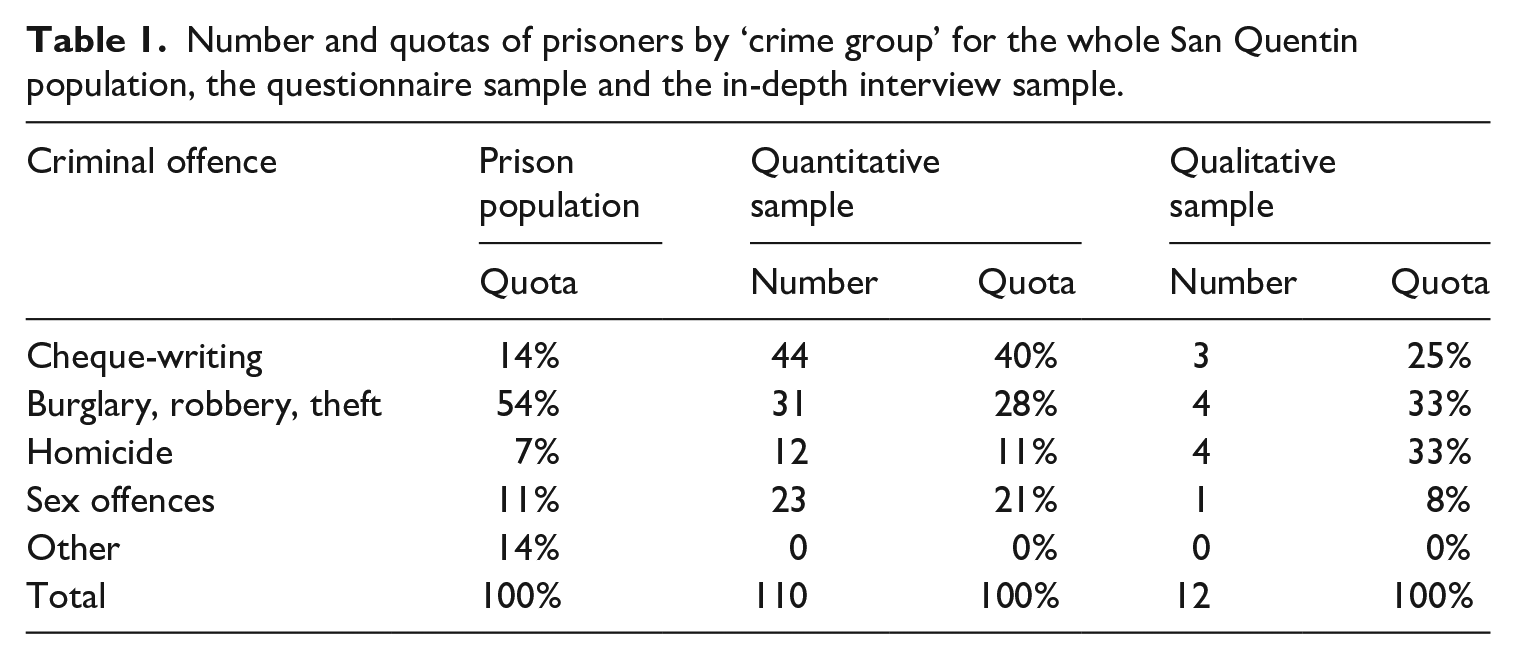
While fraudsters (‘cheque-writers’) and sex offenders are overrepresented in the quantitative sample, murderers are obviously overrepresented among the qualitative interviewees. This had consequences for the study results. Since sex offenders had achieved higher E scores (cf. Adorno et al., 1950: 848f.), the E scores for the whole quantitative sample were distorted upwards. It also meant a social bias: from the observation of the prison psychiatrist that cheque-writers mostly stemmed from privileged households (Schmidt, 1948: 47f.), it may be concluded that the sample was also socially distorted in relation to the prisoner population. Even though they did not directly subsume the San Quentin group under the group of ‘Working Class Men’, the authors’ repeatedly claimed that it was predominantly working class (Adorno et al., 1950: 173, 180, 188, 259, 287), with Adorno himself, noticing a difference to other proletarian groups, terming it a ‘Lumpenproletariat’ (Adorno et al., 1950: 638). In fact, the San Quentin group appears not to have been particularly proletarian. Moreover, the greater number of murderers among the interview partners for in-depth interviews suggests that spectacular cases were specially selected for these interviews. One of the 12 interviewees had an IQ of only 48 (Adorno et al., 1950: 818), others had gruesomely dazzling crime stories to tell such as 21-year-old Jim, interestingly enough categorised as a low scorer, who had murdered an older woman under the influence of drugs. ‘The victim’s body showed that he kissed and chewed her breasts. . . She was totally unknown to him’ (Adorno et al., 1950: 871). Whether or not Jim’s victim represented – as Morrow suspects – his mother and, consequently, Jim had acted out his oedipal conflict with a mother substitute, the case (like other cases) can hardly be regarded as representative of the San Quentin population.
The process for selecting interviewees by the prison’s psychiatric department also demands attention. The key figure in this regard was David G. Schmidt, the chief psychiatrist at the San Quentin Penitentiary. Having started as department head in 1932 (Schmidt, 1948: 27), he had begun his duty by restructuring the overcrowded psychiatric department. The apparently reform-inspired improvement in conditions at San Quentin was achieved at the high cost of creating a category of incorrigible criminals who, from then on, received the undivided attention of the psychiatrists. Schmidt’s tasks also included making instant diagnoses and prognoses, including ‘recommendations on them prior to their appearance before the Board of Prison Terms and Paroles [. . .] for parole and sentence consideration. We are proud of our percentage of successful recommendations.’ (Schmidt, 1948: 29). The psychiatric ‘recommendations’ not only served the prisoners but also the state authorities in deciding their fate. This meant that Schmidt played a huge role in the fate of the prisoners, who would certainly have been aware of this. Nevertheless, Schmidt persistently framed his work as providing almost altruistic aid to the prisoner in his involuntary struggles. At a time when the death penalty by gassing was not infrequently practiced in San Quentin – Schmidt himself reports having observed 200 gassings – this discourse was framed as a ‘reform’ even if it involved the introduction of psychiatric treatments such as insulin shock therapy, electro-shock therapy for psychotics and the treatment of syphilitics with typhoid and malaria infections (Schmidt, 1948: 32).
It was this psychiatric unit, equipped with a considerable amount of power over the prisoners – from a tentative immediate diagnosis upon admission to recommendations to the probation committee – that was now not only assigned the task of compiling the described sample but also of distributing the questionnaires and monitoring their responses. Morrow was not present when the questionnaires were distributed. This emerges from a ‘memorandum’ written by Daniel Levinson (for the questionnaire material) and William Morrow (for the clinical material), dated January 17, 1946, with the handwritten addition ‘Dr. Adorno’ (Levinson and Morrow, 1946). Here, the distribution by the prison’s psychiatric department was openly addressed as a fundamental problem: the mode of distribution led to increased F scores, they wrote, since the F-scale questions would sound like psychiatric questions (Levinson and Morrow, 1946: 1). Yet as in the final publication, Levinson was cautiously optimistic regarding the minor effect of the way the data was collected, noting: ‘The general results, I believe, are quite valid’ (Levinson and Morrow, 1946: 1). One difficulty was the low level of education among many prisoners, including illiterates. But how could illiterate people have actually filled out what as quite a complicated questionnaire? ‘Some of the subjects had to have another person read the questionnaire for them and record their responses’ (Levinson and Morrow, 1946: 6). The questionnaires were therefore most likely completed in the presence of the supervisory staff. All in all, the authors admitted, discipline among the prisoners in filling out the forms was, therefore, the lowest for all groups, also due to prisoners’ ‘asocial trends’ (Levinson and Morrow, 1946: 6) and their lack of interest in social research.
Potential influences of the interview situation on response behaviour were not limited to the quantitative sample. Social interaction was also interpreted as a one-way street in the 12 in-depth interviews, which is surprising given the study’s strong psychoanalytical focus. The effect of social desirability, that is, the interviewee’s desire to please the interviewer (who was believed to be associated with the mighty psychiatric department
6
), was interpreted solely as ‘authoritarian submission’ to the interviewer. Expressing the desire to conform to conventional opinions, the interviewee would finally also submit to fascism, Morrow concluded. He even provoked the ‘right’ answer, as the case of the ‘fascist’ Buck proves:
Buck, besides supporting Nazi persecution of Jews, exhibits an interesting mode of ideological opportunism in his behavior toward the interviewer. The first three inquiries about his views on ‘the Jewish problem’ and ‘the most characteristic Jewish traits’ elicited only pseudodemocratic denials of hostility. For example: ‘They got a right to make a living as much as anybody else . . . They got a way to make money is all I know. More power to ‘em is all I can say . . . I don’t know much about ‘em.’ But with the fourth question he apparently sensed that he would not be punished for expressing hostility and might (judging from the interviewer’s noncommittal attitude) even gain approval for having the ‘right’ view of things: (Can you tell a Jew usually?) ‘You’re damn right I can tell ‘em as soon as I talk to ‘em.’ From this point on, Buck drops his façade and exhibits intense aggressiveness toward Jews (Adorno et al., 1950: 834)
Mentioned here as an example of the art of interviewing, ‘unmasking’ the real fascist behind his pseudo-democratic façade, in the memorandum Morrow openly speaks of having manipulated this interaction.
One particularly deferent high with a very externalized superego at first expressed somewhat friendly attitudes toward Jews: but he was quite easily induced to express rather violent and fascistic attitudes toward them when my permissiveness and only slightly provocative questions led him to feel that he would not be rejected for doing so
How much of these manifestly expressed attitudes can still be interpreted as an expression of deeper personality structures in this interview situation? Put differently: how much of this response behaviour was actually a survival strategy, as Ray (1984: 266) has asked, ‘to appear agreeable to the authorities’ in a threatening institution like San Quentin?
Improvisations attested to the innovative nature of the study. Sociological surveys and interviews with delinquents in prison had not been done before the 1930s (cf. Savelsberg et al., 2015: 239), not to mention interviews inspired by psychoanalysis (cf. Moser, 1970). The authors also tried to validate their interpretations of the respondents’ statements by using other sources, ‘various non-prison social service reports and other material’ (Levinson and Morrow, 1946: 7). But these attempts merely expanded the problem without solving it. Documents by other state authorities were not ‘neutral’ sources but rather a documentation of strategic representations made by various actors in the interaction processes of a successful criminalisation – a ‘trophy collection of criminal police successes‘ (Doßmann and Regener, 2018: 43). All this raises the question of what was actually measured by the San Quentin questionnaires.
How the prison situation shaped responses
In the published version, the potential influence of the prison situation on the prisoners’ responses is discussed for only one item: ‘If and when a new world organisation is set up, America must be sure that she loses none of her independence and complete power in matters that affect this country‘ (Adorno et al., 1950: 128). Here, it is conceded that the high level of approval is not necessarily a manifestation of extreme nationalism but may be a projection of the prisoners’ lack of freedom onto the nation as a whole (Adorno et al., 1950: 824). Interestingly, in the memorandum, the interpretation of this very item originally went the other way, with Levinson and Morrow concluding that there was in fact a penchant for fascism within the San Quentin group as a whole:
There is no reason to believe that the response to this item was influenced by the administrative situation; it would seem to reflect the general reactionism politically and ethnocentrically, of this group. One of the main conclusions from the data, both clinical and questionnaire, is that this group, while it has rebelled in a legal sense, has not rebelled ideologically; we see here, as we saw in Germany, the recruiting ground for a Fascist movement (Levinson and Morrow, 1946: 2f.)
How this change of heart came about between 1946 and 1950 cannot be determined in the archives. Apparently, however, the authors had thoroughly discussed the interpretation of this item and opted for the opposite interpretation in the publication, which emphasised the influence of the interview situation – without revising the concluding comparison with Nazi Germany.
A thorough reflection of the prison situation on the response behaviour would have been necessary for all items, not merely this one isolated case. The entire frame of reference for the respondents was the prison, not outside society. The San Quentin low scorers were said to be free from rigid and stereotypical thinking (Adorno et al., 1950: 828). At the same time, Morrow criticised them for not doing something active against inequality while downplaying the importance of conflict in general. This ‘impartiality’ or ‘impunitiveness’, which Else Frenkel-Brunswik describes in her chapters as a tendency ‘to refrain from blaming altogether, be it others or oneself’ (Adorno et al., 1950: 409), is seen as an ‘incorrect’ form of the opposite to the punitivity so often seen in high scores. As such, the low scorers’ suppression of all hatred and subsequent derealisation of real conflicts (Adorno et al., 1950: 829) would ultimately lead to an implicit complicity with the status quo, which could also be fascism. Here the subtext was clearly that delinquent low scorers were not ‘real’ low scorers.
The real status quo of the low scorers, however, was the prisoner society of San Quentin, not Nazi Germany. This comparison with Morrow’s draft shows that any reference to the prison situation has been deliberately deleted in the publication. For example, one low scorer’s statement that he had no African American friends for fear of sanctions (Adorno et al., 1950: 829) is neatly stripped of references to the prison that were clear in the draft (Morrow, n.d.: 18). The change to this passage is not a negligible semantic detail but an expression of the deletion of the respondent’s socio-historical reality – something explained very well in a deleted footnote:
There had been a ‘race riot’ among the inmates only a few months prior to the present interviews. The majority of the white inmates had refused to eat at the same tables with Negroes in the prison cafeteria. This led the prison authority to rescind an order that had just been issued, banning Jim Crow eating practices (Morrow, n.d.: 18)
Unfortunately, there are no further enquiries or reports regarding these race riots. But whatever the background context, Morrow was aware of the complex and violent social reality of prison life when he blamed criminal low scorers for their alleged ‘impartiality’ and interpreted it as submission to American elites. ‘Those on top’, however, were fellow prisoners and prison guards in race riot situations. The deletion of the context individualised this supposed ‘impartiality’, suggesting precisely the individualised reading of the entire study so often criticised by Adorno (cf. Adorno, 2019; Horkheimer and Adorno, 1975; Gordon 2018).
Add-on-aetiology
There were certainly several reasons for the deletions: some remarks were redundant in view of other parts, others contained discussions of criminological literature (which was reduced to a minimum in all parts of the publication). Some parts were probably too openly political, as was the case when Morrow declared liberal ideology to be more demanding intellectually than conservative agreement with the status quo (Morrow, n.d.: 29f.). Deletions were also made to direct comparisons between post-war America and National Socialism in Germany, which may be attributed to Horkheimer’s great caution in this regard (cf. Wiggershaus, 1988: 237). However, in large part the deletions concerned ambiguities and difficulties in data collection – this in a study identifying intolerance of ambiguities as a central characteristic of authoritarian personalities. Quite often criticism did not find its way into the published chapter, for example in relation to the psychiatrist Schmidt: ‘The prison situation and especially the psychiatry department (because of its top personnel) are highly authoritarian as well as very moralistic and conventionalistic’ (Levinson and Morrow, 1946: 7). If these differentiations are not to be found in the publication, it is due to a joint decision by the co-authors. The lack of contextualisation of the interviews is therefore not to be attributed to Morrow (alone).
Additions are no less relevant than deletions. In contrast to the draft, in the study the high scorers’ psychological dispositions are declared to be the aetiology of the prisoners’ crimes: ‘It seems as if these men’s uninternalised conscience combines with especially intense disturbance about weakness to produce delinquency, as an extreme type of antiweakness defense’ (Adorno et al., 1950: 860). Ultimately, the chapter concludes, all crimes are nothing but veils over oedipal conflicts. Even criminal low scorers like ‘Art’ only seemed to have committed their crimes in order to be punished, ‘using the prison as “mother”’ (Adorno et al., 1950: 863).
These spectacular and speculative interpretations were not based on observations but on a superficial reception of contemporary criminological and psychoanalytic literature. Here, Morrow provides two major references (cf. Adorno et al., 1950: 817): the works of the Sheldon and Eleanor Glueck and Robert Lindner’s Rebel Without A Cause (Lindner, 1944). Lindner’s book was a mixture of an abridged psychoanalytic technique known as ‘hypnoanalysis’ on the one hand and orthodox Freudianism with its emphasis on the Oedipus complex on the other (Moser, 1970: 400f.; Moser, 1974: 19; Marasco, 2018: 792). Besides Morrow, Adorno was the only co-author to refer to Lindner (Adorno et al., 1950: 762–765). Yet Lindner’s theory of the pseudo rebellion, an authoritarian rebellion against paternal authority, is a key issue in The Authoritarian Personality. As the following discussion will show, superficial similarities notwithstanding there are important differences between the earlier versions of this theory by Erich Fromm (Fromm, 1936) and the one by Robert Lindner that was eventually adopted by the TAP authors. The conflicts with and eventual departure of Fromm from the Institute for Social Research (cf. Wiggershaus, 1988: 298–305; Funk, 1989: XXI–XXIV; Wheatland, 2009: 81–87) meant that paradoxically, Fromm’s work still occupied a central position while being neglected at the same time (see Fahrenberg and Steiner, 2004). His theory of (pseudo) rebellion underwent significant shifts.
Criminal ‘pseudo rebellions’
Rebels without a cause?
Given the great popularity of Robert Lindner’s Rebel Without A Cause, not least due to the eponymous film of 1955 starring James Dean, it is surprising that Lindner fell into oblivion soon after his early death (cf. Waage, 1999: 31). The book documented the transcript of ‘hypnoanalysis’ sessions with ‘Harold’, a delinquent in a prison in Lewisburg, Pennsylvania. Lindner had developed a keen interest in psychoanalysis and had been analysed by Theodor Reik. 7 As a psychiatrist in Lewisburg, he had been practicing his technique of ‘hypnoanalysis’ since 1939, describing it as a shortened form of psychoanalysis. Dysfunctions exhibited by the delinquent offered him a ‘gain [. . .] that bids him to cling to his symptoms or ways of behavior. [. . .] With hypnoanalysis it is as if surgical removal of such barriers and hazards has been accomplished’ (Lindner, 1944: 20f.). In the analysis, the patient re-experienced past events non-verbally. As well as dedicating 46 sessions to Harold, Lindner (1944) also received his information from social workers and court files, which were not problematised as sources (p. 29).
During the sessions, Harold soon opens up to the psychiatrist, whom he comes to trust through this interaction, and openly reports homosexual fantasies and even a murder he had never talked about before. He too, like the interviewees in San Quentin, shows a desperate desire to satisfy the psychiatrist’s ideas – describing his relationship with the ‘Doc’ as a ‘slight friendship’, which is confirmed by the psychiatrist: ‘Yes, you see, Harold, there is and there has to be complete trust between us’ (Lindner, 1944: 222). With Lindner (as with Morrow), the interaction goes so far as to manipulate the actions of the patient who trusts him, whom he seeks to protect from homosexual acts with his fellow inmate Perry: ‘You told me not to make any crucial decisions without talking to you first and I guess you meant about him too, so I tried to forget about everything and just let things go by’ (Lindner, 1944: 131). The psychiatrist appears to have greater problems with homosexual acts than Harold himself, whom he thinks is aggressively repressing his latent homosexuality.
The centrepiece of the book is an extremely one-sided interpretation of Harold’s childhood experience of watching his parents having sex through the bars of his crib:
I saw my mother all the way up, all the – hair and – everything, her – genitals. He seemed to be saying she should lie still and that he is not hurting her or anything. He said it in a way . . . I guess he must have been hurting her. It seemed he didn’t care about anything. She was saying he was hurting her, he should stop it. When she looked over at me I could see her eyes. I guess I was afraid, looking at her. When my father looked over at me I saw his genitals – so I got more afraid – that he’d be coming over to me and – hurting – me with – his genitals. I – I – my father was hurting her. (Lindner, 1944: 230f.).
Lindner interprets this event, which Harold clearly describes as marital rape, as normal ‘sexual intercourse’ and ignores all references to violence that are always central to Harold’s multiple narrations of this episode. This shift is symptomatic – Harold’s descriptions of the physical and sexual abuse he suffered are also de-thematised. In his diagnosis, Lindner finally asks: ‘Do you remember one morning when you saw your father and your mother having intercourse?’ (Lindner, 1944: 265), only to give the answer himself: ‘And a child, waking up in the morning, and seeing his father and mother in the act of having intercourse. Something strange, new. [. . .] How did he interpret it? He thought the father was hurting the mother, and she pushed him away. And when she did, the child saw his penis’ (Lindner, 1944: 266). The description of a rape thus becomes a story of normal marital intercourse and a child’s penis envy and castration anxiety. Violence is declared fantasy, and consequently normalised.
Lindner’s diagnosis culminates in the almost vulgar psychoanalytic hypothesis of attempted oedipal patricide. Harold allegedly wanted to murder his overbearing father because he wanted his mother to love him instead. Because Harold could not kill his father himself, he tried to kill another man in his father’s stead after the man had called him a motherfucker in a bar fight (Lindner, 1944: 262f.). The overreaction to this swear word obviously seems highly symptomatic, since, according to Lindner: ‘In a word, you really are what he called you’ (Lindner, 1944: 271). For Lindner, Harold’s multiple thefts are also due to an oedipal fixation. Harold ultimately stole to prove his masculinity and to own his mother. Moreover, his burglaries symbolised nothing less than the desire for sexual intercourse with her. Why had he stolen, the psychiatrist asks for the umpteenth time, and finally provokes the ‘right’ answer from the baffled patient: ‘It symbolizes – walking through a door – having an intercourse. Now I see . . . I – I couldn’t have anyone else go with me. That was one way to – possess – my mother. . . Now I see. I can see – all these things – what they mean. And it is right’ (Lindner, 1944: 304). One can clearly see the analogy with San Quentin’s fascist ‘Buck’, who expresses anti-Semitic imprecations upon provocation by Morrow, or with the German ‘mass murderer’ Bruno Lüdke, who had admitted dozens of unsolved murders to his Nazi criminal officer to single-handedly improve crime statistics. As Doßmann and Regener (2018: 109) have noted, ‘Lüdke did not want to answer the police questions truthfully, but rather ‘correctly’: he wanted to satisfy ‘Commissioner Franz’ with his answers’. These articulations were not manifestations of a compulsion to confess, as Reik (1974) had believed, but rather extreme forms of the effect of social desirability.
The therapy fitting Lindner’s diagnosis of oedipal patricide consists in the total exculpation of the father – and every paternal authority figure. The father, here also symbolised by the psychiatrist and the punishing state as father imagos, is declared inculpable in light of Harold’s individual ‘oedipal’ deformation. The rebel, who had actually had a reason to hate his father, is declared a rebel without a cause. Consequently, the psychiatrist demands reconciliation with the father (cf. Lindner, 1944: 309) and the outcome of the therapy is submission to the previously disregarded authority. The result is, paradoxically, the very authoritarian personality that had allegedly caused the crime in the first place. This misunderstanding is as tragic as it is obvious: Harold is by no means a high scorer according to all the rules of the F-scale (cf. Adorno et al., 1950: 222–280). He shows neither an anti-intraception, nor a suppression of his manifestly expressed homosexuality (Lindner, 1944: 71), which he contrarily accepts as a ‘female part of me’ (Lindner, 1944: 133). Harold reads a lot (Lindner, 1944: 83) and, unlike his family, does not believe in god nor wants to go to church (Lindner, 1944: 81f.). He does not care about money, which he deems a compensatory satisfaction (Lindner, 1944: 39), is not egocentric, nor thinks the world controlled by overpowering forces (Lindner, 1944: 122). Yet he is labelled a ‘psychopath’.
This diagnosis comes at a high price: Lindner has to de-thematise all social components of delinquent behaviour – such as the banal fact that Harold’s gang, of which he was leader, provided him with high social status for the first time in his life (Lindner, 1944: 292f.). Harold’s narrative is bursting with thefts and burglaries in youthful gang structures and yet only he is declared an individual ‘psychopath’. This individualisation not only promotes the role of hypnoanalysis as a psychotechnology for prisons and the armed forces, but more generally suggests that solutions to crime can be socially engineered. If one could recognise the ‘type of personality disorder that is responsible for much of crime’ (Lindner, 1944: xv.), then the right political steps could be implemented. For Lindner, Harold resembles this core of criminals responsible for a large part of all crime, the classic recidivist (Hofinger, 2015), hence the label of ‘psychopath’ who is ultimately a sociopath in his antisocial behaviour.
The understanding of psychoanalysis as a technique without reference to social theory is astonishing. The basic theoretical assumption is that the psychopath is simply an individual unwilling to work and to adapt to capitalism. ‘It follows naturally that those goals which are realised by the psychopath [. . .] are initially anti-social’ (Lindner, 1944: 4). Every problem lies with the delinquent himself: he is aimless and lacking in motivation, cannot integrate into an unproblematic status quo, and does not accept his assigned role. This creates frustration, which drives him to violent acts. The psychopath flees, is a wanderer and nomad, the ‘anti-social’ per se. When Harold reports that his sister would like to get married within her class, adding that he would not like to do so due to his parents’ negative example and condemning the wish to retain your class position when marrying, Lindner plainly states: ‘The inability of the psychopath to cherish class loyalties and his continual struggle to change his class is a generalized symptom. [. . .] The psychopath wants to change his class’ (Lindner, 1944: 126). The misplaced, ‘outclassed’ desire is not read as a classic manifestation of the American Dream but labelled as psychopathic. According to the psychiatrist, Harold should, like his sister, simply be ‘loyal’ to his hopeless class position, without any attempt to change it.
To sum up: the obsession with the status quo, with a generalised conventionalism, is shown by the psychiatrist, not the patient. The implicit social theory underlying all the individualising and pathologising is thus extremely conservative. Lindner, not Harold, destructively paints too gloomy a picture, just like TAP’s typical high scorers. Thinking himself in an anti-fascist struggle, the illusion is a delusion – the hypothesis of the unstoppable ‘heavy-booted march of psychopathy’ (Lindner, 1944: 16). ‘This is the menace of psychopathy: The psychopath is not only a criminal, he is the embryonic Storm-Trooper; he is the disinherited, betrayed antagonist whose aggressions can be mobilised on the instant’ (Lindner, 1944: 16), if only the right ‘leader’ shows up.
This hypothesis of a strong correlation between ‘criminal’ behaviour and fascism is adopted in The Authoritarian Personality – the cost of which is taking on all the ballast of Lindner’s poetics and conservative social theory. Borrowing his untested hypothesis, the TAP authors felt vindicated. ‘[W]e see here, as we saw in Germany, the recruiting ground for a Fascist movement’ (Levinson and Morrow, 1946: 2f.); ‘These considerations are in accord with the well-known role of criminal types in fascist movements; they are the “plug-uglies” who are assigned the task of terrorizing minority group members, active labour unionists, liberals, and radicals’ (Adorno et al., 1950: 817). The tragedy of this view lies in the fact that it is empirically incorrect and based on a classic, as well as classist, prejudice. Just as the unemployed did not constitute the NSDAP’s voter base (Falter, 1991: 299), convicted criminals and recidivists did not form the core of National Socialist combat organisations, rather they were deported to concentration camps by the Criminal Police in large numbers (cf. Kranebitter, 2019; Wachsmann, 2006; Wagner, 1996). The thesis is a stereotypical fantasy, not an empirically valid judgment. The point here, polemically speaking, is that embryonic fascism was found not within ‘the criminal’, but rather within criminological theory and practice.
For Lindner, ‘[h]istory has assigned to this country and her allies the task of cleansing civilisation of the predatory creature whose typical history is presented in this volume’ (Lindner, 1944: 16). To be sure, Lindner saw the solution to this necessary ‘cleansing’ of society in the re-education and psychoanalytic treatment of psychopaths. After all, he considered his hypnoanalysis with Harold – which, again, led to his total submission to the psychiatrist as authority figure – as nothing less than a cure and boasts of having healed a fascist (who had never been one). ‘Gone is that sneering sullenness, that arrogant aggression, that Storm-Trooper mentality, that disregard for the rights and feelings of others. He knows that he was a psychopath; he knows why he was a psychopath; he knows that he needs to be a psychopath no more. . .’ (Lindner, 1944: 320). However, it is all too easy to socially engineer a solution to a ‘problem’ once it has been defined as such.
The pathologisation of fascism, the externalisation of fascism as a problem of psychopathic criminals, weighs down The Authoritarian Personality. Some cultural scientists later argued that Lindner was, in fact, a subtle ‘analyst artist’ (Waage, 1999: 29), whose books were full of irony – as was the title Rebel Without a Cause. In this view, Lindner basically had blamed society for Harold’s deeds and was simply referring to the absence of an ideological justification for his crimes (Waage, 1999: 26). This, however, remains wishful thinking. Lindner’s book was a manifestation of the current criminological discourse, not a piece of art. Like Lindner, the San Quentin psychiatrist David Schmidt imagined ‘psychopaths’ as people who could not accept their place in society. ‘We all want what we want when we want it, the way we want it, as children; and only those of us who will not, do not – and refuse – to learn from experience that we can’t have everything turn out to be psychopaths’ (Schmidt, 1948: 33).
Sheldon and Eleanor Glueck were also on the lookout for the ‘eternal criminal’, calculating correlations and predictive statistical models. Laub and Sampson (2003), re-visiting a number of the Gluecks’ ‘delinquent boys’ at the age of 70, retrospectively proved the Gluecks’ prediction models for future delinquency as under-determined. The Gluecks, in turn, had written a foreword to Lindner’s book, praising hypnoanalysis as a satisfactory procedure for pinpointing the 15 to 20% of incorrigible psychopaths among America’s prisoners.
They bedevil the administration for other prisoners and the directive personnel. They are among the ring leaders in planning escapades. They resort to assaults upon guards and fellow prisoners. They are, in a nutshell, the truly dangerous, ‘hard-boiled,’ ’wise guy’ and least reformable offenders. (Glueck and Glueck, 1944: xi)
Phenomenologically completely different ‘types’ were homogenised into a group of hard-core criminals, the slang expressions revealing that identifying ‘the “born criminal type” described so minutely by Lombroso’ (Glueck and Glueck, 1944: xi.) was not about scientific typologies but everyday labels. The solution to the problem of the eternal criminal in terms of social engineering would therefore consist in hypnoanalysis, but the details were kept deliberately vague. The Gluecks, as well as Lindner, demanded a greater role for psychology and sociology in court judgements and sentencing. In this they side-lined existing legal statutes, emphasising instead that sentences should no longer be fixed according to the offence, but rather adjusted by an expert panel who would examine the fundamental dangerousness of the delinquent personality beyond the concrete offence (Lindner, 1945: 280).
Variations of ‘pseudo rebellion’
In his discussion of the rebel, Lindner explains that a ‘scientific’ diagnosis – from psychopathic inferiority to moral delusion to sociopathy – was difficult because the resistant objects would block the respective label and boldly change their symptoms. The only unifying symptom was therefore that of the person being a rebel:
Symptomatologically, then, the description of psychopathy derives from the consideration of the culture in which it appears and to which it is relative. Considered in this light, the psychopath [. . .] is a rebel, a religious disobeyer of prevailing codes and standards. Moreover, clinical experience with such individuals make it appear that the psychopath is a rebel without a cause, an agitator without a slogan, a revolutionary without a program: in other words, his rebelliousness is aimed to achieve goals satisfactory to himself alone. (Lindner, 1944: 2)
Lindner’s Harold as rebel was the main inspiration for TAP’s criminal high scorer, who was believed to be someone who had dealt ‘incorrectly’ with his oedipal conflicts. The high scorer loves and hates his overbearing father – a sometimes covert, sometimes open reference to Erich Fromm’s sado-masochistic authoritarian character (Fromm, 1936). The simultaneity of ‘fear of authority’ (Fromm, 1936: 96, my translation) and ‘pleasure in obedience and submission’ (Fromm, 1936: 110, my translation) weakens the ego, which unconditionally submits to authority. This results in the inability to criticise authority and instead in its stereotypical idealisation; any form of revolt against this authority by the high scorer is then a ‘pseudo rebellion’. But this is where the apparent agreement between Fromm and Lindner ends. The superficially identical concepts of pseudo rebellion do not share the same content.
In Morrow’s chapter, the theory of pseudo rebellion reads as follows:
Sometimes they express feelings of victimization toward parents and other authorities [. . .]. But these feelings are overpersonalized: the prejudiced men cannot really criticize antidemocraticness as such; instead, they feel themselves singled out – as individuals, as ‘the poor people’ or whatnot – for ‘persecution.’ Their furtive resentment of parents and other authorities can be expressed only in pseudo rebellion, often delinquent or fascist; and in prejudice against mythically ‘dominant’ groups such as Jews, who symbolize the hated parental power and values – i.e., by ‘growling’ defiantly while expressing the very authoritarianism ‘growled’ against. There are signs that, to bolster their weakened masculinity and independence, these men have tried to identify with the external aspects of the resented parents – i.e., parental authoritarianism, status and power, especially that of the father. (Adorno et al., 1950: 875f.)
This differs in essential points from the psychoanalytic observations on which it is implicitly based and does not fit the San Quentin data. It also differs from Fromm’s ideas. First, the rebellion described here as an over-personalisation was completely impersonal in Fromm’s thinking. Fromm described two types of rebellion, both distinguished from a ‘revolutionary’ way of dealing with authority – rebels would either simply replace one god with another, or rebel for no reason. In the first case, the lustful submission to a concrete authority could turn into hatred against it and transform into the lustful submission to a new authority. For Fromm, the empirical background for this was Martin Luther (Fromm, 1936: 132) and, implicitly, probably the Stalinist deformation of the Russian revolution. In the second case, people react ‘automatically as rebellious [. . .] as the authoritarian type acts submissive and adoring’ (Fromm, 1936: 131). Both reactions are irrational, the desire for love and recognition remains, the solution is a pseudo-solution. Here, Fromm’s models (1936: 131) were ‘anarchist types’ who would (according to Fromm) easily transform into worshipers of power. For Fromm, both types of rebels do not over-personalise but depersonalise. Apart from hating the old and weak authority, the rebel hates nobody, his hatred is free-floating and objectless. There is a difference in focus: Fromm had emphasised the positive satisfaction of needs, a desire to submit to authority. The focus on this ‘positive’ side of the matter blocked his view of the (pathic) projection, which is emphasised in The Authoritarian Personality. In the case of San Quentin, the ‘pseudo rebellion’ against authorities, however, was not observed empirically at all. The prisoners’ anti-Semitism was not particularly high, as noted above, because Jews were seen as a dominant father substitute, a group prisoners rather wanted to belong to and did not dare to hate. The results did not match the interpretation and Fromm as the source of the psychoanalytic theory.
The second difference between Fromm and Lindner was in the theory of narcissistic identification with the father. Fromm had explicitly refused to call this submission to authority, which he understood as a desire to be part of something bigger, ‘identification’ since the distance to the leader remains crucial and does not allow for identification (Fromm, 1936: 124f.). Morrow, however, identifies submission with identification without further ado. In the high scorer’s suppressed hatred of the father, a hatred projected onto dominant social groups and institutions, he was said to unconsciously identify with these groups, which is why his hatred of authority remains authoritarian, his rebellion pseudo rebellion. This theory does not stem from Fromm, but from Anna Freud (1966: 109–121) and Bettelheim (1943). The powerless subject imitates the dreaded external object physically and thereby identifies with it, and that imitation consequently internalises the fear and transforms the powerless into the powerful (Freud, 1966: 113). For Anna Freud, this identification was still a ‘normal’ phase in the development of the superego. Bettelheim claimed to have observed this mechanism in long-term, that is, ‘old’ prisoners in Nazi concentration camps, who allegedly identified themselves with the aggressor (the SS) after a certain period of detention and thus totally submitted to them. Bettelheim, who was released from Buchenwald concentration camp in April 1939, emigrated to the US and was entrusted with another volume of the Studies in Prejudice series (Bettelheim and Janowitz, 1964). He was therefore well known to the authors of The Authoritarian Personality. However, Bettelheim’s observations were empirically flawed (Fleck and Müller, 2006) and his thesis has been criticised by various sociologists (see Kranebitter, 2017; Kranebitter and Fleck, 2018, for details). In short, identification was not, in fact, found to be empirically true, either in the concentration camps or in San Quentin.
This rather peripheral reference to the different variations of the psychoanalytical theory of identification is found not only in Morrow’s part of the study, but also in Adorno’s typology, with which he attempted to differentiate between certain types of high and low scorers. From the outset, a typology of anti-Semites was Adorno’s central concern. An early outline of the project mentions ‘Improving Teddy Typology’ as the aim of the study. 8 In the summer of 1945, Adorno finished the first drafts (Fleck, 2007: 408), which he continued to elaborate upon until publication. The published version of this typology was provided with a nine-page introduction (Adorno et al., 1950: 744–752), a defence of social science typology and, at the same time, a condemnation of such an attempt. Among the seven types of high scorers, Adorno outlines one as a prime example of a fascist: the rebel and the psychopath (Adorno et al., 1950: 762–765). Representatives of this type blindly hate everything and everyone and undertake ‘pseudorevolutionary actions against those whom the individual ultimately deems to be weak’ (Adorno et al., 1950: 763). It is the archetype of the SA man, familiar to the institute from the first typology of 1939, unemployed and open to any excess, from homosexuality and drinking to delinquency.
The extreme representative of this syndrome is the ‘Tough Guy,’ in psychiatric terminology the ‘Psychopath.’ Here, the superego seems to have been completely crippled through the outcome of the Oedipus conflict, by means of a retrogression to the omnipotence fantasy of very early infancy. These individuals are the most ‘infantile’ of all: they have thoroughly failed to ‘develop,’ have not been molded at all by civilization. They are ‘asocial.’ Destructive urges come to the fore in an overt, nonrationalized way. [. . .] The borderline between them and the criminal is fluid. Their indulgence in persecution is crudely sadistic, directed against any helpless victim; it is unspecific and hardly colored by ‘prejudice.’ Here go the hoodlums and rowdies, plug-uglies, torturers, and all those who do the ‘dirty work’ of a fascist movement. (Adorno et al., 1950: 763)
It is easy to recognise Lindner’s Harold, whom Adorno presents in the next few pages. Even though he is the only co-author to provide a nuanced reference to the influences of the ‘prison situation’ (see Adorno et al., 1950: 638, 698, and 764), Adorno rules out any doubts about this type in the typology, stating that: ‘Neither the widespread existence of the “Tough Guy” syndrome, particularly in marginal spheres of society, nor its importance for some of the most sinister aspects of the fascist potential can be doubted’ (Adorno et al., 1950: 765).
The adoption of Lindner’s ‘observation’ of the interconnection between criminal behaviour and fascism weighs heavily. The empirically flawed observation of allegedly authoritarian prisoners at least partly transfigures National Socialism into a movement of Lumpenproletariat criminals, but also into a genuine rebellion. Consequently the co-authors mistakenly see the danger of fascism in the US as stemming, to a large part, from its prisons. The introduction of the category of ‘pseudo rebellion’ raises the difficulty of being able to distinguish between ‘real’ and ‘false’ rebellion, elevating the social scientist in his observer post to the status of sole ‘expert’ able to make this decision. In terms of social theory, it carries with it a conservative ballast which, politically, was not far from German Chancellor Konrad Adenauer, who later declared the SS as having been composed of ‘the asocial and the previously convicted’ (quoted from Paul, 2002: 17). In turn, this political conservatism was based on the instrumentalisation of psychoanalysis as a hypnosis technique and tool for prison administrations, which condemned rebellion morally and equated it with headstrong delinquency.
This conservative criticism of the rebel ‘from above’ fell far short of Fromm’s intention. Adorno had unconsciously adopted Lindner’s ‘psychoanalytic’ position. In fact, his co-authors had already been surprised by his stance towards psychoanalysis at this time. In an interview in 1992, Daniel Levinson, who generally emphasised the good cooperation with Adorno and the high degree of shared self-reflectivity, emphasised: ‘Adorno was primarily a sociologist, his use of psychoanalytic ideas sometimes seemed naïve to us, [. . .] just as our sociological ideas must have often seemed naive to him’ (Levinson, 1992: 11). Despite all its methodological openness, a version of psychoanalysis was retained in TAP ‘in its rather orthodox Freudian variant’ (Adorno, 2019: 34). In contrast to Fromm, who was accused of ‘revisionism’ (see Dahmer, 2019: 115), TAP’s co-authors did not want to ‘sociologise’ psychoanalysis supposedly because they took it too seriously (Adorno, 2019: 34). Yet this becomes a constraint as it leads to individualisation: because of his character deficits, the pseudo-rebel is a ready-made fascist, waiting only for the ‘social milieu which acts to awaken latent psychopathy’ (Lindner, 1944: 14). By adhering to the orthodox variant of psychoanalysis – with its emphasis on the Oedipus complex – the result was ironically a strange idolisation of the most cultural-industrial of all psychoanalytic products, Lindner’s Rebel Without a Cause, and the adoption of its conservative criticism of rebels, accompanied by their de-socialisation, individualisation and pathologisation.
Conclusion
This historical-sociological analysis of the empirical flaws in the San Quentin interviews and its interpretation has shown a major shift in the theory of pseudo rebellion from Fromm’s original theory towards a more superficial and technical use of psychoanalytic terms. Following Marie Jahoda, one might conclude that in the Institute’s earlier study Autorität und Familie (Horkheimer, 1936), psychoanalysis was more thoroughly incorporated while social research techniques remained rather naïve (Jahoda, 1954: 14), whereas in The Authoritarian Personality the opposite could be observed. However, the general relationship between psychoanalysis and critical theory is too complex for generalisations from specific observations like this (see, to name but two major contributions, Whitebook, 1996, and Bock, 2018), and beyond the scope of this article, as are the reasons for the differences between Horkheimer and Adorno on the one side and Fromm on the other.
As far as Fromm’s departure from the Institute is concerned, it seems safe to state that it was caused to a large extent by personal alienations following Horkheimer’s decision to cut back Fromm’s salary (Wheatland, 2009: 83f.). On a more theoretical level, there were differences on the role and possibilities of psychoanalytical therapy, and on the question of the ‘revision’ of Freud’s drive theory. Two points are relevant here. Firstly, these controversies contained opposing views on the psychoanalysis of crime. Lindner, following Theodor Reik (cf. Lindner, 1953), believed in principal in the possibility of a ‘cure’ for the delinquent, determined as such by his unconscious drives, through psychoanalysis, as has been shown. In contrast, from the beginning of his career Fromm had stressed the economic and social determinants of crime and considered any kind of specific deterrence (‘Spezialprävention’), deterrence being the alleged goal of all criminal law, an outright illusion (cf. Fromm, 1931). The epistemic position taken by these two views resulted in diametrically opposed theories. Secondly, Fromm’s psychoanalytic ‘revisionism’ confronted several of Freud’s blind spots relevant here as well, especially in regard to the Oedipus complex. Re-reading Freud’s case study of ‘The Case of Little Hans’, Fromm pointed to the fact that Hans’ castration anxiety was (very much like Harold’s in Lindner’s book) not an irrational fear given that his mother had openly threatened to cut off the little boy’s penis (cf. Fromm, 1966: 179). According to Fromm, Freud had not seen this due to his patriarchal views (Fromm, 1966: 181). Going even further, Fromm challenged Freud’s reading of the Oedipus myth itself: it should be read as a story of rebellion against patriarchy, not incest (Fromm, 1979: 27–38).
More recently, Robyn Marasco has shown that the fixation of orthodox psychoanalysis on the Oedipus complex is itself patriarchal and can also be found in The Authoritarian Personality.
Fascism becomes a matter of weak egos and unresolved Oedipal issues as opposed to social, economic, or political forces, geography, social class, ideology, militarization, or national culture. Fighting fascism becomes a question of collective therapy – as if this were possible – as opposed to political struggle. (Marasco, 2018: 792)
Although, as in its previous study, psychological problems were politicised by making the family the subject of investigation as a social entity, Horkheimer and Adorno were caught in a patriarchal pattern of thought. The breakdown of hegemony, the real authority of the father in the family, and the pseudo-answer of authoritarianism are regarded as a problem, and the implosion of patriarchy is mourned (cf. Marasco, 2018: 795). Following Marasco, one could say that it was not the San Quentin prisoners but the researchers whose ‘defensive attachment to strong fathers and patriarchal authority is odd’ (Marasco, 2018: 795). The selective perception of a particular strand of psychoanalysis had thus not only left the patriarchal role of the father intact but had even unconsciously encouraged the individualised reading of the study strongly criticised by Adorno (Adorno, 2019).
In a widely read essay of 2016, Peter Gordon focused on the two hearts beating within The Authoritarian Personality as a dialectical space between sociology and psychoanalysis (Gordon, 2018).
The AP study [. . .] contained two distinct lines of argument. The first of these arguments [. . .] claimed to have identified a new ‘psychological type.’ The second argument was rather more sobering and radical in its implications: it suggested that the authoritarian personality signified not merely a type but rather an emergent and generalized feature of modern society as such. (Gordon, 2018: 47)
The division, however, is not personified in tensions between Adorno and the American social researchers, tensions which would ‘absolve Adorno for bad arguments because his admirers don’t want to believe he actually made them’ (Marasco, 2018: 792). The history of the San Quentin interviews simply does not allow this conclusion. Rather the division runs through the whole study, including those parts written by Adorno. Rolf Wiggershaus has stated that Adorno, interviewing radio listeners during Paul Lazarsfeld’s Radio Project, had observed from a position of maximum distance (cf. Wiggershaus, 1988: 276). The San Quentin interviews reproduced this position of distance from those taking part in the study. The consequence was the compulsive and relentless schematisation of their statements, with little attention paid to contextual problems of sampling or the interview situation. The TAP authors ran the risk of adhering rigidly to their basic assumption that ‘criminals’ would turn out to be high scorers and embryonic storm troopers; to confirm this, design and results had to be adapted.
The purpose of this article was not to join the chorus of those demonising The Authoritarian Personality because of its actual or alleged methodological shortcomings. Rather it was to investigate the study’s blind spot, namely the un-reflected models of thought influenced by criminological discourse at the time and ideas around ‘criminals’ and fascism. Only the reconstruction of these models of thought, an anamnesis of their genesis, or in other words, only the search for what ‘was self-evident with Adorno, what he tacitly assumed in his analyses and interpretations’ (Steinert, 1989: 157) and a working through of self-evident facts can enable further work on and reconnection with this stimulating exploration of authoritarianism in all its facets.
Footnotes
Acknowledgements
I want to thank Christian Fleck, Arno Pilgram and Joanna White as well as the five anonymous reviewers for the many suggestions, corrections, and comments that substantially improved this paper.
Declaration of conflicting interests
The author(s) declared no potential conflicts of interest with respect to the research, authorship, and/or publication of this article.
Funding
The author(s) disclosed receipt of the following financial support for the research, authorship, and/or publication of this article: The archival research for this article was made possible by a 2019–2020 William J. Lowenberg Memorial Fellowship on America, the Holocaust, and the Jews at the Jack, Joseph and Morton Mandel Center for Advanced Holocaust Studies, United States Holocaust Memorial Museum, for the project, ‘Surveying Mass Murder: GIs and the Production of Sociological Knowledge about the Nazi Concentration Camps.’
