



Abstract
Building upon decades of feminist methodological thinking, the objective of this article is to position caring as a central defining feature of qualitative interviewing within diverse transformative research paradigms. Transformative research designs are those that organize the research process—not just the findings—to catalyze positive social change. We are motivated by the question: how do we optimize the interview interaction’s transformative potential? Specifically, we argue that caring, as an interview ethos and technique, can maximize the interview as a mutually transformative experience for both the researcher and the researched. Using two of our transformative research projects for application, we present a working model of a caring interview, which includes (1) cathexis, (2) responsiveness, and (3) epistemic justice, before, during, and after the temporal boundaries of a qualitative research interview. Cathexis is the act of investing mental and emotional energy into something and can manifest in caring interviews via authentic concern for the well-being of the researched, prolonged relationships, and preparation of interview protocol and interview experience. Responsiveness implies that the researcher must listen to and respond to the desires and needs of the researched communities. It can manifest via honoring the food, time, or location preferences of the interviewee and flexibility in the deployment of the interview protocol. Finally, epistemic justice refers to the equal valuing of individuals as knowers and can manifest in caring interviews via verbal, geographic, and organizational cues from the interviewer. This working model can be used as a planning and reflection tool for researchers invested in transformative projects. The article concludes with a discussion of the implications for individual researchers and universities if they adopt this working model.
Keywords
Researchers from many paradigms—transformative or otherwise—extensively use interviews as a primary data collection technique. Research interviews are a diverse data collection technique, from highly structured survey interviews to life story interviewing (Gubrium et al., 2012). While positivists have traditionally explored ways to optimize data extraction from the interview interaction, we are motivated by a different question: how do we optimize the interview interaction's transformative potential? Transformative research designs are those that organize the research process—not just the findings—to catalyze positive social change. Specifically, we are interested in how caring can maximize the interview as a mutually transformative experience for both the researcher and the researched. We articulate a three-pronged working model of caring as a transformative interview ethos: caring as cathexis; caring as responsiveness; and caring as epistemic justice.
Building upon decades of feminist methodological thinking (e.g. Kivunja and Kuyini, 2017; Oakley, 1981, 2016), the objective of this article is to position caring as a central defining feature of qualitative interviewing within diverse transformative research paradigms. While caring has a robust role in feminist methodological conversations, our main contribution is to position caring within the transformative paradigm of research, as well as concretize a research tool with which to self-evaluate. We present this working model as a tool for both research planning and reflection. We first review (1) transformative research paradigms and (2) philosophical and methodological commentary on caring. In the second half of the article, we (3) present and demonstrate the application of our working interview model through two transformative research projects. Finally, we end with (4) implications for individual researchers and institutions when we recognize caring as a central feature of transformative research interviews.
What is a transformative research ethos?
Conventional research is embedded in a positivist paradigm. 1 Positivists have an ontological assumption that the world is a fixed and stable setting, in which objective truth exists (Sage Research Methods, 2021). In other words, positivism is an approach to research that assumes there is a singular, underlying truth that the research process is uncovering (Schrag, 1992). As such, most researchers rely on positivist epistemologies and methodologies that seek to minimize research influence and bias during the research process. Importantly, qualitative research can be embedded in the positivist paradigm. In fact, many important qualitative studies rely on positivist ideals. On the other hand, transformative research is rooted in interpretivist or constructionist paradigms. While the intellectual history of these ideas is messy (Chen et al., 2011; Sage Research Methods, 2021), both interpretivists and constructionists assume that reality is not stable and that truth is subjective (Sage Research Methods, 2021; Schrag, 1992). As Schwandt (1994: 221–222) writes, constructivists and interpretivists understand that ‘particular actors, in particular places, at particular times, fashion meaning out of events and phenomena through prolonged, complex processes of social interaction involving history, language, and action.’ It is from this paradigmatic lineage that the transformative research ethos comes. While not all interpretivists/constructionists use transformative methods, all transformative researchers are rooted in interpretivist/constructionist paradigms.
We use the term ‘transformative research ethos’ to indicate an approach to research in which the research process itself—in addition to the findings of a research study—are catalytic to positive change in both the researched and researching communities. 2 Mertens (2010: 472) highlights how the transformative ethos in research design wrestles with social power and equity: ‘The transformative methodological belief system incorporates the explicit address of issues of power in terms of interrogating both the research methods themselves and the interventions that may or may not be in the control of the researcher.’ Inherent in a transformative research design is one that interrogates the power and privilege embedded in data collection techniques.
We use the term transformative to encompass several different research designs and frameworks, including but not limited to critical ethnography, participatory inquiry, and feminist frameworks of research. These examples span specific research designs to wider frameworks or ‘stances’ (Call-Cummings et al., 2023). The goal of this section is not to tease out the nuance between research design, framework, stance, or paradigm, but rather to gesture broadly to the type of research that we identify as ‘transformative.’ It is to this type of researchers (broadly defined) that we speak: transformative researchers that do not hide from its political context or implications. For example, Ttueba (1999) writes that critical ethnography must, among other things, accelerate ‘the conscientization of the oppressed and the oppressors’ (p. 593). In other words, along with other objectives related to ‘documenting the nature of oppression … [and] reaching a higher level of understanding of the historical, political, sociological, and economic factors supporting the abuse of power and oppression’ (p. 593), critical ethnographers are transformative in that they are using the research process to support the sociological criticality (or ‘conscientization’) of both the research participants 3 and researchers.
Participatory inquiry has a similar approach, though is more disciplinarily diverse than ethnography. Cornwall and Jewkes (1995: 1669) describe participatory research process as, ‘researchers and local people work[ing] together as colleagues with different skills to offer, in a process of mutual learning where local people have control over the process.’ While they do not specifically cite power and oppression, participatory research has an axiological and epistemological orientation toward justice that is different from ‘conventional research’ (Cornwall and Jewkes, 1995). In fact, participatory research models rest on the epistemological stance that all humans are researchers, that the research industry in positivist traditions can be violent to communities that are marginalized. To overcome that violence, research projects must be codesigned and co-conducted with communities (e.g. Elmesky, 2012; Call-Cummings et al., 2023) and enacted with "ethical expertise" so as to build authentic connections and "oneness" with the community members —avoiding unintentional disrespect or unkindness (Elmesky, 2005). While participatory frameworks may not inherently focus on the transformation of the community members involved, they do assume the transformation of the university-based researchers and the research industry through the research process—or as Cornwall and Jewkes (1995: 1669) writes, ‘mutual learning.’ As such, they should be considered within the transformative approach to research.
Because this article defines the transformative research ethos as a broad approach to research that centers the research process as a catalyst of equity, we also wish to bring in some of the feminist methodological thinking into this article (Kivunja and Kuyini, 2017). Oakley (1981, 2016) writes of the second-wave feminism movement, which brought many feminist methods and methodologies into more mainstream conversations: ‘Sociologies ‘of’ were reframed as sociologies ‘for’ – specifically for women, with the construction and communication of knowledge about their lives and experiences treated as an emancipatory act’ (p. 196). In other words, women, who had been historically excluded from sanctioned and ‘esteemed’ processes of knowledge construction, were now honored for their epistemic contributions. Most relevant to this article, however, was that the ‘construction … of knowledge … [was] treated as an emancipatory act’ (Oakley, 2016). In other words, the process of research was understood as a transformative—or ‘emancipatory’—experience for the women involved.
Central to all these research designs is catalytic authentication (Lincoln and Guba, 1986). Catalytic authentication is one of the markers of quality in qualitative research. Lincoln and Guba (1986: 82) define it as ‘stimulation to action.’ While they concede it could be applied to conventional (a.k.a., nontransformative, positivist) research as well, catalytic authentication is a critical characteristic of quality for transformative research projects. Specifically, as stated earlier, a transformative research project has catalytic authentication built into the research process, not just the research results. Its capacity to catalyze positive change in the collaborating communities (both the university-based research community and the community that is the object of study) is a critical marker of an effective transformative research study.
Before we transition to understanding caring as a social phenomenon and a methodological technique, we first want to briefly define interviews as a method. An interview is a taken-for-granted type of data collection process that spans disciplines and paradigms. Interviews are a diverse data collection technique (Flick, 2018). Some quantitative researchers use interviews, often as highly structured interactions through which numerical or highly controlled verbal/textual data emerged (Singleton and Straits, 2012). These are not the types of interviews we are discussing. Instead, we are discussing qualitative research interviews, in which a researcher uses semistructured or unstructured protocols to interact with a participant to gather nonnumerical data about a social phenomenon (Brinkmann, 2014). Scholars have spent years articulating different types of qualitative research interviews, from ethnographic interviews (Spradley, 2016), to oral history interviews (Janesick, 2014), to phenomenological interviews (Bevan, 2014), and beyond. In their literature review, Campbell et al. (2010) found that, while between 25% and 45% of survey respondents reported a personal benefit to taking the survey, between 50% and 85% of interview participants reported a benefit from the interview experience itself. How to minimize harm and maximize transformative potential of an interview interaction is the focus of the remainder of this article.
How has caring been conceptualized and adapted by transformative methodologists?
We argue that centering caring in the planning, conducting, and reflection stages of qualitative interviewing can optimize an interview's transformative potential. In order to fully engage with this argument, however, we must have some shared understanding of caring as both a social phenomenon and as a methodological technique.
Caring as a social phenomenon
First, caring is a well-explored concept in feminist scholarship and beyond, often rooted in Black feminist scholarship (e.g. Gilligan, 2003; Hooks, 2001; Noddings, 2005; Walker, 1993). There is an extensive literature on carework or caring labor—that is how individuals are compensated for the acts of caring within a capitalist system. While important, this is not our focus. Instead, we how are curious about how interviewers can care about the participants during the interview interaction. Ungerson (2005: 188–189) articulated this nuance: ‘the difficulty of distinguishing between ‘care’ as feeling and ‘care’ as work … between ‘caring about’ someone, which was defined within feeling terms, and ‘caring for’ someone, which was defined as task orientated activity and hence most closely defined as ‘work’.’ Our interest is in caring about—as a feeling, rather than a task within a capitalist system—the individuals engaging in the interview process. This distinction is critical to how we define—and later how we operationalize caring as an interview ethos. Hooks (2001) identified care as the first of six ingredients of love in her foundational treatise, All About Love. While her main thesis expanded and nuanced our society's conception of love, in doing so, she provided important insights into care: she specifically pulled from psychoanalytic literature to explore the idea of ‘cathexis.’ As she wrote, ‘when we are drawn to someone, we cathect with them. That is, we invest feeling or emotion in them’ (p. 5). It is this idea of cathexis that is a central defining feature of ‘caring as feeling,’ rejecting the capitalist cooptation of the concept of care.
If we assume caring is a feeling, then we must also assume there are ethical considerations on how to care well. We look to Noddings's (2005) conception of caring as a relational characteristic and Gilligan's (2003) ethic of care. Gilligan (2003: 159), the foundational feminist psychologist, in fact argued that, ‘the standard of moral judgment … is a standard of relationship, an ethic of nurturance, responsibility, and care.’ Gilligan argued that caring for others and self is central to fully realized moral development. Noddings explored the ways in which the educational system does or does not allow for caring relationships between teachers and students. One of her foundational arguments is that caring is relationally situated. In other words, while we articulate caring as a feeling, it is not a feeling located in an individual but an interpersonal experience. Notably, Noddings also argued that if the person who is being cared for does not perceive or recognize the caring, then the caring does not exist.
In fact, when ‘caring’ is imposed on someone, caring can have the potential to cause harm. Metz (2013: 86), in comparing an ethic of care to Afro-communitarian ethic, suggested that a care ethic does not demand the interdependency of solidarity and identity, as the Afro-communitarian ethic often does. In talking about a ‘caring’ man, he discussed the empathy and altruism that guides the man's action but adds: would it not be better if he also did the following?: knew them to the point of thinking of himself as part of them, felt a sense of belonging with them and took pride in their accomplishments, wanted to be with them and decided to participate in their lives, engaged in joint projects with them and did so for the sake of sharing a way of life. The combination of identity and solidarity best captures what is attractive about a family. It is not merely the caring relationship involved, I submit, but also the common sense of self, the shared activities and the trust.
As a postcolonial or anticolonial response, Noddings (2005) and Valenzuela (2010) discussed responsiveness as a central feature of caring. ‘Responsiveness’ refers to the idea that the person enacting care understands and responds to the cared-for's needs and wants. Rather than assuming what the cared-for needs, a responsive carer will listen and respond to the cared-for's expressed needs. In her interrogation of how schools serve U.S.-born Mexican students, Valenzuela (2010) typologized two types of caring: authentic and aesthetic. In authentic caring, supported by Noddings’ notion of a responsive caring relation, ‘educators … care for their Latino/Hispanic students as culturally located individuals, with an emphasis on reciprocal relationships,’ whereas with aesthetic caring, ‘educators care for the learning of these students, based on a commitment to ideas and practices that purportedly [emphasis added] lead to improved Latino/Hispanic educational outcomes’ (Cavanagh et al., 2014: 567). In other words, rather than listen and respond to what the students were saying, aesthetically caring educators in Valenzuela's ethnographic study were enacting a caring—at times against their students’ will and without respect to the students’ needs—on the students rather than engaging in a culturally and politically self-aware caring relation with them. This responsiveness is a critical feature of an anticolonial ethic of care.
As we are directly speaking to those who fall within diverse transformative approaches, we want to recognize how caring has been understood as transformative. Many scholars who have articulated conceptions of caring have simultaneously recognized the political power of caring (e.g. Beauboeuf-Lafontant, 2002; McKinney de Royston et al., 2017/2021; Valenzuela, 2010). Beauboeuf-Lafontant (2002) studied ‘womanist caring’ in Black woman teachers. She recognized three characteristics of womanist caring: an embrace of the maternal, political clarity, and an ethic of risk. Similarly, McKinney de Royston et al. (2017/2021) articulated four characteristics of a pedagogy of politicized caring: political clarity, communal bonds, developmental appropriateness, and affirming potential. Mansbach (2012: 43), in an analysis of Israeli women's actions toward Palestinians, showed how mundane ‘politicized caring’—or the strategic use of caring for political ends—has the potential to reverberate outward toward larger systems of oppression: The strategic use of the politics of care can challenge existing social and political orders. The conscious decision of activists to direct the practice of care toward the ‘wrong’ subject – toward Palestinians rather than Israeli soldiers – challenges the dehumanisation [sic] of Palestinians in Israeli society.
Caring as a methodological technique
Feminist epistemologists and methodologists have adapted and contributed to this understanding of caring as a social phenomenon and further recognized the interview experience as a caring one. In her 40-year literature review of feminist research methods, Herron (2023: 664) wrote that feminist methods, ‘placed caring about the well-being of participants at the center of methodological practice, analysis, and representation.’ Oakley (1981), in her foundational exploration of feminist interviewing, rejected the dominant, transactional focus on ‘rapport-building’ with interview participants, instead finding that the women participants in her studies were enthusiastic co-constructors and communicators about their lives. Her interviews rested on the fact that the interviewer and participant were equal participants in knowledge construction and therefore the interviewer valued and cared about the lived experiences of the participant.
As Herron (2023: 667) wrote: Within an ecosystem of care, we may be able to hold multiplicities of taking care and doing care work, while avoiding dominating practices that are embedded within capitalist and zero-sum frameworks all too common in academia and higher education … Rather than seeking to “get the story” or “extract data,” human interaction that truly cares about the people (and our shared worlds) behind the research, is what defines rich and meaningful qualitative feminist interviewing.
There has been other related methodological thinking related to care but using different lexicon. Laura (2013) advanced the idea of intimate inquiry. While her framework extends beyond just interviewing techniques, it has implications for how researchers and their participants interact in a data collection capacity. At its heart, intimate inquiry has three components: ‘witnessing, engaging, and laboring with and for the individuals whose lives our educational work aims to shape’ (2013: 219). It involves a relationship with research collaborators that exists beyond the extraction of data. Laura's intimate inquiry has implications for using the interview data collection as a moment of caring. Similarly, Tillmann-Healy (2003), Owton and Allen-Collinson (2014), and others described friendship as a method in ethnographic projects. Owton and Allen-Collinson (2014: 285) emphasized that friendship allows ethnographer and participant to move beyond the transactional nature of positivist research and, ‘reduce the hierarchical separation between research and participant.’ Related, Ross et al. (2023) discussed solidarity as a methodological practice. While they did not use caring as a perspective, they argued that transformative methodological practice emphasizes nontransactional and nonhierarchical relationships between the researcher and the researched. It also emphasized the role of responsiveness to the expressed needs and desires of the research participant.
Building on this rich thinking both of caring as a social phenomenon and as a methodological practice, this article contributes a new working model of caring as an interview ethos, that transformative researchers can consciously engage with while planning, conducting, and reflecting on the data collection process.
What are the defining characteristics of a caring interview?
As a tool for planning and reflection, this working model provides insights into the successes and shortcomings of transformative qualitative research studies (see Figure 1). We articulate three main characteristics of caring in a qualitative interview interaction: (1) caring as cathexis; (2) caring as responsiveness; and (3) caring as epistemic justice. This experience of a caring interview not only offers both the researcher and researched an immediate positive emotional experience, but it can also shift how the researcher and researched move in the world beyond the immediate temporal boundary of the interview. Further, the caring interview can produce rigorous and transferable data, thus optimizing its transformative potential.
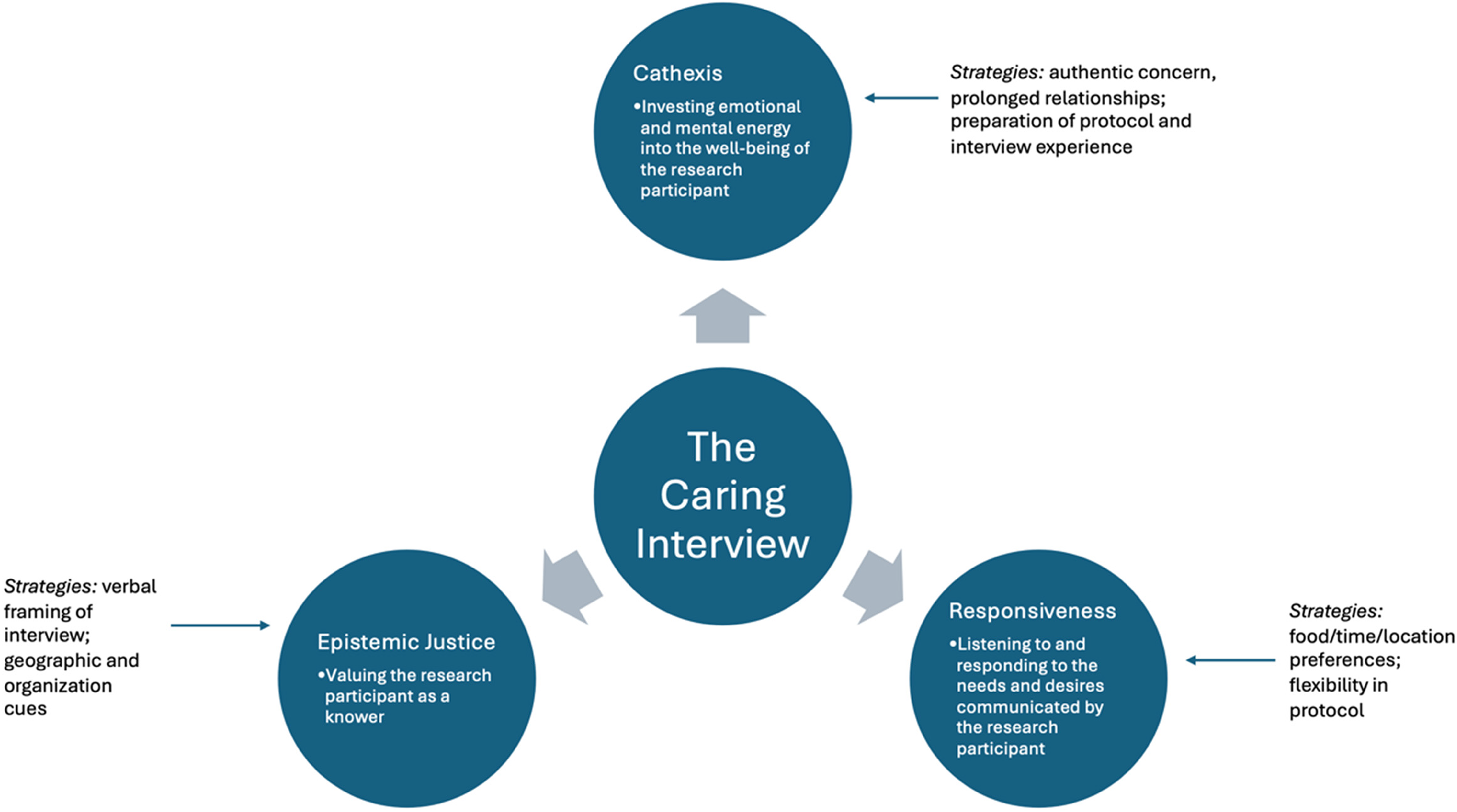
Working model for the caring interview.
This section presents this working model of a caring interview through two transformative studies conducted by the authors. We refer to the two studies as the Touchy Topics Tuesday (TTT) study and the Local High School (LHS) study. The TTT study was an interview study, led by Olivia Marcucci (first author) and Mrs Tiffany Robertson, TTT's founder, about a grassroots, antiracist educational program. The LHS study is a critical ethnography, led by Rowhea Elmesky (second author) with secondary leadership by Olivia, with a predominantly Black high school in the Midwest of the United States. After overviewing each research project, we walk through the working model of caring as an interview ethos, exploring how we did or did not enact these ideals in each project.
Study overviews
The TTT study
TTT is a grassroot, antiracist educational organization in St Louis, Missouri, founded by Tiffany Robertson. In 2014, Darren Wilson, a White police officer, shot and killed Michael Brown, an unarmed Black teenager in Ferguson, Missouri. When Wilson was not indicted for Brown's killing, Mrs Robertson, a Black woman and mother of five Black children, founded TTT, a grassroots education group focused on sustained interracial dialog. At the time of the study, TTT ran weekly dialogue groups throughout the St Louis metropolitan area. The dialogue groups met for two hours and were ‘intentionally integrated,’ which later became part of the mission of TTT. The dialogue groups interrogated ideas of Whiteness and race, often using discussion prompts about topics like transracial adoptions, a Shepard Fairey art show, or specific incidences from the participants’ lives. Around 8–10 people were assigned to each dialogue group, although the model was dynamic and shifted throughout the years.
Mrs Robertson approached Olivia for a research collaboration, understanding that university-based research is often seen as legitimizing to grassroots organizations. Following models of participatory inquiry (Cornwall and Jewkes, 1995), Mrs Robertson and Olivia developed the research objectives in collaboration. The study focused on the participants’ self-reported motivations for joining TTT and the participants’ self-reported outcomes from participation. Olivia designed the interview protocols and solicited feedback from Mrs Robertson. In total, 30 participants (n = 30) were interviewed via Zoom as data collection took place at the height of the COVID-19 pandemic. Along with Olivia and two other university-based researchers, Mrs Robertson and another TTT participant engaged with the writing and framing of the analysis and are coauthors on study (Marcucci et al., 2023).
The LHS study
The LHS study is a longitudinal critical ethnography with a school district in a midwestern city in the United States starting in 2014. The data collected over the duration of the study has focused on documenting and helping the district and its high school, LHS, in making a cultural shift from one that is punitive to one of restorative humanization of their predominantly Black student population. Early work established that the (predominantly White) LHS staff struggled to connect with their Black students (Elmesky & Marcucci, 2023; Marcucci & Elmesky, 2024), leading to a culture of disrespect, dehumanization and prevalence of antiblackness (Marcucci & Elmesky, 2016; Marcucci & Elmesky, 2023).
In this study, we were focused on the documentation, analysis, and the transformation of discriminatory aspects of LHS. By ‘documenting, critically analyzing, and acting on—indeed, changing—the discriminatory practices’ (Barton, 2001: 914), our research became one mechanism to shift the oppressive nature of the school. To fully and critically understand the nature of what was unfolding, the critical ethnographic framing integrated a coparticipatory research model with administrators, teachers, and students, in addition to video recording classrooms to identify vignettes that could be utilized for further analysis/reflection during restorative research circles/cogenerative dialogs. While the project used more than just interviews as a data collection method (see Table 1 in Elmesky & Marcucci, 2024 for a comprehensive review of the LHS dataset), our focus here is on the unstructured and semistructured interviews in the data corpus (31 one-on-one semistructured interviews; 21 group interviews).
Caring as cathexis
We argue that the transformative interview should first and foremost enact caring through cathexis (Hooks, 2001). Cathexis, derived from psychoanalysis literature, is the act of investing mental and emotional energy into something (Izard, 2013; Peck, 2012). Cathexis could be applied to another person, an object, a symbol, or an idea. Historically, the term itself is debated. Early translations of Freud's work using the word ‘cathexis’ were later accused of being overly esoteric (Hoffer, 2005). The term has been used to describe a range of psychosocial states, sometimes with negative valence (e.g. Federico, 1963; Secord and Jourard, 1953). hooks (2001), however, brings the term back into nonpsychoanalytic conversations to understand cathexis's relationship with love. hooks is clear that love and cathexis are not synonymous, but she does point out that caring is often operationalized through cathexis. In essence, we use the term to communicate an emotional and mental investment in both the interview interaction and the interviewee. Recognizing that a caring interview demands some emotional investment in the people with which knowledge is constructed rubs against positivist notions of objectivity (Schrag, 1992). In other words, the interviewer should invest mental energy and emotion into the relationship, beyond thinking of it as a potential moment of data extraction. A caring interview demands that the interviewer cathects the interviewee and the interview interaction.
In the interview interactions themselves, an authentic concern for the well-being of the interviewee is a sign of cathexis. Our relationships with our research participants (or co-researchers, as they were referred to in the LHS study) extended beyond the temporal boundaries of the interview space. In both the LHS and TTT interview interactions, authentic concern often showed up in the preparation for the interview interaction. Cathexis requires investment in emotional and mental energy before the interview interaction takes place. For example, during the TTT project, Olivia and Mrs Robertson spent considerable time thinking through if and how racial matching between interviewer and interviewee would be important—important not only for the empirical knowledge constructed through the interviews but also for the concerns for the well-being of the interview participants, given the ‘racially oriented’ topics of the TTT interviews. The behind-the-scenes conversations indicated emotional and mental investment in what would create the most comfortable experience for the interviewee. While racial matching is a debated methodological choice (Archer, 2002; Marcucci, 2024; Osanami Törngren and Ngeh, 2018; Rhodes, 1994), in this case, the cathexis in this decision seemed to resonate with some TTT participants. As one woman of color said to her TTT interviewer, ‘I’m glad you’re not White.’
Further preparation into cultivating an interview protocol—semistructured or otherwise—can indicate cathexis. This is particularly true for interviews that are not part of a prolonged relationship—often a hard-to-reach ideal in transformative research (Elmesky, 2007)—when all relationship-building needs to occur within the temporal boundaries of the interview. Consciously structuring the protocol to range from less vulnerable questions to more vulnerable questions shows a mental and emotional consideration into the well-being of the interviewee. For the TTT interview, for example, early questions in the semistructured protocol asked questions like ‘How did you hear about TTT?,’ a relatively light and nonvulnerable question. Later questions explored racial identity and experiences with racial justice and demanded more vulnerability from participants. For example, questions in the second half of the interview included, ‘Because TTT focuses on social identity, it would be helpful if we know how you identify racially. Would you feel comfortable sharing your racial identity? If yes, what is it?’ and ‘Are there any other aspects of your social identity or personal story that you would like to share?’ This attention to the emotional experience of the participant is not only best practice for data extraction but indicates a caring about (or cathexis of) the participant's phenomenological experience of the interview. It centers the researched not just as a source of data but as a human being with a robust emotional life.
Importantly, a caring interview needs not only to showcase an authentic concern for the well-being of the interviewee, but the caring interviewer may also need to mobilize resources to support an interviewee's well-being. While cathecting refers to the dedication of mental and emotional energy, that energy can often manifest in resources, financial and otherwise. In simple ways, this could be a generous incentive to compensate interviewees for the time and energies, if grant or other funding is available for the project. If financial resources are not available, researchers can provide other resources, such as time. During a Teacher-Researcher Residency, a space designed to learn from teacher-researchers in the LHS study, we learned about the struggles experienced by one of the teachers. 4 For a semester in Spring 2017, we cotaught every meeting of the class period that she struggled the most with. We embedded frequent informal interviews with the teacher and with some students during the coteaching, but most importantly, we invested our time (a valuable resource) both within and outside of the interview interactions. Mason (2023) argued that ‘staying’ beyond the temporal boundaries of a research project can be a ‘positive endeavor’ when mutually desired by the researcher and the researched. As Mason (2023: 720), ‘presented ‘staying’ as a productive relational practice with potential ethical affordances, derived from deeper affective ties and enhanced opportunities for reciprocity, rooted in purposeful investments beyond research.’ It is this type of ‘staying’—or cathecting via time—that we engaged in with this particular LHS teacher. We never published from this coteaching experience, as our concern first and foremost was how to provide the students with a humanizing experience and support the teacher in creating better relationships. We share this example because it showcases our investment in the well-being of the students and struggling teacher and our willingness to mobilize the mental, emotional, and other resources we had at the time.
Importantly, cathexis can at times indicate an over investment in something, as evident by the large body of psychological literature that uses the term to describe body cathexis and its relation to disordered eating (e.g. Priebe and Röhricht, 2001; Sertoz et al., 2009). It would be irresponsible to tout cathexis as a desirable characteristic of a caring interview, without simultaneously including a word of caution. While emotional investment in interviews and interviewees can be life-giving and inspiring, it can also can be tiring and lead to burnout (Lustick, 2021), which can ultimately shorten the length of our careers and our capacity to co-create and support transformative research projects. There can and should be boundaries around cathexis as an interview technique. In reality, we cannot only volunteer in struggling teacher's classroom schools with no path toward publications or some other way to institutional success and job security. When enacted authentically and sustainably, however, cathexis is a critical characteristic of a caring transformative interview.
Caring as responsiveness
The second characteristic of a caring interview is responsiveness. The idea of ‘responsiveness’ (Noddings, 2005) or ‘authentic caring’ (Valenzuela, 2010) is central to many anticolonial theories of care and implies that the carer must listen to and respond to the desires and needs of those being cared for. Rather than assume what the cared-for needs, the carer must take careful consideration of what the cared-for communicates. It is intimately related to the idea of cathexis—in that the interviewer must invest mental energy into understanding the desires and needs of the interviewee—except that it adds an element of anticoloniality (Paris and Winn, 2013). Responsiveness is anticolonial in that it rejects a paternalistic complex that some researchers may approach the researcher–researched relationship with, particularly when researching populations that experience the brunt of oppressive systems. Instead, responsiveness centers the agency of the research participant, in small and large ways.
Our prolonged engagement with the LHS community and our close relationship with many of the participants made this responsiveness easy at times. For example, in a series of three group interviews with students in a student-researcher residency, where students were compensated to learn about restorative justice and qualitative data analysis, Olivia asked the students to decide on what lunch to bring each time for the meetings. In this simple act, Olivia responded to the students’ expressed desires and motivated resources to fulfill them. Frequently when we had repeated interviews with an individual or group, we would ask their preferences for food ahead of time. In another example, Rowhea was interviewing a student, James, in Spring 2017. James told Rowhea that he was struggling in math and looking for a math tutor. She then worked with him to find and pay for a math tutor and set up several sessions afterschool at the LHS library. Her focus was not on the extraction of data from this one-on-one interview with James but on his expressed needs in that moment. Importantly, she motivated resources—unrelated to her professional advancement—to attend to James's needs, which intersects with our operationalization of cathexis. As Laura (2013) articulates in her intimate inquiry, Rowhea ‘witnessed, engaged, and labored with’ (emphasis added) James in this moment, as he negotiated through a school system with suboptimal cultures for his mathematical advancement.
These examples are contextualized within a longitudinal project where relationship-building was a central feature. Using the one-off interview interaction, however, as an opportunity for responsiveness can be difficult. That said, even without an extended relationship that develops through ethnographic or participatory methods, the interviewer can still be responsive through simple acts like deferring to the participant's choice for a time and location, but also—as the one-off TTT interviews showed—through a flexible interview protocol. While Olivia attempted to demonstrate cathexis through the thoughtful and strategic planning of the semistructured protocol in TTT, she also attempted to demonstrate responsiveness through the flexible style of interviewing. Semistructured interviews inherently allow for some flexibility—for example, in the TTT study, the interviewers used their discretion to change the order of questions depending on the participant's previous responses. That said, we can strategically demonstrate responsiveness by allowing the participant to guide the conversation. There are certainly limits to this operationalization of responsiveness—in many projects, there are specific objectives that need certain data in order to be addressed—but when possible, we argue that a responsive interview would be one that allows the participant to communicate what they believe is important and relevant, rather than doctrinally subscribe to a protocol as designed by the researcher. These are simple actions but when enacted with intention, can effectively communicate an ethos of care to the participants and therefore maximize the interview's transformative potential.
Caring as epistemic justice
Building on the idea of responsiveness to the intellectual desires of the participant, the third way to enact care is by designing the interview interaction to level the intellectual power dynamics inherent in research interviews. This leveling can be a marker of epistemic justice. Epistemic justice refers to the equal valuing of individuals as knowers (Fricker, 2007). It implies treating the knowledge that research participants produce with equal value as the knowledge produced by researchers. In many ways, it is inherent in the transformative research paradigm, which often upends the typical power dynamic of researcher-as-knower and research-participant-as-data-source. We specifically frame epistemic justice as caring based on the literature around politicized caring (McKinney de Royston et al., 2017, 2021). Politicized caring between individuals—or what Fricker (2013) would call ‘nondomination’—demands an epistemic equality between the two knowers (a.k.a., the researcher and the research participant). In other words, to care about someone is to have ‘political clarity’ (McKinney de Royston et al., 2017, 2021) about their experiences in the world—including their engagement with the sanctioned and esteemed production of knowledge—and to be ‘potential affirming’ toward them. As such, a caring interview must center epistemic justice.
In an interview, epistemic justice must be consciously communicated nonverbally, paraverbally, and verbally, but more so must be a mindset with which interviewers approach the interview interaction. In the first wave of LHS focus groups in Spring 2015, we presented quantitative analyses of the school's disciplinary data, expressly to elicit their interpretations of the data. While these early focus groups honored the stakeholders’ epistemic contributions, we questioned if that structure optimized the catalytic authentication of the group interview space. This was in part because we were using the interview interaction as a point of data extraction, rather than an opportunity to level the intellectual power dynamics. While the findings of the traditional focus groups from the beginning of the LHS study came to have important implications when communicated to the administrators and school board, the focus group spaces failed to deliver on the ideal of leveling intellectual power dynamics. This leveling of power dynamics is inherent in participatory projects (Call-Cummings et al., 2023), but we specifically frame it as an act of politicized caring, based on McKinney de Royston et al. (2021) conceptual work around ‘affirming potential.’
As the LHS study evolved, we moved instead toward restorative research circles or cogenerative dialogs as a way to engage in group interviews. These models of group interviewing inherently remove the intellectual power dynamic, therefore, by our definition, more easily enacted an ethos of care. While they still were planned thoughtfully with semistructured protocols, they used certain geographic, organizational, and verbal signals to communicate an affirming of the intellectual contributions of the research participants. For example, during one part of the LHS study, we video recorded Mr B's foreign language classroom (Marcucci & Elmesky, 2023). When it came time to review the video data with the students in Mr B's class, Rowhea led restorative research circles, starting the second one by saying: I can’t reiterate how insightful and how much I’ve learned by being in this–by having this opportunity to talk to you all. So, I really genuinely and sincerely thank you. I also hope that you have gained and [feel] like it has been a beneficial experience for you … I talked to you about the idea of collaborative research. The idea is that the type of research is … is research that is transformative to everyone that is involved.
In one-on-one interviews, however, there are fewer nonverbal (i.e. geographic and organizational) indicators to communicate this leveling of intellectual power dynamics. As such, framing comments, like the one Rowhea said at the beginning of Mr B's class's restorative research circle, are critical. In the TTT study, Olivia concluded one of the interactions by saying: Awesome, well thank you so much for all your insights and all your stories that I really appreciate hearing about them and learning so much. And if there's anything else you do think … is important for me to include in the research project, just shoot me an email and I would love to include it.
While they may seem like trivial moments of interaction, in reality, these types of framing comments have the potential to communicate the underlying—and in other ways unspoken—ethos of epistemic justice within an interview. [First author] expressed gratitude, positioned herself as the learner, and left the door open to continue the participant's contributions. This was the standard practice in how [first author] concluded one-on-one interviews in the TTT study. In other TTT interviews, she said ‘such a beautiful story to illustrate the definition’ or ‘Is there anything else you would like to add that you feel like we didn’t fully capture in this interview?’ The honoring of the participant as an equal intellectual contributor is an important moment of epistemic justice (Fricker, 2007), affirming the potential (McKinney de Royston et al., 2021) of diverse individuals’ contributions to the knowledge construction process.
Similarly, using the interview space to cultivate the research participant's identity as a coresearcher, is an act of epistemic justice. Rowhea frequently referred to the students in Mr B's class as co-researchers and used that restorative research circle to cultivate their identities as researchers and knowledge producers. In a one-on-one interview during the LHS study, we interviewed Mr A, a teacher who had participated in the Teacher-Research Residency (Marcucci & Elmesky, 2023). He had actually moved to a new district so we had not interacted in over a year. The first fifteen minutes of the interview was spent catching up on his new position and new district (demonstration of cathexis). The intention of the interview was to understand his insights into a few videoed moments of his classroom management strategy. Throughout the interview, we spent time explaining complex analytic processes (ethnographic microanalysis) in order to elicit his fully formed introspection of the video clips. In doing so, our aim was to recognize his intellectual investment in his teaching practice and honor his experiential knowledge. There was no sense that he would not be able to engage in this type of scholarly conversation. He was treated as an equal coresearcher, and we worked together to develop analytic tools during the interview space to understand the videoed clips of his classroom.
What are the implications of conceptualizing the caring interview?
We present a three-pronged model of a caring interview. We argue that caring can manifest through (1) cathexis, (2) responsiveness, and (3) epistemic justice, before, during, and after the temporal boundaries of a qualitative research interview. Further, we argue that operationalizing care in these three ways can optimize the social–emotional and political transformative potential that an interview can have. Since it is difficult to directly measure an impact of an interview post-hoc, we use theoretical arguments to support our main thesis. This working model can be used as a planning and reflection tool for researchers invested in transformative projects. If researchers do adopt this working model, what are the implications for research, educational practice, and the world if we frame caring as a transformative interview standard? While this line of inquiry could fill books, we focus in this section on the implications for both the researcher and the institutions supporting these interviewers.
First and foremost, there are ethical implications for operationalizing the caring interview, namely around recognizing the boundaries of it. Caring research interviews should not take the place of or be confused with therapeutic interviews. Rossetto (2014) suggested that researchers and therapists use similar techniques, including paraphrasing, probing, and non- or paraverbal indications of active listening. All these techniques support empathy and could even facilitate the three-prongs of the working model presented here. That said, Rossetto (2014) and Minikel-Lacocque (2019) still defined the boundaries between therapy and research interviews, even while they allow for some therapeutical benefits. As Rosetto wrote, ‘therapists become authority figures, responsible for life changes … and improvement … they seek to enable affective experiencing, cognitive mastery, and behavioral regulation …. Qualitative research interviewers are more equal partners in an intersubjective storytelling experience’ (p. 483). Minikel-Lacocque specifically stated that researchers should know when and how to refer a research participant to a mental health professional and should not attempt to take the place of a trained therapist. While further research articulating the exact boundaries of this approach may be necessary, for a starting point we offer the following boundaries: qualitative researchers using this caring model should not offer life or medical advice nor should they work with research participants to change thought patterns or behaviors. While leaning into caring as an interview ethos may blur the lines between research interview and therapeutic interview, it is imperative that researchers understand the boundaries between a trained mental health professional and a qualitative researcher.
In addition to the ethical boundaries of this interview ethos, this working model has implications for how we attend to and train in interviews as emotional labor (Fisher and Monahan, 2023; Hoffmann, 2007). Many of the ethnographic traditions have not shied away from recognizing the emotionality of research with human subjects. Owton and Allen-Collinson (2014: 284), for example, ‘contend that emotional involvement and emotional reflexivity can provide a rich resource for the ethnographic researcher, rather than necessarily constituting a methodological ‘problem’ to be avoided at all costs.’ Others in the ethnographic tradition have grappled with the emotionality of qualitative fieldwork (Capurro, 2021; McQueeney and Lavelle, 2017). That said, conceptualizing caring as a defining feature of a transformative interview demands even more respect and attention to the emotional labor, particularly as we operationalize cathexis in this model.
Not only does this working model have implications for how qualitative researchers are trained for sustainable and long-term careers, but it also has implications for demands for quantification in research productivity. It is not reasonable, for example, for a qualitative researcher embedded in transformative research methodologies to be expected to have the same numerical output of publications for a successful promotion review as a quantitative researcher using secondary data analysis. Laura (2013: 282) argues how ‘intimate inquiry’—a framework broader than caring in transformative interviews but related—forces researchers in a tension between the ideals of intimate inquiry and ‘struggling to maintain productive ‘academic’ lives in the interest of legitimacy, collegial respect, and professional marketability.’ Particularly given the neoliberal pressures of academic research funding, the ideas of caring in research—and even in transformative research paradigms in general—seem distant. Bennett and Brunner (2022: 86) articulated similar tensions, where they found the need to articulate a ‘buffer zone’ for researchers engaged in ‘collaborative action research.’ This buffer zone provides a recognition of the relational and political work involved in transformative research, which historically have ‘conflict[ed] with pressures on researchers to achieve outputs with the greatest academic value such as high-ranking journal articles.’
As a theoretical model, this three-pronged approach would benefit from more methodological research. First and foremost, understanding how researchers themselves enact caring could help substantiate this theory. An interview study discussing qualitative researchers’ sensemaking around care, particularly the boundaries between therapeutic interviews and research ones, would flesh out this model. Further inquiry into the role of institutional support for transformative researchers would also help reify equitable promotions criteria, which has implications for the construction, democratization, and sharing of knowledge via university mechanisms. How can the academic institution value this approach and view the research process as a mutually transformative opportunity for caring?
Conclusions
This article presents a working model of a caring interview. It builds on decades of philosophical and methodological commentary on caring to (a) layer it onto conversations about transformative research and (b) concretize a tool with which researchers can self-evaluate. The tool should be used for reflection and planning by researchers invested in diverse transformative research projects. While lots of extremely influential methodological guidance has come from feminist and anticolonial methodologists, we offer that this idea of caring—when enacted with cathexis, responsiveness, and epistemic justice—provides an opportunity for mutual transformation. This is our main contribution to this important lineage of scholarship.
The interview interaction is a powerful social moment. It can be transformative for both the interviewee and the interviewer, as well as the communities that surround them. We argue, however, that researchers can maximize its transformative potential if the interview is ethically planned and conducted following the three characteristics of a caring interview outlined in the article. All three characteristics can be imperfectly enacted through the interview interaction in isolation, but the interdependent centering of these characteristics, we argue, has the potential to maximize the transformative nature of qualitative research interviews.
Footnotes

Funding
The authors received no financial support for the research, authorship, and/or publication of this article.
Declaration of conflicting interests
The authors declared no potential conflicts of interest with respect to the research, authorship, and/or publication of this article.
Notes
Author biographies
Olivia Marcucci, PhD, is an assistant professor at the Johns Hopkins University School of Education. Her main area of research is in race, racism, and racial bias in the U.S. school setting, with particular attention to school discipline, social control, and restorative justice.
Rowhea Elmesky, PhD, is an associate professor of education at Washington University in St. Louis. She uses critical and collaborative research models that interlink theory and practice in ways that transform teaching and learning contexts, schools, neighborhoods, and communities.