



Abstract
Documentary films potentially provide a rich source of secondary data on societal phenomena. As novices and ‘fools’ we first used documentary films as secondary data during the extended COVID lockdown. We describe in detail the methods used in two case studies. Each focuses on a different environmental theme and one uses documentary films to supplement two additional sources of secondary data while the other uses films as secondary data to compliment primary data. As novices we made many mistakes, most notably failing to engage with the rich literature and theorising on documentary films. However, we learned much from the process, including that documentary films as secondary data provide valuable insights on social issues being researched.
There is an embarrassment of riches in documentary film resources.
(Belk, 2011: 405)
Introduction
The ongoing COVID lockdown was the context in which we started to use documentary films as secondary data. We were complete novices and our initial literature search confirmed that documentary films or audiovisual materials 1 produced by mass media have been underutilised or overlooked by social scientists as a source of data (Belk, 2011; Nisbet and Aufderheide, 2009). Although we did not find much information about methods (selection criteria, data collection, observation guides, analysis, etc.), we decided to go ahead and include some documentary films as one form of research data in two graduate thesis studies. Indeed, fools rush in where angels fear to tread! However, we found solutions to the methodological questions, constructed our own observation guides and managed to conduct in-depth qualitative research in spite of our ignorance – in fact, we enjoyed the process and came to the conclusion that documentary films can be an excellent source of secondary data. The objective of this ‘Notes’ paper is to share the methods we used in the two case studies, the mistakes that we made and our reflections on what we learned in the process – and to encourage others to explore the use of documentary films as secondary data.
Documents (textual) have long been considered legitimate data for qualitative research, though Bowen (2009) stresses that typically documents are used as supplementary data rather than the sole source. Lewis and Atkinson (2025) promote documents as socially generated and therefore worthy of ethnographic analysis. This insight could be extended to the analysis of documentary films. Belk (2011) contends that researchers should use audiovisual materials in the same way they use books, journal articles and documents, that is, as a rich source of data in qualitative research. Possible reasons for the underutilisation of audiovisual sources include that they may be viewed as ‘less scientific’ and that researchers are biased towards using textual sources (Belk, 2011: 405). Other challenges identified in the use of documentary films as data include the need for awareness of which social groups were included and which were not represented, and which facts were stated and which were not reported (Rouleau, 2024).
Use of documentary films in research
While documentary films are used in many disciplines, three dominate: ethnographic films (often made as part of data collection i.e. primary data) (Callahan, 2015; Fitzgerald and Lowe, 2020; Franzen, 2013), films used as pedagogical tools for example for assessing professionals in training (Hilburn et al., 2021) and in media studies (Downing et al., 2004). However, we discovered it is also possible to use commercially produced documentary films as secondary data, as a source of information related to a research question. Researchers writing about the use of audiovisual material as secondary data are clear to distinguish between two different ways of using such material: firstly as an object of research in itself, and secondly for the information it provides on the social phenomenon being studied (Figueroa, 2008; Warmington et al., 2011). When a film itself is the object of research, the focus of study may include the process of its creation or its technical features or, for example, whether the director of the film chose to present the material in a style that is observational, participatory, reflexive or performative (Figueroa, 2008; Nichols, 1991; Warmington et al., 2011). Figueroa (2008) labels this as the AVO-perspective (audiovisual data as the object of analysis) and notes that the intentions and strategies of the filmmaker are important. We found studies where the analysis focuses on differences in the role (performative or not) and ‘voice’ of directors (Fathoni, 2014); on how discourse is used to identify and justify claims on a topic (Christopher et al., 2018) and one on how the editing and camera work (zooming in and out) nuanced what was being communicated (Viswambharan and Priya, 2016).
In contrast, when a particular societal phenomenon is the object of research, and documentary film is used to provide factual evidence or information on the phenomenon, Figueroa (2008) labels this as the AVM-perspective (audiovisual material as medium). Even when the focus of research is on a particular societal phenomenon, some of the characteristics of the AVO approach will provide analytical insight, for example, how the intentions and underlying assumptions of the filmmaker have shaped meaning or significance given to the phenomenon (Altheide, 1987, 1996). Two articles, both exploring the use of the same two documentary films on the ‘Black Summer’ bushfires of 2019–2020 in Australia use information from the documentaries to inform different objectives: policy and governance issues one the one hand (Fourie et al., 2024) and organisation in extreme contexts on the other hand (Rouleau, 2024). Although they are predominantly using the AVM method, they acknowledge the need to pay attention to production issues as in the AVO method. A group researching the intersection of the social issues of race and drug addiction analysed 64 documentary films made between 1991 and 2008 and, besides information on patterns of race and drug addiction, they also found symbolic inequalities in the filmmaking, for example, in the representation of minorities (Anderson et al., 2015).
Whether the documentary film is being studied as an object in itself or for the information it provides on a societal phenomenon, there are a number of qualitative analytical strategies that have been used in previous studies (Altheide, 1996; Machin, 2007). Since the completion of the two research projects, we have discovered that there is an extensive literature out there under terminology of which we were unaware, for example, ‘visual anthropology’ (Hockings, 1975), ‘multimodal analysis’ (Machin, 2007), ‘visual sociology’ (Harper, 2012), and ‘media analysis’ (Altheide, 1996).
Below, we first describe the two case studies and how we used documentary film as data on societal phenomena, then in the discussion section, we reflect on the mistakes that we as novices made and what we have learned about using documentary films as secondary data.
The case studies
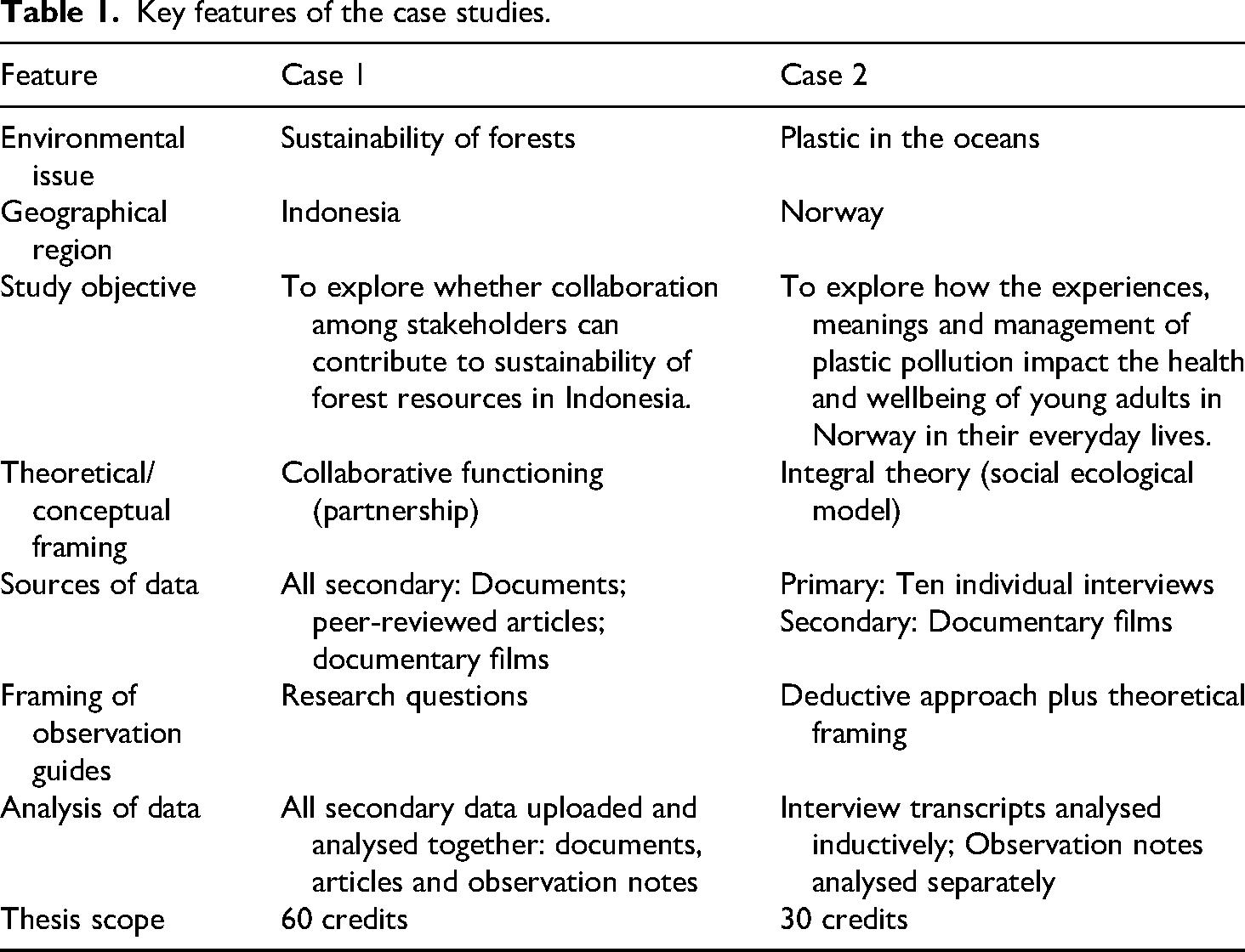
Both studies were conducted as part of graduate research culminating in a thesis; both focused on environmental themes, although the particular issues, geographical region, theoretical framing and approach to the data varied. Table 1 summarises the main features of the two studies, each of which is described in more detail below.
Key features of the case studies.
Case Study 1: documentary films as an additional source of secondary data
In the first case, documentary films were used as one of three different sources of secondary data. This study (Hansen, 2022) explored, firstly, whether collaboration could contribute to sustainability of forest resources in Indonesia through analysing the informal collaborative functioning between all relevant stakeholders concerning the sustainability of forest resources in Indonesia; and secondly, how interactions between these stakeholders affect the wellbeing of local communities and indigenous people. The study was framed by a conceptual model of partnership called the Bergen Model of Collaborative Functioning (Corbin and Mittelmark, 2008).
There were three main reasons for including the use of documentary films as a source of data. Firstly, there was the novelty of using a method which is not widely used. Secondly, the repercussions of the COVID-19 pandemic and the travelling-restrictions set in place to prevent further spreading of the disease, made travelling to Indonesia in 2021 for data collection impossible. Therefore, using documentary films provided a visual insight into the situation, which could not be achieved by travelling. Lastly, the use of documentary films in this study created the possibility that relevant findings might emerge which may not have been covered in other forms of data used. The two other forms of secondary data used were English-language documents of the Government of Indonesia (e.g. forestry laws and development plans) and peer-reviewed literature on the various stakeholders involved in Indonesian forests (e.g. palm oil producers, indigenous people, local communities).
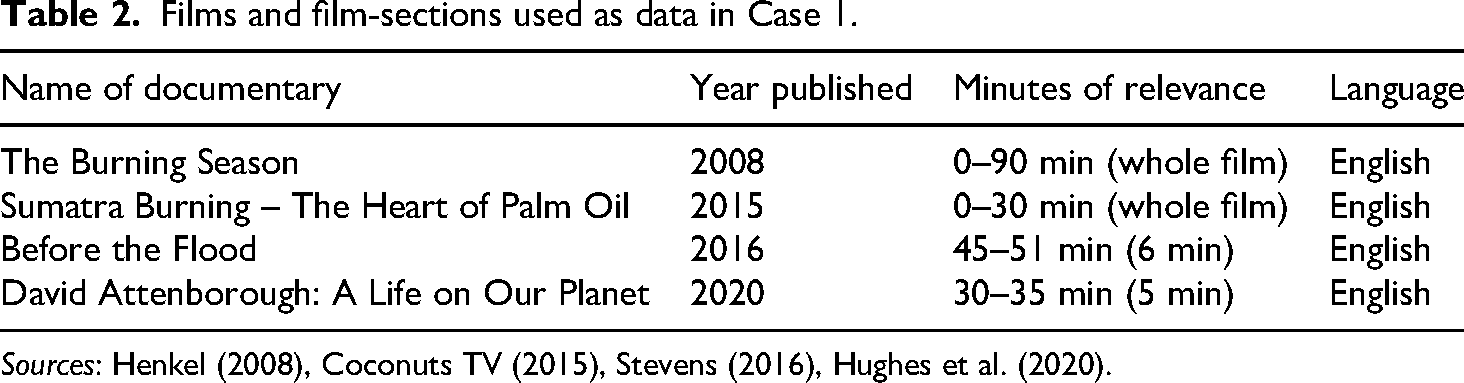
There were two inclusion criteria for selecting the documentary films. Firstly, relevance for the case: because of the uncertainty of how to best utilise documentary films, and not knowing how much time it would take to analyse and code, Hansen (2022) chose to focus on a limited number of relevant documentary films. Whilst some were full-length documentary films, there were others where only specific sections were included as relevant. The second criterion was that the documentary films had to have an official English translation. Table 2 shows the films that fitted the inclusion criteria.
Films and film-sections used as data in Case 1.
At the time of the study, it was difficult to find articles suggesting how to best create an observation guide for the analysis of documentary films so an observation guide, focusing on the research questions, was created (see Figure 1). Later in the research process, Hansen (2022) added two new sections to the observation guide, covering any signs of conflict and/or collaboration, and a section for transcribing relevant quotes. This last section, with relevant quotes and the people who stated them, contributed the most in the observation and analysis. After filling in the observation guides, they were then uploaded to the qualitative software tool NVivo 12 where they were coded along with the other forms of data.
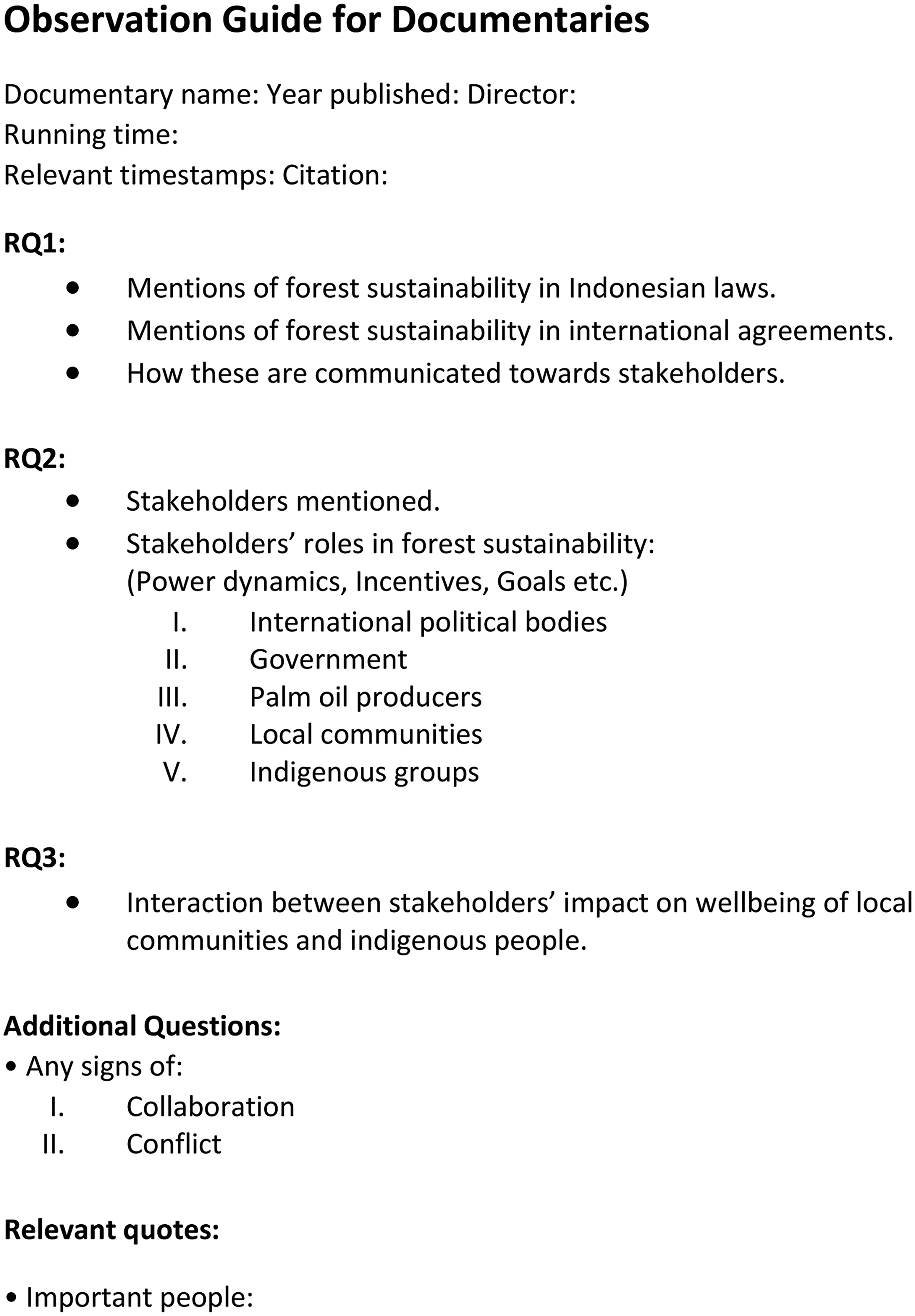
Observation guide for Case Study 1.
Findings from the documentary films have been extensively reported in the thesis (Hansen, 2022) and are thoroughly integrated with the findings from the Indonesian Government documents and from the peer-reviewed articles. Material from the documentary films is often in the form of directly transcribed quotations from the narrator or participants in the films but also includes descriptive observations of the visuals. The inclusion of documentary films enriches the findings and deepens insight into the phenomenon of the informal partnership to increase the sustainability of Indonesian forests. The visual observations provide contextual understanding that would not have been possible had the films not been included as a source of data. This was achieved by noting contextual clues not normally covered in research texts, for example, observable emotions and an informal honesty from the participants in the films.
Case Study 2: documentary films to complement collection of primary data
The second case study uses documentary films as an additional source of data when primary data have been collected, in this case in the form of individual interviews. This study (Bergstøl, 2022) explored how the experiences, meanings and management of plastic pollution impact the health and wellbeing of young adults in Norway in their everyday lives. To grasp this complex issue, one aspect of integral theory (Lundy, 2010; Wilber, 2005), namely the quadrants (see Figure 2), was adopted to approach the individual experiences and strategies, and how these are perceived to interact with community values and policies.
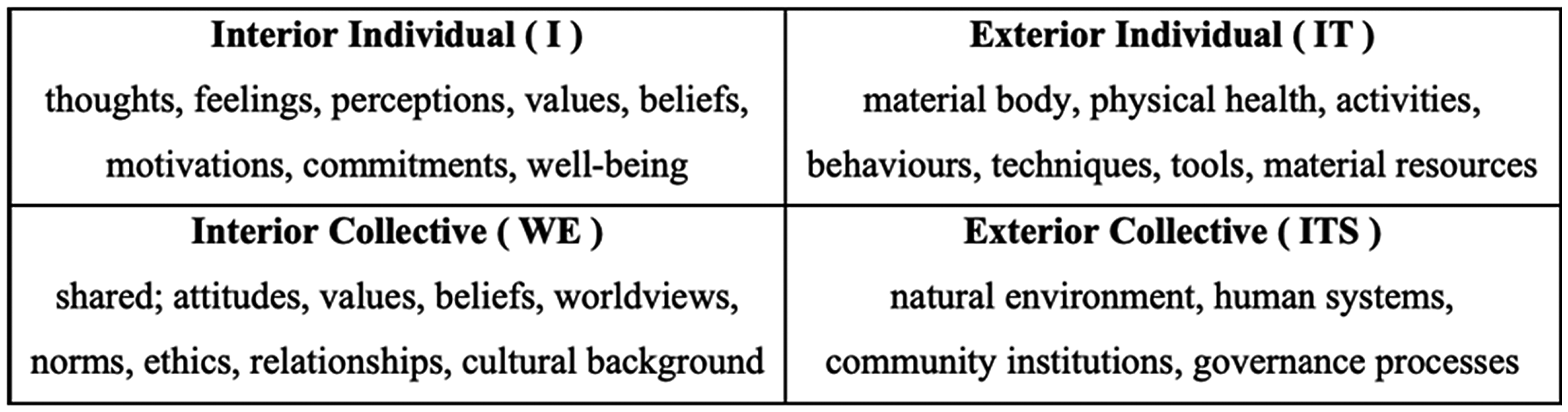
The four quadrants.
Primary data collection occurred through ten individual interviews, evenly divided between those who are actively engaged with environmental sustainability and those who are passively aware. The inclusion of documentary films to complement the primary data was based on their ability to shed light on the plastic pollution challenges through ‘objective’ representations of perspectives and environmental images, for example, providing the view of the phenomenon that everyone experiencing it would have through their sense of sight. Documentary films were in this case utilised for both the participant viewpoints and the phenomenon itself. In other words, the material complemented the interviews by exploring similar or debunking viewpoints, while also exploring (through the researcher lens) how documentaries potentially can affect viewers by presenting visual information about the topic. Since this study did not use prolonged engagement in the field, the observation of documentaries was used to try and mimic this engagement process by viewing body language, facial expressions and feelings of those present in the film. Triangulation of methods granted the exploring of both individual realities, and expressions which are not present in everyday life; meaning that audiovisuals can capture nuances that written or verbal descriptions might miss. This gave a variety of perspectives, making the analysis more comprehensive by featuring people, places and events through a camera lens.
The inclusion criteria for the selection of documentaries included relevance to the topic, and up-to-date information from the region, and materials had to (1) look into how the phenomenon affects human health and wellbeing, and (2) shed light on what Norway is doing about the matter. As there was not much material fitting the criteria, it was an obvious choice. The two Norwegian-language documentary films selected were:
Et hav av muligheter – ‘Ocean of Opportunities’ (NRK, 2020: 3 h 20 mins). This material was chosen for its content of the national scope of happenings and funding, to get an understanding of the amplified Norwegian efforts toward combatting plastic pollution. Plasthavet – ‘Plastic Ocean’ (Bruvik, 2021: 42 mins). A documentary mini-series focusing on how plastic pollution impacts the ecosystem. Episode 3 ‘consequences’ was chosen for its identified focus on environmental and health-related impacts of plastic pollution in the ocean.
Case Study 2, like Case Study 1, also generated its own observation guide (see Figure 3), this time based on the analysis method suggested by Figueroa (2008) which moves from broader to narrower themes, as well as using the quadrants from Integral theory. It starts with exploring global themes through impressions of what is/is not presented; it then inspects the implicit expressions that are underlying in the materials (e.g. presented indirectly) and recognises more concrete examples by looking further into the themes; the third step identifies the emerging topics; and finally, the observation guide also connects the topic to the appropriate quadrant (i.e. relating it to this study's choice of theory).
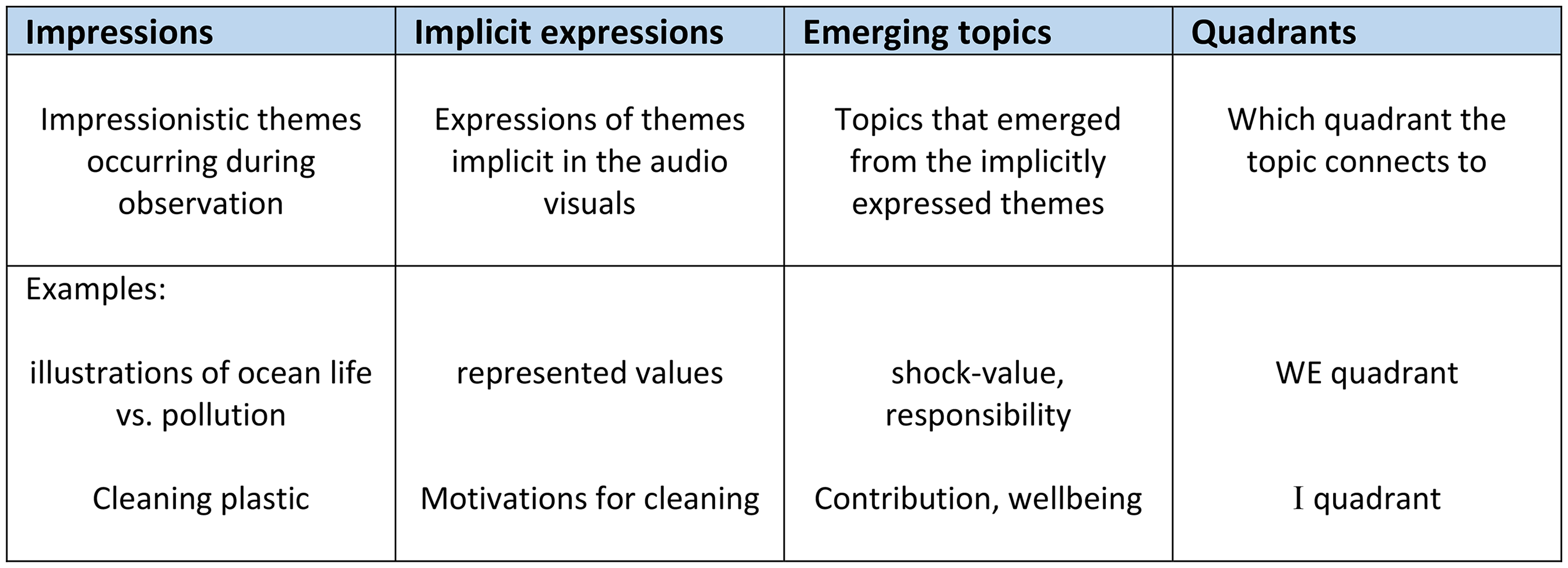
Observation guide for Case Study 2.
The selected documentary films were viewed several times; first, notes were taken on impressions such as cleaning plastic. During subsequent viewings the motivation for this behaviour was observed, as expressed implicitly. Finally, the observation guide framed reasons for the findings and application of theory. In the thesis (Bergstøl, 2022), findings from the interviews were analysed inductively; themes related to the four quadrants in Integral theory emerged and structured the presentation of the findings, with each sub-section presenting one of the four quadrants. Within each sub-section findings from the interviews are presented first, followed by findings from the documentary films. In some cases, the very same themes are discussed from both data sources, but sometimes new themes and information emerge from the documentary films. Data from the documentary films have been used to extend and enrich findings from the interviews, but they have also generated new information and insights to complement the findings from the interviews.
Discussion
Our objective in this article is to share the methods that we used, and also our reflections on mistakes made and what we learned from the process. The two case studies presented above describe the methods used; here we reflect on our mistakes so others may learn from our experiences, and we also consider what we discovered in the process of using documentary films as secondary data – and hope others will be encouraged to do so too.
Reflection on mistakes
In reflecting on our mistakes, we limit our discussion to our two largest and most significant errors, both closely connected to our ignorance and ‘rushing in’. Firstly, we failed to engage fully with the deep tradition and rich literature that exists on documentary films. As mentioned above we were unaware of the range of terminology that applies to the analysis of film or audiovisuals. The article by Belk (2011) cited at the beginning of the paper stating that the use of films has been overlooked and underutilised by social scientists comes from the field of marketing and consumer studies. This is echoed in some other social science fields such as Organisation Studies where Rouleau (2024: 486) mentions ‘the underexploited genre of documentaries used as data source…’. At the time of our studies, we were ignorant of the deep and long-standing tradition of the use of documentary film in social sciences like anthropology, sociology and history. There is an enormous literature on using documentary film as primary data, for example, many ethnographic films are made by anthropologists to document their own data (Henley, 2020), workplace ethnographic films have been used to improve efficiency of technology-use or professional-client interactions (Heath et al., 2010; Ogston-Tuck et al., 2016). Likewise, in sociology, documentary films are made as primary data to observe, document and understand social or population-level issues such as living conditions, social injustices and social movements (Harper, 2012). However, there are fewer studies using documentary films as secondary data and this is perhaps where our study can contribute; we can encourage others to explore the method.
Secondly, with our main focus on the AVM method, we failed to engage sufficiently with how documentary films are theorised. One of the most cited authors in the literature on documentaries, is Bill Nichols, in particular his 1991 book ‘Representing reality: issues and concepts in documentary’ (Nichols, 1991). The title says it all: the filmmaker chooses how to represent reality. Superficial or ‘rushed’ engagement with documentaries often assumes that documentaries show reality, that what we see is the truth (Moon, 2018). Another widely cited author is Grierson who defined documentary as the ‘creative treatment of actuality’ (Grierson cited in Plantinga, 2005: 105). Corner (1996) entitled his book ‘The art of record’. While we did attempt to analyse the films critically, to consider their trustworthiness and credibility, as we would with other qualitative data, we lacked the necessary documentary-related conceptual frameworks that might be present in the AVO method. Nichols (1991) theoretical classification of documentaries is a good place to start. Initially he identified four modes of representation: expository – with authoritative commentary; observational – with no intervention by the filmmaker; interactive (later called participatory) – filmmaker and participants talk to each other, interact, often through interviews; and reflexive – the filmmaker discusses production techniques (Nichols, 1991). Later he added two further categories: poetic (focused on style and technical aspects) and performative (emphasises filmmaker's own involvement with the subject) (Nichols, 2001). Other authors classify documentaries in different ways, for example, Corner (1996) considers ‘action formats’ such as drama-documentary (reconstruction with actors) and verité or fly-on-the-wall modes of documentary. ‘Staging’ could also be regarded as an action format and the viewer's response or interaction is another aspect to consider (Ward, 2006). These categories and typologies overlap and have all received criticism (Villanueva Baselga et al., 2021) but nonetheless they increase the analyst's awareness and provide frameworks for evaluating the role or influence of the filmmaker in documentaries (Ward, 2006).
In topics related to environmental sustainability, filmmakers may wish to present extreme views to shock the viewer or even to ‘stage’ events to the extent of undermining the link between some visuals and reality (Otway, 2015). Warmington et al. (2011: 461) warn against filmmakers’ contentious practices ‘wherein “fact”, “argument” and “persuasion” are bound together’ to rework or exaggerate the significance of an event. Rouleau (2024) highlights other useful points to consider such as how the relationships between the viewer and characters were influenced by the film, which social groups were marginalised, and what facts were included or omitted. In our ignorance we made many mistakes, especially related to lack of engagement with documentary literature and theory.
Reflections on what we learned
In both case studies the authors state that their findings and understanding of the issue were enriched through the use of documentary film as secondary data. The wide availability of documentaries, the ‘embarrassment of riches’ Belk (2011: 405) mentions, through streaming platforms or through social media like YouTube (Mohammed et al., 2023) makes accessing films relatively easy and cost effective (Heath et al., 2010). Rouleau (2024: 486) notes that it is ‘an indirect way of “being there”’ and helps the researcher avoid typical field-related difficulties such as the time involved, and the recruitment of and acceptance by participants. In both case studies, the authors benefited from being able to repeatedly view the films; Heath et al. (2010: 2) note that this allows observation of the ‘fine details of conduct and interaction’ and extend this by describing how films can be analysed from different disciplinary perspectives and theoretical framings. In the case studies, the use of film allowed ethnographic-like observation, and the addition of audio and visual information provided insights which were not available through interviews or textual documents alone. This is affirmed by other authors (Rouleau, 2024). While we applied typical qualitative research trustworthiness criteria to the documentary data, the need to seriously reflect on how the filmmaker is representing reality is advised by multiple authors (Nichols, 1991; Rouleau, 2024). Having had a very positive encounter with the use of documentary films as secondary data, we recommend further use of the AVM approach in social science research.
Conclusion
The objective of the article was to describe how we – as novices and ‘fools’ – have used documentary films as secondary data on societal phenomena, the mistakes we made in the process and what we learned. We have described two case studies with methodological details like selection criteria and design of observation guides. We encourage those tempted to try using documentary films as secondary data in qualitative research to engage with the rich existing literature on documentary films as well as with how documentary is theorised and the implications this has for how filmmakers choose to represent reality. Although their scope, use of theory, analysis procedures and presentation of findings from the films varied widely, both case studies were enriched through the use of documentary film as data: they gained knowledge, insight and understanding of the societal phenomenon being researched.
Footnotes

Funding
The authors received no financial support for the research, authorship, and/or publication of this article.
Declaration of conflicting interests
The authors declared no potential conflicts of interest with respect to the research, authorship, and/or publication of this article.