



Abstract
This article showcases an extensive team-reflexivity process of an embarking transdisciplinary research team in psychiatry. It explores a multilayered tension between the authors, five Dutch researchers with different embodied positions, from diverse research traditions and at different stages of their careers. This article represents a meaningful collision between the rise of horizontalizing participatory research practices, and persistent traditional hierarchies in academic psychiatry. We show how this played out in a hierarchical, transdisciplinary research team, including its emotion work and power ambiguities. Such an intensive and shared reflexivity process is novel, that is, not typical of a responsive research design. The value of this article is that we show and analyze what we have come to call our ‘passible polyphony’: a thorough grappling with multiple perspectives in often disharmonious interactions.
Keywords
Introduction
This article draws on the interactions among members of a transdisciplinary research team in the field of psychiatry. As a team we were collaboratively preparing a responsive evaluation study, that aims to: (i) gain more insight into the multiple perspectives of stakeholders concerning ‘the good life’ of people with psychosis susceptibility in supportive housing contexts; (ii) facilitate dialogue and mutual understanding between stakeholders; and (iii) improve collaborations with and around people with psychosis. Responsive evaluation is a ‘relationally responsible’ research approach developed by Guba and Lincoln (1989), Abma (2006; Abma and Widdershoven 2011) and Bos (2016; Bos and Abma, 2018) and others, in which a diversity of ‘stakeholder concerns’ and meanings are studied in an embodied, dialogical and reflexive way, being sensitive to power imbalances.
In 2019 and 2020, during preparations for a prolonged period of fieldwork with ‘friendship as method’ (Tillmann-Healy, 2003)—an interpersonal research methodology acknowledging overlaps between ethnographic fieldwork and friendship—to be done by the first author (PhD student), we became aware of a methodological parallel between the intended research process and our emerging team dynamics. While we were about to start mapping multiple perspectives—for example of people with psychosis, their relatives and caretakers—we operated from within a team that itself also was characterized by a multiplicity of (sometimes colliding) perspectives and positions regarding our research aims. Similarly to Mathijssen et al. (2021), who studied ‘diversity’ as a diverse research team, ‘we found ourselves (…) entangled’ (56) and divided, especially regarding the question of ‘the good life’ of people with psychosis, even before we started fieldwork. As individuals, we hitherto embodied various (and sometimes blended) positions such as ‘mad’ and hospitalized accordingly, family carer, responsive researcher, psychologist, psychiatrist and policy maker. Due to this methodological parallel, we recognized the need for a reflective approach of our team dynamics, positionalities and of the ways in which we might co-produce and -process the prospective fieldwork data. We aimed to do so, not only as individual researchers, but also as members of a transdisciplinary team, frequently interacting with and attuning to each other. So, we chose to engage ourselves in an extensive team-reflexivity process.
Recent studies have shown how team-reflexivity can be practiced and how it may add value to research, by overcoming resistance and appreciating polyphony (Huq et al., 2017; Wells et al., 2021), counterbalancing power asymmetries (Muhammad et al., 2014), or creating a safe environment for sharing, confronting, (dis)agreeing, and negotiating (Kapinga et al., 2022). However, how we might deal with conflicting views in the context of structural (power) asymmetry in academic teams—other than overcoming (Muhammad et al., 2014) or avoiding them (Kapinga et al., 2022)—remains largely unaccounted for. We draw on a contrasting theoretical position that values an attitude of ‘passibility’ (Brons, 2014; Kal, 2001; Lyotard, 1988) in polyphony, that is of consciously enduring the (sometimes painful) differences without trying to resolve them. In this article, we showcase and analyze our team-reflexivity process, by discussing exemplary dialogs and interactions that occurred in the first two years of our collaboration.
With this article, we aim to contribute to the methodological and epistemological potential of responsive research (and other collaborative research approaches) by engaging with current debates on the horizontalization of research relationships and the destabilization of traditional hierarchies in the academic community. Rather than focusing on (in)equalities and power struggles in the researcher–participant relationship, as is common in responsive research (Abma, 2006; Guba and Lincoln, 1989), we focus on power dynamics within a research team. Thus, in line with Frers and Meier (2022), we pay due attention to ‘hierarchies and inequalities on our own academic playing field’ (661). We specifically report on the methodological aspects of performing team-reflexivity the way we did: extensively grappling with both a plurality of perspectives in often disharmonious interactions, and with the asymmetrical positions within an academic research hierarchy.
The article is structured as follows. A short ‘research context’ is provided to embed our collaborative research project and this article, in broader (psychiatric, societal, academic) developments in the Netherlands. After that, we describe the methodology of our team-reflexivity process, for example our positionality writing, analytical positionality meetings, our use of the concept of ‘polyphony’ (Bakhtin, 1984) as interpretive lens, and we shortly introduce ourselves as authors cum research team. Then, we continue with the application of the conceptual metaphor of ‘polyphony’, by departing from its Open Dialogue definition, that is ‘the coexistence of multiple, separate, and equally valid “voices”, or points of view’ (Olson, Seikkula and Ziedonis, 2014: 5). We take three cues from this definition, as we subsequently touch upon (i) the multiplicity; (ii) the (in)equality; and (iii) the coexistence of voices. By doing so, we focus specifically on three central tensions in our team dynamics: (1) colliding consciousnesses, (2) uncomfortable exchanges in and on power, and (3) personal-professional modes of coexistence. The article ends with concluding that it is both arduous and valuable to make room for a passible polyphony through team-reflexivity. We stress the methodological potential of transdisciplinary team-reflexivity in—frequently contested—academic disciplines such as psychiatry.
Research context: Challenging collaborations in psychiatry and society
In this paragraph, we briefly discuss the main developments in current (academic) psychiatric practice within the broader context of Dutch society, as the background to our transdisciplinary team-reflexivity process.
Recent societal and policy developments increasingly emphasize social participation and inclusion of every citizen encompassing people with psychosis. Particularly the deinstitutionalization and reshaping of services according to the recovery model (Anthony, 1993) represent an ongoing shift in the way that care for people with psychosis is organized (Boevink, 2017). Whereas psychiatry used to be the main player in the lives of the ‘mentally ill’ for decades, nowadays, the importance of family involvement is increasingly emphasized, signaling a move from the clinician–patient dyad to the clinician–patient–family triad. Besides, other societal parties are increasingly involved in the lives of people with psychosis, for example regular housing services, employers, and law enforcement (police). Consequently, for mental health care workers, collaboration across different spheres and domains (family—health care—social care—safety—work) is more prevalent and necessary (Daggenvoorde et al., 2022). New cooperating parties have entered the field, for example community-based mental healthcare teams working with the Dutch model of ‘Flexible assertive community treatment’, and, in the domain of social care, recovery centers based on self-help and peer-support. In this changing mental health care and social welfare landscape, within the force field of mainstream society, collaborative and communicative practices regarding the lives of people with psychosis in supportive housing contexts have become more complex.
Also, in academic psychiatry and psychology, collaborations (in the broad sense of the word) are complex. In line with wider horizontalizing and destabilizing tendencies in science, that is, the rise of participatory and collaborative research methods, traditional knowledge production processes in academic psychiatry have become increasingly contested by those that bring ‘experiential knowledge’ to the table (Russo, 2012; Russo and Beresford, 2015; Weerman, 2016). ‘The scientific theoretical framework of academic psychiatry and psychology is increasingly being questioned’ (Van Os et al., 2021: 727) in the ongoing process of the emancipation of the psychiatric patient. Mad Studies, related to (Critical) Disability Studies, is developing increasingly as a full-fledged academic discipline (Kusters, 2020; Saville-Smith, 2023; Voronka, 2015). As experiential knowledge is critically discussed, advanced, developed, and advocated for 1 , psychiatry's power-knowledge landscape is gradually shifting (Jones et al., 2021; Karbouniaris, 2023).
How we performed our team-reflexivity process
At the start of this research project, we decided to emphasize researcher reflexivity (Bos and Abma, 2021), particularly in Alke's PhD trajectory. Our concerns with reflexivity stem from a (mostly) shared epistemological orientation on knowledge production as a situated, relational, and normative undertaking, in which ambiguity, multiplicity and power asymmetry should be acknowledged. In the responsive evaluation tradition, which informs the overarching research design and methodology, all these elements are recognized (Abma, 2006; Guba and Lincoln, 1989). However, in most responsive studies, the focus for this reflexivity is on the researcher (PhD student) doing the fieldwork. However, since we would conduct this responsive study as a team, and since we knew that fostering democratic dialogues and collaborations within (academic) psychiatry is important as well as challenging (Groot et al. 2022; Van Os et al., 2021; Woelders et al., 2015), we decided that only Alke's reflexivity would not suffice. We decided to start an intensive team-reflexivity cycle, to gain more insight in how all team members would (like to) influence the scope and content of our collaborative research process.
Table 1 shows a chronological overview of our team-reflexivity process, and its overlap with the process of drafting this article. In December 2019, all authors wrote their first positionality piece, responding to the following questions: (1) What and how do I want to study?; (2) Where do I stand in relation to this research topic?; and (3) How is this focus informed by my professional and personal background, training, worldview, image of human(ity), and my beliefs about right and wrong? Consequently, each of us send their positionality piece to the others, to be inquired about in an informal team meeting. We did this firstly as a kind of ‘learning therapy’ (Richard's wording), and secondly to start practicing with the research aims for the prospective fieldwork: Handling multiple perspectives and facilitating dialogue and mutual understanding, to improve collaborations with and around people with psychosis in supportive housing contexts.
Chronology of our team-reflexivity process.
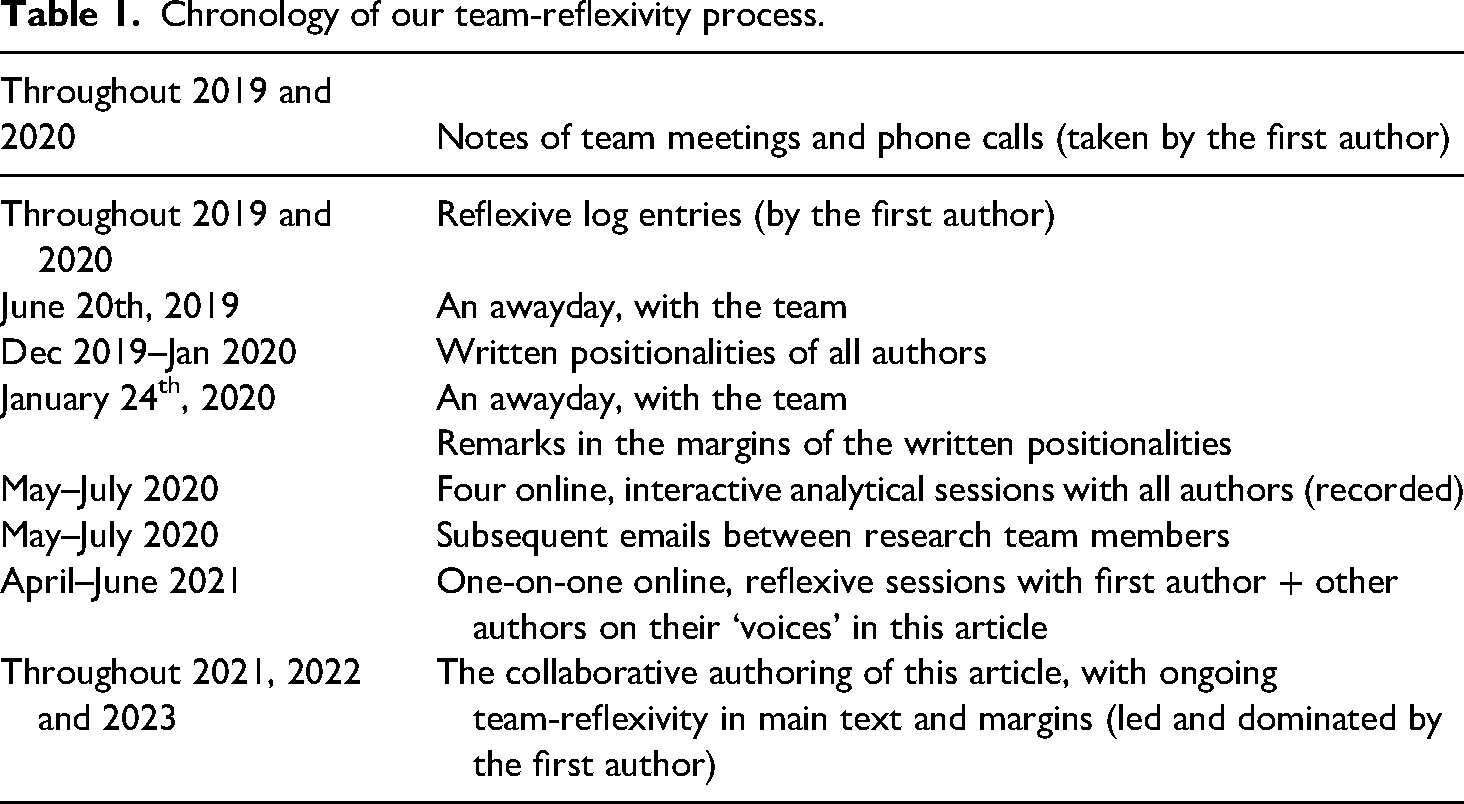
We had two awaydays with the team. On the first we discussed the urgency of team-reflexivity, and on the second we discussed our first written positionalities. To further explore and foster our team-reflexivity, from May to July 2020 we performed and recorded four online, interactive, analytical ‘positionality meetings’ (Kapinga et al., 2022) with the whole team, based on dialogical analysis (Riessman, 2008) and interactive interviewing (Adams, 2008; Ellis, 2004; Tilmann-Healy and Kiesinger, 2001), concordant with approaches to team-reflexivity (Muhammad et al., 2014). In these sessions, we discussed all five written positionality pieces one by one. Guiding questions for these sessions were: (1) What do you notice?; (2) What (feelings) does the text induce in you?; and (3) What would you like to know more about, what questions do you have for (the person whose positionality was central), and what would you like to talk about with them?
Although the challenges that we reflect on in this article started pre-COVID, discussing these team dynamics online—due to the COVID-19 pandemic—proved to put on an extra layer of complexity. The four online analytical positionality meetings formed a rather sharp contrast with the pre-COVID awaydays, that next to critical exchanges also contained a large convivial element. How to handle disagreements, crying on-screen, being angry at someone in the Zoom room? We stumbled, and our interactions were less sensitive, less attuned to each other's needs than we would have liked.
We approached the inquiry of our team-reflexivity as an iterative, creative-relational process, which did not end when we started to write. As Jackson and Mazzei (2013) stress, by systematically coding qualitative data to arrive at ‘stagnant’ themes, one risks losing sight of relevant contradictions and tensions. Therefore, we drew on ‘writing-as-analysis’ approaches such as ‘thinking with theory’ (Jackson and Mazzei, 2013, 2023) and ‘writing in immanence’ (Gale, 2018), which urges ongoing reflection rather than the arrival in a fixed knowing, palpating rather than understanding, experimenting and creating rather than representing or interpreting (e.g. Masny, 2016, drawing on Deleuze).
Polyphony as an interpretative lens
We applied the conceptual metaphor of ‘polyphony’ as an interpretative lens in the iterative process of reflection, analysis, and writing. Polyphony is an important concept in the writings of Bakhtin (1984) on literary theory, specifically in his analysis of the work of Dostoevsky. Polyphony, as Bakhtin theorized this, is: A plurality of independent and unmerged voices and consciousnesses, a genuine polyphony of fully valid voices … not a multitude of characters and fates in a single objective world, illuminated by a single authorial consciousness; rather a plurality of consciousnesses, with equal rights and each with its own world …. (Bakhtin, 1984: 6)
Our, initially intuitive, choice for ‘polyphony’ as an interpretative lens resonates within organization studies (Letiche, 2010; Sullivan and McCarthy, 2008), as well as psychosis research, specifically the Open Dialogue approach (Seikkula and Olson, 2003). In Open Dialogue, a social network treatment approach to psychosis developed in Finland, polyphony is defined as: ‘the coexistence of multiple, separate, and equally valid “voices”, or points of view’ (Olson, Seikkula and Ziedonis, 2014: 5). Power and hierarchy are regularly discussed in Bakhtin's theory of ‘polyphony’, with voices battling for authority. Noteworthy is the nonfinalisability of authority and hierarchy in Bakhtin's analysis (1984). Much in the same vein, our responsive design recognizes the importance of dialogue and polyphony, positionality, plurality and a critical awareness of the (ambiguous) power-knowledge relationship (Abma, 2006).
Embodied positions within our transdisciplinary research team
The authors of this article embody varying roles, capacities, and responsibilities with our research team. The first author (Alke) is a PhD student, cultural scientist, and social work lecturer. She holds experiential knowledge due to the events of psychosis and hospital admission in 2016. The second author (Gustaaf) is Alke's daily supervisor. He is a senior researcher in the tradition of responsive evaluation, and a disability scholar, who specializes in collaborative research, mostly regarding people with severe intellectual disabilities. The third author (Suzanne) is a PhD student and a senior policy advisor at a local municipality, with an education in public administration. The fourth author (Lian) is a senior researcher, already involved in initiating this research study, and a clinical psychologist working in the outpatient department in psychosis. She has a background in cultural analysis, and experiential expertise as a family member, being a sister of a person with psychosis. The last author (Richard), who initiated this research project, is psychiatrist and project leader. By initiating and partaking in this research project he made a radical topical and methodological turn: from biological psychiatry to social and community psychiatry, and from quantitative to qualitative research.
Performing polyphony
In the following, we discuss and analyze various exemplary dialogs and interactions that occurred in the first two years of our collaboration. We apply the conceptual metaphor of ‘polyphony’, as we subsequently touch upon (i) the multiplicity; (ii) the (in)equality; and (iii) the coexistence of voices.
Multiple voices: First practices in polyphony
A symphony with cacophonic undertones
When we merge the first written positionalities of the individual team members into one plural perspective, our collaboration appears to be a symphony with a few cacophonic undertones. These undertones most distinctively appear in the wide variety of ways in which psychosis was viewed within our team. Richard and Lian represented a primarily biopsychosocial perspective on psychosis: a mental illness or disorder, a state of increased (psychosocial) vulnerability, and an abrupt life event, often resulting in a loss of common sensical conventionality (Blankenburg and Mishara, 2001).
In addition to a dominant medical, individualized view, psychosis was also seen as a meaningful phenomenon worth inquiring into, by Alke. Critical to this perspective are emancipatory efforts, such as A Philosophy of Madness (Kusters, 2020) which aims to communicate the overlap of madness with mysticism and philosophy to the wider humanity. Contrary to the established clinical research on compliance, adherence and ‘lack of insight’ of people with psychosis, Alke would rather study ‘Eigensinn’ (Bock, 2006), or follow a Mad Studies’ approach of ‘recovery through resistance’ (Grietje Keller, interviewed by Tijhaar, 2016).
Third, from a critical-ethnographic (Madison, 2005), phenomenological care-ethical perspective (Leget et al., 2017; Vosman, 2023), Gustaaf perceived our prospective interlocutors with psychosis as holding marginalized societal positions. Paradoxically, although people in the margins often lead precarious and volatile lives, their existence also appears to be challenging, unsettling and even threatening to many values, norms and structures of mainstream society (Kal, 2001; Roex, 2019).
Finally, our team held a local government policy perspective (Suzanne). Since the decentralization of the Social Support Act and the Long-Term Care Act in 2015, municipalities have become responsible for the care and support of people with (severe) mental illnesses. For local policy advisors this entails questions around for example how to coordinate care responsibilities, and the capacity of these citizens to belong in mainstream society, to be(come) self-reliant, and to engage in sustainable and meaningful daytime activities (Den Draak and Van der Ham, 2018; Kroneman et al., 2016).
Overall, at the start of the fieldwork phase, our team held quite diverging perspectives on psychosis, and on the suffering of people with psychosis, in terms of psychosis itself and/or due to their ‘treatment’ in psychiatry or by society.
Battle dynamics
Although this plural perspective may seem relatively complementary and harmonious at first sight, the polyphonic interactions within our team often were much less harmonious. Battle dynamics became explicit nine months after the start, in January 2020, when Alke, without consulting the rest of the team, edited her first written positionality piece to be published in a Dutch anarchistic journal. She finalized a draft, and shortly before submission send it ‘FYI’ to her colleagues. Richard added various CAPS LOCK comments in the margins of Alke's draft, which is his regular method for commenting on drafts. However, since this was Alke's first draft to be commented on by Richard, and she not yet familiarized herself with this habit, she was shocked to read how her rewritten positionality piece was received, especially in this (naive, in terms of unintended power assertions) form of feedback from her primary supervisor. This was a major ‘conflict’ (Richard's phrasing) between Richard and Alke.
Content-wise, this ‘conflict’ centered around three topics. Firstly, Richard was triggered by what Alke wrote about her ‘collective approach’ to psychosis: As a cultural scientist, I was trained to study collective processes and mechanisms in society, rather than disorders manifesting in individuals. For example, we can regard psychoses as expressions of the repressed collective unconscious (C.G. Jung, Huub Mous), or as walking into a glass wall of social norms and taboos.
To which Richard responded: Very beautiful, but we’re not concerned with that in [our project].
Secondly, when Alke stated in the spirit of decentering a dominant medical approach: I do not consider psychosis primarily as an illness, I do not especially regard madness as a disorder that has to be neurochemically “attacked”.
Richard, in defense of the medical view, reacted: A psychosis can be many things, but the people our research is about are unfortunate to have a chronic psychotic disorder which does not just disappear …. Of course, people are in continuous interaction with their environment, and context is fueling psychosis, so of course it is not just neurochemistry. But that is no reason to say it is no illness.
The third topic of conflict appeared when Alke discussed stigma and various pejorative assumptions about people with psychosis, and spoke about ‘pill-distributing psychiatrists’ in general. Richard felt professionally and personally offended: I think this is a strangely spiteful description of two of your own supervisors … and many other honorable colleagues. Moreover, I think such a remark is extremely supercilious.
In a shared response to this conflict, the three supervisors decided that Alke's rewritten positionality piece should not be submitted as an article in this form, at that moment in time. Richard and Lian argued that Alke could not independently write about their shared project, yet without them. A second argument, which was important to Gustaaf, and ultimately also to Alke, was that publishing an article like this, before the actual start of fieldwork, seemed overly presumptuous. Arguments aside, what had happened was, for all of us, contradictory to feeling valued for one's view, and for one's contribution to a plural perspective as well as a team effort. Moreover, it was damaging to our budding collaboration in terms of feelings of trust and belonging.
Diverging language sensitivities
Contributing to these battle dynamics is that we had—and still have—such different preferences and sensitivities in language (use). Engaging multiple voices entails a multiplicity in (body) language, words, phrases, discourse, intent and intonation. To be/feel criticized on one's vocabulary could be painful. As Lian expressed in the fourth analytical session in July 2020, where Richard's positionality piece was discussed, such critique could also have a silencing effect, and be the end of an open, candid conversation: What are we still allowed to say? Which terminology may we still use? Is any conversation possible at all when everything is so sensitive? It is as if you need to rethink your choice of words every sentence ten times over. For me that leads to shutting down completely, saying nothing anymore. That might be an outcome.
Several months later, in the beginning of 2021, Lian reflected again, in the margins of a draft version of this paper, on the apparent shared sensitivity to language in our research team. She noted that our preoccupation with discursive frictions might have prevented us from realizing that those very frictions emanated because of a common—albeit diverging—sensitivity to derogative language. When Alke used the word “psychotics”, Richard fiercely objected. I understand that; I too think “psychotics” is an ugly, stigmatizing word which I would never use. If a colleague would use it, I would say something about it. The same goes for “schizophrenic”. Alke uses this. Since she is also sensitive toward language, I assume she uses it as a badge of pride. What stood out for me in this incident, was that the demonstration of sensitivity to language by Richard, was perceived as constrictive by Alke. Yet, language issues are something with this “target population”. I have the feeling that I am already trying to choose my words carefully. And I think we in our research team share a sensitivity to language.
Not reaching consensus
A third apparent unbridgeable aspect of the multiplicity of our voices concerns different expectations of the outcome of the dialogical analysis of our written positionalities. Throughout the analytical sessions (May–July 2020), some team members came to realize that we would probably not reach a (unequivocal) shared position. Lian for example stated at the end of the fourth and final analysis session (in July 2020): Qualitative research analysis sessions that I have participated in were usually like consensus sessions, with the central question “Do we agree on the results that we have distilled from the analysis?”.
In sum, we experienced in our team uncomfortable, disharmonious interactions, even conflict. Our consciousnesses were ‘colliding’, in Bakhtin's (1984: 110) terminology. We experienced this in the collision of our languages, (paradoxically) via our shared—albeit diverging—sensitivity to ‘language issues’ regarding people with psychosis, and we came to realize that fore-fronting a plurality of voices can be something quite different than working toward consensus (Abma et al., 2019).
The equal validity of different voices: Hierarchy and power
Because of the opposing interpretations and their felt consequences within our team, we felt the urge to keep thinking about the ‘equal validity’ (Olson et al., 2014) of our voices in ‘polyphonic interaction’ throughout Alke's PhD trajectory. Were all our different voices heard and validated in a similar manner? In this section, we reflect on hierarchy and power differences between team members, firstly to discuss the tension of multiple voices within the hierarchy of academic psychiatry, and secondly to analyze the experienced emotional (Banks, 2013; Jones and Cutler, 2018; Zembylas et al., 2014) and moral labor (Porter, 2009; Scheffler and Munoz-Dardé, 2005) in talking about power asymmetries in psychiatric practice. We start reflecting on these issues by means of Vignette 1.
Vignette 1: Fighting over a work phone
“Is that your work phone?”, with a telling frown on his face, professor Richard points at the mobile number on the participant recruitment flyer. PhD student Alke waves her smartphone, “No, it is my own, I use it for work as well”. Without hesitation, Richard firmly states that work and private should be kept separate. In his opinion, Alke should have a work phone for her contact with research interlocutors (people with a “psychotic disorder” diagnosis, with some form of housing support). Richard's work phone is off when he is off duty, he is simply unreachable. Then, Gustaaf, Alke's daily supervisor, enters the room. Richard makes his case again and adds: “In your weekends you spend time with your family and friends. That is normal, that is professional. That is how I have managed to last in psychiatry for 25 years”. And he worries: “What if Alke is getting called on Saturday at 7.30 in the morning? Somebody is in the emergency room and has appointed Alke “emergency contact”. Is that then our moment of celebration: “Oh yeah! Friendship as method has worked!”?” Gustaaf: “I wonder if that determines the success of friendship as method”. The next day Gustaaf sends an e-mail expressing his wish to reflect together on everyone's institutionally, professionally and personally shaped views, assumptions, and needs. After the weekend, Richard tells Alke that he needs to protect her and the interlocutors, therefore she must use a work phone. Since he has final responsibility, it is his decision. “Maybe you find that patronizingly patriarchal”, he says, “but it is maternally caring as well”.
This vignette shows how friction related to the (in)equality of voices came to the fore when the project leader (Richard) decided what is good for ‘his’ PhD-student as well as for prospective research interlocutors, based on his own frame of reference as a seasoned psychiatrist.
The tension of multiple voices in a psychiatric academic hierarchy
In the hierarchy of our academic research team, with a professor (Richard), two post-docs (Lian and Gustaaf), and two PhD students (Alke and Suzanne), not all points of view are always found to be equally valid, as is illustrated in Vignette 1. This is partly so because decisions sometimes are to be made, responsibilities are unevenly distributed, and a single course of action based on consensus is harder to reach in a team with multiple voices. Hence, to a certain degree, PhD students operate within a space determined by professors and post-docs. In general, this is also meant to provide a safe environment for them to learn the academic trade. In our team, Richard, as project leader, carries final responsibility for this environment. Although he takes up this responsibility to the best of his ability and based on decades of experience, he is—like all of us—also informed by a particular frame of reference, which inevitably encapsulates intentions, preconceptions, and blind spots. In interaction with Alke, Richard reflectively labeled his course of action in Vignette 1 both as ‘maternally caring’ (his intention), and as ‘patronizingly patriarchal’ (estimating the impact on Alke).
In this instance, the psychiatric hierarchy appeared to trump the hierarchy of the academic context, in Richard's decision-making, as he reflected later, in April 2021: In situations like this, the psychiatric hierarchy is much more dominant than the academic hierarchy. So, within myself I also find a polyphony, and a hierarchy of “voices”. Starting with the dominant voice, these are: physician, psychiatrist, researcher and professor. I am a professor with the premier sense of responsibility of a clinician.
This interplay between externalized and internalized academic and psychiatric hierarchies within a team problematizes Olson, Seikkula and Ziedonis’ polyphony definition (2014), with its conceptual ideal of equally valid voices. After all, in everyday practice, we sometimes need to make decisions such as: A work phone, yes, or no? Discussing this matter made clearer why even though decisions like this affect the PhD student several days a week, the professor carries ultimate responsibility for them. Due to his internal polyphony, he not only wanted to facilitate the PhD student, but also wanted to protect both her and the prospective study interlocutors, people with psychosis, whom he also thinks of as patients, due to his dominant role as clinician.
Emotional and moral work in talking about power asymmetries in psychiatry
In one of our first team meetings, in the autumn of 2019, Richard, Gustaaf and Alke discussed the responsive design (Guba and Lincoln, 1989). Alke and Gustaaf contended that our research plan should include the rights-based and value-driven rationale behind responsive research that is the reality of social injustice (Abma, 2006; Abma et al., 2019), and the dominance of system logic over life-world experience (Habermas, 1981/1995a, 1981/1995b; Kunneman, 1996). By proposing to evaluate the well-intended policies of participation and inclusion by starting from the lifeworld of people with psychosis, Gustaaf and Alke expressed an aim to contribute to social justice and equality. Gustaaf underscored the need to gain emic, personal, and interpersonal knowledge from our prospective interlocutors with psychosis, in order to pursue that aim. After all, we were a priori interested in learning how to collaborate best with them regarding what matters most to their lives, that is actual people in actual precarious situations. Vignette 2 illustrates what happened next.
Vignette 2: ‘The psychiatrist’ does not want to talk about power
“Agreed, there is asymmetry in power”, Richard irritably admitted, “but I refuse to view my patients as powerless. They are more than just victims, aren’t they?!” He explained his view that we would encounter “the power factor” only in the most severe situations in supportive housing. Alke countered with her n = 1 experience of being picked up by the police and her hospital admission to a closed ward. Back then, she did not live in supportive housing, but she did experience the power of “their” language over “us, mad(wo)men” (Kusters, 2004). The next day, Alke sharply scribbled in her reflexive log: “No, of course, the white and middle-aged psychiatrist (male) does not want to talk about power!”.
A few months later, Alke reflected in her positionality piece (December 2019) on her wary anticipation of encountering stifling and silencing effects of power asymmetries, omnipresent, in the supportive housing contexts that she was about to enter: It is my expectation (my prejudice?) that I will encounter mainly compliant people with psychosis in supportive housing, who follow mainstream psychiatry's biomedical model including neurochemical treatment. And who want/have to swallow the (mostly subtle) power exercised over them in language, attitude, treatment.
In Richard's positionality piece (January 2020), his reflection on power asymmetry was limited to the fact that he had ‘learned to see the monopoly of power (read: coercion) (…) as a necessary evil/good, which we as clinicians should use carefully’. Especially for Lian and Richard, as clinicians, there was something very unsettling about the lens of power that Alke and Gustaaf advocated. Richard voiced his feelings about this shortly after the fourth and final analytical session (July 2020), in which we inquired his positionality: By analogy with the privileged middle-aged white male, I almost get the feeling having to apologize for 50 years of antipsychotics distribution by “Psychiatry”.
To view oneself as part of a practice that contains unwanted yet sometimes necessary, oppressive elements, was very unsettling, as Lian said in the analytical session where we focused on Alke's positionality: I do this job, and if I thought it was fundamentally wrong, I wouldn’t be able to survive where I am. Not only am I a clinician, but I have also experienced my brother's psychosis up close. I do my very best. Most mental health care workers can easily feel attacked by the critical way Alke writes.
And Alke reflected, during the same session: Apparently, I am confrontational for mental health care workers with my texts, and it strikes me that I have to take into account their vulnerability. The extent to which professionals feel personally attacked and judged by me, surprises me.
The above also illustrates that in our polyphonic interactions, we were partly reflecting and reflected by each other. It was hard to deal with (some) negativity, with the reproach, rejection and blame (emotion work) that visited most of us during and right after our interactions.
How to coexist, in and/or beyond separation?
In the slipstream of multiplicity and (in)equality, we now turn to the ‘coexistence’ (Olson et al., 2014) of the voices present in our transdisciplinary research team. The methodological choice for ‘friendship as method’ (Tillmann-Healy, 2003) for Alke's fieldwork proved to be provocative within our team, for example it led us to negotiate the personal–professional balance and to reflect on friendly-hostile (Smaling, 2008) dialogs in our academic collaboration. Since an ever-continuing coexistence, in the sense of ‘unfinalizable’ and unbridgeable difference, is both the mark and challenge of polyphony, we analyze the coexistence of voices within our team, as well as an(other) example of multiple voices coexisting within a single research team member.
Coexisting voices within a team
‘Friendship as method’ (Tillmann-Healy, 2003) is a relational–ethical approach to inquiry that deliberately muddies the professional–personal dichotomy, contributing to (more) intimate, humanizing, horizontalizing and reciprocal research encounters. Vignette 1 illustrates how different conceptions of ‘friendship as a method’ produced friction in our team, due to its potential to blur the boundaries between professional and personal/private life (cf. Tillmann-Healy, 2003: 736). Prior to the start of Alke's fieldwork, in the spring of 2020, Richard suspected: ‘You will apply friendship as a method radically, as I do in my consulting room. But outside these walls I don’t’. With regards to the work phone situation, and his wish to protect professional and (inter)personal boundaries, he pondered: Why would you be always available, of why wouldn’t you, from the perspective of a “friend”, a clinician, a researcher? And from the perspective of an employer, the PhD-student with lived experience of psychosis? Who defines the boundaries for whom, who is boundless, who is unduly rigid in this respect: Alke, Gustaaf, or me?
These reflections reinforced a methodological concern for Alke: By getting so personally involved (in the dual role of friend-and-researcher), what is the professional attitude of a researcher working with the method and ethics of friendship? Or, flipping the question: What sort of friend do I want to be, and can I be, as a researcher in supportive housing contexts?
Hence, ‘friendship as method’ forced us to rethink the definition and boundaries of responsive research between academics drawing on experiential knowledge and/or mental healthcare expertise (Wisselink et al., submitted). A similar tension is bound to be present in the prospective relations between research interlocutors and Alke, in which we intend to foster an interpersonal process of inquiry through the practices, at the pace, and with an ethic of friendship (Tillmann-Healy, 2003), yet within inherently limited and goal oriented academic and psychiatric contexts.
Coexisting voices within individual team members
In the single crowd of an individual team member, a multitude of voices is present, each competing for precedence. We can recall the hierarchy of voices within Richard, with his ‘premier sense of a clinician's responsibility’. For Lian the voices of the sister, psychologist and cultural analyst coexist, as she formulated in her positionality piece in December 2019: I often struggle with my professional role, with what I have been trained to do, what is expected of me—to diagnose, to help relieve the individual's symptoms—and how I think the world should be. As a sister, I wish a better life for my brother. I also find my position as a family member somewhat uncomfortable. It plays an undeniable role for me because it is a source of experience from which I draw. At the same time, I am the sister with my college degree, a job and a family, who now uses his story. When is he an instrument, when a brother? When is it his story, and when is it mine? Wouldn't it be better to play a card game with him instead of doing research?
Lian's recurring struggle is a fitting example of the effort that ‘coexistence’ is. For Bakhtin, coexistence meant to keep all (single author's) voices going in an open-ended dialogue characterized by unfinalizability (as interpreted by Morson and Emerson, 1990: 239). According to Letiche (2010), to achieve this (polyphony) is a huge effort. Letiche draws on the work of Spivak (1999), which he calls ‘pivotal’ for the study of polyphony: ‘The challenge of Spivak's work is to try to keep all these conflicting voices alive in the text, interacting and in relation to one another, without all the themes, issues, and perspectives collapsing into a single truth, principle or totalization’ (2010: 263).
Keeping all concurring (and often conflicting) voices alive within our team proved to be challenging as well. As mentioned before, we encountered conflict, had to navigate the academic hierarchy and experienced emotional and moral labor when discussing power asymmetries in psychiatry. At various twists and turns of our polyphonic interactions, we experienced that the coexistence of our voices was neither easy nor self-evident. On the contrary, it could be hard to listen to each other with a receptive and curious mind, to keep in touch with one another, and make our own contribution.
And yet, in addition, we have seen that our voices are not, and do not remain, separate, especially after a few years of our collaboration. For example, at some point Richard started to say to Alke regularly: ‘You got me thinking about power’. And, during the fieldwork, which started in August 2020, Alke, in turn, was grateful for the work phone she initially was reluctant to accept.
Paradoxically, in a growing shared awareness of the reality of power asymmetries in the context of academia and psychiatry, we also increasingly nurtured the ‘horizontal dimension’ (Tillmann-Healy, 2003) in our coexistence as a research team. For all our differences, it proved to be possible to continue our collaboration, and to open ourselves more to the perspectives of our colleagues, by staying friendly, holding on, not diverging (too far), to (increasingly) contain and accept our feelings of doubt, confusion and anger, reflect on them and/or express them in a constructive way.
However, we are aware that this seemingly enchanting process, in reality as well as on paper, runs the risk of masking or brushing away relevant conflicts with harmonious positive vibes, dozing off in an illusion of unison; searching for consensus after all, or giving in to ‘the collapse into a single truth, principle or totalization’ (Letiche, 2010). Yet, feeling more heard, attended to, appreciated, respected and trusted by each other over a prolonged period – while ‘foreclosing’ (Letiche, 2010) a complete understanding and agreement – enforced our shared determination to contribute to sustainable collaborations regarding ‘the good life’ of people with psychosis.
Learning from our polyphonic tensions
We continue here with what we learned from our polyphonic tensions, viz. (1) colliding consciousnesses; (2) uncomfortable exchanges in and on power; and (3) personal–professional modes of coexistence.
First tension: Colliding consciousnesses
We experienced that neither of us has an individual, isolated positionality. Rather, each team member wrote their positionality piece in relation and in response to the others. At the same time, the diversity in discourse within our team led to polyphonic interactions of which we can doubt the ‘dialogical’ nature. In a sense, they tended to be on the monological side of the monolog–dialog continuum, especially at times that our voices conflicted, turned violent, were fighting for dominance and validation. These colliding consciousnesses emanated within the ‘battle dynamics’ we analyzed (see ‘Battle dynamics’), in the experience of feeling silenced in one's choice of words (see ‘Diverging language sensitivities’). And in Richard's strategy in Vignette 1: him simply deciding unilaterally. In a way, starting our team-reflexivity cycle by writing individual positionality pieces provided a communicative opportunity to make our voices heard, set the tone, take position in relation to others, influence others, perhaps even outshout one another.
In our reflexive team process, we saw that fore-fronting the plurality of perspectives also meant to abandon expectations of reaching consensus, as Lian realized. Here, we agree with Kapinga et al. (2022) that ‘it is essential to refrain from working toward consensus’ (114), since the added value of engaging in reflexivity with a diverse group of people is that this will be uncomfortable, will reveal blind spots, and involves critical and confrontational exchanges. To navigate these uncomfortable differences, Kapinga et al. (2022) propose working toward a ‘meta consensus’. Using this concept, they draw on Curato et al. (2017), who define meta consensus as involving ‘mutual recognition of the legitimacy of the different values, preferences, judgments, and discourses held by other participants’ (31).
The multiple experiences of our consciousnesses colliding provided the first tension we had to navigate. Polyphony, with its separate voices, is perhaps too ‘neat’ a concept for both the ‘mutual influence’ (Wells et al., 2021) and disharmony we experienced as a team. We are in concordance with Bieler et al. (2021) to ‘not conceptualize co-laboration as a harmonious or harmonizing endeavor assimilating the different disciplines’ (83).
Second tension: Uncomfortable exchanges in and on power
As an academic research team collaborating in the context of psychiatry, we also had to navigate several uncomfortable exchanges in and on power. The arduous, emotional work that collaboration entails, (also) needs to be understood in terms of knowledge/power-dynamics. While the work of Rogers-Dillon (2005) and Lingard et al. (2007) is helpful, we did not find studies about interactive team-reflexivity practices that were extensively grappling with and through asymmetrical positions in the research hierarchy, like we did. On the contrary, Wells et al. (2021) found ‘few significant power imbalances at play’ between the collaborating researchers, and Kapinga et al. (2022) even advice to avoid asymmetry at all, and rather organize ‘positionality meetings’ with research level peers. They go on to argue that thus ‘creating “safe space” is essential to share, confront, (dis)agree, and negotiate’ (114). However, avoiding these power hierarchies, as Kapinga et al. (2022) recommend, was not feasible in our team-reflexivity process. Moreover, this would not have done justice to the reality of the (academic) psychiatric context of our research, and of life in general. After all, as Foucault demonstrated throughout his philosophical body-of-work, power is always a factor. Therefore, we argue in line with Woelders-Peters (2020) that we should approach any collaborative project as a power-full space, and engage in reflection on the inevitable, ongoing power dynamics.
The history of psychiatry is permeated with paternalistic, hierarchical and asymmetrical relations, especially in the ‘clinical encounter’, but also among the various professional disciplines. Contemporary mental health care teams especially struggle with the dominance of clinicians over other professionals (Huq et al., 2017; Jones, 2006; Kamp and Dybbroe, 2016). For instance, Huq et al. (2017) studied the case of an interprofessional mental healthcare team, theorizing the process of ‘protecting the paradox’ that is safeguarding the opposing views residing in such a team. Central in their argument is the acknowledgment that certain professional paradigms (the more ‘medical’ disciplines of psychiatry, nursing and psychology) are dominant over others (spiritual caregiving, social work).
In Vignette 1, we saw Richard (as psychiatrist and project leader) decide for the sake of Alke (as PhD student) and her prospective interlocutors. It is illustrative and, in a way, ironic—given Richard's firm position of power—that prior to our collaboration power and social justice were not relevant topics to Richard. The ‘axiomatic drive’ to work toward social justice, shared by Gustaaf and Alke, was incompatible with the overarching research proposal, in Richard's eyes. Looking back at these different orientations toward power, social (in)justice and the role and responsibility of academic researchers, we can perceive them as a result of an interplay of methodological, epistemological, and disciplinary differences. 2
Alke's surprised realization that her ‘clinical’ team members are also vulnerable and even sensitive to her critique, resonates with the work of care ethicists Vosman and Niemeijer (2017), who discuss the concept of ‘precariousness’. Vosman and Niemeijer define precariousness as ‘the instalment of uncertainty’ (465) and ‘the insecurity about one's own position within the order of society, both in the present and in the time to come’ (472). Consequently, people who may appear powerful in contemporary health care systems may be vulnerable as well, in the sense of omnipresent institutional insecurities and demands, dependent on uncontrollable societal and governmental influences. Vosman and Niemeijer's notion of ‘precariousness’ as an interpretive lens may be helpful to prevent hasty judgments and promote compassion for, and collaboration with, people that are often constructed as ‘those in power’ or ‘oppressors’ within health care institutions.
Adding a precariousness-lens to our prospective interpretative toolkit, however, does not mean that we should ignore power asymmetries within (academic) psychiatry. As we have shown, in our team Richard only began to consider the role of power after more than 25 years of working within psychiatry. Although Lian reflected that ‘psychiatrists do not want the power they are forced to use’, unwanted power still must be acknowledged. Moreover, according to the research strand of critical inquiry (that was new to Richard, coming from a ‘quantitative’ background) we must also take a stand (Orlowski, 2019). Like the renowned activist philosopher Freire (1985) stated: ‘Washing one's hands of the conflict between the powerful and the powerless means to side with the powerful, not to be neutral’ (22). Critical reflection on researcher attitudes, as well as open and transparent communication toward everyone involved, seems pivotal here (Bos, 2016; Kunneman, 1996; Woelders-Peters, 2020).
In that regard, the work of qualitative methodologist Smaling (2008) is helpful, as he endorses a combination of friendly-hostile dialogs among researchers. According to Smaling, it is helpful to create a safe holding environment, which enables being ‘brutally honest’ with each other, and to speak truth to power, whilst balancing with compliments and gift giving. With a sensitive and contested topic such as ‘the good life’ of people with psychosis in supportive housing contexts, we may yet need, again and again, in the paraphrased words of Woelders-Peters (2020), the courage to involve ourselves, and to question our own normative positions, related to power and knowledge. That at times also calls for courage to speak freely (Foucauldian parrhesia) when something is at stake that fundamentally affects us, and puts pressure on what we deeply stand for (247).
Third tension: Personal and professional modes of coexistence
The third and final tension in our passible polyphony concerns personal and professional modes of coexistence. Since the power-knowledge landscape within (academic) psychiatry is gradually shifting—in particular because of the advance of experiential knowledge—the ‘normality’ of strict separations between professional and private life, as Richard advocated, is increasingly questioned. It seems to us that the struggles in the first phase of our collaboration process also emanated from our diverging orientations toward the mingling of experiential with professional knowledge. Richard's initial reluctance to allow for his PhD student to work with a more personal approach such as ‘friendship as method’, might be understood in the light of the historical tendency to prioritize scientific and clinical knowledge and interpretation over experiential knowledge (Fricker, 2007). Although experiential knowledge is increasingly emancipated as a valid ‘third source’ of knowledge (Karbouniaris, 2023; Weerman, 2016), when tapped into, it often makes collaborations uncomfortable (Church, 1995). In line with this, Von Peter and Bos (2022) conceptualize collaborative research as a process of necessary unsettling encounters, and highlight the importance of an inter-personal process of inquiry, in which everyone may emerge in more complex humanity.
As a team, we came to consider an interesting parallel in the personal–professional modes of our interactions, and in Alke's prospective engagement with her interlocutors during fieldwork. Friendship as method (Tillmann-Healy, 2003) appeared to concern both how we as a team, and how she aimed to coexist with her interlocutors. In both cases, we (would) have multiple years including many encounters, leading to the development of relationships involving (relatively) intensive contact, aiming for in-depth understanding of everyone involved, as professionals as well as persons. Weerman (2016) stresses how both caregivers and the people they support—as well as researchers, we might add—should not apply and delimit their roles too rigidly since ‘the various roles, private as well as professional, played by each and every person, will be mingled irrevocably in daily practice, as there is only the one person’ (420).
Conclusion: Making room for a passible polyphony through team-reflexivity
The central aim of this article was to offer a methodological report of an extensive, interactive team-reflexivity process, done by a transdisciplinary research team. It demonstrates that transdisciplinary research team-reflexivity is an arduous (in terms of time investment and emotional/moral labor) yet important methodological-ethical exercise, especially when teams study sensitive, contested research questions within hierarchical contexts. The contribution of this paper is that we show and analyze our ‘threefold path of performing polyphony’—extensively grappling with both a plurality of perspectives in often disharmonious interactions, and with the asymmetrical positions in the academic hierarchy—from a theoretical orientation of ‘passibility’ (Brons, 2014; Lyotard, 1988). In other words, we were interested in the concurrent learning from our frictions, while we endured them. The conceptual metaphor of ‘polyphony’ offered valuable guidance and helped us sort out the tensions in our team. This article is addressed to hierarchical research teams struggling to do right by a multiplicity of voices, knowledges and positions among themselves, related to their research topics. We hope that this article offers recognition, new language, and helpful (ethical) notions to fellow researchers in various (hierarchical) positions, and help them to passibly (Brons, 2014; Kal, 2001; Lyotard, 1988) endure and negotiate polyphonic frictions, to withstand the potentially deteriorating impact of those frictions on collaborative efforts and learning experiences, to which those ‘lowest in rank’ are the most vulnerable.
The recent rise of qualitative and mixed research methods designs invites disciplines dominated by ‘quantitative notions’ about objectivity and neutrality, such as psychiatry, to deeply engage with decades of constructionist, critical, and emancipatory research traditions. This may inspire a critique and an unsettling of the fictitious neutrality and objectivity of researchers, instead of ‘just’ superficially adding a few ‘nice’ research techniques as we often see happening. From a responsive or participatory researcher's point of view, this might be a chance for psychiatry to critically reflect on its implicit preconceptions, the so-called objective and neutral third person perspective, the assumed ‘view from above, from nowhere’ (Haraway, 1988: 589). The walls between the academy and the ‘world out there’ are porous and researchers should not hide that they are relational stakeholders too, with relevant embodied positions regarding their research topics. Team-reflexivity enriches transdisciplinary and collaborative efforts by making room for polyphony not only among team members, but for the polyphony that researchers then may find within themselves: dialogical selves, multiple selves, fluid selves, always becoming. Relational selves, negotiating within the team, within themselves, since we do not determine our positions as individuals, but we position, reposition, and counter-position in resonance with team members, research contexts, societal and political issues.
Footnotes
Acknowledgments
We would like to acknowledge Tineke Abma and Wouter Kusters for their crucial, encouraging engagement with our team effort, and for their constructive comments on early versions of this paper. We are grateful to all members of the ‘FOCUS’ sounding board group—and in particular Marja Jager-Vreugdenhil—for their general support.
Authors’ contributions
LvdK and RB secured funding for this study. RB was the PI for the project, and GFB was attracted for his expertise in ethnographic and collaborative research methods. All authors contributed substantially in the team reflexivity process. The iterative analysis- and writing process was led and dominated by the (voice of the) first author, in close collaboration first and foremost with GFB but also in several rounds of reviewing, commenting and editing with LvdK and RB. All authors read and approved the final manuscript before submission.
Declaration of conflicting interests
The authors declared no potential conflicts of interest with respect to the research, authorship, and/or publication of this article.
Funding
The authors disclosed receipt of the following financial support for the research, authorship, and/or publication of this article: This work was supported by the Nederlandse Organisatie voor Wetenschappelijk Onderzoek (Grant No. Aut.17.005).
