



Abstract
School Photo Day used art intervention as research method in a transdisciplinary project exploring children's experiences of school. Artist researchers invited junior school children to work with them to make portraits of themselves, in a process that closely emulated the prosaic school photograph day experience that is common in the United Kingdom. The project facilitated a ‘stage’ for collaborative performance, where children negotiated ‘making themselves’ in a space of complex power relations and representation, amongst entanglements of peer relationships, the time-space of school, and the wider communities of family and popular culture. In this article, we ask how this method brings new attunement and sensitivity to the way school life constructs children and how they feel at school. We discuss the double-edged ethical sword of making images with children, the risks and benefits of artistic research creation-approaches, and how their (deliberate) uncertainty challenges the ‘informed’ nature of informed consent.
Keywords
Introduction
The visit of the school photographer is a traditional part of UK primary school experience, in which sitters are encouraged to construct a version of themselves for a permanent image. This usually happens in front of their peers and an unfamiliar person in a kind of theatrical set that is installed in school. Children are encouraged to ‘say cheese’ to ensure they are making the expected smile. This experience, with its familiar and distinct staging, is usually repeated annually, generating home archives of images that record change through children's school years. It often results in a solo portrait, but might also include a sibling, or a class or full school photo.
In a year when the COVID-19 pandemic stripped UK schools of many calendar customs, we – two artist researchers with a photographer – instigated an art practice-led research intervention called School Photo Day, at a primary school in Manchester, with 60 Year 6 children. The process and staging resembled the prosaic school photo day, but as an act of practice research, it had a very different internal logic. We wanted to find out if the work could ‘touch’, ‘embody’, ‘materialise’ and ‘experiment with’ the way representation, performance, image and visibility interact to create powerful positive, negative and other nuanced experiences of school. In making School Photo Day we sought to make a process that was simultaneously an artwork, an act of research, a replacement for a usual event, and a gift of an image for the children and their carers.
The work was part of a major research project funded by the AHRC, Odd: Feeling Different in the World of Education, from 2018–2020 (AH/R004994/1). Odd, led by Prof. Rachel Holmes, involved a team of researchers from childhood cultures, education, anthropology and art, exploring how children feel at school, and, in particular what it might feel like to experience oneself as ‘different’ at school (https://www.oddproject.co.uk/). The project conceived the notion of ‘oddness’ as a way to resist institutional tendencies to define ways that children either conform or are ‘different’ to norms, identitarian characteristics or targets. Odd also sought ways to experience aspects of children's lives in school that resisted interpretation, definition, synthesis, analysis and representation. The project aimed to explore non-representational research traditions through post-qualitative orientations and to keep a dialogue alive with the pragmatism needed to work with, and in, school. In this paper, we consider the multiple ethical dilemmas generated by School Photo Day exploring its capacity to generate shared attention to ethics and representation.
Context: Photography of children in school – construction and consent
School Photo Day is intended to operate practically in the ubiquitous tradition of the solo school portrait. Stylised and familiar, this form is ingrained with what many of us recognise as some ineffable quality of schoolness that is communicated inside the school and outside (in marketing, etc) and that is also experienced and remembered in children's bodies. The significance of photography in school is understood as one of the many processes of constructing school, one which carries the internal and external discourses that maintain ‘school as a modern institution’ (Burke and Ribeiro de Castro, 2007, p. 214). Accordingly, different types of school photos are used for internal and external communication and affirmation purposes and appear on noticeboards, newsletters, websites and marketing literature to celebrate achievements and affirm positive models. In her photo essay, Joanna Fursman explores how conventional school photography maintains the ‘normalised reproduction’ of children ‘as school subjects’ (Fursman, 2020, p. 197).
While many of us may hold a personal memory of the type of pose expected in the school photograph, there are stylistic changes and trends, including a rise of less formal, more candid portraits, as described in a recent Guardian article exploring how, ‘embarrassing old school photos are history: smile for a smart studio shot. Once it was a “cheesy” grin in a cardboard frame. Now kids do the “Mobot” or pose like Charlie's Angels’ (Ward, 2013). The resulting images are no less tied up with the concerns of the institution, but their contemporary focus perhaps seeks to represent a successful, happy child. These informal school photos do their work by connecting with ideals of portraiture – perhaps suggesting that with the removal of formality and ritual the truthful ‘essence’ of the child is being ‘reached’ (or at least that such an essence might exist).
The development of the school photo is, of course, grounded in the wider development of photographic technology. Commercial school photography company Arthur Reed Photos (https://arphotos.com.au/evolution-of-school-photos/) provides a summarised history on their company website, noting how film cameras, colour photography, instant cameras and digital cameras have all changed dimensions of school photography, from the amount of time it takes to take an image (which used to be lengthy in silver gelatin photography processes), cost, specialist skill, printing and storage. They note that digital photography now enables instant previews, instant editing, cheaper storage and easy sharing, all of which affected how we made School Photo Day However, we also note that mobile phone photography is ubiquitous – and no less for the children we worked with (although not used in school) who were familiar with the affordances and daily creativity of the camera. School Photo Day operated then in a schism between a fluid digital culture and the odd formality of the school photo and framing of the child.
When planning the work, we anticipated that the appeal for our participants, carers and school would lie in a material outcome – the photo itself. However, our primary interest was in the staging and process as a means to interrogate and experience the forces at play in the production of images with the participants, through felt actions rather than descriptions in words. We also recognised that the project needed the expectation of an image, an outcome, to properly imbue the process with the quality of a genuine collective intention towards the creation of an image.
Photographs of children in school are surrounded with necessary protective and ethical protocols. Consent to include children in ‘day to day’ photography is usually managed through an administrative process, whereby carers are asked for written consent when the child begins school, so there is no need to repeat the process frequently for each event in which a photo may be made. Carers are asked to consider levels of publicness and can refuse all photography, or they can consent to different degrees of exposure and types of use, for example, perhaps agreeing to internal use of photography, but no use for school promotion. Some children cannot be photographed at all because of legal protection issues legislated beyond school. The school photograph is understood slightly differently as the picture is produced for families and carers. School Photo Day operated within these existing school photography consent systems, as well as research ethics, a complicated assemblage of ways to protect participants and the school.
While the work was planned and delivered with scrupulous care, some ethical issues only became apparent through the experience, in the doing. These were explored in an iterative and responsive mode that captures ethical dimensions in the emergent acts of artistic research and research creation. This text, then, puts emphasis on the experience of acts themselves, rather than the translation or analysis of acts into words. In the following, we will move through some of the stages of production including planning, rehearsal, selection and the sharing of the work exploring how these different stages generated and drew attention to ethical relations, forms of power, consent, autonomy, authorship, exposure and resistance.
Art practice ‘inheritances’ and their implications for ethics
The multiple or hybrid identity of School Photo Day as research process, as ‘gift’ to the participants, and as a potential ‘artwork’ generated an excess of ethical questions or sensations about power, consent and representation. The work was grounded and enriched by many known existing art practices and precedents but still felt somewhat unstable in terms of how it was understood by all those encountering it. While this was problematic, the uneasiness also meant that it drew attention to how looking and performing usually happen in school.
In addition to hovering in blurry terrain as research and art, School Photo Day is also situated in productive historic tensions in art discourse that examine whether artists collaborate with communities or use their own authorship while forming a representation of others. For example School Photo Day might be seen as a photographic artwork, with its focus on the production of images, as in Steve McQueen's recent school class photography project, Year 3, (2019), or as in Melanie Manchot's work where the artist collaborates with people to explore the ways their identities are constructed in photography, such as in Dance (All Night, London) (2017). School Photo Day can also be seen in relation to socially engaged art practice, motivated by a desire to promote equitable relationships and agency – seeking to empower, or represent a group identity. Suzanne Lacey's The Circle and the Square (2015–2017) for example, used process and performance to make imagery and make encounter, but was framed as a more overt exploration of a political issue. School Photo Day might also share some affinities with Annette Krauss's Hidden Curriculum (2009) which also addresses school, and involved collaborative activities with children that did not look like a conventional curriculum, but which gained their power and critical force by being understood as ‘curriculum’. Other ‘inheritances’ from the world of art practice included a tradition of re-staging or re-enactment, common in the 2000s and onwards, such as the work of Ian Forsyth and Jane Pollard (e.g. The Smiths is Dead, https://iainandjane.com/portfolio-item/thesmithsisdead/) where the participant is invited to interact with a known copy. In a transdisciplinary research project it is important to understand artistic antecedents of this kind and how their knowledge might inform and challenge other forms of academic ancestry.
In our deliberately uneasy frame, every participant, including the artist researchers, was trying to work out how to ‘be’, perform, and react within it. Our intention was to not deliver singly any of the constructs (artwork, gift, and research) above but instead to ‘touch’ and share the experience of the constraints and conventions of representation – a way of being inside the event of the school photograph, but also being inside a research event (Springgay and Truman, 2018). School Photo Day (2020) then, is also situated as artistic practice research, with antecedents in the work of well-established artistic researchers like Annette Arlander (e.g. 2008), Anna Macdonald (e.g. 2017) who seek to ‘create problems’ rather than answer pre-framed questions, and who output in forms that complicate the singular edge of the artwork.
Research creation and ethical attunement through acts in themselves
As an act of research creation School Photo Day operated as speculative and event-oriented (Springgay and Truman, 2018) which, in symmetry with Erin Manning's 10 Propositions for Research-Creation (2016) seeks to think while in process and to inhabit an encounter and communicate it. Whilst it explores representation, it resists forms of analysis that seek to represent others.
All instances of decision-making to produce School Photo Day are considered as aesthetic, meaningful and critical ingredients – not simply practical decisions. The early etymological root of the word aesthetic pertains to perceptible things and being ‘perceived by the senses’ (Oxford Languages, https://languages.oup.com/google-dictionary-en/) whereas its contemporary use to mean beauty was a nineteenth century development. The decisions about the form of the work respond to the situation as understood in that moment and to generate a new encounter and insights. This article then, contains a lot of description of what happened, because this is ‘what means’ rather than an analysis that comes afterwards. We are ‘foregrounding material events over interpretation’ and placing an emphasis on the ‘shape’ of events (Jones and Jenkins, cited in Springgay and Truman, 2018: 204). Akin to much research creation work, we aim in this paper to write the ‘thinking-in-movement’ of the work, and to resist how writing after the event creates the expectation for an additional layer of ‘proper’ analysis.
Re-enactment and rehearsal: ‘Sensing’ ethics?
Anticipating that the ‘material’ of the work would be made through the encounter with the children, we devised a way to ‘think with’ the internal experiences and the emergent relational qualities of space, equipment and how we spoke and moved. Motivated by an ethical stance to mitigate any risk or unease and to anticipate (enough) the multitude of possibilities, we arranged a ‘rehearsal’ day to place ourselves in something like the scenario we imagined for school.
With a set including backdrop and photography equipment, we took turns enacting the role of photographer, host and subject, and sensed the strangeness of each of these positions. As photographer we sensed the (unwanted) power of releasing the shutter, and as sitter we sensed the awkwardness of anticipation, uncertainty about our performances (What should one do with hands, face, expression, eyes?) and the vulnerability of being in someone else's frame and a lack of control over the resulting image. Rehearsal slipped into re-enactment/recollection of our own experiences of being photographed.
We devised and enacted versions of our welcome and invitation, considering the arrival of the children, the anticipation of the photograph, the spectatorship and the performance aspects, We sensed when the phrasing felt ‘wrong’, noting that small differences in word and gesture would ‘push’ the space we wanted to create too far one way or another: too far into being an education process; too far into being a pastiche; all of which would coerce the children to produce different versions of their performance. Our own ‘radar’ of what it felt like, as both photographer, orchestrator and in the position of child generated queasiness of the possibility of feeling inauthentic, of performing ‘too much’ (see Figure 1).
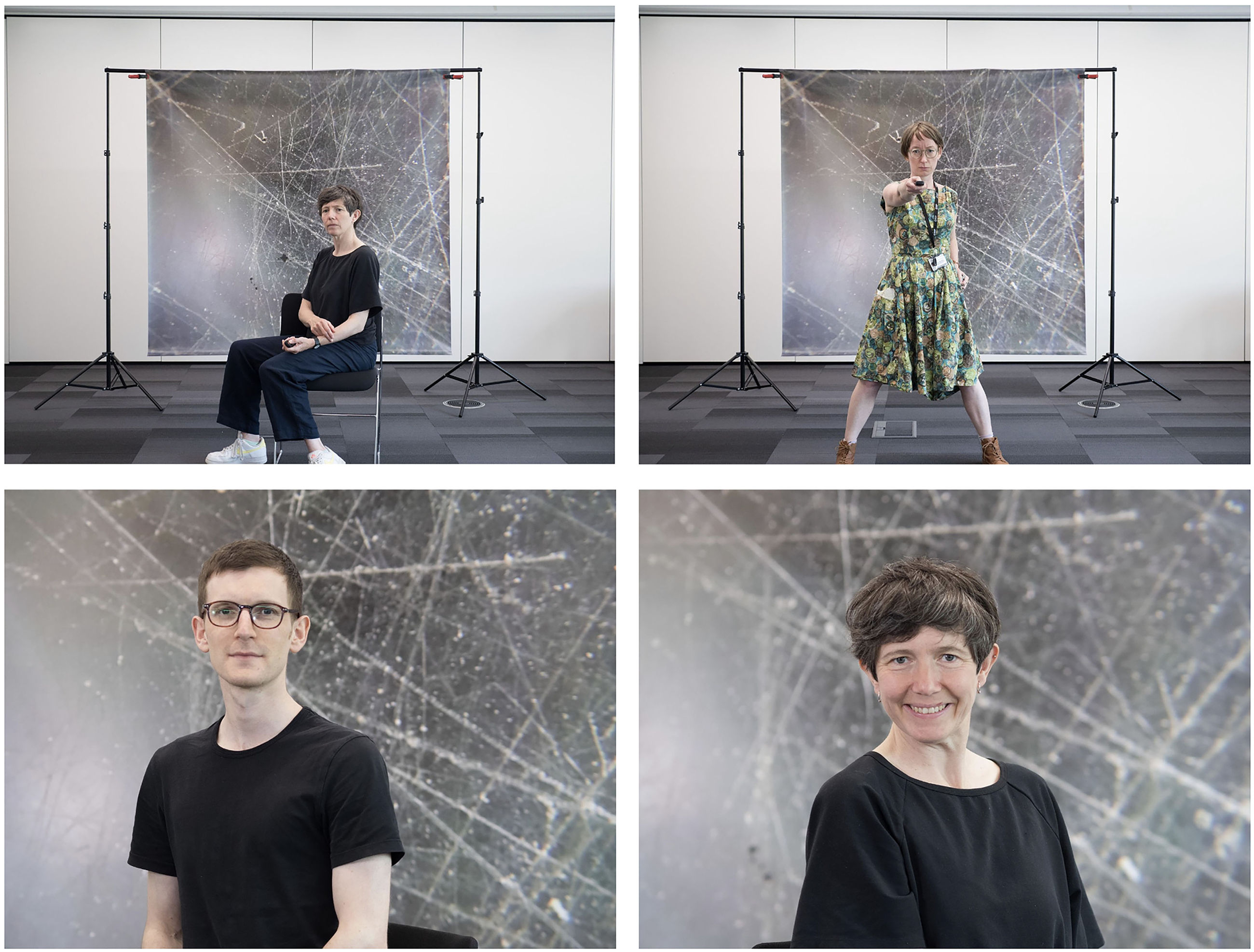
Artist researchers rehearsing school photo day at Manchester Metropolitan University.
The discomfort of performing in front of each other was a larger feature of the experience than we had anticipated. This spilled into some playful enactments, including a kind of clowning with the set and props. We discussed our own levels of ease and discomfort, our experiences of being photographed at different scenarios and ages in our lives, our relationship to our own school photos from the here and now, as well as parallel photographic forms, such as staff photographs in our own university workplaces. We recognised the effort to remain ‘neutral’ and to not perform, and also felt embarrassed at feelings of over-performing, over exposure. Our experiments generated a frantic and intense few hours of action, questioning and reflection, helping us to understand the experience as an assemblage of the spatial, technical, temporal, sensory and relational.
The experience of the pressured or expectant performance space allowed us to better comprehend the complicated ethical space we were proposing. We explored some of our own difficulties with presenting ourselves and being represented as ‘proper’ academics’ or ‘good adults’, not unrelated to the normalising world of education our project found focus around. Amidst recollections of ourselves as children in school photo experiences, we also explored feelings of being ‘irregular’. We recognised how we were simultaneously wanting to be ‘seen’ (and valued) as we are and wanting to hide from or resist a certain kind of professional legibility. Jack Halberstam's (2020) work explores this urge to resist and argues for ‘failure’ as a form of escape that seemed pertinent to worlds of education, in school and in academia; “… failure allows us to escape the punishing norms that discipline behaviour and manage human development with the goal of delivering us from unruly childhoods to orderly and predictable adulthoods” (p. 3).
Our playful rehearsal could be dismissed as indulgent, but this experience of our own exposure enabled us to question what the experience might be like for the children we would work with. Our experiences and observations must be understood as our own, our complex relationship to being seen, and frustration at our own illegibility should not be assumed to be shared by the children. Importantly, it allowed us to explore broader connections between the normalising forces at play in many realms of education and professional life and again to problematise the compartmentalisation of adult/child. The rehearsal gave powerful insight into the risks and potentials the event might generate.
Being pictured generates exposure. There can be real risk present in being ‘seen’ or being represented, even in spaces considered progressive. Our experience of rehearsing drew attention to a sense of being ‘outed’ or othered even in spaces that seem progressive. We noted this in relation to distinct contexts of being outed through gendered, sexual and racial identities, but also via a much broader and critical understanding of queerness. We understood that these risks compound for those who experience being or feeling different, or who don’t conform to expectations of legibility. We have noticed that when sharing School Photo Day in conference presentations, we have foregrounded the images of us adult researchers ‘rehearsing’ the school photo day. Initially we did this to avoid showing images of children where we didn’t need to. However, we also see this as an important ethical choice to be ‘seen’ in our own silliness, divergence, and ‘failure’. ‘Failure preserves some of the wondrous anarchy of childhood and disturbs the supposedly clean boundaries between adults and children, winners and losers … it also provides the opportunity to use these negative affects to poke holes in the toxic positivity of contemporary life’. (Halberstam, 2020, p 13)
Through our rehearsal we also recognised that the space of the school photograph is an extension of the values and norms of school and that they become more perceptible, heightened by the extra theatre of the photographers set, and the function as live artwork. The intervention might be considered a microcosm of school itself where the child is negotiating their performance all the time – a living performance that usually escapes ethical interrogation.
Invitations and being ‘good hosts’
In inviting the children and parents to take part we needed to offer an activity that they might enjoy, and to couch it in ways that precisely outlined the focus but without precluding what might happen. We chose a light, playful language to connote something not quite conventional, and a very practical description (see Figure 2).
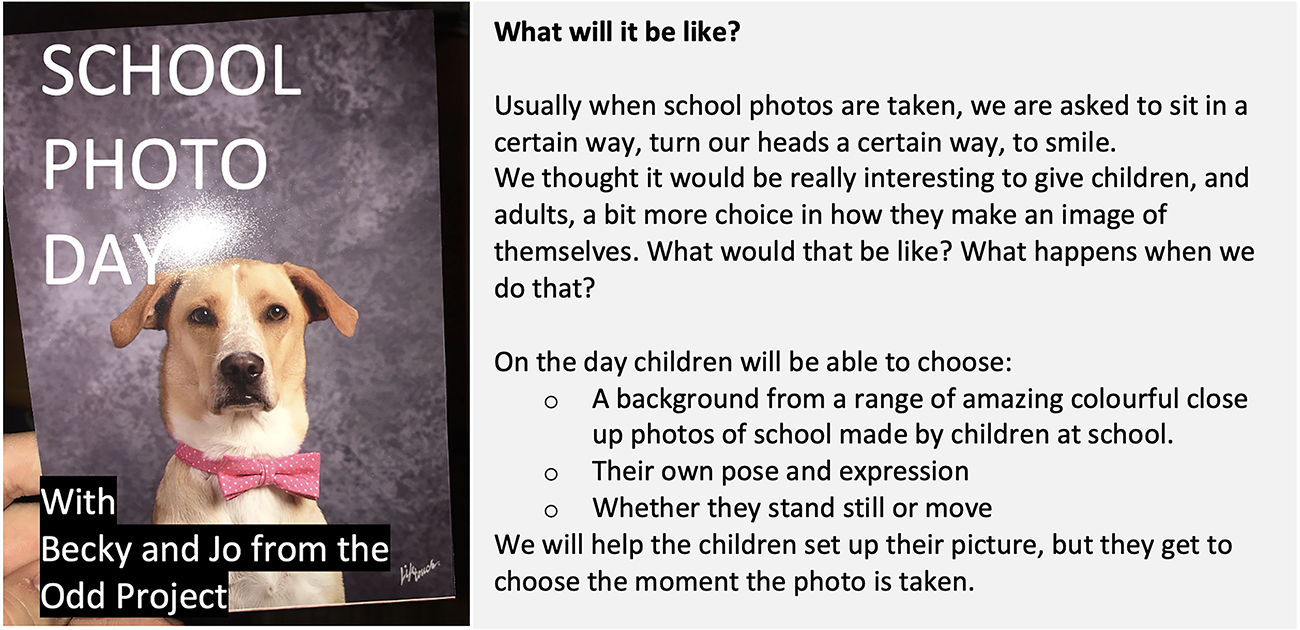
The invitation to participate.
Accompanying the invitation was a consent to participate form. This allowed children's carers to separate out the ethical decisions around participation in School Photo Day, having a digital and/or printed set of photographs, being contacted in the future about the work, and the use of the photographs for research purposes after the event. This meant that children could participate in having their photo taken, but their carer could opt to receive no photograph and refuse the use of the photographs in the future. The consent form was extremely clear about the options, but as in so many instances of formal consent, we were unsure whether this process could communicate what this experience might feel like, or what it might risk, for the child.
The mise-en-scene/abyme. Freedom or failing?
In the following, we talk about the compositional decisions we made to form the work and the recognition that material ingredients generate affects that can impact the ethical structures at work. We reclaim the understanding of aesthetic in its the earliest sense here – as sensed – not as conveying an attractive or successful appearance.
The school hall is the conventional location for the visit of school photographers, where they set up their kit and the children can be brought in to perform to camera without lesson disruption. This is all part of the school photograph ‘mise-en scene’ – ‘that which is put’ to create the stage for school photos. The UK school halls are spaces of ‘event’ commonly built for performance, with many having proscenium arches and raised platforms for steering an audience's view towards to the stage. School halls might be understood as exemplary materializations of the panopticon, as instruments of spatial and ocular control.
In this school, the hall was the central ‘hub’ of the building with all other classrooms and spaces leading off it. So, while this is certainly a space where children are controlled, the viewing schema is the flat, horizontal plane of multiple viewpoints rather than the material view from above. The hall generates a frame for many forms of ‘assembling’ including parent events, PE, and school assemblies. In the hall ‘all eyes’ are on the children and in many different directions. Children look at and perform for other children, parents and children are observed by teachers, and vice versa. In our school, the large number of children to be fitted into an assembly meant that children were under pressure to be quiet and still. Children struggling with this became visible to the whole school community, sometimes in the act of being disciplined or removed, or receiving some kind of intervention from the adult world. The hall then, is a material amplifier of looking, exposure and a mis-en-scene where difference is created and seen (Figure 3).
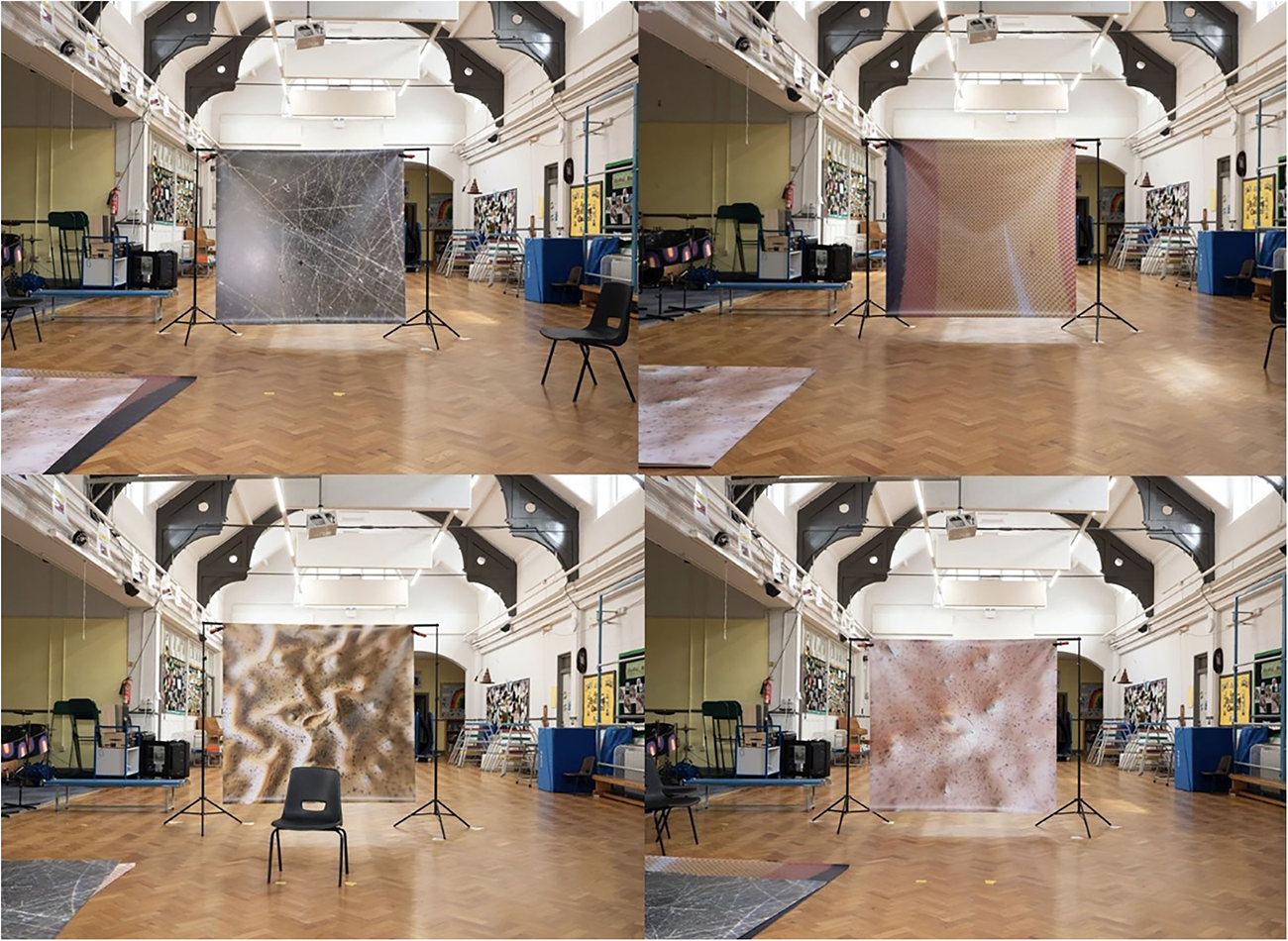
The ‘Mise En Scene’, the set-up for School Photo Day in the school hall.
In contrast to, or perhaps as part of, the ocular pressure of the hall, the hall's expanse of beautiful, smooth and reflective parquet floor regularly created exuberant, expansive running and laughing, especially when children were sent to cross it in smaller groups, outside the programmed curriculum. They were often accompanied by (also laughing) teachers, enjoying the burst of life the crossing allowed and produced. During our ‘set up’ children travelling through the hall and not in the photographs delighted in flowing through our mis-en-scene, not around it. We note that School Photo Day functions like Manning's (2016) ‘meta-models’ – the understanding of research as an event in itself.
Staging School Photo Day in the hall, occupying the hall as ‘school photographers’ brought us new understanding of the hall's pressures of preferable performance, and the joy of resisting it. Our presence interrupted daily life but also responded to the significance of the hall as a space of multiple observation and the staging of ‘school’. We noted that, for us, and for people more accustomed to the space, it seemed to inspire movement and levity, and it could be difficult to know the line where acceptable became unacceptable. The work attuned us to the ways that children might feel uncertain in school space – sensing the very ‘material’ of unspoken and spoken codes of behaviour, and not sure what modes of transgression (like hall crossings, vocalisations, and unpredictable movements) were acceptable. We also felt out of place and ‘on show’ as we occupied a space that was not ours. This heightened our sense of the uncertainty School Photo Day would create as it generated new uncertainties that meshed with, or amplified, existing ones.
Mis-en-abyme: The amplification of school via backdrops
In their analysis of school photography, Burke and de Ribeiro (2007) note the ‘ritualized and expected arrangement of the body in uniform and/or in relation to certain objects and backdrop’ (p. 220). This sense of ritualised staging itself performs school. We used a series of four vinyl backgrounds printed with close-up images of the surfaces of school that had been taken by children two years earlier. The surfaces were recognisable to many of the children who had been involved in earlier workshops where they had been used to make props, wearables and dens to hide in; all strategies to navigate where the body of the child and the surface of school begin and end. Like the print backgrounds conventionally used by school photographers that might call to mind illustrations of swirling galaxies or the mottled covers of leather books, they appeared abstract but not empty, conveying a sense of spatial illusion and operating as a middle ground to work with different skin tones. However, they were not abstract, but rather ‘documents’ – close up photographs of surfaces of plastic chairs, carpet and peeling paint, disrupting the assumed smooth and impervious ‘order’ of school. The backdrops appeared to ‘zoom out’ into the representation of the scale of a galaxy, whereas in reality, they were actually ‘zooming in’ close-ups (see Figure 4). This material quality offered the potential to also disrupt the scale of the child, in relation to the scale of school.
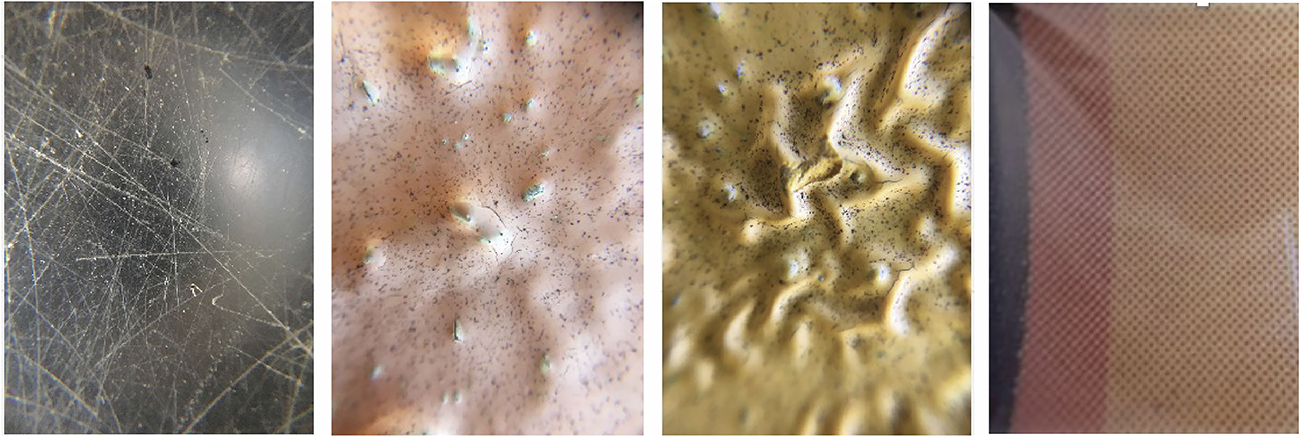
The School Photo Day backdrops, which we referred to as ‘Skins of School’.
The backdrops were ‘of school’ but looked ‘not of school’ – offering a slight shift of reality rather than a violent disjuncture, echoing the hall's tendency to control and then offer a space of transgression. The children were invited to perform in front of these backdrops – a kind of microcosm of the performance of school inside the hall (which is already a site of performance). We noted this as a kind of ‘mis-en abyme’ – a story within a story or a play within a play, like the play within Shakespeare's Twelfth Night which amplifies and muddles themes and relationships between the ‘real’ and the fiction. In the same way, we saw the backdrops as destabilising and confounding whether School Photo Day was real school photos, research or artwork. The French term when translated directly means to ‘put into the abyss’ a term which, in this context, perhaps starts to get at some of the risk of performance and visibility in school – the ‘adrift’ moments of children's uncertainty before the camera, as well as the risks in our own work.
Thinking about the backdrops and the hall made us reflect on our ‘fictional’ space and whether the unusual backdrops might offer a sign that the children were going to be invited to be ‘in on’ something ‘different’. However, we also questioned whether it is ever possible to offer a different ‘space’ in school, when its existing dynamic is ever present. The oddity of the backdrops was significant to us. They were part of our intention to ‘hover’ on a knife-edge between legible familiarity and difference. In bringing in such a visually different element we also sought to draw attention to how school photo day and school in general is a construction of decisions – nothing ‘has to’ be the way it is, potentially opening up a critical space and a sense that things can change. However, we also questioned whether the degree of illegibility and misunderstanding we might be producing was unethical as it might inflame discomfort or irritation for staff and intensify the risk of illegibility for some children.
Say cheese? The ethical weight of the ‘shutter moment’
Our ability to undertake the research relied substantially on the support of classroom teachers and how they said it could be managed on the day. They proposed a schedule whereby groups of 5/6 children were brought to the hall, seated on a gym bench which offered full view of the photo space, and photographed one by one. In rehearsing School Photo Day we had had an internal picture of a line of children out of view, so that the subject performed without other viewers. However, the method suggested by school was considered practical to avoid needing a teacher to supervise. It also reflected conventional school photographer visits more realistically when classmates watch each other perform.
As classes arrived on the bench one of us acted as usher, welcoming and describing how the photographs would be taken, checking participants were still comfortable to continue, helping them select their backdrop, and ensuring that we had the correct name recorded to correspond to the image set. We also provided hand sanitiser so the children could all safely touch the cable release.
We used two cameras, a singular digital camera tethered to a mac laptop with option of a cable release. The photographer, Miles, would be taking the photos, and another of us would be inviting/describing the task. In addition, we set up a camera on a time release with a wider shot that took in the edges of the backdrop as we thought that the wider movement of children in space could be of interest. This camera received very little attention, but it ran continuously, the focus being on the ‘live’ camera and Miles as photographer. Before each child was invited to the chair, they were given a choice of which of the four photographic backgrounds they wanted, then we fitted it to the stand. This involved a lifting and stretching gesture that ended in a slight flourish to the children, as if to say ‘here it is’. This occasionally (and unexpectedly) became a comedic moment with an element of slapstick where the backdrop didn’t go on straight, or when the vinyl sheet slid out from the clamp. This act of bodies ‘framing’ the child become much more part of the routine and relationship than we had anticipated.
Negotiation of ‘now’
The children were given sparse instructions to ‘frame’ the encounter enough so they did not feel too confused and could be guided from a familiar situation to the possibility of something else. Our shared plan, worked out in rehearsal was as follows:
Show the back drops and ask them to choose (say the number)
Ask them to stay seated while we swap the backdrop
When ready (with chair): ‘we’re going to make your school photo’.
Prompts: ‘what does it look like when you get your school photo done?’ ‘can you remember how that felt?’ ‘what do you usually do?’ ‘do what you want for your own photo’? ‘this time you can move anywhere inside the yellow lines – press button to take the picture’ (button in the tray on floor) ‘are you ok with that’? ‘did you want to try anything else’? ‘this is the last photo – this time you can see what the photo looks like when you take it’.
‘are you ok with that’? ‘did you want to try anything else before we finish’?
After a few images were taken with the first prompt, bracketed with different exposure to get good light and focus, etc, the children were invited to do what they wanted in terms of pose and position. In conveying these instructions, despite much rehearsal, we still struggled with the tone, oscillating between feeling like teachers, children's TV presenters or the ‘say cheese’ school photographer. This discomfort felt like the small heel of a stiletto shoe – with the whole weight of the project bearing down through a few words and a few seconds. The specificity of the instructions at the same time as the uncertain space of social interpretation ‘How to perform?’ generated a sharp point of ethical complexity where the child was left to decide how to make themselves.
The broken button
In rehearsal we had decided to offer a cable release, recognising that the decision of when the sitter was ‘ready’ was an important one. We had also intended to explore the difference between the sitter having full control (being able to see a tethered screen to see their image) and us taking the photograph without this. However, because we had worked together as adults ‘rehearsing’ we had not fully understood the significance of the problem of ‘when is the photo’. This suddenly became an issue when the hand sanitiser being used to disinfect the remote between children seeped into the mechanism and broke it. Miles the photographer noted that he then had to, ‘try to intuit when they were ready for me to take the picture’ and wrote about the difficulty and potential of this moment. Figuring out when to press the shutter was sometimes easy and sometimes difficult. For some children each pose was distinct and unambiguous, confident and theatrical. Some children would pose and then wait, unwavering, until I confirmed that I had taken the photo. Sometimes the children would give me a silent signal, like a nod, or a glance, to say they were ready. But for other children the poses were less obvious. Sometimes I couldn’t tell if they were posing or just paused in thought. Sometimes a clear, definitive pose would appear and then disappear immediately, before I had had a chance to press the shutter. Sometimes it was hard to read the glances. Determining when to take the picture therefore involved a kind of subtle, uncertain communication between myself and the children. There was a sense of collaboration and connection, but also distance and ambiguity. (Team notes, 2020)
Noticing gestures – reading/resisting reading
In making ‘the photograph they wanted’ some children moved to poses that seemed like they had been planned, and which caused laughter from their class peers: the other children who were watching and waiting for their photo. We noted glances towards their peers that could perhaps have been checking-in non-verbally, whether this was ‘ok?’, and some also looked for reassurance verbally. We were conscious of our intention to resist projecting or extracting meaning, but nevertheless found ourselves trying to share in what we noticed, glancing at each other as we recognised popular poses or fleeting references. These included peace signs, frequently performed in photos, now often identified with by K-Pop fans, and indeed some of the children did later explain their fandom. This ubiquitous pose has become an almost universal ‘cute’ sign, and, as Laura Miller (cited in Ovide and Woo, 2023) writes, it is now so common that ‘it is stripped of any specific meaning and is simply the nonverbal equivalent of saying “cheese”’.
Another common gesture performed by the children was with either one finger or two fingers on the vein of the arm. Commentators track this gesture back to a victory pose of a basketball player meaning ‘ice in my veins’ – that is, cool under pressure. However, it has emerged in TikTok as an expression of ‘all this is true’ or ‘keeping it real’ by bloggers after a ‘confession’. Another common pose was a hand under the chin, a kind of pose to draw attention to the face. We found ourselves associating this with Manga where it is used to convey dreaminess, pensiveness and cuteness. Another version is with the chin on the back of both hands – also seen as emerging from contemporary visual cultures such as graphic novels and Japanese anime, and it might signify pleasure or pride when receiving praise. All these popular culture gestures washed in and out of our School Photo Day, producing a hybrid blend of school and community and social media culture, some of which we saw but didn’t understand as they weren’t ‘for us’. We were uncomfortable with assigning any semiotic meaning to these movements, noting rather that the children were ‘playing with’ the social materiality that was evidently shared amongst them, given the laughter it produced.
After the first pose
After performing an initial (often planned) confident pose, there was often a period of hesitation as the photo subject decided what to do with the open invitation. At this point, many of the children moved through a series of gestures and poses, hesitating and iterating. We allowed time and space for this, and Miles described ‘seeing them trying to figure things out’. In this time the children ‘checked in’ with us, in an unspoken negotiation, that felt like a search for reassurance that they were doing it ‘right’, accompanied by frequent sideways glances to their group on the bench. The quality of the movement between the gestures was at times extraordinary. One child's movements become a dance-like flow where it was not clear where any one pose began and ended. This was a seamless, although hesitant set of gestures which seemed to happen at the same speed as she was thinking about it. In between common poses there was also fragments of other gestural vocabularies, including some which looked like South Asian dance vocabulary. The movements seemed to mix gestures that could be from ancient traditions and online communities: perhaps a hybridisation of local and digital global cultures.
At the same time, some children began to use the performance props, including lifting the chair, hiding under it, standing on it, in a range of bold and creative gestures where their bodies went beyond the edge of the backdrop and back into the school. It was commonly boys who did this. In addition, there was one child who did not make any adjustment to his serious expression and straightforward pose for the two stages. He made eye contact but did not smile or experiment as his peers had done. We noted this different kind of playful response, as a kind of refusal to perform that seemed to understand the space we had made and its potential for critical resistance.
At the end of set, the children asked if they could be photographed with their peer group, and a riotous set of group poses followed. Children dragged each other up or ran and carried out a funny, playful set of performances of group love, ‘membership’ and camaraderie. The children wanted to perform to the camera so we took these shots, knowing that we could never use them for research as they would not conform to our consent system. We took them because the children wanted that space of performance, and because we were pleased to give something in return for the exploratory performances that they had ‘given’ to us and that we (despite the evident pleasure and creativity they had deployed) had imposed. The ‘gift’, as explored by anthropologist Marcel Mauss (2014), is a complex phenomenon which generates weighty and problematic indebtedness that must be returned, but which is also a social transaction that creates forms of community and belonging. This way of understanding the photographic transaction is useful because it acknowledges the difficulties and the potential transformation at work.
Showreel – gif/gift
Throughout the day, teachers had passed through the hall, enjoying watching the children. At the end of the day, groups of teachers came excitedly into the hall asking to get their picture taken too. They posed alone for their ‘school photo’ but then performed a range of group photos. There was a strange sense of the carnivalesque, and release. The threat of lockdown was all around us (and in fact UK schools locked down the next day for a short period), and several teachers were leaving at the end of the term, so it was likely to be their last day teaching in the school. The process of taking the photographs of the teachers was joyous and tearful. At this point we didn’t know the status of the pictures we were taking and had not asked for teacher's written consent – but again, went along with it. We delighted in the ways the teachers understood the performance space and were gratified by their desire to ‘play’ with us and ‘include’ us in school meaning-making.
Later, at the end of term, the teacher who led the leaving events for Yr6 asked us if we would make a showreel of the images for the children – as a kind of visual set to accompany their disco music. This unexpected request was an exciting context in which to ‘show’ the work and to feel like the work was valued as part of school. A Powerpoint slide show (PPT) was made with one image of each child interspersed with all the group shots. As these would only be shown in school, to the children in the shots, there were no formal ethical consent issues. The teachers also asked that their (teacher) images were compiled as a PPT and given to them.
The experience of making School Photo Day generated a ‘space’ where the sensory experiences of power were being ‘played with’ through our performances. The two parts of the task invited the children to show us what they knew of the way school photographs are usually performed and then to do their own. We recognised that the ‘do your own’ might be construed as an attempt to give ‘freedom’, to ‘enable creativity’ and to ‘be yourself’ but this comes with a multitude of high stakes, including public exposure. This request makes tangible that any type of ‘un-self-conscious’ ‘freedom’ is impossible in the heightened exposure of school. ‘Freedom’ in school (and in School Photo Day then, is not necessarily fun.
In his notes, Miles described his surprise at the spectrum of responses to the problem of how to construct oneself visually. He wrote: ‘It occurs to me that every portrait involves some kind of response to this question. Perhaps it feels more conspicuous in this context because we added strangeness and friction that meant that you could then see the children ‘trying to figure things out’.
The work's triple identity (as art, research and photographic gift) meant that the children and us were held in a difficult space. Difficult or uncomfortable spaces are often created by research but rarely materialise as form in the way School Photo Day did. In this uncertain space, some children appeared to play with the format to explore their power, and that of school, seeing how far they (and we) could take it. This generated a moment where it did seem we had a shared space to sense the material of power together – perhaps akin to Manning's (2016) ‘platform for relations’, a space full of incredible possibility and problems. However, we recognise that we potentially created discomfort for those children who might prefer predictability or for whom the exposure of social performance is more effortful, and that this must be considered as ethically problematic.
The ethics of selection: The internalised audience
The following day, we selected images for distribution to families and guardians. We needed to ‘deliver’ on our promise to supply images to the school community, whilst maintaining confidentiality, and with an element of choice for families. As we viewed the images we were confronted with an overwhelming set of new concerns and complexity that we had not fully prepared for. We felt responsibility to the children, their carers, but also to school itself and the way the ‘school child in the frame might act as means of cementing or securing the belief in school’ (2007, p. 216). Burke and Ribeiro de Costa (2007) write that the school photo always straddles two domains between public and private or home and school, describing it as ‘border crossing’(p. 224). We felt the discomfort of the border crossing acutely as we tried to decide which images to send home.
To review the images, we opened each set on a laptop and viewed them together, in one day. We felt an unanticipated and dizzying pressure of selecting the images. With no parameter for what might be ‘right’ or ‘best’, we found ourselves discussing what might be ‘best’ for each person, speculating on how a parent or guardian might want to see their child. We found ourselves worrying if an image felt ‘too much’ of anything: too silly, too unprepared, too adult or ‘knowing’ too vulnerable or uncertain, or if any of the actions represented might be construed as bad behaviour by a parent or guardian. We spent time discussing if skin tone was conveyed accurately, which felt responsible, but found it was also so easy to slip into an aesthetic judgement about whether one image was more ‘appealing’ than another and we noted the problems in this. Within these impulses to protect and care, we recognised multiple ethical dangers, for example, of possible assumptions around behaviour codes and gender/sexuality in relation to children's faith backgrounds, ethnicity and class.
In the constrained space-time of selection, we had to ‘muddle through’ all the conflicting pressures of representation. Our decision to provide eight images for each child, allowed us to reduce the impact of our own aesthetic biases and to leave more space for parent and guardian (and indeed child) choices. The series also at least gave some insight into the process, whereas a single image might have implied an adherence to that concept of the portrait as conveying a single ‘truth’ or ‘essence’ (Figure 5).
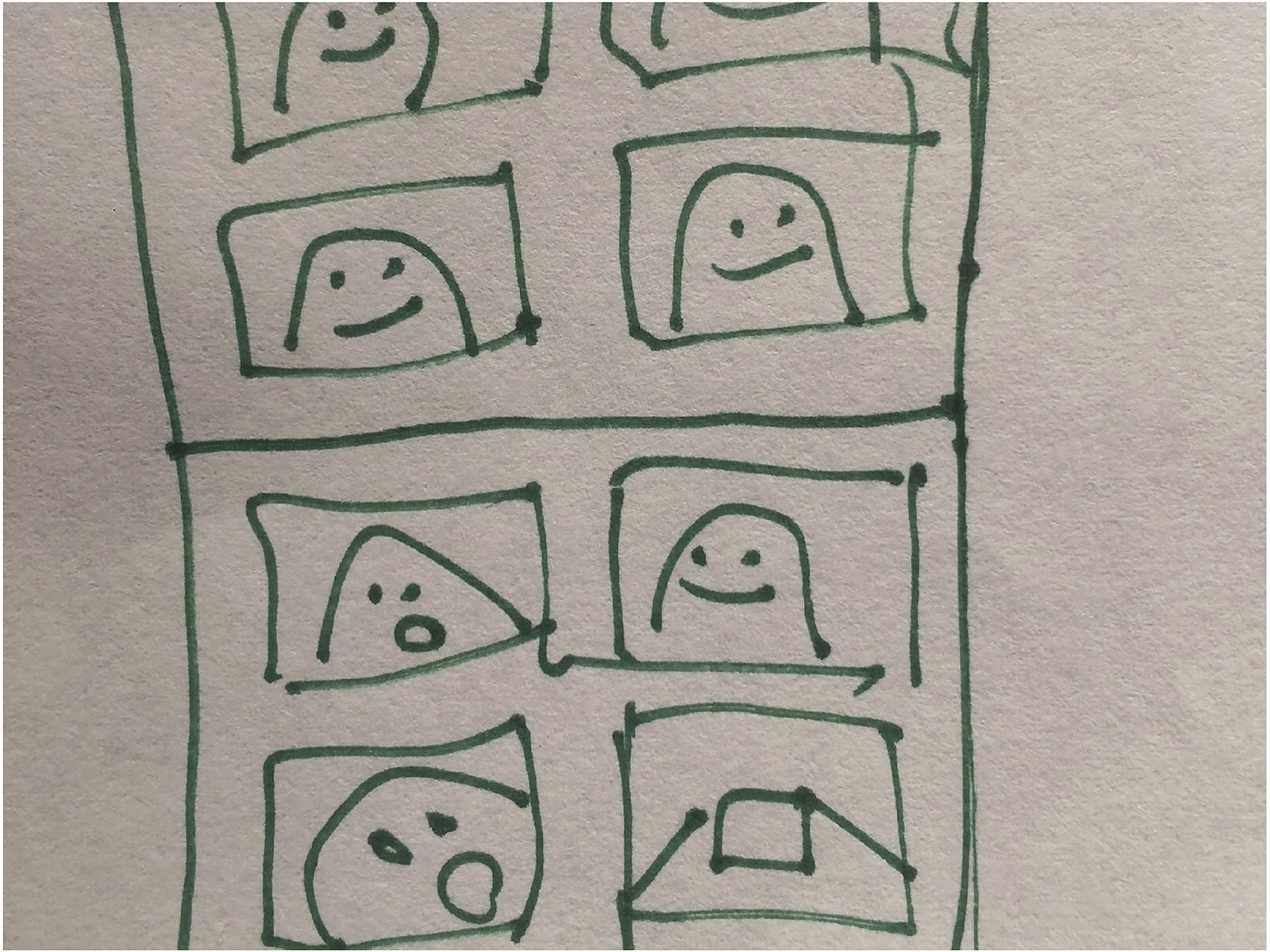
Drawing to plan the presentation of the photo ‘gift’ to children and their carers.
During the photo shoot day it had felt like the atmosphere in the school hall had been pushed and shaped through a shared social interaction, even if the children had understood it differently to us. The encounter had materialised an understanding and shared ‘play’ with representation. This had felt like a living critique of the tendency for school to harden identity. However, left with the need to select, the portrait had congealed and ‘hardened’ back into a representation. This is a fundamental and ancient experience of photography, known since the light of the sun and the human sitter was ‘set’ in silver gelatin. However, in this circumstance we recognised that the hardening of ‘identity’ was counter to the moving, living and non-defined identities experienced as we had taken the photographs. We repeatedly questioned whether we should have made the commitment to giving images. However, without creating this contract with school and with families and guardians, the pressured representation of making a school photograph would not have been present. We regarded our responsibility seriously, humbled by the trust that school had placed in us in such challenging times.
In contrast to the printed and digital images sent to parents, the PPT presentation we made for the school disco, which was played on repeat at the event, was full of lively excess. In the group images included in slides, the children's focus was on each other not the photographer, nor (perhaps) any other internalised critic. The slideshow was also made to be seen with light, in the moving fun of the disco, and played with a soundtrack that included the children's favourite songs from across their final year of school. This version of the event, then, seemed to counter the ‘hardened’ material copy, and kept the children's movements alive in the moving light projection.
Diffractions: Sharing art led research through art practice
Alongside preparing the parents and carers, and the slideshow, we also put together our own PPT using only the images of children for whom we had received consent to be used in this way, imagining a version of this as an artwork. However, as in the moment of selection, we were overwhelmed by the weight and responsibility of the decision to show the children's images. The lockdown and movement to high school meant that we could not return to the children to re-check if they were happy with their appearance in an artwork. While consent had been given, we felt strongly that parents and families might not have understood the full consequence of their children's image being used in an artwork, and the places where it might get seen. We asked if the gaze of an art audience would be different to a research audience and anticipated that new meaning and values might be assigned to the children's images that were beyond what any of us anticipated. However, we also recognised that not using the images when consent had been given, and being over-protective, could also present the problem of not doing with the research that which could give it more impact. We recognised that the children's images were extremely powerful and to suppress them might prevent a positive impact on how identity is seen in school. Artworks have the capacity to convey meaning beyond description (in depiction or words) so it also felt important to make the work in a form beyond words, to try and practically expand what is regarded as research dissemination in a way that means inclusion for all parties.
To address this, we returned to an earlier strategy for sharing research, an act of ‘diffraction’ (Palmer, 2016). Instead of simply writing about findings, we had built guided resources, prompts and workshops to give new audiences an embodied experience of our findings, rather than translating them into words. This bears some connection to the work of Kat Jungernickel (2020) and her use of ‘transmission’ experiments to embody research findings. To address these issues in School Photo Day (2020) we returned to our own experience of being photographed.
The Odd project had been invited to curate the contents for an annual educational psychology conference. We used this space to re-stage School Photo Day inviting the conference participants to be photographed by us following the same instructions and ‘staging’ as we had used in school (Figure 6).
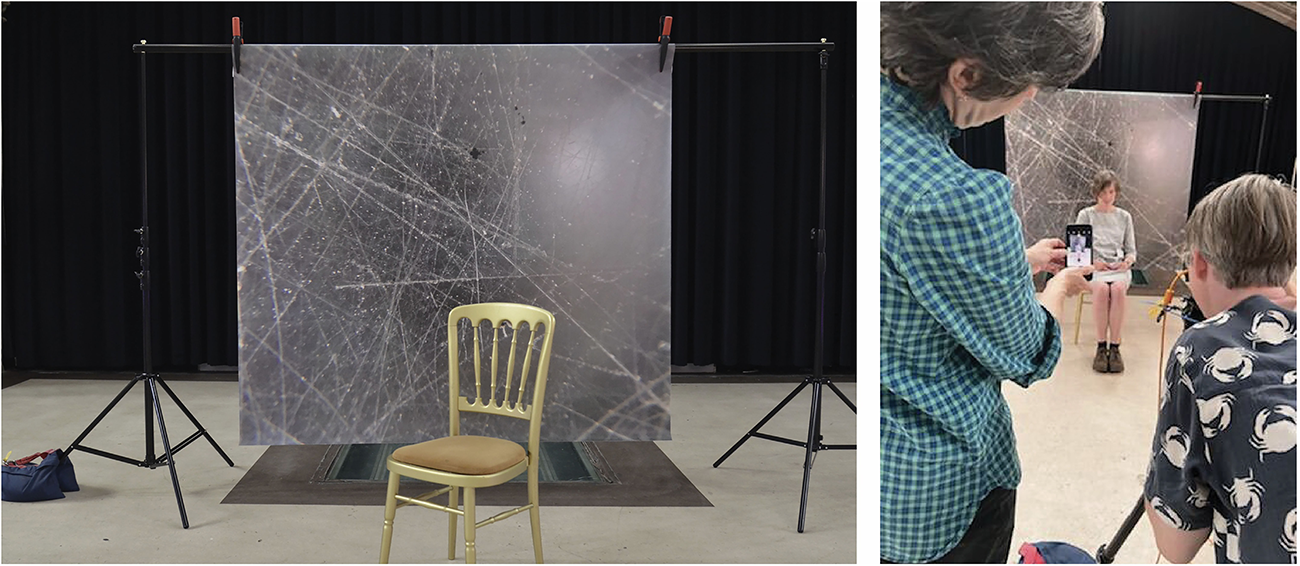
Re-enactment at Catalyst Psychology Conference Inclusion Matters, Manchester 2023.
This re-enactment extended the research space and invited conference participants to both experience the research and continue it. Participants reflected (informally, while doing) on their own experiences as educators and as young people, there was a sense of collapsing times as their experience as adults and as children merged with their impression of the experience of the children in our original event. The re-enactment meant that we could maintain the focus of the work as the experience of constructing representation, rather than representation itself. This bypassed any misunderstanding or aesthetic appreciation of the children's images. It also meant that we were able to resist the tendency for research communication to strip out meaning and complexity, an unethical reduction.
Conclusion
School Photo Day generated a time-space, where children were uncertain how to perform, and which could not be fully described beforehand. Whilst we could describe an approach, we couldn’t fully describe what would happen, because we didn’t know. A full description would also have taken away the space of improvisation that was the very purpose of the research. The uncertainty allowed it to be (through the ways that we and the children visibly performed) a shared space where we were all ‘handling’ the material of school, and the regimes of performance therein that are difficult to read. In this sense we ‘rendered formation forces’ into ‘platforms for relation’ (Manning, 2016) where we could see and feel the forces at play in school. The space of School Photo Day materialised and continues to materialise forms of visibility and legibility. The risks of being illegible or too legible held more risk for some children than others, making the process ethically problematic. However, it also enabled us to see and name those process of aspiring for/resisting legibility, among other moving and provisional forms. In ‘Seeing like a State’ James C Scott (2020) explores illegibility as a possible source for political autonomy, noting that the state always seems to be the enemy of ‘people who move around’ (Scott, 2020, p. 1).
Here we might consider, as well as people whose movement is between communities, countries, cultural codes, the need for some bodies to occupy or move in space differently. In moving and being illegible, Scott sees resistance to containment and definition. The oscillating legibility of the children and indeed, the whole operation of School Photo Day generated a kind of joyous ‘play’ with representation, questioning and challenging why anything should need fixing down.
Our navigation of artistic research, Research Creation, and art practice produced what we understand to be a vital tension between ‘doing’ and ‘final form’. In school we are all ‘fish in water’ (Bourdieu and Wacquant, 1992, p. 27), where our identities are inseparable from the social ‘miasma’ that constructs them. The unstable space of School Photo Day offered a way for us to ‘sense’ the water – hovering on the meniscus and being able to see ourselves in it and outside of it at the same time. In an online interview, Brian Massumi (2003) describes how, ‘Ethics in this sense is completely situational. It's completely pragmatic. And it happens between people, in the social gaps. There is no intrinsic good and evil. The ethical value of an action is what it brings out into the situation, for its transformation, how it breaks sociality open. Ethics is about how we inhabit uncertainty, together’.
In the decision to share the work as re-enactment we fought to maintain the material, relational and temporal qualities: the event of the work. This was important aesthetically and ethically, as it refused to strip down or summarise experience. Reflecting on his multimodal transcriptions of playful, spatial research encounters with children in an after-school club, Chris Bailey (2020) discusses the limitations of words, drawing on anthropologist, Michael Taussig who writes ‘The very words you write down seem to erase the reality you are writing about … it is as if writing obliterates reality, pushing it further and further out of reach’ (Taussig cited by Bailey 2020), https://media.ed.ac.uk/media/Dr+Chris+Bailey+%27Visualising+Lived+Experience%27/1_t0wckgah). Artistic strategies then, offer ways to experience and interact with the space, material and movement of the ‘reality’ of school, erasing no realites with words, but juxtaposing multiple realities of performance to seek to transform the experience of school (Figure 7).
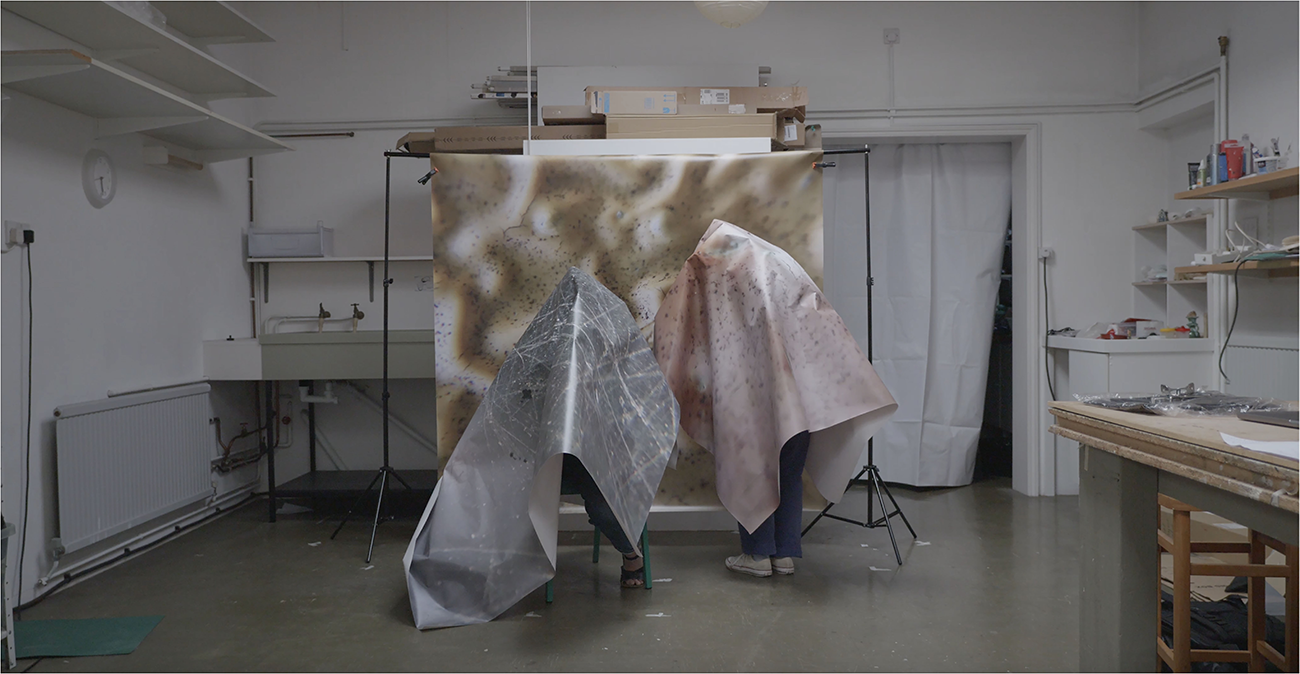
Continued iterative research through the generation of new art works.
Footnotes
Declaration of conflicting interests
The authors declared no potential conflicts of interest with respect to the research, authorship, and/or publication of this article.
Funding
The authors disclosed receipt of the following financial support for the research, authorship, and/or publication of this article: This work was supported by the Arts and Humanities Research Council (grant number AH/R004994/1).

Author biographies
Becky Shaw is an artist and Professor in Fine Art Practice. Her area of research is the role of art in institutions and in interdisciplinary collaboration.
Jo Ray is an artist and Senior Lecturer in Design. Their area of research is site responsive practice, co-creative methods and creative ‘re-activation’ of archive materials.