




Abstract
The paper seeks to illuminate the limiting categorisations and hierarchical relationships between urban versus rural, slow versus fast research and between research methodologies, to reconsider notions of place and re-search (or searching and searching again) in a ‘rural’ Australian context. We illustrate these ideas by first examining the dynamic, productive nature of language and by demonstrating how language can be used to review and resist dominant and conservative beliefs and limiting categories. We also specifically consider how critical discourse analysis can reveal the discursive ‘Othering’ of both ‘the rural’ and women living in rural communities and catalyse a feminist narrative inquiry designed to hear and amplify the voices of a diversity of women living in southwest Queensland and how this seeds case studies crafted to enable women in rural, regional and remote communities to work achieve their storied vision and capacities. The paper finally demonstrates how over time (2019–ongoing), slow re-search processes, supported by relationality and trust, evolved, suggesting that discourse analysis, as analytical activism, can lay the foundations for sustained, engaged and relational re-search designed to expose and address entrenched gendered power imbalances and limiting binaries.
Introduction
This paper, which examines the emergence of a multi-methodological research portfolio of projects, establishes how Australian rural places of geography, community and culture/s outside urban locations, are discursively framed and ‘Othered’. Enveloped within a feminist epistemology, we provide a brief consideration of the power of language in making/shaping ideas and illustrate how hierarchies of geography result in metrocentric policy-making and resourcing and the further Othering of women living in rural locations. We next reflect on how ‘using words to think with’ (Kinsella and Shepherd, 2020) prompted us to adopt a feminist narrative inquiry to learn about the lived experience of women from what are described as ‘non-urban’ locations across southwest Queensland. We also consider how our subsequent response to the women participant's stories and expressed need for digital communication support and latterly for opportunities to share stories of and develop capacity in business and community leadership, led us to develop four inter-related though separate research projects [names omitted for review].
We reflect on these re-search process to make manifest how one research approach/methodology can seed another to facilitate multi-methodological, slow (Mountz et al., 2015) and ‘promiscuous’ (Childers et al., 2013) re-search. We finally discuss some of the characteristics embedded in slow research that supported the garnering of women's situated knowledge in regional, rural and remote (RRR) locations.
Our work is founded on and cohered by a feminist epistemology. By adopting this stance, we affirm our understanding that knowers, knowledge and the processes of knowing are historically, culturally and personally situated and acknowledge the existence of multiple, overlapping and complementary ways of knowing, each being partial yet valid and valuable (Anderson, 2020). We thus situate women as knowledge producers and their/our standpoint as legitimate. Accepting then, that women's knowledge and their/our processes for creating or finding new knowledge are partial and incomplete, we adopt methodological agnosticism and in concert with Phelan (1994), invite research to be evaluated on its potential to bring about social change for women, rather than epistemological or methodological purity.
How our research was formed through a consideration of the productive capacity and dynamism of language
As communication scholars we are interested in the productive power/s of language, particularly its capacity to determine what, where, how and who are most valued and how power is circulated and haegemonically maintained. Whilst we do not provide an exhaustive overview of this rich theoretical arena, we illustrate some of its key ideas as a prelude to a critical discourse analysis presented further below. The prelude, embedded in a feminist epistemology, confounds strict adherence to any one form of research practice or field and instead is offered as ‘words to think with’ (Kinsella and Shepherd 2020). As Kinsella and Shepherd explain, feminist researchers use: scavenger methodologies… [to] look sideways at the conventional sites of enquiry. We unsettle that which is frequently take for granted, including the very categories we use to think with… To recognise and make visible that which has been otherwise ignored or obscured requires and, indeed, subsequently disorders not only the conventions of research but also its methods. (2020, 2)
Language
Language not only names what already exists or is known, but it brings ideas, concepts and actions that had not before been fully conceptualised or operationalised into being (i.e., language is productive). It facilitates both the development and communication of ideas and behaviour. As early as 1956, Whorf and Carroll identified the potential of language to shape thought and actions (Gelman and Roberts, 2017). Later, post-structuralists argued that language and discourse construct knowledge and what is knowable, and that ‘reality’ does not exist outside of language and discourse. Considering its political productivity, Hall (1982) identified that language is the ‘privileged medium in which we make sense of things, in which meaning is produced and exchanged’ (np) (our italics). Language, therefore, plays an active and vital role in the re/production of ‘reality’ and does not merely mirror the culture in which it exists. Furthermore, Maynard Smith and Szathmáry (1997) suggest that language actively supports the evolution of complexity and plurality of ideas through intergenerational transmission of information or the passing of information and categories down through generations. So, language and the naming or labelling of phenomena create and shape ways of knowing and behaving, construct culture/s and facilitate the evolution of complex and plural understandings and practices.
Relatedly, as we are interested in understanding the role of language in creating possibilities of (feminist) resistance, we also briefly consider how the use/s of labels and categories evolve. Gelman and Roberts (2017) explain that human languages form normative labels, indicating their stability of meaning temporally and spatially. Furthermore, while labels and categories can be stable and therefore constraining, they are also ‘generative (leading to innovation) [contributing to] the process of cultural transmission’ (Gelman and Roberts, 2017: 7904). Accordingly, labels and categories reflect the culture and can generate and reflect new meanings. In addition, new social practices or ‘awareness's’ are reflected in the development of new words or the re-inscription of existing language codes.
The re/naming and reframing of what has hitherto been referred to as the Third World or developing world provides an example of how language operates as a powerful purveyor or ‘bringer’ of new ideas. For example, the damaging terms of the ‘Third World’ and ‘developing countries’ have, until recently, been used to categorise a suite of countries, nationhoods, cultures and communities described through Westernised notions of economic status and production. I Imbued with racist implications, the term suggests a backwardness in comparison with other worlds (Khan et al., 2022). A similarly deficit term, ‘developed’ versus ‘developing’ countries describes the transfer of resources from economically prosperous to economically poor countries, implying how nations and nationhoods are conceptualised in economic development terms (Khan et al., 2022).
Alternatively, the subsequent widespread adoption of the terms ‘The Global South’ and ‘majority world’ reflect the dynamism of language and related ideas and cultures. Haug et al. (2021) argue that the [now relatively] new terms highlight systemic inequalities stemming from the ‘colonial encounter’ and provide a space for resistance against ‘northern’ dominance and colonisation. Thus, language can both draw attention to colonial framing and create possibilities to resist it.
Furthermore, the naming and framing of ‘worlds’ can be understood as a discursive macrocosm of the de-limiting naming/framings of regional places within said ‘worlds’); illustrated when ‘the region’ as a microcosm is predominantly defined by what it is not—the non-urban, non-metropolitan, non-central (Chambers, 2012) and thus considered as deficit.
Yet, we recognise that the places generally referred to as the regional, rural and remote are often the central locations for living for First Nations peoples. It is arguable, then, that ‘Othering’ these spaces as somehow on the periphery to and dichotomous/lesser than the urban spaces of a country or nation is a continuation of the colonial project. Indeed, Birch posits that colonial constructs, such as those labelling certain areas as ‘remote’ within Australia, lack cultural significance from an Indigenous perspective (2016: 96) and rural spaces, are composed of various interconnected spaces (Edensor, 2006: 484); so any discussion or examination of rural areas must consider their specific geographical contexts (Halfacree, 2006: 45). Thus, within this intricate framework, rural areas are not perceived as separate or inferior or in relation to a binary relationship.
We also acknowledge that homogenising places that are geographically, economically and socially outside of urban Australia is tantamount to ‘geographical blindness’ (Green and Letts, 2007) that essentialise both place and people. Such categorical homogenisation leads to state paternalism where ‘particularities of place have been erased by a general comparison between the “normal” urban and the “deviant” rural’ (Roberts and Green, 2013: 766). It also constructs the rural as backward, in need of ‘rescuing’ and conceives it as having the same/similar needs as urban spaces. Consequently, the label and associated meanings of ‘the rural’ deny individual and community self-determination by undertaking distributive approaches to overcoming economic differences, where metropolitan centres determine and address the needs of the rural and the cosmopolitan values of urban élites (Roberts and Green, 2013: 765).
In contrast, Donehower et al. (2011) observe that the non-urban is demographically, geographically and culturally heterogeneous and Roberts and Green (2013) posit that the non-urban inhabits a diversity of landscapes and affordances, including wealthy fertile areas and semi-arid land. Furthermore, and with specific reference to Australia, it's recognised that the rural inhabits a complex economic mix that cannot be reduced to a socio-economic status category because pockets of extreme wealth are juxtaposed with extreme poverty in the countryside (Green, 2008). Finally, Gieryn (2000, 465) observed that ‘place is space filled up by people, practices, objects and representations’ and languages of place needs to embrace subjectivities and particularities.
Of note is that framing the rural, regional and remote as ‘minority’ reflects a colonialist and economist lens which leads to centralised and metropolitan forms of power and control (Alam, 2008, 89). To counter this phenomena, Alam (2008) coined the term ‘majority world’ to celebrate ‘the appreciation of these communities’ cultural and social wealth’. He also uses the term to illuminate that the Group of eight countries, which represent only a fraction of the world's population, make decisions that affect most of the world's people (Alam, 2008). Refusing to use the terms Third World or developing world, or even least developed countries, as these terms hide histories of oppression and continued exploitation, Alam (2008) identified that economically poor countries of the world are generally countries that have been colonised. Khan et al. (2022) agree that using the term majority world can explicitly remind the West that ‘minority countries’ outnumber them. Similarly, Cuervo (2012) argues that places must be understood in terms of diverse forms of capital and Roberts and Green (2013: 768) recognise cultural diversity and the Australian rural’s quest for self-determination and local governance.
Founded on the ‘words to think with’ (Kinsella and Shepherd 2020) presented above, we felt there to be a political and cultural necessity to listen and respond to the needs, capacity and vision of community within RRR communities, for they are the holders of the knowledge and cultures of their diverse and abundant place. Indeed, Thomson (2000) suggests that each place has a distinctness or a ‘thisness’ (as understood from an insider's perspective) and we need to know the experience of people from rural locations to understand the ‘thisness’ of their community. Roberts and Green (2013) extend this idea by arguing that people from outside non-urban locations can only understand a ‘thatness’ of place and that problems with ‘thatness’ occur when people on the ‘outside’ control the distribution of goods and services and direction of policy relating to non-urban locations. A ‘thatness’, or an understanding of non-urban spaces and their needs from the lens of people outside that place, is mainly observable in politics and research. For example, according to Argent (2011), many farmers in Australia feel that their priorities are ignored because urban voting blocs take precedence and politicians from heavily populated urban areas impose their values and regulations without considering non-urban circumstances. This is consistent with Casey et al. (2024, 10) finding that rural Australian communities feel ignored, not valued and controlled remotely.
Whilst CDA provides a broad framework for identifying and critiquing the delineation of place and affordances thereof, feminist CDA recognises gendered power differentials and the imbalances of power between and within gendered groups, including ‘women’, and the pervasiveness of subtle, discursive workings of modern power that further marginalise women based on a suite of factors including geography (Lazar 2007).
Thus, through a feminist CDA lens, we are drawn to Alston's (2003) observation that Australian rural women's contributions to community remain relatively ‘invisible’ because the terms and discursive frameworks of ‘farmer’ and ‘male’ are synonymous and interchangeable, subjugating women's knowledge about agriculture, contributing to a marginalised discourse shaping agriculture in Australia, and a propagation of women as ‘mere shadows in rural representation’ (Alston, 2003: 486). It also illuminates Alston and Wilkinson's (1998) recognition that although women contribute 48% of farm income, they are mainly overlooked in agricultural policy formation and decision-making, and Bock and Derkzen's (2008) analysis of rural policymaking which found that women are particularly under-represented in rural governance. Moreover, Bryant and Pini's (2011: 1) argument that even when women are selected to speak on ‘behalf of rural Australia’, research consults predominantly ‘older, white, able-bodied, married landholders’, is brought into view. Thus, while most farmers and farming communities feel under-represented in national governance, certain women are the most excluded from ‘rural’ policy-making and influence, resulting in women's knowledge, capacity and vision being omitted from national policy formation or resource distribution decision-making.
The gendered policy landscape is also reflected in research contexts, where women's research is valued less than men's and where challenges to researching in and with rural community exist. For instance, research proposals submitted by men score higher concerning ‘quality of researcher’ (van der Lee and Ellemers, 2015), women receive fewer grant awards, less research income per award granted (Head et al., 2013) and fewer prestigious awards (Ovseiko et al. 2016) than their male counterparts. Similarly, scholarship by women is less likely to be published than men's submissions (Bendels et al., 2018), and scholarship published by women in crucial author positions receives fewer citations than those by men in the same positions (Lariviere et al., 2013). Furthermore, editors and peer reviewers impose stricter standards on women and the peer-review process for women-authored work takes, on average, 6 months more than that of male-authored papers (Hengel, 2017). This gendered landscape limits funding and publicity opportunities for women's research.
This context is intensified by neoliberal governance processes within universities, which impose significant pressure to accelerate the turnover of research deliverables (and promote what is known as ‘fast’ scholarship). A focus on fast scholarship has the potential to frame what, where and who is researchable because ‘metropolitan-based scholars can operate [more] comfortably and effectively’ than scholars seeking to understand people and places outside of urban locations (Bunnell and Maringanti, 2010: 417). Indeed, Pini, Moletsane and Mills (2014: 454) identify that ‘researching the rural is time-consuming, costly and involved’ and that demanding academic workloads and limited time for research create practical barriers to studying in and non-urban locations. Consequently, gendered, economic and/or time-bound restrictions on what and who is researched, by whom and where contribute to ‘metrocentric’ approaches to academic research (Bunnell and Maringanti, 2010). Thus, masculinity and urbanity become normative and privileged in academic research (Pini, Moletsane and Mills, 2014) resulting in limited investigations into women's experiences in rural and regional areas (Crimmins et al., 2021) and their lived experiences and insights seldom inform policymaking.
This analysis of various though interconnected discourses, as a form of ‘analytical activism’, aligns with the aim of a feminist epistemology which seeks to transform traditional gender relations and affordances. As Lazar explicates ‘the radical emancipatory agenda [of feminist CDA] makes for praxis-oriented research … [which] entails mobilizing theory in order to create critical awareness and develop feminist strategies for resistance’ (Lazar, 2007: 145). For us, illuminating gendered power relations based on gender and rurality constituted both analytical activism and compelled us to undertake further feminist research as activism.
Called to respond
The context established above, constituted first by CDA and latterly by feminist CDA, illuminated a double Othering (Fanon, 1967) of women in RRR locations and the barriers established by ‘fast research’, compelling us to respond. Working with Barad's (2007) understanding of ‘response-ability’, we accept our agency, ability and responsibility to respond to these contexts. Barad (2007) also establishes that what ‘matters’ is dynamic and research foci and practices evolve as researchers interact with the phenomena they explore; so the research process changes and reshapes over time. Furthermore, most research is iterative and non-linear.
Acknowledging both the constraining factors and the importance of learning and making known the largely ‘yet to be voiced’ (Arnot and Reay, 2007) experiences of women from the RRR community, we designed a project to elicit the emic knowledge/s of a diversity of women living in non-urban places in South-East Queensland. To understand the ‘thisness’ of the communities we were engaging with, we specifically committed to listening to them before co-designing an activity to meet their needs or vision.
Feminist narrative inquiry
We adopted a feminist narrative inquiry methodology to garner and illuminate the voices of women farmers and women in farming communities in drought-affected Queensland (Crimmins et al., 2021) (2018 and 2019–2020). Choosing a narrative inquiry provided a robust methodological foundation for the second phase of research (the first, which instigated this re-search, involved a deconstruction of the discourse surrounding rurality and the marginalisation of RRR women). Adopting narrative inquiry provided an opportunity to voice the fully embodied experience of research participants (Merleau-Ponty, 1962) where stories convey ‘knowledge about the teller, her background and the common situation … in which the narration is taking place’ (Küpers, 2005: 121). Providing space for women in RRR community to ‘voice’ their personal and place-based stories became an essential riposte to the sustained discursive Othering of women from ‘the non-urban’.
The affordance of voice provided by feminist narrative inquiry specifically supported our intention to create an audience for women's stories, as Boje (1995) suggests, presenting stories from marginalised groups exposes and celebrates multiple stories and storytellers, providing audiences with a ‘variety of real-life stories women provide about themselves’ (Lugones and Spelman, 1983: 21). These opportunities thus suited the project's intention of democratically disrupt and extend current discourses around women's experience in RRR communities by ensuring a diversity of women's voices become heard. Relatedly, narrativising lived experience is also key objective of feminist research which seeks to challenge the androcentric biases within science and expanding the notion of legitimate knowledge (Harding, 1987). More specifically, Halpern (2012) posits that narrative inquiry can support feminist research by integrating subjective and objective ways of understanding the world rather than favouring one over the other. The approach can also support the elicitation of ‘haecceity’ or ‘thisness’ (Garfinkel, 1988) of the idiosyncratic nature of lived experience as told through story. We therefore employed a feminist narrative approach, which accommodates inter and intra-subjective perspectives to support the unearthing of a ‘thisness’ or an insider account, that may be deeply multiple, many, situated (and emergent), which an outsider cannot know or articulate. Bruner argues that narrative knowing is expansive and elicits subjective accounts of reality within a spectrum of equally valid perspectives. Narratives also tend to be expressed in connotative language that reveals the author's perception, goals and experience as one position amongst many. Finally, Bakhtin (1986) argues that narrative knowing occurs through the interaction of multiple narratives and authors, a process he described as intertextual social dialogue. Thus, relativity, inclusivity and plurality, central to narrative knowing and feminist narrative methodology, oppose binary thinking—whether the binaries relate to geography, gender, or research methodology.
We recruited the women participants by working with the Lifeline and are Balonne to contact the women before visiting them (via phone calls) and then facilitating face-to-face interviews and conversations. The interviews and conversations were conducted mainly in the participants’ homes and workplaces at a time convenient to the women. Interviews were unstructured and open-ended, with the researchers using a general protocol or focus of inviting the women to share their experiences, visions and wants as women in their respective places or communities. These interviews were filmed to capture the participants’ idiosyncratic ‘expressive, contextualised and vernacular forms of language … [imbued with their] personal signature’ (Barone and Eisner, 1997: 73–78).
The resulting micro-documentary series reflected an inclusive dissemination strategy that could easily be shared with many audiences. Notably, the format offered a platform whereby women's voices in rural Queensland could be heard and considered in policy-making and resource allocation. In contrast, broader coverage of rural events, such as climate variability, by media and government discourses and discursive strategies lacked these personal characteristics. For example, Paxton's (2021) research indicates the framing of the rural event ‘might be made more powerful using more meaningful and emotive narratives’ (Paxton, 2021: 101). This strategy of personalised and meaningful messaging of rural voices supports our re-search participants’ narratives, showcasing their stories in an accessible form, verbatim (without the traditional framing, selection or interpretation of researchers’ ‘interference’ or media/government discursive strategies), communicated clearly that the women storytellers owned the shared narratives.
The themes from analysing the narrative interviews included why people remain ‘in the bush’, the impact of drought and the strategies they use to withstand its hardships, the importance of off-farm income and women's lack of voice in governance/metrocentric governance processes. However, the most prevalent focus has been how plural women's capacity to develop digital communication skills while digital connectivity impeded on and off-farm income (Casey et al., 2022).
We listened deeply and reflected on this latter concern (as we had on the dominant discourses around rurality discussed initially), again feeling compelled to respond. Oliveros (2005) defines listening as a voluntary act that includes ‘giving attention to what is perceived both acoustically and psychologically’ (xxii, see also Junkin (2017) on deep listening and performativity). Drawing on the traits and characteristics of ethnography work, Willis et al. (2023) suggest that employing a strategy deep listening contributes to a cultural sense of being and understanding. In this way, the re-search sets the stage for a raised state of consciousness and provokes the elicitation of untold stories of experience (Willis et al., 2023). This collaborative approach thus becomes a process of co-production and shared insights (Hughes and Pennington, 2017).
Adopting this approach resulted in us caring about the women who had shared their stories with us and we considered if and how we could support them. As t’Hart (2023) argues, this kind of listening creates an ‘emotional connection with the participant’ to hear multiple layers of meaning and context’ (290). In response, we partnered with de-identified (a rural organisation that aspires to increase the viability of community in the Balonne Shire, southwest Queensland) and with colleagues Professor Sandy O' Sullivan (Macquarie University) and Dr Karen Sutherland (University of the Sunshine Coast), developed a project to identify and support the digital literacy and business communication needs of people living in St George and Dirranbandi in Balonne Shire between 2019-2020. While the details of the specific project exist outside the focus of this paper, it is relevant to note that within the resulting case study: `Discovering and supporting the digital literacy and business communication needs of people living in St George and Dirranbandi' (Ethics number: A191295)), we surveyed local community members, entrepreneurs and business owners and facilitated a Think Tank with local government, Chambers of Commerce and community leaders to identify the digital communication competencies, wants, and needs of the community. Thus, we sought to learn the community's specific vision, capacities and wants before responding to these needs by cod-designing a suite of digital communication workshops (for various stages and needs), a mentorship program, and an online repository of resources. Therefore, engaging in discourse analysis led us to seek out the stories of lived experience through a narrative inquiry, which subsequently motivated us to iteratively seek more detailed and specific preferences and visions of the community through a case study design (see Casey et al., 2024).
Our process clearly illustrates how research processes evolve, ‘seed each other', and blur the divisions between research projects and methodologies. The processes also undermine the efficacy of the binaries and divisions constructed to separate research projects and methods. A salient outcome in the case study was the resourcefulness and commitment of women in rural and regional southwest Queensland to sustaining communities and remote locations by undertaking entrepreneurship. Relatedly, the women expressed a need for support in developing leadership skills and competencies and wanted to engage in professional networks to maximise their enterprises' financial and social yield.
Following an earlier pattern, we sought to understand the leadership and communication capacities. We stated the needs of the plural community in a project we named Real Rural Women's Leadership (2021–2022) (Ethics number A211633). This engagement required us to undertake a second case study, which included semi-structured interviews with women leaders across the Balonne Shire. Responding to the main identified concerns, we developed (in partnership with a community organisation within the Shire) a bespoke mentorship program and a series of workshops. We initiated a public ‘voice' for regional and rural women by producing a 30-episode podcast series of authored/storied by the women participants.
The most recent and current project explores livelihood diversity as a strategy for coping with climate change, using case studies from rural Australia and the Pacific Islands. This project responds to re-search outcomes that emerged slowly (but iteratively) by working with the same rural communities over 5 years, where women identified how they cope with climate variability/change by diversifying their income streams (beyond farming and land-focused enterprise). As women are most affected by climate change (Pearse, 2017), this project seeks to profile the entrepreneurialism and creativity of women in plural locations, identify synergies in the strategies used across locations and determine what strategies employed by one community of women can benefit another.
The two key ideas that our experience brought to the fore are the importance of methodological polytheism (Wacquant, 1998) and slow research (Mountz et al., 2015; Smith and Mentz, 2020), for which the importance of listening first and responding and determining the re-search approach and instruments that best fit the substantive focus and research aims, are essential. It also depended on being methodological agnostic and placing one's preferences aside.
Methodological polytheism and the role and importance of ‘slow’ research
Researchers tend to predetermine the research approach and establish research methods before fully understanding the substantive focus of what or whom the research explores (Weaver and Snaza, 2017). Similarly, Manning (2016) suggests that predetermining research methods and treating them as self-contained and static ‘stops potential on its way, cutting into the process before it has had a chance to fully engage with complex relational fields’ (31–34). That is, predetermining and following only one research tradition or method without reflecting on the fit of the method/s may simplify or thwart opportunities to find new, iterative or complex knowledge. Springgay and Truman (2017: 204) extend this idea by claiming that predetermining static research approaches present data as ‘already pre-supposed entities waiting to be captured, extracted and mined’. By extension, Lather and St Pierre (2013) describe a traditional research design that follows conventional protocols of questions, literature review, methods, data analysis and representation and assumes that the ‘human [who controls the research] is superior to and separate from the material’ (630). The result of such conventional approaches to research typically conveys the idea of a systematic inquiry, governed by methods of empirical verification, into a previously unknown area of knowledge or unsolved problem and create binaries of hierarchy between the researchers and the researched.
Researchers negotiate the tensions between complying with socially accepted research norms, or what Foucault (1980) refers to as ‘epistemes’ and their thinking. The latter leads researchers to adopt the term re-search, with an intervening hyphenation, thus reconstituting the traditional term of ‘research’ and returning the user to the earliest meaning of the word to search (again) for something or someone. In doing so, researchers understanding is socially and culturally rooted in the knowledge constructed iteratively over time (see Alvesson and Kärreman, 2011). However, researchers need to also think ‘outside the box’, thus offering ways to reform and generate knowledge (Gergen, 2015).
The tension (described above) between ‘breaking in’ and ‘breaking out’ from a research paradigm or community plays out in many ways (Ojansivu et al., 2022). Researchers speak of ‘positioning’ (Baert and Morgan, 2018). Thus, researchers must explain themselves within their research culture to their academic community in ways that elucidate the research phenomenon and convey a representation and negotiating interpretation of the phenomenon with other researchers in the field.
We therefore explicate our practice of undertaking multi-methodological re-search, ‘positioned’ within a feminist epistemology, that is designed to resist a linear and traditional predetermined approach (as indicated above), as we seek to ‘harmonizes with a field populated by experts who value embodied experience acquired through open-ended investigative techniques as practice-based research and participant observation’ (Roach 2015: 29–30). Our feminist approach aligns with a broader participatory research approach within rural contexts which enable local people to share and analyse their knowledge of life and conditions and to plan and to act (see Chambers, 1994) and extends this approach by focusing particularly on women and their lived experience and situated knowledge/s. Such strategy embraces the Action Learning approach of sharing and co-generating knowledge, which attempts to address some of Hammersley's (2014) concerns regarding ethical complexities involved in interview analysis where there might be a disconnect between participants’ and researchers’ understanding of the focus and aims of interviews. As such, our approach is characterised by direct learning from local women, triangulating and seeking diversity, while embracing principles concerned with facilitating participation and knowledge making and sharing by local people (Chambers, 2012).
Our analysis of discourse terrains catalysed a narrative inquiry, which in turn summoned and framed two separate but connected case studies, reflecting an iterative and evolving process. This practice is aligned with feminist research, often described as ‘promiscuous’ and ‘always in-the-making and already ahead of what we think they are’ (Childers et al., 2013: 507). In other words, the promiscuous or agnostic nature of research journeying is often ahead of a corresponding label or theory. Lather and St Pierre (2013) describes this ‘messy’ practice of inquiry, which transgresses imposed boundaries or assumptions, as ‘methodologies-in-practice’ and explains that it cannot be neatly defined or expected to stay in place on a grid. Rather than re-searchers expecting the data to follow predetermined research questions and processes, flexibility and following the data are thus required to engage fully in the re-search process. Adopting such a process, the researcher ‘must search after their object, conducting re-search into what was once, but at the moment of writing is no longer, an event’ (Roach, 2015: 30).
Our research focus and methods travelled – from discourses to women's narratives and their capacities and enterprise – following the threads that emerged by engaging with the unfolding and often iteratively presented outcomes of projects. Through this re-search journeying, we deepened relationships with the research communities. We built trust by demonstrating our commitment and response-ability to the plural communities. So, in concert with Wahab et al. (2022: 147), we did not set out to undertake ‘slow research’. However, the research reflects characteristics of this approach with the project moving at a pace of trust, integrity and relationships, employing a practice of care and taking the time needed for the re-search outcome to emerge and evolve.
So, without deliberately embarking on a slow re-search process, the discourse analysis we initially undertook between 2016 and 2017 evolved into a relational, careful, multi-year and methodologically promiscuous re-search journey aimed at resisting binaries and traditional research approaches (see Figure 1).
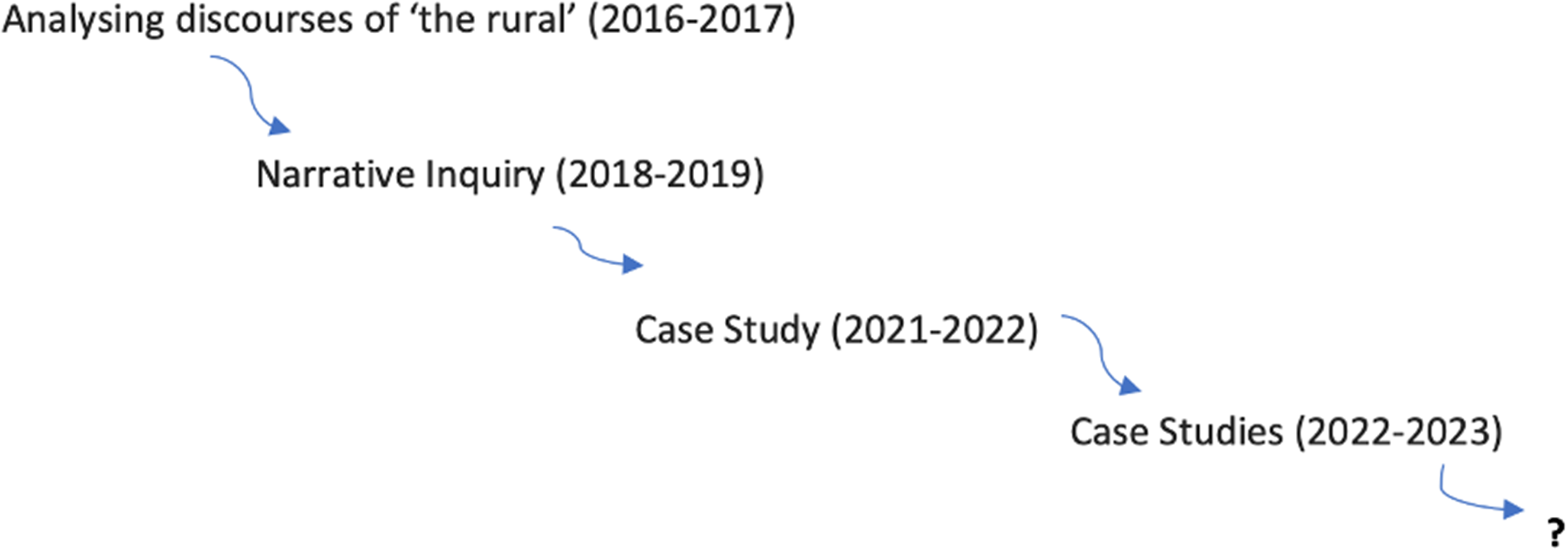
Components of slow and ‘promiscuous’ research project.
Although each project yielded multiple and often repeated ‘findings’, our reflection on the 7-year re-search process has demonstrated that researcher's response-ability behoves them/us to delve deeper and follow the trajectory of the data and not to be led by methodological purism or academic haste.
Slow research or slow scholarship is described as a considered and reflexive process which cannot be undertaken in haste (see Glenn, 2021; O’Dair, 2008; Rose and Todd, 2023; Smith and Mentz, 2020; Wahab et al., 2022). O’Dair (2008) places slow scholarship as an alternative to the desperate instrumentalism of neoliberal capitalism. The same might be analogous to notions of ‘quiet scholarship’, which listens before it speaks and ‘plural scholarship’, which pays attention to discourses that can sometimes appear secondary but act primarily to socially construct meaning within communities. In the lull that precedes interpretation, other voices will emerge, already speaking and complete. Smith and Mentz (2020) describe this approach as ‘blue humanities scholarship’ in which the re-search ‘should treat Oceanic cultural materials not as lacunae in need of filling, but as a plenum of stories, lives, ideas and cultures’ (13). As such, the ‘slow’ movement of re-search formulates a sustainable alternative to the onslaught of speed (Glenn, 2021: 592). As Kuss (2015) suggests, slow scholarship or research resists institutional interests and pressures researchers to conform to policymaking. Instead, the slow scholarship allows the researcher to analyse policy in ‘its ambiguous social context and insists on asking the scholar's thoughts about it’ (Kuss, 2015: 828).
Slow research is characterised by cultivating relationships, a concern for improving people's lives and re-making the university through facilitating caring academic cultures and processes, involving more than a slowness of pace by focusing on care, deliberateness and thoughtfulness (Mountz et al., 2015). As re-searchers, it is essential that slow research works against binaries by questioning the nature of knowledge itself (Wahab et al., 2022). Slow research seeks to accommodate complexity, nuance and non-linear knowledge production that combats what Ulmer (2017) refers to as assembly-line logic and fast research turnover. Glenn (2021) characterises this form of research as one that shows a ‘lack of time for thoughtful, critical reflection and impacts on the quality of scholarship and on professional agency’ (592).
Martell (2014), however, notes that the ‘slow’ in slow scholarship is not just about time but about dismantling structures of power and inequality. For this study, the analysis of discourses, which determines how the rural is positioned concerning the non-urban, demonstrated metrocentric inequities and distributions of power. This analysis, congruent with the value and privilege attributed to masculinised and metrocentric research and men and women's contribution to rural community and governance (Crimmins et al., 2021), prompted us to place women from non-urban communities as experts of the plural and their needs and imagined futures. This prioritisation illustrates how discourse analysis can lay the foundations for slow research in intent and focus.
Our subsequent re-search was built on and further embedded a relational research approach based on listening to the double ‘Othered’ (Fanon, 1967) plural women, where we were and remain, at the service of the community by assisting them in sharing their lived experience and in finding an audience for their insights. Relational research, built around collaborative action research and associated methods, highlights a dialogic approach to sharing lived experiences. Glenn (2021) argues that a ‘slow approach’ to action research supports a practical application that encourages personal, intellectual and relational awareness.
The subsequent co-design of project activities, including the development of microdocumentary and podcase series and workshops, also sought to trouble traditional models of ‘support’ where people from the outside (adopting a ‘thatness’ of place) predominantly tell the plural what they need—and help them achieve it. The foundation of social justice and care for the plural community, on which all phases and aspects of our re-search were based, also aligns with the focus of slow scholarship, which is ‘not just about looking after ourselves as academics, but rather about building a broader sense of care … as a means of finding ways to exist in a world that is diminishing’ (Ahmed, 2014 in Mountz et al., 2015: 1239). Finally, our re-search was iterative, meandering, and sometimes circular, where themes that emerged in the discourse analysis surfaced in the narrative inquiry and again in a case study. Yet, each time a key consideration re-emerged, we could understand it in a more nuanced or textured way. For example, the women participants discussed approaching leadership in iterative and complex ways spanning community leadership, mentorship, entrepreneurship, advocacy, agvocacy, local government leadership, volunteerism The data, therefore, became more complex and relational, defying binary classifications and more deeply understood. Such iterative and evolving research journeying is congruent with slow scholarship's focus on time that is not ‘marked by a chronology of events, [but by] interwoven levels, paths, directions and moments that weave in and out’ (Wahab et al., 2022: 152). The level of depth and investigation is at odds with the efficient productivity requirements of the neoliberal academy (Tight, 2019). Nonetheless, Glenn (2021) argues that the value of taking time to build collaborative research relationships and understand each other's perspectives cannot be underestimated and Black and others (2017) demonstrate that research collaborations borne out of a slow research approach can create research momentum and uplift, through: producing together, supporting, motivating, and energising each other. By flying as a team in this formation, each of us feels the assistance of another as we fly. We rotate (also organically) and someone new moves to the front. Fatigue is avoided, strength and vigour is renewed. We learn and grow as a team.
Conclusion
This paper established the productive role that language plays in naming, shaping and framing what already exists and in producing new ideas and ways of being. We also acknowledge that to ‘challenge ideological injustices in culture, the language of a society must be challenged as well’ (Chukwuezi, n.d.). These two concepts lay the foundation for analysing discourses relating to the ‘rural’, which established how geographies of place in Australia and the dichotomy between the rural and urban is problematically based on economic and colonial measures and lenses. This analysis led to a consideration of how women from ‘non-urban’ places become double-Othered (Fanon, 1967), as they are even less likely to be included in national or regional decision-making than their male counterparts. The analysis of dominant discourses of places and gender became the impetus of a series of research projects which evolved and incrementally built on (and overlapped) each other. That is, the feminist CDA employed constituted analytical activism by mobilising theory to create critical awareness and develop feminist strategies for resistance (Lazar, 2007) that seeded further feminist research.
The resulting multi-year, iterative projects bridged the boundaries of research methodologies and demonstrated the limitation of time and process-bound definitions of research. Congruent with Barad's (2007) notion that what ‘matters’ is dynamic, our re-search focus and practices journeyed (by following the data) allow for iterative and non-linear research processes and relationships to evolve and deepen. Engaging with/in the principles of slow scholarship, we developed trusting research relationships based on integrity and care and a commitment to iteratively listen and respond to the stories, vision and capacities of the rural women with whom we first engaged. These iterative processes discarded traditional research methodologies’ temporal and categorical boundaries, allowing new knowledge and processes to emerge through messy, feminist, multi-methodological research approaches. These processes and findings both illuminate and seek to bridge some of the dominant binaries that delimit what research is undertaken, with whom and when.
Footnotes
Declaration of conflicting interests
The authors declared no potential conflicts of interest with respect to the research, authorship and/or publication of this article.
Funding
The authors disclosed receipt of the following financial support for the research, authorship, and/or publication of this article: This work was supported by the AGL Energy Limited, Care Balonne, Department of Water, Agriculture and Environment Australia, University of the Sunshine Coast. Partner organisations (non-funded) - Lifeline, Murweh Shire Council.

Author biographies
Gail Crimmins is associate dean (L&T), School of Business and Creative Industries at the University of the Sunshine Coast and is widely published in gender equity, gender in education and the lived experience of women in developing gender equity strategy and cultural change management. She has worked alongside Sarah Casey on the ‘Real Rural’ projects, is an executive member (2021–Present) of the Australian Women's and Gender Studies Association and she sits on the Board of high ranking gender journals such as Gender and Education. Crimmins has published three books, is experienced in creating NTROs, as well as producing scholarly works in high ranking journals.
Sarah Casey is a senior lecturer, Communication at the University of the Sunshine Coast, Australia. She leads the Real Stories of Country Women, Real Rural Digital Solutions and Real Rural Women's Leadership projects. Her work and lived experience about rural life has featured in academic publications, national media, as well as internationally in the Chicago Quarterly Review. She is the author of two books and produces NTROs such a microdocumentaries and podcasts. Sarah is a long-term executive member of the national peak body, the Australian Women's and Gender Studies Association and the co-editor of the associated journal, Feminisms, Gender and Advocacy (with Gail Crimmins). She is a member of the National Rural Women's Coalition Communication Reference Team (2021–Present), the key industry alliance for rural, regional and remote women in Australia.