



Abstract
Go alongs are a popular research method for studying everyday mobility practices, providing insight into embodied experiences of engaging with lived environments. Generally considered positive and productive, there is increasingly discussion of go-along interviews as emotionally, cognitively and physically demanding. We consider care an essential component of go-along interviews. However, this has been overlooked in scholarship; particularly the relationality of care, including care of the researcher. We provide four vignettes discussing our experiences of conducting 118 go-along interviews with residents living in or near London Low Traffic Neighbourhoods. Reflecting on care-full encounters, we highlight the role of reciprocity, solidarity, and mutual understanding, strengthened by the recognition of shared experiences. Reflecting on care-less encounters, we highlight how, by disrupting traditional research hierarchies, go-along interviews can expose marginalised and stigmatised researchers to abuse. Overall, our vignettes demonstrate that care is a relationally produced, shared accomplishment involving both the researcher and the participant.
Introduction
Go-along are interviews where the researcher accompanies the participant travelling through a socio-spatial environment. They are considered a powerful method for the exploration of place and how people move through it, and for understanding its meaningful role in participants’ lives (Carpiano, 2009; Kusenbach, 2003). Some researchers consider that go-along interviews challenge inherently unequal researcher-researched power dynamics of traditional sit-down interviews (Bartlett et al., 2023; Hitchings and Jones, 2004).
Within the context of their growing popularity in geography and mobilities research (Bartlett et al., 2023; Merriman, 2014), go-alongs were an obvious method to use as part of our NIHR-funded project ‘Low Traffic Neighbourhoods in London’ to understand resident experiences of such interventions. This is because go-alongs attend to how the participant moves through and experience their physical and social environment (Kusenbach, 2003), in the case of this research Low Traffic Neighbourhoods (LTNs). LTNs are networks of residential streets ‘filtered’ to restrict motor vehicles, using infrastructure such as Automatic Number Plate Recognition (ANPR) cameras or physical barriers like bollards and planters. LTNs remain accessible by motor vehicle but the route may be more circuitous. LTNs aim to improve conditions for active travel – walking, wheeling 1 , and cycling – by reducing interactions with motor vehicles (Laverty Anthony et al., 2021a).
Research so far has found LTNs in London have increased levels of active travel (Aldred and Goodman, 2020; Goodman et al., 2020a), reduced road injuries (Laverty Anthony et al., 2021a; Laverty Anthony et al., 2021b), cut car ownership (Aldred and Goodman, 2020; Goodman et al., 2020b), and reduced driving by residents (Goodman et al., 2023). Despite promising evidence, LTNs have been highly controversial (Mason, 2021) and politicised, and few are being implemented in the UK, especially outside London. Initially supported under Boris Johnson's Conservative government, more recently Rishi Sunak's Conservative government has distanced itself from and even attacked LTNs (DfT, 2023; Walker, 2023).
In total, we, three precariously employed, under-40 white female researchers, undertook 118 go-alongs with residents who live in or close to four planned or implemented LTNs across Summer 2022 and Summer 2023. Recognising that not everyone can participate in go-alongs (Parent, 2016; Warren, 2017), we undertook two virtual ‘go-alongs’ using Microsoft Teams and Google Maps.
The precarious nature of our employment reflects a wider academic context in which the production of knowledge is predicated upon the employment of academics on insecure and fixed-term contracts (Burton and Bowman, 2022). In the UK, for example, 66% of research-only staff (like us) are employed on fixed-term contracts (UCU, 2023). Such casualisation is borne of a university business model in which permanent contracts are considered too costly, thereby individualising risk through precarity. This is reinforced by grant providers who fund fixed-term employment and do not tend to make conditions within grants that would support more secure roles. As we reflect within this paper, the precarious nature of our employment influences how we can undertake research.
Whilst most research positively depicts go-alongs, some reflections attest to their sometimes demanding nature; physically, cognitively and emotionally, as well as exposing those involved to possible dangers (Bell and Bush, 2021; Foley et al., 2020; Moran et al., 2022). Certainly, we felt demands during our 118 in-person go-alongs. These included, for example, navigating narrow and overgrown pavements with participants next to busy roads, conducting go-alongs when temperatures exceeded 20 °C and needing to ensure our own hydration and wellbeing but also check in with participants, and the physical (lots of walking) and cognitive (simultaneously maintaining mental agility in question formulation and managing equipment) difficulties of undertaking multiple go-alongs in one day. In this paper, we want to trouble go-alongs further, positing that because they are challenging and a method aimed at opening up and disrupting traditional researcher/participant boundaries, go-alongs need more attention to care. Within this piece, we reflect upon what we call ‘care-full’ and ‘care-less’ encounters whilst undertaking go-alongs. Recognising that care is both relational and a shared accomplishment (Tronto, 2013: 20, 2015b), we consider not only our own care-full and care-less encounters with participants, but also the care-full and care-less ways that participants encountered us as researchers. In thinking ‘care-fully’ about go-alongs (to think in order to care (Stiegler and Ross, 2017)), we are following calls by Castrodale (2018), Duedahl and Stilling Blichfeldt (2020) and Merriman (2014) for more critical reflections upon the use of go-alongs, and specifically, whether go-alongs are always appropriate.
Go-along interviews
Within a wide range of research disciplines, including transport and mobility geographies as well as urban studies, the go-along has become a popular qualitative research method (Bartlett et al., 2023). Go-alongs involve a researcher ‘accompany[ing] individual informants on their ‘natural’ outings, and – through asking questions, listening and observing – actively explore[ing] their subjects’ stream of experiences and practices as they move through, and interact with, their physical and social environment’ (Kusenbach, 2003: 463). Go-alongs offer an opportunity for the socio-spatial environment to prompt and contest what is being said (Hitchings and Jones, 2004). Accompanying most commonly involves walking, but other examples include by car (Porta et al., 2017), by cycling (Van Cauwenberg et al., 2018), by public transport (Porta et al., 2017), and by wheeling (Parent, 2016). The socio-spatial environment that the researcher and participant are moving through should be relevant to the objective of the research (Moran et al., 2022). Go-alongs are generally considered a hybrid form of observation and interview, overcoming the difficulty accessing experience and interpretations from the former method, and overcoming the difficulty in contextualising and understanding placed details of the latter (Kusenbach, 2003).
Within our research, we conducted 81 walking go-alongs in Summer 2022 (Figure 1), and 37 follow-up go-alongs in Summer 2023. The interviews were part of a wider project – ‘LTNs in London' – in which we were focusing upon resident experiences of LTNs. Participants were given £40 vouchers for taking part. The go-along were conducted by three of the authors of this paper. We were joined by two research interns (names pseudonymised) for four of the interviews. We utilised go-alongs as they are a popular method for studying everyday socio-spatial mobility practices, which provide insight into participants’ embodied experiences of engaging with and responding to the environment (Carroll et al., 2020; Evans and Jones, 2011; Kusenbach, 2003). Evans and Jones (2011) for example, found that go-alongs tend to be longer and more spatially focused, with the participant engaging more deeply with the characteristics of the environment, compared to sedentary interviews. Parent (2016) develops this embodied experience of place further by demonstrating through go-alongs with disabled participants, including visually impaired participants, that it is more than sight that prompts discussion, but the physical experience of being in, and responding to, place. Go-alongs can be used to reveal how mobility relates to socio-spatial environments and demonstrate the barriers, as well as enablers, of mobility within those environments (Bartlett et al., 2023; Carpiano, 2009; Castrodale, 2018).
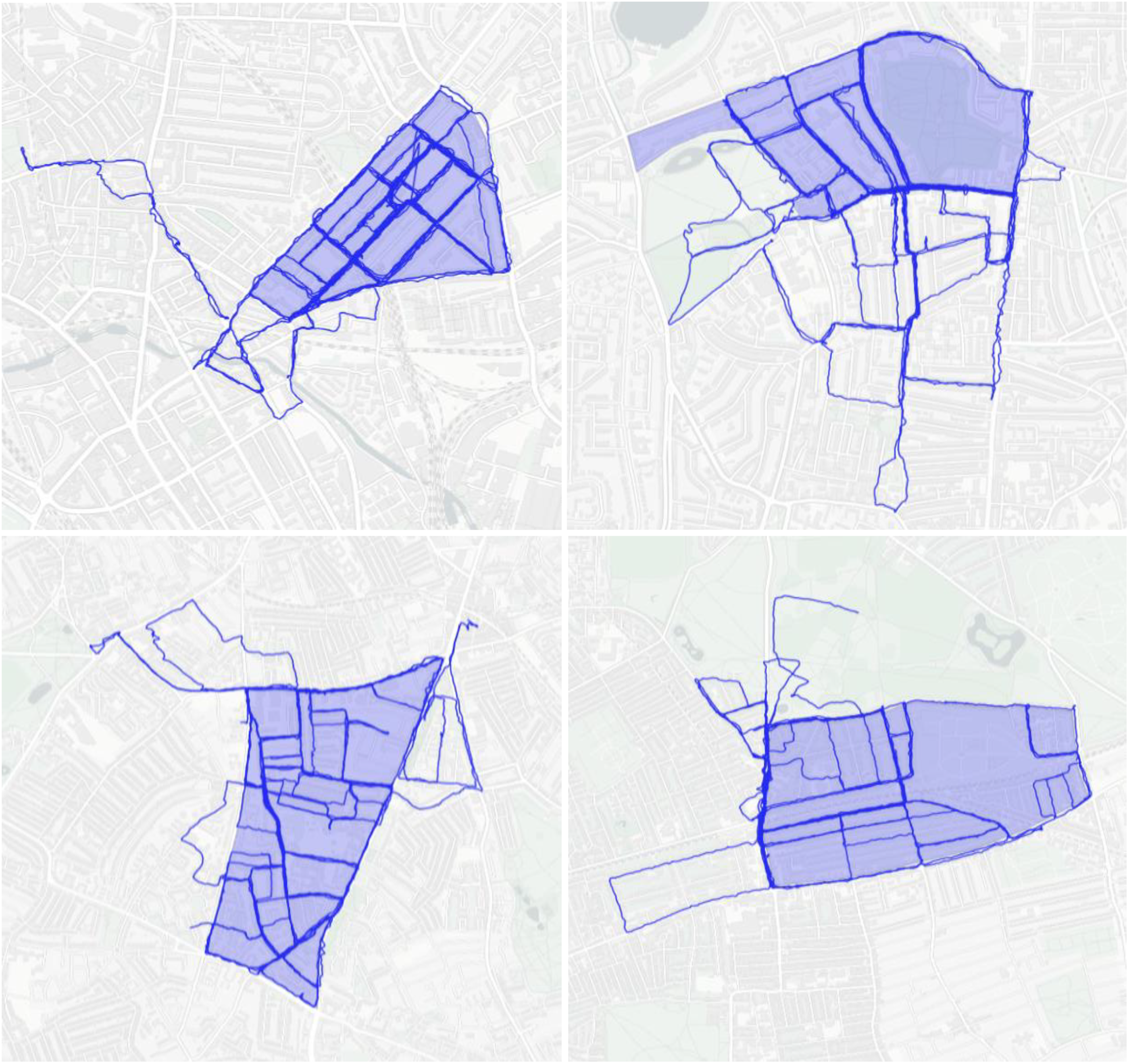
GPS tracks for 81 go-alongs conducted across four case study areas in Summer 2022.
In addition to developing more embodied understandings of socio-spatial environments, go-alongs are considered to be an effective method in unsettling power dynamics between the researcher and the participant (Bartlett et al., 2023), as they can create more closeness and authenticity in the interview process (Merriman, 2014). Indeed, this unsettling is commonly cited as a reason for choosing go-alongs as a research method (see Bartlett et al., 2023; Bell and Bush, 2021; Carroll et al., 2020; Castrodale, 2018; Parent, 2016). Unsettling dynamics comes in a shift of control over the research process from the researcher to the participant, who will generally select the go-along route and be familiar and comfortable with the environment they are moving through (Brown and Durrheim, 2009; Carpiano, 2009; Moran et al., 2022). Hitchings and Jones (2004) found that interviews walking with participants in their gardens, compared to sitting inside, meant participants were trying less to give the ‘correct’ answer, and more likely to offer deeper social meanings around connections with plants. That said, unequal power dynamics can remain in terms of the interviewer-interviewee relationship, as well as the interviewer commonly having a research agenda (Moran et al., 2022).
Generally, much of the research available on go-alongs depicts them as a positive and productive research method. There is, however, growing critical reflection upon their demanding nature (Castrodale, 2018; Duedahl and Stilling Blichfeldt, 2020). It is both physically and cognitively demanding to navigate socio-spatial environments together with participants, simultaneously ensuring safety and minimising risk whilst asking and answering questions and thinking about said questions and answers (Bell and Bush, 2021; Duedahl and Stilling Blichfeldt, 2020; Foley et al., 2020). In our research, for example, we would often undertake two or three go-alongs per day on research days, walking for an hour or more per go-along. As research was undertaken in the summer, the temperature could often be over 20 °C. We scheduled interviews to be over as condensed a period as possible for several reasons. Firstly, as precarious academics with fixed-term contacts, we do not live in London where our research institution, as well as our research, is based. Condensing the research period meant we were reducing accommodation and travel costs or the burden on friends and family to host us. Additionally, because of the sometimes substantial travel distances within London to case study areas, being as efficient as possible with interviews meant reducing the total time spent travelling. Finally, as ECRs we are painfully aware of the necessity of publications, and condensing research into fewer days creates more time for analysis and writing.
We have estimated that over the course of the interviews in 2022, we walked over 200 miles between us (see Figure 1). We found the go-alongs both physically and cognitively tiring. During each go-along and research day we had to ensure that we were hydrated and well nourished. For one of us (Harrie) this was particularly challenging as she had to balance her enteric feeding regime with the anticipated amount of walking. Whilst Harrie had been reluctant to disclose challenges to the team in 2022, largely because she was new to the project, in our follow-up go-alongs in 2023 and 2024, we developed a team approach where we can more openly have discussions about capacity and adaptations we can all make.
We also had a responsibility to check in with participants that they were managing the distance, the heat, and were hydrated. In addition to this, we had to be careful about ourselves and our participants when navigating through the environment. We had to consider motor vehicles, other pedestrians, cyclists, and e-scooter users, as well as the existing infrastructure of pavements like cracks, lumps, tree roots and the absence of dropped kerbs. Participants also looked out for us as we navigated our way around LTNs or planned LTNs. The researcher was responsible for managing the technology involved in the go-along; namely setting up a clip-on microphone and tracking the route using Strava. Both researcher and participant managed all this – which Bell and Bush (2021: 316) describe as ‘what at times felt like constantly shifting assemblages of more than human nature’ – whilst discussing experiences of the infrastructure that we were moving through.
Go-alongs can be emotionally demanding, as going through meaningful places can illicit very strong and emotional responses (Bartlett et al., 2023). For example, conducting walking go-alongs at the site of natural disasters, D’Errico and Hunt (2022) demonstrate how strong emotions are elicited through moving through and discussing place, which are felt by both the participant and the researcher. Parent (2016) demonstrates such an emotional demand by reflecting upon the challenges and barriers they faced doing go-alongs as a disabled wheelchair user. By creating an in-depth and intimate relationship between researcher and participant, go-alongs can also become a moment of vulnerability for both (Bashir, 2020). Whilst everyday mobility and LTNs may seem a mundane topic, many who participated in our research had strong opinions – positive or negative – on the intervention and so strong emotional responses were relatively common during interviews. Some interviews discussed immobility and its impact on everyday life, where discussions could be particularly emotive.
A further demand of go-alongs is that because they tend to be outside and in public spaces, they open up both researcher and participant to unforeseen socio-spatial encounters that would not necessarily happen in a traditional sit-down interview where factors such as noise, other people etc. are more predictable (Castrodale, 2018; Curl et al., 2018). More marginalised people are often more at risk of negative encounters within public space because of histories of oppression (Bartlett et al., 2023). Castrodale (2018), in their research with Disabled and Mad people, demonstrated that not only are go-along participants vulnerable to potential negative encounters, but the potential of these encounters could mean that participants are unwilling to participate in go-alongs. However, whilst there is consideration that marginalised/vulnerable participants could be at risk of discrimination because of their visibility during go-alongs (Bartlett et al., 2023), there is limited consideration that the researcher themselves (as in our own work) could be a marginalised person.
Troubling go-alongs through a lens of care
Considering the emotionally, cognitively, and physically demanding nature of go-alongs, as discussed above, we consider care to be a particularly important element of the method. Yet care is barely mentioned within scholarship on go-alongs. One element is that go-alongs can be considered as a practice of care; as they offer a situated, embodied, and relational approach to making sense of the world, and so offer a setting in line with an ethics of care in research. However, we propose that go-alongs should not be considered as an automatically caring research practice, and attention needs to be paid fully to the implications of relationality of care within the method itself.
A reflection on the ethics of care emerged as part of a feminist approach and onto-epistemic shift in research, which has advanced relational and situated understandings of living in the world, calling for a fundamental shift in the understanding of ethics and responsibility in knowledge production (Gilligan, 1982; Sevenhuijsen, 2003; Tronto, 2013). As part of this rethinking, care becomes a fundamental element of researching as:
‘a species of activity that includes everything we do to maintain, contain, and repair our ‘world’ so that we can live in it as well as possible. That world includes our bodies, ourselves, and our environment, all of which we seek to interweave in a complex, life-sustaining web’ (
Fisher and Tronto, 1990
: 40).
In such a perspective, care is conceptualised as a central aspect of social life (Tronto, 2015a), a ‘shared accomplishment’ (Conradson, 2003: 508) that emerges from the embodied relations that make up our living in the world. As proposed by Tronto (2013) (and others, see, e.g. Sevenhuijsen, 2003), this accomplishment is made of many different moments that constitute care as a nested practice: a recognition of the need for care (caring about), the taking responsibility for responding to such need (caring for), performing actions to give such care (care giving) and a moment of receiving such care (care receiving). To these steps, Tronto (2013: 23) adds a final key moment of caring with which ‘requires that caring needs and the ways in which they are met need to be consistent with democratic commitments to justice, equality, and freedom for all’.
In such a way, care is understood as a co-created network of ‘non-normative obligation’ (Puig de la Bellacasa, 2012: 198) to take responsibility for and with others, arising from the recognition of how one's life depends on others, and considering all human and more-than-human beings as co-participants in the making of the world (Lonkila, 2021). Based on the recognition of the fundamental role of interconnectedness and interdependence in the functioning and maintenance of our world, an ethics of care demands a pluralistic and relational approach to research and moral responsibility in the research process (Barnes and Brannelly, 2022). It implies seeing research as a process of building social justice embedded in and part of a troubled world of social and environmental crises which involves caring for humans and non-humans as it works to challenge marginalisation and injustice (Brannelly, 2018; Groenhout, 2004; Hall, 2022; Lonkila, 2021). This is to say, an ethics of care is inevitably linked to environmentalism, and to participatory research practices.
A central tenet of care in qualitative research has been to re-centre research on the perspective of participants, reframing and ‘repairing’ the traditional researcher/researched relationship from one that is hierarchical and extractive to one of collaborative relationship of knowledge co-production and mutual understanding, from researching ‘about’ to researching ‘with’ others (Nind, 2014). By centring the research process on participants’ concerns and values and un-doing hierarchies, co-production opens up the research process to a plurality of voices, placing reciprocity and authenticity at the heart of knowledge production (Bridges and McGee, 2011; Nind, 2014). Because of their focus on relationality, both reciprocity – as ‘the mutual give and take of human interactions and relationships’ (Bridges and McGee, 2011: 215) – and authenticity – as the work of both parts in creating auspices for genuine and authentic conversation, mutual understanding and interaction (Gubrium and Holstein, 2009; Whitaker and Atkinson, 2019) – are directly related to ideas of care. Particularly, we posit that there is reciprocity and authenticity in the process of co-production when care is relationally produced and reciprocated between researcher and participant.
The process of democratising research practices (Edwards and Brannelly, 2017) has centrally involved refocusing research questions on issues that matter to participants and their lives, and constant questioning of how ‘those who do research relate to others who may be the subjects of research and whose lives may be influenced by what we do’ (Barnes and Brannelly, 2022: 3). The reflection on research and care is intertwined with thinking with epistemic justice, reflexivity on one's positionality, questioning who is excluded or included in the research process and knowledge production, and interconnections and interdependencies implied in researching and care (Hall, 2017). Budworth (2023) demonstrates how implementing flexibility into research practices can support more care-full methods, that work with the comfortabilities and capacities of research participants. This is particularly important when working with disabled and chronically ill research participants.
Within this growing recognition of the importance of care and caring research practices, the focus has predominantly been on unidirectional researcher-researched caring relationships, where the researcher is ‘caring about, for and giving care to’ their human or non-human (Lonkila, 2021) participants. This is important and has been key to disrupting traditional research hierarchies. However, we argue that an underpinning theory of care as relationally produced also demands considering all aspects of ‘caring with’ and ‘being cared about, for’ and ‘being given-care’ from the perspective of the researcher, and how these can be disrupted. We propose that, as part of the increasing recognition of the need for care-full research, a more detailed reflection is developed upon encounters where these moments of ‘caring about, for and giving care to’ and ‘caring with’ are not part of research practices. We call these, ‘care-less encounters’, as opposed to ‘care-full encounters’ where all moments of care are possible from both the researcher and participant side.
This can complement existing literature on the related emotional and physical risks and burdens qualitative researchers can face when participants exercise power over researchers inducing vulnerabilities, including exposure to physical and emotional dangers (Bashir, 2020). It can deepen existing work on the vulnerability of the researcher in qualitative research in relation to sexual and gender-based harassment and violence, bringing consideration to other marginalised positions (Clancy et al., 2014; Hunt, 2022; Pritchard, 2019; Pritchard and Edwards, 2023; Ross, 2015; Schneider, 2020). Within this paper we reflect upon both care-full and care-less encounters within our research, troubling the unidirectional researcher-researched caring relationship proposed within literature upon methodologies of care ethics.
Care-less and care-full research encounters
In this section, we reflect upon vignettes of care-less and care-full encounters we experienced as researchers during our go along interviews. Through these vignettes we trouble the idea of unidirectional care within interviews, demonstrating how care is relationally produced (or not produced) during the research process. We demonstrate how an ethics of care for the environment, our ‘caring with’ approach (Tronto, 2013), for example, is not necessarily shared by participants, resulting in conflicting interests in care (see more in Lonkila, 2021). We developed the vignettes by each of the data-collecting researchers (Harrie, Ersilia, and Emma) reflecting upon the question ‘What was a care-full/care-less encounter you experienced during research?’. We then used our fieldnotes, interview transcriptions, and memory to recall, reflect and write our vignettes.
Care-less encounters
Vignette 1, Harrie.
I meet with the participant outside a park and one of the first things he does is point to the tube on my face and ask me whether it's for oxygen. I don't feel like I have the option to do what I normally do when people ask invasive questions about my medical history, which is ignore them, and I answer that it's a feeding tube as my stomach doesn't work and I can't eat orally. He accepts this and we move on, undertaking the go-along interview together. And at the end of the interview, after he takes off his microphone, he looks directly at me and he says, “I’d rather die than have a feeding tube”. (Harrie, Vignette 1)
When considering carelessness within our go-alongs, the vignette above is the encounter that I (Harrie) immediately recalled. I think as a researcher I don't necessarily expect a participant to care about and for (Tronto, 2013) me. Although saying that, it is most definitely something I experienced as discussed in section ‘Care-full encounters’, as well as through the way many participants would look out for me – as I would look out for them – as we navigated the infrastructures of their neighbourhood together (see also Bell and Bush, 2021). But the vignette above is not an absence of caring about and for, but rather a stark example of when a participant could not care less for me and with me. The participant encounters me, a visibly disabled researcher, and asks me invasive medical questions. Strangers asking disabled people similarly invasive questions is well documented within academic literature (Calder-Dawe et al., 2020; Rinaldi, 2013), as well as within disability communities (e.g. see Pring, 2023 for disabled people's response to a UK government disability campaign ‘Ask. Don't assume’). The temporality of this encounter also compounds that the participant could not care less. It wasn't an ill-considered, in the moment, response after I had (reluctantly) disclosed my medical condition. The participant waited until the end of the interview, until the microphones had been switched off, to give me their opinion.
The belief that it is acceptable to ask disabled people invasive medical questions is related to the historic objectification of disabled people. This objectification stems from popular understandings of disability being rooted in the medical model of disability. In the medical model, ‘atypical bodies and minds [are framed] as deviant, pathological, and defective’ (Kafer, 2013: 5). Through this framing disabled bodies become objects to cure through medical intervention and to fail to be cured indicates a personal defect that further exacerbates objectification. The asking of an invasive question is a demonstration that this participant could not care less about me, a disabled researcher they were encountering, although it is important that their being careless, or more specifically ableist, is entangled with wider structural inequalities.
What also strikes me when reflecting upon my vignette is that I didn’t feel like I had the option not to answer the question. The action that I would normally take in response to invasive questions, which would be to ignore them or pretend I hadn’t heard them, becomes more difficult in an interview, and even more so, I think, when you are standing with someone in a non-traditional research context as you are expecting more of your participant (in the case of the go along to show you around a socio-spatial environment personal to them) and you feel like you are indebted and cannot be withholding. That the participant had the power to ask an invasive question, and that I did not feel like I had to the power not to respond to the question, does demonstrate a reversal in power dynamics that would be traditionally assumed within an interview, although potentially reduced within a go-along interview (Bartlett et al., 2023). I suppose how I feel is that as a researcher, recognising power dynamics within my work, I know that I have a duty of care to my participant – indeed it is part of a feminist ethics of care as previously discussed. However, once power dynamics begin to change, one can question whether participants – in the case of the vignette – will always display an ethics of care to the researcher and what the implications of this are. For me, for example, listening to a participant say that they’d rather die than having a feeding tube was scary, because they were telling me my life wasn’t worth living. And it was upsetting and impacted upon my confidence, with a cumulative effect beyond the go-along interview itself (see Larrington-Spencer, 2023).
My encounter discussed in the vignette is also related to how go-alongs involve being seen (Bartlett et al., 2023). Whilst Barlett et al. consider this as a risk for participants who are from marginalised backgrounds and so are more likely to experience stigma and discrimination in public spaces (and who we need to take care of in this regard), my vignette offers that we also need to consider the risks of discrimination through being seen as marginalised researchers. For myself, as a disabled researcher undertaking go-alongs, one of my most pervading experiences was of being seen, and the subsequent disablism – discrimination against disabled people (SCOPE, 2023) – that I experienced because of this visibility. In addition to the encounter in the vignette, I was repeatedly asked by participants what is wrong with me and told that having a feeding tube is awful or a tragedy. My being seen as a disabled researcher also extended beyond encounters with participants. For example, after a day of go-alongs, whilst I was waiting for a bus, I was approached by a passerby who told me that my feeding tube is unpleasant. These experiences demonstrate that when we consider care around the demand of being ‘seen’ through the visibility that go-alongs pose as a method, we need to extend considerations out from only the marginalised participant, to recognising that many researchers are ourselves often part of marginalised or stigmatised communities (Aldred, 2008; Clancy et al., 2014; Gladstone et al., 2023; Pritchard, 2019).
Vignette 2, Ersilia
The below vignette reflects upon a follow up go-along interview with one of our research participants. The initial interview was undertaken by both Ersilia and Harrie – it was our first interview of the project, and we were observing each other's research techniques – and the follow up interview was conducted by Ersilia, who was accompanied by Anika, one of our project interns. This reflection is written with the consent of Anika. The first interview had been challenging; we found it difficult to ask constructive questions, or any question really, as the participant wanted to use the interview to explain his extremely strong opposition to any restriction on driving, also providing us with printed evidence to support his points. This first interview, and our inability to build therein ground for a genuine reciprocal conversation, really stuck in our minds, and we talked about the encounter multiple times afterwards. We undertook a follow-up interview with the participant because it was part of our methodology to understand experiences over time. Whilst we could have chosen not to undertake the interview, and instead find a new research participant, considering how controversial LTNs became during this time, we decided a ‘better the challenging participant that you know’ approach was safer than recruiting a new participant. In other cases we made other choices: for instance, we had already adjusted the project not to include on-street engagement events because of potential risk. Perhaps because of such embodied shared experience of having witnessed the interaction together, with all the added layer than a transcript often fails to convey, the interview remained as a vivid reminder of the challenges the project and interviewing brings.
I knew this would be a difficult interview as I had interviewed this participant the previous year and I was very nervous, especially as our research intern Anika was joining me. I meet her and warn her this is a quite challenging participant. We wait at a junction. As on the previous time, the participant arrives and a warm greeting is followed by a walking-lecture where he wants to cover research he had done on the topic. As I am prepared to this, I try more proactively to gently interrupt and ask, why, where did you read this, why do you say so? I feel Anika is as uneasy as I feel. The participant shows us where he drives though the restrictions illegally, and how he has challenged the fines received on the premise of his right to drive. I think of the children walking past the same junction. I feel extremely nervous. We walk on a pavement, it's such a sunny day and mothers with prams, people with bags, are crowding the pavement and struggle negotiating the limited space they have. I invite the participant to tell us how he feels about the pavement having been widened by the council.
“It's ridiculous. Why make – what, are you expecting to have a concert here? We haven't got Wembley Stadium here. What is the purpose of having great big pavements making the road smaller?” he responds.
I would want to scream thinking of the participants’ attitude towards us and everyone around, ‘but don't you see these people walking around you? Don't you see others?’ He changes again the topic wanting to talk about chem trails, as the true cause of pollution. Then, he suddenly turns towards Anika and addresses her with a ridiculing tone:
“People have no control over the pollutions that are – you know you get pollution from your central heating, did you know that? Did you know? [,..] You do? Why didn't you tell me before? I'm joking, I’m joking.”
The man's attitude to Anika seems implicitly racist and really destabilises me and I worry about Anika, young woman of colour, having to experience this. I feel he's again, just making fun of us. I just wrap up the interview as quickly as possible, as my stomach hurts more and more. When he leaves, I exhale deeply and look at Anika and apologise. (Vignette 2, Ersilia)
The two encounters with this participant are here as a reminder of the additional challenges that emerge when there exists a striking dissonance between our attempt to establish a caring relationship for and about the participants, whilst keeping faith to our commitment to ‘caring with’ not just us in the research pair, but also others and the environment (Tronto, 2013).
As mentioned, our research topic has been increasingly controversial, framed as a culture war, and elicits very strong responses, especially by those who have felt intervention to be a hindrance to their right to drive (Mason, 2021). As researchers working on transport and mobilities, we are very aware of the substantial negative impacts driving and motorised transport has on the environment and society. We are also aware of the challenges embedded in challenging car dependency, and the risks of uneven effects. Our research is framed in terms of just transitions, being genuinely open to understand whether schemes such as LTNs will in fact help reducing levels of car-use and air pollution, but also their more extended socio-distributional impacts and how these might affect different groups (Aldred, 2019). In such context, some of the narratives used to oppose these schemes, for example around a blanket right to drive regardless of where and how, remain fundamentally at odds with our values and the world we would like to build and inhabit (Furlong et al., 2023).
In general, and in the interview covered in this section, we found it extremely challenging when participants’ general positions, which often go far beyond the scheme we are considering, rejected the evidence of years of work on the detrimental impacts of car-dependency (Walker et al., 2022), and enrolled such narratives to justify fundamentally an unwillingness to adapt their behaviours, or instrumentalised others, such as disabled people, to reinforce their arguments (Hamraie, 2021). Even more as when those views, in most occurrences and particularly in this interview, entangled with a specific gendered interaction, a specific way of responding to our questions which was paternalizing us, or even with racist comments expressed during the interview.
In both encounters I felt the interview turned rapidly into a very unpleasant experience, where our vulnerabilities as young female researchers strikingly emerged, as a reminder of the challenges of our work, but also more in general as a reminder of the challenges of trying to open a dialogue with those who do not recognise us or others we care about as legitimate others (Rancière, 1992). Carelessness in these encounters take the shape of a continuous ridiculing and patronising in response of our questions, bringing other, ‘better’, evidence, to challenge our work. What in the fieldnote we called lecturing, an example of what others called mansplaining (Solnit, 2014), the being taken on a walk that someone else is directing to make their point even louder, bring us back to a position where it becomes extremely challenging to keep caring about, for and with the participant. Having to listen in silence to extremely long answers that bluntly negate what we have been working on for over a decade, corrodes our esteem and patience and denies any possibility for building authenticity or reciprocity. It reminds us about professional status, and how tenuous this status can be, particularly for precarious/female/minority/marginalised researchers.
As the participant uses these different techniques to take power over us, the work of care towards them has to be inevitably turned towards a work of repair towards oneself, trying to calm one's stomach and anger, or, in this particular setting of having a colleague nearby, trying to show understanding and solidarity with a quick exchange of glances, savouring the moment when he will let us go and we can freely vent about what happened. In the second encounter, the carelessness towards Anika, demands even more strongly such work of repair, but entrapped in the role of a powerless interviewee, I (Ersilia) am struggling to act promptly and with the depth I would have liked to have. The carelessness of the participants towards us and our intern, which strikingly resonate and expands in our perception the carelessness of his unseeing others, children, mothers, as they inhabit the space we are walking in or he will be driving in, restrains and impossibilises the work of ‘caring with’ we are used to and want to bring into the world. In such sense, these two careless encounters (Vignettes 1 & 2) are examples of how the undoing of the researcher/researched power dynamic without considering care relationally, risks turning go-alongs into an extremely challenging experience, where dialogue and making sense together are replaced with an intrusive and aggressive statement of one's unquestionable views on how things should be. The question remains, how can we still maintain our commitment to careful research when interacting with participants who not only fail to recognise us as legitimate others, but show explicit lack of care towards those we care about and feel entangled with, for the environment, for others around us as we walk on the streets, for our research interns?
On reflection we (Harrie and Ersilia), as Anika's line managers, were also care-less. We arranged for her to join two go-alongs towards the end of her internship and we chose two participants with diametric views for her to understand the radically different viewpoints on LTNs. Choice of participants was restricted to a short timeframe whilst Anika was still working as an intern and when she was available between classes. Whilst juggling these variables, we failed to care-fully consider how the participant might react to a much younger, female, researcher of colour and the position that this would put Anika in. This further highlights how, through the visibility of go-alongs, we need to better consider researchers from marginalised or minoritised groups.
Care-full encounters
In the following section we reflect upon care-full encounters that we experienced whilst undertaking go along interviews.
Vignette 3, Emma.
I was meeting with a participant for the first time. The woman had a pram with a small baby that I met at a street corner near her home. I (the researcher) had been staying with a friend the night before due to not living in London so had a large backpack containing my personal items. I also had a smaller bag that had research related items that I was holding. The participant was very warm and friendly. Within a short space of time from meeting (I think this was when I was trying to get consent forms and microphone out and used a garden wall to rest items on), she offered to put my rucksack on the shelf on the bottom of her pram. My immediate reaction was to decline as I did not want to ask anything of the participant but then ended up accepting as it was very large and heavy, and I realised that it probably had minimal impact on the participant. On reflection, if I had worn the rucksack, it would have been quite uncomfortable as it was very heavy and a warm day, which may then have taken away from the conversational style and quality of the interview (Vignette 3, Emma).
This vignette exemplifies the practicalities and challenges experienced by the researchers due to not residing in London due to the precarious short-term nature of job contracts and often relying on the goodwill of friends and relatives to accommodate us. In this example, the large distances in London between my friend's home where they were able to stay, our office, and the case study area, meant there was not enough travel time to leave the bag in the office before the interview took place, which would have been the most practical option. This was not a one-off occasion, as all three of us were in this situation at some point. On another occasion on an initial pilot interview, Harrie and I both had bags and we were offered to leave them at the participants house before doing the interview. The researcher here encountered challenges of thus having their belongings, although knowing that it was not the ideal scenario or most conducive to an interview but was necessary.
This example highlights that the participant is aware and caring for and about the researcher by acknowledging her challenge and wanting to give care. In my head there was a slight battle whether to receive care, as I did not want to take advantage or inconvenience the participant, especially as I always wanted to be courteous towards participants. However, after a few of her offers, I weighed up that she really did not mind and it would indeed be of minimal burden to her. I also considered that she may feel bad or guilty for not being able to show care about and for me whilst I obviously struggled.
In addition to baggage, we also needed equipment needed to conduct the interview – consent forms, pens, vouchers, clip on microphones, using the Strava app and using a recording device. This resulted in the researcher also having to juggle and hold many things as well as ensuring that the forms were correctly filled out and answer any participant questions. On this occasion, a nearby wall had to be used, and on others I had to put on the ground/street. During this, I often tried to be conversational rather than potentially awkward silence when filling out the forms. By engaging in this conversation, even if it was ‘small talk’, was an opportunity to show interest and care about the participant.
This act of care resulted in the quality of the interview improving due to the ability to walk comfortably and relaxed beside the participant, rather than having the constant weight and adjustment of the bag. This also built rapport and reciprocity, and I felt there was a more balanced dynamic with the participant.
On this occasion, and in another few cases, participants brought along children or dogs as they had their own caring responsibilities. In the instance of this vignette, the baby slept soundly throughout the walk along, with the mother's main concern ensuring that they remained this way, noting that she knew where all the dropped curbs were to navigate through the area, and watching out for cars. In another case of a man with this new pet puppy, the man used the go-along as a chance for its walk. Our go-along route was in a highly busy area and past main roads – the puppy pulled at the lead and was excited to explore therefore it caused the participant to have to look out for and care for the dog whilst the go-along was conducted. Although there were some instances in attending to the child or dog, these instances were not to the detriment of the overall interview as it highlighted how they interact with the environment normally when caring about and for these as well as the threats to their safety and wellbeing that had to be navigated.
Vignette 4, Harrie.
I met with Hannah for a follow-up go-along interview a year after our first one. Hannah is disabled and has several impairments that make walking, as well as social interaction, difficult. This year Hannah didn't feel able to walk, so we decide to meet up in the park across the road from her home. When I arrived, there were several benches free and I selected the one in the shade, remembering that last year Hannah struggled with the sun because of a skin condition. When Hannah arrived, she exclaimed that she had forgotten the bottle of chilled water she had planned to bring me. After the interview I realised that I hadn't given Hannah the thank you voucher, and so I text her to ask if I could drop it to her. When I did, she made sure to give me a bottle of water, making reference to the heat, and that I especially – because of my disability – need to stay hydrated if I was to be undertaking further go-alongs that day. (Vignette 4, Harrie)
I really like to reflect upon my two interviews with Hannah, which were both reciprocal and care-full encounters. In the vignette above I describe my second research encounter with Hannah. Within the vignette I mention how I sought to care about, for and give care to Hannah within my research practice; we changed the format of the interview recognising her needs, I sought out a shaded bench to ensure she was as comfortable as possible, and I made sure that Hannah was recompensed for her time when I initially forgot to give her the thank you voucher. These are examples of flexible research encounters that are instrumental in supporting care-full research practices (Budworth, 2023). I sought to ensure that I was the researcher for the follow up interview with Hannah, recognising how in our first encounter she had mentioned that she had trouble with meeting new people. But the care-fullness of encounters with Hannah was not uni-directional. Hannah also sought to care about and for me. She had planned to bring me a bottle of water and in the end she did in fact gave care to me and made sure to give me the bottle of water and when she gave me the bottle, she referenced my disability and the necessity of staying hydrated to stay well.
Unlike the careless encounter that I reflected upon above in which my disability was the subject, the mention of my disability by Hannah was very strongly received as an act of care. One reason for this was because it was not invasive and did not demand personal medical history that I did not want to share. Indeed, I had already naturally and reciprocally discussed my disability with Hannah when we were talking about mobility and disability during the interview, a factor that I believe increased the authenticity of our encounter. The mention by Hannah that I should drink water was also not an overbearing form of care, stemming from (the often non-disabled) medical model perspective that disabled people are inherently vulnerable and need to be helped to care for ourselves. This act of care from Hannah came from a mutual disability solidarity, as we had, over the course of two go-along interviews (albeit one sitting down), developed a shared meaning of what it is like to be a disabled person who struggles with the heat.
My encounter with Hannah troubles the uni-directional perception of care that is considered in terms of research undertaken within an ethics of care framework. My vignette above demonstrates how care is relationally produced through care-full interactions between myself and Hannah and despite my being the researcher, Hannah seeks to practice care within her role, not only as a participant, but also as a fellow disabled person.
Conclusion
Building on theories and ethics of care in research, we have called for a more critical approach to go-alongs. For whilst go-alongs are consistent with an ethics of care by destabilising the researcher-researched power dynamic, we have highlighted how more attention needs to be paid to the relationality of care and care as shared accomplishment, as well as care of non-humans, namely the environment, and the impact of conflicting cares. We would also add the addition of co-researchers as having a role in this production of care, and indeed this paper is the outcome of caring conversations between the researchers. As research with care as a shared accomplishment disrupts the traditional understanding of the powerful researcher and vulnerable participant, we should watch for occurrences where participants exercise power over researchers inducing vulnerabilities, including exposure to physical and emotional dangers. Troubling the traditional researcher/participant role in go-alongs should not lead to blanket romanticising of reciprocity and authenticity in research (Nind, 2014; Whitaker and Atkinson, 2019). Recognising this, we need to consider institutional caring responsibilities, as well as interpersonal colleague care, for go-alongs. To complete this paper, we reflect upon what more can be done institutionally, and what we are already or will be doing differently in the future.
As discussed, our ability to care for participants has often been hindered by time pressure and housing conditions, which are, in turn, strongly linked to the institutional model of precarious employment, and which has broad detrimental consequences on researchers’ wellbeing (Loveday, 2018). Challenging this model and ensuring researchers’ stability and wellbeing is cared-for by the institution in which they work is a first step to promote care-full research. In addition to those structural changes, we need serious discussions about risk beyond standard risk assessments, and to consider how and if go-alongs can be a truly caring method for researchers at risk of discrimination, who, like marginalised participants (Bartlett et al., 2023), are at risk of abuse because of the visibility and being seen in public space. We should think carefully about what protections and support we can offer to colleagues at risk, as well as when the risks of go-alongs outweigh their benefits.
There remains a question regarding what should be done to address such carelessness in research. To what extent should our right to be respected supersede the right of participants to express their views? For go-alongs, we need better guidance on how long we are willing to follow participants, and how to respond to intrusive questions. As a demanding method with physical and emotional proximity to participants, go-alongs are perhaps better suited for less controversial topics, where participants may be more willing to recognise researchers as legitimate recipients of care.
At the project level, again for the 2024 follow-up go-alongs we (Harrie and Ersilia) have, for the same reasons as discussed above, decided to condense go-alongs into a short-time frame, organising two or three go-alongs per research day when possible. As we are only doing 20 go-alongs in 2024 compared to 80 in 2022 this is already less onerous. However, to ensure that we take care of each other as researchers we have enacted several practices, learning from our experience in previous years. For example, we considered the participants with whom we are undertaking go-alongs and considering their previous go-along, whether it would be appropriate to have two researchers attend the interview. We have also scheduled interviews to coincide with us both being in London. This offers opportunities for catching up and support, as well as being able to substitute for each other in case of illness. Furthermore, reflecting the flexibility we have shown to participants regarding go-alongs, for example, undertaking a stationary interview with a mobility-impaired participant but still within the LTN to enable the socio-spatial environment to stimulate discussion or undertaking an online go-along with a heavily pregnant participant, we are also more willing to allow this flexibility for ourselves if necessary. In discussing the go-along by email with a participant, Harrie, for example, established both the potential to adapt the interview to the participant's needs (the participant had previously experienced a significant injury following a road traffic collision), but also established that she too may need flexibility, particularly if the weather is warm: ‘The go-along normally takes up to 60 minutes and if that's too much walking we can sit on a bench. We can also do this if it is hot, as I struggle with the heat’ (email to participant).
Whilst undertaking go-alongs has, at times, been challenging, they have been incredibly productive and they are certainly a method that we plan to use in upcoming transport and place-related projects, but we are approaching research design ensuring that flexibility and care are considered from the outset. For example, in grant applications by Rachel, Ersilia, and Harrie, the intention is to use go-alongs to understand disabled people's access needs within active travel design and practice. Developing on from this project, the selection of go-alongs has been undertaken as they value the epistemic possibilities that emerge from embodiments of disability and involve thinking with rather than thinking about disabled people (Dokumaci, 2018). However, these will be necessarily adapted to the needs of both researcher and participant and involve a palate of in-person go-alongs, online go-alongs where maps and photos are used to elicit socio-spatial reflections, and a-synchronous go-alongs where resources are similarly used by participants but within their own time and space.
Footnotes
Acknowledgements
This study is funded by the NIHR [Research Award (NIHR135020)]. The views expressed are those of the author(s) and not necessarily those of the NIHR or the Department of Health and Social Care.
The authors would like to thank research participants for the involvement in this research. They would also like to extend their thanks to Anna Goodman, Jamie Furlong, for earlier reviews of the paper.
Declaration of conflicting interests
The authors declared no potential conflicts of interest with respect to the research, authorship and/or publication of this article.
Funding
The authors disclosed receipt of the following financial support for the research, authorship and/or publication of this article: This work was supported by the National Institute for Health and Care Research (grant number NIHR135020).

Notes
Author biographies
Harriet Larrington-Spencer is a research fellow in the Active Travel Academy in the School of Architecture and Cities at the University of Westminster. Harrie's research interests centralise around environmental sustainability with an emphasis on everyday urban mobility and active travel. She is particularly interested in inclusive environmentalism and the intersection of feminist theory and critical disability studies to inform this work.
Ersilia Verlinghieri is senior research fellow at the Active Travel Academy, University of Westminster. Her research focuses on transport governance and planning, with emphasis on issues of social and environmental justice in low-carbon mobility transitions.
Emma Lawlor is a research fellow in the School of Cardiovascular & Metabolic Health at The University of Glasgow. Emma's research focuses on developing and evaluating active travel interventions, using qualitative methods to understand how communities experience the environment, and exploring stakeholders' experiences of implementing population health interventions.
Rachel Aldred is Professor of Transport and Director of the Active Travel Academy at the University of Westminster. She is interested in sustainable mobilities and especially active transport, and has published widely in this area.