



Abstract
Drawing on research with a ten-pin bowling league in London, this paper seeks to add to discussions about remaking place through video methods by exploring (1) the challenges involved in presenting both the perspectives of participants and recreating a sense of place through video methods; (2) how using different forms of video methods – together and in tandem – can address this challenge. Through discussion of this example, we set out how we assembled and reassembled video data in a range of ways for different modes of presentation, providing insights on how video techniques and modes of presentation both recreate and intervene in the social worlds and places that they seek to understand. In doing so, the paper contributes to discussions of how video methods might be used in more imaginative and lively ways in social research to foreground the sensory qualities and lived experience of places.
Introduction
This paper centres on the example of using video methods with a ten-pin bowling league in London, as part of a wider ethnographic project exploring everyday multiculture and urban change. We seek to add to the discussions about remaking place – building on Jungnickel's argument about ‘making there’ (2014) – through video methods in social research by exploring (1) the challenges involved in presenting both the perspectives of participants and recreating a sense of place through video methods; (2) how using different forms of video methods – together and in tandem – can address this challenge.
Through using this example, we set out how we assembled and reassembled video data in a range of ways for different modes of presentation. In doing so we provide insights on how different video techniques and modes of presentation both recreate and intervene in the social worlds and places that they seek to understand. Reflecting on our process, we argue that using a range of forms of video methods to research belonging in place is deeply interwoven with practices of belonging, rather than merely documenting them. The paper thus contributes to discussions of how video methods might be used in more imaginative and lively ways in social research to foreground the sensory qualities and lived experience of places.
The research this paper draws on was part of a project that examines a bowling alley in Finsbury Park, London used by a highly diverse (in terms of class, ethnicity, age, dis/ability, nationality, gender) range of people. At the time of the research, the area surrounding the bowling alley was undergoing profound and accelerated change and the building, earmarked for demolition, had become central to arguments about the future of the area. The project used this example to probe how the shifting ground of urban redevelopment and austerity impacts on urban culture and forms of co-existence and how ideas of urban diversity are deployed to make competing value claims in moments of urban change (Jackson, 2019). The project sought to examine the positioning of the bowling alley in this context, while also being attentive to the kinds of practices of leisure and belonging that unfolded within (Jackson, 2020) and that underpinned it as a place of everyday multiculture. It is this aspect of the project that we explored through the use of video methods. Within this wider ethnographic project, Emma, an urban sociologist, collaborated with Andy, who works in cross-disciplinary practice in film and digital media, on a video project that focussed specifically on the bowling league.
The approach we are taking to video methods in this paper should be understood within the wider theoretical framing of the project. In short, the place of the bowling alley and the bowling league as a group were not approached as fixed objects. Following Massey (2004), the bowling alley was interpreted as a dynamic place that is constantly being remade through the actions and imaginations of those who use it, interventions from those who own and manage it, and also through the actions of officials who have made judgements on its social value. While the bowling league was used as a focus for our video project within this wider context of the bowling alley, rather than approach the group as a fixed community (as a noun), we were interested in more recent work that approaches community as a verb, something that is made and done (Blokland, 2017; Studdert, 2016). This orientation towards place as a process and belonging as a practice has implications for research as the ethnographic project feeds into both the shaping of place and the practices that (re)make the group. As we argue below, the process of using video methods and the subsequent screenings of the films were key ways in which the research fed back into the processes of re/making place and a sense of the league as a group.
The project used video methods to generate four different modes of film that were intended to be viewed in quite distinctive ways. A short film (Lee and Jackson, 2016) that is available online [https://www.bowltogether.org/the-films] and has been screened in film festivals and the bowling alley itself; a three-screen video installation that was installed for an end of project event; a set of three 360-degree virtual reality films that can be viewed through a VR headset or online; and footage captured from the first-generation Snapchat Spectacles worn by the bowlers. When we set out on this project, we hoped the resulting films would convey the sensorial experience of being in the bowling alley on league night, the vibrancy of the material and visual culture of bowling, bowling as a practice of belonging, and bowling as an embodied and theatrical practice. We aimed for the films to both conjure the place of the bowling alley and the practice of bowling for the viewers, while also providing an opportunity to hear the stories of the bowlers. As we explore below, drawing on recent discussions in the video methods literature, these goals do not always sit neatly together.
The next section situates the paper in wider discussions of using video methods in ethnographic research to ‘make there’ – drawing on Jungnickel's (2014) argument that video methods do not only reflect place but remake it – setting out how we approached video methods as both live and sensory. We then give an overview of how video methods were used within the project. Next, we show how the choices that were made – in terms of aesthetic judgements and the interventions of participants – shaped how we remade the bowling alley through video and involved decisions about when to prioritise the voices of the group or the sensorial experience of place. We move on to reflect on the forms of video outputs we produced, in order to tease out how each format had a different impact in this process of ‘making there’. We focus on how the short film re-performs the league, which itself feeds into a formation of a sense of community, and also reflect upon the successes and limitations of our attempts to remake place with Virtual Reality films and video installation. In doing so, we discuss some of the potentials and pitfalls of using video methods to ‘make there’ while exploring belonging and community. Reflecting on our use of these different techniques of video methods that were displayed and interacted with in a range of formats, we evaluate what these video techniques offer social research on place and belonging.
Video methods: Live and sensory
The overall approach taken to the ethnographic project was inspired by Back and Puwar's Manifesto for Live Methods (2012). There are four points in the manifesto that particularly inspired the methodological approach taken here. Firstly, the aim to produce a sociology that is ‘more artful and crafty’ (2012: 9) through harnessing the possibilities offered by new technologies. Secondly, their proposal for collaboration across disciplines. They suggest ‘Working with artists, designers, musicians and film-makers enables new modes of sociology to be developed and performed … we induce a capacity for a respectful exchange, with both partners open to mutation and becoming otherwise…..’ (2012, 11). Thirdly, their emphasis on ‘curating sociology within new public platforms’ (2012: 10). As we discuss below, the ‘liveliness’ of video methods and the accessibility of the outputs were also revealed in how they captured the imaginations of the research participants. Finally, we were inspired by the manifesto point of ‘Utilizing our senses equally when attending to the world’ (2012: 11). This call to the sensory informs how we approach video methods.
While traditionally bracketed within visual methods, recent writing on video methods has stressed that is not only a visual method. Bates proposes: With its sound and its movement, video exceeds the visual realm. It might better be thought of as a sensory method, not simply because it blends what we see with what we hear, but because it evokes a sense of feeling— a feeling there and a feeling for the spaces and people, the animals, things, relationships, and practices that we seek to understand through our research. (2014: 1)
Video methods thus has a particular potential as a live and sensory method for evoking the textures, sounds and visuals of place and the practices that bring place into being. As Jungnickel argues, video ‘provides not only a way of ‘being’, ‘seeing’ and ‘feeling there’ but also a way of ‘making there’ (2014, 124). The idea of ‘making there’ as Jungnickel uses it is different to the idea of ‘being there’, in that rather than trying to take the viewer into a space through documenting it, it acknowledges that using video is always a remaking of a place, an experience involving a repatching together of video materials.
Within this process of reassembling, we can learn from Boudreault-Fournier who argues that sound has been the ‘poor child’ in ethnographic research, compared to the foregrounding of the visual. She argues not just for a ‘turning up the background’ as advocated by Back (2014: 768) but for more artfully engaging with sound in ethnographic film, for example, by bringing in music. Her work is helpful in drawing out how a focus on sound, in particular, can feed into ‘making there’ in ways that are out of step with traditional approaches to documentary films. She argues: [V]arious sources of soundscape elements can involuntarily become part of an ethnographic film soundtrack. This can be seen as a technical weakness, but it can also be approached as something that makes ethnographic films rich in conveying meanings that are not only framed in spoken language, but also transmitted through sonic textures (among other ways). (2020: 157)
This is instructive when considering how to balance hearing participants’ voices against a faithful rendering of soundscape.
In her discussion of working with the sensory aspects of place through video, Kasic critically evaluates the Sensory Ethnography Lab approach that eschews dialogue, interviews and narration in order to focus on the embodied, ambiguous and sensual (2020). She explores Pavsek's critique that this potentially ‘minimizes the cognitive and linguistic components possibly resulting in a thin description of a culture’ (cited in Kasic, 2020). In order to remedy this, Kasic proposes her approach of Sensory Vérité: ‘fusing the sensory with the cognitive and resulting in a comprehensive approach to ethnographic filmmaking. The sensory vérité film uses observational long takes, haptic images, heightened sound design and combines these with interviews or personal points of view’ (2020: 173).
While a similar approach can be seen in the 3-screen installation version of our film (described below), our overall approach was a little different and has more in common with that suggested by Robert Willim who suggests instead that: there is no final cut, but instead the different works are provisional renditions that are part of a generative and iterative process where what appears to be a finished work is instead the sprout for another work and for possible insights and ideas within (and beyond) research. (2020: 61)
Building on Willim's point, we argue that using a range of video methods within the same project can ‘make there’ in different iterations, as the material is assembled and reassembled. Indeed, one lesson Emma learned from Andy was that rather than bring everything together in one unitary film, different ways of using video could be used as complementary outputs. For example, 360-degree Video ‘makes there’ in a very particular way. As Westmoreland argues ‘360° video enacts a completely different mode of perception than cinema's conventional strategies of framing, movement, and montage’ (2020: 258). It can quickly take a person into a space but at the expense of the accounts that are often are a feature of more traditional forms of documentary.
Using a range of video techniques to ‘make there’, including making film for VR and installation, also requires a reappraisal of the spaces of communication produced in displaying this material. Reflecting on their use of video installation, Hatzius and Wakeford argue that: Sociologists …rarely consider the spaces in which they communicate as having site-specificity, and yet it is clear that even in the most standard lecture theatre … factors such as the size of the screen, the resolution of the projector, the quality of the speakers and even the way in which people physically inhabit the space will all impact upon the ways in which the presented work unfolds and is experienced. (2014: 188)
As Pink argues (2009) each of these viewing contexts are themselves multisensory environments that are ‘evocative of sensory memories and imaginations’ (2009: 139). The mode of the film and the places in which they have been screened then also impact on how the viewer experiences the various versions of the remade bowling league night. She suggests that this culminates in a multi-layered process whereby: The making of an ethnographic documentary might be conceptualised as the intentional/or serendipitous bringing together of a series of interconnected events involving encounters, objects, emotions, sensations, weather, person and more which constitute place. These are edited/interwoven in a representation, a deliberate rendering of place, itself loaded with ideologies, theory and more, which constitute place. The viewing of the film, however, becomes another kind of place … the viewer becomes part of and engaged corporeally, affectively and intellectually in an ethnographic place (2009: 140)
Pink therefore expands our understanding of ‘making there’ through video methods to incorporate the environments in which the video outputs are received. Indeed, we can use Pink's point to further enrich our Massey-inspired (2004) approach to space as processual and multiple, to argue that the process of viewing in each context also feeds into the multi-layered making of place.
While the films take on different meanings according to the modes of viewing and the spaces they are screened in, the meaning attached to these filmic outputs and attempts to ‘make there’ can also change over time. Zuev and Bratchford argue that images cannot be read in a vacuum but are mobile, performative and relational (2020: 4). So too are moving images. By taking a long view of how the use of video methods feeds into these processes of place and group making, we can track some of this meaning-making over time. Following Zuev and Bratchford (2020), we discuss how the bowling league film is mobile in that it travels through time, taking on new resonances in the midst of a pandemic; it is performative, in that it tells back a set of stories that feed into the production of the league as a community; and it is relational in that it does not occur in a vacuum but should be understood alongside other film representations of bowling that are part of a visual and material bowling culture that the participants are already embedded in.
Taking video methods bowling
We embarked on this joint video project in 2016, one year after Emma started the wider ethnography. Video methods were brought in at this stage to both convey the themes from the first part of the research and to develop and explore them further. The intention of the collaboration between the two of us was not to illustrate through film the ethnographic findings but rather with the intention that as a sociologist Emma could also learn from Andy. about different ways of telling stories and representing social worlds through video (in line with the Back and Puwar's (2012) comments on the potential for collaboration in sociological (see discussion above)).
At the time of filming, the ten-pin bowling league was highly international, comprising bowlers originating from countries including Ethiopia, Slovakia, Finland, Malaysia, USA, Australia, Guyana, Hong Kong, the Philippines and Sweden. Bowlers ranged in age from 21 to 75 and it was roughly 75% male. League members’ occupations ranged from shop assistants to communications professionals. Emma began bowling with the league in March 2015 as part of the larger multi-method ethnographic research project (ES/L011360/1 ‘The choreography of everyday multiculture: Bowling Together?') focusing on the bowling alley and remained part of it after the research had officially ended in 2017. Andy first came along in January 2016 and the bulk of the filming took place between February and May 2016.
We decided to focus the video project on the bowling league because it gave us a ‘way in’ to looking at the place of the bowling alley and its uses. Emma's ethnographic work and aural interviews had shown this to be a heterogeneous group who attached a range of meanings to participating in the league. It was also easier, from an ethical and practical point of view, to talk to the people present and to get informed consent and answer any questions in a way that would have been a challenge in the extremely busy atmosphere of a non-league night, with a rotating cast of characters. As described below, Andy's first two visits to the bowling league night involved bowling and talking with the league about the film, rather than filming. These discussions went beyond a one-off consent form sign-off moment and the insights and suggestions of the league fed into how we approached the film.
Our initial plan was to film on iPhones. We wanted to experiment with everyday technology and break down the barriers between the films that people made of themselves bowling and our own film. We were inspired by recent developments such as the feature film Tangerine (2015) that was shot entirely on iPhone 5s. The Tangerine filmmakers had employed the everyday technology of the iPhone because it could produce an acceptably cinematic image on a micro-budget and because of the empathetic aesthetic it created. Furthermore, the minimal footprint and visibility in comparison to traditional camera equipment helped them gain access to particular locations and communities (Thomson, 2020).
However, on Andy's first visit it became obvious that using iPhones in this way was going to be difficult. The bowling alley is very brightly lit over the lanes and very dark in the communal areas. And above all, it is loud – the sound of the clacking of the bowling balls on pins, the music that soundtracks the bowling and ranges in volume from quite loud to very loud. These were challenging conditions for making a film on an iPhone, so instead, Andy decided to use a small DSLR camera for most of the filming. This camera is relatively small in comparison to traditional film and video equipment and being a ‘stills’-type camera felt less invasive. We shot using one, very bright, light held by Andy while Emma interviewed someone at very close range using a lapel mic. All interviews were filmed in the bowling alley during league nights. We watched footage back at the end of each night. This also prompted bowlers to come over and talk about the process and the look of the film.
Another key consideration when making a short film in a bowling alley is that bowling is highly cinematic and films featuring bowling, most notably the Coen Brothers’ The Big Lebowski (1998), feed back into bowling practices. This can be seen in the bowling alley more widely, particularly through an event that happened during fieldwork where a pop-up film night (‘Feed Me Films’) held an ‘eat and drink along screening’. In the league, engagement with The Big Lebowski ranges from people naming themselves ‘The Dude’ or ‘The Big Lebowski’ on the computer console, to the picture of Jeff Bridges in that role taped to the file containing bowling league statistics, and an image from the film being used as the league's Facebook cover photo. These are examples of how research participants play with bowling culture and how it feeds back into their own bowling practices and material cultures. This ‘visual literacy’ (Twine, 2016) and grounding in bowling visual and material cultures also informed how participants wished to present the league in the film.
The choice to use the camera also marked out what we were doing as different and separate to the kind of everyday film-making that many of us are engaged in through smart phones. As described above, part of our approach was introducing Andy to the group over the course of a couple of weeks before filming began. However, by the end of the second week people were beginning to ask questions (‘where is the camera?’). In the weeks that followed, the camera and (ever-expanding) related pieces of equipment that Andy brought in a big, black professional looking bag, marked him out as an expert. We moved further away from our original plan of using minimal technology and the idea that bringing in extra equipment was problematic. There seemed to be a synergy between the bowling league members – many of whom are interested in the technology of the sport, the use of balls, how the lanes play – and the technology involved in the filming process. League members were curious about the filming process. This drew people over to Andy and into the project.
The filming took place over a 12-week season to produce a short film ‘Bowling Together: Portrait of a League’, alongside footage intended for use in different forms – including exhibition situations, online spaces and ‘vertical video’ for Snapchat. We have subsequently made the footage into a short 15-min film and a shorter 5-min film that serves as recruitment for the league. In 2017, we returned to shoot extra footage to use in three short virtual reality films and a three-screen installation version.
For the three virtual reality films, we used 360-degree cameras placed at different points in the bowling alley. One ‘backstage’, where the bowling machinery whirrs and clunks, one in the middle of the lanes, so the bowling balls come at the viewer and one from the usual perspective of the bowlers looking down the lanes. For the three-screen installation we used three cameras to film across the lanes capturing a 180-degree view of the bowling night. The footage was shot in real-time and from the perspective of participants observing from the seated area of the lanes to be shown simultaneously. We also experimented with using wearable Snapchat spectacle glasses, which were worn by participants to film down the lanes from their perspective, but we were unable to find a meaningful use for that material. Perhaps because neither of us were engaged Snapchat users. Nevertheless, this was an attempt to engage with new technology at the time. Snapchat are currently experimenting with a new iteration of the glasses that are not yet available to the public.
For the purposes of writing this paper, Emma revisited fieldnotes on the process of making and screening the film. We then had two hour-long Zoom discussions, which were recorded and transcribed, where we discussed these processes in depth and reflected on them, both expanding on and filling in some of the gaps in the fieldnotes. This also enabled us to reflect on the afterlife of the films, particularly the extra resonances that the films have taken on after the COVID-19 pandemic.
The aesthetics and tensions of ‘making there’
This section moves on to consider the aesthetic choices involved in ‘making there’ and the tensions between balancing an attentiveness to the participant's stories of place and the sensorial remaking of the bowling alley. Crucially, we were also all too aware that the bowling alley was devalued in official accounts of the local area (Jackson, 2019). The move to using a camera which, as outlined above, started as a solution to the constraints of what was possible in the venue, also meshed with a political concern about the representation of the place.
Making these aesthetic and technical choices were an important part of reconstructing the bowling alley on film in a way that reflected the experiences of our participants – and our own experiences too. We did not want the film to look grainy because that version of the bowling alley was not aligned with people's stories of the place that framed it as a place of excitement and sociability. This required some technical intervention. With the lanes bathed in brighter light, a player's shape is in strong silhouette and the action of the game is highly lit (see Figure 1). This creates a sense of the cinematic for participants in the moment of bowling, but to fully remake this experience on camera requires some balancing of the light.
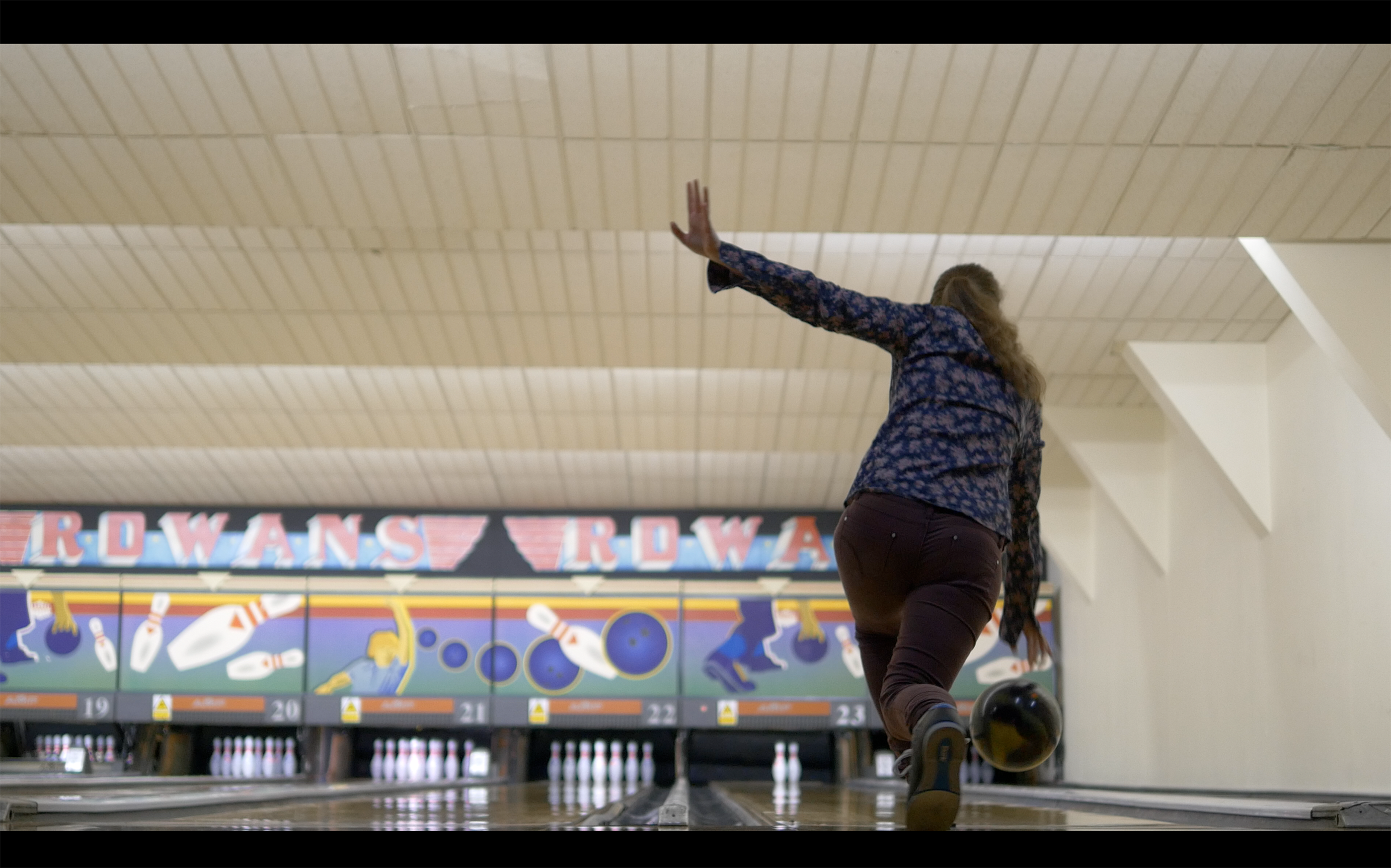
Bowling silhouette. Still image from the short film footage.
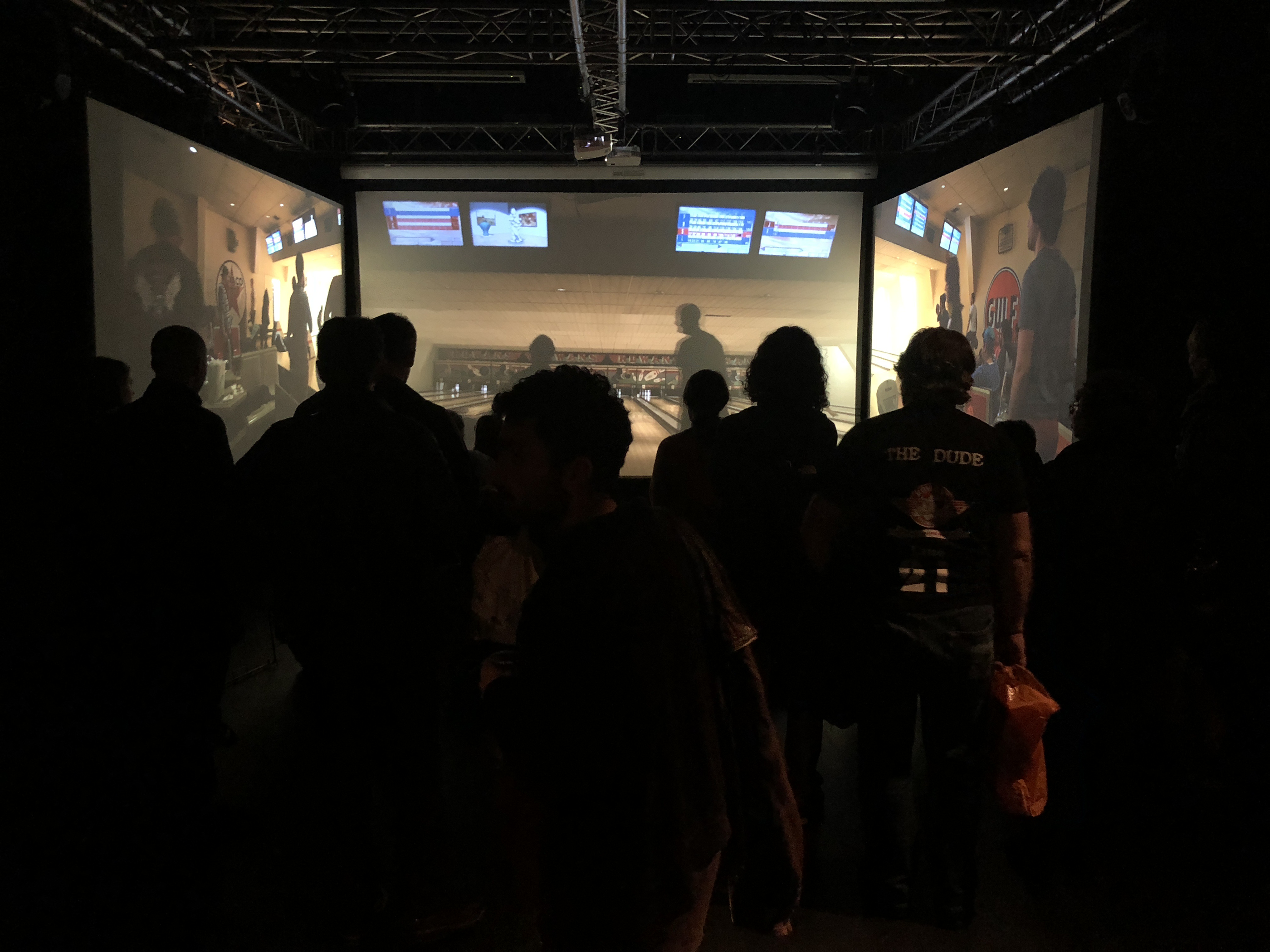
The three screen installation.
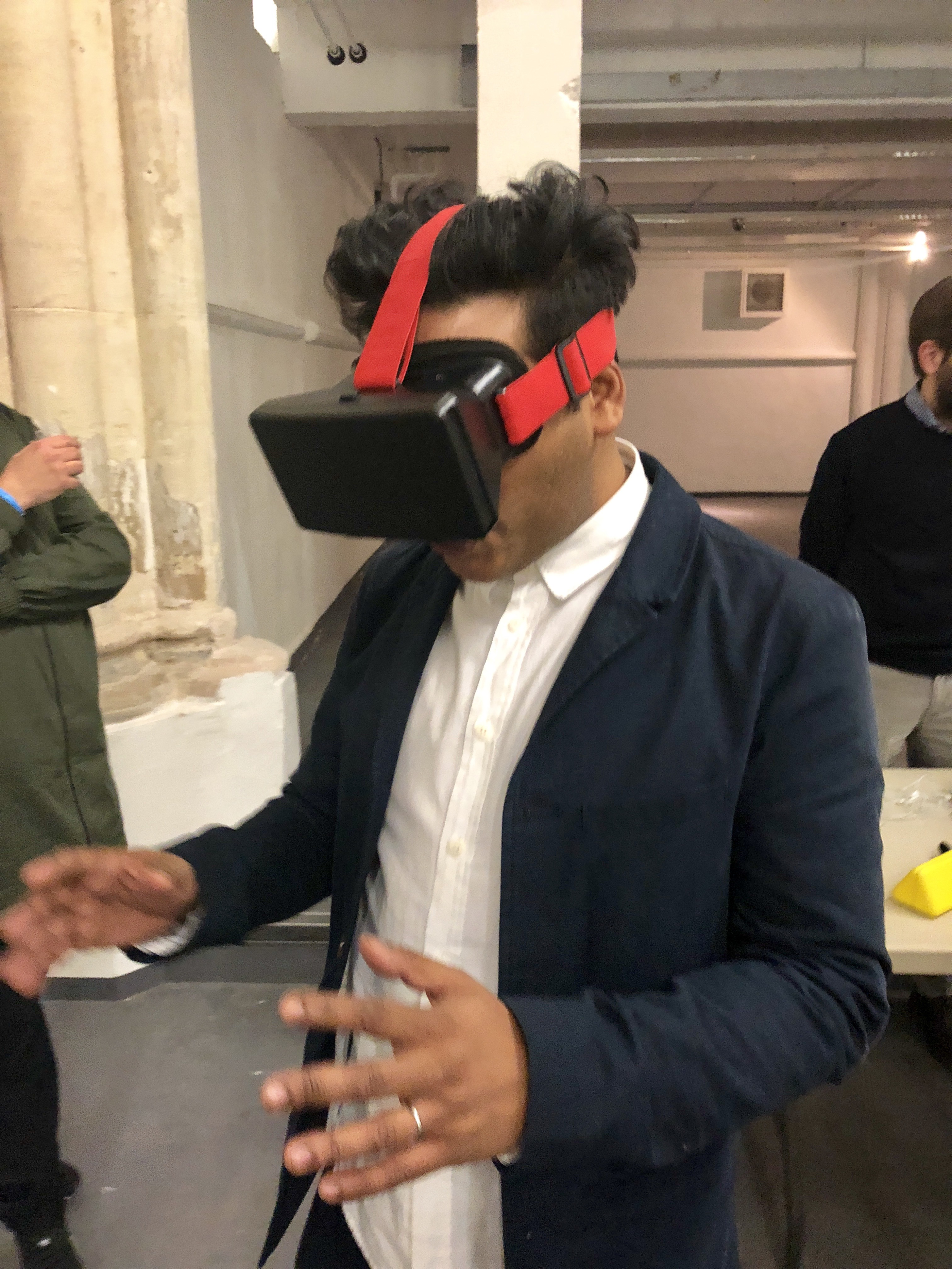
Experiencing the Virtual Reality films.
On Andy's first visit to the bowling alley, it was not only the impracticality of our original plans that struck him but also the theatricality of the place. This was about the lighting and the physical and material features of the place, such as the large proscenium arch that frames the lanes. But unlike a conventional theatre, he noted, the action is all seen from behind. In another paper, Emma has written about the theatricality of bowling performances on the stage of the lanes that shape not only an individual's relationship with bowling but also the atmosphere of the space (Jackson, 2020). Bringing a camera into this already theatrical space added another layer. Our first forays into filming in the bowling alley are captured in this fieldnote: At the end of the first night of filming, I join Andy on the raised platform by the dance floor and we watch back some clips. He says that the least interesting thing is the pins going down. He is interested in the shapes. The shape of the walk, the shot, the celebration – or lack of. I like the shots of feet and legs. After looking at a lot of clips we decide that the shots between two lanes are the most interesting. That what happens between is more interesting than the straight down the lane shot. There are also some great across shots from low down where you can see the choreography of the movement. As we finish watching, Amy seems interested, so I say to come and look at some of the shots. Once she's there, Claudia comes and Kevin too. Amy
1
says that Andy has really captured the league. He reiterates that it's just test shots for now. Amy says she will email everyone and ask them to wear their bowling shirts next week. I don't say that actually capturing it as it is, is fine, better in fact. Because she's excited and I’m glad, plus not everyone will do this. Emma's Fieldnotes, 2 February 2016
There are two key points to be drawn from this example. The first is how as filmmaker and sociologist we decide from which angles we will ‘make’ the action of ‘there’ in ways that are most interesting to us and our aesthetic preferences. The second is how bowlers also shaped the aesthetics of the film through their clothing choices and comportment, as well as through their accounts. While we are not sure if Amy ever sent that email, more bowling shirts appeared on filming nights than at other times.
This example illustrates just one of the ways in which an active role was taken by participants at all stages of making and screening the film. Gillian Rose has argued that when sociologists have used visual research methods in their work, they have often focussed on visibility – showing, making visible an aspect of social life – and have perhaps neglected the visual (2014). In particular, she points to the neglect of the visual expertise of participants, which the bowlers had in abundance.
On a couple of occasions, we could tell whether an individual had decided to be interviewed or not by what they wore on the night. For example, when one young woman turned up in sparkly jewellery that she didn’t usually wear to league night, we knew she had decided to take part. Conversely when another person who had rather shyly agreed to be interviewed turned up in a baggy t-shirt, we correctly guessed that she had decided against it after all. From a traditional realist documentary perspective this might be seen as a problem or inauthentic. But for us, this adds one more layer to bowling as a performance. Importantly, it shows how participants actively constructed the way that the bowling alley and the league look in the film and their affiliation with the material cultures of bowling – feeding into the process of ‘making there’.
A useful comparison can be made here with the use of still photographs in Douglas Harper's (2004) visual sociological work on a rural bowling league in the USA. Unlike the league we worked with, the bowling league in question is characterised as a socially homogenous group of white working-class men. The bowling league provides an important forum for them to talk about their lives and also leads to employment opportunities, but these functions of the league do not seem to vary much from individual to individual.
After bowling with the league for many years, Harper uses photographic snapshots from one bowling league night. He describes the role of photographs as communicating ‘the ambience and some of the norms of league culture … They show the clothes, postures and sense of comfort these men have with their bodies and with each other’ (2004: 98). The films we made also capture these kinds of norms, comportment and comfort. And yet, in our international multi-ethnic group we found that as well as a shared sense of belonging to the league there were also other forms of belonging across place and time being performed through bowling – such as links to childhood bowling experiences (Jackson, 2020). Some of these personal trajectories were reflected on by participants in the accounts they give in the film. But the moving image and use of sound also allowed the capture of some of the embodied and affective aspects of these trajectories – the use of British slang in an American accent, a person's face lighting up at the mention of a good score – that a photograph would not.
Using video thus allowed us to move away from only expressing people's relationship to bowling through their words and enabled us to present these embodied performances in place. For example, Claudia – who regularly won the women's trophy and was repeatedly crowned the ‘Lady of the Lanes’ – was an important presence in the league and was also integral to the project. It was Claudia who pointed out to Andy the peculiarity of bowling being a sport where the audience is always behind the action. She felt rather shy about being interviewed and declined our invitation for both audio and video interviews. However, with her permission, we could incorporate her (excellent) bowling performances even though she did not feel comfortable speaking to the camera. She is there throughout the film, throwing brilliant strikes and winning trophies.
We conducted interviews in situ – using lapel mics to allow us to record in the noisy atmosphere of the bowling alley. This meant that we had to compromise on how we recreated the space and atmosphere because of technical considerations around lighting and sound. While Andy was concerned this would result in technical annoyances, choppy and unprofessional looking footage that couldn’t be easily edited, we took the risk in order to bring a sense of place into the interviews through sound rather than filter it out.
However, the one time we reached our limit was when a Champions League match involving the local football club, Arsenal, was being screened. The loud football commentary and co-presence of football fans in one half of the space and bowlers in the other – with the Arsenal fan bowlers moving between the two – added another layer to the atmosphere and to the scene but was not compatible with filming interviews. Emma described this moment in her fieldnotes and this fed into her analysis of the league as being part of the production of the bowling alley as an urban scene (Blum, 2003), rather than being a self-contained entity (see Jackson, 2020). The short film we made conveys this relationship between the league and the wider place of the bowling alley through people's stories and through background noise – up to a point – but not through showing these kinds of happenings in place.
While we made some compromises over ‘making there’ – particularly in regard to sound, in order that individual voices be audible for the purposes of the short film – for the 3-screen installation presentation and the VR films, we did not have to worry about constraints of loud match commentary, voices or music levels. The purpose in making these VR versions of the bowling alley through video was to produce something more immersive that remade place rather than foregrounding the stories of the bowlers. For the VR films, once the three 360 cameras were set up, we let them run and the resulting films used on the VR headsets are unedited. However, while this medium allows a different kind of ‘making there’, we would not claim that it is in any way more ‘real’. As Westmoreland argues: ‘Since the medium envelopes the viewer and is coordinated with their movements, it provides “the strong illusion of being in a place in spite of the sure knowledge that you are not there” (Slater, 2009: 351)’ (2020: 257).
For the installation, we let three static cameras run for 25 min and presented the unedited footage over three-screens in real-time, with the short film fading up in the middle screen. These long shots combined with the short film in the installation version of the film are perhaps more in line with the sensory verité approach (Kasic, 2020), allowing sensory emersion alongside an engagement with the interview material.
Thus, while both atmosphere of place and the stories of the bowlers were key considerations for us, the use of three modes of film provided the opportunity to experiment with different ways of achieving this balance across the films, rather than trying to do everything through one film. The weighting towards atmosphere or story can be adjusted, depending on the format and the purpose of each rendering of the league.
Remaking league night through different video modes
In this section, we move on to consider how each video format had a different impact on the process of ‘making there’. The liveliness of video methods became apparent through the way in which even the promise of making a film impacted on the relationship between the participants and the wider research project. Making the film drew people into the larger ethnographic project. The first time that we screened the short version of the film was at a presentation night. This happens at the end of every 12-week season. Prizes are given to the top bowlers and people celebrate and commiserate their seasons over Domino's pizzas provided by the venue. It was important to us to show the film to the bowlers first and to get feedback and gauge reactions before making further edits. As exemplified in this fieldnote, even while doing a technical check, we found contention within the version of events we had set out, with the origin story of the league disputed: While the film plays, the head technician disputes Pete's version of how the league was formed (‘I started it!’) but then settles into agreeing with people's accounts of their own bowling. While this is going on, someone who used to bowl in the league but who hasn't been for a year has come up to get her bowling bag. It has been moved into the overflow cupboard and so John goes off to help her find it. Her friend waits and watches the film. When it stops, the friend says ‘well, I’m sold!’ and asks about the details of the league. ‘Do I need a team…?’ Emma's Fieldnotes, 26 June 2016
We noticed after that first screening that things people said in the film started to be repeated again at league nights, sometimes in joking ways. For example, one bowler says in the film of his approach to bowling: ‘I just think, knock ‘em down’, and this became inscribed as a catchphrase with his bowling friends. The above fieldnote also demonstrates the impact and role of the film as performing community in the place that it set out to remake through film. It even attracts a potential league bowler (‘well … I’m sold!’).
The second screening of the short film was at a film festival in a cinema at Goldsmiths and a group of bowlers came down and joined in the Q&A session that followed. We went to the pub afterwards and one of the bowlers, Steve, exclaimed that he was looking forward to bowling on Tuesday even more than usual, having just seen the film. What became noticeable from these screenings is that the short film itself is performative – it repeats the stories that the group tells about itself and cements it. Circling back to Pink (2009) and Hatzius and Wakeford's (2014) arguments about the importance of viewing contexts, it is likely that the comfortable and exciting context of the cinema during the film festival also impacted on the film's immediate affective impact on Steve. The film screenings also allowed participants to intervene in discussions of the research. At public screenings of the film, bowlers have joined in Q&A sessions.
The 3-screen installation was presented at Goldsmiths in a theatre space at the end of the project in 2017, where we worked with Dimitrios Coumados, a specialist technical colleague, who helped coordinate the building of the installation. There are numerous practical considerations with displaying a video installation – from highly technical considerations to unexpectedly having to beg a person from university estates for a ladder on the day of installation – that mean we haven’t reinstalled it since then. Despite these complications, it was a very effective way of recreating the space in a more immersive way than a short film. We found that people would spend a lot of time in the installation. Communally watching the bowlers on three screens in a dark space resonated with the experience of watching bowlers in the space of the bowling alley. There was an interesting moment when after leaving the installation and returning to it, we found that someone attending had rearranged the chairs in the room, from a line in parallel with the screen to a perpendicular line of two chairs, to mirror the furniture in the bowling alley.
Immersion in this installation space seemed to be more comfortable for people than the use of the headsets (see Figure 2). In contrast to the installation space, where people would sit for a long time, there seemed to be a bit of unease about putting on a VR headset (see Figure 3) to access the space of the bowling alley. The technique we used is very basic, you can move your head from side to side and turn fully around to get a different perspective, but you cannot move forwards or backwards. This is not a perfect recreation of a space in virtual reality but does allow some immersion and user-control of the perspective from a vantage point inaccessible or impractical to most. For instance, one camera position was in the middle of a lane enabling the user to look toward the bowlers (a reversal of the usual viewpoint) and then spin around to follow the ball toward the pins.
And yet, for the most part people are not used to being in these VR environments. We have found at events that people put the headsets on, move their heads from one side to the other and then are quite keen to take them off again. The format seems to interfere with what we wanted to offer through these VR films which was another way of inhabiting the space of the bowling alley. The exception was when they were presented at a workshop on visual methods at the University of Liverpool, where people did enjoy spending time in the VR environments. Of course, the advantage of this mode is that we can take the VR headsets in our bags whereas we cannot recreate the three-screen installation. And we expect that over time the use of VR headsets will become less alienating for people. Indeed, familiarity with immersive virtual spaces is already likely to have increased since we first presented the VR films and this will become a more common way of engaging with media as future headsets are launched. However, in our experience, rendering what is usually a communal experience into such an individual one did not quite work. As Westmoreland argues with 360 films, ‘Immersion comes at the cost of being socially unaware of the “audience”’ (2020: 259).
Lastly, the meaning and resonances of all the films have also changed over time. We were very aware when making the film that the bowling alley might be under threat due to gentrification changing its character, or the long-threatened demolition finally coming to fruition. But we had no idea that the pandemic would come to halt the league. Our remaking of the league night in these three different formats now takes on an extra resonance because of the changes to the bowling alley brought about by the pandemic. They have in effect become time capsules. When one of us revisited the league in August 2021, there were Perspex screens between the lanes, messages on the consoles reminding bowlers to wear masks and that high 5s should be virtual only. Even the technology had changed, with the vintage pin machines being replaced with pins on strings.
But most importantly, successive lockdowns prevented the league from bowling together from March 2020 to July 2021. The remaking of the league through video then took on a special and new significance when the pandemic-related lockdown had halted the leagues activity. During this time, Emma was in touch with the league organiser about doing follow up interviews with the bowling league. He replied that: ‘Playing the film brings back so many memories, brings a tear to my eye because I wonder will it ever be the same again!’ In this context the film became a representation of Bowling League nights in the ‘before times’. While the Perspex screens have since been removed and bowling activity returns to ‘normal’, the films retain the poignancy of capturing a pre-pandemic form of sociability.
Using video was particularly tangible and interesting for the bowling league members. The short film reperforms the league over time by reinscribing the stories told by league members. From the outset the making of the short film was more tangible to the participants than the promise of future academic writing, and in our case had a much quicker turnaround, with the first screening taking place at the bowling alley four months after filming began. As a comparison, the first journal article from the project came out two years later. This process of reperforming is still unfolding some seven years later at the time of writing, since the first version of the short film was screened to the bowlers.
However, there are challenges with the excitement generated by the camera. Participants also brought their own hopes and expectations of what it could bring. This ranged from one league member hoping the film might make the management realise they should give the league bowlers cheap drinks to someone bringing along their friend who made promotional tourism films to meet Andy as a networking opportunity. Later, the film is seen as having the promise to be part of bringing people back to the league after the pandemic. The researcher using video methods has to manage some of these expectations.
Conclusion: On using video methods to research belonging in place
In this paper we set out to explore how video methods in this project were used to ‘make there’ in a way that balanced a sensory recreation of space with the stories of the bowlers. Reflecting on the use of video methods through this project provides a useful angle on how research on belonging in place feeds into the social worlds, places and groups that it studies and also the specific possibilities and challenges of working with video to both convey and remake places and groups. The aims of recreating the space of the bowling alley in our films and presenting narrative stories of belonging were sometimes in tension with each other. For the short film, this resulted in us having to constantly balance considerations of the use of sound. We found that using different video techniques – both in the short film and through the use of other forms of film including the 360 films and the video installation – enabled us to capture some of the embodied expressions of bowling, even when participants did not want to be interviewed. This shows the potential of video methods to move beyond narrative when conveying belonging in place.
The paper also has implications for future studies using video methods as it demonstrates how using multiple forms of video methods in a project allows for the exploration of ‘making there’ in more experimental modes (VR, the 3-screen installation), while attempting something more holistic and narrative in the short documentary and the installation version. It shows the different kinds of potentials and pitfalls involved in using these approaches to ‘making there’. This challenges researchers to go beyond thinking of video as inevitably feeding into one unitary ‘project film’ and instead suggests a consideration of the potential of different video techniques for generating data that can be assembled and reassembled, rendering the social worlds that we seek to convey and understand in a variety of lively ways.
The paper provides insights into how modes of video, beyond the traditional ethnographic film – Virtual Reality film and video installation – were differently effective or not in meeting our aims of conveying a sense of place and capturing participants’ practices of belonging. The more experimental approaches of VR and installation remade the space of the league night – with mixed results. While not all of our video experimentations were fully successful, the playful spirit of bringing in equipment such as Snapchat Spectacles and 360-degree cameras was well-received by the participants within this space of play and may have more resonance in the future as immersive video and worn cameras become more commonplace, and this is something we would encourage other researchers to consider.
Overall, our approach to video as ‘making there’ rather than just documenting ‘being there’ adds another dimension to arguments about community as something that is, ‘a verb rather than a noun’ (Studdert, 2016) or as Blokland puts it ‘an urban practice’ (2017). Rather than thinking of video methods as documenting a pre-existing community or place, our approach seeks to use them to remake place and represent practices of belonging that are themselves in process, while acknowledging that our uses of video methods also feed back into group formation and the making of place.
Footnotes
Declaration of conflicting interests
The authors declared no potential conflicts of interest with respect to the research, authorship, and/or publication of this article.
Funding
The authors disclosed receipt of the following financial support for the research, authorship, and/or publication of this article: This work was supported by the Economic and Social Research Council (grant number ES/L011360/1).

Notes
Author biographies
Emma Jackson is a Reader in Sociology and Director of the Centre for Urban and Community Research at Goldsmiths.
Andy Lee is a Senior Lecturer and Teaching & Learning Innovation Lead in the School of Media & Communications at LCF.