



Abstract
In this article we argue that theoretical and empirical insights from the sociology of people's names can enrich qualitative researchers’ decision-making about, and descriptions of, their practices of (re)naming participants as well as inform methodological debates about these practices. We review the research politics of participants’ names and outline how issues of anonymisation and pseudonymisation can be thought through using sociological theorising about and empirical research on people's names. In illustration of the value of this perspective, we discuss (re)naming of participants in our study of names in adoption. We describe the challenges that arise around anonymisation and pseudonymisation when the topic is potentially sensitive and where people's names are the focus. We draw out the broader significance of our findings to encourage researchers, regardless of their topic, to better reflect on and account for choices made about why and how research participants are (re)named.
Introduction
The use of pseudonyms (or ‘false’ names) in place of orthonyms (‘real names’) of participants, and for any people mentioned by participants, is a ‘ubiquitous’ mechanism of anonymisation (Lahman et al., 2015: 445) in qualitative research. The taken-for-granted quality of pseudonymisation is so strong that, in publications, researchers-as-authors can often fail to discuss what was done about people's names, and why it was done (Heaton, 2022). Furthermore, we argue that in methodological debates about anonymisation and pseudonymisation, there are tendencies for contributors to under articulate the reasons why (re)naming people in qualitative research is important, and/or to make over generalised claims about the socio-cultural significance of names unsupported by evidence. These observed ‘fault lines’ in methodological discussions of and debates about the (re)naming of research participants reflect wider cultural tendencies which position people's names as prosaic and quotidian, and which underplay the complex significance of names for people's individual and socio-cultural identities (Author B, 2016). In this article, we argue that theoretical and empirical insights from the sociology of people's names can enrich qualitative researchers’ decision-making about, and descriptions of, their practices of (re)naming participants as well as inform methodological debates about these practices. We begin by reviewing the contours of debates about the whys and wherefores of anonymisation and pseudonymisation, which largely overlook insights from the sociology of people's names. To show how this perspective can inform what we call ‘the research politics of (re)naming participants’ we outline sociological theorising of and empirical research on people's names. We illustrate our argument by drawing on our qualitative study of names in adoption. Using this empirical example, we highlight the challenges that arise around the (re)naming of participants when the topic is potentially sensitive and where people's names are the focus. We draw out the broader significance of our discussion of the names in adoption study to encourage researchers, regardless of their topic, to better reflect on and/or account for choices made about why and how people are (re)named in qualitative studies.
The research politics of (re)naming participants
Expectations of privacy, anonymisation and/or pseudonymisation are deep seated within multiple layers of research ethics governance, from local level ethics review committees to the European Union's General Data Protection Regulation (e.g. Carniel et al., 2023; Iphofen, 2020). Anonymisation and pseudonymisation are especially recognised as commonplace, normative practices in qualitative research. Yet, critical evaluation of these routinely deployed tools has so grown in scale and scope that the issue of (re)naming of participants in qualitative research has been described by several contributors as amounting to the ‘politics of naming’ (e.g. Guenther, 2009; Moore, 2012) – although we think ‘the research politics of (re)naming’ is a more accurate label. A simple characterisation is that there are two basic positions in debates about the (re)naming of research participants (Vainio, 2013). The first position we label as ‘pro-anonymisation and pseudonymisation’. Here, anonymity is regarded as important on ethical and other methodological grounds, and perfectly achievable (e.g. Allen and Wiles, 2016; Creswell, 2013; Saunders et al., 2015; Vainio, 2013). Relatedly, as a tool of anonymisation, pseudonyms are seen to help protect participants’ ‘real’ identities in a ‘respectful’ way (Allen and Wiles, 2016: 149): they ‘personalize’ participants’ identities (Heaton, 2022: 127), and so can be preferable to more ‘dehumanising’ tools such as replacing participants’ orthonyms with numbers (Lahman et al., 2015). The second position in debates about (re)naming participants we label as ‘anti-anonymisation and pseudonymisation’. Here, anonymity is regarded as difficult to achieve in practical terms and therefore problematical on ethical grounds (e.g. Jerolmack and Murphy, 2019; Moore, 2012; Svalastog and Eriksson, 2010; Vorhölter, 2021). Further, it has been argued that ‘masking’ identifying details of people and/or places (for example, by using pseudonyms) in a research project can ‘lead to the erasure of sociologically significant information’ (Jerolmack and Murphy, 2019: 803; see also Moore, 2012; Nespor, 2000; Tilley and Woodthorpe, 2011), thereby compromising the value of qualitative data as ‘thick description’ (Geertz, 1973). From being seen as simple routinely deployed technical mechanisms in qualitative research, whether to and/or how to anonymise and/or pseudonymise participants are increasingly recognised as complex power-filled issues, situated within the theories and methodologies underlying different empirical qualitative research projects and the substantive topics they explore (e.g. Brear, 2018; Lahman et al., 2022; Rowlands, 2024; Saunders et al., 2015).
We welcome the increased attention paid in methodological debates to the issue of (re)naming of participants, and the accompanying recognition that in qualitative research (and elsewhere) ‘the act of naming is an act of power’ (Guenther, 2009: 412). However, within these debates, the reasons why and how people's names matter tend to be implied rather than explained – a reflection, perhaps, of how names are more widely regarded as prosaic and quotidian phenomena (Author B, 2016). Relatedly, there has been limited engagement with sociological literature that theorises and evidences the socio-cultural power of people's names. This is apparent even when names are noted to be ‘deeply personal and reflective of culture and identity’ (Lahman et al., 2022: 678), or as having ‘personal, social, and symbolic meanings’, marking and conveying ideas about ‘ethnicity, age, gender, religion, and other identity characteristics’ (Heaton, 2022: 127), or be identifiers that research participants might want to retain because of their meaningfulness (e.g. Allen and Wiles, 2016; Brear, 2018; Grinyer, 2002; Guenther, 2009; Lahman et al., 2015; Svalastog and Eriksson, 2010).
Our proposition is that a more substantive engagement with the sociology of names would advance the research politics of (re)naming participants, infusing it with a sociologically informed understanding of why people's names matter so much in the first place.
(Re)naming participants: a sociology of people's names perspective
In the introduction to a landmark collection of essays in ‘onomastics’ (the study of names), Hough (2016:1) notes that it is both an old discipline, dating back to ancient Greek philosophers, and a young discipline. The latter is especially true of the study of people's names. In anthropology, for example, ‘the theoretical and analytical scrutiny’ merited by people's names is relatively recent (Palsson, 2014: 618; see for example, Vom Bruck and Bodenhorn, 2006). In sociology, theorising of people's names is longer standing and, for example, has been used to examine connections between names and identities. Althusser (1971: 176) briefly mentioned surnames in the context of the ‘familial ideological configuration’ and conceptualised names more generally as one of the ‘practical rituals’ of everyday life that routinely allow us to recognise ourselves and others as unique individual subjects (1971: 173). In turn, for Elias (1991, originally published in 1987), a person's first name(s) signals their ‘I’ or individual identities and their surname signals their ‘We’ identities or their group belongings, especially to family. Subsequent work by Finch (2008) examined how first names and surnames sit at the nucleus of individual identity and family affiliations and are important for the ‘display’ of these identities. Writing from an identities as social processes perspective (Lawler, 2014), Goffman argued that the ‘complexes of information’ about an individual that makes them identifiable as such are, more often than not, ‘bound both to name and body’ (Goffman, 1968: 74, 76). Developing Goffman's (1968) ideas, Author B (2016) introduced the concept of ‘embodied named identities’ in recognition of the ways a person's individual, social, and civil-legal identities are interactively (re)produced through the intertwining of their names with their bodies.
In addition to these theoretical insights from sociologists about names and identities, empirical sociological research has also established how people's names are at the nucleus of a range of significant socio-cultural identities. These include gender (e.g. Aboim, 2023; Pilcher 2017), race and ethnicity (e.g. Edwards and Caballero, 2008; Wykes, 2017), social class (e.g. Lieberson and Bell, 1992; Lindsay and Dempsey, 2017), sexuality (e.g. Dempsey and Lindsay, 2018; Patterson and Farr, 2017) and age (e.g. Pilcher et al. 2022; Johfre, 2020). Such studies demonstrate empirically how names matter in the (re)production of socio-cultural identities and the ways that embodied named identities have social consequentiality (Author B, 2016). Applying intersectional thinking (e.g. Crenshaw, 1989; Hill Collins and Bilge, 2016) to people's names requires a recognition that the names of an individual are likely to be simultaneously and multiply meaningful arising from the combination of their socio-cultural identities. For example, Author B (2017) argues that the signalling of ethnicity through first names is also strongly and at the same time also about ‘doing’ gender, and vice versa. In other words, a person's names are a condensed coalescence of their embodied identities, (re)producing and displaying especially their gender and their family belongings, but often also their ethnicity, and/or age and/or social class.
A theoretically informed and empirically evidenced sociology of names positions names as richly complex phenomena at the nucleus of people's individual identities, family affiliations, and socio-cultural and civil-legal identities. In presenting this overview in a methodological journal of qualitative research, our aim is to secure a wider recognition of the value of this scholarship among research practitioners and methodologists. So, exactly what does the sociology of people's names add to the research politics of (re)naming participants? We think there are three interrelated ways that the sociology of people's names can enrich debates about the whys and wherefores of anonymisation and pseudonymisation and offer guidance to researchers about what to do about their participants’ names.
First, the sociology of people's names potentially bolsters the respective positions of contributors in both the ‘pro’ and the ‘anti’ anonymisation and pseudonymisation camps. It does so because it provides a theoretical and empirically informed understanding of why people's names matter so much in the first place. In other words, it provides an intellectually rigorous and robust framework for the underpinning concern held in common by both ‘sides’: the inescapable importance of names for people's identities (Author B, 2016). Moreover, for both ‘sides’, the embedding of the sociology of names within identities as social processes perspectives provides a new lens through which to view power relations infusing decision-making about names made by multiple stakeholders in a research project – especially by researchers and participants themselves. The research politics of names is, at its core, about the interactive and contextual co-management, (re)production and display of participants’ identities – and how these, as processual, may change over time even within a single study (Brear, 2018; Grinyer, 2002). Further, an embedding of the sociology of people's names within identities as social processes perspectives shores up arguments that readers of research outputs (including here participants themselves) have a role as audiences who interpret and give meaning to the display of participants’ identities, whether these are signalled through orthonyms or pseudonyms. In their own locales, readers interpret identifying information about participants’ identities (gender, ethnicity, age, etc.) that are encoded either in the ‘real’ names of participants or in their allocated or self-chosen pseudonyms. The sociology of names articulates in a forensic way why and how names are core to practices by which people come to identify, categorise and understand both themselves and others – whether this is within empirical qualitative research projects and resulting outputs, within qualitative methodological debates and/or within every day, lived social worlds.
A second contribution to the research politics of participants’ names made by sociological literature on people's names is the acute focus it brings to the issue of anonymisation. On the one hand, if people's names have a ubiquitous importance and an entangled intersectional complexity for their identities, then claims that participants’ ‘real’ identities need to be and can be protected by anonymisation via pseudonyms are reinforced. Opponents to anonymisation might counter that, actually, conceptualising identities as being ‘embodied named’ negates any need for anonymisation through pseudonyms. This is because, although plenty of other people in the world are likely to have a particular participant's orthonyms, this is inconsequential for the exposure of a participant's identity if (as is mostly the case) their face and body are not visible in research outputs: their unique embodied named identity remains unknowable. Of course, in qualitative research using visual methods, people's faces and bodies are often visible and here, the scenario is reversed. Wiles et al. (2012: 50) argue that in research outputs drawing on visual methods, images of people ‘used without an identifying name…offer very limited threats to the identity of an individual being revealed’. In turn, however, advocates of anonymisation might argue that knowing only a research participant's orthonyms or seeing only their face and body can mean that, in the digital age (Saunders et al., 2015) and using facial recognition software/A.I., their full (embodied named) identity can be determined relatively easily. Moreover, digital culture makes it harder for researchers and participants to anticipate the range of harm, whether in the short or longer term, that might be caused if the embodied and/or named identities of participants are exposed (Rowlands, 2024; Saunders et al., 2015).
On the other hand, if people's names are so ubiquitously important and have such entangled intersectional complexities for their identities, this not only explains why some participants might want to use their ‘real’ names (e.g. Grinyer, 2002; Svalastog and Erikson, 2010) but it also bolsters arguments that it is the use of participants’ orthonyms which should be the default position in qualitative research, rather than the use of pseudonyms as is presently the case. But then, which of a participant's orthonyms should be used? Their full orthonyms, including first names and surnames, or only their first name or only their surname? Particularly if full orthonyms are used, and anonymisation is a residual concern, then the ‘masking’ of other identifying information about a participant, such as their physical appearance, occupation, location, and age, may become a priority (e.g. Kohli and Solórzano 2012). A sociology of people's names perspective cannot resolve these kinds of issues about anonymisation, but we do believe it has the potential to help researchers and methodologists reflect more deeply about the pros and cons of anonymising, or otherwise, participants’ embodied named identities.
The third way that we think sociological theory and empirical evidence about people's names can inform the research politics of naming relates to pseudonyms as a tool of anonymisation. For example, insights from sociology about the complex and intersectional importance of people's names can be used to bolster arguments that pseudonyms are anonymisation tools which compared to, for example, numbers or epithets, show greater respect for and personalise participants’ ‘real’ identities (e.g. Allen and Wiles, 2016; Heaton, 2022). Strategies of pseudonymisation can also be informed by the sociology of people's names. Within research projects where participants’ orthonyms are not used because of concerns about anonymity, should pseudonym choices be in the power of participants or of researchers? If the former, this at least gives participants the opportunity to choose pseudo-names that are meaningful to them (e.g. Allen and Wiles, 2016; Itzik and Walsh, 2023), and may help counterbalance the absence of their orthonyms in terms of their identity investment in a study. But whether pseudonyms are selected by participants and/or by researchers, which orthonyms should they replace – all of them, or first names only or surnames only? Also, by which criteria should pseudonyms be chosen? From a sociology of people's names perspective, orthonyms convey richly thick and intersectionally complex identities information. Consequently, we argue that, if used, participants’ pseudonyms (first names and/or surnames) should closely ‘match’ their ‘real’ names to retain as much as possible of that richly complex identity information (e.g. Edwards and Caballero, 2008; Wykes, 2017). This strategy of pseudonymisation may also help enhance the value of a qualitative study. As implied by Vainio (2013), it means that stories within data can be told without revealing whose story it is. It is a strategy of anonymisation which minimises what Jerolmack and Murphy, (2019; 803) has described as ‘the erasure of sociologically significant information’.
Beyond ‘pro’ and ‘anti’ positions in debates, we hope that, for researchers, our overview of the sociology of people's names will encourage more considered decisions and practices about the (re)naming of participants and enhanced explanations in published outputs of what was done about orthonyms and pseudonyms, and why. At the least, we think that a greater familiarity with the sociology of people's names will help researchers avoid mistakes in (re)naming participants such as admitted by Grinyer (2002), who initially left it up to a transcriber to choose participants’ pseudonyms, or Brear, (2018) who made several missteps about ethnicity and the (re)naming of participants, or Vorhölter (2021: 13) whose self-described ‘sloppiness’ meant that ‘somehow’, they ended up not using pseudonyms for participants when, retrospectively, they believed they should have done. In underscoring the importance of decisions qualitative researchers make about anonymisation and pseudonymisation, a sociology of names perspective necessarily makes the research politics of (re)naming an even more difficult terrain to navigate than previously. A sociology of people's names perspective cannot, however, prescribe a ‘how to’ protocol for (re)naming participants or people mentioned by participants. As others have argued (e.g. Allen and Wiles, 2016; Guenther, 2009), anonymisation and/or pseudonymisation protocols need to be worked out within the specific contexts of the topic and underlying methodology of particular research projects. Our argument is that, regardless of topic and methodologies, protocols must also be worked out via researchers and methodologists engaging meaningfully with sociological theorising and sociological empirical evidence which substantiates the multiple intersectional complexities of people's embodied named identities – both ‘real’ ones and those conjured up by pseudonyms. The research politics of participants’ names is, though, especially complex when a study's topic is names and identities, as we discuss next.
(Re)naming participants in research about names and identities
It might be assumed that being more familiar with the sociology of names, researchers focused on the topic of people's names and identities might address issues of anonymisation, orthonyms and pseudonyms more comprehensively than other researchers. However, we have found that, in qualitative studies where the names of participants and/or those of their kin are the topic, too often only limited attention is paid to the specific challenges of (re)naming participants. Discussion of anonymisation rarely goes beyond that routinely noted in qualitative research on other topics. It might be noted only that pseudonyms are used (e.g. Almack, 2005; Aboim, 2023; Duncan et al., 2020; Lindsay and Dempsey, 2017; Reynolds et al., 2020; Suter, 2012). More rarely (Heaton, 2022), pseudonyms are noted to be ‘in keeping’ with, for example the gender, ethnicity and/or language of participants (e.g. Pennesi, 2019), or as ‘matching’ as closely as possible the ‘intention and effect’ of participants’ ‘actual names’ (Edwards and Caballero, 2008; see also Wykes, 2017). Davies (2011) in their work on the family meanings children give to surnames does explicitly acknowledge the ‘additional challenges’ (2011: 558) that research focused on names poses for anonymisation through pseudonymisation, but the challenges are not specified.
The names in adoption study
In the following paragraphs, we use the example of our names in adoption study to illustrate complexities of (re)naming that can arise when participants’ names and/or names of their family members are the topic of qualitative research. We describe why and how we (re)named people in our study, how we communicated our (re)naming protocols to our participants and how they responded to these protocols, the challenges we faced and the mistakes we made. Our experiences in the names, identities and adoption study therefore have a wider resonance, with potential to inform qualitative researchers’ practices of participant (re)naming, regardless of topic.
The names and adoption study focused on domestic non-kinship adoption in England and Wales and was undertaken in 2022–23. It examined the naming and identity experiences of 29 adults who were adopted as a child (‘adoptees’) and of 22 adults who had adopted a child (‘adopters’). Within the research politics of (re)naming participants, it is recognised that anonymisation and/or pseudonymisation protocols need to be worked out within the specific contexts of the topic and underlying methodology of particular research projects (Allen and Wiles, 2016; Guenther, 2009). We used interdisciplinary ‘life story’ research tools (creative writing and follow-up one-to-one video call interviews) with these participants to capture the rich complexities of their experiences and understandings of names, identities and belonging in adoption. The theoretical and methodological framing of our study was informed by understandings of identities as social processes (Lawler, 2014), including here the specifics of both Elias’ (1991 [1987)) and of Goffman's (1968) insights, and the concept of embodied named identities (Pilcher, 2016), which together led us to regard names as core to practices by which people come to identify, categorise and locate both themselves and others. Our decisions about (re)naming participants in the names and adoption study were also very much embedded in our perception of adoption, and names in adoption, as topics that are ethically sensitive and in multiple ways.
Especially since the 1976 Adoption Act, adoption in England and Wales has changed from being a ‘closed’ and secretive process to one characterised by a culture of ‘openness’ (O’Halloran, 2015). These changes foregrounded adoption as a version of kinship that should include both adoptive relatives and birth relatives (Jones and Hackett, 2011: 45). It is also a version of kinship that entails adoptive names and birth names, not only of a child but also of their birth and adoptive parents, siblings, and other relatives. Consequently, names play a central role in the ‘keeping’ or ‘dilution’ of adoptees’ birth heritage and can also help cement adoptive family identity or be a hindrance to it (Pilcher et al. 2023). Moreover, adoption has long been a process riven by inequalities (Kirton, 2020), and so it is likely that associations between names, social class (Lindsay and Dempsey, 2017) and/or ethnicity (Wykes, 2017) feature in adoption experiences. Arising from the multiplicities of their kinship and the resulting complexities of names in adoption, a key psychological challenge faced by adoptees is to make sense of their ‘adoptive identity’ (Grotevant, 1997) throughout their lives.
The profiles of the two groups of participants in the names and adoption study adds further texture to our explanation of why we regard names in adoption and names in adoption as potentially sensitive topics. Many of the adoptee participants in our study were adopted in the ‘closed’ and ‘secretive’ pre-1970s era. Adoptions then typically involved babies whose birth mothers had been pressured into ‘giving them up’ because of their unmarried status, and/or their social class and/or ethnicity (Garrett, 2000). Adoptees often only gained (some) details of their birth history (including birth names) in later life – as teenagers or even when deep into adulthood. In contrast, the experiences of adopters in our study took place under an ‘open’ culture of adoption, which raised different ethical sensitivities for us to consider. Adopters in our study had all adopted a child after 2010. Typically, children adopted in England and Wales in recent decades have had difficult, if not traumatic, previous experiences: they were likely ‘taken into care’ and became available for adoption because their birth family was unable to look after them suitably (Thomas, 2013). Also, contemporary adoptions tend to involve children aged 1–9, often in sibling groups (Coram, 2019; Department for Education, 2019). These characteristics, along with ‘expectations of openness’ (Jones, 2016) about adoption, means that these children will likely know their own birth first names and surnames, and even the names of birth family members. Regardless of the era in which an adoption took place, we were also concerned that digital culture heightened the risk that our participants and/or people they named (including children) might be identifiable, which could result in unwanted contact from people who are birth and/or adoptive kin and cause safeguarding issues (see Samuels, 2018).
The multiple emotional and ethical sensitivities of names in adoption, and the assumed risks if participants’ ‘real’ identities were exposed, meant that we took the decision to try to protect our participants, and any people they mentioned, by anonymising their ‘real’ identities. However, this decision was complicated by our study's focus on names and our concern to limit the erasure of sociologically rich information encoded into the names of our participants and the names of the people they wrote and/or talked about. So, given that a degree of anonymisation was ethically warranted by our focus on the potentially sensitive topic of adoption and names, and our interest in the thick description of identities offered by names was theoretically warranted, a key challenge we faced was how to (re)name our participants and the people they mentioned.
We decided that participants in our study could only choose to keep, or to pseudonymise, their own first name. This decision was driven by our interest in capturing sociologically rich information held within names and in engendering a name-based identity investment in the study among our participants and our concerns about anonymity. The prioritisation of participants’ first names was informed by Elias’ (1991[1987]) argument that people's identities as individuals (their ‘I’ identities) are embedded in their first names. As Finch (2008) argues, surnames (‘We’ identities) are affiliative and display family relationships. As such, we believed that using surname orthonyms – either in place of or in addition to first names – would have been too great a risk for the anonymity of our participants and their families. Apart from participants’ first names, all other names of participants, and all names of other people mentioned by participants, including family members, were anonymised by project researchers, including via pseudonyms. Our understanding of the sociology of people's names directly informed our selection of pseudonyms, whether for participants themselves (where applicable), and/or for people they wrote or spoke about. In other words, pseudo-names were carefully chosen by researchers to reflect as closely as possible the socio-cultural identities information encoded in people's orthonyms, especially their gender and age (for first names), familial affiliations (for surnames), and ethnicity (first names and surnames). To choose meaningful pseudonyms in line with these criteria, we supplemented our knowledge of sociological research evidence on names by using resources such as ancestry websites for surnames (e.g. forebears.io) and baby name websites for first and middle names (e.g. nameplayground.com). We are (reasonably) confident that our choice of pseudonyms did reflect the gender, age and ethnicity information encoded in the names of our participants and the people they mentioned. However, evidence about social class and first names is more limited (Lindsay and Dempsey, 2017) and so our choice of pseudonyms was likely influenced by our own biases about the social class attributes of first names.
Like Kohli and Solórzano (2012), we decided that because some participants had decided to use their ‘real’ first names it was especially necessary for us to anonymise other potentially identifying information about our participants and people they mentioned (e.g. physical appearances, ethnic heritages, ages, occupations, geographical locations). We therefore replaced specific detail with more general detail in a way intended to retain broader meaning – for example, replacing, say, ‘Leeds’ with ‘a city in the north of England’. In some cases, a decision was taken to redact potentially identifying information altogether; for example, details of cases of child abuse that had resulted in children being taken into care and then becoming adopted.
Given the sensitivities of adoption and our focus on the rich socio-cultural information encoded in names, we gave our participants written guidance – in addition to that provided in participant information sheets – about the choice and use of orthonyms and pseudonyms to anonymise their data (Figure 1). This guidance included a statement of the (re)naming choices available to participants, a definition of what a pseudonym is, an outline of the pros and cons of participants choosing to use either their first names or a first name pseudonym, tips for choosing a pseudonym and some illustrative examples of well-chosen pseudonyms in relation to orthonyms. We tried to convey the importance that a participant's choice of a first name pseudonym should reflect their ethnicity and age.
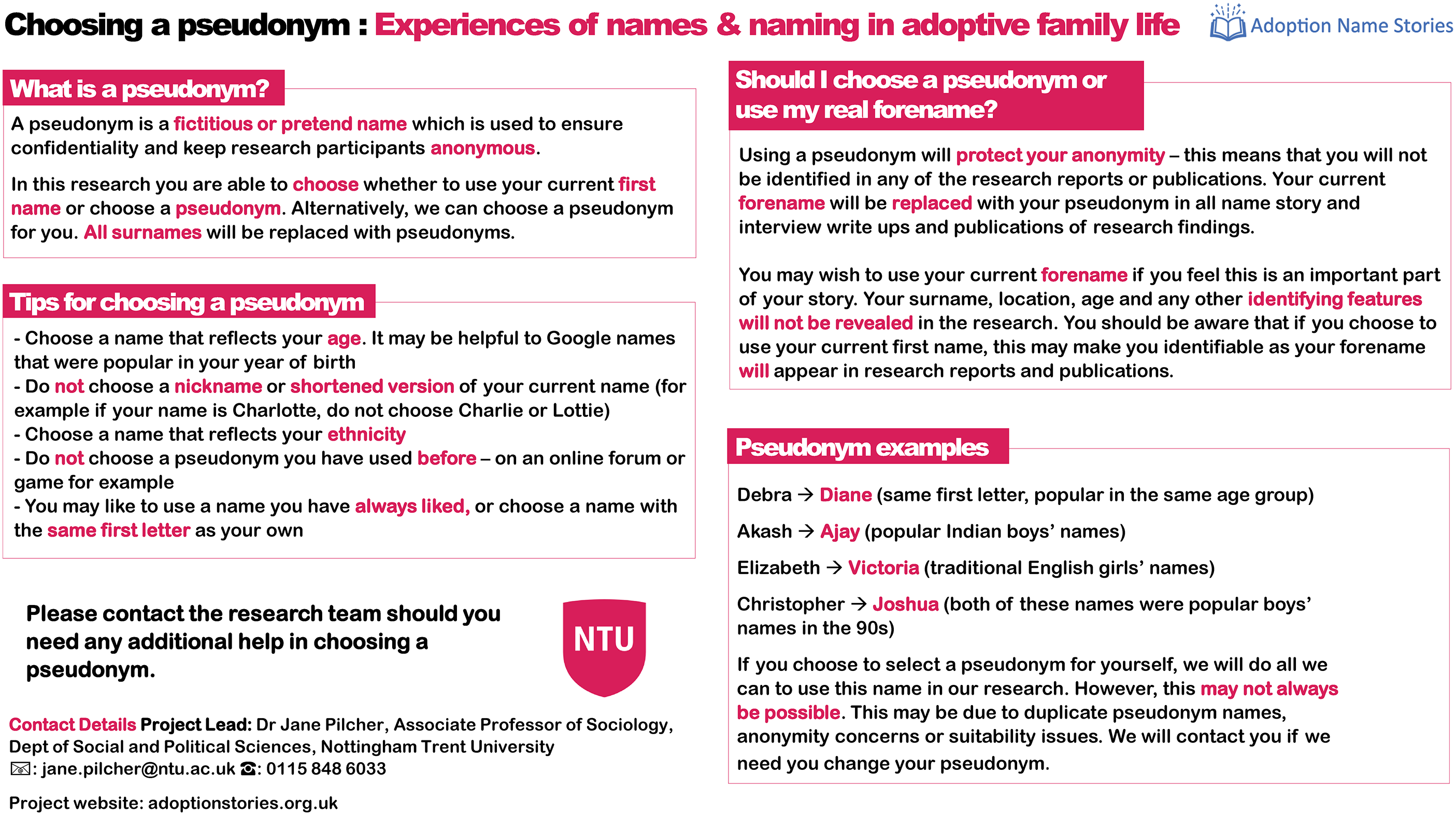
Guidance about pseudonyms for participants in the names and adoption study.
We found that adoptees and adopters tended to make different decisions about first name orthonyms and pseudonyms. Of the 29 adoptees who consented to take part in the study, 19 chose to use their current first name. For some, this meant using their birth name which had been retained or using their adoptive name. For others it meant using the name they had chosen for themselves in adulthood. Fewer (10) chose to use a first name pseudonym. Of those opting for a first name pseudonym, six chose their own pseudonym and four requested the research team to do so on their behalf. In contrast, of the 22 adopters who had returned a consent form, nearly twice as many (14) chose to use a first name pseudonym than chose to use first name orthonyms (8). Of those opting for a first name pseudonym, six self-chose and eight asked the research team to choose one for them. These findings suggest that, even in the same study, decisions by participants about whether to use first name orthonyms and pseudonyms are linked to their differing name-based identity investments in the topic. Adoptees in our study had all previously been the subjects of name change – one or more elements of their birth names had been changed by their adoptive parents. It is understandable that, given a choice about whether to change their first names in our study, most adoptees exercised their agency and chose to use their first name orthonyms, or, if opting to use a first name pseudonym, took the opportunity to choose their own. One adoptee who consented to take part in our study (but did not go on to participate) told us via email how much they valued being offered a choice about their names: … I think it's…really cool by the way to suggest that we can be involved choosing our own pseudonym first name. I know so many adoptees who feel extremely uncomfortable that their names were changed when they were adopted, naming and ownership is a very tricky thing. I’m not sure if this is the reason why there's the option to be involved in choosing a pseudonym – but I just want to feedback that it feels very powerful to be offered this opportunity in this context. Thank you so much.
The ‘very tricky thing’ of ‘real’ names and of pseudonyms for our adoptee participants was evident in comments that others made, either in their creative writing booklets or in email correspondence with researchers. For some adoptees, choosing to use their first name orthonym was tightly bound up with their telling of their adoption name story: I would like to use my original first name in the research as I don't believe I can fully share my name story without keeping it. It won't be possible to tell it with a pseudonym.
One adoptee participant wrote about how she felt about the option to use a pseudonym in place of her current name and our guidance on choosing one: I found it ironic that the advice for picking a pseudonym was to choose one that reflected ethnicity. What would I choose, adoption stripped me of my ethnicity, culture and language. My name is a pseudonym.
It is the names given to Stephanie by her adoptive parents that she experienced as pseudonyms. She implies that, for her, it is her birth names that are her real names; they hold rich meaning because, unlike her adoptive names, they are encoded with her ethnic birth heritage. In her follow-up interview, Stephanie said “you know, my father was [from Southeast Europe] and I would like my name to reflect my…heritage. And it certainly doesn’t reflect that”. The complexity of Stephanie's feelings about her birth and adoptive names might explain why she chose not to use her current orthonym (her adoptive first name) and instead asked the research team to choose a pseudonym on her behalf.
Like Stephanie, another adoptee participant used the word ‘ironic’ in their written reflections about real names, and pseudonyms in the adoption and names study: [It's] ironic you would ask an adoptee who has already had name changes to make a name up and have yet another name change… I appreciate [the study] and think it's important and I am glad it's been done but the asking us to change our names yet again is probably going to upset quite a few adoptees.
We did not, in fact, ask adoptees to change their names ‘again’ (see Figure 1, for example). We think that being an adoptee had made ‘real’ names and pseudonyms such sensitive issues that Bob had misunderstood our guidance about (re)naming choices available to participants in our study. We emailed Bob to give further details about our decision-making regarding (re)naming participants and to clarify the (re)naming options we had made available. We were actually able to get ethical approval [for participants to be allowed to choose to use their first names] arguing the same thing you point out, that people's names are important to them, and they won't necessarily want to change them. However, some people do choose to make up a fake name to further protect their identity, which is why we have allowed for this also. Hope that explains the thinking behind it.
Apart from Bob, we have no evidence that other participants had misunderstood our guidance about (re)naming in the names and adoption study. But our concerns about anonymity for participants meant that we did communicate with one adoptee about their decision to use their (uncommon) first name orthonym in the names and adoption study. We emailed the participant to double-check their choice and to outline other options. The participant's reply reiterated that their choice was an informed one, and shows the importance of their name for their identity: Thanks for letting me know and giving those options. However, I feel comfortable with my name being used as it is for the findings and any publications.
Compared to adoptees, most adopters opted for a first name pseudonym, and of these, most wanted the research team to choose a first name pseudonym on their behalf. We think that adopters’ choices around first name orthonyms and pseudonyms were motivated by a desire for enhanced anonymity for themselves and their family, including children who may be vulnerable on safeguarding grounds linked to their birth family history. At the start of their interview, several adopters did seek additional verbal confirmation that their child(ren)'s names were going to be pseudonymised. However, while some adoptees wrote in their booklets or communicated with us via email about the (re)naming protocols of the study, no adopters did.
Our study focused on names in adoption, and while we anticipated some complexity in (re)naming our participants and the people they mentioned, we underestimated how labyrinthian a task it would be. When a participant had chosen to use their first name orthonym this reduced the challenge we faced in retaining the thick description of identities, including ethnicities, offered by participants’ (first) names. This was especially so in the case of adoptees’ first names, as these examples show: I’ve always been called Dermot [adoptive first name] and I feel that it has meaning. It's an Irish name or at least an anglicized version of it…Diarmúid of Irish legend was the right-hand man and lieutenant of Finn MacCool a hero of myth…..It means ‘without envy’ or ‘free man’. Interesting but of no more than passing interest I suppose. It's important though as it's a bit different, and it connects me with the heritage and identity of my (adoptive) parents in a way that an English name would not have. For that reason I’m glad to be Dermot rather than Scott [birth first name]. I don’t use the Richard [adoptive middle name] much or feel particularly strongly about that, and Fuller [adoptive surname] connects though to the lineage of my dad – one I do not share biologically. But Dermot as my given forename is something I STRONGLY identify with, it's who I am but it also connects me to my mum and dad and their Irish identity.
I feel that my name is a gift from my adopted Mum. She wanted a name that could not be shortened, so chose this. I find it amusing that other people lengthened it instead. It means ‘Grace of God’ which is very meaningful to me as I am of the Christian faith and it reflects that. I talk to myself using the name Annie though, which I have just realised.
Because many of our adoptee participants did opt to use their first name orthonym, we were able to make fewer changes in the retelling of their name stories. Otherwise, we had to very carefully choose a pseudonym that tried to capture the meaningfulness – so apparent in Anne's and Dermot's creative writing – of a participant's name and identity experiences.
Even if they had chosen to retain their first name orthonym, a single adoptee participant still required multiple pseudonyms for themselves to try to capture the meanings of their birth name orthonyms (first name and/or middle name(s), surname), their adoptive name orthonyms (first name and/or middle name(s) and surname) and married surnames (where people who had married had changed their surname). In addition, a single participant, whether adoptee or adopter, could mention several other people by name including birth and adoptive kin on both ‘sides’ of their complex adoptive family structures. Often these people also had to be renamed using pseudonyms in ways that retained the kinship and other socio-cultural identities information encoded in the names as well as the meaning of a name story – for example, about how as a adoptee, they had been ‘name-saked’ after an adoptive grandfather, or what the names of their birth parent(s) were. My original name was Natasha Hatton, how strange! It [birth certificate] also gave the name of my biological mother, Sandra, and the address of where she lived when she had me, this was in [the midlands]. The space for the name of my father was blank, although…. the letters from Social Services said his name was Carl.
For similar reasons multiple carefully chosen pseudonyms were needed to address the rich and meaningful complexities of names in the experiences of adopters, including changing spellings of children's names and name-saking related to their child, as shown in the examples below: We loved the phonetic pronunciation of both Rosy and Everet. Due to their ages we were not allowed to change the forenames, but we were allowed to alter the spelling as long as they were phonetically the same. This allowed us to add some meaning for [my wife] Florence and me….Rosy became Rosie after the flower, which has resonance with my maternal and Florence's paternal heritage, with ancestors named after flowers (i.e. Iris and Daisy). Everet then became Everett to link back to my Celtic (i.e. Welsh) heritage.
When we were waiting to hear who we had been matched with, we decided that our child would take whichever of our surnames best fitted with her/his first name. When we found out we’d been matched with Arthur, the name went well with both surnames, so we had to choose between Arthur Wakefield or Arthur Trent. Grampy Trent was a father figure for [my partner] Emma, so I suggested we pick Trent, to carry her family history and the history of his adoption.
Arguably, to retell name stories like Sam's we could replace all the names of people mentioned in it (Arthur, Wakefield, Trent, Emma) with ‘[name redacted]’. It certainly would have been much quicker and easier for us to do so. But we argue that the meaningfulness of, for example, Jane's name story about discovering her birth names and the names of her birth parents, or Simon's about the naming of his children, is deeply enriched by using names, albeit false ones. Our study shows the value of using carefully chosen pseudonyms where anonymity concerns have ruled out the part use or whole use of participants’ orthonyms. Pseudonyms, or at least those chosen purposefully to reflect ‘real names’, convey more of the affective content of participants’ stories because of the way they personalise and humanise people's embodied named identities. To manage the labyrinthian complexity and very time-consuming process of (re)naming in our study in ways that were intended to respect the socio-cultural and familial identities of individuals and to retain the meaning of the name stories that were shared with us, we developed a pseudonymisation tracker (using a MS Excel spreadsheet and stored while in use on a secure drive). This enabled us to systematically record (re)naming decisions whether made by our participants or ourselves and to sense-check the meaningfulness of pseudonyms in relation to orthonyms.
Our study on adoption and names was deeply informed by the sociology of names, but we still made mistakes in the (re)naming of our participants. In the design and piloting of the guidance document for participants about (re)naming, we originally used the term ‘real name’. We quickly realised that, in the context of adoption where birth names of adoptees are likely to have been changed, referring to a participant's ‘real name’ is both potentially ethically insensitive and conceptually imprecise. Nor did it fit with our theoretical understanding, outlined earlier, of identities and names as processual rather than singular and fixed. Consequently, we redrafted the guidance and used the more appropriate term ‘current name’ in all participant facing documents and, subsequently, in our reporting of findings. A second mistake related to replication of participants’ names. We assumed that replication of participant orthonyms (current first names) or participant chosen first name pseudonyms would be a problem (see also Grinyer, 2002): for ourselves when processing and analysing data, and in anticipation of how readers as audiences – including participants – of eventual publications might respond to multiple participants having the same name. We decided to avoid name replication by overruling participant choices on a first come first served basis. There were cases of replicated current first names and cases of replicated self-chosen pseudonyms where this applied, which means that we overruled the naming choices of four participants in our study. Information we had previously given to participants had clearly flagged this as a possibility and we communicated our decision to the participants who were affected. In retrospect, we think our assumption about the impracticality of name replication was wrong, especially given that all participants were ‘named’ in the study using both a first name (orthonym or pseudonym) and a surname (pseudonym). Ours was not a participatory action research study but, even so, we now recognise that our method of avoiding name replication (first come first served) was insensitive and represented an erroneous exercise of the power that we had as researchers compared to participants in our study.
Conclusions
We have argued in this article that researchers’ decisions about, and practices of, anonymisation and/or pseudonymisation, and methodological debates about these processes, can be enriched by an engagement with theoretical frameworks and empirical evidence offered by the sociology of people's names. Given its relative infancy as a field, qualitative researchers and methodologists of yesteryear might be excused for overlooking some of the earlier literature in the sociology of people's names. But the development of the field over the past two decades or so means that a more substantial engagement with its literature is now due. A sign that things are beginning to change is that authors of two of the more recent publications in the research politics of participants’ names (Itzik and Walsh, 2023; Rowlands, 2024) do embed their arguments in sociology of people's names literature.
Using our adoption and names study to illustrate our argument, we showed how, in research on names and identities, anonymisation through pseudonymisation is far from being a simple matter of just replacing one name with another. For us, it was a significant task of labyrinthian complexity – and necessarily so given that we aimed both to respect our participants’ embodied named identities and the affective content of their stories, and to retain the value of sociological data encoded in names. When the identity related experiences of names are the key focus of the research whether to redact or to alter participant orthoynms (and which ones), or to use pseudonyms (and if so, which ones), are all decisions that require careful reflection if the rich meanings of the name stories told by participants are to be retained.
Yet if, as we have argued, names (orthonyms and pseudonyms) have inescapable importance for people's identities, being richly encoded with sociologically significant information, then challenges we faced in the names and adoption study about the (re)naming of participants, and strategies we used, are also potentially significant for researchers focussed on other topics. These researchers might not need to develop an anonymisation tracker or, at least, not one as complex and sizable as our own. But we think that regardless of topic, and irrespective of participant information sheets, participants’ understanding of (re)naming choices in a study can be enhanced by a document like ours that provides detailed guidance to participants (Figure 1). Like us, researchers should be careful in the terminology used when referring to participants’ names: it is not only adoptees who might have complex feelings about the notion of a ‘real’ name. Examples here include women who change their surname at marriage to a man, people who change first names and/or surnames linked to a transition in gender identity and people who anglicise their names to avoid marginalisation and/or racial discrimination in contexts where their ethnicities are minoritised. Like us, researchers might need a strategy to manage replication of names (orthonyms and/or pseudonyms) among their participants. As in our study, if pseudonyms are used and whether chosen by researchers or selected by participants themselves, researchers should try and ensure that these ‘false names’ closely reflect participants’ ‘current’ names so that sociologically rich information encoded in those names is not lost.
In accounts of qualitative research – even when that research is about names and identities – the (re)naming of research participants is too often taken for granted and limited reflections are offered by researchers about why and how decisions are made about orthonyms and pseudonyms (Guenther, 2009; Heaton, 2022). We acknowledge that this is, in part at least, a consequence of the tyranny of word limits, especially in research outputs in the form of academic journal articles. We concur with Lahman et al. (2022) that, because the (re)naming of participants is an important and challenging issue in all qualitative research projects, editorial policies of academic journals should allow more space for researchers to report on their decision-making and practices regarding participants’ orthonyms and/or pseudonyms. For example, by allowing discussion in supplementary material that can be uploaded and accessed alongside a journal article. Given that ‘the act of naming is an act of power’ (Guenther, 2009: 412) and names are so richly encoded with sociological significance (Author B, 2016), policies such as these would enable contributors to the research politics of participants’ names to better account for their views about, and actions taken, on anonymisation and pseudonymisation, including any substantive engagement they have had with the sociology of people's names.
Footnotes
Declaration of conflicting interests
The authors declared no potential conflicts of interest with respect to the research, authorship and/or publication of this article.
Funding
The authors disclosed receipt of the following financial support for the research, authorship and/or publication of this article: This work was supported by the The Leverhulme Trust (grant number RPG-2021-301).

Author biographies
Hannah Deakin-Smith has a background in social geography. Her qualitative research has examined international student mobility and academic mobility. Most recently, Hannah has been a researcher for a series of studies examining experiences of people's names, including among adult adoptees and adopters.
Jane Pilcher is a Sociologist and Qualitative Researcher whose recent work focuses on socio-onomastics (the study of people's names and naming practices). Her research examines experiences of people's names in terms of identities and/or (in)equalities, including among people who are adult adoptees or adopters.
Jan Flaherty is a Sociologist whose research interests are identity, class, poverty and social exclusion, homelessness and creative research methods. Most recently, Jan was a researcher in a study that examined experiences of names and naming in adoption.
Amanda Coffey is a Qualitative Sociologist, with interests in ethnography, education, young people, transitions to adulthood, and in adoption studies.
Eve Makis is a Novelist and a Teacher of creative writing. She works extensively in the community delivery writing workshops to marginalised groups and brought this expertise to a qualitative research project examining people's experiences of names and naming in adoption.