




Abstract
From the positionality of a Mexican scholar in security studies who identifies as female and an investigative journalist born and working in Sinaloa, Mexico, this article builds on existing scholarship examining the positionality of local stakeholders who are integral to the production of knowledge in conflict settings. In early 2021, Mexico had the world's third-highest number of deaths caused by Covid-19. Additionally, close to 80,000 people were officially missing and 52,000 remains in state custody lacked identification. In this context, civil society groups raised concerns about the proper handling of bodies, fearing cremation prior to identification of the remains. The article highlights two phenomena as evidence of a reflexivity process followed by the authors: first, for mothers searching for their children, Covid-19 was an additional life-threatening risk (not the main health risk, as in the general population). Second, we consider how global pandemics produce compounding crises in contexts of chronic violence and vulnerability, while simultaneously bolstering advantages for scholars in the Global North. The article is a call to action for more ethical qualitative research methodologies within the emerging social science community working on illicit economies and extralegal actors.
Introduction
On 4 June 2020, Mexico's Undersecretary of Health asserted that reaching 60,000 Covid-19 deaths would be a “catastrophic scenario.” By August 2020, it was clear that Mexico would reach and surpass that number. By the end of 2021, almost two years after the first Covid-19 case was detected in Mexico, close to 300,000 people had died from the virus (INEGI, 2021a), making Mexico one of the most affected countries. Covid-19 landed into a context with at least two other important developments. First, lethal violence has continued unabated. After the declaration of the “war on drugs” in 2006, Mexico's homicide rate increased from 8 per 100,000 in 2006 (slightly above the global average of 6 per 100,000) to 29 per 100,000 as of 2020. Homicides have steadily increased every year (except for a two-year reduction in 2014 and 2015 (INEGI, 2021b), resulting in a pervasive annual cycle of discussing new “record-high years” of violence 1 .
Second, it is not hyperbole to say the country faces a disappearance and forensic crisis, with 100,000 people officially forcibly disappeared (Comisión Nacional de Busqueda, 2021) either by state or criminal actors. To put this number into perspective, Argentina's dirty war—arguably one of the best-known incidences of disappearances in the region, resulted in approximately 30,000 cases (EAAF, 2021). In 2017, Mexico created the National Search Commission with the mandate of coordinating federal and state authorities to locate those who have disappeared. The head of the recently created National Search Commission has officially recognized Mexico's forensic crisis, but this national agenda is arguably set by vernacular or bottom-up approaches 2 . Families across the country, and mothers in particular, have personally taken on the search for their loved ones. These family-created groups—widely known as colectivos (collectives) or buscadoras (searchers)—know their work is the remit of the state. However, the colectivos still search, knowing that a lack of political will and lack of state capacity means their loved ones may never be found otherwise.
As the Mexican government grappled with how to contain the pandemic, another urgent problem surfaced: colectivos raised concerns over the proper handling of newly discovered bodies. While public health officials advocated quick cremation, this could permanently prevent the effective identification of the remains. The panic was not baseless: as of August 2021, there were 52,000 unidentified remains in state custody. Civil society groups had low levels of trust in authorities, and yet another instance of egregious mishandling of human remains was not unimaginable.
The goal of this article is twofold. First, it engages in an intersectional reflexivity exercise to understand the author's position and how qualitative research experiences during Covid-19 renewed and altered epistemological and theoretical critiques of research in settings with ongoing violence. In doing so, it builds on existing work examining the positionality of local stakeholders who are integral to the production of knowledge and central to the research process (not as an afterthought). This recognition is important when studying violent contexts, but fundamental in conflict settings and a global pandemic.
Importantly, the notion of conflict settings increasingly goes beyond traditional state-state conflicts. Social sciences (beyond criminology) have begun to study illicit economies and extralegal actors involved in criminal activities (see, e.g., the 2022 application for a new section on Illicit Economies and Extra-Legal Actors within the American Political Science Association). The move is a recognition that in the same way political scientists study political organizations and parties, they are increasingly applying their toolkit for researching complex dynamics of the Global South, including those that operate in illicit spaces.
Second, this article advances the concept of compounding crises to challenge the exceptionalism narrative of Covid-19 and situate the pandemic within contexts of chronic violence. The exceptionalism narrative purports that Covid-19, for a period, was the main risk faced by people everywhere. Challenging this exceptionalism does not imply that there were no effects of Covid-19. In fact, the pandemic bolstered (albeit gendered) privileges for many researchers working in the Global North. Furthermore, in contexts of chronic violence and vulnerability, it became an additional life-threatening risk to the well-being of individuals. To do so, this article builds on existing scholarship that challenges positivistic approaches to generating knowledge in conflict settings (Fujii, 2015; Jenkins, 2018; Bell-Martin and Marston Jr, 2021; de Vries and Glawion, 2021; Thomson et al., 2021). It focuses on the positionality of local stakeholders (Crowhurst, 2013; Jenkins, 2018; Mwambari, 2019; Parashar, 2019; Schulz, 2021) and emerging literature on Covid-19's impacts on qualitative research (Verweijen et al., 2020; Bashizi et al., 2021; Erll, 2020; Mwambari et al., 2022).
The article is organized as follows: “Self-construction and the simultaneity of insider/outsider status” section explains the author's stance on reflexivity and discusses her positionality researching violence in Sinaloa, with a focus on how her insider/outsider status impacted other sites of privilege. “Going to the field during a global pandemic: An opportunity to rethink the role of local stakeholders in knowledge production?” section explains the decision to conduct research in Sinaloa during the pandemic (before the deployment of vaccines either in the United States or Mexico). I also discuss the positionality of a Sinaloa-based journalist who I worked with. The section interrogates how the phenomena of compounding crises became visible through collaborative work in an otherwise separate research project. “(Un) Exceptional times: Covid-19 and territories of compounding crises” section briefly reviews how the Mexican government managed the pandemic to further illustrate the concept of compounding crises. This section, which places the Covid-19 crisis into the context of other crises unfolding in Sinaloa, draws on fieldwork conducted in November 2020 and August 2021.
Self-construction and the simultaneity of insider/outsider status
Before discussing the reasons informing my decision to conduct research and my positionality in Sinaloa during a global pandemic, it is important to clarify my stance on reflexivity. First, in line with other scholars researching violence, this section is not intended to be an “indulgent account of the ‘me’ in fieldwork” (Hume, 2007: 481). Rather, it seeks to “challenge the view of knowledge production as independent of the researcher producing it and of knowledge as objective” (Berger, 2015: 220). Furthermore, following Rose (1997), this reflexivity exercise rejects the possibility of “transparent reflexivity.” That is to say, “there is a visible landscape of power, external to the researcher, transparently visible and spatially organized through scale and distribution [….] depend[ent] on certain notions of agency (as conscious) and power (as context), and assumes that both are knowable” (Rose, 1997: 311). Rather than thinking there is a “‘transparent’ self waiting to be revealed,” I subscribe to the notion of reflexivity as a process of self-construction, not self-discovery (Rose, 1997: 313).
There are several sites of privilege that provide advantages in my work. In line with self-construction over self-discovery, I discuss those that I know impact my positionality without assuming a complete accounting. These sites of privilege are significantly mediated through the insider/outsider status I have as a born-and-raised Mexican researching violence in the country, albeit in states other than my own. As discussed by Merriam et al. (2001) and Parashar (2019), I am always a local to the extent that I am Mexican, but I am an outsider in the specific regions where I conduct my work. This simultaneity of being an insider/outsider is perhaps best illustrated by my interlocutors in Sinaloa who quip about granting me “culichi citizenship” after my many visits to the state. “Culichi” is the demonym used for inhabitants of Culiacán, the capital city of the state of Sinaloa in Mexico.
My insider/outsider status is also informed by being a Mexican who presents as white. Racism and discrimination remain powerful forces in Mexico. According to official data, over 50% of the population 18 years and older report being discriminated against because of their appearance (INEGI, 2020), while 75.6% of indigenous people believe they are undervalued by others (INEGI, 2020). Whiteness often grants access where other populations are restricted or refused. I have been told, “you do not look Mexican” (which is intended as a compliment) and, in some cases, interviewees have noted my “good Spanish.” For my interlocutors, whiteness sometimes signals higher perceived levels of socioeconomic status and greater potential for social mobility, 3 or even foreign citizenship from a predominantly white country.
Furthermore, interviewees were more willing to speak with me as a scholar trained and working in the US. They may perceive scholars in the US to do more relevant and important work than scholars who live and work in Mexico. Conversely, some individuals are more likely to grant me interviews precisely because they want to ensure I bring “real” information about Mexico back to the US, even though I am Mexican. To be sure, some individuals agree to meet with me out of real interest in my work and a genuine desire to help with my research. Furthermore, the reasons outlined above are not mutually exclusive categories. However, to reiterate, because I consider reflexivity as self-construction rather than a self-discovery process, I do not pretend to identify all the reasons why individuals choose to speak with me. Regardless of their reasons, I appreciate everyone who takes time out of their busy lives to speak with me.
Sites of privilege as a cisgender woman are more ambiguous than perceived skin tone and professional links to the US. In a context where machismo prevails, women can be interpreted as a nonthreat, paradoxically resulting in significant disclosures of information. This is to say, some male interlocutors speak with me not from an equitable position but from a place of perceived gender dominance. These interviews are dynamics of power, whereby male interviewees “elucidate” complexity to a female interviewer. Equally, being a woman, particularly a woman researching organized crime and violence, can translate into exclusion from territories, and consequently, information. As Álvarez (2021) has so eloquently written, when a territory is classified as insecure or unsafe it means that only people with certain attributes are allowed to transit through them. Characterizing a place as dangerous justifies the exclusion of certain bodies and the prominence of others. In this way, masculine and armed corporealities belong in those types of contexts while feminine bodies are deliberately excluded under the guise of amplified vulnerability. In this sense, referencing danger is, frequently, a strategy to marginalize women of war and conflict (translated from the Spanish by the author, emphasis in the original)
I also want to explicitly state, as part of the reflexivity exercise, that my work largely benefited from the opportunities and resources available to me as a scholar based in the United States conducting research in Mexico. This included the opportunity to travel and return to the United States during a partial border closure on the US and Mexico border. Again, this underscores the benefits of having insider/outsider status in my research pursuits. I am aware that other scholars, especially those residing in the Global South, did not enjoy equal opportunities to travel even within their own territories. The next section discusses my decision to “go to the field” during a global pandemic and the positionality of my local partner in the production of the present research.
Going to the field during a global pandemic: An opportunity to rethink the role of local stakeholders in knowledge production?
The Covid-19 pandemic presented an important window of opportunity for qualitative scholars who were not trained to consider reflexivity and positionality. As scholars working in conflict and post-conflict settings pursue embracing emotions as central to an ethical research practice (Thomson et al., 2021: 141) insofar “to grapple with emotion is foremost to negotiate and make sense of the relationships that define the fieldwork enterprise” (Thomson et al., 2021: 141, emphasis added), the pandemic offered a low barrier of entry for scholars (especially those who could conduct fieldwork in a time of global crisis) to seriously reflect on their multiple sites of privilege. Such work is about both epistemology and accountability. The growing social science interest in illicit economies and extralegal actors (e.g., in Political Science, Economics, and Sociology) demands engagement with these questions of power and privilege, which are generally more common in the humanities (see e.g., the proposition of a militant anthropology by Scheper-Hughes (1995) and the ethics of researching global organ trafficking 2004). They ought to be fundamental to the development of this emerging intellectual community.
Following Jenkins (2018), Cronin-Furman and Lake (2018), and Mwambari (2019), we must underscore the positionality of local stakeholders who are integral to generating knowledge by providing access to research spaces and individuals (among other functions). The pandemic, therefore, also presented an opportunity to advance emerging research that seriously considers the positionality of local stakeholders/research brokers (as conceptualized by Mwambari (2019) and Parashar (2019), respectively). Doing so interrogates how knowledge is produced (for an extensive discussion on the production of knowledge and violence, see Baird, 2018; Eriksson Baaz and Utas, 2019). Arguably, such work is even more critical in conflict settings, where the pandemic brought additional risks and challenges for those often involved, yet invisibilized, in the knowledge-generating process.
My decision to travel during the pandemic was linked to my work on mass graves and formal burial sites which I began before Covid-19. This work argues that not all lives lost in the context of Mexico's “war on drugs” are treated equally. Following Butler's (2016) Frames of War: When Is Life Grievable?, I examine how criminal groups and the state treat the deceased. Case studies from Sinaloa show how perceived status or social standing shapes how corpses are cared for. Furthermore, the disproportionate effects of the “war on drugs” do not end with homicide but are perpetuated even after death.
Collecting information for this project required site visits to public and private cemeteries, areas where clandestine graves had been found, and cenotaphs located in different areas of the city. My aim was to photograph these spaces, not to meet with people, so I was not exposing potential interviewees to Covid-19. Since I would be arriving from the United States, I wanted to be sure I was not creating additional risks for a population already living in a precarious state. According to official data, the main cause of death in Sinaloa in 2020, for both men and women, was Covid-19 (INEGI, 2021a). Therefore, my decision to travel was heavily informed by the fact that my research on grievable life only involved visiting the dead.
There was one exception. Before arranging my travel, I discussed this research with the foremost journalist working on disappearances in Sinaloa, Marcos Vizcarra 4 . Manuel and I have collaborated on several occasions, and we agreed this trip could be another partnership. My work with Marcos has never replicated the contractual schemes that characterize “fixer” relationships in the foreign media (local journalists are paid a daily rate). As an academic who wants to be mindful of how payment can distort work in certain contexts, and without the resources of large international media conglomerates, I have attempted to develop mutually beneficial working relationships. This is particularly important considering the job precarity of journalists in Mexico and the life-threatening risks they face when covering certain topics, including those related to organized crime. According to the Committee to Protect Journalists, a nonprofit organization that promotes global press freedom, Mexico is among the deadliest countries in the world to be a journalist (CPJ, 2022).
Marcos agreed to take me to the site visits (I would cover the cost of fuel and food) and in turn, he would collect his own photographs that he could either use in his work or sell to the foreign press, which often contacts local journalists when they need images related to the war on drugs in Sinaloa. Furthermore, if an interesting story emerged in the process of our site visits, he could report on the material 5 . Before meeting Marcos for the Dignity in the Afterlife project, we agreed I would take a Covid-19 rapid test to verify (as much as was possible under the circumstances) that I had not contracted Covid-19 while traveling from the US. This was the best option since, in November 2020, Covid-19 testing was only available in Mexico for those who presented symptoms and were at risk of being hospitalized. I was able to secure a home rapid test from a contact in the pharmaceutical industry who was in the process of negotiating distribution contracts in Mexico and had samples they could sell me. Being able to purchase a rapid-home test for Covid-19 when they were largely unavailable for the general population is, undoubtedly, another site of privilege.
During the reflexivity process for this article, I reached out to Marcos to ask, in his view, which site of privilege was most important during my visit to Sinaloa in November 2020. According to Marcos, while the abovementioned elements (insider/outsider status, whiteness, US links, and gender) mattered, the instrumental piece was that he accompanied me. Here, Marcos is not trying to become a protagonist, but rather have a conversation about his positionality vis-à-vis my work in Sinaloa. Marcos was born in Culiacán, Sinaloa and has worked as a journalist for the main media outlets in the state. Sinaloa has a robust tradition of investigative journalism (the reasons why are beyond the scope of this article). Marcos honed his skills and became a main contributor, making a name for himself in recent years covering disappearances. He is the recipient of several international awards recognizing his work.
Marcos has also been a “fixer” for international media, which has pushed him to reflect on his positionality when working with outsiders. Sometimes he is never even paid (despite signing a contract with the outlet), but he is also sometimes credited in the resulting article. Like local stakeholders elsewhere (e.g., Mwambari, 2019), Marcos's reflections center power imbalances: he had less power negotiating compensation, work hours, and safety, but greater power as a gatekeeper. He also experienced the phenomenon of “research” fatigue (Eckl, 2008; Rogers, 2008; Wood, 2006 in Mwambari, 2019), in which local assistants eventually tell their clients what they want to hear. My perception is that research fatigue and safety were often heightened when Marcos was working as a fixer. As Marcos explains, the international media often seeks “narco narratives” in Sinaloa and want the so-called “narco tour,” including site visits to shrines allegedly frequented and sustained by local illicit actors and clandestine labs where illicit drugs are manufactured. Local journalists who work as fixers know these “narco tours” hardly reveal the truth of illicit dynamics in the state but agree to take the jobs because they can often make the equivalent of their monthly salaries, if not more, in the span of a few days.
I fully agree that transiting these spaces with Marcos, as opposed to by myself, not only granted access and better negotiation of potential physical risks but also permitted the collection of photographic evidence. Even though I have worked in Sinaloa extensively, Marcos is arguably one of the most knowledgeable persons about disappearances in Sinaloa. This means that he knows the locations (cemetery addresses aside, much of this is not public information in Mexico), and the lookouts who work in these sites (clandestine, public, or legal) also know him 6 . If Marcos decided not to collaborate with me on this occasion, my research would have been limited to documenting graves, mausoleums, and to a lesser extent clandestine graves without affording an opportunity to reflect on his positionality in my work in the context of a global pandemic.
The empirical phenomenon I discuss later in this paper (compounding crises) became visible when working with Marcos and discussing the work I was trying to do, what I was experiencing through the site visits, and what he was experiencing in his professional and personal life. This is akin to Fujii's (2015) “accidental ethnography,” “the unplanned moments that take place outside an interview, survey, or other structured methods […] The importance of these observations lies not in what they tell us about the particular, but rather what they suggest about the larger political and social world in which they (and the researcher) are embedded” (Fujii, 2015: 525). To be sure, the fact that my fellow special issue authors and I can reflect on how qualitative experiences during the Covid-19 pandemic created opportunities to renew and alter epistemological and theoretical critiques of research in conflict settings speaks volumes to the diverse sites of privilege at play. It also underscores the opportunity we had to continue with our work, while many of our colleagues and friends could not, due to the life-altering dynamics Covid-19 set in motion.
An emerging scholarship on conducting research during a global pandemic, in particular, in conflict (including illicit economies) and post-conflict settings (where a diverse range of violences are experienced daily) has called for more sustainable and ethical research practices (Verweijen et al., 2020; see also Knott, 2019). As Mwambari, Purdeková and Nyenyezi Bisoka argue, “as research has moved to online platforms, there is potential for the “digitalization of suffering [which] risks reducing complexity of social phenomena and omit[ing] important aspects of lived experiences of violence or peace-building” (2022: 969). Conversely, for those privileged scholars like myself who were able to travel, the pandemic presented an important opportunity to expand on research that examines the positionality of local stakeholders involved in the production of knowledge. Marcos's positionality was central to my research in Sinaloa, even more so in the context of a global pandemic where several risks had to be negotiated, including the (heightened) mobility challenges of places with chronic violence.
This process of reflexivity—for the researcher and local stakeholders—matters because it visibilizes how intersectionality shapes the context and the individuals we work with as social scientists (Shields, 2008; Clarke and McCall, 2013; Kerner, 2017; Mason-Bish, 2019). While Covid-19 intensified existing sites of privilege for my work, it exacerbated vulnerabilities for the colectivos. While I was in Sinaloa in August 2020, the insular proximity of doing fieldwork on death, I had a measure of emotional protection even as I was physically intimate with it. This was mirrored by the exposed distance of the buscadoras, who are continuously exposed both emotionally and physically, and are—in a perverse way—almost always farther from death than they would like. And these risks and distance, only intensified with the pandemic.
(Un) Exceptional times: COVID-19 and territories of compounding crises
This section proposes the concept of compounding crises based on my work in Sinaloa in November 2020 and August 2021. I build on the notions of chronic violence (Pearce, 2007) and chronic vulnerability (Baird, 2020) and, in doing so, challenge the Covid-19 exceptionalism narrative. Compounding crises are periods where additional risks for populations living under chronic violence and chronic vulnerability emerge due to shifting dynamics. This working concept for research in conflict settings is not presented here as a stand-alone idea but rather as a concept that became visible through engaging with reflexivity. Had I not engaged with reflexivity and positionality discussions with Marcos, this phenomenon would remain hidden from [my] view. Therefore, this section can also be interpreted as evidence of my reflexivity process and the self-construction discussed in “Self-construction and the simultaneity of insider/outsider status” section. I also review key factors that have aided in the construction of Sinaloa as “a violent place.” This review should not be construed as an exhaustive history of violence in the state nor the origin of these narratives. Rather, it highlights how Covid-19 was an unexceptional event against this sometimes imagined (sometimes factual) backdrop of violence. For the members of the colectivos searching for their loved ones, it became an additional, but hardly the most pressing, risk.
On 28 February 2020, the Mexican government confirmed the first case of Covid-19 in the country. On 23 March 2020, the government announced the “Sana Distancia” campaign, which called for social distancing and a stay-at-home mandate; however, the Mexican government's response to Covid-19 was generally suboptimal. In 2020, Covid-19 was the first and third cause of death for men and women, respectively. Per official data, excess mortality—the difference between the observed number of deaths and expected number of deaths in the same time period—in 2020 in Mexico was 43.6% (INEGI, 2021a). December 2020 became the second most lethal month of the year, as Mexico surpassed its “catastrophic scenario” of 60,000 deaths. As of June 2022, Mexico has accumulated 325,000 Covid-19 deaths, placing it among the top five countries with the highest Covid-19 mortality behind the US, Brazil, India, and Russia (World Health Organization 2022).
In June 2020, when official Covid-19 cases (not deaths) had reached 75,000, the federal government adamantly rejected introducing tax reliefs or stimulus measures. They stated that a stimulus would only benefit a select few and that tax relief was simply tax amnesty, which was “antithetical to the government's anti-corruption stance, given the perceived abuses to which past tax amnesties were subject” (Martínez D’Meza and Gonzalez Orta, 2020). Notably, the López Obrador administration continued disbursing cash benefits for low-income citizens, unemployed youth, and the elderly. While these stipends have some merit, taxpayers—whose payments fund these stipends—initially received no support. Even when the government did provide some economic relief from the effects of the pandemic, the policies closely adhered to fiscal conservatism. Mexico's stimulus plan amounted to 1.1% of GDP, less than a quarter of the average in Latin America and only an eighth of what Brazil spent on pandemic help (Weber, 2021).
The colectivos or buscadoras quickly reacted to the potential human devastation of Covid-19 based on their experiences witnessing and denouncing the mistreatment of human remains by the Mexican state. In early April, they called for a “no cremation” order regarding all unidentified remains. The goal was twofold: prevent additional human rights violations by cremating unidentified individuals deceased from Covid-19, and find the 60,000 missing individuals (60,000 was the official number at the time of writing; in June 2023, the official number is close to 112,000,000). A few days later, the Mexican government agreed to forbid the cremation of unidentified bodies (Diario Oficial de la Federación, 2020).
In May, I learned through media reporting and social media accounts that the colectivos were continuing their searches in defiance of the “stay at home orders, their own fears, and warnings by other family members” (Vizcarra, 2020). One of the buscadoras explained, “As mothers of a disappeared [person] we have the need to mitigate our pain. Not going out to search is like doing nothing to find them” (Cruz in Vizcarra, 2020). By October 2020, I was directly involved in a process to alleviate some of these burdens. The leader of one of the colectivos in Sinaloa reached out to me for help. She wanted to formally reallocate some funds she had received from an international civil society organization toward buying additional protection equipment. She explained that things were difficult for the colectivo; several of the women were at a higher risk of severe Covid-19 due to diabetes, hypertension, or both. I should note that I knew (and know) this colectivo and their work very well and have collaborated with other scholars to digitize their archive to ensure their data are protected. Before this, the colectivo's information and maps only existed on paper.
During the pandemic, my work entailed discussing issues with the leader of this colectivo and drafting a letter addressed to the international organization. In the letter, I recounted the challenges the colectivo communicated and requested to use some of the allocated funds to purchase protective equipment, such as facemasks, antibacterial gel, and other disinfectants. At the end of the funding period, the leader had to submit receipts, so it was incredibly important that these purchases were approved before the money was spent. The process of drafting and sending the letter helped me understand the several crises these women and their families faced. However, it would not be until my visit in November 2020 that I understood that, even in the context of a global pandemic, these colectivos faced a very different reality than the one crafted by public officials responding to the pandemic in Mexico.
The pandemic heightened sites of privilege for scholars like myself while creating compounding crises for those in conflict settings. In the context of memory studies (Olick and Robbins, 1998; Kansteiner, 2002; Feindt et al., 2014), such assertions build on the notion of memory worlds as conceptualized by Erll (2020). Covid-19 “has subjected people around the world to new rhythms: Work, childcare, home-schooling, family visits, leisure, even eating, sleeping, and taking showers are—temporally—not what they used to be” (Erll, 2020: 862). However, “corona-rhythms look different in other worlds of temporal experience […] and the new rhythms associated with the corona pandemic emerge as a marker of privilege” (Erll, 2020: 863). Similarly, Romania (2020) has proposed Covid-19 as a bolster for interactional anomie, “a condition of uncertain knowledge of what rules of conduct regarding social distance shall be applied to interaction with non-familiar people in public spaces” (Romania, 2020: 59). In this sense, the additional risks of the pandemic for buscadoras generated a different corona-memory (Erll, 2020) and will create different interactional anomies (Romania, 2020) than what I experienced, or the ones created by other Mexicans.
Sinaloa occupies a central space in narratives about violence in Mexico. In the collective imaginary, it is regarded as Mexico's cradle of drug trafficking and has seen the most consistent crop eradication against opium poppies and marijuana. Crop eradication in Mexico between 1990 and 2020 focused on a few municipalities. The municipality of Badiraguato, Sinaloa, which lies in the drug-producing region known as the Golden Triangle, had the most marijuana eradication and third-most opium poppy destruction in the last 20 years (MUCD, 2021). Such eradication measures demonstrate how the Mexican state, through its armed forces, has characterized Sinaloa as a drug-producing territory, and particular communities have been consistently targeted and victimized. Crop eradication by the armed forces—through aerial fumigation and by hand—is itself a violent activity. As Frissard Martínez et al. (2023) explain: It represents the economic loss of investments in labor and resources that affects only the peasant producers, never intermediaries or drug lords. Moreover, the permanent presence of the Armed Forces in these zones clearly reflects the power schemes that the Mexican State employs to deal, differentially, with distinct territories, and that contributes to “criminalizing” poverty […] the criminalization of emblematic territories of drug production and transport, and the resulting stigma placed on their inhabitants, fuel mechanisms of revictimization that transfer responsibility for violence to those who suffer it […] in this light, the scenarios of the destruction of illicit crops have historically offered fertile ground for serious human rights violations
This is not to say Sinaloa is totally misunderstood or that violence never occurs. Certainly, residents have lived through moments of considerable lethal violence. For example, in 2009, Mexico's homicide rate was 18 per 100,000 (compared to 6 per 100,000 globally), but Sinaloa's rate was 52. It then increased to 86 per 100,000 in 2010 when a purported fight within the Sinaloa criminal organization and between the state and alleged criminals resulted in thousands of casualties. These episodes of violence fuel narratives of Sinaloa as a territory dominated by narcos—ungovernable men enriched by an illegal trade, who are all too eager to display their wealth and dominance through big pickup trucks, assault rifles, and women (not necessarily in that order) 7 (Figure 1).
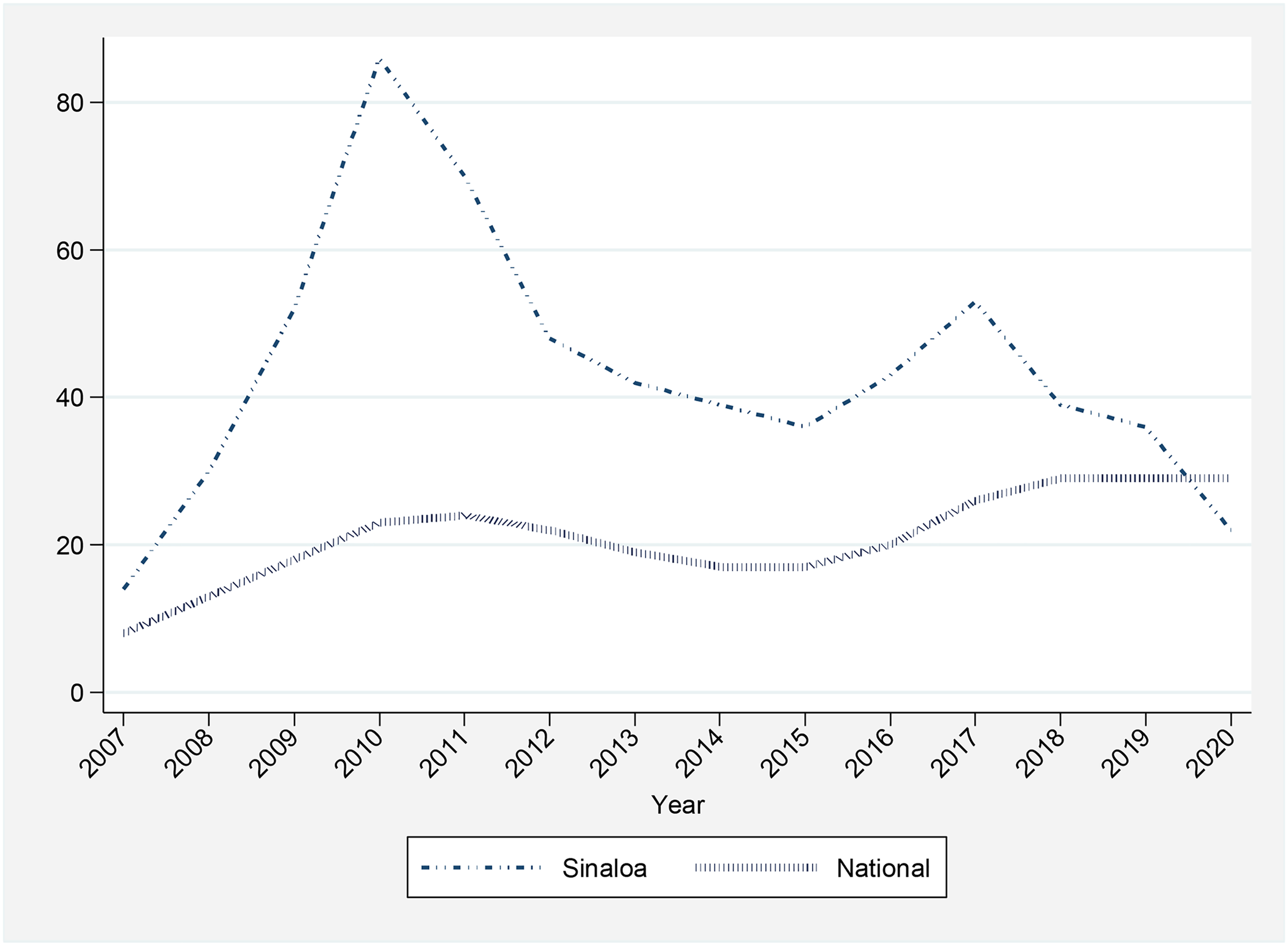
Homicide Rate per 100,000 in Mexico and Sinaloa 1 .
Within this context, buscadoras search for their loved ones at great risk to their emotional and physical well-being. As of June 2021, of the official 92,000 disappeared people in Mexico, 10,736 cases (over 10%) were reported in Sinaloa, although only 4638 were officially recorded as disappearances by authorities (Corral 2021). Families who report disappearances often face seemingly never-ending revictimization from the authorities due to two interconnected forces: wilful negligence and a lack of state capacity.
Examples of willful negligence in Mexico and Sinaloa abound. Conversations with members of colectivos and journalists reveal how authorities evade responsibility by characterizing disappearances as the result of an individual's behavior 8 . This victim blaming is built on the narrative that men who disappear “had it coming” (and young women who go missing are often said to have run away with their boyfriends). In this logic, people who disappear were involved in criminal activities and have, therefore, surrendered all claims to due process and justice. For some authorities, these are not “real” victims (but individuals who got what they deserved), so there is no urgency to use state resources to locate them. The mothers in Sinaloa respond that whether they knew or suspected their child to be involved with crime, they deserve to know where their child is and give him or her a proper burial and grave that they can visit; it is up to the state to prove they were criminals. Thus, families, particularly mothers, have pushed back against the dehumanizing narrative that seeks to construct two categories: lives that can be grieved and those that are disposable (Farfán Méndez and Porter, 2023).
Investigative journalism on disappearances in Sinaloa also sheds light on this willful negligence. As reported by Vizcarra (2020), freedom of information requests revealed that the Attorney General's office lost records of unidentified bodies and their location in public graveyards during an administrative transfer in 2017 when the Attorney General's office became independent. This shows that the state can produce records, but did not care about their preservation. When the records were lost, the bodies buried in mass graves disappeared once again.
Since the authorities either will refuse to search or lose records of discovered bodies, the families are left to search. Revictimization by authorities, however, is not the only vulnerability they contend with. In the least hostile situations, colectivos suffer damage to their property and the tools they use to search. For example, a drone purchased using donated funds (to hopefully lessen the security risks for the colectivo) was shot down during a search in a potentially deliberate attempt to hinder searches. This colectivo also had their van stolen, which effectively prevented them from conducting searches by limiting their mobility, their ability to travel together to different search sites, and the loss of the tools inside the van. After denouncing the theft on social media, and with support from local media and NGOs, the van was found. However, the engine and electric circuit had been significantly (likely intentionally) damaged; no one was ever arrested for the theft.
Additionally, when families search on their own, they are exposed to potential violence and threats from both criminal and state actors. In one instance, the leader of a colectivo was approached by a criminal group that warned her against searching in a particular area. When she continued with her search, the criminal group threatened her and her family 9 . Some of these threats result in death. In a 2021 case that made national news, Aranza Ramos, a member of a colectivo in the state of Sonora was shot to death in her home. Aranza was searching for her husband, who had disappeared seven months and eight days prior to her murder. In August 2022, Rosario Rodríguez Barraza, a mother searching for her missing son since 2019, was murdered in Sinaloa. Rosario was a member of a colectivo in Elota, Sinaloa named “Hearts without Justice” (Corazones sin justicia in Spanish). Tragically, she was killed on 30 August, the International Day of the Victims of Enforced Disappearances. After her murder, the colectivo ceased its activities (Nordahl, 2022).
According to a source who works with these colectivos, searches are perilous because they often happen with the knowledge or even authorization of the perpetrators. In the best-known case in Mexico, a group of mothers in Veracruz uncovered the largest clandestine grave found to date after they received an anonymous letter indicating the location. At Colinas de Santa Fe, over 22,000 human remains (from skulls to smaller bone fragments) were found (Soberanes 2019). According to the source, perpetrators—linked to crime, the state, or both—revealed this information since the remains were no longer a liability. For instance, the perpetrators may think that if someone was disappeared in 2014, it would not matter if the remains were located almost a decade later.
The source also believes perpetrators sometimes reveal the location of clandestine graves after experiencing some regret and assuming their supervisors will not care about potential discoveries. 10 Notably, colectivos have used social media to request that perpetrators not hide and/or dismember bodies. In their plea, colectivos argue that murder has already achieved the perpetrator's goal, so there is no need to keep it from the family. It is unclear whether these pleas have any effect on perpetrators. Yet, their existence and publication on social media platforms reveals the difficult interactions colectivos must navigate with perpetrators, both from criminal groups and the state.
Members of colectivos also experience severe psychological impacts. Research has found that “relatives of a disappeared person are endlessly confronted with uncertainty, exacerbated by impunity” (Bourguignon et al., 2021: 14). The absence of a body is an endless torture that impacts families’ grieving process (Bourguignon et al., 2021: 14). I have also witnessed how a disappearance can further fracture families. Dedicating one's time and energy to search for a relative disrupts the quality time she can spend with other family members and may trigger feelings of abandonment. The topic of how individual family members are affected by the disappearance of a loved one deserves further attention so that clinical tools can be developed to assist the relatives of the 111,866 people missing in Mexico as of May 2023.
Describing the conditions under which buscadoras exist (perhaps, more accurately, survive) should not be read as an attempt to delineate a neatly demarcated self-contained space or reality. Instead, I hope to show their vulnerability in a context where other lethal and nonlethal forms of violence take place. Consequently, it is difficult to support the idea that members of colectivos experienced Covid-19 as an exceptional crisis. Rather, Covid-19 became an additional risk in the process of searching for their loved ones; they adapted their searches to meet health measures (now added to the already long list of security protocols).
According to interviews in Sinaloa from August 2021 (over a year after the lockdown was first implemented), adopting health protocols and continuing with their searches was nothing extraordinary. Per a source who has worked closely with victims, colectivos continued with their day-to-day just as the rest of the population adapted to the “new normal” 11 . Just as some dined out with family and friends (to meet social needs) at restaurants operating with pandemic protocols, buscadoras pursued their need to search.
Despite a national call for social distancing and lockdowns, searches continued throughout 2020, revealing a total of 559 clandestine graves and 1086 bodies (CNB, 2021). Considering the endless torture these families face, it is unsurprising that continuing their searches became an “essential” activity, in the same way that keeping supermarkets open was essential for those experiencing other “corona rhythms.” The concept of compounding crises helps differentiate effects among populations living in contexts of chronic violence and chronic vulnerability. While Covid-19 itself was not the main physical risk for the colectivos, it created other burdens.
Interviews conducted in August 2021 revealed colectivos sought assistance from government entities. These relationships with the state were considerably different from the state entities linked to criminal investigations. Buscadoras often requested financial assistance in the form of small stipends to make up for lost salaries. Most of these families live paycheck to paycheck, so employment loss created significant hardships. When financial assistance was unavailable, they requested small packages with basic necessities and food staples. Help with medical expenses, in particular finding and paying for oxygen (an important input in treating people with medium to severe cases of Covid-19), was another frequent request.
Mexico's Law on Victims allows this type of relief to be disbursed as a one-time payment through reparation of damages or through small stipends that help victims ameliorate the damages of the action that caused them to become victims in the first place. The latter gives public officials who want to help these colectivos some flexibility. For example, they can give victims modest amounts of money to help pay for gas in the vehicles used in searches. According to one of my interlocutors, who was directly involved with assisting victims, colectivos never attempted to take advantage of these small benefits. He believed there was a shared understanding of the collective challenges; people knew they would be better off with solidarity than by abusing the system. People only asked for what they really needed and, once they got back on their feet (e.g., by finding another job), they would not request additional governmental assistance for Covid-19 relief.
Conclusion
This article engaged in a self-construction (rather than self-discovery) reflexivity exercise to explore how Covid-19 permitted scholars to renew and alter epistemological and theoretical critiques of research in conflict settings. I built on existing work that examines the positionalities of the researcher and local stakeholders as core to ethical research practices. While interrogating the positionality of stakeholders should be part of all research in conflict settings, this task is even more relevant in the context of a global pandemic that created mobility constraints (among other challenges) that were negotiated differently by local actors and outsiders. While reflexivity should not be an end in itself, I contend that questioning these areas of power and privilege ought to be central to the emerging intellectual community working on illicit economies and extralegal actors in the social sciences. As more political scientists, sociologists, and economists research illicit economies and extralegal actors, our work should incorporate reflexive practices and decolonial approaches that have been extensively developed in other fields studying “traditional” conflict settings.
This reflexivity process also centers how Covid-19 bolstered existing sites of researcher privilege, while compounding crises for colectivos searching for their loved ones in contexts of chronic vulnerability and violence. I challenge the Covid-19 exceptionalism narrative, for scholars and conflict settings alike. This is not to imply that there were no effects. Instead, it shows that those experiencing sites of privilege through research benefitted while those living in contexts of chronic violence and vulnerability added Covid-19 to a long list of already existing risks to their well-being and lives.
In transparently presenting my research process with Marcos in Sinaloa, I hope to show that it is never too late to engage with reflexivity processes, even when our qualitative training did not teach us how to do it. As Nyenyenzi Basoka (2020) reflects, “the aim of such arguments is to show that, after four centuries, there remains a racist element to the production of who is vulnerable in the field, and more broadly, in the production of knowledge.” Covid-19 produced different corona-rhythms for various populations. It offered a window of opportunity for scholars who were able to travel and/or continue with their work; they (unintentionally) mobilized several sites of privilege to research conflict settings, including illicit economies. Unquestionably, these sites of privilege came into sharp focus during the pandemic and are a good starting point for reflexivity. More importantly, research during Covid-19 offered a prime opportunity to advance scholarship that seriously interrogates the positionality of our local partners and improves the transparency, sustainability, and ethics of conducting research in conflict settings.
Acknowledgements
We are grateful to the buscadoras who trusted us with their experiences at a time when they were exposed to multiple life-threatening risks. Estamos con ustedes, Hasta Encontrarles. The authors also wish to thank Kathleen Bruhn, Rebecca Bell-Martin, Michael Lettieri, and two anonymous reviewers for the candid and thoughtful comments they provided for improving the quality of the article. Cecilia also wishes to express her gratitude to Günther Maihold for providing an invaluable writing and thinking space at the Stiftung Wissenschaft und Politik/ German Institute for International and Security Affairs where this article was largely developed and revised.
Footnotes
Funding
The author(s) received no financial support for the research, authorship, and/or publication of this article.
