




Abstract
Duoethnography involves engaging in a personal critical dialogue between two people about a shared experience for the purpose of personal and social transformation. Research involving people usually requires prior formal ethical approval; however, in duoethnography where the researchers are also the participants, many have chosen not to do so due to the situated and ongoing nature of the ethical relationship. Instead, they report generally on the ethical principles enacted in their method. Embarking on our first duoethnography, we experienced conflicting perspectives between applying for formal ethical approval to guide us and autonomously negotiating our own ethics of care. By sharing our divergent experiences of obtaining formal ethical approval, we offer our stories as a springboard for provocations and guidance on the unique ethical considerations for future duoethnographers. Ethical principles include understanding the relationship dynamics, commitment to the project, vulnerabilities, consent and confidentiality, and working with differences.
Keywords
Introduction
The line of flight into not-yet-known is both exciting and dangerous. It involves longing and belonging, unanticipated becomings can be both joyful or intensely painful. (Wyatt et al., 2018: 751)
Duoethnography is an act of research where two people compare their individual experiences of the same phenomenon and rework these narratives of their lived experiences (Sawyer and Norris, 2012). Prior to the use of the term duoethnography, anthropologists have been incorporating autobiography with ethnographic study, which can be termed self-ethnography or autoethnography. In addition to ethnographic observations and reflections made in distant field sites and cultures, sociocultural anthropologists may reflect closer to home on their own individual and institutional practices. Incorporating one's own autobiography in the sites of observation positions the researcher as both participant/observer and insider/outsider. This leads to more revelatory and authentic representations (Reed-Danahay, 2009, 2021). In autoethnography, a single researcher generates, explores and interprets (e.g. through a journal, poetry, performance etc.), their own narrative of a personal experience located in a wider historical, biographical and cultural context. Through a reflexive process, the researcher can develop greater understanding of their experience as it is influenced by wider social dynamics. Through critical analysis they contribute to a wider understanding and theorising of the phenomenon so that readers may also feel moved to respond (for a list of definitions, see Denzin, 2013). As such, autoethnographic writing is a radical genre aiming to disrupt structures of domination and give voice to those subjected to them (Clough and Halley, 2007).
A critique of autoethnography has been the limitation of a single author's perspective. A way to mitigate this limitation is to bring others to the reflective process. Including others has been termed ‘collaborative autoethnography’ in which two or more people are engaging in dialogue as they compare their stories. Although collaborative autoethnography has been defined as two or more people (Chang et al., 2016), the term duoethnography has been developed specifically to indicate a dialogue between two people (Norris and Sawyer, 2012). Working with differing perspectives is a purposeful choice ‘to disrupt the metanarrative found in solitary writing’ (Norris and Sawyer, 2012: 24) and to use ‘the past to reconceptualize the present, the present to reconceptualize the past and both to envision future action’ (p. 43).
The findings from duoethnographies can be challenging and insightful with the intent of participants gaining deeper insights into their experience for personal and social transformation (Breault, 2016) in their personal and professional lives. For example, two colleagues explored the experience of teaching English in Japan from the perspective of a male, American, native speaker and the other as a female, Japanese, non-native speaker. They called for disrupting the dominant Western narratives of language teachers through considering the intersectional identities and value of all teachers to counteract societal and interpersonal power inequalities and injustices in the professional development of language teachers (Lawrence and Nagashima, 2020). In a highly personal example, a couple explored the experience of recurrent miscarriage from the perspective of the female partner and the other as the male partner. They brought their lived experience into the research on recurrent miscarriage to increase awareness in the literature of the internal and social impacts of recurrent miscarriage for both partners in contrast to the predominance of the experiences of single miscarriages (Thiemann and Thiemann, 2020). There are systemic power imbalances within social contexts, such as gender and ethnicity. These types of projects enable researchers to more closely examine the impacts of systemic inequalities, such as patriarchy and Eurocentric values, on their own lived experiences. Duoethnographies enable deep dialogue to inform reconsiderations of participants’ own experiences and wider social discourses (e.g. Calderwood and Rizzo, 2023).
The relationship between duoethnographers is one of teaching and learning from the other with the aim of transforming the self rather than changing the other. Participants allow change to emerge and take whatever form is appropriate for each person without attempting to reach an agreement on a single interpretation or end point (Norris and Sawyer, 2012). Duoethnography leads to personal change through encountering oneself and disruption of established perceptions in the presence of the other person that can create new possibilities (Amundsen et al., 2019; Schultz and Paisley, 2016) without judgement, reassurance or agreement with the other person (Farquhar and Fitzpatrick, 2016).
When we started our first research project, we were both new to duoethnography. We met at an academic women's writing retreat and initially intended to engage with this methodology to investigate our academic identities and practices during a change of academic discipline, AH from her background in art and design, and KH from social science. However, during the formal ethical approval process for that project, we noticed our experiences of the process were vastly different to the extent that we put that project aside and began this current duoethnographic project on our divergent experiences of obtaining formal ethical approval for a duoethnographic study. In duoethnography the writers are both the researchers and research participants (Wall, 2006). They are the location of the research as it plays out through interaction, reflection and reconceptualisation of the process (Sawyer and Norris, 2009). Given that this dialogue is between two self-selected participants, who are often researchers themselves, formal ethics processes can be limited, but situated negotiations are considered and these are increasingly being explored and reported in research involving duoethnography.
Ethics is a key part of the duoethnographic process, but we found ourselves at times unprepared for the actual intensity of situated and ongoing ethical relations. The tensions in our approaches emerged from our lack of understanding of how deeply personal it would be and the level of vulnerability required. Although we read from the growing body of literature on duoethnography and its characteristic non-prescriptive method, there was limited guidance for the deep ethical issues that can emerge in practice. We would have greatly benefited from examples of other's experiences of negotiating the ethical process of duoethnography in the literature. Subsequently, we decided to put the discipline identity project on hold and embarked on a duoethnography of our divergent experiences of applying for ethics.
Our aim is to share our experiences and offer a guide of reflective questions that may assist others, both those new to duoethnography and those on Institutional Review Boards (IRBs) or ethics committees, who offer advice or are responsible for approving/rejecting these projects. We argue the deeply personal aspect of this dialogic method requires a more considered approach to ethics that extends beyond a formal ethics process to an ethics of care for self and others. In this article, we describe ethical characteristics of duoethnography, the disjuncture between traditional ethical approval processes through IRBs, and the situated nature of an ethics of care that is needed in duoethnography. We also report on how ethical practice has been reported in duoethnographic literature before sharing some of our own dialogue from our duoethnography. Based on existing literature and our experiences of duoethnography, we then present a guide for researchers who want to engage in an ethics of care approach. In the spirit of existing tenets (e.g. Noddings, 2013; Norris and Sawyer, 2012), we suggest the reader can go beyond these principles and be open to interpreting and drawing from them what they consider to be relevant in their context.
Ethics in duoethnography
Ethics committees such as the IRB in North America or other forms of ethics committees in other countries serve to protect people participating in research from physical or emotional harm. These committees were the response to unethical medical research practices revealed last century. Ethics committees review research proposals to ensure research will be conducted in accordance with appropriate standards of research and institutional policies (Enfield and Truwit, 2008). These committees play a pivotal role in peer-reviewing new qualitative and quantitative research methods. However, critics of the ethics process argue that the clinical and biomedical standards required of quantitative research can be problematic when applied to qualitative research. For example, it can be difficult for people to judge risk and approve consent at the beginning of a project when it is unknown how relationships will evolve and change (Dingwall, 2008). It is also difficult to assess the risk of or the ability to avoid of harm, when some research may require people to be uncomfortable for the explicit purpose of personal growth (Langlois, 2011). Scientific standards are inappropriate when applied to qualitative research which is: more performative; contending with fluid social relationships; and where ethics should not be controlled by one political group (Denzin, 2009). Subsequently, ethics committees have different expectations of qualitative research but the degree to which quantitative methods are privileged and new methodologies are welcomed can vary across universities.
In duoethnographies, the two researchers are researching with each other (rather than on each other), so the relationship is one of relative equality – risk is understood, consent is given, and the process is mutually beneficial. In reality, there are likely to be some power imbalances corresponding to demographics, the ebb and flow of relationships, and project stages. However, as participants mutually initiate their project, they are perceived to have equal status in duoethnography, so formal ethical approval is not usually sought unless one of the participants is non-academic (Norris and Sawyer, 2012). Instead, duoethnographers consider ethical issues in the research process through the ethical stance described in the development of their duoethnographic method.
In published studies engaging with duoethnography, researchers generally chose not to apply for formal ethical applications; many described their ethical processes, which shows the fluid nature of their ethical relationship (see Ellis and Rawicki, 2013). These incorporate familiar ethical principles, for example, ‘[…] our joint participation is evidence of joint consent. We mitigate any potential harm to others mentioned in our memories by removing publicly identifiable information, such as names of people or organizations’ (Olt and Stowe, 2020: 1624). Other researchers have included more situated ethics specific to the pair, such as Lawrence and Nagashima's (2020) detailed account of how they mitigated different power imbalances between them in their language-teaching context. Growing interest in duoethnography has led to researchers developing more detailed documents describing ethical procedures. For example, in a collaborative autoethnography, Wells et al. (2019) created an informed consent document outlining the study purpose, benefits, risks, confidentiality, and the right to withdraw. Fox and Gasper (2020) created a document to assess risk when setting up a duoethnography.
Norris and Sawyer (2012) developed nine specific tenets to guide the focus, values and spirit of the duoethnography relationship. Throughout all the tenets there are easily recognisable ethical values of equality, trust, respect, promotion of benefit and the desire to do no harm. A tenet on Ethical Stance specifically focuses on the ethical care of the other researcher. They argued that the duoethnography relationship is one of equality, in which they have a fundamental duty of care to protect each other. Considerations must also be made on how they will protect other people whose stories may make them incidental participants (Lapadat, 2017; Norris and Sawyer, 2012). More broadly, the reader themselves may be perceived as a co-author in that they interpret the two stories in the dialogue to create their own meanings (Norris and Sawyer, 2012). While Norris and Sawyer (2012) outlined the general guidelines that duoethnographers need to consider when undertaking this type of research, in practice, we found that further information was needed on how to manage the personal and delicate ethical issues that can emerge in duoethnography.
Juxtaposing Ethics of Justice and Ethics of Care
As within qualitative research generally, the interpersonal practice of duoethnography can often encounter a disjuncture with traditional Western ethical processes in human research. Tensions can lie in there being two quite distinct and separate processes: ethics of justice and ethics of care (Kelly, 2019; Phillips et al., 2021). Ethics of justice applies principles of fairness that are pre-determined and set by the morals and laws of the society (Guillemin and Gillam, 2004; Held, 2006). These are reflected in procedural ethics which requires researchers to follow specific procedures and complete forms to progress the research, as evident in IRB or ethics committee applications.
In contrast, an ethics of care approach rejects the emphasis on the abstraction of general norms formed into documents to enforce rules, and the mentality of individuality over interdependence. Instead of beholding people to a moral theory, it embraces a relational ethics approach involving a montage of caring relational practices (Held, 2006; Phillips et al., 2021). This ethics in practice approach involves the practical, lived reality of undertaking ethically considered research (Banks et al., 2013). People consider their values and emotions in live interpersonal situations to work out what is best (Lawson, 2007). Rapport, for example, is fundamental for building trust, but deeper disclosures mean considerations of power imbalances, perceived biases, misinterpretations and coercions, and unintended consequences, which can occur throughout a project involving complex social interactions (Bussu et al., 2021).
As ethics of care is the focus of our study we think it is essential to explore this approach in more detail and its relationship to our experiences of the process. Ethics of care is a practice-based approach that acknowledges people are relational and interdependent (Bussu et al., 2021; Sevenhuijsen, 2003). It is the focus on relationships that makes ethics of care distinct from an individualistic ethical focus on virtue, character or values (Held, 2006). It moves beyond the more abstract and reasoned reliance on ethical rules, to a more lived relational experience in which morally capable people in relationships care about one another and are trusted to undertake considered actions and behaviours (Noddings, 2013; Tronto, 2013; Williams, 2017). Early theorists argued for the reprioritisation of the value placed on the fundamental aspects of care: honouring the connective power of relationships; the ability to be attentive and empathetic; trust and competence in responding to the needs of the situation; and reciprocal with a responsibility to create mutually beneficial outcomes (Noddings, 2013; Sevenhuijsen, 2003; Tronto, 1993).
Ethics of care elevates people's emotions, considers the role of power and privilege, and feels a social responsibility for others, which includes not only the people we are close to but surrounding and distant others as well (Lawson, 2007; West-McGruer, 2020). Brannelly and Boulton (2017), for example, reflected on Māori and non-Māori research partnerships and argue that an ethics of care approach offers a worldview to critically analyse privilege, politics and power, and provides a framework for building solidarity with indigenous communities that can begin to redress inequalities. As formal ethical processes may not be sufficient for autoethnography, duoethnography and collaborative autoethnographies, researchers must identify the ethical situations arising in their research process and engage in ongoing ethical discussions (Lapadat, 2017). This requires navigation and examination of both regulatory ethical processes, one's own research ethics, and how these are enacted in relationship with another person in a specific context.
We believe reporting ethics of care processes are important as duoethnographic relationships that break down are unlikely to be published, so detailed reports of successful relationships are valuable for others. However, duoethnography is not a prescribed method, so reporting ethical processes in duoethnographic research is an ethical behaviour demonstrating transparent ethics of care and it offers a guide, or launching point, to other researchers. Therefore, we offer our stories as a springboard for provocations and guidance on the unique ethical considerations for future duoethnographers.
Our experiences of navigating a formal ethics process for a duoethnography
This research project emerged from our contrasting experiences of the formal ethics process in our different disciplines. AH had found the formal ethics process to be reductive and penalising, with students in her discipline frequently advised to avoid research that required ethics to minimise dealings with the committee as their research would often be significantly changed. It was perceived by many as a largely traumatising experience. KH, on the other hand, experienced the formal ethics process as a valuable and necessary stage of research to ensure protection of participants and researchers. She viewed any delays in approval as part of the double checking of proposed procedures to ensure everyone's ethical treatment. It was this explicit conflict and tension experienced in our first duoethnography attempt that gave rise to this second duoethnography and development of our guidelines. We wanted to know more deeply about our own experiences and how we created our meanings around the ethics process by contrasting them with each other's writing and discussion. From this comparison, we could understand ourselves and our professional identities relating to ethical processes in our higher education context. Duoethnography is an effective way to disrupt our singular metanarratives through juxtaposition of our experiences (Norris and Sawyer, 2012). Furthermore, we wanted to participate in transformative action by adding our voices to the discussion on offering possibilities for the practice of negotiating ethical relationships within duoethnographic research. Our reflections and discussion spanned a lengthy timeline including significant changes in working conditions and a pandemic.
Over a period of two months, we undertook a written dialogic process. We first wrote our own separate accounts about our personal perspective of the formal ethics process. Then we shared our writing via email to read each other's accounts. The comparison of our accounts enabled us to reflect on and reconceptualise our own experiences as we wrote in response to the other's account. We complete the process when we both felt a sense of completion. The following extracts of our written dialogue show a critical incident (Kelchtermans and Hamilton, 2004) in the initial comparison of our experiences of applying for formal ethical approval and the subsequent reconceptualisation of our stories leading to transformation and action. Our theme was the experience of applying for ethical approval and how this was shaped by our different academic discipline histories. To give more space to our discussion and recommendations, we have limited the amount of duoethographic text we present here and therefore present a smaller number of specific incidents than is typical for a duoethnographic report. We selected this incident as it strongly illustrates the experienced disjuncture between a formal ethics process and an ethics of care. In reporting it we did not mention any interactions with others regarding our decisions to preserve confidentiality and relationships as recommended by other authors in the field (Lapadat, 2017; Norris and Sawyer, 2012). The following three subsections outline our initial personal reflections of the ethics approval process, the reconceptualisation of our experiences and the opportunities for transformation and action:
Experience of applying for ethical approval for a duoethnography
KH
Most of my research has involved research human participants and so I seek ethical approval. I value ensuring no people are harmed in the research process and welcome the scrutiny of my proposals to ensure I have not missed any potential risks. Therefore, even though I could not initially see any risks between AH and myself being the only research participants in a mutually supportive relationship, so I downloaded the ethics form and started the process.
AH
When I initially heard that we were doing ethics for our autoethnography I was apprehensive. We hadn’t discussed it in much detail and before I knew it KH had started the process. I felt at the time that I didn’t know enough about the research approach and given that ethics is such a formal process, we would have to make concrete decisions and formalise our methodology. I also hadn’t gone through ethics at our institution but had heard from my colleagues that it was particularly tough to get through for people in our discipline. Research in our subject area is heavily scrutinised because it often involves newer types of pedagogies that the committees don’t necessarily understand, so it can be a punitive process. I knew I didn’t personally think it was necessary but went forward anyway because I could see it was important to KH. I figured though as we went through the process it would at least formalise the research and put parameters around what we could and could not do.
Reconceptualisations of experience
KH
Through comparing my experience with yours I realised that my values have been strongly influenced by coming through a psychology background in which ethical approval of research is rigorous and time consuming. I experienced learning about ethical practice as much in a punitive way against the researchers as it was protective towards research participants. I have since feared “doing it wrong” and being a “bad researcher”. In seeking ethical approval through a formal channel, I was wanting my choices to be sanctioned through a higher authority rather than trust a negotiated process between us to decide for ourselves. I thought this was a universal perspective and it would ensure any of our blind spots were discovered. It took this conversation for me to realise the negative effect on someone else and giving up my own agency in the process of applying for ethics itself were blind spots for me. This was a painful, but ultimately liberating experience to work through.
AH
I considered myself and KH to be ethical people and felt based on our conversations that we would conduct ourselves appropriately. I have no issue engaging in an ethics process, but it was clear from the feedback that the committee didn’t understand our methodology so required us to make significant changes. Both of us have taught ethics and have deeply thought about these issues previously so the process that was presented felt punitive. I found the process hugely frustrating because I felt the time we spent on the ethics process was almost the same as we could have spent on actually doing the research. The additional actions we were asked to make didn’t make sense (e.g. talking to the student union for example, even though we weren’t discussing students). I think the main benefit was the Memorandum of Understanding and I think that is a good initiative, whether people do ethics or not, and our ability to share this approach in this research will benefit others.
The juxtaposition of our stories showed a stark contrast in our focus between determining an ethical procedure based on established rules and one based on negotiation between the individuals involved. IRBs or ethics committees view ethical practice through a modernist social science perspective (Cannella and Lincoln, 2018; Christians, 2018). Coming from a social science background, KH had adopted the perspective of modern social science and the process of the university as ‘the only authority’ to which to cede control. Internalising theoretical models leads to behaviours that reflect that model (Held, 2006). KH's behaviour in following the rules reflects her adoption of the dominant ethical process model in modernist social science.
In contrast, coming from an art and design background, AH had been apprehensive about applying for ethics as there was often misunderstanding of the discipline and caution towards practice-led research by the ethics committee, similar to the challenges experienced by other social researchers engaging in new research practices (Munteanu et al., 2015). She felt that as educators who had previously taught ethical practices, we had the knowledge and capabilities to negotiate an ethical relationship between ourselves. Given that duoethnography is deeply personal and requires tremendous trust and vulnerability (Breault, 2016), AH's perspective reflects a more ethics in practice approach. Our two perspectives of the ethics application at the beginning of a duoethnography project illustrate the unanticipated tensions that can be felt between researchers who are adopting an ethics of care approach in contrast to a predefined ethics of justice.
Transformation and action
Duoethnography does not require participants to come to a similar conclusion or change in equal ways. In our case, KH challenged a previously held assumption about her own autonomy in the ethical process, while AH found a useful aspect of the formal process was the development of a memorandum of understanding between us. There were other tensions that arose that we do not present here. We felt we had not found enough methodological guidance in previous literature or from our experience of formal ethical approval for our journey and that developing principles based on our experiences would be of benefit to others in the wider research community. Therefore, we revisited the ethical concepts relating to duoethnography with the aim of understanding our own experiences more and developing a guide for people who may be undertaking a duoethnographic study or sitting on IRBs advising on these projects.
In subsequent duoethnographies and collaborative autoethnographies, KH has used the guide presented in this paper to facilitate an ethics of care process with other researchers (e.g. Hammond and Lemon, 2022). The guide (described below) has been useful in aligning with values of care, raising greater awareness of ethical considerations early in a project, and providing a framework to reference when issues arose. She perceived the researchers engaged with articulation of values they hold and noticing where there were differences and potential uncertainties to be negotiated.
Relational ethical principles – our guide
Based on our writings and discussion of our experiences, we suggest that at the beginning of a project, whether the researchers need to complete a formal ethics process or not, they consider five key principles: relationship dynamics, commitment to the project, vulnerabilities, consent and confidentiality, and working with differences. We have included questions that researchers can use as a guide to consider when establishing and building their partnership, especially on how to deal with difficulties before and as they arise. These questions consider needs from the perspectives of ethics of justice and ethics of care. We present this as a process that we recommend researchers conduct at the beginning of the project, but it remains fluid as an evolving process requiring continual revision and renegotiation. We found that our responses to these initial questions became more nuanced as the project and our relationship evolved. We discussed these deeper nuances during our process and present some examples here to illustrate our five key principles.
Relationship dynamics
The relationship at the start of the project can vary between researchers – some may have an equal relationship, such as equally ranked co-workers, while others have come from more discrepant relationships, such as a manager and a staff member. Most duoethnography is said to be undertaken with ‘equals’ but there may be an existing hierarchy, for example, a supervisor and their student. Lawrence and Lowe (2020) cautioned that power imbalances can influence how narratives are shaped and presented, so duoethnographers must be aware of this and state these in their duoethnographies. Our research differed from many duoethnography studies as we did not already know each other, so an agreement on how we would work together was needed. Most of the studies we found already assumed a pre-existing relationship. Breault (2016) argued that working with strangers can yield mixed results if an incompatible partner is chosen, but also presents a unique opportunity to disrupt narratives and lead to a regenerative, transformative process. We suggest that even in projects with apparent equality there may be subtle power imbalances, not immediately obvious, but present. For example, one person may be more familiar with the process and take the lead. As in any relationship, power can inherently shift because of knowledge, experience, position, role, personality or life circumstances. There may also be a tendency for certain personalities to dominate, so it is important to check in and navigate how the relationship dynamics will be managed from the start and throughout the project. Clarity around the nature of the duoethnographers’ relationship builds a sense of trust, which is essential as this type of research touches on personal, sensitive subjects (Norris and Sawyer, 2017). The questions in Table 1 may assist researchers in exploring and understanding the initial dynamics that exist between them.
Relational questions on relationship dynamics.
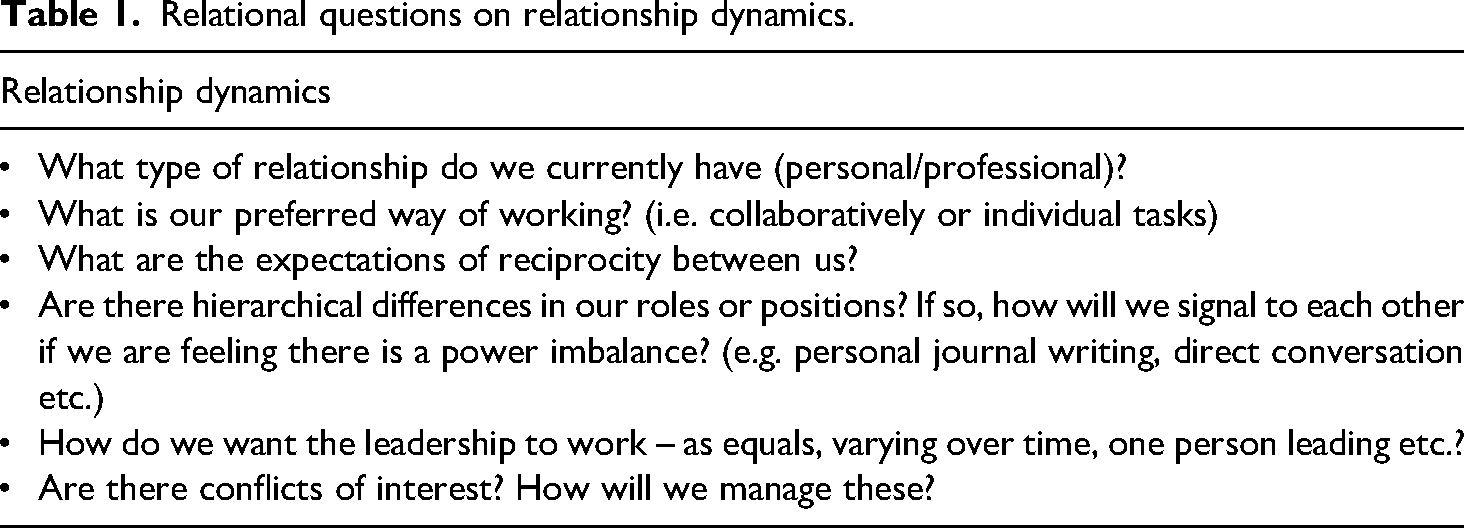
Reflecting on the questions in Table 1, we found that these questions became more nuanced over the course of the project as our situations changed. For example, when considering the concept of ‘reciprocity’ we initially had divergent conceptions of this word that became more apparent as we progressed. KH had internalised an academic-self and task-focused form of reciprocity to mean equal amounts of time spent on the project at approximately the same time. She felt frustration due to the inner conflict between the timeline pressure for academic publishing (activating the academic self) and commitment to the relationship with a dear friend (activating the emotional self). In contrast, for AH while achieving the tasks was important she had chosen to prioritise the development of the personal relationship. As the project went on, KH realised her internalised task-focused concept of reciprocity did not align enough with an ethics of care approach. She re-evaluated her blind spot by recognising the importance of ethics of care for AH, and for her own self-care to reduce stress from the pressure to publish.
Duoethnography projects can often take time as the depth of the relationship develops, enabling richer discussion and insights. There is often a misalignment between the time it takes to complete academic publication tasks and the investment it takes to form relationships, which can cause tension in projects. Reciprocity is fundamental to a duoethnography process so it is important that researchers have early discussions around their initial conceptions and revisit them throughout the project.
Commitment – person, process and outcome
Researchers need to be open about discussing the level of commitment they have for the project. We recommend discussing initial expectations for the project, which includes time expectations, workload and how to deal with unexpected life events. While this seems obvious, it is where projects are vulnerable to failure and the personal nature of this work means that without a shared commitment the project is likely to falter. We recommend these being revisited as the project and relationships evolve, particularly if there are differences in what was envisioned and what occurred in practice. The questions in Table 2 explore expectations around time and the outcomes of the project, personally and professionally.
Relational questions on commitment.
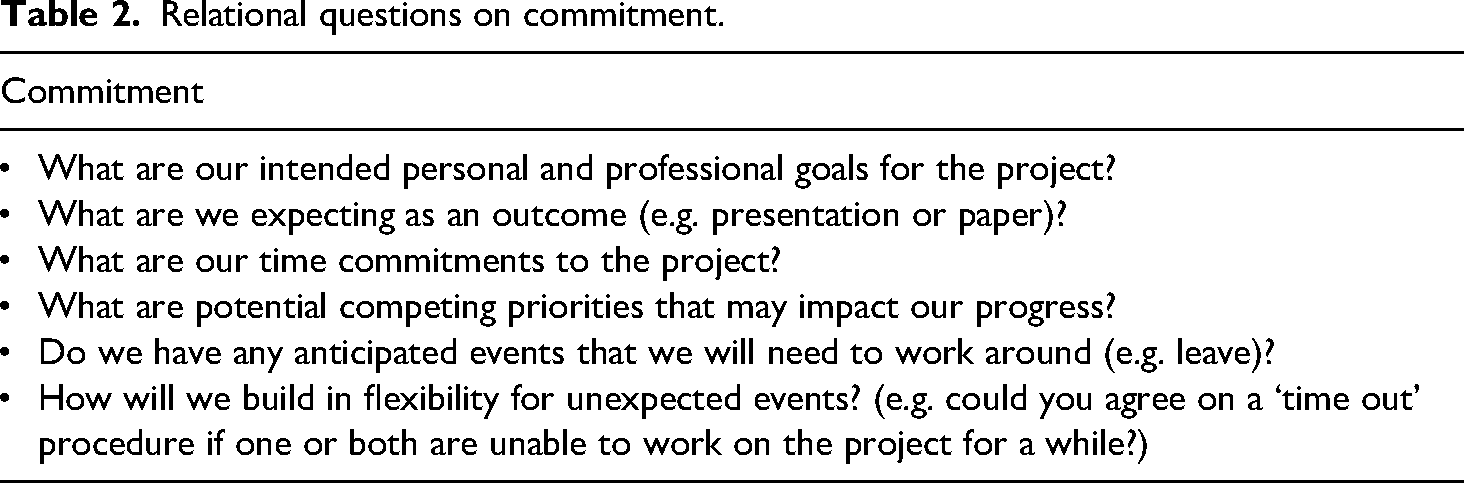
We think these questions are important because we personally struggled with having different work priorities and this impacted on us working at different paces. For example, AH recognised that her initial ‘time commitment’ was aspirational. In reality, she had competing priorities, such as managing a team, so it was challenging to work on the project at the same time as KH. In reflecting on this and other projects we have been involved in we realised that it is not uncommon to be energised and aspirational about commitments at the beginning of a project. In reality this energy can wane as competing priorities demand your time. Identifying what the competing and higher priorities are at the beginning may help to clarify the overall commitment to the project and to each other. In duoethnography it is important to have time working together as it is the compassionate reflection of each other's perspective that is crucial for understanding. Commitment to the duoethnographic process is not like other articles with a ‘leader’, usually as first author, who drives it from the beginning and has the most responsibility. In duoethnography, researchers have to be constantly checking in with each other as equal ‘first authors’ and connected colleagues.
Understanding our feelings and vulnerabilities
A dialogue with another person that can facilitate critical consciousness requires honesty and transparency. However, trust takes time to develop and maintain, and honesty and critical thought may be experienced as confronting (Hayler and Williams, 2020). Participants may experience ‘feelings of ugliness’ (Docherty-Skippen and Beattie, 2018: 79) such as shame, anger or fear in the space where they release their current self-beliefs to re-examine their stories and face uncertain futures. This requires a degree of self-awareness and openness to changing one's mind. McGinn et al. (2005) argue in research collaborations for a space of belonging where members are welcomed and accepted. A sense of belonging is integral to developing the intimacy this type of research requires. The questions in Table 3 may help researchers identify how they will manage vulnerabilities when they emerge in their projects.
Relational questions on vulnerabilities.
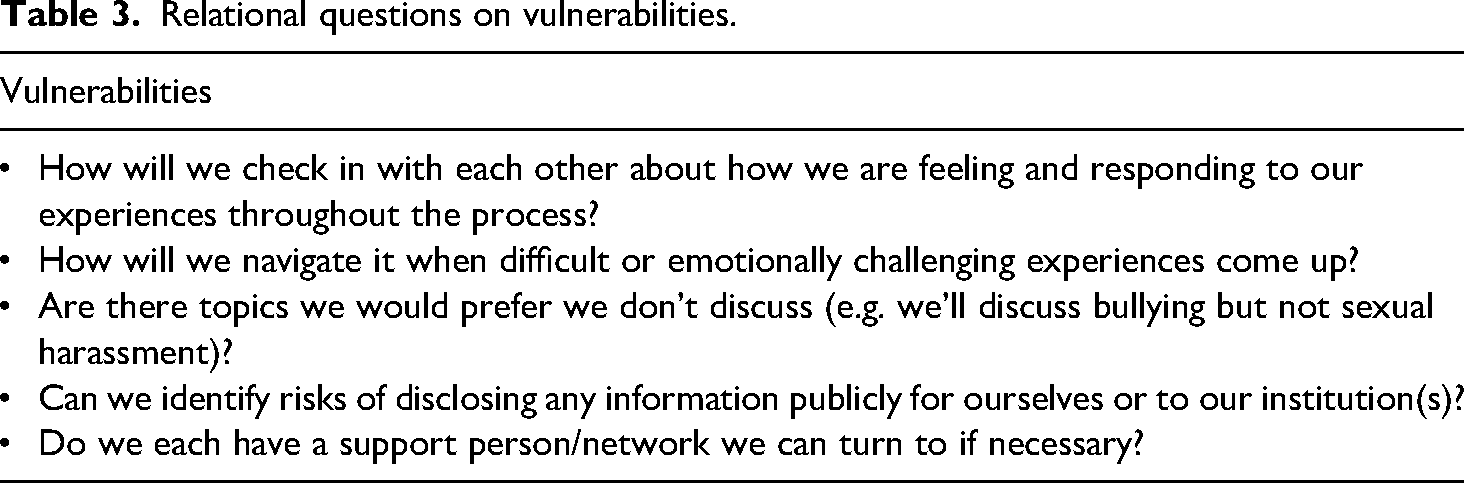
When we started duoethnography we thought we knew what we were getting into, but we did not fully appreciate the emotional commitment that would be required. We found that in addition to our thoughts on issues, it was important to have an awareness of how we are feeling throughout the process. When working so closely with deeply held experiences, these types of conversations can be challenging and hard. We found ourselves asking ‘how are you feeling about that?’ and the necessity for the other to listen as the project progressed. AH initially found it challenging reflecting on her experience in a more personal and less academic way and was uncomfortable with identifying how she was feeling throughout the process. In these types of projects, it may be easier for some people to reveal their feelings than it is for others (Farquhar and Fitzpatrick, 2016). For example, KH found that although initially she had wanted to deal with any emotionally difficult experiences as they occurred, in reality she found she could only reveal them later in the project as a greater level of safety had been built in the relationship. There is an incredible amount of vulnerability and personal insight required, which can be emotionally challenging, with researchers sharing more courageously at different times. As Ellis (2007) stated, mild discomfort can be a cue to probe further, but it is important to protect the other from distress or harm. We achieved this by giving each other the space to move apart and self-reflect before coming back together and sharing our insights.
While there is a desire to be authentic in duoethnography, the reality is that we may not be completely open as we fear others will be hurt by what we reveal in publication. Researchers can opt for non-disclosure as a form of protection. We advocate for being as honest as possible in the exploration phase when sharing insights with a duoethnographic partner. When it comes time to publish, there may be text each person wants to omit or alter. For example, AH was reluctant to include information about her criticisms of our institution's ethics committee panel because she was afraid of retaliation in future research projects. Unlike traditional research projects where the participants are anonymous, the authors in these studies are clearly identifiable. Once it is written in print, deeply personal narratives can easily be identifiable and open for critique. For example, one author was concerned about text the other had written because it appeared overly self-critical, which led to a discussion on how they would feel once it was written in print and resulted in an agreement on its omission. The challenge lies in sharing authentically while ensuring duoethnographers appropriately protect one another.
Confidentiality and Consent
For a duoethnography dialogue process to work effectively there needs to be considerations of the confidentiality of information and consent between participants. An understanding that what is shared between the researchers will be kept private is important for building and maintaining trust. Consent, like in other interpersonal relationships, must be given before revelations are shared with others. This is especially true at the publishing stage. If there are difficult topics being discussed, a way that collaborators can protect themselves is that instead of giving a detailed account of the exchange, it can be summarised into a more general sentence, enabling the person to be kept anonymous. Sensitivity is also needed because self-revelations inevitably involve relations with others (Norris and Sawyer, 2017). There needs to be an understanding of how the researchers will manage information on incidental participants. Farquhar and Fitzpatrick (2016) blacked out text that referred to other people or which they considered too revelatory. Consent needs to also extend to understanding what happens if a person is no longer able to continue. Can the project be completed, or is there agreement that both must be actively involved for it to be finished? The questions in Table 4 will enable researchers to agree on how they will manage confidentiality and any issues that come up around consent.
Relational questions on confidentiality and consent.
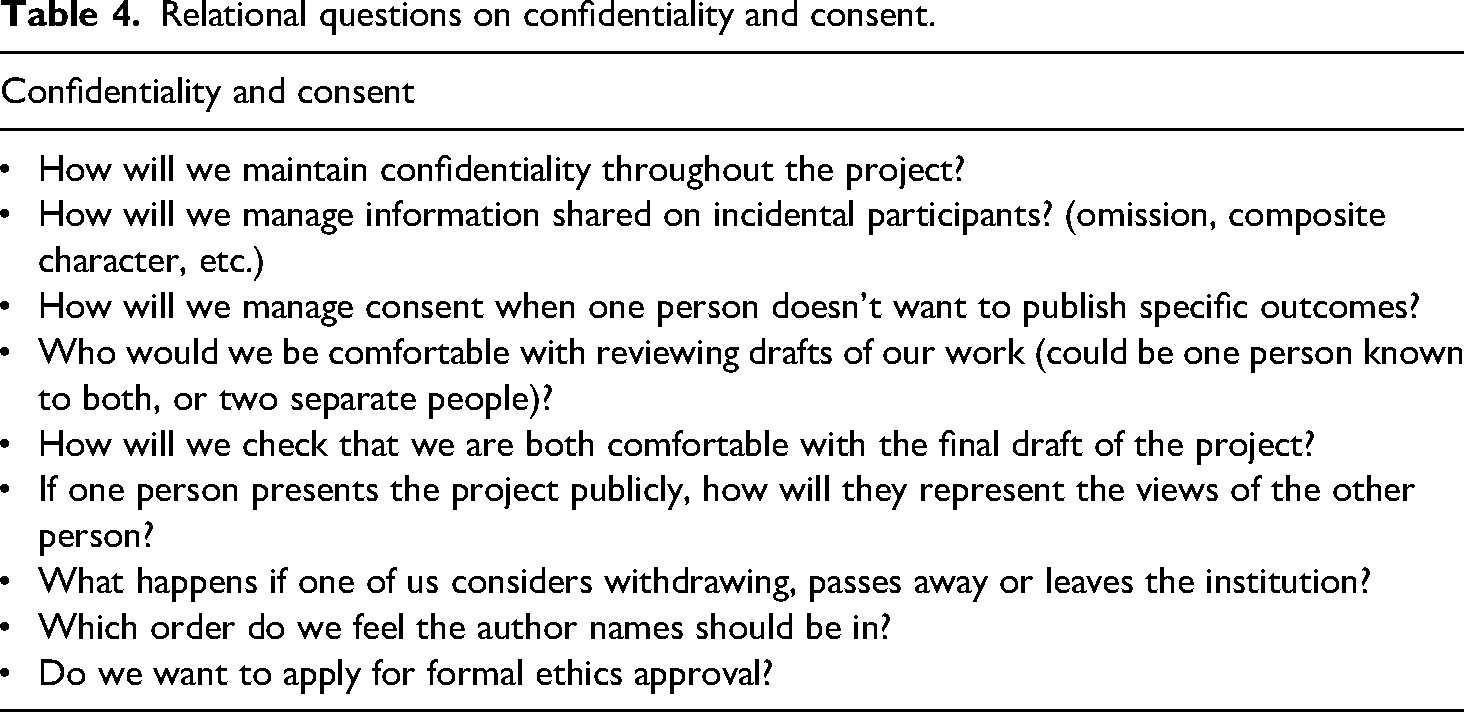
One of the things we found helpful in this project is that we specifically checked in with each other about what we would be comfortable sharing with a third party (e.g. colleagues or friends). We agreed when talking with others about it we could share our own perspective but not the other person's experiences. This level of consent helps to build trust between duoethnographers. We also protected incidental participants by omitting any text identifying specific others. This keeps the focus on our reflections and reduced the risk of readers misconstruing intentions or actions of others.
Given the shared nature of this research, the order of the authors in publication also needs to be considered. Academic conventions require positioning one author before another. We contributed equally to this project and leadership changed back and forth according to our capacity to work on the project. In these types of projects, having to choose an order of publication can be challenging as it does not fit the nature of duoethnography. While it is important to discuss these issues at the beginning of the project, we also found consent to be an ongoing process that requires the researchers to be checking in with the other person throughout the project.
Working with differences
It is important at the beginning of a project to consider how to work together to navigate differences of opinions and perspectives, whilst supporting a sense of collective agency (Lapadat, 2017). This research is polyvocal, so the purpose is not to seek a singular truth (Norris and Sawyer, 2012). Understanding the intersectionality (i.e. gender, class, rank, linguistic competence, race, and culture) that researchers identify with is a key starting point (Koonce and Lewis, 2020) in which people make personal meaning across multiple dimensions of identity (Patrón and Burmicky, 2023), with some identities privileged and others seen as deficit and subject to oppression (Fox and Sangha, 2022). When there are different views on an issue, there needs to be a willingness to understand and respect both positions. Researchers must also ensure that their partners are not inadvertently biasing the dialogue (Lawrence and Lowe, 2020). Conflict in this context can be a positive outcome as it provides rich and original insights. It is the space in between that provides insight and understanding so differences of opinion is a necessary and integral part of this approach. Table 5 outlines questions that will support the researchers to explore how they will account for and manage their differences.
Relational questions on working with differences.
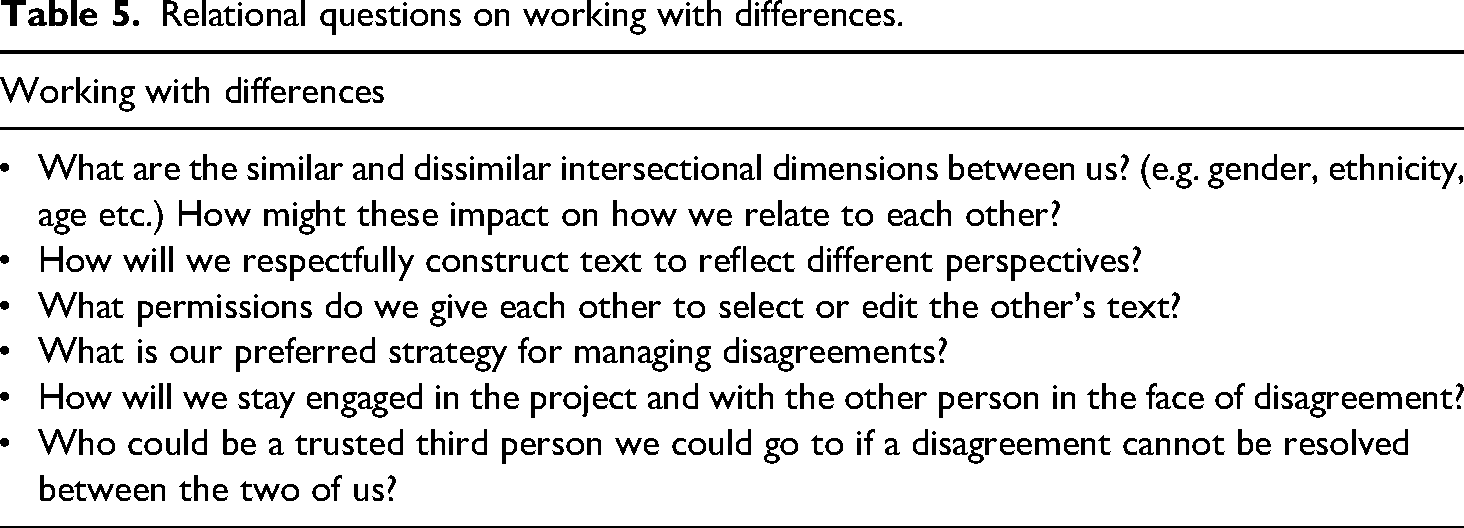
Given that disagreements are inevitable, it is helpful to begin with awareness of each other's intersectionality and use this to guide some initial agreement for how these could be raised and negotiated. As with the questions presented in the previous tables, our guiding questions here served our initial discussions and became more nuanced as the project progressed. Starting out, our identities as European females meant we were not confronted by obvious cultural and gendered differences between us, yet whispers of these dimensions did influence us. Our more obvious differences were the dimension of our academic disciplines that sensitised us to different aspects of the project as well as our personal backgrounds. For example, we started out with considering a trusted third person to resolve disagreements. In reality, this became unnecessary as the nature of this work and continued commitment to the process meant that we could resolve our own issues. On reflection, a referee could be perceived as a Euro-centric approach to resolving conflict by handing over judgement to an external party. We also found that initially when we were ‘respectfully constructing text’, we tended to discuss with each other and then write separately. As we progressed, we ended up writing and rewriting together in the same ‘room’ (physical and digital), collaboratively co-creating the insights. The conversation was a continual revisiting and recalibration of our perspectives and boundaries. The space between us got closer, literally and figuratively, and it felt like a more supportive and co-created outcome. There was an energy and intent about it that was both challenging and enjoyable as we unpacked our understandings in the moment.
Discussion
This research project was borne from our frustrations with a formal ethics process that primarily considers an ethics of justice perspective with a focus on rules and requirements. This aligns with previous researchers who have argued that the focus of ethics committees lacks understanding of the needs of social researchers (Israel and Hay, 2006; Jeffrey, 2020) and indigenous scholars (West-McGruer, 2020). The lack of trust in social research by ethics committees’ contrasts with the evidence that this type of research is often reported as being conducted to the highest ethical standards (Hammersley, 2009). Battin et al. (2014) question if the risk perceived by the committees is genuinely ethical risk or more specifically the mitigation of legal risk for the institution, which can lead to misuse or abuse of power by institutions towards researcher's undertaking critical research in the social sciences. Despite ethical processes aiming to limit harm, it has been argued that they can be unethical when committees act as gatekeepers who seek to limit, control, censor or prevent particular types of research from being conducted (Jeffrey, 2020; Scott, 2008).
We encourage researchers to go beyond the requirements of an ethics of justice perspective and incorporate an ethics of care approach, with a focus on care and compassion for the other. As Gilligan (1993) first defined, a morality of care requires a sensitivity to the needs of others. Care is situational and considers the more human side of interactions that can be subjective and changeable (Held, 2006). The concept of care is ideologically and politically informed and requires from the researchers an authentic respect that can be equalising, even when inequities exist (Bartolomé, 2008). We suggest that in duoethnographies an ethics of care is vital to enabling insight and generating trust between researchers to undertake the deep transformational work that challenges structural norms.
In undertaking a care approach, researchers embody emotional reflexivity and reciprocity throughout their projects (Bussu et al., 2021). As Olson (2021) stated, there is a relational shift needed from an adversarial one focused on autonomy to a mutually caring approach that appreciates the attunement between people. Given the relational nature of duoethnography, we believe this approach has the potential to address the current shortcomings of a traditional ethics approval process. This aligns with Kuntz's (2021) description of increasingly emerging approaches to post-qualitative research inquiry which moves away from predetermined practices and opens new ways of being and becoming during the research practice.
The relational ethics process that is involved in undertaking duoethnographic research is complex and continually changing. Thus, we do not prescribe set ethical practices based on our experiences. Respectful conflict in this context can be a positive outcome. We did not perceive or experience ethics as a singular moment in time. We experienced it as the space between us that was constantly evolving, in which we were able to move, sometimes in agreement and sometimes in conflict. It required us to constantly check back with each other and our initial guideline was consistently adapted as our project developed. Our aim is not to replace formal ethical bureaucracy with another form of normative assumptions and procedures. In alignment with Badiou's (2002) concept of an ethic of truths, we offer our guide in openness to others and their placement in their communities. We recognise there are inherent cultural considerations in the guide that come from our research. Our guide was constructed from the experiences of two Caucasian females in a Western culture. Intersectional dimensions will uniquely influence each duoethnographic pair (Koonce and Lewis, 2020). For example, duoethnographic research still prioritises the individual consent of the two participants and their ownership of knowledge they share. This and other ethical considerations come from a Western tradition and may not be suitable for participants from other cultures that value collective autonomy rather than individual autonomy in sharing collective knowledge (West-McGruer, 2020).
Reflecting on the main impact of this duoethnography, we each took away something different and treasured. KH became aware of her valuing, but unquestioning, adherence to ethical processes from her social sciences background and her internalisation of the task as priority. This duoethnography enabled her to rework a new perspective which blends her valued traditional ethical principles while expanding them into a situated ethics of care for AH and herself. This resulted in the development of a friendship that enabled her space to examine her own values and reactions of ethics of care in duoethnography in an ‘at home’ setting in academia. She continues to reflect on and critique her concepts of ethics formed by a Eurocentric context. For AH, she had initially struggled with expressing her feelings in a research context, it felt fundamentally ‘unacademic’ and she was surprised by how vulnerable she felt expressing her deeper felt emotions in print. She came to recognise the power of expressing her struggles, and the frustrations that can come from being an academic who feels small in the face of institutional power. Over the course of this research, she recognised there is bravery in researchers who take an ethics of care approach, willing to move beyond the confines of regulatory rules and acknowledging the power of relational collaboration. Duoethnographies can result in authors coming to an agreement in the reworking of their experiences, or letting their conceptualisations remain divergent, sitting side by side. We came to many points of agreement while simultaneously holding space for flux and development along the way.
We suggest the influences of patriarchy might also be considered as part of the discussion, especially when considering relationship dynamics and working with differences. Gilligan and Snider (2018) stated that patriarchal culture continues to value masculine characteristics over feminine ones. They believe humans need both a sense of self and connection in relationships, but patriarchy robs men of their sense of relationships and women their sense of self. As people often internalise patriarchal values and view their world from this perspective, we ‘can unconsciously absorb and reify a framework that we consciously and actively oppose’ (p. 9). In a qualitative study of early-career academics, Aprile et al. (2020) found the ongoing tensions of managerial and output-focused demands foreground academics as producers of knowledge rather than who they were as people, privileging outputs over interests that align with their passions and a sense of meaningful impact. Breaking free of patriarchal restrictions requires a conscious effort. Duoethnographies can be fraught with tension between one's productive academic self and one's relationship with the other person. KH had initially focused more on the task side of the project while AH had prioritised the relational side. As we found, this caused tension in our relationship, and only by conscious focus, we came to identify and articulate the impact of patriarchy on our experiences. This was a key driver for us seeking to understand the role that an ethics of care approach had on us as female academics.
Our guide overlaps with traditional research ethics and may apply in many situations within various forms of ethnography. While we only focus on duoethnography rather than the larger numbers engaging in collaborative autoethnography – further research could explore the ways in which our guide could be modified to include more participants collaborating in dialogical co-constructions of experience. Collaborative autoethnographies of three or more people would bring in further issues of relational dynamics that are not present with only two people. For example, the continuation of the project in the event of one person withdrawing, the social dynamics if one person feels left out, or as Lapadat (2017) pointed out, the increased complexity of negotiating expectations and processes in larger groups of people.
To conclude, duoethnographers interact, reflect and reconceptualise their experiences to enable personal and social transformation. To undertake this deep inner work requires a relationship built on trust and equality. Subsequently, we argue that ethical considerations need to extend beyond traditional ethics processes to include an ethics of care framework. We offer this guide to assist other researchers on this journey, both as a starting point of the conversation and to support a situational and ongoing ethical relationship. Ultimately, the space between each pair of duoethnographers is a constantly evolving relationship of care in context. We encourage those bold enough to engage with this space to be aware of the ethical considerations and choose knowingly and appropriately from the widening scope of formal and situated processes.
Footnotes
Funding
The authors received no financial support for the research, authorship, and/or publication of this article.
