



Abstract
Social media is of growing interest as a platform for post-COVID research, providing ungated platforms for minority groups and activists that may struggle to have their messages and voices heard in other media. In First Nations communities around Australia there is a higher-than-average uptake of social media platforms, particularly Facebook. Based on a qualitative research project with a First Nations group in Southeast Queensland targeting knowledges, experiences and perspectives to decolonise disability and caring knowledges this case study explores the use of social media, specifically Facebook, as a platform for virtual yarning focusing on the experiences of First Nations peoples with disability. The study acknowledges the limitations and challenges associated with social media platforms, such as the potential for over-sharing, privacy concerns and the risk of bullying. It emphasises the need for researchers, especially those considered outsiders, to carefully consider the ethical implications and potential exposure to lateral violence. The research highlights the advantages of virtual yarning on Facebook, including increased access to culture and belonging, reduced participant burden and cost-effectiveness. It recognises the value of multimedia platforms in promoting culturally appropriate and accessible communication, particularly for communities with diverse literacy levels. However, the study acknowledges the trade-off between breadth and depth of data quality inherent in social media research and recommends virtual yarning as a supplementary method alongside focus groups and yarning interviews or as a platform to recruit participants for research. Ethical considerations are crucial in this context, particularly regarding privacy, data sovereignty and intellectual property.
Keywords
Indigenous scholars commonly describe Indigenist research as a political act of resistance globally performed and informed by First Nations peoples. Such research prioritises the voices of First Nations peoples whose sciences and conceptualisations of knowledge have historically been marginalised or ignored in western research (Cram et al., 2016; Kovach, 2009; Rigney, 1999; Smith, 1999). Indigenist research is often positioned as anti-colonial because of its focus on (re)establishing political integrity, (re)creating change, (re)empowerment and resistance. It must also however, privilege First Nations voices and ways of knowing, being and doing, and be flexible, critical, portable and user friendly (Rigney, 1999; Smith, 1999). While these broad stroke descriptions are useful, researchers working in this context will rightly ask, what does this look like in context? This paper examines one approach that exemplifies some of these key characteristics, in particular giving agency to the Indigenous voice: virtual yarning.
What ‘is’ Indigenist research?
Indigenist research aims to amplify Indigenous voices in decision-making processes throughout research by giving power and priority to the stories shared by First Nations peoples on both the individual, community and Nation group level (Atkinson, 2008; Nakata, 2007; Rigney, 1999). This is extended to all stages of research from the crafting of research questions to the dissemination of results by prioritising Indigenous identified research needs and methodology to ensure research is accurate, ethical and brings a benefit to the community (Atkinson, 2008; Chilisa, 2012; Mackay, 2017; Nakata, 2007; Rigney, 1999). Above all, this research is relational in nature; it requires participation in relationships as all knowledge emerges through relationships and everything is interconnected (Capuder, 2013; Kwaymullina et al., 2013; Martin, 2003).
Indigenist research frameworks also recognise that reality and research is diverse: it therefore not just foregrounds Indigenist ontology, but also welcomes the development of new methodologies and methods. It is an essential part of decolonising research, and widely accepted that the worldview of the researcher shapes the subject, concepts and limits for any research project. Indigenist research is a form of resistance to centuries of colonial domination and is part of a much broader political, economic, cultural and spiritual project of Indigenous resurgence (Coburn, 2013; Moreton-Robinson, 2003). This method acknowledges the history and trauma of First Nations peoples and communities in Australia, particularly within research contexts, which justified attempted physical, cultural and spiritual genocide. The exclusion of diverse epistemologies and ontologies in the research sector has severely impacted on non-white people around the world (Cram et al., 2016). It is argued (Cram et al., 2016; Ormond et al., 2006) that this type of research has played a role in colonisation globally, validating warfare and discriminatory legislation. It also focuses on the survival and resistance against racist oppression by uncovering and protesting continuing forms of oppression (Rigney, 1997).
Indigenist research has no specific guidelines, it is a process that is informed by key qualities (Kovach, 2009; Moreton-Robinson and Walter, 2009). These qualities include a holistic view of research embracing reciprocity, the honouring of oral knowledge traditions, a responsibility to protect and give back to the involved Nation group, the use of cultural ways to gain and understand knowledge, and an overall understanding of the ongoing impact of colonisation on the researcher, participants and university (Kovach, 2009). It is important to note that there is a shift within research to (re)discover and (re)centre Indigenous knowledges to address impacts of contemporary issues such as climate change (Howitt, 2020).
Background to virtual yarning
Yarning is a traditional means of transmitting knowledge that has also been used for decolonising practice, including in research (Christensen, 2022; Hughes and Barlo, 2021). Virtual yarning as a formal research approach has only been introduced recently into the scholarly literature (Carlson and Frazer, 2018; Christensen, 2022; Cooms, 2022). The term has emerged in Indigenist research to describe using the approach of yarning in the context of where Indigenous voices are increasingly gathering: online (Carlson and Frazer, 2015; Cooms, 2022). Yarning is defined as an informal, relaxed encounter at which the researcher is placed inside the discussion, rather than taking a position of power in the research gathering stage. Yarning has been described as a means to maintain cultural integrity in collecting Indigenous worldviews as it foregrounds the building of relationships (Bessarab and Ng’Andu, 2010; Carlson and Frazer, 2018; Lewis et al., 2017).
There are a number of social media platforms that facilitate interaction within a safe, enclosed, peer-to-peer space that could potentially be used to gather data in this manner, including Facebook, YouTube, Twitter, Instagram, Tik Tok and LinkedIn. Each platform lends itself to different types of research that carries its own risks and benefits. This paper specifically presents the case of Facebook for yarning in a qualitative research project. The Facebook platform and associated privacy settings has the flexibility and capacity to accommodate the principles of Indigenist research. This includes creating virtual safe spaces that privilege and prioritises First Nations voices, experiences and ways of knowing, being and doing and centring relationality (Carlson and Frazer, 2015; Christensen 2022; Kwaymullina et al., 2013; Martin 2003; Rigney, 1999; Smith, 1999). First Nations peoples in Australia have been described as early adopters of technology, embracing social media with some research suggests that the rate of usage could be as much as 20% higher than the national average (Carlson et al., 2015; Carlson and Frazer, 2018; Walker et al., 2019). Social media in general has been likened to online community yarning circles (Carlson et al., 2015; Carlson and Frazer, 2018; Walker et al., 2019) with a number of researchers (see Kariippanon and Gurruwiwi, 2020; Rice et al., 2016) suggesting that social media as a multimedia platform is compatible for oral communication. The literature is unclear if usage is consistent across all social media platforms or what influences individuals’ engagement and online behaviour. However, researchers (Carlson and Frazer, 2018; Kariippanon and Gurruwiwi, 2020) argue that in contrast to the gating mechanisms associated with conventional media, social media allows the culturally appropriate expression of traditional practices such as art and dance to be shared via these multimedia platforms that have low barriers to distribution and access.
Benefits
Research benefits
Social media promises a range of benefits for researchers, for example, in the health sector researchers argue that social media is useful but it is not a standalone solution to research obstacles (Walsh et al., 2021). In the field of wildlife conservation social media is recognised as a powerful tool for raising awareness and mobilising action, however researchers warn of the importance of managing online misconduct and guidance for action (Bergman et al., 2022). Social media for First Nations peoples offers an avenue for the revitalisation and continuation of language and culture, music, education, activism, increased access to employment opportunities, maintaining kinship connections, accessing social supports, accessing formal and informal help, self and community empowerment as well as increased opportunities to counter negative narratives (Carlson and Dreher, 2018; Kariippanon and Senior, 2017; Rice et al., 2016; Walker et al., 2019).
The benefits of social media are only beginning to be explored in the research sector. Smith et al. (2021) argue that Facebook can provide an authentic and non-invasive avenue for qualitative research in hard to reach and marginalised populations. They suggest that using social media for research significantly reduces participant research burden and is a time-efficient and cost-effective research tool. While the potential benefits of social media for First Nations peoples and researchers are apparent, it is important that more research is conducted to improve our understanding of online behaviours (Walker et al., 2019). Effectively, if handled correctly, social media offers understanding and data to emerge as a secondary process to community and individual benefits (see following section).
Community and individual benefits
The literature is replete with examples of how historically marginalised groups are using social media, for communication, not research. Equally, social media may be a neutral non-sentient entity, but its users have agency to use and abuse. For example, Carlson and Frazer (2015) suggest that social media is changing what is and is not considered culturally acceptable. This can be positive: they describe social media as an ‘online cultural interface’ where members can explore understandings, values and performances of respect. Within this online interface there is the potential to challenge stereotypes of First Nations peoples as anti-technology and create new narratives and cultural expectations that reflect this fluid and dynamic culture.
The high rate of social media engagement for First Nations peoples in Australia is a trend that is reflected amongst other First Nations groups globally (Carlson and Frazer, 2015). For example, Māori peoples are reportedly using social media to engage in cultural and political practices, as are First Nations communities in Canada and the Sioux people of North Dakota (Carlson and Frazer, 2015). Wilson et al. (2017) report the grassroots utilisation of social media for cultural and political practices across the globe. For example, Velasquez and Montgomery (2020) report Latin Americans are using social media for cultural and political purposes. McMillen and Alter (2017) advise that people with disabilities are also using social media to engage in events and political discussions and access services and supports that would otherwise be difficult to access. Miller (2017) reports a similar trend in their research with participants from the Queer community who have a disability. Each of these groups can harvest unique benefits and be exposed to unique risks when engaging with social media, and more research is needed to explore this field to ensure that risks are minimised, and benefits are capitalised on.
From a community and individual perspective, the low cost of entry means that social media cuts across restrictions related to class, but, in practice, there is little evidence that social media has opened up public discourse from a class perspective (Yates and Lockley, 2018), with e-literacy continuing to be associated (although not highly correlated) with privilege.
Carlson and Frazer (2015) additionally argue that social media provides First Nations peoples in Australia with an effective platform to assert sovereignty and cultural vitality. It allows avenues to challenge colonial power relations, as well as form political collectives and organise political action. This argument is supported by Petray (2013) who posits that social media has been used to challenge negative narratives that continue to marginalise and undermine First Nations peoples. An example of this was discussed by Carlson et al. (2017) who tracked a Twitter hashtag trend #IndigenousDads. This hashtag was developed in response to a colonial narrative that portrayed First Nations men as abusive fathers. The campaign involved sharing images of First Nations fathers along with messages of love and pride. This campaign was successful in challenging the harmful colonial narrative while fostering pride and agency for First Nations peoples in Australia (Pearson, 2016). Researchers (Carlson and Frazer, 2018; Hefler et al., 2019; Petray, 2013) suggest that social media is also being used by First Nations peoples to directly resist colonisation by engaging in online activism countering racism and negative stereotypes. The success of this online activism is acknowledged by Fredericks et al. (2021) who write about the use of social media to disrupt the colonial algorithm in Australia. Lumby (2010) coined the term ‘cyber-Indigeneity’ to describe the forms of self/community/cultural-expressions that occur online that may not be available offline.
Social media appears to offer the opportunity to engage, maintain, expand and transform cultural practices, inclusive of individuals with poor literacy and numeracy (Carlson, 2013; Carlson and Frazer, 2015). This includes networking and maintaining connections; sharing cultural practices and expectations; seeking and offering support (e.g. engaging in sorry business and sharing grief with family and extended social network); participating in politics and activism; and exploring identity (Carlson and Frazer, 2015, 2018; Hefler et al., 2019).
There are many collectives, also described as online yarning circles, on social media that have diverse approaches, however they are all working towards opposing the impact of colonisation and increasing relationality (Carlson and Frazer, 2018; Fredericks et al., 2021). Yarning is a tool that can be used in the decolonisation process as it embraces First Nations relational ways of knowing, being and doing (Besserab and Ng’andu, 2010). These online yarning groups allow First Nations peoples across Australia to share stories, increase relationality, exchange knowledge, reinforce cultural identity, challenge stereotypes and express values and perspectives (Carlson and Frazer, 2018; Kariippanon and Gurruwiwi, 2020).
Some researchers (Carlson et al., 2020; Rice et al., 2016) suggest that social media has more focused benefits as well. For example it may offer the potential to improve health and address social disadvantage, as it can reach populations that are typically described as marginalised or inaccessible. This platform provides more opportunities to engage relationships with family, kin and community to gain social and emotional support outside of the dominant health paradigm (Carlson et al., 2020). Hefler et al. (2019) view Facebook as a supportive online environment effective in generating online and offline support. They posit that participants in their research reported positive experiences on Facebook reflected in collective support and reinforcement of Indigenous identity which did not reflect the real-world experiences of colonisation, discrimination and marginalisation reported by participants. Fredericks et al. (2021) state that social media, Facebook in particular, has privacy settings that allow for control over access to culturally sensitive information and identity protection which has facilitated the development of safe online communities.
Risks
There are well-recognised risks associated with social media for individuals, communities and indeed for research, and many of these risks are common to both Indigenous and non-Indigenous research. Social media increases exposure to misinformation, abuse, racism, bullying, trolling, homophobia, misogyny and threats of physical and sexual violence (Carlson et al., 2015; Carlson and Frazer, 2018; Carlson et al., 2020; Rice et al., 2016). The ethics around research using social media, particularly with First Nations peoples, has not been fully explored and this lack of ethical guidance is a risk for researchers and participants in this emerging field (Smith et al., 2021). The lack of ethical guidance and use of this platform as a sole approach to data gathering has raised questions around generalisability and validity (Bergman et al., 2022; Morant et al., 2021; Walsh et al., 2021).
Leighton et al. (2021) warn of being unable to determine sampling error and make generalisations based on data gathered on social media platforms. They suggest that sampling bias is a real risk for qualitative research on social media platforms particularly as it begins with a limited representation of the population. This approach prioritises the voices of individuals who are frequent users compared to those who are infrequent users and fails entirely to capture the voices of people who have no access to the internet (almost half of the world’s population) (Leighton et al., 2021). Walsh et al., (2021) warn that using social media for qualitative research could be sacrificing depth for breadth, with social media serving to magnify inappropriate research design. Fredericks et al. (2021) identify three types of bias that are reinforced by social media and its personalised algorithms. This includes distortion bias where reality is distorted or fabricated, content bias where information is one-sided and decision-making bias which refers to the editorial choices of the individual presenting the information. Fredericks et al. (2021) have coined the term ‘colonial algorithms’ to explain the phenomenon of where social media algorithms and bias serve to reinforce colonial structures and hierarchies. They define algorithm as ‘…a set of rules, processes and instructions that are followed for a desired outcome’ (p. 159). Fredericks et al. (2021) argue that expressions of passive and explicit discrimination on social media reinforce these colonial algorithms which in turn reinforce white authority and deny or silence First Nations ways of knowing, being and doing. In addition to the algorithms that govern key social media performance characteristics, there is an underlying colonial infrastructure that sees data stored off Country.
The impact of social media is yet to be fully explored in First Nations communities across Australia and very little of this research has been conducted by First Nations scholars, with calls for any research into this area to embrace the principles of decolonisation (Carlson and Dreher, 2018; Walker et al., 2019). Fredericks et al. (2021) as well as Carlson and Frazer (2020) warn that social media can become merely another platform for First Nations peoples to be exposed to a colonial gaze. The colonial gaze is the objectification of First Nations people in research where we are treated as passive subjects (Smith, 1999).
Kariippanon and Gurruwiwi (2020) warn that the individualistic nature of social media and communication technologies can be at odds with the communal nature of First Nations societies, and this has the potential to create conflict for communities. Kariippanon and Senior (2017) discovered in research of social media and mobile phone usage in a remote Indigenous community that the consequences of cyber bullying contributed to youth suicide and caused other young people to feel socially and emotionally isolated. This risk was also observed by Carlson et al. (2020) who note that some social media users encourage pro-suicide behaviour. Other research (Carlson and Frazer, 2018; Hefler et al., 2019) has highlighted the risk of ‘lateral violence’ among Indigenous peoples, describing this as more damaging than experiences of direct racism. For First Nations peoples in Australia, engaging in online activism increases exposure to racist discourse and threats of violence are an unpleasant, harmful and isolating reality (Carlson and Frazer, 2018). Carlson et al. (2020) warn of the threat of misinformation in social media particularly around vaccines, diet and treatments for chronic illness and the impact this may have on First Nations peoples and communities. Finally, social media has known data security risks, with data stored and ‘owned’ by entities that have little or no Indigenous input (Neumayer et al., 2021).
Case study
This case study evolved almost by chance. During COVID-19 more conventional methods of qualitative data gathering such as interviews and focus groups became challenging, particularly with marginalised Indigenous communities. With the study focused on dis/ability, the research team decided to draw on a strength of the community – its uptake of social media – to overcome this issue of access. In-person yarning is a well-established tool for First Nations researchers (Bessarab and Ng’andu, 2010), however the use of social media to conduct yarning is a relatively novel method of data gathering. The approach was taken to place less burden on participants and reduce the risk of exposure to COVID-19 for this group of high risk participants (Thurber et al., 2021). The virtual yarning made possible by social media allowed the group to share the collective wisdoms around ways of knowing, being and doing in relation to disability and providing care. This Facebook group also provided a platform where members could increase relationality, share their skills, knowledge, assets and strengths in a culturally appropriate and familiar way with the wider group.
The Facebook group name chosen was drawn from the traditional language used by that nation group and developed in close consultation with Elders in Council. The group was geographically based around the group's tribal Country, inclusive of members living on and off that Country. Social media made it possible to include group members from diverse locations but centred around a collective belonging to a specific place, in this way connection to Country grounded the Facebook group membership. An Elder from this nation group was involved in the group as an administrator. Elders in Council are Nation members over the age of 55 who are respected by the community and are nominated by community and peers to represent their communities’ interests. They are responsible for maintenance and protection of Country, culture, knowledge and people. The data gathering on social media was part of a project that also drew on yarning interviews with Elders and autoethnography (Bessarab and Ng’andu, 2010; Whitinui, 2014). This is important to note as previous research (Carlson and Frazer, 2020; Fredericks et al., 2021; Leighton et al., 2021; Morant et al., 2021; Walsh et al., 2021) has highlighted the risk of using social media as the sole avenue to conduct qualitative research.
Working in the dis/ability space, the Facebook group was developed with more than just research objectives: apart from gathering data, it was explicitly created to share knowledges, skills and support amongst Nation group members whether they live on Country or not. While this was a non-intrusive method of conducting qualitative research, it was made clear to participants that this was (in addition to other things) research. It was an approach, however, that recognises the value of relationships and provides access to what is considered a ‘difficult to access’ population whilst prioritising connection to Country (Carlson and Dreher, 2018; Carlson and Frazer, 2018). In summary, engaging the principles of Indigenist research methods, and utilising Quandamooka ontology and intersectionality theory, the developed Facebook group created a safe online space to share and create knowledge that centred custodial priorities (Cooms, 2022; Martin and Mirraboopa, 2003).
Ethics
The project was given ethics approval from Central Queensland University. Initial approval was given to conduct interviews and focus groups, however the impact of closures and risk from COVID-19 meant the original approach became impossible. In this research project, the Facebook group was used to supplement the data already collected prior to COVID-19 restriction. The ethics application was modified to incorporate the use of Facebook as a platform to conduct yarning with the Nations group in question. This required a letter of support from the Elders in council as well as their involvement in the administration of the group and an extensive review of the literature. During data gathering no ethical issues arose, no one was removed from the group, and no one withdrew their data or resigned. A pinned post at the top of the group informed members of the project, confidentiality, and ability to withdraw without consequence. Using a pinned post rather that an ethics ‘information sheet’ was familiar for members and a regular practice for group description and rules. At the conclusion of data gathering the Facebook group was handed back to the Nations group members for administration. To ensure the confidentiality and privacy of the project going forward all posts related to the research project were removed.
Recruitment and group membership
Recruitment in this research involved the researcher and the advocating Elder reaching out to existing kin connections to begin the yarn. Following this, the researcher encouraged virtual word of mouth, resulting in a recruitment approach reminiscent of the snowball sampling approach outlined by Leighton et al. (2021). This allows community and Nation group members to vouch for the authenticity and trustworthiness of the researcher and project as well as validating the belonging and connection of invited participants. This recruitment and sampling practice prioritised connection to Country and acted to protect the group and knowledges to ensure accurate and appropriate research, aligning with principles of Indigenist research (Carlson and Frazer, 2018; Fredericks et al., 2021; Martin and Mirraboopa, 2003). This approach to recruitment facilitated the recruitment of 130 participants in 6 months with varying levels of engagement and minimised the burden of participation (Smith et al., 2021). The Facebook platform and associated settings not only ensured group privacy; it also facilitated the gathering of informed consent at three different stages.
Group membership was primarily determined by connection to Country and kin, facilitated in a number of ways:
Known kin invited by administrators; Invited members answer membership gating questions. Once accepted into the group members are then encouraged to invite their known kin contacts (word of mouth); Invited kin contacts required to answer the gating questions to gain access to the group.
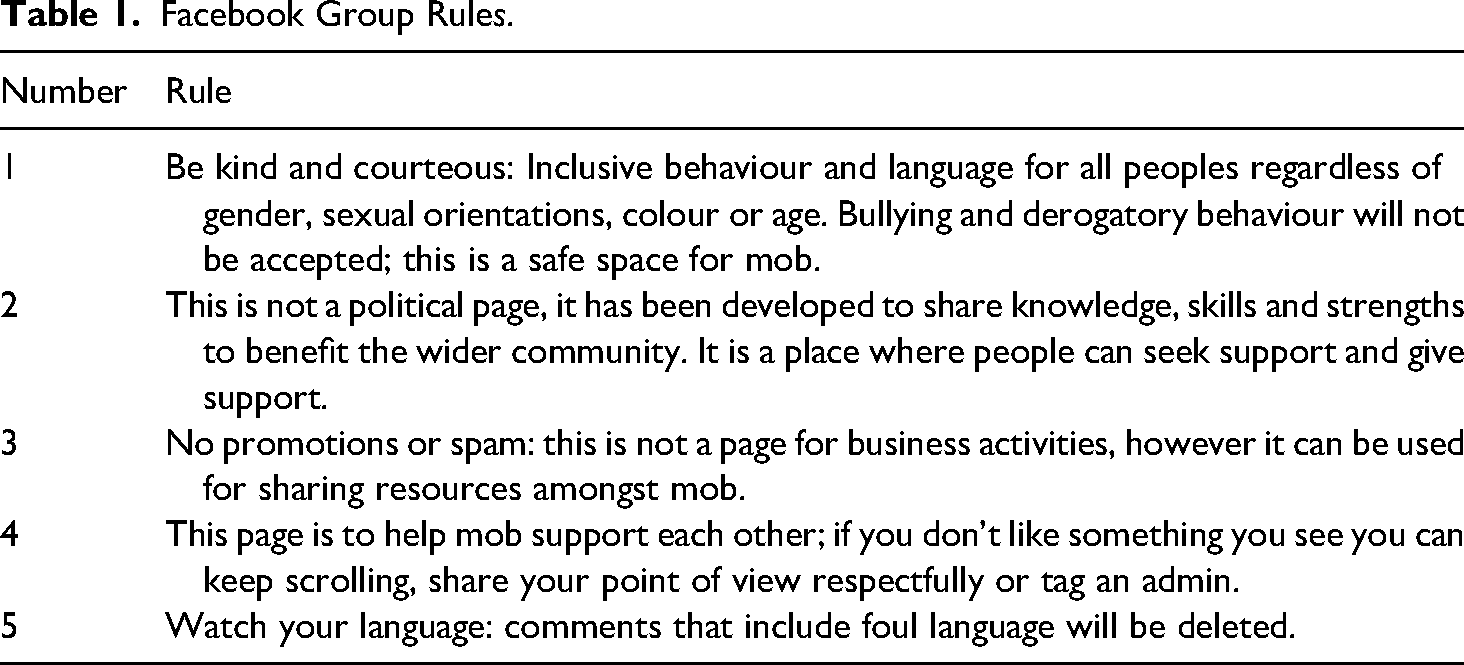
This practice ensured that membership was determined through connections to kin and Country with all members being vouched through known kin networks with administrators having the ultimate authority to accept membership. Table 1 presents the rules for this group.
Facebook Group Rules.
Facebook groups have a number of settings that allow administrators to moderate membership. This includes:
Who can join the group: The administrators set this to profiles only.
Who can approve member requests: The administrators set this to only admin and moderators. This means that other members can invite kin connections to the group who then must answer gating questions and be approved for membership by administrators.
Who is pre-approved to join: Administrators set this to nobody to ensure that all group members where subject to the gating questions and vouching process.
Membership gating questions:
Are you a member of the (Redacted) people? Will you follow the group rules? Do you agree to always be kind and supportive of other members?
Over a period of 6 months, the Facebook group gained around 130 members, with varying levels of engagement. The sample consisted of people ranging in age from their early 20s to late 50s with the majority of participants aged between 20 and 35 years of age.
Informed consent
Facebook group settings allow for a ‘pinned post’ at the top of the group which informs members of the group rules and purpose. A pinned post is the first thing a member will see when they visit the group, a group can have any number of pinned posts. In the current project there were two posts, one informing the group of the rules of conduct (see Table 1) and another informing members of the research project, confidentiality and ability to withdraw at any stage without consequence. This was written in the engaging, straightforward language of a Facebook post, rather than in the style of an ethics ‘information sheet’. Thus, informed consent at this stage had been handled in the ‘natural’ style of Facebook protocols, familiar to participants, rather than in the relatively formal style of a conventional research project.
The rules for the group were designed to ensure a respectful, safe and appropriate yarning space that minimises the potential for lateral violence or harm. These rules were based on those used by other Aboriginal and Torres Strait Islander Facebook groups that had high levels of membership. If a person has been found to break these rules, they will be given one warning and reminded of the rules. If that person continues to break the rules they will be removed from the group. Facebook privacy and group settings meant that the group could not be ‘discovered’ by members of the public thus minimising the impact of the colonial gaze. Additionally, group settings gave control to the administrators with posts to the group page needing to be approved by an administrator. It also gave the option to ‘mute’ participants whose comments may be inappropriate. The settings of Facebook and the associated messenger application facilitated the consent process which was given at three different stages:
At the top of the group page a pinned post outlined the project goals and ethical approval from the university's ethics committee as well as the limits of confidentiality and guidelines for withdrawal from the research. Individual posts to the group that were for research gathering were clearly labelled on the post ‘for research purposes’. Vignettes summarising participation on labelled posts sent via private message for review and approval.
Data quality
Previous researchers warn that social media brings breadth but not depth to qualitative research (Walsh et al., 2021) and this was observed within this project. The current study recruited 130 members, however, not all members engaged in the research project posts and some members only engaged in a broad and superficial way. It became increasingly clear throughout the data gathering that transparency and sharing on the part of the Elder and researcher were essential to opening dialogue on social media. Yarning is about building a relationship for conversation and in this study the researcher and Elder shared stories and pictures of personal experiences relating to the research topic as a way to start the conversations (Bargallie, 2020; Bessarab and Ng’andu, 2010). Facebook analytics provided feedback on when and what types of posts participants engaged best with which improved research efficiency and effectiveness (Waite and Wheeler, 2014). Drivas et al. (2022) report that social media platforms provide daily behavioural analytical data that can be used to improve users’ engagement. In their research social media platforms represented a cost-efficient tool that could expand visibility and awareness in marketing. They suggest that the use of Facebook analytics is essential for developing strategy and maximising performance. Facebook analytics includes information about days and times in which engagement was higher, in the current project analytics indicated that Thursdays after 12 but before 3pm were the peak engagement times. The reason for this is unclear and requires further investigation. It also indicated that the posts that lead to the greatest engagement were those that had a story and a picture included. Facebook analytics tracks the group quality, this tracks the number of times members and administrators breach Facebook community standards or administrators use Facebook tools to moderate group activity. In the current group no violations or moderations have occurred indicating good group quality. Waite and Wheeler (2014) state that while Facebook analytics can provide useful information, they warn against relying solely on this as a source of data as there are many communicative subtleties that are not measured by Facebook.
Virtual settings do not elicit the same data as in-person settings, and this is true of yarning as well. Voice-to-text increased during the pandemic but still remains very much a minority approach to posting (Javid et al., 2022), so communication for participants in a virtual yarning circle is naturally slowed, more deliberate and less extensive. The use of emojis is not equivalent to facial expressions and liking posts or comments while similar to agreeing does not build the depth of conversation that would occur in face-to-face contexts. The ‘publicness’ of this private yarning circle nevertheless was forbidding to some participants. Many participants would message the researcher privately on the associated messenger application but did not respond on posts publicly. The use of private messaging allowed the researcher and participants to engage in more in-depth yarning, but this is more of a bilateral form of communication than is generally the case in yarning. The aim however, was to make the individuals feel safe and comfortable in communicating. Using social media in this way required a more active effort on the part of the researcher (and indeed the participants who chose to do more than just read) to share relational connections as well as personal information and motivations to develop trust and transparency and this potentially added to participants being comfortable with private messaging. While the data gathered in a virtual circle was not as comprehensive as would be elicited from a ‘traditional’ yarning circle, the virtual circle still had the same characteristics of safety and positive sharing as an in-person yarning circle. The results additionally indicated that engagement from Elders is essential for data gathering in this manner to ensure researcher and community safety and conduct as well as effective and appropriate knowledge (re)generation. This approach has potential as it places less burden on participants for First Nations peoples in Australia (Smith et al., 2021). It was also observed that this Facebook group helped to build and, in some cases, re-establish kinship connections offline. To our knowledge, three members of the group have now established kin connections outside of social media with the researcher and the Elder that did not exist prior to this project suggesting that virtual yarning can act as a avenue for building relationships beyond social media. Additionally, virtual yarning allows for relational and cultural information and knowledge to be transmitted to people who find physically returning to Country difficult. This aligns with the principles of Indigenist research and decolonisation by centring relationality, amplifying and empowering First Nations voices and perspectives, it is flexible, user friendly and prioritises connection to Country (Kwaymullina et al., 2013; Martin and Mirraboopa, 2003; Rigney, 1999; Smith, 1999).
The yarn
Yarning was facilitated in this study by initially encouraging participants to share their connections to Country and through the researcher and Elder sharing a variety of posts that included images, stories and questions clearly labelled for research purposes. This could arguably be considered as the ‘pre-yarn’ and required story telling to set the stage for the research yarning (Barlo et al., 2020; Bessarab and Ng’Andu, 2010) Participants responded in three ways to create a ‘thread’: by replying directly on the initial post; commenting on others initial replies or by private messaging the researcher about the topic for a more private yarning of the topic. The researcher and other participants then had the opportunity to post further questions or comments on the thread or post a new thread to build on the discussion in the original post. Over the period of the project research posts were made on average once per week and encouraged users to share knowledges, experiences and perspectives of the research topic. These posts were available for all group members to read and engage with and no restrictions were placed on replies to posts. Facebook settings allow the group administrator to be notified of all activity on the group and this facilitated the researcher and Elder moderating comments to a ensure safe and engaged setting. Yarning was facilitated through back and forth sharing of positionality, knowledge, mutual experiences and perspectives related to the topic with participants and the researcher commenting on replies to deepen the conversation. The Elder involved shared cultural knowledge related to the various subjects and topics that were raised in the research posts furthering the yarning practice. The Elder regularly offered support to any participants and relationality was increased through group membership and encouragement to share experiences and knowledge of connection to Country and kin. The members who did not actively engage in the research posts were not questioned on their lack of participation. Silence is a normal part of First Nations yarning that gives space to people more directly experienced to participate while allowing others to contemplate and reflect on the subject, it can also indicate that they feel someone else is speaking for their perspective and they do not need to participate. It can also indicate disinterest or disapproval, however, this would generally be reflected by a disengagement on a larger scale (Geia, Hayes and Usher, 2013; Haig-Brown, 2010). Motivations, and barriers and the meaning of silence for engaging in this virtual practice need further investigation.
Discussion
This project emerged in 2020 as concern about the impact of COVID-19 on the Indigenous population began to spread. With the first author on a scholarship timeline, there was imperative to proceed with the research against the background of the pandemic. The choice of using Facebook to recreate a ‘yarning circle’ was pragmatic, and while not unique to this project, this case study offers an early insight into how the aspirations of a yarning circle play out in research.
The use of virtual yarning was well received by the Nation group members who participated in this research further suggesting that it could be an effective platform for Indigenous researchers working to decolonise knowledges and extend the capacity of yarning in research (Bessarab and Ng’andu, 2010; Kwaymullina et al., 2013; Smith, 1999). The use of social media for research allowed for the development of safe online spaces that promoted connection and belonging, important principles for Indigenist and decolonial research (Hefler et al., 2019; Martin and Mirraboopa, 2003; Rigney, 1999). The combination of Indigenist research principles and Facebook privacy settings acts to protect marginalised Nation group and community members as well as our collective knowledges from exploitation and the colonial gaze (Carlson and Frazer, 2020; Fredericks et al., 2021). Research conducted with First Nations peoples on social media that does not draw on principles of decolonisation and Indigenist research may pose a risk of exploitation or misinterpretation to First Nations ways of knowing, being and doing (Fredericks et al., 2021; Martin and Mirraboopa, 2003; Smith, 1999).
The potential for risk in research using social media is significant, either from non-Indigenous researchers unfamiliar with the Nation group or from lateral violence occurring within a social media setting. It is essential to ensure that any use of social media for research must be monitored carefully to reduce risk of misconduct, abuse, lateral violence, pro-suicide content, misinformation, racism, bullying and trolling, homophobia and threats of violence (Carlson et al., 2015; Carlson and Frazer, 2018; Carlson et al., 2020; Rice et al., 2016; Walsh et al., 2021). Facebook can give users the sense they are in a ‘safe’ enclosed community, when in fact they are unusually publicly exposed – even in a curated community such as the one described in this case. One strategy employed to minimise these risks was ensuring that no member can post onto the group without approval from administrators. There is also an identified risk that for projects such as this being conducted solely via social media may exclude some community and Nation group members who do not participate with these platforms and give priority to the voices of people who are frequent users of that platform (Leighton et al., 2021). Researchers relying solely on social media may develop a false sense of comprehensive data sampling and it is questionable if results can be generalised to the wider group (Leighton et al., 2021). Until further research is conducted regarding the saturation, demographics, usage and effectiveness of social media for data collection in First Nations groups, it is advised that social media yarning be used in conjunction with other approaches, as starting point for yarning research or as a platform for recruitment (Fredericks et al., 2021; Leighton et al., 2021; Walsh et al., 2021). This is to ensure that the information gathered is culturally appropriate and an accurate representation of the Nation groups perspectives, knowledges and experiences as prioritised in Indigenist research practices (Fredericks et al., 2021; Rigney, 1999; Smith, 1999).
The benefits apparent in this research project align with that identified in the literature (Carlson and Dreher, 2018; Kariippanon and Senior, 2017; Leighton et al., 2021; Rice et al., 2016; Walker et al., 2019; Walsh et al., 2021). This included cost effectiveness, access to a large audience, access to a hard-to-reach population during a pandemic, reinforcing kin networks, providing opportunity for both seeking and providing support, promoting pride in identity and promoting a sense of belonging and connection. The benefits identified in using social media as a platform for yarning also align with and provide opportunity to build on the priorities established in Indigenist research. Namely, there are benefits for building connection to Country and culture, relationality, belonging and avenues for support seeking without imposing a burden on members to participate (Martin, 2003; Moreton-Robinson and Walter, 2009; Rigney, 1999). The use of an appropriate ontology and Indigenist research methodologies centred around First Nations ways of knowing, being and doing in this research, social media was well suited to prioritising these principles and practices (Carlson and Frazer, 2018; Fredericks et al., 2021; Kariippanon and Gurruwiwi, 2020; Martin and Mirraboopa, 2003; Rigney, 1999; Smith, 1999). This allowed for the uncovering of a mix of contemporary and traditional knowledge's and practices around disability and caring that honours and promotes First Nations ways of knowing, being and doing, important for decolonising the disability sector (Martin and Mirraboopa, 2003). The use of social media in this context allowed for a more rapid word of mouth process and easier access to participants who could partake in the project with minimal disruption to their lives, consistent with the findings of previous research (Leighton et al., 2021; Walsh et al., 2021). Throughout the data collection process, it was noted that certain types of posts were useful in increasing engagement and building rapport. This included sharing photos and personal stories related to the topic; sharing jokes; and sharing posts related to cultural and Nation group knowledge, history and achievements. Facebook analytics were useful in monitoring which posts were effective and the days and times posts would receive the most engagement. Previous research (Drivas et al., 2022; Waite and Wheeler, 2014) suggest that while Facebook analytics is a useful tool it should not be used in isolation as an indicator of data quality or group effectiveness. Further research is needed to explore the implications of Facebook analytics for Indigenist research, particularly for understanding trends in engagement and how other data sources can be incorporated.
Since the research project has ceased this group has persisted as a hub on social media to share information, knowledge, history, achievements, culture and language specifically related to that Nation group. Clearly, this storage of knowledge is accessible to people regardless of their capacity to travel to Country and could not happen in a face-to-face yarning group, let alone a non-indigenous approach to research. This approach to research design has a flexibility and longevity that western approaches often lack and is accessible to Nation group members that are geographically dispersed. It is now operated by Nation group members and is a place where people can build relationality and belonging as well as learn about their Nation groups ways in an accessible and safe way. Posts related to the research project were removed from the group once data gathering was completed to ensure confidentiality and privacy ongoing. Social media used in this manner aligns with the principles of Indigenist research and decolonisation by creating a virtual space for Nation group members that is safe and prioritises their experiences and perspectives (Kwaymullina et al., 2013; Martin, 2003; Rigney, 1999; Smith, 1999). In this space, members are free to express their cultural identities, share their knowledges and develop knowledges for the future without the influence of western views. It engages the principles of Indigenist research by honouring Country, connection and kin and giving the power and ownership to the group members. Indigenist research methodologies appear to be well suited to social media platforms and provide an opportunity to extend a community's yarning capacity.
Limitations
There are several risks and limitations that have been identified in this project that are important for future researchers wanting to use the Facebook platform for virtual yarning. Each social media platform carries its own risks and limitations that will need to be identified in future research, but they all share the risk of a sense of intimacy and privacy, on the one hand, that can lead to oversharing in ‘public’, and a sense of safety behind the keyboard, that can lead to (for example) bullying. In this project, creating a group on Facebook required the researcher to use their own social media profile, while in this instance, this was considered an acceptable risk for the researcher as a member of this group, it could however be problematic for researchers who are considered outsiders (Martin, 2008). Previous researchers (Carlson and Frazer, 2018; Hefler et al., 2019) identified that there is a very real risk of exposure to lateral violence in using this platform, this project supports those concerns. In the current study there were no instances of lateral violence, and it is posited that the involvement of a highly respected Elder may have minimised this risk. It was also apparent that in conducting this virtual yarn participants would speak in general terms on the group posts and would speak more openly in private messages with the researcher. Previous research has warned that social media lends itself to broader information rather than in-depth data and this case study supports those concerns (Walsh et al., 2021). The researcher in this context was already known to the group (an insider: custodial researcher) and this potentially added to participants feeling comfortable private messaging the researcher (Martin, 2008; Schmider et al., 2022).
Another limitation recognised the risk that researchers could develop a sampling bias in which they have a false sense of a comprehensive population sample. Leighton et al. (2021) advised that qualitative research on social media excludes large sections of society that do not participate in these platforms. Further, they argue that this platform will lead to the privileging of participants who are frequent users and minimise the participation of people who are infrequent or occasional users. This method would be best used in addition to other methods until more information is available to understand the demographics, usage and saturation of each social media platform.
There remains a lack of ethical and moral guidance on best practice research using social media with little commentary on how platform ownership influences privacy, data sovereignty and intellectual property, more research is needed to explore these issues (Bergman et al., 2022; Carlson and Frazer, 2020; Morant et al., 2021; Walsh et al., 2021). Further research is also needed to explore what impact fake identities and fake profiles could have on this type of research. Fredericks et al. (2021) identified three types of bias apparent on social media including distortion bias, content bias and decision-making bias. The use of an Indigenous ontology, engaging Indigenist research methodologies and a range of research methods may have served to moderate this bias, but the risk remains and must be monitored.
The rise of research using social media is likely to grow into the future and it is important that First Nations peoples are aware of this when using various social media platforms. The constant threat of the colonial gaze is present on social media platforms and for this reason we would not consider this an appropriate method of data gathering for non-Indigenous researchers seeking to conduct research with First Nations peoples or other oppressed groups (Carlson and Frazer, 2020; Fredericks et al., 2021). Social media platforms are a good fit for Indigenist research methodologies and decolonial practices and First Nations researchers seeking to use this method should (when possible) work closely with Elders to ensure any risks are minimised and voices are respected.
Conclusion
The risks and benefits of using social media, specifically Facebook, to gather data with and about people who are considered marginalised and hard-to-reach population groups continue to be developed. There is a potential for social media, specifically Facebook groups, with little ‘retooling’ to become avenues to extend yarning capacity. Virtual yarning appears to offer a good fit with Indigenist research principles, supporting access to culture and belonging, reducing burdens on participants, and increasing cost effectiveness (Carlson and Frazer, 2015; Fredericks et al., 2021; Leighton et al., 2021; Walsh et al., 2021). Additionally, the multimedia platforms of social media allow for the sharing of a range of content that embraces oral communication, described as culturally appropriate and accessible regardless of literacy levels (Carlson and Frazer, 2018; Kariippanon and Gurruwiwi, 2020). In the case study presented here, the use of Facebook to conduct yarning gave access to work with a population that may not have been accessible by other methods of data gathering, especially considering the impact of COVID-19. The case identified a risk of breadth rather than depth in data quality; however, the dynamic space of social media allows for different levels and types of communication. Future research into this area would do well to explore ways to improve data quality, until then we recommend that virtual yarning be used as a supplement to other forms of data gathering such as focus groups and yarning interviews or as a platform for recruitment. It creates a body of data that is part of a conversation that is already occurring in communities online; in a sense, then, it is (to use the western research term) akin to secondary data.
More information around ethical guidance is needed to identify and minimise risks as well as maximise benefits for First Nations groups and researchers (Carlson, 2013; Carlson and Frazer, 2020; Fredericks et al., 2021). Any research in this space must be place based as well as supported and operated with involvement from First Nations group members and Elders to ensure these virtual spaces are culturally safe. Utilising the privacy settings, and consent processes ‘naturally’ available on Facebook along with the application of Indigenist research principles is a good fit for minimising the risks identified in the literature but needs further exploration to establish best practice principles (Fredericks et al., 2021; Leighton et al., 2021; Walsh et al., 2021). Indigenous users are already familiar with the processes (e.g. of group membership and moderation of comments) in a non-research context. Compared with obtrusive and unfamiliar ‘information’ and ‘consent’ processes used in western research, the Facebook approach is less prepossessing, more genuine. The Facebook platform allows a handover of the social media group back to the members, this means the group can be continued in perpetuity or until the First Nations group decides to repurpose or close the group. Additional research is needed to explore the variety of platforms available on social media and the associated risks and benefits of each platform. In addition, it would be beneficial to explore how incentives can be used and how the concept of reciprocity can be maximised in this space.
In a sense, a measure of a good virtual yarning circle is that it merely continues a conversation that has already begun rather than imposes a conversation structured or imposed by a researcher. It is evident that the impact of using social media as a platform for data gathering also does not end when the project is finished. These conversations and knowledge developments have ripple effects that cannot be underestimated, including likes, retweets, sharing and tagging. Researchers must be mindful of the virtual research footprints and the narratives that may stem from the research project. Researchers have a responsibility to create narratives that strengthen identity and connection, whilst prioritising the concepts of relationality and reciprocity that are centred in Indigenist and decolonial research approaches. Concerns are raised for research conducted on these platforms targeting First Nations peoples or other oppressed groups that do not draw on Indigenist principles to structure their research design and reproduce the colonial gaze (Fredericks et al., 2021). More research is needed to unravel the complex and dynamic space of qualitative research on social media to ensure that marginalised people are not exploited. Social media could become a powerful tool in the work of Indigenist research and decolonisation, but further research is needed to ensure that participants’ and their communities are protected as well as the knowledge that has been created.
Footnotes
Declaration of conflicting interests
The author(s) declared no potential conflicts of interest with respect to the research, authorship, and/or publication of this article.
Funding
The author(s) received no financial support for the research, authorship, and/or publication of this article.

Author biographies
Samantha Cooms is a Lecturer of management in the Business School at the University of Queensland. She is a proud Noonuccal Quandamooka mother and carer who completed her PhD in 2021 focusing on decolonising disability.
Sharlene Leroy-Dyer is a Saltwater woman from the Darug, Awabakal, Garigal, Wiradjuri nations. She is a Senior Lecturer and Associate Director Indigenous Engagement at the University of Queensland Business School focusing on Closing the Gap in the employment disadvantage that Aboriginal and Torres Strait Islander peoples face.
Olav Muurlink is a Social Psychologist and an Associate Professor in sustainable innovation at Central Queensland University. He is Head of Country, Bangladesh of international NGO Co-operation in Development, which builds and runs schools and kindergartens in climate-impacted chars or mud islands in the Bay of Bengal.