




Abstract
Currently, limited guidance is offered to qualitative researchers regarding ways to undertake data analysis that focus on the complex transactions of person and place. We propose that honouring mutuality of person and place requires analysis textured as ‘custodianship’ of the diverse expression of values in research data that constitutes an ‘ecology’. The process of analysis as custodians is the enacted responsibility to learn with data: digging deep within the ecology to reveal flows of diverse values motivating human behaviour. In this article, this inherently more relational approach to data analysis is theorised as an eco-behavioural stance, inspired by the social-ecological model and ecological psychology. Directing increasing sensitivity to the role of the qualitative researcher that considers the multiple emergent processes operating simultaneously across various levels of analysis, we contend, will bring a resultantly richer feast of findings.
Keywords
Introduction
Stokol's (2018), in his comprehensive text, Social Ecology in the Digital Age, reinforced that for over a century humans have sought to make sense of the complex transactions and ‘interconnected nature of human-environment systems’ (p. 11). Recently, those in fields such as public health, psychology and environmental science have continued to explore this complexity. However, with a particular view to theorising data analysis that focusses attention on the complex transactions of person and place as co-constituted, there is currently limited guidance.
Qualitative researchers are in a privileged position of perceiving data via several iterations of direct perception, as we cycle over data, we engage and learn with it. As researchers, we play in a field of possibilities, discerning what is significant information to describe the background, the foreground, as well as the details located in the spaces and contexts that intersect. However, with little theoretical support available in the methodological literature for those researchers who seek a profoundly contextualist approach, this article moves the field toward an approach to qualitative data analysis conveyed via the eco-behavioural paradigm.
This article targets new researchers from qualitative methodological paradigms, as well those more experienced researchers, in reflecting on and articulating their practice, in efforts to support researchers with this increased responsibility to account for complexity in data as lived analysis. We start by providing an overview of the theoretical threads we are weaving to propose custodianship as an umbrella term (Brown, 2019) to capture this eco-behavioural stance to data analysis, and the way multiple, emergent, identities of person and place form ecologies of data. We do this by providing several key practices and examples from our own research as tools to anticipate, attend to, and capture what is significant as data, as analysed from this eco-behavioural stance. Five key responsibilities of custodianship of the ecology of data are distilled to support researcher adoption of a co-constituted stance for approaching data analysis. Thus, custodianship of an ecology of data is outlined as: custodians mapping the edges and intersection of systems; custodians analysing the affordances of place; custodians attending to the minutiae – analysing effort after meaning and value; custodians considering flows of value, and; custodians learning with and curating data as pedagogical.
Qualitative research typically attends to phenomenological and experiential approaches to data analysis. Shotter (2014) summarises a movement over the last two decades towards analysis inspired by a co-constituted relationality. This movement, we suggest, has a longer tradition in ecological systems thinking and ecological psychology, and is best described by Szokolszky et al. (2019) as a necessary post-cognitive turn.
To explain further, cognitive science is limited by its scope to what de Oliveira and Chemero (2015) describe as smallism and localism for its focus on constituent parts and confinement to mentalistic internal representations. Ecological psychologist Edward Reed (1996) contended that a co-constituted, eco-behavioural science pushes beyond cognitive theorising, that the world is merely copied or experienced first and then re-constructed in the head. Reed alternatively proposed that active and agentic organisms make their way in a constantly changing world, inspired by the work of James Gibson (1979, 1986, 2015), who theorised perception as direct and of affordances – opportunities for action in the environment simultaneously coupled with effectivities as capabilities for action. A clear distinction is drawn between cognitivism in the traditional sense, and an eco-behavioural paradigm that: ‘takes cognition to be the dynamic adaptation of an individual to its surroundings’ (de Oliveira and Chemero, 2015: 20).
In this article, we embrace and encounter this fundamental paradigm shift as a post-cognitive ‘turn-away’ from the assumption that the world is experienced first and then re-constructed in the mind by invisible processes of internalisation – a move from interactionism, of separate subjects and objects, to mutualism, as Szokolszky et al. (2019) surmise as ‘the principle of organism (animal or human) and environment being mutually defined relational aspects of one another’ (p. 20). We ask, as we shift our own discourse and draw from this tradition of eco-behavioural science, how might this eco-behavioural paradigm support researchers to undertake qualitative analysis?
We wonder in this article, what the consequences are for taking such a stance towards data analysis? How can novice and more experienced researchers engage with qualitative research from this eco-behavioural stance? To us, this feels like an increasing responsibility to bring data to life, to reveal our own positioning, and those who voluntarily participate with us, as not merely sense-making, but making our way in a world of seemingly increasing complexity.
Clues are provided by Shotter (2014) that emphasised increased attention to context, the settings of behaviour, and the opportunities available for action in the environment. Shotter hints at these complex transactions of person and place as co-constituted, and the necessity of inquiries becoming ‘… focussed much more on what we can notice as occurring, spontaneously, within the flow of people's activities within a particular circumstance’ (p. 312). To pursue this, behaviours, in this article, are an encompassing term that extends beyond mental constructions, language and positioning, and appreciates that actions reveal the motivations and values that move us in the human form of life.
The authors draw on their shared histories as teachers of young children, social scientists, our experience as qualitative researchers and methodological innovators, as well as drawing from the inspiration of social ecology and ecological psychology. These theories guide consideration for how to proceed with the analysis process from a mutualistic stance, introduced below.
Key theory to support an eco-behavioural stance
In this article, and possibly because we both share a background as educators, we draw an analogy between how learning happens, and our fundamental intention or purpose as researchers to investigate a problem with questions that seek to reveal, uncover and portray something unique and novel from the research act. In this way the research act correlates with learning, and just as it is possible to view learning from an eco-behavioural stance, rather than a purely cognitive one, so we begin to widen the scope of theory applied to data analysis as the key phase of research where learning happens. Perceptual learning theory, from ecological psychology, helps inform how learning happens, beyond the work of cognitive constructivism, where the ‘complex and dynamic relationality of organisms and environments holds the potential to open doors to perception…illuminating the tangle of values and concerns that animate action’ (Finn and Phillips, 2023: 115–116).
The fundamental premise of a co-constituted relationality, and its potential as a science in its own right (see Reed, 1996), can be traced to the work of ecological psychologist James Gibson (1979, 1986, 2015). J. Gibson's work proposed perception as direct, action-oriented, and of affordances – opportunities perceived in relation to capabilities. This work ran counter to the cognitivist paradigm of separate subjects and objects, which comes to be internalised (see, e.g. Vygotsky, 1978), and introduced affordances as the means by which organisms (including the human kind) are co-constituted.
Eleanor Gibson collaborated with James Gibson and applied a commitment to affordances, with an interest in developing a perceptual learning theory (Reed, 1988). To Eleanor Gibson (1991), the search for affordances was such a basic function of human behaviour she claimed, ‘it is as ingrained, strong, and unconscious as the functions of digestion and breathing and much more elaborately provided for’ (p. 474). In contrast to cognitive representation of external events stored in a ‘memory’, Gibson and Pick (2000) summarise the process of learning as a stream of specificity, and a process of continual discrimination where perception and action are reciprocal.
This view of learning, according to Gibson (2003) encompasses exploratory and performatory activity in cycles of perceiving and acting. We note the alignment of this learning theory with the action of researchers during analysis, where data is both cycled over in exploratory ways (the sensorial experiencing of data as it is engaged with in situ and viewed retrospectively as collated artefacts), as well as through the application of selected methodologies performed with the data. The perceptual system guides a search for invariance – information that stays the same and may suggest consistencies or reliable patterns, and from this stable background, variance or anomaly comes to the fore (Gibson, 1979, 1986, 2015). Through this activity, learning is increasingly refined towards specificity (Reed, 1996).
Affordances are detected in the data over time, to reveal what matters in relation to the research questions and specific findings. In theorising data analysis, we contend, the fundamental process of research has neglected ‘to know’ as ‘to directly perceive’. This shifts our attention as researchers from a cognitivist paradigm of representationalism describing as separate the views and experiences of individuals or groups, with the possibility for some description of contextual factors, to more responsibly attending to the mutual relationality of organism-environment system – that is to affordances.
J. Gibson (1979, 1986, 2015) explained perception as a process that occurs over time and is improved with attunement. According to Heft (2001) attunement to affordances is part of our socialisation process from birth. Humans bring a history of continuous attunement, or sensitivities to moments. Perception-action cycles are mediated by the features of socially produced material-spatial-temporal-relationalities of environments.
The challenge an eco-behavioural stance presents to researchers analysing data is to primarily understand and explicate the higher order contingencies that organise and impact behaviour. Recently, van Dijk and Kiverstein (2020) have expounded on direct perception in context and the radical empirical account of behaviour as the relationship maintained with surroundings ‘prior to any analytic separation from…environment’ (np). We contend the research analysis process mimics learning understood as attunement to an affordance (its perception) in an information-rich landscape of affordances (Rietveld and Kiverstein, 2014). Thus, the eco-behavioural stance we propose, is a responsibility to learn with data.
The following section provides justification for why the term custodianship of an ecology of data has been selected as an overarching phrase for researchers’ responsibly applying an eco-behavioural stance. Having introduced some key theory to outline this stance, further theory aligning with eco-behavioural paradigm will then be drawn upon, along with examples from Finn's (2015b) research. These efforts expand the application of this theory to data analysis and in doing so, support researchers to make analysis as custodians of an ecology of data.
Why custodianship?
A key component of analysis for qualitative researchers to discern, according to their research intentions, is deciding on which data to include, which data to privilege, and which to ignore or overlook (Brown, 2019). Much of the existing literature describes why these efforts are necessary, and the practical techniques that may be of use (Clandinin et al., 2016; Denzin and Lincoln, 2017; Miles et al., 2014). However, there is limited guidance to encompass the work, approach or paradigmatic concerns qualitative researchers seek, or may wish to consider, in moving through the analysis phase with regard to such complexities.
To address this notable gap in theorising analysis, Maxwell and Chmiel (2014) offer a summary of typical strategies that serve most popularly to categorise data, such as thematic coding, or less commonly, to make connections as in narrative analysis. They note ‘attention to context is often seen only as a check or control on the use of categorizing analytic strategies, and most works say little about how one might analyse contextual relationships’ (p. 26). Specifically, drawing on the eco-behavioural stance, we will explicate several practices to support what it is that researchers do during analysis in order to privilege the complexity of person and place as co-constituted.
We now outline and exemplify a case for researchers positioning themselves as custodians of an ecology of data, whereby adopting an eco-behavioural stance, and enacting a responsibility to the data analysis process as theorised by an eco-behavioural paradigm, is prioritised. We find the notion of custodianship a useful reference to signify this eco-behavioural stance. The term conceptualises a move away from a sense of ownership or proprietorship of data during this phase. Instead, custodianship helps to position, and more deeply consider and reflect authentic respect for the emerging agencies (see McGann, 2020) in lived experience of research participants and research ecologies as mutually transacting.
The phrase custodians of the story was first introduced by Brown (2019) as a way of explaining and deeply considering the responsibility that researchers had for the honouring and ‘retelling of participant’ stories’ in order to then share the insights we have amassed with others (p. 230). The authors note that the concept of responsibility is referred to by others, including those who write about participatory studies and collaborative data analysis techniques in relation to the shared responsibility of research (Morriss, 2016). Those who write on the topic of narrative enquiry, such as Jeon-Hee (2016) also refer to responsibility and humility in relation to interpretation of participant stories.
An example of this is in a paper by Leggo (2004) that refers to ‘ethical understanding’ and ‘moral responsibility’ and the role of the researcher/interpreter in honouring the stories of others with ‘humility and humour’ (p. 108) in the context of recounting. In this article, these practices will be further developed under the umbrella of custodianship of an ecology of data. These efforts help to compel a sensitivity and responsibility to bring to analysis an active process of not merely recounting lived experiences but learning with the data.
In putting forward a case for the phrase custodians of an ecology of data we attempt to discern how novice and experienced researchers might draw on the eco-behavioural paradigm to make an analysis of data. Custodianship, as we propose it, should focus on the footprint, or legacy for how the findings of research are conveyed, so that integrity and complexity are retained (Bermúdez et al., 2016; Brown, 2012; Harden et al., 2010). Integral to the role of custodians of the data is recognising and having a deep-level of respect for the transactions of ‘story’ (the data) to place and temporality (through and across time) (Grbich, 2007; Van Manen, 1990).
Such deep-level respect for connection, and the dynamic transactions of story to place and time, shifts the emphasis of data analysis to one that truly reflects the mutualistic, context-dependent aspects of data. Interestingly, in popular discourse, people like Nora Bateson (2018), daughter of ecological thinker William Bateson, have even affirmed the criticality of ‘warm data’ as necessary to contextualise what she names ‘cold data’ (number crunching). The criticality of warm data, or emphasising greater consideration for a context-dependent lens to data, opens the possibilities and potentialities of data, particularly in terms of peeling back the complexity of layers and detail of people's lived experiences and context, and in doing so affording for multiple perspectives (Miles et al., 2015). The outcome of this is that the essence of the data is revealed in ways that intensifies the authenticity and richness of findings.
As custodians, adopting an eco-behavioural stance honours ecological complexity and helps shift researchers beyond automatically grasping at historically embraced methodological approaches for making sense of data, such as coding data, searching for simple patterns and clustering data into themes. Instead, custodians are not only conscious of data being relational, and embedded in context, but having a deeper, richer account of multiple and emerging agencies of people and place (McGann, 2020).
The notion of custodian increases researcher responsibility to detail the experiences of research participants, revealing that their actions, intentions and recollections, are not merely contrived in the head. Instead, they are embedded, embodied, enacted, and extended in a more fundamentally ecological way (Szokolszky et al., 2019) taking ‘integrated living wholes, functioning as dynamic open systems as the starting point of explanation. The existence of the organism is grounded in a ceaseless flow of matter and energy exchange with its surroundings’ (p. 17).
We develop the notion of custodianship of an ecology of data, introduced as an umbrella term, to capture the responsibility and obligation appropriate to learning with data from an eco-behavioural stance, as we have introduced above and will expand on below, as we theorise and exemplify several practices in the following section. The outcome of this paradigmatic shift being a win, win, both to the ethical treatment of participant data, as well as offering a more bountiful feast of findings for the researcher. The following section of the paper exemplifies how to apply the suggested notion of custodianship of an ecology of data, supported by further theorising from the eco-behavioural paradigm.
Throughout the rest of the article, we draw on and refer to examples from Finn's (2015b) research and its subsequent publications to help explicate key concepts.
A brief introduction to the research example of custodianship of an ecology of data
Finn's (2015b) research examined a school-based innovation called the Studio, run mostly with parent volunteers, providing for child-led, adult-supported activity for an hour and a half each week. Data included meeting minutes, interview transcripts from students, teachers, and volunteers, artefact analysis, participant observation, images, and video. The research afforded an array of findings across a multitude of concerns of educators including parent engagement (see Finn, 2019), inclusivity (see Finn, 2021), as well as pedagogy and learning environments (see Phillips & Finn, 2022). We refer to these published papers as the feast of findings that were afforded by applying an eco-behavioural stance to data analysis. The findings are only briefly summarised in this article to draw out and name each of the five key responsibilities of custodianship of the ecology of data, to be applied during the data analysis process.
In summary, educators were challenged by the kinds of opportunities for learning that the programme, and perhaps child-led approaches more generally afforded. The exploratory, open-ended activity proved contentious with teachers under pressure to teach, while freedom to pursue open-ended activity, highly constrained within the school as a wider unit of behaviour, was highly appreciated by students. Parents involved, valued opportunities for children to take responsibility for their learning, as well as the opportunity the programme presented for them to make pedagogical contributions to the school community by sharing skills (Finn, 2019).
Within the ecology of data, captured in Figure 1 (A sociological exploration of the Studio Learning Project) and referred to throughout this section of the article, Finn (2021) honed into the way the programme presented a parallax of competence, where students with specific learning disability (SLD) won praise and attention for their motivation and creativity in the Studio, while academically competent students occasionally struggled with real-world problem-solving and motivation. The pressure teachers were under to meet professional requirements (reflected in the micro-system and macro-system of Figure 1), was found to underpin their struggle to value the learning opportunities afforded by the programme. This blinded teachers to the value of the programme to increase the overall inclusivity of the school. Thus, teacher criticism of the programme, overlooking the achievements of those students who were challenging to teach in the regular classroom, while focusing on children who were challenged by self-initiated activity, was disproportionate to the overall value of the programme, considering the programme was only provided to each class for 1–2h/week.
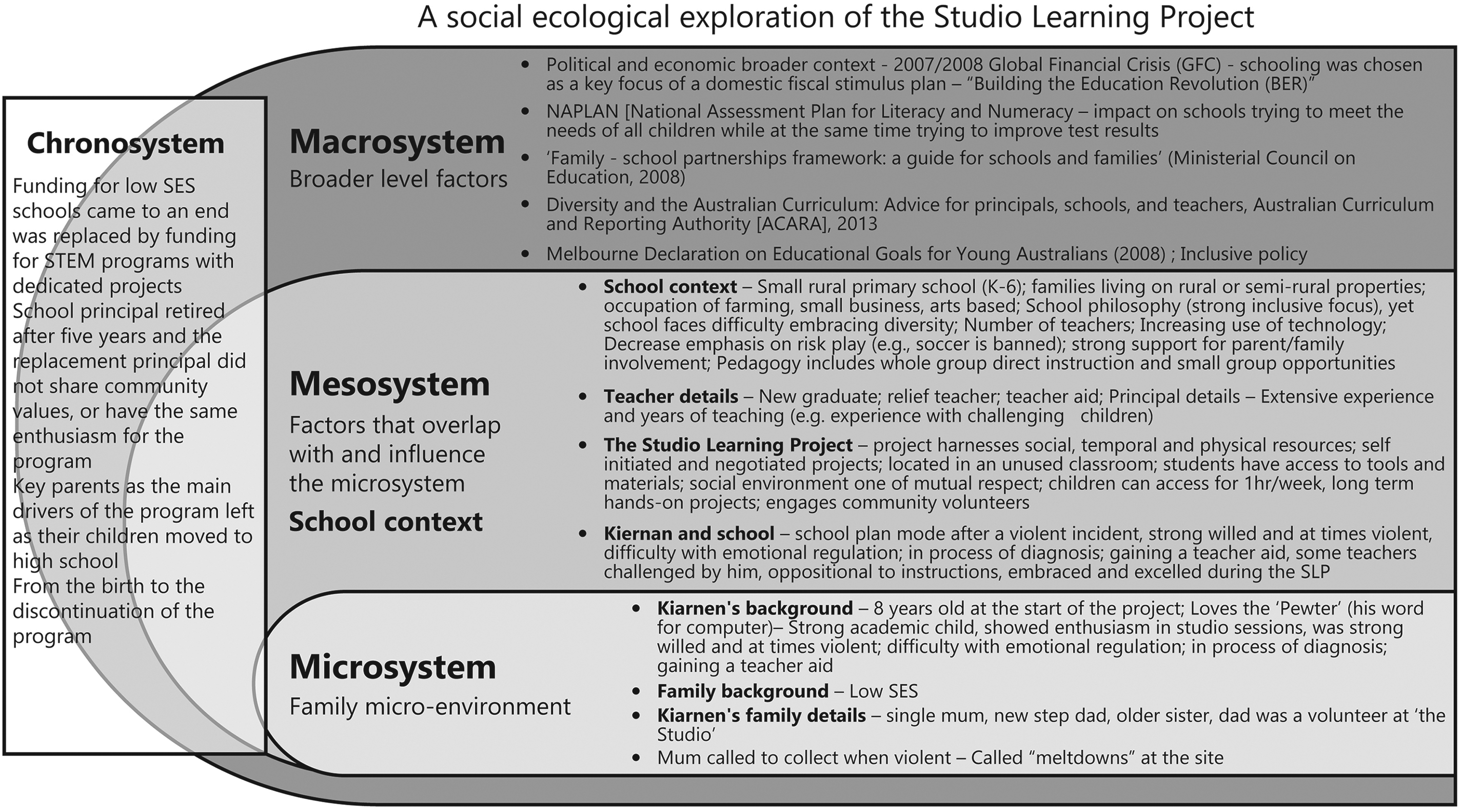
A social-ecological exploration of the Studio Learning Project.
Goodfellow (2012) describes a social and academic hierarchy that defines the capacities of children with learning disabilities, suggesting schools are ‘places of power relations that work to materially and discursively position SLD within a social/academic hierarchy relative to their “non-disabled” peers’ (p. 68). The ecology of data, provided clear evidence of this hierarchy at play and also the reasons for it, where teachers were not intentionally acting to exclude (see Finn, 2021).
As custodian of this ecology of data, it was important to attend to the transactions of people and place, to notice how roles and the settings of behaviour (this complexity of ecology captured in Figure 1), and the pressures that come with them such as to teach, can shape perceptions. By taking this eco-behavioural stance, a responsibility is enacted to bring understanding and appreciation for the conditions and contexts at play in the life-worlds of research participants. What becomes most pertinent to consider during analysis from an eco-behavioural stance is the forces at play in orienting our research participants and impacting their responsivity to our research lens. It is also worth questioning how research participants are coordinating with their environment, and how the environment is coercing their emergent identities. The following section will outline more specifically what this entails.
Whispers and tantrums: Theorising data analysis as custodianship of an ecology of data
What follows is the distillation of key analytical processes leading to these research outputs, drawing on theories from the eco-behavioural paradigm. Five key responsibilities of custodianship of the ecology of data, to be applied during the data analysis process (alongside other time-tested approaches) are outlined as: custodians mapping the edges and intersection of systems; custodians analysing the affordances of place; custodians attending to the minutiae – analysing effort after meaning and value; custodians considering flows of value, and finally; custodians learning with and curating data as pedagogical.
Custodians map the edges and intersection of systems
How people (among other species) act, and what they act towards, is influenced by forces that shape and sensitise them within the contextual environment (Bruineberg and Rietveld, 2019). These forces can include distal factors at the macro-system level, such as broader political and economic factors, like the global financial crisis that preceded Finn's study, or the key agenda of the Australian government in pushing to raise literacy and numeracy standards – both affording space for the programme in an unused classroom, as well as funding to kick start the programme. Within an ecological system, a key intersecting system, particularly related to the Studio project, were factors located within the meso-system, such as factors related to the school, the teachers and aspects of the project itself (see Figure 1).
Ecological systems modelling first proposed by Bronfenbrenner (1979), as well as by others such as Stokols (2018), place significant emphasis on social, temporal and environmental factors of influence. This modelling of systems of influence focusses the researcher's attention during the analysis phase to a multitude of interacting contextual factors at play in environmental systems, and in doing so deepens the researchers understanding of and appreciation for those shaping and sensitising forces. As custodians, adopting an eco-behavioural stance that draws on the social-ecological model, helps us cycle over the data in exploratory and performatory ways (as outlined above), while at the same time considering and accounting for greater complexity and interconnected relationships between people, behaviour, values, lived experiences and environments (Stokols, 2018).
It is through identifying factors in the social-ecological model that researchers become aware of multiple levels of analysis. Mapping the edges and intersections of potential forces reveals a more complete picture of the ecology of data (although there is always the potential that some forces may remain unseen). Potential forces of influence mapped in this way provide clues for making a comprehensive analysis of behaviour as the co-constitution of individual-environment systems. Utilising the social-ecological model to map the edges and intersections of systems, reveals a range of interconnecting potential forces at play on the emerging agencies of people and place as enacted affordances.
This work provides fertile ground to begin to analyse data with a thorough undertaking to consider wide and more far reaching forces. This comprehensive mapping of levels of analysis provides a picture ranging from obvious up-close forces (micro-system), such as resources in the socio-material environment or resilience in the psycho-social environment, to bigger picture forces, such as public–private partnerships impacting policy directions and funding priorities (macro-system).
The ecological model has been retrospectively created (see Figure 1 – A social-ecological exploration of the Studio Learning Project) to exemplify what this mapping might look like and the value it adds to discerning points of variance (bring to the foreground from the background) forces that make a difference. For example, Finn found the mapping useful to discern key changes across time (chrono-system), from the birth to the discontinuation of the programme. That schools are an inherently monomorphic (one type) system made the forces of influence that led to the creation and dissolution of the programme pertinent, given innovation in such systems is near impossible, as has been long noted by researchers such as Fullan (2001).
It is also possible that when researchers are examining multiple cases or multiple participants, the modelling would lead to specificity in the same way, through discerning what forces stay the same (invariant) and what forces are unique (variants) across multiple participants or sites. Thus, we see how social-ecological modelling works as a tool for circling back, and cycling over data, a powerful tool for foraging for information relevant to our findings (data analysis), and as a learning process, across and through systems. This modelling of the edges and intersections of wide-ranging forces thus becomes an enacted responsibility of custodianship of an ecology of data when taking a non-dualist, eco-behavioural stance.
This responsibility is enacted by moving through the research analysis process with a social-ecological lens, very aware of the multiple environments (e.g. micro-level, macro-level, meso-level and chrono-level) that impact on human behaviour. This lens also appreciates that behaviour (see Barker and Schoggen, 1973; and Bronfenbrenner, 1979 for seminal writing on this topic) occurs within a series of ecological niches (a specific place where an individual spends significant time and is heavily influenced, but also has influence) (Brown, 2012). This affords an appreciation of the contextually embedded uniqueness of data, collected from the research site/s and each participant, in terms of idiosyncratic diversity and contextual nuances (Brown, 2012; Brown et al., 2013).
In moving into and through the data analysis phase, researchers are thus reminded that multiple forces of influence are at play in any moment, and that observed behaviour, or respondent's answers in interviews for example, reflect a co-constituted relationality. The simple identification of themes, and associated examples, does not provide a full or rich picture of forces coercing behaviour in any moment. Instead, referring to dedicated social-ecological modelling allows the nuances and idiosyncrasies of ecological niches to emerge.
We argue that this type of analysis more effectively accounts for the locatedness of data within context, and in doing so affords a deeper understanding of a phenomenon (Brown, 2012, 2019; Gale et al., 2013). Given this, custodians are able to build a richer, faithful, more holistic picture, and rendition of the data, pertaining to its embeddedness in a social-ecological model (Fivush and Merrill, 2016; Warr, 2004). Custodians of an ecology of data, in this way, bring authenticity and integrity through efforts to illustrate the relationships that exist within the data and the situatedness of the data in the place in which the data originated. In doing so, researchers are able to achieve more ‘descriptive and explanatory conclusions’ and more detailed layers of meaning, shaped in ways that retain their integrity and complexity (Brown, 2019: 245).
Formalising an approach to detailing and considering the research site/s and participants with this model throughout the research phases, and particularly as data analysis becomes the focus of the research, is an important addition to gain traction over the wide-reaching factors that do not merely impact but, as we explore further below, co-constitute lived experiences. We begin to understand the tantrums (the data that speaks loudly) and the whispers (the finer grained nuances) in the ecology of data. To further explain how to bring attention to data from this mutualistic stance as custodians of an ecology of data, we turn now to another branch of eco-behavioural science, environmental psychology.
Custodians analyse the affordances of place
Roger Barkers’ (1968) work in ecological psychology (although he is often credited with influencing the separate field of environmental psychology) describes behaviour settings, as the ways the contexts of behaviour constitute coercive forces producing standing patterns of behaviour – that is, behaviour that remains the same even when the participants are changed. For example, the historically passive classroom design repeated in schools throughout the world is exemplary of designed affordances, and behaviour settings that are synergistic with instructive pedagogy to induce listening and attending to an instructor. The arrangement of material-spatial-temporal-relationalities imply function and ‘in the case of both affordances and behaviour settings, individuals do not have unconstrained choice. Factors outside of their control may limit the range of socially sanctioned choices’ (Heft, 2001: 290). Affordances are not simply utilitarian properties of the environment, they are socio-materially and spatio-temporally nested and extended relationalities that manifest the probabilities of human behaviour.
Whilst Barker's (1968) behaviour settings theory suggests that the context of behaviour and its collection of promoted affordances may be the primary predictor of behaviour, it is important to note how perception is directed by the linguistic system, amongst other pedagogical tools as extended (across time and space) affordances in order to attune attention. The implications for researchers during data analysis are to notice particular affordances promoted over others, through and across the material-spatial-temporal-relational realm. Analysing the affordances of place, as the collections or landscape of affordances (Rietveld and Kiverstein, 2014), where behaviour settings induce particular roles and thus behavioural expectations for participants, is significant work for custodians of an ecology of data, bringing an eco-behavioural stance to data analysis.
The understanding that affordances are nested in place, and extended across time, allows thorough examination of possibilities for action and discussions of who benefits, how, and what might be unseen, or obfuscated. For example, an eco-behavioural stance can illuminate how particular values implicitly harnessed to work roles, policy and procedure, mandates, or curricula, compel and restrict action. Understanding how this happens as part of the perceptual learning process is fundamental to increasing responsibility to research human action in holistic ways. Consideration to how settings of behaviour constrain and enable behaviour to achieve higher order purposes brings attention to the affordances of place (see Finn, 2015b; Heft, 2017) and whose goals behaviour settings serve? Whose voices are silenced? What tempos are favoured, and which are discouraged? And, how participants are coordinating with their environment and how the environment coercing, or coalescing with their emergent identities? Barker's (1968) seminal work on the theory of behaviour settings points to situating the places of research as a priority for responsibly working as a custodian of an ecology of data.
Finn's research revealed the ordinary ways that parental engagement in a school setting is limited, regardless that parents might bring pedagogical knowledge about their children, and children in general that can support principles of inclusive education (see Figure 1 – Meso-system details). By examining the Studio as a behaviour setting, within the school as an ecological niche, it was possible to specify the affordances of place this unique behaviour setting produced. Most notably by increasing pedagogical diversity at the school site (see Finn, 2019).
The parents working in pedagogical ways to support children's interests in the Studio environment broadened affordances for children's learning. Interested parents and community members, including resident artists, took the opportunity to contribute in pedagogical ways to the educational environment by personalising learning, resourcing child interests, sharing skills and, encouraging and mentoring. The general proximity of adults to children additionally afforded increased opportunities for literacy and numeracy learning (see Finn, 2015a).
Analysing the ecology of data to illuminate standing patterns of behaviour within the behaviour setting of the Studio revealed particular spatio-temporal qualities (a beat) of slowness (e.g. being able to work at their own pace, return to projects, and seeking input to improve quality) and spontaneity (e.g. being able to pause projects to pursue more pressing interests), and relational qualities of friendliness (e.g. showing appreciation for volunteers and for quality or innovative work), and reciprocal helpfulness (working to support each other and to be respectful to volunteers). This produced a pedagogy of guided participation (Rogoff, 2003); transmuting the student/teacher binary and more closely resembling learning in contexts outside of schools. Most interestingly, this behaviour setting was perceived to produce a different quality of learning than the regular classroom. For example, students noted the difference between instruction in the regular classroom where students perceived they were told what to do all day, and the Studio where, instruction (being told what to do) by parent and community volunteers was perceived as helpful (see Finn, 2015b, 2019).
Attunement to the edges of the multiple layers of interconnected ecological systems, as well as the affordances of place as behaviour settings with standing patterns of behaviour, revealed how the Studio learning environment exemplified a way to engage parents in the school and over time, how this challenged teachers who did not share a commitment to the programme given the pressure they were under to teach. The parents’ pedagogical capacities to make a meaningful contribution could be specified beyond the ordinary ways for parents to engage in the school as an ecological niche. The following section explores how custodians of an ecology of data attend to the minutiae as analysing effort after meaning and value.
Custodians attend to the minutiae – analysing effort after meaning and value
Ecological psychologist Edward Reed (1996) claims that meaning and value, while grounded in the environment, requires effort on behalf of any organism to engage it. Reed (1996) explains, ‘It is this effort after meaning and value that…is psychologically basic and is the embodiment of motivation’ (p. 101). Thus, further foraging through the ecology of data, to detect information that reveals where effort after meaning and value actualise affordances or not, seems another significant element of analysis from an eco-behavioural stance. This process requires an active engagement with the minutiae, which refers to the finer grained detail and the nuances of enacted behaviour.
Initially researchers examine their own effort after meaning and value (Reed, 1996) to account for what it is that is important to research, both in formulating the research questions and pursuing various threads of meaning throughout the research process. Then, it is necessary to bring to analysis attunement to multiple perspectives within the ecology of data, educating attention to the actions of research participants, as making effort towards what is of meaning and value to them. This foregrounds analysis as attention to identity, roles and the mattering that Barad (2003) popularised in her seminal work, inspiring Shotter (2014) and our own exploration here. We proffer a means to understand how it comes to be, from an eco-behavioural stance, that everything matters.
The Studio pedagogy came to matter most significantly to the students, who eagerly anticipated their time in the space, chattered about their projects on the bus to and from school, and showcased their work on many occasions. It was particularly the children who stood out in the regular classroom for needing extra support to be included (SLD) that seemed to benefit most from the efforts parents and the school principal had made to procure the space, funding and rouse enthusiasm in the wider community to initiate the programme (see Figure 1 for details at the micro-system level). In the Studio, and under the altered pedagogical conditions, these children flourished. As Finn (2021) has elsewhere detailed, a parallax of competence emerged, where children (SLD) who were challenging to teach in the regular classroom were able to demonstrate competencies that would ordinarily go unseen. While academically successful students in the regular classroom, in the Studio learning environment, experienced requiring assistance and opportunities for failure that seemed equally important. It was in this way that the diversification of pedagogy and the parallax of competence it produced created a more inherently inclusive school (see Finn, 2021).
When making an analysis of effort after meaning and value, it was never more evident to Finn just how much this pedagogy, a homelier pedagogy, was valued, than when a particularly challenging child who was known for disrupting the regular classroom was being viewed on video during data analysis. A clear indication of this child’s valuing of the Studio programme was his effort to act respectfully towards the parent and community volunteers, and to enthusiastically engage in activity in the Studio without needing a teacher's aide (as was required in the regular classroom). The video revealed this boy's attentive stance as he crouched down to gaze at the foot of a sewing machine on a table, while a Grandmother (not his own) was providing instruction to him and a friend (see Figure 1 – Micro-system).
He had initiated a project via the affordance of playing with donated fabric, and the ideation of potential costumes he could make. Parents attuned to this interest and the machines were found and serviced along with someone to help sew – personalising learning (Finn, 2019). In the video, as he crouched down, eyes wide, gaze strong, as the necessary instruction was provided, a faint whisper was detected, and being almost inaudible, required re-watching of the video many times before it was unquestioningly ‘I wish my Nan was here’ identified as the words so softly spoken. A wish seemingly whispered to the ether, from a child of few words and whose temper tantrums could throw the whole school into disarray (see Finn, 2013). The statement, and the stance conveying volition for instruction, conveyed a clue to perceiving the value of this homelier pedagogy and the ‘parallax of competence’ it afforded (see Finn, 2021).
The words were analysed as a felt appreciation for the ‘homelier’ pedagogy and clear evidence that coming into relation (perhaps even more for children diagnosed as ‘somewhere on a spectrum’) may be highly significant for their educational success. His effort to come into relationship, reciprocating respect, volition for instruction and making commitments to show up when someone shows up for you, indicated a relational synergism with the pedagogy of the Studio learning environment. Self-discipline came with the freedom the programme afforded, and thus his embodied learning demonstrated the kind of education that brings out competencies, in contrast to identifying deficits.
As custodians, bringing an eco-behavioural stance to data analysis and pinpointing these efforts after meaning and value in the minutiae of the landscapes of affordances forges pathways through the ecology of data. It is this awareness of values as central determinants of behaviour and how these underpin action (that) provides opportunities to examine flows of value that will be further detailed in the following section.
Custodians reveal flows of value
Just as flows of value aligned in the birthing of the Studio programme – leadership (the school principal) with expertise with challenging students and valuing community, motivated parent volunteers, policy supporting parent engagement, funding availability, and uniquely, new space up for grabs at the school site (see Figure 1), so too did they align for its demise. Over time, the Studio did threaten the hegemonic order, blurring roles and boundaries, and challenging the instrumental ease of ordinary classroom instruction. Teachers, exhausted with the pressures of an audit culture, national testing, report writing, professional evaluation responsibilities and an overcrowded curriculum, did not perceive the benefits of the kind of everyday learning that was emerging from the Studio, let alone value it or find the time to understand it. Together with a sudden change of school leadership (the principal moved away from the area), and the moving on of key parent volunteers whose children had progressed to high school, these forces combined to bring the innovation to its end. The flows of value across and between the various ecological systems, the affordances of place produced by behaviour settings, and the efforts people make towards what is meaningful and of value, contributed however to a deep and penetrative analysis of the ecology of data.
While universal approaches to data analysis can be useful, applied without an eco-behavioural stance, can create a blindness ‘to discontinuities and heterogeneity; differences, conflicts, and tensions between the various kinds of value that animate agents’ actions’ (McGann, 2020: 6). Meaning and value motivate action – therefore the small and sometimes seemingly insignificant actions, as well as attending to what is not said as much as what is said, become increasingly significant to detailing a rich feast of findings. As McGann (2020), in the vein of Reed (1996) states: ‘Understanding agency means understanding both the values that animate it, and the constraints (bodily, worldly, and various things in between) that underpin it’ (p. 3). Nothing illustrates this better from Finn's ecology of data than a highly anticipated visit to the school from the Regional Director of schools.
Finn recalls accompanying the Regional Director to observe the rostered parent volunteers and a group of younger students in the Studio first-hand. When entering the room, it was noisier than a regular classroom…but it was the kind of buzzing sound that undertaking important work makes. Children were flitting about from one end of the room to the other gathering materials and chatting busily. To young children in such a space where they have the ability to talk freely while undertaking activity, language is a great affordance which enables them to share ideas, make connections to potential partners for collaborative effort, detail the reasons for their actions, and share their life-world experiences. Allowing children the freedom to make commitments to their own activity connects schooling with their life beyond it. This generates a particular sound that indicates opportunities are manifesting for the kind of learning that children don’t know they are doing.
The Regional Director of Schools did not experience her encounter with the space in this way. She stepped no further than a few metres inside the room, made no attempt to engage with the children or parent volunteers, and stayed for no more than a few minutes before making her abrupt and decisive comment: ‘I couldn’t teach in this sort of classroom’, and she was gone.
The Regional Director's comment while seemingly negative could also be interpreted as prophetic. It pre-empted the research finding that the Studio's pedagogy of guided participation transcended the teaching/learning binary. However, there was also the cautionary intent in her comment that could be read as affirming the warning given by Ainscow et al. (2006) ‘One person's view of an improving institution may be another's vision of educational hell’ (p. 11).
Revealing flows of value through the ecology of data supported an analysis of how the Studio was perceived as a place of specific affordances – a unique behaviour setting within the eco-niche. This enabled a deeper and more nuanced sensitivity to synergisms of the affordances of place, to emerging agencies tethered to roles, identity, selectivity and intention. In this way, a wider scope of interpretation of experiences of inclusion and exclusion, were made visible. For example, the Regional Director, attempting to identify with the space as a teacher, seemingly perceived no affordance in the Studio environment for teaching but in making her analysis, Finn wondered (with changes across the chrono-system in mind) if perhaps she had entered the room at age 7, would she have perceived its value for learning?
In the following section we recap a theme introduced early in this article, that custodians, taking an eco-behavioural stance to data analysis, actively engage with data in exploratory and performatory ways, to learn with data, and additionally, to curate data as pedagogical.
Custodians learn with and curate data as pedagogical
Theory that supports attunement as an active search for clarity is a concept proposed in the seminal work of ecological psychologists, and introduced at the outset of this article (see Gibson, 1966; Gibson and Pick, 2000). The notion of custodianship captures the analysis phase as a pedagogical process, whereby the attention of researcher is attuned to information as significant within the data, often related to the identified research questions. This process is not merely an extraction from the data of what we expect to uncover, it is an approach that requires the researcher to step out of the comfort zone of expert (having completed extensive literature reviews at this point) and to be willing to learn with and from data surmised by the responsibilities outlined above to curate these learnings as findings.
Inspired by the eco-behavioural paradigm we contend that the work of qualitative researchers, involves moving beyond representationalism to simultaneously learn with data, and organise data as a pedagogical device. Analysis begins as a learning process of perception of data, encountered in an exploratory way with the privilege as researcher to revisit the ecology in its entirety. Data is also encountered in performatory ways, as drafted presentations are made in writing and for conferences presentations. In this way, researchers cycle over the ecology of data to eventually specify what is pedagogical for presentations as findings.
As educators, we are familiar with the term listening pedagogy, described by Rinaldi (2006) as being a process of parent, teacher or guardian aligning with children's perception of their environment. Listening pedagogy is positioned within a strengths-base lens that reflects the deep respect for the perspectives and positions of others. Rinaldi (2006) understands or sees listening in its broadest terms, as ‘a metaphor for having the openness and sensitivity to listen and be listened to, listening not just with our ears, but with all our senses (sight, touch, smell, taste, orientation)’ (p. 65). Deploying listening pedagogy in practice, means sidelining opportunities to teach and to tell, in favour of capitalising on opportunities to learn from and with others, their curiosities, wondering, and of course what they already know – endorsing the etymology of education from its Latin root to bring out.
We propose that listening pedagogy is akin to custodianship of an ecology of data. Listening pedagogy helps explain the researcher stance to attune with data from an ecological stance. This means putting obvious or expected findings aside and allowing space for data to organically emerge and to pedagogically inform us – being responsive to emerging agencies in the flow of lived experience.
In Finn's research example, she recalls being surprised at this hegemony at play, having anticipated that teachers would be supportive of the way that the programme enabled a parallax of competence where students on the Autistic Spectrum and with Attention Deficit Hyperactivity Disorder often attracted the awe of the peers for their creativity and ideation (see Finn, 2021). Curating an ecology of data entailed including multiple voices of children, parents, and teachers, as well as multiple types of data to ensure the audience gains a full appreciation of the forces at play. Finn (2015b) details in her research how she came to understand (learned with data) the instrumentalism of the school as an institution (a monomorphic system that reproduces itself), as a force impacting teacher perceptions of behaviour that could be sanctioned as learning, having far more to do with their dispositions to relationality and temporality under these role constraints, than any personal deficits. The teachers were blinded to how learning happened in an everyday way and thus unwittingly acted to reproduce the hegemonic order of the system.
We see aligning with our research collaborators perception of the environment as central to qualitative researcher's positioning as custodians. This process of attunement, via the sharing of attention (see e.g. Zuckow-Goldring and Arbib, 2007), is a primarily pedagogical behaviour that supports all learning, according to Heft (2013). From such a stance, our notion of researchers during the analysis phase, can be understood as the allowing of data to educate attention. As we learn with the ecology of data during analysis, changes in perception, as increased specificity leading to expertise, is the reward for our efforts.
Conclusion
This article makes a case for increasing the responsibility of researchers to account for complexity during data analysis, specifically understanding the co-constituted relationality of person and place, drawing on eco-behavioural science. This responsibility, conveyed by the phrase custodianship of an ecology of data, and specified as the responsibilities to map the edges and intersection of systems; analyse the affordances of place; attend to the minutiae – analysing effort after meaning and value; consider flows of value, and finally; learn with and curate data as pedagogical, when considered and applied to data analysis, we suggest, will increase research depth, interest and output.
Eco-behavioural science positions human action as constrained/enabled, by multiple emerging agencies within a particular landscape of affordances as a field of action for emerging possibilities (see McGann, 2020). Thus, possibilities for action are enabled/constrained by sites of work, roles undertaken, and lived experiences that situates behaviour. From this stance to analysis, attention is never on separate individuals and environments, but on the complex interconnectedness of organism and environment in a dynamic transaction.
Inspired by ecological systems modelling and ecological psychology, a holistic account of complexities of situatedness can be accounted for with increased consideration to various systems of influence. These include influences that occur close to an individual (micro-system), those influences that sit more distally (macro-system), or others that occur across or through time (chrono-system) (Bronfenbrenner, 1979; Bronfenbrenner and Morris, 2006). We suggest this opens up opportunities to learn with data.
In conclusion, we suggest moving through the affordance landscape with a sense of custodianship. This affords us to analyse data in a respectful way that acknowledges the multiple emerging agencies of people and places in which data emerges. In this way custodians of an ecology of data do not prioritise extractive techniques that simplify data. They prioritise emergent themes by connecting with the ecology of data.
As custodians walk the landscape of an ecology of data, they not only tread carefully, but engage with an intensity of gaze and gait not like walking a dry, broad creek bed searching for nice flat steppingstones, but with a deeper level of perception, as if the creek is moist with rain and slippery with slope, requiring caution to seek out where foot, water, rock and earth best come together for a gripping effect. Custodians create connecting pathways through the complex ecology of data to lead others through the landscape in informative ways.
Footnotes
Data availability
The data that support the findings of this study are available on request from the corresponding author.
Declaration of conflicting interests
The author(s) declared no potential conflicts of interest with respect to the research, authorship, and/or publication of this article.
Funding
The author(s) received no financial support for the research, authorship, and/or publication of this article.

Author biographies
R Finn's interest is in ecological psychology's application to education.
A Brown focusses on innovative methodological approaches that reframe research with young families with ethical and respectful application to participants’ involvement and agency in inquiry.