




Abstract
This article discusses using concepts from various fields across general semiotics, to centralise children's abstract images in research. The aim is to move towards a natural semiotics – which accommodates the primordial, natural and universal dimensions of experience – that children connote through their ‘out of this world’ images. Natural semiotics is a term used to interrogate typical socio-cultural orientations towards meanings generated through signs. It is an approach to the co-interpretation of children's abstract images that appeals to emerging fields in semiotics and philosophical models which suggest the natural world as carrying intrinsic semantic value. Moving towards a natural semiotics carries potentials for co-interpreting children's ‘out of this world’ signs, in relation to situated and universal systems of meaning. When children cannot narrativise their experiences, symbols and other abstract imagery naturally emerge. A natural semiotics approach can be valuable for trying to figure out meanings behind children's creative, and at times, unknowable-yet-known data.
Introduction
The field of qualitative research often centralises personal narratives as a rich and valid source of data. In narratives we find identities, social relations, experiential authority, performances, strategies and motivations for telling stories (Bell, 2002; Frank, 2010; Bamberg, 2008; Labov and Waletsky, 1967). Narratives can be closely examined through discourse analysis, to reveal the colonisation or appropriation of discourses from dominant institutional fields, such as politics or education (Fairclough, 2013). Stories are a rich site for meanings and for generating research knowledge from the epistemological authority of everyday people (Thomas, 2021). Everyday narratives are typically privileged in qualitative research and are valuable, in so far as, human beings are not synonymised with their stories (Thomas, 2021). It becomes clear why as researchers, we feel compelled to hang on to narratives when we find ourselves in the realms of the abstract and symbolic. But at times, verbal narratives cannot capture experiences that are none/pre-/post-conceptual, timeless, non-chronological and non-referential with things in the social and material world (Leone and Parmentier, 2014; Thomas, 2022a, 2022b; Simecek, 2015). Recognition for the limitations of narrative, and the value of images, has encouraged researchers to adopt creative approaches to research. Offering affordances for the inclusion and privileging of diverse experiences, knowledges and perspectives of marginalised groups – such as disabled adults (Carawan and Nalavary, 2010), individuals with health conditions (Thomas and O'Connor, 2023, Cheung et al., 2016) and children (Leigh, 2020; Brooks et al., 2020).
As a field, qualitative research accommodates a plurality of approaches and methodologies to capture complex and often ineffable realities (Mazzanti and Freeman, 2022). The many studies which apply creative methods, indicates a continuing enrichment of the field, and a shift away from methodologies imbued with an unconscious logical positivism (Lather and St Pierre, 2013). A shift in values, in terms of what constitutes knowledge (and its varied representations), has led to more children being invited into research (Punch, 2002). Often in research with children, visual methods are considered as solutions for more accurate representations of children's experiences (Umoquit et al., 2011), or to enable the unmasking of social influences on children's identities (McLaughlin and Coleman-Fountain, 2018). Devolving power to children through creative methods in research (Kindon et al., 2007) and embodiment of experience (Woodyer, 2008) are other benefits highlighted by researchers. In creative research with children, visual data can often be viewed as a communication tool (Liebenberg, 2009; Rollins, 2005; Glegg, 2019). What can be missed when visual images become a tool for communicating, are the potentialities for uncovering meanings and dimensions of images. When images are highly abstract, in the form of scribbles, spirals and geometrical lines, there are potentials for children's visual data to be hidden in the margins (Jellema et al., 2022). Children's ‘out of this world’ experiences, can be a good site for exploring abstract visual data, where children's images are put centre stage (Jellema et al., 2022).
This article discusses using concepts from various fields across general semiotics (Peirce, 1931–1958; Barthes, 1986; Nöth, 2001; Tarasti, 2012), to centralise children's abstract images in research. Semiotics is ‘the study of anything that can be taken as a sign [and] anything can be a sign as long as someone, or, more importantly, a group of people who are part of the same culture or society, interprets it as signifying something’ (Aiello, 2020: 367). The aim of the article is to move towards a natural semiotics – which accommodates the primordial, natural and universal dimensions of experience – that children connote through their extra sensory images (Thomas, 2022a, 2022b, 2023). Natural semiotics is a term used to interrogate typical socio-cultural orientations towards meanings generated through signs. It is an approach to the co-interpretation of children's abstract images that appeals to various fields in semiotics (protosemiotics, Nöth, 2001; neosemiotics), and philosophical models which suggest the natural world as carrying intrinsic semantic value (Kastrup, 2017). Moving towards a natural semiotics carries potentials for co-interpreting children's ‘out of this world’ signs, in relation to situated and universal systems of meaning. When children cannot narrativise their experiences, symbols and other abstract imagery naturally emerge (Thomas, 2022; 2022a; 2022b; 2023; Thomas and O'Connor, 2023). A natural semiotics approach can be valuable for trying to figure out meanings behind children's creative, and at times, unknowable-yet-known data (Thomas, 2022b).
The studies
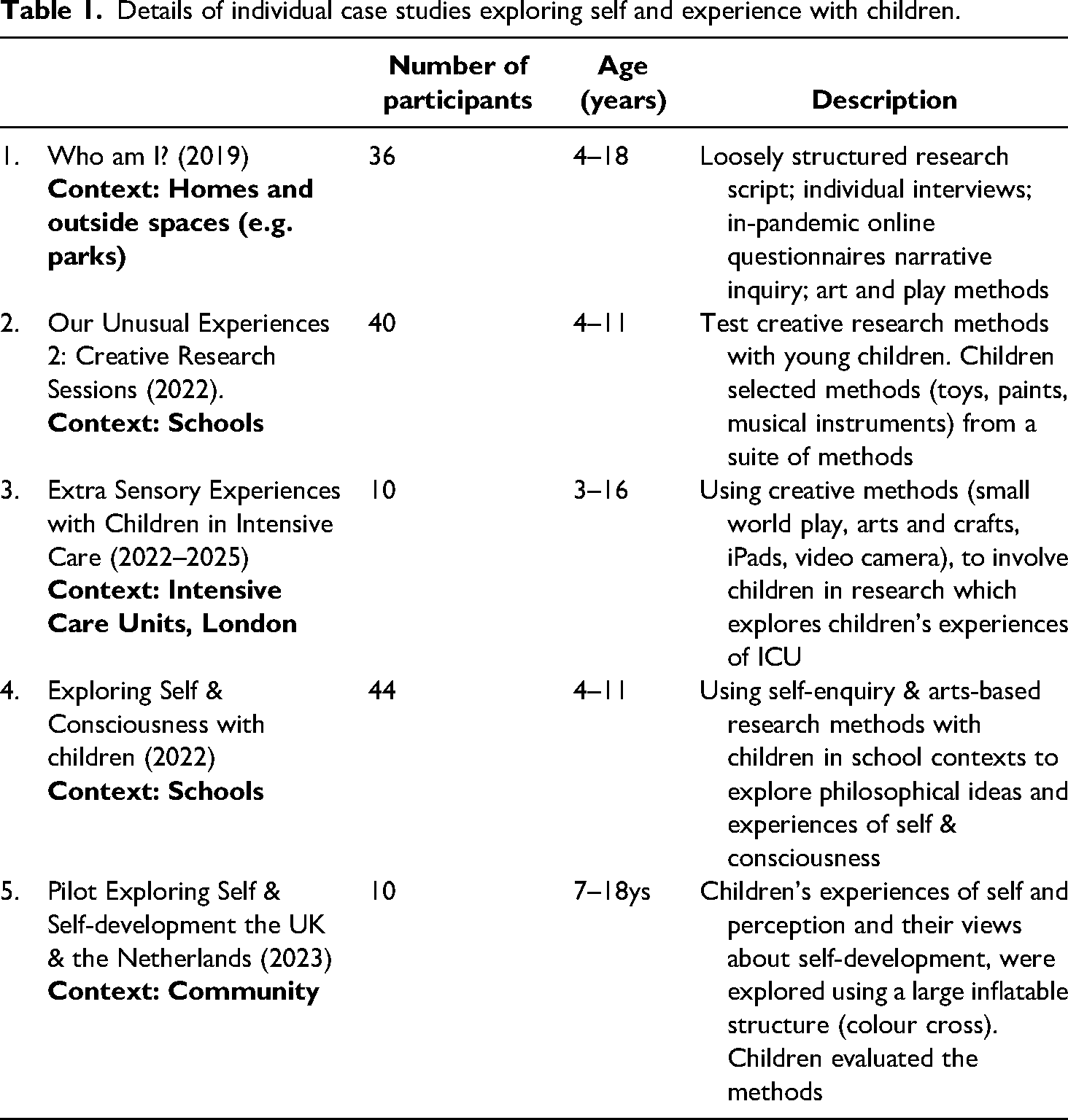
Data included in the article is taken from a programme of research that explores the nature of self and experience with children – to inform service delivery, development and policy-formation (Thomas, 2022, 2022a, 2022b, 2023). Table 1 details individual studies.
Details of individual case studies exploring self and experience with children.
The central aim for the series of pilot studies is to explore the nature of self and subjective experience (consciousness) with children. The aim for the studies responds to:
Unquestioned assumptions about the nature of self in social research/social science and service provision, as a discrete individual entity with a precise centre and location (Thomas, 2021; Harris, 2021) Exclusion of a range of (extra sensory) human experiences from social research, service development and policy formation; The topic itself is an anomaly, and one which emerged from children as a topic of interest; a usual experience for children (rather than anomalous or non-ordinary), and a dissatisfaction with mainstream mental health narratives.
All data from the example case studies in Table 1 were recorded through audio and video. Datasets contained multimodal information including pictures, photographs, videos and textual/narrative data. Every child and young person gave informed consent and parental consent was sought for children under 18 years. Information booklets were produced for children and young people. Separate information sheets were made available for younger children who gave verbal consent/assent. The ICU study (see study 4, Table 1) was granted ethical approval by the Health Research Authority and Health and Care Research Wales on 19 July 2022 – reference: 316532 22/SC/0185. Studies 1, 2, 4 and 5 were granted ethical approval by BAHSS ethics committee at the University of Central Lancashire. Studies were/are conducted in a range of contexts, including schools, hospital units, community centres, homes and outside spaces.
To evoke research conversations about children's extra sensory experiences, each study used a generic question, elicited from research activities. For example, in study 2 (research sessions in schools), the researcher read a story based on a real-life experience gathered from previous studies. Following the story, children were invited to respond to the question ‘Have you had a similar experience and if so, can you share it using your chosen activity?’. New questions would emerge from the participants responses (verbal, visual or through play) related to their experiences. 1 A mobile suite of creative methods was partly developed with a group of children with extra sensory experiences, research participants and adult researchers. Children across all studies selected what methods to use for representing their experiences (Thomas, 2022a; Thomas and O'Connor, 2023). Methods included storytelling (Satchwell et al., 2020), art (Eisner, 2008), photography and videoing (Punch, 2002; Buchwald et al., 2009), take a selfie (Thomas, 2022b) and play (Green et al., 2009). For the purposes of the article, examples are taken from studies 1, 2, 3 and 4 (see Table 1).
Centralising images in extra sensory research with children
For qualitative researchers who may be working with a range of semiosis, it's important to develop approaches for working with both figurative and highly abstract symbols. For example, children's ‘out of this world’ (aged 10 years) or extra sensory data (Thomas, 2022, 2022a, 2022b, 2023) can be highly abstract, seeing tensions for co-interpretation between adults and children (Thomas 2022a, 2022b). Extra sensory research can grapple methodologically with the ‘more-than-visual qualities and capacities of images…considered to facilitate the communication of that which is beyond words, or which cannot easily be articulated’ (Lovell and Banfield, 2022). Developing creative research methods is important for children who report ‘out of this world’ phenomena – or experiences which go beyond social realities, materialities, personhood, time and space (Thomas, 2022, 2022a, 2022b). Extra sensory experiences of children ‘surpass categories offered by the five-sense sensorium when they describe their embodied experience’ (Pink, 2011: 262). This also applies to children's disembodied experiences, seen in their reports of out of body experiences, premonitions (Dossey, 2008), peak or transcendental experiences (Taylor, 2012; Hoffman, 1998), exceptional dreams (Bogzaran, 2003) and telepathy (Krippner, 2016). Extra sensory experiences can be conflated with mental disorder, despite the blurred boundaries between them (Thomas, 2022, 2023). An important motivation for researching extra sensory experiences with children, is to address the rapid medicalisation of children's experiences, before they are explored with children (Thomas, 2023).
Recent studies (see Table 1) are showing how children intuit their extra sensory experiences as a natural aspect of being a child (Thomas, 2022, 2022a, 2022b, 2023). Studies further show how adults’ interpretations of children's experiences can cause unintentional distress (Thomas, 2022). When extra sensory experiences are supported well, they show a potential for well-being in children (Thomas, 2022). Children's extra sensory experiences can carry philosophical implications, challenging the dominant materialist ontology and constructionist paradigm (Thomas, 2022b). Narrative talk is often ruptured in extra sensory research, due to the nature of these experiences as transpersonal and trans-linguistic – having no lexical and experiential referents located in the social or physical world (Thomas, 2022, 2022a, 2022b). This is more the case for children who attempt to report peak or transcendental experiences (Thomas, 2022b), where their usual sense of personhood, space and time are dissolved into a unified field (Thomas, 2022b; Taylor, 2012; Hoffman, 1998). In this way, children's images are privileged and centralised in the process of research knowledge production, in extra sensory research (Thomas, 2022a, 2022b, 2023).
Images, and other modes of semiosis, can be a form of expression that fosters fruitful dimensions through which to theorise (Mazzanti and Freeman, 2022). Often in qualitative research, or related fields such as linguistics, theorising images entails social constructionist orientations (Stephan and Akyuz, 2022; Sandu and Ponea, 2010). Images and symbols are examined in terms of how they relate to people, circumstances and socio-cultural conditionings. Researching ‘out of this world’ images with children, highlights how typical, semiotic constructionist-orientated approaches, may not carry the explanatory power required to identify, interpret and theorise highly abstract data. More so when ‘abstract art is a whole coherent unto itself, like a spider-web held by its own connotations and suspended in virtual isolation from its surroundings apart from minimal strategic anchor points’ (Jones, 2003: 652). Children's images may reveal experiences interrelated with an intuitive teleology and design in nature (Kastrup, 2017, 2019), prior to, or beyond, conceptual and social referents (Thomas, 2022b). As Nöth (2001) argues, ‘semiotics is no longer only concerned with signs that depend on cultural codes, since it has advanced to a theory of sign processes in culture and nature’ (p. 9).
Semiotics and extra sensory images
Nuanced debate interrogates whether visual data can really go beyond linguistics, asking to what extent images still rely on words and language (Pink, 2011; Jellema et al., 2022). Researchers can rely on language that at times, can limit the potential for images to represent, to make known, subterranean experiential domains. Semiotics can be a valuable approach for centralising and uncovering meanings from visual data. As a science, semiotics examines signs and encoded messages found in language, images, movies, books, clothing, music and food – identifying how meaning can be made through objects and other kinds of modes we are exposed to (Berger, 2014). Social semiotics has typically been interested in the deconstruction of verbal, written and visual texts, to identify codes that are agreed upon within a given cultural system – ‘and that thus allow the members of the same culture to understand each other by attaching the same meanings to the same signs’ (Aiello, 2006: 90). Signs can be relational, making sense relative to a system. For example, the red in the traffic light takes its meanings from the other colours in the system (Saussure, 1964, in Krampen, 1987).
Semiotic approaches, regardless of their orientation, share a common goal in establishing a sign and its object (Peirce, 1931–1958). For Peirce, a sign has three parts – a sign, an object and an interpretant, with the interpretant carrying significance in the generation of meanings (Goharipour and Gibson, 2022). The object refers to whatever the sign is signifying, for example fire would be the object to which smoke signifies. A sign must fall within certain parameters of the object or referent to be able to signify meaning, for example, smoke can only signify its object (fire) by virtue of it being a specific feature of the object (smoke). Making sense of the sign and what is signified becomes more complex when the parameters of some experiences are unknowable and ‘unstructured by subject, object or any differentia’ (Albahari, 2019: 2). Especially in cases where there is a ‘phenomenological suspension’ (Leone and Parmentier, 2014), like Oliver's example in Figure 1: “I don’t know, I just know, its me” Oliver, Aged 16 years
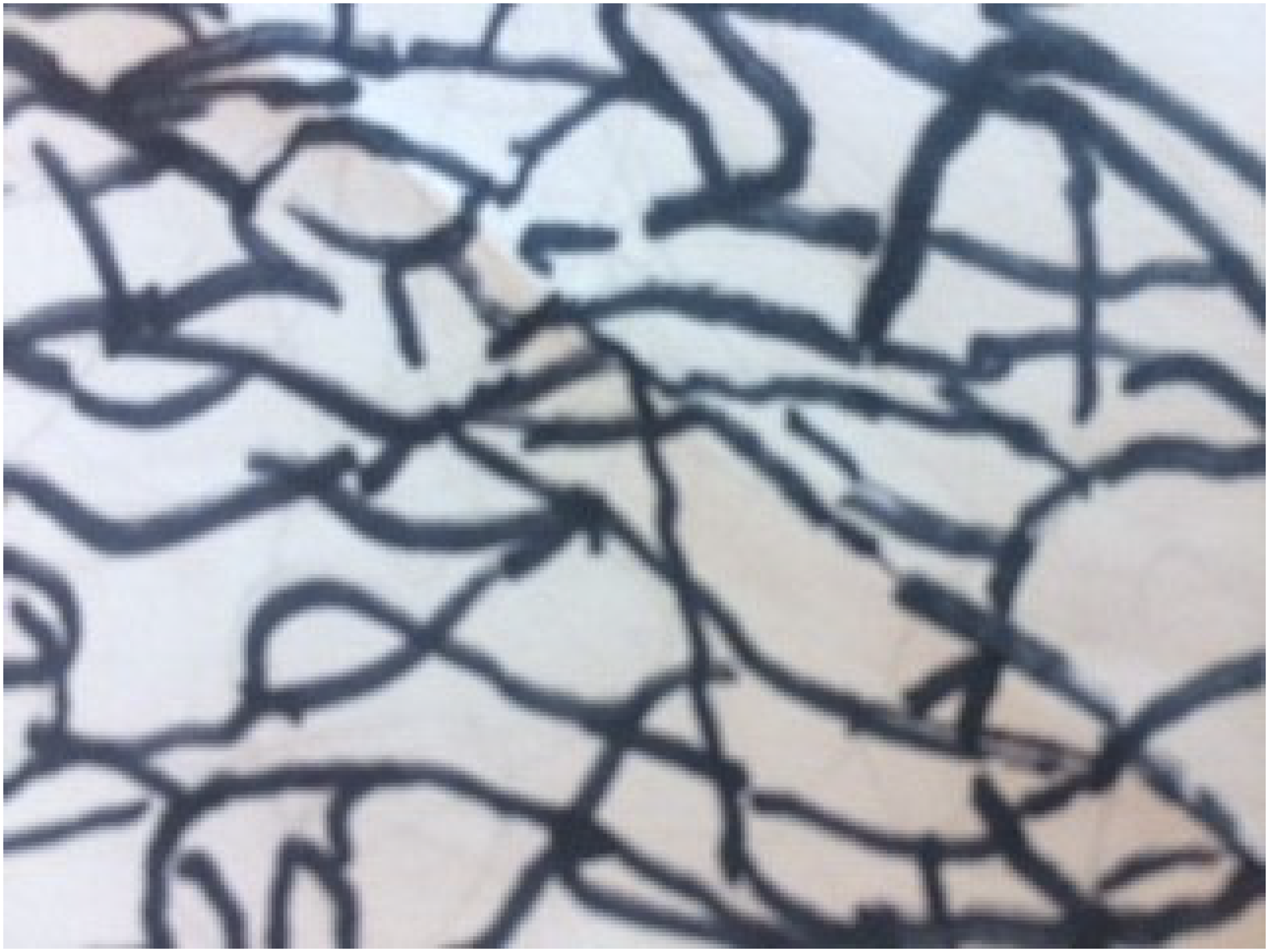
Example – Oliver, 16 years. This is me. Who am I Study, 2019.
When the researcher invited Oliver to draw his experience, that he could not explain verbally, Oliver produced the geometrical pattern seen in Figure 1. Perhaps, as a representaman (Peirce, 1931–1958) of the ‘aha experience, the fragmented body and sensation that converges with the pre-linguistic sense of self’ (Ladsaria and Singh, 2016). In Lacanian terms ‘an imago or gestalt, providing merely an illusion of identity and control’ (Lacan in Fink, 2020: 162; Lemaire, 1979). Geometrical patterns and lines have been understood to signal transcendence in pre-Columbian and western European artistic traditions (Leone and Parmentier, 2014). The abstract style ‘involves the reduction to single lines and the approximation of geometrical forms that depicts referents not normally observable in the everyday world’ (Leone and Parmentier, 2014). Tensions between semiotic mechanisms and experiences like transcendence, are highlighted through ‘these transcendent objects by the very definition that their natures cannot be so represented – because they are on one hand beyond knowing and, on the other hand, anchored in an utterly separate realm’ (Leone and Parmentier, 2014: 2).
Oliver's image emerged naturally and spontaneously in place of a verbal narrative. Before the researcher and Oliver employed talk-around-image, both stayed with the image – following the lines with fingers, silently, until odd words emerged from Oliver, such as I, everything and connected. Co-interpreting the pattern with Oliver revealed that his experience had no or little referent with any conceptual, social or material experiences (Thomas, 2022b). For example, Oliver had never experienced his self in this way (as all, everything), nor had he experienced an absence of time, or space (as Oliver had become the space). Oliver described an absence of thoughts, rather, he identified as a peaceful awareness, a state Albhari (2020) notes as an ‘aperspectival witness consciousness’. The experience itself visually manifested as a geometrical pattern in lieu of linguistic resources and worldy referents, constituting ‘part of the human experience that has not been tamed and symbolized by language’ (De Certeau, 1996: 61).
Co-interpretation with children becomes more important with visual images, with their potentialities for varied meanings, produced between creators and interpretants (Jewitt and Oyama, 2001). Oliver could not verbalise his transcendental experience, so the researcher invited Oliver to draw it. Once Oliver had completed his visual representation, Oliver offered a metaphorical interpretation for his image – and experience: “Erm …it's like these lines are like tree roots, you know, like tree roots are connected but trees look like they’re separate and that's what it's like for us, for human beings” Oliver, aged 16 years
Oliver's experience and the meanings ascribed to it, are beyond the socio-cultural world, forcing Oliver and the researcher to reconfigure typical co-interpretation processes. For example, silence, embodied reading (following lines with fingers), and the image itself was central to the research process. Oliver storified his experience through strong metaphorical referencing, rather than employing typical narrative strategies found in everyday language use (see Labov and Waletsky, 1967 – oral narratives in everyday interaction). Oliver's story carries features of the mythical, of the storytelling found in ancient teaching traditions which depart from postmodern stories (Sandberg, 2016) that are continually shaped and reshaped in interaction with the social world (Thomas, 2021). For the interpretants, co-engaging with the image in this way (before talk around image) afforded an intuitive space from which Oliver's creation could ‘speak’. Its form reached out to similar images produced by children across various studies, corresponding with geometrical art and symbols located historically across different cultural cosmologies (Thomas, 2023).
The semiotics of nature
Experiences and signs are often accounted for in linguistic, social or material terms. Saussure regarded semiotics as ‘a science that studies the life of signs within society’ (Berger, 2014). Signs and meanings are therefore based on convention rather than nature (Berger, 2014). With a constructionist orientation, applied semiotics can imbue the social or textual world with an ontic primacy. As a well-used theory in qualitative research, constructionism is often the lens through which ‘one's […] set of ontological commitments and epistemological procedures [are] embedded in the assumptions and choices made by research communities’ (Mazzanti and Freeman, 2022). Nöth (2001), argues that nature, and natures semiosis, are often overlooked in socio-cultural semiotic orientations. For example, Peirce's system of semiotics stems from a ‘radical antidualism and evolutionism’ (Santaella et al., 2022) that questions dichotomies between the social and natural world, and mind with matter.
The term natural semiotics is used here to capture aspects of various and transdisciplinary semiotic fields, that have emerged to interrogate the dominance of semiotic structuralism, based on ‘anthropocentric and logocentric foundations’ (Nöth, 2001: 6). Natural or general semiotics queries the perspective of socio-cultural semiotics which views nature as a socio-cultural product (Eco, 1979). Instead sign processes in nature are investigated as semiotic processes sui generis, or unique to itself (Nöth, 2001). The semiotics of nature, for example, can examine sign processes between human cultures and non-human animals referred to as zoosemiotics or anthroposemiotics (Kull, 2014; Deely, 2005). Biosemiotics (Favareau and Favareau, 2009) lowers the semiotic threshold from human semiosis to semiotic processes of micro-organisms or living cells (Nöth, 2001). Existential or neosemiotics (Tarashi, 2012), constitutes a type of ontological semiotics ‘starting from the modality of being and shifting towards doing and appearing’ (Tarashi, 2012: 316). Neosemiotics accommodates, yet reinterprets, representation, genres, dialogue and the nature of communication (Tarashi, 2012) – reflecting new epistemic choices in how the world is understood.
Children's abstract images interrogate not just epistemic choices but ontic choices in how the world is understood. For example, Kastrup (2018a, 2018b) argues for the semantic value of the world, an idea which contradicts dominant materialism, its hegemony and its assumed world of dead inert matter. Semantic value of the world entails natural patterns, orders or habits in nature. For example, Kastrup (2018a) uses logic and mathematics as an example of natures’ mental templates ‘according to which thought unfolds’ (p. 47). The key point Kastrup (2018a) makes is how archetypal patterns in nature ‘extend into the world’, indicating the world as mental and continuous with our minds – ‘If there is no intrinsic separation between our minds and the objects of perception, naturally these objects should comport themselves in a way consistent with mental archetypes’ (Kastrup, 2018a: 47). Peirce (1931–1958) also viewed mind with an ontic primacy, arguing for matter as mind frozen to regular routine (Nöth, 2001: 26). For Peirce, ‘all this universe is perfused with signs, if it is not composed exclusively of signs’ (Peirce in Santaella, 2014). Peirce is not proposing a textual universe, rather, matter is viewed as ‘effete mind, inveterate habits becoming physical laws’ (Peirce in Santaella, 2014). A natural semiotics highlights the historical demarcation of the social from the natural world, even when the habits of nature continue to be felt across the lifeworld (Habermas, 1996).
Abstract images and natural semiotics
Oliver's abstract image (Figure 1) is similar with other types of symbols that can emerge in research with children and their extra sensory experiences (Thomas 2022a, 2022b). Children's squiggles, spirals and scribbles can often be overlooked by adult researchers. Children's drawings can easily be dismissed, when ‘the prevailing notion of children's drawing development is one in which the child more or less thoughtlessly assembles a vocabulary of marks which are eventually used for figurative purposes’ (Matthews, 1984: 3). Child artists have often been considered as failing realists (Piaget, 1929), with measurements of young children's drawings assuming an independence from any symbolic meaning (Matthews, 1984). Often, to adults these types of marks are non-referential with objects or circumstances in the material world. Children's symbolic capabilities and activities suggests potentialities for meaning in the so-called random marks made in research sessions, like Lily's image in Figure 2.
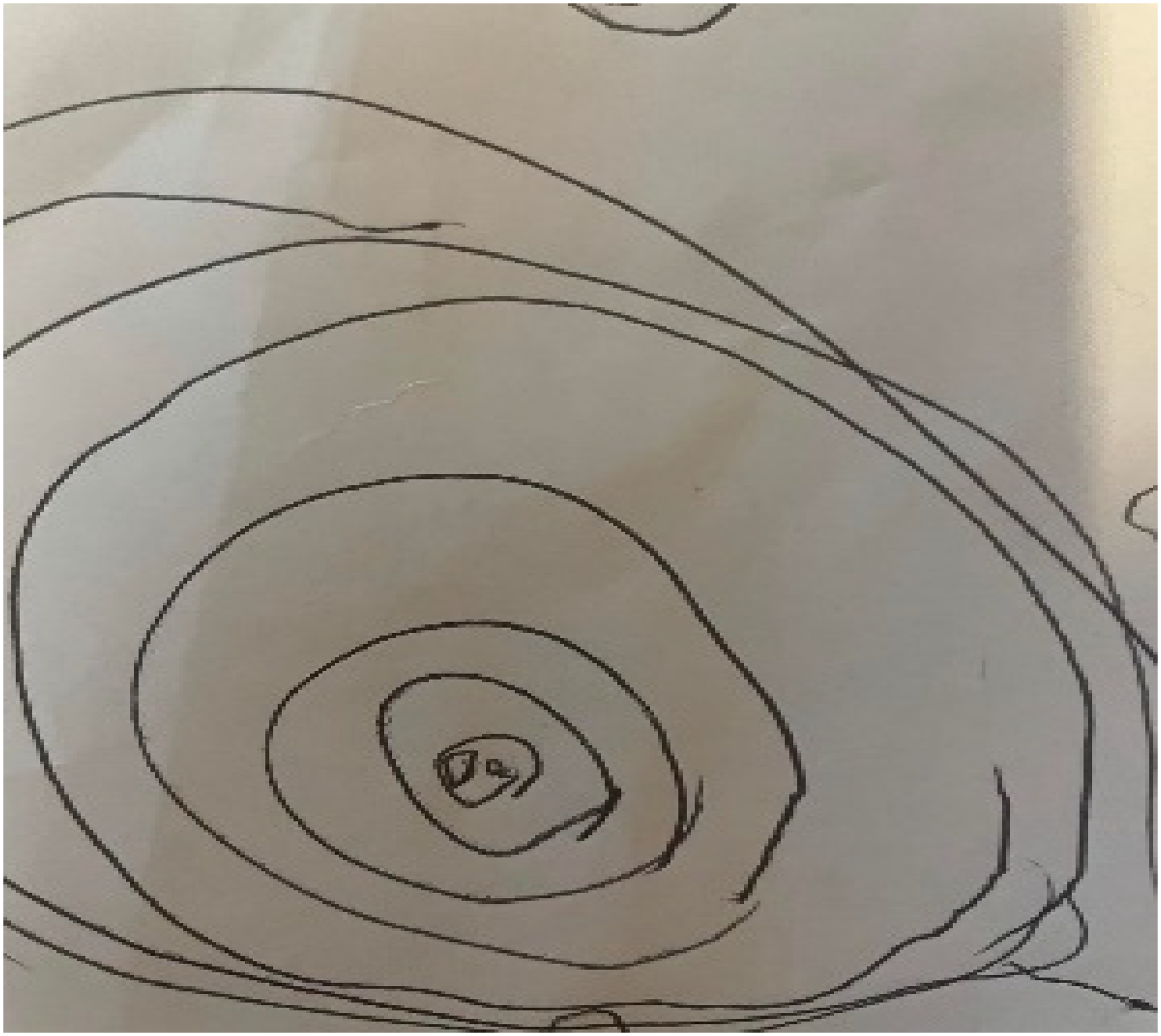
Lily, 5 years. Travelling to other worlds. Being Connected Study, 2020.
Lily was invited to share one of her many extra sensory experiences. For example, Lily, aged 5 years, reported seeing a figure in her room. The figure was later confirmed to be her deceased great grandmother, according to Lily's grandparents. Lily identified her inexplicable visitor, when looking through a photograph album with her grandparents (Thomas, 2022a). Lily was invited to share other experiences. The image in Figure 2 was drawn by Lily, a spiral-like image with two smaller circle shapes in the centre. The researcher enquired with Lily, asking what the picture represented.
R = Researcher; L = Lily, aged 5 years; […] silence
R: I love your picture Lily may I ask what it is? L: pointing at the picture and following the pattern with her finger […] I go through it R: That's very interesting Lily, can you tell me some more about that? L: erm [silence…returns to the picture with her finger again following the pattern] it takes me to other worlds I go through it *Lily is then distracted and runs towards other play items in the room
Natural semiotics extends dialogue beyond social constructionism, to find wider explanations for why children like Lily and Oliver, might produce abstract images to represent transcendental or other types of extra sensory experiences (such as out of body experiences, Thomas, 2022a, 2022b, and near death experiences, Thomas and O'Connor, 2023). Turning to fields such as archaeology (Von Petzinger, 2016), cultural studies (Ricciardone and Danesi (2023) and indigenous studies (Laack, 2019), shows how abstract markings are often located within cultural mythology, religious texts and engraved into stone walls, structures and caves. Symbolising the collective and universal features for these kinds of markings (Von Petzinger, 2016). Children's signs and their meanings may represent a protosemiotic influence (Nöth, 2001), of primordial patterns in nature, with the natural world carrying intrinsic semantic value (Kastrup, 2019). Encoded in children's abstract images is something beyond the worlds ‘face-value appearances and is amenable to interpretation, just as ordinary dreams’ (Kastrup, 2019: 55). When gleaned through a natural semiotics, children's extra sensory representaman, challenges and interrogates mainstream cartesian values which hold the believe: That the semantic value of the world is simply an artifact of human minds. The world doesn’t have a story to tell, a suggestion to make or an insight to convey. It isn’t saying anything. There is nothing meaningful to be gleaned from the world, just utilitarian predictions to be made about its behaviour. (Kastrup, 2019: 56)
Extra sensory signs and semiotic systems
Mandalas are a good example of a symbol which transcends cultures, geographies and time (Jung, 1973; Shayka, 2000; Harms, 2011). Mandalas are often viewed as vehicles for self-exploration (Holbrook and Comer, 2017). In Jungian psychoanalytics (1973), the mandala symbolises the self and aspects of the collective unconscious, ‘and thus, its physical manifestation is a psychological expression of the self’ (Holbrook and Comer, 2017: 203). The mandala is iconic and transcends socio-cultural identities, appearing across diverse cultural, mythological and religious landscapes (Zaluchu and Widjaja, 2019). Mandala-type doodles and geometrical patterns emerged in lieu of narrative resources, when children tried to represent transcendent experiences, out of body experiences and near death experiences (Thomas, 2022a, 2022b; Thomas and O'Connor, 2023). Jacob, aged 5 years, creates a mandala-type image when invited to share his own experiences. Jacob has reported engaging with deceased loved ones in dreams and philosophises often about the nature of reality. The researcher asked Jacob if he would like to share one of his extra sensory experiences. Figure 3 shows Jacob's image.
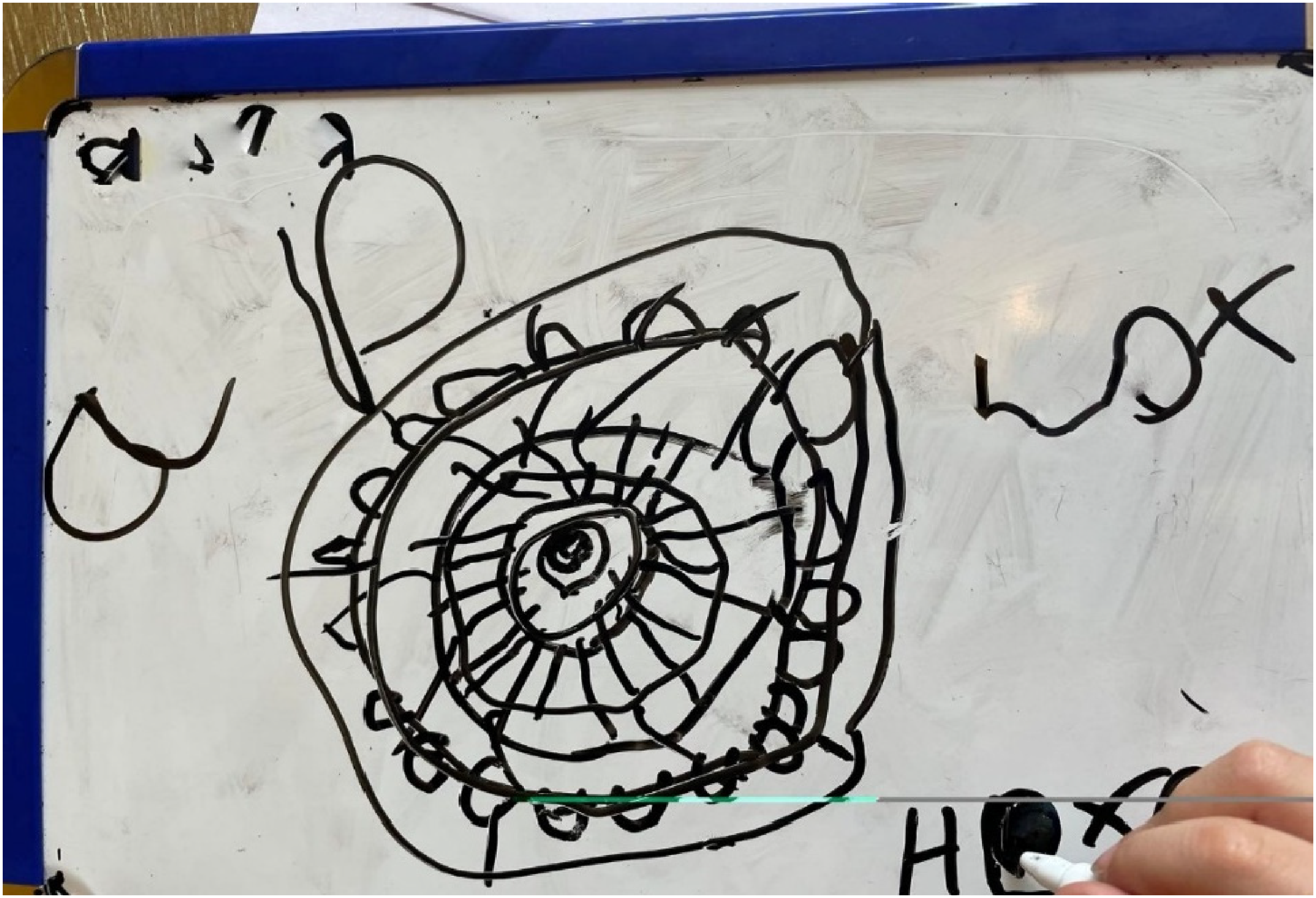
Jacob, age 5 years, Our Unusual Experiences Study, 2022.
Like Lily, Jacob described his mandala in terms of a portal between the everyday world and other-wordly dimensions, implying a shift from one state of being to another. Examining Jacob's image in its situated context (research framed with a question around extra sensory experiences), and in relation to its system (mandalas across the dataset, across time, geographies and cultural cosmologies), can support wider meanings imbued in Jacob's sign. What becomes interesting with Jacob's image is its movement between situated and universal meanings. A ‘methodological alchemy’ (Ptolemy and Nelson, 2022) was present, where all elements were appealed to in the act of co-interpretation – elements of images, sounds, bodies, spaces, interdiscursivity and dialogue with the numinous, living experiences, and wider theory and philosophy (Thomas, 2022b). For example, for Jacob, the mandala emerges as a representaman for his self and for circling from one sense of being to another (Thomas, 2022b). Jacob reveals how the middle point of his mandala is an ‘eye’ (I) ‘that fills everyone with magic’ (Jacob, aged 5 years).
Mandalas and circular images, such as cruciform, are viewed in various cultural practices as cosmological diagrams, expressing divine order and harmony (Leone and Parimentier, 2014). Sanskrit definitions of the mandala are synonymous with ‘Chakravala’, meaning a cosmic disc or wheel, with chakra as a derivative term, implying circular movements (Shayka, 2000). What is signified through abstract patterns and symbols can be difficult to read without relationality or binaries (Saussure, 1964). Yet the mandala's meaning is part of a system of signs which transcends both Jacob's and the researchers limited and secular cultural knowing – to speak with ‘that which is known whether it be conscious or deep in the personal and collective unconscious’ (Harms, 2011: 89). The system of meaning the mandala sits within is a geometric logic that is universal, ‘giving expression to a changing consciousness of the self…it is the philosophical a priori concept of Plato and Kant that the order in the universe exists in itself, but it is for us to recognize’ (Harms, 2011: 89).
Symbols, paint and ‘out of this world’ experiences
Not all children's extra sensory images are highly abstract, especially when the experiences can be referenced with events and activities in the everyday world. Cora used art methods to share an experience of an exceptional dream. Dreams are viewed as representational of the days’ activities, or as aspects of trauma (Miller et al., 2021), as social dreaming or as unconscious elements of a wider social unconsciousness (Neri, 2004). Exceptional dreams are distinguished from conventional dreams, by scholars in fields such as parapsychology (Krippner, 2017), transpersonal psychology (Bogzaran, 2003) and indigenous studies (Shawanda, 2020). Characteristics of exceptional dreams include lucidity, predicting future events, receiving information not previously known, and engaging with different worlds and entities (Bogzaran, 2003). Cora's example is from a research group conducted with ten children aged 10–11 years in a primary school context. The research question, ‘Using your materials, can you share an unusual experience you’ve had?’, prompted children to share their experiences. Cora selected paints, sequins and tissue paper (Figure 4).
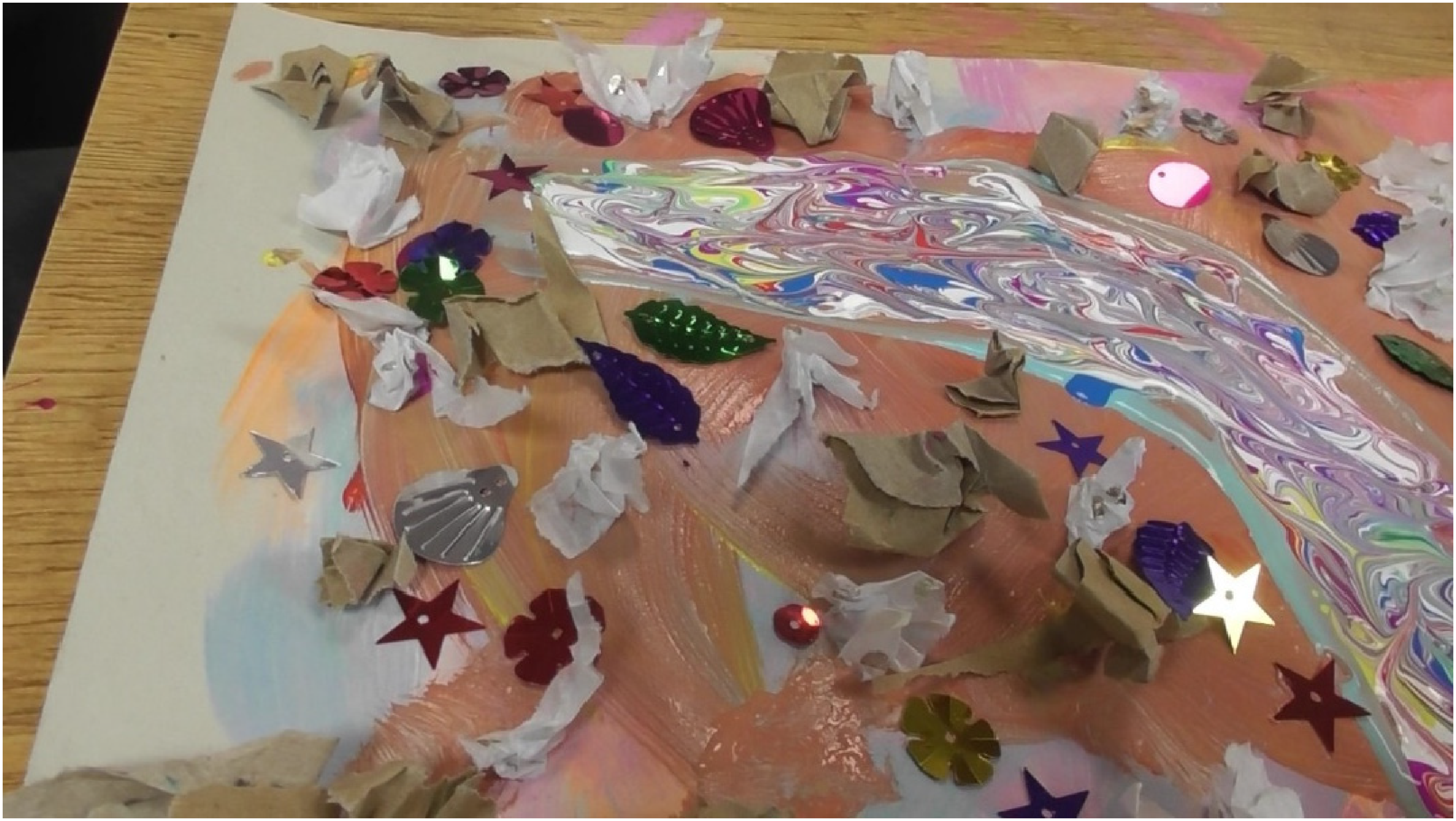
Aged 10 years. An exceptional dream. Our Unusual Experiences Study, UK, 2022.
Asking Cora research questions during the creative process proved valuable for Cora's reflection and discernment – and for developing the researcher's understanding. Creative research methods are shown to enable children to deeply reflect on their experiences and report findings, generating rich data (Leigh, 2020). The paint and additional art materials used by Cora, carry iconic and symbolic functions (Barthes, 1986; Peirce, 1931–1958) through shape and colour. For example, without talk, the researcher identified the streaks of paint as a river, reading its iconic (Peirce, 1931–1958) or denotive (Barthes, 1986) functions. Other aspects of Cora's image required talk, such as the pieces of brown and white tissue paper Cora used to represent abstract mental processes, such as thoughts. The colours carry symbolic meanings (Barthes, 1986; Peirce, 1931–1958), with white representing positive thoughts and brown, negative thoughts, that are dispersed chaotically across the paper.
The shiny shapes represent memories, although not Cora's memories. Thoughts and memories are mental processes that do not usually pose issues for telling stories. Yet, the memories, according to Cora are not her own but belong to a woman experiencing the dying process, an example of a collective dimension of experience (Harms, 2011; Thomas, 2023). For Cora, the images represent what happens after death – a process shown to her by a woman in her dream. As Cora describes, “It wasn’t like a normal dream. I was actually there and watching this woman and what was happening after she died. It was like she was showing me what happens when we die”. (Post-reflective discussion, Cora, aged 10 years)
Cora uses the colours available to her, despite how the colours that Cora experienced are described as ‘out of this world’ – having no referential nouns or verbs to describe them. Painting the experience and reflecting on the process, afforded opportunities for Cora to piece a narrative together. Usual elements of narrative construction such as chronology of events and situated knowledge (that imply familiarity with the place) were missing. Abstract references are used to define the place Cora experiences in her dream. For Cora: “It's where you go when you die erm (…) you float down a river of colour Whenever you get to the end then it goes blank you can then start again like (….) create a new world I saw the woman who was showing me in my dream on the news the day after and she had died (…) Memories get blurry when you float down the river Erm negative thoughts don’t go all the way with you” (Cora, aged 10 years)
Cora struggles to storify the strange contents of her experience, such as knowing future events before they happen. Other socio-cultural influences which can rupture children's narratives, include fears around not being believed, or assumptions that these, and similar experiences (especially hearing voices and visions), are disordered (Thomas, 2022, 2022a). Dreams are socially acceptable events and representing experiences as dreams reduces the risk for children's experiences to be considered as fantasy or madness. Dream-tellers ‘need to demonstrate that – although in their dreams they saw and did strange things – they are normal and reliable agents’ (Bardina, 2021: 254). Using creative methods enabled Cora to bring her extra sensory experiences into the world. Contradictions arose when Cora's discursive and methodological choices became jeopardised through the researcher's need to bring Cora's ‘out of this world’ experience, into the world. The researcher became aware of this contradiction between centralising Cora's image sui generis and the need to generate talk around the image. Languaging Cora's experience reduced the intensity and fractured its meanings – exposing a reductionist process. Yet it was necessary to generate linguistic and shared understandings around the experience Cora chose to convey.
The value for centralising children's ‘out of this world’ images
Appealing to aspects of different semiotic approaches has been valuable for centralising images as primary modes of knowledge production in extra sensory research with children. Examining children's abstract images through a natural semiosis orientation (Noth, 2001; Tarashi, 2012; Leone and Parmentier, 2014), highlights the significance of these images as a discourse in their-own-right. When children's experiences and signs are located within wider semiotic systems (Peirce, 1931–1958; Noth, 2001; Tarashi, 2012; Leone and Parmentier, 2014) or legitimised through emerging ideas of the world (Kastrup, 2018a, 2018b, 2019), experiences cannot so easily be dismissed. Matthews (1984) brought attention to children's scribbles as conduits for symbolic meaning, having functions such as monitoring and representing the movement of imagined objects through space and time (Matthews, 1984). For children's ‘out of this world’ experiences, the transcendental objects to which signification relates, are beyond typical models of space and time (Thomas, 2022a, 2022b) – requiring an appeal to ontic possibilities for mental templates of nature which extend into minds, bodies and the world (Kastrup, 2018a; 2018b, 2019). Abstract images like Oliver's, Lily's and Jacob's are semiotic mediators between the everyday and the unreachable, unknowable realms of experience, often missed in research with people (Thomas, 2022b).
In extra sensory research, children show how experience can fly beyond a priori social reality, with their images, ruptured narratives and embodied representations, alluding to natural and multidimensional realms (Thomas, 2022a, 2022b, 2023). Children often appeal to naturalistic explanations of their extra sensory experiences, arguing for a telos 2 in the natural world, itself imbued with meaning and purpose (Thomas, 2022b; Kelleman, 2004). Children also express a deep interconnection with the natural world and universe in several types of common experiences, such as transcendent, out of body or near-death experiences (Thomas, 2022b, 2023). A strong alignment with natural signs and children's images, challenges semiosis as primarily socio-culturally constituted – warranting further examination, when the nature of subjective experience remains elusive and still under debate (Albhari, 2020; Chalmers, 1995; Kastrup, 2018, 2019; Shani and Keppler, 2018). Children's extra sensory experiences break not only societal laws, but mainstream physical laws too – through experiences such as travelling outside the body, knowing future events before they happen, or reading other people's minds (Thomas, 2022; 2022a).
Researching the non-normativity of extra sensory experiencing shares similar issues with individuals and groups who challenge normative social assumptions. For example, non-normative identities, such as individuals who identify as asexual can face the same limitations for having meaningful discursive resources to draw upon in research (Mitchell and Hunnicutt, 2019). Natural semiotic approaches may be a useful way to research with emotional, subterranean and psychic experiences, which cannot be represented verbally. Reaching into the natural world may offer, or make-know, deeper epistemic influences and locate where people's experiences are situated within wider systems of meaning. The linguistic and non/linguistic debate, grapples methodologically with images as data (Lovell and Banfield, 2022). Applying natural semiotic approaches to visual data may support the tensions for privileging various experiences, epistemologies and modalities. The researcher's compulsion to hold tightly to the linguistic aspects of data becomes greater when working with material considered ‘out of this world’. Natural semiotics does not exclude the social or cultural aspects of images, rather it reorientates signs, including natural and universal aspects for experiences and their meanings. Being with the sign in-its-own-right, offers affordances to access an ‘unreachable knowledge’ (Arendt, 1971).
Applying highly complex analytical frameworks, such as semiotics, with co-interpretation with children, brings its own challenges. As a specialised knowledge, semiotic analyses of children's images carry a real potential to exclude children's own insights and interpretations. Co-interpretation is a crucial aspect for natural semiotic approaches, as an act beyond member-checking and typical processes to avoid the limitations inherent, when analysing data without participants insights (Livari, 2018). Rather, co-interpretation emerges in unison with the creative experience, in layers of meanings and modalities that can be slippery, elusive, and held in moments of wonder (Elwick, 2020). Co-interpretation of extra sensory data with children is active, fluid, embodied, and at times, silenced, moving between language and sign, the social, the numinous and the natural world. It is a process too, that can present numerous challenges ‘in terms of representation, as the researcher endeavours to listen to children's voices to understand and portray their perspectives accurately’ (Tatham-Fashanu, 2022).
Mannay (2010) considers how visual methods of data production can afford a suspension of the researcher's preconceptions of familiar territory, as an approach for ‘making the familiar strange when the researcher's own experience mirrors that of their participants’ (p. 91). Escaping customary habits of seeing and thinking (Tatham-Fashnu, 2022) in extra sensory research with children, entails the need for a transpersonal reflexivity on the part of the researcher (Thomas, 2021, 2022b). Children can contest, agree, adopt or reject wider interpretations for their experiences – the aim is to generate collaborative dialogue, a dialectic between children's living experiences, representations, adult interpretations and other ideas of the world (Thomas, 2022b). If extra sensory experiences interrogate hegemonic materialist ideas of the world, what follows is a need to rethink methodologies which privilege the constructionist paradigm which dominates creative research.
Limitations and further research
Limitations for the research emerge in the research context and within a wider policy context. For example, co-interpreting images with children is timely and requires resources such as spaces and commitments by gatekeepers to afford children time to engage. It can be challenging to centralise the image without seeking narrative explanations for what the sign is pointing to, that may either reduce or expand the sign's intended meanings. A central aim for research with children is to access children's epistemological authority over their own living experiences. Participatory research with children has a transformational aim in the process of informing service development and policy formation. Abstract images as data may entail more difficulties for conveying children's experiences to policy makers. The risk for adult reinterpretations of children's images becomes greater when they are decontextualised from the research moment. Children's abstract images as a discourse-in-their-own-right have the potential to inform service development, especially in the areas of mental health and education. A more robust system of signs developed from children's abstract images may need to be identified. To achieve this, children's out of this world images collated from present and future studies will be collated and co-analysed (with children) in relation to their wider system. Centralising children's out of this world images in research using a natural semiotics approach, although embryonic in its approach, carries research potentials for making known the unknowable.
Footnotes
Declaration of conflicting interests
The author(s) declared no potential conflicts of interest with respect to the research, authorship, and/or publication of this article.
Funding
The author(s) received no financial support for the research, authorship, and/or publication of this article.

Notes
Author biography
Donna M Thomas is a Co-director of ICreateS International Research Unit at University of Central Lancashire. Donna leads on a programme of research which explores the nature of self and experience with children, to inform social transformation and services which support children and young people. Co-developing creative research methods with children and young people is a key area of work. Donna advocates for children's involvement in areas of scientific research, such as consciousness studies, philosophy and parapsychology, arguing for excluded epistemologies and discourses of children in the development of ideas that influence society. Key areas of interest are living experience, epistemology and ontology in social research. Donna has published several articles and a book on children's extra sensory experiences, the nature of self and post material philosophy.