




Abstract
Advances in online data collection spurred on by a pandemic springboard have been well recognised, but less attention has been given to corresponding approaches in recruitment. This article addresses this gap by examining whether recruitment challenges can be overcome by utilising personalised recordings to recruit interviewees. Developed to engage elite interviewees in challenging circumstances, this innovation opens up methodological considerations of recruitment. Drawing on researchers’ and participants’ reflexive accounts, the advantages and limitations are considered of employing online recruitment videos which centre on the researcher to initiate connection. The contribution of this analysis is to foreground multiple goals of recruitment and expose the complexity of establishing recruitment efficacy. Moreover, it identifies three challenges of recruitment methods concerned with alienation, exclusion, and researcher well-being. Notwithstanding such shortcomings, this article argues videos offer an alternative recruitment method appropriate for the digital age that could be utilised for both online and in-person interviews.
Keywords
Introduction
This article examines the recruitment challenges that researchers face when undertaking research interviews and considers the arguments in support of and against employing online introductory films to recruit interviewees. Online research processes can still have value after the pandemic restrictions are lifted (Willis et al., 2021). There has been considerable discussion concerning online methods as a means of conducting research data collection during the pandemic, but less work has focused on its use in recruitment. Recruitment emails have long been a mainstay in online recruitment practice, but multimodal approaches which step beyond textual limitations are rarely considered. The main purpose of this article is that the methodological adaptations which were introduced to overcome the interview recruitment challenges of conducting elite interviews in a pandemic context can inform future approaches to negotiating access for research interviews. It relates the recruitment lessons for elite interviews to methodological insights in online interviews found in both pre-pandemic literature and contemporaneous studies conducted under pandemic restrictions. Attention is given to introductory videos distributed via gatekeepers as an innovation in interview recruitment practice that was piloted in the present study in response to the methodological recommendations from previous studies. The interviews were conducted by three researchers. All three researchers discussed the possibility of using recruitment videos, but two of the three chose not to use videos in the end. This paper pays attention both to the justifications for undertaking this method and the explanations why some researchers chose not to deploy it.
This article begins with a brief introduction to the context of our own methodological challenge of conducting elite online interviews between 2021 and 2022 to provide the backdrop for the development of this recruitment method. It then draws on extant literature about recruitment challenges for elite interviews, online research methods and contemporaneous accounts of the specific recruitment challenges that a COVID world presented us as researchers, which informed the justification for the development of introductory recruitment videos that were piloted in the present study. It analyses reflexive accounts to consider both the advantages and limitations of such a method. It closes with an evaluation of the long-term lessons that can be drawn for interview recruitment. In so doing, it unveils multiple goals of recruitment, addresses the complexity of establishing the efficacy of recruitment approaches and identifies the limitations of using online videos for recruitment in terms of alienating or excluding potential participants and the emotional labour of the researcher. Nevertheless, it recognises the opportunity that online videos might represent.
The context of our methodological challenge
Our research project set out to examine the systems of patronage within Welsh civil society. It sought to capture first-hand accounts from trustees and those in other positions of patronage (presidents, ambassadors, and a range of honorary roles), recruited from notable Welsh charities across a range of settings. It aims to contribute to the literature on elite sociology. Elite sociology has been experiencing a revival which has been partially fuelled by recent attention on the wealthy elite and their role in increasing economic inequality (Khan, 2012). There are diverse strands of elite studies literature. A focus on elites has been fuelled by analysis of the rise of populism and its associated discourses that compare the populous to the ‘corrupt elite’ (Gifford, 2020; Mudde and Rovira Kaltwasser, 2012; Richards, 2019; Stoker, 2019; Zizek, 2006). Elite reproduction literature has been influenced by Bourdieu's concepts of cultural, social, and symbolic capital alongside economic capital (Bond, 2012; Bourdieu, 2018; Reeves et al., 2017; Shucksmith, 2012; Uhlin and Arvidson, 2023). Separately, growing understandings of globalisation have led to an interest in the group of transient transnational elite (Kalm, 2023; Kunz, 2016). Although these routes into elite studies are broad, there has been a lacuna of studies concerned with the civil society elite (Korolczuk, 2022). Thus, there is a much smaller subset of literature that is concerned with elites in charity and voluntary sector settings (Johansson and Kalm, 2019; O’Brien et al., 2022; Uhlin and Arvidson, 2023). Some focus on elite individuals such as those studies concerned with philanthropists and philanthrocapitalists (Haydon et al., 2021). Others are concerned with the civil society organisations that are considered to be elite, given their close relationship with governments (Korolczuk, 2022). This study sought to bring these two strands together to look at the individual elites who occupy senior roles within the organisations that might be considered to be elite organisations in terms of their close relationship with governments or their position in the national civil society landscape. The case study organisations were purposively selected to reflect different aspects of political, cultural, social and economic capital in Wales. They included organisations such as the Welsh National Opera, The Royal Welsh Agricultural Society, Community Foundation Wales, the National Library of Wales, the National Museums of Wales and the Wales Council of Voluntary Action. The elite individuals of interest in this study were those in elite patronage roles, adopting a broad definition of patron which includes those in senior roles that donate their time and reputation to these charities (Tribe, 2020).
Elite interviews were intended to be the primary form of data collection. Literature concerned with elite interviews is another distinct strand of elite study. It is commonly associated with political research (Garnett and Lynch, 2012). In this context, the definition of ‘elite’ is contentious as Smith (2006: 645) explains, because it may refer variously to people who influence important decisions, have an elite form of knowledge, work within prestigious organisations, have control of resources and/or have seniority of position in authority. All of the above applied to our interpretation of elite, since we sought to recruit elites who occupied senior volunteer roles (Harvey, 2011). We included trustee board members which differ from the definitions of patron used by charities (Tribe, 2020). These data were supplemented with a post-interview survey with the aim of conducting a social network analysis, which is discussed elsewhere.
Like other researchers across the globe, our research team faced the challenge of setting up and then conducting data collection during a period of pandemic social distancing measures, which required considerable adaptation to how the research methods had originally been conceived. Data collection began in May 2021 which was in the period following the third UK lockdown. In Wales, social distancing measures still applied to people outside of one's extended household. Therefore, both interview recruitment and the interviews themselves needed to be conducted online at the outset.
Given that the first UK lockdown began on 23 March 2020, there had been 14 months of other ongoing research projects during the pandemic. This provided a limited but vital source of experiential knowledge upon which we could draw. Pre-pandemic, there was a small pool of researchers who had begun to overcome the logistical considerations of conducting online research during a humanitarian crisis, such as Chiumento et al. (2018), who conducted research into post-conflict mental health in three South Asian countries where conflict and disasters had disrupted basic infrastructures. The realities of the challenge of conducting research in a crisis scenario needed to be quickly grasped by the wider research community. The pandemic required researchers to embed responsiveness into research design (Ravitch, 2020). Much of the learning about pandemic research had yet to make it into peer-reviewed journals so we also drew from a range of online research methods seminars. Additionally, we consulted the extensive body of literature that examines the methodological nuances of setting up online interviews, which leapt from its relatively peripheral position to being central to the academic community. Yet acquiring proficiency in online research methods has always been a fast-moving target, even pre-pandemic, given the speed of technological innovations that quickly leave methods outdated (Snee et al., 2015). This rapid pace increased exponentially with the dramatic change in internet usage that occurred as a consequence of lockdown policies. Thus, we sought to synthesise the contemporary researcher accounts of responding to the pandemic with extant insights on setting up online interviews. These informed our own approach and led to specific adaptations in recruitment practice to mitigate challenges of participant recruitment during a pandemic (detailed later). The wider lessons for conducting online data collection during a pandemic have been addressed elsewhere, so this paper does not seek to rehearse these accounts. However, relatively little methodological attention has been given to the specific challenge of securing research participants during this pandemic period. It is common to provide some detail of the recruitment process utilised by researchers but a more thorough methodological examination of recruitment methods is often omitted, even though it can have a profound impact on the nature of knowledge production (Kristensen and Ravn, 2015).
Having set out the challenge that our study faced attention is now given to this synthesis of methodological literature about recruiting elites with previous analysis of recruitment for online research and researcher accounts of recruitment during the pandemic.
Understanding elite interview recruitment
The elite status of the interviewees is important to acknowledge, since scholarly advice on interviewing is not always appropriate for elite interviews (Harvey, 2011; Li et al., 2021). The literature on elite interviews recognises that these groups can be difficult to access (Breeze, 2023; Li et al., 2021). Reasons for this include the obstacles presented by gatekeepers, such as personal assistants (Marland and Esselment, 2019), and also potentially due to their unwillingness to be subjects of scrutiny (Odendahl and Shaw, 2001). The challenge of recruiting volunteer elites was compounded by the circumstances that we found ourselves in.
In a pandemic, many of the usual researcher strategies for negotiating access to recruit participants were no longer available due to social distancing restrictions (Valdez and Gubrium, 2020). These included the logistical difficulties of accessing participants who were not meeting in groups or organisations (Ravitch, 2020). Email communications, which are the mainstay of recruitment approaches, were still available. These were limited in the UK because offices were shut, many administrators were on furlough and even accessing email addresses that were not readily published online became more challenging.
The gatekeeper is instrumental in providing researcher access to such interviewees (Kristensen and Ravn, 2015). Odendahl and Shaw (2001: 307) recommend developing relationships and “considerable rapport” with key individuals who can provide a picture of the institutional culture since they are often best placed to provide the best entrée to the individuals whom the researcher wishes to access. Understanding which gatekeepers are relevant in the context of these senior volunteers in civil society organisations was therefore pivotal. The Chief Executives’ relationship with their board is paramount since they are themselves elites and they have a unique interdependent relationship with the volunteering elites that constitute the board members of their charities (Mole, 2003). Yet voluntary sector studies have recognised that while Chief Executives have dominant power in some charities, the Chair can be dominant in other charities and which is dominant is dynamic and can change over time (Cornforth and Macmillan, 2016). Thus, the individuals who play either role serve as important gatekeepers to the rest of the board or other senior patrons when seeking to recruit these elites.
Developing relationships with such gatekeepers requires ‘a mixture of ingenuity, social skills, contacts, careful negotiation, and circumstances’ (Odendahl and Shaw 2001: 305). Researchers were reporting a greater reliance on gatekeeper organisations during the pandemic both within the public sector and third sector (Cullingworth, 2021). Successive lockdowns proved quite an impediment to developing these relationships (Nakueira, 2021). Therefore, research conducted earlier in the pandemic identified pre-established connections prior to the pandemic and online secondary data analysis as vital recruitment tools (Nakueira, 2021).
Nakueira (2021) proposed that the personality traits of passion, boldness and persistence which she prized highly in her own approach to research had greater importance during the pandemic in order to access research participants, given the additional challenges of recruitment that she had faced during the pandemic. However, there are ethical considerations concerning persistence. Pre-pandemic, attention had been given to how the ethics of online interviews differ from those of in-person interviews (Deakin and Wakefield, 2014). When a potential participant does not respond to communications, it is difficult to assess how reasonable it is to contact them repeatedly (Hutchinson, 2015). Some view it as acceptable to send friendly reminders with the assumption that such reminders will be appreciated (Kivits, 2005). Other researchers argue this does not respect the individuals’ right to opt out (Hutchinson, 2015). Interpreting where this line is drawn requires the skilled judgement of a researcher who understands the community they are studying (Hutchinson, 2015). However, such ethical considerations of conducting online interviews at the pandemic's peak offered a greater degree of complexity because the entire population was experiencing a collective trauma (Ravitch, 2020). Consequently, researchers were reflecting on the burdens faced by potential participants of displaced working practices, caring responsibilities, anxiety and trauma that the pandemic imposed (Ravitch, 2020; Vindrola-Padros et al., 2020). In the context of conducting elite interviews, assessing the appropriate degree of persistence needed to be applied as much to the gatekeepers to secure access, as it did with the intended elite participants themselves.
Building the participant–researcher relationship
The task of recruitment not only aims to recruit participants, but also aims to lay the foundation for the researcher–participant relationship. It has previously been observed that, during online recruitment, potential participants may be concerned by unsolicited requests (Griffiths, 2010; Mosca, 2014). Thus, it has been suggested that providing university email addresses can help overcome these suspicions towards researchers (Mosca, 2014). Furthermore, investing additional time in assurances of confidentiality and conveying credibility, including an online link to a university-hosted page with details of the study is also considered worthwhile (Upadhyay and Lipkovich, 2020).
Developing trust can be harder in online settings (Mosca, 2014). One step to mitigate this is to consider a range of online tools to enable the participant to “meet” the researcher and put them at ease, such as through additional email communications (Deakin and Wakefield, 2014) or with the use of videos or photos (Chiumento et al., 2018). For example, prior to the interviews, Kivits (2005) suggests the researcher can provide information about themselves beyond generic information, presenting their background, including families, work, holidays and hobbies, to build up the relationship with their participants, and encourage them to do the same. Kivits (2005) suggests that this mutual self-disclosure can lead to identifying common ground which may put the interviewee at ease. The researchers disclosing information about themselves has been well documented in the literature. For example, Hammersley and Atkinson (2019: 70) describe the value of disclosures in keeping with normal social intercourse that establish the researcher's identity “as a ‘normal’, ‘regular’, and ‘decent’ person’ in order to build trust. This invoking of an almost pen-pal quality to the communication as advocated by Kivits (2005) may be an effective tool for engagement in some settings, but it may have the opposite effect in other contexts. Researcher self-disclosure can also alienate participants so it does not always achieve its intended interviewee reciprocity (Abell et al., 2006). The form of informal communications recommended by Kivits (2005) could well serve to alienate elite interviewees, who might deem it inappropriately forward. Also, there are risks to the researcher when they make personal disclosures in an online setting, because there is the potential for communication to be forwarded by participants who are not bound by the same code of ethics as the researcher (Neville et al., 2016).
Notwithstanding these limitations to such forms of pre-interview communications, it is clear that the process of recruitment should not simply be regarded as a method to secure participation; it must strike the right balance in respecting a participant's boundaries and also plays an important part in laying the foundations for a trusting relationship between the interviewee and interviewer at a later stage. These insights inspired the research team to consider innovations in how to achieve these multiple functions through the process of recruitment. Attention now turns to the innovations that were piloted in our present study to address some of these challenges.
A recruitment innovation: Introductory videos
Extant methodological accounts of conducting elite interviews had highlighted the challenge we would face in recruiting elites to participate in the research and furthermore, contemporaneous accounts of research during the pandemic lockdowns had emphasised the additional challenge to successfully recruit participants during the pandemic, as detailed above. Moreover, the extant literature on online research methodology had identified the challenge that we would face in achieving rapport with our participants given that we would be conducting online interviews. Therefore, we recognised the value in taking extra steps to achieve recruitment and in researchers finding ways to ‘meet’ the participant prior to the interview (Chiumento et al., 2018; Deakin and Wakefield, 2014; Kivits, 2005). However, we were cautious about ensuring such measures were appropriate for our elite target population (Harvey, 2011). With these considerations in mind, we decided to pilot-producing video messages to recruit participants which would establish a degree of familiarity that was appropriate for elite interviewees.
Much has been written about the use of videos in research yet this largely focuses on videos as data to be analysed, whether videos recorded by researchers as a form of ethnography or videos downloaded from the internet that have been produced by either lay or professional producers (Knoblauch, 2012). Additionally, participatory action research has assigned research participants the control of the camera in data collection, and this has then been used to engage children and young people and/or disabled people in the research process (DeGennaro and Duque, 2013; Kaley et al., 2019; Siry and Mick, 2013). Less is understood in terms of how videos might be used at an earlier stage in the research process in recruitment. There is some limited evidence of the use of animated films to convey details of a study as part of the recruitment process (Stoffel et al., 2022). While such an approach conveys information, it does not provide the opportunity for the potential participant to ‘meet’ the researcher. Participatory action research has also piloted innovative measures for recruiting participants that have involved the use of visual methods or digital technologies. Where such methods are considered, this often aims to engage participants who are considered harder to engage in research. One example is the use of comic storyboards to explain research to young children in order to secure their consent to participate (Tatham-Fashanu, 2022). Another example is Arias-Urueña and Vaghi (2023), who produced information sheets and digital flyers designed to be accessible for disabled children and young people, provided audio recordings of these that were accessible through a quick-response code and circulated these through appropriate networks. They then arranged for either phone calls or online video conferencing sessions where the potential participants could ‘meet’ the researchers prior to deciding whether to take part. This staggered recruitment process was in keeping with the specific needs of their intended participants and the underpinning principle of participatory action research that aims to disrupt researcher–participant power dynamics. However, such a time-consuming multi-staged process would be less appropriate for busy professional elites. Elite participants are considered hard to engage in research, but for very different reasons. The greater time investment required to engage these other groups is the opposite of what is needed for these elite participants. In contrast to these approaches, videos of the researcher were recorded for this present study and sent to the potential elite participants via email.
I led in producing the first set of videos. Given that one aim of these introductory videos was to lay the foundations for establishing interviewer–interviewee rapport in advance of the online interview, attention was given to the facets that would portray the researcher's approachability. The introductory videos involved a single shot close-up of my face speaking directly into the camera. The films needed to be engaging from the outset. Thus, I had rehearsed conveying a friendly, personable tone appropriate for communicating with people in such an elite voluntary role, which aimed to balance the reassurance of my own academic credentials with an amenable demeanour. Prior to recording, I had memorised the contents to avoid it appearing scripted. The intention was to communicate in a style that resembled as much as possible the natural speech of an in-person meeting, albeit without the opportunity for an interaction. Thus, each video began with me naming the intended recipients and then introducing myself, my role, and my institution. It was not our intention to make films akin to those produced by a professional production company. There were neither the resources for this, nor would it have met our aims. The amateur home recording, using a camera facility found on any contemporary laptop or handheld device, ensured the films replicated a form of communication familiar to much of the UK population when in contact with friends, family and colleagues online during lockdown. It has been observed that the pandemic allowed new boundaries to be set between work–life and life–life leading to the development of new professional intimacies (Eggeling, 2022). Similarly, the background conveyed the appropriate domestic setting for lockdown, with the furnishings of my home study/spare bedroom visible including family photos in view. The use of visual artefacts for informally building connections between elite interviewees and researchers has previously been observed (Li et al., 2021). These subtle visual cues gave participants personal information about my life within pre-established professional boundaries. Thus, the films aimed to find a balance between ensuring the recipient felt familiar with my face in a way that approximated having met me, while confining the communication to a form appropriate for conveying information to a person in their senior voluntary role.
Furthermore, we recognised that recruitment methods are more successful if participants are interested in the subject (Kristensen and Ravn, 2015) and that this was vital for overcoming the additional challenges that a pandemic presents. Consequently, these video messages to recruit participants were personalised based on my knowledge of their specific interests that we had drawn from publicly available online information and pre-established relationships within the case study charities. Following my introduction, the content of these films included me giving a brief overview of the research and an explanation of why their charitable organisation was of particular interest. These videos were then tailored to appeal to the individual concerned, so I addressed specific features of the intended participant's background and why that might give them a valuable insight that was worth capturing through the research. In the case of trustee board members, the personal messages of each trustee were collected in one video. The recording ended with a reassurance that their participation was entirely optional, a brief explanation of how they could contact me if they were happy to participate in the research and a thank you for watching the film. The introductory films varied in length but it was felt that brevity was key, so their duration was no more than 2 to 4 min.
Approaching potential participants
The sample was drawn from the patrons of the case study organisations, which included trustee board members alongside other patron roles such as presidents, ambassadors, and a range of honorary positions. These were identified through secondary online data from the charities’ own websites, and those listed as board members on Companies House and the Charity Commission's websites. This scoping exercise provided key background information about these patrons and their eligibility for their roles. The challenge of approaching these senior volunteers is that it is not appropriate for these organisations to publish contact details such as email addresses and telephone numbers, nor to provide these upon request.
In order to approach the target population, we first established a connection with the Chief Executive of each of the case study organisations. These were the key gatekeepers that could afford us communication channels with the intended elite interviewees (Kristensen and Ravn, 2015). If this initial approach was unsuccessful, we would have approached the chair, but this was not necessary, with the exception of one organisation. When communicating with the gatekeepers, we explained the purpose of the research and our data collection methods in order to secure their consent for us to conduct the research within their organisation. Following this, these gatekeepers then became the principal method through which we distributed information about our study to the trustees and other senior volunteers within the charitable organisations. This enabled us to overcome some concerns that the potential participants might have from an unsolicited request (Griffiths, 2010; Mosca, 2014).
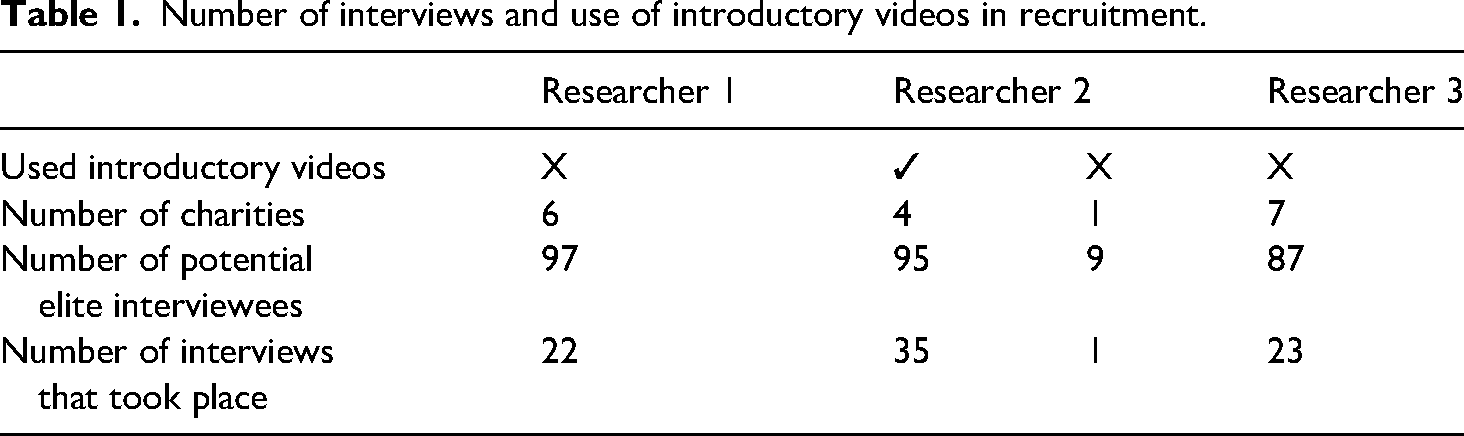
All three researchers made preliminary contact with the chief executives of the charities and used this initial contract to access the wider volunteer elites. All three researchers also expressed an interest in using introductory recruitment videos. However, I was the only one of the three who elected to do so in the end. In total, 82 interviews took place with 18 different charities or civil society organisations, as detailed in Table 1.
Number of interviews and use of introductory videos in recruitment.
In the introductory videos, I named the gatekeeper and explained that this gatekeeper had consented to forward this information to the recipient. The information that they were sent included email introductions, the full study background information sheet, and their link to the personalised video message. Where a video was not made, these participants received email introductions and the information sheet. As has been detailed above, the video provides components that the email and information sheet did not. Succinctly these included: (1) familiarity with my face and way of speaking, along with subtle visual cues about my personal life; (2) a sense of “knowing” me as the researcher through my tone and with access to the multiple micro-indicators of temperament and character captured on film; (3) reassurance of the legitimacy and relevance of this research to their volunteering, through the gatekeepers endorsement, the linking of their role and organisation to the research and my academic credentials conveyed through my words and my manner of speech; (4) an understanding of the aims of the research that is more accessibly conveyed by speech than reading a full written description; and (5) a framing of the value that their particular insights can bring to the research and thus reassurance of their own value and a sense of being chosen.
Challenges in assessing the efficacy of recruitment videos
The research team were successful in securing the interviews that they hoped to achieve (N = 82), and this applied to cases that did and did not use introductory videos. The use of these gatekeepers to distribute interview invitations to the elite volunteers cannot be disaggregated from other factors that enabled the success of securing these interviews. A comparison of the recruitment rates for those who did or did not receive a video would be misleading because there were multiple other variables, including differences in the researchers and in the organisations approached. There is a clear obstacle in attempting to measure the efficacy of such an approach by simply quantifying participant numbers in this study. This setting was far from that of a natural experiment. There were so many factors that impacted recruitment which related to the pandemic itself and also to the shift towards online data collection that it necessitated.
An important facet of this that was frequently referenced in contemporaneous accounts of research conducted during the pandemic and in online research methods literature was the benefits of using online interviews. This included that they are convenient, inexpensive and quick for both researchers and participants (Davies et al., 2020; Griffiths, 2010; Mosca, 2014; Nakueira, 2021). Furthermore, online methods may increase researchers’ access to participants (Chen, 2022; Ravitch, 2020). It may encourage participants who would not participate in face-to-face meetings (Griffiths, 2010; Upadhyay and Lipkovich, 2020) and participants who are habituated to online communication may feel more comfortable with online meeting platforms (Davies et al., 2020). As a consequence, some studies reported that the changes towards online data collection dramatically increased their anticipated sample size (Cullingworth, 2021; Hutchinson, 2015). It is therefore difficult to interpret the impact of our study's recruitment approach on achieving success in recruitment. This reflects the well-recognised problem with the causality question, where a number of factors mean that it cannot be said when outputs are solely a result of a particular intervention (Jones, 2011; Engeli and Mazur, 2018). Thus, constructionist researchers have concentrated less on measurable outputs and more on the discursive construction of the perceived efficacy of an intervention (Schmidt, 2013).
Participants' reflexive accounts concerning recruitment
As a research team, we were eager to evaluate the methodological changes that we were introducing, including piloting these introductory videos. Thus, following the interviews, all participants were invited to give reflexive accounts of their interview experience through a post-interview survey that they received via email. As noted above, this survey was already part of the research design providing social network analysis data to supplement the research interviews, so the introduction of reflexivity questions was an easy addition. The reflexive questions in the survey were introduced to meet the call that qualitative methodologists have made for greater use of interviewees’ reflections on the interview experience to advance research methodology (Chiumento et al., 2018; Irvine et al., 2013; Wolgemuth et al., 2015). To implement this, we informed participants that the second part of the research was the completion of a survey immediately after the interview. We allowed time for this within the period allocated for the interview to avoid making additional demands on elite participants’ time. This enabled us to achieve a participative reflexivity without placing undue time pressure on participants (Vindrola-Padros et al., 2020), which was not only appropriate because they were elites, but also given the ethical considerations related to the pandemic strain (Ravitch, 2020). These reflexivity questions invited the participants to comment on their experience of participating overall, specifically on (i) the pre-interview experience, (ii) the interview process itself and (iii) the researcher. Additionally, researchers identified real-time moments of reflexivity from participants in the interview data (Perera, 2020). The researchers also conducted their own reflexive practices and these were shared across the research team through regular online team meetings.
Below, we draw on the participants’ reflexive accounts to assess the use of the adaptation piloted in the present study. Much of the feedback was more concerned with the interview process. However, those who received videos not only gave feedback about the interview itself, but also gave favourable accounts of pre-interview contact, as seen here: Process of being invited was effective. Nice e-mails from both our Chief Executive and the researcher… Researcher very responsive while arranging the interview. (Participant 6, Community Foundation Wales) I thought the researcher communicated well in advance about what was required, was flexible with my timings and engaging. (Participant 7, WCVA) I thought the whole process of participating in this research project was very accessible and streamlined. The information I first received regarding the project was informative and clear. (Participant 14, Community Foundation Wales) Very helpful video introduction to provide background and context to the research and get a feel for the researcher. (Participant 16, Welsh National Opera) Clear and relevant information provided in advance… Interesting idea about video introductions to trustees to encourage involvement in the research. (Participant 1, WCVA) [The Researcher's] initial personal request (including a short video) for us to participate as individuals was done in a very relaxed and welcoming way which made me feel a wish to participate. (Participant 35, Royal Welsh Agricultural Show) I was encouraged to volunteer at a WCVA board meeting, the arrangements were efficiently made, and the online interview worked well and was conducted in a very friendly manner and [the researcher] made the experience very pleasant as well as thought-provoking. (Participant 10, WCVA) I thought the introductory video was excellent and a helpful way of introducing the researcher pre-meeting. [The researcher] made me feel totally relaxed, which enabled a far better interview. (Participant 13, Community Foundation Wales) The whole experience was a good one! The researcher was great and very clear in all communications. The interview itself was great with the researcher putting me at ease right at the start. (Participant 12, WCVA) I'll be honest with you, I get lots of these things. And I'd ignored the first couple of your emails… And then… I thought well there's a video with this. So, I thought, I'll listen to that… The passion of what you were trying to do, I thought ‘Well I'll meet this lady, because she's made an extra effort’. That little video – just a bit of feedback for you… that was a clincher for me… Well, it worked with me. I mean, it may not work with everybody, but I'm somebody that sort of thinks that person's gone the extra yard. So, I'm going to give them something back there. Because that's fair play, she's not giving up. And now she sent me this video message. And I can't delete that… So, I just think there's something in it. It struck me, but your video was the icing on the cake really. (Participant 32, Royal Welsh Agricultural Society)
Those who did not receive videos gave fewer textual comments in their feedback, tended to focus their feedback on the interview itself and did not comment about the pre-interview communication, with two exceptions, see below: Communication about the project has been excellent at all times. (Participant 24, Learned Society of Wales) The researcher was very personable and made the whole process pleasant. Indeed, the whole process from initial overture, interview and to date has been done well. (Participant 37, National Library of Wales)
It is important to acknowledge these data only provide a partial view. Given that researcher self-exposure could alienate some participants rather than establish a connection that the researcher had hoped to achieve (Abell et al., 2006), if the introductory videos served as a deterrent to potential recruits, then their subsequent alienation means we would not have had the opportunity to collect their views. Therefore, caution needs to be taken to avoid overstating the efficacy of this as a research method. Here, the response rate to the video can be revealing, as discussed below.
Where introductory videos were less successful
An important researcher observation from this present study was that the introductory videos were not successful for every case study charity where they were used. Recruitment from the Royal Welsh Agricultural Society was one case study that did not respond well to the introductory videos. There were very few responses to the first introductory video that had been sent out via the Chief Executive's office, notwithstanding that this charity had a notably large number of board members. Keen to recapture the apparent success of previous videos, I recorded a second video that was filmed onsite at their Winter Fair. This elicited very little response either. Those who did respond gave favourable reports on the introductory videos, but the scale of non-communication from the wider board was revealing. However, when formal invitations printed on University letter headed paper were sent out, as a final effort to illicit participants, there was a substantial response. It is important to consider why this was the case for this particular organisation.
The use of the University letterhead to invite a participant proves to be an important tool in recruiting elite interviewees (Marland and Esselment, 2019). In this case study, the formality of the letter was befitting the seniority of their role in a charity steeped in tradition. Of course, it may be argued that the letter had just reached the requisite tipping point of invitations. After all, it is recommended that unsuccessful interview requests be converted by taking one final appeal, provided the persistent contact is deemed respectful (Marland and Esselment, 2019). However, there are reasons why the responsiveness of this case study to the letter should not simply be interpreted as having met the requisite tipping point. For example, this board had quite a large number of senior people in age. Although age may play a part in participants’ ability to engage with online tools (Chen, 2022), generational differences are not the only factors that impact digital engagement (Longhurst, 2017). Insights from Helsper (2021) are useful here because she recognises that extrinsic pressures interact with intrinsic motivations for digital engagement and, as she highlights, motivations and attitudes are the least researched facets of digital inequalities. This board consisted of people with traditional agricultural backgrounds, whose work would have been less mediated by video communications and less impacted by the digitalisation leap that the pandemic imposed in other fields. It is unsurprising then that online introductory videos were not effective in reaching elite volunteers from this setting.
These participants proved that introductory videos are not appropriate for certain samples. The digital divide whereby participants who lack access to computers, laptops and smartphones or appropriate internet access, is known to exclude those experiencing resource disadvantage (Chiumento et al., 2018; Valdez and Gubrium, 2020). However, digital inequalities are a consequence of problems not just with access, but also digital literacy and digital engagement (Helsper, 2021). Recruitment choices including online methods and using gatekeepers will reach certain people and exclude others (Chen, 2022). As this case study demonstrates, it can exclude certain groups within an elite population sample who are not experiencing resource disadvantage. Thus, concerns that online interviews as a method might be exclusionary due to the digital divide should be extended to recognise the similar danger of using digital introductory videos in recruitment.
Thus far, we have considered the participants’ experiences of these recruitment practices. A different perspective can be gained from the accounts of the researchers’ who chose not to use recruitment videos, and it is towards this that this paper now turns.
Why researchers chose not to use recruitment videos
These researchers explained that one reason that they chose not to use this method to recruit was that they were successfully recruiting participants with simple email communications, as explained here: The simple thing is that I was able to just set up interviews without recording those small videos… If I did not have any success in… people agreeing for an interview, I would have thought okay, maybe what's next?… So, it was just that it wasn't required to go to that extent. (Researcher 3) It was a bit more: ‘Well, I've already got a system in mind. And I'm going to use my system. And I'll look at that system [of using recruitment films] and see how it goes. Maybe I'll use that system later’. But yeah – I let you be the guinea pig. <laughs>… If I'd been struggling to get participants than maybe I would have thought ‘okay, what can I do differently?’ But it was going fine. So I was like, Well, yeah, if it ain't broke, don't fix it. (Researcher 1) If they [potential interviewees] were not coming back to me. I'm going to go with something different. And then I will do this… This is for me the next phase – it's a step up. But… I managed to get interviews so [I thought] ‘oh, well why should I do that? (Researcher 3) I’m inclined to think if I did one, I might frighten them off! I thought it was an excellent idea. And I was very much on board with it. But I am a very shy, introverted person, and I do not like being on film. And I would rather hide behind an email, I think, is the honest answer <laughs>. (Researcher 1) I think of myself as quite a shy person… Just to make a video and send it to people. It wouldn't be my first choice. (Researcher 3) Possibly, if it had not been in a… pandemic… If we'd not been semi-lockdown, and if I had not not seen daylight for x months, and you know, was more used to… going out and doing things, doing performances, I would have been happier with it. But… I was really not doing much and not feeling all that great… <laughs> And I didn't want to be on film. (Participant 1)
Early reports of research conducted in the pandemic's first year highlighted that while consideration was being given to accommodate participants’ needs, the researchers’ well-being was being neglected (Calder and McInnes, 2021). This follows a tendency in qualitative research to consider participants’ emotional well-being but neglect researchers’ emotions, notwithstanding their role in the emotional landscape of the interview process (Hanna, 2019). Yet, the emotional work of recruiting interviewees should not be underestimated even without the context of the pandemic, with researchers approaching people with whom they do not have prior relationships, following up on communications that have not been reciprocated and facing rejection (Kristensen and Ravn, 2015). This may leave the researcher without an understanding of the reason for the withdrawal, which can be unnerving (Kivits, 2005). All of these considerations bring us to reflect on the vulnerabilities of the researcher.
The researcher who did utilise introductory videos was not immune to these vulnerabilities, as their account reveals: It was incredibly nerve-wracking to upload and send them. I recorded so many versions of them trying to get it right. It felt like a risk because it is a pretty unusual thing to do… I used to be quite extroverted but the pandemic has helped me embrace a more introverted side of my nature. (Researcher 2)
All of these above factors need to be recognised when interpreting how a researcher might experience the prospect of filming themselves to develop introductory recruitment videos for potential participants that they have yet to meet.
This necessitates consideration of the implications for the researcher's practice. The research community can turn to advances in our understanding driven by equality theorists when considering the emotional needs of researchers. While expanding understanding of emotion and affect is part of a broader sociological movement, examining researcher emotion has been led by feminist researchers (Hanna, 2019). One implication for this in the context of the pandemic was to ensure that there were additional peer support mechanisms in place within the research team (Hanna, 2019; Ravitch, 2020), including risk-assessing researcher well-being from the outset (Hanna, 2019). This may be sufficient in terms of putting in place appropriate support for the researchers in a general sense. However, the extent to which this might be sufficient for the researcher to feel able to take that extra exposing step to produce online introductory videos must be down to the individual choice of the researcher.
This notwithstanding, where a researcher feels able to use this method it seemingly pays dividends in both recruitment and pre-establishing rapport in certain contexts, if we accept the participants’ reflexive accounts of perceived efficacy.
Conclusion
This article examines online videos as a means of recruiting research participants, which has hitherto been an underexplored recruitment method. The premise upon which this paper is based is that the adaptations deployed to overcome the challenges of conducting research with elites at the outbreak of the pandemic can lead us to develop innovative approaches that may inform future practice in other settings. This article acknowledges the challenges of assessing the impact of these videos, but qualitative accounts from participants suggest that these introductory videos had the desired impact. The analysis showed that while such videos are welcomed by participants who were inclined to give feedback, the limitations should also be understood. For example, a hidden cost that this study has revealed is the role that the digital divide can play in excluding certain population groups. Frequently, the exclusionary nature of the digital divide is understood in terms of economic disadvantage, but this study has highlighted that individuals who are perceived to be elite and privileged can also be excluded. This finding makes a small but important contribution to the wider literature on digital exclusion.
More significant to understanding recruitment videos is the discussion that centres on the researcher's feelings about prerecording and distributing a video of themselves. We must be honest about the propensity amongst researchers to self-label with an introvert-identity rendering the prospect of producing such a film abhorrent or imposing anxiety as they send their faces out into the internet ether. Notwithstanding these considerations, it is posited here that such an innovation retains an alluring quality that should not easily be dismissed by the research community. Given the fast pace of change in online practices, researchers must be poised to adapt to social and technological advances. In a world that is increasingly characterised by digital mediation, we must embrace innovative strategies of immersion (Eggeling, 2022). These videos have the potential to quickly convey the relevance of a research project to its target population more effectively than text documents whose contents may serve to alienate individuals in this digital age. Additionally, measures that build rapport with potential elite participants prior to meeting them are worthy of consideration. Researchers seeking to engage other participants who have been labelled as hard to engage may also benefit from similar approaches. While acknowledging the limitations of the recruitment innovation described here, we call on the methodological community to cast a fresh eye on the limitations of recruiting with just an information sheet attached to an email that has become normalised research practice in many cases and instead, explore new multimodal approaches.
Beyond specific consideration of introductory videos, a contribution this analysis makes to methodology is to draw attention to recruitment as part of the research process which is seldom examined beyond a brief descriptive account. It has revealed the dual role that recruitment processes can play, which is not only to recruit participants but to lay the foundations for a trusting researcher–interviewee relationship. In addition, we have exemplified the multiple nuanced micro-cues that the researcher might want to consider when appealing to a particular group to establish a connection, from voice tone to accessories. The discussion has revealed the balance that must be struck between amiable approachability with personalised contact and appropriate respectful professionalised distance. Acknowledging this balance makes a small but crucial contribution to the elite interview literature, as does the discussion about the centrality of the gatekeepers to achieving access in the first place. The researchers’ own reflexive accounts have drawn attention to the hurdles that researchers can face, including inadvertently excluding potential participants and the significance of the researcher's feelings and self-esteem in the course of the recruitment. We have also exposed a conundrum of recruitment whereby the choice of mechanism might alienate some potential participants, yet, such an impact is akin to dark matter since we can hypothesise about its existence, but it is difficult to prove that it has occurred since those participants would not engage to communicate their response. Until the research community begins to grapple with the thorny nuanced questions of recruitment unveiled here, we condemn our projects to dull or staid recruitment practices. We should consider what that tells our target participants about the nature of our research.
Footnotes
Acknowledgements
I am very grateful to Dr Flossie Caerwynt and Dr Najia Zaidi for their peer support throughout this research project and their participation in the reflexive accounts. Thank you also to Dr Jesse Heley and Professor Sally Power for their encouragement.
Declaration of conflicting interests
The author(s) declared no potential conflicts of interest with respect to the research, authorship, and/or publication of this article.
Funding
The author(s) disclosed receipt of the following financial support for the research, authorship, and/or publication of this article: This Patronage, Elites and Power Relations research project was supported by the Economic and Social Research Council (ESRC) as part of the WISERD Civil Society Research Centre (Civic Stratification and Civil Repair) grant number: ES/SO12435/1.

Author biography
Amy Sanders is a Postdoctoral Research Associate at the Wales Institute of Social and Economic Research and Data at Aberystwyth University. She undertook her doctoral thesis at Cardiff University. She is a qualitative researcher with a background in discourse analysis and her research interests are in civil society and the voluntary sector, governance, representation, equality and intersectionality.