



Abstract
This paper presents a new methodological model that was developed whilst carrying out an Institutional Ethnography to explore school food working practices. The model brings together two complementary approaches; Institutional Ethnography and Systems Thinking, to offer a novel approach to the analysis and visualisation of ethnographic data as systems maps that show how power shapes practices. This novel contribution allows for the mapping of complex working practices to show interdependencies and flows, and addresses limitations in the applicability of Institutional Ethnography to policy research. This approach will be useful for researchers and practitioners who want to utilise findings from Institutional Ethnography to design effective interventions, change outcomes of working practices, or tackle policy problems.
Introduction
This paper introduces a methodological and analytical model that was developed to visualise qualitative research findings as systems maps, in order to account for the power imbalances that shape practices. This work makes an important and novel contribution to the development of qualitative research through the application of a systems mapping approach as an analytical and data visualisation model for ethnographic research data, which enhances its accessibility and impact beyond the academy, and in the field of applied policy research.
This model was developed as part of a research project to explore a ‘wicked ‘policy problem, namely why school food policies were not having the anticipated impact on school meal uptake, by exploring the day to day working practices in school food work. The aim of the research was to show what happened when school food workers tried to implement policies, and to make recommendations based upon this analysis. Practices rather than behaviours are the focus of attention here, as this work adopts a framing that sees the performance of everyday life as complex evolving social practices (Giddens, 1984: 2–3). Practices are neither static nor uniform, it is the dynamic quality of practices that makes practice theory such a useful way of exploring how everyday life takes place (Shove et al., 2012). A commitment to visualise the dynamics of practice was a key driver of my exploration of alternative communication methods.
An important focus of my work was to account for the ways that power shapes practice to address an acknowledged shortcoming of practice theory (Vihalemm et al., 2015; Watson, 2013). Many studies that explore how the social organisation of everyday life works to reproduce inequality recognise that there is the need to work to identify (and in most cases, challenge) what are variously described as ‘structures of power’(Cahill, 2007: 279; Weis and Fine, 2012: 173), ‘ruling relations’ (Smith, 2005, 2008), and ‘spatial embeddedness of power’ (Kesby, 2005: 2827) that reproduce ‘circuits of dispossession and privilege’ (Weis and Fine, 2012: 187). School food is an important case study because there is a strong policy framework in place aimed at reducing dietary health inequalities in children through the provision of affordable and nutritionally controlled school meals, and as such, the failure of this policy to have a measurable positive effect is concerning (Impact on Urban Health, 2022). Stabilised inequalities are often the result of an imbalance of power, and so the hope was that mapping the manifestations of power and influence in the school food system would show why the well-intentioned policies were not achieving the desired outcomes.
The contribution this paper makes is to outline a new approach to working with narrative accounts generated by Institutional Ethnography, by using Systems Thinking and scribing to translate them into systems maps that make visible the ways in which power shapes working practices.
Institutional ethnography
The research adopted Institutional Ethnography (IE) as a research approach. IE is a qualitative methodology that was developed by Sociologist Dorothy Smith as a method for revealing hidden work practices that are often subsumed within institutional discourses and highlighting the way that everyday life is shaped by ‘ruling relations’ or power structures, that are often hidden from view in the day-to-day performance of practices. Smith argues that the official account of how work takes place within an institutional context often fails to recognise the many nuanced situations and negotiations that take place to navigate these ‘ruling relations’, resulting in a simplified account of complex work (Smith, 2008). IE is considered a feminist methodological approach as it highlights the gendered nature of the work that is often obscured, and the methodology has been deployed to reveal, for example, the subsumed roles that mothers play in supporting schools, the ways in which care work is done, and the hidden work of managing health conditions (De Vault, 2013; Smith, 2005; Smith and Turner, 2014).
Whilst methodological texts discussing IE often talk about ‘mapping’ social complexity, they are most often written up as a narrative account, or the mapping of a single participant's experience (Taber, 2010; Vannini, 2013; Smith and Turner, 2014), which can be limiting as a way of understanding the ways in which different accounts intersect. Narrative accounts also tend to present findings as a linear description which fails to capture the dynamics and feedback loops of a complex system, or to see where in that system to target an intervention. The researcher decides where to start telling the story, and this becomes where the story begins rather than simply the point in the system at which the researcher enters. To better capture these intersections and visualise the power imbalances that I encountered, I adopted a Systems Thinking approach to the analysis and visualisation of the data produced from an IE of school food practices. My research speaks not only to an academic audience, but also to people working in applied policy research and policy design. The research problematic for this project was set by a local authority school food team, and so the findings needed to be communicated in a format that was succinct, accessible, and engaging.
IE as a research approach involves discovering work problematics through the process of research, rather than developing fixed ideas or hypotheses in advance. Institutional ethnographers must collect data that captures detailed accounts of the coordinated activities that constitute the ‘everyday’ life and work of the chosen area of study (Campbell and Gregor, 2008). Research informants are identified as their work coordinates with others, and so they not only provide their expert account of the work, but also direct the researcher to the next point of enquiry. In this study the line of enquiry started with local government school food officers and led on to school management teams, school architects, kitchen and lunchroom staff, children, and parents.
Texts as coordinators of everyday activities and work are key to IE as a methodology. Institutional ethnographers treat texts as data in order to ‘see’ the creation of discourse. Texts can include memos, policy documents, posters, menus, evaluation sheets and monitoring documentation, and are the carriers of the ideological account of the work practice (Smith, 2005). The focus of textual analysis here is upon how they coordinate and shape work practices, and how different people interpret and apply the content of the texts. It is not possible to anticipate the range of texts that will be encountered until field work commences, only those texts that are ‘activated’ in a working practice by being utilised or referred to in interviews or observation will be analysed. One of my research objectives was to discover the ‘hidden’ textual architecture of the work by asking why people are doing things in a particular way (Smith and Turner, 2014), when viewed from the standpoint of a range of actors who participate in the ‘work’ of school food.
There is a somewhat contradictory claim made by IE to present working practices from the standpoint of the informants rather than through the theorising of expert researchers, whilst at the same time ascribing a role of explicating what is ‘actually happening’ by analysing the way that various accounts intersect. This ‘seeing things as they really are’ does place the researcher in a powerful role in relation to informants, who merely experience the day to day without seeing the bigger picture (Tummons in Reid and Russell, 2017). The exploration of structures of power and how they shape everyday lived experience can be challenging because it requires the researcher to switch attention between the close and local level lived experience, and remote structures of power that may feel vast and unreachable through qualitative enquiry. Looking beyond the institutional context felt at times like I was straying beyond the boundaries of IE, but when so many of my informants spoke about food norms as a barrier to policy enactment, I knew it wouldn’t be effective to stay within the boundaries of school food. Weis and Fine (2012) propose ‘critical bifocality’ as a way to reveal the relationship between groups and structures of power. It does this by thinking about epistemology, design, and the politics of research as a theory of method in which researchers try to make visible the sinewy linkages or circuits through which structural conditions are enacted in policy and reform institutions, as well as the ways in which such conditions come to be woven into community relationships and metabolized by individuals (Weis and Fine, 2012: 174). They propose a method that will enable and encourage exploration of the linkages between what is uncovered ethnographically at the local level; and global shifts and argue that researchers must pay attention to the explicit linkages between collected ethnographic action and narratives, and what is happening in broad context (Weis and Fine, 2018).
Using IE to explore school food working practices meals was very successful as a data gathering approach, allowing for multiple perspectives on a problem, and identifying unexpected and interesting factors shaping school meal provision and uptake. However, a challenge arose when I approached the data analysis and write up stage of the work. Whilst there is frequent mention of ‘mapping’ (Campbell and Gregor, 2008), there is very little detail about how to work analytically with data to produce a map (Murray, 2022). Almost all institutional ethnographies are written up as narrative accounts, which can be read as interesting stories about the field of study but do not lend themselves well to wider application in say, policy development or the design of targeted interventions (Vannini, 2013). I needed a clear and concise way of communicating the findings that would be accessible and useful to policy makers and practitioners, and for that I decided to adapt Systems Thinking approaches I had encountered in public health research reports.
Systems thinking
Systems thinking originated in systems engineering but has more recently adopted by a wide range of disciplines, including community psychology, and latterly public health bodies seeking to understand the complex drivers of health inequalities, and then use this knowledge to better design and evaluate interventions (Egan, 2019; Hawe and Ghali, 2008). Arnold and Wade (Arnold and Wade, 2015: 670) define systems as ‘complex behaviours’, where someone using a more sociologically informed frame may see a social practice or performance. Complexity refers to the range of elements (e.g., actors), locations, technologies and drivers, that coalesce to form a system. The rationale for adopting ‘Systems Thinking’ in more technological contexts such as process design, has been to understand complexity better in order to tame it or adjust outcomes (Arnold and Wade, 2015). When applied to human systems, complexity becomes a defining characteristic of the system.
A feature of Systems Thinking that was especially useful to my work is that it allows for the drawing of systems boundaries to capture remote processes that affect the local context, in recognition of the fact that significant systemic change often requires a fundamental shift in the status quo, and that drawing the boundaries too tightly around the problem can often lead to ineffectual interventions (Foster-Fishman and Behrens, 2007). This approach complemented my use of critical bifocality as a way of looking beyond institutional processes when informants’ accounts directed me there.
IE recognises hidden or ‘subsumed’ complexity as the key to understanding how and why everyday life operates as it does, often in ways that contradict the official accounts of what ‘should’ be happening.. IE is good at exploring complexity, but the rigour of the method often requires the researcher to ‘draw a line’ when exploring the lived experiences of participants ethnographically. It is not feasible to follow every line of enquiry to its conclusion and this can present a challenge when the power dynamics affecting the local context appear to be vast and remote. In this case power dynamics were often expressed by research informants as a sense of powerlessness in relation to competing with the kinds of foods that children and families were used to eating. My job as a researcher was to explore what might be making them feel this way, but this felt like a daunting prospect within the resource constraints of a solo research project. Systems Thinking allowed me to incorporate and account for more complexity than I was able to explore ethnographically.
Systems diagrams as a problem-solving tool
Identifying where a ‘problem’ sits within a wider system of drivers was one of the main objectives of this research, and adopting some of the visualisation methods used in systems thinking has been useful in the presentation of findings in two ways: firstly, it helps to identify the upstream determinants of some of the problems manifesting themselves within the local context; and secondly it supports the identification of interventions at points that would support systemic change, rather than simply continuing to manage the recurring problem at the local scale. Many policy failures (especially targeting public health outcomes) can be attributed to ‘weak prevention’, that is interventions that address the problem but have limited and poorly sustained impact (Hawe et al., 2009: 268). This often happens because the intervention doesn’t draw the system boundary wide enough to attempt to address the upstream causes of problems, many of which (especially in relation to health inequalities) are structural and socio-economic in nature (NIHR, 2017). Dietary health problems such as those school food seeks to address are clearly related to changes in the types of food that people have access to (Kelly and Baker, 2016), and whilst this was often referenced by my research informants, it was usually attributed to people making poor choices rather than to the choices available to them. But I was nevertheless prompted to explore why food choice had become so problematic, which felt challenging within the scope of my research project.
An excellent example of a systems mapping approach being applied to food system analysis can be found in Greenberg (2017) which used this approach to demonstrate how corporations structure consumer food choices in the South African context. Figure 1 is taken from Greenberg's (2017) work and shows the complexity of actors and agents that shape the consumer food environment. I have drawn upon the evidence from Greenberg's (2017) research to demonstrate the scale and complexity of the food system within which school food is operating.
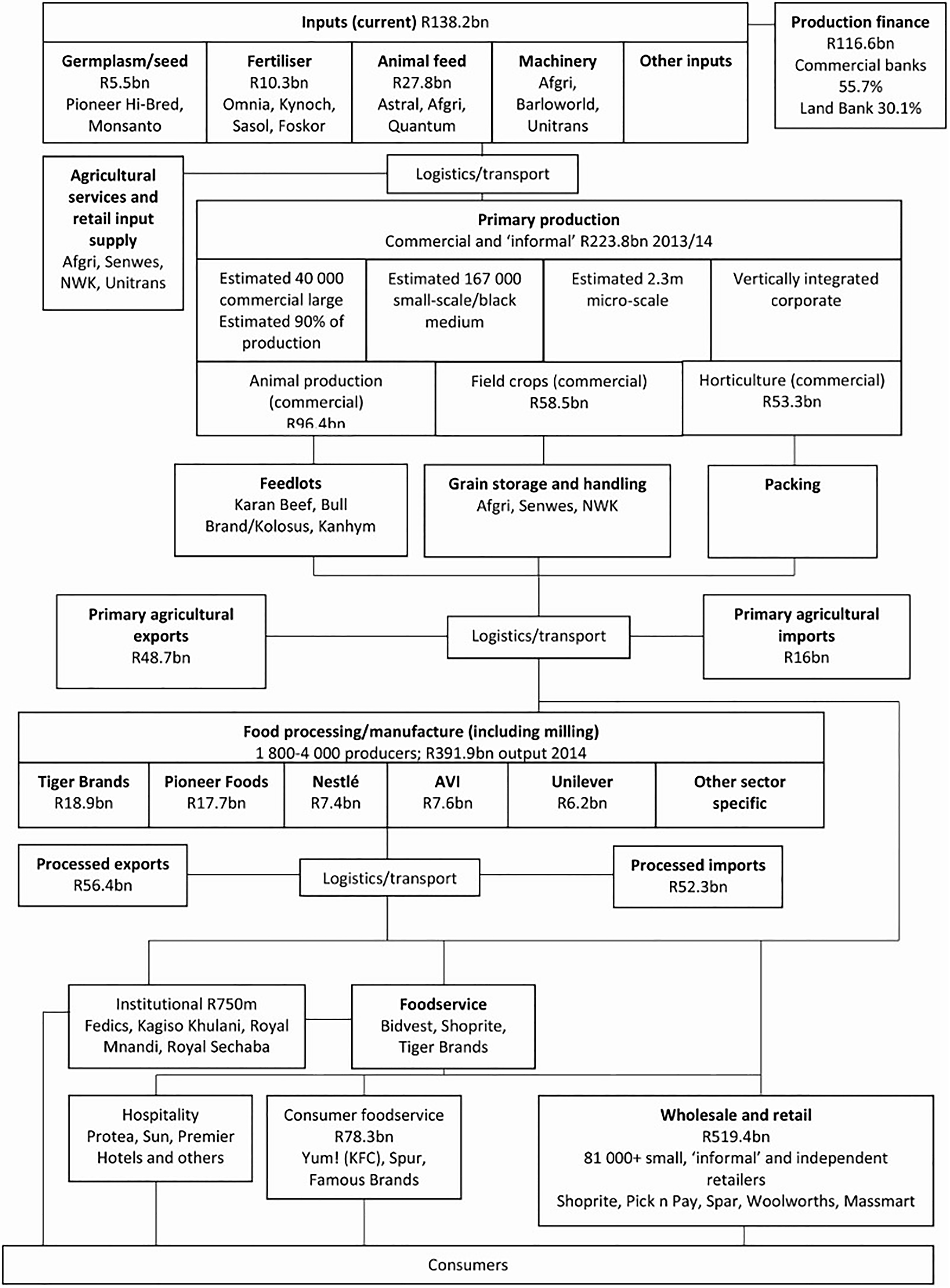
Schematic overview of South African agro-food system structure. (Greenberg, 2017:470).
Systems mapping as an analytical approach
The use of models that include different levels radiating out from the individual and finishing at a macro-level can be both frustratingly simple and profound. Thinking in terms of such levels can be liberating if used for consideration of contextual influences on individuals. (Christens et al., 2007: 234)
Both IE and Systems Thinking recognise the role of power in the shaping of work practices and systems. As the aim of this project was to propose some interventions that could meaningfully address the problem of low school food uptake, it was first important to acknowledge that this would require identifying the dominant power relations that were responsible for the status quo (Christens et al., 2007; Peirson et al., 2011). This can seem daunting, especially when drawing the boundaries of the system wide to capture processes of globalisation and conglomeration within the food system. But if these processes perpetuate the status quo, then system change is not possible without addressing these forces (Foster-Fishman and Behrens, 2007).
My research process outlined
The model discussed here was developed as part of an IE in 3 primary schools in Northern England over a 2-year period. Ethical clearance for the study was obtained from the University of Sheffield ethics committee. I was invited by the Local Authority school food team into schools to understand more about the problem of low meal uptake by exploring the working practices and perspectives of those involved in the day-to-day work of school food. The aim of the research was to use the findings from the IE to make recommendations for improving school food uptake, and the first interview was carried out with a member of that team which established the key aims and entry point for the research. In some schools we’ve only got 60% uptake amongst the children that are entitled to a free school meal, it's a problem! (Local Authority school food team member)
The three schools were chosen by the local authority partner as they had several common characteristics such as being of a similar size (around 500 pupils) and serving a similar demographic population (around 50%-60% of children in the schools were entitled to free school meals). There were differences in the design of the buildings, with two occupying new school buildings (less than five years old) and one occupying a building that was built in the 1930s. The three schools also took slightly different approaches to the serving of school meals, and all were happy to welcome a researcher into the school. The variables were limited to the school food service environments so that the variations in these working practices could be foregrounded, as opposed to seeing how similar work took place in schools that served very different populations. This would also be an important and no doubt revealing context to explore but was beyond the scope of this project.
Data gathering methods in IE are not that different to other forms of ethnographic research. What distinguishes IE is the focus upon the textural coordination of work, looking for ways in which work is coordinated across a number of sites and focusing in particular upon the conditions that shape those working practices. In each school I undertook a preliminary extended interview with a member of the school leadership team with responsibility for the food service. The interviews were guided by an interview schedule that asked the person about their role and responsibilities in relation to school food, and then moved on to asking them about how the work of applying school food policy was done in their school, what challenges they faced and how they worked to manage them. I asked each participant who they thought I should speak to next. Despite having a schedule, interviews followed a largely unstructured format, enabling themes to be explored flexibly and leaving space for the unanticipated to emerge (Savin-Baden and Howell Major, 2013).
Following the leads set by research informants, interviews were conducted between 2017 and 2019 with:
• Three School business managers or deputy heads (with lead responsibility for school food) • Three School Head cooks • Three Kitchen support staff • One Catering company manager • One Local Authority school food officer • One former Local Authority school architect • Three parents The goal for design of research using participant observation as a method is to develop a holistic understanding of the phenomena under study that is as objective and accurate as possible given the limitations of the method. (DeWalt and DeWalt, 2002: 92)
Observation and work shadowing are an important method in IE and were used extensively to provide as holistic an account of working practices as possible (DeWalt and DeWalt, 2002: 92), and because food practices have often become stabilized and habitual through reproduction (Southerton, 2013). In all three schools I was invited to observe and participate in lunch service, in one school I was served lunch alongside the staff and pupils, in another I spent time in the kitchen during lunch preparation and service, and in the third I observed the lunch service from the dining room and then was invited to eat with the staff at the end of the meal service. At all times I was guided by my research informants, being directed to the people and places that they felt were important to the way work was done in their school. During observation and shadowing I took notes and sketches and spoke to staff and curious children about what I was doing in their dining room in a white lab coat armed with a clipboard (a health and safety requirement that the children found amusing).
Use of texts
During the observation and interviews, I was alert to references made to texts. Texts can include memos, policy documents, posters, menus, evaluation sheets and monitoring documentation. They are seen as coordinators of everyday activities and are an important aspect of institutional ethnography. Institutional ethnographers treat institutional texts as the carriers of the ideological account of the work practice (Smith, 2005) and as such, identifying texts was an important ongoing analytical process during interviews and observation of work practices.
The focus of textual analysis here is upon how they coordinate and shape work practices rather upon contents of the texts per se. It is not possible to anticipate the range of texts that will be encountered until field work commences. Only those texts that are ‘activated’ in a working practice by being utilised or referred to in interviews or observation will be of interest. One of my research objectives was to discover the ‘hidden’ textual architecture of the work by asking why people are doing things in a particular way (Smith and Turner, 2014). Texts that were analysed included:
• School menus. • Nutritional standard guidance documents. • School food policy documents. • Schools’ web pages discussing school meal service. • Design and build guidance for UK primary schools. • Headteacher perception survey.
This immersive and evolving approach to fieldwork is a fundamental characteristic of IE. Rather than attempting to identify an ideal research sample in advance of the research, each informant directs the researcher to the next point of enquiry. This comes from the tenet of IE that holds the informants as experts rather than the researcher, the researcher therefore does not pre-determine the scope of the research. In practice this resulted in the research work extending to include interviews with members of the catering company that provided the school meal service for the local authority, a school architect, and several parents.
Data analysis
Most interviews were recorded and transcribed, but in some cases participants preferred not to be recorded and notes were taken. In addition to interview data, I had notes and sketches taken during observations and coded analysis of texts that had been referenced by research informants. I used open coding to identify key themes. I was interested in exploring why people were doing things in a particular way, this could be references to documents or other ‘texts’, or references to barriers or issues that they were navigating. This focus is what makes IE a distinct form of ethnographic enquiry, as it seeks to understand working practices explicitly. In exploring this ‘how’ and ‘why’, I was looking for indicators of power dynamics, habitual or normative drivers, and spatial and temporal factors that informants referenced or that I observed. Because IE follows a linear process, each interview and set of site observation notes were analysed in turn. This is because each research participant's account not only adds a layer to the bigger picture but suggests the next point of enquiry for the researcher (Campbell and Gregor, 2008). At the end of the process, I looked again for common themes so that I could start to assemble a picture of how the accounts intersected. It was at this point that I wanted to take a more literal approach to ‘mapping’ the work as a system.
Notes, sketches, transcriptions, and textual analysis were then used in conjunction to build a picture of the work that was done and to explicate how that work was coordinated by institutional processes and shaped by power structures. Each informant's story helps the researcher to see more of the emerging ‘big picture’ (Campbell and Gregor, 2008:85), so the analysis of data is not so much looking for confirmation of a theme by repetition, or triangulation, but rather seeking to add each informant's account to the development of the mapped practice and looking for ‘institutional hooks and traces’ in the accounts of the work (McKoy in Smith 2005: 123).
Figure 2 shows a sample of the coding process. The codes both add to the emerging picture of the working practice and direct the researcher to the next stage of enquiry. In the examples shown below the two emergent codes identified common problems that required further explication:
Why does school food differ from the food that children are used to eating? Why is there insufficient space in new school kitchens for staff to meet increased demand for school meals?
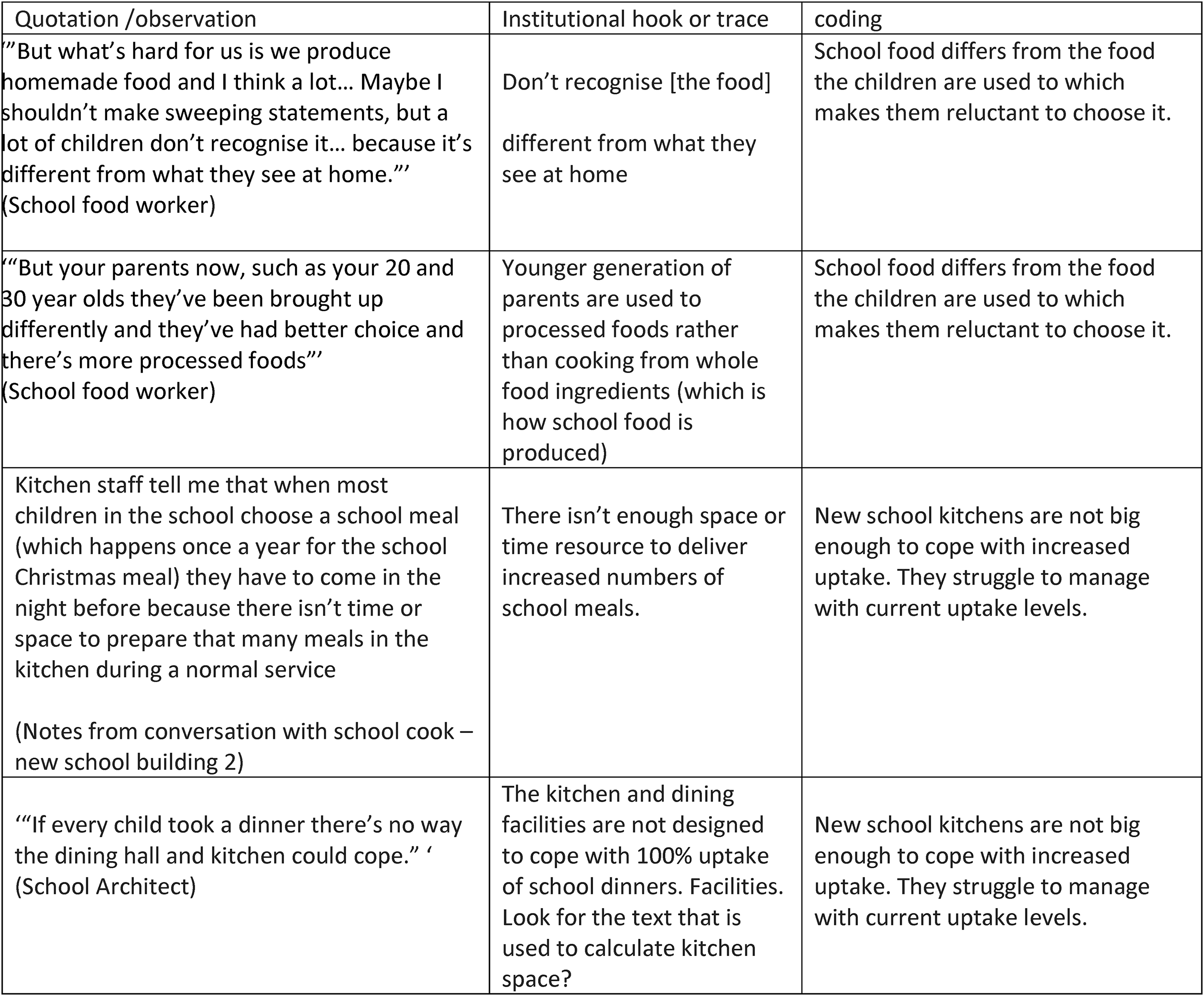
A sample of the data coding.
Figure 3 summarises some of the key findings from the institutional ethnography which will be discussed in forthcoming papers (Hawkins, 2023; Hawkins and Rundle, 2023). For the rest of this paper, I will use one of the identified problems to outline the process for creating systems maps from the ethnographic data; why does school food differ from the food that children are used to eating?
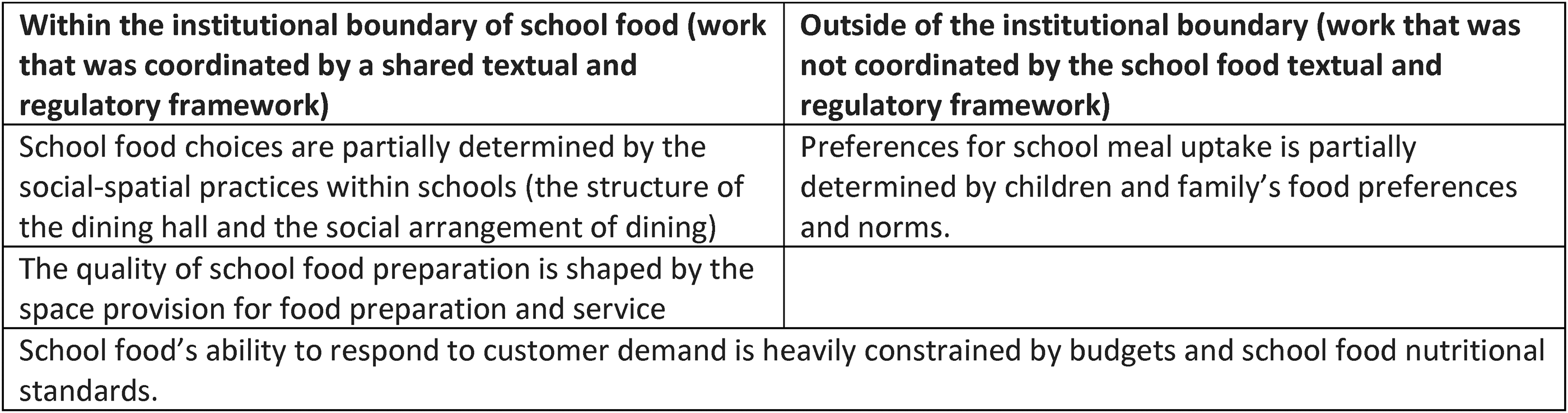
a summary of key findings from my institutional ethnography of school food.
I used the analysed data to produce a range of narrative accounts from the standpoint or perspective of different research informants to understand the trans local coordination of the work and the ways in which power dynamics at both an institutional scale, and beyond, operated to shape that work. These narrative accounts were focused upon distinct aspects of the wider problem of school meal uptake that would require different intervention approaches (see Figure 3). Despite my analytical process cumulating in the transformation of my findings into a traditional ‘persuasive’ narrative account (Campbell and Gregor, 2008: 93), I did not feel that this format gave a clear picture of working practices because it wasn’t able to capture the interdependencies of the pressures and processes that were shaping the work that I had observed. Nor did this format allow me to clearly show how power was operating within the system, because the narrative was linear and only ever able to be told from a single standpoint. I realised that I wanted to find a way to show my findings diagrammatically in the form of systems maps.
To produce the systems maps I adopted a ‘system scribing’ approach. Systems scribing combines the practice of scribing (the process of visually representing ideas while people talk) with systems thinking. Just as systems thinking emerged from more technical systems design disciplines, systems scribing borrowed representative tools from system engineering – using elements such as actors, frames, relationships, and annotations. (Bird and Riehl, 2019).
Scribing is most commonly used to record discussions as they are happening live, with systems scribing focusing more specifically on the ways in which discussions and accounts describe relationships and dynamic flows. In this case I did not have a scribe accompany me on my site visits and to interviews, instead I adapted the method so that I shared the narrative accounts that emerged from the institutional ethnography with a systems scribe, who created a visual representation in the form of a system diagram.
Mapping school food practices
In this section I will show two examples of the systems maps produced and discuss the benefits of this novel approach.
Figure 4 is the first of the systems maps created using systems scribing approaches to interpret and visualise the findings from the IE. This system map represents the school perspective on the problem of why school food isn’t what children are used to eating, which leads to low uptake. In it we see that the home occupies a central position in terms of determining the food preferences of the children, with the local food environment (represented by shops and other food outlets) playing a part, but parental choice is seen as the primary site of power and agency when setting food preferences.
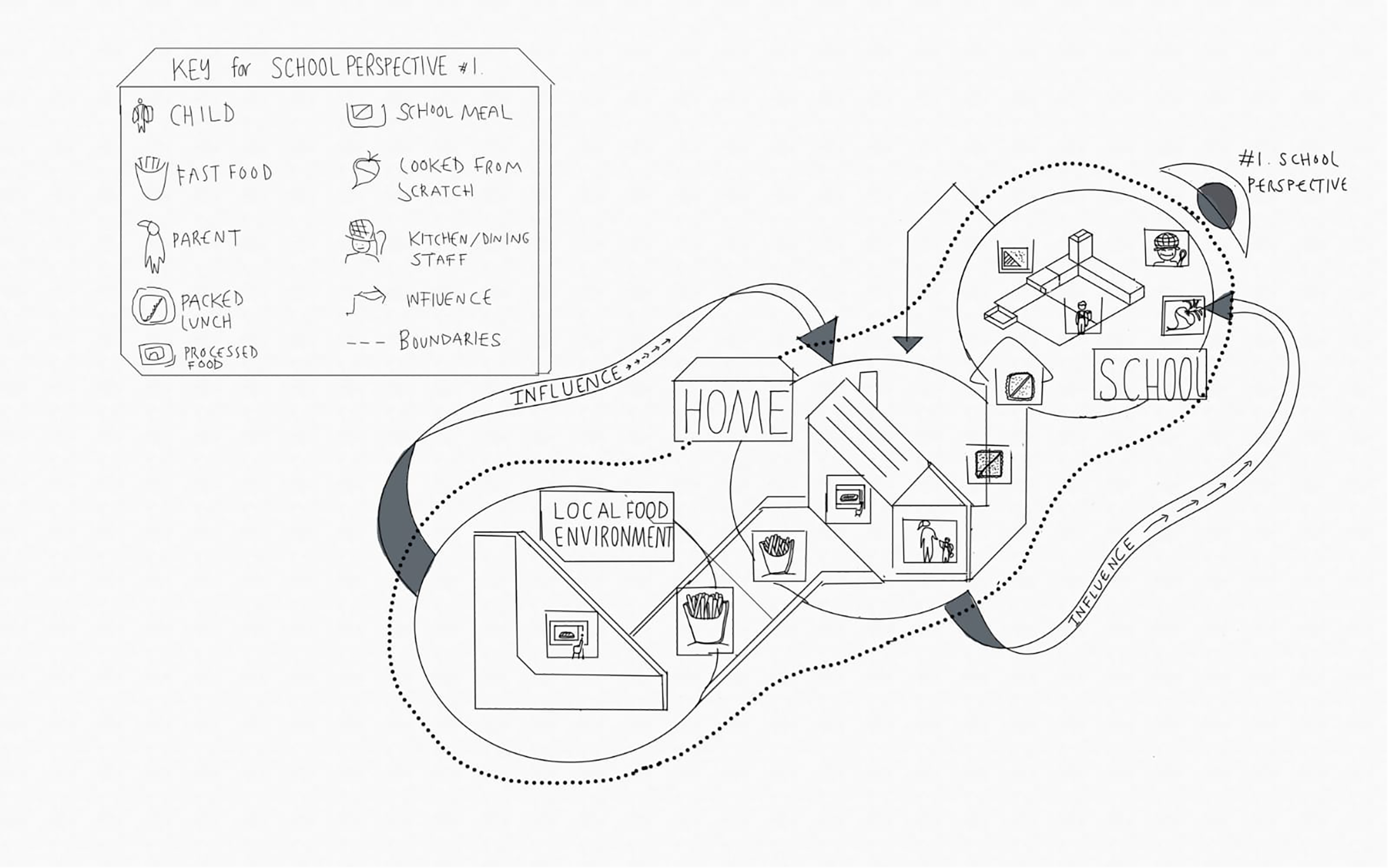
The school perspective on why school food differs from the food that children are used to eating.
The school food environment is seen as offering food that is cooked ‘from scratch’ (prepared from basic whole ingredients), but this is seen as contrasting with the dominant food norms set by the home food environment and supported by what food is available in the local shops and takeaway food outlets. Packed lunches represent one of the main ways in which food from the wider food environment permeates the institutional boundaries of school food, in both a literal and normative sense. The contents of packed lunches brought from home are not subject to the same nutritional regulation as school meals and so parents are free to choose what their children eat. The normative power of what children are ‘used’ to eating is the real challenge to the ‘protected space’ that the nutritional regulation of school food is supposed to provide.
Accounting for obscured powers shaping practices
An assessment of this system map would suggest that an intervention to improve the acceptance and therefore uptake of school food should be targeted at the home, as the parent is identified as a key decision-making power in this system. However, there were contradictory accounts of who had the power to establish and modify food norms. When speaking in their role as parents, some of the school cooks conceded that they themselves felt powerless when trying to control what their children ate and wanted to eat because of the unrestricted access they had to poor quality food in the wider food environment of their neighbourhood. Since my oldest two have gone up to secondary now, I’ll give them the money for their dinner and their bus fares, they’ll go in the shop and spend it. And they’ll spend it on junk. My daughter has put a big amount of weight on, and I’ve told her it's down to eating junk, going to the co-op and getting a packet of doughnuts, not just getting one, they’re getting a packet because it works out cheaper. I hate it me, whereas when they were [at primary school] I could see what they are eating, and I knew it wasn’t junk. (Parent and school cook)
Figure 5 shows some of the organisations, institutions and structures that have been consistently shown to shape and influence the consumer food environment and shape food norms (Bernstein, 2016; Hawkes, 2005; Lang and Heasman, 2015). These larger forces were hidden from the perspective of most of the people who participated in the IE, but incorporating these actors into the system map revealed a very different picture and suggests a very different intervention approach, one that does not misattribute power to parents and recognises the powers that are acting upon them in the form of product availability and marketing. This map combines my research findings with a synthesis of food system research to produce an alternative account of the power dynamics shaping school food work. This systems map is used to make the case for a reorientation of policy focus away from blaming parents and children for failing to recognise and choose school food, and to argue for policy design that addresses the ways in which the dominant food system infiltrates the supposedly protected space of school food (Hawkins and Rundle, 2023).
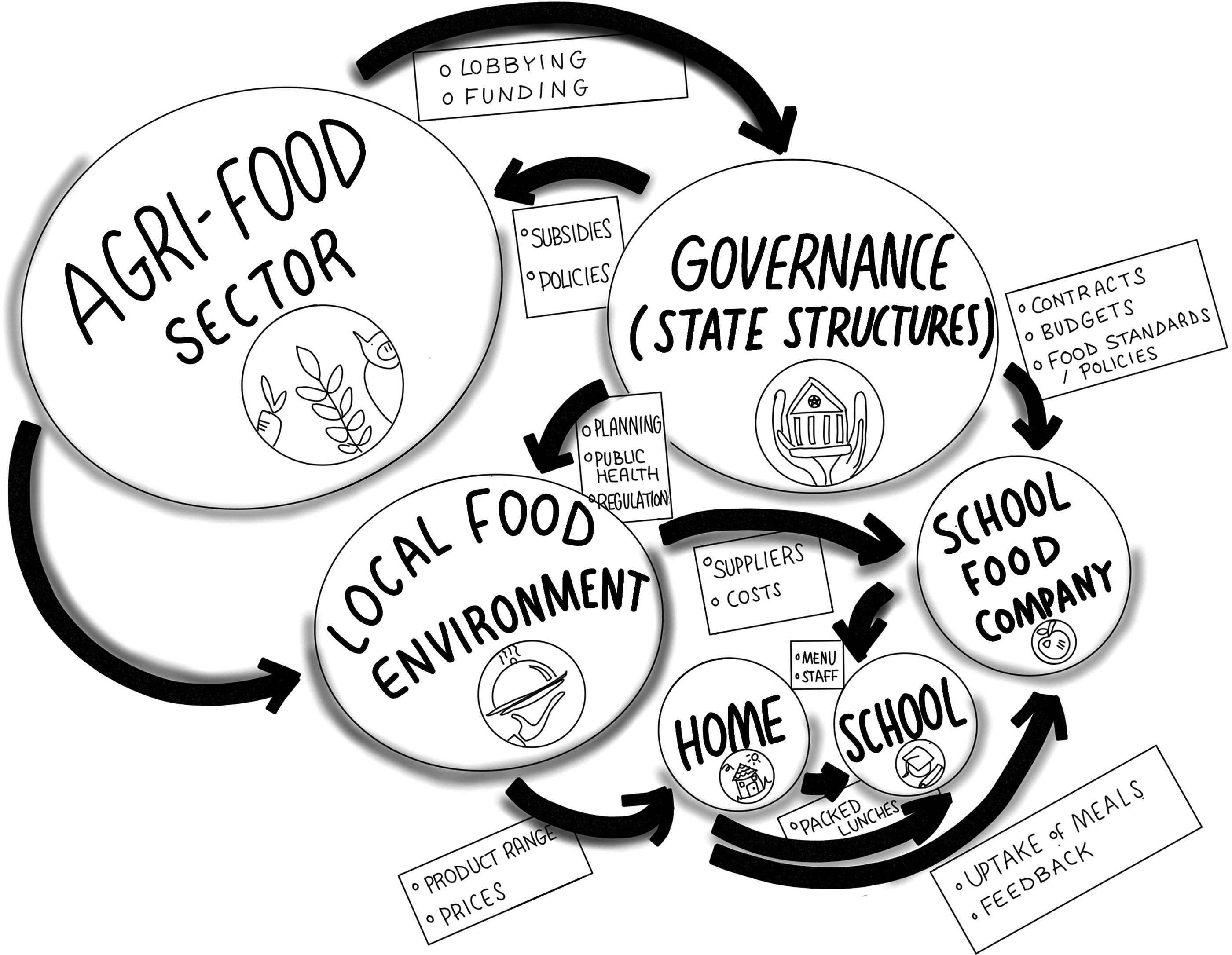
The wider food system shown as acting on the school food environment.
Discussion
I was tasked with exploring the working practices around school food with the aim of developing a set of recommendations that would support an increase in school meal uptake. In this context, working practices extended to conceptualise school children's interactions with the school food processes as work. The prevalent discourse in school food policy and research literature is that school meals are nutritionally balanced and affordable, with families on low incomes able to access free school meals (Department for Education, 2016: 4; Adamson et al., 2013; Nelson et al., 2006). The assumption is often that the nutritional regulation of school food will be appealing to parents and that participation in school meal rituals will be seen as socially as well as nutritionally beneficial (Andersen et al., 2015; Department for Education, 2016; Daniel and Gustafsson, 2010; Fletcher et al., 2014; Best, 2017). The fact that school meal uptake remains below target numbers is therefore a cause for concern for policy makers and school food professionals.
To develop recommendations to change levels of school meal uptake, I needed to suggest intervention points in the current working practices, and so needed to map not only the complex working practices but also account for the powers that shaped them (Taber, 2010). When exploring the school food context, I found that institutional processes were often failing under the exertion of pressure from beyond the institutional boundaries. This represented a challenge both in terms of the scope of the research, and how to visualise these power dynamics in relation to school food. Adopting a system thinking approach to data analysis and visualisation allowed me to incorporate power relationships beyond the scope of my fieldwork.
Combining IE and Systems Thinking approaches helped me to explicate and articulate the relationship between distant, powerful, and conceptually vast processes like the global food system, and the day-to-day performance of school food practices by describing them as part of a complex system. This approach recognises that institutions are not closed systems with clearly delineated boundaries and that institutional power does not exist within a vacuum.
The food supply chain has long been conceptualised as a highly complex system, especially since the acceleration of the global market that accompanied developments in industrial agriculture, food processing and financialization since the second world war (Greenberg, 2017; Hawkes, 2005; Lang and Heasman, 2015). What my novel methodological approach enables is the incorporation of school food into the wider food system. Once the system boundary is redrawn it becomes clear that far from existing in a protected annexe, school food was actually operating as a weak competitor within the wider food system. The visualisation approach clearly shows the power dynamics included those being exerted by global players in this food system, that were acting upon children and parents and changing food environments and norms. This allows me to challenge the dominant policy narrative, arguing instead that far from being given power by the nutritional regulation of school food, it is having its ability to compete constrained by this regulatory framework (Hawkins and Rundle, 2023). This argument is strengthened by the visual representation as a system map because it makes it much harder to suggest interventions aimed at persuading parents and children to eat differently, without addressing the larger powers that are also persuading parents and children to eat in a certain way.
Conclusions
The location of school food outside of the dominant food system by scholars and policy makers afforded it an advantageous position in the battle against the perceived decline in children's diets and concerns about the negative impact this was having on health (Evans et al., 2016). Through the development of this methodological approach I have been able to reincorporate school food into this dominant food system and show this as a system map. This visualisation makes it clear that there are very large and powerful forces shaping the consumer food environment and altering food norms (Greenberg, 2017, Winson, 2013), and that an intervention that does not address these forces is unlikely to succeed. Whilst the scale of the task facing school food looks daunting when represented this way, I argue that it is important to visualise this complex system so that we can start to attribute power more accurately and stop expecting small and relatively powerless institutions such as schools and the home to solve the public health problems created by a powerful global food system.
In creating these systems diagrams to represent the ‘mapped practices’ revealed through ethnographic methods, the intention is not to present a fixed model of a practice, but to visualise the complexities, dynamics and interrelationships between actors, spaces, and practices as they were revealed to me by my research informants, and to recognise power differentials within these systems. The dynamics of power of course remain contested, but they are experienced and articulated as having a measurable impact through the accounts provided by informants, usually expressed as their sense of frustration or powerlessness.
My work makes a novel contribution in three ways:
It offers a new way of analysing and presenting the findings from IE research in a systems diagram to allow for a more holistic reading of the complexities and trans-local connections articulated by research informants. It offers a way of visualising and accounting for the power dynamics that shape everyday practices, including power dynamics that are obscured and experienced as a sense of ‘powerlessness’ by research participants. It allows for the application of IE in a wider range of research contexts by offering a more accessible and concise way of visualising findings that can inform programmes of evaluation and change.
IE as a research approach seeks to free the complex reality of work as it is performed from the rigidity of the ‘ideological account’ of how that work is supposed to be performed. Findings are usually written up as narrative accounts that reveal hidden work processes and offer a more detailed and nuanced explication of why work processes happen as they do and how this work is coordinated. But with a detailed narrative account it is not always easy to visualise these connections or to account for the interconnectedness and power relationships of actors and agents within a system. Systems Thinking provides both a visual model for communicating the coordination of actors and agents within a network, and it also provides an analytical and conceptual model for developing and proposing interventions to bring about change.
Both IE and Systems Thinking work to explicate day to day lived experiences by helping to reveal the location and dynamics of power within complex systems. This compatibility supported the development of an analytical model that allowed visual as well as conceptual mapping of working practices (Campbell and Gregor, 2008; Egan, 2019). My work proposes a new way of interpreting and presenting findings from ethnographic research that can be used to complement or summarise the more traditional narrative account. This visualisation approach allows the reader to explore complex system of practices and experiences from a number of different perspectives and helps to suggest appropriate intervention points when designing programmes of change (Christens et al., 2007). It is my hope that evolving the ways in which research findings from IE are communicated will make this important research methodology applicable in a wider range of research contexts, bringing the benefits of deep qualitative research to a wider audience.
Footnotes
Declaration of conflicting interests
The author declared no potential conflicts of interest with respect to the research, authorship, and/or publication of this article.
Funding
The author received no financial support for the research, authorship, and/or publication of this article.

Author biography
Anna Hawkins is a Senior Lecturer with the Department of Natural and Built Environment at Sheffield Hallam University, UK. Their research interests include shifting consumption practices and using ethnographic methodologies to explore wicked policy problems.