



Abstract
Researching sensitive topics often carries immediate effects on researchers, yet discussions about the emotional and psychological impacts of conducting this type of research remain rare. In recent years, debates begun to emerge about the emotional and psychological toll that qualitative field-based research on violence in general, and on gender-based violence (GBV) in particular, can have on those conducting this research. Most of the existing support and self-care strategies in response to these effects, however, are primarily tailored towards practitioners, but not specifically for researchers, who often face unique challenges and experiences. At the same time, most existing self-care guidelines in the fields of violence research typically centre around neo-liberalized strategies, which fail to take into account the structural dimensions of researchers’ challenges and the long-term nature of vicarious traumatization. In this article, we move beyond such approaches and instead adopt relational and collaborative ways of taking care of ourselves and each other. Drawing on our experiences of researching GBV, we propose that strategies of coping with the emotional and psychological toll of GBV research require relationships and collaborations. This collaborative and communal approach becomes particularly acute within the absence of support and care at the structural and institutional level, within universities and organizations. The collaborative and relational approaches that we propose in this article specifically include forms of peer-support and fostering ‘caring communities’, in the form of groups, collectives or networks.
Keywords
Introduction
Since the turn of the millennium, an extensive body of knowledge and research on gender-based violence (GBV) in conflict and emergency settings emerged. Yet, discussions about the emotional and psychological impacts of conducting this type of research remain rare (Clark, 2017; Aroussi, 2020a), even though researching stories of rape, sexual abuse and intimate partner violence often carries serious consequences for researchers (Coles et al., 2014; Sexual Violence Research Initiative (SVRI), 2010). In recent years, this has slowly begun to change, and there are now growing debates about the emotional toll that researching violence in general, and GBV in particular, can have on those conducting this research (see, indicatively, Hummel and El Kurd, 2021; Loyle and Simoni, 2017; Wood, 2006; Williamson et al., 2020). In response, some have also begun to formulate ways of engaging with these experiences, and on how to cope with the emotional and psychological effects of researching violence in general (Dickson-Swift et al., 2007) and GBV in particular (Campbell, 2002; Coles et al., 2014; Sexual Violence Research Initiative (SVRI), 2010) – often framed around practices of self-care (Cayir et al., 2020; Theidon, 2014).
Most of the existing self-care guidelines, however, are specifically tailored towards practitioners, humanitarian workers, service-providers and front-line staff (Frey et al., 2017; Williamson et al., 2020). The experiences of (academic) researchers thereby remain largely overlooked (Backe, 2020; Nikischer, 2019). Based on existing research and our own experiences, we maintain that GBV researchers engaging in fieldwork often face particular experiences, challenges and needs, that may include: unsupportive (or unprepared) institutional environments and a lack of structural support (Coles et al., 2014); an often individual and isolated fieldwork and writing experience (Theidon, 2014); a sense of helplessness due to an inability to offer concrete assistance to GBV victims/survivors participating in research (Campbell and Wisco, 2015); very limited training and preparation to conduct fieldwork, let alone deal with trauma (Irgil et al., 2021; Schwartz and Cronin-Furman, 2022). These experiences, in turn, often require specific strategies of coping and care for GBV researchers. 1
Most existing self-care guidelines for those working on violence meanwhile centre around highly individualized strategies, such as a healthy diet, marketable products, regular exercise or yoga and meditation – thereby mirroring societal idea(l)s of self-care more broadly (Cayir et al., 2020; Puig de La Bellacasa, 2017). ‘Run yourself a hot bubble bath and eat some chocolate pralines and everything will be alright again’, it is suggested in a metaphorical sense. Such individualized approaches and the neo-liberal 2 outsourcing of responsibility for one’s well-being, however, tend to offer quick and often temporary ‘fixes’, if even, and fail to take into account the structural dimensions of researchers’ experiences and challenges, and the long-term nature of vicarious traumatization (Coles et al., 2014), which give rise to the need for care and support in the first place.
In this article, we aim to move beyond these individualizing approaches and instead advocate for relational and collaborative ways of taking care of ourselves and each other (Ahmed, 2014; Dutton, 2014). Rooted in feminist thinking about care, self and community (Ahmed, 2014; Michaeli, 2017; Ward, 2015) – which recognizes our intrinsic relationalities and inter-dependencies (Held, 2006) – we propose that strategies of coping with the emotional and psychological toll of GBV research require relationships and collaborations, rather than an overt/exclusive individually centred approach. This collaborative and communal approach becomes particularly acute and necessary within the absence of support and care at the structural and institutional level, within universities and organizations.
Our critique of dominant individualizing self-care strategies should not be understood as a dismissal of the importance of taking care of ourselves, particularly when exposed to adverse emotional and psychological reactions when conducting ‘difficult research’ on ‘sensitive topics’. On the contrary, the need to care for our well-being is the main reason we are writing this piece. As Audre Lorde famously states, ‘caring for myself is not self-indulgence, it is self-preservation’ (1988: 205). In the context of research methods at large, it is difficult to practice compassion – so central to ethical research with/on vulnerable subjects (Fujii, 2018) – without self-compassion. We also do not mean to downplay the value of some of the commonly proclaimed self-care strategies, but we uphold that an exclusive focus on these individualizing efforts overlooks the importance of relational and communal approaches – something that this article moves to the centre of these debates.
The collaborative and relational approaches that we propose in this article specifically include ‘turning to people who get it’ (Theidon, 2014: 2) and who share a lived reality, as well as fostering ‘caring communities’ (Care Collective, 2020: 45) in the forms of groups, collectives or networks. Whilst prior writings have begun to flag peer-support as an important tool to counteract research-related trauma (Coles et al., 2014; Hummel and El Kurd, 2021; SVRI, 2015), we explicitly apply this to the specific challenges of researching GBV, which in its variety can often be a very isolating experience, and specifically formulate these peer-support strategies as forms of collaborative self-care.
Embracing the collaborative effort that we advocate for, we are coming together here as a collective of four researchers at different career stages, including academics and consultants, who all conduct research on GBV in conflict and humanitarian emergency settings. Between the four of us, we have several decades worth of experience conducting research on this topic, in various contexts across the globe. 3 As part of our research, many of us often engage directly with victims/survivors of sexual violence, as well as with humanitarian agencies, civil society representatives and governments assisting victims/survivors, following a relational research approach (see Fujii, 2018).
We proceed with reflections about the emotional and psychological impact of researching gender-based violence, before identifying numerous shortcomings of dominant approaches to self-care and then articulating our notion of collaborative and communal care. Based on these reflections, we then put forward several strategies and avenues for enacting these forms of relational and communal forms of self-care that we advocate for, primarily in the form of peer-support and fostering caring communities. These reflections are of relevance and interest for researchers conducing qualitative field-based research across different settings, and particularly so on sensitive topics, such as GBV.
The emotional and psychological impact of researching gender-based violence
Across the social sciences, the emotional and psychological challenges of conducting research and carrying out fieldwork are only seldom discussed (Cullen et al., 2021; Dickson-Swift et al., 2007). As Clark notes, ‘very rarely do we hear about how fieldwork affects researchers’ – which remains a ‘gap within social science literature that needs to be filled’ (2017: 423). In recent years, scholarly reticence to engage with challenges in research processes has slowly begun to erode. Situated within an expanding literature on the realities and complexities of qualitative research methods and ethics in ‘challenging environments’ more broadly (Cronin-Furman and Lake, 2018; Krause and Szekely, 2020; Schulz, 2020; Wood, 2006), there now exists a growing body of scholarship reflecting upon the manifold psychological impacts of researching sensitive topics 4 and the emotional toll that engaging with stories of violence can have on researchers (Dickson-Swift et al., 2007; Loyle and Simoni, 2017; Coles et al., 2014; Williamson et al., 2020; Hummel and El Kurd, 2021).
Drawing on conversations with a range of scholars working on violence, Theidon lists several symptoms of this emotional toll, including anxiety, extreme fatigue and depression, nightmares, sleeplessness or angry over-reactions (2014: 4). Elisabeth Wood similarly discusses common ‘emotional challenges of fieldwork in highly polarized settings’ (2006: 374), including periods of loneliness and depression as well as ‘secondary trauma’ (384). Acknowledging these negative effects, Wood maintains, is fundamentally important, as ‘inadequate attention to them may (…) have significant consequences for their research subjects as well as (researchers) themselves’ (384). Such emotional and psychological effects of research may be particularly pronounced and acute when conducting research on especially sensitive and emotionally charged topics, such as GBV (Campbell, 2002; Campbell and Wasco, 2015; Ellsberg and Heise, 2005; Theidon, 2014). As Coles et al. (2014) note, vicarious or secondary trauma – but also feelings of anger, guilt, shame, fear, depression and nightmares – are particularly prevalent among those researching and investigating GBV. At the other end of the spectrum are experiences of desensitization or feeling ‘inoculated’ against accounts of suffering and trauma after extended exposure, which researchers also experience as worrisome (Dickson-Swift et al., 2007: 340–342).
Psychological and emotional impacts can often be conditioned by the ways researchers approach their work. The closer (emotionally and personally) one is to one’s research topic or participants, the higher this emotional and psychological impact of conducting research may be. This is reflected in our own work, which mostly follows a relational (see Fujii, 2018) and care-based approach (Anumol, 2021) that is built on establishing close relationships with the people who participate in our research, which has helped us to elucidate more complex and nuanced pictures of the lived realities of victimhood, GBV and its impacts. When done successfully, ‘this certainly enhances the research, but it can also increase the risk of (trauma) due to (…) “the cost of caring” for others in emotional pain’ (Williamson et al., 2020: 58). By seeking to conduct the research as carefully as possible, and by caring, our emotional attachments and hence our corresponding emotional and psychological reactions to the stories we encounter can become further magnified.
Reflecting on our own experiences, all of us similarly experienced emotional reactions to our research on GBV, including the ‘emotional toll of listening to (…) repeated stories of despair, physical pain and degradation’ (Ellsberg and Heise, 2005: 42; see Campbell and Wasco, 2015). These include instances of interviews with sexual violence survivors during which researchers, research participants and collaborators cried intensely together in the face of the heartbreaking accounts (Schulz and Kreft, 2021). Tears in interview scenarios can be particularly ‘contagious’, cracking the professional façade that we adapt to listen to these stories (Chynoweth and Martin, 2019). Research scenarios in which interviewees displayed strong emotions – such as sadness, grief and anger – were often particularly emotionally taxing and mentally exhausting. Episodes of mental (and physical) exhaustion, generalized anxiety or even depression are also familiar to us.
Such emotional reactions to our work are by no means restricted to the (often very exciting) period of actual field research, but exhibit temporal dimensions and long-term effects. The emotional impact of listening to peoples’ narratives of sexual violence often weighs particularly heavily upon return from the field site and can be particularly taxing, often manifesting in physical and mental exhaustion. Re-engaging with accounts of violence and injustice through transcribing, coding and analysing the data (Dickson-Swift et al., 2007), in addition to writing up findings, can also cause emotional distress (Chynoweth and Martin, 2019; Schulz and Kreft, 2021). As Theidon suggests, researching and writing about violence often ‘mark points on a spatial, temporal and phenomenological continuum’ (2014: 4), whereby writing up our research ‘plunges many of us back into the field’ (Ibid.). As one of us reflects upon elsewhere, in words that resonate with all of us: I remember sitting in front of my laptop, re-listening to the recordings of some of the interviews, and re-reading my transcriptions and notes and feeling absolutely overwhelmed, even paralyzed. For weeks on end, I was not able to concentrate on anything or to engage with these stories in any way (Schulz and Kreft, 2021).
Especially as many (early career) researchers receive little or no formal fieldwork training, preparation or de-briefing (Irgil et al., 2021; Schwartz and Cronin-Furman, 2022), and in particular on aspects of mental well-being (Backe, 2020), these affective responses after the actual fieldwork period often come as a surprise and may be perceived as unwarranted or disproportionate. Indeed, many of us may be prepared to set in place suitable coping strategies while ‘in the field’ but have prepared very few strategies for coping upon return from fieldwork (Schulz and Kreft, 2021). Of course, this ability to actually return home, and to (mostly) be in a (relatively safe) space after the actual field research, is a privilege that many external researchers, often based in the Global North, get to enjoy, but that does not necessarily extend to local researchers – thus (re-)producing neo-colonial research hierarchies. 5
Many of these adverse emotional and psychological reactions can also exacerbate researchers’ already existing trauma or inequalities (Hummel and El Kurd, 2021). The extent and precise impact of emotionally unsettling fieldwork experiences thereby differs between individuals, depending on, amongst others, gender, race, socio-economic status or previous trauma (Cullen et al., 2021). Intense emotional and psychological experiences and encounters in the field can often be a particular trigger for researchers who have personal experiences with GBV and/or gender discrimination themselves (Aroussi, 2020b; Sharabi, 2020), which is not uncommon in a field of research that is generally dominated by women. As Sahla Aroussi courageously writes, survivors can be researchers and researchers can be survivors too, yet ‘the situation of the survivor/researcher has not been considered enough in the literature’ and there is an ‘absence of guidance in this area’ (Aroussi, 2020b: 1).
Lack of institutional support and structural limitations
At the organizational and university level, there frequently is a complete lack of awareness and institutional support. While professionals and researchers working in psychology and mental health generally draw on well-thought out and timeworn systems of supervision, regular breaks, awareness and support (Cartara, 2021), no such thing exists for GBV researchers, despite very similar risks for those involved (Coles et al., 2014; SVRI, 2010a). Despite the fact that some universities now employ mental health counsellors for students and staff, they rarely are equipped, or have the resources and capacities, to offer thorough guidance specifically for GBV researchers (and in particular while researchers are ‘in the field’). As such, there are usually no clear pathways of support at the institutional level within most universities. This pattern fits into a larger trend across the social sciences of inadequate support for scholars embarking on (or returning from) fieldwork – in particular for early career researchers and first-time fieldworkers (Irgil et al., 2021) and of very limited qualitative research training (Emmons and Moravcsik, 2020). According to a recent survey among graduate students at U.S. universities, a majority (62%) of those who have carried out international fieldwork never received any formal training or preparation whatsoever – and only a minority (20%) felt very or fully prepared (Schwartz and Cronin-Furman, 2022). Linked to this lack of training and preparation, there similarly is a striking absence of post-field research support or care for researchers, particularly so with regard to potential mental health, emotional and psychological challenges – many of which we explained above.
This lack of adequate structural or institutional support exacerbates some of the other challenges of GBV research, such as the fact that our research is often characterized by a perceived inability to actually assist or help victims and survivors participating in our research, particularly in areas with few or no services in place for GBV survivors. A common sentiment experienced by many of us is that as ‘a researcher, your hands are tied – you can not make people go to counselling; you can not provide them with counselling and you know little about the quality of services they will receive’ (SVRI, 2010a: 9). Unlike most GBV practitioners, who are often trained to support victim-survivors, researchers are rarely in a position to do so – even though ‘it is an ethical imperative that when conducting data collection activities that involve interviewing individuals about sexual violence, at least basic care and support services to which survivors may be referred are available’ (World Health Organization, 2007):13. In light of this, some of us collaborate closely with service-providers, such as counsellors (see Schulz, 2021: 17-19), or map existing GBV actors and provide their contacts to research participants. This way, we were at least able to offer immediate services during the interview scenario if they had been necessary or to utilize the resources of the collaborating service-providers to refer our research participants for further care and assistance. A relational approach therefore underpins not only our ways of care and coping, as we reflect upon further below, but also characterizes our research processes at large (see Fujii, 2018).
Additionally, scholarly research is typically a solitary activity, carried out largely in isolation from others. For the most part, academics embark on research trips individually – at times in collaboration with research assistants – and carry the responsibility for the research process and output themselves. But also the aftermath of field research and the analysis and write-up stages often tend to be solitary activities. This aspect of ‘working alone sometimes in difficult circumstances (…) can increase the risk of vicarious trauma’ (Sexual Violence Research Initiative (SVRI) 2010a: 11; Ellsberg and Heise, 2005), and in our experiences can be isolating and at times depressing.
What is more, institutional ethical review procedures often require individual researchers to provide a detailed outline of potential physical and psychological risks for themselves and their research participants (Schulz, 2020). Yet, institutions typically do not follow-up during or after the research, to enquire about their emotional well-being and/or to offer support if necessary. In fact, ethical protocols are designed first and foremost to avoid liability for the institution rather than to practice a duty of care towards the researcher and often end up as a box-ticking exercise, rather than a sustained commitment to researcher safety and well-being. For freelance and consultant researchers, there often is even less support from the commissioning organizations, with very minimal to no institutional responsibility and an absence of any practiced duty of care. For instance, consultants typically have to pay for their own insurance and there is no institutionalized support available or institutional responsibility accepted on the side of organizations for whom the consultancy work is carried out.
As a result, the institutions that GBV researchers work for – under whose names they conduct (and then eventually publish) this research – ultimately fail to listen to and support them, thereby often exacerbating the initial harms and impacts. In the case of research on GBV and adjacent research areas, it is thus a broader oversight of institutions to assume responsibility for the mental well-being of their staff and any issues arising for them as part of their work, instead outsourcing this to the individual researchers concerned.
Individual self-care as a solution?
Within the absence of institutional support structures for GBV researchers, and in response to the challenges discussed thus far, a growing body of guidelines and literature discusses how to deal and cope with experiences of working on violence (Williamson et al., 2020) and GBV (Sexual Violence Research Initiative SVRI, 2010). These strategies are largely framed in terms of self-care (Cayir et al., 2020; Theidon, 2014), which is often presented as a viable solution to the breadth of mental, emotional and psychological consequences GBV researchers experience. Such self-care strategies tend to place ‘the burden of care onto the individual rather than attending to the structural challenges’ (Hobart and Kneese, 2020: 11) Without claiming to give an exhaustive overview of the strategies that emerging guidelines and literatures propose, there are some overarching tendencies and recurring trends in existing guides. Central among these are: getting enough sleep; healthy and regular diet; frequent physical exercise; pleasurable and recreational activities; meditation, relaxation, prayer and journaling; embracing humour; careful work planning and organization or seeking emotional support (Theidon, 2014; SVRI 2010a; Wasco et al., 2002).
While the advice given to researchers is well-intended and, in some cases, helpful (if not necessary) it more often than not fails to address the structural root causes of the emotional and mental toll of researching GBV, as well as the contextual factors that compound them. There is, as such, a general outsourcing of responsibility for the well-being of those conducting research on violence and GBV away from the institutions and onto individual researchers. As Yashna Maya Padamsee points out, ‘too often self-care in our organizational culture gets translated to our individual responsibility (…)’ (2011: 1). Such a neoliberal and individualizing approach to self-care, however, is problematic in several domains, as feminist scholars aptly point out (Ward, 2015; Dutton, 2014; Puig de La Bellacasa, 2017). For one, it involves an individualization and privatization of responsibility, whereby one’s well-being and care is perceived as individual liability, ‘rather than the collective responsibility of society to create structures enabling and facilitating one’s well-being’ (Michaeli, 2017: 53). As a consequence, an individualized understanding of self-care obscures larger underlying structural problems, including the manifold social, economic, political, cultural and gendered sources of distress, exhaustion or other emotional and psychological consequences, and the role institutions should play in ensuring the physical and mental well-being of their staff (Ward, 2015).
Individualizing approaches, in turn, may provide short-term fixes to some immediate symptoms of vicarious trauma and emotional challenges associated with difficult research, but they cannot tackle any of the larger, more systemic components that give rise to the need for care in the first place – as we articulate in greater detail in the following section. While taking a bubble bath may provide temporary relief, it is hardly a substitute for adequate supervision or institutional mechanisms to support people who are exposed to accounts of pain and suffering on a regular basis or for adequately dealing with the many psychological responses to researching sensitive topics (see above). Without institutional support, which should centre around the employer’s responsibility to minimize the negative effects of an employee’s work on their physical and mental well-being, self-care merely amounts to applying a band-aid to a deep wound. Existing self-care strategies advocated in academia are, in sum, all too often modelled on those popularized in society at large and centre around individual actions that have become the basis of an extremely profitable industry (Care Collective, 2020; Puig de La Bellacasa, 2017; see below).
Our critique of dominant self-care strategies may best be summarized via this meme: Figure 1
The Sexual Violence Research Initiative (SVRI) guidelines for preventing and managing vicarious trauma among sexual violence researchers (2015) provide an important exception to this rule, as they also advocate for structural changes that benefit both researchers and research participants. These include providing access to a trauma-trained counsellor for researchers who can offer pre-project, ongoing and post-project support, including regular ‘emotional debriefings’ for researchers in the field (see Ellsberg and Heise, 2005; Wasco et al., 2002), as well as the creation of trauma-informed processes and institutions. In advocating for changes and interventions at the structural level, the SVRI guidelines (2015) thus move beyond the individualization and privatization of responsibility. However, in times of scare resources, overstretched mental health care and institutional disregard for these challenges (see above), it appears unlikely that these SVRI guidelines and suggestions will be voluntarily taken up by universities or humanitarian organizations. Meme on neo-liberal safe-care strategies.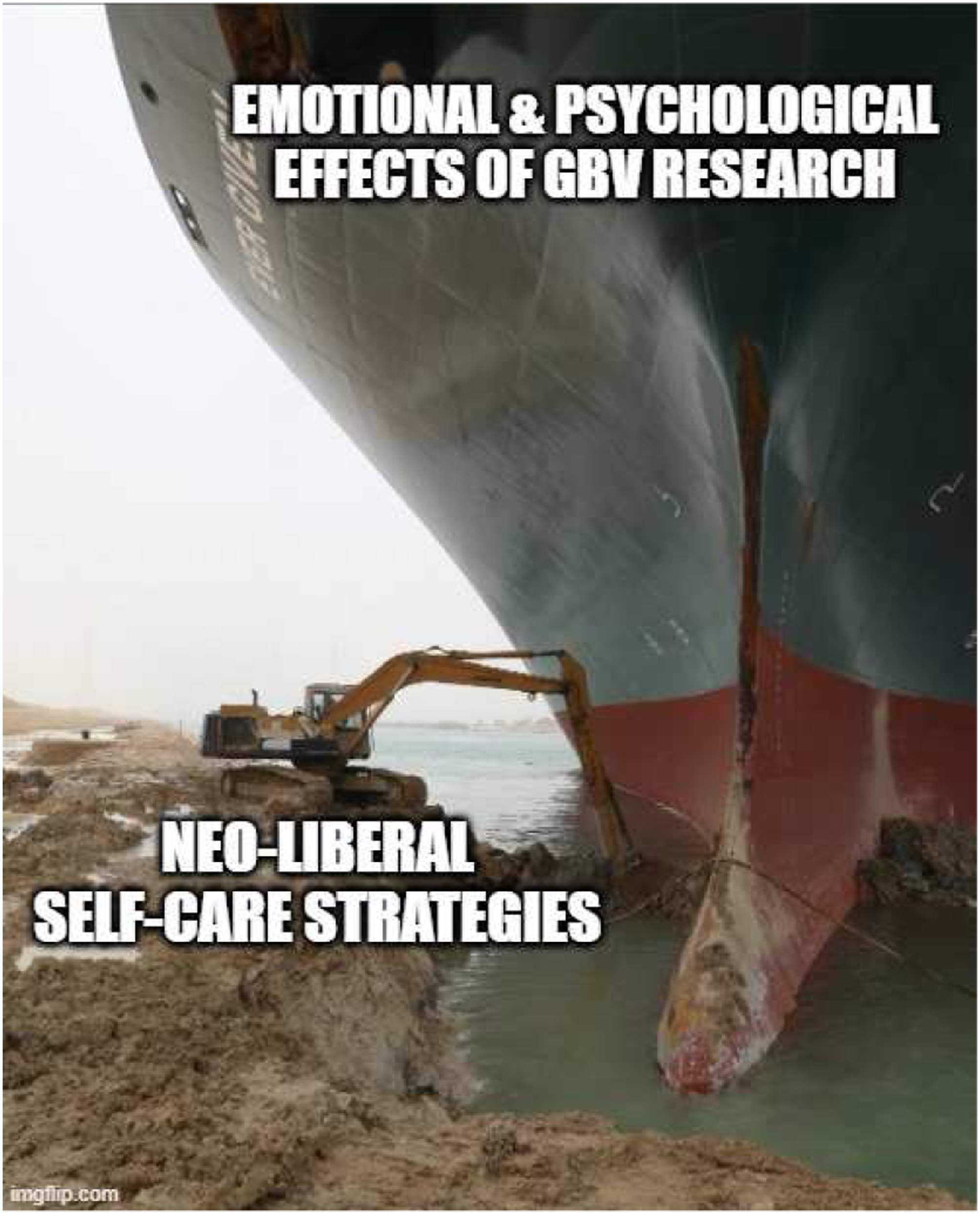
Centring care, rather than the self
Such an individualizing approach to self-care appears particularly indifferent when contrasted with thinking about care more broadly. As the Care Collective analyzes, the ‘notion that care is up to the individual derives from the refusal to recognize our shared vulnerabilities and interconnectedness’ (2020: 13). Scholarship on the ethics of care indeed illuminates that care is always relational and inter-dependent (Held, 2006: 13), based upon a recognition of the relational ties and mutual dependencies that characterize our lives. This is reflected in dominant definitions of care, which conceive of caring as ‘everything that we do to maintain, continue and repair “our world” so that we can live in it as well as possible. That world includes our bodies, ourselves and our environment, all of which we seek to interweave in a complex, life-sustaining web’ (Tronto, 1993: 103) (emphases added).
Care (as a value and as a practice) thus occurs in relation, but not individualized (Held, 2006).
In light of these insights, we align with feminist scholarship, and in particular women of colour feminists, who have previously critiqued prominent approaches to self-care as too centred on the individual, and who move beyond individually tuned self-care strategies (Ahmed, 2014; Ward, 2015; Michaeli, 2017; Backe, 2020). According to this, ‘feminist legacies and conceptualizations of self-care and well-being are anything but individualistic and de-politicized’ (Michaeli, 2017: 53). Instead, they often centre around relationality and community (Ward, 2015; Ahmed, 2014). Such an approach is aptly reflected in concepts such as ‘community care’. The academic and community organizer Nakita Valerio sharply marks this contrast, by stating that: ‘Self-care is about the individual caring for their own basic physical needs, whereas community care is focused on the collective: taking care of people together, for everything from basic physical needs to psychological and even spiritual ones. Community care is a recognition of the undeniable cooperative and social nature of human beings and involves a commitment to reduce harm simply through being together’ (2019: 2).
According to this, practices of caring (for the selves and for others) must ideally be carried out communally and collectively, rather than individually. Pandamsee similarly reminds us again that ‘a liberatory care practice is one in which we move beyond self-care into caring for each other. (We) should not have to do this alone’ (2011: 2). By embracing these communal and relational conceptions of care, the practices we discuss here conceive of self-care as a way of de-centring the self and instead re-centring the collective and communal. As Sara Ahmed observes, ‘self-care is about the creation of community’, whereby ‘we reassemble ourselves through the ordinary, everyday and often painstaking work of looking after ourselves, looking after each other’ (Ahmed, 2014: 3).
Building communities that listen
In the absence of support infrastructures for dealing with the impacts of conducting research on violence at the structural and institutional level, and when confronted with institutions that fail to listen and attend to these experiences, it often becomes necessary for us to build communities that will listen and offer support. Without absolving institutions of their responsibility, we thus advocate for relational and community-building approaches to self-care in order to engage with the emotional and psychological toll that our research can take on us.
At their most fundamental, these strategies are based on turning to ‘people who get it’, as Theidon puts it – who have made similar experiences, ‘who allow us to move beyond sharing guarded details about “our trips” to discussing how our research makes us think and feel’ (2014: 2). Friends and family who care about us will want to help, but it is not always prudent to share details with them. We all recall instances of friends or family members (well-intentioned) asking ‘How was your trip?’, only to be confronted with painstaking stories of atrocities, cruelty and harms, which in turn are often met with shock, horror, disbelief or silence (see Schulz and Kreft, 2021; Theidon, 2014). Rather than actually offering much solace, such encounters often leave us as researchers feeling (even more) guilty of dragging those around us into our emotional and psychological challenges.
Instead, it is ultimately those who understand what working on violence and/or in fragile or conflict-affected settings entails, who are often best equipped to listen and give advice, or simply reciprocate by speaking about their own experiences. Turning to those who share a lived reality with us and crafting and finding groups or networks of peer-support can be a particularly helpful collective way of engaging with fieldwork-related mental health challenges – both during periods of field research and its wake. Different studies on fieldwork in violence-ridden contexts indeed begin to note ‘the importance of formal support networks in maintaining the safety and security of researchers, as well as that of their interlocutors’ (Hummel and El Kurd, 2021: 3; see Lake and Parkinson, 2017). Yet, this literature is mostly concerned with physical safety and security, and ‘does not emphasize building networks for maintaining mental health’ (Hummel and El Kurd, 2021: 3), and not yet as an explicit (self-)care strategy – something that we develop as an argument in this paper.
What is more, these strategies were thus far only marginally linked to researching GBV. A noteworthy exception to this are Coles et al. (2014), who find that informal peer-support systems with colleagues played an important role in mitigating the negative mental health effects of working on sexual violence among the researchers they interviewed. The SVRI guidelines (2015) similarly mention to ‘(m)aximise collegiality and support from colleagues to avoid isolation’ (13) as specific coping advice for researchers. We build on these initial reflections and integrate our own experiences, to show how peer-support networks have constituted vital caring resources for us in the context of researching GBV (see Backe, 2020).
Peer-to-peer support
In our work, all of us greatly benefited from ‘reaching out to people who get it’ (Theidon, 2014: 2), both whilst conducting field research, as well as in its wake. For example, when one of us (Kreft) had been in Bogotá, Colombia for her fieldwork and after a few weeks started to feel isolated and alone, it was a very welcome relief to connect with other PhD researchers based in the city. It was the first such meeting, with another junior scholar, that sticks most vividly in her mind. In a quaint café in downtown Bogotá, the two of them chatted about their various experiences and challenges – from bouts of loneliness to unfamiliarity with a country which neither had visited prior to their PhD research, to the sometimes-unpredictable security situation and general worries about the research process. It was not that the conversation harboured much in the way of concrete solutions for either of them, but realizing that theirs were not isolated challenges and did not result from personal insufficiency was invigorating and a source of comfort. Similarly, when one of us (Schulz) was conducting research in Northern Uganda, sharing a flat with a friend (and fellow researcher) to whom he could turn to speak about what he had heard or observed that day similarly served as a much-needed coping mechanism.
Beyond a doubt, connecting with peers plays an important social function ‘on the ground’. Understanding the unique context of the field site and, ideally, the research topic in which the researcher works, peers may also be best positioned to provide helpful advice on possible contacts for your research and any bureaucratic or logistical issues that arise (see also Hummel and El Kurd, 2021: 3). The existence of a peer-support network, however, is not a given, unless a researcher embarks on fieldwork as part of a team or in affiliation with an NGO or other organization (as has been the case for some of us). Individual researchers will usually have to build these networks from scratch, for instance by reaching out to colleagues in their own department, but importantly also colleagues previously met in ‘the field’, at conferences, workshops, symposiums, courses or other events. Many of the contacts we established resulted from snowball-like networking (being put in touch with the friend of a friend) and social media. Some of us also made positive experiences ‘cold-emailing’ researchers whose work we had come across and asking them for input on different questions or for advice.
As previously discussed, research in conflict-affected settings in general and on GBV specifically can affect the researcher’s well-being even after their return. In this context, it is not unusual to feel a certain disconnect from the colleagues at your ‘home’ institution who may not have been in the field and thus cannot easily relate to your experiences (or with whom you do not want to share the burden). Exchanging messages or holding video-calls with other researchers who have also recently returned from their own research trips (even if they were in different settings) can thereby be a stabilizing factor. Prior to, during and after our fieldwork trips, we all benefited greatly from virtual exchanges with peers. Nonetheless, activities such as informal conversations at conferences or organizing workshops with like-minded colleagues allowed even more in-depth and frank discussions, which were extremely beneficial. If we were to formulate concrete recommendations, we would therefore encourage researchers working on sensitive topics, and on GBV in particular, to reach out to others who work on similar issues, in an attempt to start building and developing such peer-to-peer support relationships. It is generally advisable to establish such connections as early as possible, so that one has a small network in place by the time the going gets tough. Leveraging one’s supervisors, colleagues at the same institution or other scholars or practitioners met at conferences, at courses, workshops or seminars are useful steps to take – often, these can serve as important connectors to other researchers. An important piece of advice in this context is also to reach out to others in a similar career stage; many of our own experiences with peer-support revolve around networks with other early career researchers, rather than necessarily with more experienced scholars who serve as mentors.
‘Caring communities’
In addition to these forms of support amongst and between individual researchers, another dimension of collaboration and ‘turning to others who get it’ includes efforts to form support networks. These can be characterized as ‘caring communities’, in ‘which we can support each other and generate networks of belonging’ (Care Collective, 2020: 44). After all, practices of care are not restricted to inter-personal relationships, but ‘they also take shape in the environments we inhabit and move through – in local communities (…) and the groups we belong to’ (Ibid.). Especially in the solitary everyday routine of the individual (field) researcher, as we elaborated above, such a sense of belonging is a crucial prerequisite for mutual support, that is, ‘to create systems of care and generosity that address harms and foster well-being’ (Spade, 2020: 2). Thus, if the structures and institutions in place fail to care for and offer support to researchers, as we have argued above, we are ultimately forced to foster such caring communities ourselves, in which we craft spaces to share our experiences and engage with our emotional/psychological reactions.
But what can this look like in practice? Support networks or caring communities can be formal or informal. Examples of formalized networks include, for example, women’s organizing, mobilization and movements in general or various (local) social movements (Spade, 2020). In the specific context of working on GBV in emergencies, one prominent example of a caring community includes the GBV AoR Community of Practice. This virtual group serves as a platform for GBV professionals to build community by offering those working on GBV in emergency settings a forum to exchange experiences, discuss challenges or celebrate successes. The GBV AoR Community of Practice has begun to offer regular community care sessions in different languages, which one of us (Martin) moderates and facilitates. These offer GBV practitioners and researchers a space to collectively learn about vicarious trauma, engage in body-centred practices such as stretching and guided breath meditations, all while allowing members to meet online to share experiences and build communities. Another example of supportive and caring spaces for those engaging with experiences of violence through a gender lens is the Feminist Peace Research Network (FPRN), which brings together feminist peace researchers and activists and facilitates collaborative research processes (see Wibben et al., 2019).
Likewise, three of us (Touquet, Martin, Schulz) are involved in coordinating a formalized network of researchers and practitioners specifically focused on sexual violence against men and boys in conflict and emergency settings – to facilitate dialogue, experience exchanges and co-operations. As part of this network, we organize regular informal workshops that, among other things, offer a space for us to exchange experiences, including with regards to the mental and psychological impact of conducting this type of work and the challenges of working in this space professionally. This then facilitates a concrete network of peer-support that fosters safe spaces and environments for us to take care of ourselves and each other and find ways to cope with the effects we have previously experienced in conducting our research.
In addition, it is possible to leverage existing networks and turn them into caring communities of sorts, establishing valuable connections with individuals within these. Thus, one of us (Kreft) has led many informal conversations about ethics, safety and well-being during fieldwork in conflict-affected settings and on sensitive issues in the context of the Norwegian Research School on Peace and Conflict and its alumni network, the Interdisciplinary Peace and Conflict Research Network, which she co-founded. These engagements and conversations have also prompted her to organize a pre-conference workshop on ethics and mental well-being in difficult research that brought together GBV and other conflict researchers in a more focused conversation.
Caring communities, in other words, do not have to have to be formal. Across the four of us, caring communities are often composed of smaller, informal groups, networks and exchanges –sometimes with overlapping compositions. Indeed, the four of us all got together at a small, informal workshop, 6 which also provided a space to exchange field research-related experiences. Since then, we have engaged in different collaborative research projects and continue to have ongoing conversations and discussions about not only the content of our work, but specifically also the manifold challenges arising from it.
In the spaces that have emerged from our connections – whether they are bilateral or more collective – we discuss the difficulties of conducting our work, whether that is over dinner at conferences, via telephone and zoom or in written chats. The connections we have fostered have created an atmosphere where we feel comfortable speaking about a whole variety of experiences and issues relating to our research – from mental health challenges; research-related anxiety; to spurs of loneliness, intensified by the pandemic. For those of us conducting research specifically on male-directed sexual violence, and who are part of the network on sexual violence against men and boys, these connections and communities are also immediately helpful and ‘allow us to hold each other’s hands’ (Erikson Baaz and Stern, 2021: 2) when confronted with some of the criticisms to our work – as caught up in ongoing debates within the field about hierarchies and prioritizations of gendered victimhood (Touquet et al., 2021).
From these collaborations have also emerged various co-authored writing projects, both substantive and on the mental and psychological challenges of researching GBV. Indeed, co-authoring has for us transpired to be a particularly helpful and beneficial form of collaboration in response to, and as an avenue to overcome, the isolation and solitude of academic work. The importance of this became particularly pronounced in the socio-political global context of pandemic-conditioned lockdown measures, which further contributed towards isolation and solitude. Over time, we have learnt to value co-authoring as an incredibly restorative, supportive and caring practice whereby we have been able to enter into dialogues and conversations and learn from as well as think with each other (on ‘thinking with’, see Puig de La Bellacasa, 2017). These joint writing projects enable us to conduct research collectively and cultivate knowledge communally and carefully – thereby also resisting neo-liberal ideas of productivity pressures in academia – that is based on an ethics of care and that recognizes that good scholarship requires not only time, but also collaboration (Mountz et al., 2015: 1237).
In sum, these various groups, networks and collectives have enabled us to work, write and research, but also to talk, reflect and feel together. In fact, the more formal and productive aspects go hand-in-hand with the affective and reflective dimensions, thus also arguably making us better researchers. Moreover, we are also able to celebrate successes in these communities we have crafted – whether these are research-related in the form of paper acceptances, new jobs, funding awards or the pleasures and joys of life more broadly, such as new additions to the family or international moves to sunnier destinations. As a result of these exchanges, our collaborations have quickly become more than professional associations and have developed to be relationships of friendship, empathy, trust and, indeed, care.
We fully acknowledge, however, that these caring communities are not a structural solution to handling the mental well-being effects of researching GBV. The responsibility for fostering networks – reaching out to others, creating communication channels, establishing structures, routines and friendships – continues to lie with the individual researcher, even if they are embedded in a scholarly community. But even within this scholarly community, not all individuals have the same access and resources, and an array of personal circumstances as well as structural barriers like racism, sexism or socio-economic imbalances will invariably lead to some individuals being better positioned than others to create or join such networks. Ultimately, we believe that structural changes that remove these barriers and the conditions giving rise to the absence of institutional care in the first place are essential - and we call upon institutions and organizations to take responsibility in enacting larger processes of change. In the meantime, however, as long as such structural support remains largely absent, the best we can do is share our own experiences that fall between individual and institutional responses – and of these, caring communities are an important one.
Conclusion
In this article, we have argued that self-care strategies and practices specifically for researchers working on sensitive topics in general, and GBV in particular, remain scarce, insufficient and too focused on individual coping and caring strategies. This is in large part due to structural factors that rely on the notion of the individual researcher in charge of their own research and well-being, embedded in an academic institution that is unresponsive to the mental and psychological challenges that researchers encounter in their work. In response to various emotional and psychological impacts of researching GBV in conflict and emergency settings (Coles et al., 2014; Clark, 2017) and in the absence of institutional and structural support to engage with these experiences, we argue in this article in favour of processes of collectively and collaboratively taking care of ourselves and each other. For this, we argue, it is important for scholars experiencing the emotional and psychological toll of researching sensitive topics like GBV to foster networks and communities of care in which researchers can extend mutual support to one another. We are aware that the initiatives and experiences we share here, although focused on the position of the researcher as part of a collective, ultimately still place the responsibility for ensuring mental well-being at the level of the individual researcher who establishes or joins networks, connections and reaches out to others. In sharing the strategies that we have employed and showcasing the merits of collective care, as grounded in feminist thinking, it is not our intention to absolve institutions of their responsibilities. In the absence of structural conditions that would facilitate an institutional duty of care, however, this is the most actionable advice we can currently give.
As GBV specialists begin to recognize the importance of community care for recovery for survivors, it should also be time to recognize that those who document and research this topic could benefit from such an approach. In the long term, it is fundamentally important that institutions also recognize the impact that research on sensitive topics and in challenging environments typically takes on individual researchers and subsequently offer assistance and care. Institutions and universities must do more to support and facilitate the creation and flourishing of caring spaces and better incentivize communal and collaborative initiatives. This, then, would also go against the grain of academic cultures that value and glorify individual work and efforts over collaborative initiatives. As such, longer-term shifts are necessary when it comes to preparation, training, support and follow-up of field-based qualitative research, particularly so in violence-affected, conflict-ridden and emergency settings.
Footnotes
Declaration of conflicting interests
The author(s) declared no potential conflicts of interest with respect to the research, authorship, and/or publication of this article.
Funding
The author(s) received no financial support for the research, authorship, and/or publication of this article.
