



Abstract
Using data generated from a ‘video booth’, this paper explores how LGBT+ identifying individuals and allies navigate public visibility in front of a video camera. The video booth was set up in eight different NHS organisations in the UK to enable users to record short messages (30 s maximum) about their working life and/or experiences of LGBT+ employee networks, using a self-operated tablet system. The workplace context had an impact on how people represented themselves in front of the camera with prioritisation of professional identities and positive work-self. LGBT+ visibility was further masked by the inclusion of allies. We also discuss ethics and privacy issues related to using video booth methodology and signal how this methodology can best be used for future research purposes.
Keywords
Introduction
In humanities and social sciences, videos are typically used in conjunction with other methods with the aim to capture information that is not readily accessible by other means. Examples of such information include, but are not limited to, emotions, trauma, body language, physical transitions, facial expressions, mannerism, mood, gestures and personal presentation including clothing and hair style (see for example Cooper and Hughes, 2015; Douglas et al., 2019; Holliday, 2004; Jones et al., 2015; Klein et al., 2018; Noyes, 2004; Pinchevski, 2012; Wargo, 2017; Zundel et al., 2018) or lived experiences in different settings or across contexts (Cooper and Hughes, 2015; Whiting et al., 2018; Zundel et al., 2018). Equally, videos are viewed as a tool to empower potentially dispositioned individuals (Buchwald et al., 2009; Noyes, 2004) or marginalised groups (Holliday, 2004; Jean-Charles, 2016; Klein et al., 2018; Lovelock, 2019) and to help bring sensitive topics to the surface (Buchwald et al., 2009; Douglas et al., 2019; Holliday, 2004; Lovelock, 2019; Noyes, 2004; Pinchevski, 2012; Zundel et al., 2018). The empowering potential of research, as described above, rests on a collaborative approach where participants produce videos within the comfort of their own home or other informal settings without interference from the researcher (Buchwald et al., 2009; Holliday, 2004; Jean-Charles, 2016; Klein et al., 2018; Lovelock, 2019; Noyes, 2004; Zundel et al., 2018), but also, the opportunity to convey meaningful nonverbal data by the very nature of videos (Buchwald et al., 2009; Douglas et al., 2019; Holliday, 2004; Lovelock, 2019; Noyes, 2004; Pinchevski, 2012; Zundel et al., 2018).
Although video outputs are sometimes made available at community screening events and conferences (see for example (Flicker and MacEntee, 2020) and participants from time to time identified (see for example Lomax and Fink, 2010), videos produced for research purposes in work and organisation studies are rarely made available to the public (e.g. Best and Hindmarsh, 2019; Jarzabkowski et al., 2015; Llewellyn and Whittle, 2019; Whiting et al., 2018; Zundel et al., 2018). At best, a small number of still video shots are published in research articles (Zundel et al., 2018), mostly with blurred faces of individuals (Best and Hindmarsh, 2019; Jarzabkowski et al., 2015; Llewellyn and Whittle, 2019). At the back of a major funded research project into LGBT+ employee networks involving 9 case studies and two online surveys, we developed a research tool, hereafter referred to as the video booth, with the view to provide a platform for voices to be heard by wider audiences and to further develop our understanding of LGBT+ identifying staff and their allies. The video booth can best be described as a prefabricated private space with a fixed self-operated video recorder. As a research tool, the video booth presents a novel way of exploring the boundaries of LGBT+ visibility through short recorded messages. In part because it surpasses research conventions by making the videos available to the public, but also, for not securing individual anonymity. In this article, we describe this innovative methodology and discuss some of the opportunities and drawbacks of applying it in the context of work and organisation studies.
The article is structured as follows. First, we situate our method within the context of video methods and explore overarching themes emerging from the literature. Then, we introduce the video booth methodology and recording of short messages. This includes information on hosting organisations and their events, promotion of the booth and details about operating the video booth. Following this, we discuss issues around visibility and what role different influencers play in stimulating visibility. After that, we detail how the context, the workplace, shapes both the content and duration of recordings. We then discuss ethical challenges and issues around privacy associated with the video booth methodology. Finally, we bring the article to a close and revisit debates around visibility, empowerment and agency, self-presentation, and how best to use this methodology in the future for other purposes and in other contexts.
Videos for research purpose
The ‘video booth’ methodology is situated within the broader context of video methods and, more specifically, videos created for research purposes where participants face the camera, but in a controlled environment. For clarity, we categorise video methods broadly in terms of the direction of the camera and whether participants are filmed in a controlled environment. We acknowledge that a combination of these categories is possible, for example, Whiting et al. (2018) prepared a video camera with a reversible flip-out screen that allowed participants to record outward or inward as they wished. We also accept that our analysis in this paper is by no means exhaustive as it is based on videos that have been generated for research purposes where participants face the camera. Pre-existing videos (except for Lovelock (2019) which involves LGBT+ identifying individuals) and videos with participants positioned behind the camera, or filmed in the social settings, are excluded. We next turn to the three broad themes generating questions around the use and value of the video booth in an organisational context. These themes are as follows: empowerment, agency and control; representation of self for (imagined) audience; and visibility.
Empowerment, agency and control
The degree of flexibility in producing videos differs between studies with some passing a camera to participants with broad instructions (Jones et al., 2015; White, 2009; Whiting et al., 2018; Zundel et al., 2018) when others take a more directive approach detailing the expected focus and frequency of recording (Buchwald et al., 2009; Holliday, 2004); providing a diary room for recording (Harris et al., 2015; Noyes, 2004) or simply taking part in an interview video recorded by the researcher (Cooper and Hughes, 2015; Douglas et al., 2019; Pinchevski, 2012).
Despite the different approaches, there is no obvious pattern to their outcomes, ranging from empowering or giving voice to participants (Douglas et al., 2019; Jean-Charles, 2016; Pinchevski, 2012; White, 2009) by, for example, establishing more collaborative research practices (White, 2009), reflecting on own experience and relating to peers’ experiences regarding sexual harassment and bullying (Douglas et al., 2019), helping LGBTQ identifying people to navigate through experiences of inequality (Wargo, 2017) and young people to raise their concerns in community (Jean-Charles, 2016), along with preparing children to talk about their emotions and thoughts with peers (Buchwald et al., 2009), to situations where talking to the camera causes stress and anxiety (Jones et al., 2015).
Research objectives and flexibility in recording do not necessarily go hand in hand. Buchwald et al. (2009) point out difficulties in controlling the regularity of recordings and Zundel et al. (2018) further stress that broad instructions may make it difficult to control the content and setting of the videos. The diary room method seems to offer a partial solution to this with a custom-made setting (Harris et al., 2015; Noyes, 2004). Also contested is the degree of editorial control. Holliday (2004) argues that passing editorial control to participants where they can watch, re-record, select and edit their videos before submitting to the researcher gives agency to participants in representing themselves off-the-cuff and reflexively. On the contrary, Jones et al. (2015) maintain that participants still struggle with the recording, making a number of attempts to record and needing constant promotion, reminders or guidance from the researchers of what to say.
Discussions around visibility and/or the possibility of being identified are rare and limited to the use of pre-existing videos involving LGBT+ communities (Lovelock, 2019; Wargo, 2017). Given the emphasis on reading visual cues (see Zundel et al., 2018), this seems somewhat contradictory but can largely be explained by the use of videos generated for research purposes, which are typically regarded for the sole use of the researcher. Videos that are shared beyond the research realm do not necessarily offer identification either (Douglas et al., 2019) with two important exceptions, in the work of Cooper and Hughes (2015) and Pinchevski (2012) who argue that showing the faces of the speakers promotes the qualities of ‘immediacy and evidentiality’ (Pinchevski, 2012: 146). The methodology we introduce generates videos for dual purposes; research and impact/training. This raises a layer of questions about empowerment, agency and control and how visibility of so-called ‘hidden’ identities intersects across all three areas (empowerment, agency and control) in a one-way dialogue with the awareness that identities of participants will not be disguised for publication purposes. Identification of research participants can raise immediate moral and safeguarding concerns. Although these are typically addressed by researchers through anonymisation or revisualisation of data (Mannay, 2020), identification can also trigger longer term challenges. These relate to how resources are used and interpreted (Brady and Brown, 2013), factors largely beyond the control of the researcher, but nonetheless, of huge importance for publicly available resources like ours.
Representation of self for (imagined) audience
Videos are often used to study self-presentation (Iivari et al., 2014; Wiggins et al., 2014), identity construction and negotiation (Nind et al., 2012), embodied identities, identity disruption and idealised self (Cherrington and Watson, 2010). Authenticity and credibility of behaviour in videos remain contested. Not only in terms of representation of self (Lovelock, 2019; White, 2009) and the temptation to ‘put up an act’ in front of the camera (Buchwald et al., 2009: 16), but also, how identities are typically performed (Holliday, 2004). At one end of the spectrum, White (2009) argues that the presence of the camera does not influence how young people perform their identities, intrude or distract them. This point is also made by Wiggins et al. (2014) who use video diaries to provide insight into experiences of wig users who suffered from alopecia. Nind, Boorman and Clarke (2012) further argue that video diaries involve less image management than when compared to photo elicitation or digital comic-strip photo albums. At the other end of the spectrum, Jones et al. (2015) stress that university students are unable to be themselves on camera, furthermore, with the involvement of researchers, participants’ voices are no longer authentic but mediated by the researchers. Yet, some researchers report a mixture of identity management tactics. Iivari et al. (2014: 513), for example, found that students both present themselves in front of a camera through different subject positions such as a ‘news anchor’, a playful and dramatic ‘stage performer’ or a confessional, intimate ‘diarist’, and were able to transition smoothly between different positions. Other scholars point to the use of technology and the way in which it shapes identity management. Firstly, technology enables people to mediate the extent of disclosure of personal detail (Whiting et al., 2018). Secondly, manipulation of recordings, editing and displaying (e.g. pause, zoom and fast-forward) effectively mean that videos ‘translate rather than transmit’ organisational reality (Zundel et al., 2018: 387).
The potential impact of an audience beyond the research realm, imagined or real, has received considerably less attention in the literature (see however Mannay’s (2013) work on the influence of intrusive presence of others including friends, parents and adults). One plausible explanation is that most videos, especially in the field of work and organisation studies, are created for research purposes, but also, intended for the sole use of the researcher. Whiting et al. (2018) argue that video diarists are indeed mindful of their audience, the researcher, balancing exposure against distance from this audience. In Iivari et al.’s (2014) study, the imagined audience of pupils who produced video diaries ranged from an unspecified audience to a teacher, friends, researchers and a diary. These video diarists also used some body language to engage with the audience such as finger pointing, hand waving or eyes widening (Iivari et al., 2014). Wargo (2017: 565) further emphasises the ‘mood’ that stylistic choices present for the audience. Video interviews also have the potential to ‘captivate[d]’ (Cooper and Hughes, 2015: 30) and move the audience, giving the overall impression of being physically present with the speaker. Most importantly, these aesthetic experiences help the audience to develop empathy, compassion, humanism and respect for other people (Cooper and Hughes, 2015; Kostas et al., 2007).
Using videos is neither a linear process of self-representation or always performative but is likely to include a degree of identity management shaped by a host of factors including technology, the actual and perceived audience, and the instructions given by the researcher. By controlling the recording environment and providing clear instructions to participants, we are able to explore how identities are performed and managed and who the imagined audience of video booth users is.
Visibility
Allowing public access to videos and/or visual data is a contentious topic. Of those in favour, Dickens and Butcher (2016) argue that public exposure can be beneficial for identity formation and the self-development of those involved. Largely because it opens doors for recognition but also because it helps to build self-respect, confidence and self-esteem. Other studies argue that visibility is neither straightforward nor is it an on-off thing. Rather, visibility should be viewed as a continuum from complete anonymity to full visibility. Individuals negotiate visibility to manage tension between the two poles, typically balancing issues around safety against the need to be seen and represented (Ganesh et al., 2016). As a cautionary measure, researchers often opt for anonymising visual data. This traditional practice faces growing criticism for silencing people, undermining their agency, obscuring meanings or even triggering feelings of oppression, and ultimately undermining the research integrity (Allen, 2015; Liabo et al., 2018; Lomax, 2015; Mannay, 2016; Wiles et al., 2012).
For LGBT+ communities, visibility is often linked to the process of ‘coming out’ or being ‘open’ about gender and sexual identity to the public. Although the specific details differ, scholars generally regard ‘coming out’ as a process, ranging from being closeted or lying about sexuality to affirming their identity (Cass, 1979; Robbins et al., 2016; Troiden, 1988; Ward and Winstanley, 2005). This endorses the conception of visibility as ongoing, processual, and negotiated where LGBT+ individuals assess the risks and benefits of coming out (Cisneros and Bracho, 2019) and even test or explore self-expressions and behaviours before becoming fully out/open (Fox and Ralston, 2016). To aid this process, LGBT+ communities often rely on social media to learn about and try out their LGBT+ identity (Fox and Ralston, 2016), or adopt specific approaches such as limiting disclosure (coming out) to low-stake audiences (Cisneros and Bracho, 2019) such as supportive and non-hostile communities (Ganesh et al., 2016). We next introduce the video booth methodology and continue on to explore how far visibility of LGBT+ identities can be pushed using the booth.
Video booth methodology
We designed the video booth as a custom-made open-top box (125.8 × 159.7 × 199.3 cm3), shaped similar to a passport photo booth with a curtain at the entrance (see Figure 1). One of the front panels is labelled with the project title, the University’s and funding body’s logos, but the remaining panels are decorated with LGBT infographics. These infographics include the rainbow, bi and transgender flags and images of a diverse group of people positioned in groups and pairs. The inside of the booth is all white with a fixed tablet on one of the side panels. The Video Booth.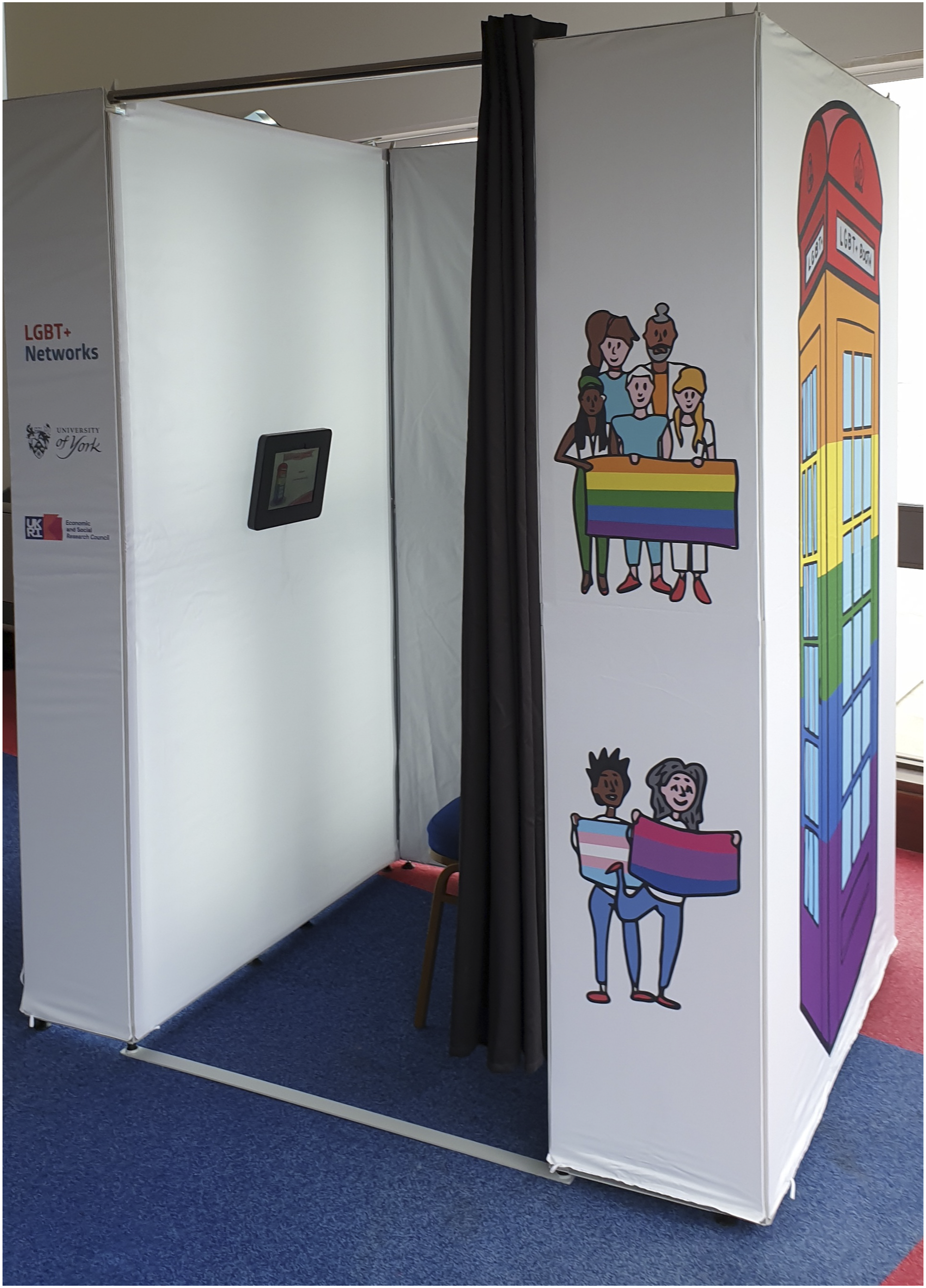
A chair is placed in front of the tablet for users to sit on while recording. The video booth is made of lightweight material, making it both portable and easy to assemble. Erecting the booth takes two people approximately 45 min, and dismantling took 25 min. The portability and accessibility of our video booth to wider populations, sets it apart from the ‘video booth’ produced by Epperson (2015), which seems to function more like a video diary room (Harris et al., 2015; Nind et al., 2012; Noyes, 2004) with a fixed location.
Hosting organisations and their events
Initial calls for organisations to host the video booth were made via NHS Employers (our research partner) and followed up with further calls on Twitter targeting organisations with planned events during LGBT+ history month. The calls included information about the project, how the video booth works, in what ways the recordings would be used, and means of contact for expressions of interest. A total of 41 organisations (39 NHS organisations and two non-NHS organisations) responded, subject to our project constraints we were able to accommodate a total of eight organisations. In selecting organisations for inclusion, we gave priority to those with LGBT+ networks and sought to best represent a geographical spread across different NHS organisations.
All of the events the video booth appeared at were organised primarily by and for NHS staff, with a handful of events also being open to external parties. These events differed in terms of the size (one with 15 in attendance, four events with 50–100 in attendance and two events with approximately 200 in attendance), format and formality, ranging from a traditional one-day large conference to a low-key quiz night with a small number of attendees. At most events (6 out of 8), the video booth was placed in an area dedicated to networking alongside other promotional stalls for internal and external parties, such as local equality groups and organisations that had LGBT+ networks. The precise location of the video booth was stipulated by the event organisers, prompting issues around accessibility, noise and privacy. For instance, when the booth was located in the same area as the presentations, attendees could only use the video booth during scheduled breaks. In contrast, when the video booth was located in the foyer and away from scheduled sessions, it had more exposure and could be used all throughout the event. Placing the booth in a social space also helped to create more privacy for users as sound from the booth was generally cancelled by background noise.
Promotion of the video booth
Event organisers were asked to promote the video booth with an information sheet prepared by the research team to event attendees prior to the event. The information sheet provided details of the study, what participants were asked to talk about, what happens to the data, the approvals in place and contact information. Further promotion of the video was also encouraged on the day of the event. Two organisations included information about the video booth in their event programme (Trust 2 and Trust 4). Four prepared printed copies of the information sheet for people to collect at the registration desk (Trust 4 and Trust 7) or from a dedicated leaflet stand (Trust 8), and in one case, the organisers used it as a poster (Trust 2). Judging from the level of surprise expressed by attendees at one of the events, we were unsure if the organisation had advertised the booth in advance as requested (Trust 1).
Event organisers also used the opportunity to promote the video booth to attendees in their welcoming brief with attendees or in sessional talks (5 organisations; Trust 4; 5; 6; 7 and 8) and/or directed attendees to the booth at various points during the event (5 organisations; Trust 1; 2; 5; 6 and 8). The video booth was further promoted on the project website and Twitter. As a research team, we also approached event attendees to explain the study, the purpose of the video booth and what people were asked to talk about in the video. Furthermore, we prepared an A2 information sheet poster and placed it near the video booth. In the following section, we explain how the video booth works.
Using the video booth
Video booth instructions.
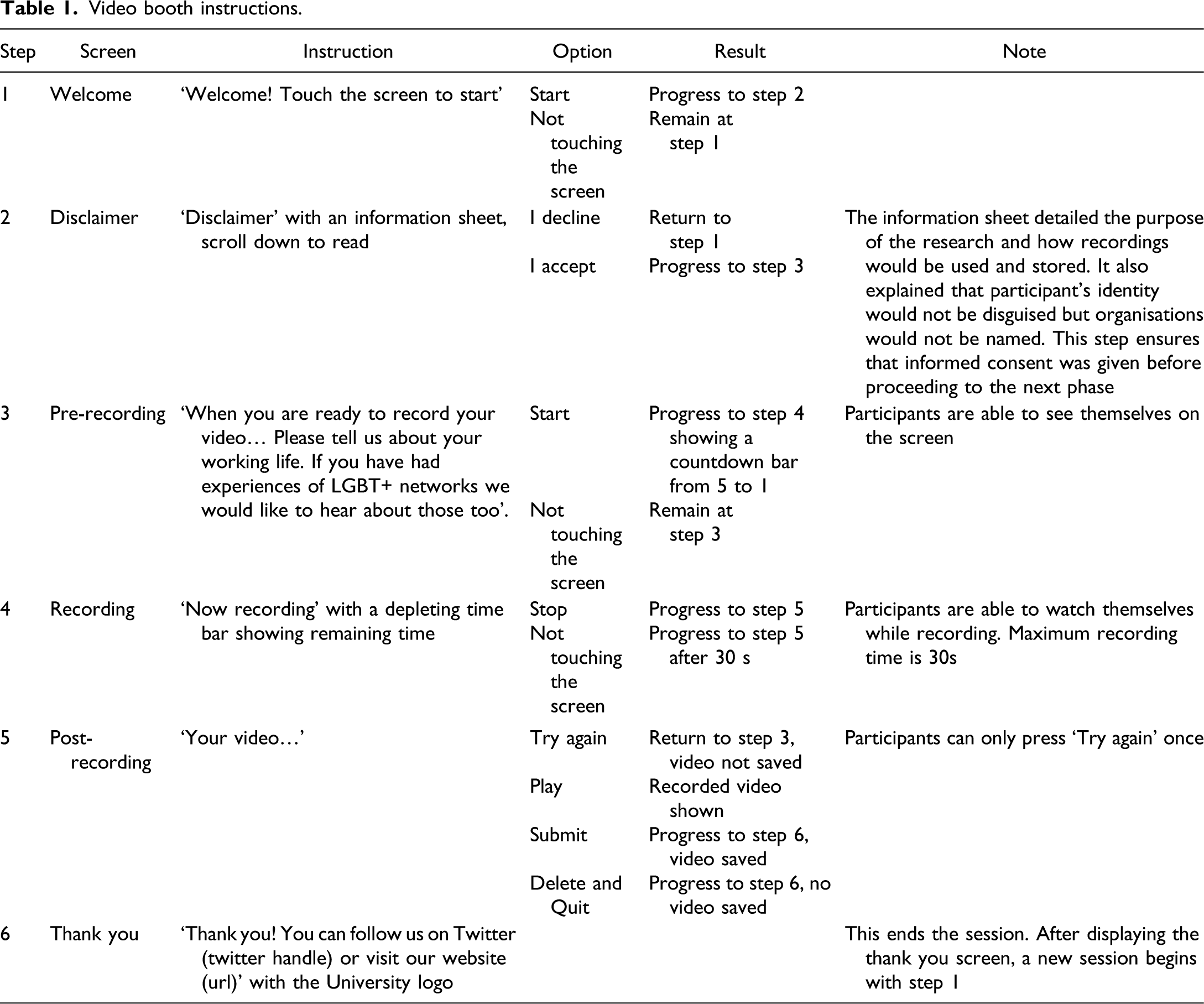
As indicated in Table 1, video booth users were first greeted with a welcoming message and then provided with an information sheet, detailing the purpose of the project and how recordings would be used and stored. Users were informed that their identity would not be disguised, but organisations would not be named. For impact, a selection of videos will be published on the project website. This was clearly stated in the information sheet, partly to avoid overload of information but also to manage expectations and the risk of participants potentially feeling that their contributions were not ‘good enough’. In the end, recordings were selected for the project website according to three main themes including ‘LGBT+ networks’, ‘working experiences of LGBT+ people’, and ‘supporting and engaging with LGBT+ communities’.
Once accepted, video booth users were asked to talk about their working life and experience of LGBT+ networks with a maximum recording time of 30 s. While recording, users could see themselves on the screen, and post-recording, they were further able to watch their video, re-record, delete or submit it (to the research team). After careful consideration, we decided to limit the recording time to 30 s with a single re-recording opportunity. This is largely to prevent buildup of queue with people waiting their turns, but also, to ensure fast turnaround. Nevertheless, these triggered some concerns about (editorial) control, an issue we will return to later. In total, 120 recordings were made.
Although there was no specific debrief process after participants made their recordings, members of the research team were present next to the booth and available for questions at all of the events (except for Trust 3 which did not have an event. Instead, the video booth was offered as a standalone activity). This proved invaluable as the video booth attracted considerable attention. For the most part, people were curious about the booth and why it was there. A number of people had specific questions in mind or were looking for some form of reassurance, typically around the public visibility of the videos (a topic we will return to later). Interchange of this kind formed an important part of our fieldnotes. We also tuned into conversations between event attendees and, in general, kept a close eye on social interactions and gestures around the video booth. We kept a detailed reflective log describing the ambiance around the video booth, the imprint of our presence and reflexively how we felt towards the reception of the booth. In total, our fieldnotes spanned over 40 pages.
(The fear of) being seen
Despite the prefabricated recording environment and simple instructions, anxieties around being on camera were not fully eradicated. In fact, recording in private with no audience seemed to encourage some but not others. This outcome undermines people’s abilities to be themselves in front of the camera and how authentic their voice is, even in the absence of researchers (Jones et al., 2015). Below we explain further how event attendees responded to the opportunity of being seen via the video booth methodology and discuss the influencers pushing their visibility.
The reaction from people about the video booth was mixed, ranging from disinterest or apprehension about the booth to celebratory. A significant number of people declined the offer to use the video booth outright, citing the camera, their appearance or not knowing what to say, as a reason. Responses such as ‘I am camera-shy’, ‘I can’t be videoed’, ‘nah, I don’t do videos’, ‘no [shaking head], no, thank you’, ‘I don’t want to do it [laughter], I’m shy’, ‘I don’t want to put my face in’ and ‘we will make a pass for the video’ were typical, as were these comments ‘not today with my hair like this’, ‘I look tired today’, ‘not my thing’ and ‘I don’t know what to say’. Some referred to time constraints, ‘I’m very sorry, I have a meeting to go to’, claimed to be in a rush or promised to be back, but did not. In one instance, the person claimed they did not have enough to say and another person gave the impression that they had recorded, when in fact they had not.
Most people shied away from the booth and needed a lot of encouragement to use it including endorsements from event organisers, persuasion by colleagues who had already recorded a message or the opportunity to join in with others. In short, the decision to use the video booth was influenced by a number of (trusted) parties, and in some cases, availability of others to join in the recording. Promotion by the event organisers (e.g. Trust 1 and Trust 5) proved far more effective at inducing engagement with the video booth than when event participants were approached by members of the research team. Needless to say, some event organisers were more convincing than others, particularly those who appealed to peoples’ consciousness. At Trust 6, the event organiser announced that the research team had come all the way from York, and so far (halfway through the event), only one person had used the video booth. Following the announcement, a further 18 recordings were made. At a different trust a number of recordings also contained references to the event organiser and judging by the volume of recordings of general nature across trusts, we suspect that some people may have felt obliged to contribute without giving it much thought.
A number of people welcomed the opportunity to get their message across, and used the video booth to self-promote. For these individuals, encouragement was not generally needed. Some explicitly complimented the research team for a ‘very good initiative’ and a number of people, usually senior management, used the opportunity to promote their organisation as inclusive or performing well on the Stonewall Workplace Equality Index. Several people also took pictures of the video booth, not all of these photographers actually recorded a video. There were others who seemed to enjoy being in front of the camera and appeared to be having fun with the process. By way of illustration, one person performed a Superman pose and a group of people used rainbow themed material and waved the rainbow flags while cheering ‘love is love’! In the next section, we examine the influence of the workplace context on the use of a video booth.
Why the workplace matters
Placing the video booth at work-related events mattered in a number of ways. First, it enabled us to target events likely to attract LGBT+ staff. Second, it helped video booth users to focus on their working life but, at the same time, the context shaped what could be safely shared on camera. Finally, it prompted us to limit recording time to ensure that people could record a message and take part in the event without compromising either. We now address these issues in turn and explain how sharing of identities and the content of messages were shaped by the working context and subsequent restrictions on recording time.
The level of sharing and visibility of video booth users varied significantly. Overall, introductions tended to be professional in nature with individuals introducing themselves by their name (65% of recordings), identifying their workplace (70%) and their role (62.5%). A number of people also shared their involvement with LGBT+ networks (26.67%) and/or highlighted their role in EDI/HR or senior management (26.67%). However, much less emphasis was placed on other identifying factors, with only a fraction of video booth users sharing their gender and sexual identities (16.67% identified as LGBT+ and 9.17% as allies). The limited number of videos containing direct disclosure (sharing) of gender and sexual identities was somewhat disappointing but not necessarily surprising, particularly in light of the complexities of LGBT+ visibility (see for example Cass, 1979; Robbins et al., 2016; Troiden, 1988; Ward and Winstanley, 2005) and identification more broadly (Ganesh et al., 2016). Concerns of this kind were voiced by video booth users with questions around where the videos will be published and who will have access to them. Participants were particularly concerned around sharing sexual minority status (e.g. ‘do I have to say that I am gay’?) and quite possibly, apprehension about meeting our (undeclared) research expectations. The issue was further complicated by the inclusion of allies, a matter we turn to later.
Placing the video booth in the context of work produced particular types of video messages. Most were optimistic, applauding the organisation, broadcasting uplifting personal experiences or championing LGBT+ employee networks. Of course these messages were not only safe to share, but also quite possibly, actively encouraged by the playful appearance of the video booth and the organisations themselves. We are sceptical of the true value of these messages and the potential to generate meaningful impact. It is also questionable what the recordings teach us about LGBT+ working lives and, indeed, if the recordings can be used for training purposes. The videos can, however, be viewed as evidence of the problems associated with public visibility and as illustrations of organisational influences.
Difficult personal experiences, criticism of organisations and/or colleagues or negative experiences of LGBT+ networks were rarely voiced in the videos. When such experiences were shared, they were typically expressed with more caution and appeared less coherent, with important details such as their name, gender and sexual identity left out. Negative experiences were further couched with progress and a positive outcome, or expressed in broad terms such as dealing with ‘inequalities in the workplace’. In addition, the licence to be critical about LGBT+ networks appeared restricted to LGBT+ people. Steve’s message is a good example of the difficulties of sharing negative experiences in front of the camera. Looking to the left and down, Steve appears nervous when sharing his experiences of chairing a network.
I’m Steve, I am the co-chair at the [organisation] here, LGBT’s, erm, + staff network. I really enjoy it, it’s hard work. Erm, it can be up-, [stuttered, pressed lips] upsetting when not many people turn up to the meetings or events, but I’ve really, really persevered. I started it 28 years ago when there was no network and I went [inaudible], and I’m now proud that I’m now the co-chair. (Trust 4, Video 13).
As referred to above, placing the video booth in the workplace context had a further impact on recording time. With busy work schedules and concurrent event activities, it proved important to limit recording time to 30 s, which would help to bring out the essence of what people wanted to say and allow individual users to playback their video and, if needed, re-record in less than 2 min. The 30 s slot provided sufficient recording time for most people to get their messages across and to avoid potential buildup of queues. A number of people only used a fraction of the available time, whereas some did more than one session of the recording. Given that our main purpose was to explore and experiment with the issue of public visibility (how would LGBT+ people and allies react, navigate their visibility and/or create impact in front of the camera), the set time cap enabled us to explore visibility, but not impact as fully. Longer recording times are, however, unlikely to eradicate these effects.
Inclusion of allies
Mirroring the composition of most LGBT+ networks, the video booth was open to LGBT+ employees and their allies. The inclusion of allies had some unexpected outcomes. First of all, it masked LGBT+ visibility because using the video booth was not exclusive to LGBT+ identifying people. In practice, this meant that LGBT+ employees were only visible if they shared their gender and/or sexual identity in front of the camera which the majority did not do. Secondly, some allies appear to have felt obliged to participate, even when they had limited personal experience to share. This resulted in a number of empty or ‘cliche’ statements, such as these: Hi [smiles enthusiastically], I want to live in a world where everything is equal, for everybody and everything. (Trust 6, Video 11) I’m part of the equality and diversity group at my workplace. And I just want to say that love is love. (Trust 7, Video 2)
These recordings generally failed to provide meaningful information. They were also short, typically less than 15 s. However, some allies did speak candidly in front of the camera and delivered heartfelt videos. In most cases, these allies had LGBT+ family members, as illustrated in the following examples.
Hi, I’m Leanne, I work for [organisation] and I’m a call auditor. And [looked up] I’m so pleased there is a [network] group at [organisation] because my husband came out as transg-, transgender [closed eyes] and that was very difficult for him and for me to process and there wasn’t - I didn’t think [looked up] there was any support but [network] were there for me to message and especially [person’s name]. She was brilliant, gave me lots of advice and helped us through [smiled]. (Trust 3, Video 25)
I suppose the most important thing I get across at work is people asking me questions, what it is like to be the mum of an LGBT teenager, um, and all I say to them is you love your child come what may. Accept [stressed the word ‘accept’] them for who they are, know that they [stressed the word ‘they’] own their name, not you, so accept [stressed the word ‘accept’] their name and accept their pronouns, and just be proud of your child. It’s stunning to see the differences when they just accept who they are and you acc-… (Trust 5, Video 3)
The decision to include or exclude allies was considered to be difficult by the research team. Importantly, excluding allies was considered likely to trigger backlash from organisations, allies and within LGBT+ communities and compromise the success of this initiative. Including allies offered potential gains and seemed to offer a better solution. For a start, we were interested in capturing the ally experiences, particularly those who were actively involved with LGBT+ networks/communities. Their inclusion also meant that people were unlikely to be ‘outed’ or labelled by using the video booth, as discussed above. However, the decision to include allies sent mixed messages to event attendees. On the one hand, they were presented with a video booth decorated with LGBT+ specific graphics such as rainbow colours, bi and transgender flags and, on the other hand, an information sheet that also welcomed allies. This undermined LGBT+ exclusivity and visibility, and further limited our control over contributions from people that appeared somewhat disconnected from LGBT+ communities.
Ethics and privacy
As a research tool, the video booth raised a number of ethical challenges. Most of them were anticipated (i.e. issues around public visibility, informed consent and the right to withdraw) and cleared ahead of time by the University Ethics Committee, followed by NHS Health Research Authority approval and further site clearances. However, a few challenges only surfaced once the research had commenced. These proved difficult to address and, in some cases, not possible to fully resolve. Below we detail the challenges and explain what measures were introduced to address them, starting with foreseen challenges followed by those more difficult to predict.
First, given that anonymity of self-recorded messages could not be protected, strict safety measures were put in place blocking sharing and/or archiving of any recordings including material that compromised personal dignity, threatened employability of individuals or institutional integrity. Second, to alleviate concerns about lack of prior information about the video booth (i.e. video booth information sheet not being circulated by event organisers as requested) the information sheet was further displayed in the video booth where people were asked to consent to participation. Third, to minimise collection of personal data, no identifying criteria was attached to the recordings. As a result, ex post withdrawal from the research was difficult. We agreed, however, that all requests for withdrawal be approved, providing that the individual could detail the place and approximate time of the recording as well as share a photograph to match our records. No one made contact to withdraw. Nevertheless, the long-term challenges of publicly accessible non-anonymised data posed some ethical concern. Largely, due to the lack of control over how videos are used, but also, the way in which they are interpreted and by whom (Brady and Brown, 2013).
Later challenges discovered in the field, including lack of privacy and the content of recordings, were typically out of our control. With the video booth having no ceiling and walls made of fabric, privacy was never guaranteed for those using the booth. This potential problem was accentuated on site with limited or no control over where the booth was placed, creating challenges around accessibility and privacy as explained earlier. A further and more pressing challenge rose in relation to the content of the recorded messages. Not necessarily threatening employability of employees or integrity of the organisations, as we anticipated, but failure to respond to our aims and to present value to our research project. These recordings do not feature on the project’s website but will be archived as specified by the funder.
A further issue developed because we were not able to contact those who recorded. In part, this exposes issues that can arise in the absence of a dialogue, but equally, the difficulties associated with accepting videos at face value. As an illustration, one recorded message involved four individuals with one person sharing ‘Roger 1 has just joined us and he is tansgender’. Roger then gestures thumbs up and responds ‘hi’ while everyone points at him. Despite signs of approval, we were unsure about how comfortable Roger actually felt about the recording and being singled out in this way. As a result, we decided to err on the side of caution and omit the video from any publication. We accept that our approach may have failed to expose transphobic gestures in action, but without the option to double check with Roger, we felt inclusion was very high risk.
Conclusion
We set out to create a platform to allow more LGBT+ voices to emerge and to capture a greater range of experiences that could be used for training and impact. We also explore the boundaries of visibility and lessons from using the video booth as a research tool. We were particularly interested in when, where and how the video booth could be of (best) use, whether this methodology can be applied to different groups and used for different purposes, and in general, what it has to offer in relation to the three central themes outlined earlier; empowerment, agency and control; representation of self for (imagined) audience; and visibility. We now address the themes in turn.
Operating the video booth within the context of work does not necessarily empower dispositioned individuals (Buchwald et al., 2009; Noyes, 2004) or marginalised groups (Holliday, 2004; Jean-Charles, 2016; Klein et al., 2018; Lovelock, 2019). We found that producing videos in workplaces raises difficult questions about collaborative work, the price of organisational buy-in, employee agency and control. Our attempt to steer individual contributions towards LGBT+ workplace experiences and experiences of LGBT+ networks was often caught between an apparent need by the participant to self-promote or their need to comply with organisational pressure to engage. Also, by limiting the opportunity to re-record and the recording time to 30 s, this compromised editorial control in a number of ways. First, some people may have preferred a longer recording time. Second, video booth users who were not happy with their ‘second try’ were left with two options either to submit or delete their video. For some, neither option may not have been their ideal choice. On the basis of this, it is clear that neither we nor individual contributors had full control over submitted content. Once submitted, the future of all videos was automatically placed under our control. This raised an immediate dilemma. Largely because of the volume of videos that were ‘off topic’ and of no obvious value for training purposes, but also, our promise to publish a selection of videos on our website. On balance, we decided to limit publication to videos that met our initial research criteria, with other messages excluded from the video bank. We accept that this may not be what participants were led to believe would happen; however, the decision was based on the need to maintain research integrity and our duty to protect research participants.
The drive to present a professional, positive work-self by participants was striking. For the most part this was marked by prioritisation of work-related identities above other types of identities. The participants also had difficulties sharing negative experiences, particularly for LGBT+ identifying contributors, unless couched with positive outcomes. With that in mind, the video booth may not be the ideal medium to bring sensitive topics to the surface but instead it provided a platform to elicit more positive experiences.
With no direct audience, we were intrigued by who the messages targeted? For the most part, people spoke to LGBT+ networks, organisations, colleagues and event organisers, but not other LGBT+ identifying individuals. The LGBT+ participants did not view the video booth as a tool for peer support. Instead, they typically used the video booth as a megaphone, calling for organisational action or an opportunity to address/thank senior management or to educate others. In contrast, allies expressed benefits of working alongside LGBT+ people and stressed disenfranchisement of LGBT+ people. Principally this meant that sensitive issues could only be raised in front of the camera when referring to others.
The final theme of our research project concerns visibility. Opening the use of the video booth to all, had some unforeseen consequences. While this may have encouraged more people to use the booth, removing the exclusivity of the video booth to LGBT+ identifying people, masked gender and sexual identities of the participants who subsequently then needed to self-identify to become publicly visible. No doubt, visibility is much more problematic for LGBT+ individuals than others, and this was further complicated in our research by removing the exclusivity of the video booth to LGBT+ employees. The only party that remained invariably visible amongst our participants was the employer. We found that the video booth did not help improve LGBT+ visibility. Rather, the video booth may be argued to have primarily helped organisations to promote their events and themselves. Masking organisational names from the recordings helped to limit this ambition by employers and, as originally intended, offered participants protection against potential exploitation by their employers. However, this act was by no means sufficient to cancel out the impact organisations had on the making of the videos.
How, then, could the video booth be used more effectively in the future? First, we suggest that the impact of the organisations can be reduced by situating the video booth in a context with less attachment to any particular workplace. For example, placing the video booth at an event hosted by a local community or a LGBT+ focused nationwide civil society organisation. This way, the chances of the video booth being used for publicity or as a promotional tool for a specific workplace are reduced and employees are also less likely to face organisational pressures to contribute (with ‘empty statements’) or to present the organisation in a particular way. More to the point, self-presentation might be different where event attendees can express themselves outside of the context of work. It is clear that the potential of the video booths have not been fully realised and it would be interesting to test what messages would be delivered and to which (imagined) audience people speak when the booth is placed outside of professional boundaries.
Second, in order to increase public visibility of LGBT+ individuals, the video booth might work better if it was only open to LGBT+ people. We appreciate that this approach comes at a cost. Largely because (potentially) insightful messages from allies will be lost, but also, LGBT+ employees might be reluctant to use the booth given its exclusivity. Nevertheless, the benefits, in our view, outweigh the cost as gender and sexual identities will not need to be voiced to be identified. Moreover, making the booth exclusive will prevent empty statements from allies who do not engage much with LGBT+ communities. By focussing exclusively on LGBT+ individuals, their voices can be heard more loudly and their presence is unambiguous. That being said, we realise that the exclusion of allies can pose the risk of ‘outing’ those who use the booth, both on the day (because video booth users are assumed to identify as LGBT+) and when the recordings are made public. To mitigate this risk, a clear and respectful communication must be ensured when promoting and encouraging people to use the video booth, acknowledging sensitivities around visibility, openness about gender and sexual minority status and public visibility in general. For instance, ensuring that attendees will not be approached individually either by event organisers or a research team as this might label them. Those who are comfortable to take part will step forward by themselves.
Even with the above adjustments in place, the number of recordings may still be low and neither public visibility nor impact for LGBT+ communities can be guaranteed. Taking all things into consideration, showing one’s face and identity in front of a camera to the public is not within everyone’s comfort zone. As we argued earlier, the fear of being seen, may be heightened for LGBT+ communities, but is unlikely to be limited to this population. Yet, this innovative methodology may offer an important step for marginalised groups to make their voices heard. We encourage future researchers to build on our methodology, reflect, and debate on its virtue and further application.
As a ready-made recording studio, the video booth is accessible and easy to use. It provides a hassle-free solution to record messages in a dedicated space. With fabric walls, a curtain and a self-operated facility (without the interference of researchers), external exposure is minimised (making people feel more at ease) and some form of privacy is provided for producing the videos. Yet, the outcome of the recording is open to the public. This means that the video booth transcends a public-private dilemma of self-presentation and offers a unique environment to explore sensitive issues and how individuals react to the camera. By the same token, this method is highly versatile and can be tailored to different groups (e.g. ethnic minorities, people with disabilities, students or managers). It can also be used for different research purposes such as market research, product development and/or documenting student experiences, to develop training or to generate impact. However, to ensure the desired effect, video booth users need clear guidance on the nature and content of the recording. Last but not least, we accept that the tablet system is expensive which may limit its reach and usability. As a research team, we believe that alternative, equally as effective, technologies can be applied to reach a similar outcome, but at a reduced cost.
Footnotes
Author's note
New affiliation of Sudthasiri Siriviriyakul is Thammasat Business School, Thammasat University, Bangkok, Thailand.
Declaration of conflicting interests
The author(s) declared no potential conflicts of interest with respect to the research, authorship, and/or publication of this article.
Funding
The author(s) disclosed receipt of the following financial support for the research, authorship, and/or publication of this article: This work was supported by the Economic and Social Research Council (ES/N019334/1).
