




Abstract
For centuries the autopsy has been a key technology in Western culture for generating clinical/medical as well as cultural knowledge about bodies. This article hails the anato-medical autopsy as a generative trope and apparatus in reconfiguring Western humanist knowledge of bodies and bodies of knowledge and takes up the possibilities of working with the concept of autopsy in disrupting qualitative research methodology. In doing so, the article outlines and returns (to) a series of research-creation experiments assembled at an academic conference, which engaged with the challenges for social science knowledge laid out by Law’s (2004) After Method book. Our research-creation experiments centred autopsy as a theoretical-methodological gaze and apparatus for de-composing qualitative research methodology by engaging with post-humanist and new material feminist thinking.
Keywords
Autopsy, conference, research-creation experimentation and. . .
In this article we return to a range of research-creation experimentations that were composed during a conference workshop and which were enacted to disturb, trouble and illuminate established methodological practices. Our aim is to explore what thinking with autopsy makes possible for methodology when ‘social science tries to describe things that are complex, diffuse and messy’ (Law, 2004: 1). The autopsy has a long history entwined with knowledge production. It is premised on a thorough scientific examination of a corpse to determine the inner workings of bodies (Foucault, 1963/1975), and it is also associated with dissection and scrutiny which is produced through a particular epistemological occularism (Bleeker, 2008; Sawday, 1995). We draw on that history to position autopsy as a site and mode of inquiry in examining how bodies and bodies of knowledge, themselves, become a corpus which defines and frames social science research methodology more widely.
Through research-creation experimentations (Law, 2004; Lupton and Watson, 2020; Manning, 2016; Vannini, 2015) with autopsy-like practices, we pose questions about, and raise the spectre of, the decomposing body and, thus, the bodies of knowledge (the hu/man) in Western humanisms. In doing this, we attempt to disturb the onto-epistemological technologies through which autopsy operates as a critical instantiation of masculinist modes of producing knowledge, which rely on methods that configure, even transfigure, the body into a knowable and sensible ‘thing’. Our experimentations act as a set of provocations for (re)thinking and enacting qualitative research practices that rely on the putatively objective scientific gaze of observation and examination, measurement and classification, codification and categorisation. We offer our autopsy-like experimentations as a set of tentative, speculative and emergent techniques, taking seriously those process-oriented and relational frames of thinking that are redolent of post-humanisms (Braidotti, 2013) and new material feminisms (Barad, 2007) – an impulse emerging and emergent in this journal (e.g. Levy et al., 2016; Lupton and Watson, 2020; Schadler, 2019). As such, we do not seek to warrant, justify or legitimise autopsy-like experimentations in any way as a final destination. Rather, we offer the returnings to this conference event as (only) one way to highlight how working with theory, alongside a set of immanent and unruly methodological (autopsy-like) experimentations, can produce ways to rethink methodological practices.
In particular, and in the context of Law’s (2004) challenge to work with/in the mess, we heeded Manning’s (2016) invocations towards the immanence of thinking-doing as research-creation. Manning and Massumi (2014: 89) envisage research-creation as an immanent research technique in that ‘it reinvents itself in the evolution of a practice’; it is speculative, in that it engages creativity and experimenting; and it is pragmatic, in that it occurs in the enactment. In such inquiry, ‘knowing does not come from standing at a distance and representing but rather from a direct material engagement with the world’ (Barad, 2007: 49 italics in original). The researcher is imbricated in the research and not an independent observer at an ontological distance, and methodology is envisaged not as a series of tools that collect and categorise data but as a series of emergent techniques which might trigger processual thinking and feeling (Latour, 2004; Manning and Massumi, 2014). This article offers our autopsy-like experimentations as one way of engaging with research-creation, to highlight how working with and doing (with) theory, can produce ways to rethink research practice.
Our research-creations materialised in the form of some collective theoretical discussions and in an ‘Autopsy goes Rogue workshop’ research-creation event held at the After Method conference in September 2017 in Mälardalen (Sweden). The conference – inspired by Law’s (2004) provocation to re-think social sciences methodologies in relation to the messiness, slipperiness and indistinctiveness of (knowing) the world – provided an ideal opportunity to experiment some ‘techniques of deliberate imprecision’ (2) in imagining ‘methods when they no longer seek the definite, the repeatable, the more or less stable’ (6). The ‘Autopsy goes Rogue workshop’ research-creation event was shaped as a methodological intervention on decomposing the hu/man body which drew on autopsy-like practices and aimed ‘to create new potential for a thinking-with-and-across techniques for creative practice’ (Manning and Massumi, 2014: 88).
All across these pages we focus on both the history of autopsy and on our autopsy-like experimentations as generative means for decomposing normative (humanist) ways to know; for rethinking knowledge produced through the ghoulish (Western hu/manist) gaze of conventional research methods. The autopsy-like research practices are intertwined with a constellation of scholarly works, which interrogate and query the normative scientific gaze and the methodic inquiry and scholarship that instantiates canonical knowledges of bodies.
The article proceeds with a brief consideration of the premise for autopsy as a gold standard of Western scientific knowledge-making practices, and queries how this positioning is transposed as a technology for establishing knowledge of bodies and bodies of knowledge. It outlines the autopsy-like research-creations at the After Methods Conference and then moves through a series of critical-analytical returns to our research-creation experimentations in which we put post-humanist and new material feminist ideas to work alongside our autopsical experimentations as a way of signifying the possibilities for thinking differently with/in a different orientation to methodology (see also: Lupton and Watson, 2020). Following these returns (what we call ‘renderings up’), we reflect momentarily on Foucault’s considerations on the demise of the ‘Man’ of Western humanism and relate this to our rationale for focusing on autopsy as theoretical gaze. We end the article with some (in)conclusions on autopsy as a generative trope for qualitative research.
Autopsical bodies (of knowledge): historical suggestions
Autopsy, most commonly associated with the dissection of post-mortem examination and with the reassembly of (fragments of) bodies in forensic anthropological procedures (see Figure 1), has an etymology in Greek: autopsy (auto+opsis) contains the dead metaphor of vision – ‘to see with one’s own eyes’ (Klaver, 2005: intro). The post-mortem autopsy, a technology by which ‘systematic, direct visual and tactile investigation remains the ideal’ (Wolfe, 2010: 232), has a long tradition in Western knowledge-making histories with mapping and territorialising the body interior. Determining cause of death was a much later (late 18th and 19th centuries) basis for autopsy and followed a tradition whereby the dissection of dead bodies was in service to the penetrating gaze (Foucault, 1963/1975) of medical knowledge to the benefit of their living hu/man counterparts (Klaver, 2005).
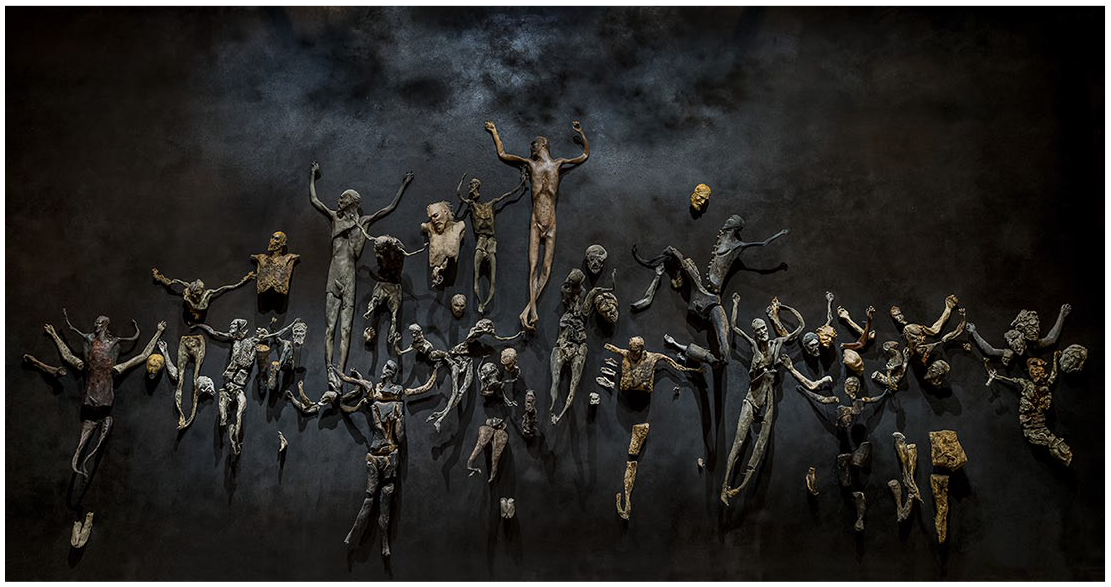
‘Imitatio Christi’, 2017 (Roberto Cuoghi).
Sawday (1995) evinces the grandiose architectural theatres of display that characterised early anatomical dissection in the great European centres of learning. The chase for knowledge vied with the playhouse as a popular site of public spectacle. In the days before post-mortem refrigeration, it is fascinating to imagine the viewers’ line of sight, assailed by a wider bodily sensorium, at such exhibitions. One might sense the fetid smells of decay and putrefaction experienced by those human, more-than-human and not-quite-human bodies in attendance. This backward glance at early autopsical practices contrasts starkly with the sanitised imaginary of contemporary media representations of autopsy, which are myriad in popular culture (Hausken, 2014; Hirschauer, 2006; Maxwell, 2008; Tait, 2006). Here, performances of autopsical authority remain relatively intact, whilst autopsy is largely consigned to the well-sealed lab – that clean, spare and sterile sanctuary of the omnipotent, objective and forensic modern health professional. The autopsy can, therefore, be considered a key technology through which a range of academic, professional and popular knowledge by and of the (human) body is fabricated and (re)assembled.
Autopsical dissection is not only harnessed in a perpetual thirst for knowledge of particular bodies. Advancements in anato-medical knowledge also shaped Enlightenment understandings of bodies, knowledge and selfhood more broadly (Laqueur, 1992; Sawday, 1995). Klaver (2005) argues that Western knowledge production hinges on ‘radically distinguishing subject from object in the service of humanist inquiry’. Concomitantly, she posits that in anato-medical autopsy such onto-epistemological separations (subject-pathologist vs object-corpse) are far from straightforward. The autopsy is a site in which the body – now a corpse – is likely to lose its physical and metaphysical coherence. Thus, the autopsical corpse inherits simultaneously both and neither subject/object positions. Such subject/object blurring necessitates particular kinds of twists in positioning bodies (and bodies of knowledge) as known and knowing.
Autopsy, valorised as a technology par excellence in sedimenting knowledge procured through the discipline of logic and scientific observation (Wolfe, 2010), is simultaneously a key site and mode of producing hu/manist knowledge more generally – what Latour (2004: 209) refers to as ‘the collective body of science’. It is through these reflections on autopsy that we introduce our autopsy-like research-creation experimentations. As a site and mode of inquiry, the practices associated with anato-medical autopsy (Klaver, 2005) remain fairly resolutely confined to the realm of bio-medico-legal discourse and practice. The relative dearth of anato-medical autopsy as an explicit site or mode of inquiry in the social sciences seems somewhat surprising especially when compared to other techniques associated with the body. We feel that this is a missed opportunity, hence our rationale for considering what thinking and experimenting with autopsy might do in bringing normative understandings with regard to research methodology.
Research experimentations through/with autopsy
Taking seriously the idea of autopsy as a technology through which both particular and generalised knowledge of bodies is created and crafted, the interventions at the conference took the form of some serious play practices – referred to as Stations – through which (academic) bodies might become differently. These stations engaged participants in and with a range of novel events, occurring ‘in the mess of relations not yet organized in terms such as “subject” and “object”’ (Manning, 2016: 29).
The autopsy event offered audience and presenters opportunities to engage in immersive, collaborative co-performance in a range of creative assemblages – nine Stations – positioned throughout the room. Presenters wore white contamination suits and masks (see Station 8 below), which made autopsy-like experimentation organisers both anonymous to conference participants and only noticeable to each other by their differing body shapes. During the research-creation event, photographs and videos were taken of what was going on around the room. Nine different Stations shared autopsy-inspired practices as their theme and offered the following potential experiences/ entanglements (see Figure 2):
Naked live-dead body: A table, acting as a mortuarial plinth, bore a motionless dead-like male body which was naked but for some gossamer fabric worn from the waist down. Beside the body were a range of accoutrements including medical instruments, measuring equipment, make-up and pens.
Graffiti wall: A white wall lined with paper on which co-participants could write, draw, doodle. A range of writing implements were provided.
Body part (re)assembly: Various body-related toys, miniature model body parts, and partly formed male dolls were assembled with a range of other craft-related materials (see Figure 3).
Live body shadow theatre: A recurring theatre performance in which a supine body is eviscerated with a large knife and body parts extracted alongside blood-curdling screams. The performance took place behind a sheet with the body and body part silhouettes projected onto that sheet.
Sewing bodies: Complete and partly formed body outlines transferred onto translucent interlining fabric. A range of needles and thread of various size and texture were provided, as were a range of craft items.
Unsight/ed/ly autopsy table: An upturned table on a plinth was covered in ‘operating scrubs’-type fabric and offered participants the opportunity to put gloved hands through a series of slits. Inside was a blank body outline with a range of body objects having various textures, smells, temperatures. Invoking the sanitised theatre of surgical operation but with a queering twist, this Station intentionally occluded sight in favour of reliance on a wider sensorium.
Pecha Kucha: a rolling series of slides containing classic and grotesque body-related images. The images were interspersed with theoretical/methodological quotes.
Contamination suits: Those bodies (dis)organising the research-creation event were clothed in white, hooded contamination suits with operation theatre face masks, disposable plastic over-shoes and latex gloves (see Figure 4).
Body outlines: a series of white paper body outlines – not unlike those seen in television crime scenes – were randomly placed on the floor of the room in which the event took place (see Figure 5).
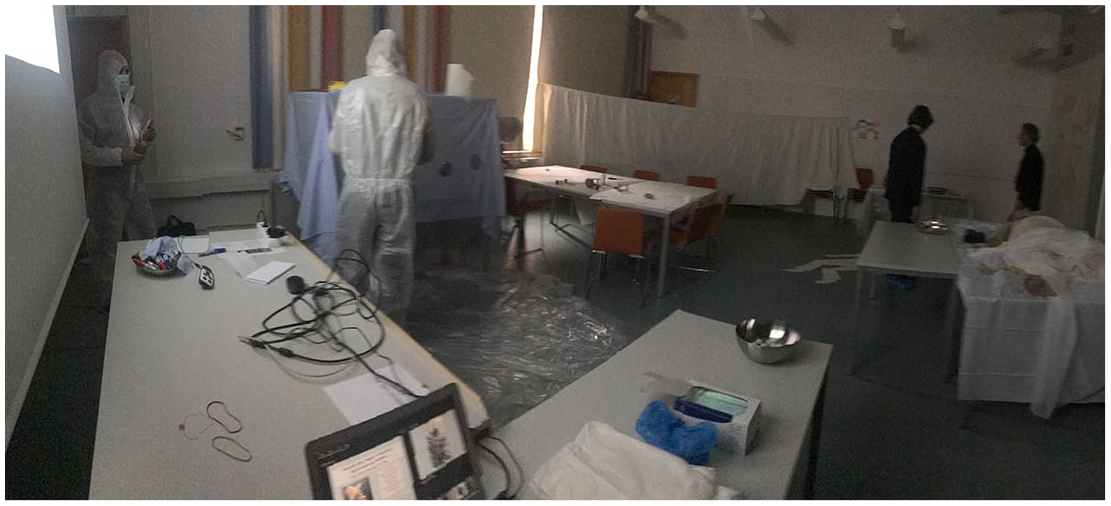
Autopsy room set-up.
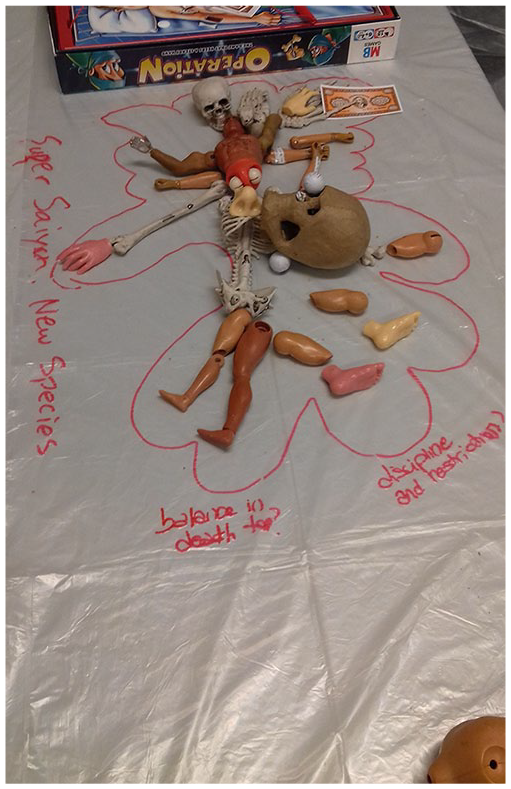
Crafting autopsical bodies.
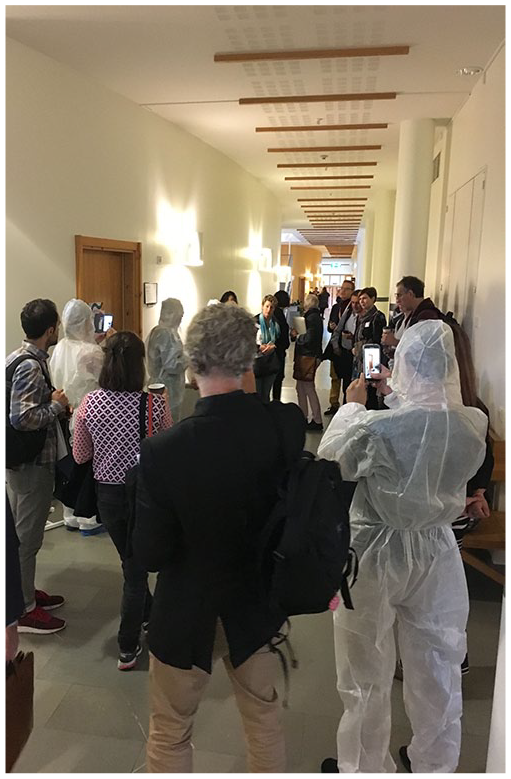
White-suited pre-entry.
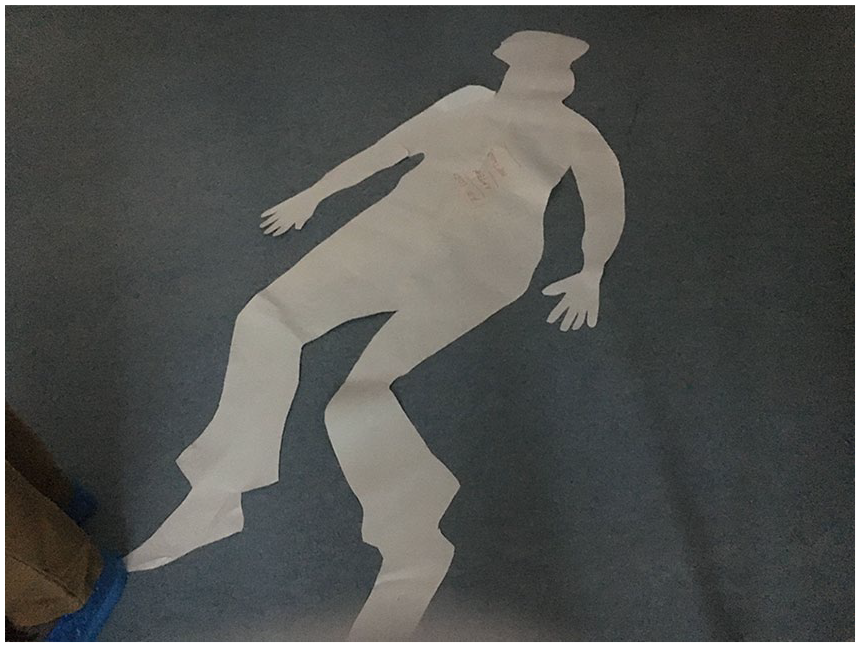
Autopsy map, body outline.
Participants were not given any theoretical or contextual explanation and were not served with any instructions as to the scope or nature of their participation. They were simply requested to wait outside the room until being invited in en masse. However, adhering to a legal proscription from the university at which the event was sited, participants were informed before entering that the room contained a naked body as displayed in Station 1 (see Figure 6). The room, darkened in line with the aim of occluding participants’ ‘full sight’, encouraged a reliance on the wider bodily sensorium: on touch, sound, smell and affect (see Figure 7).
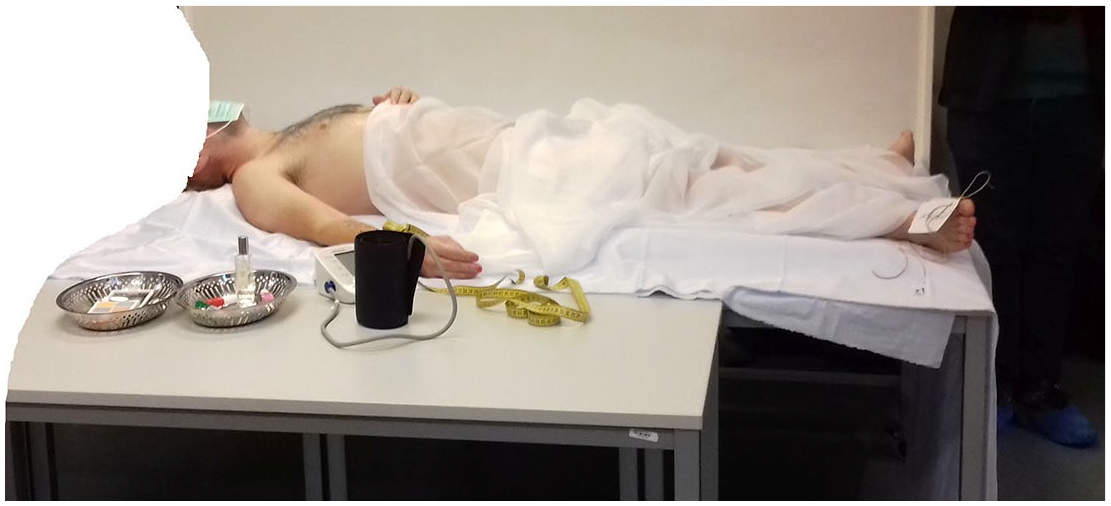
Living dead autopsy body.
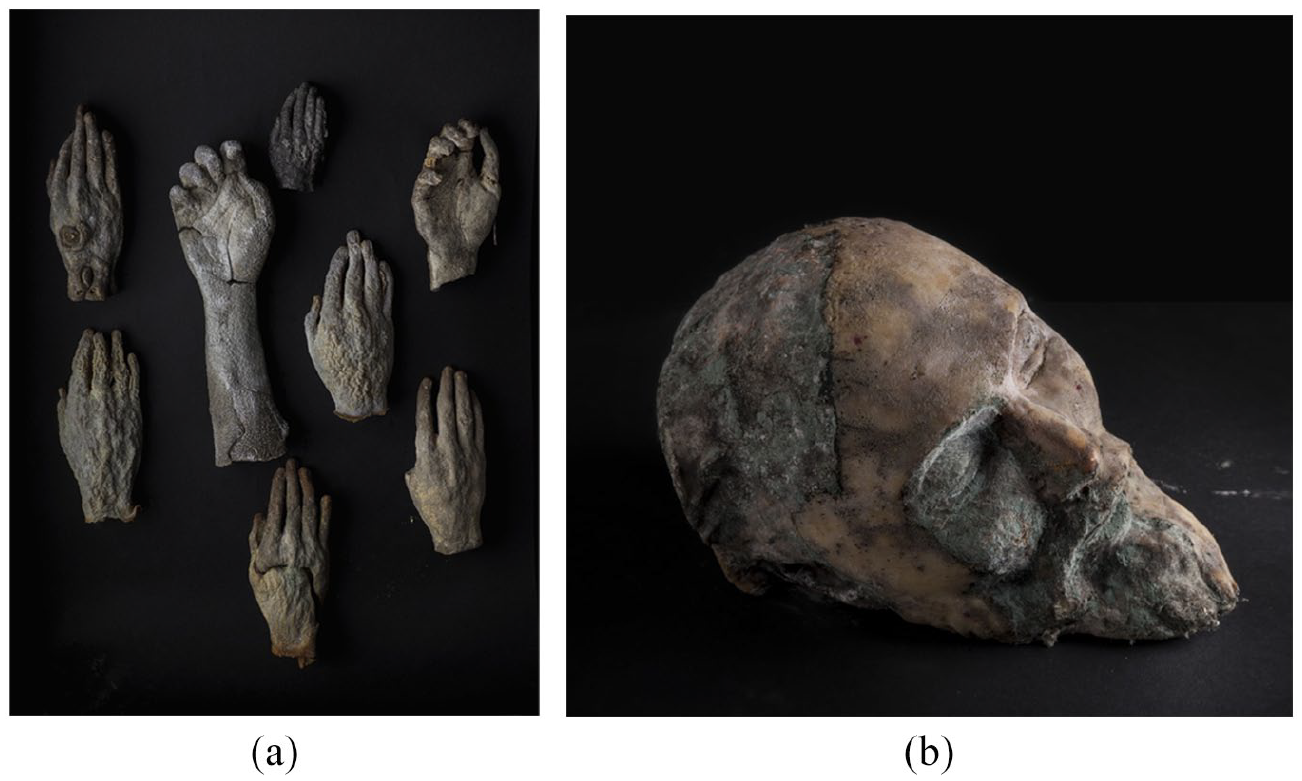
‘Imitatio Christi’, 2017 (Roberto Cuoghi).
Autopsical renderings (up)
We return here to what autopsy makes possible for knowledge-making practices more generally. In what follows, then, we render (up) some of what unfolds in/from the autopsy event: a series of musings that pose and position, compose and decompose human and non-human bodies as they entangle unevenly with the autopsy-like practices of the research-creation event. In doing so, our musings on the research-creation events also resonate with Law’s (2004: 154) thinking on ‘method assemblages’ as a means to ‘provoke debate about methods’.
Art-autopsy-body-corpse
The live-dead body on Station 1, stretched out almost naked on a dressed plinth, indexes most obviously the autopsical corpse. Here a (living dead) body becomes object – vulnerable in its legibility and abjection; it becomes a spectacle for witnessing something between horror and fascination. It reminds us about the paradox of knowing simultaneous past, present and futures and regenerates those living-dead bodies of (methodological) knowledge that we came to share in academic conference spaces. The live-dead body of (methodological) knowledge(s) was demonstrated to, and co-lived with, the conference participants drawing attention to how more artful performances might act as tools and strategies to process differently these paradoxical methodological and intersectional bodily spaces. Here, our living-dead body reposes in a funereal, half-lit space surrounded by contamination-suited bodies (Station 8) – a crime-scene staple of popular culture viewing. Scattered around the room are a series of spectral body outlines (Station 9) indexing the body maps that chart and code autopsy reports.
As theatrical artistry, Station 1 indexes a complex of artistic representations of the posthumous – usually saintly male – body. For Braidotti (2013: 107): [i]n so far as art stretches the boundaries of representation to the utmost, it reaches the limits of life itself and thus confronts the horizon of death. To this effect, art is linked to death as the experience of limits
Station 1 gestures to Mantegna’s classic image of The dead Christ, which represents the funerary arrangements made on Christ’s body – that ultimate spectacle in Judeo-Christian traditions. This iconic image includes a range of funerary objects and a number of mourners, all witness to the body’s perfumed preparations for burial, presaging its passage from the realm of the living to elsewhere, marking its absent presence as brute materiality, as relational other to that materiality that once pronounced its life and now does so its death. The image of Christ’s near naked body marks the vulnerabilities of all flesh, the incontrovertibility of corporeal mortality, the finitude of (any individual) life.
Station 1 similarly indexes Marina Abramovich’s performance Rhythm0 (5974), (Abramovich, https://vimeo.com/71952791) which involved the artist’s body and 72 objects laid out on a table in a room in a Neapolitan art gallery. The objects accompanying Abramovich’s body included instruments of torture and accessories alike – whips, chains, pieces of metal, pistols, razorblades, glass bottles, shoes, feathers. Abramovich stood for 6 hours at the disposal of the visiting public who were allowed to do anything they liked to her prone and prostrate body including using the objects provided. Abramovich’s artistic body – posed, female, vulnerable – an object at once subject to the wounding wiles of brutality and beautification, lays itself open as a puppet of the public, to the cut, to the decaying transgress of interior/exterior, object/subject.
Roberto Cuoghi’s reworking of Imitatio Christi for the 2017 Italian pavilion at the Venice Art Biennale (‘The magic world’; https://www.youtube.com/watch?v=I-HraCbmAfg) continues those long-established artistic tropes that represent and thus interrogate the vulnerabilities of the corporeal body, the immanence of its own decomposition. For Cuoghi, everything is already in various stages of decomposition: bodies do not finally reach a state of death; they experience putrefaction as an essential part of their being (a)live in the world. As Roach (2004: 65) has it: ‘Life contains these things: leakage and wickage and discharge, pus and snot and slime and gleet. We are biology. We are reminded of this at the beginning and the end, at birth and at death’.
In indexing the complex of artistic representations that capture those posthumous moments before fleshly autolysis, bloat and putrefaction kick in, or, in experimenting/imagining what the subject-less life of the body – body as object – might be, Station 1 mimics most closely the site of autopsy: a space of death where the body – no longer subject – becomes an object of/for knowledge. Station 1 gestures to the demise of the lived body and raises the spectre of death as the ultimate end state of subjecthood and knowledge. For Braidotti (2013: 131), ‘Death is the inhuman conceptual excess: the unrepresentable, the unthinkable, and the unproductive black hole that we all fear’. Yet, in the context of this article, the death of the body is not the only death that is presaged in the autopsy-like research-creation event. Enacting bodily death as artistic theatricality at an academic conference challenges traditional knowledge making practices and raises the spectre of the death of normative method alongside-and-with (intimately bound to) the death of the ‘Man’. For us, these imagined deaths are what we reached towards, in the hope that, in our autopsy-like theatrical research desirings, death might also become ‘a creative synthesis of flows, energies and perpetual becoming’ (Braidotti, 2013: 131), helping scholars to imagine otherwise and practice methodologies and research approaches differently.
Cinema-medicine-autopsy-death-body
Other autopsy practices gestured to in our research-creation event collide with cinematic, theatrical and cultural histories, which privilege the site/sight of bodies in one way or another. For many scholars seeing, observing and witnessing add to the credibility of their inquiries. Sight, visual experiences and verifiable forms of knowledge bodies are used as foundations for quality and trustworthiness. Sights of bodies function as evidence of larger grand narratives. For example, the image of the knife cutting into the female body (Station 4: see Figure 8) is a scopophilic image par excellence in cinema history. In Alfred Hitchcock’s classic film Psycho from 1960, Janet Leigh’s vulnerable, naked body is lovingly framed and insistently displayed in close-up to the killer (Norman) and, more importantly, to the eyes of the viewers. However, Hitchcock knew that the sight of the knife cutting the body, slashing the soft skin, rending the flesh and entering the body was the most desired shot, the one which guaranteed the power to see – to really see – to the viewer. And so in 78 camera setups and 52 cuts of labour-intensive work across seven days of shooting (Bradshaw, 2017), the viewer watches as the knife in ‘the shower scene’ – that most luminous and brilliant example of cinematic misogyny – delivers up a dead woman’s corpse to the avid gaze of the viewer. Mulvey (1975) analysed such displays of female bodies in relation to the ‘male gaze’, a scopophilic economy of power that sees man as bearer of the look and woman as ‘looked-at’ sexualised object, an economy of bodies and gazes which is still alive and kicking in current consumer culture. To work against this scopophilic currency, we were interested in activating theatrical techniques for occluding omniscient male methodological directionality or ‘full sight’. In the shadowed silhouettes of Station 4 a large knife threatens contact, a high-pitched scream pierces the room, irrupting the otherwise humming soundscape. This knife-body touch remains unseen, unverifiable.
In modern operating theatres, likewise, the surgeon’s gaze is critical. Image towers are now part of the panoply of equipment with surgeons as often as not looking at screens rather than at bodies. Recently, a surgical procedure was live streamed via Google Glass to 13,000 students from 115 countries (Smith, 2014). Barad (2007: 194) argues that visualising technologies such as ultrasonography – the imaging equipment which represents the foetus – do ‘not simply map the terrain of the body; it maps geopolitical, economic and historical forces as well’. She notes that outside the affluent West, sonography’s visual productivity is aligned with the 60% of ‘girled’ foetuses that are immediately aborted or murdered at birth because of their cost to their families. How the body materialises, then, is a feminist matter of concern. Bodily materialisation, visual technology and the work of death are ongoing materializations of ‘how matter comes to matter’ (Barad, 2007: 210).
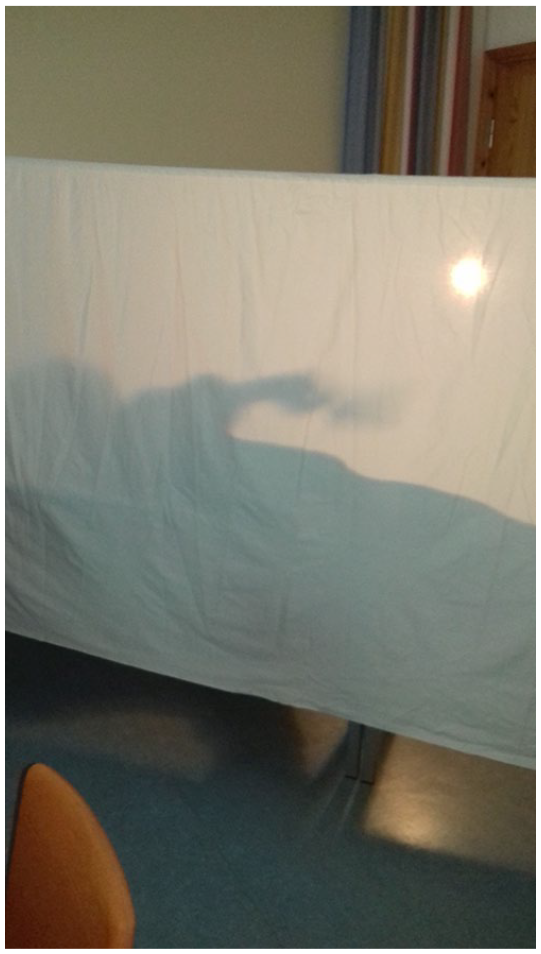
Shadow autopsy dissection.
Autopsy Station 6 – Unsight/ed/ly autopsy table – put this insight (or non-sight) into motion as participants’ unseeing, tentatively groping hands encountered the tactility of materials: a body in parts, bits and fragments laid out for touch, sensation, and experimentation. The vitality of sight as a reliable source of evidence and holistic bodily knowledge is being removed here. Station 6 as apparatus was a ‘physical presence . . . an ontological thereness as phenomena in the process of becoming’ (Barad, 2007: 210), offering up to the touch a decomposed self, an inchoate body, its parts no longer whole but becoming-unwholesome. Not the soft, warm flesh of the loved and living but the unwelcome cold, hard, gooey, soft, sticky, smelly flesh of the fresh corpse. This partial autopsical body was, perhaps, a potential ‘thing’, to be despised, feared, mocked, held in suspicion and loathing. This is the monstrous body, sets of sensational knowledges (un)familiar and (un)available for fabrication (see Figure 9).
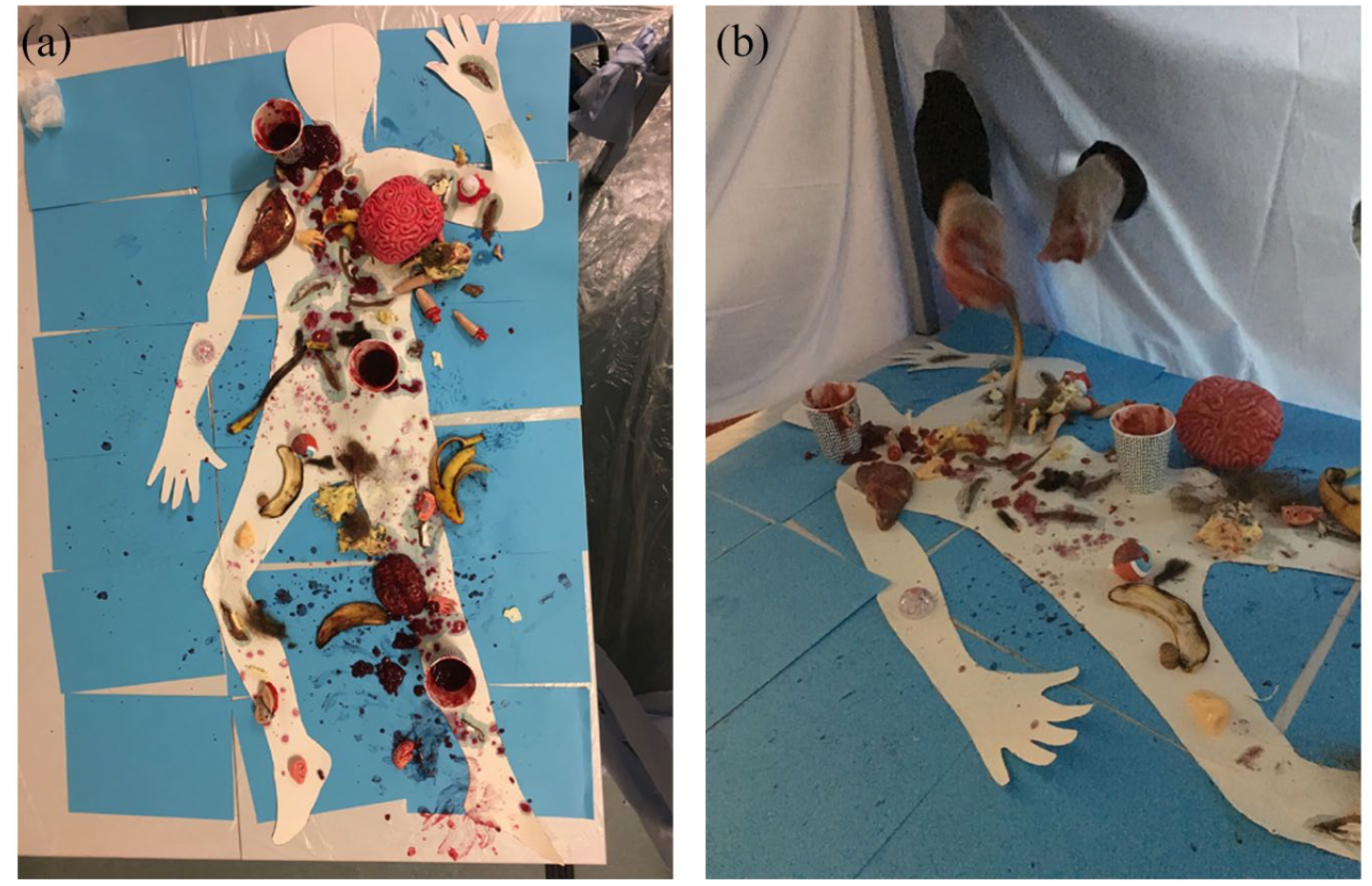
Unsight/ed/ly autopsy table.
Surgeons stitch and suture. Their hands weave stitches, closing wounds, containing blood and pus, repairing skin surfaces after bodily harm, injury or surgery: the living body endures. Morticians stitch too, reassembling corpses after accidents or autopsies, using thread, chemicals and cosmetics to ‘make-up’ the body again rendering it ‘asleep’ and recognisable in casket and coffin. Such de/re/compositioning practices took shadow form in the autopsy event as bodies are sewed, knitted and knotted together – bodies are de/recomposed; re/dis-connected. At Stations 3 and 5, partial bodies were craft-ily (re)assembled or sewn into semi-opaque fabric: the bodies, calling for more stitching, provoking new and different nonhuman bodily forms to emerge. Human participants sat at the table and stitched lines, solid and dashed, punctuated by other non-human bodies, objects and things in unforeseen combination. Interestingly, hand and heart were stitched in physically correct places. Even though the station was concerned with bodily disruptions the pull of the normative body form was strong and irresistible (see Figure 10). These weavings provoke new expressions of methodology as entanglement and relational practice. De Freitas (2014: 285) argues ‘theoretical framing is like a mesh work of lines . . . a knot of entangled lines’ which, in this case, anchors the body to currently understood ways of knowing – despite the seductions, the lures, towards difference and diversity.
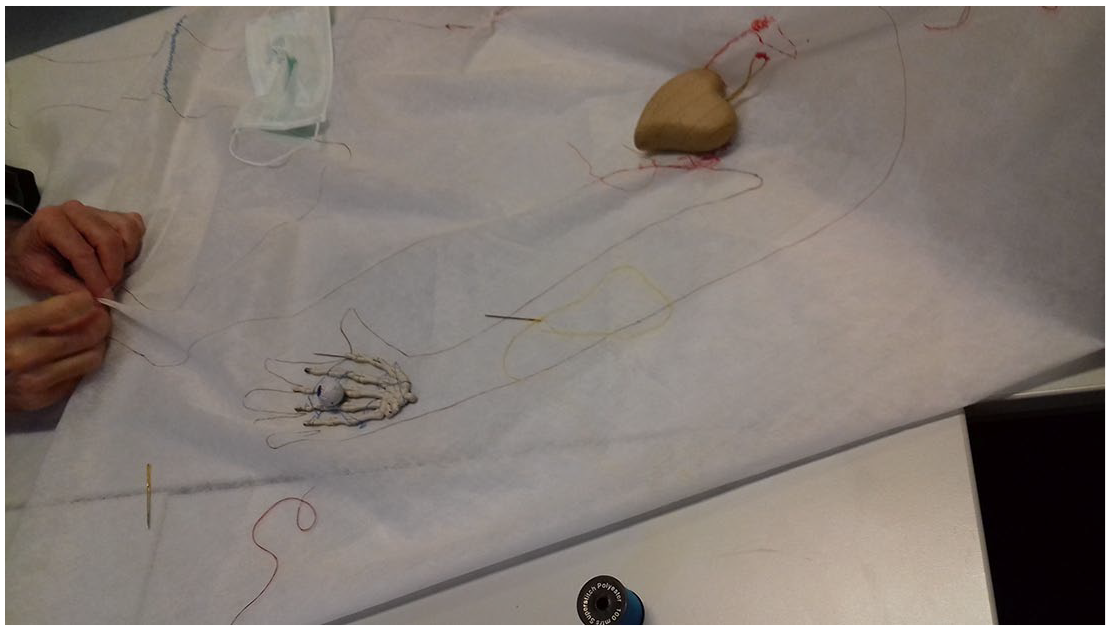
(Re)stitching (un)sewn bodies.
Such theatrical stitching – perhaps a play on mending the Y incision of autopsical dissection – questions normalised fabrications, constructions and sedimentations of knowing ‘a body’ or ‘the body’. It gestures towards undoing normative relations of bodies in research productions and poses challenges for both the integrated body of ‘Man’ and the traditional methods ‘his’ body has privileged. Sewing and re/assembling bodies enabled methods, inquiries and questions to emerge suggestive of feminist practices that examine the visibilities of women’s (stitching) work and the fragmentation and scopophilic re-stitching of women’s bodies in a visual economy of pornography. All manner of stitchings in relation to all sorts of bodies play their part in the constitutive functioning of power: a sort of literal Baradian agential cut (2014, see below) that materialises a particular mode of bodily mattering.
Space-silence-autopsy-death-body
Wary and unknowing participants skirt, scope and experiment at autopsy-like research stations. The theatrical space settles into a hesitant, unsettled and unsettling rhythm; a hushed realm of uneasy (in)activity. This university room – intended for instruction, for reasoned conversation – is transformed into a weirded operating theatre, an autopsy lab, a space becoming monstrously (un)familiar, no longer a conference seminar room. Here, routinised ways of knowing, doing methodology and being scholars are inadequate, and erstwhile academic bodies are discombobulated, disorientated and disordered. No longer can one sit and listen, take notes, ask insightful questions. Perhaps a mild panic sets in, as one’s body is exposed to and proposed by new relations of knowing: the requirement to consider those very ‘imaginaries, fluxes, indefinitenesses and multiplicities’ (Law, 2004: 148) that produce knowledge differently and considers different knowledge. How to exist amidst the unfamiliar; how to act alongside the abject; how to engage, research, explain, and be in a space that lacks and fails to provide easy recognition?
And yet, the impulse to familiarity imposes: a noticeable turning towards the ‘graffiti wall’ (Station 2: see Figure 11), a turn back to the pecha kucha (Station 7) in a technological relational moment where images of bodies, death and decay flashed past. These are familiar turns, well-scripted in contemporary academic conference spaces, towards the whiteboard and PowerPoint, the reflective surfaces of the erudite professing ‘speaker’. Perhaps Stations 7 and 2 simulate the practices of representation: the practised academic labour of the conference and the comforting strata of the academicconferencemachine (Benozzo et al., 2019; Taylor et al., 2019).
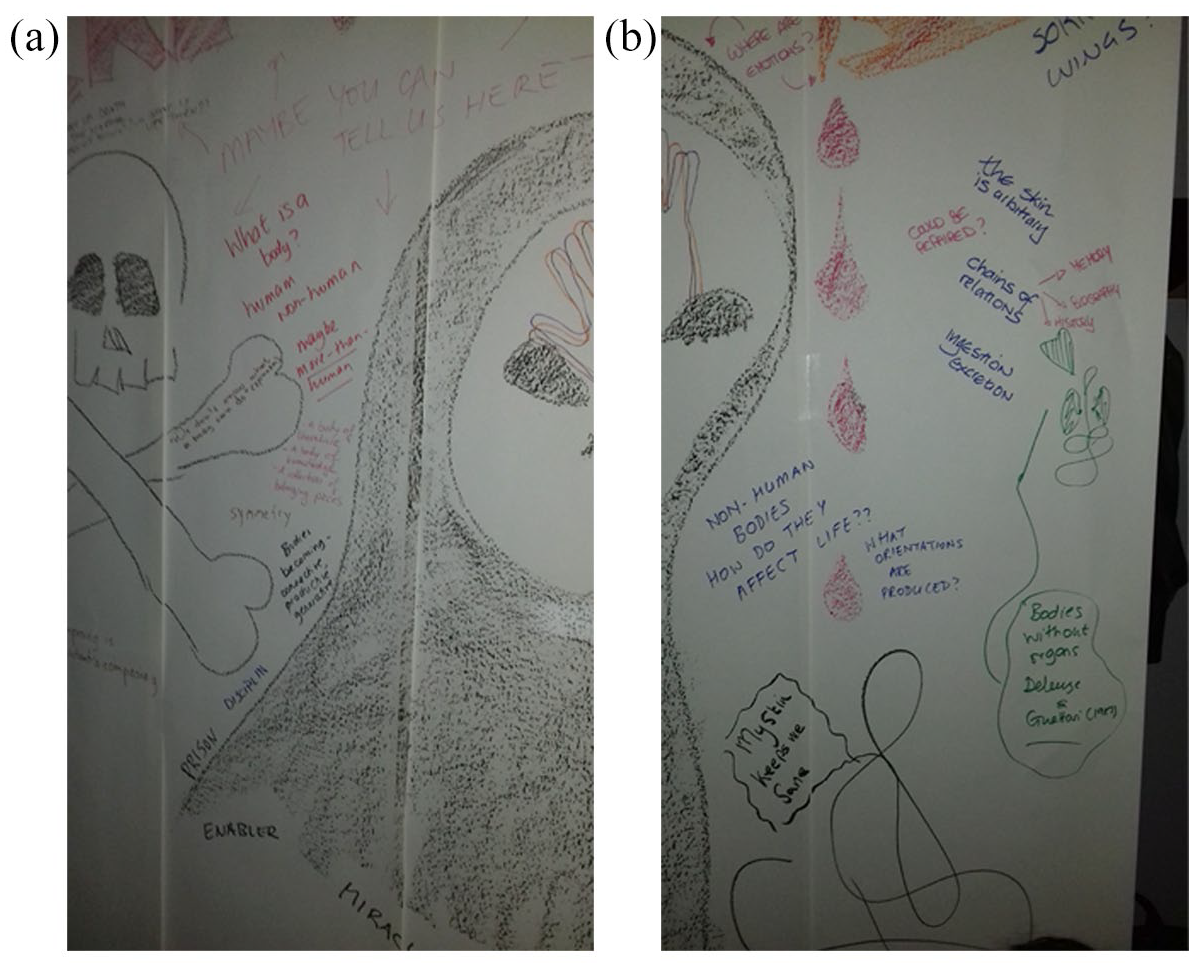
Autopsy graffiti wall.
The eerie silence of our event echoes the reverent silences noted by Hirschauer (2006) in Von Hagens’ exhibitions of plastinates; viewers’ unwillingness to share their viewing pleasure as doing so might highlight their ‘indiscrete’ gazing at once-live bodies. This uncanny silence sounded in the struggle to bring into practice that for which there was no pre-existing script and was torqued in the hyphen-slash of un/familiarity, un/knowing. This fissure of silence – unexpectedly created by and in the event – roared its rupture of the certainties of more usual vocal academic labours, and whispers to Law’s (2004: 147) plea for a mode of knowledge creation ‘that stutters and stops, that is more generous, that is quieter and less verbal’. This risky academic work led to speculations and unexpected yet uncomfortable forms of radical imagination. The silence chanted a more supplicating orientation towards knowledge making; practices in which participants falter in speculatively (co)authoring the body of the ‘Autopsy goes Rogue workshop’ research-creation event. Royle (2003: 23) reminds us that the uncanny’s ‘critical elaboration is necessarily bound up with analysing, questioning and even transforming what is called “everyday life”’ – including that of academic life. The autopsy room then is a line of flight (Deleuze and Guattari, 1987), a vector to decentre and deconstruct (knowledge of/by) ‘the man’, the one who knows, who fabricates bodies and knowledge of bodies, and whose knowledge keeps him secure. It is on this flight, this interval between moments of recognition, that the future of ‘man’ becomes a possibility instead of an inevitability. This is the moment of ‘bi-directional betweenness’ (Manning, 2013: 84) in which the future presents and the past futures flow: the tendency to orient a linear, knowledgeable, male-centred self is thwarted.
Decomposing (a certain sort of) ‘Man’ and (a certain sort of) knowledge
Our autopsy-like research-creation experimentations resonate with both Foucault’s announcement of the death of Man and with many feminist, post-colonial and indigenous scholars’ critique of a certain idea of Man. One of the most powerful and successful elements of Foucault’s thinking is the analysis of the development of medical science (Mills, 2003). He has shown how the dissection, observation and analysis of the corpse was the basis for the start of modern medical knowledge about the life within the body (see Figure 12). Once the practice of dissection was perfected, life, illness and death created a technical trinity that contributed to the birth of medical science and constituted the Western man. In The Birth of Clinic (1963/1975), Foucault argued that ‘it is within medical discourse that the individual first became an object of positive knowledge’ (Foucault, 1975: 27 in Mills, 2003: 106). In conclusion to The Order of Things, Foucault (1966/1992: 387) goes on and famously writes: As the archaeology of our thought easily shows, man is an invention of recent date. And one perhaps nearing its end. . .
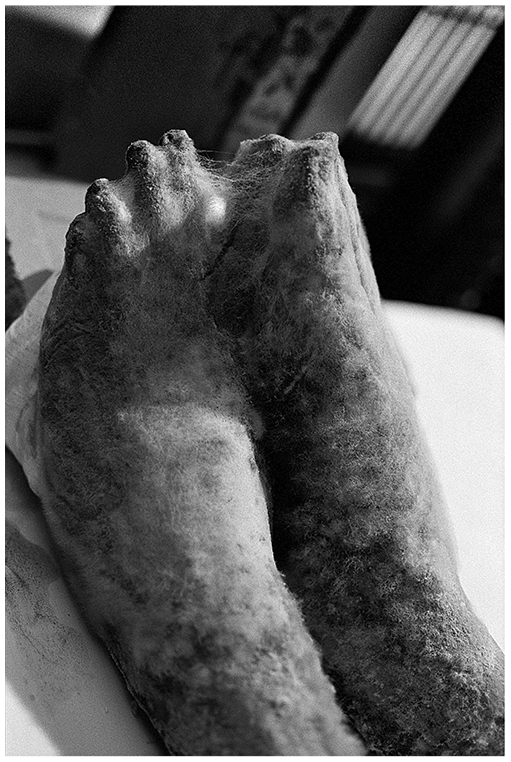
‘Imitatio Christi’, 2017 (Roberto Cuoghi).
Here Foucault announces the death of Man – paralleling Nietzsche’s earlier proclamation about the death of God – and problematises the idea of the humanist subject embodied in a concept of Man as the putative driving force behind civilisation and its progressivist ideals garnered through the dispassionate production of knowledge of the object, including that of the body, through anatomical dissection. This concept of Man, as the main character in a uni-directional history, finds it bodily representation in Vitruvian man (Mascaretti, 2013). This Man of Western humanism is also the originator of scientific procedures – observation, testing, the discovery of generalisable laws of nature – for obtaining and verifying Truth. As objective and independent knowledge, it stands apart from and above all those other forms of local and lesser ways of knowing which are, in comparison with scientific truth, castigated as partisan, partial, personal and political. It is this humanist concept of Man, reified in the anato-medical knowledge of the body through dissection, and the bodies of knowledge generated through the intellectual paraphernalia of putatively objective scientific procedures, university disciplines and modern technologies of bodily governmentality, that Foucault aimed to demolish.
Concomitantly, as feminists, post-colonial and indigenous scholars (e.g. Tuhiwai Smith et al., 2018) have long pointed out, the humanist concept of man at play here arose from, and was located within, discourses relating to the bodies of particular men – those whose classed, gendered and raced attributes accord him, as of ‘natural right’, cultural privileges and social status. As Code (1993: 22) notes, (male) scientific objectivity is actually: A generalization from the subjectivity of quite a small social group, albeit a group that has the power, security and prestige to believe it can generalise its experiences and normative ideals.
The body of this man became the cultural/intellectual norm against which all those ‘other’ bodies – feminine, children, disabled, leaky, sexually perverse, black, brown, noncompliant – were measured and, without exception, found wanting. This broader discursive construction of modern Man thrums continually in the background of our autopsical discussions and, like Stengers and Despret (2014: 29), we refuse ‘to separate the pursuit [of bodies] of knowledge from the question of who[se body] produces this knowledge and how it is produced’.
Through our research-creation experimentations, we literally feel/produce/fabricate the death of man: the death of that man who produces knowledge of bodies and bodies of knowledge; that man who develops a research methodology to construct that knowledge. The autopsy-like experimentations subject autopsy to a gaze that queers and complicates the occularity of traditional social science knowledge making practices. In transplanting anato-medical autopsy into autopsy-like experimentations at a Social Science academic conference, we engaged workshop participants in rethinking methodological possibilities from posthuman and new material feminist perspectives. The autopsy-like experiments we undertook were oriented to de-centring ‘the very notion of core’ (Minh-Ha, 1989: 96), which underpinned the idea of the unitary, sovereign, Enlightenment subject (Braidotti, 2002), and instantiate experimental ways of grappling with anti-foundationalist, anti-essentialist concepts, methodologies and bodily framings.
(In)conclusions
The autopsy research-creation experimentations (re)turned throughout this article have a relation to the medical autopsy that might be characterised as ‘not a representation actualized but an actual composition spun into representations, objects, and states of sensory alert’ (Stewart, 2015: 24). Our autopsy-like event, as a site of theatrical assembly, was an effort in thinking differently about what social science knowledge and methods do, claim to do and might want to do. We enacted this by reimagining the body in its relation to autopsy – moving away from the stable, rational subject of Western Enlightenment to the bodying without a body, the body in movement, the body in de/re/composition. The autopsy-like research-creation experimentations, and the encounters they envisioned and enacted, entangled participants with/in activities which que(e)ried the methodic rigours of segmentation, observation, operationalisation, bracketing and other knowledge technologies of control and separation – those technologies that underpin Euro-American empirical-based ontologies arbitrated in narrow understandings of bodily sense(s). Such onto-ethico-epistemological technologies have produced what we call the rigor mortis of method: procedures valorised and routinised as the only ways of doing research and producing knowledge. Our autopsical research-creations aimed to cauterise and queer these normative social science modes of knowing by reworking the ‘cut’ of the autopsy into a Baradian (2014) cutting-together-apart – an enactment of contingent rather than absolute separation – that is, material-discursive interventions that delineate phenomena, enacting boundaries, properties, meanings and categories. The verb to cut here does not instantiate an inherent distinction or a disconnection. Instead, through the idea of cutting together apart, the body emerges at the intersection of particular ‘apparatus of bodily production’ (Haraway, 1991: 200), including the politics and practices of conference organising; the models and practices of research; the images and discourses connected to (particular and partial) histories of epistemology that mark the development of research methodology; the devices and the materials used during the experimentations; the reception of particular tactile, visual, auditory and olfactory sensations during the autopsical event; the circulation of curiosity and desires, interests and disappointments.
Simultaneously, our autopsy-like research-creations here problematise the split between subject/object, knower/known – a split based on a belief in the existence of an external world of real objects independent of the knower, and on a knower who is himself (sic) conceived as the possessor of sovereign, hu/man reason. The theoretical and methodological experimentations (re)presented in this article align with scholarship that challenges dualisms as explaining or sufficiently speaking to/for the powerful and productive existence and world of material objects and matter which entangle with bodies, minds, and sensed knowing-feeling. Post-human and new materialist feminist theorising refutes the subject/object binary in favour of relationality between bodies. Relationality produces expanded forms of subjectivity which are not dependent on bodies-as-separate-from-the-world. Barad’s (2007) concept of intra-action proposes that the body is only realised at the moments of its entanglement with other (human and non-human) bodies. Such ‘bodying materialisations’ are in constant motion: bodies change form and function as new intra-actions are enacted. Therefore, researcher and bodies have unlimited potential depending on the other bodies and forces with which they are in relation. In focussing on the relationality of bodies, Barad (2007) argues for knowledge as a material practice, an onto-ethico-epistemology, where the researcher and researched are co-implicated in the world’s ongoing materialisation. Methodologically, our autopsy-like research-creations locate us as turning away from subject/object dualisms and leaning towards (re)thinking bodies as constituted – especially in critical sites of living-dying practicings. These experimentations with the bio-medical body, and with cinematic, craft and popular cultural bodies of knowledge (about bodies), offer an attempt to fracture and disrupt the certainty of method. Such disruptions also put forward a means to know the body differently, and to question those humanist bodies of knowledge which seek to compose and construct, to fabricate and maintain, a bodily foundation for the agency and subjectivity of ‘Man’ conceptualised as an essentialised, integrated, coherent and individualised human being.
Post-human and new material feminist approaches decentre the hu/man (sic) researcher in a more distributed process of research-creation. If we are de-centring the man-researcher-body, then who is leading the research? From a post-human and new material feminist perspective, the researcher would merely be part of and the result of the ongoing intra-actions of the event (Nordstrom, 2015) together with all the material, nonhuman, and other “participants,” including the conference, presentations, tools, techniques, and. . . and. . . and. . . The research-creation autopsy-like experimentation is conceived not only as a research workshop generated by a particular conference theme, but rather, it is a phenomenon already entangled with and connected to forces (like discourses, policies, history. . .) that dictate and justify what is legitimated and allowed to be researched. The autopsical-like event is the consequence of different forces of which we, as researchers and bodies, are not in complete control.
Diffracting our understandings of the historical and contemporary manifestations of the autopsy with post-human and new material feminist thinking, affords us the opportunity to rethink how our conference workshop could provide a different imaginary for knowledge production (See Benozzo et al., 2019; Taylor et al., 2019). From post-human and new material feminist perspectives, knowledge of bodies (and bodies of knowledge) is only ever situated, relational and immanent in the entanglement of researcher and researched. The autopsy research-creation experimentations enacted a novel ‘method assemblage’ (Law, 2004), inhering ideas that take seriously ‘the possibility of alternative futures, the failures of representations, the contingencies of interventions, and the effervescence with which things actually take place’ (Vannini, 2015: 7). The autopsical body is becoming a body of continuity and cartography, between life and death, between object and subject.
Footnotes
Acknowledgements
The authors would like to thank the artist Roberto Cuoghi who provided the photographs in Figures 1, 7 and  and granted permission to use them. The photos were created by Alessandra Sofia and relate to the work ‘Imitatio Christi’. Installation at, Padiglione Italia: Il Mondo Magico, 57th Venice Biennale, Venice, 2017. [Note from Artist’s studio: The hands, feet, and face do not belong to Roberto Cuoghi. We asked a young man to make a cast of his body. What is relevant is that all the sculptures presented and produced during the Biennale derived from the same mould, but the intervention of moulds (mildew) and bacteria on the organic matter has allowed us to obtain always different results, so the appearance of each hand, each foot, each head (each Christ, in general) was the result of a path neither foreseeable nor imaginable.]
Disclosure
The author(s) declared no potential conflicts of interest with respect to the research, authorship, and/or publication of this article.
Funding
The author(s) received no financial support for the research, authorship, and/or publication of this article.