




Abstract
Qualitative empirical enquiries into dynamics of security and insecurity often include a blind spot that bear theoretical ramifications because only those areas and respondents that allow for relatively safe fieldwork are studied. To transparently articulate the spheres of projection that creep into our knowledge production, we propose a distinction between inner and outer circles as highly fluid but separate geographical, socio-political and methodological spaces. Drawing on fieldwork in the Central African Republic and South Sudan, we discuss the risks posed by incomplete data and subsequently flawed inferences. We argue that the perceptions of fear projected onto the outer circle shape people’s behaviour more than measurable insecurity incidents and that increased interaction between actors in both circles reduces the perceived threats coming from the outer circles. We demonstrate how studying insecurity from inner circles risks securitizing outer circles while further centralizing the inner ones. We thus urge transparency in data collection and the related inferences that underpin our knowledge production.
Introduction
‘Those things. We are not supposed to talk about it.’
The Catholic priest lowered his voice, looking over his shoulder in his otherwise empty kitchen in the middle of a large, deserted church compound in Raja town (interview 1). We had just probed him on the conspicuous manifestation of the Justice and Equality Movement (JEM, one of the rebel groups from Darfur opposing the Sudanese regime) in Raja County in South Sudan in December 2014. One night during our short stay, we observed a long convoy of armoured vehicles, pick-ups and lorries passing our compound for 30 minutes: Vehicles packed with armed men, women, children and cooking material. The rumour among neighbours was that the military convoy was made up of Darfuri rebels from outside Raja, who were moving towards Bentiu – the frontline of the South Sudanese civil war to support the South Sudanese government in their fight against the opposition forces (Wassara, 2015). With our firsthand observations, we hoped we could find out more about the presence and movements of the Darfuri rebels present on South Sudanese soil, but the priest and others were keeping quiet about it all.
It had taken several days of convincing before National Security in Wau agreed to let us, two white researchers based at European knowledge institution, visit Raja. Without the green light from National Security, we would not have been able to jump on the United Nations Mission in South Sudan (UNMISS) helicopter at all. Even before our departure, it had become clear to us that things were very sensitive. One month before our trip, in November 2014, Sudanese military allegedly attacked the Raja area by air to send a warning to the rebels from Darfur, but these rumours could not be verified because the South Sudanese government had denied UNMISS access to the bombed site. During one of our focus group discussions, one farmer from the bombed area started to talk about what had happened, but our research partner explained after the discussion that the other participants told him not to talk to strangers about this.
The shushing and silence that followed our cautious attempts to enquire about the presence of a JEM proxy army present on South Sudanese territory proved at least as illuminating as if we had been able to freely talk about direct and indirect consequences of the Darfuris’ presence on inhabitants’ safety. Yet, whatever we would write or publish on this issue would be inherently one-sided, as we were explicitly prohibited by the gatekeeping National Security agents from moving beyond the town limits. We operated from within a methodological and geographical ‘inner circle’ from within whose bounds we tried to collect data on the ‘outer circle’, the space beyond our empirical and geographical reach, from which we could collect only a few stories. Ultimately, we knew very little about the alleged presence of 8000 Darfuri militia soldiers outside the town. What we could get a glimpse of was its impact on people who were afraid to talk about it and the quick silencing of those willing to discuss the issue. This brings us to the heart of the twofold dilemma this article addresses: 1) What can we know about dynamics of (in)security in spaces outside our immediate observation? 2) What are the consequences of such limited insight for theory and analysis?
Especially in places that are marked by chronic insecurity, or situations characterized by ‘no-peace-no-war’ (Richards, 2005), researchers often fail to collect data in areas and among people that are the source of insecurity. Reasons vary from research sites being too dangerous or too difficult to access logistically to gatekeepers prohibiting research in the outskirts of areas under their control – in the example we gave above, all three dimensions played a part. Hence, researchers rarely study those areas from which actual or alleged risks emanate and the people causing this insecurity (a few notable exceptions are Baaz & Stern, 2009; Debos, 2016; Schomerus, 2021; Verweijen, 2013). As a result, however, academic work on security dynamics and causes of conflict risks is often inferred from a mixture of hearsay, projections and assumptions voiced by people who were accessible to the researcher.
Attempts to delimit the spaces of empirical research – in which certain modes of governance among a (fluid) set of actors are demarcated – are common in the various social sciences. Sally Falk Moore (1973) famously spoke about semi-autonomous social fields, Monique Nuijten (2003) developed the term ‘force field’, and more recently Tim Glawion (2020) proposed the concept of the ‘security arena’. Yet, these delimiting attempts mainly focus on the power dynamics that can be observed from what is studied, while particularly in situations of simmering conflict and insecurity, the challenge is to unravel what cannot be observed directly.
In this article, we investigate the blind spots in our research and account for the impact of these on our analysis. We do so by differentiating between the ‘inner’ and ‘outer’ circles of research. We define an inner circle as being simultaneously a geographical and a socio-political space of actors that are within reach. The outer circle represents the flip side of the inner circle, as it lies beyond the immediate space of observation, forming the projected and imagined world. Crucially, these circles are not fixed geographies or impassable socio-political clusters, and their pertinence is contingent on the positionality of the individual actor, segment of society, or researcher seeking to access, influence or understand the dynamics in a circle. The idea of the circle acknowledges the multiple ways in which society and space are differentiated. As we will demonstrate, the circles’ permeability and meaning continuously shift under influence of local power dynamics and serendipity, in addition to security dynamics. We argue that the ordering dynamics of the respective inner and outer circles differ so decisively that observations and interviews in the inner circle cannot explain what happens in the outer circle.
The theorization of the inner–outer circle lens is not only a restriction of what we can immediately observe, it also conceptualizes what we can learn from its conscious appreciation, such as a deepened understanding of threat ascriptions onto the outer circle from an inner-circle perspective. Differentiating between circles provides avenues to understand how the interactions between the two spheres separate actors and geographies from one another and open ordering opportunities. In other words, it can help us to understand what the imagined outer circle signifies for creating inner-circle order, as well as to challenge this imaginary by allowing outer-circle respondents to voice their viewpoints directly.
We base our analysis foremost on field research in the Central African Republic (CAR) and South Sudan. The data were collected by the two authors over the course of four trips between 2014 and 2018, with only one 4-week research trip to South Sudan (due to the developments in the civil war our three case study sites had become inaccessible for a second trip as we had originally planned). With respective backgrounds in development sociology and extensive field research in South Sudan since 2008 (author 1) and political science with an emphasis on the CAR since 2014 (author 2), we used an inductive approach and a mixture of qualitative methods including observations; semi-structured interviews (25 in South Sudan, 170 in CAR) with authorities, representatives from various social groups, and ordinary people; focus group discussions (20 FGD in CAR and 11 in South Sudan); and actor mappings. We set out to study the interplay between security and insecurity in the peripheries of South Sudan and the Central African Republic. Inspired by the comparative area studies approach, we studied three and four localities in each country, respectively (Ahram, 2011). In five out of seven sites we drew on the support of research assistants – research brokers (Parashar, 2019) – who helped us identify and contact interview partners and worked as translators when needed. While we had clearly defined ideas of which places would be the most useful to answer our research question, we had to confine ourselves to those that were accessible and relatively secure. In these contexts of rapidly developing and shifting instabilities, we sought to understand how citizens and institutions organized security for themselves and what type of actors and dynamics presented a source of insecurity. In what follows, we will first lay out our theoretical contribution to studying security, proceeding to discuss the inner and outer circles in the context of our fieldwork, distinguishing between geographical, socio-political and methodological circles. We conclude by arguing that the failure to acknowledge the blind spots in empirical research reverberates in theoretical ignorance and ultimately also bears the risk of loss of human life.
State of the art
Qualitative methods and data collection through fieldwork have emerged as the preferred approach for gaining deep understanding of situations of conflict. This shift came about in response to conventional political science and security studies approaches that have often been criticized for misstating the perspective from which knowledge is produced. Authors proposing innovations in security studies have rendered visible voices of the marginalized, processes on the micro-level, and immeasurable aspects of safety. Lene Hansen, for instance, finds a theoretical blind spot as she criticizes how ignorance of gendered security in critical security studies neglects to broach the issue of how women cannot talk about their lived experiences, thereby rendering important viewpoints in security research on topics – for example, honour killings – invisible. She thus developed the term security as silence to describe ‘a situation where the potential subject of security has no, or limited, possibility of speaking its security problem’ (Hansen, 2000: 294). Actors operating in and from what we call the ‘outer circle’ risk being subjected to similar silencing, because researchers rarely make the effort, or feel secure enough, to access these actors. The result is that without further research, such actors are analysed mostly as projected threats. Our research follows in the footsteps of vernacular security studies by recentring security issues around people at the so-called margins (Lind & Luckham, 2017), from the vantage point of the micro-politics of conflict (Kalyvas, 2008). However, the important emphasis on people’s everyday experiences has a downside in that insecurity is rarely studied from the perspective of the geographies and sources of (perceived) threat and insecurity. Therefore, this article speaks to the literature that discusses how blind spots in our modes of research hinder us from adequately analysing certain dynamics that are deemed too dangerous, whether for the researcher or for the respondent. Such blind spots inhibit those involved from voicing their concerns.
In the past decade, a range of countries on the African continent has been confronted with an increased spread of simmering and outright conflict. While few places are fully embroiled in civil war, the conflicts in Mali and the wider Sahel region (Lecoq et al. – 2013), the instability (or inter-war cf. Debos, 2016) in the Lake Chad Basin, and the regionalized conflicts in the greater Horn and the Great Lakes region have changed not only what is being researched, but how (Bergamaschi, 2014). In an attempt to understand the particularities of the conflict dynamics – in other words, the violence or insecurity that marks certain spaces – a surge in important empirical work has been published in recent years (e.g. Thurston, 2020; Hoffman & Verweijen, 2019; Tapscott, 2017 to name a few). While most of these studies address dynamics of conflict and insecurity, few studies were able to include data collected among those that occupy geographical and social spaces from which insecurity is allegedly emanating (a few important exceptions are Baaz & Stern, 2009, Lombard, 2016; Richards, 1996; Schomerus, 2021). Key to understanding the no-peace-no-war terrain is to recognize war or insecurity as social projects in which people decide to engage – ones that they favour over other social projects (Richards, 2005). Hence, insights into what these social projects look like, why people mobilize and what the sources of their emotions are would be crucial to gain but remain notoriously difficult to discern. Instead, data are often collected from a relatively safe space while the analysis may well attempt to make inferences on hard-to-verify and impossible-to-triangulate ideas about the range of actors operating beyond immediate observation. We argue with this paper that this causes a blind spot even in those projects and articles with a (self-)critical approach.
Usually, academic articles covering dynamics of conflict and insecurity only briefly account for methodology. In the past decade, there has been an increase in papers that explicitly account for methods, doubts, and difficulties (Perera, 2017), or that describe how serendipity and ‘meta-data’ have shaped research (Fujii, 2010, 2014) or how fieldwork is increasingly constrained by safety politics at universities (Peter & Strazzari, 2017), and ethic/institutional review boards (Vlavonou, 2021). Over the past 2 years, several publications and projects critically assessed power imbalances towards in-country academics (see the (Silent) Voices “Bukavu series”) and the ethical – (Cronin-Furman and Lake, 2018), and emotional aspects of research affecting knowledge production (Trogisch, 2021). Reflecting on positionality and fieldwork in published work is more common in, for instance, anthropology (Diphoorn, 2013; Lecoq, 2002; Rodgers, 2007; Lombard, 2013). However, the result is often more or less similar: the methodological reflections are published as separate articles, while the findings of the study are published elsewhere, often paying little attention to the methodological blind spots that may have impacted data collection and subsequent knowledge production. In other words, the openness that is increasingly manifested in the multiple accounts of research dynamics rarely extends to questioning the findings itself. Most findings are published – with less reflexivity – in high-impact journals. As a result, and despite the relative openness, the blind spots endure, and it largely remains unclear to what extent writings about insecurity are based on research in zones from which threats allegedly originate.
We argue that there is urgent need for more openness about the impact of the circumstances in data-collection because these circumstances impact the inferences we can make. We therefore propose an explicit differentiation between inner and outer circles of research to ensure transparency and to further theory-building. Distinguishing between these epistemic circles is relevant to the research methodology, geography, and socio-political alterations. Firstly, the geographical inner circle is a methodological confinement as the space where actual data collection takes place, while the outer circle starts wherever that space ends. In practice, the boundary between the two often can be found at the outskirts of a town – for instance, at a roadblock. Secondly, the socio-political boundaries between the inner and the outer circles are often more fluid and inherently dependent on the positionality of the people who circulate between them. For instance, the often bunkerized space of certain (humanitarian) compounds (Duffield, 2012; Fisher, 2017) might be easier to access for a (white) researcher who is part of the expat socio-political network than for a local resident who is not. In Paoua, Central African Republic, to add another example, residents explained that travelling along the southern roads was easier for one ethnic group in town because local bandits would not attack them, while north of town a rebel group was active, offering safe passage to the other ethnic group. The geographic inner and outer circles are thus overlapped by differently shaped socio-political circles that are inherently fluid and contingent on who moves between them. The methodological circles of observation are the last level of differentiation we propose; they are mostly anchored in ethics, security of the researchers and research partners, and logistics. In what follows, we will discuss all three variations of the inner and outer circles and demonstrate how they create different ordering spheres that impact what researchers grasp as dynamics of security and insecurity.
The inner and outer circles
Geography delimits research boundaries
The geographical difference between inner and outer circles is the most straightforward and arguably the least theoretically relevant. Nevertheless, it often has important repercussions on research, as zones of accessibility become spatialized, often dependent on temporal or seasonal dimensions. Two different ways of projecting geographical inner and outer circles of danger and insecurity deserve mentioning: the ordering (driven by international actors) of ‘secure’ and ‘insecure’ geographies visible at checkpoints on roads leading into town, and people’s everyday differentiation, mainly marked as within the given town/village versus the dangerous ‘bush’ outside, which often refers not only to its natural characteristics but also to a projected feeling of threat and insecurity (see Figure 1 further below). Socio-political inner circles layered over geographical circles.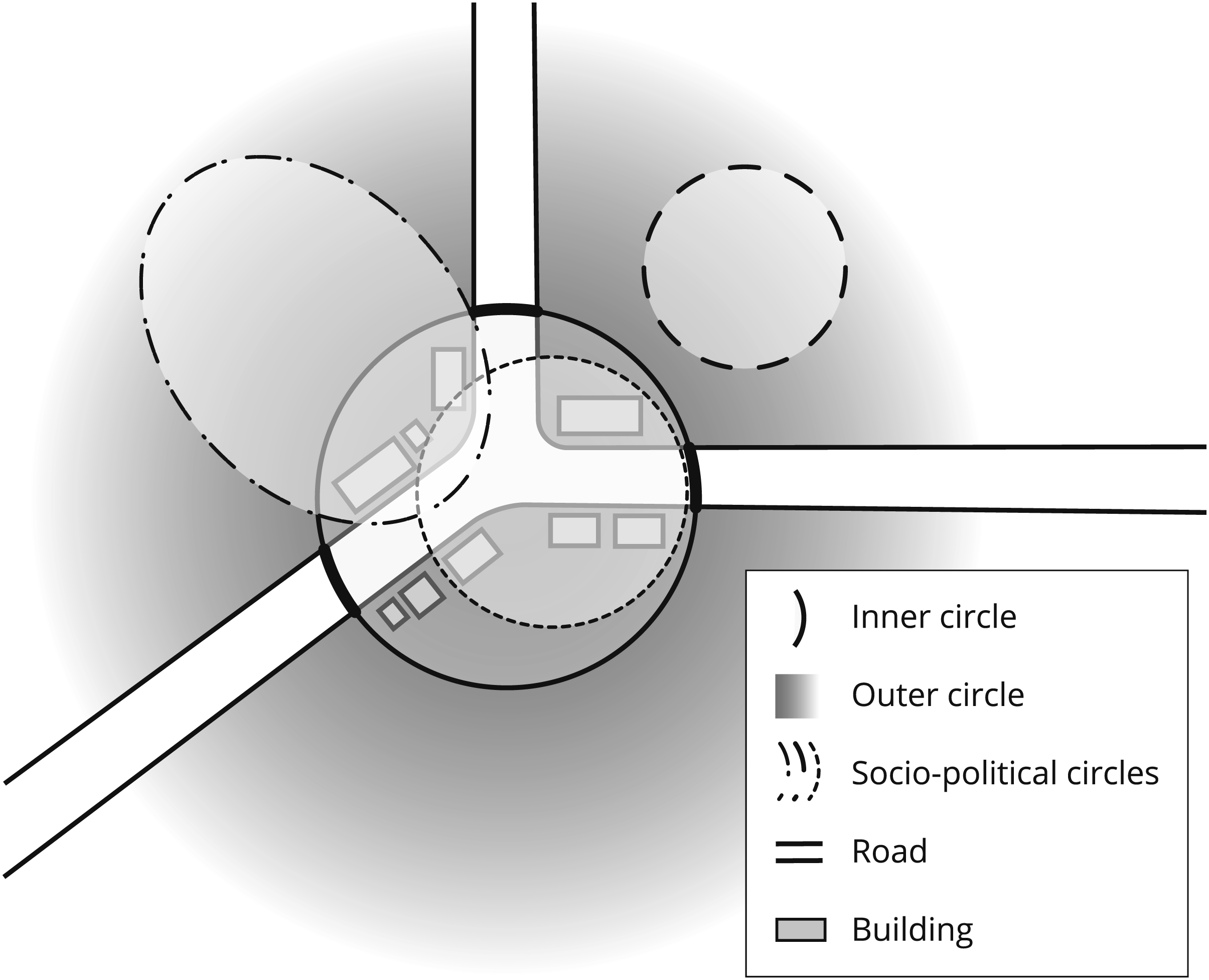
In places of open conflict, the international community, particularly the United Nations, is an important determiner of distinct geographical spaces of accessibility and inaccessibility. The international community, often through the UN, marks whole regions in colours varying from green to dark red, while roads receive threat levels, ranging from level 1 to 4 based on incident reports (see, for instance, on Haiti, Lemay-Hérbert, 2018). Each level corresponds with safety protocols – for example, travel in armed convoy – by which UN agencies and many NGOs abide. On top of the spatial differentiation lies a temporal one, mainly marked by voluntary or imposed curfews that staff are expected to respect. 1 While this type of spatial zoning is mostly relevant to outside intervenors, it has a great impact on researchers, too, because many of us (are obliged to) draw on the threat analysis of the United Nations to decide where it is safe enough to do research (Peter & Strazzari, 2017).
We need to stay acutely aware of what this means for sites that are considered out of bounds. 2 Ndele, in the northeast of the CAR, was described to us over many years as inaccessible to researchers because the government and the international community are not in control and Ndele was the headquarters of the strongest armed faction of the ongoing conflict. In actual fact, violent incidences in Ndele were no more frequent or deadly than in many other parts of the country, and when one of us did research in Ndele’s inner circle, we found similar governance structures and degrees of personal safety as in other towns, even though they were run by one of the CAR’s rebel groups.
Such security-driven zoning is far removed from what people in towns and villages identified as relevant to their perception of insecurity, which mostly concerns the difference between towns and their surrounding rural areas. To many, this distinction involves visible markers – for instance, through checkpoints along the roads and the shift from residential quarters to agricultural fields, cattle camps, or forest. In daily vernacular, interlocutors in both South Sudan and the CAR spoke of the space outside towns as ‘the bush’. 3
The difference between the dangerous ‘bush’ and the safe inner circle was nowhere so often and acutely mentioned by residents as in Obo, in the far southeast of the CAR. Upon their arrival in 2009, the Ugandan People’s Defence Force (UPDF) and American special forces informally advised Obo’s residents to not cultivate fields beyond an imagined circle of five km outside town due to the threat of the Lord’s Resistance Army (LRA). Residents perceived the five-km zone as the spatial part of what we call the inner circle, whereas the bush beyond was considered dangerous. By 2015 and 2016, when we conducted research in the area, the agricultural plots had mostly been exhausted, but people still largely referred to the five km as the space within which they felt safe. Few ventured into the outer circle, except for hunters. To people living in the area, the lack of access to spaces outside the five km entailed a self-imposed limitation of their area of operation. To researchers such as us it implied that – regardless of our one-morning bike ride outside town – all that we say and write about the security dynamics in Obo was based on what we learnt from how people within town talked about these issues. The spatial limitation affected what we were able to know about the social and political production of security.
Socio-political circles
Layered onto the relatively sharp geographical distinction between inner and outer circles, there are socio-political circles revolving around notions of governance and access, raising the question of whose authority extends to where and over what. In the case of Raja County in South Sudan, where the Darfuri rebel groups were residing in 2014, it became apparent that the public authorities in the town and county were not in direct communication with the Darfuri militia in the vicinity of the town. Instead, the county commissioner and his colleagues from the various police departments focused on everyday incidents of theft and violence, leaving the real source of insecurity to be governed by South Sudan’s national security and military intelligence, with whom the Darfuri groups collaborated. The outer circles – including its political and military properties – were off-limits even to the local government representatives, even though the activities organized by those in the outer circle had an enormous impact on people’s lives and that of their public authorities, for example, the aerial bombing of the area by Sudan.
The gap between formal authority and its practical reality is considered a common feature of governance in many African countries (De Vries & Mehler, 2019; Hagmann & Péclard, 2010; Lund, 2006). But the social repercussions of such divides between different administrative circles are often overlooked. These social dimensions impact the perceived dynamics of (in)security for segments of society and define what people consider to be part of the inner and outer circles. In Paoua, in the northwestern part of the CAR, for instance, we found that the gendarmerie and the police each mostly catered for the two different major ethnic groups in town. People put more faith in those to whom they felt socially and geographically more proximate. This means that different social groups have different inner and outer circles that impact not only which authority they turn to, but also in which neighbourhoods youth can hang out, and what roads people prefer to move outside of town.
The fluidity between the socio-political circles becomes visible when (groups of) actors cross the line from the outer into the inner circle. In some situations, it reduces the perceived threat, while in other instances, it only reinforces the lack of trust and fear. In Mundri, in the southwest of South Sudan, the outright fear of armed cattle-keepers was palpable among local residents from within and outside of town who mostly relied on subsistence farming. Following a series of successive incidents – from the ruining of plots, to the killing of cattle, to the killing of the farmer who killed the cows, to the burning and destruction of the village in which he lived – local residents fled to town, where they expected the commissioner to calm the situation. To some community members, the commissioner was considered to have crossed over into the socio-political outer circle (despite his physical presence within the inner one): One conversation with the cattle-keepers had lasted too long, according to local elite members, and the problems between residents and armed cattle-keepers had only gotten worse since. People believed the commissioner had been bribed into accepting the presence of the cattle-keepers into the area. Meanwhile another social group, the butchers, operating at the market, were able to navigate the different circles quite smoothly because they belonged to the same ethnic group as the cattle-keepers in the bush. They were town residents and therefore known, while they also served as intermediaries between those roaming the outer circle and the town residents who mistrusted them but relied on them for meat.
The socio-political stability of the inner circle may have seemed to be threatened by outside actors, but we also observed how quickly risk perceptions and stability may change under the influence of actors arriving from outside, bringing along a different risk perception. In Obo, the CAR’s armed forces contingent was replaced with a new batch arriving from the capital, Bangui, in 2016. Where as Obo had remained largely stable during the 2013 turmoil – i.e. relations between Muslims and Christians remained good as they had always been – tensions between these religious communities had become fierce in the rest of the country, particularly in Bangui. The new contingent of soldiers brought the tensions between ‘Muslim’ and ‘Christian’ communities from Bangui’s inner circle into Obo’s. Local authorities and elites intervened to explain to the new batch of soldiers how all residents cohabitated peacefully, which calmed things down but it did not bring back the stability that had marked the inner circle of the town in the years prior.
There are thus three types of socio-political inner circles (see Figure 1): Firstly, one that overlaps with the geographic differentiation, relevant to international and local authorities as in the case of Raja; secondly, an inner circle that crosses from town centre to a certain part of the outskirts, often based on ethnic affinity as in the case of Mundri’s butchers; thirdly, groups that are almost entirely confined to a space in the geographic outer circle, such as the LRA in Obo. As became evident, socio-political boundaries matter and the ways in which they reverberate between groups of actors and interlocutors matters more. As researchers, reading dynamics of (in)security from within an accessible socio-political circle almost inherently comes with a blind spot vis-à-vis other circles that are equally important for the dynamic of (in)security. This brings us back to the most fundamental of differentiations between circles over which researchers have some control: the methodological ones.
Methodological circles of knowledge
The ‘situatedness of knowledges’ and the way in which this intertwines with the positionality of a researcher have gained importance since Donna Haraway’s seminal piece (Haraway, 1988). In situations of violence and simmering conflict, blind spots that are caused by these situated circumstances often remain unaddressed. The methodological circles differ from the geographical and socio-political ones in the sense that some parts are intimately linked to who is doing the research and how that constrains or facilitates access (Thapar-Bjorkert & Henry, 2004). We discuss two aspects that shaped the methodological inner circle from which we projected our understanding of the outer circles: the role of gatekeepers and local elites and the serendipitous nature of organizing fieldwork.
The role of gatekeepers is visible when they impose actual limitations to movement, which happened to us on several occasions, like national security’s close eye on our research in South Sudan. More subtle and less acknowledged is the gatekeeping role that local elites play in knowledge production. Local authorities, for instance, are often the first people to visit, even for courtesy and clearance purposes. These individuals often suggest people to speak to, often those within the same socio-political circles. For most of the case studies (except for Mundri and Bangassou), we worked with research assistants who helped us determine which social groups to talk to and where to start. Local researchers and assistants often feel stuck in an imbalanced power relation wherein they must select and grant access to respondents important to the visiting researcher (Jenkins, 2018; Mwambari, 2019), which in practice often signifies meeting the local intelligentsia. While we had the ambition to talk to all social groups in the each of the localities, this meant that rather than speaking to women, youth, or Muslim minorities, we spoke to the chairperson of the women’s organization, the leader of the local youth, and the imam. Of course, we tried our best to move beyond these interviews and focus group discussions comprised of elite-engineered inner circles. But in spaces constrained by societal tensions and looming security risks – not to mention language and access difficulties – it is very hard to obtain a broad picture of social tensions and insecurities.
In Buseri, a little village outside Wau, respondents considered the temporary stationing of soldiers as the most important source of insecurity because of the abuse suffered at their hands by women and girls. At the time of our research, however, no soldiers were stationed there, which meant that what we learnt about the impact of their presence from people in the village and not from the alleged source of insecurity. Moreover, respondents were mostly men, rather than women who experienced the abuse. In addition to acknowledging who we talk to, researchers ought to be more transparent about who we fail to talk to and what that means for the potential one-sidedness of the findings we present.
In Paoua, to give another example, we stayed on the side of the town where the few international organizations were situated. The politically dominant ethnic group lived in the same part of town, which also held most administrative buildings. The town had two sources of insecurity that people faced, each of which presented a danger to particular social groups. From our interviews and focus group discussions we were informed of the horrific dangers emanating from one group of local bandits. Rather than bringing nuance, this picture was reaffirmed through informal chats with coffee-sellers, people at the market and in bars, and moto-taxi drivers, all from the same part of town. While methodologically, we tried to collect our data in a balanced manner, a hidden bias crept into our research, which was corrected thanks to serendipity rather than our wisdom as we explain later.
Lee Ann Fujii (2014) has eloquently stressed the importance of the serendipitous nature of research. How ‘accidental’ our research project was, came most strikingly to the fore in the case selection. While the bias of security was already discussed in terms of geographical inner and outer circles, the issue of physical access is another aspect that is much more important than is often acknowledged. On top of safety, case selection thus comes with an inherent bias for localities that can physically be reached easily, often through the logistical means of the same actors that define safe and dangerous zones in the first place. Researchers (but also journalists and others) heavily rely on the United Nations Humanitarian Air Service (UNHAS). 4 In the CAR, it brought us to study Bangassou instead of Bria (where we thought a more diverse arena of actors would be engaged in organizing security) because that was the only stop-over location on the way to Obo in the far east. In South Sudan, we studied the little village of Buseri as a case because it was close enough to be reached by tuktuk or town taxi from Wau, since we did not have a car to move around.
A second aspect of serendipity worth mentioning are the accidental encounters and pieces of information that are uncovered through observations, chats, or interviews, and which can drastically alter the perspective that emerges early on and may be subsequently confirmed through interviews and observations in the same geographic, socio-political and methodological circle. In Obo, for instance, we focused on the alleged Lord’s Resistance Army (LRA) threat – which to this day internationals describe as the main danger in the area – and the relations between local inhabitants, security actors, and the massive international intervention missions stationed in this peripheral town. It was only during the last 2 days of our stay that we finally found a safe space to talk to the imam in the Muslim quarter and realized that the main recent tensions revolved around the army inciting prejudice against the Muslims and aggressing them, leading to two deaths and risking a much larger confrontation had the Ugandan forces not intervened.
Sound methodology that is profoundly aware of its own limitations is more important when studying simmering or open conflicts than anywhere else, because findings, and more importantly, the absence of certain types of data, may have immediate and knock-on effects on people’s lives and livelihoods. Yet, as we demonstrate, sound planning and interviewing skills can only bring research that far. This means that in addition to accounting for methods and techniques, we ought to move towards more transparency with regards to the unknowns that remain part of empirical data collection due to safety concerns in conflict contexts.
Theoretical implications
The inner- and outer-circle differentiation challenges theoretical findings drawn from empirical studies on dynamics of conflict and insecurity. Firstly, it grants an opportunity to more clearly and humbly state what we do know based on the data obtained mostly in inner circles. From this data, outer circles will often be depicted as an obscure sphere of projection used as a backdrop against which to justify actions in the inner circle. Secondly, by acknowledging what we do not know, we ensure differentiating threat narratives from actual conflict practices. Whenever feasible, reaching out to the outer circle can demystify many an alleged threat and thereby contribute to better understanding political narratives that drive security decisions.
What we know about the inner circle and its inferences about the outer circle
The geographical, socio-political, and methodological distinctions between the inner and outer circles are part and parcel of a local political ordering. We know that the inner circle is often described as the more stable part and the outer circle as a sphere of contention.
This can be observed foremost in the centralization of political actors in the inner circle. Intervening actors that come either from the nation’s capital, or – often with more resources and even less local knowledge – from international institutions, risk easily deepening the inner – outer circle division by securitizing the outer circle. Peacekeeping forces in the CAR and South Sudan sought to show a very strong presence within town. State officials prefer remaining in the substate’s capital, doubling the roles of municipal staff rather than taking up their posts outside of town. This centralization is (re)produced further by humanitarians that live within town, where they move about freely, while any travel beyond the town’s borders – usually defined by a state or peacekeeper checkpoint – has to be carefully planned.
The second point that we know about the distinction (the flip side to the centralized inner circle) is thus the securitization of the outer circle and people moving between these circles, such as the hunters in Obo and butchers of Mundri, are often watched with a degree of suspicion. Any move outside of town is seen as carrying a potential physical threat. Thus, countermeasures are put into place: humanitarians travel in convoys, peacekeepers travel only heavily armed, and state forces below the military often eschew the outskirts altogether. A consequence of the securitization of the outer circle is that residents and actors from the rural areas are portrayed as a potential lethal threat (and their voices remain largely absent in research, including in ours). Such efforts deepen rather than ease the sentiments of threat of the ‘bush’ as dangerous, not only for the governing and international bodies, but also for residents in urban and rural areas.
Knowing of these tendencies to centralize in the inner circle while securitizing the outer circle becomes a token of negotiation for political actors. The outer circle can be evoked or even used to stage a contestation to challenge the power balance in the inner circle. Youth leaders in Mundri, for instance, spoke of rumoured rebellion around their town as a token in the negotiation with the ruling leadership of town to reduce repression – lest more people join the rebellion, even implying themselves. Inner-circle leaders can also use the ‘lawlessness’ of the outer circle to vent frustrations. In the CAR’s Paoua, for instance, a chief proposed to a group of youths that brought a goat thief to his compound: ‘If you want to kill him, it has to be done in the bush, not here’ (interview 2). A challenge to the existing order that prohibits state-employed chiefs having thieves killed rather than pursued by the (albeit dysfunctional) justice system was diffused rather than opposed. Order in the inner circle was upheld, while the outer circle was reaffirmed as a place where anything can happen.
Acknowledging what we do not know and demystifying the outer circle
Acknowledging data gaps means that we often cannot verify the most divisive aspects of the situations that we aim to comprehend and produce knowledge about. Did the angered youth in Paoua indeed take the goat thief out to the bush to kill him? Was the LRA really roaming the outskirts of Obo? Were youth indeed forming a rebel movement in the woods around Mundri? We do not know for sure. As researchers are often subject to the same restrictions as other inner-circle actors, it is hard to find definite answers to these and other questions concerning actors and dynamics in the outer circle.
The key to theorization is thus not to confuse ascriptions onto the outer circle with descriptions of its functioning. Assuming thus that ‘the bush’ represents a sphere where social and political norms of justice are altered is not verifiable by the data we obtained. And it is easy to fall into a methodological trap. While researching Paoua, we heard many stories of the violent extortion committed by ruthless bandits outside of town. The peacekeeping mission, state officials and many local respondents agreed on this fact. Our analysis could have thus ended, by stating that one of the key security threats (remaining after the failed 2013 rebellion) was armed banditry on the outskirts of town. Peacekeeping missions have political and civil-affairs liaison staff that converse regularly with all inner-circle actors, even armed groups. However, civilian interveners rarely interact with outer-circle actors, and when they do, it is often within securitized frameworks – that is, accompanied by armed forces or in the context of seeking to de-escalate a security situation.
The factual baselessness of this and other ascriptions becomes evident when the outer circle is researched. We were allowed to join an IOM-led mission to a village near Paoua in which a reputed group of bandits was present to discuss their inclusion in so-called communal violence reduction (CVR) programmes. The IOM’s contact to the armed actor was facilitated by a local peace mediation board comprised of religious leaders and notably an ex-rebel leader. During the meeting, a few factors stuck out: Firstly, the group that had been described as ruthless and dangerous turned out to be village youths embedded deeply into their local community. Secondly, they greatly respected the authority of the local mediators. Thirdly, they were willing to join the moderately lucrative CVR programme. The youth had important political and economic revendications to proclaim: they felt marginalized (due to the peacekeepers collaborating with another armed group that was better organized and whose leader was present in the capital, while they were being killed by the same UN forces), and they were frustrated that the only valuable economic opportunity – the local cotton mill – had shut down. While they themselves had been responsible for robberies, the ominous outside threat turned out to be much more mundane and manageable than inner-circle respondents had described. Tellingly, those mediators and internationals present at the meeting acknowledged this as well.
Demystifying encounters can occur even when confined to the inner circle, when those who regularly straddle the two spheres are sought out. Even during times of growing conflict with encroaching armed cattle herders, butchers who lived in South Sudan’s Mundri could go to the cattle camps outside of town to search livestock for sale. Economic prospects are also not exclusive to town centres, since herding and resource extraction happen outside urban centres. The frequent interaction between inner- and outer-circle actors can make the differentiation much less visible, and less divisive to security production.
Conclusion
This article has proposed differentiating between inner and outer circles to transparently articulate the spheres of projection that creep into our knowledge production and that need to be made explicit. We explored three levels of differentiation between inner and outer circles – the geographical, the socio-political and the methodological. Each has their own specificities, but they all convey the tendency of researchers to draw on data gathered within the confines of the inner circle, from which they infer an image of the outer circle, often painted as risky, violent, and dangerous. Our call to distinguish between inner and outer circles does not serve the purpose of delineation, because multiple circles operate at the same time and these are in constant flux. Rather, the inner–outer distinction serves as a much-needed tool to sharply bring into focus the blind spots that persist due to incomplete data collection and ascriptions too readily made.
We have demonstrated the consequences of our inner-circle bias for what we thought we knew. The knowledge produced out of these data gain relevance when the blind spots are acknowledged and explained. To what extent, for instance, does our confinement to the geographical inner circle silence certain voices and (over)emphasize the opinions of the (male) politically and economically privileged? This transparency and reflexivity is not only ethical, but also crucial in interactions with international actors. We observe a push for strong claims and recommendations about how dynamics of insecurity can be ‘solved’ especially in places where the international community intervenes. Parallel to such calls, we also see how conflict dynamics are easily influenced by repeated messages of othering and political mobilization. Our roles as researchers in such dynamics are not innocent: Threat and security analyses that are drawn up based on partial evidence, collected from the securitized and centralized inner circles, risk doing more harm than good.
Footnotes
Declaration of Conflicting Interests
The author(s) declared no potential conflicts of interest with respect to the research, authorship, and/or publication of this article.
Funding
The author(s) disclosed receipt of the following financial support for the research, authorship, and/or publication of this article: This work was supported by the German Science Foundation.
