




Abstract
Words and stories have the power to resonate with people. Composite narratives can be constructed using multiple participant accounts, representing their experiences while also capturing the properties and categories of qualitative research findings. The ability of composite narratives to represent the multiple facets of theory construction through a singular narrative point-of-view is unique and provides a concise and credible method to present research findings. This paper explains how composite narratives can be constructed to present the research data that findings are built upon through an illustrative example of the process. The example of a composite narrative presented in this article is one of a larger set from a grounded theory study about a substantive group of Australian students’ experiences of their interactions in the classroom that communicate their teachers’ expectations of them. Narratives have the power to affect change in society by enhancing the transferability of research findings, presenting research findings with impact because they are engaging and memorable for readers. Qualitative researchers who are interested in composing composite narratives to reflect multiple participants’ different experiences, through interview data, will benefit from the justification and example of the technique, which provides a model for future research.
Keywords
Words and stories have the power to resonate with people. Composite narratives can be constructed using multiple participant accounts, representing their experiences while also capturing the properties and categories of qualitative research findings. The ability of composite narratives to represent the multiple facets of theory construction through a singular narrative point-of-view is unique and provides a concise and credible method to present research findings. This paper explains how composite narratives can be constructed to present the research data that findings are built upon through an illustrative example of the process. The example of a composite narrative presented in this article is one of a larger set from a grounded theory study about a substantive group of Australian students’ experiences of their interactions in the classroom that communicate their teachers’ expectations of them. Narratives have the power to affect change in society by enhancing the transferability of research findings, presenting research findings with impact because they are engaging and memorable for readers. Qualitative researchers who are interested in composing composite narratives to reflect multiple participants’ different experiences, through interview data, will benefit from the justification and example of the technique, which provides a model for future research.
Introduction
Humanity has always used stories to transmit knowledge and impart complex ideas and understandings. Stories, and the words that comprise them, have a unique power to resonate with the people who hear them. Social science research can draw on this power by using stories to communicate research findings in a way that is easy for diverse audiences to make meaning from. Constructing narratives is an effective way of conveying complex ideas and projecting participants’ voice. For example, narratives can promote student voice through qualitative educational research findings. I use composite narratives to convey research findings about students’ experiences interacting with their teachers in the classroom through a process that is exemplified in this article.
Qualitative research can play a role in giving participants, such as students, voice by using composite narratives to disseminate research findings. The word ‘voice’ is chosen in this paper to represent more than just the uttering of words, but in reference to research that projects the participants’ opinions, ideas, and experiences (Krappmann, 2010; Lundy and McEvoy, 2012). The phrase ‘student voice’ refers to students’ collective ‘presence, power, and participation’ (Cook-Sather, 2006: 375) in education and entails consulting them, asking them to participate by expressing their views, and giving them audience and influence (Cook-Sather, 2018; Lundy, 2007; Rudduck, 2007). The use of this phrase also connects this paper to the wider field of student voice in educational research.
Composite narratives are stories that are woven together to represent interview data from multiple participants, presenting complex ideas in a way that can impact on audiences and maximise reader resonance. The composite narrative is, in my definition, a first-person account that is written as a vignette by using data from multiple participants’ interview transcripts to represent a specific aspect of the research findings. The method of using composite narratives in qualitative research is, at the time of writing, a relatively modern method. Thus, researchers such as myself who are using composite narratives lack a set of detailed, step-by-step guidelines regarding what the method entails and how it is employed.
Increasingly, qualitative researchers across disciplines use composite narratives, such as in psychology, environmental science, and medicine (Crooks, 2019; Ellis et al., 2019; Willis, 2019). Each author draws on established methodologies while also navigating his/her own way of constructing narratives that convey research findings, but no guidelines for the process currently exist. However, authors of composite narratives vary in the extent to which we use participants’ quotes in the construction of the composite narrative. Willis (2019) calls into questions ‘opaque’ methods of creating composite accounts used by scholars previously where the connection to the research data is not transparent. She exclusively uses direct quotes from interview transcripts to construct her ‘composite narratives,’ which reduce several politician’s interview transcripts to a singular account (p. 476). Crooks (2019) also draws on Willis’ methods to create composite narratives of refugee experiences that present multiple situated accounts as ‘whole’ stories (p. 78), while Ellis et al. (2019) creates one composite narrative to represent the data from all of the cardiac patient participants’ experiences. Others, such as Duke (2010) use the label ‘composite narratives’ to describe composites that are ‘heavily laced’ with quotes and paraphrasing from the interview transcripts (p. 9). These varying approaches to the use of participant quotes all employ the phrase ‘composite narrative’ in reference to the final amalgamation of data from interview transcripts that uses a singular point-of-view to tell a story that is based on multiple participants’ accounts.
Most of the researchers mentioned above have used what we all call ‘composite narratives’ to present research findings from narrative analysis methodology (Crooks, 2019; Ellis, 2019; Willis, 2019), but composite narratives can be used to represent findings from other kinds of qualitative research, too. For example, my research uses composite narratives to reflect the complex theoretical categories, properties, and dimensions of a grounded theory. I write composite narratives to represent the findings of a grounded theory study about students’ experiences – a theory that we developed together to explain how the students were affected by their teachers’ expectations. Composite narratives have been used to disseminate research and influence practice and policy by very few other researchers in education (Clarke and Wildy, 2011; Wildy et al., 2014). I plan to use the composite narratives when disseminating the findings to the schools that participated so that the students’ voices can be heard and acted upon by their educators.
Qualitative researchers with a range of approaches to research might also find benefit in using composite narratives to disseminate their research findings. They could consult this paper for a guide to the process. The example of how a composite narrative can be constructed in this paper is from educational research that employed a grounded theory approach, but the basic method for developing composite narratives could be adapted for research in other disciplines and with different theoretical backgrounds.
In this paper, I present the methods that I have developed to create composite narratives that capture the experiences of the participants. In the example of a composite narrative ‘Feeling Smart’, the participants’ quotes are used to construct the narrative. The narrative used as an example in this article is called ‘Feeling Smart’ because it represents the research finding that students respond to teachers with high expectations by becoming more confident in their academic ability. Like Willis (2019), I use only direct quotes from participants in the narratives to show transparency and rigour in the connection to the research data. The composite narratives that I write convey multiple participant accounts relating to the same research finding, so unlike Willis, I draw on each interview transcript multiple times in my series of 24 narratives. The example of a composite narrative in this paper is one in a series of 24 narratives in the larger grounded theory project, which together account for the data used to create a substantive grounded theory about how students experience their teachers’ expectations of them. The 24 narratives each synthesise the data from multiple students’ accounts, with each of the 25 students’ interview transcripts being drawn on multiple times across the whole set. However, it is not within the scope of this paper to present more than one example.
Developing methodology about the use of composite narratives cites their utility for providing anonymity to participants (Willis, 2019), which was an ethical consideration crucial for the students that participated in my study. For example, in this study, the participant students were recruited as those who were vulnerable to teachers’ expectations effects because they displayed erratic behaviour and results, teetering on the edge of disengagement with school (Jussim and Harber, 2005; Rubie-Davies and Peterson, 2016). Anonymity was assured and consent was gained from all students, parents, teachers, and principals that participated in the study. When sharing data with participants and in publications for dissemination, I was careful to anonymise by choosing the words to share carefully and removing contextual identifying details. Ethics approval from The University of Western Australia Human Research Ethics Committee and the Western Australian Department of Education System Performance was formally attained before the grounded theory study commenced.
The larger grounded theory study sought to give the participants a voice through qualitative research, so the student participants also played a central role in the process of constructing the composite narratives. They contributed through the grounded theory methods (Corbin and Strauss, 2008; Glaser and Strauss, 2017) of constant verification and theoretical sampling, which served to enhance the credibility of the narratives and authenticated the use of a first person student point-of-view in the composite narratives. While I, the researcher, arranged the composite narratives into an amalgamation, the product represents the students’ experiences in a process that is transparent, as exemplified by the presentation of detailed audit trails in this paper. These narratives represent a step towards research that gives the students voice, which will be more fully realised once the findings are disseminated to their educators. The ideas expressed, the words used, and the experience captured are those of the participants and represent the theory that we constructed together.
The benefits of composite narratives that present research findings
Although composite narratives are a relatively new method for conveying research findings, they offer an array of benefits that traditional ways of presenting research findings do not. Research findings are impactful when they are accepted by readers as rigorous and credible, while also capturing the lived experience of the participants in a way that is relatable for readers from a range of backgrounds (Wertz et al., 2011) – composite narratives offer one way to accomplish this feat. Composite narratives are a type of the ‘descriptive phenomenology’ described by Todres (Todres, 2007; Todres and Galvin, 2008), a novel form of what he called ‘embodied interpretation’ in reference to the empathetic process required. Todres used the words ‘embodied interpretation’ to describe the process used by the author of composite narratives to ‘re-present words’ in narratives that have the capacity to allow readers to physically feel the knowledge imparted (Todres and Galvin, 2008: 573). Todres did not use the words ‘composite narrative’ to describe his technique, but his process of creating ‘evocative prose’ marks the genesis of an evolving notion of composite narratives (Wertz et al., 2011). He used phenomenological research to find ‘an essential narrative structure’ in the accounts of people caring for a partner with Alzheimer’s disease, then wrote what an ‘embodied interpretation’ to represent the findings in an ‘empathetic’ and ‘evocative way’ that could enhance reader transferability (Todres and Galvin, 2008: 580).
Composite narratives can offer a way of presenting research findings that enhances research impact, as the narratives can be purpose-built and poignant for research end-users. Drawing on the concept of a body-based hermeneutic (Gendlin, 2004), composite narratives can convey understandings that ‘live in ways that touch both “head” and “heart”’ (Todres and Galvin, 2008: 568). Researchers convey the accounts of the participants, blended with the researchers’ own interpretation, in composite narratives (Wertz et al., 2011) through an amalgamation process that can be compared to ‘braiding’ (White, 2018: 344). Although composite narratives were initially conceptualised as a vessel for the presentation of findings from narrative and phenomenological research, their use can be adapted for other types of research, including grounded theory (Boufoy-Bastick, 2003; Duke, 2010).
The construction of composite narratives to present findings has the potential for overcoming some of the obstacles faced by qualitative researchers. Researchers concerned about the impact of their research on practitioners and policymakers can use composite narratives to present their findings in a way that is short and easy for readers to understand (Sikes and Gale, 2006; Willis, 2019). More lengthy descriptive accounts can be a barrier for time-poor readers and are often accompanied by lengthy explanations of research findings. The composite narrative offers a concise way of presenting a descriptive account that reflects the research findings through how it is constructed.
Narratives also enhance transferability of research findings because stories are readily incorporated into readers’ existing schema (Kim, 2015; Wertz et al., 2011). I have witnessed and experienced this effect in my own research training and I have further experimented in using composite narratives with the prospective teachers in my initial-teacher-training classes. I have found that composite narratives can invoke deep discussion and reflection. Narratives are accessible to readers, so they are powerful resources for impacting upon educational practice (Barone, 2007). My participants have told me that the composite narratives are ‘accurate’ and that the method ‘really does capture’ their experiences. Further research is needed to explore the effect of composite narratives in research dissemination and impact.
Authors also cite the benefits of narratives including their usability for a wide audience, the anonymity they can help afford participants, increased credibility and transferability of findings (Piper and Sikes, 2010; Willis, 2019). These benefits address some of the difficulties traditionally associated with qualitative research surrounding rigour, impact, and anonymity (Cutcliffe and McKenna, 1999; Ryan-Nicholls and Will, 2009; Tilley and Woodthorpe, 2011). Composite narratives are credible and conductive to participant anonymity when they are constructed through the method presented here, allowing readers to transfer the complex findings presented so that they have immediate impact.
The power of using composite narratives to project participant voice
Composite narratives are an effective method to convey participant experiences to a wide audience so that their voice resonates. One area of educational research is devoted to projecting student voices to their educators, for example. Student voice research refers to the area of educational research that gives student voice or investigates processes that claim to give students voice (Krappmann, 2010; Lundy and McEvoy, 2012). In this section of educational research, student voice is conceptualised as more than a sound and includes a social process of hearing, listening and acting (Cook-Sather, 2018; Lundy, 2007). Educational researchers can use composite narratives to convey their research findings where new knowledge was constructed together with students, providing a vessel through which student voices can be heard and acted upon by their educators. In this way, the use of composite narratives to present research findings might appeal to researchers interested in the area of student voice or in projecting the voices of participants in other fields.
Fielding (2011) offers six ways that researchers can work with younger participants to give them a voice, ranging in the nature of collaboration from just using them as data sources to engaging in learning together. Educational research has found that when students have voice, there are multifold benefits including increased engagement and educational outcomes (Mitra, 2018; Quinn and Owen, 2014; Rubin, 2003). Student voice initiatives can also develop connections between students and fulfil their human rights, encouraging democratic participation (Bourke, 2017; Mayes et al., 2019; United Nations Convention on the Rights of the Child, 1577 C.F.R., 1989). The process presented in this article for constructing composite narratives gives students a voice while also presenting a way of conveying participant voice to other researcher in other fields.
Composite narratives offer researchers a method for using participants’ words to present research findings, but still can help assure participants’ anonymity (Willis, 2019). Additionally, the process used for constructing narratives described in this paper worked with participants to develop the research findings that the narratives convey. The grounded theory that was developed in this research was constructed together with the students that participated by working together with the students to develop the theory and constantly verify its construction. This invokes comparison to Fielding’s (2011) third category of collaboration, where participant students are co-enquirers in research. Further detail about how the participants and I collaborated to construct a grounded theory is available in a separate paper (Johnston et al., 2020).
Constructing composite narratives allows the researcher to include the participants’ spoken accounts in the dissemination of the research findings. In the case of this research, dissemination will include the participant students’ educators reading the narratives. Each narrative represents multiple students’ experiences and is constructed to convey the main findings that were developed together with the students through grounded theory methods of theoretical sampling and constant verification. The final product exemplified here is a story that represents a finding about confidence that was reached together with the participant students.
An example of using composite narratives to project participant voice and convey research findings
The example provided below will show how I constructed composite narratives. The process of developing the main findings that are presented included theoretical sampling, constant verification and a member checking process that ensured the main idea in the narratives were developed with the participants. Twenty-four composite narratives were constructed to convey 24 main research findings, one of which is presented below.
Grounded theory research methods were used in this project because they are suitable for research that aims to capture participants’ experiences (Corbin and Strauss, 2008; Glaser and Strauss, 2017). Before explaining how the composite narrative was constructed, a brief explanation of how grounded theory was applied is provided. This includes an example and explanation of the open coding process, then demonstrates how the theoretical category and main finding were generated through synthesis of the data. The process of constant verification and member checking with participants is also outlined. Finally, the process is presented whereby the quotes from participant students were arranged to develop a composite narrative that conveys the main finding, using the participant students’ words.
Grounded theory methods entail gradual sampling so that a theory is intentionally constructed. The researcher starts with one bit of data and analyses it before returning to the field for more data, which can be guided by the development of the theory (Draucker et al., 2007; Reybold, 2013). Using this method of theoretical sampling, I began with a series of open codes, which were abstracted to synthesise each of the 24 main findings of the research. The process included first conducting a shadow-study observation of the participant student interacting with a teacher during a class. The student was then interviewed and asked to discuss examples of how their teachers’ expectations affected them, but the interview was always transcribed and analysed before the next observation and interview were conducted. Thus, I was able to discuss and refine the findings with the participant students, building the theory together. The participant students led me to observe and interview them about the experiences of their teachers’ expectations that were important to them. Each subsequent student added to the construction of the theory. This iterative, inductive method that is essential to grounded theory is exemplified in the below outline of how one of the main research findings was developed together with the participant students.
Developing a main research finding
I was collecting data with one of my first participants when she discussed her experience of increasing confidence. I had transcribed an interview with this participant, called ‘Jenny,’
1
and developed the initial open code of ‘self-confidence from difficult work’ as a coding label for what is indicated by the following quote:
We didn’t even know we were doing that (difficult work), which is kind of a good thing. It’s not like hiding the truth, it’s just like a little cheeky, like oops you just did this Year 12 work! So it’s kind of like a little boost of confidence. But if he had said ‘We are going to Venn Diagrams in Maths, here’s a year 12 booklet on it’, as a start, it’s like – I don’t’ want to do this! (Jenny)
Jenny was describing an instance where the teacher praised the class for achievement at a year 12 level. He had assigned a difficult Physics question and then told them afterwards that it was a year 12 concept that they had learned. Jenny responded with an increase in her confidence.
Through the grounded theory method of constant comparison, I noticed some similarities between what Jenny was saying and another open code that had been created. For example, this next extract from an interview with ‘Curt’ (alias) was initially coded under ‘getting it right’.
So when I get complimented on my work by the teacher, I get like ‘Okay, I’m doing it right.’ I know I am on the right track. . ...it makes me feel smart. (Curt)
Curt was describing an interaction where his teacher had praised him for completing a question where he had asked for feedback because of being unsure of his response. He responded positively to the praise he received, which he described as feeling ‘smart’. I described Curt’s experience to Jenny in a way that used his language but assured his anonymity. Jenny agreed that Curt’s experience was comparable to hers, and we sought further examples of increasing confidence together.
Further indicators for data coded as ‘self-confidence from difficult work’ and ‘getting it right’ were collected from Jenny and other students who she (and others) suggested I invite to participate. More indicators were coded as ‘increasing confidence’ and ‘when it clicks’ during initial coding. Theoretical codes were developed and all four of these initial open codes were collapsed as indicators of ‘increasing confidence’. The students then guided in theoretical sampling, which we used to obtain data that would lead to exploration and eventual saturation of the category of ‘increasing confidence’.
Further indicators of improved confidence included the following experienced described by students:
I’m kind of really proud of myself. I’m like – the teacher’s proud of me, and that makes me feel good about myself. I get more confident and put up my hand. I also just sort of feel like maybe it’s not a sort of hard as it would be before. Like sometimes I’ll think, ‘oh this subject is going to be so hard’, and then I’ll put up my hand and I’ll be like, ‘aw it was simpler than I thought!’ My results get slightly above what I used to think they would be then. (Abra)
I get a better understanding of it, like normally he goes through the basic of it first and then relates it to what we are doing. . ... it makes me feel like I am ahead of the class. That I understand more of the content than some people in the class. (Jeremy)
When she came and did that it was actually good because we were in a small group, so we could actually do it with her. We could kind of see more of what it was about. And then we did one by ourselves, and it was actually easier when she did it first. We knew what to do, it was actually alright. (Alyssa)
Abra, Jeremy and Alyssa describe a shift in their attitude towards learning when they feel more confident, following from interactions with their teachers. They reflect on their interactions with their teachers where they experienced an increase in their confidence to meet their teachers’ expectations of them. They all agreed that these types of interactions with their teachers instilled confidence and made them feel more capable of accomplishing academic success.
More participant students confirmed the main finding that students react to teachers whom they appraise positively by feeling confident in their academic ability, allowing the category in our theory of ‘increased confidence’ to become saturated. The synthesis of the data into this finding included the students’ identification of negative cases, where they experienced decreased confidence. However, we noticed that decreases in confidence were associated with negative appraisal of the teacher. After the students and I developed this main finding, I developed a composite narrative to convey both the positive and negative cases to readers in a way that would resonate with them.
An example of constructing a composite narrative to convey participant experiences
To convey the main finding in a way that would have credibility and transferability (Barnes et al., 2012; Chiovitti and Piran, 2003), I constructed a composite narrative using the words of the participants who I had developed the main finding with. The benefit of directly quoting the participants is that their experiences are captured while also illustrating the synthesised data that was used to construct this aspect of the grounded theory. Grounded theory methods had left a clear trail between the abstracted finding and the data in which it was ‘grounded.’ Thus, the first step to construct the narrative was to return to the data.
The building blocks of the narrative are the participant accounts that were used to develop the main research finding. The data was first compiled into a long list of quotations from interviews that indicated the properties and dimensions of the main finding. In this example, there were 48 quotes from 13 participants that had been used in the process of generating the main finding (there were 25 participants all together). I read through all of these quotes and found one that had a detailed description of a classroom interaction that could be used as a foundation for the narrative. I call this the ‘narrative thread’, as it ties together all of the composite data around a single storyline.
After the narrative thread was selected, I whittled down the participant’s description of the incident to capture her experience. The process involved separating the participants’ quotes and rearranging them. I kept a detailed audit trail of the origins of the data that was selected. In the example of the narrative constructed to convey the main finding about increasing confidence, quotes from Abra about a critical interaction, where her teacher showed a graph of grades, were arranged to form the narrative thread. The audit trail shows this example of the process in Figure 1, with yellow highlighting illustrating unchanged quotes from the participant.
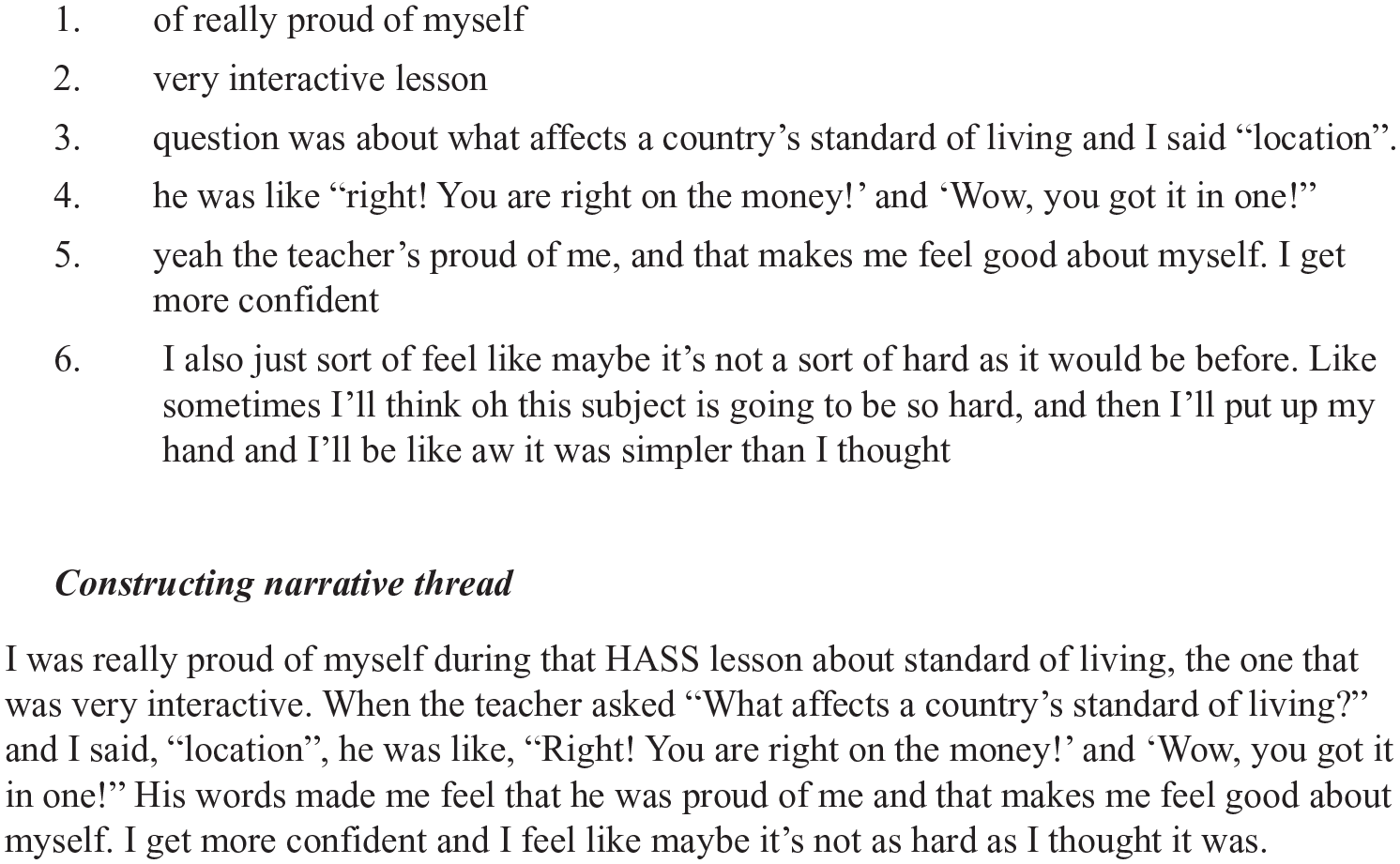
Constructing narrative thread.
Some slight additions and changes are made to develop the narrative flow and readability, but I made every effort to use the participant’s language as much as possible. My understanding of the school context that I gained through classroom observations allowed me to provide some contextual details for the narrative where needed.
The next step, after developing the narrative thread, was building the story. Quotes from many other participants were used in this process and I ensured that all properties and dimensions of the category of ‘increasing confidence’ were conveyed. In the example in Figure 2, the narrative about increasing confidence is expanded and detailed with further participants’ accounts.
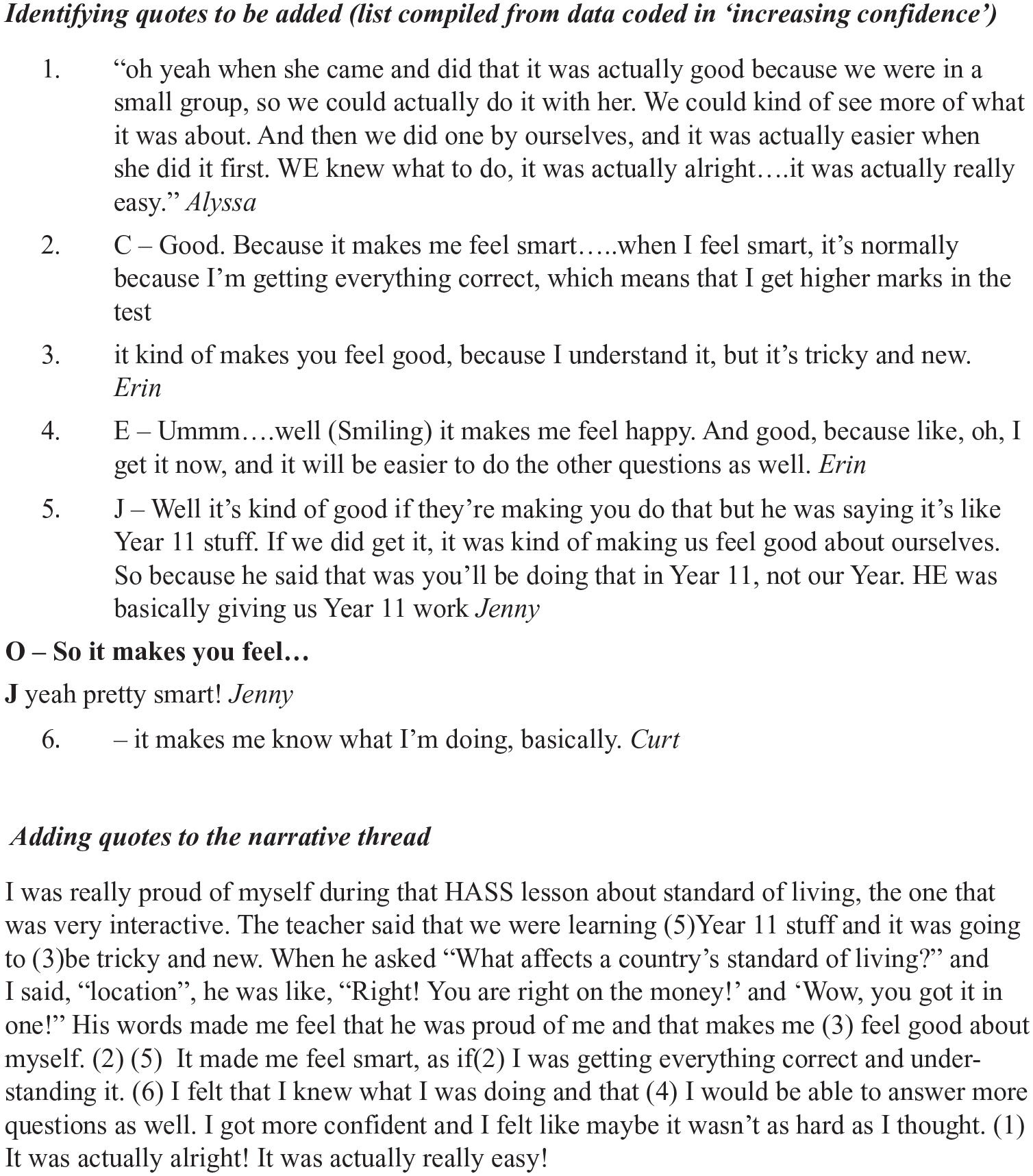
Adding quotes to the narrative thread.
As evidenced in Figure 2, a total of six individual participants’ experiences are represented in this first part of the composite narrative, which represents the positive cases of participant students’ experiences of increased confidence.
The final composite narrative includes a contrasting second half that further communicates the properties and dimensions of the coding category of ‘increasing confidence, but this time through the negative examples. Thus, the second half represents the differing and contrasting experience of students who experienced decreasing confidence in their academic ability. The same process of selecting a narrative thread, developing the narrative thread, and adding other quotes to the narrative thread was used to write the contrasting half of the narrative. The final narrative thus represents both negative and positive aspects of the main research findings, with a total of 13 different participants’ words used in this example of a composite narrative. The participant words that were chosen were those that best represented the main finding and its properties and dimensions in a way that would shape the narrative for readability.
Finally, a title was chosen for the narrative that emphasises the main research finding conveyed. The title carries significance and signposts to the reader what is significant in the story. In the example in Figure 3, the participant students’ reaction of ‘feeling smart’ is chosen for the title, using student language from the data while also indicating the depth of meaning in the story. This sentiment of ‘feeling smart’ was carried by the participant students represented in the story and the audit trail in Figure above showed that two separate students used this exact phrase to describe their reaction to their teacher.
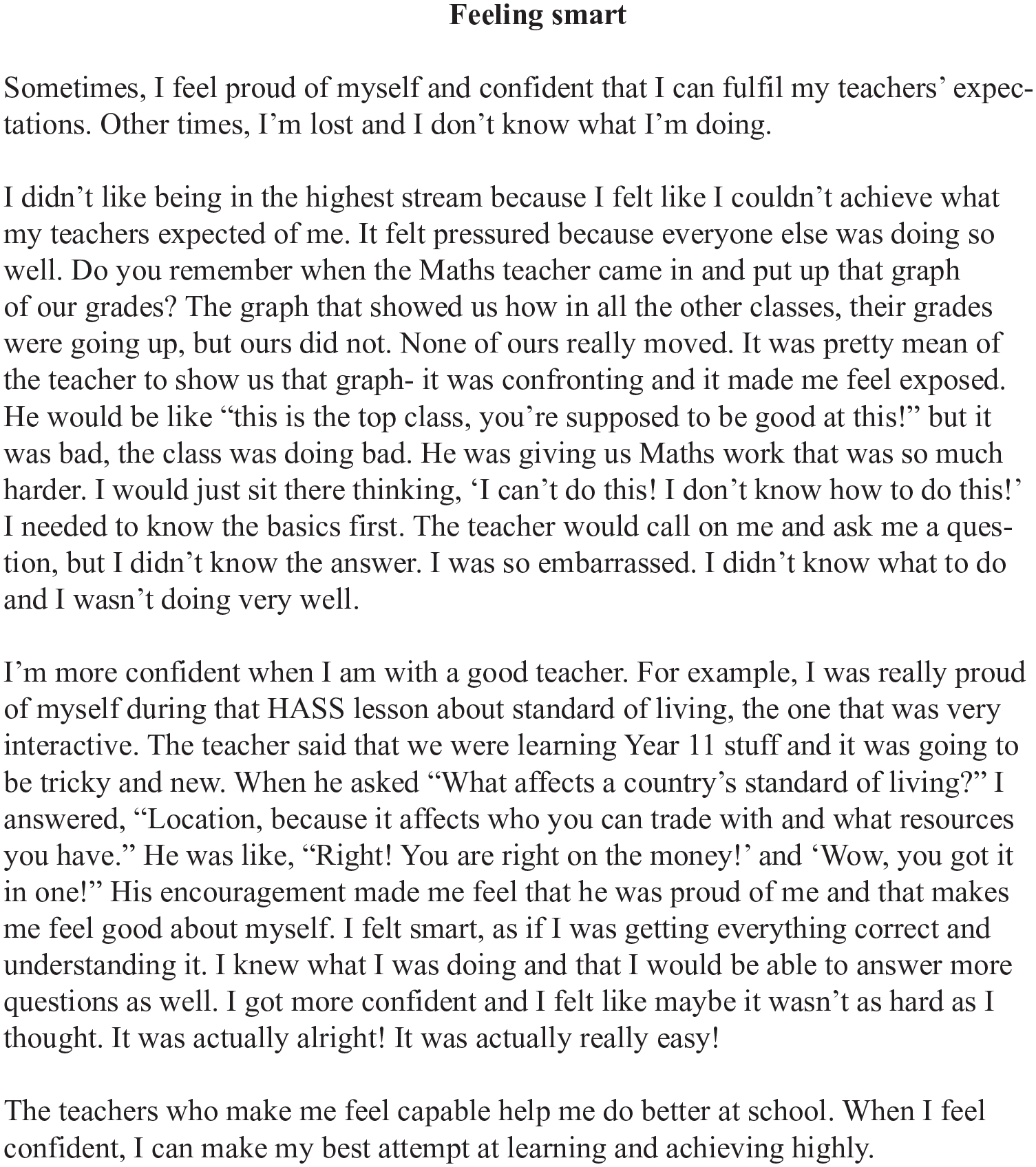
The final composite narrative.
Implications, limitations and discussion
Constructing a composite narrative that conveys multiple participant experiences and projects participant voice is a method for communicating research findings in a way that resonates with readers (Wertz et al., 2011). Furthermore, composite narratives are highly usable for practitioners from a range of backgrounds, including (in education) academics, teachers, policymakers and school principals. The usability of narratives can enhance the impact of the research that they present because they are easily transferred into the reader’s existing schema (Sikes and Gale, 2006; Willis, 2019). The narratives’ representation of the research findings also makes them engaging for a wider audience, including educators who, like many practitioners in other fields, are time poor and may not have the time or inclination to read lengthy accounts of research findings. More readership could lead to increased impact when compared to alternatives that readers might find dry or verbose. This increase in accessibility and reach of the research findings could promote participant voice when those involved in practice hear and act upon the findings conveyed by the composite narratives.
Composite narratives also provide a way to present complex research findings while also conveying the multifaceted accounts from groups of participants in a way that is cohesive, but still channels the perspectives and experiences of the individuals involved in the study. My method for constructing narratives rearranges the original words of the participants from the interview transcripts into complete narrative structures that contrast the participant students’ positive and negative experiences of their teachers’ expectations. In the case of grounded theory research, the results of the grounded theory approach of data collection, analysis, and synthesis (Corbin and Strauss, 2008; Glaser and Strauss, 2017) are captured in the construction of the narratives.
Composite narratives have several limitations, including the reliance on the skill of the researcher to create narratives that are effective and anonymous, while still accurately reflecting the participants’ perspectives (Willis, 2019). In my experience of using composite narratives to present research findings, readers need to be able to understand the rigour of the method through transparency in how they were constructed (Johnston and Wildy, 2018). Thus, long descriptions of composite narrative construction may be uninteresting for the reader and counteract the effect of their use. While narrative inquiry has a strong theoretical foundation (Clandinin, 2006; Clandinin and Caine, 2013), the connection between the utility of composite narratives for narrative researchers and those from other qualitative research backgrounds is only beginning to be explored. As an establishing method for presenting research findings, the author who constructs composite narratives can expect abundance of criticism and questions about how and why composite narratives are written. This requires skill and transparency on the part of the researcher who aims to construct composite narratives to represent research findings.
With these limitations considered, many qualitative researchers, from education and other discipline backgrounds, may still choose to use the method provided in this article as a practical guide for composing composite narratives. Increasing researchers across disciplines are employing composite narratives to present their findings, but each researcher’s method is unique and the specific process used for construction is seldom shared in detail. This article provides the fine details of a process for creating a composite narrative so research end-users can hear, and act upon, the voices of the participants. In this case, the narrative conveys a main finding that was co-constructed with the participant students through a grounded theory approach, so that students are given a voice through research about how their teachers’ expectations affect them.
Composite narratives provide a ‘way in’ to research for readers, introducing them to complex findings that can be further investigated. The narrative presented in this paper titled ‘Feeling Smart’ was an example that conveyed the research finding that students react to teachers whom they appraise positively by feeling confident in their academic ability. The properties and dimensions of this idea are elaborated in the narrative so that the reader can understand how this reaction occurs according to the participant students who experience it, with contextual examples provided by the narrative threads. In this way, composite narratives provide a way to present research findings concisely but still with rich detail and description, allowing readers to absorb a wealth of data and information. Once readers understand and appreciate the trustworthiness and reliability of the process used to construct the narrative, the research findings can be understood in a way that resonates in both the head and the heart of each individual reader.
Footnotes
Authors’ note
All authors contributed to the study conception and design. Material preparation, data collection and analysis were performed by Olivia Johnston. The first draft of the manuscript was written by Olivia Johnston and all authors commented on previous versions of the manuscript. All authors read and approved the final manuscript.
Funding
The author(s) disclosed receipt of the following financial support for the research, authorship, and/or publication of this article: This paper was written with support from the Australian Department of Education Research Training Program.
