




Abstract
This project employed community researchers as a means of improving community engagement around their Private Water Supplies (PWS) in rural Scotland. In this paper, we reflect on working with community researchers in terms of the benefits and challenges of the approach for future rural research that seeks to improve community engagement. The paper (1) critiques the involvement of community researchers for rural community engagement, drawing on the experiences in this project and (2) provides suggestions for good practice for working with community researchers in rural communities’ research. We offer some context in terms of the role of community members in research, the importance of PWS, our approach to community researchers, followed by the methodological approach and findings and our conclusions to highlight that community researchers can be beneficial for enhancing community engagement, employability, and social capital. Future community researcher approaches need to be fully funded to ensure core researchers can fulfil their duty of care, which should not stop when data collection is finished. Community researchers need to be supported in two main ways: as continuing faces of the project after the official project end date and to transfer their newly acquired skills to future employment opportunities.
Keywords
Introduction
Community members are increasingly being employed within social research, particularly within ethnographic research with specific ‘communities of interest’, for high public and policy interest topics such as healthcare (Mosavel et al., 2011; True et al., 2017). Community researchers are ‘local residents from the case study areas who [are] employed to help carry out research on [a] project’ (Teedon et al., 2017: 1). Within these settings, community members, as community researchers, can play vital roles as community assets building trust and knowledge between researchers and the studied communities (True et al., 2011) because of their insider status (Devotta et al., 2016).
The authors of this paper were commissioned to form a research team to explore attitudes to Private Water Supplies (PWS) in Scotland. The overall project aim was to explore the community experiences of, and with, PWS engagement. The team comprised Creaney and Currie who had the experience of working with rural communities, Teedon who had the experience of employing community researchers in hard to reach topics and Helwig, an expert in water quality. Rural communities are not generally considered hard to engage (Nimegeer et al., 2016) as they are predisposed to collective working (Farmer et al., 2015). However, within the context of PWS, several of the key policy stakeholders, related to water protection in Scotland, had found engaging with rural communities challenging. Community researchers were employed to encourage latent engagement in the topic and to reach a wider range of local PWS users. The findings of the paper are based on the reflections and observations of the core research team members (the commissioned research team who are also the authors of this paper) who had management responsibility for conducting the research and employing the community researchers. The findings of the paper have been informed by multiple and ongoing discussions and exchanges with the community researchers throughout the project.
Role of community researchers in social science research
Traditionally, conventional social science methods such as in-depth interviews and focus groups are used to gather a depth of qualitative information (Silverman, 2016). Issues associated with these methods include community cynicism or disinterest (Schutt, 2018), which have resulted in the exploration of less conventional qualitative approaches being employed. One result has been an increased focus on participatory action research (PAR) methods including the use of ‘lay’ researchers which are seen to improve data access, widen awareness and public understandings of issues, and potentially enhance empowerment and inclusion (Hardy et al., 2016). Lay researchers play an active rather than passive role; the research-theme data they collect is considered in tandem with their own experiences of the issue. Where such approaches are successful, ‘each person involved in the effort will learn new skills by moving from the roles of insiders to outsiders and back again’ (Hardy et al., 2016: 593). These developed skills may lead to future changes in their communities and within policy (Ericson-Lidman and Strandberg, 2015). However, a significant challenge for PAR is in empowering participants, whilst also ensuring research is robust and rigorous (Lushey and Munro, 2014).
PAR initially emerged to raise awareness of the nature of knowledge and its connections to power through how it is produced, legitimised and accepted (Baum et al., 2006; Habermas, 1968). From here, PAR enabled researchers to work with communities to instigate action and change. Meanwhile, citizen social science emerged from citizen science in the natural sciences. It aimed to improve the collective understanding of an issue rather than improving that issue per se (Castree et al., 2014). Citizen social science differs from traditional citizen science in natural sciences in that lay researchers are involved in all stages of the research, from conception to results delivery, rather than solely data collection (Sui et al., 2013). We consider our research to be a form of citizen social science given that the aim was to improve collective understanding of the differing levels of community engagement around PWS issues, rather than to create action for change as is commonly associated with PAR.
Community researchers are an example of lay researchers. Community researchers have been employed in situations with hard-to-reach groups (physically and socially) such as pesticide and agricultural research (Teedon et al., 2015) and research with individuals living with drug additions (True et al., 2017). Community researchers can also play a role in building longer-term links that reduce the risk of researchers parachuting in and out of a study area (True et al., 2011).
Context of this project: engaging rural communities around their PWS
Although this paper reflects on the benefits and the challenges of employing community researchers on a specific issue, it is important to offer some context to the wider project from which this paper derived. Within this project, community researchers were employed to better engage around their PWS. The selected four communities all contained differing amounts of PWS. Some were fully reliant on PWS, and some partially reliant on PWS and public water supplies. Approximately 3% of the Scottish population (but proportionally higher in rural communities) residents, as well as many visitors, rely on PWS. These are ‘drinking water supplies which are not provided by Scottish Water and are the responsibility of the owners and users of the supplies’ (DWQR, 2017). Several water protection stakeholders in Scotland have expressed concern that these drinking water sources may not all provide resilience in dry periods and the quality of these supplies are highly variable leading to potential health risks (DWQR, 2017). For instance, contaminants and infectious diseases (such as Escherichia coli) may be more prominent in PWS rather than publicly managed water (Fewtrell et al., 1998; Kay et al., 2007; Richardson et al., 2009). Yet, many people living in rural communities reliant on PWS feel it tastes better and is more natural than Scottish Water (the national supplier) (Teedon et al., 2017), meaning people often do not wish to alter their current water supply. Additionally, the widespread, but inaccurate, view that people using PWS build up an immunity to it over time continues to persist (Frost et al., 2005), which puts vulnerable people at risk (Richardson et al., 2009). Thus, due to the persistence of inaccurate views of PWS, water protection stakeholders in Scotland (DWQR 2017) perceived a lack of engagement from many rural communities about their PWS and these associated risks. The wider study to which this research is attributed therefore sought to uncover the reasons for this lack of engagement and suggest strategies for improvement. This perceived lack of engagement provided the rationale for the employment of community researchers in the project to enable better engagement and (potential) empowerment of rural communities around PWS issues.
Our employment of community researchers
Some of the main proponents of this approach, namely, Teedon et al. (2015: 3), promoted the use of community researchers for ‘their embeddedness within the case-study communities [which] was likely to bring a range of community-based strengths and resources’, such as more effective recruitment and retention of participants; trust-building, more effective and immediate responses to local issues due to availability of better local knowledge and eliciting information from a population who were perceived to be reluctant to engage on this topic. As such, we employed community researchers to enable better understand community-level responses and engagement in the policy and public-health related issue of PWS. The community researchers were required to live in, and be part of, the local community (Teedon et al., 2017) so they would be well-equipped to encourage greater community-level responses to engagement around PWS issues.
Methods
We undertook this project from October 2015 to November 2016. The wider project was commissioned to address concerns amongst key Scottish water protection stakeholders (e.g. Scottish Water, DWQR and Scotland’s Environmental Protection Agency [SEPA]) of low community engagement around PWS issues and a Steering Group, comprised of a range of these same stakeholders, was established by the research commissioners to offer guidance before and throughout our research project. We, the core researchers, were commissioned to undertake the research and we engaged in regular meetings with the Steering group through the project, and, in addition, several members of the Steering Group attended community-engagement events and the final sharing event with core and community researchers (see Table 1). The Steering Group also facilitated the study-area determination and offered comments on research tools (topic guides, etc.). Four remote rural communities were chosen as case-study areas to capture a range of PWS circumstances, hereon referred to as Communities A, B, C and D. The communities covered a broad geography of Scotland and were each characterized by different types of PWS sources and different community issues such as land ownership patterns, levels of rurality, levels of significance of reliance upon PWS and community makeup (e.g. proportions of newcomers, tourists, longstanding residents, retirees, etc.).
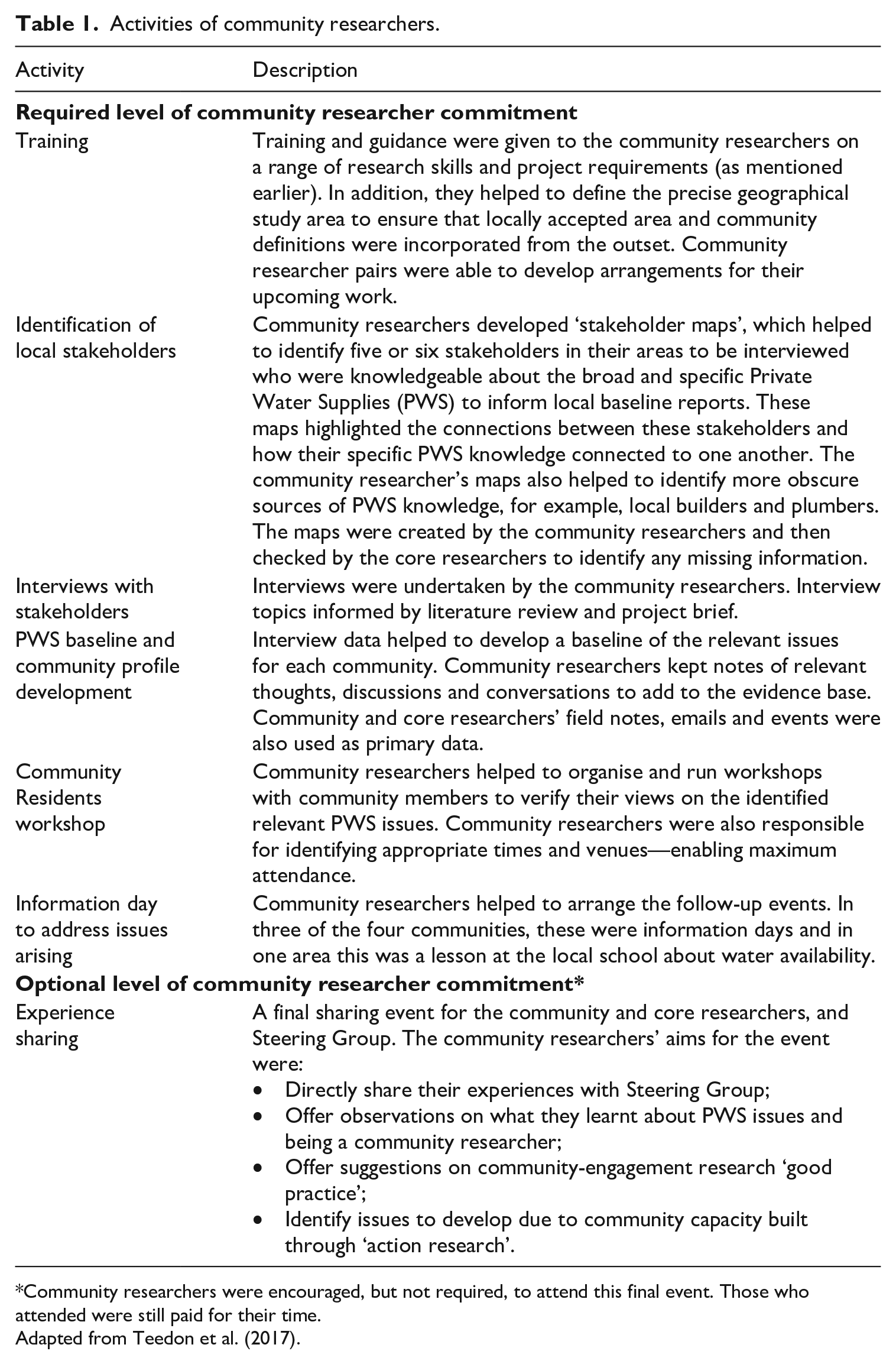
Activities of community researchers.
Community researchers were encouraged, but not required, to attend this final event. Those who attended were still paid for their time.
Adapted from Teedon et al. (2017).
Selecting the community researchers
Given our previous research experience, we recognised that employing community researchers may be a good method for improving PWS engagement. Thus, eight community researchers (two per case-study area, working for approximately 12 hours per month for 6 months) were employed to undertake several research activities within their areas, which were designed to allow them to fit research activities with existing commitments. By employing two community researchers per area, we enacted a ‘buddy’ system which was advocated in previous uses of the method (Teedon et al., 2015). The posts were advertised within the communities via noticeboards, mailing lists, social media and contacting key community representatives. We aimed to hire researchers who lived within their specific communities, were well connected within these communities (i.e. had lived in the communities for a long time, and worked in the community or were involved in different community groups) and had experience or knowledge of PWS. Furthermore, as a desirable element, the community researchers should have had some experience in conducting social research, though this was not essential. We carried out the interviews for the posts within the case-study areas, and the successful candidates were subsequently given intensive formal training and a handbook which covered interview techniques, ethical considerations, digital recorder use and overviews of the relevant PWS issues and information. We selected the successful candidates based on how well they performed in the interview and their level of local knowledge. In addition, the intensive formal training enabled the community researchers to understand the level of commitment and provided an opportunity to withdraw if they felt it was not something they could undertake. Each community researcher was formally employed (i.e. with a contract) as part of both a quality control process and our social responsibility as researchers.
Activities of the community researchers
Table 1 highlights the main research activities undertaken by the community researchers and indicates the level of commitment of each activity.
The interviews were conducted with key stakeholders (e.g. landowners, tenants, local environmental health officers) who were knowledgeable about PWS in the case-study areas. These stakeholders were selected based on the maps produced by the community researchers. Semi-structured interviews with specifically designed topic guides were used; they lasted under 90 minutes and were conducted in community researchers’ homes, interviewees’ workplaces or homes or other suitable community venues. Interview summaries were drawn up by the community researchers and core researchers could review these after having listened to the audio files to ensure completeness and accuracy. Interview topics were informed by a range of elements: issues of concern or interest to Steering Group stakeholders, issues emerging from a consideration of pertinent academic literature, and direct input by community researchers based on their awareness of relevant PWS issues. Once drafted, these were agreed upon by Steering Group members. Interviewees were also given opportunities to discuss other issues during their stakeholder interviews that they felt were relevant, and thus, topic guides were flexible to allow freedom to explore issues of importance to interviewees. All community researchers practised interview skills with their ‘buddy’ and established their own schedules for interviews. Furthermore, we gave the community researchers weekly support and supervision through a meeting and open lines of communication (e.g. one of our phone numbers or email addresses they could contact anytime they had any concerns). All community researchers were required to tell the core research team when interviews were scheduled. Written consent was taken at the start of each interview, and all interviews were recorded using University digital voice recorders. In total, 24 community stakeholder interviews were undertaken between October 2015 and January 2016. All data collected were uploaded to a secure University server. Some pairs conducted their first interview together to help build their confidence.
We analysed the interview data with input from the community researchers to inform the workshops. The workshops, to which the whole community was invited (whether or not the individuals relied on a PWS), were conducted in each case-study area and facilitated by the core researchers with input from the community researchers. Through the workshops, we aimed to verify the information established in stakeholder interviews with the wider community, better understand the levels of PWS community engagement and identify the next steps for the communities in terms of improving their engagement with PWS. We then held a second round of events to respond to an identified community need for information on how barriers to improving PWS in each case-study area could be overcome. In Communities B to D, these were information days, and in Community A, on recommendation of the community researchers as a potentially more effective way to further engage their community, a lesson on PWS issues was undertaken with the local primary school children. This enabled informal conversations with the parent community as well as the children sharing their learning with their parents directly. The interview and workshop data were used to create a series of information sheets to highlight the current PWS engagement levels in these areas and provide recommendations on how to strengthen this engagement further where necessary (e.g. Teedon et al., 2017).
Tracking the research processes to identify the benefits and challenges of employing community researchers
Throughout the research project, we asked the community researchers to use an online project management platform (Basecamp) to record and share their experiences of conducting research within their communities. Some community researchers used this platform frequently, whilst others preferred to share these experiences in the weekly meetings with the core researchers. In addition to this, the core researchers kept field diaries of their reflections and considerations of employing community researchers as a methodological approach and paid particular attention to identified benefits and challenges of employing community researchers as a means to improving community engagement around PWS. Records were shared amongst the core research team and thematically analysed to assess consensus and disagreement amongst the core team when writing this paper. Furthermore, although the core researchers were the point of contact for separate community researchers (i.e. two members of the core researcher team were the contact-point and more heavily involved in Communities B and C, whilst the other two core researchers were the first contact for Communities A and D) we made sure to overlap this contact at each event so that members of each core researcher attended at least one selection interview panel or workshop that was the responsibility of the other core researcher team. Furthermore, the initial training and final sharing event were attended by all core and community researchers together. This allowed us to build more robust reflections on the degree to which our observations on the benefits and challenges of the approach were identified across multiple communities and multiple community researchers.
Results
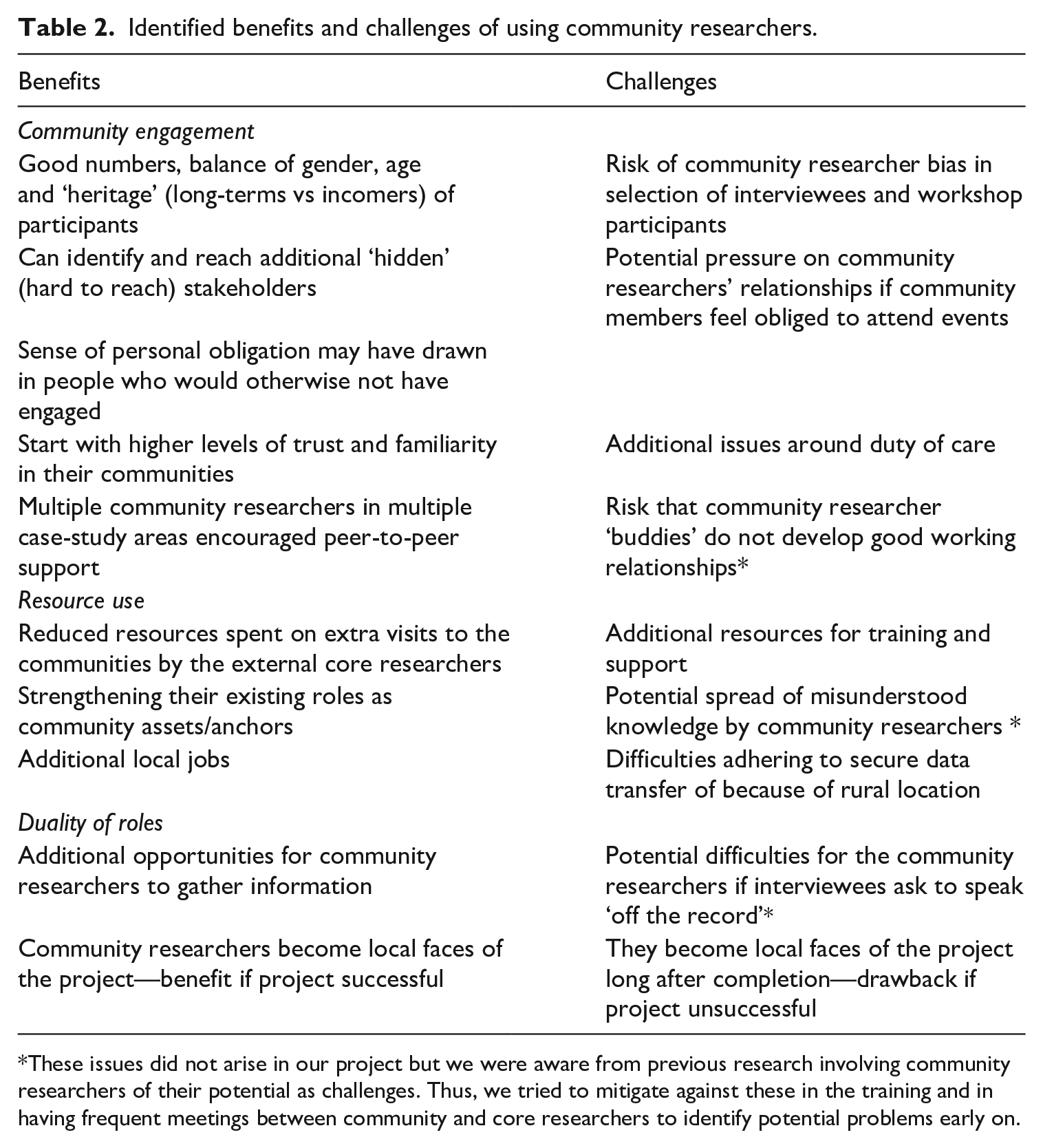
It was useful to group the benefits and challenges of working with community researchers in this research project under three categories: community engagement levels, resource use and the duality of roles.
Community engagement levels
Like True et al. (2017), we found a major benefit of working with community researchers was the identification of different stakeholders who may not be otherwise considered or identified by outsider researchers. These stakeholders may have been identified through snowball sampling; however, the community researchers were also able to access higher numbers of community members to participate in workshops than we expected. Community researchers may also have been able to access and interview participants who would not wish to be interviewed by someone unknown to them. Each first-stage community workshop was very well attended by over 20 community members in each case (representing 20–25% of the total populations of each of the communities), and high proportions of attendees were male which is unusual for rural community events. Attendance was recorded by the community researchers. There were also, according to the community researchers, a good mix of long-term community members and newcomers. This suggests that they encouraged more representative event attendance than we might have managed ourselves.
There are several reasons we believe that the community researchers promoted greater community involvement which included: they were known and trusted members of their communities, and thus community members felt a sense of obligation to attend and support their neighbours in their community researcher roles; they were able to identify a time and place that suited the community rather than the core research team: three out of four events were held during weekends, and the fourth event during a weekday evening (with home-made food) so as not to clash with other community events. Furthermore, the community researchers provided a platform in the community for latent engagement around PWS issues: at a number of events, several individuals indicated that it was the first time anyone had asked them about their thoughts on PWS. Through conversations with community researchers, we believe that the high attendance figures were related more to the community researchers encouraging community members to come to the events rather than initial engagement with the topic per se, which means the role of the community researcher in the process was essential to the participants’ eventual engagement with the topic. We also saw evidence, through informal discussions at the workshops, that the community researchers were able to act as spokespeople for the research project and highlight its importance to their community from their local perspective. Although more research is needed to identify the extent to which this could be the case in other similar research projects. Community researchers were able to identify nuanced connections between stakeholders and produced thorough stakeholder maps which provided considerable detail of community roles. Community researchers subsequently promoted community capacity building and additional knowledge acquisition as they became knowledgeable assets within their communities around PWS issues (Emery and Flora, 2006). For instance, one community researcher disclosed that community members had come to her for advice after the project ended and she directed them to specific stakeholders. This illustrates how the new knowledge acquired by the community researcher was translated into enhanced social capital.
Leaving the control of the workshop and interviewee participant selection to the community researchers also meant that there may have been some bias in selecting the participants. It is unclear if the community researchers enhanced the inclusion of socially excluded individuals and local politics may have played a role, although we were not ever explicitly aware of this occurring. Alternatively, the employment of community researchers had the potential to put pressure on existing relationships as we reflect that some community researchers noted having to cajole their friends into attending ‘their’ events. We tried to address this by asking prospective community researchers how they would engage the whole community during their interviews and employing individuals who represented different community sectors where possible, thus more likely to identify different stakeholders to interview. Furthermore, the success of our community researcher approach was aided by the fact that they were well-respected community members, meaning neighbours either felt obliged or encouraged to participate in events. However, it was equally true, particularly during recruitment interviews, that in some cases community researchers provided considerable insight into existing sensitivities. Although selection bias is a common problem within any research project given that all research is subjective to an extent (Silverman, 2016), this risk was minimised by employing two researchers per case-study area to widen the community connections and lower the impact of any frictions related to a single community researcher. Even employment of two community researchers per area could lead to further challenges of the approach if they simply ‘did not get on’ or ‘could not work together’, although there was no evidence of this within this project.
Resource intensive or resource efficient?
There are financial and resource implications of the approach, particularly regarding rural research. Employment of local community researchers provided additional (albeit short-term and part-time) local jobs within communities, using University (Research Assistant) pay scales, contracts and flexible hours, which appeared to fit with the predominantly part-time employment in the communities. Although community researchers were costly for our research project, in terms of additional recruitment, training and employment costs compared with utilising the time and skills of the core research team, these costs may be offset in terms of additional visits to the rural communities (e.g. accommodation and travel costs) which would have been required to achieve the same quality outputs.
Additionally, community researchers gave support and assistance to each other, both within and across the case-study areas and included good practice for stakeholder identification (e.g. stakeholders that had good PWS knowledge such as local plumbers), interview tips (by conducting mock interviews with each other) and workshop preparation (e.g. sharing knowledge of the use of school halls as good workshop locations). However, the community researchers predominantly lacked extensive prior research experience and needed considerable support and training from us in undertaking tightly defined research tasks. For example, with interview etiquette affirmance was frequently needed over when to prompt and pause, and leading questions were not asked, despite these issues being covered at the training event. Although such issues may be similar to those that any early career or student researcher would experience, due to relative inexperience.
In addition, the remote location of the communities and associated poor internet connectivity (Skerratt, 2013) meant that additional time was spent trying to securely transfer data whilst safeguarding anonymity. As the community researchers lived and worked some distance from us, a system had to be devised to securely transfer the interview audio data to the core research team. Community researchers were given University email addresses and access to a shared drive on the University server. The interviews were recorded on University-owned digital voice recorders and the intention was to transfer data from the community researchers’ University email address to this shared drive. However, most study areas had poor internet connectivity, so the physical transfer of the digital voice recorders to the University often became necessary.
Overall, we consider community researchers as resource-efficient, particularly as the commissioned brief was to maximise levels of community engagement. Alternatively, there would have been considerable additional costs for the core research team to conduct study-area visits to establish the level of community knowledge, trust and familiarity that community researchers demonstrably possessed.
Duality of roles
As the community researchers continued to live and work within their communities throughout the research project, they were performing dual roles of researcher and resident. Some community researchers struggled to maintain and distinguish separate boundaries. On the plus side (for the project), this meant community researchers were acting as ‘faces of the project’ and could gather more informal feedback about the project and its progress as they went about their everyday lives. This aspect was found to be particularly valuable when designing the second workshop in ensuring that the proposed format fit with community needs. Yet, acting as both community member and researcher may also have some drawbacks. Other community members may have interacted differently towards community researchers (Jamshidi et al., 2014). Furthermore, the community researchers also remained living in the community after the project finished and may have retained their status as ‘the face of the project’ after the project end. If the project has been perceived to be successful by the local community, then this may be an asset to the future engagement of the community around other policy-based issues. However, if the project has been viewed negatively then this could lead to difficult community relations for the community researchers in the longer term (True et al., 2017). This also raises ethical implications in terms of the duty of care of employing community members for research within close-knit communities (True et al., 2017).
Relatedly, ‘physical proximity’ to the case study communities was a considerable benefit (Richman et al., 2012) as community researchers were, given their local and research knowledge, able to understand and navigate between their dual roles. In turn, our research benefitted from high levels of engagement across the four areas which facilitated stronger links with the core research team, the Steering Group and the PWS research. However, physical proximity may also cause problems as did occur in one instance during our research. During a Community A workshop, one community researcher was challenged by a workshop attendee who was also her landlord. We sought to maintain lines of communication with the community researcher through additional informal meetings with her to ensure she was supported and happy to continue in the research. She was happy to continue, and the incident did not have long-lasting implications for her life in her community; yet, this is an important issue to be aware of in future research, and it would have been preferable to gauge and manage the risk of disrupted relations a priori. The complexities associated with navigating between these roles have been understudied (Mosavel et al., 2011).
Thus, core researchers need to make sure that the roles, tasks and expectations of the community researchers are delineated at the beginning of and throughout the project. Within our project, we attempted to minimise the risks of community researchers balancing objectivity or emotional distance from daily and research lives (Banks-Wallace, 2008) by having the community researchers role associated with clearly defined tasks to build boundaries between a community researcher’s ‘work’ and ‘home’ life (True et al., 2017).
Our specific community researcher approach had several benefits and challenges to both the project and the community. Table 2 below summarises these benefits and challenges.
Identified benefits and challenges of using community researchers.
These issues did not arise in our project but we were aware from previous research involving community researchers of their potential as challenges. Thus, we tried to mitigate against these in the training and in having frequent meetings between community and core researchers to identify potential problems early on.
Discussion
In this paper, we have reflected on the key benefits and challenges the core team observed from working with community researchers to improve local engagement around a particular topic, in this case, PWS: a theme seen to be (technically) complex and one which water protection stakeholders had perceived was of little interest to their communities. We aimed to produce some considered reflections on using this approach within (largely remote) rural research, areas often characterised as having high levels of engagement and lower levels of internet access. We found that in addition to the benefits suggested by previous iterations of the approach (e.g. Teedon et al., 2015), using community researchers can develop social capital in terms of social networks built on reciprocity and trustworthiness (Putnam, 2000), peer-to-peer support, and position the community researchers as local faces of the project (Jamshidi et al., 2014). Some further discussions are given below in terms of duty of care, the role of trust and power, reducing research bias and enhancing long-term funding for employing community members within research projects.
Duty of care
Working with community researchers can create more nuanced findings and increased community engagement (Teedon et al., 2015; True et al., 2017). The duty of care between core and community researchers needs to recognise this, not only during but also following, any research process, as the biggest impacts on the community researchers may appear after the project’s conclusion (Richman et al., 2012). As such, if the benefits of research methods involving community researchers continue to be promoted within policy and research, associated research funding needs to be cognisant that the duty of care does not stop when the project ends. Within our project, this was difficult, as this was research commissioned by a client with a very specific brief. Nevertheless, this raises particular ethical dilemmas for the core research team because of physical distance from what were remote rural study areas, though in this case, some informal links did continue after the project ended. But clearly, there can be feelings of abandonment which may be strengthened if the project leaves negative impacts on the community (Jamshidi et al., 2014). Given that some of the core research team had conducted work with community researchers before, we were able to address some of these potential issues (e.g. abandonment) in the training sessions. However, funding and resources should be easily accessible in all projects involving community researchers to ensure that core researchers can ethically best meet and maintain their duty of care. Furthermore, such resources need to recognise the potential trust and power imbalances that may be present within community researcher approaches.
Recognising trust and power imbalance
There is a central consideration here to understand the importance of trust and power imbalances when employing community researchers. The potential of being viewed with suspicion (by community members and community researchers) as possible advocates of a top-down policy ignoring local needs and particular circumstances (True et al., 2017) was at the forefront of our thinking. Some concerns about this were raised by community members, however, by working with community researchers from the outset to address potential concerns explicitly we believe we navigated this challenge fairly well both with the communities and community researchers. Nevertheless, our position of power is something that we could potentially have emphasised further to our community researchers, given that they too held an alternative position of power, as they were in effect our gatekeepers for what community data and knowledge would be shared. Relatedly, risks exist for community researchers being viewed as both outsiders and insiders, and as such, gathering data on difficult topics and relaying this information to both a community and research team could again lead to difficulties if not carefully considered (Kingori, 2013). As such, building trust, both between core and community researchers and community members, is key to ensuring that data collected is as representative and truthful as possible (Mosavel et al., 2011). In trying to build close relationships with our community researchers, we aimed to foster trust and rebalance the power relationships; further research could be undertaken to understand if the community researchers also reflect such an opinion.
Reducing researcher bias potential
Previous research has highlighted the potential for research bias (Devotta et al., 2016; Jamshidi et al. 2014). To reduce this potential for bias it was important that we, as the core researchers, had some more detailed knowledge of the communities under study, to enable appropriate levels of support to the community researchers. Firstly, we drew on expertise and guidance from the Steering Group who were knowledgeable about the local areas and PWS issues, and we reviewed documentary sources such as government reports, news articles and community websites pertaining to the case-study areas to inform our understanding of the areas. This helped ensure the project would not be swayed too much, by either core or community researchers, in a direction that did not fully represent the issues under study. Framing the roles, tasks and employment contracts of the community researchers was also a central consideration, therefore, to ensure effective working with community researchers. Secondly, we undertook early initial visits to the communities to characterise the areas’ services, geography and specific issues. In addition, throughout the project, we sought to ensure transparency and voice equality in the discussions between core researchers, community researchers, communities and wider stakeholders.
Better funding for long-term community researcher approaches
Our experience of the approach was not without its challenges. As our community researchers worked on a contractual time-limited basis to fulfil defined tasks, they were not fully involved in this reflective stage (i.e. paper writing), although they were invited to read and comment on a draft version. The commissioned research had a brief to produce a client report, so further reflective research to gather the views of the community researchers on the research process itself or to include them as authors of the paper was not possible as their formal employment contracts were no longer in place. Although the paper may have benefited from including community researchers as co-authors, we thought it would have been unfair to ask them for significant further participation, as their involvement (unlike ours) would have been voluntary rather than paid, which we as a project team did not think to be ethical. However, a key aspect to finalising the involvement of community researchers at the end of the project was to engage them in a final sharing event at which they presented their thoughts on their community PWS issues in their community and reflected on their experiences as community researchers.
Furthermore, we identified challenges around the extent to which our community researchers could shape the research, given they were not involved with the initial design and implementation of the project (Castree et al., 2014). In this case, the community researchers were employed after the Steering Group, core researchers and communities to be studied had been selected. This parallels with citizen science in natural (rather than social) science, in which citizens are recruited to only collect the data (Sui et al., 2013). Although in our case, the community researchers contributed significantly to the design of the second and third phase of the research (i.e. the workshops). As with any similar research (Teedon et al., 2015; True et al., 2017), it is difficult to measure the specific level of engagement that the community researchers brought to the research project. We believe they increased the engagement levels around PWS within their communities overall, particularly given our experience of holding previous workshop-based events in rural communities without employing community researchers, or other experiences from the literature (Farmer et al., 2015; Schutt, 2018). The community researchers were able to reach higher proportions of the community population than the core researchers could have expected to alone. Our utilisation of community researchers was positive (for the communities, the research and the community researchers) as we maintained good relationships with them, and they worked well together and within their communities to obtain high-quality data. This highlights the importance of the initial training day to provide both the core and community researchers with a better sense of how well the pairings might work together. Finally, one effective method that we used to track our experiences of employing community researchers was through keeping reflective field diaries (Banks-Wallace, 2008) in which we, the core researchers, reflected on: (1) the process of the research; (2) any concerns with the community researchers, and (3) ongoing thoughts on the benefits and challenges of the approach. We found this to be a low cost and simple means to track progress and changes in working with community researchers over time that would have otherwise perhaps gone unnoticed.
Overall, these aspects would have been just as likely to occur in an urban setting (Hardy et al., 2016) and thus should not be considered as negatives for employing community researchers in specifically rural communities. However, they do highlight the potential additional benefits that could be achieved from longer-term funding for community researcher-based projects, including better initial insights in terms of the research design, input into academic outputs, and assisting community researchers to better translate their newly found or improved research skills on their CVs after the ‘research’ ends.
Conclusion
Working with community researchers in rural research raised several issues and provoked considerations about ethics concerning the relationships between all the researchers involved and communities under study. The approach allowed us to develop a deeper understanding of communities more quickly, but appropriate time and resources are needed to provide support (both research and more personal) during and after the project. This is particularly true in research within close-knit rural areas in which community researchers may remain faces of the project long after it ends. The employment of community researchers on a topic that has been assumed to be ‘unengaging’ can provide a platform for identifying latent levels of engagement. It also has the potential to increase a community’s level of engagement, employability and social capital.
Although assessing the benefits and challenges of employing community researchers was not the main aim of this research project, the reflections and discussions we highlight in this paper have led us to suggest the following recommendations of good practice in terms of working with community researchers. First, a support programme should be established to help core and community researchers deal with the longer-term impacts of research, particularly when researching difficult or divisive topics, as well as education and training to support potential core and community researchers before project commencement. This may include external pastoral care mentors for both core and community researchers. This is particularly key with the recent push towards increasing community empowerment and rising numbers of rural dwellers in Scotland (Revell and Dinnie, 2020; Skerratt, 2013). Secondly, and perhaps most importantly, we would highlight that there is a spectrum of participatory research approaches (Lushey and Munro, 2014, Schutt, 2018), and the involvement of community researchers is one such approach which can be useful in providing a platform to enhance latent community engagement.
We also offer several suggestions for further research around employing community researchers in rural research that is perceived to be unengaging. Given that community researchers fulfil both the role of ‘insider’ and ‘outsider’, more research is needed into the longer-term challenges for community members working as researchers within their communities to better understand the potential impacts after a research project concludes. For instance, additional research could be carried out on the role of subjectivity within community researcher work. The community researcher holds the insider knowledge about the community and may guide the research in a desired direction. Meanwhile, core researchers hold the knowledge of the wider research process and may also steer the research in a particular direction (e.g. sampling strategies and site selection). The impacts of the views that are perhaps intrinsic to the community or core researchers could be an interesting topic for analysis. Furthermore, when do community researchers stop being ‘faces of the project’ and what is the impact on community researchers if the project ran into problems? Is there potential for community researchers to become ‘community champions’ on the research topic and be advocates for the community in managing the issue in the longer term? Or perhaps what is most pertinent is a more ethical community research approach that includes warning, or at least discussion, of the potential outcomes on the community members as researchers during the initial training.
Footnotes
Acknowledgements
The authors thank the Steering Group, and all involved in the project, including funders, for their assistance and guidance throughout as otherwise the project would not have been possible. However, mostly we would like to thank our community researchers for their hard work throughout the project and beyond and for the passion they showed for their communities. They are most definitely assets to their communities.
Funding
The author(s) disclosed receipt of the following financial support for the research, authorship, and/or publication of this article: This research was funded by the Centre of Expertise for Waters (CREW) and the Scottish Government’s Strategic Research Programme (2016–2021).
