




Abstract
The focus of this paper is on the complex and sometimes contradictory effects of generating films with and about young people who have experienced homelessness, through participatory research. Drawing on two projects – one in Ottawa, Canada, and the other in Manchester, UK – we scrutinise two key aspects of participatory research projects that use film: first, how to appropriately communicate the complexity of already-stigmatised lives to different publics, and second, which publics we prioritise, and how this shapes the stories that are told. Through a theoretical framework that combines Pierre Bourdieu’s account of authorised language with Arthur Frank’s socio-narratology, we analyse the potential for generating justice versus reproducing symbolic violence through participatory research and film with homeless young people. In particular, we scrutinise the distinct role played by what we are calling first, second and third publics – each with their own level of distance and relationship to the participatory research process.
Introduction
How can we not feel anxious about making private worlds public, revealing confidential statements made in the context of . . . relationship[s] based on trust? . . . [N]o contract carries as many unspoken conditions as one based on trust. In the first place, we . . . protect . . . people . . . by changing the names of places and individuals to protect identification. Above all, we [must] . . . protect them from the dangers of misinterpretation (Bourdieu, 1999: 1)
This paper emerges from an international collaborative exchange between the University of Central Lancashire and Manchester Metropolitan University, England, and Carleton University, Canada, on the subject of the use of film within participatory research and youth citizenship. This is a shared scholarly interest. Three of the authors have a background in youth work and all have backgrounds in sociology and arts-based participatory research with young people.
Participatory research projects with young people often plan to create new moments of personal and political awareness as well as desires, intentions and/or possibilities for personal and collective activism from which change processes might be generated or scaffolded (Blum-Ross, 2013). The hope tends to be that enabling young people to take on roles as researchers might alter the research and might be part of an emancipatory, democratising and personally beneficial process of knowledge creation (Braden, 1999). These potentials are predicated on being able to nourish the constituents of citizenship within the lives and situations of those who take part as well as creating spaces in which young people feel able to make meaningful interventions in the public sphere (Braden, 1999; Wheeler, 2012).
Participatory video research (PVR) with young people is part of this dynamic and developing field, which is informed by a politics about involvement (who should be involved in research activity), process (how such activity should be undertaken) and benefit (who should experience the positive effects of research) (Roy, 2012). An emerging critical literature attests to the fact that, whilst commitments to such principles are easy to voice, they are far more complicated to enact (Caretta and Riaño, 2016; Kindon et al., 2012; Lomax et al 2011; Mannay, 2013; Mistry et al., 2014; Shaw, 2012; 2015; Smith et al. 2010).
The use of film in participatory research with young people has been advocated for a variety of reasons. These include that young people are immersed in a highly visual culture; because film can be used at different phases in the research process to support different modes of reflection and communication (Shaw 2015); because film-making is capable of supporting processes of self-conscientisation and empowerment (Braden, 1999); because films can bring into view some of the more hidden elements of participatory research processes (Rogers, 2016); because the films created can strengthen the possibilities of achieving change, especially if used by young people for their own purposes (Wheeler, 2012), or with broader publics as part of wider advocacy (Kindon et al., 2012); and because films can prompt audience members to focus on the chosen issue in new ways (Low et al., 2012).
In this paper, we engage with an emerging critical literature through which we examine the possibilities and constraints for realising such objectives (Mistry, Bignante and Berardi, 2014), particularly when working with young people already stigmatised within the public view – in the case of our projects, young people with experience of street homelessness. As Shaw (2015) has argued, film has no inherent ‘magic’ (p. 639) and its use does not unproblematically guarantee improved understandings, democratising processes, power-free relations between academics, youth communities and statutory bodies, or change/impact which is of obvious value to those who take part (Roy, 2012; Kennelly, 2018a, 2018b; Caretta and Riaño, 2016; Holland et al. 2010; Lomax et al., 2011; Mannay, 2013; Mistry et al., 2014).
In what follows, we introduce two case studies to scrutinise two key questions in participatory research projects which use film: (1) how to appropriately communicate the complexity of already-stigmatised lives to different publics, and (2) which publics we prioritise, and how this shapes the stories that are told. Both questions hinge on what Pierre Bourdieu (1993: 39) describes as ‘the paradox of communication’ that results from the fact that all modes of sharing experiences rely on the social laws of language, and the power dynamics that shape these. As Arthur Frank (2015: 36) argues, ‘humans live in a storied world’, but all stories are both subjective, reflecting the experiences of the speaker, and external: ‘no story is ever anyone’s own, but is always borrowed in its parts’. These authors provide insight into what stories can be told, and also how they might be received and interpreted by others.
The first project took place in Manchester, England, involving a collaboration between an arts and social care organisation working with homeless young people, an artist, a social scientist and a film-maker. The film was used to tell the story of the development of a participatory action research (PAR) project that addressed the everyday lives and lived experiences of street homeless young men in Manchester. The second was a PAR project that explored the civic issues of homeless young people in Ottawa, Canada. The film was used to convey the issues raised in the research to wider publics. Both projects engaged professional film-makers to direct and edit the films, with efforts made to test out and agree on the final product with some of the young people who took part.
Each project team experienced tensions about how the film(s) might ‘travel’ and concerns about the potential harms to the homeless young people involved due to different forms of exposure and reception (Gubrium et al., 2015). In addressing these concerns, we introduce the idea that there are several publics – what we are calling first, second and third publics – each with a different distance and relationship to the participatory project itself and each potentially predisposed to different interpretations (or misinterpretations) of the findings, including the film(s). This distinction becomes important when we examine the role played by process within these two participatory research projects. In each project, researchers were able to work with youth participants to create a space that fostered the sharing of stories, which countered dominant narratives about poverty, marginalisation and homelessness (Frank, 2010). However, the research team’s commitment to ‘authorise’ (Bourdieu 2000) these new accounts did not always find clear expression in the films produced, leading precisely to the forms of anxiety referred to in the opening quote. To dive more deeply into an examination of why, we draw on the work of Bourdieu (1993, 2000) and Frank (2010, 2012) to frame our analysis of what role film in participatory research might play in communicating the stories of stigmatised young people to different publics, and the limits and potential injuries within such an approach.
Theoretical framing: symbolic violence and the social construction of stories
Young people who are symbolically and physically located at the margins of society – in this case young people with experience of street homelessness – are typically not visible in their full humanity within the public realm. Rather, they are often reduced to tropes and stereotypes, ranging from derelict and criminogenic to charitable cases without agency of their own. Creating PAR projects that centre on the multi-layered experiences of citizenship – as both of our projects did – assumes a sense of belonging within the nation-state, and thus faces from the outset a challenge that does not arise to the same degree with young people who are not marginalised in this way. There are tensions between the accounts of participants and how they are received, heard and interpreted by different publics (Milne, 2012). We have found Frank’s (2010) work on dialogical narrative analysis useful in developing a means of understanding these tensions, because he explores how stories ‘can do what they can do’. Drawing on Harrington’s (2008) work, Frank makes a distinction between stories and narratives. ‘Narratives, in contrast to stories, are templates that people use as resources to construct and understand stories’ (Frank, 2010: 121). Narratives are important, because understanding how a story fits within a narrative means grasping it within its relevant context. The problem arises when existing narrative(s) cannot make sense of the stories that are encountered: [P]eople’s abilities both to tell stories and to understand stories depend on their narrative resources. . ..[A] story outside any narrative is a fish out of water: it can’t breathe and usually will have a quick end (Frank, 2010: 122).
Frank suggests that narratives themselves are neither inherently positive nor negative. Drawing on Bakhtin, he argues that problems arise for individuals when narratives become monologic rather than dialogic. In other words, the conflict emerges when narratives close down the possibility of other stories and prevent/foreclose further debate and dialogue.
Whilst Frank’s dialogical narrative analysis helps us understand some of the dynamics at play in the films produced through the two participatory research projects, a more explicit account of domination (power) and its effects on stories is also required (Mookerjea, 2010; Rogers, 2016). Bourdieu (1993: 55) suggests that who tells a story matters as much as what the story is: ‘the competence adequate to produce sentences that are likely to be understood may be quite inadequate to produce sentences that are likely to be listened to’ (emphasis his). Similar to Frank’s concept of narratives, Bourdieu (1993: 39) points out that ‘[C]ommunication . . . presupposes a common medium, but one which works . . . only by eliciting and reviving singular, and therefore socially marked, experiences’.
Under Bourdieu’s approach, the ‘common medium’ that gains the most traction in divided societies is a socially constructed one that is represented as ‘common sense’ (or doxa) and typically aligns with the dispositions and experiences of dominant groups. This, in turn, is reinforced and reified through those bearers of authorised language who validate some forms of discourse over others (e.g. news media, educators, religious leaders, politicians, etc.). Those not in the dominant group are obliged to make common cause with [dominant] discourse and consciousness . . . since they cannot . . . mobilize themselves or mobilize their potential power unless they question the categories of the social order which, being the product of that order, inclined them to recognize that order and submit to it (Bourdieu, 1993: 131).
Submission is not a conscious decision but rather the result of innumerable micro-moments made up of practical strategies and embodied dispositions permitting the agent to respond to the objective conditions in which they are located – the development of their habitus, in other words. Because both the dominant and the dominated alike are products of the same social world, in which there are shared rules of the game, it can be exceedingly difficult for either to question the legitimacy of these rules or the conditions that generate their disparate positions.
The painful situation in which marginalised people find themselves, whereby dominant stories about their lives do not reflect their experiences and yet are also the stories they incorporate into their own perceptions of the social world, is described by Bourdieu as symbolic violence. He writes: Symbolic violence is the coercion which is set up only through the consent that the dominated cannot fail to give to the dominator (and therefore to the domination) when their understanding of the situation and relation can only use instruments of knowledge that they have in common with the dominator, which, being merely the incorporated form of the structure of the relation of domination, make this relation appear as natural (Bourdieu, 2000; 170).
In the next section, we introduce the two cases to identify ways in which symbolic violence was evident or disrupted within each of the projects, returning to Frank’s description of narrative in order explore this. This would often manifest as participants feeling they must respond to, parrot, parody or insert their stories within dominant narratives that circulate about young people and homelessness. For example, young people would often convey the shame they felt, placing blame on themselves for their own circumstances, referencing dominant neoliberal narratives about choice and responsibility. It could also manifest in our own assumptions or practices, as researchers, and in those of others involved in the projects. In other words, it was challenging to create spaces in which the dominant narratives about homelessness could be troubled or suppressed, even whilst working together to explore and honour lived experiences which involved creativity and survival in difficult circumstances. After introducing the two case examples, we analyse the issues they raise with reference to theoretical framing from Bourdieu (1993, 2000) and Frank (2010, 2012) and the critical literature on PVR outlined in the ‘Introduction’.
Introducing the two projects
The core assumption driving both projects was that young people who have been marginalised by the state and society are persistently misrepresented and dehumanised by the stories that are told about them. Our efforts thus circulated around creating interactive and participatory spaces where young people’s own experiences and accounts could be foregrounded, reducing as much as possible the background noise that typically shapes their stories into creatures not of their own making. The initial goals of the outputs (films and walking tours) in each project were to document and ultimately share these experiences and accounts with different publics, generating further discussion.
The Manchester project
This project was one element of an EU-funded Horizon 2020 project exploring spaces and styles of youth participation (18–30 years) across eight European cities – PARTISPACE. 1 The PAR project was developed through a 9-month ethnography (Rowley, 2019) with an arts and social care charity for young homeless men. The creative director of the charity and a core group of eight young men working long term with the charity developed a PAR project, which explored the lived experiences of being young and homeless in Manchester, England. From the outset, the young men were keen to counteract stigmatised messages about homelessness.
The men took an active role in the PAR process, which involved 12 weekly workshops through which they developed the idea of an art installation (see Figures 1 and 2). This deliberately evoked the imagery from Victorian Britain’s ‘freak shows’, using boxes that encouraged audience members to peer in and view a depiction created by the men around five aspects of their lived experience – mental health, substance use, washing, sleeping and getting support. The boxes were located in planters and the plants worked in tandem with the theme of the boxes. The boxes were placed in sites around the city designed to attract the attention of passers-by. Over 2 days, three of the ten men led walking tours to pre-selected groups of local government representatives, third sector workers, academics, artists, educators and members of the homeless community, explaining their creative process and discussing their experiences of living on the streets.
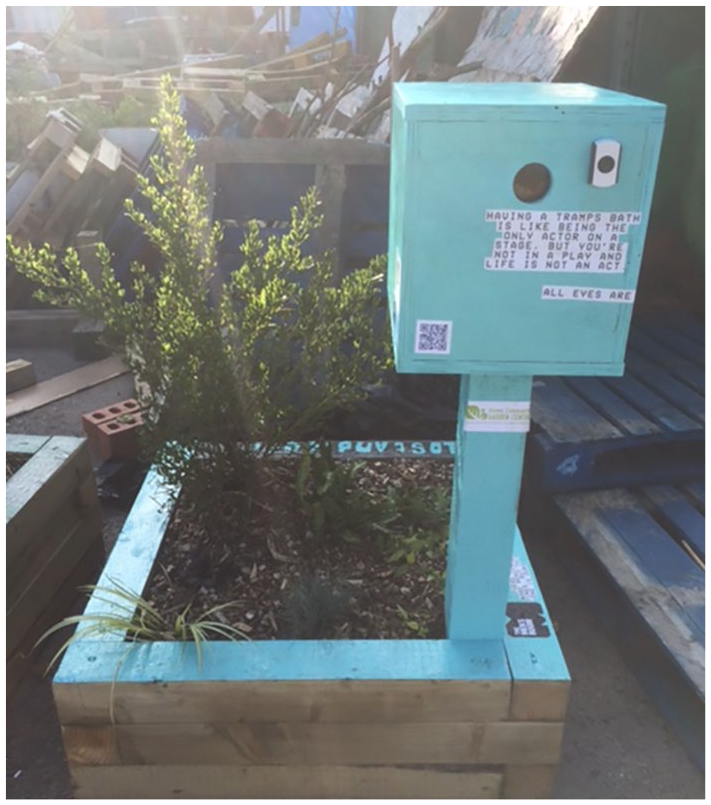
Box and planter.
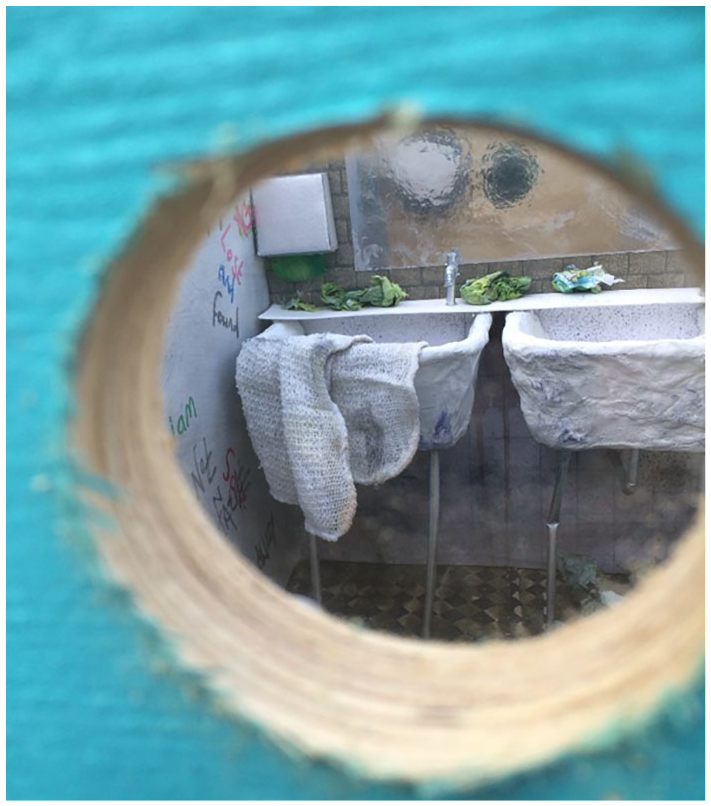
View inside.
The PARTISPACE funding for the project made producing a film a specified deliverable, and the research team employed a film-maker who worked alongside the group on an ad hoc basis to document the project. Although this meant that the video technology stayed in the hands of an adult professional (Kindon, 2003), his skill in interviewing allowed the young men to reflect on the process. It also gave them an experience of answering questions and explaining process behind the project, which proved to be a useful preparation for the walking tours. The recorded reflections also provided another data source, which supported the researcher to step outside the dynamics of the group, aiding the ethnographic study. However, at the outset, there was limited discussion about how and by whom the footage would be edited and how and by whom the final film would be used or shared, something that reflected the fact that the project team were learning on the go (Gubrium et al., 2015). Furthermore, at the time, the PARTISPACE European consortium had not reached an agreement about how confidentiality or anonymity would be maintained and on what basis the films would be made publicly available. Thus, the project team deliberately focused on the film as a way of documenting the creation of the art installations and the walking tours rather than as a shared output.
The film was edited by the film-maker and the researcher in a 3- week break in the project, immediately after the walking tours. Some discussion took place with participants about possible framings of the film, but time did not allow for a collaborative editing process. Instead, these decisions were taken by the film-maker with some suggestions from the researcher. Two of the young men, the creative director and the researcher viewed a rough edit before it was screened, but the young men provided limited feedback. The film was screened at an end-of-year gathering for staff, participants and others with a professional connection to the organisation. It was the first time most of the young men had seen the film and the event was also the last working day of the creative director who had worked with many of the young men for 10 years. The film generated a lively discussion with the audience, and there was enthusiasm about its potential use in wider advocacy. However, it proved impossible to arrange further project meetings in order to make collective decisions about whether and how the film could be used. Consequently, although written consent had been obtained from participants at the beginning of the project, this was deemed by the research team to be insufficient as a basis for informed collective consent. This was important because several of the young men were identifiable in the film, and no discussion had taken place about the harms that might arise from participants being identified were the film made more widely available. It was therefore decided by the researcher and creative director that the film would not be released for public viewing.
The Ottawa project
The goal of this PAR project was to identify the civic issues important to homeless and at-risk young people in Ottawa, Canada, and then move to an ‘action’ component to respond to the issues. Beginning with 8 months of ethnographic fieldwork with young people (ages 16–24) using a homeless youth drop-in centre, the fieldwork included focus groups, walking interviews, photo-based projects and individual interviews with 50 young people. The drop-in centre location made it hard to maintain continuous contact with young people, and the team recognised participants would come and go, adjusting the project accordingly. The project was funded by a research grant from the Spencer Foundation, which supports research exploring the civic engagement of marginalised young people.
After the ethnographic fieldwork, the team engaged a small sub-set of participants at the drop-in in a PAR process designed to get their ideas on how the main research themes might be acted upon. Following a wide-ranging discussion (see Kennelly, 2018a, for more details), the team settled on films as a feasible option that piqued the interest of the young people. Through three focus group discussions with young people (n = 26), the research team sought to identify which issues had the highest priority, with focus group participants ‘voting’ for and then discussing their top issues. All three groups selected youth–police relations and legalising marijuana as most important to them; a third issue – transitioning out of homelessness – was prioritised by only one group but was chosen by the research team because Jackie (author 2) thought it might be used as leverage in an existing advocacy process, outside of the research.
The filming process was decided by the research team, in conversations with professional film-maker (Ben Hoskyn), who volunteered much of his time. A day was set aside for filming, and the researchers and the film-maker attended the same drop-in and recruited eight young participants, several of whom had taken part in the previous fieldwork. During the morning, a focus group was conducted with the eight young people, addressing all three priority issues. After lunch, small groups of young people led the film-maker and research team on walking tours, which the film-maker followed as the researchers encouraged participants to speak about the priority issues (see Kennelly, 2017).
The film-maker edited the three films. It was agreed in advance that young people’s faces would not be shown, for the sake of anonymity and to minimise risk to individuals, a challenge that the film crew struggled with in producing aesthetically interesting films (see Kennelly 2018a, 2018b, for further discussion on this). Rough takes of the films were screened at the drop-in centre. Although all film participants were contacted, only two came. They offered helpful feedback which the film-makers incorporated into the final edits. The team later returned to the drop-in with the finished films, again informing all participants of the screening times. Twenty-five young people and staff attended; none of the film participants were present. A few young people who had participated in the ethnographic research were present.
Weblinks to the films were sent to all who had participated, but the team does not know whether young people viewed the films or used them for their own purposes. The research team distributed the films to advocacy organisations, other researchers and policy makers through a Twitter campaign, targeted public screenings and presentations at academic conferences and in higher education classes. They developed a resource guide that has been made freely available on Jackie’s website, to facilitate community organisations and educators in using the films to discuss the issues. 2 The transitioning-out-of-homelessness film was screened at the launch event for a national coalition on ending youth homelessness in Canada (A Way Home Canada); the youth–police relations film and the legalise marijuana film were taken up by a local organisation called Youth Ottawa, to support their efforts to engage 15-year-old students in advocating for civic issues in their community.
A critical analysis of issues raised by the use of film in the two cases
‘Making private worlds public’
One of the persistent features of participatory research is that much of the work happens behind closed doors, made up of processes that involve incredibly complex intersubjective exchanges, negotiations and contestations (Roy et al., 2018). Murphy (2012) describes how these processes provide the ‘very engine of collaboration’. However, their invisibility can create two important problems for the participatory research academic: first, a feeling that audiences must be asked to take on trust that the decisions, findings and recommendations, which are the outcome of a project, did, in fact, emerge from a participatory process. And, second, a fear that in the absence of objectively measurable change effects, some might view these sorts of projects as futile and pointless dances into the lives of homeless young people (Manley and Roy, 2017). Low et al. (2012) point out that part of the impetus for outcomes or effects often comes from community collaborators; and in both of the projects we discuss, young people expressed a desire to take their stories to wider publics, including those in control of strategic decisions, in order that their experience might achieve change for other homeless young people.
One obvious value of films is that they provide a readily available product that can be used to disseminate findings widely (Braden, 1999). The films in these two projects also provided a visual register of the choreography of the PAR processes and encounters. The expressed goal of the film about the Manchester project was to capture the PAR process as well as reveal the insights generated by the young people; whilst in the Ottawa project, the goal was to convey the issues raised to wider publics, by replicating the conditions of the original fieldwork (the focus groups and walking tours). However, one thing that has preoccupied our discussions, following Frank (2010, 2015) and Bourdieu (1993, 2000), is the different ways in which the stories conveyed within the films might work for and on different publics.
In order to conceptualise this, we introduce here the notion of first, second and third publics – exploring their potential relationship to symbolic violence. The first public consists of the core group, the participants and researchers themselves. The social processes initiated in these two projects involved creating spaces in which researchers, young people with experience of homelessness – and in the Manchester project also artists – could collaborate (Rowley, 2019). The two projects point to the productive ways in which film-making in participatory research can contribute to opening out a temporary agora, which provides access to a civic space formed of a first public of collaborators, some with a relatively privileged position in terms of their status or resources. The value of these moments and spaces of collaboration should not be underestimated. Many of the young people who took part in these two projects were experiencing lives that involved considerable disruption of attachment to place, history and personal relations. In both cases, the projects successfully created spaces in which their stories and experiences could be seen, heard and worked with creatively, with humour and understanding, and with reference to other local and national issues (Roy et al., 2018). In the Manchester project, the involvement of a member of staff – the creative director – who had worked with some of the young men for 10 years, helped to create the conditions for trust, securing some level of ongoing commitment from the young men. In the Ottawa project, the presence of the research team in the drop-in centre over a period of 8 months allowed them to develop relationships with some young people who then acted as mediators, inviting more openness from other young people (see Kennelly, 2018b). The idiosyncrasies as well as the broader effects of homelessness were voiced in these spaces. The use of film underlined that the young people’s voiced experiences were legitimate, valued and recognised by other collaborators. It was hoped that this process might have provided some form of antidote to young people’s wider experiences of symbolic violence, in which their understandings of their own lives are undermined by dominant narratives.
The second public consists of those who are outside of the research process, but who are linked to it through some clear understanding of the context and in some cases an indirect connection to the work. These links can help to mediate the ways in which stories are heard and interpreted, facilitating serious and sincere forms of listening and an important degree of intelligibility (Pryke, 2003: 168; Shaw, 2015). In the case of the Manchester project, these second publics were participants on the walking tours (including first and third author) as well as those who attended the first screening of the film; in the Ottawa project, they included the film team who spent a day with the researchers and the young participants, documenting their stories. In both cases, the research teams played a mediating role, helping create spaces in which the second public and people with lived experience of homelessness could be co-present, enabling young participants to interact directly with audiences and film-makers. Young participants made additional commentary, adding explanation, and feeling able to request and scrutinise the responses of the second public. It was hoped that this might help challenge any unwitting symbolic violence or dominant narratives about homelessness perpetuated by audiences and the films.
The third public for both projects was more akin to what is often assumed when using the term ‘public’ – a wider audience who views the films independently and that does not have the opportunity to meet the young people or participate in any intersubjective process with them. In the Manchester case, very few members of the third public saw the film – albeit for reasons that respected the ethics of shared decision-making in the project. In comparison, the Ottawa films have been fairly widely screened, often with the researchers (but not the young participants) present. It was hoped that these screenings might have taken some steps towards revealing the relationships of domination inherent in contemporary narratives about homelessness and challenge the unquestioned acceptance of these inequalities.
Narrative story tensions and symbolic violence
The conceptual frame provided by Bourdieu and Frank enables us to analyse the tensions and contradictions that emerged within each project, and to ask two key questions of the two films: did the films produce stories that challenged existing narratives of homeless youth or did they inadvertently reinscribe existing injuries as a consequence of the inescapability of dominant narrative frameworks? And, how did the films help youth participants to challenge experiences of symbolic violence; or, did they reinforce these (Rogers, 2016)? Although we are not able to provide a definitive response to these questions, the examination below helps to reveal the dynamics at play that appeared to push the films in one direction or another.
In the film from the Manchester project, one young man is seen telling a story about how he and his brother managed the difficulties of washing in public bathrooms, by developing a clear local knowledge of times when the bathrooms were likely to be quiet as well as by guarding the front door for each other to avoid the shameful feelings of being seen by others whilst washing in public. This story is also the subject of one of the boxes produced in the project (pictured in figure 2 above).
The story told by the young man in Manchester was originally presented during a series of walking tours of the city (described above). In this context, the young man deployed his own telling, conveying some of the challenges of surviving in the city. Two of us experienced this story first-hand when we attended the tour. Told in the first person, the story is living (he animates the story, bringing it to life), local (it refers to explicit locations in the city of Manchester, England) and specific (it tells a story related to his own life) (Harrington cited in Frank, 2010: 24–25). Delivered in this way, the story reflected the accumulated expertise and knowledge of the young man, opening a space for dialogic exchange and maximising the potential for serious listening amongst the audience (Shaw, 2015). The second public witnessed how the project had started to interrupt processes of symbolic violence and to disrupt dominant narratives (Low et al., 2012), and the young men could be seen and recognised as citizens whose knowledge was necessary to developing new policy frameworks (Roy, 2012).
However, as Frank (2010) highlights, the effect of stories can easily be infracted so that they slide into narratives that may not be a match for the original intentions of the story. In the Manchester film, we argue, the young man’s story is infracted through the film-maker’s edits and is stripped of its life, locality and specific personal relevance. Although this was clearly unintentional, there are two dynamics that contributed to this effect: firstly, the prevalence of dominant narratives about young people and homelessness might have meant that the film-maker inadvertently edited the film in a way which linked the young men’s stories to familiar and recognisable narrative frameworks – at least from within the dominant doxa. This is a particular danger in films about marginalised people, because as Bourdieu (1993) reminds us, who tells the story matters as much as the story itself. The second key dynamic is the proximal distance between the three levels of public who experienced this story. The first public of researchers and artists were able to develop intersubjective relations with the young men, creating a space in which non-dominant stories could emerge. The film-making process also provided a reflective tool within this first public, through which stories could be tested out together and considered in relation to existing narratives. On the walking tour, the story is aimed at a second public and it serves a dialogical function, opening a space of exchange between the group and the young men leading the walk. But the film also generates a story for a third public, severing direct contact with the young men and raising questions about how well it travels (Kindon et al., 2012; Wheeler, 2012).
Decisions made during the Manchester project may have reinforced this effect. The creative director encouraged the three men who led the walking tours to narrate the film. The young men demurred, feeling that their Mancunian accents would mean they were not taken seriously or understood by audiences. Bourdieu (1993: 52) describes the ‘invisible, silent violence’ that is perpetuated via the learning of ‘formal’ versus ‘informal’ or ‘local’ dialects. The former – which represents the dominant classes and their versions of ‘proper’ language – is imposed through schooling, media and other forms of cultural production, whereas the latter – generally representative of the dominated classes – emerges through everyday encounters with one’s families, community and peers. The film-maker offered to narrate with some input from the researcher. Inadvertently, this decision – while respecting the requests of the young men – generated a disjuncture in the film that emphasised the distance between the stories of the young people and the narrative of the film. The film-maker’s middle-class British accent stood in stark contrast to those of the young people, reinforcing the narrative story tensions within the film, unintentionally tapping into the trope of unfamiliar ‘others’ being viewed through the lens of middle-class familiars.
Despite these criticisms, it is important to state that there are moments when the film captures elements of the young men’s complex humanity, something that was evident throughout the participatory research process. These elements were clearly noticeable in the responses of the second public audience at the screening, all of whom knew the young men to some extent and who laughed at familiar lines of humour. However, the overall effect of the film seemed to flatten this complexity and the research team feared that the film may have struggled to challenge dominant narratives if viewed by third publics.
In the Ottawa project, the tension between stories and narratives was evident in how young participants shaped their stories for third publics. For instance, when young people shared their experiences of police abuse of powers, they did so with a vehemence that suggested they did not think their stories would be believed. This was an important reference to dominant cultural narratives circulating about homeless young people as suitable targets for policing, reinforced by legislation that criminalises poverty and homelessness in Canada (O’Grady et al., 2011). Their fears were borne out in some third public responses to the film, where either the vehemence was repeated in support of their stories (as attested to by a former police officer, for example, and by a former street-involved adult), or the young people’s legitimacy was queried by audiences conditioned to trust the police over homeless people. Jackie’s experience suggested that the audience reception and interpretation has largely been dependent on the degree to which audience members are open to ‘serious’ rather than ‘tokenistic’ listening to critical narratives from homeless young people (Shaw, 2015).
What is clear from both projects is that the young people understand the broader narrative templates for homelessness, and the tropes and plotlines that frame these. Even within a PAR process, they fear that if they do not use dominant narrative templates, their own experience will not sound right or plausible and will not be heard or trusted despite the experience, knowledge and expertise that frames it (Frank, 2010; Hajer 1995: 63). Jackie, who conducted the Ottawa project, strongly believes that anyone who had the opportunity to sit through the interviews, walking tours and focus groups would walk away convinced of the legitimacy of the young people’s stories. But attempting to do justice to these complex and controversial stories, whilst also attending to the structural issues that frame them, proved challenging in short (5- minute) films. This left the films, and the young people represented in them, open to queries about their perceptions of the police, and potentially reduced the efficacy of the films as advocacy tools in attempting to achieve systemic change in youth–police relations in the city.
Conclusion
The intentions behind these two participatory research projects reflect a genuine desire amongst the academics who worked on them for young people’s experiences and perspectives to become part of broader public discussions. The films were one element of this original desire, which also found a second expression in the Manchester project in the art installations and walking tours of the city. Each participatory research project worked to invoke solidarity between the adult and young research team members, and successfully scaffolded certain practical potentials and inclusionary effects. Also, and most clearly in the Manchester project, the work became an object of attachment for young people, in some cases lasting several months. In this way, the practices of PR helped young people express their experiences of homelessness, successfully making these available for shared thought and communication. In the walking tours, which formed part of the Manchester project, young men opened a space for dialogic exchange with a second public, using their own expertise and the art works created in the project, to engage and open out discussions of broader relevance to street homelessness in the city. The effect of these walking performances was partial, unpredictable, varying from tour to tour – something that reflected the multiple subjectivities of the young men who led the tours and the different experiences of those who took up the tours on different days. This example shows how the deployment of stories can produce different effects that depend on where and how they are told, and by whom (Bourdieu, 1993; Frank, 2010). Arguably, in the Manchester film through the edits of the professional film-maker, the live effect of the stories is limited, and the stories told by the young men take on a more confected feel (Thompson, 2008). We argue that the narrative story tension had a different effect in the film in comparison to the walking tours, affecting how the men’s stories were heard. Inserting the stories into a different narrative framework risks perpetuating symbolic violence, because it shapes how the stories are received by the third public.
In a similar way, in the Ottawa project, we see how – despite creating the conditions for open dialogue – when young people imagine how a third public might engage with their stories about youth–police relations, they fear their own experience will not sound right, seem plausible, be heard or trusted. This is because they recognise that their experience sits outside of dominant narratives about police and homeless young people (Frank, 2010). Hence, we argue that whilst the processes that were developed within these projects explicitly acknowledged and addressed power structures, in crafting the final films, something important may have been lost. We recognise that throughout the process of shooting and editing, film-makers and research team members must question how stories are being told and by whom as well as considering how some connection might be made between those stories and potentially resistant third publics.
The three short films produced in the Ottawa project have been made publicly available and have been used as advocacy tools, generating impacts that might accumulate over time. The Manchester film, in comparison, has been unused since the end of the project, albeit for reasons that respect an ethics of shared decision-making. In both projects, it is much easier to see how academics rather than young people have benefitted most directly from the public story-telling involved in sharing and discussing these projects (Mistry et al., 2014). Returning to the question of whether the films ultimately expanded justice for youth participants, or merely reinscribed symbolic violence, our response must reject the either/or framing of this inquiry and instead posit a both/and. First, both projects opened out collaborative spaces in which people worked together on issues around homelessness, recognising the knowledge of marginalised young people and generating new stories that challenged existing narratives. It is our view that the value of this achievement in a first public should not be underestimated. In this respect, we concur with Low et al. (2012: 57) who criticise the implication that the most important ‘goal of participation for marginalised communities is’ for those who take part ‘to make themselves more intelligible to those in power’. Nonetheless, in both projects, young people’s experience and ideas were taken successfully to second publics, and in the Ottawa project third publics. Here, a temporary civic space of critical exchange was opened out and young people’s experiences and ideas were heard and recognised and some dominant narratives appeared to have been troubled.
Questions remain about the extent to which the films successfully extended these knowledge effects. However, Bourdieu (2000: 236) provides us with some explanation of how this troubling may occur, and some hope on the possibility for justice, at least at the symbolic level: ‘the symbolic transgression of a social frontier has a liberatory effect in its own right because it enacts the unthinkable’. The liberatory nature of this symbolic transgression was particularly visible in first and second publics, where filming can act dialogically, alongside discussion, to underline the legitimacy of the stories being inserted into the dominant narratives perpetuated by audiences who are relatively open to change.
Although Bourdieu rightfully warns us, as noted above, that who tells a story is as important as what the story is, he notes that there is a possibility for: an utterance or action [i.e. the films] . . . aimed at challenging the objective structures to have some chance of being recognized as legitimate . . . [if the] structures that are being contested [are] themselves . . . in a state of uncertainty and crisis that favours uncertainty about them and an awakening of critical consciousness of their arbitrariness and fragility (2000: 236).
In other words, if these films are seen by audiences (members of the third public) in moments where cracks in the dominant narratives about the blame-worthiness of homeless youth and the infallibility of police (for example) are emerging, then, over time, they can contribute to shifts, and in some small way, raise public awareness and alter dialogue. We open the paper with a quote from Bourdieu (1999: 1), which addresses the necessary anxieties involved in ‘making private worlds public’ and the felt need to ‘protect’ people, especially ‘from the dangers of misinterpretation’. We argue that any PVR project must scrutinise the relations between participant stories and dominant narratives in efforts to avoid the possibility that films might re-stigmatise and re-injure those involved, through the experience of symbolic violence. The use of film in PVR is neither immune to re-constituting inequality, nor does it inevitably result in empowerment and the sharing of marginalised voices in ways that generate justice. However, the potential lies therein, and is not to be negated.
Footnotes
Acknowledgements
Jacqueline wishes to thank the research assistants who worked with her on the Ottawa project, Dr. Valerie Stam and Lynette Schick, as well as the film-maker who helped the team create the films, Ben Hoskyn. She is also grateful to the youth centre where she worked, and the youth who participated in the project.
Harriet would like to thank the young men who participated in the Manchester research. She would also like to thank her colleagues Chris Charles and Janet Batsleer for their support with this project
Funding
The author(s) disclosed receipt of the following financial support for the research, authorship, and/or publication of this article: The University of Central Lancashire funded the international collaboration that enabled discussions between the authors. The Ottawa project was funded by the Spencer Foundation through their New Civics Initiative granting scheme, grant # 201300126. The original grant was entitled ‘Encountering Democracy: Low Income Canadian Youths’ Perspectives on Citizenship and Democratic Processes’. The Manchester project received funding from the European Union’s Horizon 2020 Research and Innovation Programme under Grant Agreement Nº: 649416.
Notes
Author biographies
 ). Her research focuses on young people’s experiences of citizenship and democracy, schools as sites of youth homelessness prevention, and the housing experiences of young people leaving homelessness. Past books include Olympic Exclusions: Youth, Poverty, and Social Legacies (Routledge 2016), Citizen Youth: Culture, Activism, and Agency in a Neoliberal Era (Palgrave MacMillan, 2011), Lost Youth in the Global City: Class, Culture, and the Urban Imaginary (co-authored with J. Dillabough, Routledge, 2010), and Phenomenology of Youth Cultures and Globalization: Lifeworlds and Surplus Meanings in Changing Times (co-edited with S. Poyntz, Routledge 2015).