




Abstract
Conducting a participatory action research (PAR) in schools is challenged by traditional asymmetrical power relations between adult teacher-researcher and young student-participants inherent in the school setting. In this article, we present PowerView, a new method that may reduce power hierarchy in the research classroom. Based on postcolonial theory, feminist theories, and critical visual studies, we implemented the idea of ‘reversal-of-the-gaze’ by asking the student-participants in our PAR program to turn their cameras at the instructor-researcher and capture images that represent their point of view of him. Enabling the students’ to gaze back at the instructor-researcher/serial observer with their cameras disrupted the hierarchical power paradigm in the research classroom and created a more equal space. The article will introduce the methodological stages of PowerView and present findings that demonstrate the potential of the method to change power relations between the researcher and students and challenge the power structure at the research classroom.
Keywords
Introduction
‘Is that okay, Teacher?’ This was a common request for approval addressed to Author One, the field researcher and instructor in a participatory action research (PAR) project we conducted with marginalized youth in a high school in central Israel. Thus, he confronted an issue grappled with by researchers in the research classroom: the asymmetrical power relations that persist between adult researcher and child participant (e.g. Kemmis and McTaggart, 2000; Whitehead and McNiff, 2006; Wöhrer and Höcher, 2012). This can emerge even, and perhaps particularly, in the framework of PAR projects where the researcher is often also the instructor and the researched participant her or his students. Indeed, despite the growing popularity of PAR initiatives that try to challenge such power relations by assisting the voices of students to be heard and engaged within their schools, there is ample evidence that few succeed to do so in a meaningful way (e.g. Arnot and Reay, 2006; Bragg, 2007; Cook-Sather, 2007; Fielding, 2004; Mitra, 2009; Robinson and Taylor, 2013). In our study, we sought to implement and examine a PAR program using Photovoice methodology (Wang and Burris, 1997), to enable participating students to sound their voices and interrupt power relations in their school using the camera and visual images they photographed.
Photovoice methodology, developed by Caroline Wang and Mary-Ann Burris, is a PAR approach in which marginalized communities ‘identify, represent and enhance their community through a specific photographic technique’ (1997: 369). In their study, Wang and Burris (1977) sought to enable women in a rural village in China to improve their community by giving them cameras to document their daily lives. The photographs the women took generated a dialogic process through which they recognized their needs and learned about their social conditions and, eventually, presented to policymakers their views on ways to improve their community life. The use of Photovoice has since gained in popularity (Lal et al., 2012) and spread to other disciplines (Sutton-Brown, 2014), including education (e.g. Greene et al., 2018; Robinson-Keilig et al., 2014; Sánchez, 2015; Warne et al., 2012). The latter studies are part of a trend, in recent decades, of increased use of photography as a methodological tool in research with youth in schools and communities (e.g. Chio and Fandt, 2007; Ewald and Lightfoot, 2001; Goodhard et al., 2006; Harper, 2002; Piper and Frankham, 2007; Torre and Murphy, 2015). These methodologies are considered a valuable tool for generating a social process of critical consciousness, especially in marginalized communities (Catalani and Minkler, 2010). Using photography affords the generation of new knowledge, which reduces the gap between ‘experts,’ who present hegemonic knowledge, and those who lack it—‘non-experts’—and assists in overcoming inequalities produced by age, class, language, and status. For youth, photography is a tool that enables them to ‘critically reflect upon their social world, their place in it, their personal perceptions and all the contradictions within and between each’ (Stambe and Fryer, 2014: 3).
On this background, we chose to use Photovoice in a PAR project, exploring the methodology’s potential to interrupt the traditional hierarchical power relations in the school setting (Hemy and Meshulam, forthcoming) and to achieve ‘a cultural shift that opens up spaces and minds not only to the sound but also to the presence and power of students’ (Cook-Sather, 2006: 363). As described, the presence of unequal power relations in our research classroom was evident from the very outset of the project. The same expressions of student-participants’ uncertainty and need for affirmation, permission, and direction from the instructor-researcher repeatedly arose: ‘What should I do, Teacher?’ Such questions certainly reflect their anxieties in contending with the unfamiliar research setting and conditions. However, the fact that all, without exception, addressed the researcher as ‘Teacher’ signifies the power relations that prevail and are assumed by students in the classroom setting between adult and child: the automatic presumption that the adult is a formal source of authority and knowledge. Indeed, in response to the researcher’s question, ‘Why do you call me “Teacher” even though you know I’m not on the teaching staff?’ students declared, ‘We usually call anyone who stands in front of us “Teacher.”’ After this encounter, the researcher wrote the following field note: I wonder what I can do to alter power relations in the class. I do not want to use the authority of a teacher or to be assisted by their [homeroom] teacher. I do not want to give an incentive in the form of rewards or threats. I feel that I have to treat students as full partners who come with a real desire to participate in the research. Right now, they are still caught in the school paradigm that there is a teacher who tells them what to do, and they must do it; otherwise, they will be punished. (Field note, 15 February 2015)
To interrupt these inherent classroom power relations, we developed the PowerView method as a supplementation of Photovoice methodology. We sought to examine whether we can use the camera to reverse the gaze of the researcher (the person who ‘stands in front of us,’ the ‘teacher,’ the ‘ruler’) at the student, back at himself/herself. We assumed that reversing the point of view and reversing the role of the researcher as the traditional observer with the traditional observed role of the students would undermine the conventional power paradigms of the classroom and thus alter students’ hierarchical relation toward the instructor-researcher. This article presents the development and implementation of the PowerView method over the course of our project and study. We begin with a short introduction to PAR methodologies, followed by the theoretical principles on which the PowerView method is based: postcolonial thought (e.g. Bhabha, 1984, 1998), feminist theories (e.g. hooks, 1994, 2003; Mulvey, 1975), and critical visual studies (e.g. Amad, 2013; Azoulay, 2012; Sontag, 1977; Wells, 1996). We then present the methodology we used in our study and a detailed description of the application of our new method, PowerView, and study findings. We conclude by discussing the implications and possible contributions of PowerView to equalizing asymmetrical power relations in the research classroom in Photovoice studies and PAR initiatives in general.
Participatory action research: reflections on the researcher-participant relationship
PAR methodologies include a variety of research approaches that perceive the study participants as legitimate voice and knowledge partners who actively contribute to the research process (e.g. Bennett and Roberts, 2004; Kemmis and McTaggart, 2000). PAR evolved out of concern with the way knowledge is generated during research and the way the research process perpetuates the control of some groups over others (Chataway, 1997). It is based on the assumption that providing research participants the ability to reflect on and analyze their unique circumstances will enable them to generate progressive knowledge that will affect their lives. Based on this premise, PAR seeks to promote the active involvement of the participants by sharing power and challenging the usual hierarchical relationship between researcher and researched, who are conventionally the focus of research (Chataway, 1997). Sharing power means that the researcher, who usually occupies a higher status, is positioned as an equal collaborator working with the participants to define the research questions, describe their experiences in their terms, and use the research results to effect change (Fals-Borda and Rahman, 1991; Marshall and Reason, 1993; Whyte, 1991).
Implementing PAR methodologies within a school can be a powerful tool for challenging power relations, providing students with voice, empowering them socially, and transforming them into agents of social change (Call-Cummings, 2018; Cammarota, 2011; Cammarota and Romero, 2011; Cook-Sather, 2012; Ozer, 2016). However, the power relations with which researchers conducting such PAR projects must contend are particularly complex and asymmetrical, due to the age, knowledge, class, and institutional affiliation gaps inherent to the school setting (Fontana and Frey, 2005). Moreover, researchers (e.g. Cahill, 2004; Gallagher, 2008) have called for a reexamination of the assumption that conducting PAR in schools can be a way to shift power away from the academic researchers. Power relations cannot be ‘reduced, negated, or worked around’ (Gallagher, 2008:140) by taking some of it away from adults and giving it to children. This notion tends to blur the complexity of power relations as they manifest in the research classroom. It means, for example, that researchers might be unable to attend to how children react to participatory techniques and may ‘unwittingly reproduce the regulation of children by insisting upon certain forms of participation, in the belief that this constitutes “empowerment”’ (Gallagher, 2008: 137).
Even stronger criticism of PAR methodologies as a means of reducing the power hierarchy between researcher and participants has been voiced from the perspective of decolonization of methodologies (Battiste, 2001; González et al., 2005; Sandoval, 2000). This school of thought argues that the hegemony of modernism, monolingualism, Eurocentrism, and colonialism remains predominant even in liberatory methodologies like PAR (Gill et al., 2012). The continued use in PAR of dominant research terminology like ‘collecting data,’ ‘analyzing findings,’ and ‘research implementation’ has yet to be critically examined through reflection on the ‘ethics of whose interests are being served and whose interests are being displaced on whose land’ (Gill et al., 2012: 5). Constructing research as a framework of mutual advocacy and recognizing the participants as genuine collaborators requires that researchers seek and develop new practices and techniques for creating a nonhierarchical PAR process. Indeed, Gill et al. (2012: 12) assert that ‘participatory action research must begin from an anti-colonial perspective, and it must have a co-created, decolonizing and transformative agenda.’ Thus, to respond to this call and explore ways to address the obstacles to overcoming power hierarchy in the research classroom, we developed the PowerView methodological tool based on postcolonial theory, feminist theory, and critical visual studies.
Theoretical foundations of the PowerView method
The PowerView method we developed and implemented in our PAR project rests on three theoretical foundations: postcolonial thought (Bhabha, 1984, 1998), feminist theories (e.g. hooks, 1994, 2003; Mulvey, 1975), and critical visual studies (e.g. Amad, 2013; Azoulay, 2012; Sontag, 1977; Wells, 1996).
Postcolonial theory seeks to expose how societies assimilate colonialist values into their culture, practice, and values (Frenkel and Shenhav, 2006). Key thinkers in postcolonial discourse, such as Fanon (1952/1991) and Said (1979), tended to preserve the binary construction of oppressor–oppressed, observer–observed. Bhabha (1984, 1998), however, argued that this approach ignores the reciprocal hybrid relations between the oppressor and oppressed. Power, argued Bhabha, is not the exclusive domain of the colonial ruler, and the potential to counter colonial authority and power exists already in the act of parodized representation of the ruler through mimicry (Bhabha, 1984). The oppressed colonial subject, due to her lived experiences, develops what Bhabha termed a double-vision. This phenomenon enables her to look simultaneously both from the margins and through the eyes of the ruler. However, this dual consciousness is not the exclusive property of the subject, for the ruler adopts it too, whether intentionally or not, thereby creating a discourse of mimicry. In this discourse, the ruler sees himself through the eyes of the oppressed subject in a way that presents him as a source of mockery, which gives the subject her main tool to alter the power relations.
Feminist theory references the work of Lacan (1964/1977) to explore how the dominant male gaze objectifies women. Aspects of power and dominance are implied in such a gaze: while the person who is gazed at becomes objectified, the person who gazes becomes a powerful subject (Mulvey, 1975). Other feminist works have examined photography from the perspective of the establishment of power relations and expand the other’s objectification to include dynamics of race, sexism, and status (e.g. Eileraas, 2003; hooks, 1994, 2003; Neumaier, 1995; Solomon and Spence, 1995; Wang, 1995; Wells, 1996). According to these approaches, the power and control that underlie the relationship between the photographer and the photographed object generate images that reinforce class and gender perceptions and stereotypes. Thus, marginalized groups should be allowed to represent themselves through the photographs they take in order to change how they are represented (Wang, 1995). However, the power afforded by the camera has enabled marginalized groups to represent themselves but not to reverse the gaze of the camera and direct it at those who hold power.
Critical visual studies scholars have interpreted the colonized gaze into the camera of the Western photographer (‘return-of-the-gaze’) as a move that is ‘aimed at recovering resistance or at least a trace of agency for the nameless masses trapped like insects within modernity’s visual archive’ (Amad, 2013: 53). The photograph is perceived as text: a site at which the interaction between the photographer, the photographed object, and the viewer creates meanings (Burgin, 1982). Azoulay (2012) argues that the widespread use of photography in recent years has created a new form of encounter between people. She claims that the camera allows photographers to observe the actions of the ruling power and create images of those actions that force the authorities to negotiate their power. Researchers engaged in critical study of photography commonly consider the camera a critical tool that enables its user to present, from a personal point of view, events that are at times subversive and unconventional and yet acceptable and ordinary (Scruton, 1981). The camera has the power to illustrate reality as it is and, at the same time, present the subjective point of view of the photographer, thereby reflecting social and political values as well as aesthetic and artistic values (Scruton, 1981). Moreover, researchers (Allen, 2012; Packard, 2008; Warren, 2005) assert that using photography as a methodological tool can level, to some extent, the power relations between researcher and researched, by including the participant in the research design and construction of knowledge.
Based on the above premises and thinking, we took the further step in our Photovoice-based PAR program of having the student-participants direct their cameras at the instructor-researcher so as to enable them not to return the gaze but to reverse it. Instead of being ‘the object of information, never a subject in communication’ (Foucault, 1979: 200), the students reverse the researcher’s ‘right to look without being looked at’ (Leenhardt, 1973: 76) by operating the camera and gazing at the researcher through its lens and the images they shoot, a move that opens up a space for dialogue.
Study methodology
The participatory action study during which we developed and examined the PowerView method was based on an intervention program (see Appendix 1) conducted by Author One as instructor-researcher in a public high school in a marginalized neighborhood in a central Israel urban center. The research combined qualitative methodology and case-study design with a critical ethnographic approach. The intervention program consisted of 15 weekly 3-h class sessions with 12 tenth-grade student-participants (7 females, 5 males) aged 15–16.5 years.
From the outset of the intervention program, it became clear that the student-participants tended to maintain the power relations they were accustomed to at school. Thus, we decided to implement the PowerView method, described in detail in the next section below, during the third and fourth sessions of the program. At the beginning of the third session, Author One invited the students to use their cellphone cameras to photograph one image of him that conveys what they feel and think about him. During the session, each student planned and designed a photo shoot and then photographed the researcher positioned as each student chose. Following the photo shoot, the class gathered for reflective dialogue about the students’ feelings before and while they were shooting the photographs. In the next session, the researcher asked the students to each choose one of the photographs taken and write a short story about ‘the man in the picture,’ as though he were a complete stranger to them.
To examine the extent to which the implementation of the PowerView method affected the way in which the participants experienced the power relations between them and the researcher, we analyzed data collected through participant observations, interviews, and field notes. (1) Participant observations: The reflective dialogue conducted with the students following the photo shoot was recorded and transcribed for analysis. (2) Semistructured interviews: Two short semistructured interviews were conducted with each of the student-participants, one at the beginning of the PowerView sessions (after the third session of the intervention program) and one after the final session of the intervention program. In the first interview, the students were asked to describe how they experience the relationship between them and the researcher; in the second interview, they were asked about any change they felt had occurred in their power relations after the PowerView sessions. (3) Field notes: We used Author One’s research field notes to triangulate the data collected from the observations and interviews.
The PowerView method: description and findings
The PowerView method we developed in this Photovoice study was composed of five consecutive steps implemented over the course of two program sessions.
Step 1: Reflect on what you feel and think about the instructor-researcher and design a photo shoot
The instructor-researcher began the session by inviting the students to formulate a sentence that responds to the question, ‘What does the researcher mean to me? What do I think and feel about him?’ He then asked them to design and prepare a photo shoot that conveys what they wrote. They planned where and how they wanted to place the researcher and how they would like to shoot the picture (e.g. location, set, lighting, angle, etc.). This activity was conducted following the first two sessions of the program in which the students learned the basics of photography as a means of self-expression (see Appendix 1).
Step 2: Shoot the picture
After designing their photo shoot, each student decided on a set that characterizes the way she/he perceives the researcher. She/he then staged the researcher and photographed him in a way that represented her choice. Figures 1–3 are some of the images taken by the participants:
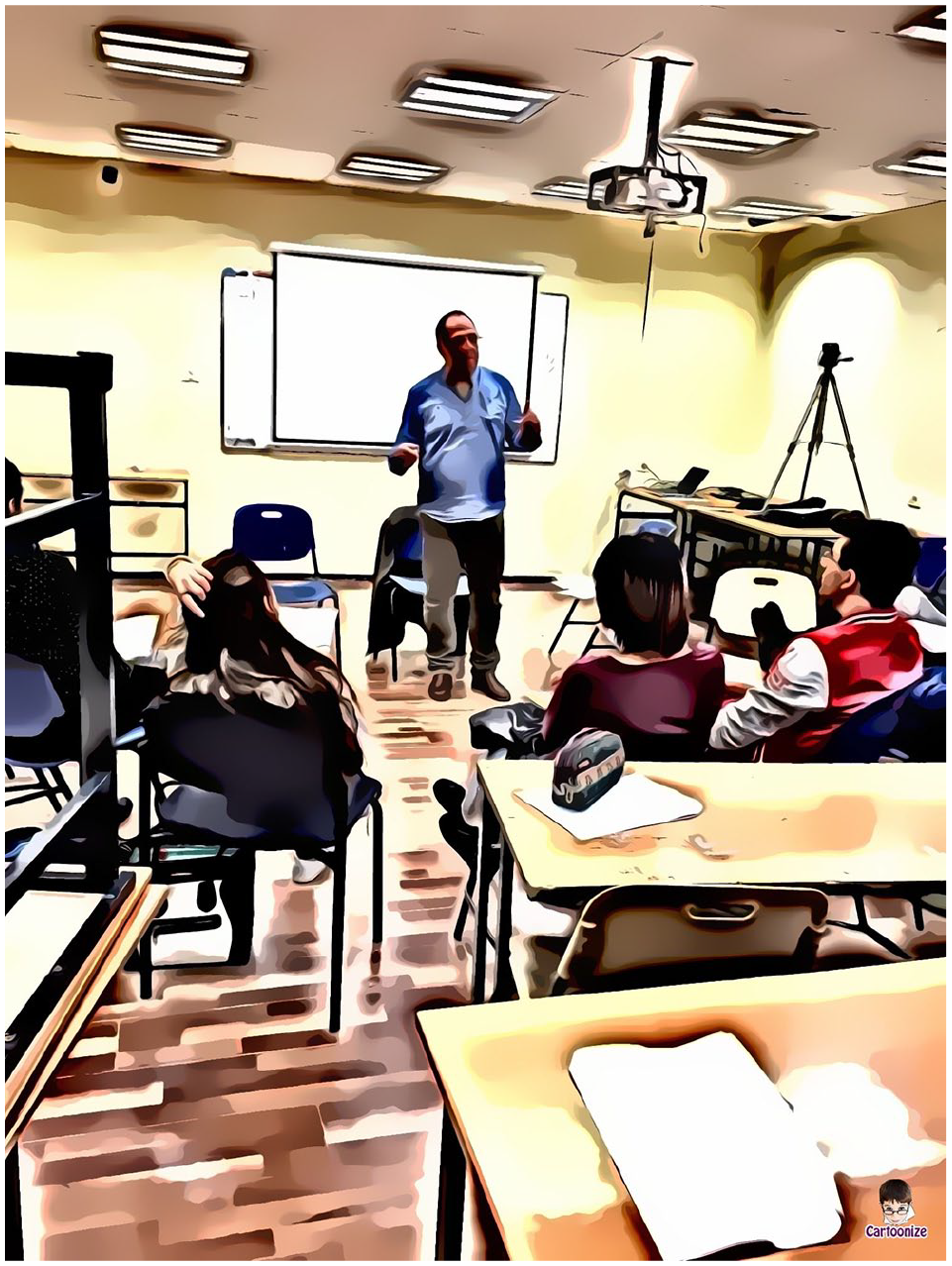
The researcher in Gal’s eyes.
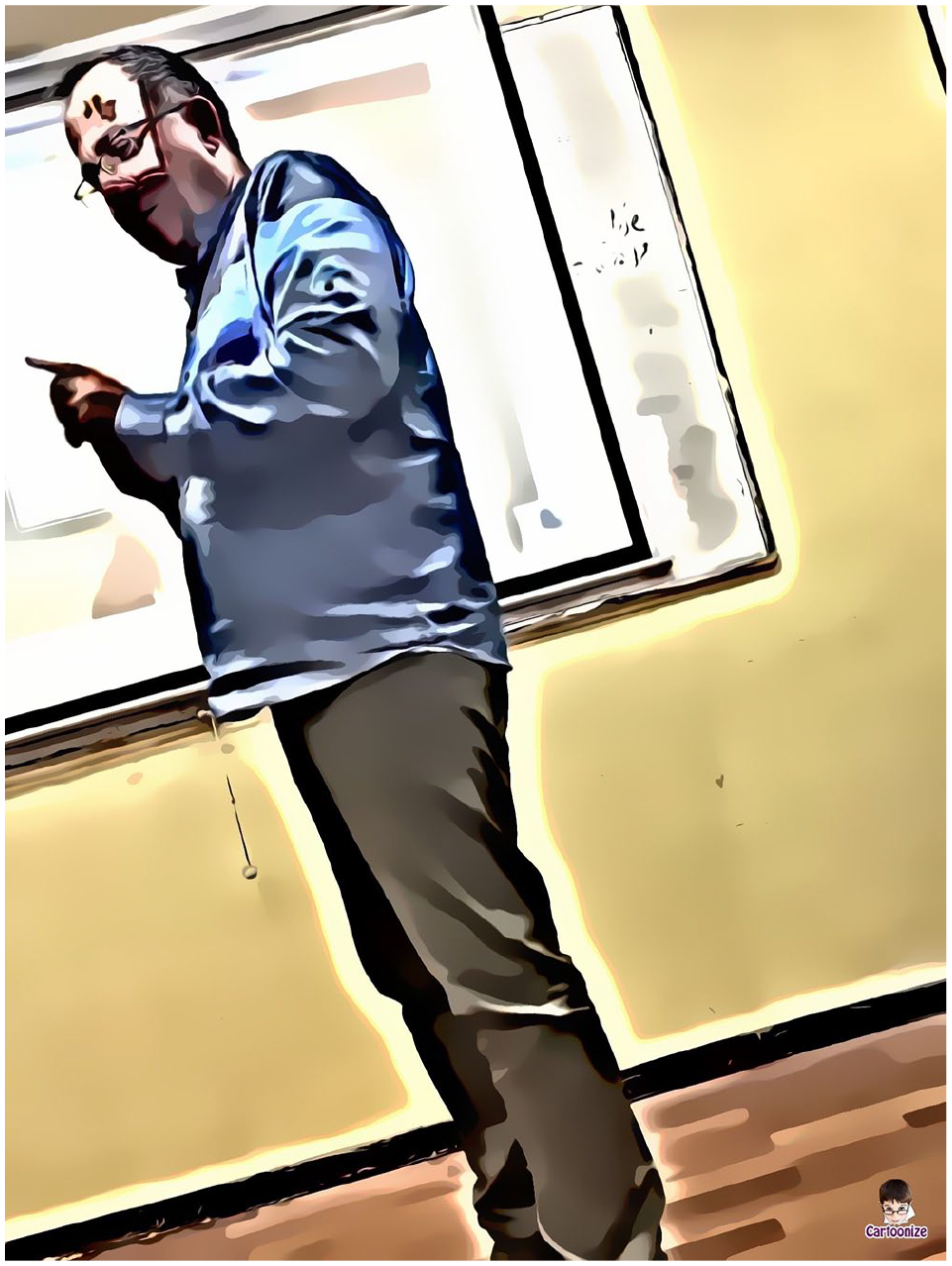
The researcher in Effi’s eyes.
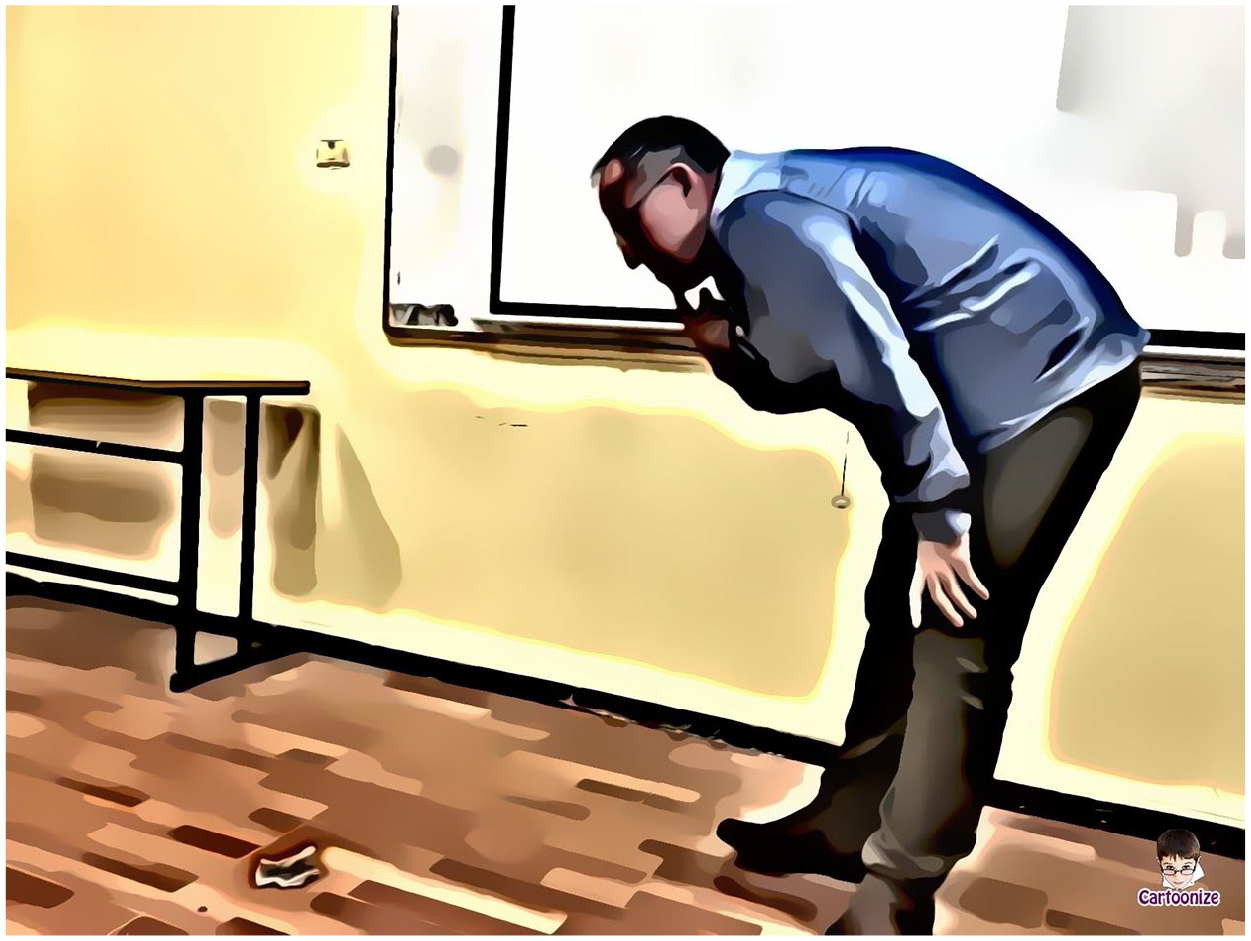
The researcher in Shiran’s eyes.
Step 3: Describe your experiences and feelings during the photo shoot
Immediately following the photo shoot, the research group gathered for a reflective dialogue in the classroom. The students discussed their feelings and experiences before and during the shoot. Below are some of their reflections:
We felt in control.
You were in our hands; we told you what to do.
You stopped being a person with influence. You became someone we were photographing, and that’s it.
[I felt] a kind of disrespect.
Did I invite you to disrespect me?
Kind of.
It’s like changing the order of things.
We don’t photograph teachers every day.
It wasn’t pleasant to stage you. It felt strange. If you were a friend of ours, our age, it would be different, but when it’s your teacher. . .
When I took the picture, I felt like you [like the researcher].
We suddenly became like teachers, and you became a student.
Foucault argued that power manifests itself through its gaze: ‘An inspecting gaze, a gaze which each individual under its weight will end by interiorizing to the point that he is his own overseer, each individual thus exercising this surveillance over, and against, himself’ (1980: 155). The students described a contradiction between the power relations familiar to them in school life, where they are perceived as objects of their teachers’ gazes and their own gaze back as disrespectful of ‘the order of things,’ and the change that occurred when they turned their camera/gaze toward the instructor-researcher: a new, odd, and not necessarily pleasant feeling of power. This inversion of power the students experienced correlates with Susan Sontag’s assertion: ‘To photograph is to appropriate the thing photographed. It means putting oneself into a certain relation to the world that feels like knowledge—and, therefore, like power.’ (1977: 4)
Step 4: Defamiliarization—choose an image and tell a story about the person in it
In the next step of applying the PowerView method, the researcher asked the participants to choose one of the photographed images and write a short story about ‘the man in the picture,’ ignoring that he is someone they know. The students were then asked to volunteer to read aloud their stories.
Issi chose the wide-angle image taken of the researcher (Figure 4) and read his story to the class as follows: I saw a person who works in an app company, inventing all sorts of things and presenting his inventions to potential investors who consider if the application is accepted or not accepted. That person tries to convince the people sitting in front of him. His facial expressions and body expressions show that he is very stressed. Look [turning to Author One], it seems to me that you and your face are like this [makes an expression of a stressed face] and now, I feel that he wants them to love his work.
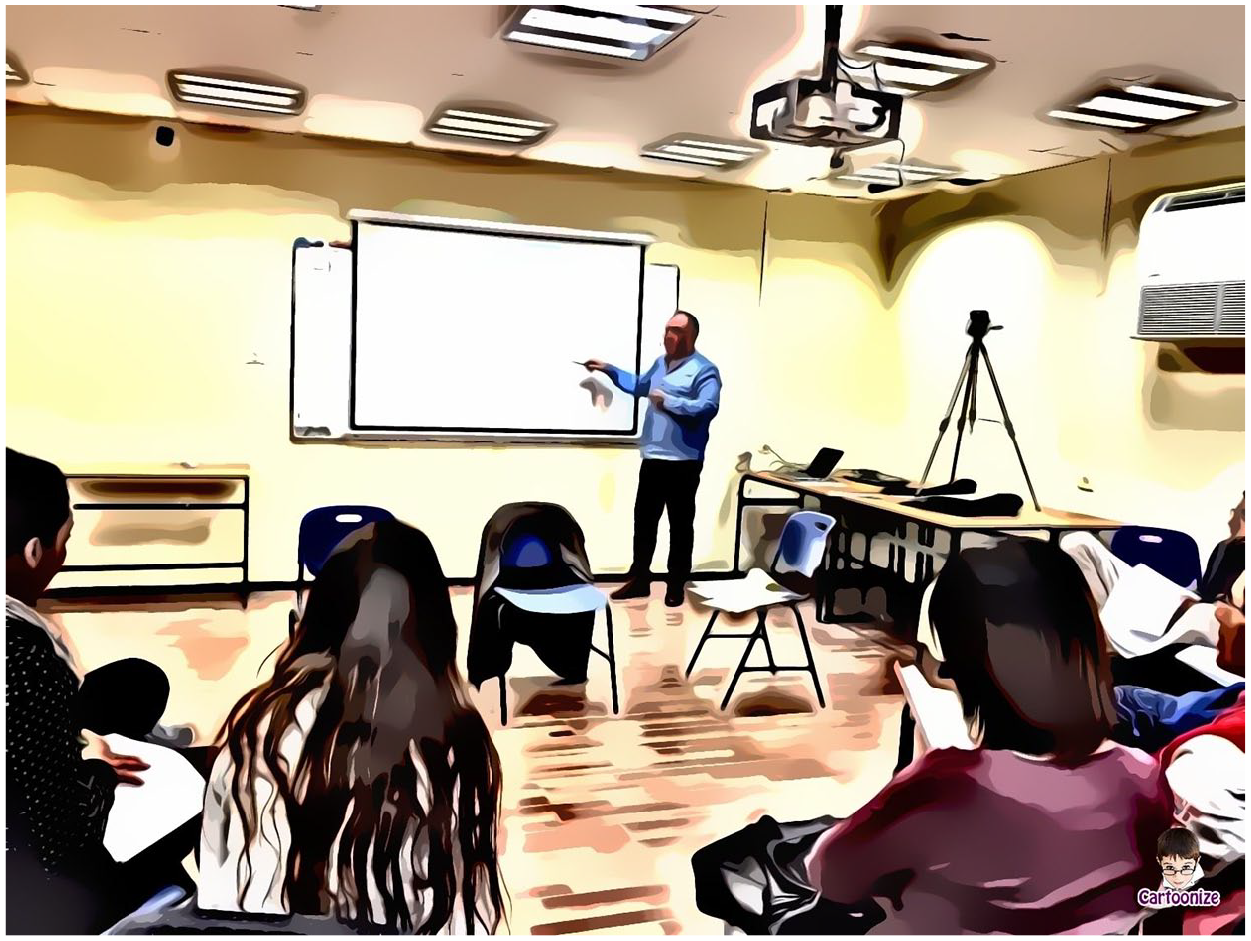
The researcher in Issi’s eyes.
Issi’s story exemplifies the reversal of roles we wanted to achieve in the research classroom. In comparing the instructor-researcher’s role to that of an entrepreneur who needs to engage his audience’s attention and cannot survive without them, Issi formulated a kind of allegory that likens students to ‘angels’ who provide financial support for startup ventures: they are the raison d’être of the researcher and his research. As Foucault (1979: 176–177) argues, power relations are never one-sided but, rather, a network of effects: [A]lthough surveillance rests on individuals, its functioning is that of a network of relations from top to bottom, but also to a certain extent from bottom to top and laterally; this network ‘holds’ the whole together and traverses it in its entirety with effects of power that derive from one another: supervisors, perpetually supervised.
Once the students were able to observe (surveil) the instructor-researcher through the camera, they created sufficient defamiliarizing distance to relate to him not from a defensive position or out of fear of his authority, but from a more egalitarian, stronger position. The students’ experience of a sense of inversion was a defining moment in the program: a transition from object to subject.
When we parted ways after the process, some of the students called me ‘[Author One’s first name].’ The others quickly corrected themselves after they had said, ‘See you, Teacher’ and said, ‘Bye [Author One’s first name]!’ (Field note, 27 April 2015)
Step 5: Personal interviews—describe the effect of PowerView on your power relations with the researcher
At the end of the project, the instructor-researcher conducted personal interviews with each of the participants, asking them to describe their experience of the power relations between themselves, as co-researchers, and the researcher:
At first, we saw you as a professor, as if we were so small. . . After that, you let us be equal, and then, we were equal. We felt that way.
Thus, Roni indicated experiencing a process of equalization in relation to the researcher. However, he also pointed to the experience that this was still top-down, dependent on the instructor-researcher’s willingness: ‘you let us be equal.’
Issi, in his interview, reinforced this sense of ambivalence about turning the research classroom into an equal space. He makes an illuminating connection between the identity of the instructor-researcher—who possesses the symbolic and institutional power (Bourdieu, 1977)—and the attempt to create an equal space:
You are still in front of us, but your class demonstrated that you are not on the other side, standing opposite us.
Did I succeed?
You succeeded, yes.
Issi also expressed a sense that ultimately success at equalizing the power relations is dependent on the ‘ruler’ consenting to and enabling the power-sharing: ‘Did I succeed?’ asks Author One. This recalls the assertion that for a PAR project to be truly liberatory, empowering, and collaborative—to attend to the mechanisms that underlie the unequal power relations between the instructor-researcher (‘I’) and student-participants—from the outset it must have ‘a co-created, decolonizing and transformative agenda’ (Gill et al., 2012: 12) that considers whose interests are being served (Gallagher, 2008). Yet Issi also expressed an important insight as to how and why our PAR intervention program could proceed as intended and planned following the PowerView sessions, to challenge hierarchical relations in the school, beginning with the research classroom. His response reveals the sense that following the PowerView exercise, the class had transformed from a group in which the researcher shared the program with the students, standing ‘in front of us,’ into a community in which the researcher and students are members and where the researcher is not in opposition to the students but an equal partner.
Discussion and conclusion
The basis of PAR methodology is the perception of participants as ‘voice and knowledge’ subjects who actively contribute to the research process (Bennett and Roberts, 2004; Kemmis and McTaggart, 2000). A question that any PAR researcher concerned with the existence of conventional power relations in schools should ask is, ‘To what extent did I manage to establish a true sense of equality among the participants in the class?’
Our findings suggest that implementing the PowerView method was instrumental in challenging power relations in the research classroom and positioned student-participants as powerholders with the cameras in their hands directed at the instructor-researcher. PowerView enabled what hooks terms an ‘oppositional gaze,’ through which the marginalized can declare ‘not only will I stare. I want my look to change reality’ (2003: 94): it empowered the students by positioning them in a state of power over the researcher, inverting the power relations. At the same time, the PowerView method was also liberatory for the researcher. By agreeing to become the subject of the students’ gazes, he not only expressed trust and openness but also acknowledged the way the students wanted to present reality. Creating such a space is an important role PAR researchers should assume (Mannion, 2007). In the interviews, the students described a deeper acquaintance, connection, and closeness with the instructor-researcher. They realized that the goal of the PowerView exercise was to create a more egalitarian relationship between them and reported that they did feel that he now knew them better and understood what it means to be a young and powerless student in school. As one student stated toward the end of the intervention program, ‘You don’t have to be like us, you can be like you, but understand what it means to be kids.’ Author One felt that not only the students’ perceptions and experiences of the research process and goals changed through PowerView, but that it was transformational and liberating for him as well. Releasing his hierarchical power through PowerView fundamentally created a new space for the PAR project that manifested for both participants and researcher a well-known quote in decolonizing approaches and Indigenous pedagogies: ‘If you have come to help me, you are wasting your time. But if you have come because your liberation is bound up with mine then let us work together’ (Aboriginal activists group, Queensland, 1970s). 1 Indeed, perhaps the most powerful result of implementing PowerView emerged in the final stages of the PAR project, when the students decided to present their unpleasant findings on power relations at school to the principal. They felt, as did Author One, that they are now pushing back at the school together—the students and their instructor-researcher—to acknowledge their needs. Thus, the liberatory collaborative effect of PowerView empowered not only the students but also the researcher to create a critical space for the students to challenge the school authorities and power in the next stage of the Photovoice program.
The scholarly significance of this research is in offering an innovative way to address the persisting challenge of unequal power relations between researchers and their participants, particularly as this impacts research conducted in schools. As PAR researchers we must accept Gill et al.’s astute insight, ‘It would be hypocritical and unethical to negate the position of power that the location of the academy provides for researchers’ (2012: 5). The PowerView method, we suggest, may offer a way of contending with this position of power not only in Photovoice studies. Further research is warranted on what uses can be made of the method and how it can be further developed in the framework of other kinds of participatory action studies, as well as in non-PAR studies that explore the dynamics of power structures in the school and classroom. Moreover, our PAR program and study were conducted without any significant presence or involvement of a teacher in the process. Thus, it is crucial to examine the PowerView method in the framework of PAR initiatives in which school teachers participate as full partners. In the PAR methodological and research literature, the notion of ‘students as partners’ relates also to teachers’ concerns and objections that can affect how the methodology is applied (e.g. Pinson et al., 2020; Cook-Sather, 2007; Ozer and Douglas, 2013; Schäfer and Yarwood, 2008; Seale et al., 2014). These researchers call for exploring new ways in which teachers can be motivated to participate in PAR processes and to experience themselves as full partners. It would, therefore, be important work to explore whether the PowerView method may support such processes of partnership between teachers and students in PAR studies.
Footnotes
Appendix 1: Intervention Program Teaching Plan
Declaration of Conflicting Interests
The authors declare no potential conflicts of interest with respect to the research, authorship, and/or publication of this article.
Funding
The authors received no financial support for the research, authorship, and/or publication of this article.
