




Abstract
This article explores the use of vignettes in qualitative research from a post-humanist and multi-species perspective. Drawing on methodological principles espoused by Karen Barad and Donna Haraway, as well as empirical data from the Dementia Dog pilot project in Scotland, UK, we explore the use of vignettes as a technique for understanding human–dog relations in dementia. In so doing, we outline an approach to using vignettes that is guided by principles of diffraction, which is contrasted with humanist principles of interpretivism, reflection and representation. Moving away from humanist methodology, we argue, calls for new approaches to evaluating the quality of vignettes. This involves disrupting conventional approaches, within which vignettes are defined by their purpose and evaluated according to fixed criteria (e.g. validity, authenticity and trustworthiness). In their place, we argue for an approach to evaluating vignettes that is rooted in performativity and guided by the question: What can a vignette do?
Keywords
The use of vignettes within qualitative research
Within qualitative research, vignettes have been defined as: ‘short stories about hypothetical characters in hypothetical circumstances, to whose situation the interviewee is invited to respond’ (Finch, 1987: 105), as well as: ‘compact sketches that can be used to introduce characters, foreshadow events and analysis to come, highlight particular findings, or summarise a particular theme or issue in analysis and interpretation’ (Ely et al., 1997: 70). As these definitions serve to highlight, the use of vignettes within the field of qualitative research constitutes a diverse form of practice.
As a technique for collecting data, vignettes have proved popular with a relatively small number of researchers, who have used vignettes to explore the ways in which actors perceive and respond to social situations, especially ‘sensitive’ social situations that may be practically or ethically difficult to observe first hand. Drawing on an interpretive phenomenological framework, a seminal study by Hughes (1998) sought to explore participants’ perceptions of risk associated with drug injecting, by embedding a hypothetical, multi-stage vignette (entitled: ‘Injectors and the inside’) within qualitative interviews that involved members of the prison population in the UK. By using vignettes to facilitate a less direct method of questioning, Hughes argues that participants were able to ‘introduce their own experiences’ (Hughes, 1998: 389) when responding to the vignettes without being directly asked to do so. Further, by providing participants with hypothetical contexts within which they can situate their responses, vignettes can provide important opportunities for researchers to explore the socially situated nature of behaviour, including the influence that factors such as ‘previous behaviour, routine, cultural norms, power, and the process of negotiation’ (Hughes, 1998: 395) have on everyday decision-making. As the use of vignettes to collect qualitative data has expanded, application of the technique has diversified to incorporate a range of theoretical and methodological approaches. For example, in discussing the issue of interpretation within vignette-based data collection, O’Dell et al. (2012) highlight the utility of dialogic selfhood theory (Hermans, 2001) as a useful framework for interpreting participants’ responses to vignette stimuli – especially as participants may shift from first, second and third-person perspectives when responding to vignettes.
Parallel to their use in data collection, vignettes have been used as a powerful tool within qualitative forms of analysis. This approach to using vignettes tends to be located more within ethnographic, auto-ethnographic, participatory and arts-based forms of qualitative inquiry – as opposed to policy and practice-focused qualitative research – and tends to draw upon literary (in addition to purely descriptive) forms of academic writing. Humphreys, for example, explores the use of vignettes as a technique for producing ‘mini ethnodramas’ (Humphreys, 2005: 842) of career transition. Drawing on Erikson’s description of vignettes as ‘vivid portrayal[s] of the conduct of an event in everyday life’ (Erikson, 1986: 149, cited in Humphreys, 2005: 842), Humphreys develops three analytical vignettes, written in the present tense and designed to be embedded within a first-person, auto-ethnographic narrative of becoming an organisational ethnographer. As Humphreys argues, one of the primary motivations for using vignettes in this fashion is to facilitate a vicarious sense of experience amongst readers; to give readers a sense of ‘being there in the scene’ (Erickson, 1986: 150, cited in Humphreys, 2005: 844).
In addition to facilitating a vicarious sense of experience, vignettes have been used to surface and problematise aspects of the research process. DeLuca and Maddox (2016), for example, draw upon the vignette technique to document and explore their personal feelings of guilt and privilege, as they came to experience them, through the process of conducting separate ethnographic projects. In so doing, the authors argue that the creation of first-person vignette-based narratives served to highlight the positionality of the researcher and the ways in which this came to shape the data. A similar approach to using vignettes can be seen in an earlier article by Forbat and Henderson (2003), in which the authors construct a fictionalised vignette based on their experiences of conducting qualitative interviews with couples, as a way of positioning the researcher as ‘stuck in the middle’ of two people involved in an intimate relationship.
Whether vignettes are used for purposes of data collection, data analysis or to present troublesome aspects of the research process, methodological principles of reflection and of reflexivity tend to be central considerations. Whilst this is the case, the extent to which emphasis is placed on the former, as opposed to the latter, tends to shift according to the purpose for which the technique is being deployed.
When used primarily as a data collection technique, researchers tend to emphasise the importance of ensuring that the contents of the vignettes provide an internally valid, authentic, plausible or realistic reflection of the social situations that are likely to occur within real-world settings (see, e.g. Finch, 1987; Hughes, 1998; Barter and Renold, 2000). As Hughes (1998) argues, vignettes that are perceived by interviewees as unrealistic are unlikely to engage participants in more complex acts of interpretation and, therefore, are unlikely to yield rich qualitative data. To mitigate this risk, researchers have tended to emphasise the need to ensure vignettes are well piloted and are, whenever possible, based on the lived experiences of real social actors. This is, arguably, an echo of key methodological considerations when vignettes have been deployed within quantitative designs, such as factorial surveys, in which participants’ responses to vignette stimuli are usually treated as proxy indicators of their real-world behaviours (see, e.g. Wallander, 2009). In contrast, and when used principally as an analytic technique, discussion of methodological considerations tends to focus on the extent to which vignettes provide a vehicle for reflexivity; in other words, of locating researchers and participants within complex networks and relations of knowledge production. From this perspective, vignettes may be assessed based on their ability to surface authentic feelings, attitudes, prejudices and orientations, and to provide descriptions that may be considered trustworthy (Spalding and Phillips, 2007) by researchers and research participants.
Whilst reflection and reflexivity have been central within qualitative research since the cultural turn, writers within contemporary feminist scholarship have been critical of an over-reliance upon such optical metaphors. Haraway (1997), for example, argues that, whilst metaphors of reflection have been useful in (re)contextualising processes of knowledge production, they create a danger of producing ‘geometries of sameness’. As Haraway argues: Reflexivity is recommended as critical practice, but my suspicion is that reflexivity, like reflection, only displaces the same elsewhere, setting up worries about copy and original and the search for authentic and really real. (Haraway, 1991: 16)
In contrast to reflection, Haraway (1997) offers an alternative optical metaphor, namely, that of diffraction. An established concept within the physical sciences, diffraction refers to the disruption of wave-based systems as they encounter obstacles, so as to create an observable pattern of interference. This disruptive element is, for Haraway, of central value in the application of diffraction as a methodological metaphor within critical scholarship. As Haraway continues: [D]iffraction can be a metaphor for another kind of critical consciousness . . . one committed to making a difference and not to repeating the Sacred Image of the Same . . . diffraction is a narrative, graphic, psychological, spiritual, and political technology for making consequential meanings. (Haraway, 1997: 16)
In this article, we consider the use of vignettes from a diffractive methodological position. Whilst there is an emerging body of work exploring the application of diffractive methodology within contemporary qualitative research, including arts-informed qualitative inquiry (e.g. McKnight, 2016), we are not aware of any attempts to apply this approach to the use of vignettes. Langer (2016: 735) comes closest to this, when situating vignettes as a ‘mediating position between conventional and experimental forms of writing’, capable of disrupting dominant modes of knowledge production. In the sections that follow, we locate our approach to using vignettes within the agential realist framework of Karen Barad (2007). Then, by way of illustration, we present three vignettes produced as part of a secondary qualitative project exploring relations between people living with a diagnosis of dementia, their spousal carers and their assistance dogs, during the Dementia Dog pilot project in Scotland, UK.
From reflection to diffraction (switching optical metaphors)
In Meeting the Universe Halfway, the post-humanist feminist and particle physicist Karen Barad (2007) locates her practice of diffraction within a broader onto-episto-ethico framework, which Barad refers to as agential realism. Drawing on the work of Neils Bohr and the rise of quantum physics during the post-war period, Barad’s agential realism emphasises the fundamentally entangled nature of reality and, as such, the ontological inseparability of objects (the realm of matter) from subjects (the realm of meaning). Contrary to the Newtonian view, Barad argues that there are no a priori objective or subjective states. Rather, Barad argues, both matter and meaning are brought into being through their mutual entanglement, a process which Barad comes to refer to as intra action. As such, debates within qualitative research as to whether phenomena are ‘naturally’ or ‘socially’ constructed represent, from Barad’s perspective, something of a false dichotomy. According to Barad, it is only through intra action that boundaries between phenomena are brought into being. Such boundaries Barad refers to as Cuts. Cuts are the products of agential acts that produce separations within life’s infinite alterity. In this sense, Cuts are simultaneously discursive and material; they are more than socially constructed distinctions between material objects (e.g. ‘Man–Woman’; ‘Human–Animal’), they are instrumental in shaping the materiality of that which they call forth into being.
It is in the context of agential realism that Barad, drawing on Haraway (1997), introduces diffractive methodology. Like Haraway, Barad views diffraction as, ‘an apt metaphor for describing the methodological approach that I use of reading insights through one another in attending to and responding to the details and specificities of relations of difference and how they matter’ (Barad, 2007: 71). Expanding on the critique of reflexivity offered by Haraway, Barad argues that a fundamental problem with the concept is its reliance upon representationalism – in other words, the belief that our representations reflect the social and natural world and are, therefore, distinct from that which they seek to represent. This, she argues, maintains the humanist fallacy of ‘holding the world at a distance’ (Barad, 2007: 87) by seeking to maintain a (false) insuperable dividing line between knower and known. As Barad states: [E]ven in its attempts to put the investigative subject back into the picture, reflexivity does nothing more than mirror mirroring. Representation raised to the nth power does not disrupt the geometry that holds object and subject at a distance as the very condition for knowledge’s possibility. Mirrors upon mirrors, reflexivity entails the same old geometrical optics of reflection. (Barad, 2007: 88)
In contrast to representationalism, Barad’s approach to diffraction is rooted in post-humanist performativity – placing the observer within (as opposed to outside of) the material-semiotic assemblage that is the focus of knowledge production. As such, knowledge production is never a process of discovering or uncovering pre-existing facts about the natural or social world but is, rather, part and parcel of the world’s own becoming. As knowledge production is an agential act, it matters (in both a material and semiotic sense) what knowledge gets produced, not simply because knowledge has consequences, but because knowledge production is integral to ‘worldly configurations’ (Barad, 2007: 91).
It is in this context that the ethical and evaluative implications of diffractive methodology come to the fore. Following Barad, the quality of one’s analysis is not to be evaluated according to the extent to which it provides a valid, authentic or trustworthy reflection of the phenomena under investigation, as this would imply an independent phenomenon that is located at the centre of knowledge’s production. To take such an approach would, to use Barad’s phrase, continue to hold the world at a distance. In contrast, and drawing on Harding’s (1995) notion of strong objectivity, Barad argues that researchers need instead to be accountable to and response-able for the worlds which their research contributes to materialising, when evaluating the products of their investigations.
In recent years, several articles published in both Qualitative Research and Qualitative Inquiry have started to explore the application of Barad’s approach within the qualitative tradition (see, e.g. de Freitas, 2017; Kara, 2017; Kuntz and Presnall, 2012; Mazzei, 2014; Nordstrom, 2015). What unites such articles is a shared attempt to use diffractive methodology as a means of disrupting, replacing and of rendering capable established processes in qualitative research, such as relationality (de Freitas, 2017), power and identity (Kara, 2017), interviewing and recording (Kuntz and Presnall, 2012; Nordstrom, 2015) and inductive coding (Mazzei, 2014).
In the remaining sections of this article, we explore the use of the vignette technique from this methodological imperative.
The context: Dementia Dog
The vignettes explored in the following sections of this article were created as part of a qualitative study into how people with dementia, their spousal carers and assistance dogs lived together in the context of dementia. As a hypernym, dementia refers to a variety of progressive neurocognitive conditions which affect approximately 50 million people across the world, the most common form of which is Alzheimer’s disease (Alzheimer Disease International, 2015). Whilst nonhuman animals have historically played an important role in assisting human health and healing – dating back, at least, to the cult of Askelepios, St Francis of Assisi and St Roch (Serpell, 2010) – it is only recently that animals have begun to be trained and deployed to promote health and improve wellbeing amongst people living with dementia.
Established in Scotland, UK in 2011, Dementia Dog (http://dementiadog.org) is a collaboration between a charitable association (Alzheimer Scotland), an academic institution (Glasgow School of Art) and an animal assistance organisation (Dogs for Good). Initially centred around training dogs to assist people with dementia in a range of daily activities – including medication adherence, wayfinding and social interaction – and placing dogs with couples living with dementia (on an indefinite basis), the project provides a blueprint for a range of dog-assisted interventions in dementia across the world. In 2016, we were invited to conduct a realist evaluation (Pawson and Tilley, 1997) of the pilot phase of the Dementia Dog programme, which ran from 2012 to 2015. Findings from the realist evaluation have been reported elsewhere (see Ritchie et al., 2019) and approval to conduct the research was provided by the University of the West of Scotland, School of Health & Life Sciences Ethics Committee. After we completed the evaluation, we sought to explore the human–animal relations that developed within the context of the Dementia Dog pilot from a post-humanist and multi-species perspective.
Since the 1980s, approaches to facilitating human–animal interactions within care environments have been structured largely through the discourse of Animal Assisted Therapies (AATs) and Animal Assisted Interventions (AAIs), within which animals are positioned ostensibly as sentient forms of prosthesis for disabled people. In contrast, post-humanist and multi-species theorising has tended to highlight the roles that speciesism, human exceptionalism and bounded individualism have played in the subjugation of humans and nonhumans alike, within Western societies (e.g. Wolfe, 2003). Two of the most influential scholars in this area, Cary Wolfe and Donna Haraway, have each argued how recognising connectivity, affinity and kinship with non-human animals (as opposed to separateness, distinctiveness and division) may provide the basis for multi-species forms of caring. Wolfe (2010), for example, in seeking to connect critical disability studies and critical animal studies, argues that: . . . instead of seeing the nonhuman animal as merely a prop or tool for allowing the disabled to be mainstreamed into liberal society and its values, wouldn’t we do better to imagine this example as an irreducibly different and unique form of subjectivity - neither Homo sapiens nor Canis familiaris, neither “disabled” nor “normal,” but something else altogether, a shared trans-species being-in-the-world constituted by complex relations of trust, respect, dependence, and communication (as anyone who has ever trained-or relied on a service dog would be the first to tell you)? (Wolfe, 2010: 140–141)
Whilst preferring the label of compostist to that of post-humanist, Haraway (2008, 2016) argues that to live with companion animals is to evoke complex questions of how humans and other-than-humans are to get along with each other on a damaged earth. Inspired by Barad’s agential realism, Haraway argues that relations between humans and other ‘critters’ are ones defined by processes of intra action (as opposed to inter-action) as neither human nor non-human animals precede their mutual encounter. For Haraway, to become with animals is to become response-able for the worlds that are shaped through multi-species entanglements. As Haraway (2015) argues: Response-ability is that cultivation through which we render each other capable, that cultivation of the capacity to respond. Response -ability is not something you have toward some kind of demand made on you by the world or by an ethical system or by a political commitment. Response -ability is not something that you just respond to, as if it’s there already. Rather, it’s the cultivation of the capacity of response in the context of living and dying in worlds for which one is for, with others.
Being response-able, Haraway argues, can be a difficult and challenging process, as each comes to inherit each other’s histories and each must learn how to get along with each other within mundane, everyday worlds. Whilst these offer compelling arguments for less anthropocentric forms of qualitative research, writers such as Latimer (2013) and Chiew (2014) caution against attempts to construct overly unified understandings of multi-species inter-subjectivity. Drawing on the work of Marilyn Strathern, Latimer emphasises the importance of focusing on the ‘partial connections’ formed between human and nonhuman animals – connections which may involve ‘cooperating with one another, even working together, but not with the same materials and not necessarily to the same ends’ (Latimer, 2013: 80).
It is within these post-humanist and multi-species debates that we sought to use vignettes as a means of reading relations of difference and how they matter (Barad, 2007) in human–dog relations, as they developed through the Dementia Dog pilot in Scotland. As such, the following section describes the processes through which we developed a set of three analytical vignettes. We then proceed to discuss our approach to reading vignettes from a diffractive methodological standpoint.
Constructing the vignettes
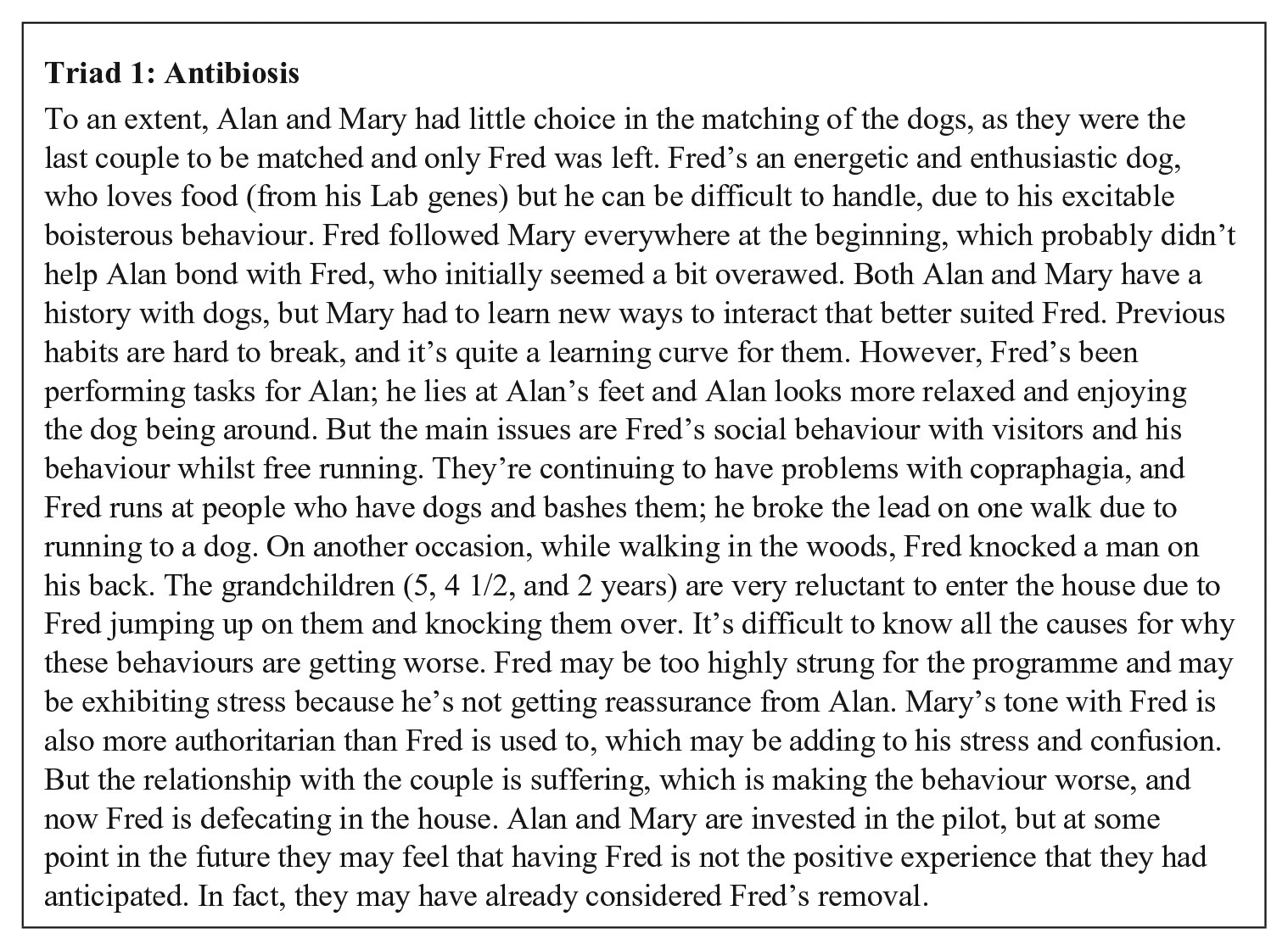
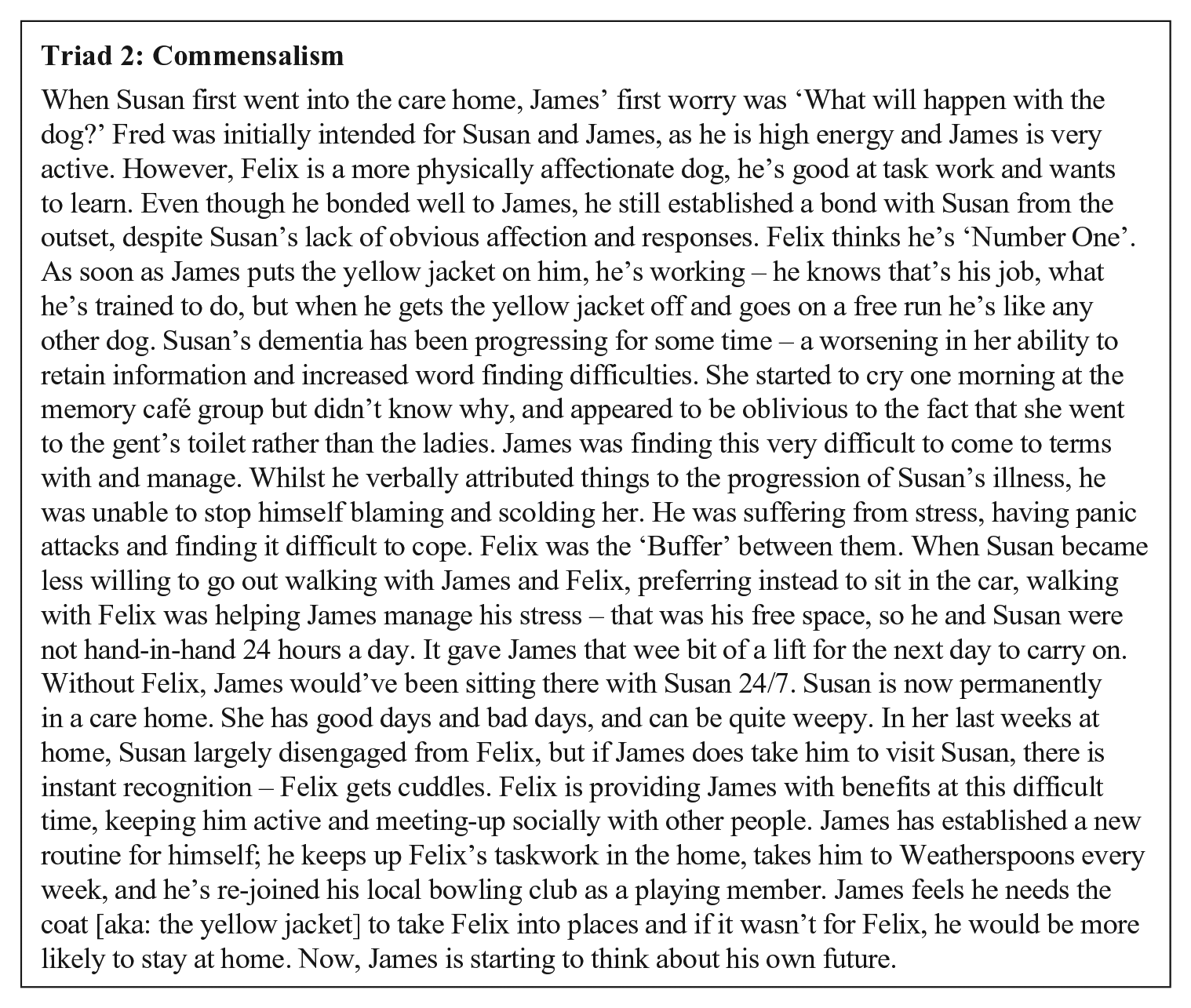
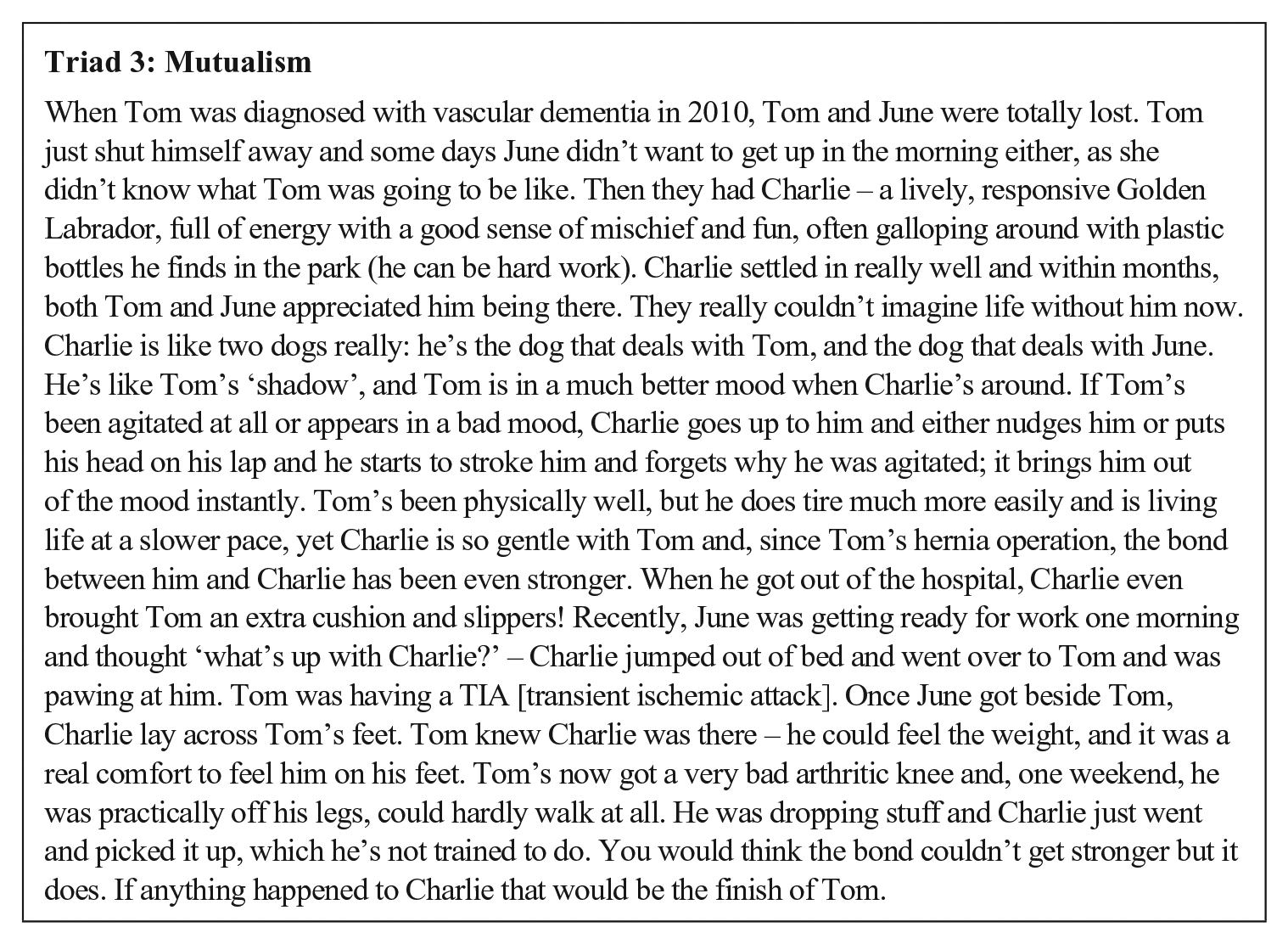
As part of our evaluation of the Dementia Dog pilot project, we were given access to 138 separate artefacts that were generated by the Dementia Dog team over a period of approximately 3 years. These artefacts ranged from meeting notes, case file notes and aftercare reports, to self-completion questionnaires and video-recorded interviews with the recipients of the dementia dogs. In order to create vignettes from these data, we first grouped together all artefacts that pertained to each triad’s experiences. Having done this, we proceeded to select extracts from artefacts – such as quotes from carers and people with dementia (captured in video-recorded interviews) and summaries from project workers (recorded in aftercare reports) – and we edited them together so as to produce a synthetic narrative of each triad’s experiences. As such, the words that comprise our vignettes are the spoken and written words of the people with dementia, spousal carers and project staff who participated in the Dementia Dog pilot – words recorded by different people and collected at different time points over the 3-year period. These are not ‘our’ words. Where we altered the wording of the texts, it was solely to anonymise, alter tenses, shift from first to third person perspective or insert occasional clauses in order to fuse segments together. The outcomes of our (re)assembling processes are presented below.
Reading relations of difference and how they matter
In this section, we offer a brief summary of our approach to reading relations of difference (Barad, 2007) through these vignettes from a diffractive methodological standpoint. The first point we wish to highlight in this respect is that, in constructing these vignettes, we were not seeking to represent each triad’s lived experiences of the Dementia Dog pilot. Thus, we do not claim that these vignettes provide a mirror into the world of Dementia Dog, nor do we claim that they provide audiences with authentic, plausible or trustworthy representations of human–dog relations in dementia. To adopt this representationalist approach to our vignettes would, in Barad’s words, require that we continue to hold the world at a distance. In contrast, we argue that these three vignettes are better conceptualised as lively assemblages of enunciation (from Deleuze and Guattari, 1984/2004). As such, we see these vignettes, not as representations, but as synthetic texts that encapsulate complex and immanent relationships of meaning, action and intra-corporeal transformation that researchers, as agents of observation, become entangled with. In line with this way of seeing, our approach to interpretation was not to use vignettes as a means of producing authentic reflections of participants’ lived experiences but, rather, to observe processes of intra action through which ‘people with dementia’, ‘carers’ and ‘dementia dogs’ are mutually constituted.
To achieve this, we draw heavily on the concept of sympoiesis. First articulated by Dempster (2000: 1), sympoiesis refers to ‘complex, self-organising but collectively producing, boundaryless systems’ that are made with (as opposed to independently of) other dynamic systems. Haraway (2016) uses Dempster’s notion of sympoiesis as an alternative to autopoiesis (Maturana and Varela, 1980) and as a primary tool for understanding how human and non-human animals become with each other within their everyday encounters. Thus, person and dog are not positioned by Haraway as two independent (autopoietic) systems but, rather, each is made with each other in complex intra action.
In line with this approach, each of our three vignettes call forth ways in which people with dementia, spousal carers and assistance dogs became with each other (sympoietically) during their dementia journeys. Our third vignette (Mutualism), for example, calls forth mutualistic forms of sympoiesis in dementia, characterised as Wolfe (2010: 141) argues, by ‘complex relations of trust, respect, [and] dependence’. Within the vignette, Tom and Charlie are each rendered capable through their intra actions. Tom, for example, is transformed from passive to active through Charlie’s sensitivity, whereas Charlie is transformed from dog to Dementia Dog through Tom’s vulnerability. These are processes of intra action (as opposed to inter-action) we argue, because we observe Charlie becoming Charlie through Tom, and we observe Tom becoming Tom through Charlie. In this respect, Tom cannot be said to precede Charlie, and vice versa.
Our first vignette (Antibiosis) in contrast calls forth ways in which the person with dementia and assistance dog may be rendered less capable through their intra action. In the text, we can observe how the presence of Fred’s animality leads to Alan’s withdrawal from human–human interactions and creates barriers to Alan maintaining relations with his human kin. We also observe Mary’s desire to exert dominance over Fred, and how this leads to Fred displaying heightened signs of stress and anxiety. In so doing, we observe how Western notions of human exceptionalism and the belief in the human–animal binary are immanent in these enunciations, and the role such material-discursive forces play in Fred’s becoming as a ‘failed’ Dementia Dog.
Our second vignette (Commensalism) calls forth the presence of inter-species affinity when caring in dementia. In this vignette, we observe the inclusion of Felix as a ‘buffer’ between James and his wife, Susan. We observe how the time James spends exercising and playing with Felix creates the conditions for respite, enabling James to continue in the caring role. Thus, James (the carer) becomes such, in intra action with Felix’s becoming as Dementia Dog. Equally, we observe how Susan’s transition into the care home places both James and Felix in liminal positions – betwixt-and-between becoming carer, widower, assistance dog and companion animal.
In summary, through the vignettes, we were able to read insights into the socio-material processes through which relations of difference are created, sympoietically, in the context of the Dementia Dog pilot. As such, we found the vignette technique to be ideally suited to exploring human–dog relations in dementia through the lenses of post-humanist and multi-species theorising. In the final section of this article, we provide a summary of the argument thus far, before offering some tentative suggestions for evaluating the quality of vignettes from a post-humanist methodological perspective.
Discussion: ‘What can a vignette do’?
In this article, we are seeking to explore the use of vignettes in qualitative research from a post-humanist and multi-species perspective. To contextualise our discussion, we have argued that since the 1980s, the use of vignettes within qualitative inquiry has been developed most notably from within (humanist-inspired) phenomenological, ethnographic, auto-ethnographic, arts-based and participatory forms of qualitative research. Across these disparate traditions, the vignette technique has been deployed primarily with the intention of representing or reflecting upon the inner worlds of researchers and their participants, or the social environments that actors inhabit. In line with such imperatives, attempts to assess the quality of vignettes have tended to focus on the extent to which vignettes provide valid, authentic, plausible or trustworthy reflections of these worlds. In contrast, we are seeking to advance an alternative approach to the use of vignettes in qualitative research. This approach, rooted in post-humanist theorising, seeks to position the vignette technique as a catalyst for diffraction, as opposed to representation and reflection. From this position, we have argued, vignettes may be better understood as lively assemblages of enunciation within which researchers are intricately entangled, and through which researchers may be able to observe complex and immanent relations of language, action and intracorporeal transformation in the creation of difference and how it matters. In this section, we consider the implications of our approach for evaluating the quality of vignettes.
Drawing on principles of post-humanist performativity (Barad, 2007), we wish to begin this discussion by rooting our approach to evaluation not in notions of what a vignette is (or should be) but, rather, in the question ‘What can a vignette do?’ Conventional approaches to evaluating vignettes tend to begin with notions of what a vignette is and proceed accordingly. If vignettes are defined in teleological terms – as, for example, ‘compact sketches . . . used to introduce characters, foreshadow events and analysis to come, highlight particular findings, or summarise a particular theme or issue in analysis and interpretation’ (Ely et al., 1997: 70) – then criteria for assessing their quality tend to flow logically from such statements. Further, these evaluative criteria tend to be fixed, in that they are typically understood to be applicable across research contexts and are thus capable of producing definitive evaluative statements. In contrast, basing an approach to evaluation on the question What can a vignette do? encourages researchers to focus on issues of performativity, as opposed to teleology. This approach tends in turn to produce evaluative questions, questions that are rooted in and contingent upon the specific conditions of the research. From this approach, evaluations of vignettes are perpetually partial and continuously subject to revision, in light of new information. To illustrate this position, we seek to discuss, briefly, the evaluative questions arising from the three vignettes discussed in earlier sections of this article.
Whilst the ‘animal turn’ (Ritvo, 2007) in the humanities and social sciences has led to new ways of conceptualising research subjects and new ways of formulating research issues, the field of dementia studies has been slow (and arguably somewhat resistant) to embrace dementia’s ‘zoological connections’ (Bryant, 1979). The reasons for such resistance are complex and result in part from over two centuries of struggle to recognise people living with Alzheimer’s disease and associated conditions as full members of the Personhood Club, with all the legal and associated rights that membership entails. Yet, as Fox and Ray (2019) argue, many older people are forcibly separated from companion animals each year at the point at which they enter the residential care system and rarely, they argue, are these inter-species relationships treated by practitioners as being of equal legitimacy and importance to that of human-human kinship. In this context, we ask if our vignettes may help open up spaces of alterity, within which multi-species approaches to dementia may flourish. We ask if vignettes can help disrupt anthropocentric assumptions that, when it comes to practices of caring in dementia, there is no substitute for human touch and help open-up possibilities for recognising the importance of inter-species relations in dementia. Connected to these questions, we ask if vignettes can create possibilities for disrupting anthropocentric positioning of non-human animals as ‘assistants’ to people with dementia, and as living prostheses that practitioners deploy in their attempts to restore in people with dementia, intrinsic and essentially human forms of agency. We ask, instead, if our vignettes may create possibilities for understanding agency in dementia as a form of inter-species accomplishment, one that cannot be reduced to individual actors. Our approach to answering these questions, of what a vignette can do, will take a variety of forms, including exploring how publication of the vignettes in this article may influence thinking within the qualitative research community.
Summary
The post-human and animal turns across the humanities and social sciences have brought with them exciting opportunities for qualitative research. Developing the use of vignettes as an instrument of diffractive observation, as opposed to representation and reflexivity, opens up new possibilities for advancing post-humanist methodology. Whilst this is the case, the use of vignettes from within post-humanist and multi-species worldviews calls for new approaches to evaluating the quality of the vignettes we produce. Such new approaches, we argue, need to be rooted in performativity and recognise the socially situated nature of knowledge production.
Footnotes
Declaration of Conflicting Interests
The authors report no conflict of interest. The authors alone are responsible for the content and writing of the paper.
Funding
The author(s) disclosed receipt of the following financial support for the research, authorship, and/or publication of this article: Funding for the realist evaluation of Dementia Dog pilot project was provided by the Alzheimer Scotland. No other financial support was received in connection with this research.
Author biographies
 ).
).