




Abstract
Against the background of critique in public engagement scholarship on new and emerging science and innovation, this article engages with the methodological and conceptual challenges of making anticipatory knowledge. Adopting a science and technology studies perspective, a public engagement methodology is presented aimed at anticipating the kinds of possible and plausible worlds that novel science and technology bring into being. Drawing on six empirical social science research projects using focus groups, design criteria are explicated on context, framing, moderation, sampling, analysis and interpretation. A feature of the methodology lies in the assembly of emergent collectives and identities that are constituted to negotiate endogenously public meanings, concerns and priorities. I reflect on the potential of such processes to reconfigure dominant policy narratives, the role of the social scientist in mediating such processes and the politics of making anticipatory knowledge.
Keywords
Introduction
Anticipating societal responses to emerging science and innovation is a major challenge for contemporary democracies. In this article, the use of a particular kind of focus group discussion is explicated as an anticipatory or ‘upstream’ methodology in deliberative research on new science and technology (on the idea of ‘upstream’ public engagement in science and technology, see Wilsdon and Willis, 2004). The policy dimension for this kind of research involves exploring whether a deliberative form of research – in our case making use of focus group discussions with lay publics – can lead to a robust representation of the potential social and ethical effects of a technology, at a stage early enough to guide (or even restrict) its further development. Yet, can deliberative methodologies give voice to the articulation of public views on topics on which participants – at least prior to the deliberative intervention – have poorly formed attitudes and standpoints? How are future possible worlds being constructed in deliberation and with what effects? And what is the role of the social scientist or participation specialist in mediating this process? Policy logics may demand early or upstream public engagement in the desire for socially robust science and technology policy, but it is not self-evident how to appraise the quality, usability and relevance – and indeed legitimacy – of methods that have been crafted to cast light on how people are likely to respond to a technology where constituent social responses do not as yet exist. Rather than undertaking public engagement research after a controversial social or ethical question has arisen in relation to a new technology – as is often the case in such research (Rogers-Hayden and Pidgeon, 2007) – the challenge here is to craft an anticipatory methodology aimed at articulating a contextual understanding of how people develop views and attitudes under conditions of unfamiliarity.
In this article, I have three goals. First, I explore recent critical interventions on public engagement and what these imply for deliberative processes that mitigate against their use as tools for legitimation. Second, in the context of these debates and drawing on empirical qualitative research, I set out design criteria for a robust anticipatory focus group method. And third, I reflect on the role of the social scientist and on the politics of making anticipatory knowledge.
An engagement with critique
Historically, public engagement initiatives are set up to involve citizens in the deliberation of public policy issues. In the field of science and technology policy, they are designed as a counterweight to technocratic decision-making to provide citizen input to decision-making processes on contested issues. By the 2000s, however, a wave of critique emerged, arguing that institutionally sanctioned forms of public engagement had all too often reduced participation to a mere tool of legitimation: reinforcing existing relations of professional power and science policy institutional culture, solidifying dominant models of economic rationality and deficit understandings of the public, negating the creative political agency of participants and producing marginal impact on policy or on decision-making processes (amongst many, see Horlick-Jones et al., 2007; Lezaun and Soneryd, 2007; Wynne, 2006). Relatedly, by studying empirically participation in practice, scholars have criticised the naïve realism in (much) participatory methods (Chilvers and Kearnes, 2016), demonstrating alternatively the unavoidable situated sense-making processes inherent in any method for constructing a public opinion (Gomart and Hajer, 2003), and the reformulation of a deliberative method not as a politically neutral tool for extracting public views but rather as a machinery for making publics (Felt and Fochler, 2010) or even as a technology of democracy (Laurent, 2011).
Irwin et al. (2013: 120–121) argue that such critique has contributed to a ‘double impasse’, where on the one hand ‘science and technology studies scholarship often falls into a pattern of “case study” followed by critical assessment’ whereas, ‘[o]n the other hand, policymakers can become frustrated with a sense that whatever they do will be criticised by social scientists’. Informed by Boltanski’s sociology of critique (Boltanski and Thévenot, 1999), which argues that lay actors themselves are perfectly capable of critical thinking (i.e. that this is not the sole preserve of the analyst as social critic), their response is view critique as a constitutive and performative feature and already situated within deliberative practice. They argue not only that participants in public engagement exercises have the capacity to cultivate and deploy critical capacities, but that they do so by utilising competing and often contested moral vocabularies. This implies that if public engagement processes are to facilitate critique from within, or what I term endogenous critique, they need to attend to the character of deliberation in public engagement initiatives, and to the opportunities that are being offered for dynamic expression and critical exploration.
If Irwin et al. point to critique as an emergent quality of public engagement, Wynne examines the framing of public meaning making processes in deliberation. For decades, Wynne has criticised what he terms ‘scientism’, defined as the phenomenon where scientific and policy elites impose definitions on the meaning of public issues, foreclosing engagement with broader public meanings and their constituent alternative normative and ontological underpinning (see Wynne, 2001, 2006, 2016). For Wynne, the radical promise of public engagement is to constitute or engage with new kinds of collective meaning making, involving the ‘inclusive mutual negotiation of those public meanings, concerns and priorities’ (Wynne, 2016: 117). Importantly, and as a prerequisite for democratic governance for Wynne, these meanings, often cultivated by and through civil society organisations, need to emerge through endogenous processes, rather than being imposed either by science or by what Wynne calls ‘global neoliberal agents’.
What such a collective might look like requires an imaginative act. Callon and Rabeharisoa warn against the role of an impoverished social science and its historical tendency to ‘participate willy-nilly in that major enterprise of [the] progressive reduction of society to a collection of individuals who argue, decide and are responsible for themselves and their actions’ (2004: 23). One can think of the methodological individualism embedded in dominant paradigms in the social science of risk, or of public attitude theory. By contrast, collectives need to be constituted where participants can reject or refuse ‘the liberal subject model’, in which citizens are constituted as capable of articulating diverse arguments and forms of morality, and through which different collective identities and meanings can emerge. Callon et al. (2009) introduce criteria for deliberative public engagement processes designed to explore the ‘possible worlds’ associated with new science and technology. Along the first axis is the criterion of intensity, measured by how early non-specialists are involved in the exploration of possible worlds, coupled with the degree of concern in the importance of the issues being discussed. Along the second axis is the criterion of openness, measured by the level of diversity in the groups invited to deliberate, and in the openness of the process to facilitate the constitution of emergent identities. Finally, and cross-cutting both axes, lies the criterion of quality, responding to the capacity of the participants to express their arguments and claims with seriousness of voice, and to the level of continuity of the deliberative process across time and space. For Callon et al. (2009: 161), processes are deemed to be more deliberative to the extent to which they are intense, open and of quality.
To summarise, the above sociologically informed critical interventions in public engagement scholarship point to three operating criteria for the enactment of deliberative processes that mitigate against their use as tools of legitimation: the need to understand public engagement as a performative exercise in meaning making, the dangers inherent in engagement processes where dominant representations are imposed (often unwittingly) on the meaning of public issues and the importance of developing new kinds of collective which are empowered to negotiate the meanings of issues endogenously. Yet, while these points may be fine in principle it is less clear how they can be operationalised in practice and in the form of design criteria. In the section ‘Design criteria for an anticipatory focus group methodology’, I explicate how these criteria have been negotiated in the development of an anticipatory public engagement methodology using focus group discussions.
Design criteria for an anticipatory focus group methodology
In a meta-analysis of UK government public dialogue initiatives sponsored by Sciencewise-ERC, three ideal types or models of dialogue were identified (Macnaghten and Chilvers, 2014). First, there is the ‘upstream’ model of public engagement, where the function of the dialogue is to engage publics in exploratory conversations on a range of issues and questions posed by science and technology at a relatively early stage in the innovation process. Examples of Sciencewise-ERC dialogues deploying this model include those on nanotechnology, synthetic biology and climate geoengineering, where the aim is to scrutinise how an emerging science and technology is imagined by social actors, to explore possible worlds, the social and ethical issues associated with them, and the factors that shape public concern, hope and possibility. Such initiatives are loosely tied to specific policy outcomes with participants being constructed as ‘exploratory subjects’ who develop novel identities and positions through the dialogue itself.
These are distinguished from the ‘honest broker’ model where the function is to foster deliberation in weighing up the pros and cons of different courses of action, and the conditions, if any, under which different policy options are acceptable. Sciencewise-ERC dialogues using this model are primarily health related, for example focusing on the dilemmas of stem cell research, chimeras and human enhancement. They have closer links to policy outcomes and are less exploratory, with publics configured as ‘reflective’ subjects who deliberate the conditions of whether and how to proceed with a controversial domain of science. Third, there is the ‘issue advocate’ model of public engagement where there exists an already agreed policy goal, such as climate policy, and where the function of the dialogues is not to deliberate on these goals but rather on how they can be realised. There is less scope to explore the framing of policy goals or to discuss alternatives, with publics represented as ‘malleable’ subjects able to have their views and positions bent through the provision of information and argument by the sponsoring institution.
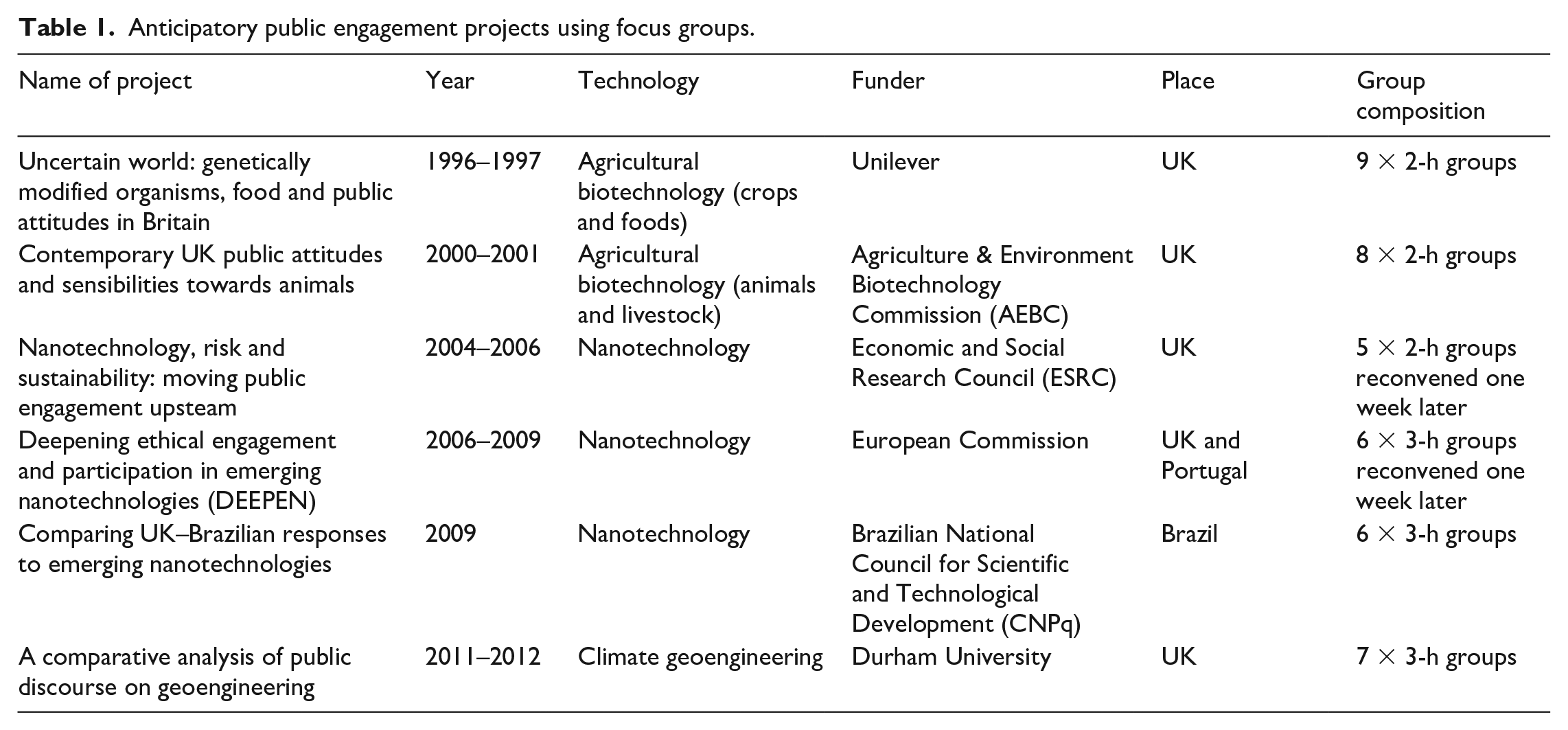
Although an individual dialogue may subscribe to more than one of these models, they nevertheless serve as a heuristic to reveal the different functions of public dialogue in the policy process. For this article, I describe design principles that have guided an anticipatory model of public engagement research. In contrast to Sciencewise-ERC sponsored dialogues, I examine qualitative social science research projects where the primary aim is to understand the assembly of social worlds, albeit with policy recommendations. Six research projects are reviewed in this article: two on agricultural biotechnology, three on nanotechnology and one of climate geoengineering technology. The design principles are an emergent feature of engagement both with practice and theory: partially from working in an innovative interdisciplinary research centre (the ESRC-funded Centre for the Study of Environmental Change – CSEC), partially from collaboration with civil society and industry actors, partially from academic collaborations across the UK and Europe, partially from market research practice and partially from literature on deliberative methods. Yet, although these projects cover diverse technologies over nearly two decades, there remain points of convergence that warrant instantiation, not least in how they anticipate the kinds of possible and plausible worlds that novel science and technology bring into being, and emergent collectives and identities that are constituted to negotiate endogenously public meanings, concerns and priorities. The details of each project can be seen in Table 1.
Anticipatory public engagement projects using focus groups.
Context
The first design feature is context, a neglected aspect in scholarship on focus groups and deliberative methodology, but a core element of our methodological design. Given that, by definition, people are unfamiliar with an emerging technology and with the social and ethical issues it poses, it is necessary to explore the context out of which public responses are likely to emerge. Conceptually, it is assumed that through contextual factors people develop both an understanding and a relationship to technological innovations as they permeate everyday practice. This presents a challenge and a responsibility, especially given the ambition of facilitating an endogenous process. Our response is for the research team to deliberate on social meanings and dynamics, to reflect on social theory and relevant everyday experiential practices, and through deliberation to derive contextual factors deemed as likely to be significant in the shaping of subsequent public responses. Inevitably, the choice of context is a matter of judgement. Other choices could have been made and may have been significant in the subsequent structuring of responses. But by using social science expertise to situate the technological innovation in its constitutive domain of practice, choices are made designed to provide a space for the cultivation of emergent endogenous identities and meaning making practices.
For the 1996/1997 project on agricultural biotechnologies, the selected context was everyday food practices. How people will respond to genetically modified (GM) foods, the argument went, depends on how they think about food in general and what they consider to be the appropriate role of technology in food production (Grove-White et al., 1997). The focus group discussions began with 20 minutes of deliberation on what had changed in the world of food over the last 5 to 10 years or so, exploring with participants what had been lost and gained. The discussions themselves were illuminating, as participant spoke of their ambivalence towards the use of advanced technology in food: while technology had enabled people to lead busy and convenient lives, it had also generated concerns about food processing, the use of artificial preservatives and the apparent increase in food health scares. Drawing on the then proximate ‘mad cow’ disease controversy, participants expressed unease about the integrity and adequacy of government regulations, official ‘scientific’ assurances of safety, the benign intentions of food producers and processors and the increasing perceived ‘unnaturalness’ of food. Such early discussions provided clues to the ways in which public responses to GM foods would later be configured, highlighting the salience of concepts of trust, naturalness, questions of justification and perceived agency in moderating public responses.
For the 2000/2001 project on animal biotechnology, the selected context was people’s wider experience of, and relationship with, animals (Macnaghten, 2004). It was argued that deliberation on the social practices through which people experience and reflect upon animals in their daily lives – for example, as pets, in sport, as wild animals, as prey and as subjects of animal research – would illuminate the factors likely to shape responses to applications of biotechnology to animals, including their sense of the continuities and discontinuities between GM animals and those determined by conventional selective breeding. The focus groups started with a 60-min discussion on how people talk phenomenologically about, and directly experience, animals? How intelligent, how affectionate, how responsive and how like/unlike humans do participants find them to be? How do they talk about animals in relation to ‘professional’ or ‘instrumental’ uses and contexts? And how do they respond to apparent tensions, dilemmas and contradictions in their own attitudes and behaviours? These discussions revealed the affective and empathetic relations in which (certain) animals were regarded in (certain aspects of) daily life and how these were collectively blanketed out in other aspects of daily life (such as in the eating of meat or the wearing of leather). Such contextual deliberation helped in the formation of the group identity and underpinned the subsequent and overarching finding that the production of GM animals would be likely to contribute to an issue of public controversy in so far as it symbolised and give voice to underlying tensions between ‘moral’ and ‘instrumental’ approaches to animals.
For the projects on nanotechnology, the selected context was people’s experience of the transformations brought about by current technologies, on how these had changed social life (for good and ill) and on how people imagined these changes would unfold in the future. Here, we were careful to move the dialogue beyond the private sphere of individuals expressing preferences for their own actions, to open up an expanded public sphere where participants could articulate and develop arguments using a range of argumentative moralities and discursive resources. These produced wide-ranging deliberation on participants’ experience of modern technological life and on the factors that produced often contradictory and powerful pulls on hopes and desires. When, later in the focus group discussion, the concept of nanotechnology was introduced, it became apparent that participants viewed nanotechnology broadly as an intensification of existing hopes and fears on technological life. Key factors included whether an innovation posed a threat to the human and to natural orders; whether it diminished or enhanced individual choice and autonomy; whether it was likely to generate more or less inequality and whether there would be unforeseen downsides to the optimistic and seductive promises of the technology (Macnaghten et al., 2010). When this public engagement exercise was conducted later in Brazil, as a comparative study, Brazilian participants were prototypically more positive of technology, and more amenable to and accepting of a standard Enlightenment master narrative where general societal progress was conflated with technoscientific advance (Macnaghten and Guivant, 2011). Such dynamics helped explain the very different structure of feeling of Brazilian and UK responses to nanotechnology.
For the project on climate geoengineering, the challenge was to imagine the context from which people develop responses to an intentional technologically adjusted planetary climate system. Here, the focus groups began with an open-ended discussion on participants’ experience of the weather and the climate, selected as a relevant context for future deliberations on geoengineering as a climate change modification technology (Macnaghten and Szerszynski, 2013). The focus groups began with a conversation on what people enjoy (and do not enjoy) about the outdoors before asking each participant to recount a story that summed up the importance of the weather. This was followed by a conversation on the climate and on the difference between the climate and the weather, designed to open up a conversation on climate change and their views on how scientists and policymakers were thinking about it. These early conversations elicited complex and nuanced responses – such as participants struggling over the difficulty of determining what is natural/cyclical about the climate and what is human-induced; of the difficulty of linking human interventions into planetary and glacial timescales; of being given mixed messages by scientists and policymakers and being unclear of their underlying motives and of the underlying cause of climate change (seen as being one of human greed and selfishness and in which they were implicated) – all of which proved highly significant themes in understanding subsequent responses to possible geoengineering options.
To summarise, context is a fundamental component of our ‘anticipatory’ public engagement research methodology. If contextual factors are not explored prior to explicit deliberation on the technological innovation, participants are likely to develop responses using definitions and narratives that are been pre-defined exogenously, typically by scientific and policy elites. Some constraint of public deliberation is inevitable, as moderators have to keep participants closely to a pre-designed topic guide. But, by exploring ways in which the technological innovation may become situated in everyday practice, this part of the deliberation plays the role of helping in the formation of an endogenous collective, where the sharing of background experience can empower participants in the formation of alternative normative and ontological perspectives. For this reason, it is important the recruitment is topic-blind: indeed, in all projects, the focus group participants were unaware of the particular technology under scrutiny until contextual factors had been discussed in some detail, usually for between 40 min and 1 hour.
Framing
The second design feature is framing, classically defined as the selection of ‘some aspects of a perceived reality [to] make them more salient in a communicating text, in such a way as to promote a particular problem definition, causal interpretation, moral evaluation, and/or treatment recommendation for the item described’ (Entman, 1993: 52). Given that the representation of a technology is never neutral but always framed in particular ways and for particular purposes, care is exercised to introduce the technology by offering participants an inclusive range of rhetorical resources and frames, without closing down or narrowing the issue in the first place, or presuming that these align with dominant institutional frames and norms (Felt et al., 2014; Sciencewise–ERC, 2018; Stirling, 2008). Crucially, this involves attending to both current and future imagined uses of the technology and its societal impacts: the future being a key category of emerging technologies, given their often ‘promissory’ character (see Adam and Groves, 2007; Brown and Michael, 2003; Selin, 2007). For the project on agricultural biotechnology, clear distinctions were made between current and proposed uses of genetic modification techniques, highlighting the potential for the transgenesis of different genes (both plant and animal) in different contexts of application (from food production to animal rearing, to medical uses). The project on animal biotechnology was similarly conceived, exposing people to the different kinds of application of the technology (from animal testing to livestock applications to pets to the eradication of pests to the production of drugs) and to the different frames of approaching the issue from the viewpoint of science, commerce and animal rights activists.
For the projects on nanotechnology, three frames were introduced: first, a dominant institutional frame that interpolated nanotechnology as a new science that would contribute to projected breakthroughs across multiple sectors and spheres of application; second, a more avowedly utopian and revolutionary frame, with promises of how nanotechnology would extend and transform human sensory and physical capacities to transcend natural and physical constraint and third, a precautionary frame, derived from civil society actors and sceptics that focused on the uncertain risks of the technology and of wider concerns of the technology running ‘out of control’. For the project on climate geoengineering, three distinct frames were introduced: one using quotes from policy institutions, reporting on the slow progress of climate mitigation, designed to provide a frame that was relatively open to geoengineering as a policy option; a second frame designed to explore civil society and oppositional perspectives on geoengineering and a third frame setting out the geopolitical history of weather and climate modification, designed to explore the salience of alternative frames surrounding how solar radiation management techniques could be used for purposes unrelated to climate change policy.
Thus, in all cases, participants were presented different frames or styles of thought (Fleck, 1979; Hacking, 1992), not simply of what the technology is, but what it explains and represents. In-depth deliberation on these frames, on occasion cultivated through the focus groups being reconvened 1 week later, facilitated the endogenous construction of problem definitions and meanings. Across all the projects, these frames had been encapsulated through the use of stimulus materials, typically making use of pre-designed large A1 boards, consisting of pictures and text (all attributed) and presented to the group by the moderator to stimulate conversation. Importantly, even when we might anticipate the salience of a really dominant frame (such as technology running ‘out of control’ in the nanotechnology case, or ‘naturalness’ in the geoengineering case) care was exercised to introduce each of the frames in a neutral and attributed manner, without leading the discussion or anticipating where it may go (more on this below).
Moderation
The third design feature is moderation. A focus group is more than a group interview or the aggregation of individual opinions and preferences. It is a space in which a group identity and discourse can emerge, where the collective is empowered to articulate the issue at hand in its own terms and to arrive where possible at ‘the collective production of a group discourse through conversation’ (Ruiz, 2017: 281–282). The moderator encourages the movement between argument and counter-argument, in a spirit of mutual understanding and as aspiring to the ideals of conversation, valuably set out by Hans-Georg Gadamer: ‘conversation is a process of coming to an understanding. Thus, it belongs to every true conversation that each person opens himself to the other, truly accepts his point of view as valid and transposes himself into the other to such an extent that he understands not the particular individual but what he says. What is to be grasped is the substantial rightness of his opinion, so that we can be one with each other on the subject’ (Gadamer, 2004: 387; cited in Ruiz, 2017: 283).
Facilitating a group dynamic and identity is an important accomplishment as the group has to formulate shared understandings of issues that had been unfamiliar prior to the group discussion. Given Marres’ insights on the role of ‘issues’ in the formation of public concern (Marres, 2007), this requires skill and negotiation. For this reason, a senior and experienced member of the research team, usually the project PI, has, in all circumstances, conducted the focus groups, given that this role has been considered as integral to subsequent analysis and interpretation. The role of the moderator is, principally, to keep the group on topic (using a well-formulated topic guide); to raise topics, to listen empathetically and accurately to each participant’s stories; to engage in non-directive moderation where participants can express their views with minimal interference; to ensure a diversity of voice independent of background or experience; to probe difference and convergence between group members; to require participants not necessarily to arrive at a common output or consensus but, nevertheless, to articulate shared issue definitions (when present) facilitating a collective or shared group discourse aimed at increasing awareness and mutual understanding of participants’ viewpoints and to move from one topic to the next only when the full range of arguments appears exhausted (on the role of the moderator in interaction, see Barbour, 2008; Hennink, 2007; Macnaghten and Myers, 2004; Puchta and Potter, 2004).
To ensure that discussions are not framed by expert discourses and norms, the focus groups have avoided the inclusion of technical experts, as the presence of experts (unless they are very well trained and integrated into the research) can induce deference to prior framings amongst lay participants (Wynne, 2006). Nevertheless, codified information on what the technology is, how it works and what it means, is communicated by the moderator through the use of stimulus materials, but where the practical meaning of the technology, for the participants, is derived through group discussion and deliberation. Through abiding with some general rules of good focus group moderation – that there are no right or wrong answers, that this is not a test, that all opinions matter and should be respected, that you, as the moderator, are showing due empathy to participants’ views and experience (see, amongst others, Krueger, 1998) – participants have shown themselves as able and competent to enter into the lifeworld of advanced technoscience, whether this be animal and crop biotechnologies, nanotechnologies or climate geoengineering.
Sampling
The fourth design feature is sampling. Across all projects, sampling strategies have been designed to be both broad and deep. Each project typically involves between six and eight groups, each group meeting for between 2 and 3 hours, sometimes reconvened. The groups are made up of between seven and nine participants, according to standard focus group norms, and professionally recruited to cover a diverse variety of backgrounds, localities and demographics (age, gender and socio-economic class) but with topic-specific or theoretically informed variants (for an explanation of the idea of the theoretical sample, see Gobo, 2005). For the project on agricultural biotechnology, two groups were put together to include those who commonly read labels on packaging, taken as a proxy for a particular proximal relationship to food, while for the project on animal biotechnology groups were selected on account of their having particular relationships with animals: pet owners, wildlife enthusiasts, hunters and shooters, and farmers. For the nanotechnology projects, groups had shared interests in technology or politics; while for the climate geoengineering project, groups were selected of people who had a practical interest in the climate.
The decision to bring participants together on the basis of shared experience is a design feature aimed at fostering a favourable setting for the formation of the collective (see Macnaghten and Myers, 2004; Morgan, 1988). Nevertheless, some degree of diversity in the group is welcomed to allow for divergent views to enrich and revitalise the discussion (of course differences and commonalities often emerge within the group reflecting factors that were not anticipated or sampled for). The decision to involve uninformed participants, who have no particular a priori stake or position in the debate, and who do not know each other prior to the group, is a technique designed explicitly to produce an open-ended sociality, where people develop opinions and attitudes through structured interactive conversation in a safe and empowering space. In this way, the ‘anticipatory’ focus group methodology creates (albeit temporarily) ‘technoscientific citizens’, authorised to develop collective views and identities and to open up novel normative and ontological resources for thinking about emerging technology.
Analysis and interpretation
The fifth design feature is analysis. Macnaghten and Myers (2004) distinguish between two styles of analysis: styles that converge on how people talk in focus group settings (often inspired by conversation analytical traditions; see also Myers, 2004) and those that focus on what people say and where the role of the analyst is to interpret its meaning (often inspired by narrative or discourse theoretical traditions). Our analytical approach is firmly in the latter camp, where the role of the analyst is, first and most importantly, to become acquainted with the raw data, to organise key rhetorical arguments into themes or discourses through the use of codes, to articulate the interplay between thematic concerns and wider social discourses and narratives, and to interpret this meaning within a framework of theoretical and policy concerns.
The focus of the analyst is often to look for convergences, between and across groups, and to see how these differ, or not, from extant policy or academic understandings. For the 1996/1997 project on agricultural biotechnology, it had been assumed within then-dominant scientific and policy narratives that GM foods were no different in kind from non-GM foods; that current forms of regulation and oversight – that assumed that the technology can and should be managed on a case-by-case basis on independent scientific risk assessments – were sufficient to assure safety and, thus, by implication, public acceptability and that public resistance would best be countered through official reassurance and the provision of quality information (Grove-White et al., 1997, 2000). Against such assumptions, the focus groups formed a collective and convergent group discourse to the contrary: that GM technologies presented distinctive patterns of ambivalence and concern compared to non-GM food production; that participants expressed mixed feelings about the integrity and adequacy of present patterns of government regulation and, in particular, about official ‘scientific’ assurances of safety and that public concerns had a latent quality that reflected wider issues of trust in UK political institutions. Iconic examples of deliberation were used to illustrate these dynamics at play, including the observation that the more people reflected upon the technology and its application in real world circumstances, the more articulate and profound became their concern:
I started out not too bad when I had the discussion, I thought I’d have an open mind about it, but I’ve changed my mind as soon as I saw that [one] about the human gene, it really. . . suddenly the enormity of it made me feel really awful. I got an awful feeling about it, because I thought it was something that, I think we’re touching things that we don’t realize and I think we’re taking things out of the earth and we’re now trying to correct it by using things like genetic engineering because the mistakes were made. And I feel that time’s just ticking by and we don’t realize what’s going to happen in the future. I think something terrible could happen; it’s given me a bad feeling really. . .. Yes, because the earth hasn’t got what it used to have. We feel we have to put something back into the food to make it better, and maybe we’re correcting things in the wrong way. I don’t know. . .
It’s a frightening thought to think that time’s ticking away though. . .
Yes. It’s something that I’d like to put at the back of my mind now. I wouldn’t like to think about it again. I probably wouldn’t – but when we talk about it, it does bring it to your mind. But then I’ll probably put it to the back of my mind now. . .
(Working women’s group, Uncertain world project, cited in Grove-White et al., 1997: 20)
In the Uncertain World report (Grove-White et al., 1997), we suggested that this sequence reflected the sense of open-ended uncertainty evoked by discussion of the technology as central features in the formation of a shared group discourse. In such circumstances, unambiguous unilateral assertions by industry and government spokesmen that the technology can and should be managed safely on a ‘case-by-case’ basis was presented as likely to have the effect of compounding, rather than assuaging, the mistrust felt by individuals across all population groups. Thus, notwithstanding the subtle differences in participants’ talk, it was the convergences and their contrast with official discourses and understandings that drove the analysis of the data and their interpretation. Indeed, when the GM food and crop controversy unfolded in the UK and Europe in 1998/1999, and when the then UK Chief Scientific Advisor (CSA) was exposed to the Uncertain World study, he responded in a personal communication as follows, thus speaking to the potential political salience of this anticipatory mode of focus group research: ‘I now have had a chance to read “Uncertain World”, which I wish I had indeed read earlier. It is in many ways a remarkably prescient document’ (May, 1999).
Each of our upstream focus group projects has sought to reconfigure a dominant policy narrative through deep engagement with public meanings, concerns and priorities. In the project on GM animals, we highlighted the salience of the category of ‘naturalness’ as a bona fide category for policy deliberation (Macnaghten, 2001, 2004). In the projects on nanotechnology, we highlighted the prevalent tragic quality of participants’ responses and how these ran counter to the Enlightenment master narrative, typically shared by policy actors, that assume implicitly that advanced (nano)science and innovation under current conditions of regulation and oversight would generate societal progress and environmental betterment. Finding this narrative not to be prevalent in structuring participants’ responses, we argued the need for policy responses to identify and engage with the counter-narratives that were actually structuring public responses (Davies et al., 2009; Macnaghten et al., 2010, 2019). In the geoengineering case, we demonstrated that public acceptability was at best conditional, and when these conditions were subjected to the plausibility test, they were for the most part found wanting (Macnaghten and Szerszynski, 2013).
Conclusion
This article examines the role of focus groups as an anticipatory methodology. Located within the field of science and technology studies, deliberative focus group discussions are presented as offering a partial response to a policy prerogative – one explicitly shared by the author – of the need to configure through endogenous deliberative processes the public issues and stakes associated with new science and technology. The argument is one associated with democratic governance and has become a staple of the science policy narrative of responsible innovation (Engineering and Physical Science Research Council, 2013; Owen et al., 2012; Stilgoe et al., 2013). Unless science and innovation processes are embedded in societal values, the argument goes, the alternative approach, implicitly embedded in neoliberal styles of technological appraisal, is one where the articulation of the good – or what von Schomberg describes as the ‘right impacts’ of science and innovation – is delegated to the market (von Schomberg, 2013). Within this formulation, focus group discussions offer potential to assemble the possible worlds enabled by (advanced) science and technology, including their societal and ethical dimensions. While it is indeed important not to reify this ‘technology of participation at the expense of other possibilities or imaginations of participatory politics’ (Chilvers and Kearnes, 2016: 46), it is nevertheless important to note the design specificities of this particular method and its role as a means of injecting social agency in technological appraisal.
The format of the research projects reviewed in this article conforms to what Callon et al. (2009) calls ‘secluded research’, whereby trained ‘experts’ design highly artificial spaces for deliberation, carefully protected and controlled from the wider world. Are there inherent limitations of ‘channeling’ public views in this way? Are there political risks associated with this anticipatory methodology? And how does this configure the role of the social scientist, both technically and in more democratic and political terms? There are no easy answers to these questions. A preliminary response is the claim that the channeling of public views is an inherent feature of the ‘anticipatory’ methodology. Put bluntly, (counter) public spaces in the wild rarely exist, if at all. There is thus no alternative but to design participation in carefully orchestrated spaces. The design choices, nevertheless, concerning the selection of context, how the debate is framed, the choice of participants, the selection of quotes, the focus on consensus (or dissensus), all have to be recognised as exercises in political power as much as in technical prowess (Irwin, 2008). In this article, I have sought to develop a methodologically and conceptually robust rationale for design choices aimed at opening up spaces for collective imagination of the possible and worlds enabled by novel science and technology. The politics of anticipation conforms to this broad aim. Others may disagree and there is scope for radical and incremental methodological innovation (e.g. the debate on context remains embryonic in the literature). The hope is that this is the start of a new kind of conversation that is partially about the politics of anticipation and partially about methodology, with open questions concerning the quality, usability, robustness, cultural contingency and context dependencies of the approaches adopted.
The legitimacy of the method and its enactment in practice is conferred less by internal procedural criteria – the extent to which it conforms to agreed standards of what constitutes good deliberative practice – and more by the criteria as to whether it produces relevant knowledge, and for whom (Stilgoe et al., 2014). As highlighted above, our internal criteria for success were not whether it contributed to pre-defined policy goals but rather the extent to which it challenged dominant policy, academic and industry norms and assumptions opening up new understandings, problem definitions and even policy narratives. Undoubtedly, some projects were more successful in this than others, a product of both design and serendipity. Such matters point to the need for a different kind of conversation on the role of the social scientist in policy deliberation. Following Burawoy (2004), the conversation is not simply for the (public) sociologist to produce practical or useful knowledge on public values through a commitment to deliberation, but to open up deliberation of how those values are likely to resisted, complemented, threatened or embraced by techno-science that remains at an early stage of development. Given our collective need to produce models of anticipatory governance in line with societal values, and as a counter-weight to market-inspired models of technological governance, this arguably is a task worth pursuing.
Footnotes
Acknowledgements
I am grateful to the following individuals for their ideas, insights, conversations and collaboration that made possible this paper: Sarah Davies, Jean-Pierre Dupuy, Robin Grove-White, Julia Guivant, Alan Irwin, Matthew Kearnes, Cees Leeuwis, David Ludwig, Tom McLeish, Senna Middelveld, Alfred Nordmann, Joao Nunes, Richard Owen, Auke Pols, Arie Rip, Jack Stilgoe, Bron Szerszynski, Brian Wynne and all the research participants that took part in various focus groups. I would like to thank the constructive comments from the editors and from two anonymous reviewers.
Funding
The author(s) disclosed receipt of the following financial support for the research, authorship, and/or publication of this article: The author acknowledges financial support for the research underpinning this article from Unilever for the ‘Uncertain world’ research project; from the Agriculture and Environment Biotechnology Commission for the ‘Contemporary UK public attitudes and sensibilities towards animals’ research project; from the ESRC (RES-338-25-0006) for the ‘Nanotechnology, risk and sustainability’ research project; from the European Commission (Grant Agreement: 36719) for the ‘DEEPEN’ research project and the ‘Comparing UK–Brazilian responses to emerging nanotechnologies’ research project; and from Durham University for the ‘A comparative analysis of public discourse on geoengineering’ research project.
