In the current article, induced magnetic field applied on second-grade fluid flow under variable thermal conductivity by an exponentially stretching sheet is taken into account for current analysis. The chemical reaction and viscous dissipation effects under the influence of thermophoresis and Brownian motion are considered on an exponentially stretching sheet. With the above assumptions, a mathematical model was developed in terms of partial differential equations by using the boundary-layer approximations. Similarity transformations in terms of ordinary differential equations considerably simplified this system. The dimensionless system was solved by a numerical procedure, the bvp4c method. The effects of involving physical parameters are presented through graphs and tables. The obtained numerical outcomes of the skin friction coefficient, the Sherwood number, and the Nusselt number are also highlighted in the tabulated form. It is concluded that the velocity and concentration profiles increased due to higher values of material parameter.
The MHD fluid flow has many application namely: petroleum, warming system, electrostatic mechanism, power generation, modern metallurgy, pumping having the essential role in usual life. Damesh1 discussed the thermal boundary layer in the existence of a magnetic field’s impact by virtue of an exponentially stretching surface. Ishak2 considered the MHD flow of a fluid having a linear radiative effect on an exponentially stretching surface. The unsteady two-dimensional boundary-layer flow of an incompressible Newtonian fluid under the thermal reaction, magnetic field, and absorption/heat generation impacts by virtue of an exponentially stretched surface was discussed by Elbashebeshy et al.3 Nadeem et al.4 discussed the MHD flow of a Casson fluid by an exponentially shrinked surface. Ferdows et al.5 presented the numerical solutions for the flow of fluid having nanoparticles due to the effect of MHD across a porous medium by virtue of a vertical exponentially stretching sheet. Impacts of chemical reaction for MHD flow of third-grade liquid by an exponentially stretching surface are discussed by Hayat et al.6 In the recent period, a few investigators worked on the MHD flow concept under various assumptions (see Refs. 7-10).
Initially, the idea of the flow of fluid by an exponentially stretched sheet was given by Magyari and Keller.11 They discussed the numerical solutions for the fluid flow toward an exponentially stretched surface, and distributed the fact of mass and heat transfer properties. The idea of the fluid flowing toward an exponentially stretched sheet plays a vital factor in industries and engineering fields such as glass fiber, drilling of sheets and plastic films, paper production, annealing and thinning of the copper wire, etc. It is worth mentioning that the stretched velocity is not linear in all the conditions, so the stretched velocity of the fluid may be nonlinear or exponentially stretching. The flow of Newtonian and non-Newtonian fluid by virtue of an exponentially stretched surface has been discussed by scientists in the recent past. Partha et al.12 considered an exponentially vertical surface to study the heat transportation with thermal mixed convection flow under the significance of viscous dissipation. Pal13 provided numerical solutions, and analysis follows to narrate the mixed convection flow by considering a vertical exponential surface with an exponentially dependent stretching velocity. The MHD, velocity, and the thermal slip effects were used by Mukhopadhyay,14 who analyzed the heat and mass transportation by a porous exponentially stretched surface with suction or blowing. Also, Mukhopadhyay15 utilized a thermally stratified medium and made numerical solutions for the magnetohydrodynamic flow by virtue of an exponentially stretched surface. Hussain et al.16 deliberated the two-dimensional MHD flow of second-grade liquid with nanoparticles by virtue of the exponentially stretched surface. Beg et al.17 discussed the effects of unsteady MHD nanofluid flow over a vertical exponentially stretching sheet. Veeresha et al.18 surveyed the heat and mass transportation impact in a boundary-layer MHD flow of viscous fluid into a permeable medium by virtue of an exponentially stretched surface. Several authors discuss the different problems of the boundary-layer flow using different models to analyze the behavior of heat transfer and its effects (see Refs. 19-21).
A fluid in which nanoparticles are submerged is called nanofluid. The size of nanoparticles is from 1 nm to 100 nm. The thermal conductivity of the nanofluids as compared to the base fluid is higher. Hence, nanofluids are the best source to raise the thermal conductivity to the base fluid. By virtue of such important features, the nanofluids are used in many fields of life such as heat exchanger vehicle cooling, nuclear reactors, biomedicine transfer cooling, electronic devices, etc. The magnetic nanofluids are used in MHD power generators, hyperthermia, removal of blockage in the arteries, in cancer therapy, treatment of cancer tumors, etc. Choi22 was the first scientist who used the term nanofluid. Pop and Khan23 numerically discussed the flow of the fluid with nanoparticles under the impacts of thermophoresis and Brownian motion over a stretching surface. Makinde and Aziz24 analyzed the nanofluid behavior of the laminar boundary-layer flow with the impact of convective boundary condition on a stretched sheet. Rana and Bhargava25 numerically performed and discussed the laminar boundary fluid flow under the effect of nanoparticles through a nonlinear stretching sheet. Hady et al.26 considered a viscous nanofluid flow and numerically examined the heat transportation with the significance of nonlinear thermal radiation and variable wall temperature toward a nonlinear stretched sheet. Rashdi et al.27 used nanofluid with the thermal and buoyancy radiation’s influence on the magnetohydrodynamic flow toward a stretched surface. Greesha et al.28 characterized the inspiration of heat absorption or generation and nonlinear thermal radiation with a porous medium for the three-dimensional flow of Jeffery nanofluid by a nonlinear porous stretching sheet. Several authors investigated the effects of flow behavior with diffusion with COVID-19 (see Refs. 29-33).
In the recent work, we examined the MHD flow of second-grade nanofluid with the existence of induced magnetic field, thermophoretic effect, variable chemical reaction, and variable thermal conductivity. By employing the similarity transformation, the governing boundary-layer PDEs changed into the nonlinear ODEs, and they were numerically solved by the built-in bvp4c technique. The effect of different dimensionless parameters on the induced magnetic field profile, temperature profile, velocity profile, and concentration profile are debated graphically. Further, the skin friction, Sherwood number, and Nusselt number are calculated and discussed. These results are more advanced and may be useful in industrial and engineering problems.
Mathematical formulation
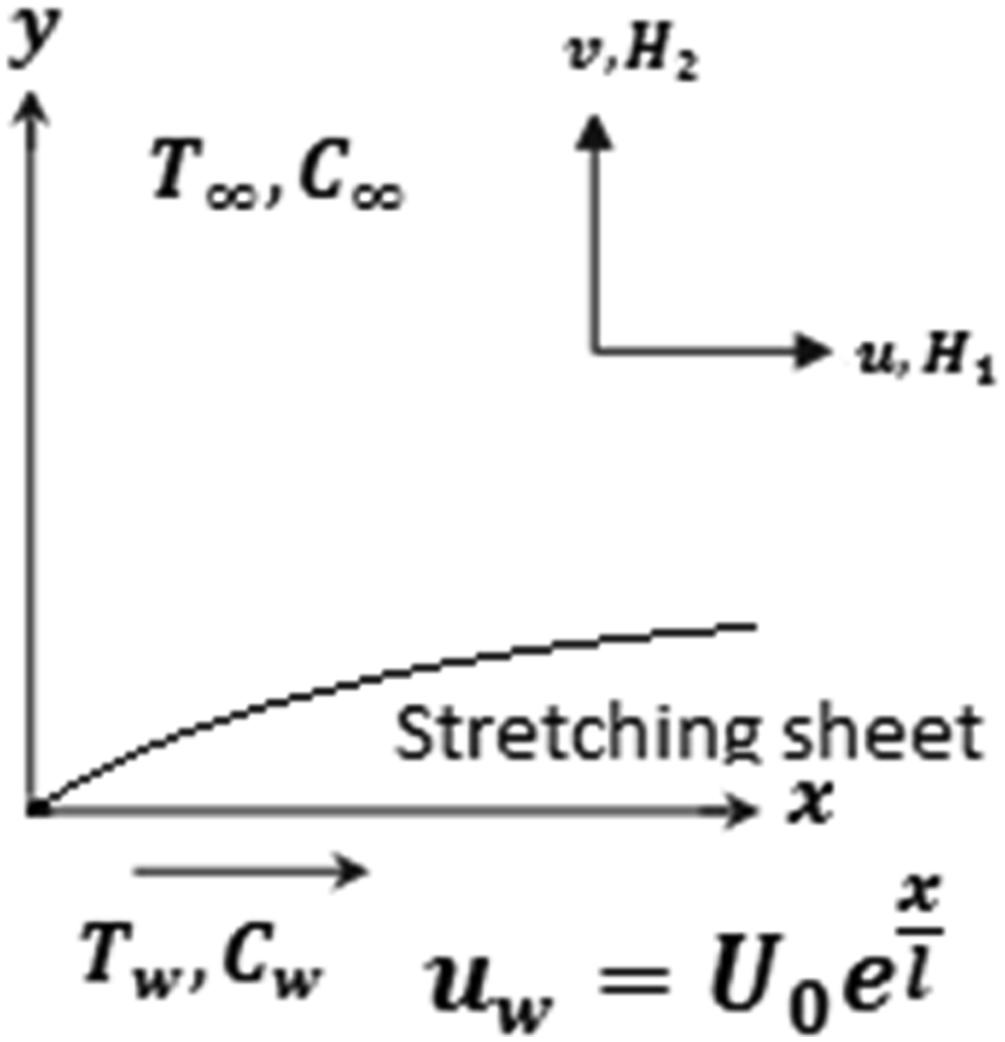
Consider an incompressible, steady of MHD second-grade fluid flow with the consequences of viscous dissipation, induced magnetic field, variable chemical reaction, and thermophoretic effect. The flow of the fluid is along the x-axis. The flow of the fluid is considered by virtue of an exponentially stretched sheet with the velocity . The description of the coordinates and the physical chart are given in Figure 1.
Coordinates and the physical chart.
By using the upper suppositions, the boundary-layer equations are
Here and are defined as
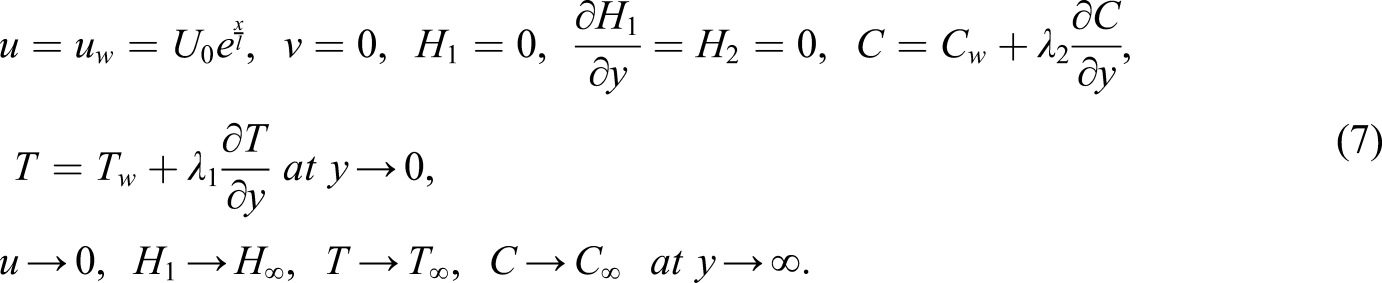
Here, , , , , , , , , , , , , , , , , and are the fluid density, kinematic viscosity, thermal conductivity, magnetic permeability, second-grade parameter, magnetic diffusivity of the nanofluid, component of the induced magnetic field along the x-axis, component of the induced magnetic field component along the y-axis, the heat capacity, coefficient of Brownian motion, thermophoresis coefficient, ambient temperature, fluid dynamic viscosity, fluid viscosity, fluid thermal conductivity, small parameter, and chemical reaction coefficient, respectively. The boundary conditions are
Here, .
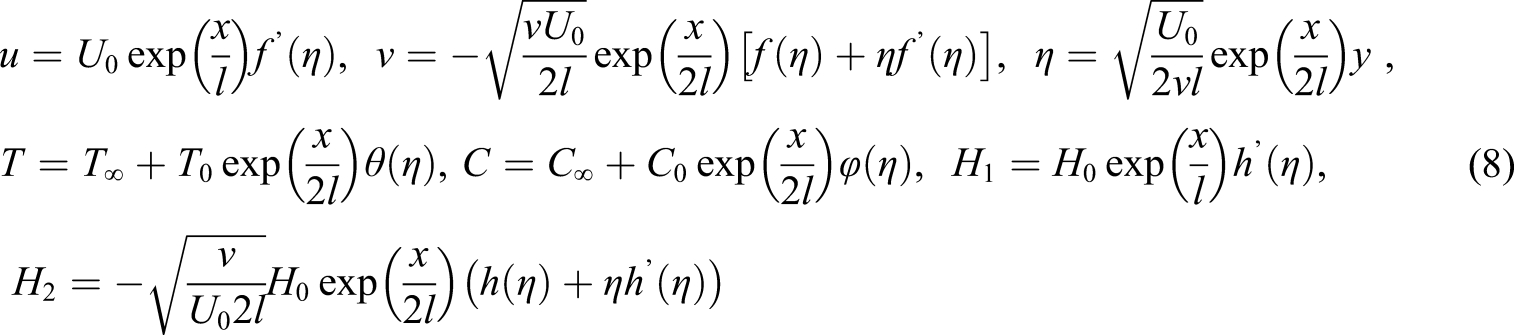
Following are the similarity transformations
After using the above similarity transformations (8), the PDEs (3)–(6) are transformed into the following ODEs (9)–(12)
The corresponding boundary conditions are as follows
(second-grade parameter), (magnetic field parameter), (Prandtl number), (magnetic Prandtl number), (parameter of Brownian motion), (thermophoresis effect parameter), (Smith number), (thermophoretic effect parameter), and (concentration difference parameter).
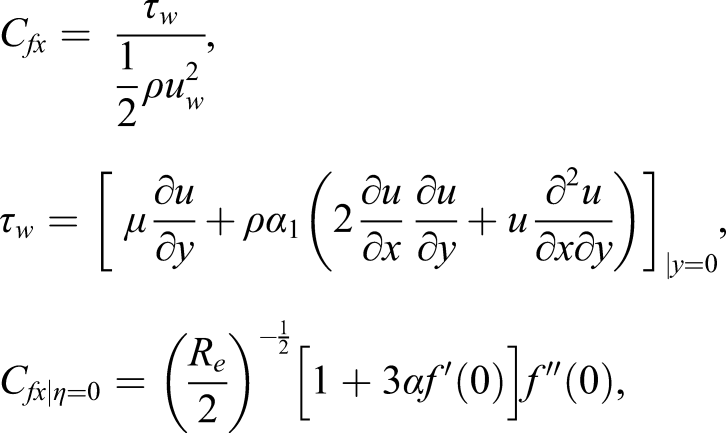
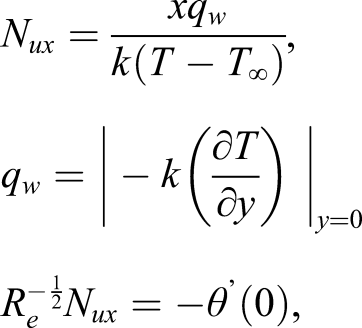
The expressions of the physical quantities of interests like skin friction, Nusselt number, and Sherwood number are defined as
Results and discussion
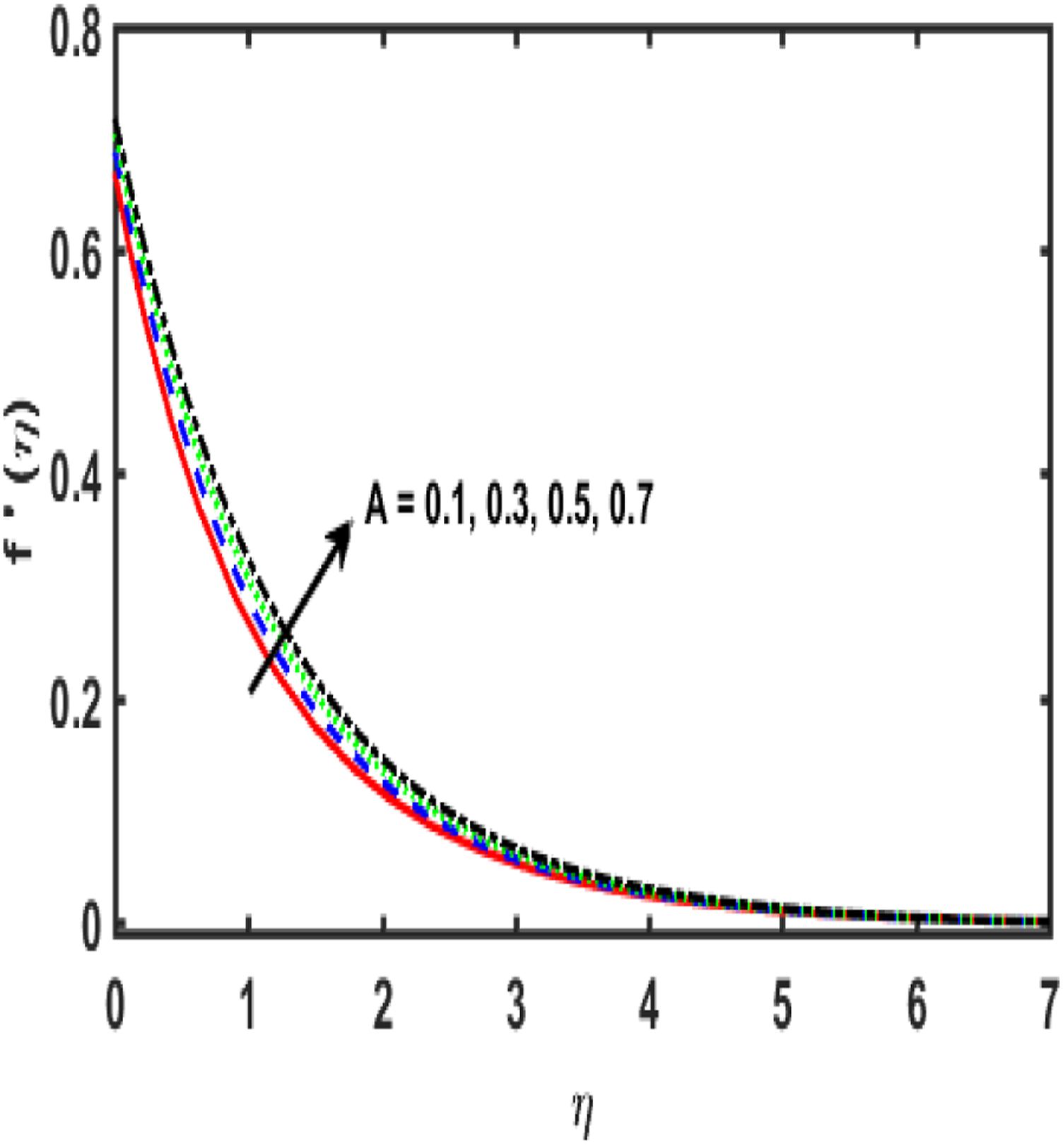
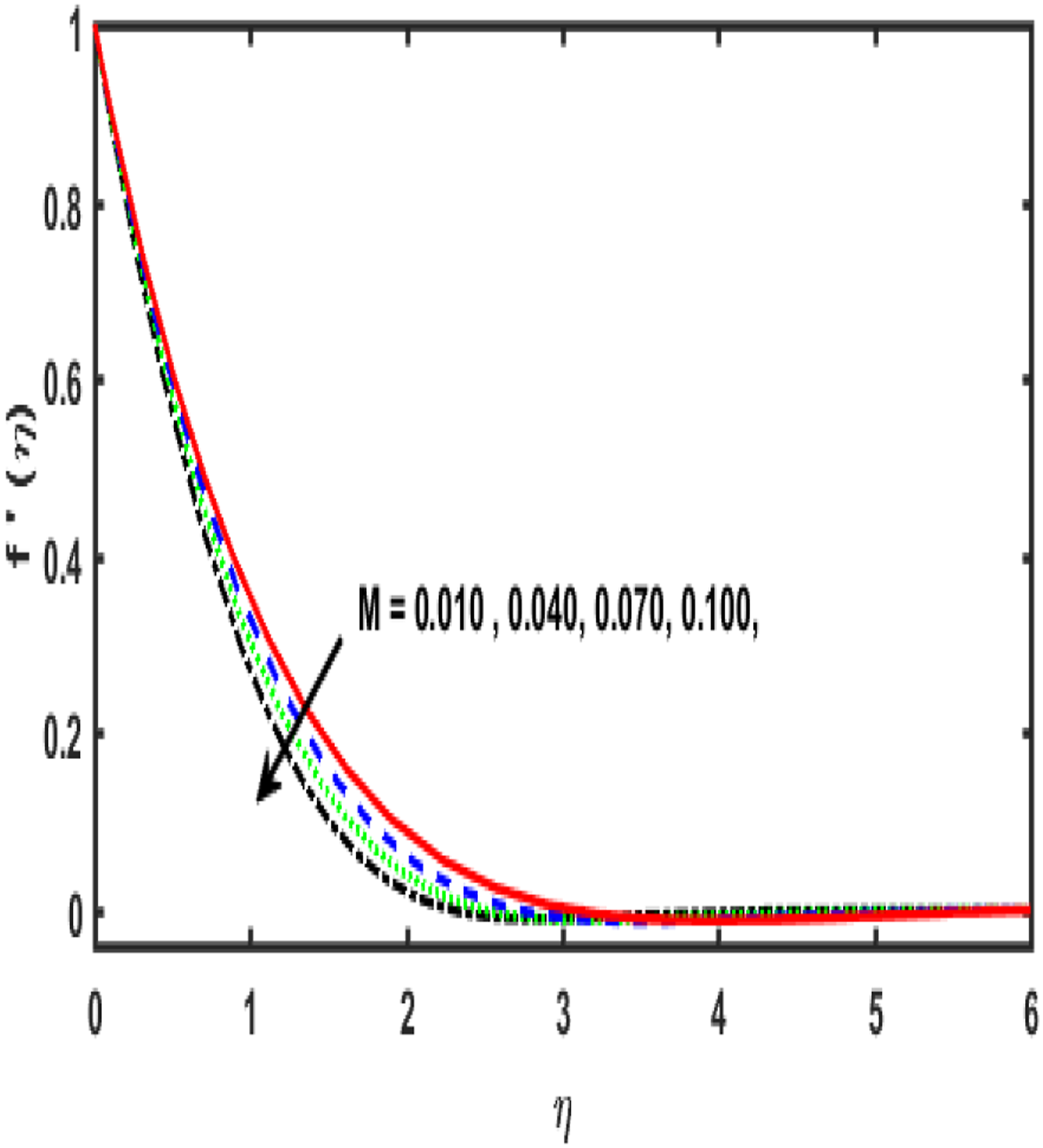
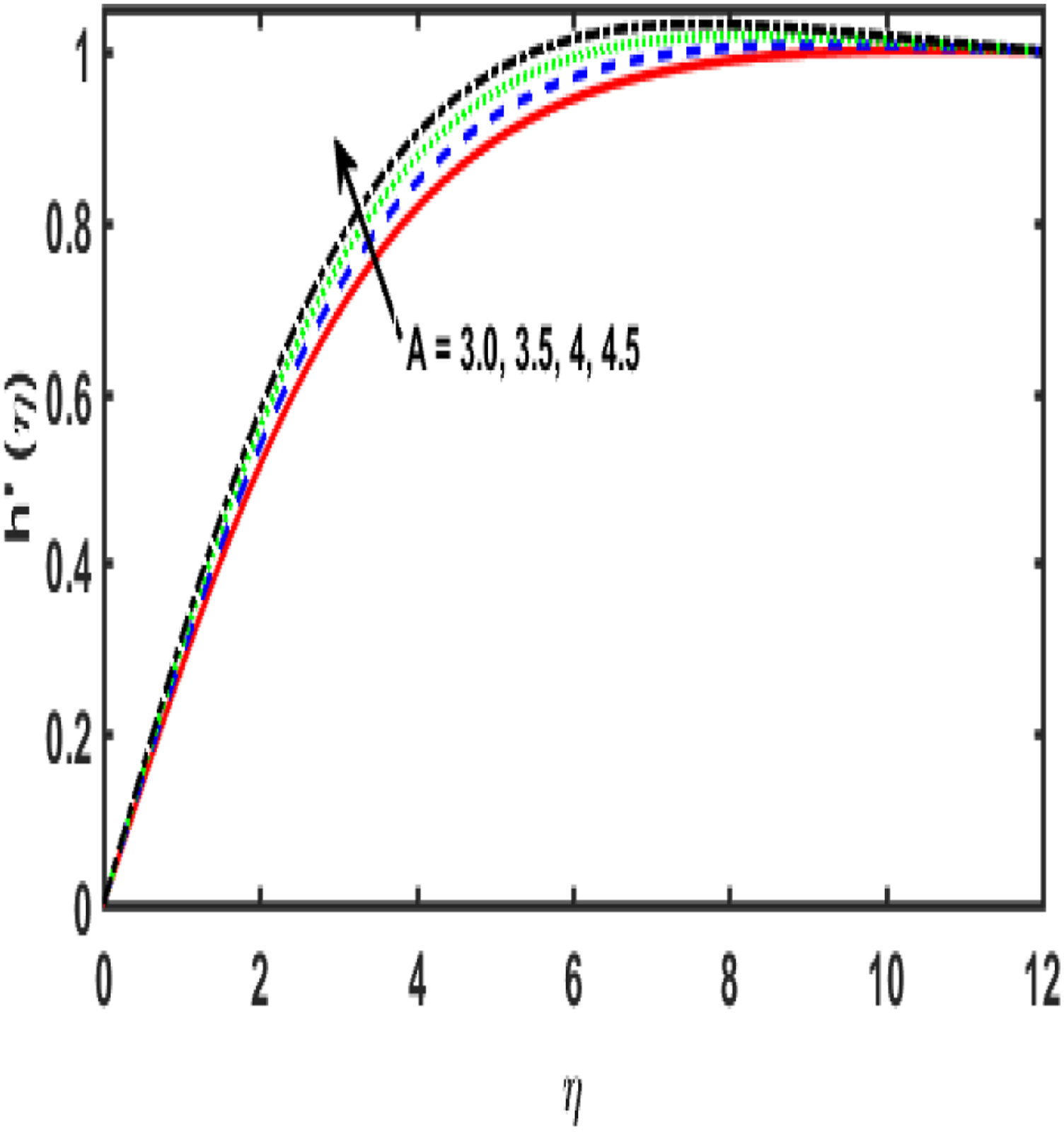
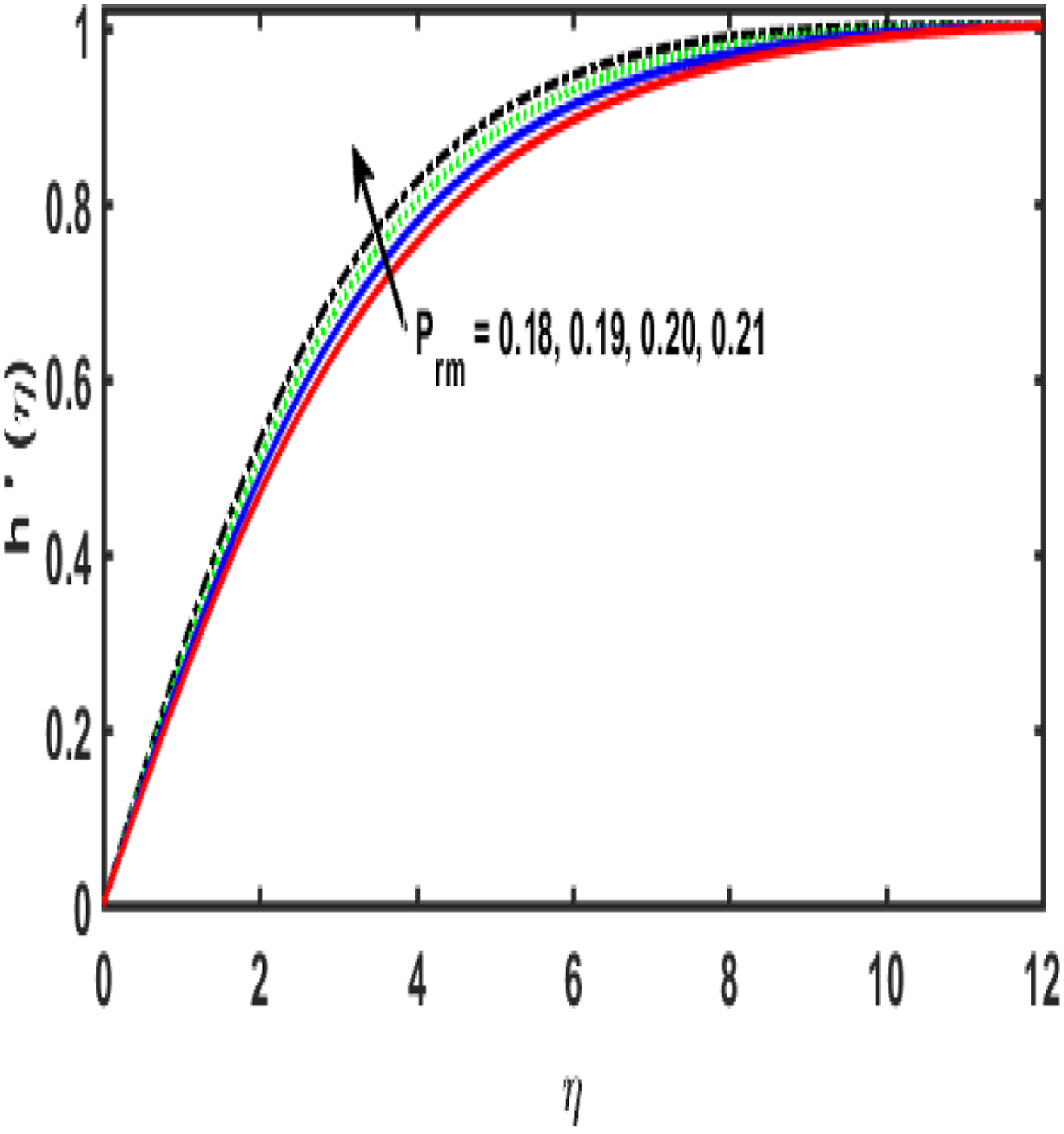
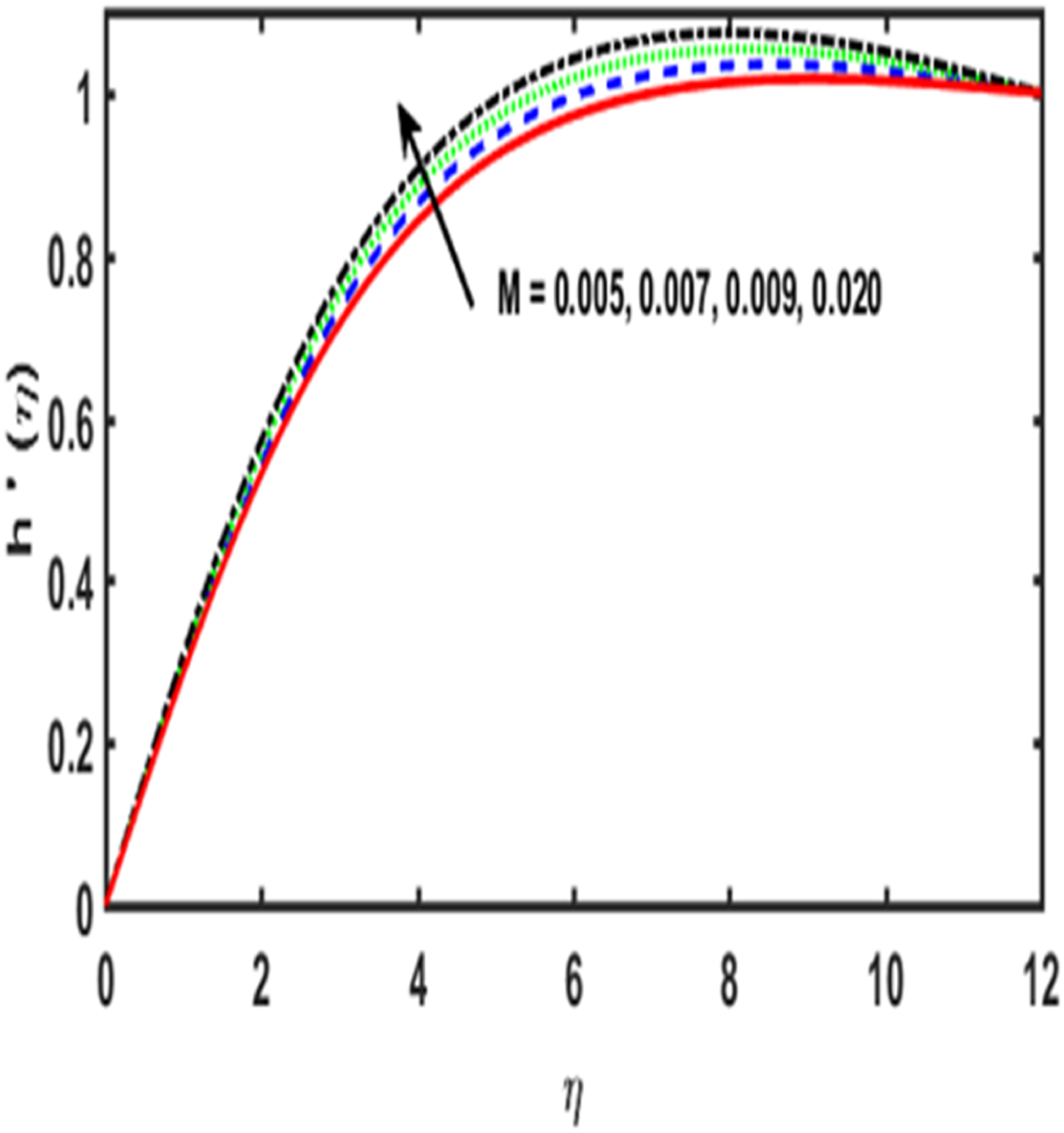
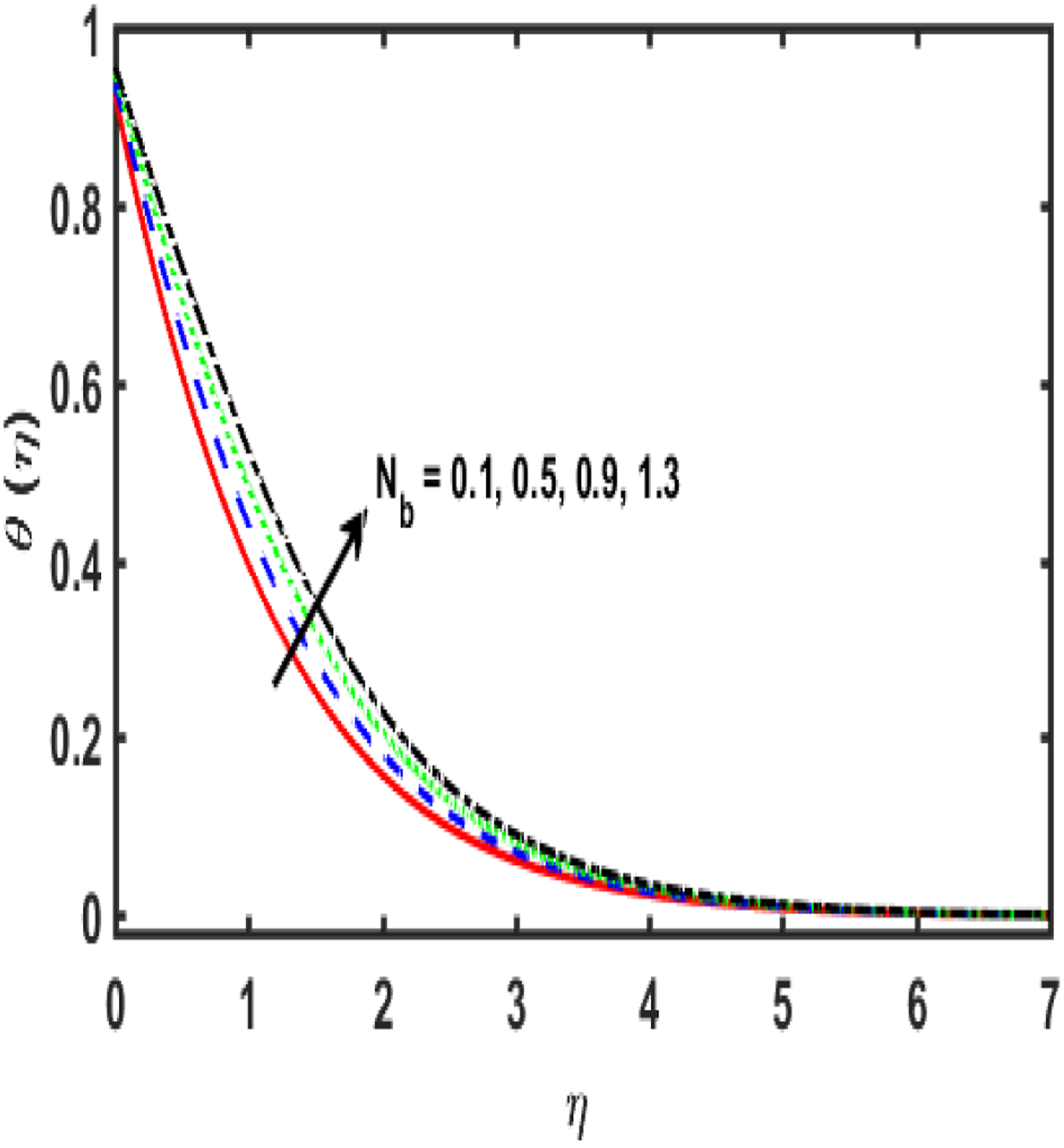
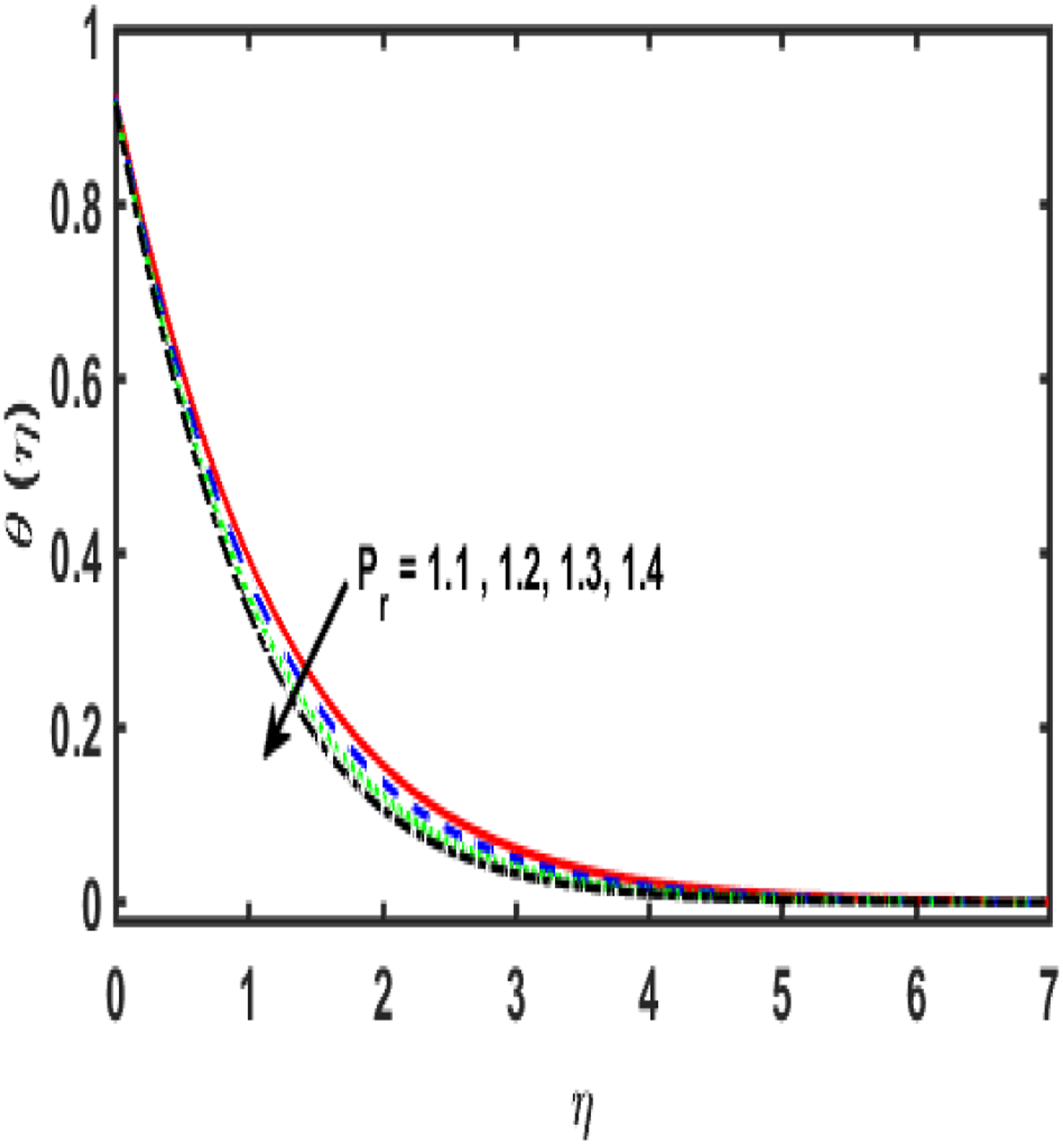
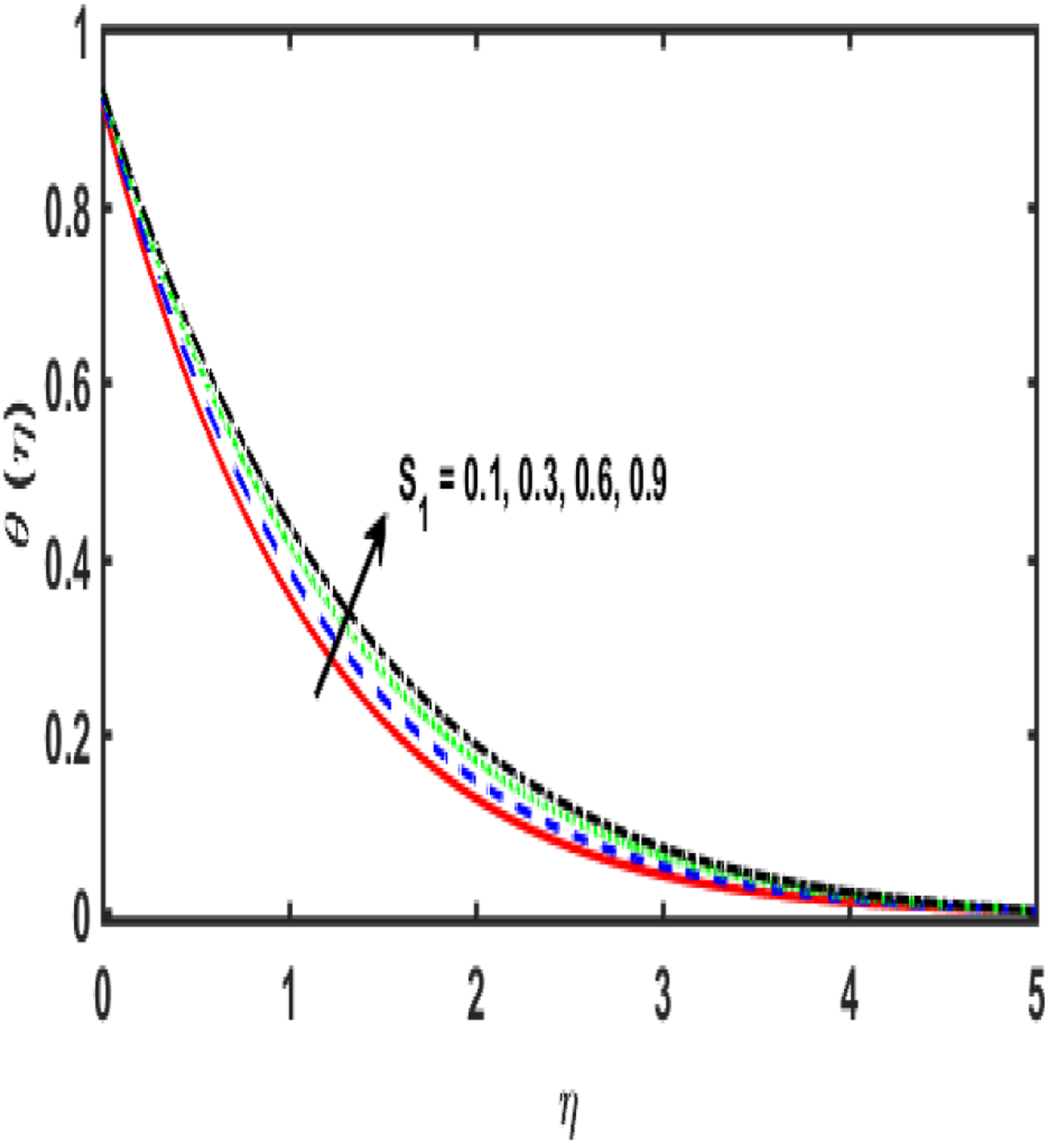
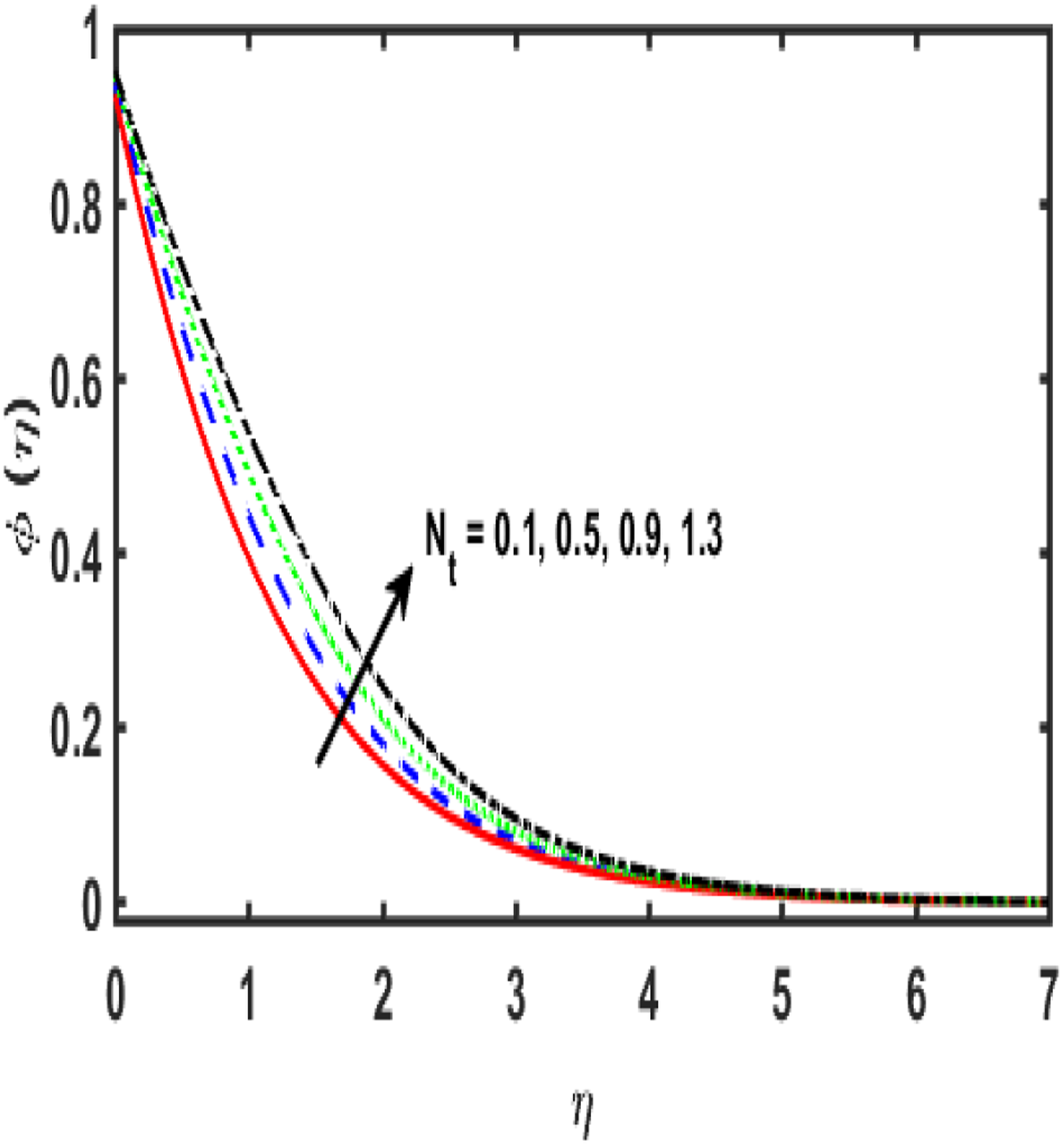
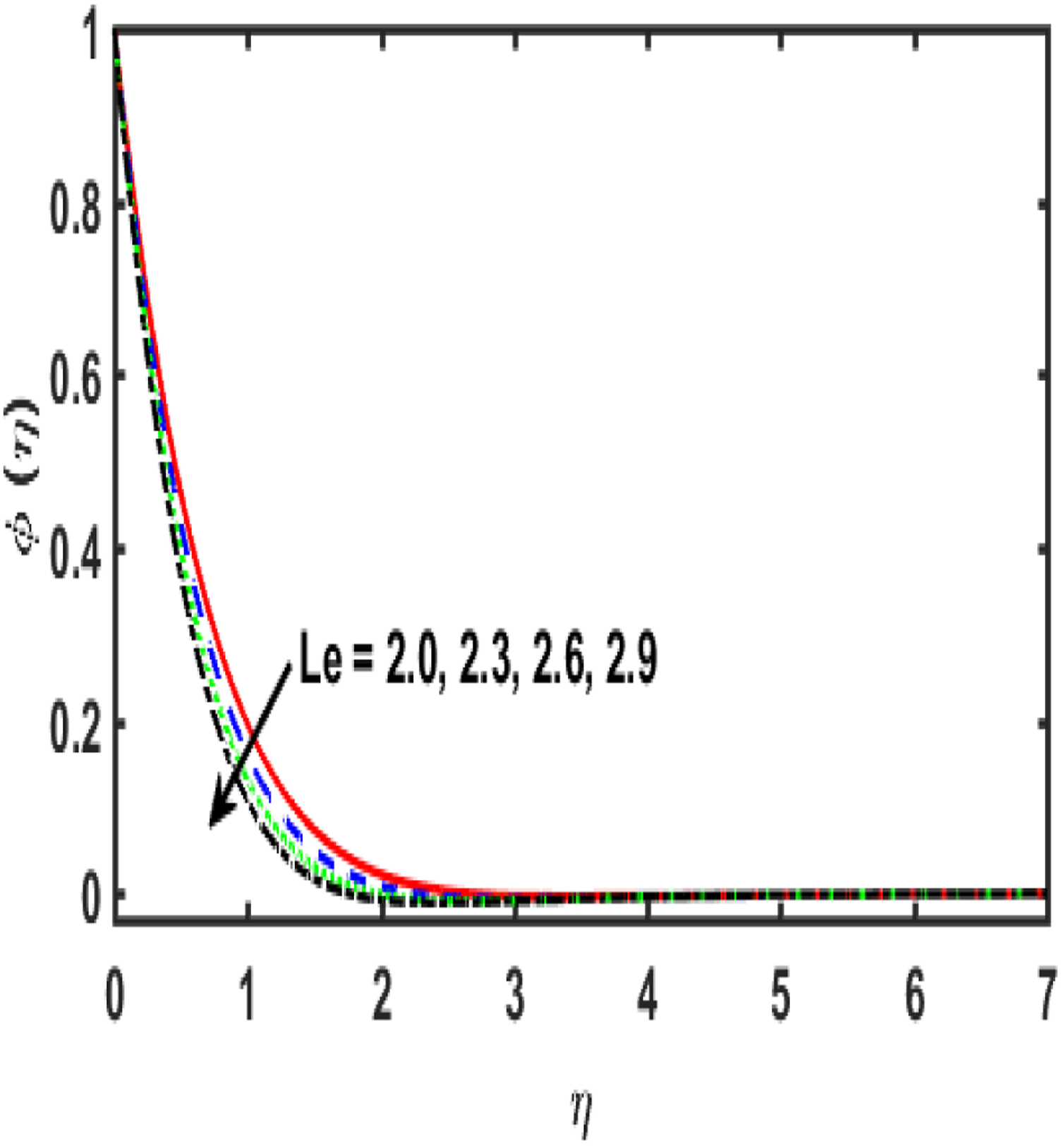
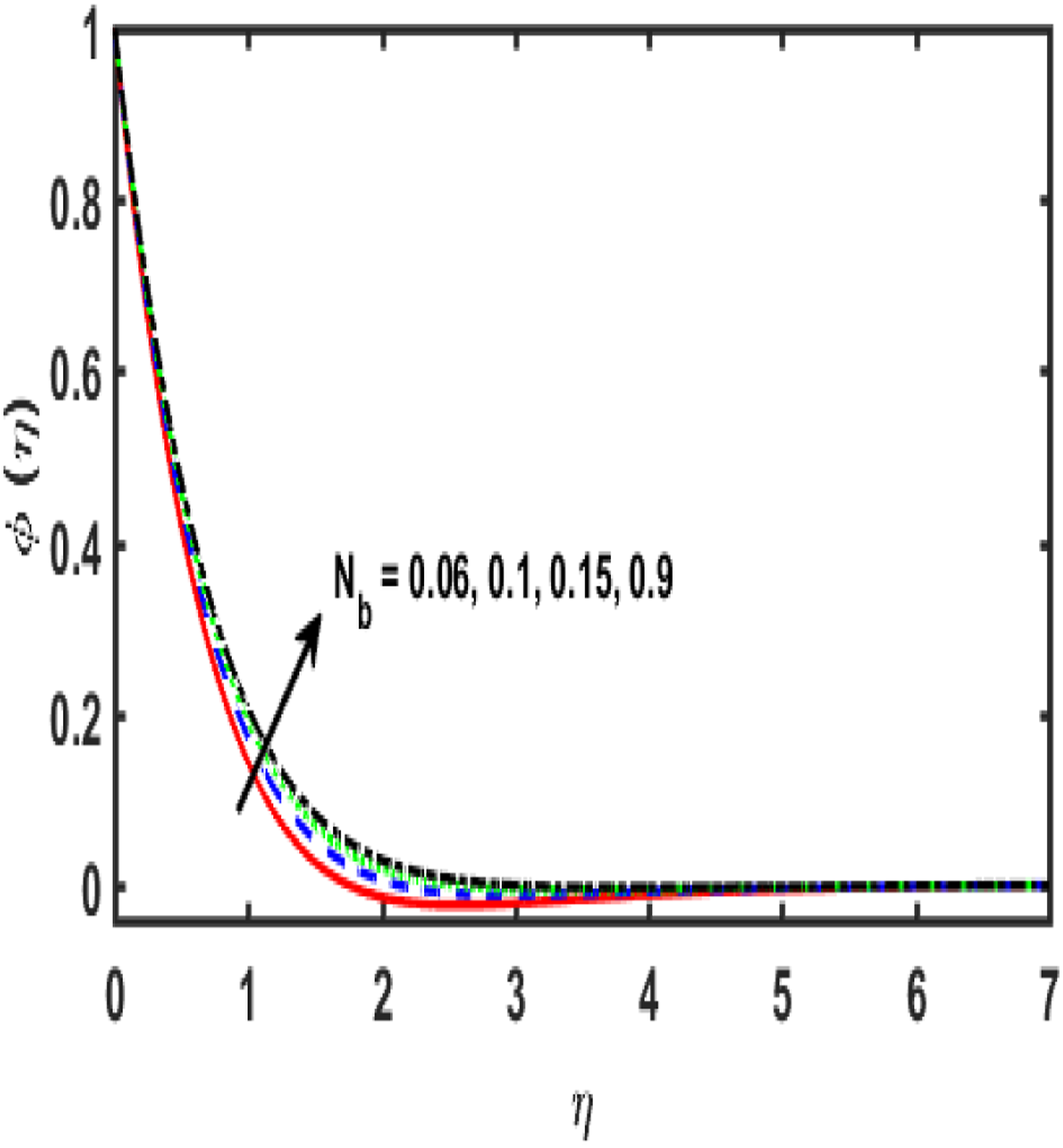
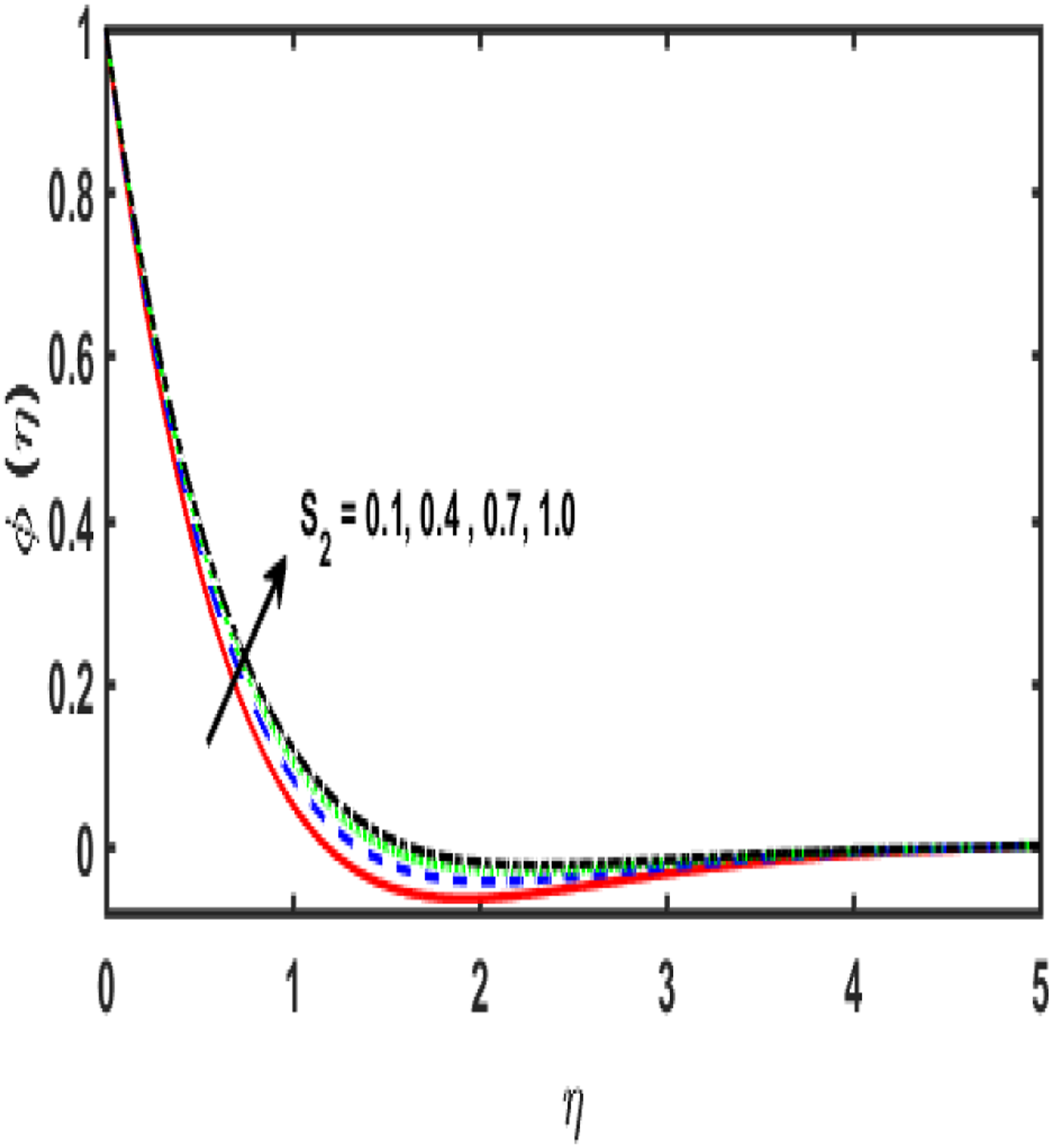
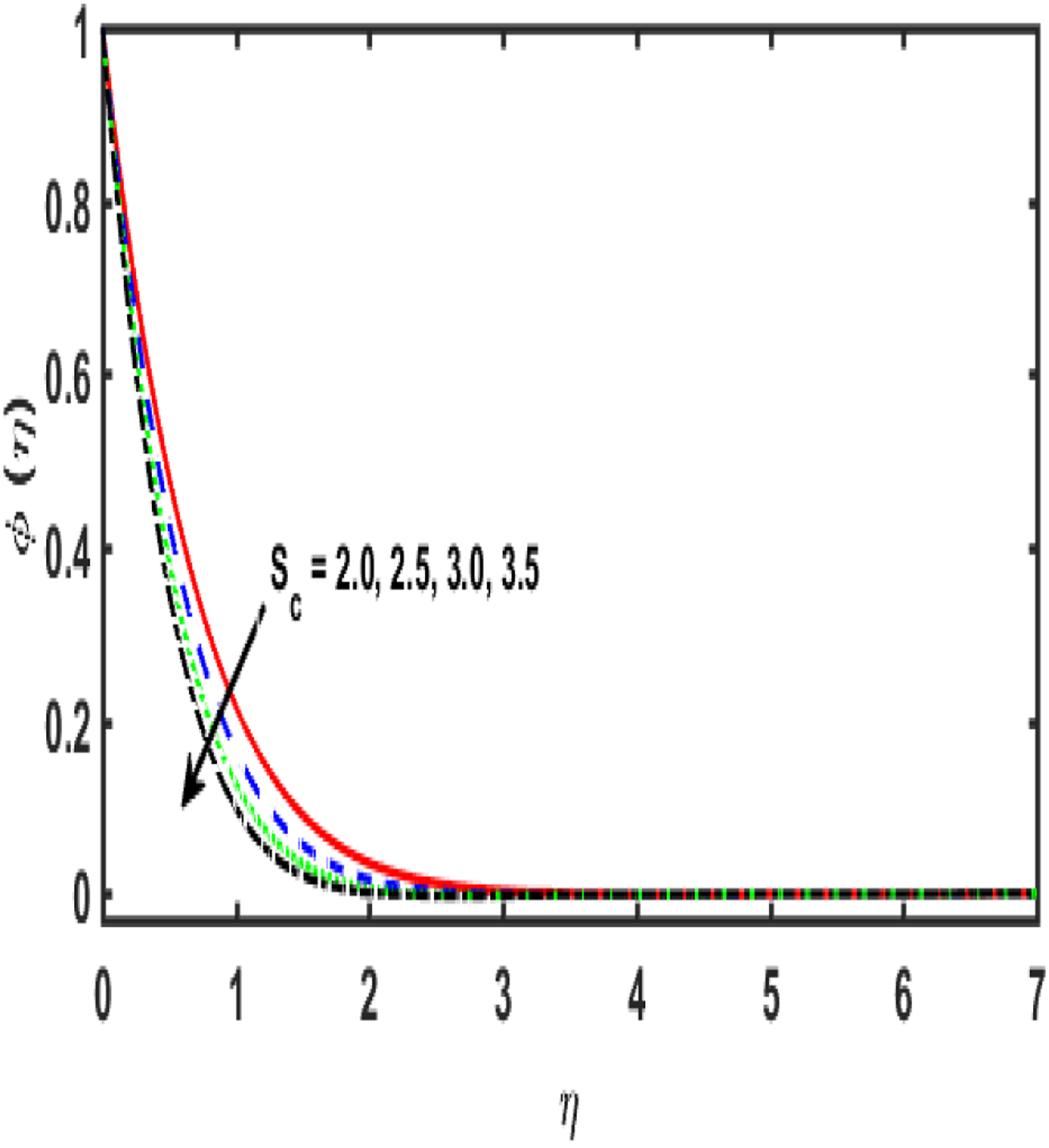
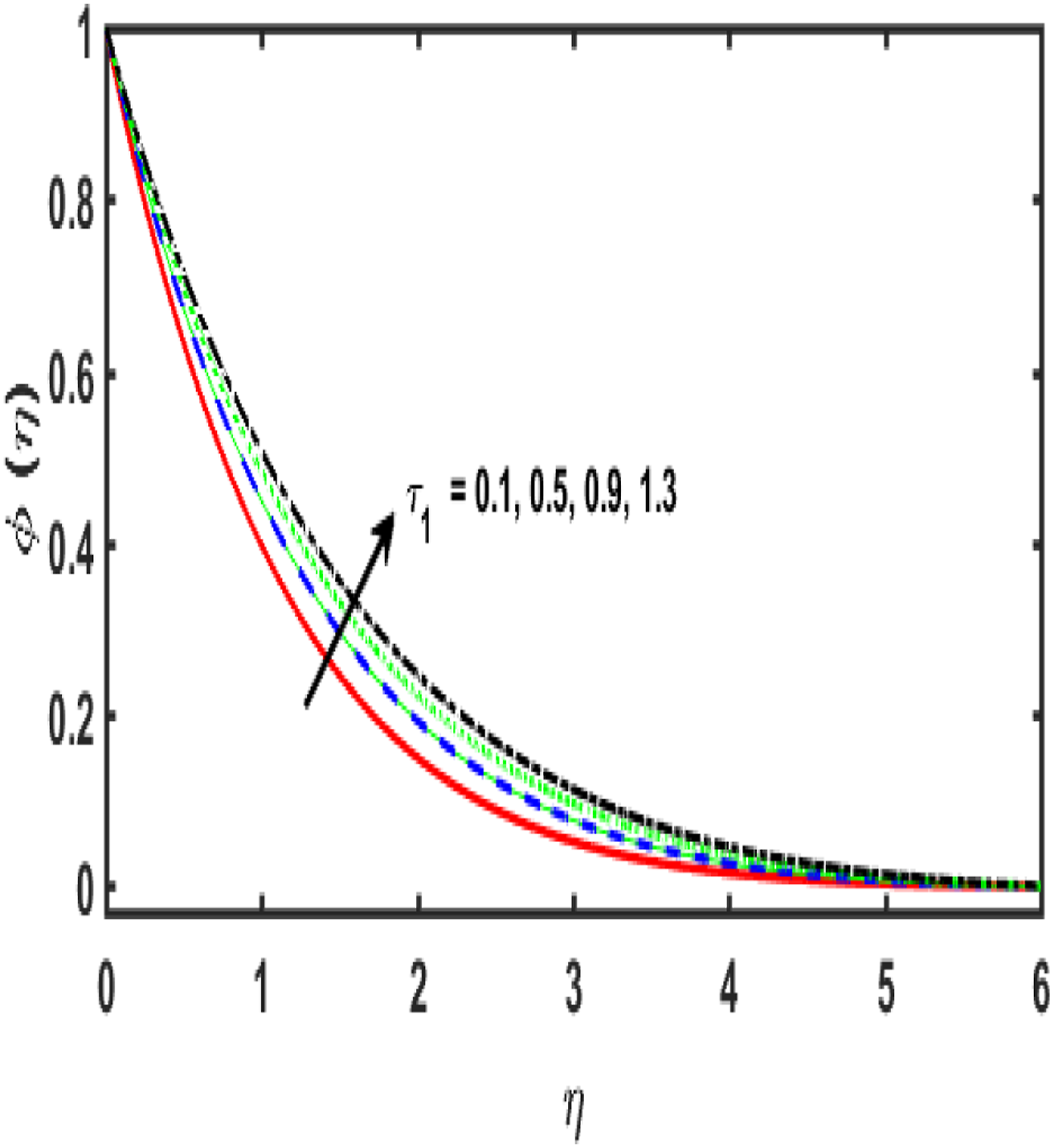
The second-grade fluid flow analysis of induced magnetic flow over an exponentially stretching sheet is taken into account. The model is developed under flow assumptions, and solved through a numerical technique. The graphical results are observed and effects are highlighted in Figures 2–15. Figure 2 presented the variation of and . It is prominent that declined due to higher values of . It means that thickness of the boundary layer reduced for higher values of the material parameter because the stress applied resists strain and shear flow linearly. These phenomena reduce the velocity profile because the thickness of the fluid is enhanced. Figure 3 displays the variation of with . The thickness of the velocity function declined due to enhancing the values of . The velocity function reduced because Lorentz force resists the decline in flow speed at the surface. Figure 4 presents the variation of the magnetic profile and The magnetic profile is enhanced due to larger values of . The thickness of the magnetic profile enhances with augmented values of the material parameter. The relation of and is revealed in Figure 5. Raising the values of which resist to increase the magnetic profile because thickness of the magnetic profile rised for higher values of . As the induced current density rises due to higher values of due to the effect of these phenomena, the induced magnetic profile thickness is enhanced. The relation of and is revealed in Figure 6. Raising the values of which resist to increase the magnetic profile because thickness of the magnetic profile rised for higher values of . Figure 7 exposes the impacts of on the temperature function . The thermal thickness is enhanced due to higher values of . The Brownian motion parameter increases which enhances the temperature due to stronger molecular motion. Figure 8 depicted the impact of on the temperature function . It is noted that thermal thickness reduced due to enhanced values of . The thickness of the thermal boundary layer is reduced as the Prandtl number rises. The ratio of momentum diffusivity to heat diffusivity is known as the Prandtl number. controls the relative thickening of the motion and heat flux zones in heat transfer problems. Figure 9 highlights the effects of on the temperature function. The temperature function is enhanced due higher values of because the thermal slip is enhanced which enhances the temperature function. The variation of and is presented in Figure 10. The thickness of is enhanced because increased. The distribution of concentrations becomes more non-uniform. Likewise, thermophoresis promotes non-uniformity in the concentration distribution, with a stronger effect at significantly greater concentrations. Figure 11 depicts the impacts of on . It is seen that thickness of is reduced due to higher values of . Physically, the Lewis number is ratio of thermal and mass diffusivity. It is used to describe the flow of fluid in which heat and mass transfers occur simultaneously. The effects of on are revealed in Figure 12. The thickness of concentration profile is enhanced due to enhanced values of because of the movement of the particles from a higher concentration area to lower concentration area. Figure 13 depicts the effects of on . It is noted that the higher values of resist the enhancement of the values of the concentration profile. The concentration profile resisted due to slip of concentration enhances. Figure 14 presents the impacts of on . It is noted that the thickness of the concentration function is reduced due to higher values of . Actually, is directly proportional to the momentum diffusivity and inversely proportional to the mass diffusivity; consequently, the greater values of conformed to the small mass diffusivity which caused decline in the concentration function. Figure 15 depicts the effects of on . The findings show that the concentration distribution gets more non-uniform as the particle size increases which resists the reduction of the values of the concentration profile.
Variation of and A.
Variation of and .
Variation of and .
Variation of and .
Variation of h ' (η) and .
Variation of and
Variation of and
Variation of and
Variation of and
Variation of and
Variation of and
Variation of and
Variation of and
Variation of and
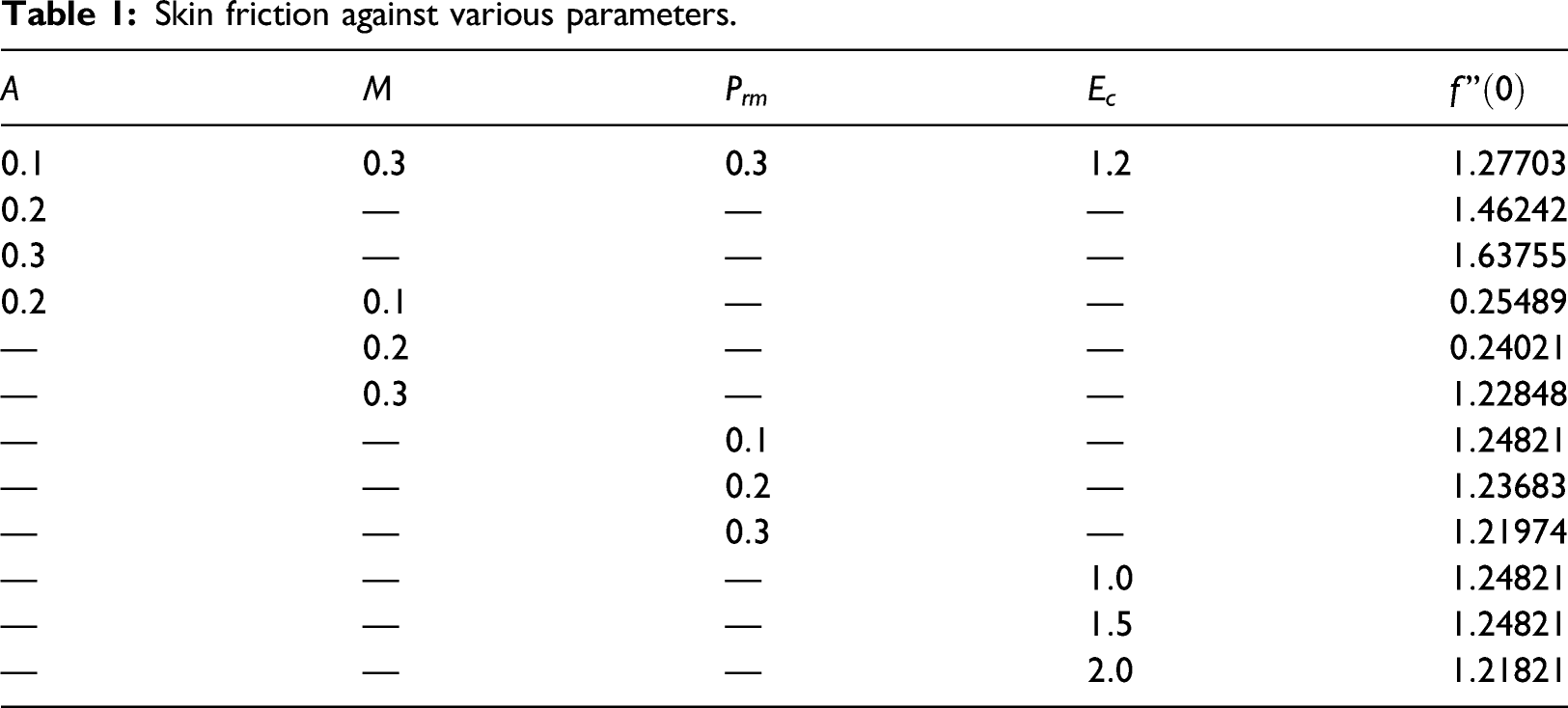
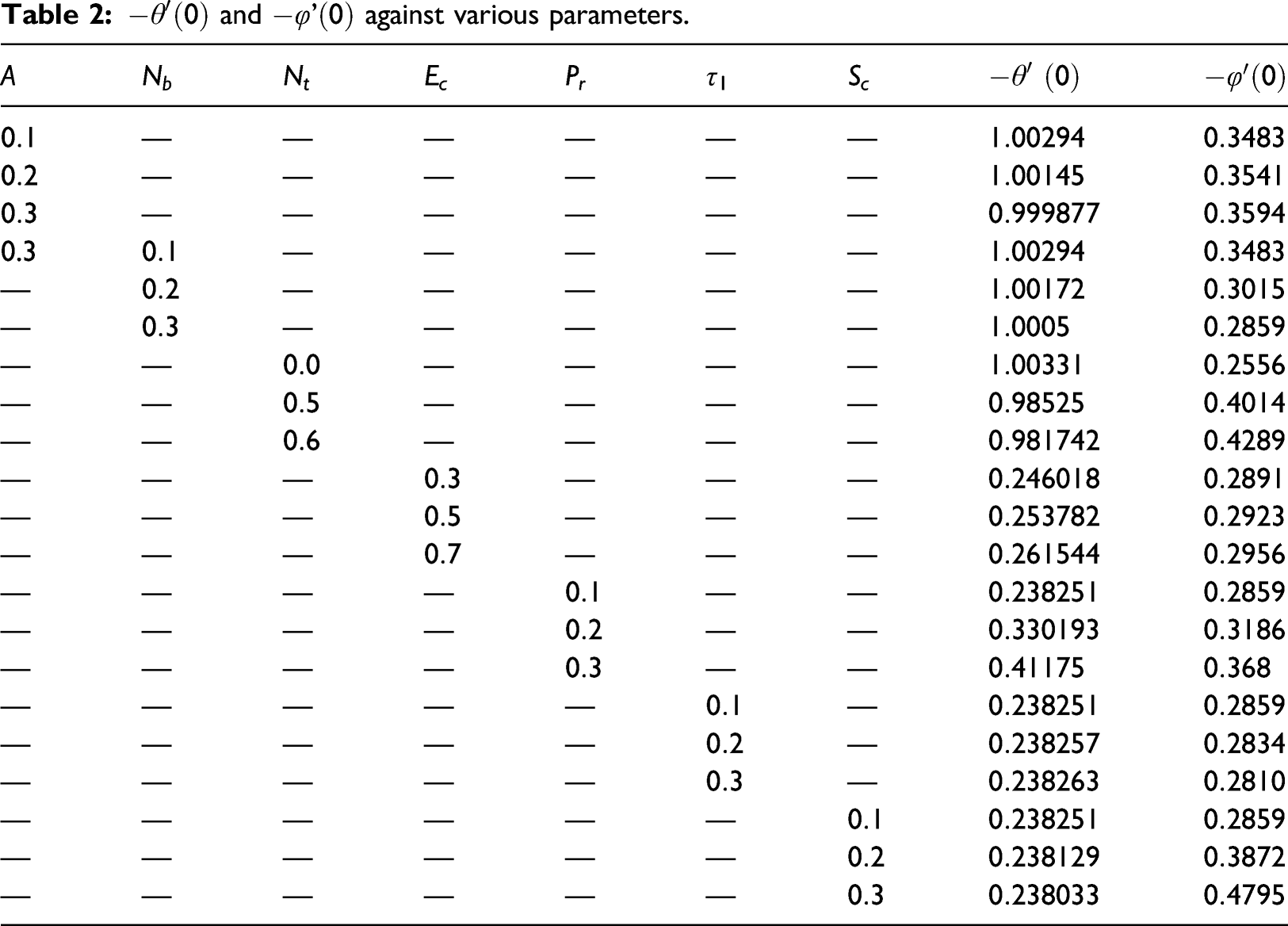
Tables 1–2 presented the effects of physical parameters on , and . The effects of material parameter increased which reduces the skin friction. Because the viscosity of the fluid near the surface enhanced due to enhanced the material parameter which resist to reduce the skin friction. The variation of the skin friction and magnetic field parameter is presented in Table 1. The values of are enhanced due to higher values of . These phenomena reduce the velocity profile because the thickness of the fluid is enhanced due to enhanced skin friction. The impacts of on are highlighted in Table 1. It is observed that skin friction is enhanced for higher values of . It is noted that motion of the fluid reduced which reduces the skin friction due to higher values of . The variation of and is presented in Table 2. There is no variation found between and .
Skin friction against various parameters.
0.3
0.3
1.2
—
—
—
—
—
—
—
—
—
—
—
—
—
—
—
—
—
—
—
—
—
—
—
—
—
—
—
—
—
—
—
—
and against various parameters.
—
—
—
—
—
—
—
—
—
—
—
—
—
—
—
—
—
—
0.3
—
—
—
—
—
—
—
—
—
—
—
—
—
—
—
—
—
—
—
—
—
—
—
—
—
—
—
—
—
—
—
—
—
—
—
—
—
—
—
—
—
—
—
—
—
—
—
—
—
—
—
—
—
—
—
—
—
—
—
—
—
—
—
—
—
—
—
—
—
—
—
—
—
—
—
—
—
—
—
—
—
—
—
—
—
—
—
—
—
—
—
—
—
—
—
—
—
—
—
—
—
—
—
—
—
—
—
The variation of and and which reveals in Table 2. It is noted that values of increase because Brownian motion parameter enhances, which improve the heat transfer rate because the movement of the particles of concentration is from higher area to lower area. The values of increased due to higher values of because the motion of the particle is enhanced which enhances . The ϕ(η) thickness enhances due to enhanced values of because the movement of the particles of concentration is from higher area to lower area. The variation of the and and which reveals in Table 2. It is noted that values of increase with higher values of thermophoresis parameter which increase the heat transfer rate, while the values of decline due to higher values of because the effect becomes more pronounced as the average concentration increases. The impacts of on and are presented in Table 2. It is noted that the values of are enhanced which enhance the heat transfer rate at the contact point of the surface and fluid while the values of increased. The heat transfer reduced due to higher values of The variation of and and which reveals in Table 2. It is noted that values of the increase, while the values of decline due to higher values of . The variation of the and and which reveals in Table 2. It is noted that values of increase, while the values of decline due to higher values of .
Final remarks
We considered the two-dimensional flow of second-grade fluid under the induced magnetic field over an exponential stretching sheet. The variable thermal conductivity and viscous dissipation under the chemical reaction effects at exponentially stretching sheet are discussed in this analysis. The following achievements are highlighted:
• Velocity concentration profile is enhanced due to larger values of but declines for higher values of .
• Material parameter and Prandtl number are enhanced which resist the decrease in the temperature and concentration profiles.
• Magnetic profile is raised due to higher values of the material parameter , , and .
• is enhanced for various values of , but the inverse tendency of the Nusselt number is noticed for larger values of and .
• increases by higher values of , , , , and but declines for larger values of and .
Footnotes
Acknowledgment
The authors extend their appreciation to the Deanship of Scientific Research at King Khalid University for funding this work through research groups program under Grant No. R.G.P.1/183/42.
Declaration of conflicting interests
The author(s) declared no potential conflicts of interest with respect to the research, authorship, and/or publication of this article.
Funding
The author(s) disclosed receipt of the following financial support for the research, authorship, and/or publication of this article: This work was supported by the King Khalid University Grant No. R.G.P.1/183/42.
Appendix
References
1.
DamsehRA. Thermal boundary layer on an exponentially stretching continuous surface in the presence of magnetic field effect. Int J Appl Mech Eng2006; 11(2): 289–299.
2.
IshakA. MHD boundary layer flow due to an exponential stretching sheet with radiation effect. Sains Malays2011; 40(4): 391–395.
3.
ElbashbeshyEMAEmamTGAbdelgaberKM. Effects of thermal radiation and magnetic field on unsteady mixed convection flow and heat transfer over an exponentially stretching surface with suction in the presence of internal heat generation/absorption. J Egypt Math Soc2012; 20(3): 215–222.
4.
NadeemSUl HaqRLeeC. MHD flow of a Casson fluid over an exponentially shrinking sheet. Sci Iran2012; 19(6): 1550–1553.
5.
FerdowsMKhanMAlamM, et al.MHD mixed convective boundary layer flow of a nanofluid through a porous medium due to an exponentially stretching sheet. Math Probl Eng; 2012: 408528. DOI: 10.1155/2012/408528.
6.
HayatTKhanMIWaqasM, et al.Diffusion of chemically reactive species in third grade fluid flow over an exponentially stretching sheet considering magnetic field effects. Chin J Chem Eng2017; 25(3): 257–263.
7.
KhanAANaeemSEllahiR, et al.Dufour and soret effects on darcy-forchheimer flow of second-grade fluid with the variable magnetic field and thermal conductivity. Int J Numer Methods Heat Fluid Flow2020; 30(9): 4331–4347.
8.
RiazMBSaeedSTBaleanuD. Role of magnetic field on the dynamical analysis of second grade fluid: an optimal solution subject to non-integer differentiable operators. J Appl Comput Mech2020; 7(1): 54–68.
9.
HayatTKhanWAAbbasSZ, et al.Impact of induced magnetic field on second-grade nanofluid flow past a convectively heated stretching sheet. Appl Nanosci2020: 10(8): 3001–3009.
10.
AnwarTKumamPAsifaI, et al.An exact analysis of radiative heat transfer and unsteady MHD convective flow of a second‐grade fluid with ramped wall motion and temperature. Heat Transfer2021; 50(1): 196–219.
11.
MagyariEKellerB. Heat and mass transfer in the boundary layers on an exponentially stretching continuous surface. J Phys D: Appl Phys1999; 32(5): 577–585.
12.
ParthaMMurthyPRajasekharG. Effect of viscous dissipation on the mixed convection heat transfer from an exponentially stretching surface. Heat Mass Transfer2005; 41(4): 360–366.
13.
PalD. Mixed convection heat transfer in the boundary layers on an exponentially stretching surface with magnetic field. Appl Math Comput2010; 217(6): 2356–2369.
14.
MukhopadhyayS. Slip effects on MHD boundary layer flow over an exponentially stretching sheet with suction/blowing and thermal radiation. Ain Shams Eng J2013; 4(3): 485–491.
15.
MukhopadhyayS.MHD boundary layer flow and heat transfer over an exponentially stretching sheet embedded in a thermally stratified medium. Alexandria Eng J2013; 52(3): 259–265.
16.
HussainTShehzadSAHayatT, et al.Radiative hydromagnetic flow of Jeffrey nanofluid by an exponentially stretching sheet. Plos One2014; 9(8): e103719.
17.
BégOAKhanMSKarimI, et al.Explicit numerical study of unsteady hydromagnetic mixed convective nanofluid flow from an exponentially stretching sheet in porous media. Appl Nanosci2014; 4(8): 943–957.
18.
VeereshaPPrakashaDGKumarS. A fractional model for propagation of classical optical solitons by using nonsingular derivative. Math Methods Appl Sci2020: 1–15. DOI: 10.1002/mma.6335.
19.
KumarSKumarRCattaniC, et al.Chaotic behaviour of fractional predator-prey dynamical system. Chaos, Solitons & Fractals2020; 135: 109811.
20.
KumarSAhmadianAKumarR, et al.An efficient numerical method for fractional SIR epidemic model of infectious disease by using Bernstein wavelets. Mathematics2020; 8(4): 558.
21.
KumarSKumarRMomaniS, et al.A study on fractional COVID‐19 disease model by using Hermite wavelets. Math Methods Appl Sci2021. DOI: 10.1002/mma.7065.
22.
ChoiSUEastmanJA. Enhancing Thermal Conductivity of Fluids with Nanoparticles (No. ANL/MSD/CP-84938. CONF-951135-29). IL (United States): Argonne National Lab., 1995.
23.
KhanWAPopI. Boundary-layer flow of a nanofluid past a stretching sheet. Int Journal Heat Mass Transfer2010; 53(11–12): 2477–2483.
24.
MakindeODAzizA. Boundary layer flow of a nanofluid past a stretching sheet with a convective boundary condition. Int J Therm Sci2011; 50(7): 1326–1332.
25.
RanaPBhargavaR. Flow and heat transfer of a nanofluid over a nonlinearly stretching sheet: a numerical study. Commun Nonlinear Sci Numer Simulation2012; 17(1): 212–226.
26.
HadyFMIbrahimFSAbdel-GaiedSM, et al.Radiation effect on viscous flow of a nanofluid and heat transfer over a nonlinearly stretching sheet. Nanoscale Res Lett2012; 7(1): 229–313.
27.
RashidiMMVishnu GaneshNAbdul HakeemAK, et al.Buoyancy effect on MHD flow of nanofluid over a stretching sheet in the presence of thermal radiation. J Mol Liquids2014; 198: 234–238.
28.
GireeshaBJUmeshaiahMPrasannakumaraBC, et al.Impact of nonlinear thermal radiation on magnetohydrodynamic three dimensional boundary layer flow of Jeffrey nanofluid over a nonlinearly permeable stretching sheet. Physica A: Stat Mech Its Appl2020; 549: 124051.
29.
GhanbariBKumarSKumarR. A study of behaviour for immune and tumor cells in immunogenetic tumour model with non-singular fractional derivative. Chaos, Solitons & Fractals2020; 133: 109619.
30.
Doungmo GoufoEFKumarSMugishaSB. Similarities in a fifth-order evolution equation with and with no singular kernel. Chaos, Solitons & Fractals2020; 130: 109467.
31.
KumarSKumarRAgarwalRP, et al.A study of fractional lotka‐volterra population model using haar wavelet and adams‐bashforth‐moulton methods. Math Methods Appl Sci2020; 43(8): 5564–5578.
32.
KumarSGhoshSSametB, et al.An analysis for heat equations arises in diffusion process using new yang‐abdel‐aty‐cattani fractional operator. Math Methods Appl Sci2020; 43(9): 6062–6080.
33.
KumarSChauhanRPMomaniS, et al.Numerical Methods for Partial Differential Equations, 2020, DOI: 10.1002/num.22707.