



Abstract
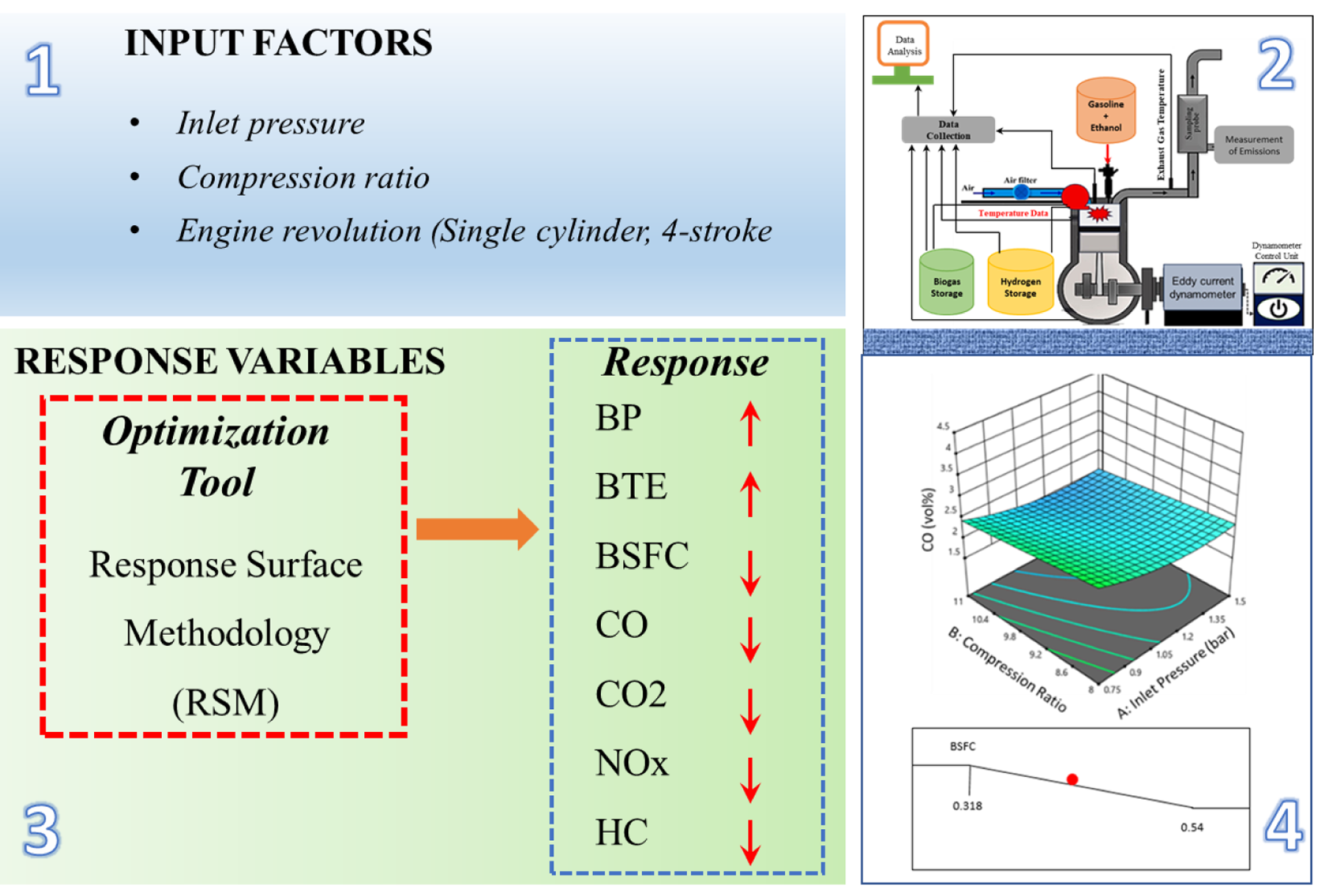
This study investigated the performance and emission behavior of a spark-ignition (SI) engine fueled with a novel four-component hybrid blend comprising 40% gasoline, 20% ethanol, 20% biogas, and 20% hydrogen, and optimized the operating parameters using a cubic Response Surface Methodology (RSM) framework. Unlike earlier works limited to binary or ternary blends, this research introduced a synergistic fuel mixture that combined the high flame speed of hydrogen, the oxygenated combustion of ethanol, and the renewable carbon fraction of biogas. Experimental tests were conducted on a spark ignition engine across a wide range of inlet pressures (0.75–1.5 bar), compression ratios (8–11), and engine speeds (1000–4000 rpm). Performance (BP, BTE, BSFC) and emission parameters (CO, CO2, NOx, HC) were modeled using RSM, and all regression models exhibited excellent adequacy (R2 > 0.97), confirming strong predictive strength. The best working conditions were 1.5 bar inlet pressure, 10.9 compression ratio and 3330 rpm. These conditions provided the maximum brake power (35.37 kW), brake thermal efficiency (25.89%), and the minimum BSFC (0.33 kg/kWh). Oxidation occurred at a faster pace with hydrogen and ethanol, and the speed at which flames propagated also increased, which reduced the emissions of CO and HC significantly. Nevertheless, the increase in the NO emissions increased slightly at higher temperatures. The integrated optimization produced a desirability index of 0.779, which showed that it was a good balance between improving efficiency and controlling emissions. The study showed that a hydrogen-assisted gasoline–ethanol–biogas blend burned steadily and without knocking, with better performance and less pollution. This showed that there is a way to run SI engines cleaner and more sustainably.
Get full access to this article
View all access options for this article.