Natural gas (NG) is an attractive fuel for heavy-duty internal combustion engines because of its potential for reduced CO2, particulate, and NOX emissions and lower cost of ownership. Pilot-ignited direct-injected NG (PIDING) combustion uses a small pilot injection of diesel to ignite a main direct injection of NG. Recent studies have demonstrated that increased NG premixing is a viable strategy to increase PIDING indicated efficiency and further reduce particulate and CO emissions while maintaining low CH4 emissions. However, it is unclear how the combustion strategies relate to one another, or where they fit within the continuum of NG stratification. The objective of this work is to present a systematic evaluation of pilot combustion, NG combustion, and emissions behavior of stratified-premixed PIDING combustion modes that span from fully-premixed to non-premixed conditions. A sweep of the relative injection timing, , of NG and pilot diesel was performed in a heavy-duty PIDING engine with = 140–220 bar, = 0.47–0.71, and a constant NG energy fraction of 94%. Apparent heat release rate and emissions analyses identified interactions between the pilot fuel and NG, and qualitatively characterized the impact of NG stratification on combustion and emissions. Changes in the resulted in six distinct PIDING combustion regimes, for all considered injection pressures and equivalence ratios: (i) RIT-insensitive premixed, (ii) stratified-premixed (early-cycle injection), (iii) NG jet impingement transition, (iv) stratified-premixed (late-cycle injection), (v) variable premixed fraction, and (vi) minimally-premixed. Parametric definitions for the bounds of each regime of combustion were valid for the wide range of and investigated, and are expected to be relevant for other PIDING engines, as previously identified regimes agree with those identified here. This conceptual framework encompasses and validates the findings of previous stratified PIDING investigations, including optimal ranges of operation that provide significantly increased efficiency and lower emissions of incomplete combustion products.
The transportation sector accounts for 28% of global end-user energy consumption, of which on-road heavy-duty vehicles (HDVs) are responsible for one quarter of green house gas (GHG) emissions.1 Moreover, by the year 2030, on-road freight activity is forecasted to grow 25%.2 Filling these transportation needs while simultaneously reducing GHG emissions is critical and will require implementation of advanced propulsion technologies with a high level of technical readiness.
One approach to reduce GHG emissions is through fuel carbon intensity reduction by implementing fuels that inherently produce less CO2 in combustion. Natural gas (NG) is composed primarily of CH4 which can result in up to 25% lower CO2 emissions compared to conventional fossil fuels such as diesel. NG has also demonstrated the potential to reduce other harmful emissions such as particulate matter (PM) and NOX in commercial HDV applications.3,4 Life-cycle analysis suggests a net reduction of GHG emissions of 10%–15% is realistic for HDVs where diesel is replaced by NG.1 Spark-ignition (SI) and pilot-ignition (PI) of fumigated (i.e. homogeneously premixed) NG are relatively simple strategies for heavy-duty NG engines, however they suffer from low thermal efficiency, , and high unburned hydrocarbon (uHC) emissions relative to direct-injection technologies, particularly at low load.5 Because CH4 is a potent GHG,1 emissions of uHCs from NG engines can result in net increases of GHG emissions when conventional diesel applications are converted to NG.6,7 Four major sources of uHC emission from premixed engines are commonly identified: (i) crevice volume quenching, (ii) slow flame extinction, (iii) wall quenching, and (iv) direct blow-through due to valve overlap.8,9 The most significant of these sources are crevice volume quenching and slow flame extinction, which are effectively addressed by using direct-injection (DI).9
Pilot-ignited direct-injection NG combustion (PIDING) uses a late-cycle pilot injection of diesel (approximately 5% of total fuel energy) followed by a main injection of NG which reacts predominantly in non-premixed combustion. Pilot-ignition provides robust, multi-point ignition of the NG, overcoming the issues of weak early-flame development and high cycle-to-cycle variability (CCV), which limits direct-injection SI (DISI) technology.10 Non-premixed PIDING combustion allows for higher compression ratios, providing high efficiency and low uHC emissions at the cost of increased PM and NOX emissions relative to fumigated systems.3,11 While the main PIDING combustion process is typically characterized as non-premixed combustion, a portion of the NG reacts in a rapid partially-premixed mode in parallel to establishment of a quasi-steady jet flame.12 The fraction of fuel converted in the partially-premixed fraction is predominantly controlled by the relative injection timing () of the NG with respect to the pilot, defined here as:
where and are the start of injection of NG and the diesel pilot, respectively.
In conventional PIDING operation, pilot auto-ignition is typically complete prior to the injection of NG, requiring . This minimizes the residence time of NG prior to the start of the partially-premixed NG combustion. However, several investigations have demonstrated that significant advantages in emissions and efficiency can be achieved by increasing the NG residence time and promoting more premixed combustion by reducing the to negative values. To this end, two general approaches have been considered: (i) slightly premixed combustion (SPC) modes using moderate reduction of from conventional non-premixed PIDING values (e.g. Faghani et al.,13 McTaggart-Cowan et al.14,15), and (ii) stratified-premixed PIDING modes where one or more NG injections are performed during the compression stroke to generate highly premixed conditions (e.g. Florea et al.,16,17 Li et al.18). For both these strategies, late-cycle is used for fast-response combustion phasing control.
SPC was studied by Faghani et al.13 with −2 ms < RIT <+2 ms by retarding the (operating conditions with RIT were designated SPC modes). For an optimized SPC mode, a 90% reduction in PM and a 2% increase of gross indicated efficiency, , were measured relative to a conventional high-load PIDING operating condition without significant NOX or CH4 emissions penalties. The decreased PM emissions were attributed to the increased NG residence time prior to NG ignition resulting in a reduction of the mass of NG with equivalence ratio, , in the PM formation region (2 5). The reduced PM formation was experimentally validated by in-cylinder 2D pyrometric imaging, which showed a lower peak soot volume fraction as the was reduced to SPC conditions.19 In earlier studies, increased efficiency and reduction of CO and PM was also observed for similar SPC operating conditions, which were attributed to higher peak apparent heat release rate (AHRR) and reduced combustion duration for SPC modes.14,15 In all of these studies, exhaust gas re-circulation (EGR) was required to mitigate NOX emissions for SPC modes. The major drawbacks of the SPC mode were indicated to be increased CCV (measured as COV of peak cylinder pressure, ) and greater combustion harshness measured by the maximum rate of pressure rise (RoPR). At low- and mid-load conditions, moderate increases of CH4 emissions were also observed with slight decreases in .14,15
PIDING combustion using up to −35 crank angle degrees (CAD) after top dead center (aTDC) (earlier than SPC modes) was investigated by Florea et al.16 who established the co-direct injection (DI2) combustion strategy. In DI2, the end of NG injection () occurs well before pilot injection and auto-ignition. As for the SPC investigations, increased efficiency with decreased PM and CO relative to non-premixed PIDING combustion was observed. Furthermore, CCV was deemed acceptable with COV(IMEP) limited to less than 2%. Relative to fumigated NG operation, a 75% reduction in the emissions of unburned CH4 was achieved, however emissions became excessive for CAD aTDC. This was attributed to the lower piston bowl position at early crank angles resulting in poor targeting of the NG fuel jets and significant penetration of NG into the crevice volumes. In a follow-up investigation, a narrower NG injection angle was successfully used to reduce unburned CH4 emissions and increase efficiency for early .17 Similar observations regarding the importance of the piston position for DI fuel mixing processes have been made for wall-guided DISI engines (e.g. Yadollahi and Boroomand,20 Baratta and Rapetto21).
Splitting the main NG injection into early- and late-cycle injections has also been considered as a strategy to control NG stratification. Li et al.18 report an increase in efficiency and reduction of PM and CO when a greater fraction of the NG (50%–90%) is injected in the first of two injections. Munshi et al.22 investigated a similar split NG injection strategy with the NG pre-injection occurring during the intake stroke and an early pilot injection similar to reactivity controlled compression ignition (RCCI) combustion. Experimental investigation and numerical simulation suggested that the increased turbulent mixing rates produced by the late NG injection supported higher flame propagation speeds and reduced CH4 emissions.22 The importance of injection-generated turbulence for enhancing flame propagation speeds and therefore reducing slow flame extinction and increasing combustion efficiency has also been reported for several DISI investigations.23–25 These findings are of particular importance to stratified PIDING combustion due to the low flame propagation speed of lean CH4-air mixtures which exacerbates slow flame extinction and uHC emissions.
Common to all stratified and lean-burn DI combustion strategies is the importance of controlling fuel stratification using the main fuel injection timing. For SI applications this is typically defined as the fuel residence time between either the start or end of injection until the spark-timing.21,25,26 In the case of pilot-ignited applications, either the has been used,12–15 and/or the time delay between the main fuel injection and ignition12 to characterize the fuel stratification.
In the case of PIDING systems, the combustion processes and engine performance have been found to be extremely sensitive to fuel stratification. In-cylinder OH*-chemiluminescence (OH*-CL) imaging of PIDING combustion showed that the combustion process changed from a quasi-steady jet flame, to rapid distributed-ignition, to flame propagation as the was set at +1.3 ms, +0.3 ms, and −1.0 ms, respectively.12 Numerical simulation indicates that parallel processes of flame propagation, diffusion, and jet-momentum induced mixing occur in DI2 combustion.16 Numerical investigation of early-cycle injections from −180 to −30 CAD aTDC indicate flame propagation is the dominant process.18 Characterizing additional engine control parameters affecting fuel stratification and identifying the conditions under which certain combustion processes are dominant is critical to continue development of further optimized stratified DING combustion.
In addition to the NG stratification, several studies have concluded that complex interactions between the NG jet and pilot jet and ignition are critical to PIDING combustion performance.27–29 Using a rapid compression-expansion machine (RCEM), Fink et al.28 demonstrated that for positive where pilot ignition occurs undisturbed by the NG jet, a wide range of relative spray angles can be used to produce robust NG ignition. However, when there is temporal overlap of the pilot and NG jets (i.e. short and/or negative ), thermal and chemical quenching of the pilot reactions by the much larger NG jet can produce significant increases in the pilot ignition delay and distance of pilot ignition from the injector.28,29 Because these factors modify ignition timing and location, they have an impact on the NG stratification and ultimately the NG combustion process(es) that ensue. These observations were demonstrated for an unbounded pilot and NG fuel jet pair (i.e. there was no piston bowl or chamber walls), which the authors acknowledged as an important caveat.
While no single NG stratification strategy has been identified as optimal under all engine operating conditions, there is potential for increased efficiency, with low PM, CO, and CH4 emissions as part of a PIDING mixed-mode strategy. Despite the demonstrated advantages, relatively few investigations of these stratified PIDING combustion modes have been performed. As a result, conclusions regarding the role of NG stratification and pilot-NG jet interactions on combustion performance are not well linked between these investigations. The factors impacting the transition between the distinct combustion regimes that have been identified as a function of are also not well characterized in terms of the fundamental combustion conditions such as the NG mixture stratification. This work addresses these gaps as a pre-requisite for further development and optimization of stratified-PIDING combustion technology.
Objectives & outline
To support development of higher efficiency PIDING engines with low emissions, this work aims to survey the stratified-PIDING combustion strategies that can be achieved by controlling the NG residence time through adjustment of . The objectives of this survey are to:
Identify PIDING combustion regimes that exist as a function of and/or NG residence time (i.e. NG stratification), where a regime is considered a domain of that exhibits consistent sensitivity of pilot combustion, NG combustion, and emissions behavior to major engine control parameters: , , and .
Define and characterize generally-applicable (i.e. not engine-specific) PIDING combustion metrics that identify transitions between the identified combustion regimes.
Use the identified combustion regimes and regime transition definitions to connect the limited stratified-premixed PIDING literature (SPC and DI2) to conventional NG combustion technologies (i.e. fumigated dual-fuel and non-premixed PIDING).
Motivate and guide future in-cylinder optical investigations of NG mixture formation, ignition, and NG combustion processes
In the initial results section, an overview of the sensitivity of major engine performance parameters to is presented. In the main discussion, the NG stratification is characterized using the NG residence time, , and the . The impact of , , and pilot-NG interactions on PIDING pilot and NG ignition, NG combustion, and emissions are presented for early- and late-cycle NG injections, separately. Finally, a summary of six identified PIDING combustion regimes and the novel parameters developed to describe the transitions between these regimes is presented. These combustion regimes span from conventional non-premixed PIDING to fully-premixed pilot-ignited NG combustion (dual-fuel). Stratified PIDING strategies identified in the literature (SPC and DI2) are also incorporated into the summary of PIDING combustion regimes, which augments descriptions of the distinctions between stratified PIDING combustion strategies.
Experimental facility & measurement description
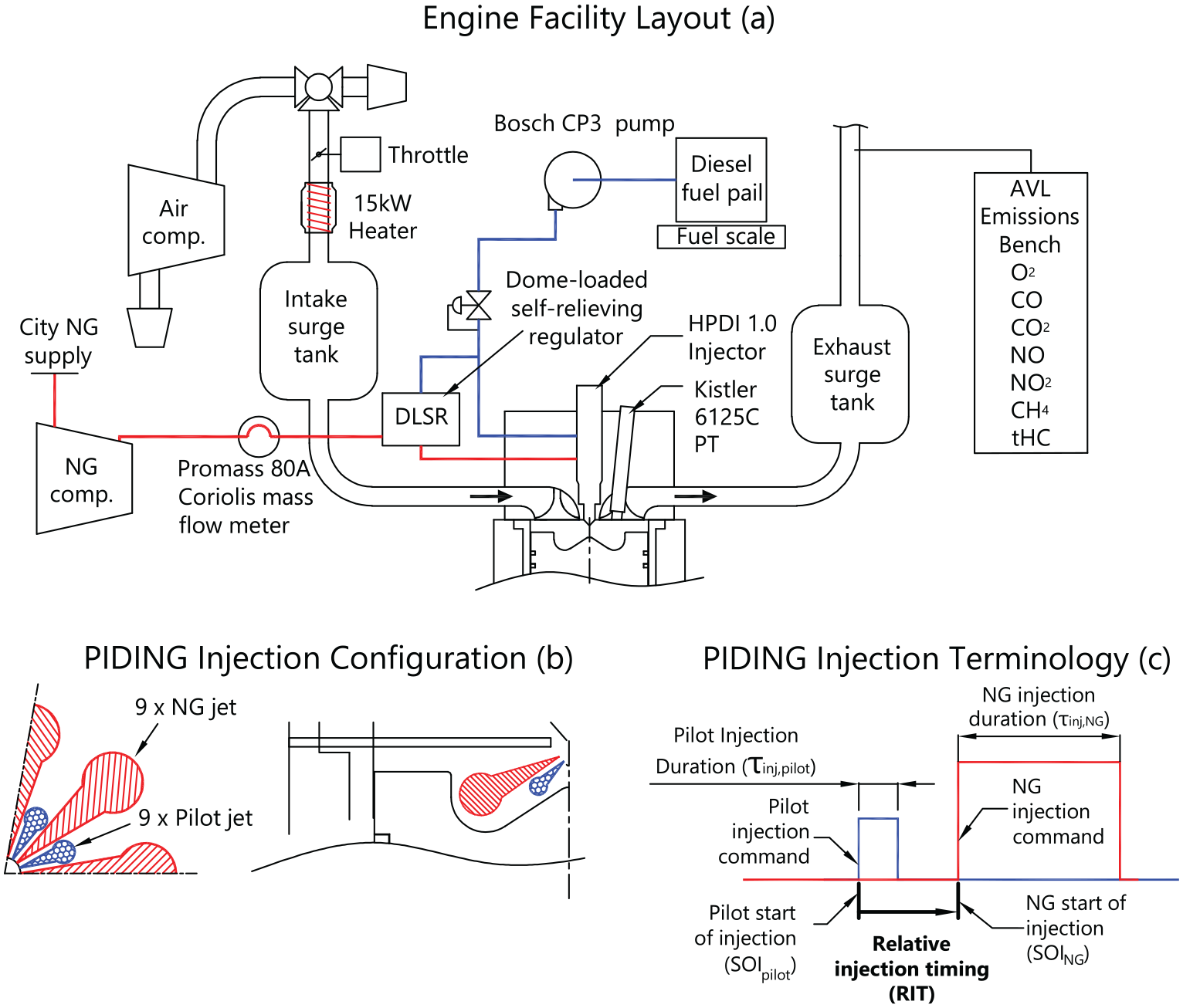
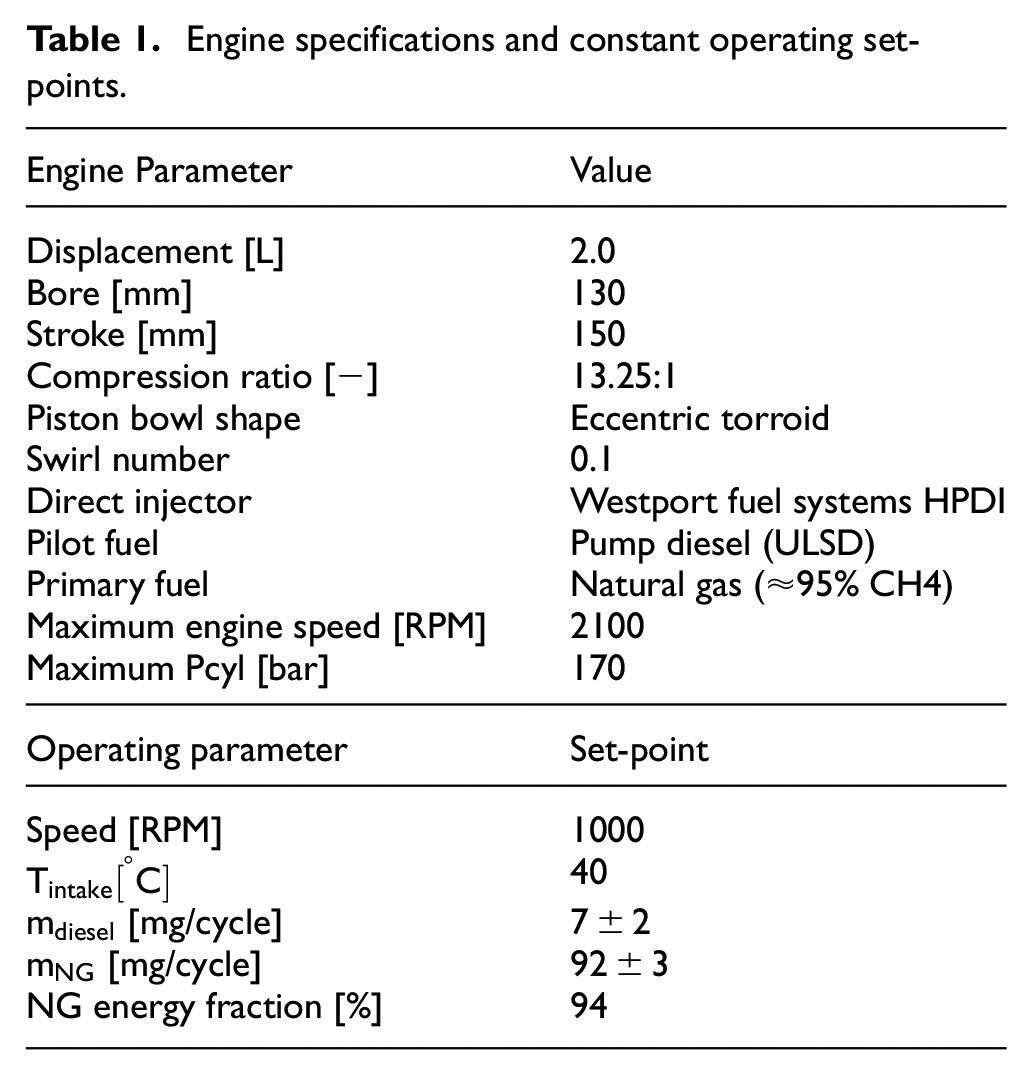
The experimental facility used in this investigation is based on a 2.0 L, single-cylinder, Ricardo Proteus engine. This facility can be operated in either a “thermodynamic” or “optical” configuration. In the thermodynamic configuration, a production aluminum piston is used, while in the optical configuration a Bowditch piston arrangement provides a large optical access to the combustion chamber.30 In the current work, only the thermodynamic configuration is considered; however, injection imaging results from the optical engine configuration are used to calculate the actual and . Future work will apply the optical configuration to provide more detailed characterization of combustion regimes identified here. An overview of the facility is given in Figure 1 and specifications are provided in Table 1.
(a) Single-cylinder engine facility schematic, (b) injector spray configuration, and (c) important PIDING injection nomenclature.
Engine specifications and constant operating set-points.
Engine Parameter
Value
Displacement [L]
2.0
Bore [mm]
130
Stroke [mm]
150
Compression ratio [−]
13.25:1
Piston bowl shape
Eccentric torroid
Swirl number
0.1
Direct injector
Westport fuel systems HPDI
Pilot fuel
Pump diesel (ULSD)
Primary fuel
Natural gas ( CH4)
Maximum engine speed [RPM]
2100
Maximum Pcyl [bar]
170
Operating parameter
Set-point
Speed [RPM]
1000
40
[mg/cycle]
7 ± 2
[mg/cycle]
92 ± 3
NG energy fraction [%]
94
To study PIDING combustion, the research engine was fitted with a first generation Westport Fuel Systems (WFS) High-Pressure Direct-Injection injector (HPDI) and dome-loaded self-relieving regulator (DLSR). The HPDI injector was designed by WFS for non-premixed combustion and uses independently actuated concentric needles to control the flow of the pilot fuel and NG. Combined with a custom programmable engine control unit (ECU), this fuel system allows arbitrary relative injection timing of the diesel and NG injections. The pilot and NG injection delays were characterized using in-cylinder Mie scattering imaging, and all analyses presented in the current work apply the actual injection timings (i.e. the injector delays are accounted for). The injector is mounted vertically and concentric to the piston bowl. The nozzle provides nine equally-spaced NG orifices and nine pilot diesel orifices midway between each NG orifice. Diesel rail pressure is controlled by the operator while the DLSR maintains the NG rail pressure at 8 bar below the diesel rail pressure to maintain stable injector operation. In all subsequent discussion, the injection pressure, , refers to the diesel rail pressure. Note that to accommodate both optical and thermodynamic configurations, the research engine has somewhat larger crevice regions and other simplifications compared to a modern heavy-duty diesel engine. As a result, unburned fuel and partial combustion product emissions can be higher than would be seen in an optimized production PIDING engine.
Definition of measurement conditions
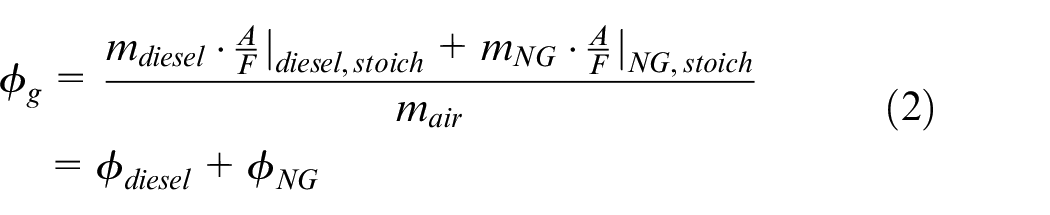
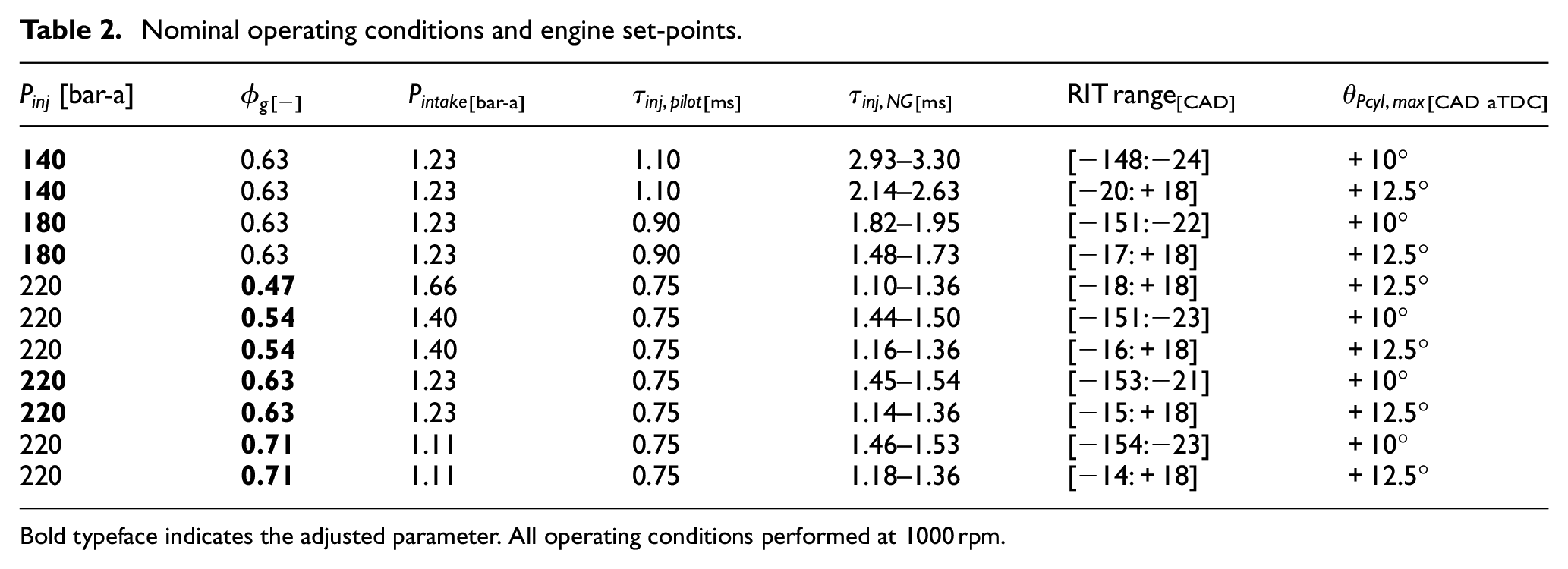
The primary engine control parameter used to characterize stratified PIDING combustion modes is the relative injection timing, , of the NG with respect to the pilot diesel (see equation (1) and Figure 1). To investigate a broad range of , was varied from −170 to −4.0 CAD aTDC. Very early (i.e. −170 CAD aTDC) were included for comparison with port-injected dual-fuel combustion, and late-cycle (−10 to −4.0 CAD aTDC) were included to encompass non-premixed PIDING strategies (i.e. HPDI). Early was limited to where the intake valve closes (−170 CAD aTDC) in order to avoid displacing intake charge air. A late-cycle pilot injection was used to control the combustion phasing for all operating conditions, with SOIpilot ranging from −28 to −4.5 CAD aTDC. For SOIpilot earlier than −28 CAD aTDC, pilot ignition became unstable. This was considered to result from low charge temperatures earlier in the compression stroke producing excessive ignition delays and over-leaning of the pilot fuel. The broad sweeps of from highly premixed (very negative ) to predominantly non-premixed charge preparation (positive ) were performed for six nominal operating conditions defined by combinations of and global equivalence ratio, :
where , , and are the measured mass of diesel, NG, and air per cycle; and are the stoichiometric air-fuel ratios for diesel and NG; and and are the diesel and NG equivalence ratios. The combinations of nominal operating conditions are presented in Table 2, and baseline engine control parameters held constant for all measurements are presented in Table 1. A range of was considered to investigate the effects of mixing rates on NG stratification, pilot-NG interactions, and the resulting combustion modes. To support identification of chemical effects on combustion processes and pilot-NG interactions, a range of was also considered.
Nominal operating conditions and engine set-points.
[bar-a]
[−]
[bar-a]
[ms]
[ms]
RIT range[CAD]
[CAD aTDC]
140
0.63
1.23
1.10
2.93–3.30
[−148:−24]
+10°
140
0.63
1.23
1.10
2.14–2.63
[−20:+18]
+12.5°
180
0.63
1.23
0.90
1.82–1.95
[−151:−22]
+10°
180
0.63
1.23
0.90
1.48–1.73
[−17:+18]
+12.5°
220
0.47
1.66
0.75
1.10–1.36
[−18:+18]
+12.5°
220
0.54
1.40
0.75
1.44–1.50
[−151:−23]
+10°
220
0.54
1.40
0.75
1.16–1.36
[−16:+18]
+12.5°
220
0.63
1.23
0.75
1.45–1.54
[−153:−21]
+10°
220
0.63
1.23
0.75
1.14–1.36
[−15:+18]
+12.5°
220
0.71
1.11
0.75
1.46–1.53
[−154:−23]
+10°
220
0.71
1.11
0.75
1.18–1.36
[−14:+18]
+12.5°
Bold typeface indicates the adjusted parameter. All operating conditions performed at 1000 rpm.
Fuel mass was held constant for all operating conditions (see Table 1), so variation of was controlled by varying through adjustment of . The NG injection duration, , was also adjusted to maintain constant fuel mass across the wide range of considered. The pilot injection timing () for each operating condition was selected such that the phasing of peak , , was held constant across sweeps of . was selected as a set-point for combustion phasing (rather than ) to avoid excessive combustion harshness, particularly in the range of CAD where the combustion duration is very short. For highly premixed conditions ( CAD aTDC), combustion durations were significantly longer than for less premixed combustion ( CAD aTDC), so two set-points for were used: For highly premixed conditions (i.e. CAD aTDC) CAD aTDC and for late-cycle NG injections, CAD aTDC was used (see Table 2). The selection of these combustion phasing definitions resulted in that was within the range of 7–10 CAD aTDC for all operating conditions, which was considered appropriate for heavy-duty engine applications. These operating specifications are representative of a medium load for a heavy-duty engine, with an observed range of GIMEP from 8.3–11.0 bar Note that the wide range of operating conditions produces a wide range of efficiencies (see Figure 6), which results in a range of GIMEP for the constant fuel massused.
To ensure repeatability of results, all measured operating conditions were repeated at minimum one week after the original measurement. Experimental results are presented as the average of the initial and repeat measurements, with the individual (i.e. minimum and maximum) measurements plotted as error bars. In all cases, a high degree of repeatability in emissions and combustion performance was observed.
Stratified PIDING engine performance overview
In this section, an overview of PIDING combustion performance and emissions characteristics is presented for the full range of NG stratification conditions considered. The combustion performance characteristics observed here are used to place the stratified PIDING combustion modes identified in the literature (i.e. DI2, SPC, and non-premixed PIDING) into a single framework of stratified PIDING engine operation. Because direct measurement of NG stratification was not possible, the NG residence time, , is used as a simple indicator of NG stratification. Increasing indicates increased premixing time and therefore more homogeneous (i.e. less stratified) charge preparation. Variants of this metric have been used in numerous DISI (e.g. Baratta and Rapetto,21 Chiodi et al.24) and stratified PIDING investigations.12,13 Generally, is defined as the interval between the start or end of NG injection ( or ) and some measure of the start of NG combustion, , as given in equation (3):
In previous work, in-cylinder OH*-chemiluminescence (OH*-CL) imaging of PIDING combustion with −6 CAD +14 CAD showed that NG ignition occurs near the pilot combustion regions before the start of premixed NG combustion.12 There, the start of premixed NG combustion () indicated by OH*-CL was effectively identified by an inflection in the slope of the rising edge of the main AHRR peak. Note that in this work, apparent heat release rate includes energy loss through heat transfer (i.e. no heat transfer model is used). There, a metric based on the slope (rather than magnitude) of AHRR was found to match OH*-CL indicators for partially-premixed NG combustion for a range of different peak AHRR resulting from different RIT and fuel masses. In the current work however, a much broader range of produces a diverse set of AHRR shapes. This necessitated modification of the previous definition for (AHRR inflection point) to the phasing at which the slope of AHRR (dAHRR/d ) reaches 20% of its maximum value:
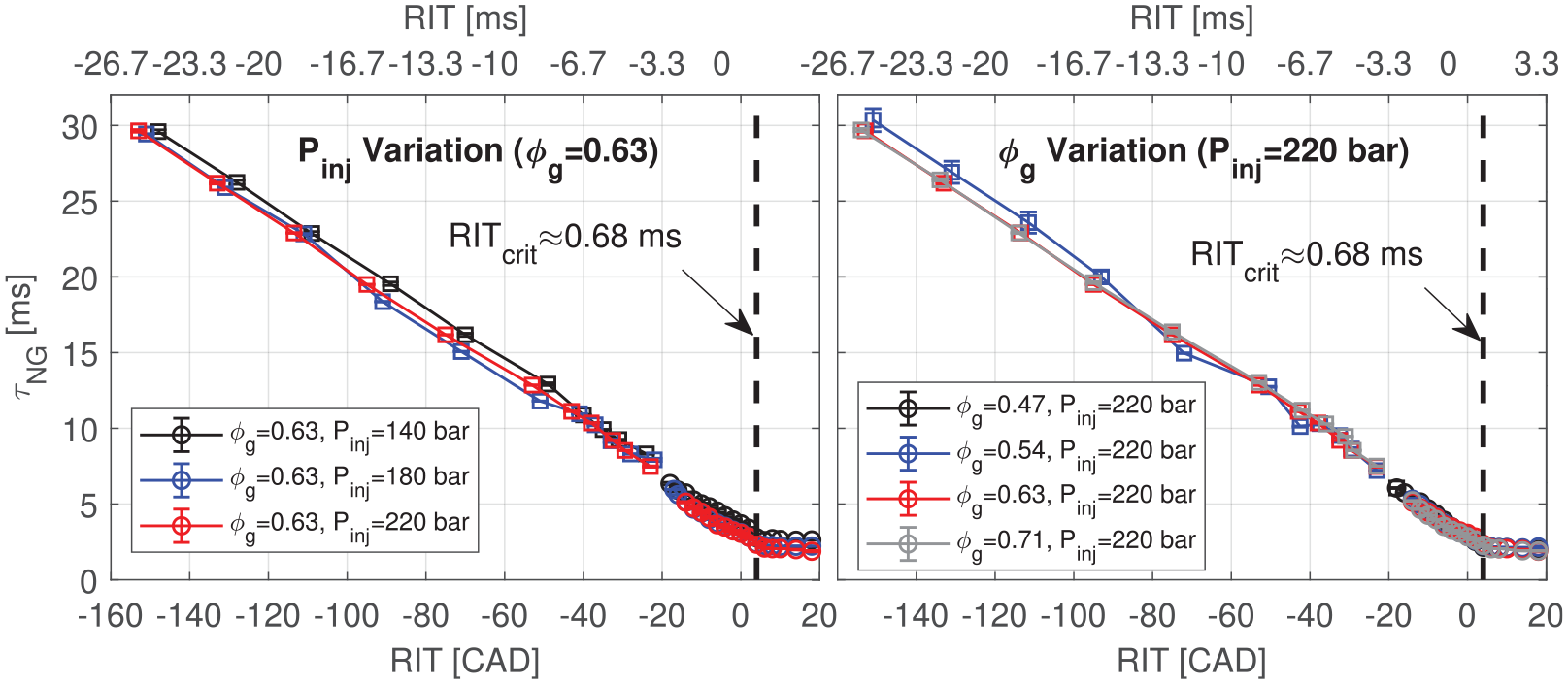
This modified definition was selected such that is consistent with the previously published definition for non-premixed conditions,12 while also providing a reliable marker for the start of premixed NG combustion across a much wider range of and NG stratification conditions (which produce diverse AHRR shapes). A graphical presentation of the calculation of for several distinct operating conditions is presented in Appendix 2 A wide range of mathematical definitions for defining the start of premixed NG combustion were compared and found to have negligible impact on all calculations based on θSOC,NG and τNG. The exact threshold used in equation (4) is therefore not considered critical to the conclusions of this work. In Figure 2, the relationship between and the NG residence time, , is presented for variations of and .
Relationship between relative injection timing () of NG and pilot and the NG residence time, , prior to the start of the main premixed combustion. Critical , , where highlighted with dashed line. Left: Variation of , Right: variation of .
For all nominal operating conditions considered, a critical , ms (4 ± 1 CAD) was measured. Note that the precision of is limited by the spacing of 2 CAD = 0.34 ms and may not be appropriate for all possible operating conditions (e.g. higher ). separates two regimes of NG stratification distinguished by the relationship between and :
: For , has no sensitivity to and is at a minimum value, . For a given , indicates a minimum fraction of the total NG mass is premixed at ; .
: For a linear increase in occurs with advancing relative to (i.e. with decreasing ) and .
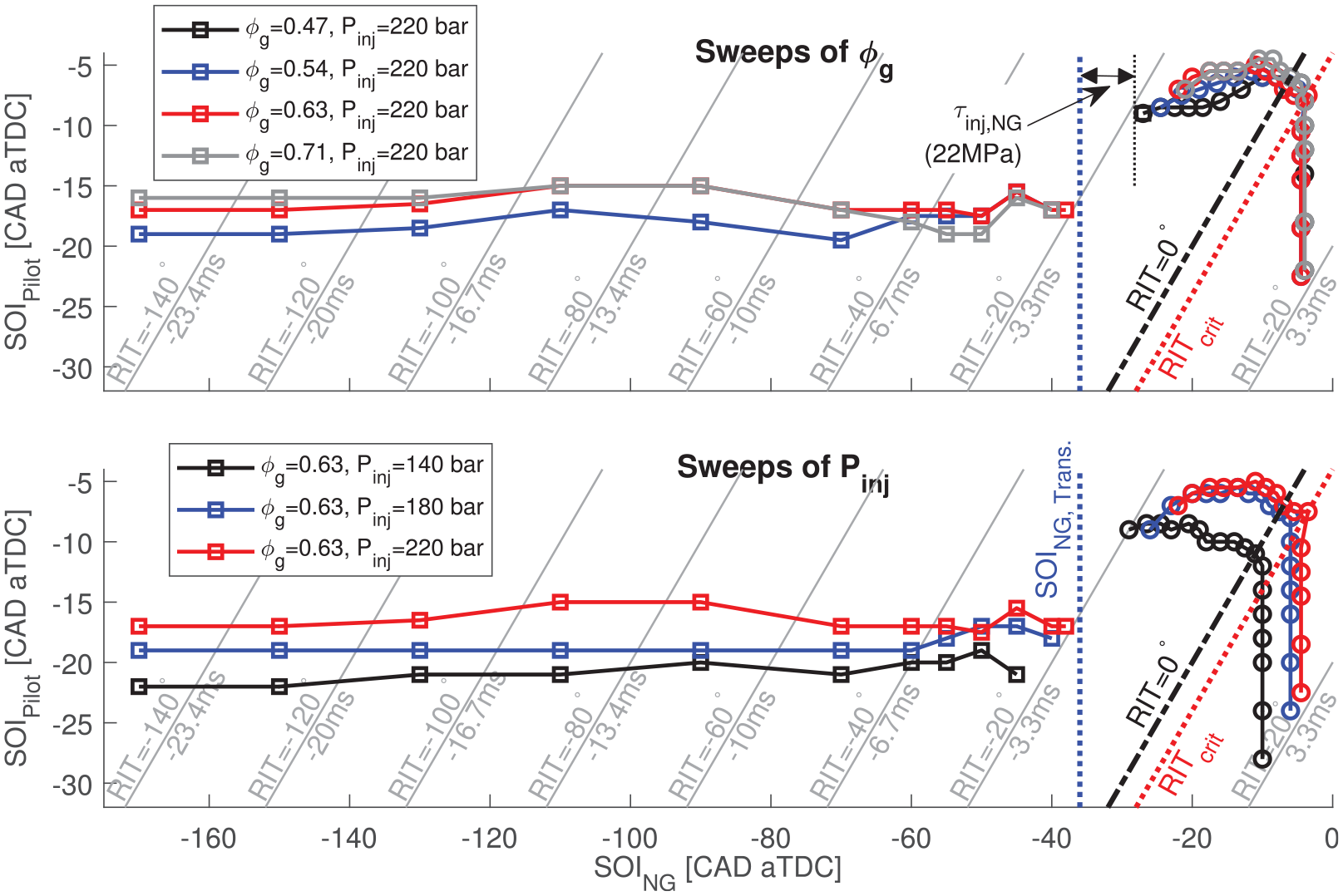
Here, is used to qualitatively describe the NG mixture state in terms of (i.e. distinguishing whether the minimum, maximum, or an intermediate amount of NG premixes prior to ). For all of the considered nominal operating conditions (combinations of and ) distinct injection control strategies ( and ) are required to maintain appropriate combustion phasing for different . The and used for all measurements is presented in Figure 3.
Injection strategy used to maintain constant combustion phasing (see Table 2) across variation of . Data sets for variation of and shown at top and bottom, respectively. Note that the x-axis is presented in terms of , which is in contrast to all other figures which use for the x-axis. Lines of constant are shown in the figure background.
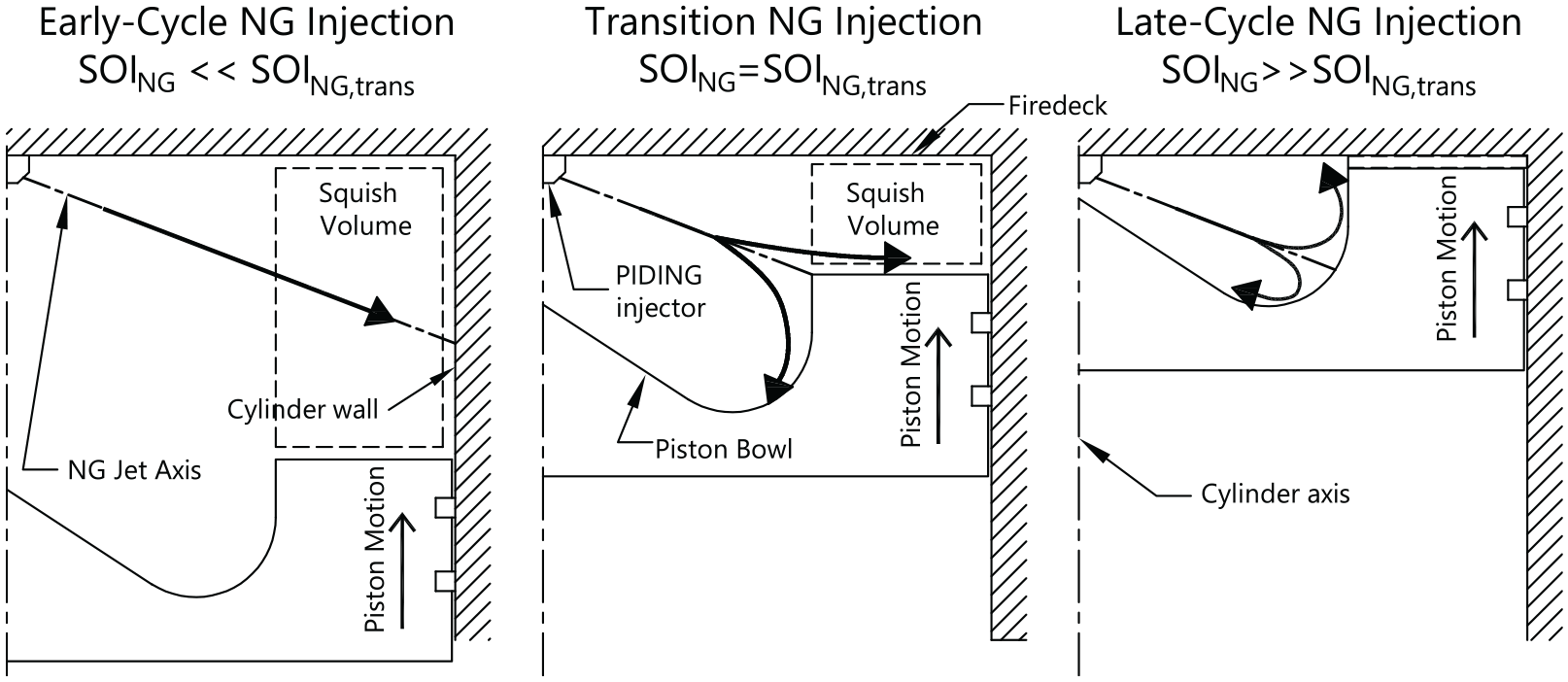
For CAD aTDC, combustion was unstable and significantly advanced was necessary to further decrease . This is indicated by discontinuous lines for each injection control strategy in Figure 3. Florea et al.16,17 observed the same abrupt transition for DI2 combustion when was advanced past = −34 CAD aTDC. They concluded that the abrupt change in combustion behavior was a result of different NG impingement geometries caused by piston motion during the NG injection. For late , the NG jet impinges within the piston bowl, while for early , NG jet impingement occurs in the squish volume and cylinder wall. In the current work, the crank angle where the NG jet orifice is geometrically aligned with the corner of the piston bowl (separating piston bowl and squish volume) occurs at CAD aTDC (note that does not account for the NG jet transit time from the injector to the bowl wall). The possible jet impingement geometries are illustrated in Figure 4. For a given , the range of that produces unstable combustion is approximately the same as the NG injection duration, , which is demonstrated for MPa in Figure 3.
Three combustion chamber geometries corresponding to different NG jet impingement scenarios at different : (i) squish volume and cylinder wall, (ii) transition between squish volume and piston bowl, and (iii) within piston bowl.
The different jet impingement geometries are fundamental to NG stratification and crevice volume penetration and are therefore used here to classify all the stratified PIDING combustion modes as either early- or late-cycle NG injection strategies. This distinction is highlighted in all relevant figures with early- and late-cycle NG injection measurements indicated with square and circular markers, respectively. is also indicated with a blue dashed line in Figure 3. Using and as reference injection timings, common patterns in the injection control strategy are noted for all nominal operating conditions in Figure 3:
:Combustion phasing is controlled by . For a given or , is held approximately constant while is adjusted to adjust .
and : and must be adjusted simultaneously to vary while maintaining constant combustion phasing. Details of the control strategy are sensitive to both and .
: Combustion phasing is controlled by . For a given , is held constant while is adjusted to vary . Injection timing is not sensitive to for .
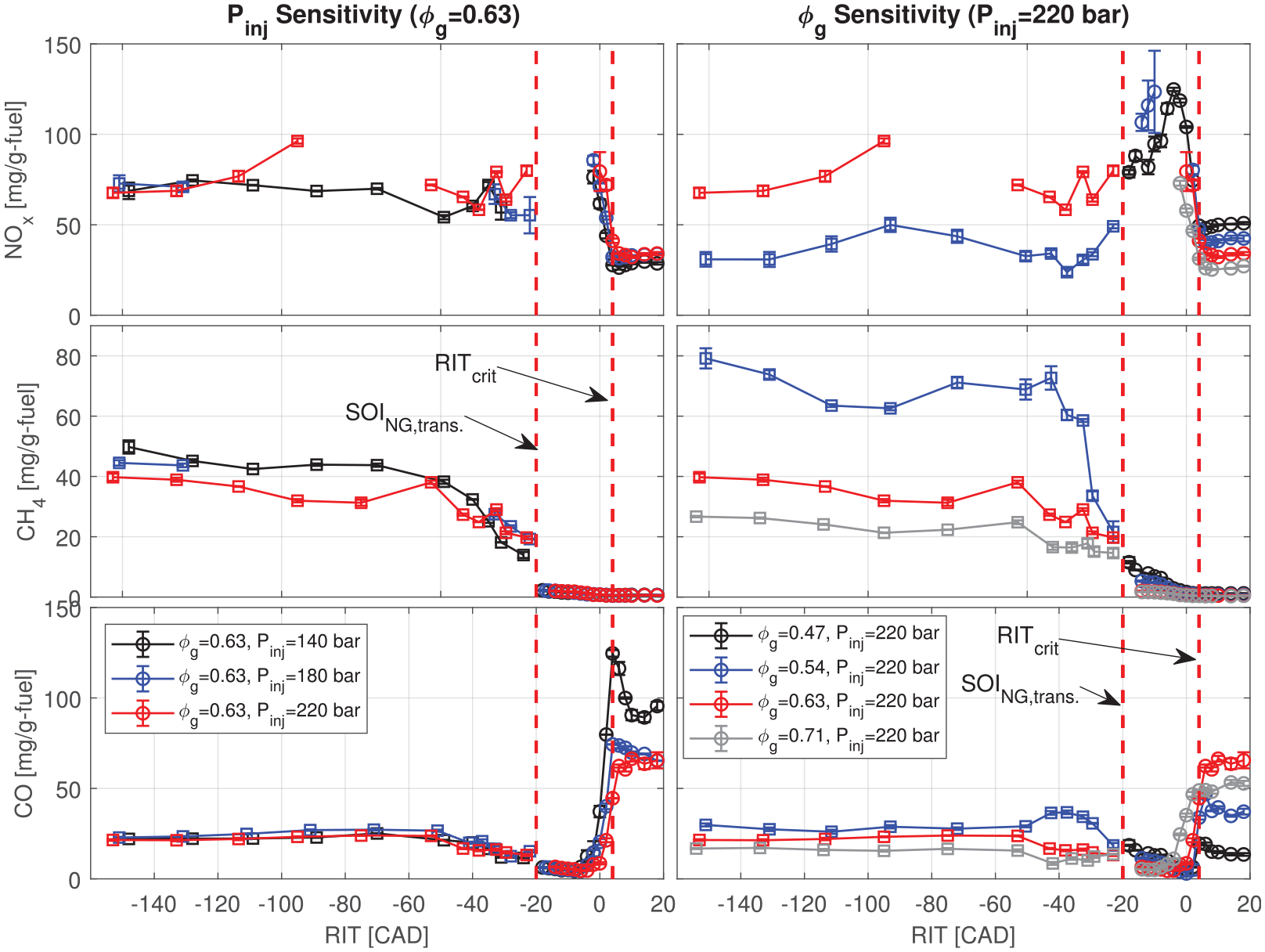
Common patterns in emissions and indicated combustion metrics were also observed through variation of . An overview of emissions performance and indicated combustion metrics are presented for all nominal operating conditions in Figures 5 and 6, respectively. Omitted data points in the plots of Figure 5 indicate exhaust species measurements that were above the calibrated range of the emissions analysis equipment (CH4 and NOX emissions for bar and CAD omitted due to poor agreement between initial and repeated measurements).
Overview of PIDING emissions performance for all nominal operating conditions at all considered . Sensitivity of emissions to and shown in right and left columns, respectively. Omitted data points indicated species concentrations above the calibration range of the emissions analysis instruments.
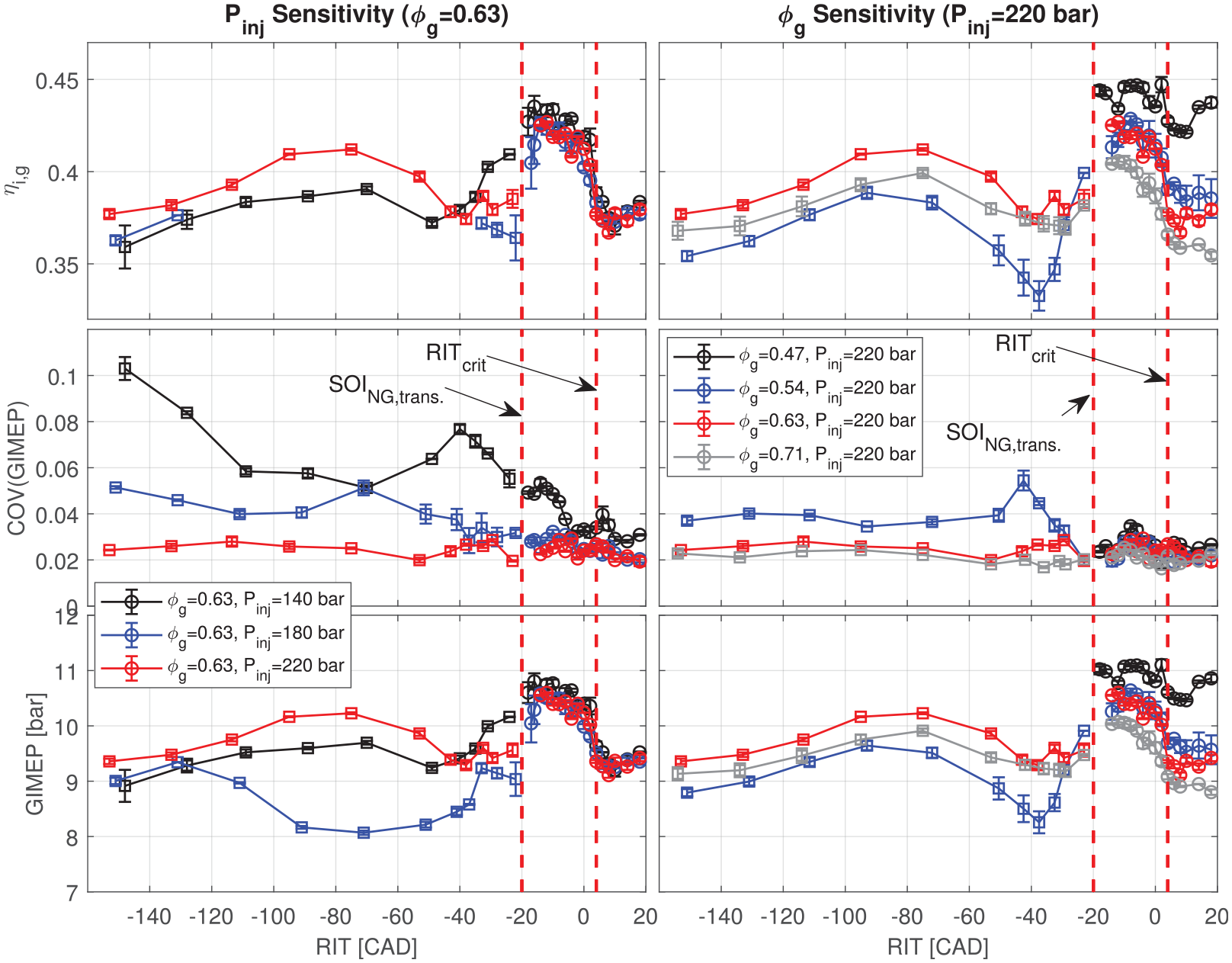
Overview of key indicated combustion metrics for PIDING performance for all nominal operating conditions at all considered . Sensitivity of engine performance to and shown in right and left columns, respectively.
For , variation of does not correspond to any change in , therefore combustion and emissions performance is relatively insensitive to . When , begins to increase and the fraction of NG that premixes prior to ignition, , increases. Across this transition from minimally-premixed combustion (i.e. non-premixed PIDING) to slightly premixed combustion (SPC), all aspects of combustion become highly sensitive to , consistent with other investigations.12–14 The increasingly premixed combustion results in higher efficiency (Figure 6) and lower CO emissions with a very minor increase in CH4 emissions from 1–2 mg/g-fuel (Figure 5), consistent with other investigations of SPC.13,14 The transition to SPC produces significant increases of combustion harshness (maximum RoPR) and NOX emissions, which have also been previously reported. The increased NOX emissions correlate with a marked increase to the mean cylinder temperature (see Appendix 3) for SPC operation. EGR is considered a viable method for reducing both NOX and combustion harshness to more acceptable levels,13,15 but was not available for the current measurements. With the transition to SPC, a slight increase in CCV is observed, however it is not significantly greater than that of the non-premixed combustion previously reported.13
As is reduced further from , combustion becomes increasingly premixed. Depending on , occurs prior to pilot ignition (e.g. for MPa and CAD) and the entire mass of NG premixes to some extent (i.e. ). The increasingly premixed conditions improve the combustion behavior observed in Figures 5 and 6: increasing efficiency, decreasing harshness, and decreasing emissions while maintaining low CO emissions. A slight increase in CH4 emissions is observed and COV(GIMEP) is observed to increase (from approximately 2% to 4%), before reducing back to an acceptable level of 2% near CAD for all late-cycle operating conditions except for = 14 MPa. This optimal range of NG stratification matches the behavior of DI2 previously reported to be flame propagation driven by diffusion and injection-generated turbulence.16,17
For early-cycle NG injections (i.e. ), combustion behavior is less sensitive to than for late-cycle strategies. As for port-injected combustion (e.g. dual-fuel), flame propagation is expected to be the dominant combustion process for early-cycle strategies due to the long NG residence times. Significant CH4 emissions result from increased penetration of NG into crevice volumes and slow flame extinction. Consistent with investigations of dual-fuel and DISI combustion, increasing and increases the flame propagation speed and maintains the mixture above the CH4 lean flammability limit. This is demonstrated in Figures 5 and 6 where CH4 emissions and CCV decrease for increasing and .
Common patterns in combustion and emissions behavior are observed as a function of in Figures 5 and 6 and qualitatively match observations from other studies of stratified PIDING combustion (SPC13,14 and DI216,17) for similar . This indicates that these intervals represent generally relevant stratification conditions that characterize distinct regimes of PIDING combustion.
In the context of this work, a combustion regime is a domain of (representing NG stratification) where pilot combustion, NG combustion, and emissions behavior are consistent. Consistency between operating conditions is indicated if all relevant heat release features (e.g. combustion duration, ignition delay) and exhaust emissions respond in the same manner (i.e. increase, decrease, or are insensitive) to variations of the major engine control parameters investigated in this work: , , and . The objective of this discussion is to identify and classify distinct combustion regimes and the parameters that govern transitions between these regimes based on AHRR and emissions.
Early-cycle NG injection combustion regimes
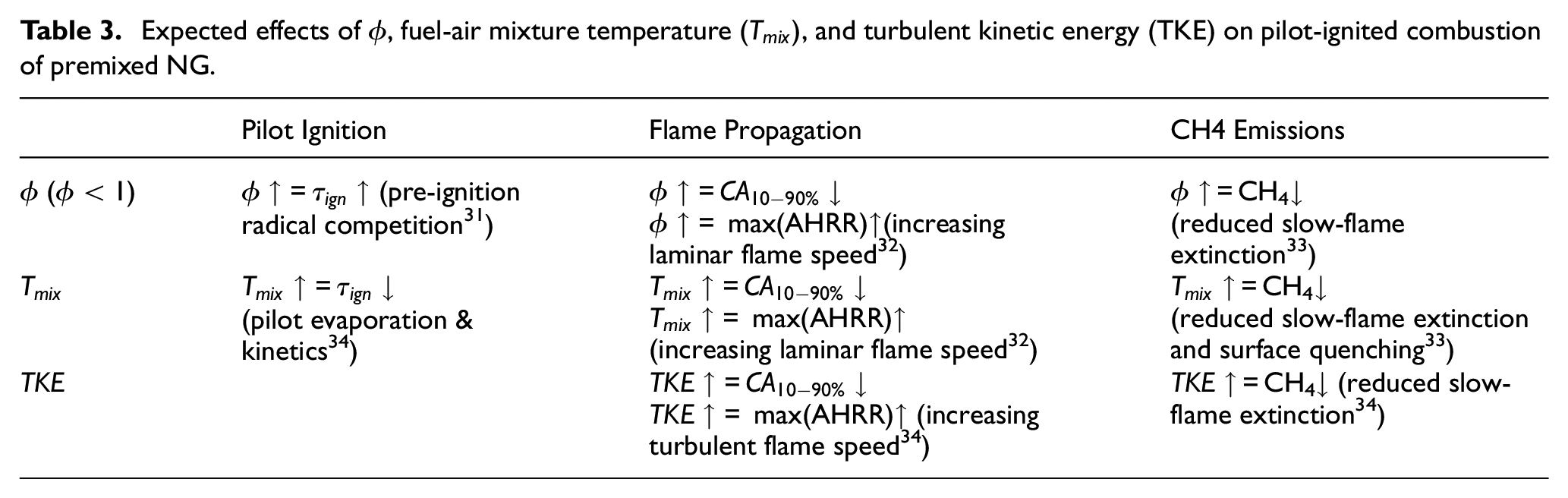
This section examines the early-cycle PIDING combustion strategies where the NG jets impinge above the piston (i.e. , see Figure 4) and significant premixing of the NG occurs prior to pilot ignition. For long NG residence times, early-cycle PIDING engine performance and combustion properties are expected to approach that of a fully-premixed combustion (i.e. dual-fuel combustion). Here, the pilot ignition delay, AHRR, and emissions performance trends of PIDING combustion with early-cycle NG injections are discussed in the context of the expected behavior for homogeneously-premixed pilot-ignited NG combustion. Relevant expected behavior for pilot-ignited premixed NG combustion is briefly summarized in Table 3.
Expected effects of , fuel-air mixture temperature (), and turbulent kinetic energy (TKE) on pilot-ignited combustion of premixed NG.
For PIDING combustion with early-cycle NG injections, there may be insufficient time to produce a homogeneous mixture throughout the combustion chamber, so . Furthermore, charge-cooling and turbulence resulting from the direct NG injection imply that and (i.e. effect of and from injection will decrease with increasingly advanced ). Rigorously distinguishing the role of each of these effects is out of the scope of the current work, however assessment of the net effect of on ignition and main premixed combustion processes provides valuable insight into PIDING combustion with early-cycle NG injections.
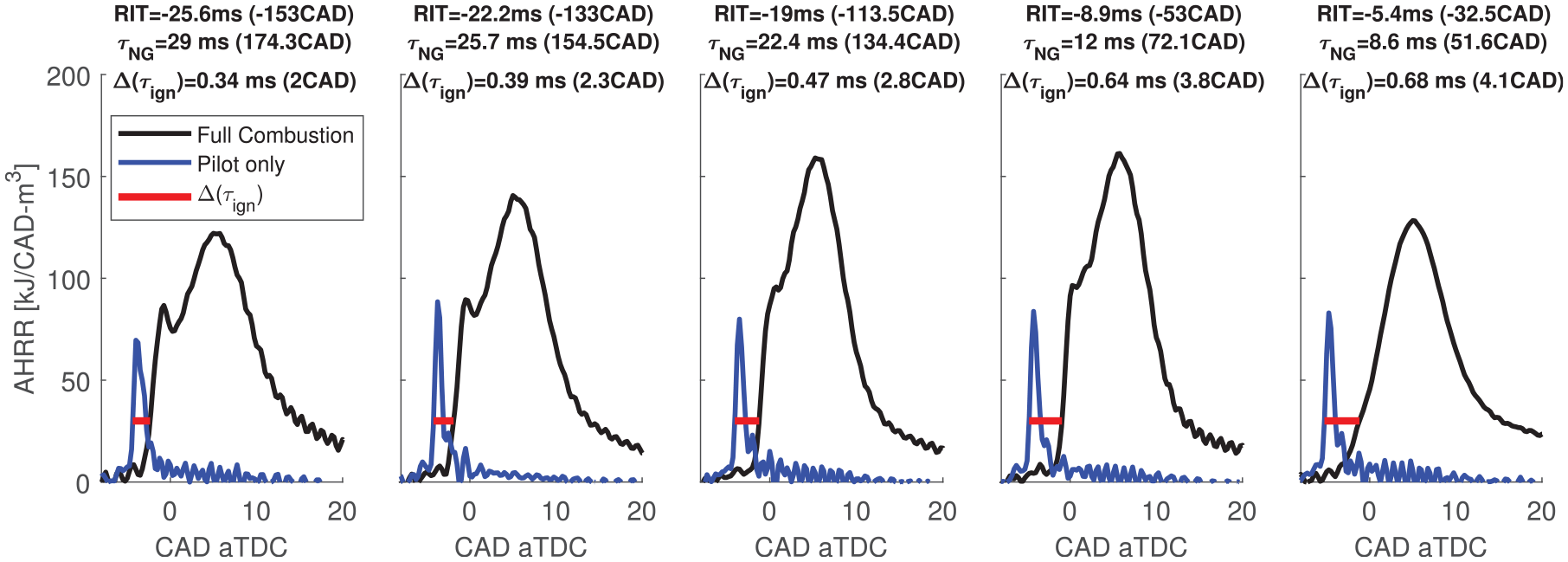
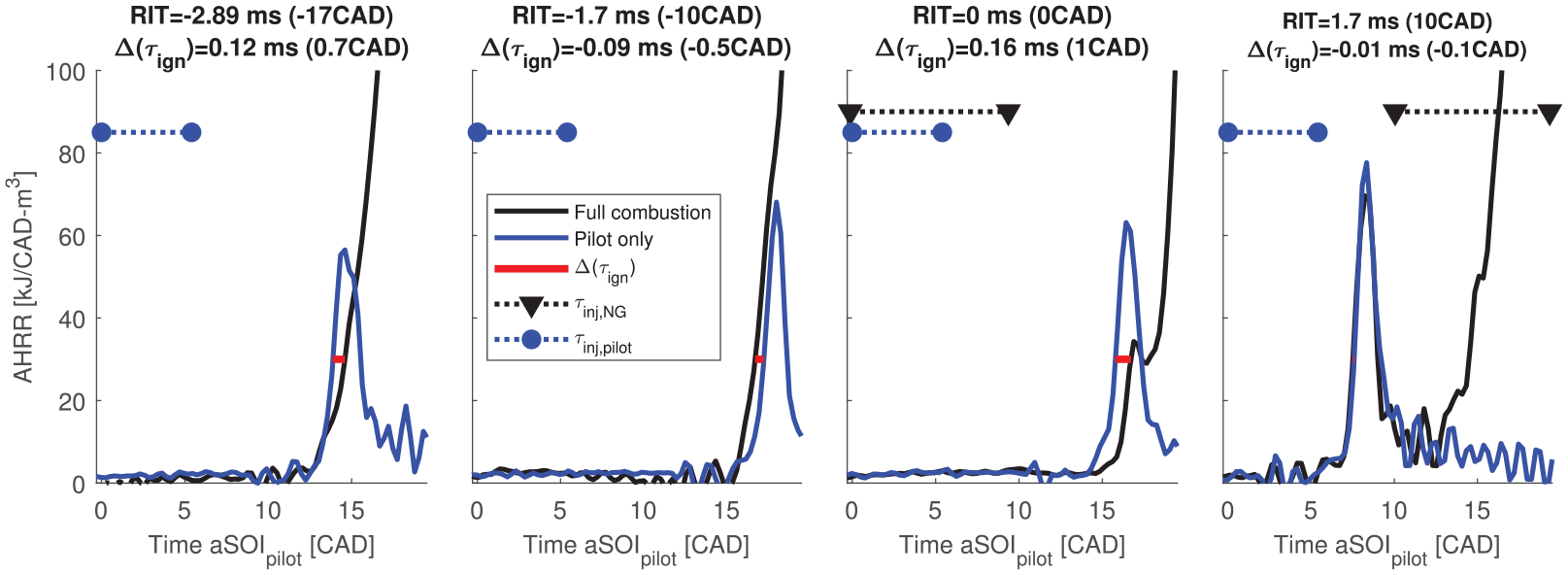
Experiments comparing for full combustion (i.e. pilot + NG) and pilot-only operation were performed to quantify the net impact of the NG direct injection and premixing on . is defined as the increase in the pilot ignition delay caused by the NG injection:
where is calculated as the elapsed time between and the AHRR increasing above a threshold of 30 kJ/CAD-:
The for pilot-only operation was measured immediately after NG injection was disabled from steady-state operation. Measurement of uses the average AHRR of the first two cycles after NG injection is disabled to match the combustion chamber conditions (i.e. cylinder wall temperature, residuals, engine speed, etc.) as closely as possible between the full combustion and pilot-only measurements. Note that because only two cycles are used to measure some signal noise remains in the AHRR measurement. Reducing sensitivity of to signal noise motivated the selection of AHRR > 30 kJ/CAD-m3 as the ignition criterion.
Pilot-only and full combustion AHRR measurements are presented for several early-cycle along with the measured in Figure 7. With the exception of the condition with the latest NG injection ( ms = −32.5 CAD), the AHRR resembles typical dual-fuel combustion; the first AHRR peak corresponds to auto-ignition of diesel and entrained NG, and the second peak corresponds to flame propagation through the remaining premixed NG.33 Consistent with dual-fuel combustion literature, the presence of premixed NG increases for all early-cycle . Both the magnitude of and the shape of the full combustion AHRR vary with . This indicates that for the nominal operating condition shown in Figure 7 (, bar), the NG mixture properties (thermodynamic and/or fluid mechanical) have not reached a steady-state with respect to . Near the NG jet impingement transition at ( CAD), the complex flow and mixture distribution resulting from the NG jet impingement with both the squish volume and piston bowl result in a AHRR shape that is distinctly dissimilar from the dual-fuel shape (e.g. CAD in Figure 7). In this transition region, it is unlikely that the conceptual model of premixed dual-fuel combustion can appropriately describe the fuel conversion processes.
Comparison of AHRR for full combustion and pilot-only combustion for the = 0.63/ bar operating condition with early-cycle NG injection. Comparison of the difference in pilot ignition delay, , used to qualitatively assess the state of NG premixing and stratification. Red lines indicate the measurement of .
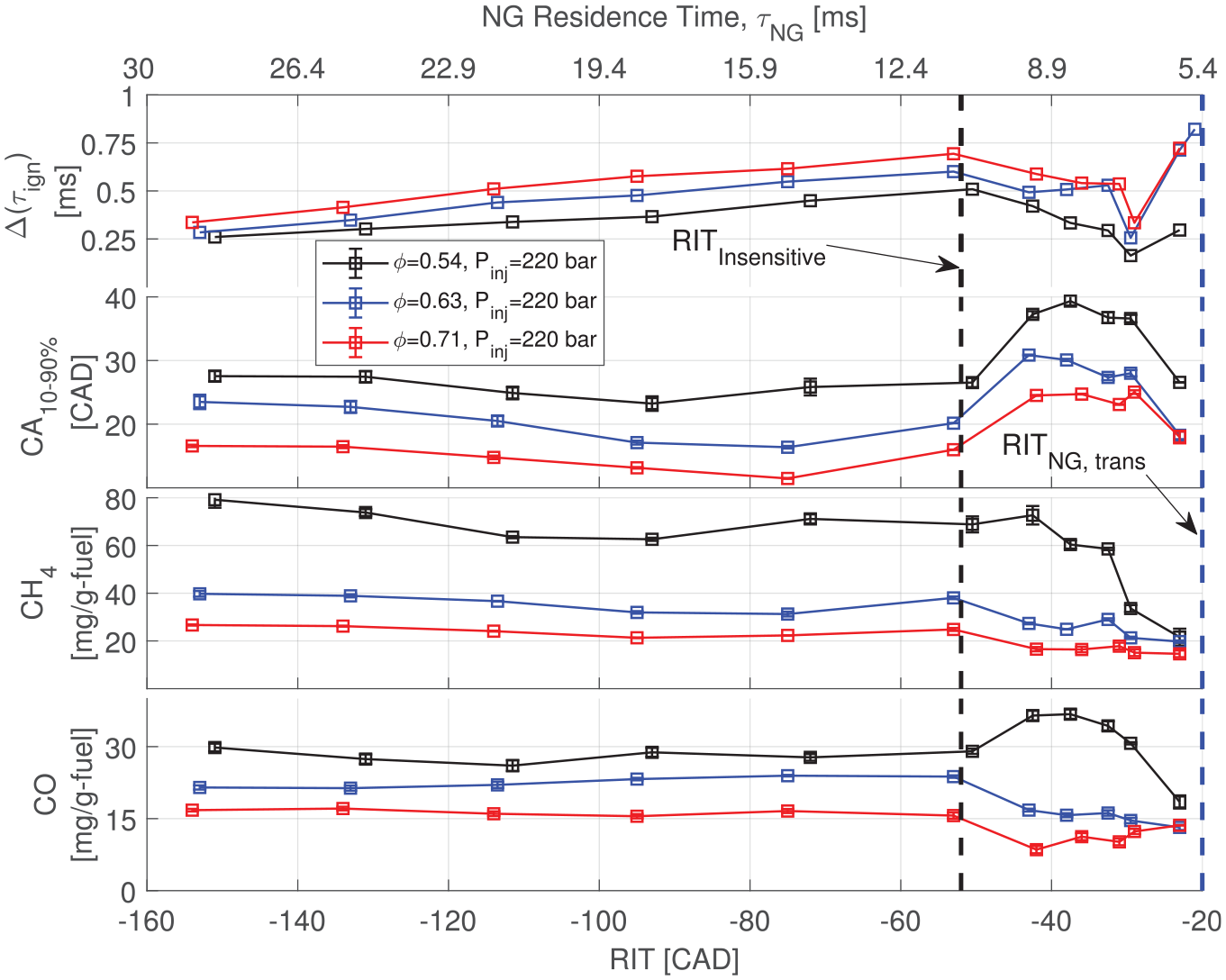
For all operating conditions except for the latest NG injections near , the sensitivity of combustion metrics to is consistent with flame propagation behavior where increasing results in higher peak AHRR and lower CH4 emissions (see Table 3). In Figure 8, is compared to the combustion duration and emissions of incomplete combustion products (CH4 and CO) to assess the role of NG stratification on the flame propagation process. For all combustion metrics shown in Figure 8, a significant reduction in sensitivity to is observed at approximately the same , denoted as . For CH4 and CO emissions increase with increasing indicating increased NG penetration to crevice volumes and/or slow flame extinction is occurring. While the injection-generated turbulence should support more rapid flame propagation for later NG injections, long combustion durations observed for and simultaneously low CH4 indicate that NG stratification dominates the flame propagation process and mass of NG in the crevice volumes. For the same range of , increases with increasing . This may indicate increasing NG concentration in the vicinity of the pilot ignition regions while approaches with increasing .
Effect of RIT and on pilot ignition delay (), combustion duration (), CH4 emissions, and CO emissions for early-cycle NG injections.
For , decreases with decreasing rather than increasing as for . This transition is considered to be a result of exceeding the duration required to develop an approximately homogeneous concentration of NG throughout the combustion chamber by the time of ignition. For , optimal early-cycle engine operation occurs for ms, where the flame propagation process is most rapid and CH4 emissions are moderately reduced. This optimal early-cycle may be a balance between the influence of unstable combustion conditions near the jet impingement transition and high injection-generated turbulence for later NG injections. Interestingly, for , increasing produces decreasing . This may be due to the diminishing impact of charge-cooling on ignition delay for earlier , however further investigation is required to characterize this effect.
Late-cycle NG injection combustion regimes
This section examines the different combustion regimes that exist for late-cycle PIDING strategies, corresponding to . With late-cycle NG injections, NG stratification and PIDING combustion behavior is extremely sensitive to . Non-premixed PIDING (e.g. Ouelette et al.,3 McTaggart-Cowan et al.,11,14), SPC,13 and DI216,17 combustion strategies all occur with late-cycle NG injections and are predominantly distinguished from one another by the used. For late-cycle NG injections, and are close to one another and the fluid mechanic and chemical interactions between the two fuel injections can significantly influence ignition and NG combustion behavior.12,28,29 In particular, the fraction of NG that undergoes premixing prior to NG combustion, , is sensitive to with three general scenarios being possible:
and. Pilot injection occurs sufficiently in advance of the NG injection such that is minimized (see Figure 2). This results in the minimum NG premixed fraction, , and is typical of non-premixed PIDING combustion.
and. As is reduced from , there is overlap of the pilot and NG injections, increases, and an increasing mass of NG premixes prior to the NG combustion process (i.e. ). This occurs for the SPC strategy.
. The NG injection is completed sufficiently early (i.e. ) such that the entire mass of NG undergoes some premixing prior to the NG combustion process. This occurs for the DI2 strategy.
The following discussion will examine each of the above scenarios in terms of pilot combustion, NG combustion, and emissions behaviors.
Effects of late-cycle NG injection on pilot combustion
Interaction of the pilot and NG jets has been identified as a critical factor for PIDING combustion performance.13 Investigations examining interactions between direct pilot and NG injections have shown that quenching and advection of the pilot reactants and products by the NG jet can occur when there is significant overlap of the two fuel jets (spatial and temporal overlap).12,28,29 In these cases, quenching of the pilot may be as a result of one or more of: (i) reduced local temperature, (ii) reduced local oxygen concentration, (iii) excessive local strain rate, or (iv) chemical competition for pre-ignition radicals. Further interaction between the pilot and NG jets may occur as the NG jets that have penetrated to the bowl wall are reflected and return toward the center of the combustion chamber.12,19
Attributing quenching to individual processes is challenging, however the net effect on pilot ignition can be investigated using (equation (5)). In Figure 9, the sensitivity of to late-cycle NG injections is presented for four different covering the three different NG premixing scenarios identified. Only the ignition sequence of each AHRR is shown in Figure 9 to improve visualization of .
Comparison of AHRR for full combustion and pilot-only combustion to assess the impact of late-cycle NG injections on pilot ignition delay. Red lines indicate the measurement of . = 0.63/ bar operating condition shown.
For CAD, pilot injection and auto-ignition is complete prior to and there is negligible difference in the pilot-only and full combustion AHRR in Figure 9, indicating this is considered free pilot auto-ignition. For = 0 CAD, the pilot and NG injections overlap (dashed lines in Figure 9). This results in a strong quenching of the pilot by the NG jet, indicated by an increase in and a reduced area under the pilot ignition AHRR curve for the full combustion case. Reduced area under the pilot AHRR implies a portion of the diesel remains unreacted until the main NG combustion process. For CAD, all of the NG is injected prior to pilot injection (, therefore ), however is small and there is little impact on the leading edge of the ignition AHRR. With further advanced ( CAD), a longer results in greater mixing of NG and pilot reactants and an increased pilot ignition delay and a more gradual pilot ignition AHRR. This suggests that for CAD the NG has had sufficient time to premix near the pilot causing an increase in the pilot ignition delay due to competition for pre-ignition radicals and/or reduced local oxygen concentration.
For all nominal operating conditions, a characteristic pattern of pilot quenching behavior with respect to variation of occurs. To support comparison of this behavior between all nominal operating conditions, a normalized definition of , , is proposed:
corresponds to (i.e. the limit for minimally-premixed combustion) and corresponds to the injection timing where has been advanced by one injection duration () from . Therefore, provides an estimate of the maximum where the NG injection is sufficiently early to allow some premixing of the entire mass of NG prior to combustion.
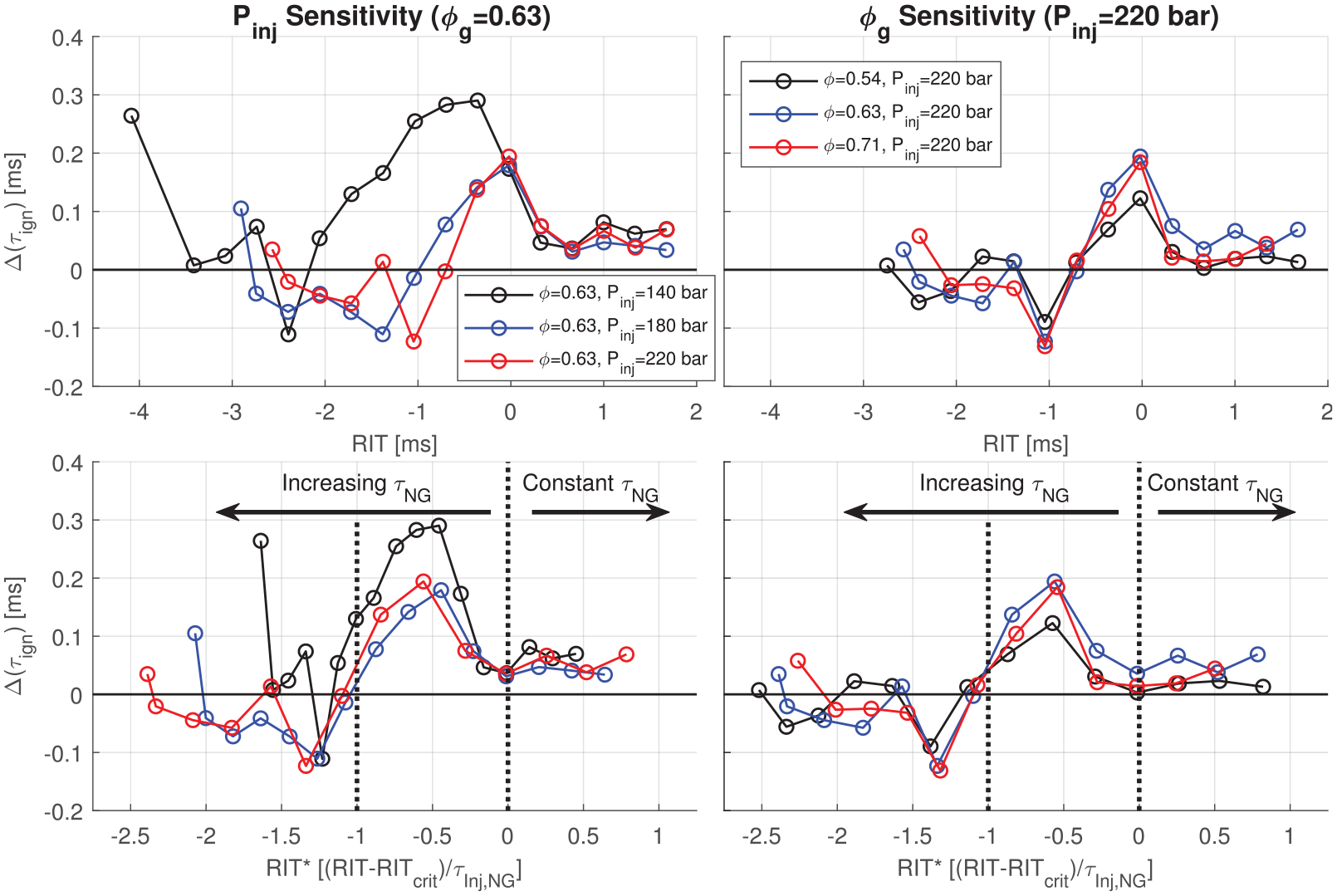
In Figure 10, the sensitivity of late-cycle to and is presented using both and (top and bottom of Figure 10, respectively). Plotting with respect to results in a common domain of pilot quenching for all nominal operating conditions for , which is not clear when is used. This motivates application of instead of for comparing combustion and emissions performance for late-cycle NG injections.
Effect of late-cycle NG injection on pilot ignition delay. Top row: with respect to . Bottom row: with respect to normalized relative injection timing, , where ms (4 CAD), , 1.7, and 1.3 ms for = 140, 180, and 220 bar, respectively.
For all nominal operating conditions, the maximum pilot quenching effect (largest ) occurs at (i.e. occurs midway through NG injection). For , is sufficiently retarded with respect to that free pilot auto-ignition occurs and there is only a small . For all operating conditions, the NG injection becomes too advanced to measurably quench the pilot at .
For bar and , NG injection causes the pilot auto-ignition process to advance () for in Figure 10). No clear chemical or fluid cause for this behavior has been found in the literature or measurements considered here. This unique ignition behavior may contribute to high and low COV(GIMEP) (see Figure 6) noted for this range of and therefore warrants further investigation.
In all cases in Figure 10, an increase in occurs for the most negative . This range of corresponds to the strategy presented by Florea et al.16,17 For this , therefore increasing is likely due to chemical competition for pre-ignition radicals. As in homogeneously premixed NG systems, the pilot ignition delay increases with increasing for very negative (i.e. for ). Because impingement of the NG jet with the piston bowl edge occurs earlier for higher , the minimum for each is different and the effects of on in this regime of combustion are unclear.
Effects of late-cycle NG injection on NG combustion
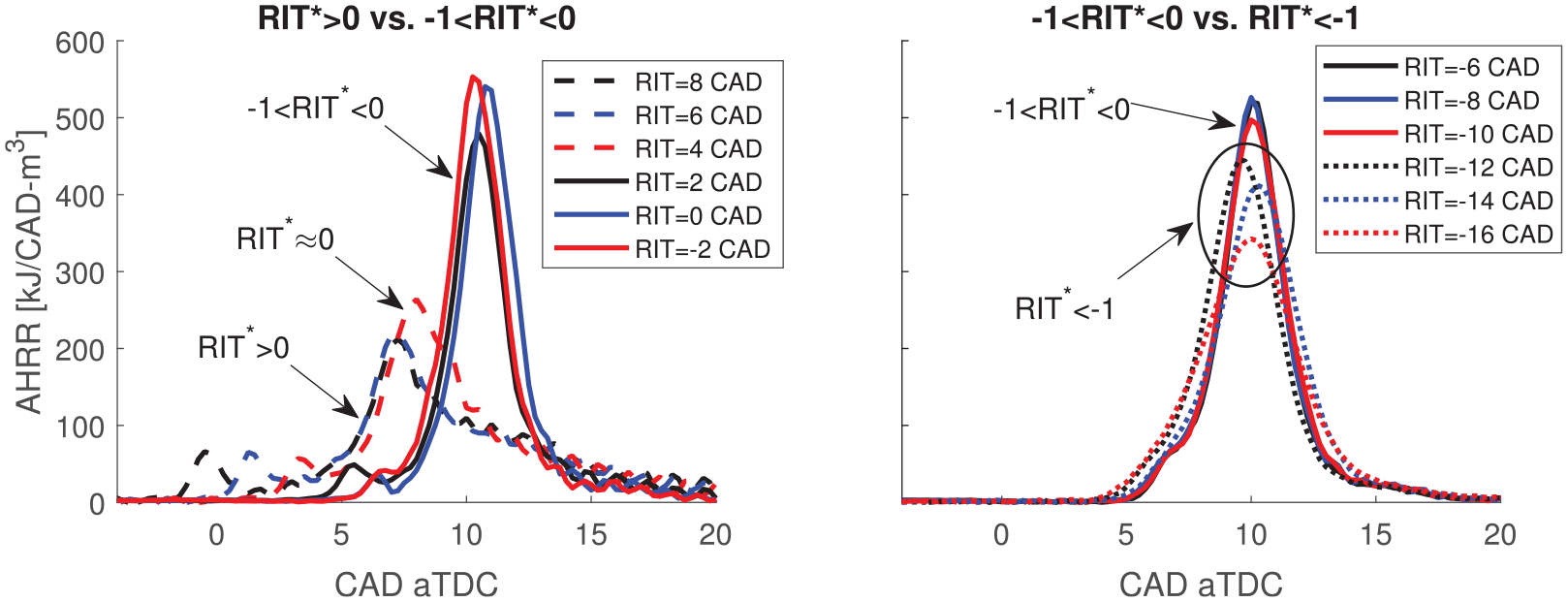
In this section, the three domains of identified in the previous section (, , and ) are connected to NG combustion and emissions behaviors, which were shown to be highly sensitive to late-cycle in Figures 5 and 6. To support the proposed combustion regimes, Figure 11 contrasts the AHRR for adjacent regimes.
Comparison of AHRR for different late-cycle PIDING combustion regimes Left: versus . Right: vs. . = 180 bar and = 0.63 operating condition shown.
In Figure 11, the peak heat release rate produced by premixed NG combustion increases rapidly as is adjusted from positive to negative values. This transition is defined by where becomes a function of and increases with decreasing (see Figure 2). Near this transition pilot heat release is less prominent, indicating the NG jets are quenching the pilot reactions (see Figure 10). This may lead to some fraction of the pilot reactants being consumed in the NG combustion process further contributing to the high peak AHRR, short combustion duration, and high indicated gross efficiency, (see Figure 6).
For ( CAD CAD), the AHRR shape is remarkably insensitive to in Figure 11. This suggests that does not influence heat release for this regime of combustion. This is in contrast to the decreasing peak AHRR with decreasing for , indicating is important for this range of . The contrast in sensitivity of AHRR to (i.e. sensitivity to ) across reinforces the utility of (equation (7)) for defining regimes of PIDING combustion.
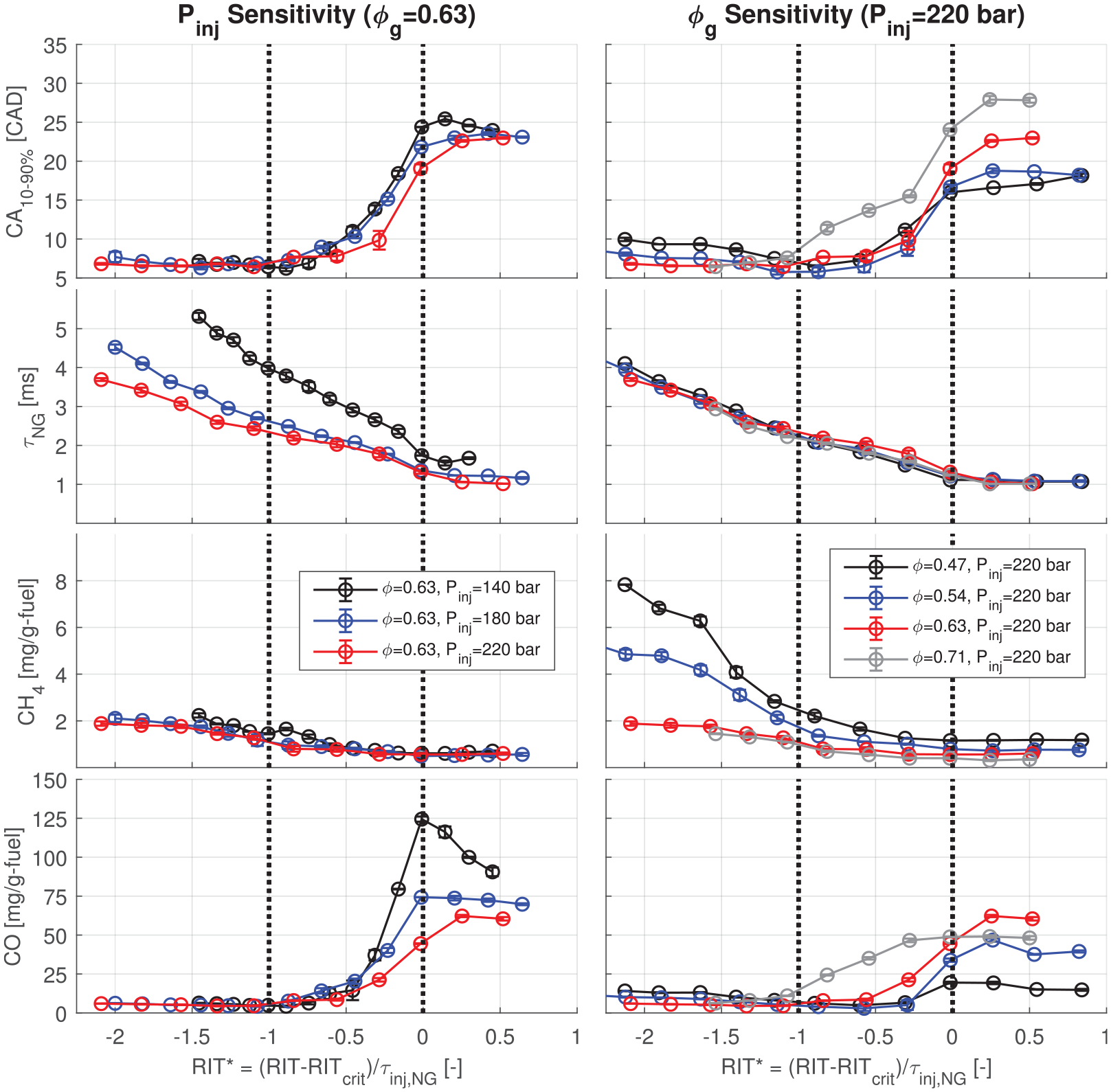
Combustion duration (), NG residence time (), and emissions of incomplete combustion products are compared using for all nominal operating conditions in Figure 12. For all conditions, a rapid reduction of combustion duration and CO emissions occurs at the regime transition. As is reduced through , there is only very moderate increase in CH4 emissions despite an increasing . For all conditions, a minimum combustion duration and CO emissions level are reached at . This minimum level is insensitive to and for , and is constant for further decreases in despite the noted decrease in peak AHRR for in Figure 11. This indicates that unlike flame propagation, neither increased turbulence or closer-to-stoichiometric chemistry influence the global reaction speed in this regime of combustion.
Effect of on combustion duration (), NG residence time (), CH4 emission concentration, and CO emission concentration for late-cycle NG injections. and effects shown at left and right, respectively. Defined combustion regime transitions denoted with dashed lines. Note that by definition, coincides with the change of to .
For , CH4 emissions increase more rapidly with decreasing (i.e. increasing ) than for , and become sensitive to . Here, the CH4 emissions are more sensitive to with decreasing , and there is no sensitivity between and 0.71. This change in CH4 emissions behavior at indicates that one or more CH4 emissions sources becomes more prominent for .
For , combustion duration decreases moderately with increasing for . This may account for the observed increase in CH4 emissions as a result of slow flame extinction (for , here). For and all considered , CH4 emissions show only very weak sensitivity to indicating that the NG is effectively constrained to the piston bowl volume and crevice volume quenching is not significant.
The above discussion has demonstrated that and are effective for classifying PIDING combustion with late-cycle NG injection into 3 regimes. Within each regime, the pilot combustion, NG combustion, and emissions behavior are consistent with respect to variation of , , and . Across the regime boundaries ( and ) pilot combustion, NG combustion, and emissions behavior changes rapidly with respect to varying . This demonstrates that the definition of relates parameters critical to the NG stratification, and that is an appropriate parameter for characterizing late-cycle PIDING combustion regimes.
Summary of stratified-premixed PIDING combustion modes
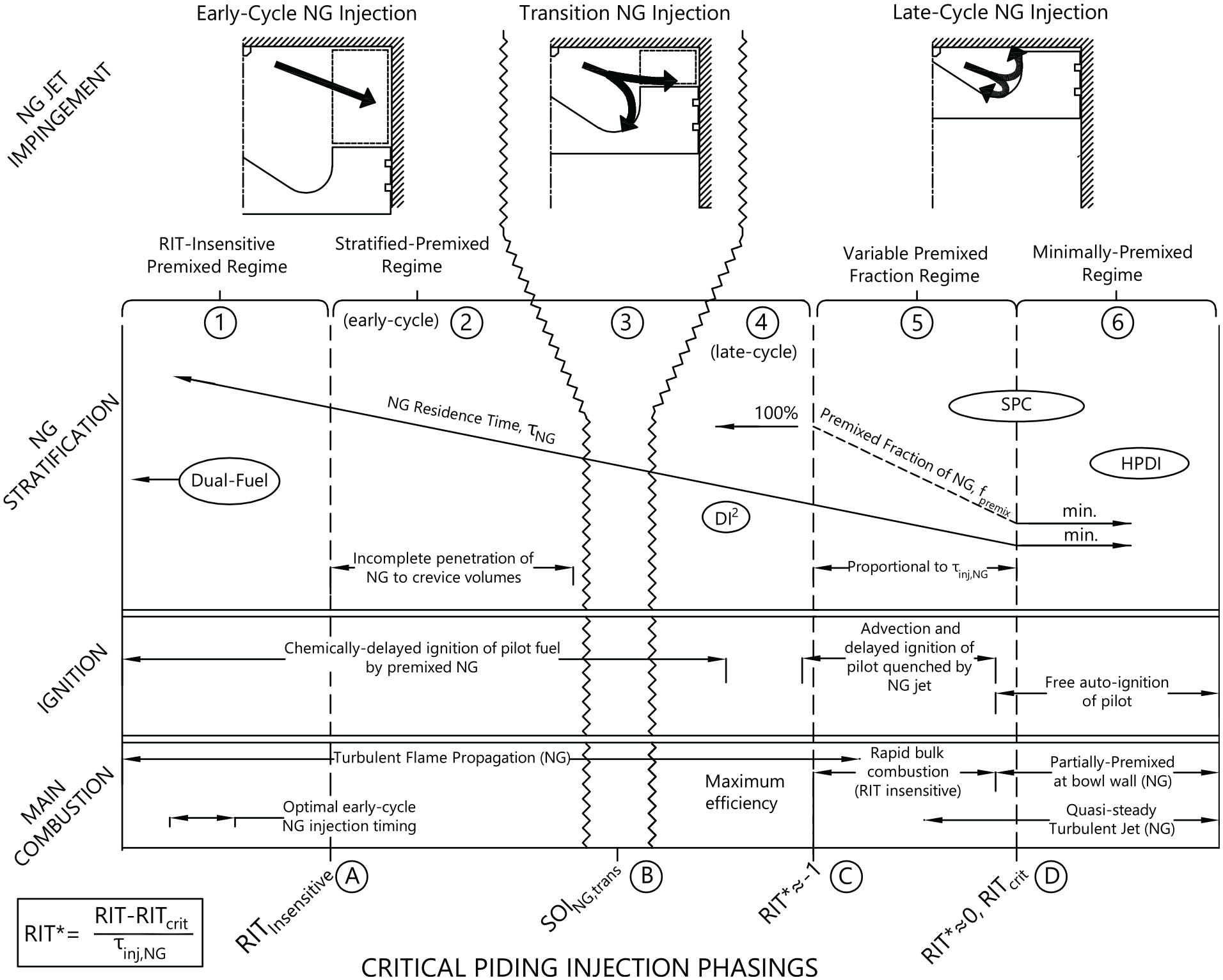
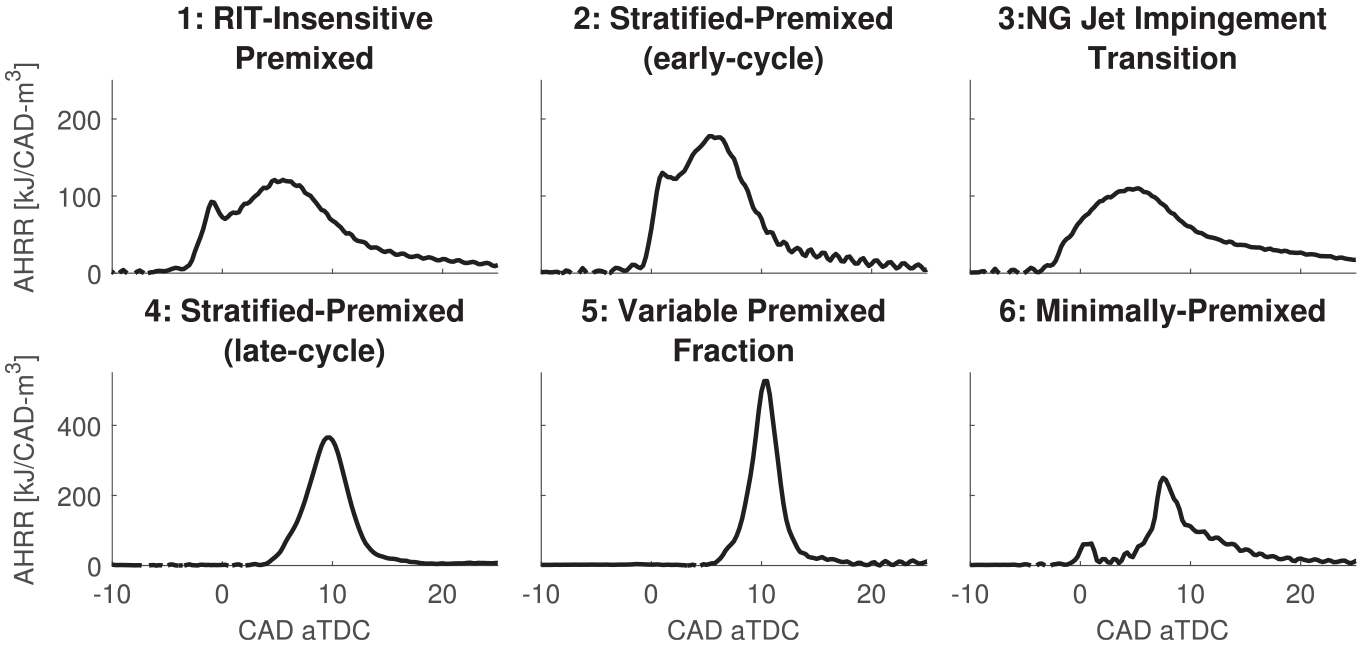
This section summarizes the identified stratified PIDING combustion regimes, their key characteristics, and the parameters that define their domains. In Figure 13, the six identified combustion regimes (1→ 6) are presented with respect to four injection phasings (A→ D). Figure 14 presents exemplary AHRR for each of the identified combustion regimes. Late-cycle PIDING combustion regimes are best defined using the non-dimensional parameter, , while early-cycle operating conditions are more effectively defined using the absolute injection timings in terms of CAD (i.e. , and ).
Conceptual summary of the six identified stratified PIDING combustion regimes and four fundamental injection phasings distinguishing the combustion regimes. Characterization of the NG injection, stratification, pilot combustion, and NG combustion of each combustion regime presented with respect to fundamental domains of .
Characteristic AHRRs for each identified stratified-premixed PIDING combustion regime. Numbering references Figure 13.
In order of decreasing NG residence time, :
RIT-insensitive Premixed Regime (): Pilot combustion, NG combustion, and emissions behavior is consistent with homogeneously premixed NG combustion (i.e. flame propagation). In this regime, there is significantly reduced sensitivity of pilot combustion, NG combustion, and emissions to compared to all other combustion regimes.
Early-Cycle Stratified-Premixed Regime (, ): Pilot combustion and NG combustion behavior sensitivity to is consistent with homogeneously premixed NG combustion. However, CH4 emissions increase with increasing , indicating that NG has not completely penetrated the crevice volumes due to significant NG stratification.
NG Impingement Transition Regime (): Alignment of the NG injection axis with the piston bowl at causes the NG jet to impinge near the edge of the piston bowl resulting in unstable combustion.
Late-Cycle Stratified-Premixed Regime (, ): The NG jet impinges within the piston bowl and NG injection terminates sufficiently early such that the entire mass of NG premixes to some degree. The resulting combustion process is very rapid, yielding high combined with low CH4 and CO emissions and low combustion harshness. This regime encompasses the DI2 combustion strategy reported by Florea et al.16,17
Variable Premixed Fraction Regime (, ): Overlapping pilot and NG injection processes cause the NG residence time and premixed fraction of NG to be directly controlled by . Quenching of the pilot products by the NG jets results in some mass of diesel reacting in the NG combustion event. Heat release is extremely rapid and insensitive to , , and . Combustion in this regime with approaching 0 has been investigated as SPC.13
Minimally-Premixed Regime (): Free pilot auto-ignition occurs prior to significant NG jet penetration, resulting in the minimum NG residence time and minimum premixed NG fraction. This regime of PIDING combustion is applied in typical HPDI applications.3
Conclusions
A survey of stratified PIDING combustion regimes was conducted by sweeping the relative injection timing, , of a heavy duty PIDING engine from −150 CAD to +18 CAD for bar, , at 1000 rpm. Regimes of PIDING combustion were identified as domains of (representing NG stratification) where pilot and NG combustion AHRR, and emissions behaved consistently with respect to variation of , , and .
The following six stratified PIDING combustion regimes were identified, presented here in order of decreasing NG residence time:
RIT-insensitive Premixed
Early-Cycle Stratified-Premixed
NG Impingement Transition
Late-Cycle Stratified-Premixed
Variable Premixed Fraction
Minimally-Premixed
These regimes span from fully-premixed to predominantly non-premixed NG combustion and encompass several injection strategies (HPDI,3 SPC,1316) that have been previously identified by other investigators. Qualitative agreement in combustion performance and emissions between the current work and that of other investigations was observed for equivalent ranges of , despite these works being independently completed on different engines. This substantiates the utility of to characterize the regimes of PIDING combustion.
The fine resolution considered here, enabled the transitions in combustion and emissions behavior between the identified regimes of PIDING combustion to be elucidated, and the domain of each regime to be described using generic PIDING parameters for the first time. A novel parameter, (equation (7)), was introduced to classify PIDING regimes for late-cycle NG injections based on the NG injection duration, , and the NG residence time, . The domain of is of particular relevance as this range of injection timings results in the NG injection quenching the pilot reactions, which has not previously been characterized in a PIDING engine. Quenching was identified here by comparing the pilot ignition delay with and without the NG injection, (equation (5)).
The novel experimental methods and identified regimes of stratified PIDING combustion are considered to be generally applicable results that can be extended to other PIDING applications. Future investigations will use in-cylinder imaging and measurement of local NG concentration to improve the characterization of the NG stratification, pilot-NG interactions, and the description of the combustion processes for each identified combustion regime. This information will guide the design of future detailed experimental investigation, numerical simulation, and hardware design for high efficiency, low-emissions stratified PIDING engines.
Footnotes
Appendix 1
Appendix 2
Appendix 3
Acknowledgements
The author(s) would like to acknowledge the technical and financial support provided by Westport Fuel Systems, Inc. The technical support and contributions of Drs. Sandeep Munshi, Steve Rogak, and fellow researchers at The University of British Columbias Clean Energy Research Centre are also gratefully acknowledged.
Declaration of conflicting interests
The author(s) declared no potential conflicts of interest with respect to the research, authorship, and/or publication of this article.
Funding
The author(s) disclosed receipt of the following financial support for the research, authorship, and/or publication of this article: This work was supported by the Natural Sciences and Engineering Research Council of Canada (NSERC) Collaborative Research and Development (CRD) grants (CRDPJ 451208-13 and 530547-18) in conjunction with Westport Fuel Systems, the Canadian Foundation for Innovation (CFI) John Evans Leaders Fund (JELF) grant (no. 32637), and the NSERC Discovery Grant Program (RGPIN 418700-13).
ORCID iDs
Jeremy Rochussen
Gordon McTaggart-Cowan
Patrick Kirchen
References
1.
Intergovernmental Panel on Climate Change. Climate change 2014: mitigation of climate change: Working group III contribution to the IPCC fifth assessment report. Cambridge, UK and New York, NY: Cambridge University Press, 2015.
2.
IEA. World energy outlook2019. 2019.
3.
OuelettePGoudieDMcTaggart-CowanG. Progress in the development of natural gas high pressure direct injection for euro vi heavy-duty trucks. In: LieblJBeidlC (eds) Internationaler Motorenkongress 2016. Wiesbaden, Germany: Springer, 2016, pp.591–607.
4.
HarringtonJMunshiSRNedelcuC, et al. Direct injection of natural gas in a heavy-duty diesel engine. SAE 2002-01-1630, 2002.
5.
PapagiannakisRGRakopoulosCDHountalasDTRakopoulosDC. Emission characteristics of high speed, dual fuel, compression ignition engine operating in a wide range of natural gas/diesel fuel proportions. Fuel2010; 89(7): 1397–1406.
6.
BeschMCIsraelJThiruvengadamAKappannaHCarderD. Emissions characterization from different technology heavy-duty engines retrofitted for CNG/diesel dual-fuel operation. SAE Int J Engines2015; 8(3): 1342–1358.
7.
StettlerMEMidgleyWJSwansonJJCebonDBoiesAM. Greenhouse Gas and NOXious emissions from dual fuel diesel and natural Gas heavy goods vehicles. Environ Sci Technol2016; 50(4): 2018–2026.
8.
KönigssonFKuyperJStalhammarPAngstromHE. The influence of crevices on hydrocarbon emissions from a diesel-methane dual fuel engine. SAE Int J Engines2013; 6(2): 751–765.
9.
NiemanDEMorrisAPMiwaJT, et al. Methods of improving combustion efficiency in a high-efficiency, lean burn dual-fuel heavy-duty engine. SAE 2019-01-0032, 2019.
10.
FanslerTDReussDLSickVDahmsRN. Invited review: combustion instability in spray-guided stratified-charge engines: a review. Int J Engine Res2015; 16(3): 260–305.
11.
McTaggart-CowanGP. Pollutant formation in a gaseous-fuelled, direct injection engine. PhD Thesis, University of British Columbia, 2006.
12.
RochussenJMcTaggart-CowanGKirchenP. Parametric study of pilot-ignited direct-injection natural gas combustion in an optically accessible heavy-duty engine. Int J Engine Res2020; 21: 497–513.
13.
FaghaniEKheirkhahPMabsonC, et al. Effect of injection strategies on emissions from a pilot-ignited direct-injection natural-gas engine-part ii: slightly premixed combustion. SAE Technical Paper 2017-01-0744, 2017.
14.
McTaggart-CowanGPBusheWKRogakSNHillPGMunshiSR. Injection parameter effects on a direct injected, pilot ignited, heavy duty natural gas engine with EGR. SAE 2003-01-3089, 2003.
15.
McTaggart-CowanGPBusheWKRogakSN, et al. PM and NOX reduction by injection parameter alterations in a direct injected, pilot ignited, heavy duty natural gas engine with EGR at various operating conditions. SAE 2005-01-1733, 2005.
16.
FloreaRNeelyGDMiwaJ, et al. Efficiency and emissions characteristics of partially premixed dual-fuel combustion by Co-direct injection of NG and diesel fuel (DI2). SAE Technical Paper 2016-01-0779, 2016.
17.
NeelyGDFloreaRMiwaJ, et al. Efficiency and emissions characteristics of partially premixed dual-fuel combustion by Co-direct injection of NG and diesel fuel (DI2) – part 2. SAE 2017-01-0776, 2017.
18.
LiMZhengXZhangQLiZShenBLiuX. The effects of partially premixed combustion mode on the performance and emissions of a direct injection natural gas engine. Fuel2019; 250: 218–234.
19.
KhosraviMMcTaggart-CowanGKirchenP. Pyrometric imaging of soot processes in a pilot ignited direct injected natural gas engine. Int J Engine Res2021; 22: 1605–1623.
20.
YadollahiBBoroomandM. The effect of piston head geometry on natural gas direct injection and mixture formation in a si engine with centrally mounted single-hole injector. SAE 2011-01-2448, 2011.
21.
BarattaMRapettoN. Mixture formation analysis in a direct-injection ng si engine under different injection timings. Fuel2015; 159: 675–688.
22.
MunshiSMcTaggart-CowanGHuangJ, et al. Development of a partially-premixed combustion strategy for a low-emission, direct injection high efficiency natural gas engine. In Proceedings of the AMSE 2011 internal combustion engine division fall technical conference. Morgantown, West Virgina, October 2–5, 2011
23.
KimTSongJParkS. Effects of turbulence enhancement on combustion process using a double injection strategy in direct-injection spark-ignition (DISI) gasoline engines. Int J Heat Fluid Flow2015; 56: 124–136.
24.
ChiodiMBernerHJBargendeM. Investigation on different injection strategies in a direct-injected turbocharged CNG-engine. SAE 2006-01-3000, 2006.
25.
ZoldakPNaberJ. Spark ignited direct injection natural gas combustion in a heavy duty single cylinder test engine-start of injection and spark timing effects. SAE 2015-01-2813, 2015.
26.
ZengKHuangZLiuB, et al. Combustion characteristics of a direct-injection natural gas engine under various fuel injection timings. Appl Therm Eng2006; 26(8-9): 806–813.
27.
LiGOuellettePDumitrescuS, et al. Optimization study of pilot-ignited natural Gas direct-injection in diesel engines. SAE 1999-01-3556, 1999.
28.
FinkGJudMSattelmayerT. Influence of the spatial and temporal interaction between diesel pilot and directly injected natural gas jet on ignition and combustion characteristics. J Eng Gas Turbine Power2018; 140(10): pp.102811-1–102811-8.
29.
FinkGJudMSattelmayerT. Fundamental study of diesel-piloted natural gas direct injection under different operating conditions. J Eng Gas Turbine Power2019; 141(9): pp.091006-1–091006-8.
30.
RochussenJ. Characterizing regimes of stratified pilot-ignited direct-injection natural Gas combustion in an optically-accessible engine. PhD Thesis, University of British Columbia, 2021.
31.
LiuZKarimGA. An examination of the ignition delay period in gas-fueled diesel engines. J Eng Gas Turbine Power1998; 120(1): 225–231.