




Abstract
Thanks to its properties and production pathways, ethanol represents a valuable alternative to fossil fuels, with potential benefits in terms of CO2, NOx, and soot emission reduction. The resistance to autoignition of ethanol necessitates an ignition trigger in compression-ignition engines for heavy-duty applications, which in the current study is a diesel pilot injection. The simultaneous direct injection of pure ethanol as main fuel and diesel as pilot fuel through separate injectors is experimentally investigated in a heavy-duty single cylinder engine at a low and a high load point. The influence of the nozzle hole number and size of the diesel pilot injector on ethanol combustion and engine performance is evaluated based on an injection timing sweep using three diesel injector configurations. The tested configurations have the same geometric total nozzle area for one, two and four diesel sprays. The relative amount of ethanol injected is swept between 78 – 89% and 91 – 98% on an energy basis at low and high load, respectively. The results show that mixing-controlled combustion of ethanol is achieved with all tested diesel injector configurations and that the maximum combustion efficiency and variability levels are in line with conventional diesel combustion. The one-spray diesel injector is the most robust trigger for ethanol ignition, as it allows to limit combustion variability and to achieve higher combustion efficiencies compared to the other diesel injector configurations. However, the two- and four-spray diesel injectors lead to higher indicated efficiency levels. The observed difference in the ethanol ignition dynamics is evaluated and compared to conventional diesel combustion. The study broadens the knowledge on ethanol mixing-controlled combustion in heavy-duty engines at various operating conditions, providing the insight necessary for the optimization of the ethanol-diesel dual-injection system.
Introduction
In an effort to decarbonize the transport sector, new CO2 emission standards have been introduced for heavy-duty vehicles in the European Union and other major markets. 1 The development of advanced combustion concepts including dual-fuel technologies is a solution to reduce CO2 emissions by improving the engine thermal efficiency and adopting fuels with a low carbon footprint. 2 From a well-to-wheel perspective, the introduction of low-carbon fuels like ethanol as fossil fuel substitutes in heavy-duty engines has the potential to decrease carbon emissions within short time frames compared to electrification, 3 as they can be used in the existing fleet with relatively limited hardware modifications. Ethanol is liquid at ambient conditions bringing benefits in terms of transportation, storage and handling. 4 However, the reduced lower heating value compared to diesel 5 necessitates higher fuel storage capacity. The challenge to introduce ethanol as fuel for heavy-duty transport lays in the resistance to autoignition, as extensively studied by Siebers and Edwards. 6 Under heavy-duty engine conditions, ethanol autoignition is not influenced by pressure and occurs only at temperatures above 950 K. 6 In-cylinder temperatures above 1100 K are necessary for achieving ethanol ignition delays comparable to diesel, and for limiting in-cylinder pressure rise rates. 6
Low-temperature combustion concepts favor the use of alternative fuels in heavy-duty engines. As an example, the review of Krishnasamy et al. 7 identifies alcohol fuels as suitable candidates for reactivity controlled compression ignition (RCCI) combustion applications. The simultaneous use of a premixed fuel with a lower reactivity and a direct injected fuel triggering ignition in the RCCI combustion concept showed great potential in terms of NOx and soot emissions abatement, as well as for engine efficiency improvement compared to conventional diesel combustion. 8 Guan et al. 9 investigated methanol-diesel RCCI combustion at high load, highlighting that the in-cylinder peak pressures driven by high pressure raise rates were the limiting factors for engine efficiency and diesel substitution ratio.
Ethanol has a single-stage ignition characteristics with no low or intermediate temperature heat release. 10 For this reason, ethanol combustion phasing is highly sensitive to the engine inlet conditions 10 when used in premixed combustion concepts, posing challenges with combustion controllability during transient engine operation. 11 It is thereby beneficial to investigate novel combustion concepts enabling the use ethanol as main fuel in compression ignition engines with diesel-like operation. To this end, engine hardware modifications to the injection and combustion systems are required.
Siebers and Edwards 6 stated that a minimum compression ratio of 23:1 is necessary to ensure in-cylinder conditions suitable for ethanol autoignition throughout the whole engine operating range including cold start. Scania has developed an ethanol (ED95) engine with a compression ratio of 28:1 relying on the use of ignition improvers. 12 The same engine was used by Aakko-Saksa et al. 13 for tests using methanol additized with ignition and lubricity improvers. Compared to the ED95 baseline, similar engine performance and THC emissions, lower CO and aldehydes emissions but higher emissions of semi-volatile particles originated from the methanol additives were reported. 13 Shamun et al. 14 investigated the use of pure methanol on a research engine derived from the Scania ethanol engine with a slightly lower compression ratio of 27:1. The study opened up to the possibility to run the engine on pure methanol throughout the entire load range, while limiting the injection parameters within narrow ranges at high load in order to avoid excessive in-cylinder peak pressures. 14
Increasing the intake temperature is an alternative to high compression ratios for introducing ethanol in heavy-duty compression-ignition engines, as implemented in the high-temperature stoichiometric compression-ignition engine 15 investigated by Blumreiter et al. 16 Stable diesel-like combustion of ethanol was reported for a broad engine operating range. Combustion completeness was favored by the high in-cylinder temperatures sustained thanks to the effect of thermal barrier coating. This effect balanced the otherwise rapid charge cooling driven by the low in-cylinder mass due to the stoichiometric air-fuel ratio. 16
Caterpillar modified a diesel engine to run on pure methanol by installing a glow-plug ignition-assist system. 17 Comparable power output, lower particulate matter and NOx emissions during transient operation were achieved, however, higher hydrocarbon emissions and fuel consumption were also reported. 18 The injector nozzle tip 17 had secondary spray holes located along the injector axis to enable fuel spray impingement against a pin mounted on the piston. The resulting secondary fuel cloud allowed to bridge the gap between the igniting methanol sprays close to the glow-plug and the rest of the fuel sprays. The optical study of Mueller and Musculus 19 on glow-plug assisted ignition of methanol in a heavy-duty engine at a medium load point subsequently confirmed that methanol ignition propagates from spray to spray after being triggered in the spray clouds close to the glow-plug.
Another solution for achieving mixing-controlled combustion of alcohol fuels in compression ignition engines is the adoption of a dual-injection system and the use of a separate pilot injection of diesel as an ignition trigger. The first implementation of this dual-fuel combustion concept dates back to the study of Seko et al. 20 on a methanol-diesel engine with two separate injectors mounted on a swirl chamber. A maximum diesel substitution ratio of 94% on a volume basis was reported with no methanol misfire. Equivalent engine performance for steady-state operation and noise emissions as well as lower NOx and particulate emissions compared to the diesel engine baseline were observed. However, an increase in the formaldehyde and CO emissions was also reported. 20 Dual-injection systems for the introduction of methanol in ship engines with diesel-like operation were developed by Wärtsilä 21 and MAN Diesel & Turbo, 22 however, limited information on performance, emissions and combustion characteristics has been published. Saccullo et al. 23 studied the simultaneous direct injection of methanol and diesel in a heavy-duty engine at a medium load-speed point. Stable methanol combustion with comparable performance, lower NOx and soot emissions compared to the diesel baseline were achieved with substitution ratios of diesel up to 96.6% on an energy basis. 23 Dong et al. 24 investigated an analogous methanol-diesel dual-injector system, achieving stable diffusive combustion of methanol with low HC and CO emissions at diesel substitution ratios above 90% at high load.
In an experimental study 25 preliminary to the current investigation, the simultaneous direct injection of ethanol and diesel fuel through separate injectors was tested in a single cylinder engine, targeting mixing-controlled combustion of ethanol. The dual-injector configuration was kept fixed throughout the tests. The influence of the dual-injection parameters on ethanol combustion characteristics, engine performance and NOx emissions was evaluated by comparison with dual-injections of diesel and conventional diesel combustion. The separate injection of diesel as an ignition trigger and pure ethanol as main fuel allowed the achievement of diffusive combustion of ethanol in a diesel-like process with minimal diesel quantities, without pre-heating the intake air or using ignition improvers. The limit on ethanol ratio at high engine loads due to excessive in-cylinder pressure rise rates observed with premixed ethanol combustion concepts 4 was overcome. Moreover, the separate direct injection of fuels with different reactivity close to top dead center was found to enable heat-release rate shaping and the enhancement of engine performance within a broad engine load range. 25
Engine data on ethanol-diesel direct injection compression ignition (DICI) combustion sampled at different load conditions and various injection strategies 25 were used to validate 26 a CFD model previously adopted in a simulation study on the same dual-fuel combustion concept. 27 Simulation results obtained with the validated model 26 allowed to achieve a detailed understanding of the interaction between diesel and ethanol sprays during ignition.
The present study provides additional experimental insights on the interaction between diesel and ethanol sprays during ignition and on the subsequent impact on engine performance, extending the experimental investigation of ethanol-diesel DICI combustion. 25 Engine tests have been carried out on the single-cylinder research engine equipped with the dual-injection system adopted in the previous study, 25 focusing on the comparison between three different diesel injector configurations. The tested configurations have the same total nozzle area, while they differ by number sprays and diameter of the spray holes. In this way, the influence of the spread of the diesel pilot fuel across the piston bowl volume is evaluated with respect to ethanol ignition, combustion characteristics and engine performance for a broad range of operating conditions.
Experimental setup
Experiments are carried out on a single cylinder metal engine derived from a Scania D12 in-line engine. The engine is equipped with a dual-injector system allowing the simultaneous direct injection of pure ethanol and diesel for triggering ignition, as displayed in Figure 1.
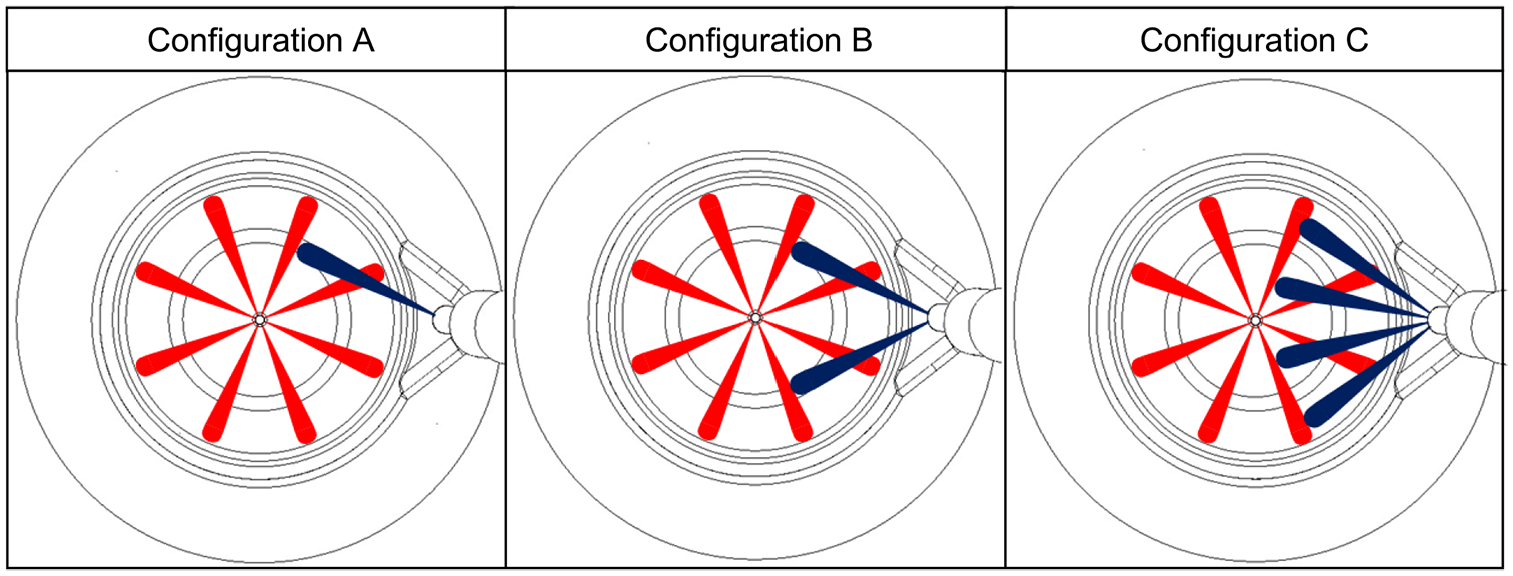
Schematic of the dual-injector system with the ethanol central injector and three different diesel side injector configurations.
The dual-injector system consists of two solenoid injectors connected to separate rail pressure systems: a heavy-duty Scania injector mounted along the piston centerline and a Bosch light-duty injector with a custom-made nozzle tip mounted in the access hole for the flush-mounted pressure transducer in the cylinder head. The start of injection (SOI), injection duration and pressure of ethanol and diesel can be set independently. In fact, the two injection events are separately controlled using a LabView based control system for the diesel fuel system and an in-house control system for ethanol fuel system, both processing the same encoder signal with 0.1 crank angle degree (CAD) resolution. Fuel consumption is calculated based on the variation of fuel mass over time, measured with two separate fuel scales for ethanol and diesel. The piston has a standard bowl geometry designed for conventional diesel combustion, with an additional recess machined for accommodating the side injector nozzle tip shown in Figure 1. The nominal compression ratio is 19.4, compared to an estimated effective compression ratio of 17.7–18.2. This difference is caused by the additional crevice volume resulting from the design modification for the side injector installation on the cylinder head, and may also be enhanced by in-cylinder gas blow-by through the side injector seal. The intake port geometry corresponds to a nominal swirl number of 1.7. Additional details on experimental setup, engine geometry and operation can be found in the preliminary study, 25 together with the physical properties of diesel and ethanol.
Crank-angle resolved in-cylinder pressure is measured via a channel-mounted pressure transducer. Pollutant emissions are sampled using a Horiba gas analyzer, recording the concentration of CO and HC in the exhaust stream on a dry-basis. A lambda sensor records the concentration of residual oxygen in the exhaust stream, based on which the in-cylinder trapped mass of air is estimated. The intake pressure is measured with a pressure transducer located in the intake manifold whereas the exhaust backpressure is kept atmospheric and measured with a transducer located on a pressure vessel along the exhaust stream. Time-resolved intake and exhaust temperatures are measured with K-type thermocouples mounted on the intake and exhaust manifolds, respectively.
Side injector configurations
The three different configurations of the diesel side injector shown in Figure 1 are compared in this study. All the configurations have a non-axisymmetric spray pattern and the same total nozzle area, that is, the injection mass flow rate is approximately the same at a given rail pressure. Specifications of the nozzle hole diameter and number are listed in Table 1: the configurations are arranged in order of increasing number of sprays and decreasing hole diameter. It should be noted that the spray liquid penetration may vary between configurations because of the different hole diameters. 28 When using configuration A, the diesel pilot fuel is enclosed in a single wider spray plume, whereas with configurations B and C a comparable amount of diesel fuel is more evenly distributed across the piston bowl volume. The orientation of the single diesel spray of configuration A coincides with the orientation of one of the sprays of configuration B, however, the area of the single spray hole is double. Moreover, the single diesel spray of configuration A is oriented along the direction of the in-cylinder swirl motion. The minimum angular distance between the diesel spray centerlines and the cylinder head sealing surface is approximately equal for all injector configurations and it was set to avoid spray impingement against the cylinder head. In order to ensure a systematic comparison between the results obtained using the different diesel injectors, the ethanol central injector with eight fuel sprays is retained throughout the tests, as shown in Figure 1. The clocking of the ethanol injector is carried out in order for the centerline connecting the nozzle tips of the ethanol and diesel injectors to bisect the adjacent ethanol sprays, consistently with the preliminary simulation study. 27
Specifications of the side injector nozzle tip geometry.
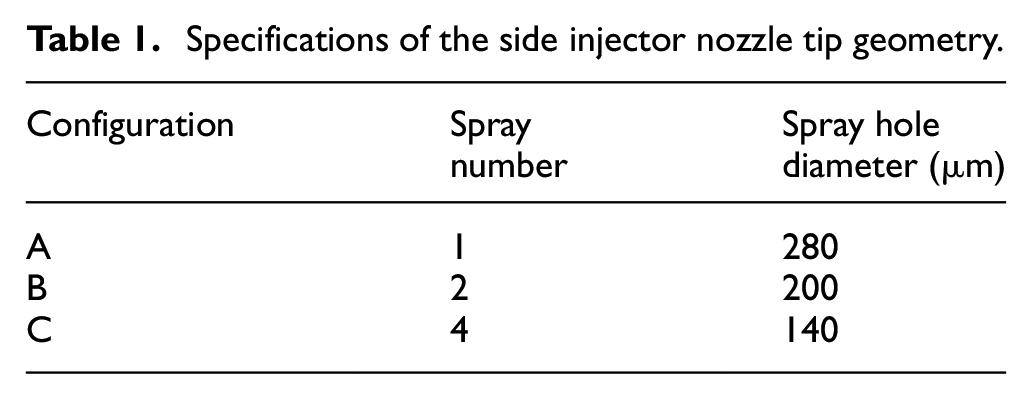
It should be noted that the two-spray diesel injector (configuration B) was used in the previous experimental study. 25 The differences in the ethanol ignition and combustion characteristics observed when using a diesel injector with a single spray and a larger hole (configuration A) or with multiple sprays and smaller holes (configuration C) compared to the baseline configuration B are outlined in the result section. The physical explanation of these differences is subsequently outlined in the discussion section.
Experimental method
As previously mentioned, the dual-injector system used in this study allows to independently control the timing and duration of the diesel and ethanol injections. Consistent with the approach followed in the previous investigations on ethanol-diesel DICI combustion,25,27 two dual-injection parameters are defined based on the timing of the pilot and main injection and on the ratio between two fuels.
The main-pilot separation (MPS) is the first dual-injection parameter defined as the difference between ethanol and diesel SOI, as shown in equation (1).

It should be noted that the above SOIs correspond to the start of the switch-on voltage signal for the injection actuation. The ethanol injector is kept unchanged throughout the tests, therefore the delay between energizing start time and actual start of ethanol injection is approximately equal for all test points – except for limited variations due to differences in the in-cylinder pressure. Moreover, the electronic components and the moving mechanical parts of the three diesel injectors in Figure 1 are the same. Hence, also the delay between energizing start time and actual start of diesel injection is assumed to be equal for all the test points. Diesel is injected before ethanol – that is, the MPS is positive – in most of the cases, however, a subset of test points with negative MPS is also considered.
The ethanol ratio is the other dual-injection parameter defined as the ratio between the ethanol fuel energy and the overall fuel energy injected, as indicated in equation (2).
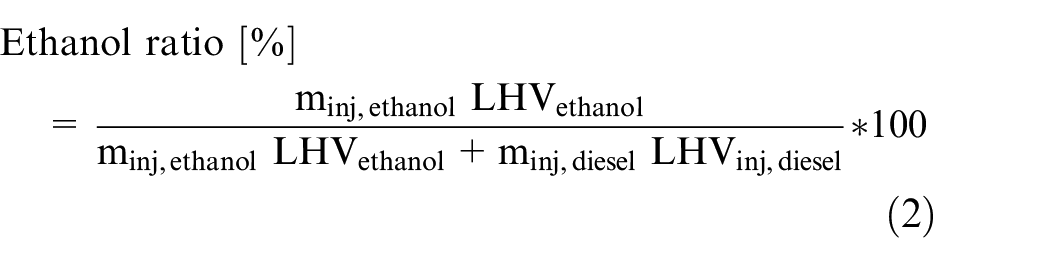
The amount of diesel injected is kept at minimal levels for keeping stable and complete ethanol combustion.
A longer ignition delay allows more time for the fuel-air mixing process, leading to a faster heat release at the start of combustion. For this reason, the apparent rate of heat release (ARoHR) peak is used as an indicator of the ethanol degree of premixing. The calculation of the start of combustion (SOC) of ethanol based on the cumulative rate of heat release was found to be inconsistent for the test points with low main-pilot separations – that is, when the two injection events of ethanol and diesel overlap. Therefore, ethanol SOC is calculated as the zero of the first derivative of the ARoHR with respect to crank angle preceding the main ARoHR peak. The ethanol ignition delay is subsequently computed as the difference between the SOC and SOI of ethanol. In order to exclude the uncertainty in the identification of the end of the late combustion phase, the end of combustion (EOC) is assumed at CA90, that is, after 90% of the cumulative apparent heat is released. Ethanol combustion duration is then calculated as the difference between EOC and SOC. Additional parameters used to evaluate the cyclic variability and completeness of ethanol combustion are the coefficient of variation (COV) of IMEPgross and combustion efficiency, respectively. Combustion efficiency is estimated based on HC and CO engine out emissions, following the approach of Johansson. 29 The HC emission measurements are corrected to account for the lower response of flame ionization detector (FID) to oxygenated species. 30 Further details on the calculation of ARoHR, ethanol SOC and combustion efficiency can be found in Giramondi et al. 25
In this study, the influence of the low pressure cycle on combustion and engine performance is not investigated. Engine performance is evaluated based on the gross indicated efficiency (
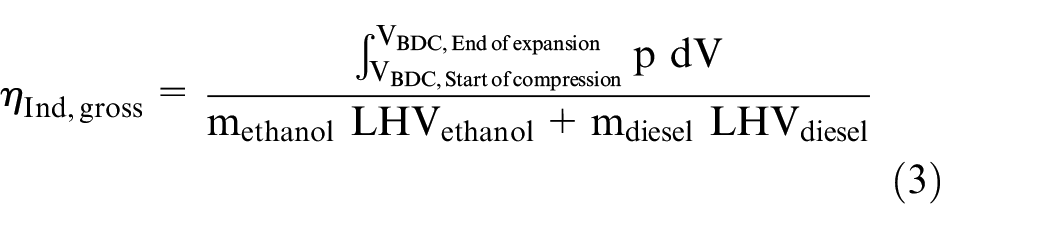
An energy balance analysis is carried out for some of the test-cases in order to assess how the residual enthalpy of the exhaust gases, in-cylinder heat transfer and blow-by losses impact the gross indicated efficiency. Equations (4) to (6) are implemented to calculate exhaust enthalpy, indicated work output, heat transfer and blow-by losses.



The exhaust mass (
Results
In order to evaluate the influence of the spray hole number and size of the diesel injector on ethanol combustion and engine performance, the same set of test points is iterated using the three different side injector configurations displayed in Figure 1. The engine conditions investigated in the preliminary experimental study 25 are replicated when using the diesel injector configurations A and C, in order to ensure a systematic comparison with the experimental results obtained with configuration B. 25 The most relevant test conditions are reported in Table 2 for the two load levels investigated. A total of 81 test points is evaluated at each load level: a three-level full-factorial sweep of (i) diesel SOI, (ii) ethanol SOI, and (iii) ethanol ratio is carried out with the three different injector configurations. All tests are carried out keeping an atmospheric backpressure owing to safety concerns for the potential buildup of unburned ethanol in the exhaust gas pressure vessel.
Experimental conditions. 25
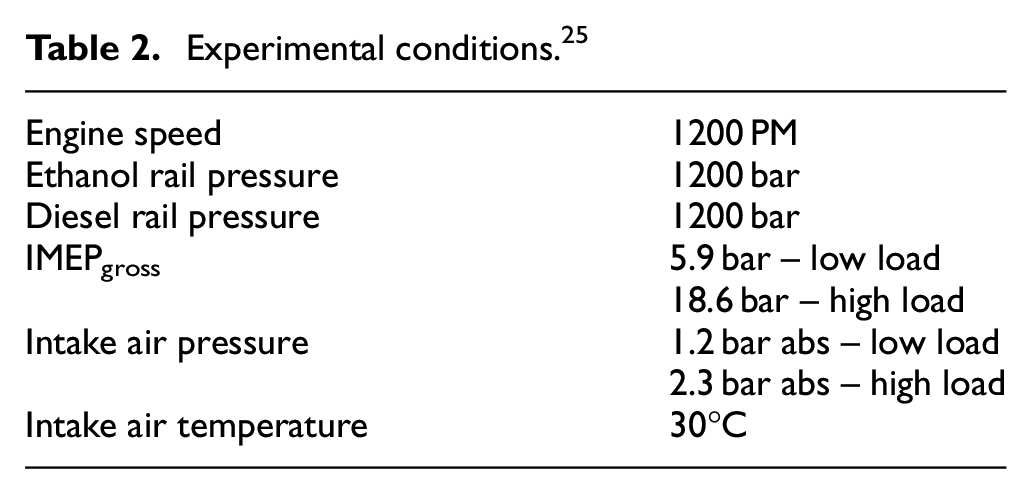
Dual-fuel combustion characteristics and performance are compared to conventional diesel combustion. Standard diesel engine tests were preliminarily carried out by injecting only diesel through the main injector without actuating the side injector. 25 The amount of diesel injected was set to match the overall fuel energy of the dual-fuel test points. The start of the single diesel injection was varied while keeping the rail pressure, engine speed, boost and exhaust pressure at the same levels as in the dual-fuel experiments. The confidence intervals of the combustion and performance parameters obtained for the diesel baseline are included among the results presented in the following sections, as a reference for comparison with the ethanol-diesel DICI combustion results. The confidence intervals are calculated assuming a Student’s t-distribution with eight degrees of freedom, since they are based on a total of nine data points. 25 It should be noted that, in some of the figures presented in the following sections, the confidence intervals for the diesel baseline are so narrow that they overlap on a single line.
Influence of the diesel injector configuration at low load
At low load, diesel SOI, ethanol SOI and ethanol ratio are varied between the values listed in Table 3. The start of fuel injection is expressed in crank angle degrees after top dead center position (CAD ATDC). The reported ethanol ratios are average values based on the fuel injected quantities measured during the tests. The mean deviations of the ethanol ratio from the corresponding average values are also included in Table 3.
Levels of dual-injection parameters tested in the full-factorial sweep at low load.
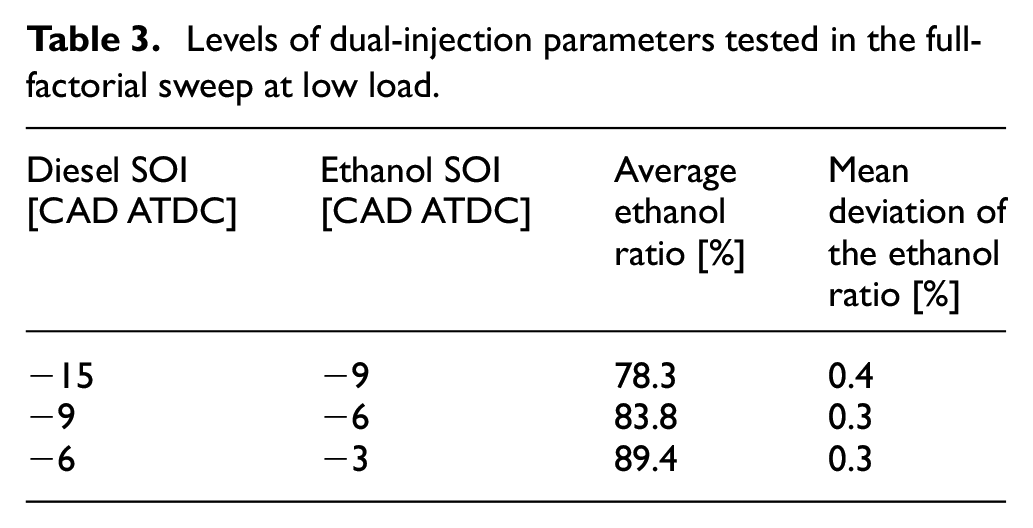
Figure 2 shows the dual-injection strategy, in-cylinder pressure and ARoHR of four reference test cases iterated using different side injector configurations. The selected cases are displayed in order of increasing main-pilot separation from 0 CAD in case (a) to 12 CAD in case (d), and belong to the subset of test points with an average ethanol ratio of 83.8%. The slight pressure difference at the end of the compression stroke observed between the three series of data included in each case in Figure 2 can be explained by fluctuations in the mass of intake air. However, the ignition and combustion characteristics of ethanol and diesel are not found to be affected by these limited in-cylinder pressure deviations, as the high-pressure fuel injection has a predominant impact on ignition and combustion. In all the cases displayed in Figure 2, diesel pilot ignition can be identified as a distinct event preceding the ignition of ethanol. Using the one-spray injector, the combustion of the diesel pilot starts slightly later compared the other diesel injector cases. When the ethanol and diesel injection events are overlapped – for example, in Figure 2(a)– the one-spray diesel injection provides a stronger source of ethanol ignition. In fact, a higher peak ARoHR and a shorter late combustion phase are observed. With a sufficiently long main-pilot separation – for example, in Figure 2(b) to (d) – the ARoHR traces tend to overlap, that is, ethanol ignition and combustion characteristics are comparable for all diesel injector configurations. The only difference observed in these cases is that the ARoHR trace of the one-spray diesel injector falls slightly below the ARoHR traces of the other two diesel injector configurations, as opposed to what observed in Figure 2(a). The differences in the ethanol ignition and combustion characteristics observed when increasing the MPS from case (a) to case (d) in Figure 2 are further explained based on the combustion efficiency trends addressed later in this section.
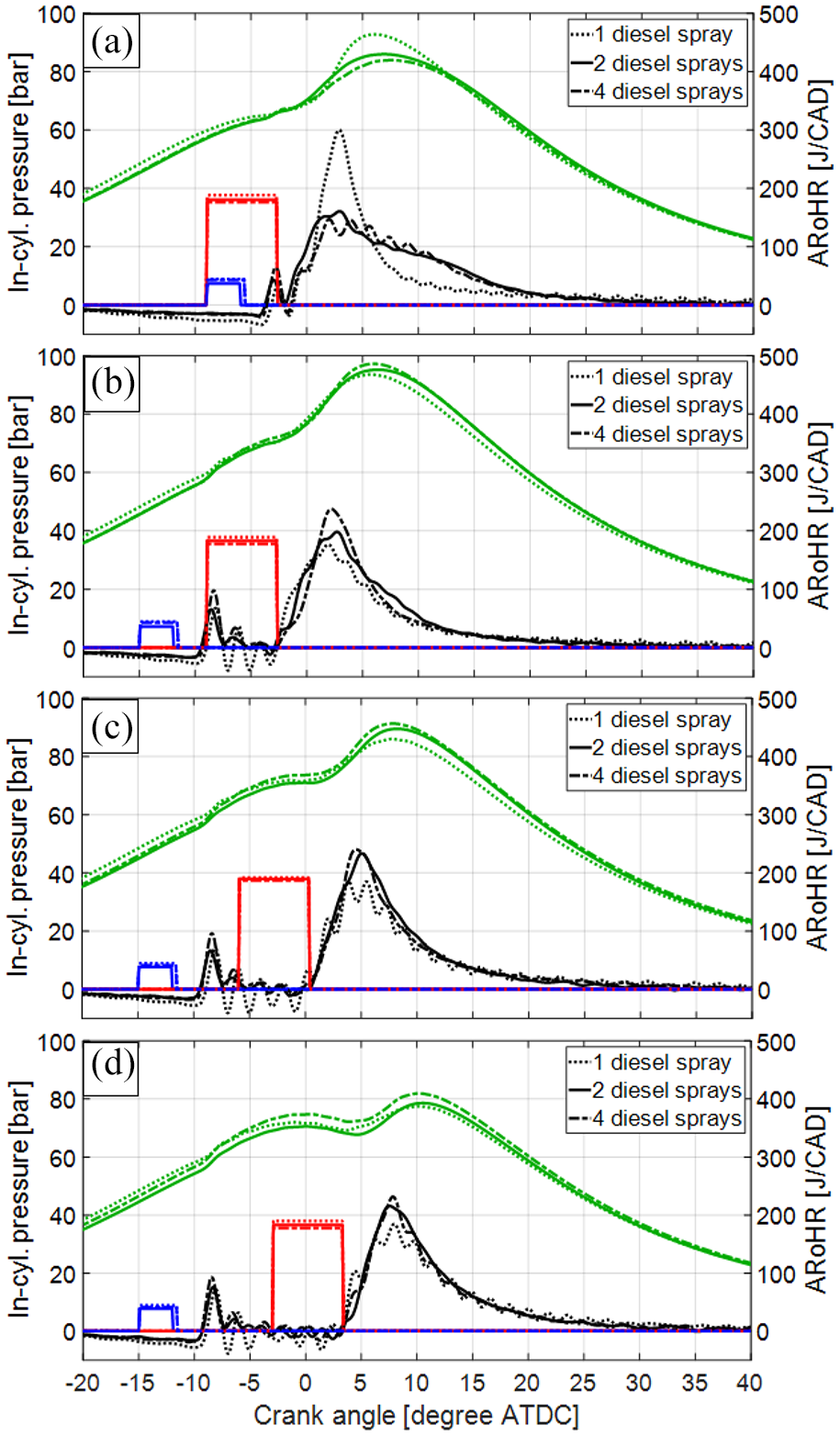
Dual-fuel combustion characteristics at low load with different side injector configurations at increasing main-pilot separations from case (a) to (d). In-cylinder pressure, apparent rate of heat release, diesel and ethanol injection on-time are highlighted in green, black, blue, and red.
Figures 3 to 5 show results obtained for the subset of ethanol-diesel test points corresponding to the lowest ethanol ratio tested at low load with an average equal to 78.3%. As a reference, the mean value (dashed line) as well as the upper and lower limits (solid lines) of the confidence interval for the conventional diesel combustion baseline are outlined with horizontal lines in the same figures. Moreover, two-term exponential functions are fitted to the dual-fuel data for facilitating the comparison between the trends obtained with different diesel injector configurations. The same approach is followed for the presentation of the results at high load. The ethanol ratio was found to have a limited influence on the results displayed in Figures 3 to 5. Hence, the observations drawn in this section can be extended to the entire dataset at low load. For completeness, the results for the entire dataset at low load including different ethanol ratios are displayed in Figures A1 to A3 in the Appendix.
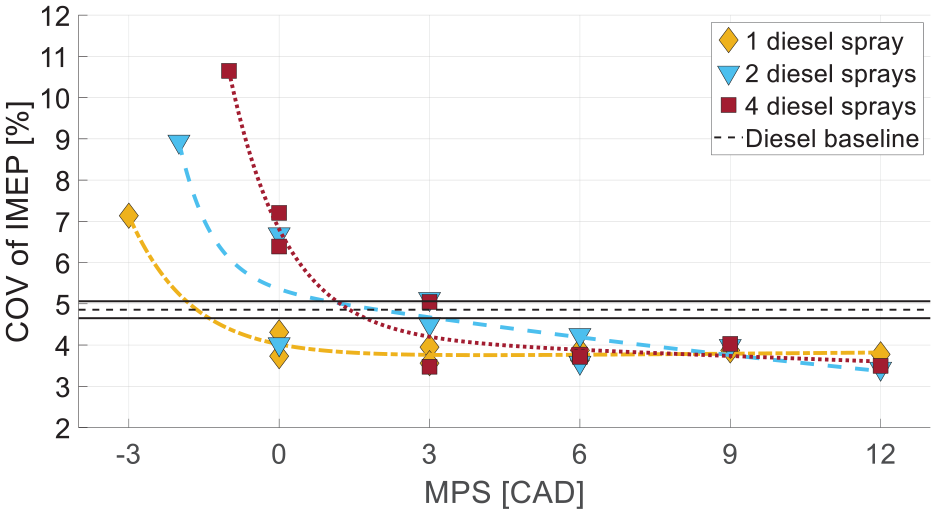
Dual-fuel combustion variability at low load as a function of the main pilot separation compared to the diesel baseline.
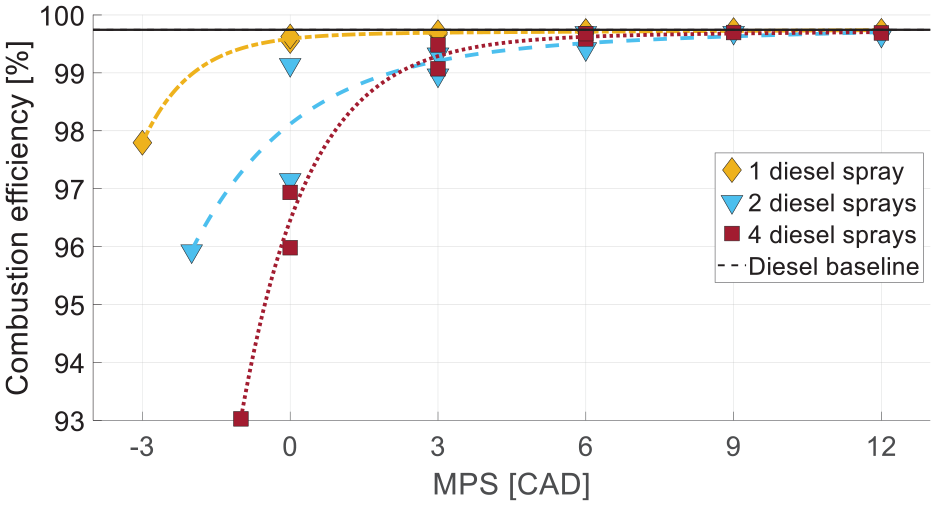
Dual-fuel combustion efficiency at low load as a function of the main pilot separation compared to the diesel baseline.
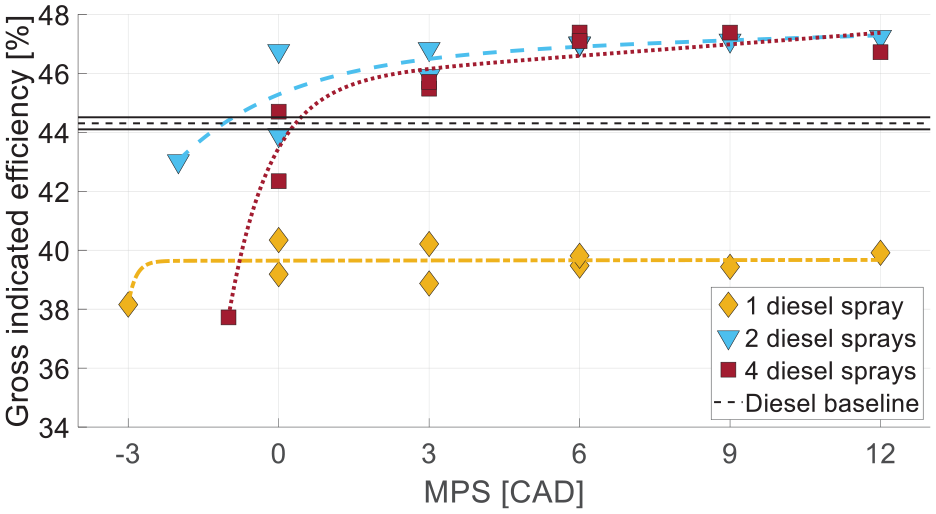
Dual-fuel gross indicated efficiency at low load as a function of the main pilot separation compared to the diesel baseline.
Figure 3 highlights the difference in cyclic combustion variability observed between the three diesel injector configurations. The main-pilot separation has a strong influence on the COV of IMEP at low load, as combustion variability grows at low main-pilot separations with any of the tested diesel injectors. Combustion variability also increases when using diesel injectors with a higher number of sprays. In fact, the one-spray diesel injector allows to limit combustion variability to diesel-like values for the broadest range of main-pilot separations. Moreover, a stronger increase in COV of IMEP at low main-pilot separations is observed with the two- and four-spray diesel injectors. Main-pilot separations below -1 CAD could not even be tested with the four spray diesel injector due to an excessive decrease in the engine power output and increase in unburned fuel emissions. Test cases with unburned hydrocarbon emissions higher than 5000 ppm on a dry basis – the upper range limit of the HC emission analyzer – were disregarded.
Cyclic combustion variability at low main-pilot separations is accompanied by partial misfire of ethanol, as confirmed by the combustion efficiency trends displayed in Figure 4. With a decreasing number of sprays of the diesel injector, partial misfire of ethanol at low main-pilot separations is mitigated. At the lowest tested main-pilot separation and at an ethanol ratio of 78.3%, partial misfire and incomplete combustion of ethanol cause a combustion efficiency loss of 2.2% with the one-spray diesel injector compared to a loss of 7.0% with the four-spray injector. The higher combustion efficiency levels obtained with the one-spray diesel injector at low main-pilot separations shown in Figure 4 are consistent with the higher peak in-cylinder pressure and ARoHR of the test case in Figure 2(a): ethanol ignition is more effective and combustion more complete compared to other injector cases. On the other hand, ethanol-diesel combustion efficiency at high main-pilot separations is comparable to conventional diesel combustion regardless of the diesel injector configuration used. Only a slight decrement in combustion efficiency can be observed among the four-spray injector cases at high ethanol ratios shown in Figure A2 in the Appendix. Extending the main-pilot separation promotes favorable in-cylinder conditions for compression ignition of ethanol at low load. 25 Under these conditions, ethanol combustion completeness is achieved with any of the tested diesel injector configurations. This explains the similarity between ARoHR traces of the different injector cases in Figure 2(b) to (d).
Combustion efficiency losses at low main-pilot separations cause a comparable gross indicated efficiency drop, as highlighted in Figure 5. However, the efficiency levels obtained with the one-spray injector are lower by 5–9 percentage points compared to the two- and four-spray diesel injectors and fall well below the average efficiency value of the conventional diesel combustion baseline. Hence, despite being the most robust trigger for ethanol ignition, the one-spray diesel injection leads to a severe performance deterioration for all investigated test points at low load.
Figure 6 outlines a comparative energy balance analysis for three different side injector cases at low load. The selected cases are characterized by the longest main-pilot separation tested at low load – that is, 12 CAD – and belong to the subset of test points sampled at the minimum ethanol ratio of 78.3%. As shown in Figure 4, these cases lay in the region with the highest combustion efficiency. In this way, the analysis is not affected by different amounts of unburned fuel between the different side injector cases. The energy contributions displayed in Figure 6 are computed based on equations (4) to (6) and normalized to the fuel energy input. The energy balance analysis shows that higher heat transfer losses contribute to the indicated efficiency drop observed with the one-spray diesel injector, given the otherwise limited variations in the exhaust enthalpy between side injector cases. Differences in the duration of the late combustion phase at low load may also play a role in the gross indicated efficiency reduction of the one-spray injector cases.
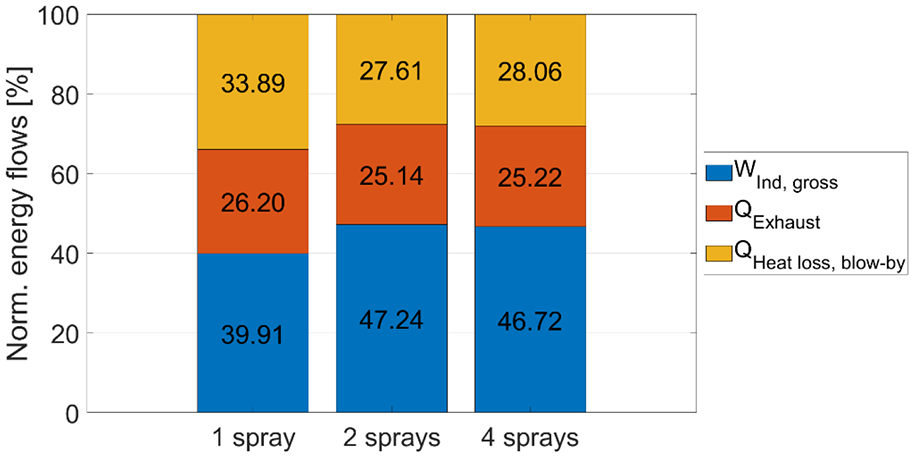
Energy balance analysis for different side injector cases tested at the longest main-pilot separation and minimum ethanol ratio at low load.
Influence of the diesel injector configuration at high load
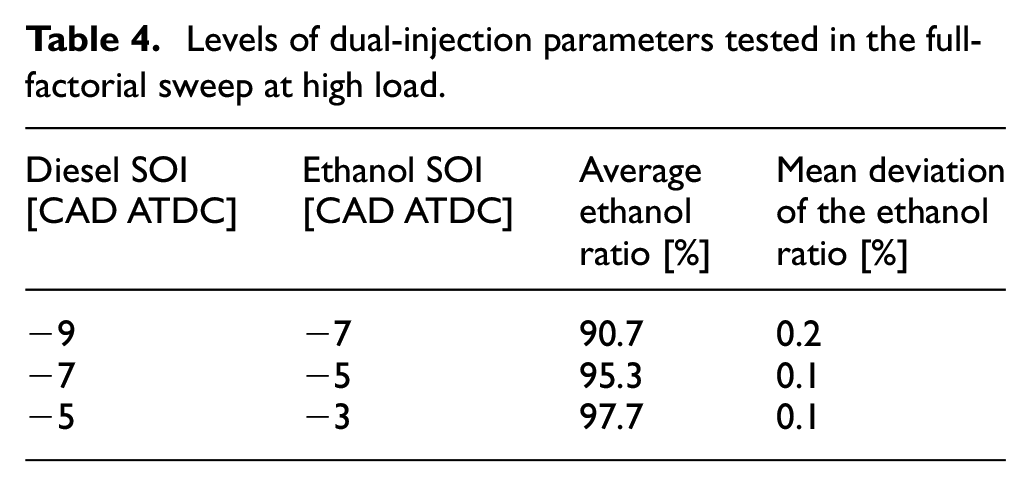
At high load, diesel SOI, ethanol SOI and ethanol ratio are varied between the values listed in Table 4. As done for the low load cases, the average values and mean deviations of the ethanol ratio are included in the table. The SOI ranges are narrower compared to low load, in order to avoid exceeding the mechanical limit for the in-cylinder pressure equal to 200 bar.
Levels of dual-injection parameters tested in the full-factorial sweep at high load.
The main-pilot separation has a strong impact on ethanol ignition characteristics, especially with the one-spray diesel injector. With this injector configuration, a 2 CAD increase in the separation between main and pilot injections causes a sharp decrease in the degree of premixing of ethanol at the moment of ignition, as the set of representative test cases in Figure 7 shows. The selected test cases are displayed in order of increasing main-pilot separation from −2 CAD in case (a) to 6 CAD in case (d), and belong to the subset of test points with an average ethanol ratio of 95.3%. Ethanol ignition propagation limits the overall combustion rate when using the one-spray diesel injector, as confirmed by the plateau observed in the corresponding ARoHR trace in Figure 7(b), as well as by the shallow ARoHR increase in Figure 7(c) and (d). Moreover, Figure 7(c) and (d) show that a shorter ethanol ignition delay is obtained with the one-spray diesel injector, despite the longer air-fuel mixing time required by the wider diesel spray liquid core. The differences in the ethanol ignition dynamics between different side injector cases are not reflected on the end of ethanol combustion, as the tails of the ARoHR traces overlap at any main-pilot separation in Figure 7. The ethanol combustion characteristics observed with the two- and four-spray diesel injectors are similar. Moreover, with a sufficiently long main-pilot separation, the ARoHR peaks are comparable for all side injector cases, as displayed in Figure 7(d). This is evidence that ethanol mixing-controlled combustion can be achieved using any of the tested diesel injectors and that, with a sufficiently long main-pilot separation, the influence on ethanol combustion characteristics of the nozzle hole number and size of the diesel injector is more limited.
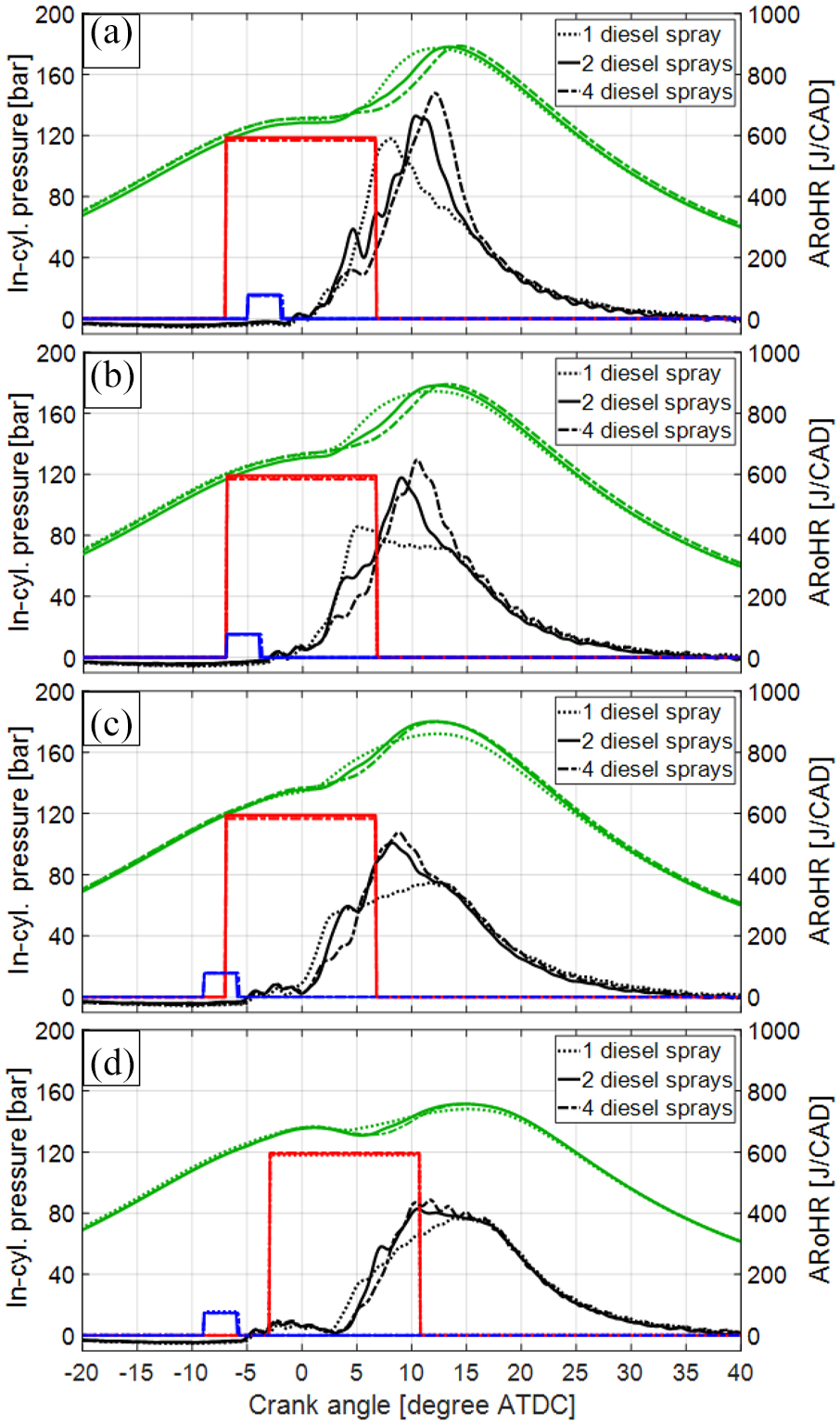
Dual-fuel combustion characteristics at high load with different side injector configurations at increasing main-pilot separations from case (a) to (d). In-cylinder pressure, apparent rate of heat release, diesel and ethanol injection on-time are highlighted in green, black, blue, and red.
The results for the subset of test points with an average ethanol ratio of 90.7% are shown in Figures 8 to 10. The confidence interval for the diesel baseline is outlined by the horizontal solid lines in Figures 8, 9 and 11 (presented later in this section), while the horizontal dashed line identifies the corresponding mean value. Also at high load, the influence of the ethanol ratio on combustion characteristics and performance is limited. Hence, the lowest tested ethanol ratio is considered in order to draw a clear comparison between the different diesel injector cases. For completeness, the results for the entire dataset at high load are shown in Figures A4 to A6 in the Appendix.
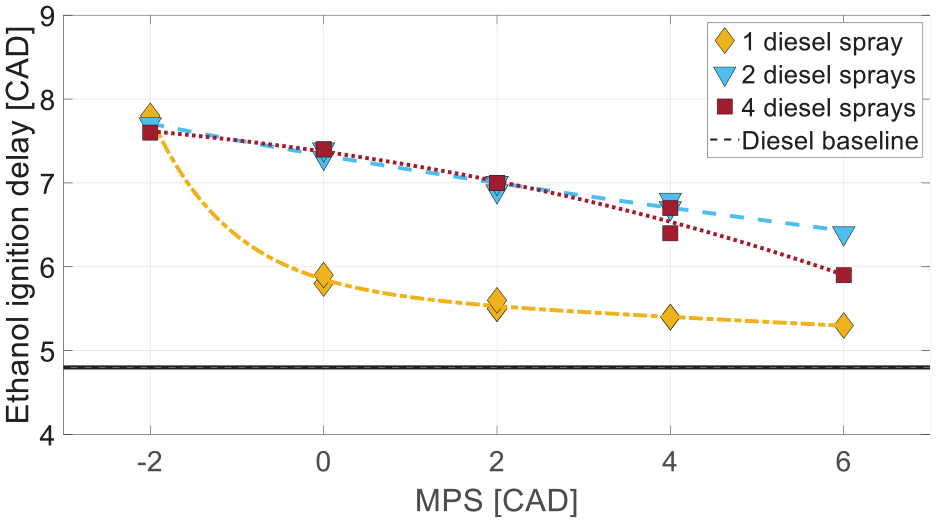
Ethanol ignition delay at high load as a function of the main pilot separation compared to the average ignition delay of the diesel baseline.
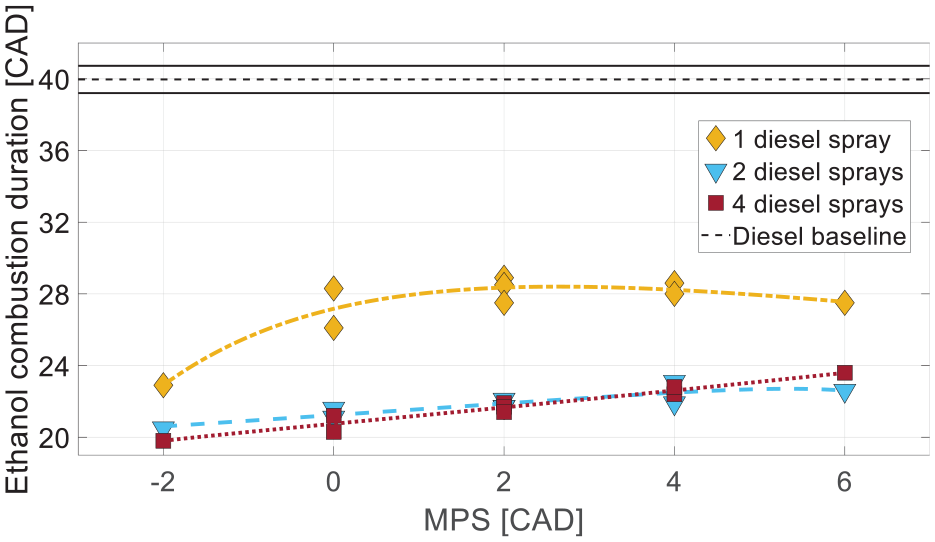
Ethanol combustion duration at high load as a function of the main pilot separation compared to the average combustion duration of the diesel baseline.
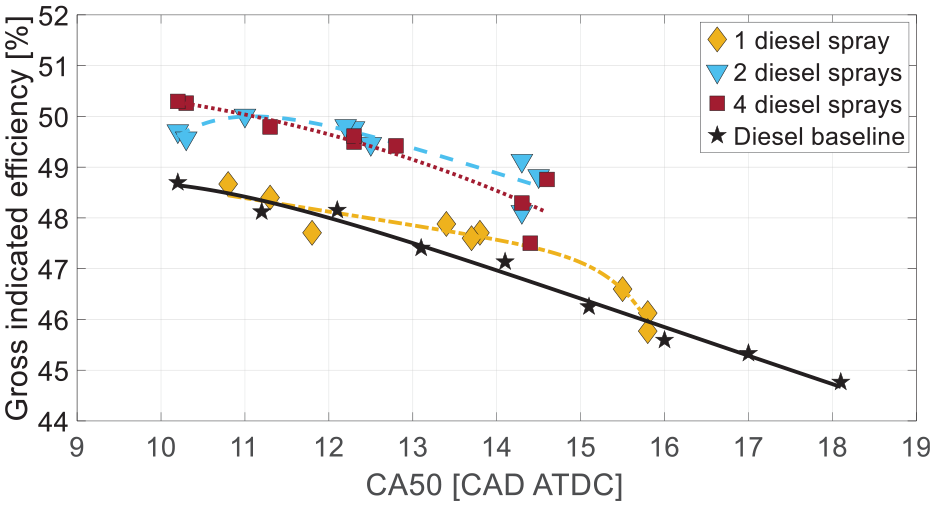
Dual fuel gross indicated efficiency at high load as a function of combustion phasing compared to the diesel baseline.
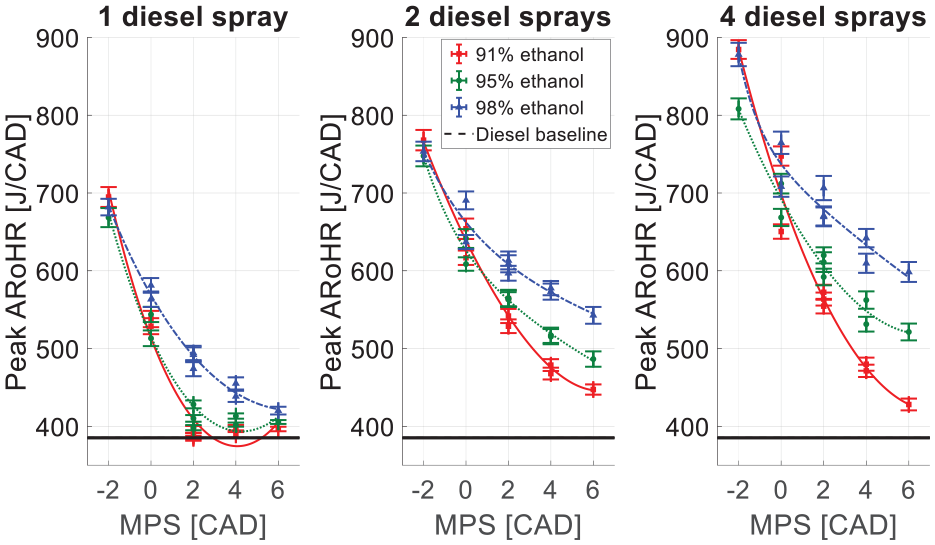
Peak ARoHR of all the dual-fuel cases at high load as a function of the main pilot separation compared to the diesel baseline.
Figure 8 shows the dependence of the ethanol ignition delay on the separation between ethanol and diesel injection. At negative main-pilot separations, the ethanol ignition delay is almost coincident for all side injector cases. Moreover, an increase in the main-pilot separation leads to shorter ethanol ignition delays. However, the decrease of the ethanol ignition delay is steeper for the one-spray diesel injector cases. This finding is consistent with the ARoHR trends shown in Figure 7.
The duration of ethanol combustion as a function of the main-pilot separation is displayed in Figure 9 for the same set of cases shown in Figure 8. The trends of ethanol combustion duration in Figure 9 mirror the trends of ethanol ignition delay in Figure 8 for all the diesel injector configurations. Moreover, the one-spray diesel injector cases are characterized by the longest ethanol combustion durations. This difference is reflected in the ARoHR traces displayed in Figure 7(c) and (d): the one-spray injector case has a shorter ethanol ignition delay whereas the tail of the ARoHR trace overlaps with the other injector cases. This is evidence that the impact of the diesel injector configuration on the ethanol late combustion phase at high load is limited: a decrease in the ethanol ignition delay drives a comparable increase in the overall combustion duration. Moreover, regardless of the side injector configuration used, ethanol combustion duration is sharply shorter compared to the average combustion duration of the diesel baseline. A faster air-fuel mixing rate driven by the higher volatility of ethanol compared to diesel may explain this difference. 25
As observed at low load, differences in performance arise when comparing the results obtained with the three diesel injectors. Figure 10 shows the gross indicated efficiency of the subset of cases displayed in Figures 8 and 9 as a function of CA50, compared to the efficiency of the standard diesel baseline cases. The relative difference in the ethanol combustion duration between dual-fuel cases and diesel baseline displayed in Figure 9 is reflected in the combustion phasing ranges shown in Figure 10. The two- and four-spray injector cases have a narrower range of CA50 compared to the one-spray injector cases, as well as to the diesel baseline. The shorter combustion durations may contribute to an increase in the work output, with a more limited effect when using the one-spray diesel injector. In fact, the two- and four-spray injector cases have comparable efficiencies, reaching values higher by 1–2 percentage points compared to the diesel baseline. Instead, the gross indicated efficiencies of the one-spray injector cases are in line with the diesel baseline. Hence, the ethanol ignition dynamics driven by the one-spray diesel injector causes a performance penalty also at high load.
The degree of premixing of ethanol estimated based on the ARoHR peak shows a strong dependence on multiple factors, as shown in Figure 11. For this reason, Figure 11 displays the results obtained for the complete dataset at high load. An increase in the main-pilot separation causes a sharp decrease in the ARoHR peak with any diesel injector configuration. Lower quantities of diesel injected – that is, higher ethanol ratios – lead to a higher degree of premixing of ethanol. Moreover, the ARoHR peaks translate upwards while increasing the number of sprays of the diesel injector. Hence, an increase in the nozzle hole number of the diesel side injector – and a corresponding decrease in nozzle hole size – leads to a higher degree of premixing of ethanol. This means that the one-spray diesel injector allows to achieve mixing-controlled combustion of ethanol for the broadest range of main-pilot separations among the tested diesel injector configurations.
Discussion
The modelling study on ethanol-diesel DICI combustion referenced in the introduction section 26 demonstrated that, under the engine operating conditions considered in the present investigation, ethanol combustion starts within the ethanol spray plumes adjacent to the igniting diesel sprays. Ethanol ignition subsequently propagates from spray to spray until achieving combustion completion, except at low main pilot-separations at low load. 26 These findings were obtained when modelling the dual-injector system with the two-spray diesel injector in Figure 1 (configuration B). However, the same ethanol ignition dynamics is likely to hold for the diesel injector configurations A and C evaluated in the present study. When using the one-spray diesel injector (configuration A), fewer ethanol sprays are close to the burning diesel spray compared to configurations B and C in Figure 1. As a result, spray-to-spray ignition propagation of ethanol is slower, in accordance with the longer combustion durations observed at high load. The study of Mueller and Musculus 19 on glow plug assisted ignition of methanol describes a similar ignition dynamics. Methanol ignition occurs within the spray plumes close to the glow plug located in one hemisphere of the combustion chamber, and it is followed by combustion propagation toward the adjacent fuel sprays. 19 The ethanol ignition dynamics described above is also consistent with the lower gross indicated efficiencies observed with the one-spray diesel injector. In fact, combustion of the ethanol sprays distant from the igniting diesel spray may occur closer to the piston surface – given the longer time for ethanol-air mixing – causing the higher heat losses outlined in Figure 6. Future modelling studies using the validated ethanol-diesel DICI combustion model 26 may further investigate this assumption.
The high peak apparent rate of heat release at negative main-pilot separations at high load shown in Figure 11 can be explained in light of the results of the study performed by Kokjohn et al. 32 on RCCI combustion of iso-octane and n-heptane. A sharp increase in the peak ARoHR was observed 32 in a test case characterized by a high gradient of local equivalence ratio between the high reactivity fuel – within spray plumes having a locally rich or stoichiometric fuel concentration before ignition – and the low reactivity fuel – having a lean and homogeneous concentration across the combustion chamber. Hence, in the present study, the decrease in the main-pilot separation drives a shift of the ethanol-diesel combustion regime from mixing-controlled toward RCCI. The dual-injector system adopted in this study could be used for experimental investigations on ethanol-diesel RCCI combustion, for example, by advancing the ethanol injection earlier in the compression stroke. However, it should be noted that the diesel injector configurations used in the present investigation are tailored to the spray pattern of the ethanol injector and designed for late ethanol injections close to top dead center position. As observed by Jia and Denbratt, 33 advancing the main alcohol fuel injection could cause cylinder wall wetting, driving the need for an injector with a different spray orientation. Krishnasamy et al. 7 also highlighted that open piston bowl geometries and narrow injector cone angles are preferable in RCCI combustion systems.
When using a diesel injector with a higher number of sprays and smaller holes, a steeper drop of combustion efficiency is observed at low main-pilot separation at low load, as outlined in Figure 4. This behavior can be explained in light of the findings of previous studies on combustion of n-heptane and alcohol fuels.34–36 Lü et al. 34 investigated the effect of in-cylinder blending of n-heptane and short-chain alcohols on homogeneous charge compression ignition (HCCI) combustion in a diesel engine at a low and a medium load point. 34 With ethanol/n-heptane ratios above 20%, an increase in the engine-out HC emissions and a severe engine performance deterioration was reported, owing to the inhibiting effect of ethanol on the ignition of n-heptane. 34 The study of Zhang et al. 35 explained the inhibiting effect of short-chain alcohols on ignition based on the competition between the production of OH radicals and stable aldehydes at low temperature. The conclusions drawn in Lü et al. 34 and Zhang et al. 35 are consistent with the study on autoignition characteristics of butanol/ and ethanol/n-heptane blends performed by Saisirirat et al., 36 where the longer ignition delays of the alcohol/n-heptane blends were explained based on a lower production of OH radicals limiting the chain branching reactions. 36 In the present study, when using a side-injector with a higher number of smaller holes, diesel-air mixing process is favored and the pilot fuel is more evenly dispersed across the piston bowl volume. When injections of ethanol and diesel overlap at low main-pilot separations, the dilution of premixed diesel and ethanol in the vapor phase is favored: these conditions may promote the inhibiting effect of ethanol on the ignition of diesel as previously observed for n-heptane.34–36 The ignition inhibiting effect is mitigated when using the one-spray diesel injector, as the whole pilot fuel charge is enclosed within a single wider spray plume limiting the dilution of premixed diesel and ethanol in the vapor phase. This assumption is consistent with the lower combustion instability and higher combustion efficiency outlined in Figures 3 and 4 for the one-spray diesel injector cases at low load.
A longer penetration of diesel sprays evenly distributed across the piston bowl may promote fast mixing-controlled combustion of ethanol by triggering the simultaneous ignition of a higher number of ethanol sprays. This can be achieved either by increasing the spray hole diameter and the total nozzle area of the diesel side injector while keeping the number of sprays fixed, or by increasing the diesel injection pressure. The former solution would allow to increase the spray liquid penetration – dependent on the nozzle hole diameter rather than on the injection pressure 28 – while limiting the diesel spray dilution effect previously described. The latter solution would allow to extend the diesel spray vapor penetration 37 thanks to higher spray velocities. Hardware changes such as the reduction of the distance between the ethanol and diesel injector nozzle tips should also be considered, in order to promote fast and simultaneous ignition of all the ethanol sprays.
Conclusion
The diesel injector nozzle hole diameter and number have a strong influence on the characteristics of direct injected ethanol combustion at low and high load, with a subsequent impact on engine performance.
At low load, there is a trade-off between combustion stability and completeness – achieved with a diesel injector with a lower number of spray holes and a larger hole diameter – and engine performance – enhanced using a diesel injector with a higher number of spray holes and a smaller hole diameter. With the dual-injector configuration adopted in this study, a diesel injector with at least two sprays evenly distributing the pilot fuel charge across the piston bowl volume as well as a minimum separation between ethanol and diesel injections are needed in order to avoid the deterioration of either combustion or indicated efficiency.
At high load, there is an analogous trade-off between ethanol degree of premixing and engine performance. The separation between pilot and main injections and/or the relative amount of diesel injected shall increase in order to limit the degree of premixing of ethanol when using a diesel injector with a higher number of smaller holes. The one-spray diesel injector allows to achieve mixing-controlled combustion of ethanol for the broadest range of injection timings and ethanol ratios. However, a diesel injector with at least two sprays is needed in order to shorten ethanol combustion duration and achieve higher indicated efficiencies.
The insight into the influence of the diesel injector nozzle tip geometry on ethanol combustion and engine performance lays the ground for the optimization of dual-injector system and dual-fuel direct injection strategy.
Footnotes
Appendix
Acknowledgements
Christer Spiegelberg, Jack Ivarsson, and Senthil Krishnan Mahendar are acknowledged for their assistance on this work.
Declaration of conflicting interests
The author(s) declared no potential conflicts of interest with respect to the research, authorship, and/or publication of this article.
Funding
The author(s) disclosed receipt of the following financial support for the research, authorship, and/or publication of this article: This work was supported by the Swedish Energy Agency and Scania.
