




Abstract
Combustion of a charge with spatially and temporally varying equivalence ratio in a spark ignition engine was modelled using the Leeds University Spark Ignition Engine quasi-dimensional thermodynamic code. New sub-models have been integrated into Leeds University Spark Ignition Engine that simulate the effect of burnt gas expansion and turbulent mixing on an initial equivalence ratio distribution. Realistic distribution functions were used to model the radially varying equivalence ratio. The new stratified fuel model was validated against experimental data, showing reasonable agreement for both the pressure trace and percentage heat released. Including the effect of turbulent mixing was found to be important to reproduce the trend in the differences between the stratified and homogeneous simulations.
Introduction
In a bid to meet the latest government regulations on pollution and consumer demands, engine manufacturers are continually looking at new combustion strategies that consume less fuel and/or produce fewer emissions. In addition, the automotive industry are also looking to reduce production and design costs.
A potential way of improving the thermal efficiency of the working cycle is by adapting stratified fuel injection, rather than ‘traditional’ homogeneous fuel injection. The benefits of stratified charge include 1 (1) reduced pumping losses due to unthrottled part-load operation, (2) decreased heat loss to cylinder walls and (3) an increase in compression ratio due to lower end gas temperatures associated with stratified combustion. Lower-end gas temperatures also reduce the chance of autoignition, although typically the stratified charge engines run under conditions in which the probability of autoignition is already small.
Disadvantages of fuel stratification are an increase in NOx emissions when compared to a homogeneous lean burn engine, as well as control of the fuel spray to ensure the fuel arrives at the spark plug at the correct time. Stratification also causes the exhaust temperature to be cooler than that of a homogeneous lean burn engine, therefore consideration must be given to the aftertreatment operating at these low temperatures. 2 However, Wirth et al. 3 found that fuel stratification is a viable combustion strategy at low load, showing a decrease in both fuel consumption and NOx emissions.
Computational models save prototyping costs with respect to drafting, manufacturing and assembly of parts, and eliminating the time taken to produce these prototypes. Two commonly used types of computational modelling strategies are thermodynamic quasi-dimensional modelling and computational fluid dynamics (CFD). Thermodynamic modelling uses the laws of thermodynamics to determine parameters such as the in-cylinder pressure and temperature, whereas CFD modelling solves the in-cylinder processes as a fluid flow using defined boundary conditions. The quasi-dimensional model is not resolved spatially, other than the location of the flame radius for a given timestep. In contrast, CFD models physical processes in three dimensions, resolving turbulent flow, fuel injection, and combustion. The advantages of using thermodynamic quasi-dimensional codes as opposed to CFD is run time, with the typical run time of a thermodynamic code measured in minutes or seconds, compared to CFD having run times measured in hours, days or even months. Thermodynamic models are routinely used to analyse homogeneous combustion but have not yet been widely adapted for stratified charges.
Fuel stratification is reserved for direct injection (DI) spark ignition (SI) engines adapting late injection timing, which does not give the fuel–air mixture the time needed to perfectly mix and become homogeneous. So far, modelling of stratified charge and the effects of late injection have been predominantly carried out using CFD.4–9 However, some research exists into quasi-dimensional stratified fuel models.10–13 For example, the stratified model developed by Aghdam 10 used a radially varying equivalence ratio. The equivalence ratio distributions were modelled by either a linear or parabolic function. However experimental examples showed that both are not representative of a realistic distribution.14,15 Aghdam’s model is the only example that accounts for the expansion of burned gas assuming a cylindrically propagating flame.
The model developed by Schmid et al. 11 uses an injection model as opposed to an equivalence ratio distribution. It also models the mixing using a mass flow equation, with the turbulent root mean squared (RMS) velocity defined as the mass flow velocity. The mixing models the transition from fuel rich to fuel lean through stoichiometric conditions. To do this, three separate zones are constructed for the unburned gas, as opposed to a continuous distribution of the charge. The combustion is modelled in two stages with an initial spherical propagation before the second phase toroidal burning. Burned gas expansion is neglected.
The work by Sjeric et al. 12 utilised a fractal combustion model with an equivalence ratio distribution that varied with respect to the mass fraction burned. Both the effect of mixing and burned gas expansion were neglected. Aliramezani et al. 13 investigated a partially stratified charge of hydrogen and methane under lean conditions. It is not clearly stated how the distribution of fuel is calculated and the effect of burned gas expansion and turbulent mixing of the stratified charge is not mentioned.
No experimental validation was provided in the works by Aghdam 10 and Sjeric et al. 12 The work by Aliramezani et al. 13 was validated for the indicated mean effective pressure (IMEP) and brake-specific fuel consumption (BSFC). Neither metric is indicative of how stratification changes combustion over the course of a cycle. Schmid et al. 11 have validated their model for both the pressure trace and burn rate with good agreement.
This article describes and validates a novel thermodynamic model for stratified combustion. The model is new in several ways: it uses a realistic radially resolved initial distribution for the equivalence ratio, it includes a new physical sub-model that takes into account the effect of turbulence on mixing the fuel–air charge distribution and it contains a modified burned gas expansion effect to simulate a spherically propagating flame. The inclusion of the turbulent mixing is necessary to simulate the physical processes that occur within the engine. An existing quasi-dimensional homogeneous combustion code is modified in this article to accommodate stratified fuel modelling. The model is validated against experimental data for both the pressure trace profile and for the rate of heat released.
Combustion code
The Leeds University Spark Ignition Engine (LUSIE) is a quasi-dimensional thermodynamic predictive combustion code. It predicts thermodynamic processes in both two- and four-stroke engines. LUSIE iteratively models the closed part of the combustion cycle, neglecting the intake and exhaust processes. The model is classed as quasi-dimensional as it separates the burned and unburned gas regions. Each region has its own temperature and chemical composition with the in-cylinder pressure treated as uniform throughout. It is assumed that no heat transfer occurs between the two zones and that the gases are ideal. Heat is transferred to the cylinder walls, piston and head surfaces using the Woschni 16 heat transfer model. The three zone entrainment model by Blizard and Keck 17 is employed to model flame propagation. Fresh gas is first entrained into the flame at a rate

where

where

where
Our model uses the Zimont 20 turbulent burning velocity model and its associated flame development factor which was first derived by Lipatnikov and Chomiak 21 including a modification to capture the thermal expansion effects of the flame. This is achieved by multiplying the original Zimont model by a density ratio and was first used by Conway 22 and Khan 23

where
The turbulence parameters (crank resolved integral length scale and turbulent RMS velocity) were generated using CFD simulations at Imperial College London. The simulations of the Jaguar Land Rover single-cylinder research engine (SCRE) were undertaken using the commercial STAR-CD/es-ice code. The code was used to simulate gas exchange and in-cylinder flow motion. The model consisted of 2.2 million cells at bottom dead centre (BDC) including the intake and exhaust ports. Time-dependent pressure and constant temperature were applied at the intake and exhaust boundaries of the model for each operating point taken from the experimental data. The base timestep used for the simulations was 0.05 °CA, which was reduced by half during the opening and closing of the valves. Turbulence was modelled using the k-epsilon renormalized group (RNG) model.26,27 The turbulence parameters provided for this study were timestep resolved. The complete methodology was validated using an extensive experimental database from an old specification Jaguar Land Rover Ingenium optical engine,28–34 and the thermodynamic SCRE used in this study. Validation results are not presented here for brevity but have been summarised by Kountouriotis. 35
Fuel stratification modelling
The combustion process in a stratified engine starts with a spark discharge of significant duration, which therefore raises the possibility of it interacting with the fuel cloud that has developed near the spark plug. The flame kernel propagates through a highly inhomogeneous mixture spreading downstream of the rich charge to the continuously leaner mixture. As the fuel mixture is inhomogeneous, the equivalence ratio varies in both space and time. The inhomogeneous premixed combustion is the primary contributor to the heat with the non-premixed after-burning of the lean and rich mixture contributing a small amount to the heat release. 36 For the inhomogeneous premixed combustion, the local zone structure resembles the homogeneous premixed combustion but the local burning rate fluctuates according to changes in the fuel–air equivalence ratio. 37
Since LUSIE is a quasi-dimensional thermodynamic code, it is not possible to incorporate a full three-dimensional (3D) sub-model of fuel injection. The changing fuel–air equivalence ratio,
Experiments have shown that the variation in the individual-cycle fuel distributions in stratified charge engines are highly stochastic due to the turbulent in-cylinder environment which will increase cyclic variations.38–42 Instability of the combustion is governed by convective flow fluctuations, which can prevent the flame kernel from propagating into the main stratified fuel cloud while allowing the fuel cloud to lean out due to transport and mixing. 43 Lean flame quenching then occurs at the edges of the fuel cloud.1,44
The equivalence ratio in our model is updated at each time step and fed into the laminar burning velocity model. Currently, the code will simply abort under extremely lean conditions as parameters do not converge, indicating to the user that combustion has not been completed. A modification of the model to include a realistic representation of flame quenching in very lean mixtures would be an interesting direction for future research.
A possible solution would be to use the Karlovitz stretch factor as a boundary at which quenching occurs. For fuels with positive stretch rate Markstein numbers, quenching has been found to occur at

The relation in equation (5) shows that as the laminar burning velocity decreases, the Karlovitz stretch factor increases, and the laminar burning velocity will become small as the mixture becomes leaner, thus predicting quenching.
Equivalence ratio distribution
The radial stratified charge was incorporated into the three zone combustion models within LUSIE. The model assumes that the flame propagates from a central point of ignition, where the mixture is rich, towards the cylinder walls where the mixture becomes leaner. Because the model is quasi-dimensional, the only point in space that can be observed is the radius of the flame at the current time step. Therefore, the model uses an initial distribution of equivalence ratio which is a function of the flame radius. The changing equivalence ratio is then passed on to the required functions and subroutines within LUSIE.
Burned gas expansion
A memory effect of stratification, which allows for a leaner mixture to burn past the lean limit when the burning followed the burning of a rich mixture, has been observed experimentally. 46 This memory effect is possibly explained by the burned gas expansion. As the volume of the burned gas increases, the expansion of this gas pushes the unburned gas, of a given equivalence ratio, closer to the cylinder walls. This means that the initial equivalence ratio profile is altered by this expansion effect at each time step. How far the gas is translated in space can be expressed as

where
For a spherically propagating flame in a cylindrical combustion chamber, the volume of the unburned gas before expansion is

where

where

where

where R is the cylinder radius. Rearranging for r and

and

Turbulent mixing
The fuel–air mixture for stratified charge varies temporally as well as spatially. After the point of injection, the fuel and air are mixing together due to turbulent diffusion. The simplest way to model the effect of turbulent mixing was to use the one-dimensional diffusion equation using a turbulent diffusivity value

The following boundary conditions were used to determine a solution to equation (13)



These boundary conditions were determined from experimental equivalence ratio profiles.14,15
Equation (14a) is derived from the charge varying radially outward from a central point at

where

and the equilibrium equivalence ratio

While the initial distribution in space may match experimental and CFD data, the turbulent diffusivity

where k and

Due to the constraints of the quasi-dimensional model isotropic turbulence is assumed so that

Consequently, the model cannot directly account for the coherent motions, swirl and tumble, that can prohibit/encourage mixing, respectively. 50 The turbulent dissipation can be written in terms of the turbulent kinetic energy and therefore is also a function of the turbulent RMS velocity

Substituting equations (20) and (21) into equation (18) gives

where L is integral length scale when applied to the flame brush thickness in the flame speed closure (FSC) model. 4 Here, the length scale used for L is the cylinder radius.
Experimental setup
The SCRE used throughout the study was a 1-cylinder version of the latest Jaguar Land Rover gasoline Ingenium engine (Figure 1). The engine was installed at Imperial College London. A geometrical specification of the SCRE is shown in Table 1. The crankcase and bottom end of this engine took the form of a Ricardo Hydra with the valvetrain consisting of a continuously variable valve lift (CVVL) electro-hydraulic system coupled with dual-independent cam-phasing on both intake and exhaust camshafts. The CVVL unit allowed for independent control of both intake valves, therefore allowing for very different valve lift profiles including the ability to close one valve independent of the other.
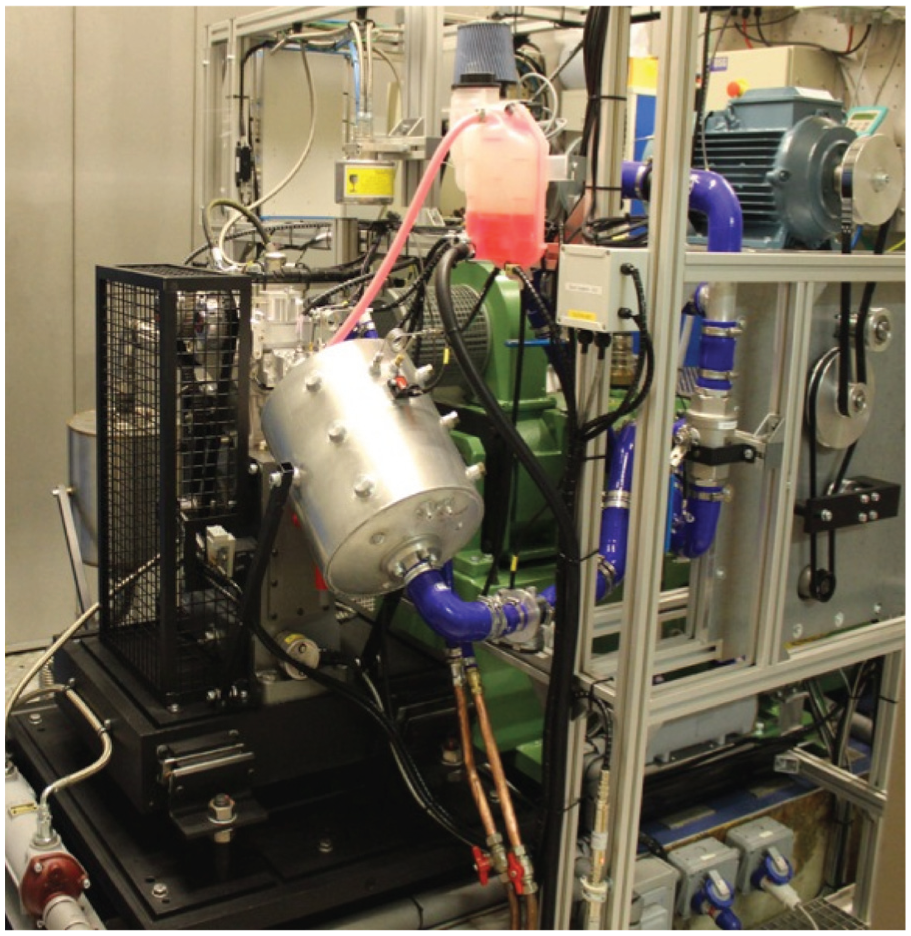
Jaguar Land Rover test engine.
Jaguar Land Rover SCRE specification.
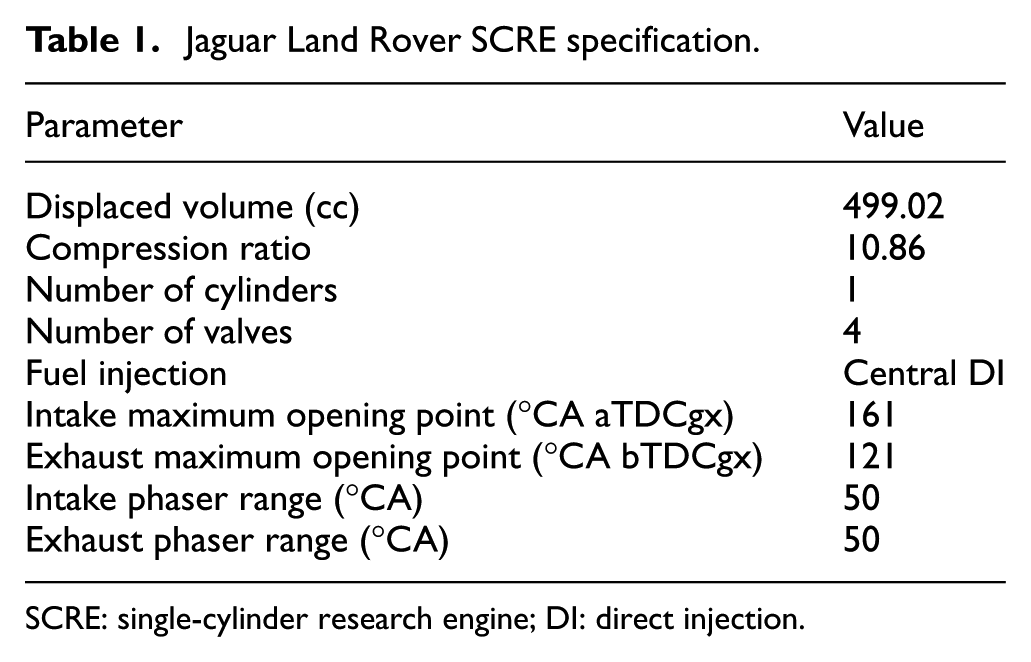
SCRE: single-cylinder research engine; DI: direct injection.
Fuel mass flow measurements were taken using a Siemens SITRANS M2100 coriolis metre (accuracy of 0.1% of full scale mass flow) with airflow measurement recorded using a Labcell Laminar Flow Element (accurate to 1% of full scale mass flow). Engine out emissions, exhaust gas residuals (EGR) and air–fuel ratio (AFR) were measured using a HORIBA MEXA-ONE emissions analyser.
High-speed, crank angle resolved data were recorded using AVL Indicom v2.6 as part of an AVL Indiset Advanced Gigabit unit utilising a 14-bit analogue-to-digital convertor (maximum error of ±0.95, ±0.061 and ±0.122 KPa for the in-cylinder, intake and exhaust pressure channels). A water-cooled Kistler 6041B piezo-electric sensor (accurate to <1% of full scale), mounted flush with the combustion chamber surface, in combination with a Kistler 5064 charge amplifier were used to measure in-cylinder pressure. This dynamic pressure was referenced to the intake manifold pressure (measured using a Kistler 4007 type sensor in conjunction with a Kistler 4665 signal conditioner) measured at the crank angle equidistant between the crank angles of maximum valve lift and intake valve closure. Dynamic exhaust pressure was measured using a water-cooled Kistler 4075 sensor connected to a Kistler 4665 signal conditioner. The determination of top dead centre (TDC) (accurate to 0.1 °CA) was recorded using an AVL 428 TDC sensor in combination with an AVL 365C shaft encoder operating at 720 pulses per revolution. In-cylinder pressure was recorded at a frequency of 90 kHz at 1500 r/min; equivalent to 0.1 °CA increments. Intake and exhaust pressures were logged at one-fifth of this rate (crank angle resolution of 0.5 °CA).
Heat release metrics from combustion were calculated according to the first law of thermodynamics. 51 The polytropic coefficients for compression and expansion were calculated for each given cycle and applied to the heat release calculation in order to accurately quantify the rates of heat release irrespective of the mixture composition. The polytropic coefficient for compression was calculated from the logP versus logV diagram between the crank angles of the midpoint of intake valve closing (IVC) to ignition (start) and ignition (end); this method was adopted from the work published by Ball et al. 52 and Stone and Green-Armytage. 53 The polytropic coefficient of expansion was duly calculated from the crank angle of maximum cylinder pressure to 60 °CA aTDCf.
Indicated combustion metrics shown in the currently reported figures in the following sections were calculated for each engine cycle, with the corresponding metric from each cycle passed across to the testbed data logging software in this case DaTAQ Pro as part of a Dynamometer Services Group (DSG) testbed. Here, the instantaneous indicated data (in conjunction with testbed pressures, temperatures, mass flows and emissions measurements) were logged over a 60-s period with an average value recorded. This process was repeated twice with the three average testbed logs averaged once more to provide a single number for a given metric.
To confirm that the experimental data were stratified the exhaust gas temperatures and emissions were compared to the homogeneous case, as no optical data were available. The exhaust data are shown in Table 2, where NOx is nitrogen oxides, CO is carbon monoxide,
Exhaust gas data.
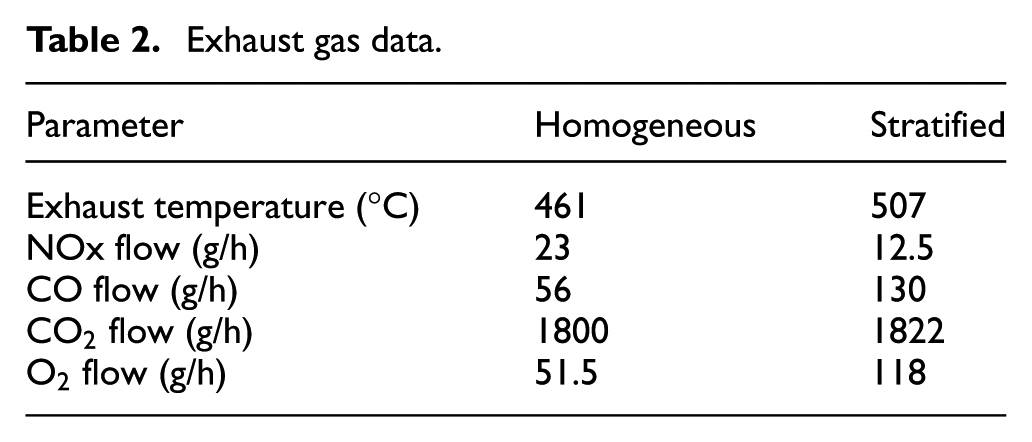
The increase in CO when compared to the homogeneous case is indicative of incomplete combustion associated with a stratified charge.
54
This poor combustion also leads to the excess
Validation
Homogeneous validation
LUSIE has previously been validated for homogeneous combustion in very different types of gasoline engines compared to the one used in this study. Therefore, we begin by validating the model for homogeneous combustion in the specific engine used in this study.
The validation is a two-step process where the model constants are first tuned so that simulations match the pressure trace for a selected set of running conditions. Then, to demonstrate that the model has predictive capabilities, it is run under different initial conditions using the constants determined for the tuned case shown in Figure 2. The running conditions for the tuned and predicted cases are shown in Table 3 with
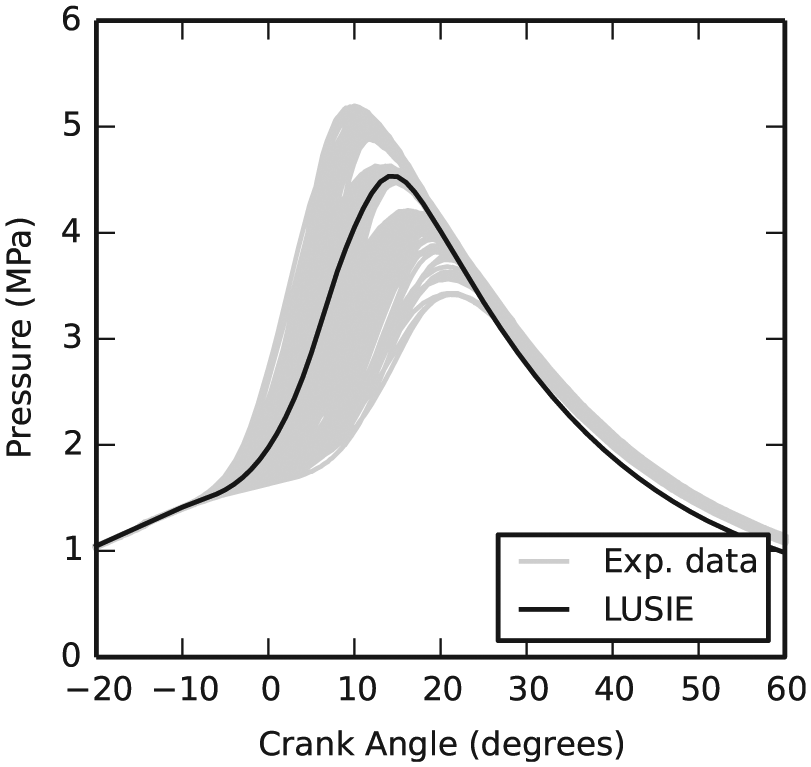
LUSIE simulated crank-resolved pressure trace with tuned constants and experimental data at 1500 r/min and GMEP of 0.79 MPa.
Running conditions for homogeneous case validation.
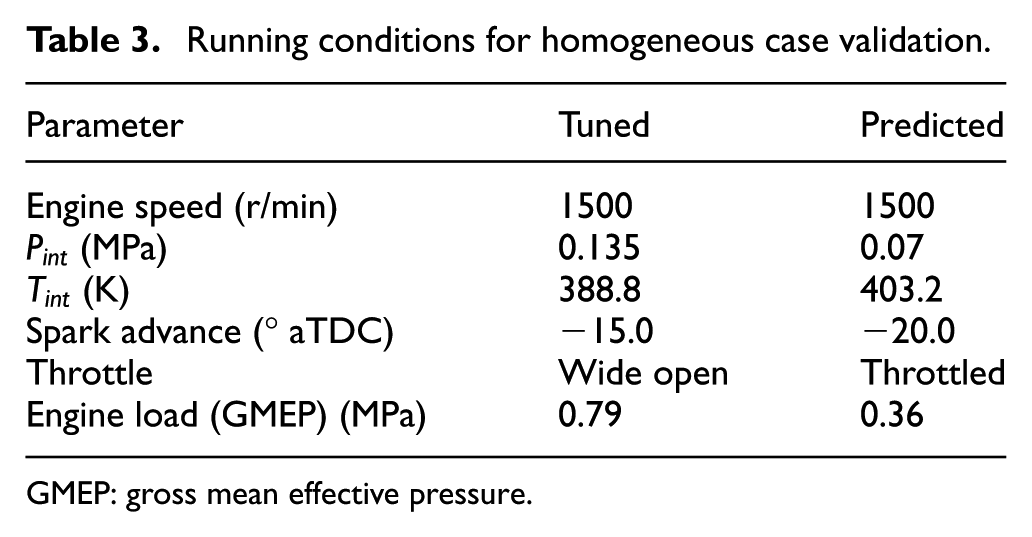
GMEP: gross mean effective pressure.
The experimental data consisted of 300 cycles for each running condition. These data were then divided into fast, middle and slow combustion cycles while removing data in-between these regions. This approach is commonly used when dealing with cyclic variability.22,24,55 Fast, middle and slow cycle are determined by the peak pressure values, with the fast combustion cycles defined as
In the three-zone entrainment model, the burn-up time constant
The simulated pressure trace for the predicted case in Figure 3 falls within the experimental bounds. Simulated results also fall largely into the 95% confidence interval (grey area) of the experimental data as shown in Figure 4. However, during the early stages of combustion, the predicted cycle is on the border of the 95% confidence interval, showing that LUSIE is predicting values for the fastest 2.5% of cycles there. In contrast to the tuned case, the simulation is no longer representative of the middle cycles, but of faster combustion cycles. Preliminary results have shown for the unthrottled tuned case, shown in Figure 2, that the equivalence ratio in the vicinity of the spark is inhomogeneous with an average value leaner than stoichiometric. This has been accounted for in the tuned case by increasing the spark delay time, where the spark delay time is the time taken for a spark kernel of a given size to form after the point of ignition. For the throttled case shown in Figures 3 and 4, the mixture may be even leaner meaning that the spark delay time would need increasing, thus reducing the speed and peak pressure of combustion making the simulation a closer representative of a middle cycle. Further research on the spray formation in the vicinity of the spark is required.
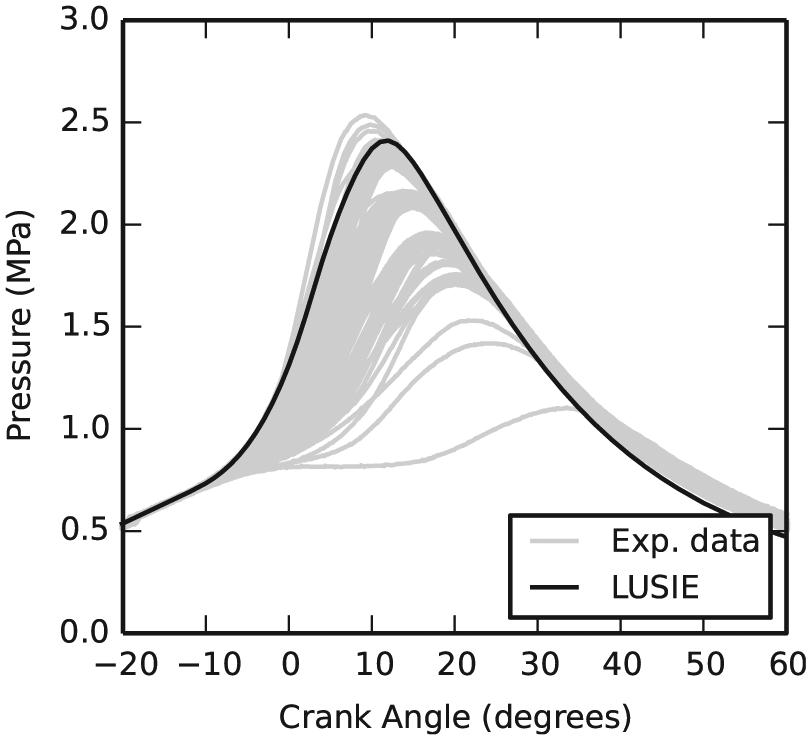
LUSIE simulated crank-resolved pressure trace, with model constants determined from Figure 2, and experimental data at 1500 r/min and GMEP of 0.36 MPa.
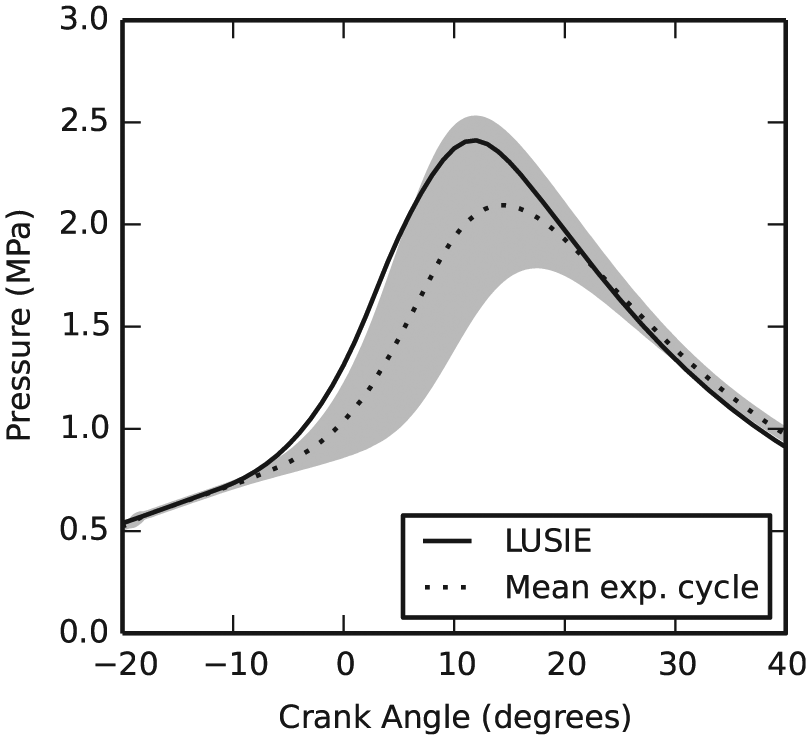
LUSIE simulated crank-resolved pressure trace, mean experimental cycle and 95% confidence interval at 1500 r/min and GMEP of 0.36 MPa.
Stratified validation
The initial conditions for the experimental stratified case are the same as those stated for the homogeneous predicted case in Table 3, the exception being the fuel injection timing. The EOI for homogeneous combustion (Figures 2 and 3) was 293° before top dead centre (bTDC), whereas the EOI for stratified combustion was 43 °bTDC. For the simulated stratified case, the maximum equivalence ratio was set to 1.28 and the minimum equivalence ratio set to 0.68. The minimum equivalence ratio was chosen as 0.68 as the engine has a high activity chamber, meaning that the charge near the walls would not be as lean as is usually associated with a stratified charge. The maximum equivalence ratio was selected to ensure that the average equivalence ratio was equal the average experimental equivalence ratio for the stratified case. Due to a lack of any optical data, both the minimum and maximum equivalence ratios are weakly constrained and subject to substantial uncertainty; however, results were relatively robust, with variations of ±10% still being well within experimental bounds.
Compared in Figure 5 are the crank-resolved pressure profiles for the simulated and experimental stratified case.
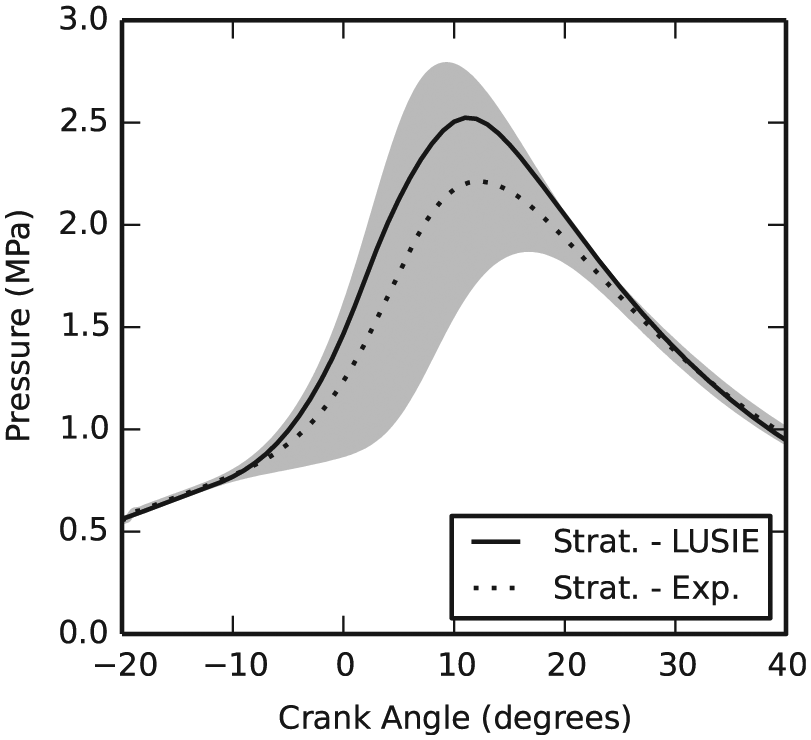
LUSIE simulated crank-resolved pressure trace, mean experimental cycle and 95% confidence interval for the stratified case at 1500 r/min and GMEP of 0.36 MPa.
The simulated stratified charge is in good agreement with the experimental case, falling well within the 95% confidence interval. Like the predicted homogeneous case, the stratified model also simulates a fast cycle under throttled running conditions. The difference in peak pressure
To illustrate the importance of modelling turbulent mixing of the stratified charge, simulations were also undertaken with the mixing model switched off. These led to a
As a second point of validation for the model, the rate of heat release was also compared to experimentally obtained data. The heat release for the simulated case was calculated using normalised mass fraction burned with respect to the maximum mass fraction burned value, due to the incomplete combustion of the mixture for the stratified case. For both the tuned and predicted homogeneous cases (not shown), the modelled rate of heat release fell within experimental bounds. Compared in Figure 6 are the rate of heat release for the modelled and experimental cases for stratified conditions. In line with the pressure trace shown in Figure 5, the percentage heat released for stratified conditions tends towards the fast combustion cycles but falls well within the experimental bounds. It is worth stressing that no further tuning of the model parameters was required beyond the initial tuning shown in Figure 2.
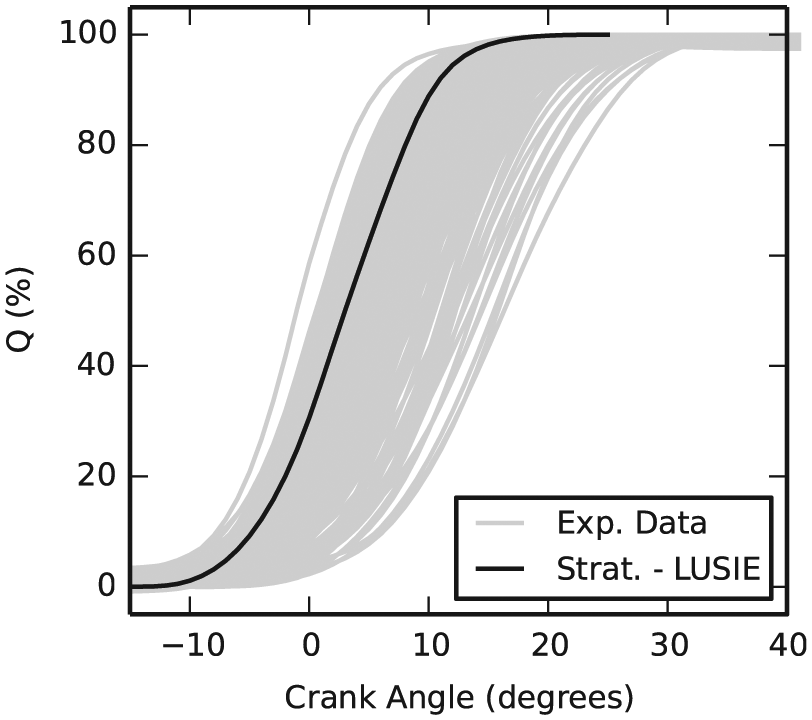
Percentage heat release for the simulated and experimental case under stratified conditions at 1500 r/min and GMEP of 0.36 MPa.
Conclusion
Presented in this article is a quasi-dimensional stratified charge model for SI engines containing three physical sub-models: (1) equivalence ratio distribution, (2) burned gas expansion and (3) turbulent mixing. It was then used to validate the stratified fuel model against experimental data for both the in-cylinder pressure trace and rate of heat release. For both the in-cylinder pressure and heat release, the model fell within experimental bounds representing a fast combustion cycle. The effect of turbulent mixing was also investigated. The trend between the stratified and homogeneous simulations matched closest to the experimental data for when the mixing model was included when comparing the parameters
Footnotes
Acknowledgements
J.K.S. acknowledges Alexey Burluka for his introduction to the project and valuable supervision during the early stages of the project. The authors thank Richard Wicklen for contributing to the work published in this article.
Declaration of conflicting interests
The author(s) declared no potential conflicts of interest with respect to the research, authorship and/or publication of this article.
Funding
The author(s) received no financial support for the research, authorship and/or publication of this article.
