




Abstract
Reactivity controlled compression ignition is a low-temperature combustion technique that has been shown, both in computational fluid dynamics modeling and single-cylinder experiments, to obtain diesel-like efficiency or better with ultra-low nitrogen oxide and soot emissions, while operating primarily on gasoline-like fuels. This paper investigates reactivity controlled compression ignition operation on a four-cylinder light-duty diesel engine with production-viable hardware using conventional gasoline and diesel fuel. Experimental results are presented over a wide speed and load range using a systematic approach for achieving successful steady-state reactivity controlled compression ignition combustion. The results demonstrated diesel-like efficiency or better over the operating range explored with low engine-out nitrogen oxide and soot emissions. A peak brake thermal efficiency of 39.0% was demonstrated for 2600 r/min and 6.9 bar brake mean effective pressure with nitrogen oxide emissions reduced by an order of magnitude compared to conventional diesel combustion operation. Reactivity controlled compression ignition emissions and efficiency results are compared to conventional diesel combustion operation on the same engine.
Keywords
Introduction
Low-temperature combustion (LTC) techniques, often categorized as high-efficiency clean combustion (HECC), traditionally have a limited operating range determined by the compression ratio of the engine and the reactivity of the fuel.1–7 Reactivity controlled compression ignition (RCCI) has the potential for greatly extending the HECC operating range by varying the reactivity of the fuel in-cylinder by stratifying a highly premixed low reactivity fuel such as gasoline, with a highly reactive fuel such as diesel fuel. Using port-fuel injection (PFI) of gasoline and direct injection (DI) of diesel fuel, not only is reactivity stratification produced, but temperature and equivalence ratio gradients are also produced in-cylinder. Initial research with RCCI was motivated by a requirement to extend the LTC operating range using fuels that had properties in between those of gasoline, which are best for high loads, and diesel fuel, which are desirable at lower loads. 7 The ability to adjust fuel reactivity in-cylinder addresses the lack of control of the combustion process with some other LTC techniques namely combustion phasing and pressure-rise rate (PRR) at higher loads and combustion stability at lower loads. A thorough examination of the RCCI combustion process can be found in the papers by Kokjohn et al. 7 and Hanson et al. 8
More recently, RCCI combustion has advanced due to extensive computational fluid dynamics (CFD) modeling and single-cylinder experiments.8–13 These efforts have been primarily focused on heavy-duty engines, and results have demonstrated high indicated efficiencies with ultra-low nitrogen oxide (NOX) and soot, as measured using a filter smoke number (FSN) technique. An early study by Kokjohn et al. 10 compared dual-fuel RCCI with homogenous charge compression ignition (HCCI) using an ideal fuel reactivity, and found that the stratification of fuel reactivity was required to control rate of heat release, while the global fuel reactivity was important for controlling combustion phasing. A study by Kokjohn et al. 7 investigated RCCI operation on both a heavy-duty 2.4 l single-cylinder caterpillar single-cylinder oil test engine, and a single-cylinder engine (SCE) version of a GM (General Motors) 1.9 l diesel engine with a compression ratio 15.2:1. For the SCE experiments, PFI of gasoline and a split diesel injection of ultra-low sulfur diesel (ULSD) were used. The first injection was delivered between 80 and 50 degrees before top dead center (DBTDC), with the second injection between 45 and 30 DBTDC. With a split-injection strategy, the first injection acts to control the reactivity in the squish region, while the second injection targets the piston bowl, creating a region of high reactivity, which acts as an ignition source. The study made comparisons between the light- and heavy-duty engines operating in RCCI mode with a focus on identifying heat transfer losses. The SCE experiments focused on 9 bar indicated mean effective pressure (IMEP) with 41% exhaust gas recirculation (EGR). Light-duty SCE experimental results showed gross indicated thermal efficiencies (ITEGROSS) of around 50%, with NOX emissions of less than 0.1 g/kW-hr and soot emissions of less than 0.01 g/kW-hr, both based on indicated power. Numerical studies showed heat transfer losses decreased with increasing engine speed, decreasing swirl ratio and decreasing surface to volume ratio of the piston. The numerical study also identified unreacted and partially reacted fuel in the ring-pack and near liner regions to be major contributors to high hydrocarbon (HC) and carbon monoxide (CO) emissions.
Initial light-duty multi-cylinder engine (MCE) RCCI experiments performed at Oak Ridge National Laboratory (ORNL) were guided by CFD and chemical kinetics modeling performed at the University of Wisconsin-Madison (UW). 14 These initial MCE RCCI experiments by Curran et al. focused on an operating point of 2300 r/min, 4.4 bar brake mean effective pressure (BMEP), which is representative of a moderate road load or light acceleration in a light-duty passenger vehicle. These experiments focused on the real-world challenges of implementing RCCI on an MCE, including the importance of cylinder-to-cylinder balancing, sensitivity of PRR on intake temperature and sensitivity of brake thermal efficiency (BTE) to boost pressure with real turbomachinery. The study showed a strong dependence of BTE on swirl ratio with higher swirl ratios leading to higher BTE, with RCCI in direct contradiction to the numerical studies by Kokjohn et al. 7 The dependence on BTE with higher swirl ratios shown in the MCE experiments by Curran et al. 14 may indicate a benefit from increased in-cylinder mixing despite the tendency to increase heat transfer. Results showed greater diesel efficiency with significant reductions of NOX and FSN with increased HC and CO emissions with RCCI compared to conventional diesel combustion (CDC) operation. Results from diesel start of injection (SOI) sweeps indicated good agreement of trends predicted by the CFD model. A follow-up MCE study by Prikhodko et al. 15 compared engine-out emissions of aldehydes, ketones, and particulate matter (PM) of RCCI with CDC and diesel premixed charge compression ignition (PCCI) at the 2300 r/min, 4.4 bar BMEP point, and found RCCI increased both aldehydes and ketones. Furthermore, the increase in carbonyl species from RCCI indicated that the combustion chemistry is quite different than that of CDC or PCCI. The study investigated particle geometric mean diameter (µg), number-size distribution and total number concentration (Ctot) as measured by a scanning mobility particle sizer. The RCCI particle number concentration was less than CDC or PCCI for 10 to 470 nm particles, with a shift of RCCI particles to a smaller geometric mean diameter. Particle mass measurements were collected on Teflon-coated quartz-fiber filters and measured gravimetrically, and they showed that RCCI PM emissions were ~40% less than CDC, but almost twice that of PCCI. The near-zero FSN readings and very slight color change of PM collected on the filters suggested semi-volatile organics present in the gas phase may have condensed on the filter. The study also investigated the effectiveness of a diesel oxidation catalyst (DOC) on the destruction of CO, HC and formaldehyde, as well as the reduction of PM, and found that the DOC was effective at reducing all four, even at the lower exhaust temperatures resulting from RCCI operation. Further MCE investigations by Curran et al. 16 looked at estimating the drive-cycle performance of RCCI using the ad hoc modal points that loosely approximate the federal light-duty drive cycle17–19 and compared RCCI emissions and efficiency to CDC and diesel PCCI. The study found that low-load operation of RCCI was possible, but a mismatch of turbomachinery at the lower engine speed/load points (due to lower exhaust enthalpy) and high fraction of diesel fuel required to maintain stable combustion offered little reduction in NOX emissions compared to CDC, which uses a high EGR fraction during those points. Weightingfactors applied to the emissions results were used to estimate the drive-cycle emissions performance of RCCI operating with gasoline and diesel fuel, and showed a 50% reduction in engine-out NOX compared to CDC and 17% compared to PCCI; however, some level of NOX aftertreatment would most likely still be required.
This work examines a broader range of RCCI operation with gasoline and diesel fuel across the light-duty speed and load range on a light-duty MCE. Current experience and insight from simulation and experiments has led to directions in optimization without a requirement to model each engine operating point directly.
Experimental setup
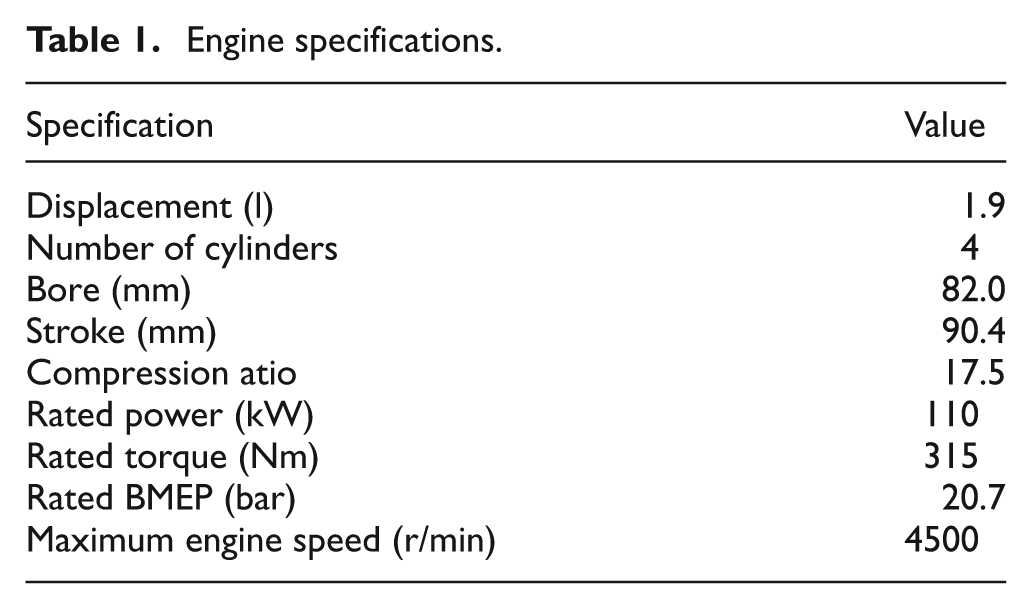
For this study, a four-cylinder light-duty GM 1.9 l turbo-diesel engine was modified to allow for PFI of gasoline. The only other modifications made to the stock engine setup were the use of a high-heat capacity EGR cooler, allowing for greater control over heat rejection within the high-pressure EGR loop, a charge air cooler (CAC) was installed, and the removal of the alternator and water pump, which were replaced with electrified components. The variable-geometry turbocharger, diesel injection system, and reentrant bowl pistons were all left in stock form. The experimental setup is shown in Figure 1 and engine specifications are presented in Table 1.
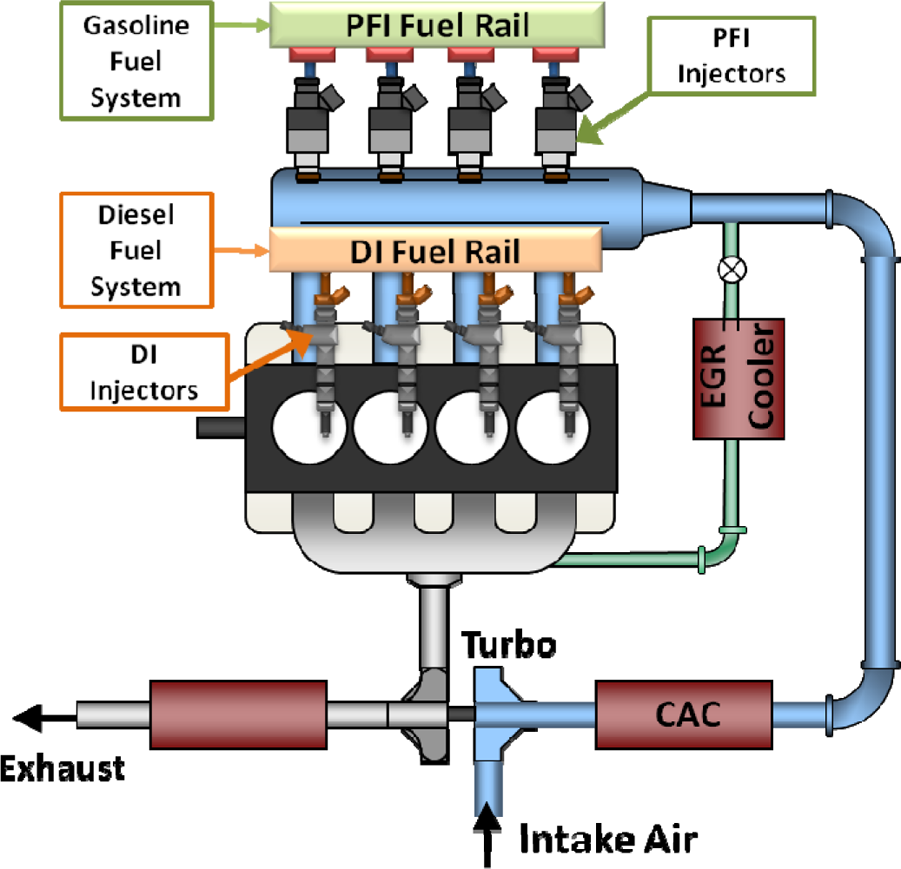
Experimental schematic.
Engine specifications.
The stock engine control unit (ECU) was replaced with a full-pass DRIVVEN control system that allowed simultaneous control of the PFI and DI fuel systems and all other engine parameters. Engine torque was measured using an absorbing eddy-current dynamometer. The DI fuel flowrate was measured using a Micro Motion Coriolis fuel meter, while the PFI fuel flowrate was measured using a Max Machinery 710-213 positive displacement volumetric flow measurement system. The intake air flowrate was measured using a laminar flow element and the stock intake mass-airflow sensor.
Engine-out emissions were measured using standard analysis techniques. A heated flame ionization detector was used to measure total unburned HC. A chemiluminescence instrument was used to measure NOX. CO and CO2 were measured using non-dispersive infrared (NDIR) instruments. Intake and exhaust O2 was measured using a paramagnetic detector (PMD). Both intake and exhaust CO2 were measured to provide the EGR rate. Sampled emissions were chilled prior to measurement by the PMD and NDIR instruments. Both intake and exhaust sample streams were conveyed from heated filters to the instruments through heated lines maintained at 190°C. Conditioned air was supplied to the engine at a constant temperature of 25°C and a relative humidity of 58%.
An AVL 415S smoke meter was used to measure FSN. A limitation to using a smoke meter based on opacity is that it may not accurately account for condensable organic hydrocarbons in the PM, which have been shown to be the primary PM mode with RCCI. Previous studies have compared the results of FSN and PM filter mass measurements from RCCI operation.14,21 Engine emissions as well as important temperatures, pressures, and flowrates were sampled for 180 s, after 120 s of stable operation had been attained.
High-speed combustion data was acquired using Kistler model 6058A pressure sensors installed in the glow plug ports of all four cylinders. Individual Kistler type 5010 dual-mode amplifiers were used to process the pressure signals, and the built-in combustion package from DRIVVEN was used to process the data. Combustion metrics were monitored and recorded using the DRIVVEN combustion analysis toolkit (DCAT). Cylinder pressure was pegged to the intake manifold pressure near the end of the intake stroke and sampled at 0.2 crank angle resolve. The high resolution is important to ensure the capture of important phenomena with advanced combustion. Ensemble-averaged cylinder pressure and heat-release rate curves presented here result from 300 cycles based on a forward and reverse infinite impulse response (IIR) filtered cylinder pressure signal.
Fuels
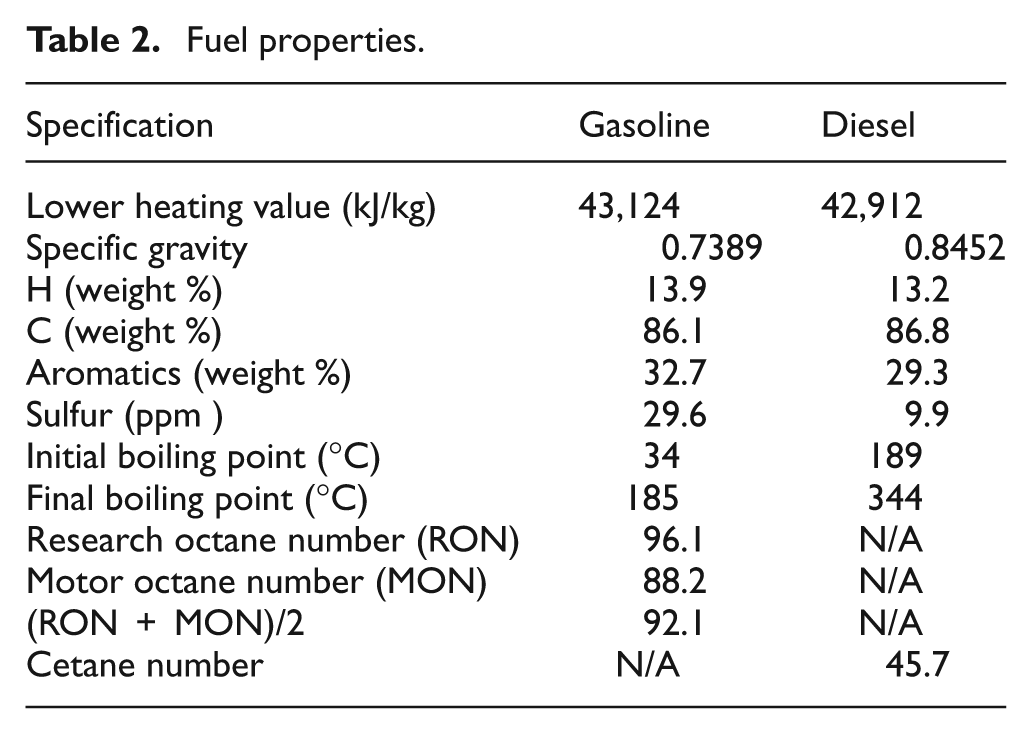
The high reactivity fuel used in this study was a 2007 certification grade ULSD fuel with a cetane number of 45.7, the low reactivity fuel was an unleaded test gasoline (UTG-96) with a pump octane number ((research octane number + motor octane number)/2) of 92.1. The properties of the fuels used in this study are similar to the certification grade ULSD and UTG-96 used in previous MCE studies at ORNL.14–16 Fuel specifications are presented in Table 2.
Fuel properties.
Experimental procedure
The initial MCE RCCI experiments performed at ORNL were guided by the UW CFD modeling in order to narrow down the extensive parameter space required to obtain stable combustion. Further MCE experiments were performed without the direct use of modeling for obtaining stable RCCI operation at a given engine speed and load, but instead through the use of a systematic approach based on the previous MCE experimental results and modeling. A separate startup procedure was followed to transition combustion from CDC to RCCI at low engine loads by gradually increasing the premixed ratio and advancing diesel SOI at a low engine load. Premixed ratio (rp) is defined as the ratio of the energy of the premixed fuel to the total fuels, as shown in equation (1), where the premixed fuel and direct injected fuel are identified with the subscripts ‘p’ and ‘d’, respectively,

A procedure for obtaining successful RCCI operation is shown in Figure 2, assuming the transition step at low engine load had already been completed, with cylinder-to-cylinder balancing of both IMEP and combustion phasing (i.e. 50% of fuel mass fraction burned (MFB50)) being implicit with each step of the approach. For this study, the primary control parameters are diesel SOI and premixed ratio, which must be balanced for the best control of combustion phasing and cylinder pressure-rise rate while minimizing NOX emissions, as well as HC and CO emissions.
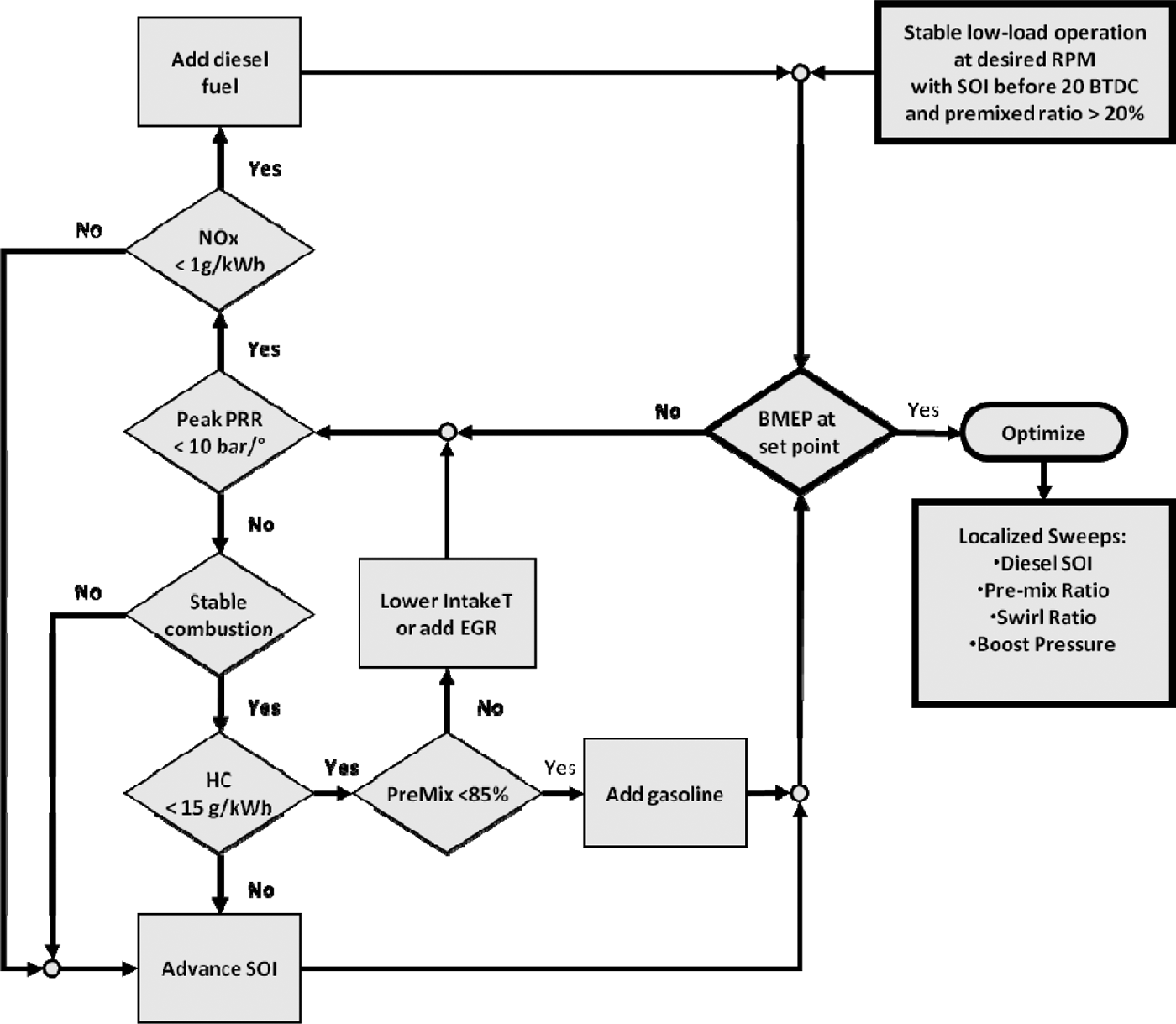
Systematic procedure for obtaining RCCI operating points.
The MCE RCCI experiments were focused on the speed range of 1500 to 2600 r/min. The upper BMEP range of operation was limited by a self-imposed 10 bar/degree cylinder PRR limit, and the lower load range was limited by a self-imposed CO emissions limit of 5000 ppm due to limitations of the CO analyzer used. This engine speed and load range covers a large portion of the light-duty drive cycle, as shown previously, 16 and is a significant expansion of the engine operating range studied for MCE RCCI operation. The engine speed and load range of RCCI operation explored in this study are shown in Figure 3. The lowest engine speed investigated in this study was 1500 r/min; however, RCCI operation down to 1000 r/min was achieved with no observable limits for further decreasing engine speed. RCCI operation has also been demonstrated on the experimental platform for speeds up to approximately 4000 r/min.
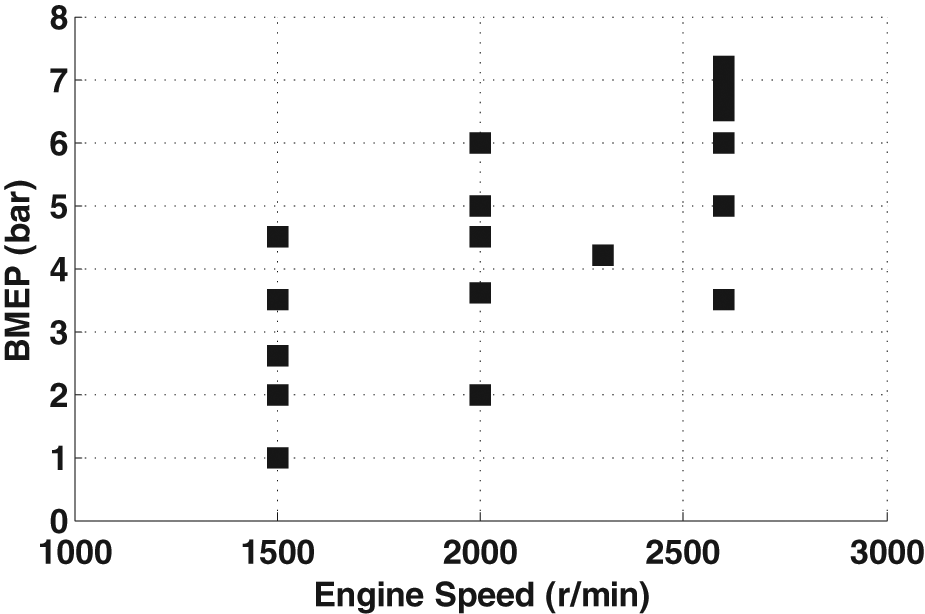
Speed and load range of RCCI operation examined.
All experimental results reported in this study were completed on the same engine in the same configuration, allowing for direct comparisons of BTE and emissions between RCCI and CDC operation. CDC operation was carried out using the automatic maps in DRIVVEN based on a Euro IV calibration supplied by GM Europe using ULSD. CDC emissions reported in this study are engine-out emissions. RCCI operation was carried out on the same engine using the aforementioned systematic approach with an early, single-pulse injection strategy with the same ULSD and premixed UTG-96. A split injection similar to that used in the study by Kokjohn et al. 7 was not found to produce higher thermal efficiencies or reduce emissions in the speed and load range investigated. This may indicate less of a requirement for conditioning of the squish area in an MCE than previous modeling has shown. PFI pressure was set to the manufacturer’s recommended injector specification of 3.8 bar for all points. DI rail pressure varied somewhat with load, with most points operating at 500 bar rail pressure and rail pressure as low as 360 bar for some of the lowest engine loads.
Results
Comparison of peak BTE with CDC
The peak BTE demonstrated with RCCI with UTG-96 and ULSD in this study was 39.0% at 2600 r/min, 6.9 bar BMEP. The maximum load achievable was 7.21 bar BMEP at the same engine speed, but higher boost levels required to maintain stable combustion at this point resulted in a small decrease in BTE to 38.9% BTE. The cylinder pressure and heat-release rate traces for the 2600 r/min, 6.9 bar BMEP point for CDC and RCCI are shown in Figures 4 and 5, respectively. A table of the key results of the comparison is presented in Table 3.
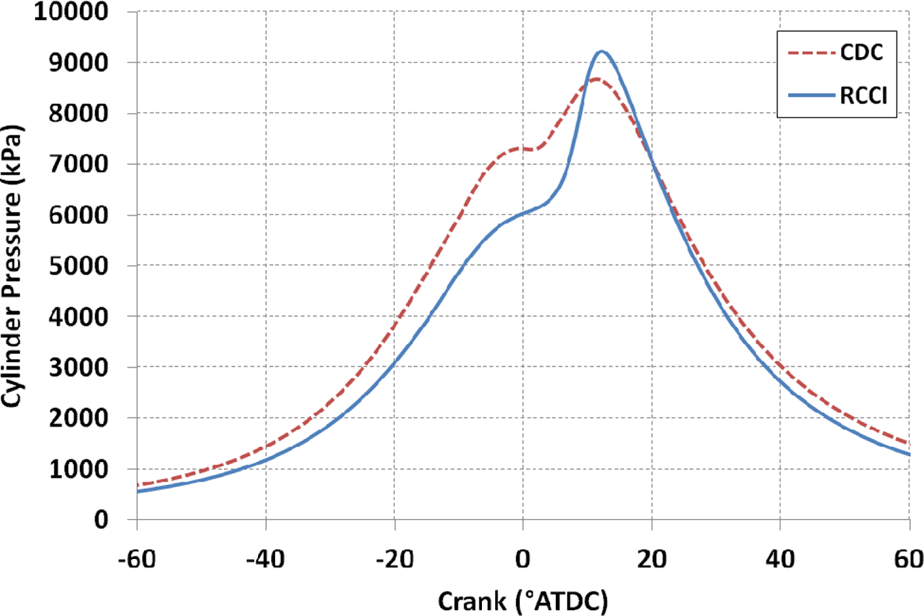
Cylinder pressure traces for RCCI and CDC at 2600 r/min, 6.9 bar BMEP. CAC: charge air cooler; ATDC: after top dead center.
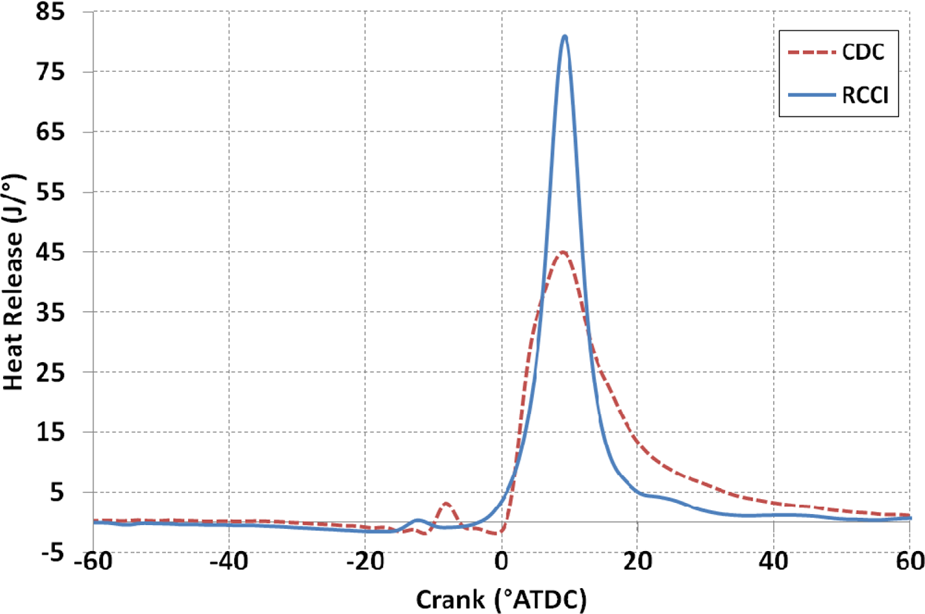
Heat-release traces for RCCI and CDC at 2600 r/min, 6.9 bar BMEP.
Comparison of RCCI and CDC at 2600 r/min, 6.9 bar BMEP.
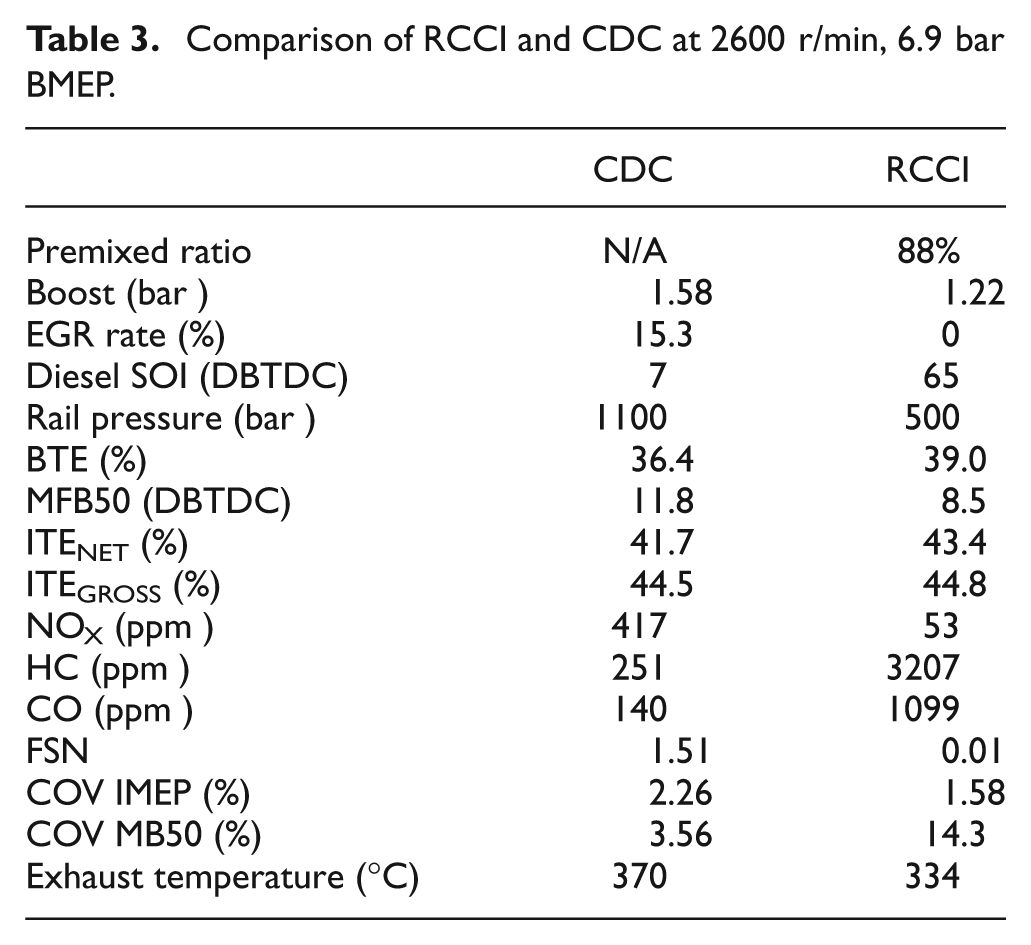
At the peak RCCI BTE condition, RCCI showed a 7% relative increase in BTE over CDC (39.0 from 36.4% BTE). RCCI shows a higher net indicated thermal efficiency (ITENET) than CDC, which is most likely due to the reduction in pumping losses associated with the use of EGR and higher boost levels with CDC. ITEGROSS values are very similar between RCCI and CDC operation. RCCI operation resulted in an 87% reduction in NOX without the use of EGR, as compared to CDC, which used 15% EGR. Brake-specific NOX emissions were 0.61 and 4.9 g/kW-hr for RCCI and CDC, respectively. There were substantial increases with HC and CO with RCCI operation, along with a 36°C decrease in exhaust temperature. The decrease in exhaust temperature was seen across the range of RCCI operation in this study. Combustion stability of RCCI was examined using the coefficient of variance (COV) of IMEP and MFB50. The COV of IMEP was under 3% for both cases, but the higher COV of combustion phasing, as measured through MFB50, with RCCI may prove challenging for implementing feedback control of combustion phasing. Also of note is the lower rail pressure used for RCCI operation of 500 bar compared to 1100 bar used for CDC operation. Net and gross thermal efficiencies were calculated using the definition of mean effective pressure (MEP) from Heywood 20 to convert MEP to power, as shown by



The above equations have terms representing thermal efficiency (η), power (P), fuel mass flow (f), lower heating value of fuel (QLHV), indicated thermal efficiency (ITE), MEP, displaced volume (Vd), crankshaft rotational speed (N), and number of crank revolutions per stroke (nR), which, for this engine, is 0.5. IMEP was averaged over the sample and calculated using DRIVVEN’s DCAT.
Engine control parameters
With multi-cylinder RCCI operation, the real-world issues from going to an MCE from an SCE using production-grade hardware can be significant. The previous section examined a single RCCI operating point and compared the same engine speed and load with CDC operation. The following sections provide a summary of trends observed over a wider speed and load range of RCCI operation.
The two most powerful controls over combustion phasing are the diesel SOI timing and premixed ratio. There was a balancing act with controlling NOX and PRR using the premixed ratio and diesel SOI timing. Figure 6 shows the trends of diesel SOI timing and premixed ratio with increasing BMEP for RCCI operation at 2000 r/min without the use of EGR, with similar trends observed at other engine speeds. At lower loads, the premixed ratio can be as low 20% with diesel SOI around 30 DBTDC. If the premixed ratio is lowered, or if the diesel SOI is retarded, decreasing the time available for mixing, NOX emissions can increase due to lowering the degree of homogeneity. At the higher loads, the premixed ratio can be as high as 85% with diesel SOI timing close to 65 DBTDC. If diesel SOI is advanced further, combustion can become unstable as the diesel mixture becomes too premixed. If the premixed ratio is increased past ~85%, HC and CO emissions increase and PRR becomes too weak to sustain stable combustion.
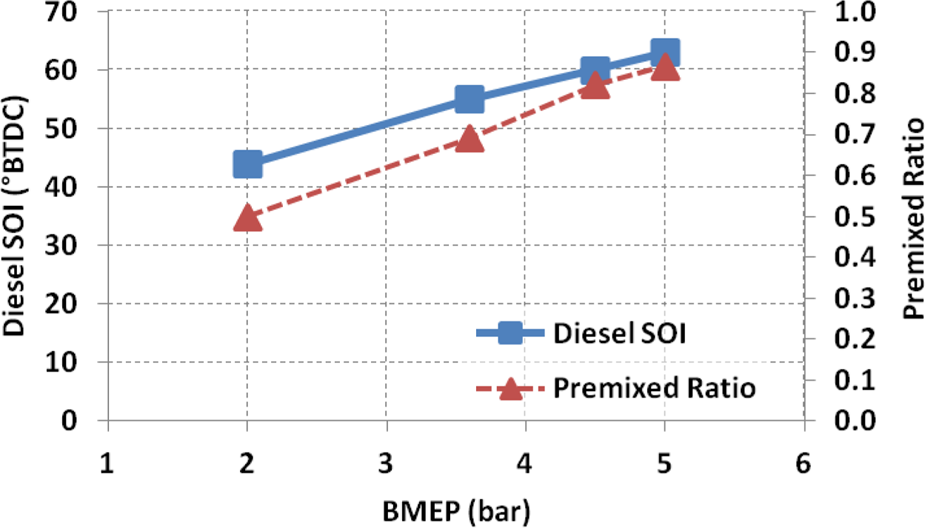
Diesel SOI and premixed ratio as a function of BMEP at 2000 r/min.
Ideally, it is assumed that for optimum BTE, the lowest possible swirl setting would be advantageous to use in terms of minimizing pumping losses and maximizing volumetric efficiency and minimizing heat loss. However, with the engine configuration used in this study, it was found that there was in fact an ideal swirl for best BTE and lowest emissions and, furthermore, the idle swirl ratio depends on speed and load. This effect of higher swirl ratios required to obtain maximum BTE and lowest emissions has been shown in previous work. 14 Small swirl ratio sweeps are an important part of the systematic procedure, as described earlier.
It was found that lower boost levels were required for maximizing BTE as compared to a similar operating point for CDC operation. Most engine operating points explored here used significant amounts of EGR. This means for a given engine operating point under RCCI operation without EGR, the equivalence ratio is already lower than with CDC operation, and increasing boost will result in an even leaner charge. At lower loads, this could result in nearing or surpassing the lean limit of the premixed gasoline, potentially reducing combustion efficiency. Higher levels of boost were however found to be helpful in controlling PRR at higher engine load points, namely by adding trapped mass and adding fine control over combustion phasing. RCCI has been shown to have a lower exhaust temperature than CDC, which is important not only in terms of exhaust energy availability for turbomachinery requirements, but also for any exhaust aftertreatments. Figure 7 shows the comparison of exhaust temperatures as a measure at the outlet of the turbocharger for RCCI and CDC at 2000 r/min over a load sweep from 2.0 bar to 6.0 bar BMEP. Over the load range shown at 2000 r/min, RCCI had between a 26% and 43% drop in exhaust temperature, which represents a temperature reduction 68°C at the lowest load to 181°C at 5.0 bar BMEP. RCCI had similarly lower exhaust temperatures than CDC over the speed and load range investigated.
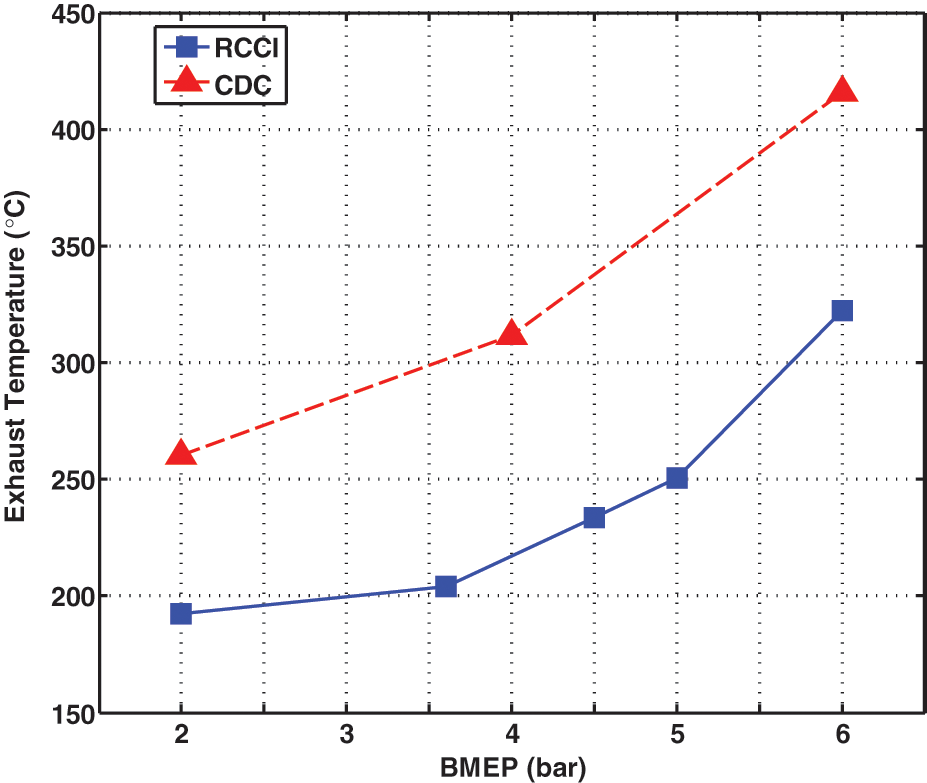
Exhaust temperatures for RCCI and CDC at 2000 r/min over a load sweep from 2.0 bar to 6.0 bar BMEP.
Cooled high-pressure EGR was found to help control PRR and NOX at the higher loads with RCCI, but at the expense of lowering BTE. EGR was not found to be able to provide a significant load expansion due the EGR raising intake temperatures, negating any combustion phasing delay from dilution. Cooling the EGR to levels required for stable RCCI operation (40–50°C) risked severe condensation of water and HCs in the EGR cooler.
EGR was found to enable a small expansion in load when EGR outlet temperature was matched to the intake manifold temperature. Figure 8 shows an RCCI load sweep at 2000 r/min through 6.0 bar BMEP. The highest load attainable with RCCI without the use of EGR while keeping under the self-imposed 10 bar /degree PRR limit and maintaining stable combustion at an engine speed of 2000 r/min was approximately 5.0 bar BMEP. Figure 8 shows the decrease in BTE with increasing EGR used to increase the load to 6.0 bar BMEP. Even with the use of EGR, it was not possible to increase engine load beyond 6.0 bar BMEP while observing the PRR limit. It was also not possible to increase load at an engine speed of 2600 r/min with the use of EGR due to the requirement of low intake temperatures.
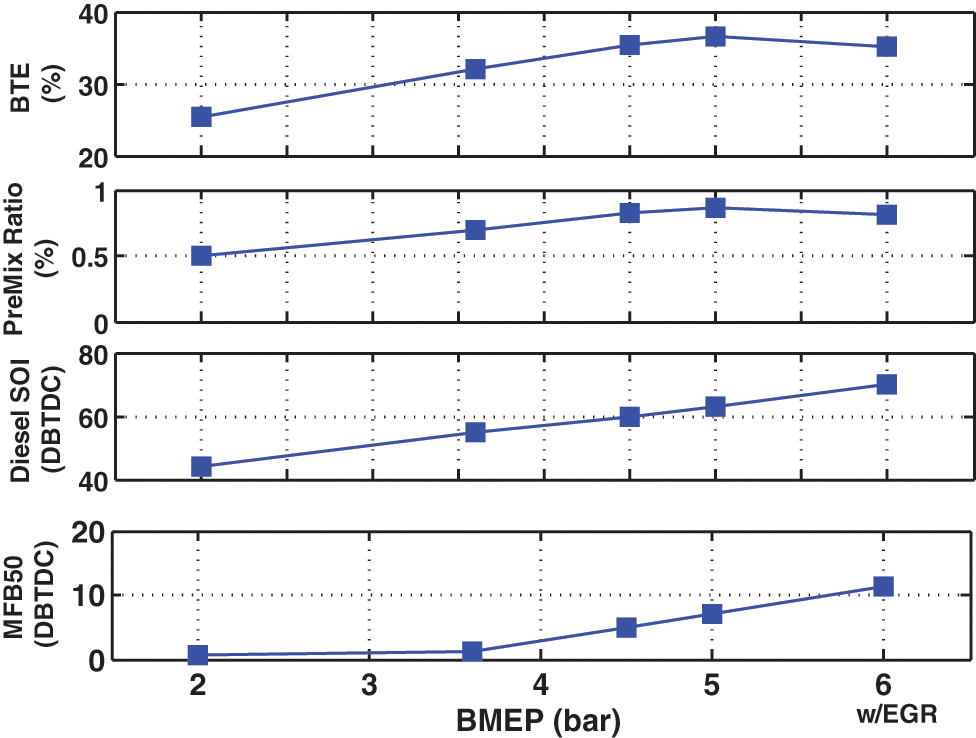
BTE premixed ratio, diesel SOI timing, and combustion phasing (MFB50) versus BMEP for 2000 r/min.
It was observed that RCCI exhaust temperatures were somewhat higher with the use of EGR. At the RCCI operating point of 2000 r/min and 5.0 bar BMEP, there was a 20°C increase in exhaust temperature when an EGR rate of 25% was used to control PRR. In this case, premixed ratios were similar and diesel SOI timing was adjusted to keep PRR constant. BTE was reduced from 36.5% to 33.6% with the use of EGR keeping while keeping NOX emissions fixed at 10 ppm. The air-to-fuel ratio (AFR) decreased from 39.6 to 29.3 with the addition of 25% EGR. MFB50 without EGR was 6.9 DBTDC and 7.7 DBTDC with EGR. HC emissions were the same however, CO emissions increased from 1690 ppm to 1870 with the use of EGR. The reduction in AFR at lower loads which, with stock turbomachinery and unthrottled operation could be as high as 70:1, was beneficial to achieving stable operation and was explored in a previous study. 16
BTE
The maximum BMEP achievable with RCCI while observing the self-imposed limit on cylinder PRR goes up as engine speed is increased. In addition, as engine speed increases, airflow increases and could help the stock variable geometry turbocharger (VGT) operate in a more efficient area than with lower engine speeds. It was observed that for each engine load, there is a significant variation in BTE, as much as four points in BTE at certain loads. These are the effects of varying diesel SOI and EGR on allowing premixed ratio to vary at a given BMEP, depending on speed and intake temperature.
To provide a perspective on the efficiency performance of RCCI, it is necessary to compare BTE with RCCI operation to that of CDC operation with the same engine as shown in Figure 9 for engine speeds of 1500, 2000 and 2600 r/min. From Figure 9, it is observed that as engine speed is increased, the BTE of RCCI goes from diesel-like efficiency at 1500 r/min to up to 7% higher at 2600 r/min. The cross-over at 1500 and 2000 r/min where CDC has a higher BTE than RCCI at the lower loads could be in part attributed to the mismatch in turbomachinery for RCCI operation. The study by Kokjohn et al. 7 also discussed the reduced heat transfer losses at higher engine speeds with RCCI.
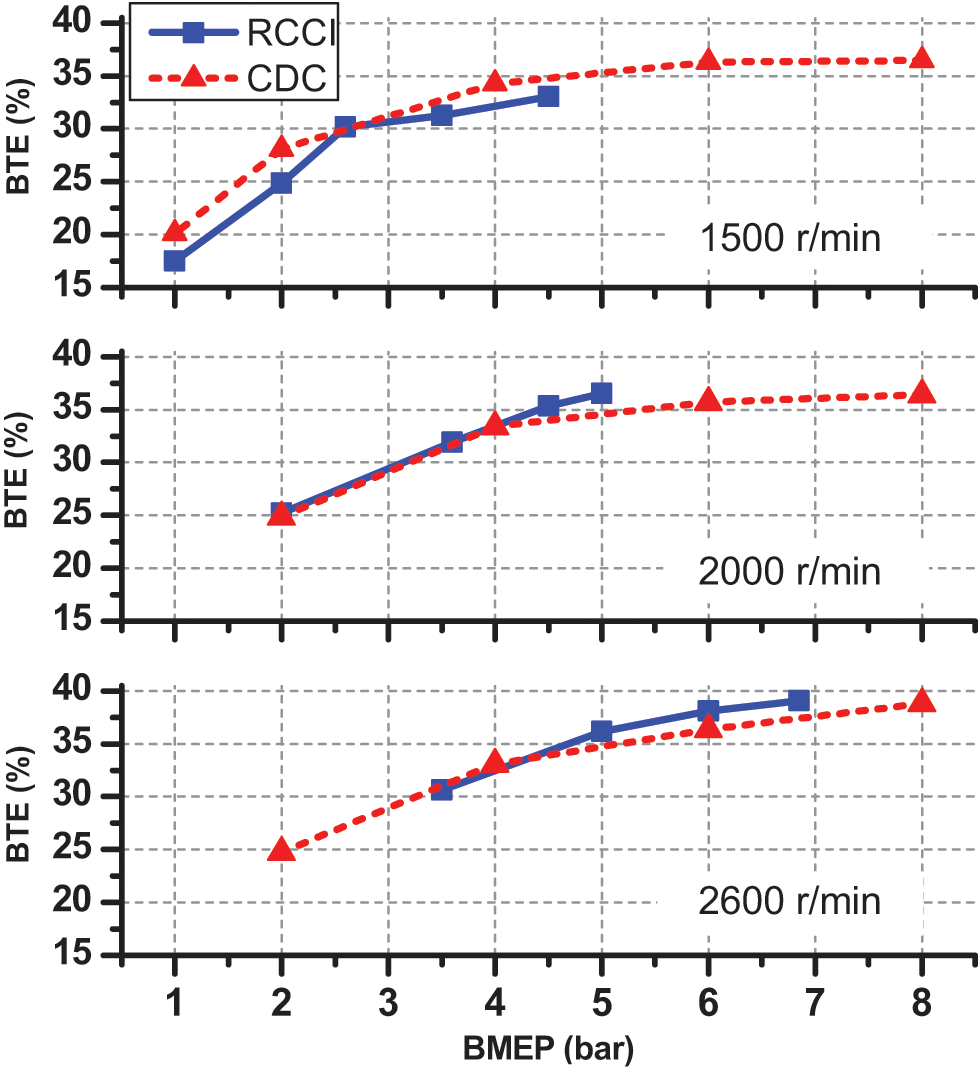
BTE versus BMEP for RCCI and CDC for 1500, 2000 and 2600 r/min.
NOX emissions
RCCI operation has been shown to produce very low NOX emissions. The general trend in RCCI NOX emissions was found to be parabolic, with higher NOX at lower loads due to the requirement for a lower premixed ratio and retarded diesel SOI to maintain stable combustion with reasonable CO and HC levels, and higher NOX at the higher loads due to higher PRRs. NOX generally trended downwards with increasing boost due to the higher trapped mass. Figure 10 shows a comparison of NOX with RCCI and CDC as a function of BMEP for the maximum BTE cases at a given load.
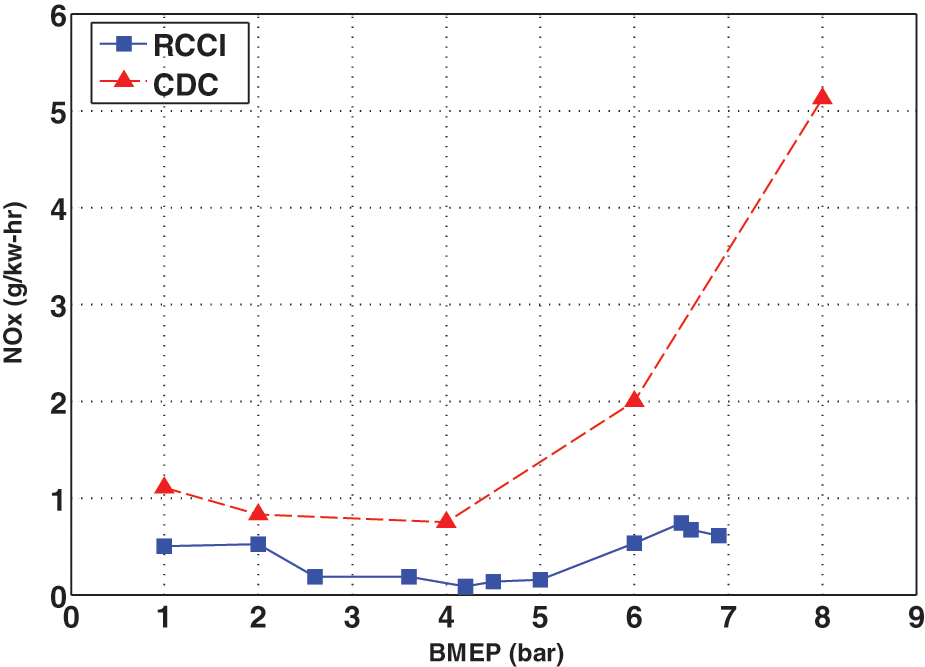
NOX as a function of BMEP for CDC and RCCI for maximum BTE operation (various engine speeds for maximum BTE).
Another way to compare the NOX reductions with RCCI over CDC is to plot NOX as a function of BTE, as shown in Figure 11. NOX with CDC combustion rises exponentially with load, with an increase at the higher loads where no EGR is used. The brake specific nitrogen oxide (bs-NOX) emissions from CDC operation quickly rise to 4.0 g/kW-hr as the BTE approaches 37%, for all engine speeds and loads, and increases sharply from there. NOX from RCCI operation remains relatively flat through the operating range explored in this study with an average bs-NOX emission rate of 0.24 g/kW-hr and a maximum of 0.74 g/kW-hr.
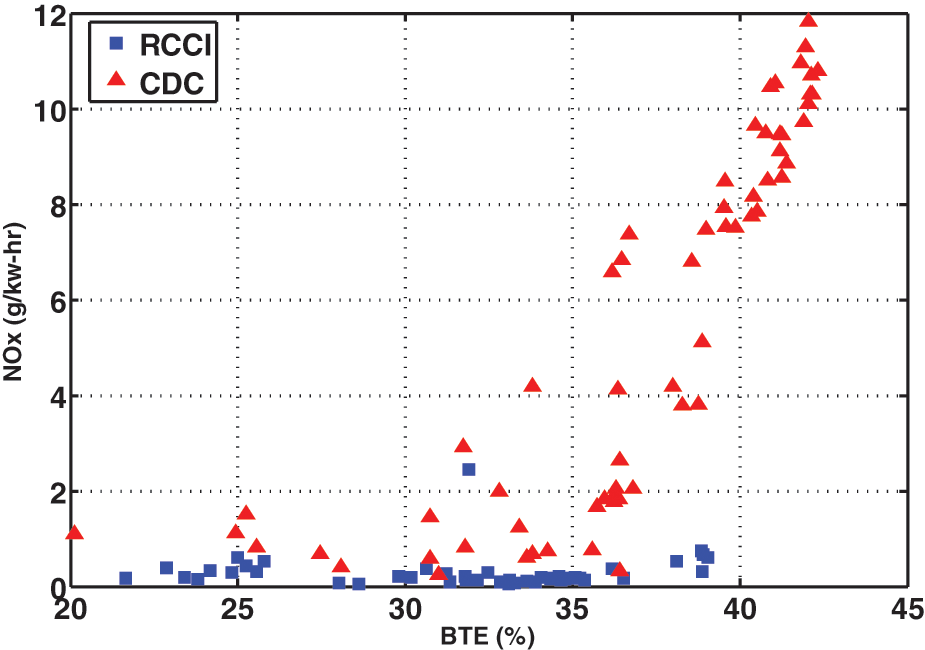
NOX versus BTE for RCCI and CDC for all engine speeds and loads.
HC and CO emissions
In previous light-duty multi-cylinder studies, the HC emissions for RCCI operation have been shown to be relatively high compared to CDC operation. The large speed and load range with this study allows a more in-depth study into the high HC levels with RCCI. In general, it was found that brake-specific hydrocarbon (bs-HC) emissions were reduced as BMEP increased. Figure 12 shows the general trend with bs-HC trending down with BMEP as compared to CDC operation. The ranges of bs-HC for each load are the result of variations in DI-SOI, stability, engine speed, and intake temperature. The lower limit for bs-HC emissions from RCCI operation in this study was just under 10g/kW-hr at ~7.0 bar BMEP.
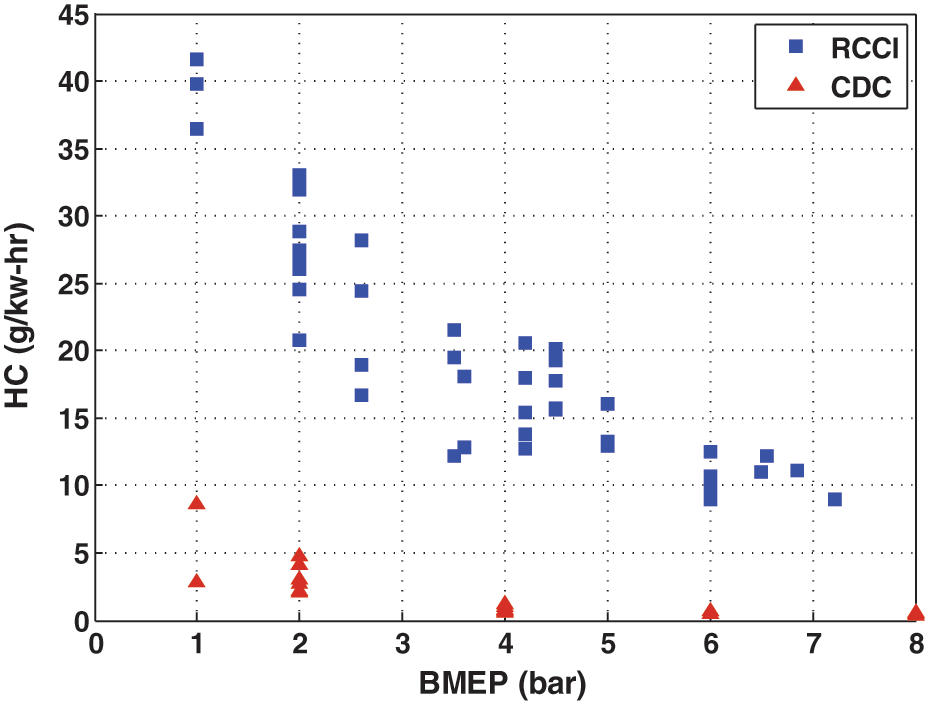
HC emissions for RCCI and CDC versus BMEP for all engine speeds and loads.
Despite the downward trend in bs-HC emissions with increasing load, the HC emissions on a volumetric basis did not trend as such. HC emissions averaged around 3000 ppm across the entire speed and load ranged investigated, with the lowest volumetric HC emissions of an operating point of 1820 ppm at 2600 r/min, 3.5 bar BMEP. In general, HC emissions were seen to somewhat reduce with advancing SOI, increased AFR, retarding combustion phasing and increasing stability as measured by COV of PRR. There were not, however, clear overall trends indicating that the consistently high HC emissions with RCCI operation may result from trapped unburned fuel in the crevice volume.
Brake specific carbon monoxide (bs-CO) emissions from RCCI track similarly to HC emissions, and are shown in Figure 13 compared to CDC operation. The lower bs-CO performance from RCCI operation in this study was approximately 7 g/kW-hr at 7.0 bar BMEP. Volumetric CO emissions for RCCI operation averaged approximately 2500 ppm across the entire speed and load range, with the lowest observed CO emissions of 1244 ppm at the operating point of 2600 r/min, 6.9 bar BMEP. CO emissions were not as constant over all operating conditions as HC emissions, with volumetric CO emission clearly decreasing with engine load. This indicates that while there may be high systematic HC levels with RCCI operation, CO emissions are more clearly reduced with increasing load (and decreasing premixed ratio) and decreasing AFR.
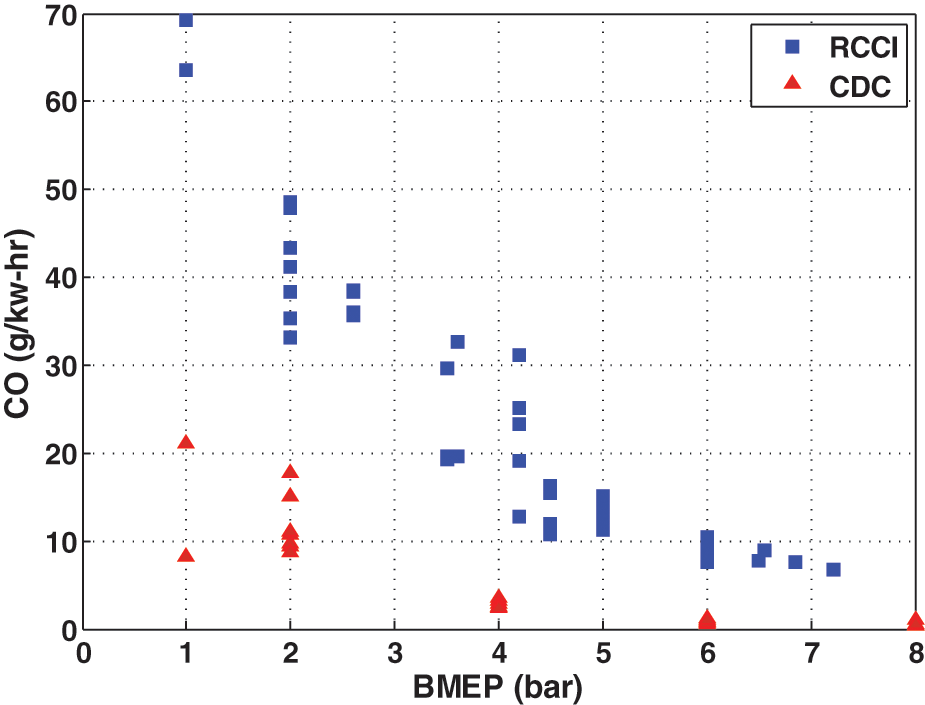
CO emissions for RCCI and CDC versus BMEP for all engine speeds and loads.
FSN
The FSN for all the RCCI experimental points averaged around 0.03. This shows the low-soot capabilities of RCCI operation, but does not capture the total PM performance of RCCI. Previous comparisons of RCCI PM to CDC and PCCI have shown that despite the near-zero FSN, RCCI had higher PM mass emissions composed of primarily semi-volatile organics.15,21
Conclusions
RCCI operation with production-viable hardware was shown to achieve diesel-like efficiency or better with ultra-low NOX emissions over a wide speed and load range on a multi-cylinder light-duty diesel engine. Stable RCCI operation was demonstrated using a systematic approach to optimizing combustion for high efficiency with the lowest possible emissions without direct CFD modeling guidance for each operating point. This approach was based on general trends explored by previous modeling efforts, along with the results of previous experimental work performed on a multi-cylinder light-duty diesel engine. The extra degree of freedom that dual-fuel RCCI allows in controlling the combustion process is very powerful in helping to meet PRR limits and controlling combustion phasing over a wide engine operating range.
The relatively high HC and CO emissions across the speed and load ranged explored in this study show a downward trend in brake-specific emissions as load is increased. The high levels of CO and HC resulting from RCCI operation led to a subsequent study in which the piston bowl design was changed from a typical light-duty re-entrant bowl to a more heavy-duty shallow dish bowl design in an attempt to reduce squish area and reduce surface area available for heat transfer. 22 The results of that study are not presented here but did show similar results.
The ability to achieve stable RCCI combustion across such a wide speed and load range without the requirement for direct CFD modeling guidance demonstrates the potential of the combustion mode to be controlled in a vehicle. Combustion controls based on some metric such as combustion phasing or PRR would depend on some form of pressure rise feedback.
Hardware challenges still exist limiting the potential for RCCI combustion on a light-duty MCE for achieving higher BTE with lower HC and CO emissions including mismatch of turbomachinery for LTC operation and limitations of high-pressure EGR when intake temperature is a critical combustion control parameter. The engine load limit of 7.2 bar BMEP at 2600 r/min using the certification grade ULSD and UTG-96 in this study is not the absolute limits for MCE RCCI operation. Other MCE studies have shown the effectiveness of using E85, 23 as well as reducing the compression ratio 22 at increasing the maximum load attainable with RCCI.
The following key conclusions can be made.
RCCI can achieve diesel-like efficiency in a light-duty multi-cylinder diesel engine with production-viable hardware and, in the case of this study, stock piston geometry, compression ratio, diesel injection system, and turbomachinery.
Peak RCCI BTE in this study was 39% for the 2600 r/min, 6.9 bar BMEP operating point, which was ~7% improvement from CDC. Gross thermal efficiencies for CDC and RCCI were similar.
NOX emissions reductions with RCCI range from ~50% reductions at the lowest loads to ~90% at higher loads, as compared to CDC operation.
HC and CO emissions were much higher with RCCI operation than with CDC operation (over an order of magnitude increase), with volumetric HC and CO emissions being somewhat constant across the speed and load range, but falling with load, as measured on a brake-specific basis.
The robustness of RCCI allows rapid speed and load exploration/optimization without direct model guidance.
Increased mixing time with the diesel SOI timings with RCCI allows for lower rail pressures (<500 bar) to be used as compared to CDC operation without an increase in soot emissions.
RCCI produces lower exhaust temperatures than CDC operation across the speed and load investigated, meaning lower quality exhaust for turbomachinery and lower temperatures for aftertreatment, which is of concern for high HC and CO emissions.
Footnotes
Acknowledgements
The authors gratefully acknowledge the support and guidance of Gurpreet Singh, Ken Howden, and Kevin Stork at the DOE. The authors would like to acknowledge input from their collogues at the University of Wisconsin, Professor Rolf Reitz and Sage Kokjohn, and support from General Motors and Delphi.
Funding
This work was supported by the US Department of Energy (DOE), Office of Vehicle Technologies.
Disclaimer
This manuscript has been authored by a contractor for the US Government under contract number DE-AC05-000R22725. Accordingly, the US Government retains a nonexclusive, royalty-free license to publish or reproduce the published form of this contribution, or allow others to do so, for the US Government.