




Abstract
In communities of Sub-Saharan Africa, where local elites participate in the selection of households for cash transfers, there is a tendency to deviate from laid down rules for various reasons. Using qualitative data from selected districts where Ghana’s Livelihood Empowerment Against Poverty (LEAP) programme is implemented, this study investigates the reasons why district and community elites deviate from prescribed selection processes of the LEAP programme. Drawing on the concept of competitive clientelism, the findings suggest that elites are deeply guided by political patronage to fulfil one primary goal, protecting their role in office. Such ambition is facilitated by the discretionary power accorded to elites by the local government system and socio-cultural values deeply rooted in Ghanaian society. In conclusion, the study draws out key lessons from the analysis and suggests a design of beneficiary selection frameworks that acknowledges the nature of domestic politics, institutions of power and powerful actors at the subnational level. The article also highlights the implications of the findings for the broad politics of social protection literature.
Keywords
Introduction
Much of the literature on the global politics of social protection highlights the role of transnational actors in social protection policy diffusion and programme implementation (Bukenya and Hickey, 2020; Hickey et al, 2020; Hickey and Seekings, 2020; Ulriksen, 2020) and the role of state capacity and political competition in shaping the distribution of social transfers (Lavers, 2022; Wanyama and Nyambedha, 2017).
Some studies also debate political economy factors which explain commitment to forms of social protection in Sub-Saharan Africa (SSA) and South Asia. For example, Williams et al.’s (2020) analysis of social protection uptake in Rwanda concludes that whereas international pressures play a role in commitment, they only take hold when they become aligned with the incentives and ideas of ruling elites in particular contexts. They add that the politics of clientelism, political ideologies and elite perceptions contribute to shaping the adoption and delivery of social protection.
In addition to global politics, there are studies on the politicisation of cash transfers at the national level which underline national elites’ interests as a key factor in influencing the selection of districts and communities. Abane’s (2017) analysis of the expansion of Ghana’s Livelihood Empowerment Against Poverty (LEAP) programme showed that elites of the then ruling National Democratic Congress (NDC) party prioritised the selection of communities in their stronghold regions over deprived but eligible communities because of their intention to secure maximum voter support from their constituents. Similarly, Angucia and Katusiimeh’s (2017) analysis of Uganda’s Senior Citizens Cash Transfer (SCCT) programme suggested that powerful national elites extended the SCCT beyond President Museveni’s stronghold districts to include districts in the opposition party’s stronghold region, with the aim of increasing the President’s clientele list and ultimately maximise political support from beneficiary groups in those locations.
Political patronage in selection processes is discussed in some country-level politicisation literature. Wanyama and Nyambedha’s (2017) analysis on the politics of implementing cash transfers in Kenya, indicated that politicians increasingly recognised cash transfer programmes as tools with which they oiled their client lists as they paraded the number of households in the constituents they supported. Political patronage in community selection is also discussed in the literature. de Sardan et al.’s (2015) analysis of cash transfers in Niger, revealed the existence of a highly developed culture of elite capture in communities, where notoriously corrupt elites manipulate rules including the selection of their kinsmen to their political advantage (de Sardan et al., 2015).
Besides political patronage, there is a small but growing literature on politicisation much of which highlights partiality in selection by community elites. Schüring (2014) drew on experimental studies conducted on cash transfer programmes in Zambian communities and concluded that partiality of elites towards groups whose poverty characteristics were not entirely consistent with rules of selection resulted in inclusion and exclusion errors. Such targeting errors are indeed consistent with elite capture of cash transfer programmes particularly where community-based targeting remains the primary selection mechanism (Devereux, 2021; Handa et al., 2012; Jimu and Msilimba, 2018).
While literature on the global politics of social protection and national level politicisation of cash transfers abound, that on politicisation of beneficiary selection at sub-national level remains relatively thin. Although there are few studies that refer to political patronage as I note earlier, they do little to provide a deep analysis of domestic politics and local government (subnational) systems of delivery when it comes to beneficiary selection. My study therefore aims to aim to fill this gap in the literature by using a case study of beneficiary selection process of Ghana’s LEAP programme to address one major question: Why do district and community elites deviate from prescribed beneficiary selection guidelines?
Analysis suggests that elites deviate from prescribed selection processes because of the pressures to protect their roles and maintain positions of power at district and community levels. Findings also show that the local government system that administers cash transfers and existing institutions of power facilitate such elite behaviour. It is anticipated that insights generated from this study will add to the literature on politics social protection more broadly as well as to the politics of beneficiary selection in SSA.
The article proceeds as follows. The next section discusses the conceptual framework, competitive clientelism. This is followed by the methodological approach employed in data collection. The third section presents an overview of the targeting mechanisms employed in the LEAP programme before a discussion on prescribed and actual beneficiary selection processes in the fourth section. The fifth section presents analysis of findings and the final section draws on key lessons from the analysis to conclude.
Competitive clientelism
Competitive clientelism as a concept describes a political arrangement detailing how power is gained and distributed in a polity. In practice, competitive clientelism is characterised by a high degree of competition between contending groups for power, a strong likelihood that ruling elites will be displaced through electoral processes and thus a high degree of vulnerability to loss of power (Levy, 2014, 2015). The vulnerability experienced by ruling elites results from the intensity of competition, and pressures to maintain that power once its gained. This opens avenues for a highly developed system of mutual expectations exemplified in how (a) ruling elites form coalitions with party foot soldiers and how party foot soldiers in return expect to disproportionately benefit from re-allocation of public resources, (b) how party officials and ruling government appointees pursue rent-seeking, including manipulating government programmes for their own benefits and (c) how the ruling government expects to return to power by the coalition in the next election (Idun-Arkhurst, 2012).
Empirical studies on the politics of implementing social protection in Ghana demonstrates that Ghana’s democratic politics is consistent with the principal features of competitive clientelism (Abdulai, 2017, 2021; Akyeampong, 2021; Appiah and Abdulai, 2017; Grebe, 2015; Oduro, et al, 2014). This is shown in how intensely competitive electoral power is fought between the two major political parties, NDC and New Patriotic Party (NPP), (Abdulai, 2021; Grebe, 2015, 2017; Osei, 2013, 2016). It is also demonstrated in how patronage networks are developed and maintained between national and sub-national level elites and non-elites of the ruling of government (Akyeampong, 2021; Jaha and Sika-Bright, 2015) and in how ruling governments expect to stay in power at least for two terms, once power is gained (Abdulai, 2017). The practice of political elites rewarding their allies with public resources in return for electoral support is prevalent where competition for electoral power is prevalent (Kopecký 2011; Seekings, 2019). As competition intensifies so do political patronage practices become commonplace (Driscoll, 2018).
Competitive clientelism has significance for the uptake of social protection. As a result of their vulnerability, elites in competitive clientelist settings are more likely than their counterparts in dominant /ruler type political settlements 1 to implement social protection programmes in ways that secures their positions of power (Lavers and Hickey, 2015). This is because of their time in office. Whereas in dominant type contexts, elites have a long-time horizon and are less vulnerable to the loss of power, elites in competitive clientelist settings have short-time horizon (Abdulai and Hickey, 2019; Levy, 2014). Thus, they often look for avenues to retain office. Social cash transfer programmes which are relatively quick to implement and offer short-term gains to political constituents in return for votes become popular with competitive clientelist governments (Abdulai and Hickey, 2016; Whitfield, 2010).
The underlying feature of competitive clientelism, that of patronage politics is not only associated with governments characterised by intense political competition but also observed in dominant ruler/government type political arrangements although it is more prevalent in the former. In Uganda’s dominant party- type context, sub-national elites used cash transfers not necessarily to secure electoral power but prevent an overthrow of the regime (Angucia and Katusiimeh, 2017; Grebe and Mubiru, 2014).
How are local elites guided by competitive clientelism and its associated political patronage practices to select beneficiary households for the LEAP programme? To get a deep understanding into elite behaviour a qualitative research methodology was employed.
Methodological approach
A case study research design was used. This comprised the use of purposive sampling from 11 community and 12 districts elites. Semi-structured interviews and observation data were collected from locations where the LEAP programme was first piloted 2 as well as locations where LEAP was subsequently expanded. 3 This empirical strategy aimed to explore the nuances in selection experiences of local government elites whose term of office coincided with a 10-year period (2008–2018) when power alternated between NPP 4 and NDC 5 parties.
The study also sourced interview data from LEAP’s programme advisors at the World Bank, the United Nations Children’s Fund (UNICEF) and Foreign, Commonwealth & Development Office (FCDO) offices not only because they contributed to the design of the selection framework, but to examine their perspectives on the prescribed and actual processes of beneficiary selection.
To complement interviews, implementation documents were sourced to analyse differences in the prescribed and actual process of selection. Thematic analysis was then employed to organise interview data and a content analysis approach was used to analyse documentary data in line with the research question and conceptual framework used to guide analysis in this study.
To gain a better understanding of the stage at which politicisation of beneficiary selection occurs, a brief, contextual overview of the targeting mechanisms used in the LEAP programme is next presented.
Targeting households for LEAP: a contextual overview
LEAP is a cash transfer programme targeted at extreme poor and vulnerable households 6 in Ghana (MMYE, 2007; MOGCSP, 2015). It was promoted by the World Bank, at a time when significant economic growth in Ghana did little to lift the poorest households out of extreme poverty (MOGCSP, 2016). In line with the poverty reduction and growth strategy of the ruling government at the time, its launch was intended to support the consumption needs of the poorest households and link them to existing complementary programmes (MOGCSP, 2016).
Since its adoption by the government 7 in 2008, World Bank, UK’s FCDO 8 and the UNICEF have remained key implementing partners with successive governments and provide financial and technical support including advice on targeting households to expand the reach of the programme (Akyeampong, 2021).
Like most cash transfer programmes implemented in SSA, LEAP adopts a two-stage targeting process (MMYE, 2007; MOGCSP, 2015). It starts with geographic targeting. This involves the selection of the poorest administrative districts 9 (Devereux, 2021; Ellis et al., 2009) with significant levels of deprivation in relation to livelihoods/income generation and well-being indicators especially education and health 10 (MMYE, 2007). Thus, districts targeted for LEAP then, and in recent times are characterised by poor road networks, poor attendance at the basic school-level, 11 high incidence of child labour and high incidence of HIV/AIDS (MMYE, 2007) among others.
Geographic targeting is followed by community-based 12 household targeting, to ensure only households who meet a defined eligibility criteria are selected by community committees /elites (Devereux, 2021; Ellis et al., 2009). In the case of LEAP, specific groups including orphans and vulnerable children and persons with severe disability are selected (MMYE, 2007; MOGSP, 2015). It is in the second stage of targeting where the politicisation of beneficiary selection occurs. This is primarily because, the prescribed selection process presents an avenue through which district and community elites exert their influence in ways that are consistent with the ruling government’s political interests. As elites find that the local government system and institutions of power accords them a degree of autonomy and enables them to exert authority, they deviate from their roles in the prescribed beneficiary selection process, 13 and participate unofficially in the actual selection process 14 as the analysis will show.
The beneficiary selection process prescribed by foreign and local technocrats, 15 the roles of Ghana’s local government system and the LEAP Management Secretariat (LMS) 16 in the selection process is next discussed.
The prescribed household selection process and the District Assembly system
LEAP’s prescribed selection process is implemented through Ghana’s local government system, also known as the District Assembly (MMYE, 2007). It is important at this stage to provide a contextual overview of the District Assembly system in Ghana and its role in the prescribed selection process of Ghana’s LEAP.
Ghana’s District Assembly 17 system was established at a time when multi-party democratic reforms led to a governance system which devolved political and administrative activities to local authorities (Ahwoi, 2010; Botchwey, 2017). Since then, the District Assembly remains the local government authority which administers the central government’s programmes and policies (Ahwoi, 2010; Botchwey, 2017; Driscoll, 2018; FES and ILGS, 2016) to communities.
Although the District Assembly has some autonomy in generating revenue to finance services at the local government level (Ahwoi, 2010), it does not have full autonomy in recruiting human resources to head local authorities. Rather it relies heavily on the ruling /central government to fill in leadership roles, which often presents patronage opportunities (Banful, 2011; Mogues and Benin, 2012), as this article will show.
District Assemblies or local government authorities exist in all geographical regions of Ghana and are demarcated by population sizes. For example, a ‘Metropolitan’ Assembly describes a local government with a population of over 250,000, a ‘Municipal’ Assembly describes one with a population of between 95,000 and 250,000, while a ‘District’ Assembly is associated with a population size between 75,000 and 95,000 (Ahwoi, 2010). However, as Ghana’s fourth republican constitution uses ‘District Assembly’ to refer to all local governments regardless of their size (Ahwoi, 2010; Ayee, 2003; Der Bebelleh and Nobabumah, 2013; FES and ILGS, 2016), the term District Assembly will be used in this article in reference to either a Metropolitan, Municipal or District Assembly. The administrative head of a District Assembly is its Chief Executive (Driscoll, 2018). Chief Executives emerge from within the local party apparatus, implying that they rise to power when they accumulate sufficient support in the local political party network (Driscoll, 2018). Where a vacancy for a leadership role arises, Chief Executives are nominated by the ruling government and approved and supported by members of the Assembly to represent the ruling government at the local government. Thus, the District Assembly is governed by the ruling party (Ahwoi, 2010; Der Bebelleh and Nobabumah, 2013; Driscoll, 2018). In this article, Chief Executives will be used in reference to the leadership of either a Metropolitan, Municipal or District Assembly.
District Assemblies recruit public servants including social welfare officers from the local government ministry 18 to manage services. Hence, social welfare directors are not political appointees nor are they accountable to a political party like Chief Executives (FES and ILGS, 2016). They are public servants accountable to the government-of-the day. In contrast, Assembly members (male or female) are elected by political constituents in an electoral area to represent them at the local government. They are accountable to a political party (Ahwoi, 2010).
Since its launch, LEAP has remained ‘a welfare programme administered directly through social welfare departments of the District Assembly’ (MESW, 2012: 10). LMS thus utilises the social welfare department of the District Assembly to select eligible households for LEAP (MESW, 2012). The beneficiary selection process implemented through the District Assembly is discussed as follows.
It starts with LMS informing the MMDAs or District Assemblies about the objectives of beneficiary selection and any related activities (MESW, 2012). This is illustrated in Figure 1 by the bold downwards arrow pointing from LMS to MMDAs at the district level.
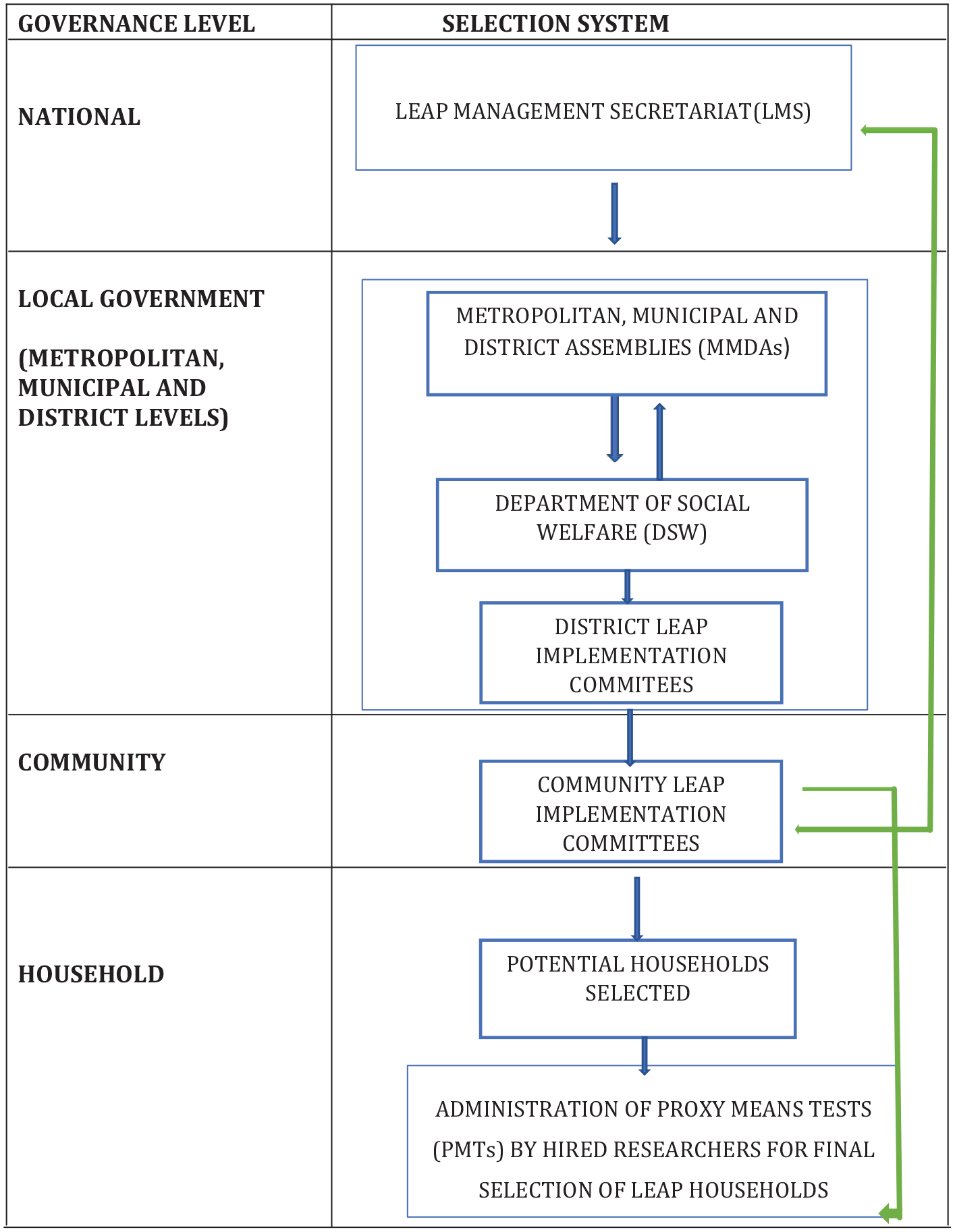
The prescribed selection process.
Next, MMDCEs or Chief Executives share details of LEAP’s selection process with social welfare directors. From interviews with LEAP directors, it was noted that ‘communication between Chief Executives and social welfare directors was very important’, ‘because social welfare departments remained the pivot around which implementation of LEAP revolves’ (LEAP Deputy Director, 2018, Interview, 20 February). A sensitisation programme, designed by social welfare directors is subsequently shared with Chief Executives. This stage is represented in Figure 1 by the upwards pointing arrow from the social welfare departments to District Assemblies. Following sensitisation, social welfare directors form and train District LEAP Implementation Committees (DLICs). A DLIC is an 11-member body comprising the District Chief Executive who heads the committee, social welfare directors, representatives of health and education departments 19 as well as representatives of religious and non-governmental organisations in districts (MESW, 2012). Since Chief Executives are appointed by the ruling government, changes in government lead to the appointment of new Chief Executives and consequently the leadership of DLICs. Following their formation, DLICs receive training in preparation for beneficiary selection (MESW, 2012). This stage is illustrated by the bold downwards pointing arrow from the department of social welfare to the DLICs.
At the community level, DLICs form community LEAP implementing committees (CLICs) with support from traditional authorities (MESW, 2012). CLICs are made up of five members including the community focal person (CFP) who represents the community or village on LEAP matters, representatives each from education (usually a teacher) who also acts as the secretary, health (a nurse), and non-governmental organisations (MESW, 2012). Once formed, CLICs are tasked with using an agreed eligibility criteria to select potential households for the programme. It is worth noting that the formation of CLICs is not based on political affiliation. Hence there are no changes to membership when political power changes hands. The CFP’s role and associated activities in the prescribed selection process is illustrated by the downwards arrow from DLICs to CLICs.
It is important at this stage to outline the eligibility criteria for selecting potential beneficiary households. LEAP targets categories of extreme poor and vulnerable households 20 (MESW, 2012; MMYE, 2007) similar to Brazil’s Bolsa Familia Programme (Hellmann, 2015). At the design phase, two conditions for eligibility were required and are still employed. First, households are extremely poor and live on an equivalent of $0.70 a day (MESW, 2012; MMYE, 2007; MOGCSP, 2015) and second, at least one or more of the following vulnerable persons would be members of the household.
Orphaned (single or double) and Vulnerable Children less than 15 years of age.
Persons with severe disability without any productive capacity.
Elderly persons aged 65 years and above with no government or family support.
Pregnant and lactating women with infants aged less than 24 months.
Using the above criteria, CFPs select potential households who go on to answer Proxy Means Tests (PMTs) (MESW, 2012). Proxy indicators which replace income, include sources of fuel for the household, health and disability status of the household and material composition of household among others (MESW, 2012). In Figure 1, this stage is shown by the arrow which stretches outwards from the right of the community committees and links to the potential households.
To complete the prescribed selection process, enumerators (external to the District Assembly) are hired and trained by LMS to administer PMTs to households. Responses are collected and then fed electronically into handheld personal computers which are linked to a LEAP server to generate a final list of beneficiary households for the programme (MESW, 2012).
Although the prescribed process was intended to be followed, observation data revealed administrative inconsistencies particularly at community and household levels. This is demonstrated in how elites diverged from prescribed roles and in how they participated unofficially in the actual beneficiary selection process.
The actual beneficiary selection process
Chief Executives (MMDCEs), chiefs and Assembly members were three groups of elites who participated in the actual selection process.
There were three points at which the deviation occurred. First, where Chief Executives (MMDCEs) used party supporters instead of external data collectors to administer PMTs. Second, at the household level where chiefs’ advisory role was extended to select CFPs, and third, where Assembly members instead of CLICs selected potential households. As the participation of the three groups in the actual selection process was unofficial, it is illustrated by the dash dotted rectangles to the left of the unbroken rectangles in Figure 2.
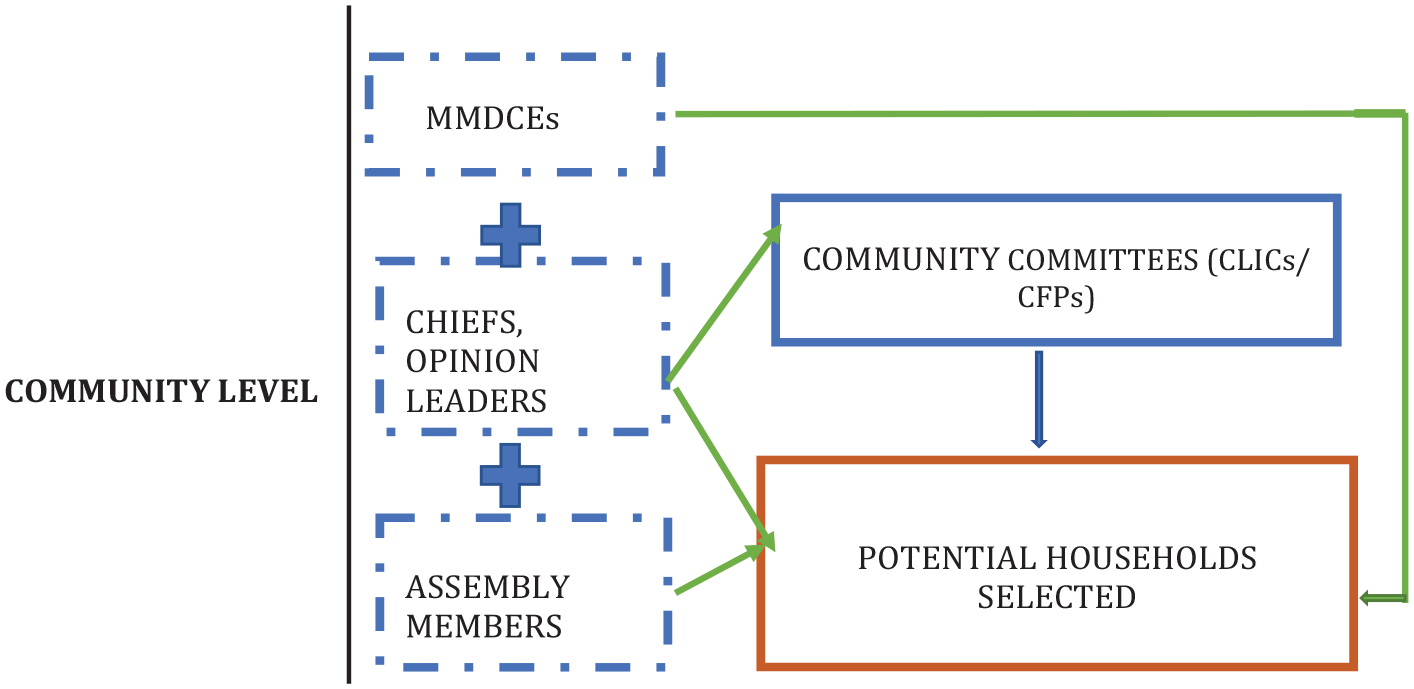
The actual beneficiary selection process.
As indicated earlier about their role, Chief Executives were only required to endorse the final list of beneficiary households prior to enrolment (MESW, 2012). However, in the actual beneficiary selection process, ‘MMDCEs sometimes actively participated in targeting potential households’ (District Social Welfare Director, Cape Coast Metropolitan, 2018, Interview, 15 February; District LEAP Implementing Committee member, Akuapem South, 2018, Interview, 9 March). This means they sometimes took on unauthorised roles in addition to their official role. This is shown in Figure 2 by the line stretching outward from MMDCEs to the potential household selection rectangle. An analysis of how their actions diverged from planned processes will be dealt with in the fifth section of this article.
Chiefs and elders or opinion leaders also referred to as traditional authorities (Asamoah, 2012; Esantsi et al., 2015) had a supporting role in the prescribed selection process. From the LEAP Operations Manual: District Social Welfare Officers and District Committees shall together with traditional authorities and Assembly members organise workshops to sensitize community members on the eligibility criteria that has been agreed upon to identify extremely poor and vulnerable households (MESW, 2012: C11).
In the actual selection process however, chiefs deviated from their facilitation role and selected CLICs. Their involvement is summed up in Figure 2, indicated by the dash dotted lines with the arrow that points from the chiefs to CLICs. An analysis of how and why they deviated from their roles will be presented in next section.
Like traditional authorities, Assembly members went beyond assisting DLICs to select potential households. Their participation in the actual selection process is illustrated in Figure 2 by the upwards pointing arrow from Assembly members to the beneficiary household selection rectangle. Along with chiefs, an analysis of Assembly members’ deviation from their roles in the prescribed process and participation in the actual process will be presented in the fifth section.
Why elites deviate from prescribed selection processes of the LEAP programme
Patronage politics at the district level
It is worth noting that the deviation of three groups of elites from prescribed selection procedures and their unofficial involvement in the actual selection process is key to understanding the politicisation of LEAP’s beneficiary selection process. At the district level, elites used beneficiary selection to their political advantage.
Interviews, observation, and documentary data suggested that the power of political patronage at district and community was key in enabling district elites deviate from their designated roles and participate in the actual beneficiary selection process. Narrating her views regarding the involvement of Chief Executives, a DLIC member pointed out groups which they selected: District Chief Executives recruited political party foot soldiers to administer PMTs. Mind you, it is not happening here but in other districts, but I cannot mention which districts they are (DLIC, Akuapem South, 2018, Interview, 24 February).
As a result of their connections with ruling/national government and local government (District Assembly), Chief Executives become as vulnerable to the loss of power as their national level counterparts (Akyeampong, 2021). To reduce their vulnerability and increase their chance of retaining power, they found it necessary to recruit party foot soldiers who would otherwise have defected to the opposition party, and ruling party foot soldiers were just the group they needed.
The response that ‘it was happening in other districts’ points to the prevalence of patronage politics and the extent of its practice. Political patronage was exhibited in forms other than elites’ recruitment of ruling party foot soldiers. The expansion of LEAP to ruling government’s strongholds illustrated patronage politics. On her reflection of how the previous social protection minister expanded the LEAP programme, a social welfare director noted: NDC’s elites were all about expanding the programme to districts of their strongholds and leaving out all the areas belonging to NPP. So for example in the Eastern region- they expanded heavily in the Manya Krobo and Yilo Krobo areas and Ketu South in the Volta region. Which districts are for NPP? Akuapem area where you have visited, they totally left those areas out. Not that there are no poor or vulnerable people there, but Madam Oye Lithur was not interested in empowering those who would not vote for her government (Social Welfare Director, Akuapem South District, 2018, Interview, 3 March).
Although some districts listed above did not form part of this study, they are districts which benefitted from LEAP’s expansion, hence the interviewee’s reference to them. Hinting at district elites’ approach to expansion is an indication of the pervasive nature of patronage politics and its influence on LEAP. Furthermore, the pressures that competitive clientelism puts on district elites to expand LEAP to districts in their stronghold areas showed how closely patronage politics at the national level links to the district level. It was thus not uncommon to find district elites exploiting beneficiary selection to their political advantage. Rewarding clients for their loyalty, according to political settlements theory is crucial to maintain the position of ruling governments (Khan, 2010).
The power of patronage seemed so strong to have driven the social protection minister’s efforts at expanding the LEAP. Recounting her knowledge of LEAP’s expansion, a social welfare director disclosed: She expanded, expanded and carried out more expansions in 2016, an election year trying to win votes in those areas. She expanded till the last minute. Even in November, 2016, she was trying to win votes from orphanages and witch camps in the Northern region, which were not part of the LEAP. She dipped her hands in Development Partners’ grants and then started offering grants to witch camps in the North, so she can gain their votes (Social Welfare Director, Akuapem South District, 2018, Interview, 23 February).
Although the response above refers to the minister, the minister did not select vulnerable groups but community committees did. The minister represents the ruling NPP and reference to her points to the ruling party’s involvement in selection processes.
Orphanages and witch camps were part of the vulnerable groups targeted for the LEAP programme, although at the time of LEAP’s expansion in 2016, they had not yet gone through selection processes like other eligible groups. However, it seemed that the social protection minister used another avenue, the party’s ideological stance to buy their loyalty. NDC is a centre left party which subscribes to a social democratic philosophy (Grebe, 2017) and one of their priorities is to improve the welfare of the most vulnerable groups using social protection measures (CODEO, 2016). Offering grants to the most vulnerable groups when elections were looming, in exchange for their support showed the lengths the minister would go to keep her position and her party in power.
Although the practice of patronage was known to LEAP’s external and local technocrats as well as LMS, ‘it was not challenged but rather seemed to have been ignored’ (LEAP National Director, 2018, Interview,7 February). In sharing his perspective on how LEAP’s implementing partners’ felt about patronage politics, a local technocrat explained: Those are the little details that the development partners care less about. Besides they deal directly with the policy people at the national level and their interest lies in impact. For them, it’s all about whether at the end of the payment cycle all 230,000 households received their LEAP grants (Ghana Social Opportunities Project Co-ordinator, 2018, Interview, 29 March).
It appears that LEAP’s implementing partners were aware of the actions of elites and recognised its potential outcome – increased patronage opportunities. However, they paid little attention to its influence on selection. Instead, the three transnational actors seemed more interested in fulfilling their organisational goals of reducing global poverty. Thus, they prioritised the poverty reduction potential of LEAP over the aspirations of local elites. Prior to promoting cash transfers as a tool to reduce extreme poverty in Ghana, the World Bank, FCDO (then DFID) and UNICEF were swayed by the positive effects of cash transfers on poverty reduction across the Southern American region (Hickey and Seekings, 2020) and have since remained committed to support the efforts of low-income countries including Ghana, to scale up cash transfers. This commitment ensures that their interests are not blurred (Akyeampong, 2021).
The power of patronage was not restricted to districts but extended to the community level where two groups of actors, chiefs and Assembly members deviated from their prescribed roles and participated unofficially in the actual beneficiary selection process.
Patronage politics at the community level
As noted in the preceding section, chiefs were only required to facilitate sensitisation workshops in communities (MESW, 2012). However, my observations and interviews revealed that, ‘chiefs and their elders wielded a lot of influence in the LEAP beneficiary household selection process’ (Civil Society Organisation Official, 2018, Interview 24 March) suggesting a deep involvement in beneficiary selection. To corroborate my observation data, a district official in a pilot case study site noted that, ‘chiefs normally chose political party foot soldiers or other loyal supporters of the ruling party as community focal persons’ (Social Welfare Director, Cape Coast Metropolitan 2018, Interview, 15 February).
The observation and interview data are consistent with Abane’s (2017) study on the politics of implementing LEAP in the central region of Ghana where chiefs and other self-selected persons constitute CLICs. Chiefs in Ghana are not simply powerful community heads but influential actors who promote socio-economic projects in their jurisdictions (Asamoah, 2012). In the colonial era, chiefs implemented the colonial government’s policies and presided in community tribunals over issues like land disputes (Asamoah, 2012; Tieleman and Uitermark, 2019). Thus, chiefs held influential positions in communities, and it appears that it is in recognition of their previous influence that designers of LEAP carved a role for them in the beneficiary selection process.
Nonetheless, the extent of their involvement in beneficiary selection became a matter of concern especially when their nominations were biased in favour of persons with political affiliations. It seemed that chiefs had come under the influence of politics, contrary to the constitutional mandate preventing them from engaging actively in politics (Government of Ghana, 1992). However, it must be noted that chiefs like community residents comprise the electorate. They understand the competitive character of Ghana’s domestic politics as they constantly observe the campaign strategies of ruling party foot soldiers in the communities. They also subscribe to the philosophies of political parties so their nominations could suggest a show of support to ruling party elites.
Along with chiefs, Assemblymen deviated from their facilitation role to protect their office at the community level. This was enabled by the power of patronage which energised them to use the actual beneficiary selection process in exchange for electoral support.
As recalled by a social welfare director: NDC’s local representatives went to some of the poorest households in the country and gave them GHC 5 and GHC 10 promising that they will make sure they are not hungry when they are voted back in power. So clearly, they were using the LEAP to buy votes. (Social Welfare Director, Manya Krobo District, 2018, Interview, 29 January);
It was not possible to corroborate this claim. Nonetheless, as noted earlier about their status in local governments, Assembly members are recognised as statesmen who represent a political party at the community level, in this case NDC. Thus, there is a possibility that they were instructed by district elites to identify and administer monetary incentives to the poorest households in exchange for voter support.
The conduct of NDC’s local elites is consistent with the behaviour of elites in competitive clientelism because of the lengths they would go to ensure that positions of power are retained. The offer of monetary incentives in exchange for electoral support showed just how vulnerability to the loss of power could trigger elites’ behaviour in ways that protected their political advantage (Banful, 2011). Monetary incentives were used as an inducement to secure electoral support ahead of the general elections, although earlier research on voter support in Ghana has found very little evidence of the use of financial incentives as a bait for electoral support (Lindberg and Morrison, 2008). Yet, the intensity of activities to promote LEAP among the most vulnerable voters, was an example of how the ruling NDC government used cash transfer to reap electoral dividends. Cash was concrete and at the time of the elections, could be used by elites to reassure the poorest households who were the party’s political constituents of the continuance of the programme if they voted them back into power.
Once they gained electoral power, elites had to secure their position in office. Evidence suggests the possibility of discretionary power as significant in facilitating this agenda as they participated in the selection of LEAP beneficiary households.
Discretionary power of local government (district) elites
The evidence suggests that discretionary power accorded to district elites by Ghana’s constitution, facilitated the deviation from their prescribed roles and contributed to participation in the final stage of beneficiary selection. From the perspective of a social welfare director, Chief Executives mobilised their own data collectors instead of using trained data collectors as spelt out in the prescribed process. A social welfare director vividly recounted: ‘Some Chief Executives did not use ESOKO’s
21
enumerators to administer PMTs but mobilised their own data collection. And if the Municipal Chief Executive says they are doing their own data collection, what do you do?’ But you know what will happen, they only select party members and sympathisers to administer questionnaires because those are the people who will enable them stay in power (Social Welfare Director, Cape Coast Metropolitan, 2018, Interview, 15 February).
Ghana’s constitution recognises Chief Executives as the ‘highest political authority at the local government’ (Government of Ghana, 1992: 111). As noted earlier about their position and authority, ‘Municipal Chief Executives represent the government in the Municipal Assembly, and because they are very powerful, they can do anything’ (Social Welfare Director, Cape Coast Metropolis, 2018, Interview, 15 February).
The position of Chief Executives in local government as powerful elites, and the maximum autonomy and administrative discretion awarded them by Ghana’s fourth republican constitution (Ahwoi, 2010; Government of Ghana, 1992), enabled them to mobilise specific groups to administer PMTs. In line with Lipsky’s (2010) street-level bureaucracy theory in which public servants attempt to minimise the difficulties and inadequacies at the workplace, it could be argued that, Chief Executives were trying to manage scarce human resources, when they mobilised their own data collectors to administer PMTs. Nonetheless, Chief Executives cannot be described as street- level bureaucrats because their role does not involve direct contact with beneficiary households (Lipsky, 2010). Instead, in view of their leadership role at the local government, it is most plausible to argue that discretionary power fuelled their actions and enabled them to form patronage networks with their own data collectors.
In addition to mobilising party members, Chief Executives exercised discretionary power when they interfered with the eligibility criteria for selecting vulnerable households.
As was revealed by a social welfare director in a pilot site: During Kuffour’s time, there was some sensitisation about which groups should be selected but later when the NDC government took over and was expanding the LEAP, some District Chief Executives lobbied for some groups whose characteristics did not fit the criteria – chiefs, party foot soldiers and party faithfuls to be added. Some selected individuals were not from the poorest households but have since been on the LEAP (Social Welfare Director, Lower Manya Krobo District, 2018, Interview, 19 January).
District Chief Executives used discretionary power to influence the eligibility criteria. Although their actions could result in inclusion errors, it was strategic, in that the groups selected were of significance to the ruling party. They were party supporters who would strengthen the presence of the ruling party at the district level. Thus, it can be concluded that LEAP’s delivery system empowered elites to select groups who will in turn offer them political support in ways that ensured their return to power.
In addition to discretionary power, other evidence suggests the possibility of socio-cultural values as equally significant in incentivising the unauthorised participation of community elites in beneficiary selection.
Socio-cultural values
In contrast to democratic leaders who gain power and influence through formal, electoral processes, chiefs and elders of Ghanaian communities operate in an informal traditional space (Asamoah, 2012) where they derive their authority from unwritten norms and cultural values embedded in society (Ahwoi, 2010; Tieleman and Uitermark, 2019). Socio-cultural values are thus informal sources of authority.
Respect for persons in authority, a socio-cultural value deep rooted in Ghanaian society was exhibited in the actual selection process by community residents. During a sensitisation event I observed in a pilot case study district, the respect accorded chiefs on entry to event grounds, was immediately illuminated as they were greeted with gestures of respect, including bowing and not shaking hands with them (Asamoah, 2012; Tieleman and Uitermark, 2019). Such gestures of respect, common in many traditional African societies (Asamoah, 2012) drew my attention to the source of their authority.
Chiefs capitalised on the respect bestowed on them to capture the penultimate stage of beneficiary selection. As community elders, they were able to select groups who they deemed fit to benefit from LEAP in a way that suited their personal goals. As was pointed out by a social welfare director in an expansion site: In the selection of beneficiary households in this district, chiefs had the upper hand. They often instructed CLICs to select themselves, ‘well-to-do’ farmers, traders and some pregnant women who looked physically well. Some disadvantaged persons were also selected (Social Welfare Director, Akuapem North Municipal, 2018, Interview, 15 January).
Considering that chiefs occupied influential positions which could not be by-passed, the selected community groups were those who recognised the chiefs’ position and in turn offered continued support to protect that position. Interfering with eligibility rules is common practice in contexts where community-based targeting remains the primary mechanism in selecting households for cash transfers (see de Sardan et al., 2015; Devereux, 2021; Handa et al., 2012).
Along with respect, there was a degree of trust which community residents had in the judgement of chiefs. As noted about cultural values in Ghanaian society, trust in elders’ ability to deliver on tasks (Lyon, 2006) and habitual reverence for leaders’ decisions (Akuoko, 2008) often went hand in hand. Trust is a socio-cultural value present in many African societies and particularly in contexts where there is a reliance on chiefs and community elders to deliver public services (Lyon, 2006). As a societal value, trust underpins community relations and is crucial in weak states where chiefs serve as intermediaries between political elites and community residents (Koter, 2013).
Trust in chiefs’ decisions, meant that like Chief Executives, the nomination of certain groups to participate in the LEAP beneficiary selection was rarely questioned but, in most cases respected. As implied in the response by a district official, ‘raising queries about why chiefs kinsmen or well-to-do farmers were selected was not only difficult but challenging’ (Social Welfare Director, Akuapem North, 2018, Interview 23 January).
It was difficult to question chiefs’ nominations and even more challenging to establish if chiefs’ nominations was an abuse of their authority. This was because, the authority of chiefs in Ghana is difficult to regulate when the limits of their power remains unclear. A documentary resource used in this analysis revealed that the authority of chiefs today has not been regulated in the same manner as governments were able to in the colonial era. While in the colonial era the ‘power of chiefs was limited through a series of Native Jurisdiction Ordinances’ which would not allow the administration of justice to natives except through indigenous tribunals (FES and ILGS, 2016: 2), the situation is different today. Although an independent body of traditional authorities which provides a public voice for the chieftaincy institution in Ghana 22 exists, it does not clearly state the limits of their power or regulate chiefs actions (Ahwoi, 2010; Government of Ghana, 1992). It is thus conceivable to argue that a combination of a lack of clarity on the limit of their authority and socio-cultural values like trust and respect enabled chiefs in pilot and expansion sites to diverge from the prescribed selection process.
Like chiefs, Assembly members were driven to participate in the LEAP beneficiary selection because they drew their authority from socio-cultural values. Although their official role was ‘to assist traditional authorities to sensitise poor communities about LEAP’ (MESW, 2012: C12), in practice they went beyond this role and selected beneficiary households. As was revealed by an Assembly member in an expansion site: I did not always use the eligibility criteria in selection. For example, I knew of a widow, who was not a farmer but was well into her fifties and did not receive any support from family members. I used my discretion and selected her (Assembly member, Akuapem North Municipal, 2018, Interview, January 18).
The response above suggests Assembly members, not only exercised discretionary power in selecting beneficiary households but were able to exert their influence as community elites because of the respect and trust community residents had in them. Trust in their judgement led a research participant to the conclusion that: Assembly members are familiar with the poorest households and know what they are doing. They are our entry points into the community so we cannot bypass them. So, we use them, but we must monitor their activities because they often select their relatives and other persons who can help them maintain their role (Social Welfare Director, Mfantseman Municipal, 2018, Interview 12 February).
However, Assembly members actions also raised some concerns. Considering the dynamics of their relationship with political parties, their decisions seemed to have been influenced by the power of patronage. This is because, their position at the local government is strengthened by their relationship with a political party. Like Chief Executives they are also guided by the demands of competitive clientelism once in office and hence they go to lengths to protect their position as well as that of the party to whom they owe loyalty. Therefore, it can be argued that Assembly members’ unofficial participation in beneficiary selection was driven by both sources of authority – socio-cultural values and political patronage. In the light of this approach, there was some sense of admission that their authority was abused.
Conclusion: key lessons for beneficiary selection frameworks and implications for the social protection literature
The analysis has revealed that the character of politics, demonstrated in the intensity of competition, reflects elite behaviour when it comes to beneficiary selection. Although local government elites in decentralised systems of administration where cash transfers are implemented, are guided by the governance systems and practices in place (see Bukenya and Hickey, 2020; Lavers, 2022; Ulriksen, 2020) it is the character of politics that ultimately shapes elite behaviour as this study has shown. This finding is worthy of note for technocrats who design beneficiary selection frameworks. First, they must understand the character of domestic politics because it will help in the anticipation of elite behaviour and inform the allocation of roles in prescribed selection processes.
Second, designers of beneficiary selection frameworks ought to understand that in low-income countries where cash transfers are implemented, there are existing institutions of power (formal and informal) from which elites draw their authority. Analysis of this study suggested that community elites drew on socio-cultural values to make decisions which could neither be questioned or challenged by community residents. The influence of such informal sources of power on local elite behaviour is cited in studies where community targeting remains the primary mechanism for selecting beneficiary households (see de Sardan et al., 2015; Devereux, 2021; Ellis et al., 2009). Thus, if community elites are relied upon to select potential households then designers ought to recognise the sources of elite authority and how that authority is played out in selection processes. This means certain behaviours will be understood and anticipated.
Finally, there are powerful players at the community level, who cannot be by passed in the final stage of beneficiary selection and ought to be officially recognised. This study has revealed that they function like brokers and include chiefs, political party foot soldiers and Assembly members. Elsewhere in SSA, they include kinsmen of chiefs and community elders (see de Sardan et al., 2015; Ellis et al., 2009). A recognition of such players and allocation of official roles to them in beneficiary selection can reduce their influence and ultimately the capture of beneficiary selection.
In addition to these lessons, this study is an invaluable contribution to the politics of beneficiary selection in SSA and the broad politics of social protection literature. What the politics of the LEAP beneficiary selection adds, is a perspective from the subnational level. It argues that the influence of domestic politics and local power structures should be given serious consideration because of how their interactions can strongly shape elite behaviour in beneficiary selection especially in competitive political contexts.
Footnotes
Acknowledgements
The author is grateful to Professor Naomi Hossain of the School of Oriental and African Studies (SOAS) in London, for the incisive comments she provided on an earlier draft of this article.
Funding
The author received no financial support for the research, authorship and/or publication of this article.
