




Abstract
In Chile, a conditional cash transfer (CCT) programme was established by a left-wing government in 2004 and then re-established by a right-wing coalition in 2014. Despite some revisions and adjustments, Ingreso Ético Familiar maintained the core characteristics of its predecessor Chile Solidario. This reflected a wider trend of CCT adoption by an ideologically diverse group of governments. Against this background, it is obvious that the CCT policy model appeals to political decision-makers on a wide scale, or at least makes it acceptable to them. However, questions remain: how was this model embraced by the ideologically opposing coalitions in Chile? And more broadly: how do CCTs appeal to such a wide range of policymakers? The article explores the argumentation of Chilean Members of Parliament and examines how the ideological and political consensus around these programmes was discursively attained. Through this case, the article also sheds light on how domestic policy dynamics interact with global policy processes. The analysis revealed points of confluence, which serve to illustrate the CCT model’s capacity to convey different meanings to different people – allowing it to be interpreted to fit a variety of different perspectives. I define this quality as discursive malleability and argue that it is an important quality not only in explaining how a policy model can resonate among or appeal to such a wide range of policymakers, but also in the process where a global model is adopted in a country and becomes part of the domestic political debate.
Keywords
Introduction
The centre-right Coalición por el Cambio 1 won the 2010 presidential elections in Chile, making Sebastian Piñera the first post-dictatorship right-wing head of state. The new governing coalition vowed to overcome extreme poverty by 2014 and general poverty by 2018. A key part of this strategy was launching a conditional cash transfer (CCT) programme called Ingreso Ético Familiar. This programme was to replace the flagship social assistance programme of the centre-left coalition Concertación titled Chile Solidario. Concertación had held office since the return to democracy in 1990 and had launched Chile Solidario – a CCT programme – in 2004. Interestingly, despite some revisions and adjustments, Ingreso Ético Familiar was closely similar to Chile Solidario. Thus, although the centre-right discarded the CCT of the previous administration, practically the same anti-poverty programme was then implemented as its replacement.
This reflects a broader trend of CCT programmes designed and implemented on a wide scale by an ideologically diverse group of governments (Osorio Gonnet, 2014; Sugiyama, 2011). In fact, by the time Ingreso Ético Familiar began operating the CCT model had been adopted by nearly one third of the world’s countries (Honorati et al., 2015). 2 As a travelling policy model constructed and promoted by international organizations (see: Heimo and Syväterä, 2022; Von Gliszczynski and Leisering, 2016), the case of CCTs reflects what Moloney and Stone (2019) refer to as global policy and transnational administration.
CCTs aim to mitigate poverty through targeted cash transfers and conditions designed to promote investments in human capital among those living in poverty. At the onset of CCT proliferation this model was presented as a new and innovative form of social assistance. Empirical evidence from early impact evaluations and overviews was presented to provide evidence of the model’s projected effectiveness (Heimo, 2019). However, CCTs were not universally embraced, rather, they were met with a considerable amount of controversy and criticism (for an overview see: Ladhani and Sitter, 2020).
As CCTs have been designed and implemented by an ideologically diverse group of governments in a socioeconomically diverse group of countries, it is obvious that the policy model appeals to political decision-makers on a wide scale, or at least makes it acceptable for them. However, questions remain: how was this model embraced by the ideologically opposing coalitions in Chile? And more broadly: how do CCTs appeal to such a wide range of policymakers?
It has been suggested that the model is possibly devoid of ideological constraints as the technical nature of the programmes neutralizes the ideological debate (Sugiyama, 2011), and that the behavioural conditions and human capital objectives locate CCTs in the ideal policy position: neither the left, nor the right (Brooks, 2015). Borges (2018) argues that although ideology has not directly affected CCT adoption, it has shaped its adaptation. The left, initially sceptical of the policy model, has drawn inspiration from the Brazilian programme by emphasizing a rights-based social assistance, while the right has opted for a design similar to the Mexican programme, which emphasizes stricter conditions and human capital accumulation. 3 Accordingly, Morais de Sá e Silva (2017: 47) argues that the CCT idea can be adapted to any ideological, political, cultural or social background.
In this article, I am interested in how the ideological and political consensus is discursively attained. I approach this question by exploring the argumentation of political decision-makers in a position to approve or discard the implementation of a CCT programme. I examine how political decision-makers from competing coalitions interpret CCTs by analysing the political argumentation of the Members of Parliament (MPs) in Chile. The analysed dataset consists of the debates in which the draft laws for the two legislative processes, which would become the Chile Solidario and the Ingreso Ético Familiar programmes, were presented to the Chilean parliament.
These Chilean CCT programmes present a unique case for four reasons: (1) The two CCTs were written into law – instead of enacting them by executive decree as many other countries have done – meaning it is possible to study the parliamentary debates over their adoption, policy design and rationale. (2) The CCTs were established first by a left-wing government in 2004 and then re-established by a right-wing coalition in 2014, thus allowing for an analysis of argumentation from a wide range of policymakers. (3) Despite some revisions and adjustments, Ingreso Ético Familiar maintained the core characteristics of Chile Solidario (Oliveira and Osorio Gonnet, 2022). (4) Chile has been both an inspiration for and an adopter of the global CCT model. In its reciprocal connection to the global CCT model Chile presents an intriguing case of how domestic policy dynamics interact with global policy processes.
The analysis revealed points of confluence 4 in the argumentation of the MPs. I use this concept to refer to the convergence in lines of argumentation through which politicians from competing and ideologically dissimilar coalitions interpret the policy proposals. The points of confluence serve to illustrate the CCT model’s capacity to convey different meanings to different people – allowing it to be interpreted to fit a variety of different perspectives. I define this quality as discursive malleability and argue that it is a key quality in explaining CCTs broad appeal to policymakers.
In making this argument I draw on scholarship focused on ideas in politics and policy-making. Several scholars (e.g. Béland and Cox, 2016; Jenson, 2010; McNeill, 2006) have advanced the argument that the more ambiguous, polysemic or malleable an idea is, the better prospects it has for being widely accepted politically, and thus adopted. However, these arguments have been made regarding abstract concepts and broad ideas that can be used to articulate and frame more specific policy instruments. I suggest that employing the concept of discursive malleability is a more fruitful way to examine the qualities of more concrete policy models, which consist of distinct established features and are underpinned by different abstract principles.
The article makes a two-fold contribution to the scholarship on global social policy. By examining the ideational dimensions of the CCT model, the article makes a broader theoretical contribution by shedding light on the qualities that make certain global policy models or policy ideas attractive to policymakers. Through the Chilean case, the article also illustrates the multidirectional way domestic policy dynamics interact with global policy processes. I proceed by introducing the theoretical approach the article takes on the ideational dimensions of policy models and elaborate how the concept of discursive malleability can be useful in examining these models. Next, I present the data and methods. Then, the article discusses Chile’s reciprocal interaction with the global CCT model and introduces the Chilean CCTs and the setting for the debates. This is followed by the results of the empirical analysis and concluding remarks.
Discursive malleability of a policy model
More than 60 countries have implemented their own variant of the CCT model, and CCTs can largely be perceived through two levels of abstraction. That is, the CCT leads a ‘double life’ both as an abstract functional model and as an implemented arrangement of governance in the form of locally set up social assistance programmes (Simons and Voß, 2018: 19), such as Chile Solidario and Ingreso Ético Familiar. The World Bank and the Inter-American Development Bank have played a key role in constructing, codifying and promoting the abstract functional CCT model (Heimo and Syväterä, 2022; Leisering, 2019; Von Gliszczynski and Leisering, 2016). The model was presented as a new and innovative form of social assistance. Features of different programmes were formalized under the term ‘conditional cash transfer’ and the model was assigned an origin story, policy rationale and established components.
I conceive of these abstract models as constructed policy templates carrying certain core features that are considered universally applicable to different contexts. In practice, a CCT programme is generally a non-contributory social assistance scheme designed to distribute cash to households whose income falls below a predetermined threshold of extreme poverty, on the condition that the beneficiary household’s children make use of supply-side services in the form of schooling and health care. The abstract ‘CCT policy model’ has been codified to consist of three key features: a monetary transfer (which generally favours women as the recipients), conditions on education and health, and a targeting mechanism to identify the extremely poor (Heimo, 2019; Heimo and Syväterä, 2022). A variant of this model has been implemented by an ideologically diverse group of governments around the world.
The broad question involves how this model appeals to such a wide range of policymakers. To shed light on this question I examine how it was embraced by the two ideologically opposing coalitions in Chile. I approach CCTs from an analytical perspective focusing on the qualities of the policy model itself. If global policy models are understood as constructed policy templates, then the qualities are predicated on how the policy model is formulated and perceived. I draw on scholarship focused on ideas in politics and policy-making and examine policymakers’ rhetoric around two local adaptations of the CCT model. I examine the adoption of these programmes through the ideas and discourse entwined with the policies and focus on the meanings attached to them. Meaning is central to understanding human action, and communicative interaction through ideas and discourse is central to conveying meaning in policy processes (Schmidt, 2008). In sum, ideas are influential because action is premised on ideas, and ideas could thus be considered a primary source of political behaviour (Béland and Cox, 2011: 3).
However, ideas come in many shapes and forms, ranging from broader philosophies and beliefs to concrete policy proposals. Campbell’s (1998) typology provides a useful starting point to grasp the relationship between ideas and policy-making. First, ideas could be understood as underlying assumptions – such as paradigms and public sentiments – residing in the background of policy debates. Second, ideas could be perceived as concepts and theories located in the foreground of these debates where they are explicitly articulated by policymakers. Furthermore, ideas can be conceived of as either cognitive or normative. In the foreground of policy debates ideas can be perceived as programmes or more specific policy prescriptions (cognitive level), that facilitate action by specifying how to solve particular policy problems. In the foreground, ideas can also be understood as frames that are used to legitimize these programmes to the public (normative level). It could be added that paradigms and public sentiments intrinsically inform the construction of the programmes and the frames used to legitimize them.
Focusing on the ideational dimension, the essence of policy-making could be seen to be the discursive struggle over ideas:
Ideas are a medium of exchange and a mode of influence even more powerful than money and votes and guns. Shared meanings motivate people to action and meld individual striving into collective action. All political conflict revolves around ideas. Policy making, in turn, is a constant struggle over the criteria for classification, the boundaries of categories, and the definition of ideals that guide the way people behave (Stone, 2012: 13).
However, if collective political action is premised on shared meanings, scholars engaged with ideas and public policy have also noted that the most attractive or successful ideas in policy-making have the capacity to convey different meanings to different people. Scholars have pointed to the ambiguous (Palier, 2005), polysemic (Jenson, 2010) and multivocal (Goddard, 2009; Padgett and Ansell, 1993) character of ideas in policy-making and discussed them as coalition magnets (Béland and Cox, 2016) and empty signifiers (Laclau, 1996; Wullweber, 2015). This notion is crystallized by McNeill (2006: 348) who finds that the most successful ideas in the development policy arena are not those that are most analytically rigorous, but rather those that are the most malleable, that is, those that can be interpreted to fit a variety of differing perspectives, achieving consensus by conveying different meanings to different audiences. However, these arguments have been made regarding abstract concepts such as ‘sustainability’, ‘social inclusion’ and ‘solidarity’ (Béland and Cox, 2016), ‘social investment’ (Jenson, 2010), ‘informal sector’, ‘sustainable development’ and ‘social capital’ (McNeill, 2006), or a broad body of ideas such as ‘Keynesian policies’ (Strang and Meyer, 1993).
These are broad ideas that can be used to articulate and frame more specific policy instruments, and thus, function in legitimizing and attaching meaning to these policies. Hence, these arguments have been made regarding how ideas influence policy due to the malleability of the ideas themselves. Theoretically the question addressed in this article is whether the same notion of malleability can apply to specific policy programmes. By drawing on Latour (1987), Ganuza and Baiocchi (2012) have argued that the malleability of a more concrete policy idea may be due to its circulation and translation to different contexts, which transforms the idea. They demonstrate this with the wide-scale travel of Participatory Budgeting which was made into an attractive and politically malleable device by reducing and simplifying it from a comprehensive reform to a set of procedures for the democratization of demand-making. In the case of CCTs, Morais de Sá e Silva (2017: 47) puts forward a similar argument about a simplified and reduced core idea that has been put into practice in a multitude of ways. She states that what has been travelling is not a complete policy model, ‘but the idea of the direct transfers of cash from the government to citizens, in a way that their families can be less poor, today and tomorrow’. De Sá e Silva argues that it is this idea that fits different ideologies and may be put into practice in a multitude of ways: ‘Like clay, the CCT idea is moldable and foldable to any ideological, political, cultural and social background. Like LEGO pieces, it can be assembled small or tall, thin or fat, cheap or expensive, very simple, or really complex’ (Ibid.).
I agree that the idea of direct cash transfers from government to citizens is part of the idea of CCTs, and that CCTs have not travelled as a complete locked-in policy model. However, I argue that – true to its name – in addition to cash, the ‘abstract model’ also includes conditions on education and or health, and a targeting mechanism to identify the recipients (Heimo, 2019; Heimo and Syväterä, 2022). According to the World Bank, CCTs ‘are periodic monetary benefits to poor households that require beneficiaries to comply with specific behavioral requirements to encourage investments in human capital (such as school attendance, immunizations, and health checkups)’ (Honorati et al., 2015: 8). What follows from this is that to be included in the category ‘conditional cash transfer’ a programme should exhibit these basic features.
The CCT model could then be perceived to be malleable in two ways. First, the abstract functional model is malleable in the sense that different features can be added to the model and different components can be emphasized in the design of the locally set up programmes, that is, implemented arrangements of governance. Some implemented CCTs emphasize rights-based social assistance while others are more strictly monitored, and some have added features like psychosocial assistance and labour market incentives (like the programmes in Chile).
Second, the CCT model could be perceived as discursively malleable in the sense that it can convey different meanings to different people. I argue that the discursive malleability cannot be reduced to a governmental promise of poverty reduction, but that direct cash transfers from the government to its citizens assembled with conditionalities and a targeting mechanism bring together different ideas and abstract principles that are not necessarily consistent but allow CCTs to be interpreted to fit a variety of different perspectives.
The focus of this article is on the discursive malleability. I propose that the term discursive malleability allows us to mark the difference between the model being malleable in the sense that the programmes can be assembled using different features and components, and the model being malleable in that it has the capacity to convey different meanings to different people allowing it to be interpreted to fit a variety of different perspectives (although these can be interconnected). In that sense, it could be said that, for actors representing different political views to adopt the same model, it needs to allow for points of confluence: principles that can be fitted into differing political ideologies.
Data and methods
The data consist of parliamentary debates in which members of the Chilean senate and the house of representatives took the floor to express their views on draft bills, which would be used to create the Chile Solidario and Ingreso Ético Familiar programmes. These legislative processes present unique cases for the investigation of how MPs from opposing coalitions interpret CCTs. The data were downloaded from the Chilean congress website. The legislative processes related to laws passed in congress were packaged as PDFs and labelled Historia de la Ley (‘History of the Law’). Two such documents were used: Historia de la Ley No. 19.949. 5 and Historia de la Ley No. 20.595. 6 The documents consist of the original bill, introductions from the corresponding ministers and various committees, amendments and modifications to the original bill, voting results on the bill and different articles and transcriptions of MPs taking the floor and giving statements regarding the proposed bill. Together, these documents comprise around 1000 pages, of which roughly 30% of the text consists of the debates.
A conventional view of parliamentary debates sees them as largely symbolic with little impact on actual policy-making (Bächtiger, 2014). The fate of the bill may have been decided before presenting it in the parliament. Bills have generally been prepared in different committees where experts and representatives of different parties have had the opportunity to comment and provide input. Accordingly, parliamentary deliberation rarely has influence on the information and preferences of the MPs to affect their voting (Rasch, 2011: 20). I do not approach parliamentary hearings as venues for policy-making, but as a public forum in which public policies are debated, decided upon and in which politicians justify their views to their constituents and the general public. In parliamentary hearings, the politicians responsible for legislation take a position regarding the proposed bill and locate themselves within the public debate (Billig, 1991: 43). By taking the floor, MPs construct their public image and identity: they show their expertise on the issue and negotiate their personal commitment to, and responsibility for, a bill to be passed or rejected (Alasuutari, 2016: 96–99). Steering clear from essentialist views, political ideologies are not taken at face value and the actors’ understanding is not used here to refer to a static set of beliefs, ideologies or moral principles, but to having a grasp of what types of arguments are feasible in a given setting to advance one’s own views and objectives.
The question guiding the analysis was: how politicians from competing and ideologically dissimilar perspectives interpreted the policy with the effect of reaching a consensus. The analysis was conducted in four phases: first, the data were coded according to who speaks, their party and coalition affiliation. Second, passages of justification and contestation of the bill (or certain aspects of it) were identified. In the third stage, the data were coded inductively – using computer assisted qualitative data analysis software – based on the contents of the statement. The passages of justification and contestation were then analysed in depth by methodology inspired by political (Fairclough and Fairclough, 2012) and argumentative discourse analysis (Hajer, 1995).
The interplay of transnational influences and domestic policy developments
In its reciprocal connection to the global CCT model, Chile presents an intriguing case of circulation of ideas (Stone et al., 2020). In the spaces of global policy and transnational administration, policy actors influence global policies as well as administrative and policy possibilities within sovereign states (Moloney and Stone, 2019: 106). Reciprocally, the construction of global models draws from certain local ideas and policy examples (Heimo and Syväterä, 2022; Leisering, 2019) in a ‘complex process of nonlinear reproduction’ (Peck and Theodore, 2010: 170).
On one hand, the central elements of the Chilean CCTs could be traced as far back as 1981, when the Pinochet regime designed a targeted non-contributory family allowance programme titled Subsidio Unitario Familiar, which initially was as a cash transfer conditional 7 on children’s school attendance as well as visits to a health care facility (Historia de la Ley 18020, 1981). Chile also pioneered an ‘extreme poverty map’ in 1975 that laid the foundation for the targeting mechanisms of future CCTs both in and outside of Chile 8 (see: Kast and Molina, 1975). Chilean officials have also been directly involved in CCT policy processes abroad. The representatives of the Chilean government advised the designer team in Mexico’s Ministry of Finance when Mexico was in the process of establishing one of the first CCTs in the mid-1990s (Yaschine, 1999: 56) and the design of Chile Solidario – particularly the psychosocial support component – has been exported to other countries in the region. 9
On the other hand, the creations of Chile Solidario and Ingreso Etico Familiar were accompanied by policy dialogue with input from international organizations and CCT consultants from other countries. Teichman (2007: 565) shows that in the case of Chile Solidario, the Finance ministry commissioned a social protection report from the World Bank, which recommended a cash transfer programme that would reach the poorest. The Bank then played a role in supporting the ministry’s vision in advancing a CCT programme, while also contributing to opening up (limited) space for civil society consultation. Civil society monitoring and evaluation of the programme were eventually included in the conditions of the Bank’s technical assistance loan for establishing the programme (Teichman, 2007: 565). Ingreso Etico Familiar built on the experience of Chile Solidario and the policy dialogue continued. For instance, the design team was advised by Santiago Levy, the main architect of the Mexican programme. 10 In addition, Chile received an ‘Additional Financing Social Protection Technical Assistance Loan’ from the World Bank to support the design of the psychosocial support and employment counselling components of Ingreso Ético Familiar (The World Bank, 2015: 8).
In sum, Chile has been both an inspiration for and an adopter of the global CCT model. However, the political debate around the Chilean CCTs takes place on domestic terms almost entirely without transnational or global references.
Background for the parliamentary debates on Chile Solidario and Ingreso Ético Familiar
The setting of two opposing coalitions in Chilean politics was largely established in the 1989 referendum on returning to democracy, which was won by the centre-left La Concertación de Partidos por la Democracia (Concertación). 11 The major parties which later formed the backbone of the coalition called Alianza – Renovación Nacional and Unión Demócrata Independiente – campaigned for the continuation of Pinochet’s rule. After remaining in power since 1990 the government of Ricardo Lagos (2002–2006) pledged to take on extreme poverty, and thus launched Chile Solidario in 2004. It was based on the pilot programme Puente and consisted of three central components: (1) psychosocial support for extremely poor households (a social worker assigned to every beneficiary household); (2) a 24-month progressively decreasing CCT with several objectives tailored specifically for the beneficiary household and (3) access to existing social assistance and ‘social promotion’ programmes . Chile Solidario was designed to be a new conditional form of social assistance for extremely poor households as well as a way to integrate the indigent into the social services they were entitled to (Historia de la Ley No. 19.949). By combining psychosocial support with the traditional CCT components, Chile Solidario filled an original niche in the field of social policies in Chile.
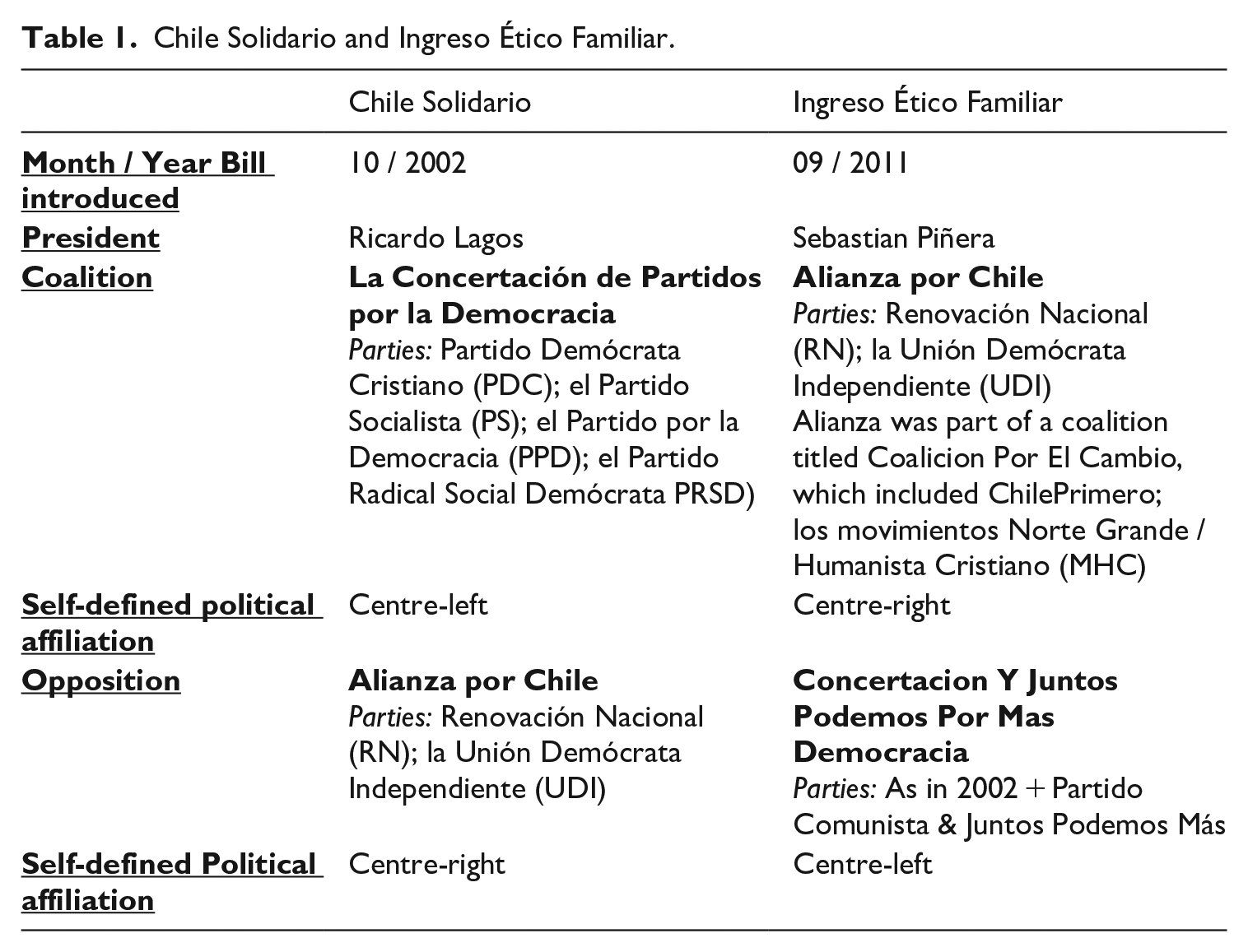
After two decades in the opposition, the centre-right Alianza won the 2010 presidential elections. The coalition ran under the moniker Coalición por el Cambio, however, I use the title Alianza for the sake of clarity as the coalition changed its name and was called Alianza during both parliamentary debates studied here. Led by president Piñera, the new governing coalition vowed to maintain, but also expand, the existing social security system of Chile, overcome extreme poverty by 2014 and general poverty by 2018. As part of this strategy Ingreso Ético Familiar was to replace Chile Solidario by 2013. According to Piñera’s first Minister of Social Development, Felipe Kast, 12 the programme was inspired by three ideas: (1) reforming the policy rationale of Chile Solidario; (2) implementing CCTs and (3) developing a grant for female employment (Kast, 2013). The programme also included components of psychosocial support and labour market assistance for extremely poor households, an unconditional cash transfer and grants for children based on their success in school. As with Chile Solidario (Table 1), the beneficiaries were to receive progressively decreasing monthly cash transfers for 24 months (Historia de la Ley No. 20.595). Both CCTs had a total of 14 different components. The conditions in both programmes differ from the standard CCT mode in the sense that that the demands are customized for each household according to the contract the household signs with the programme.
Chile Solidario and Ingreso Ético Familiar.
Points of confluence in the parliamentary discourse
Analysis of political argumentation related to the Chile Solidario and Ingreso Ético Familiar programmes shows that the CCT models includes several points of confluence wherein politicians representing different ideologies found common ground. Altogether, three central points of confluence could be identified.
Los Pobres no pueden esperar / The poor cannot wait – Pope John Paul II
The first identified point of confluence has to do with the state’s role in reducing poverty. Concertación and Alianza mostly subscribed to contradictory ideas regarding the prevailing economic model and how it functions in terms of creating or reducing poverty, yet both argued that the government holds responsibility in taking action to tackle it. Consider the following examples from the 2011 debate which demonstrate how the entire premise of an argument may differ significantly, or in fact be contradictory, yet both the MP of the governing right-wing coalition and the opposition MP from the left-wing coalition begin from these premises to provide an argument in support of the proposed policy:
Humanity has gone about abandoning statist political approaches installed under the philosophies of communism, Marxism and socialism and has evolved towards a path of growth and development as a way of lifting themselves out of poverty, and more than two billion human beings on the planet have left this condition of poverty because of these policies. Just as this is indisputable, it is also true that states, especially in the case of Chile, which is a developing country, cannot expect to overcome poverty only through this path, but has to target, subsidize and help the families living in extreme poverty, so that they can leave this condition.
13
In the same floor debate a member of the opposition expressed the following view:
For me this is an important debate because in my view it seeks to correct structural inequities resulting from the economic model, through state action.
14
In these quotations the MPs from Alianza and Concertación start from an entirely contradictory premise regarding the prevailing economic model and how it functions in terms of creating or reducing poverty. The explanation for the problem (poverty) is considered systemic in both quotations. The MP from Alianza explains the globally declining poverty rate as resulting, indisputably, from a change from statist economic policies to the prevailing economic model which he considers to be synonymous with a path of growth and development. In the second quote the MP from Concertación argues that poverty is precisely a result of the features of this prevailing economic model. The point of confluence in the two lines of argumentation is found in the practical arguments connected to the explanations of poverty. The MP from Alianza states that Chile as a developing country cannot expect to overcome poverty only through this path, but has to target, subsidize and help the families living in extreme poverty, which is to be done through the programme under debate. The programme is to play a complementary role to economic growth in poverty reduction. However, for the Concertación MP (referring to the programme under debate) it seeks to correct structural inequalities resulting from the economic model. Both support the same programme, yet the premises for the support run on fundamentally different lines of argumentation.
MPs of Alianza considered extreme poverty a problem that state action could help to solve but, nonetheless, explicitly placed economic growth first and foremost, and assigned public policy a complementary role: ‘the focus of poverty reduction must be in economic growth and economic development of the country’.
15
While the MPs of Concertación did not dispute the role of economic growth in poverty reduction, many considered the prevailing economic model to be the root cause of poverty. Some of the MPs contested the trickle-down theory and, in some instances, advocated structural changes and more universal welfare provisions. Concern for the equal distribution of wealth was expressed, yet structural changes for the distribution of wealth were proposed as solutions only when Ingreso Ético Familiar was contested by the opposition, and even then, only in a few cases. However, a major concern for the MPs of Concertación was providing state-run social protection as a matter of social rights:
As was pointed out by deputy Mulet, the growth alone does not do it. Many times the UNDP and the UN has told us very frankly that we are doing good in macroeconomic terms, but not in equal distribution of wealth. With this initiative we want to improve in this aspect, we want to give dignity to our poorest people, we want to lift them from where they are and tell them ‘these are your rights, fight for them, make use of them’. In this lies the rational of the program and for this we will support it.
16
The explicitly expressed rationale of both Chile Solidario and Ingreso Ético Familiar was tackling the problem of extreme poverty. The presidential message, where the background and rationale of the proposed policy were described, and several statements by the MPs numerically listed the number of poor and extremely poor, followed by a declaration that the situation was unacceptable and needed to be resolved. Extreme poverty was portrayed as a moral issue and its scope was considered shameful for Chile. Extreme poverty was unequivocally defined as a problem and a sphere where state action was considered legitimate by both Concertación and Alianza, as exemplified by the following quotes voiced by the opposition:
Unfortunately, ultimately, the fact that we have 600,000 Chileans – 170,000 families – living in extreme poverty or indigence is a scandal, a shame. Therefore, that this proposed legislation would tackle the problem seems very important to us.
17
Mister president, without a doubt, this is an admirable project, as working for the poorest of the country is our obligation and moral imperative.
18
To emphasize that the problem of poverty should be addressed as a moral imperative, the MPs repeated a quote from the Pope’s visit to Chile in 1987 several times during the course of both debates. During his visit, the Pope gave a speech to the nation in which he, among other things, urged the government to urgently address poverty. The MPs brought the Pope into the debate as a moral authority in support of the programme’s objectives:
Who would not be enthusiastic and motivated by this project? We can improve it, but no one can stay aside of such a humanely and socially important objective to our community. As the Pope Juan Pablo II once rightly noted ‘The poor cannot wait’. Today we have a grand opportunity, beyond speeches and intentions, of fulfilling this moral obligation of supporting this initiative and make the dream, which we should all share, of ending extreme poverty and the shame of knowing there are Chileans living on less than a thousand pesos per day.
19
Addressing poverty reduction as a moral obligation serves two purposes in the debates. Doing so creates a setting where the audience is invited to approach the situation as a shared concern, as our concern, a socially important problem for our community, for Chile. Yet, this shared moral imperative can also be linked to the policy proposal. In a widely used rhetorical strategy, other MPs were urged to step beyond what the MP in the above quotation refers to as ‘speeches and intentions’ and to leave politics and ideological differences aside to support the initiative, as failing to do so would signify not sharing the moral objective of ending extreme poverty. In fact, agreeing with the aim of tackling extreme poverty through state action lends credibility to other arguments an MP makes in the debate, and a critique of the proposed bill is often preceded by praise for the objective of fighting poverty. This line of argumentation was particularly favoured by MPs of Alianza who were contesting Chile Solidario:
Today no one can oppose an objective as laudable as this proposed legislation; however, the problem is the way MIDEPLAN
20
wants to advance it. We are concerned of the implementation.
21
There are no MPs from the right that think that this initiative is not a good one; but would not also think that it is going to be used for political purposes in future campaigns.
22
As exemplified in the quotations above, a major part of the contestation of Chile Solidario had to do with the technical and administrative elements of the programme, not the objective of the programme. In these arguments, the MPs did not explicitly criticize the policy rationale or the normative underpinnings of the programme but contested the programme due to faults in its implementation, administration and technical design. Alianza MPs repeatedly opposed the perceived centralization of the Chile Solidario administration as well as concerns for the possible clientelistic and politicized use of the programme. However, despite the criticism, a feasible argument would not dispute the goal of reducing poverty through state action.
Social assistance must be based on targeting
Eso es parte de lo que tanto hemos pedido: la focalización de los recursos / This is part of what we have called for so much: targeting of resources
The conviction that resources must be targeted for a pre-specified group of people was the second point of confluence. In social policy, targeting refers to procedures designed to concentrate provisions for those individuals considered deserving or needy (Burgess and Stern, 1991: 64). In practice, this means limiting the scope of beneficiaries, typically via means tests, income tests, behavioural requirements and status characteristics (see: Gilbert, 2001), as opposed to granting the benefits universally as a matter of social rights to the entire population without predetermined selective measures (Anttonen et al., 2012; Mkandawire, 2005). The target population for Chile Solidario were vulnerable households and individuals. Ingreso Ético Familiar targets households living in extreme poverty. The eligibility of the household is determined by applying a predetermined income threshold at a household level using a proxy means test. Although the two coalitions perceived the cause of the problem differently, the logic of targeting the policy to the extremely poor was taken for granted by both coalitions:
If we do not target the benefits, there is little hope of eradicating extreme poverty.
23
For years, we haven’t had adequate targeting of resources and the governments of Concertación have not applied serious social policies. However, this project aims to do so and we cannot reject it.
24
The starting point for both coalitions was the underlying premise of resource scarcity and limited financial flexibility, thereby requiring the targeting of the few resources available. In essence, the logic of targeting is based on viewing resource allocation as a zero-sum game, with resources directed to other sectors necessarily leaving fewer resources available to be allocated for social protection. Starting from this premise, the Alianza MP argued that extreme poverty cannot be eradicated without targeting the benefits, and that social policies are not serious if not targeted. The underlying assumption is that a group which requires treatment is identified and treatment is provided by the state through a programme, which then leads to the individuals or households in the treatment group to be lifted out – or gain the means to lift themselves out – of poverty. The fact that the policies in question are based on the logic of targeting lends credibility to the policy proposals.
In addition, as Cohen and Franco (1990: 9) have pointed out, targeted social assistance can be politically rewarding. A government which wants to demonstrate that it successfully reduced poverty could adopt this criterion and claim something to the effect of ‘When this government started, there were x families below the poverty line, whereas today, there are only y families below the poverty line’. This logic is evident in the discussions. In response to criticism from Alianza that previous governments had not done enough to reduce poverty, the former president and an MP of Concertación Ricardo Lagos responded:
I would like to point out that for the present government there remains 3 per cent of extreme poverty and 14 or 15 percent of general poverty to reduce. In other words, the policies of the past 14 years have worked. However, it has been targeted policies and not only economic growth that has enabled us to tackle the problem.
25
Although Concertación introduced a targeted policy 10 years prior, some MPs criticized Ingreso Ético Familiar’s rationale behind targeted policies and called for structural changes and more universal welfare provision. Yet, the prevailing argumentation from Concertación did not dispute the logic of targeting but took the form of how to target groups better and more efficiently, not whether to target in the first place. In addition to the implicit notion of resource scarcity, a good design of targeting mechanisms was deemed necessary in terms of correcting exclusion errors. If social protection policies could not reach the poor because of substandard designs or improperly allocated resources, the remedy would be to improve the instruments used in targeting so that the appropriate population would be better reached:
In any case, there is something that concerns all of us: that public resources are used well. In this I do not place responsibility on the line ministry headed by Minister Lavín, or on the Undersecretary. But we have a problem with targeting of social policies, due to the distortions in the social protection data sheet, which are severe particularly in the townships.
26
In addition, it is not clear to me whether this is the way to adequately target the social assistance the state provides for the extremely poor. If we already have problems with targeting with a more decentralized approach, I do not see how we can accomplish it with a more centralised logic.
27
Social assistance must go beyond asistencialismo
El estado no solo debe regalarle pescados a la gente – sino que también enseñarle a pescar / The state should not just hand out fish to people – it should also teach them how to fish
The third identified point of confluence was that the discussed policies were perceived to not be asistencialista. The fundamental element in this perception was the quality that makes CCTs distinct from other cash based social assistance programmes: the behavioural conditions. The key proponents of CCTs, such as the World Bank, have justified the conditions by using the vocabulary of economists, highlighting investments in human capital. Accordingly, CCTs have been frequently described in terms of them not being ‘government handouts’ or ‘money for nothing’. CCTs are dissociated from the type of benefits that ‘can lead to dependency rather than productivity’ (Heimo and Syväterä, 2022). This is reflected in what Deacon and Mann (1999: 423) have referred to as ‘a revival of interest on human agency’, which shifted the focus from structure to individual behaviour and choices, manifested in an increased focus on welfare dependency and the aim of changing people’s behaviour instead of focusing on responding to poverty and inequality through changing the distribution of resources. In the debates, investment and human capital are mentioned only in passing, rather, the focus is on behaviour, effort and dependency. The concept of asistencialismo is used to convey the difference between an acceptable policy which promotes effort and an unacceptable policy which generates dependency:
What is important is that, and this was discussed in the technical body, we do not gain anything by designing social policy only on the basis of monetary transfers, because in the end, this type of asistencialismo rather tends to perpetuate the condition of poverty.
28
Social programs need to advance in qualitative and fundamental terms from asistencialist and paternalist systems, as were Chile Solidario and Chile Crece Contigo, to integrated and co-participatory programs.
29
Although the textbook definition of asistencialismo could be used to convey a sense of its English equivalent social assistance and in reference to citizenship-based statutory rights to minimum social protection, it is nevertheless predominantly used to denote something negative. It is used as a rhetorical tool to mark a difference between social assistance as treatment to lift or promote people out of poverty in contrast to social assistance as handouts which bring about welfare dependency. Those living in poverty need this treatment to support them in overcoming obstacles and escaping their state of deprivation.
Concertación and Alianza use similar terms to refer to these obstacles. Concertación was more focused on collective features, such as the socioeconomic environment and culture, and use the term culture of poverty. Alianza focused on the behaviour of individuals and justified their programme designs by employing the term culture of marginalization to refer to the people living in extreme poverty and the assumption that the poor mired in this culture do not know how to escape their state:
Severe poverty, as is well known, has to do with not just immediate economic condition of the family, but also with the socioeconomic environment and most of all cultural elements. There is a culture of poverty: a sum of factors working as an obstacle for a poor head of household in finding employment, educating the children, etc.
30
We cannot let people get used to being handed everything on a plate; they need to learn and take care of themselves. Many women, and I say this having travelled my country and worked in the media for twenty years to assist those living in extreme poverty, do not know how to overcome this poverty.
31
The root causes of poverty and the ways in which people living in extreme poverty are portrayed in the debates differs between the coalitions. Several MPs from the left voiced their concerns about what they referred to as the neoliberal economic model, and the economic inequality and the wealth accumulation it creates. A shared element in the lines of argumentation can be identified in the programme design not focusing simply on handouts that address these cultures of poverty and marginalization. The elements in the design of Chile Solidario and Ingreso Ético Familiar which are considered central for changing the behaviour and promoting of the poor to overcome their state of poverty resonated with MPs of both coalitions:
Perhaps one of the most relevant concerns shared by the Senators in the united committees had to do with the possibility of establishing this benefit not as asistencialismo from the government, but as a guaranteed right, something that has been done in public policies during recent years through the logic of attaching parameters, requirements and conditions to guarantee people different benefits.
32
Social policies (in the past) have been especially asistencialistas. However, the project under debate is not.
33
Perhaps surprisingly, when discussing the conditionalities, the emphasis is not on human capital accumulation or perceiving the policy as a social investment. Alianza MPs refer to conditions as a way of promoting effort. They put emphasis on individual behaviour and choices as the key determinants of falling to, or rising from, poverty and consider that unconditional cash transfers to the poor would perpetuate welfare dependency. The strong emphasis on asistencialismo suggests that a universal or unconditional social assistance programme would not have had support from Alinaza from the opposition, nor would they have designed a programme without any mechanisms to demand effort from the recipients.
To the Concertación MPs these demands are geared to enable the government to assist the recipients of the transfer in overcoming the obstacles on their way of rising from the situation of poverty. However, the weight of asistencialismo is present in the statements of the Concertación MPs as well. As the quote above indicates, while the MP alludes to establishing the benefit as a social right, the speaker continues by adding that the rights would be guaranteed through the logic of attaching parameters, requirements and conditions to their benefit. In sum, when the state designs a programme with psychosocial assistance and conditions, this transforms the programme into something which is not asistencialismo and is thus deemed acceptable by the opposition in both debates.
Concluding remarks
This article started by asking how two ideologically opposing coalitions had designed and implemented a closely similar CCT programme to tackle poverty in Chile. The broader aim was to examine how this global CCT policy model has been able to appeal to such a wide range of policymakers. Through this case, the article also sheds light on how domestic policy dynamics interact with global policy processes. In this regard, the Chilean CCT case exemplifies the multi-directionality of influences, knowledge and ideas in global policy-making.
The empirical analysis of parliamentary debates revealed points of confluence in the argumentation of the MPs, suggesting that the CCT model is discursively malleable. I put forward that to be discursively malleable, a model needs to contain points of confluence in which different actors’ views intersect. In political debates, arguments for and against a proposed policy may differ substantially, but the existence of points of confluence means that the lines of argumentation come together in a salient fashion. Based on this, the policy model could be seen to have the capacity to convey different meanings to different people allowing it to be interpreted to fit a variety of different perspectives, thus helping in building a consensus between different political camps. I argue that discursive malleability of the CCT model has served as a key quality in its appeal to and acceptance by policymakers in Chile.
I suggest that the case of Chile can illustrate a broader point about how CCTs appeal to such a wide range of policymakers. As a policy template, the CCT model can be perceived as a hybrid that combines elements from rights based social protection, cost-effective targeted social protection and economically productive social protection based on promoting human capital accumulation among households living in the condition of poverty. However, as the case of Chile shows, the appeal of conditions cannot necessarily be pinned down to human capital objectives or perceiving social protection as social investments. The appeal also involves attaching demands, promoting effort and avoiding perpetuating welfare dependency. All this suggests that the CCT model carries the potential for adjusting it to fit diverse problem definitions, varying policy objectives and different views on social protection and the poor, thus making it acceptable to different audiences. However, viability among politicians and policymakers cannot solely be explained by a policy model being acceptable to different audiences, nor can it be considered the sole quality that explains its global proliferation. In Chile, a possible interpretation for Alianza opting for the slightly revised version of Chile Solidario could be found in policy feedbacks, namely, that previously implemented policies structure the direction of future reforms (Myles and Pierson, 2001). While the global proliferation of the CCT model could be explained by administrations emulating or mimicking an internationally acclaimed model (Strang and Meyer, 1993) or simply learning from the existing CCTs (including Chile Solidario), the political debate around the Chilean CCTs takes place on domestic terms almost entirely without transnational or global references. I argue that discursive malleability is an important quality not only in explaining how a policy model can resonate among or appeal to such a wide range of policymakers, but also in the process where a global model is adopted in a country and becomes part of the domestic political debate. This quality could be taken into more careful consideration in future studies of CCTs and other global policies.
Footnotes
Acknowledgements
The author is grateful for the comments and suggestions through different stages of the draft by Anneli Anttonen, Pertti Alasuutari, Cecilia Osorio Gonnett, Gibran Cruz-Martinez and the members of Tampere Research Group for Political and Cultural Sosiology (TCuPS). He would also like to thank the anonymous reviewers and editors of Global Social Policy for the insightful comments.
Funding
The author(s) disclosed receipt of the following financial support for the research, authorship, and/or publication of this article: This article was elaborated in the context of International Network for Comparative Analysis of Social Inequalities (INCASI), a European project that has received funding from the European Union’s Horizon 2020 research and innovation programme under Marie Skłodowska-Curie GA No 691004 and coordinated by Dr Pedro López-Roldán’. ‘This article reflects only the author’s view and the Agency is not responsible for any use that may be made of the information it contains’.
