



Abstract
Summary
This article details a study conducted with South African social workers who provide forensic services in court cases and prosecutions involving child sexual abuse. The aim of the study was to examine the experiences of social workers who are both generalists and forensic practitioners providing a specialized service in the context of sexual crimes against children, and to assess how this affects service delivery and justice for victims. To understand these circumstances, social workers from the South African Police Service, a national non-profit welfare organization known as ACVV, and the state's Department of Social Development were interviewed.
Findings
The findings revealed that the social workers dealt with a variety of problems that have adverse effects on them personally and on the services they provide. In the areas where they served, they faced threats to their safety and challenging work situations that affected their well-being and their professional interventions. Constrained resources and a lack of coordination among role players contributed to delays in the processing of cases and, as a result, low conviction rates for sexual offenses.
Applications
Effective collaboration among role players, adequate resources, and support for social workers were identified as key to dealing with these complex cases. This information provides important insights to understand and improve forensic social work related to child sexual abuse in general, and particularly in resource scarce countries that additionally experience high levels of violence, like South Africa.
Introduction
Child sexual abuse can be immensely damaging to the healthy psychosocial development of children and adolescents (Bromberg & O’Donohue, 2013). Furthermore, studies show that the effects of sexual abuse can persist over the course of the child's lifetime (Kassanjee et al., 2018). South Africa's Constitution and the Children's Act (Act 38 of 2005) define a child as a person under the age of 18. Child sexual abuse, in turn, is defined in terms of the Children's Act (Act 38 of 2005) as “(a) sexually molesting or assaulting a child or allowing a child to be sexually molested or assaulted; (b) encouraging, inducing or forcing a child to be used for the sexual gratification of another person; (c) using a child in or deliberately exposing a child to sexual activities or pornography; or (d) procuring or allowing a child to be procured for commercial sexual exploitation or in any way participating or assisting in the commercial sexual exploitation of a child.”
In South Africa, child sexual abuse is an interminable problem. In 2016, a study conducted by the Swiss-based UPS Optimus Foundation revealed that South Africa recorded 18,524 child sexual abuse cases for 2013/2014, with an average incidence of 51 cases daily (Artz et al., 2016). More recently, the South African Police Service (SAPS) annual crime statistics report for 2019/2020 showed that over 24,000 children were sexually assaulted in that period, with an estimated one in five children being a victim of sexual abuse (see also Cloete, 2022; Mahlakoana, 2020). Aside from the alarming number of recorded cases, it is acknowledged that the data on child sexual abuse is determined within a context of the under-reporting of cases, and thus does not reflect the true magnitude of the problem, which affects both girls and boys (Artz et al., 2016; Ward et al., 2018).
Because of the pervasiveness of child sexual abuse and related crimes against children in South Africa, various policies and legislation have been implemented to address sexual offenses and boost perpetrator conviction rates. The Constitution of the Republic of South Africa (Act 108 of 1996), the Criminal Law (Sexual Offences and Related Matters) Amendment Act (Act 32 of 2007), the Children's Act (Act 38 of 2005), the Law of Evidence Amendment Act (Act 45 of 1988), alongside the United Nations Convention on the Rights of a Child (1989) and the African Charter on the Rights and Welfare of the Child (1990), are legal and policy instruments to that end. However, neither these legal instruments nor intensive social work interventions are yielding the desired effect in South Africa. As Schiller (2017) confirms, the law has done little to reduce the country's rates of sexual offenses.
When child sexual abuse cases do enter the legal realm, forensic services are nonetheless a focal point of intervention and one in which social workers are key role players. To be effective, social workers should ideally have in-depth knowledge and expertise in forensic social work (FSW) in addition to their generalist training. However, this is not always the case, which has significant implications for FSW service delivery in South Africa.
This article examines the experiences of forensic and generalist social workers investigating child sexual abuse cases in these circumstances. A qualitative study using a phenomenological approach was conducted with 20 social workers providing FSW services in child sexual abuse cases. Their task is to ensure appropriate services to victims, and to support court procedures and prosecutions of perpetrators by the criminal justice system. The study aimed to understand forensic social workers’ experiences in managing child sexual abuse cases and assess the quality and effectiveness of the services provided. It sought to examine the experiences of social workers who are both generalists and forensic practitioners providing a specialized service in the context of sexual crimes against children, and to assess how this affects service delivery and justice for victims. The data was used to identify areas for improvement in the provision of forensic services to child sexual abuse victims. Social workers from the SAPS, the state's Department of Social Development (DSD) and the ACVV (previously a Christian-based Afrikaner women’s organization and South Africa's oldest social welfare organization), all of which are located in the greater Cape Town area, were interviewed about their experiences. The findings revealed that the social workers dealt with a variety of issues that had a negative impact on them personally and on the services they provided. This information provides important insights for improving FSW related to child sexual abuse in general, and especially in resource-constrained societies like South Africa. These findings are presented further in the following format: First, an overview of FSW in South Africa is provided. An outline of the research methodology and the research findings follow. A discussion of the implications of the findings concludes the article.
Forensic Social Work in South Africa
FSW is an emerging field of practice in South Africa (Rapholo & Makhubele, 2019; Rapholo & Zimba, 2022). It is one of five specialties recognized by South Africa's governing body for social work, the South African Council for Social Service Professions (SACSSP), which, in principle, allows for the registration of forensic social workers as specialist practitioners, subject to master's level FSW qualifications or social work qualifications with appropriate field experience (SACSSP, n.d.). Simultaneously, the regulations to formalize such registration, which were only instituted in 2017, have yet to be finalized; as a result, there are still few practitioners specialising in the discipline. Further, it is estimated that there were only 36,991 social workers registered in South Africa in 2021 (Gray & Lombard, 2022), with a recent 1:5000 ratio indicated for social workers to the population in the country (Bester, 2020), making FSW a limited service within an already limited social work field.
FSW evolved in South Africa as a professionalised practice in the 1990s, following the establishment of the Family Violence, Child Protection, and Sexual Offences Unit (FCS) within the SAPS to address escalating incidents of gender-based violence against women and children (Frank & Waterhouse, 2009; Van Graan, 2012). FCS units have since been established at various SAPS stations, offering a specialized service to ensure prompt investigations and assessments of sexual violence cases. Each employ at least one forensic social worker, who assists SAPS detectives and the criminal courts in cases that involve the sexual abuse of children and other violent crimes against women and children (Joubert & van Wyk, 2014; Stutterheim & Weyers, 1999). The units promote collaboration between investigating officers and the social workers dealing with sexual offenses and operate according to specific guidelines designed to provide a professional service to victims of sexual offenses (SAPS National Instruction 3/2008; Herman, 2009). Besides the SAPS units, FSW services are also provided by generalist social work practitioners working in child protection services for the state and in social welfare agencies.
The Social Service Provisions Act (Act 110 of 1978) provides the regulatory framework for social work and related professions in South Africa, including FSW. FSW is defined as “a specialized field of social work that focuses on the interface between the legal system and the secondary client (the individual, family, organization or institution being assessed) and is characterized by the primary function of providing expert testimonies in courts of law” (SACSSP, n.d.; Government Gazette, 2017). It requires that a forensic social worker have “scientific and specialized knowledge, skills, training and education and experience in forensic social work” and compiles accurate factual reports in their role (Government Gazette, 2017).
As this legal framework indicates, FSW requires specialized knowledge and expertise, as well as adherence to specific guidelines and ethical standards of practice (Butters & Vaughan-Eden, 2011; Herman, 2009; Iffley, 2012; Jonkers, 2012; Mangezi, 2014; Millstein, 2000). At present, however, only one university in South Africa offers a structured master's degree in FSW and another offers a master's program in criminal justice social work practice with a FSW component (Rapholo & Zimba, 2022).
In general, generalist practitioners working in child protection services who participate in relevant in-service training programs provide FSW services in South Africa, conducting forensic assessments, writing social work forensic reports, and providing expert opinions to support the criminal justice system, as required by statute (Joubert & van Wyk, 2014; Phillips & Abdulla, 2021). The situation has various implications for child sexual abuse victims and is examined further in relation to the experiences of forensic social workers themselves.
Methods
Research Design
The study adopted a qualitative design using a phenomenological approach. This approach was deemed suitable for gaining an in-depth understanding of the experiences of the participants, along with the meanings they ascribed to their experiences in the context of their lived realities, as is the focus of phenomenological research (Babbie, 2013; Creswell, 2018). The values of qualitative research enhanced this process, allowing for the collection of rich data in a naturalistic setting (Creswell, 2018; Guba & Lincoln, 1994). Various gatekeepers, including agency managers and police and court personnel, were initially consulted to identify suitable participants for the study and to gain approval for the study. Once participants had been recommended and approached, interviews were set up and conducted at their workplaces. Workspaces included agency offices and offices at various police stations. Because of safety concerns about the areas in which the participants were located, prior arrangements were made with the agency and SAPS staff, who ensured that security personnel met the researcher on arrival and provided a suitable waiting space before the interviews. These circumstances reflected the daily life experiences of the forensic social workers and their service users. Conducting the interviews in these settings enriched the researcher's understanding of both the topic and the participants’ lived experiences.
The study was guided by a set of research questions and related objectives that were articulated to explore the experiences, challenges, concerns, decision-making and knowledge and skills of social workers who provide forensic services to victims of child sexual abuse. The study received ethical approval from the University of Cape Town and from the various organizations from which participants were drawn; viz, DSD, the ACVV head office, the SAPS provincial office in Cape Town, and the SAPS national head office in the capital city, Tshwane.
Sampling
Participants were purposively selected based on their ability to provide expert information on the research topic and consisted of both generalist practitioners working in child protection services but also engaging in forensic services, and specialised forensic social workers (Babbie, 2013). These two groups of social workers work closely in cases of children in need of care and child protection. The major differences in their roles relate to their training and work context. Generalist practitioners are typically trained at undergraduate level and engage in a range of generic social work services. In child protection services their roles include child abuse prevention and early intervention services, statutory services that include investigations of child abuse and neglect; the removal and placements of children in need of care with recommendations in this regard made to the court, and offering family reunification services (Truter & Fouché, 2019). Forensic social workers, on the other hand, are specialized practitioners with postgraduate qualifications. Their work focuses on various areas of the law, often pertaining to criminal cases, and social welfare in which they conduct investigations and assessments, prepare court reports and act as expert witnesses amongst other tasks (Jonkers, 2012). The intersecting roles of these two groups of practitioners in forensic practice, particularly in cases of child sexual abuse, made them suitable for inclusion in the research. Their experience and expertise in the field were significant factors in their selection.
The sample consisted of social workers who worked for the state's DSD, the national non-profit welfare organization ACVV, and forensic units at various SAPS stations in Cape Town. The SAPS is the major employer of trained forensic social workers. Social workers at organizations such as ACVV and the DSD offer general child protection services to victims of child abuse but also engage in forensic practice. DSD and ACVV are authorized organizations tasked with providing child protection services according to the Children's Act. Although these practitioners may not have been trained in FSW they are, according to the Act, designated to conduct child abuse and neglect investigations. All the participants were providing services to child victims of sexual abuse in cases where criminal charges had been filed, and the cases were already in the courts of law or had been referred to the children's courts. Thus, the participants provided services to child victims whose cases were at an established stage of intervention in the legal system. Table 1 shows the participants’ profiles.
Participants’ Profiles.
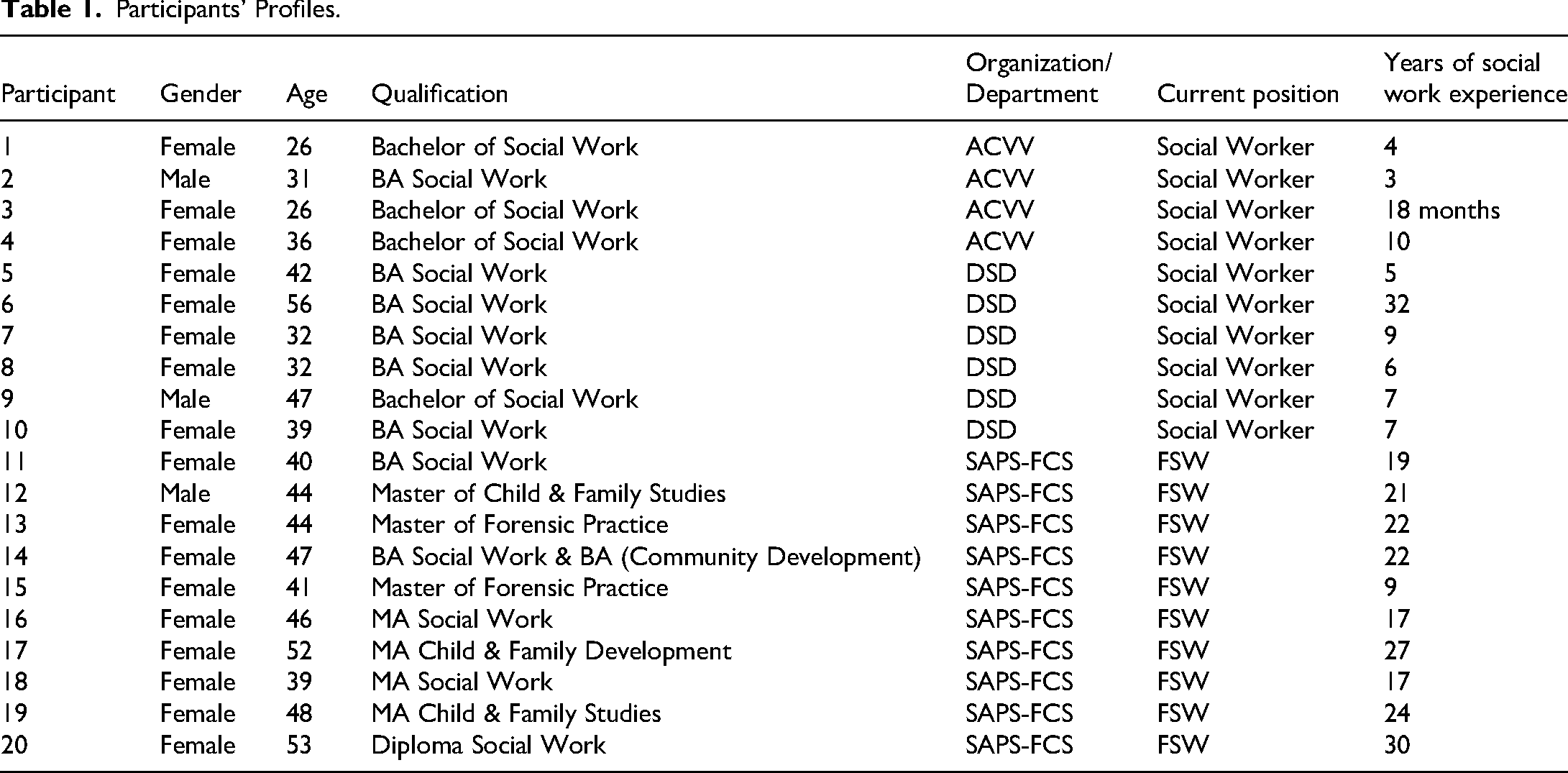
Twenty social workers comprising 17 females and three males between the ages of 26 and 56 years participated in the study. Four social workers were from ACVV, six from the DSD, and 10 from SAPS forensic units. The ACVV and DSD social workers had generalist experience with child sexual abuse caseloads within their organizations. All held a BSW degree only. Of the 10 social workers in the SAPS, seven had obtained a master's degree in different fields of social work. However, only two had a master's degree in FSW. One had a Diploma in Social Work, the qualification for social work in South Africa before it was formalized as a four-year BSW degree, and two had BSW degrees. Two were pursuing PhDs and one was registered for a master's program in FSW. The participants’ work experience ranged from 18 months to 32 years. Ten participants had practice experience ranging from 18 months to 10 years; three had between 11- and 20-years’ experience, and six had between 21- and 30-years’ experience. One participant indicated 32 years of practice in the field. The work experience of most participants combined generalist practice with varying amounts of forensic practice based on the nature of their cases. However, the ten SAPS forensic social workers, all of whom who started their forensic practice at SAPS, had 12 years’ FSW experience (nine participants) and 9 years of FSW experience (one participant).
Among the participants, 17 were previously racially defined as colored and three as black. These racial categories derive from the apartheid era division of the population into four racial groups, Black, White, Colored, and Indian, based on the then Population Registration Act of 1950 (Patel, 2015). These racial designations remain pertinent to how communities engage with one another and with welfare service delivery. Cultural and linguistic differences exist among the different race groups, which affect social worker–client interactions. For example, in Cape Town, Afrikaans is the dominant language among communities that were classed as colored, while isiXhosa is the dominant indigenous African language. This means that for the 17 social workers, language barriers were likely to impede communication with black children during child sexual abuse assessments, which did occur in this study.
Data Collection and Analysis
Data were collected using a semi-structured interview schedule that engaged the participants on their experiences of forensic practice with victims of child sexual abuse. The interview questions were thematically aligned to the research objectives, which sought to understand the challenges faced by social workers providing forensic services to victims of child sexual abuse; to examine the concerns of generalist social workers providing forensic services to victims of child sexual abuse; to ascertain the social workers intervention protocols in this context; and to determine the social workers’ levels of knowledge and skill in FSW.
The interviews were recorded with the permission of the participants using a digital audio recorder and a backup mobile phone. Field notes were taken during interviews and the interviews were transcribed verbatim. The data was analysed using Tesch's methodology for data analysis (Tesch, 1990). This is an eight-step process that requires working through the data systematically from transcription, reading and reviewing the data, coding, and then categorizing units of data into themes to present the findings.
The data were coded into categories and sub-categories based on their characteristics; from these, themes began to emerge as a framework for analysis. Several authors (Babbie, 2013; Botma et al., 2010; Guba, 1981; Guba & Lincoln, 1994) stress the importance of trustworthiness in research studies. Trustworthiness to support the credibility, confirmability, dependability and transferability of the research was upheld through, inter alia, recording the data accurately, ensuring the authenticity of the data by checking participants’ responses with them and not changing the meaning of their responses; ensuring that the research was objective by engaging with established stakeholders for data collection, and thereby making it possible for other researchers to confirm the findings; keeping an audit trail; and analysing the data according to a structured coding and analytic framework to enhance its transferability.
Results
The data analysis revealed separate but interconnected themes that captured the participants’ experiences of working in forensic practice with child sexual abuse. These themes were: Personal and professional challenges in the workplace; high caseloads and their management; and the nature of the social worker–client engagement. All aspects gave rise to practical and ethical concerns for the participants about the nature of services being provided for child victims of sexual abuse.
Personal and Professional Challenges in the Work Environment
This theme relates to the participants’ experiences related to their geographic locations and operating within their specific professional workspaces, which affected their wellbeing. Most of the participants worked in impoverished areas of Cape Town characterized by high levels of crime and violence. This environment created risks to their personal safety and security, which negatively affected their forensic investigations and consequently their services to victims. In these areas, participants were in danger of threats of harm, actual harm or being stalked by perpetrators who were connected to local gangs. Regehr and Glancy (2011) confirm that stalking of social workers including in cases of child abuse is a serious issue with profound implications. This behavior may create uneasiness in social workers, affecting both their personal and professional lives. As a result, it can compromise the effectiveness of social work services and contribute to social worker attrition. Intimidation by perpetrators was a significant concern for the participants in this study, especially in cases where a perpetrator recognized a social worker in a case that involved them. One participant explained: It is very stressful and traumatic, that sometimes I do not want to work with sexual abuse cases. I am now scared for my life because I have been threatened, thus affecting my work. Most perpetrators of child sexual abuse are part of gangs in the area and it is very scary now that, after working on a case, they can follow you, and it is risky since I stay close to the office. I feel unsafe, nervous and reluctant that I do not want [to take on] sexual abuse cases anymore. (Participant 6, female, 32 years’ experience, DSD) It's not a nice field to work in, like, the child sexual abuse field is in general not a nice field to work in, because you are listening to stories where children have been sexualized, raped, so you listen from the parents and from the child giving you details. So, it's a negative environment and I am saying that I feel that. That information I get sits somewhere that I feel so down but I don’t know the reason … I just feel so low, so lethargic, that I don’t feel like seeing the next child and it has an impact on the next child I am going to assess because I haven’t worked through that and I have to take in more (Participant 18, female, 17 years’ experience, SAPS FCS).
All the participants acknowledged a need for peer support to mitigate the impact of their work environment. The social workers at the SAPS forensic units especially emphasized the importance of peer support, since they worked in an environment where their immediate colleagues were police officers, rather than fellow social workers. Police officers saw case assessments very differently to how they saw them and sometimes questioned their decisions. Having social worker colleagues with whom to discuss cases and share feelings of distress could therefore alleviate their emotional burden and isolation.
In addition to peer support, participants expressed a need for structured debriefing; they felt that they needed structured debriefing in addition to regular supervision to be effective in their work. Supervision includes support, guidance and discussion as activities for management (Ben-Porat & Itzhaky, 2011; Engelbrecht, 2012), but debriefing could help them deal with the emotional impact of the overwhelming nature of cases they had to deal with, as Participant 11 noted when she said, ‘I feel debriefing is paramount to us because we die inside, our work gets to us’ (Female, 19 years’ experience, SAPS FCS).
The need for debriefing was also linked to the experience of vicarious or secondary trauma. Participants spoke of their experiences of secondary trauma and having to block or suppress their emotions to maintain objectivity and prevent burnout. Secondary trauma was reinforced by having to obtain descriptive details of sexual abuse from children and having to go through this information repeatedly. One participant stated, ‘Do you know how it affects me to write a court report? (…) I heard the information and I have to re-look [while] typing and I still have to testify’ (Participant 18). Similarly, a social worker in protection services articulated her experience of vicarious trauma, saying: I myself was a victim of sexual abuse, so whenever I have to deal with a child sexual abuse case, I always have to remind myself that it is not about me but about this child (…). In the beginning I was very emotional and could relate with a client, but as the years went by with more cases of child sexual abuse, I became more tougher or resilient, so I have built up this emotional wall for myself. (Participant 1, female, 4 years’ experience, ACVV)
In a study of the experiences of forensic social workers employed by SAPS, Masson (2019) and Masson and Moodley (2020) confirm the high incidence and negative impact of secondary trauma among forensic social workers. Along with vicarious trauma, social workers’ stressful work experiences and heavy workloads may result in emotional exhaustion, detachment from work, cynicism and ineffective service delivery (Agllias, 2012; Ben-Porat & Itzhaky, 2011; Bell et al., 2003; Lloyd et al., 2002). Cox and Steiner (2013) indicate that forensic practice undoubtedly involves hazards and risks to forensic social workers owing to their exposure to the realities of human hardships, cruelty and all forms of injustice. These factors affected participants in the current study and negatively impacted their provision of services to child victims of sexual abuse.
High Caseloads and Their Management
High caseloads due to staff shortages and a lack of resources and funding are features of social work practice in South Africa (Truter & Fouché, 2019) and were revealed in this study as well. High caseloads of complex cases, and their effective management amplified the practice challenges of the participants. For the practitioners working for ACVV and DSD, child sexual abuse was the form of child abuse most prevalent in their caseloads. In such cases, eliciting quality evidence requires considerable patience and time (Joubert & van Wyk, 2014; Leach & Powell, 2020); however, because of high caseloads and pending court dates, assessments often had to be dealt with hurriedly to meet due dates for completion of investigations and submission of court reports. This affected the level of service the social workers were able to provide to victims. A participant described her experience of dealing with a high caseload: There is a high influx of sexual abuse cases and it is overwhelming (…). It is difficult to handle cases properly because, as a professional, I try my best to help the child, but in a hurry to finalize the case. If there is any referral, I do so as soon as possible. (Participant 7, female, 9 years’ experience, DSD)
Schiller (2017) asserts that social workers in child protection in South Africa are required to provide generic social work services, yet when confronted with child sexual abuse cases, they are expected to do forensic assessments for which they are not trained. However, as Schiller (2017) and others have noted, against South Africa's backdrop of ongoing increases in sexual crimes against children, generalist social workers may be the only resource in a community to respond to and deal with these cases (Department of Social Development, 2018; Hendricks, 2014; Schiller, 2017). Thus, generalists investigate such cases of necessity.
Generalist social workers are called on to conduct investigations in such a way that the child is both protected from re-victimization and empowered through the provision of age-appropriate services (Schiller, 2017). However, a plethora of factors influence case management, some of which can lead to the withdrawal of cases or poor conviction rates.
Within the SAPS, the relationship between social workers and SAPS personnel was a particular area of challenge for case intervention and management. Tasks that require collaboration with SAPS colleagues, such as the removal of a child from an abusive home or practical impediments such as limited transport for the social worker, affect how caseloads are coordinated and concluded. The Children's Act (Act 38 of 2005) empowers persons authorized by the court and police officials to remove or to assist in the removal of a child from their ordinary residence to a place of safety, with or without a court order, on reasonable grounds that the child is in need of care and protection, is in immediate danger, and requires immediate emergency protection. In such instances, cases should be reported within 24 h to a designated social worker for investigation. Several social workers in this study spoke of having to remove children from homes without the assistance of SAPS personnel, and of difficulties in obtaining transport to victims’ homes particularly when victims lived in rural areas. Transport also became an issue when participants needed to obtain collateral information, i.e., information relevant to the case from schools, neighbors, or family members, to substantiate their court reports. These necessitate in-depth personal engagement with the parties concerned and cannot be conducted over the phone. Collateral information is vital to court proceedings, since it enhances the credibility of information obtained during forensic assessments and investigations and can speed up court proceedings. According to one participant: The IOs (investigating officers) are always on the road, and if I want to go and do my collaterals, it becomes difficult. For example, going to schools to speak to the teacher, hospitals to the doctor who examined the child and other professionals to get more information, because I cannot do my stuff over the phone. (Participant 15, female, 9 years’ experience, SAPS FCS)
The above concerns corroborate research that shows that a lack of resources has a negative impact on FSW practice in South Africa (Iffley, 2012; Mnguni, 2018). The participants also raised concerns about delays in the criminal justice system in finalizing child sexual abuse cases, which affected conviction rates. Delays negatively affected the information gathered and recorded from children or recalled by children after extensive time delays. Two participants (Participant 13, female, 22 years’ experience, SAPS FCS, and Participant 5, female, 5 years’ experience, DSD) stated that time delays could be between 2 and 5 years.
Alongside time delays, the lack of a standardized format for court reports and different levels of detail expected in reports by different courts affected how reports were perceived. South Africa does not have specific guidelines for forensic interviewing in the assessment of child sexual abuse (Rapholo & Makhubele, 2019). In this regard, the participants noted that they implemented a variety of protocols and techniques during their forensic assessments. Techniques like “feeling faces,” the touch survey, the body parts inventory and the use of anatomical dolls, recognized methods in FSW for child sexual abuse cases, were noted (Rapholo & Makhubele, 2019; Teoh & Lamb, 2013). One participant elaborated on her approach to interviewing: Our investigations are done using a comprehensive model – APSAC, MICHIGAN, Phase Interview Protocol, Collateral information and Hypothesis testing. I choose protocols that I feel apply in South African cases over international protocols. (Participant 13, female, 22 years’ experience, SAPS FCS)
This study established that participants chose protocols and techniques with which they were familiar and which they could defend when questioned about their applicability in court. According to Smith (2014) and Smith et al. (2018), it is important that social workers are able to defend their selected assessment techniques and procedures, showing that they are underpinned by a particular model. Despite social workers’ use of tried and tested models, the findings reveal that there was a lack of uniformity in court reports and guidelines for recording child abuse cases, which could impede case outcomes. Since there is no specific format for compiling a forensic report in South Africa, social workers write these reports as they deem fit (Joubert & van Wyk, 2014). This creates a variety of formats for court reports and may affect how different courts view the credibility of the investigation. Participants expressed concern that the current social work report formats do not fully address the courts’ needs and expectations, and influence how social workers’ contributions are received.
The Nature of the Social Worker–Client Engagement
Social worker–client engagement emerged as a theme in light of the complexities involved in dealing with child sexual abuse cases. The language of communication and parental involvement were the primary factors influencing how information was elicited and cases were documented. South Africa is a diverse society, having eleven official languages. Commonly, social workers and clients are from different cultures or previously divided racial groups and do not speak the same language or have a shared culture. English becomes the common medium of communication. Rapholo and Makhubele (2019) observe that variance in the culture and language of an interviewer and child can influence the effectiveness of forensic interviews. Therefore, communication barriers affect how case details are relayed and recorded. This problem leads to an overreliance on interpreters, which some participants (Participants 15 and 17) noted could create case delays and misinterpretations of information. The use of interpreters also affects disclosures by children, the credibility of information gathered from children, and the admissibility of children's statements in court, thus negatively affecting conviction rates (Rapholo & Makhubele, 2019). A broader outcome of this situation is that children's rights guaranteed by the African Charter on the Rights and Welfare of the Child (1990) and the United Nations Convention on the Rights of a Child (1989) to enjoy their cultural systems and use their language are compromised. However, as Maschi and Killian (2011) note, language barriers often compel social workers to use interpreters.
In this study, most participants experienced challenges in providing services to children who spoke isiXhosa. They used interpreters to maintain case flows, but expressed reservations about this approach, calling instead for more Xhosa-speaking forensic social workers. The problem with the use of interpreters, who are generally untrained in interpretation, is that cultural cues and important nuances may be lost, so that the translation does not always convey intended meaning. This affects the success rates of cases, which could be mitigated by the use of qualified interpreters as opposed to ad hoc or untrained interpreters (Rapholo & Makhubele, 2019; Tribe & Tunariu, 2009; Truter, 2010). Qualified interpreters interpret not only the verbatim spoken words but consider culture-specific norms and understandings to create useful and ethical interpretations (Tribe & Tunariu, 2009).
Several authors make the point that communication through third parties alters the quality of evidence and is time-consuming (Rapholo, 2018; Skivenes & Križ, 2010; Spies, 2012). Skivenes and Križ (2010) assert that meaning is lost because interpreters do not translate verbatim. Gaps in communication leading to loss of meaning when documenting cases were apparent in the following description of a case: I had a case before where the guy I used as an interpreter talked for long with the child and when he translated back to me, it was a short response and I was wondering what he was saying to the child. Also, when a translator is male translating for a girl child, such things where the child cannot say certain words because of culture [is a factor]. (Participant 17, female, 27 years’ experience, SAPS FCS)
Communication with young children about sexual abuse was another concern. Challenges emanated from the traumatic nature of the experience and the psychological effects on children, which influenced the social worker–child communication and the process of disclosure. The process was seen as traumatic for the victims and at times needed specialized skills, as in a case of a participant who had to assist a boy with an intellectual disability and ADHD who had been sexually abused. Many children find it difficult to talk about their experiences of being sexually abused, and struggle to disclose sexual abuse because of anxiety, feelings that no one will believe them, caregiver reactions, and fear of perpetrator retaliation (Mathews et al., 2016; Motshegoa, 2011; Rapholo, 2014; Van Dam, 2006). In addition, the traditional belief systems that prevail in African cultures tend to uphold gendered roles and patriarchal authority, which also influences disclosure in child sexual abuse cases (Rapholo, 2021). The fact that information has to be gathered through multiple interviews with various role players, each of whom may yield slightly different versions of events, also leads to distortions that affect the service delivery process.
For the participants, the variety of investigative protocols and the necessity of multiple interviews of the child by different professionals was an added concern. Children can be exposed to re-victimization when questioned by various service providers about the same traumatic event. Multiple interviews can trigger new information that may not only affect the child emotionally but can reduce the reliability of information, since therapeutic interventions, forensic procedures and investigative techniques will often yield information that differs (Cordisco-Steele, 2012; Cronch et al., 2006; Leach & Powell, 2020; Risan et al., 2020). The use of procedures that have the potential to re-victimize the child created ethical dilemmas for the participants, who also felt conflicted because they could not always uphold client confidentiality. Some children evidently expressed a desire for confidentiality, but social workers are obliged to share information with others in the criminal justice system, as this is part of mandatory reporting laws governing the protection of children in South Africa (Sexual Offences and Related Matters Amendment Act 2007). Further, testifying in court is an intimidating experience for most witnesses, especially for vulnerable groups such as children. The court experience is even more intimidating when the child has to testify in an open court about traumatic events that occurred during sexual abuse (Magagula, 2018; Reyneke & Kruger, 2006). South Africa provides for an intermediatory system, whereby a qualified person may be used to facilitate communication between the court and the child in an age-appropriate manner, and certain cases may be heard in specialized courts for in-camera proceedings, so that child victims do not have to encounter the perpetrator. However, these provisions are not always upheld, and re-victimization can occur during court proceedings (Fambasayi & Koraan, 2018).
In this overall context, a need was expressed for therapeutic services for child victims of sexual abuse. Rates of child sexual abuse in South Africa are exceptionally high and services in under-resourced communities are limited, which means that many children are awaiting therapeutic services. Childline and Safeline are designated channels for therapeutic service to child victims of sexual violence and abuse, but they have estimated one-month waiting lists. The implications thereof were explained by a social worker: Therapeutic services should be streamlined within the Department itself to reduce long waiting periods for the child victims who require crisis intervention services (…) The long waiting list on the therapeutic part stagnates the cases and other new behaviors develop and you have to deal with the new developments of the same cases again. (Participant 9, male, 7 years’ experience, DSD)
In the social worker–client engagements, parental involvement also emerged as an influencing factor that could negatively affect case outcomes. Participants identified instances where a parent would be reluctant to pursue a case against a perpetrator, or where they coached children in what to say, especially when there was financial dependence on a perpetrator. At times, charges against a parent were also identified in marital or custody disputes, which could influence the perception of credibility in a child abuse case. A participant explained her experience: When victims disclose sexual abuse, parents and caregivers do not want to believe the child, and when a case is opened, there is no cooperation from the parents or caregivers, leading to cases being thrown out. Where perpetrators are breadwinners, it is a challenge to keep him away [when he has been ordered to stay out of the household] because the other parent will draw the perpetrator close, putting the child at risk of further abuse. (Participant 10, female, 7 years’ experience, DSD)
Parental reactions are likely to affect the willingness of children to disclose sexual abuse. Parents, especially mothers, may be confronted with negative family relationships should they make the abuse known (Motshegoa, 2011; Strydom & Stander, 2011). Parental involvement can therefore negatively affect the disclosure process, influence the information provided, and delay case progression, all of which affect conviction rates. Motshegoa (2011) concurs, noting that when child sexual abuse happens within a household, parents at times expect the child to tell no one or even to deny that child sexual abuse took place. For this reason, a child's lack of disclosure during the forensic assessment should not be considered as definitive proof that child sexual abuse has not occurred. It is important that more than one forensic interview is held with the child (APSAC, 2012; Katz & Hershkowitz, 2012; Smith, 2014). In this study, three participants referred to cases where parents or caregivers negatively influenced proceedings by denying that sexual abuse had taken place or that accusations of sexual abuse had been made. This impeded the effectiveness of the FSW assessments and other services that were necessary for the children and their families.
Discussion
In South Africa, specialized forensic practice is limited as a result of low numbers of formally trained forensic social workers. Therefore, it is common practice for FSW to include generalist practitioners who undertake this role with limited expertise in the field. Various implications of this situation have been established in the literature. These include poor forensic report writing skills among generalists, the need for more effective use of victim impact reports, and the use of Western interviewing protocols rather than Afrocentric approaches, all of which can negatively influence convictions and justice for victims (Joubert & van Wyk, 2014; Phillips & Abdulla, 2021; Rapholo & Zimba, 2022). With limited specialists in the field, the number of victims per practitioner is also huge, as evident in the social worker–client ratios in the country. These factors create inefficiencies in service delivery and delayed justice for victims.
This research identified additional challenges linked to these circumstances, which intersect at various stages of intervention in child sexual abuse cases. All present impediments to and ethical concerns for social workers with regard to the way in which cases are managed and how justice is achieved for children. This is especially so in light of the principle of upholding the best interests of the child, which is a foundational principle in social work involving children and stated in the South African Constitution (Article 28(2), South African Constitution, 1996). FSW is an important channel through which to ensure justice for children, and one in which social workers play a valuable role. However, as this study illustrates, multiple factors influence how these services are delivered and whether or not justice is achieved. Many of these factors have negative effects on both practitioners and their clients.
To facilitate change, there is a need for effective collaboration between various role players involved in child sexual abuse cases. These include both generalist and forensic social workers and the criminal justice system, comprising both SAPS and the judiciary. Participants in this study perceived the justice system to be hostile to the mission and values of social work. The undermining of social workers’ role and values can lead to attrition in this demanding field, where practitioner–client ratios are high, service delivery is difficult, caseloads are high, and cases are finalized slowly, with low conviction rates.
Kassanjee et al. (2018) assert that the Optimus study (Artz et al., 2016) provides insights into the extent of child sexual abuse in South Africa, which should motivate service providers and policymakers to act with more urgency to protect South Africa's children. The participants in the current study expressed views that reflect the findings of the Optimus study. Participants called for more collaboration between social workers and colleagues in the criminal justice system, and a more structured approach to these collaborations, which would enhance service delivery to victims of child sexual abuse. Better coordination between sectors could also address the life-threatening circumstances to which social workers are exposed, as crime prevention and addressing criminal behaviour is the mandate of the SAPS and should be extended to all citizens, including social workers. Efforts by SAPS personnel to safeguard social workers in the areas where they work should be structured and embedded in forensic interventions, so that social workers are not compelled to ask for this help and hope that their need is met.
The participants were also concerned about how cases were handled and the implication of these cases for their personal and ethical practice. They expressed a strong need for peer support and debriefing. McFadden et al. (2014) advise that social workers use active coping strategies such as emotion-focused coping methods and support from colleagues to deal with emotional exhaustion. However, more is clearly needed. Changes in organizational culture and work environment, and a reduction in workloads, are among the prevention and intervention strategies recommended for vicarious trauma and burnout. Other strategies include group support, supervision, self-care and education (Bell et al., 2003; Cox & Steiner, 2013). Paying attention to the environment in which social workers work would be a further step toward to enhancing service delivery; here supportive peer systems are crucial, especially in FSW practice. In South Africa, lack of qualifications and skills to deal with child sexual abuse cases necessitates that generalist work in FSW, for which they are ill equipped. At the same time, there are limited training opportunities for forensic social workers; this keeps their numbers low and compels generalist social workers to fulfil this role. To overcome this challenge, forensic social workers could be employed as mentors or provide peer support to generalist practitioners, with the necessary adjustments to their own workloads. Being able to reach out to a colleague and share experiences could mitigate circumstances of burnout and vicarious trauma. Although such peer support does take place, it is not formalized or accommodated in terms of time. Distinct policy directives in this regard should be formulated as a collective initiative by those working in FSW and by the state, including the finalisation of registration regulations for practice. This would add structure to the support that forensic social workers receive and ultimately benefit child victims of sexual abuse. Finally, more postgraduate qualifications in FSW are required and universities in South Africa could make a significant contribution by formulating programs to address this need.
Limitations of the Study
FSW involving the care and protection of children, carried out by both specialist and generalist practitioners, is widespread across South Africa. This study offers insights into this extensive field of social work that reflect common experiences in the country and may resonate with social workers working in similar country contexts characterised by high levels of crime and violence, and resource scarce settings. In this respect, it offers useful indicators to understand the challenges that forensic social workers experience especially in terms of the traumatic nature of their work both socially and personally. To build on these outcomes and improve the work environments of forensic social workers in such contexts, focussed research that integrates specific cohorts of practitioners is essential. While this study highlights profound experiences of forensic practice, the inclusion of both generalist and specialised practitioners affects the focus on the lived realities of each group of these social workers. Therefore, ongoing focussed research is recommended to provide more nuanced insights into this crucial social work service.
Conclusion
This study examined the experiences of social workers in forensic practice working with cases of child sexual abuse. Social workers in forensic practice in South Africa encounter many challenges in dealing with child sexual abuse caseloads, often to the detriment of the child victims, who are actively and inadvertently affected or re-victimized by how investigations and court cases are conducted. Social workers themselves are affected by vicarious trauma, risks to their lives, and having to work with limited resources, all of which affects their ability to do their work. In a society marred by high levels of crime and violence, children remain vulnerable and in need of effective services. This could be facilitated through greater collaboration between relevant stakeholders and effective coordination of interventions to ensure justice for victims of child sexual abuse. Having more qualified forensic social workers could, further, go a long way toward alleviating the enormous challenges social workers in South Africa endure.
Footnotes

Ethical Approval
Ethical approval for this project was given by the University of Cape Town's, Department of Social Work and Social Development Research Committee. The organisations involved approved the research and the participants signed informed consent forms.
Funding
The authors disclosed receipt of the following financial support for the research, authorship, and/or publication of this article: Funding for open access publishing has been provided by The South African National Library and Information Consortium (SANLIC).
Declaration of Conflict of Interests
The authors declared no potential conflicts of interest with respect to the research, authorship, and/ or publication of this article.