



Abstract
Summary
The growing diasporan community requires carefully designed psychological support, because this population is crucial for global socioeconomic development. This article explores the role of resilience among Zimbabweans who were affected by upheavals connected to the announcement of the Zimbabwe Exemption Permits’ (ZEP) termination. This longitudinal qualitative study employed purposive and snowball sampling to recruit 31 Zimbabwean participants from Pretoria and Johannesburg. Data was collected using semi-structured interviews through a mix of WhatsApp and direct phone calls. Furthermore, unstructured observations of participants were conducted through WhatsApp statuses and regular communication through texts. Thematic data analysis was used to analyse the data.
Findings
The study's findings shed light on the resilience trajectory that was evident in participants. The findings focus on: discussing the background that formed the basis for resilience which includes the interruptions in their everyday lives owing to the upheavals associated with the termination of their visas. The findings further show the anxieties and worries that were caused by the news of the ending of their visas, and the evidence of resilience that followed in form of hope, coping, and bouncing back.
Applications
This study offers valuable insights into Zimbabwean migrants’ resilience in South Africa (SA). The findings highlight the specific challenges they face and the strategies they employ to cope, providing a framework for social workers to develop targeted interventions that promote their psychological wellbeing. This study serves as a foundation for further exploration of the multifaceted nature of migrant resilience and its implications for social work practice.
Introduction
This article provides insights into psychological support that can be delivered by social workers to migrants during challenging moments in their trajectories. It adopts a strength-based perspective by emphasising participants’ resilience. Participants’ narratives of resilience in this study can be valuable for social workers working with migrants at micro and meso-levels. The article is based on the premise that acknowledging the client's strengths enhances the empowerment process by highlighting positive attributes as well as fostering the cultivation of skills, expertise, capabilities and aspirations. This facilitates the regaining of personal control in their lives and fulfils the social workers’ role of facilitating client self-determination and empowerment (Pulla, 2017). Based on findings, the article highlights four resilience elements: determination, endurance, adaptability and recuperability (Taormina, 2015).
Research highlights that trauma, abuse, diseases and challenging experiences can have long-lasting and even intergenerational impacts (Kautz-Turnbull et al., 2023; Sharad et al., 2023). However, the current study builds upon resilience theory, which suggests that adverse phenomena can serve as tools and steppingstones for more constructive dealing with adversities. As research shows, resilient individuals often demonstrate healthy psychological development, fostering stronger connections, empathy and the ability to recover from hardships (Gillespie et al., 2007; Taormina, 2015; Ungar, 2013). This article focuses on Zimbabweans who either held or were closely related to someone with Zimbabwe Exemption Permit (ZEP) in SA during the upheavals associated with the announcement of its termination since 2020, followed by several postponements, due to court cases and disputes regarding the minister of Home Affairs’ decision.
Literature review
Negative global discourse and impact on migrants
Globally, migration studies, stakeholder organisations and political players’ discourses are increasingly and dangerously dominated by negativity regarding migration management, support for migrants, migrants’ circumstances and reasons for migrating. At various levels, micro (individual/psychological), meso (groups, families, and communities), as well as macro (national and global politics), many migrants encounter and sometimes overcome significant challenges embedded within the social categorisation present in migration-related discourses (Campani et al., 2022; Enroth, 2022). Stereotypically, migrants are often considered unacceptable and feared for potential socioeconomic deviant behaviours in the host society. In many political discourses, they are viewed as an economic burden (Nirmal & Nirmal, 2023; Oelgemöller et al., 2020).
Some studies support discourses like the European Fortress, while others highlight the problems with such perspectives (Oelgemöller et al., 2020). The European Fortress involves protecting Europe from external immigration, by making the European Union (EU) border nearly impenetrable through stricter policies (Bigo et al., 2020; Loon, 2022). Similar measures are taken by many nations to restrict entry and stay. In Southern Africa, South Africa (SA) tends to hold a dual role: one hand, major recipient of migrants and on the other hand, mistreating migrants, fuelled by persistent xenophobia (Crush, 2022).
As such, instead of various prospects of migration as hoped by global policies as well as migration and development theories (Băcescu-Cărbunaru, 2020; Crush & Frayne, 2007), migration becomes a global source of division and disagreements between governments and their people (Grabowska, 2023; Krotký, 2022). For example, Grabowska (2023) perceives the presence of migrants as posing societal dangers, including societal fatigue, othering and migration being exploited as a political tool by politicians to justify neglecting their duties to their countries. This perspective implies that without migrants, service delivery issues would not exist, portraying migration as problematic.
Politicians often exploit negative rhetoric about migrants to gain political support, often perpetuating inaccurate claims about their impact on services and the economy. This can be seen in SA, where migrants are blamed for service delivery issues (Adesina, 2019; Kwenge, 2020), and in Sweden, where a professor was accused of xenophobia for allegedly obstructing a Turkish student's access to education (Tulun, 2023). Additionally, exploitative recruitment practices in countries like Brazil and Canada further disadvantage migrants, who often lack adequate knowledge or government support (Larios et al., 2020; Zanforlin & Grohmann, 2022).
Taking a social worker's perspective, the above negative global discourse surrounding migration has a devastating impact on migrants’ psychological wellbeing. The negativity creates a hostile environment that undermines their sense of belonging and can erode their resilience. By recognising the inherent strength of migrants, social workers may foster their coping mechanisms and connecting them with support systems. By promoting a positive narrative and challenging harmful stereotypes, social workers can create a more welcoming and inclusive environment, allowing migrants to thrive.
Overview of Zimbabwean emigration
Over the years, Zimbabwe has faced various political and socioeconomic instabilities. This has led to high rates of Zimbabweans emigrating to neighbouring countries and overseas, seeking political refuge and better socioeconomic conditions (Foya & Ncube, 2022; Madebwe & Madebwe, 2017). Madebwe and Madebwe (2017) demonstrate that the country's emigration phenomenon has a long history divided into three dispensations: (a) 1960–1980, (b) 1991–1997, and (c) 1998–2015. In the first dispensation, migration was primarily linked to the Zimbabwean war of liberation, leading to approximately 210,000 political exiles in 1972 (Madebwe & Madebwe, 2017). Furthermore, after independence approximately 142,000 White Zimbabweans emigrated to countries like SA, United Kingdom (UK), Australia, Canada, and New Zealand.
In the second dispensation (1991–1997), Zimbabwe faced economic challenges leading to a shift from a vibrant to a highly fractured economy. This rendered the country unable to provide basic public services. This was accompanied by numerous companies downsizing or relocating from Zimbabwe, resulting in unemployment reaching about 50% in 1997, and reduced salaries for those employed (Ismi, 2004). These challenging economic conditions forced more Zimbabweans to emigrate, with an estimated 200,000 skilled professionals alone leaving the country (Madebwe & Madebwe, 2017).
In the third dispensation (1998–2015), Zimbabwe experienced alarming rates of emigration referred to as the ‘exodus’ by some scholars (Crush & Tevera, 2010; Dillon, 2013). Despite dollarisation stabilising the economy in 2009, there was high rate of unemployment, industries were under-capitalised operating below capacity. Furthermore, the series of company closures persisted, with over 900 companies shutting or scaling down production by 2000 (International Crisis Group [ICG] 2007). Zimbabwe's economy faced liquidity problems and depressed investor confidence (Kanyenze, 2006). Due to economic difficulties of 2005–2009, the Johannesburg reception Centre registered an average of 3,000 Zimbabweans entering SA daily (Betts & Kaytaz, 2009).
Zimbabweans’ reception in SA
As a host to a significant number of Zimbabwean migrants, SA's Cabinet approved the Dispensation of Zimbabweans Project (DZP) in 2009. The DZP was a permit that Zimbabweans could apply for in 2009, enabling them to study, work and live in SA. The objectives of the DZP as outlined in the statement by the then Minister of Home Affairs (South African Home Affairs, 2014), were to:
Regularise Zimbabweans residing in SA illegally, Curb the deportation of Zimbabweans who were in SA illegally, Reduce pressure on the asylum seeker and refugee regime, and Provide amnesty to Zimbabweans who obtained South African documents fraudulently.
According to the South African Home Affairs (2014), approximately 245,000 Zimbabweans were issued the DZP from 2009 to 2014. This indicates that over 245,000 Zimbabweans, including those with other visas, legally resided, studied and conducted business in SA with a degree of stability for approximately five years until the DZP ended in 2014. In 2014, the South African Home Affairs allowed Zimbabweans holding the DZP to apply for a new permit called the Zimbabwean Special Dispensation Permit (ZSP). After its expiration on December 31, 2017, the ZSP was replaced by the ZEP which, after its expiration on December 31, 2021, saw a series of extensions. The current and final expiry date is set for November 29, 2025; thereafter, no special permit for Zimbabweans in SA is anticipated.
While housing the through the dispensations for Zimbabweans, SA has been struggling with its own political and socioeconomic challenges. One of the primary challenges is the persistently high rates of unemployment (Enaifoghe et al., 2021; Gumede, 2021). Additionally, SA faces poor service delivery, high crime rates and inequalities (Matli & Ngoepe, 2021; Obagbuwa & Abidoye, 2021). However, in numerous cases, the South African government and other political parties have tended to scapegoat and blame migrants for these problems. As such, SA has tenacious xenophobia, a challenge that researchers, activists, civil organisations and other stakeholders have been actively combating over the years (Crush & Pendleton, 2007; Tawodzera & Crush, 2023).
Seemingly, the persistent political and socio-economic challenges faced by SA, contributed to the decision to terminate ZEP in 2020. This means; despite having lived in SA for more than 15 years, Zimbabweans with ZEP will not be eligible for any other special permit. The government instructed ZEP holders to apply for other visas, like work, study, or special skills, to ‘legally’ remain in the country (South African Home Affairs, 2022). However, many face challenges as they may not qualify for these visas, like the requirement that one must be formally employed to qualify for a work permit in SA.
Employers are reluctant to offer jobs to migrants without work permits. Yet, the Home Affairs’ requirement for a work permit application stipulates that a migrant must provide a letter from the employer (South African Home Affairs, 2016). Many Zimbabweans who held ZEP may lack the special skills required by the country's economy and had been working in the informal sector, such as saloons, and street vending (Ndebele, 2018; Nyakabawu, 2022). Consequently, numerous ZEP holders currently do not qualify for any other visa to legally remain in SA. This leaves them with the options of leaving the country or risking deportation as they may continue living undocumented. In any case, the termination of the ZEP will pose a crisis for the permit holders and their dependents.
Lived experiences of resilience for migrants
The termination of ZEP and the call for Zimbabweans to leave SA if they do not qualify for the new visa jeopardise the socioeconomic livelihood built by many over the past decade. Therefore, this is an upheaval with a potential to provoke multiple reactions, including depression and desperation. Noteworthy, numerous studies, as shown in Nisbet et al.'s (2022) scoping review, have reported on more challenging refugee and asylum-seeking conditions. Many studies indicate that migrants encounter significant challenges along their trajectories, yet some demonstrate resilience through these difficulties. Resilience is defined as a dynamic process that results in adaptation in the context of significant adversity (Connor & Davidson, 2003; Gillespie et al., 2007).
Examples of resilience are reported in the case of Congolese refugee women travelling across several countries to reach SA (Mbeve & Ngwenya, 2022). The study shows that these refugee women, who fled war in the DRC, often left without documentation but only with the clothes that they were wearing. Despite facing challenges, they shifted from an initial intention of escaping to an exploration state, passing through countries without attractive economies until reaching SA. The journey demonstrated micro/meso-level resilience, where migrants supported each other socially and financially (Mbeve & Ngwenya, 2022).
While in transit, migrants in Mbeve and Ngwenya (2022) showcased strong business skills, like innovative marketing, leveraging them to generate income which they utilised during their migration. Other studies indicate that migrants frequently rely on significant business skills for economic survival, when they cannot secure formal employment despite their documentation status (Mbeve et al., 2020; Ramachandran et al., 2024). Another form of migrants’ resilience was observed during the COVID-19 responses. During the COVID-19 migrants worldwide were not prioritised, leaving many stranded in foreign countries without the ability to cross borders, work, or afford their livelihoods (Chamie, 2020; Mbeve et al., 2020). However, research indicates that migrants managed to adjust their needs, find social, financial, and psychological support within their networks (Mbeve et al., 2020).
Furthermore, Ncube and Bahta (2022) conducted a broader study on exploring the copying strategies for Zimbabwean women migrants across four provinces of SA. They sought to explore their socioeconomic survival strategies. Ncube and Bahta (2022) argue that migrant women capitalised on their capabilities and capacities, including formal education qualifications, literacy, and social networks, enabling them to secure jobs, savings, as well as shelter. This resilience was evident despite participants facing xenophobia, and various political challenges. Nonetheless, Ncube and Bahta's (2022) study was based on the data collected in 2016, hence, it is imperative to update these findings with the latest empirical studies, considering that survival strategies, as identified through resilience research, are constantly transforming and highly specific to context as well as conditions (Gillespie et al., 2007; Ungar, 2013).
The current study
Theoretical framework
The current study utilises resilience theory to explore participants’ experiences and responses to the termination of their or their relatives’ ZEP. In light of critiques discussed later in this section, resilience theory is often excluded from the existing theories used to understand migrants’ experiences (Scholten et al., 2022). While not explicitly employing Foucault's theory of the power of discourse, this article aligns with the idea that discourse significantly influences the outcomes of social actions (Miller, 1990; Wandel, 2001). This suggests that when studies over emphasise migrants’ vulnerability, they perpetuate a perception that sees them as passive victims, which undermines their resilience to adversities. This may encourage social workers to sympathise with migrant clients than supporting their resilience for more effective psycho-social therapy or intervention outcomes.
By emphasising migrants’ strengths, social workers contribute to and enhance the existing hope for better resilience amidst the shifts in migrants’ lives. This approach empowers migrants to maintain control over the psychological impact of life events, enabling them to progress in their endeavours and sustain their own and their dependents’ livelihoods. Employing resilience theory to analyse the unfolding events of Zimbabwean migrants offers valuable tools for enhancing how social workers respond to migration and create support programmes. However, it is essential to recognise that resilience is context-based and subject to both personal internal factors and external resources, making it more subjective (Gillespie et al., 2007; Ungar, 2013).
Overview of resilience theory
Centrally, resilience theory focuses on the abilities of individuals, communities, or systems to adapt, rebound and possibly emerge stronger from adversities or challenging circumstances (Gillespie et al., 2007). Emerging from Werner's (1993) study in Kauai, Hawaii, resilience theory was coined from developmental psychology, and has been extensively used within the field. However, it has also been adopted in other fields such as sociology, social work, and ecology (Flaherty et al., 2019; Sims-Schouten & Thapa, 2023). In social work, the theory can be categorised under the strength-based perspective (Pulla, 2017; Zimmerman, 2013).
The concept of resilience is defined as the skills, abilities, knowledge, and insights that accumulate over time, when individuals encounter challenges through their adversities (Hersberger, 2011). It is not static, rather developmental and dynamic. However, it is used for the current and potential future circumstances (Garmezy & Masten, 1994). Resilience, represents adaptability shaped by adversity, it is developed throughout a lifespan, and it is not inherent in human personalities (Connor & Davidson, 2003; Gillespie et al., 2007). This applies across various adversity levels, hence can be explored at micro-, meso-, or macro-levels, among different groups. Findings in these explorations are crucial for social workers, who subjectively adopt person-centred and strength-based approaches.
For a more universal perspective, Gillespie et al. (2007) recommend that resilience research or theory should focus on three key elements in the studied population: springing back, elasticity, and recovery. These are key components explored in this study. Furthermore, Gillespie et al. (2007) offers tools for understanding resilience, and the current study employed the following: antecedents and attributes. Antecedents are criteria which must come before resilience; they occur so that resilience may follow (Gillespie et al., 2007; Werner, 1993). These include adversity of trauma, the intellectual capacity to interpret adversity cognitively and socially, as well as the realistic world view. The attributes of resilience are self-efficacy, hope, and coping.
Resilience theory critique
There are several critiques for utilising resilience theory when studying migrants and their challenges, it is considered unappealing (Olsson et al., 2015). In this article, these critiques are highlighted under three broad categories: ignoring the structural factors, risk of victim blaming, and simplification of complex realities. Resilience theory is critiqued for encouraging an over-emphasis on the migrants’ individual agency, while ignoring the systematic factors with strong influence on migrants’ experiences (Ndomo & Lillie, 2023). However, this article addresses migrants from an individual level, providing tools for social workers to avoid over-victimisation. The over-emphasis on the individual challenges, instead of strengths, risks dehumanising migrants. It would seem as; it ignores their ability of creativity and resilience.
Furthermore, migration researchers critique the use of resilience theory, arguing that it may risk blaming the victim (Green et al., 2021). Thus, utilising resilience theory might inadvertently place undue responsibility on migrants to adapt to their new context within the receiving community, potentially contributing to victim blaming. Despite this concern, previous migration studies [including on Zimbabweans] (Babatunde-Sowole et al., 2016; Ncube & Bahta, 2022) have hinted at available tools. Therefore, this article builds on a foundation with confirmed support.
Lastly, employing resilience theory in migration studies is criticised for oversimplifying the complex lived realities of individuals. This is addressed in the current article through direct quotations that emerged from the interviews with the participants. Furthermore, the researcher's reflections on longitudinal observations of the participants are presented. This offers the study an analysis closer to participants’ reality.
Current study's aim
Given the above background, this study acknowledges resilience as crucial for understanding as well as addressing anxiety, depression and stress reactions (Connor & Davidson, 2003) – which may have been experienced during the upheavals connected to the announcement of the termination of ZEP. The study aims to explore the role of resilience among the sample of the affected Zimbabweans, to provide insights for more studies and social workers.
Methods
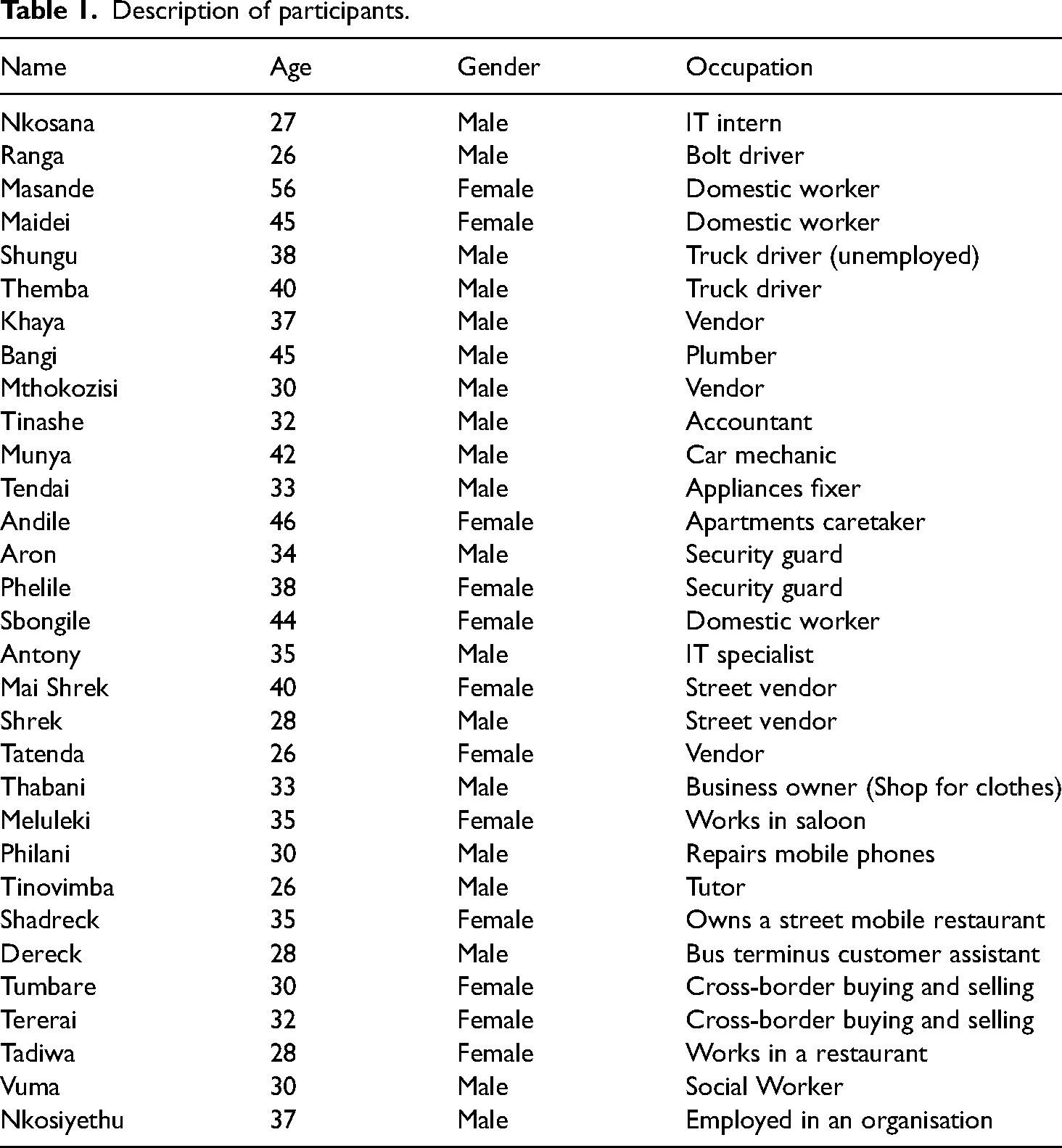
This longitudinal qualitative study used semi-structured interviews to capture participants’ reactions upon the upheavals associated with the announcement of the termination of ZEP. The study continued to track the development of participants’ resilience over time using two sets of interviews (set 1: October-November 2020, and set 2: August-October 2022). The researcher continued to observe participants for a period of nearly 12 months after the last interviews. A longitudinal study was essential for capturing different stages of resilience building over time. The study adopted purposive and snowball sampling techniques to recruit a total of 36 participants (Table 1).
Description of participants.
The study was conducted in Gauteng province's two cities: Johannesburg and Pretoria. Participants who resided in Johannesburg were based in Soweto, the biggest Township 1 of the city, and different suburbs of the inner-city. The other participants were spread in different places within the Pretoria inner-city.
Interviews were conducted online using WhatsApp calls and texts, as well as direct phone calls. Considering that WhatsApp calls require data bundles, participants were provided with a 24-hour data voucher for the interviews. Unstructured observations were conducted through WhatsApp. Participants agreed to let the researcher stay in touch, viewing their WhatsApp Status updates for the purpose of data collection, and maintaining regular communication through text messages on the same mobile App. The researcher would ask about their wellbeing, what their plans where and have a casual conversation, to continue analysing their resilience.
Data was analysed thematically, concurrent with data collection, which allowed for a continuous improvement in probing, to enrich the collected data. Data analysis was guided by Braun and Clarke's (2022) six-phase thematic approach. This enabled the researcher sufficient time to; (a) familiarise with the data, (b) generate initial codes, (c) search for themes in the data, (d) review the themes, (e) define and name the themes, and (f) develop this article.
Out of all the participants, the data that was used in this article to represent all other participants’ narratives emerged from: Nkosana, Masande, Maidei, Shungu, Sbongile, and Phelile. Data from these participants appeared richer and gave a comprehensive narrative, as presented in the findings below.
Findings and discussion
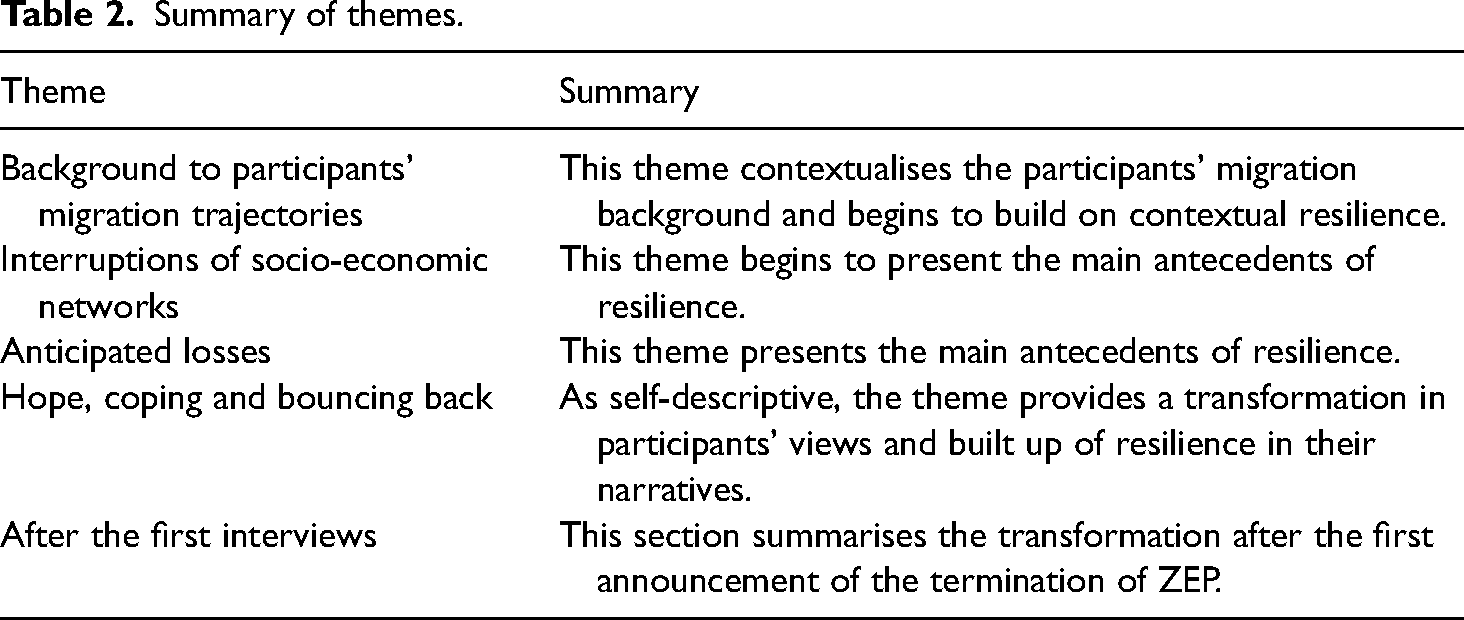
This section is presented in five themes that are summarised in Table 2.
Summary of themes.
Background to participants’ migration trajectories
Findings begin by revisiting participants’ migration trajectory prior to receiving the DZP in 2010. This sets the foundation for understanding their resilience amidst the upheavals of the termination of ZEP. It also provides a historical basis for their resilience. Starting with this theme is crucial, because resilience, as noted by Gillespie et al. (2007), is influenced by contextual and temporal variables, which will be further explored in this theme. As highlighted in Crush et al. (2015), Zimbabweans have been migrating to SA for several years, for various purposes, including work, studying, and for leisure. Most of cross-border movement was facilitated by the visitors’ visa, study visa, and work visa, all of which are still in effect. Nkosana emphasised the existing visitor's visa arrangement, which extends across the Southern African Development Community (SADC) countries by saying: ’Okay so in 2009 I had visitor's visa… It was a 90 days visa, I had to come here and after 3 months I go back home and stay there for some time and then I come back. That's how I managed to be in SA’.
Nkosana's strategy involved regularly crossing the border between Zimbabwe and SA. Ideally, he spent three months in SA, returned to Zimbabwe, and then migrated again after a period. This would be considered documented migration. Another common documented migration among Zimbabwean migrants before the DZP was applying for asylum seeker documents, as described by Sbongile below: [initially used an asylum seeker] I didn’t want to be a border jumper, so I applied for; you remember the xenophobic attacks in 2008, were after that migrants were given asylum. So, I applied for asylum… I mean 2010 when I first arrived… I applied for an asylum, and I was given 6 months. So, in 2010 December I applied for the permit, and I had to surrender the asylum. So, I had it until 2014. (Sbongile) My first time in SA was in 2009. I stayed till 2010, then I heard that there are now permits which we should apply for. So, I applied for my permit, and I was given five years, so it expired in 2015. I had to renew my permit and we were given another five years, which was up to 2020, then it expired. Then 2021 we were told to be given the whole year; it is the same that I am still using by now. (Phelile)
In Maidei's case, since the introduction of the DZP, she avoided being undocumented during all the +/- 15 years and the challenges related to it. She ensured that she applied from the onset of the DZP and regularly renewed until her latest ZEP which was still valid by the time of the interview. Overall, the findings suggest that the participants had built their lives, and those of their families, around the dispensations offered by the South African government, as demonstrated later. Therefore, for most participants, the termination of the ZEP could be regarded as antecedents of resilience (Gillespie et al., 2007). They experienced a form of shock followed by feelings of stress, disappointment, and anger; associated with adversity or threat to their livelihoods.
The announcement stripped the participants of their privilege and their perceived right to renew their visa, and maintain their lives, studies, work or businesses in SA. This is seen in Maidei's narrative as she said, ‘I felt angry, I feel disappointed because we can no longer reapply. So, we were very disappointed about that’. Another participant reported that, ‘The feeling is just unsettling, the last reaction was just like aaah so what next’ (Nkosana). For Nkosana, the news was explicitly a threat, causing emotional distress and a sense of trauma, marking a significant antecedence. This distress was mostly associated with the termination of the ZEP, leaving many Zimbabweans, including those not covered by the dispensations, with desperation and confusion. It marked the beginning of disruptions to their everyday lives, as discussed further.
Interruptions of socio-economic networks
This and the following themes in this article present the main antecedents of resilience that emerged from the findings. As illustrated in these themes, the antecedents can be accounted for using Gillespie et al.'s (2007) suggestions. To illustrate these antecedents, the article provides necessary participants’ contextual factors, an approach advised when attempting to study resilience (Gillespie et al., 2007; Ungar, 2013). Many participants in this study were in SA to work and provide for their own and their families’ livelihoods. For instance, Masande, who was elderly, had resided in SA for over 15 years. Her initial move was prompted by the 2008 global economic downturn, which, in Zimbabwe, coincided with heightened political instability. In this context, Masande felt it necessary to be cautious, spending less on rentals and other essentials while living alone in SA, as she explained: ‘I stay alone. I do not have a family this side, they are all in Zimbabwe, as you can see that in Zimbabwe things are tough so it's better for some of the family members to look for greener pastures somewhere as I did. I work as a domestic worker especially when you don’t have a right permit [work permit] you just work any type of job. I have to do it’.
Although, Masande could have used her ZEP to work in any job, she seemed unaware of this. As a domestic worker in SA, she earned less than R10,000 (+/-USD500). Despite this, Masande, a mother and grandmother, initially demonstrated her resilience by leaving Zimbabwe due to inadequate income. Later, she demonstrated resilience through self-efficacy, and then hope (Bandura, 1977). Masande's self-efficacy was evident when she recognised the importance of securing her children's future, drawn from her own experiences. She understood the necessity of improving her family's life. Consequently, she dedicated a significant portion of her salary in SA for her family in Zimbabwe. Hence, in SA she minimised expenses on rent and personal upkeep. She felt compelled to make sacrifices to safeguard her family in Zimbabwe. She further explained, ‘You know as Africans we got extended families [people that are dependent on her]. People that I am supporting are six not counting the extended ones’.
More of Masande's self-efficacy was evident through her critical thinking and planning (Bandura, 1977). Masande was motivated to provide for her family by the need to secure a future for her younger generation; despite knowing she might not witness it as she aged. This commitment represented a major sacrifice that she undertook. She also sacrificed by being in SA in the key periods of her children's development. Hence, she could not be present to celebrate their academic achievements, yet she continued to financially support them. Furthermore, she spoke proudly of her children's accomplishments: I had a child who was in form 6 and I was working that side in the ministry of health. So, when things where no longer working out, and with a child at school it was really hard. My only aim was to upgrade those children whom I left behind. Yes, they did (finished ‘A’ Level), they even did courses. I have another one who did civil engineering at NUST,
2
and it was costly. (Masande) He (child) is back home; he stays with my younger sister. I am the one who takes care of him, his father stays in Zimbabwe. We regard that as a separation. I haven’t heard anything about him doing something for the child, for now it's me the father and the mother. (Maidei)
Migration created families, for some participants, and the dispensation permits in SA maintained these bonds. Shungu, had several opportunities to learn resilience, which latter proved valuable during the upheavals. He was born Malawian, migrated to Zimbabwe with his family, who then built a home there, in Kambuzuma, 3 as he explained, ‘We [him and his wife] came [to SA] separately. The reason I am laughing is that we found each other here, the funny thing is we all come from Kambuzuma and yet we have never met in Kambuzuma’ (Shungu). Although they never met in Kambuzuma, a social bond was created with his wife based on familiarity, both having migrated from the same community in Zimbabwe, and meeting in the same South African community.
Shungu built his resilience while living in SA, within his community, facing numerous challenges, guided by the belief that he was sent by God. He was highly spiritual; hence he said he had a spiritual calling which connected him to the community. He believed; the community had several problems that he was sent to address, he explained: [started living in the same place until now] … I am still here in Pretoria I haven’t moved… I think the place loves me. I think God sent me to be in this place for a reason because I tried especially where I stay there are drug addicts, it is a den of drugs. I tried to move but I failed, later on I realised that God has his own reasons for me to be there because now there are a lot of people who are trying to repent. So, I am gaining a lot of respect through that. (Shungu) I got lots of friends even because I am not like those prophets, I am not a prophet. But at the end of the day people call me pastor. I have got a lot of friends who are not church goers, some of them are even sangomas
4
and the likes because I am friendly, the one that sold me a stand is a sangoma but he loves me a lot. (Shungu) …now I was just basing on this other offer I was promised next month. You know where I was working, they had contracts with Ford, so they were just telling me that since they are comfortable with me using an asylum. Now the challenge that they are having even with the guy I was working with is they does not have trucks but it's a logistic company. They don’t want to have trucks simply because they are contracted to other companies. So, they are afraid that the contract will get expired whilst they are paying for the trucks, and it will be difficult to finish. So, they are just looking for someone who can hire them so that's when they can employ me. (Shungu) God works in mysterious ways Mr Mbeve. So, it was him and my other cousin in Johannesburg. The church people I was the one who was helping them, just imagine a couple of weeks ago this other lady from church she is the one who paid my license disc, she gave me 400 rand (+/-USD20). (Shungu)
Anticipated losses
The upheaval concerning the termination of ZEP yielded antecedents of resilience as participants had several concerns on what they were likely to lose. This included a disruption in family structures, or a distorted living. For example, Shungu had an international family, he also did not have a visa, their children were born and raised in SA, although by documentation they were Zimbabwean, this is what he said about his family: …remember I am with my family and my son. We can’t tell my son is Zimbabwean because he was born in SA, what will he do. That's the problem we are having right now and with the properties (they bought a piece of land in SA as a family) we have, right now I stopped building because if I build what I am going to do when the ZEP expires because obviously my wife won’t have a permit, which means she is going to leave. So, it will be tough for me even if I remain behind with these children. (Shungu) Yes, it did affect me a lot… because I wasn’t expecting that… I had planned that maybe if they extend it, I might save this year and maybe next year I may return back home for good. Yes, my child
5
(I wanted to save first), you know so I can get a starting point and not be a burden. (Masande) I can’t fight the system alone that is the problem. You know in every way in life to disturb or distract someone from a certain culture like they did with us. The just distracted us using divide and rule. (Shungu) …sometimes we make plans but God has the decision. Right now, we don’t have a future, we thought that the future was to be here, build a house here and he goes to school like any other normal children, but now honestly speaking the future is uncertain for us. (Shungu)
Hope, coping and bouncing back
During the first interviews, participants expressed feelings of disappointment, confusion and hopelessness. Despite the daunting challenges they faced, including fear of deportation or xenophobic attacks, they exhibited early signs of adaptation and coping with their new circumstances (Gillespie et al., 2007). They had already began making plans for the next few months or years. Nkosana explored his position and assessed what he could do with his skills, as an information technology graduate. He noted that he had critical skills, to apply for a visa. Therefore, he proactively applied for a critical skills visa and was actively exploring possible ways to ensure its approval: In my case it's the critical skills permit, I will try to get a PR also because I studied here, I worked here, so I think PR you should have been here for 5 years and working. So, I think if I get it, I will have to work around it. (Nkosana) Things are tight, I am no longer seeing a future for me here in SA. I have to go back home unless if it happens that I get one, it would be nice because I won’t have challenges of being given few days at the border when visiting. (Masande) You know I was planning to go to United Kingdom… If I go to Zimbabwe, I am going to look for my certificate which I did nurse aid. If I find my certificate, I will apply to go to UK… That's what I am planning to. If I find money to go and write my English, I am going. (Maidei)
After the first interviews
After the initial round of interviews and a series of court hearings, the South African court ruled that the termination of ZEP was to be postponed because it was deemed premature. This development, as reflected by the participants in the second round of the interviews, gave them renewed hope and a chance to work towards new visas or sustainable plans to relocate elsewhere. They attributed this turn of events to divine intervention, as they all implied in the first interviews that, ‘God shall provide’.
Limitations of the study
This study's limitations include that researching resilience is complex and can be wider than the current scope. The study's sample could be larger, although a longitudinal approach helped to ensure an in-depth focus on the current sample. The study also has a specific geographic and sample focus of only one nationality, with unique circumstances, affecting the generalisability of the findings. However, the study makes important strides in understanding resilience among the migrant clients for social workers.
Conclusion
This article aimed to explore the resilience of Zimbabwean participants affected by the termination of ZEP, shedding light on their experiences for social workers. The study was conducted amidst the upheavals following the announcement and subsequent court cases that postponed the termination until November 2025. The study bravely applied the theory of resilience, despite its critiques for potentially lacking empathy on the migrants and blaming the victim rather than addressing systemic issues causing adversities on migrants’ lives. This study seeks to invite careful yet critical examination of migrants’ resilience through a strength-based perspective. This approach aims to humanise individuals by acknowledging their agency in shaping their own psychological outcomes amid adversities. By employing this approach, social work clients, including migrants, can perceive themselves as capable of managing their own emotional wellbeing and develop resilience to navigate challenges as diasporans. This approach is necessary, given the ongoing growth of diaspora communities globally, which is integral to socioeconomic development.
Footnotes
Ethical Approval
Ethical approval for this project was given by the University of the Witwatersrand's Human Ethics Committee.
Funding
The author received no financial support for the research, authorship and/or publication of this article.
Declarations of Conflict of Interests
The Author declares that there is no conflict of interest.
Acknowledgements
The author would like to appreciate Sheron Lunga for the language editing of this article. The author wants to also acknowledge the participants for taking their time from busy schedules to talk to him, especially at a time that was difficult for them.
