



Abstract
Summary
Social workers, alongside many professionals in “caring” domains, often feel they are poorly represented in television dramas. This study draws on a 172-million-word database to consider how social workers and seven other professional groups (cop, doctor, nanny, nurse, priest, teacher, and therapist) are portrayed in English-medium TV programs in the period 2010–2017. IMDb plot summaries are analyzed, and 200 examples per profession (n = 1,600) are classified as negative, positive, or neutral. Employing the methodology of corpus linguistics, the study contrasts with previous research as the focus is on the language surrounding mentions of professionals rather than on visual depictions or characters’ actions.
Findings
The study evidences the prevalence of negative societal discourses around social workers as either judgmental bureaucrats or uncaring “childcatchers,” contextualizing the findings through comparison with other professionals. The analysis also suggests that social work characters on TV—in common with those from other female-dominated professions such as nanny or nurse—are frequently referred to in terms of their sexual availability or physical appearance.
Applications
Findings will have practical relevance for those interested in the recruitment, job satisfaction, and retention of practitioners, and in reducing the stigmatization of social workers and their clients. The innovative methodology employed in the study offers particular insights for social work researchers and also scriptwriters. The study evidences the ongoing need to support media professionals and the general public to better understand the challenges facing the profession and thereby reduce the tendency toward a culture of blaming individuals for society's failings.
Introduction
A common complaint among social workers is that the profession is frequently maligned in the media (Legood et al., 2016). Research studies have indicated that both press and entertainment media consistently portray the profession negatively, particularly in child protection cases (e.g., Leedham, 2021; Frontline, 2022; Reid & Misener, 2001; Zugazaga et al., 2006). Studies of social workers in both film and television have so far focused largely on the visual portrayal of individual characters in terms of their personal appearance and their actions (Hughes & Houston, 2019; Warner, 2014). In contrast, the study described in this article is concerned with the language surrounding social worker, whether this features in a TV program including social work characters or is a passing mention. The study builds on previous work on the portrayal of social workers in UK press articles (Leedham, 2021), turning the focus to television as an important form of entertainment media, while acknowledging that viewing of this more traditional medium is declining among younger people due to the increasing popularity of social media and gaming (e.g., Twenge et al., 2019). In order to situate social work as one of many public service professions, the scope is extended to consider seven other professions: cop, doctor, nanny, nurse, priest, teacher, and therapist (note the choice of cop rather than police officer as the latter had few hits).
A large collection of English-medium television dialogues (from here on “transcripts”) is examined; these are drawn from The TV Corpus (Davies, 2019, 2021), which comprises transcripts from a broad array of informal TV dramas in English-speaking contexts. The dataset for the current study is a subset of The TV Corpus and comprises those programs which were first released between 2010 and 2017 (the collection ends in 2017); for the purposes of this study, this dataset is termed “The 2010s TV Corpus.”
The role of the media in the portrayal of social workers is of particular importance as most members of the public do not come into contact with social workers themselves, meaning that public attitudes are largely shaped by press and television representations. These discourses generally serve to both establish and reinforce current narratives: a report for the Professional Standards Authority (which performs a regulatory function within health and social care) concluded that the UK media give a “highly distorted picture” with positive stories “comparatively rare” (Penhale & Young, 2015, p. 172). Parton (2014, p. 2053) points to the increasing public anxiety around child protection and the consequent “anger and hostility projected onto social workers” with the media playing an important role. Social workers’ own self-esteem and pride in their profession are also impacted, affecting both recruitment and retention (Legood et al., 2016; Reid & Misener, 2001). The depiction of the social work profession is of particular significance to retention as, according to a Unison survey, 56% of UK social workers are considering leaving their role (Community Care, 2019; see also Ayakwah & Cooper, 2019) and the number of children and family social workers leaving was up by 16% in 2021 compared to 2020 (UK Government, 2022). Negative media representation (whether actual or perceived) may also further stigmatize individuals and families who require social worker support (or conversely a negative portrayal of social workers may lead to a view that clients are overly judged).
The potential impact of media portrayal on both the public's and social workers’ perceptions of the profession is ontologically related to the longstanding debate on whether the media reflects or constructs reality. For example, Branston and Stafford (2010, p. 106) discuss media representation of “reality” as “always a construction, a re-presentation, rather than a mirror”; in contrast, for Kellner (1995), the media predominantly reproduces existing social struggles, suggesting it is more reflective of a reality “out there.” More recently, Caple et al. (2020) discuss this issue in relation to news values, pointing to a combination of “top-down” and “bottom-up” aspects wherein texts both construe and are construed in the relationship between texts and culture. The study reported on in this article takes a social constructionist approach to knowledge creation, viewing the collective representations of professionals within television transcripts to be significant contributors in the shaping of contemporary discourses around what it means to be a social worker—and thus both reflecting and helping to shape perceptions surrounding social work.
A culture of blame: from press to television
The negative depiction of social workers in both press and entertainment media has been well documented across anglophone contexts (Penhale & Young, 2015, in the UK context; Pervan & Bove, 2015, in Australia; and Zugazaga et al., 2006, in the US). Such portrayal reinforces a “blame culture” (Munro, 2010, 2011, 2019) whereby a person or persons are held accountable when something goes wrong and social care is seen to have failed. Attention in the media is overwhelmingly on child protection cases: to the extent that analysis of news sharing on social media suggests affective and negative stories and those featuring children are more likely to be shared than are other types of stories (Bednarek, 2016). It is of course far easier to quantify failure in social work and success is largely unreported (Pritchard & Williams, 2010). Individual child protection workers (among other social care workers in Australia) are described in one study as “stigmatized service workers” in the media because they care for people who are perceived as “dirty” or “tainted” in the eyes of the public (Ashforth et al., 2007). In the UK, social workers are regularly demonized in the media when a child protection case goes wrong, for example, in the well-known case of Baby Peter Connelly (see Jones, 2014, for a comprehensive study of this case).
In the anglophone press, social workers tend to be depicted as either uncaring bureaucrats or as over-zealously removing children from their families (see summary of press studies in Leedham, 2021). Social workers themselves often have their personal lives held up to scrutiny, suggesting an underlying view that they should be held to a higher moral standard than other people (Leedham, 2021). While negativity is a widely recognized feature contributing to the newsworthiness of press stories in general (Caple et al., 2020), the intense negativity of the UK press toward social workers in particular led Parton (2014) to suggest that social workers have become the “cultural scapegoats” for society (p. 2049).
Entertainment media has a similar focus on individual culpability, though here the inclusion of a social worker appears to largely function as a plot device, serving to move the narrative along (Henderson & Franklin, 2007). The characterization of social workers is again largely negative (e.g., Henderson & Franklin, 2007; Valentine & Freeman, 2002). For example, Freeman and Valentine (2004) analyzed 44 movies from 1938 to 1998 featuring social workers, commenting: If people believe what they see in the movies, social workers are mostly women, mostly White, middle-class, heterosexual; they mostly work in child welfare, are likely to be incompetent, have a tendency to engage in sexual relationships with clients. (p. 159)
More recently, Edmondson and King (2016) examined four films featuring social workers, commenting on the “overly simplistic, hostile and negative impression of the profession” (p. 639), the dominance of child protection, and the “representation of social workers as ‘childcatchers’” (p. 647) (or sometimes “childsnatchers”). The term “childcatcher” originated in the 1968 movie Chitty Chitty Bang Bang in which a frightening figure drove around the fictitious Victorian London-style city “Vulgaria” and removed children from their families. Turning to television, the producers of a popular UK series “Kiri,” which centered around a social worker and a missing child, engaged a social work advisor and writer to increase the authenticity of the program (Dennis, 2018); however, views on the series from practising social workers were mixed (e.g., comments following an article by Mansuri, 2018). In the US, the social worker in “the Norm Show” (1999–2001) received a negative reception from social workers, though “Judging Amy” (2000) was viewed more positively (Tower, 2000). It is important to note here that the role of social workers has changed enormously in the decades since the profession was established, and continues to evolve differently across nations, meaning that individual programs may be more representative of one culture or time period than others. The current study focuses solely on anglophone television, while recognizing that similar findings have been revealed through studies in other contexts, for example, Kagan's (2016) work in Israel and Rek-Woźniak's (2021) study in Poland. Not all studies have been unrelentingly negative in their findings: Kwan and Cheung (2021) found that a Hong Kong TV series from the 1970s influenced a generation of social workers to join the profession.
A rare study comparing the portrayal of social workers with other professions was carried out by Henderson and Franklin (2007); indeed, their depiction of particular professions as “caring” forms the basis for the selection in the current study. Henderson and Franklin's focus was popular UK TV dramas comprising the soap operas Coronation Street, EastEnders, Emmerdale, and Hollyoaks; hospital drama Holby City, and police drama The Bill. A total of 249 episodes were analyzed with the aim of exploring the prevalence and portrayal of social workers and social care workers in fictional storylines (thus a slightly broader grouping than the current study). Henderson and Franklin found that a member of this group was depicted in 6.4% of the programs explored and compared with other “caring” professionals (e.g., police officer, nurse, GP, hospital doctor, teacher, clergy, and physiotherapist). The dominance of police officers (33.7% of episodes) and hospital professionals (nurse 8.4%, hospital doctor 6%) is unsurprising, given the inclusion of police and medical dramas in the sample, but it is interesting to note that 6% of the popular drama episodes viewed also featured a member of the clergy, and 4.8% featured teachers. Social work characters were mainly present in storylines featuring child protection and were not fully rounded characters, portrayed as “outsiders” rather than members of a local community. As such, they received limited characterization, being “introduced to the programme for a short time and then leaving when the storyline is resolved” (Henderson & Franklin, 2007; p. 147).
In general, however, there seem to be relatively few depictions of social workers in English language television programs, in comparison to the widespread coverage of police officers, doctors, and nurses. For example, a search on IMDb for TV series containing the tags “social worker” and “drama” revealed just 14 series, of which seven were aired more than 10 years ago and three are non-anglophone. Of the remaining four, only one series mentions a social work character in the plot summary and this is in the context of a “secret relationship” with a prisoner (IMDb search conducted on 11/07/23). While there are far fewer people employed as social workers than within law enforcement and healthcare (e.g., U.S. Labor Dept., 2023), it seems reasonable to surmise that the dearth of social workers on the screen means that when they do appear, viewers are likely to pay more attention and to internalize attitudes toward the characters, thus rendering these figures particularly important in shaping public perceptions (cf. Zugazaga et al., 2006, on media portrayals of social workers influencing public views). The lack of a drama featuring a social worker—whether as protagonist or as a regularly appearing character embedded within a series—means that social workers are only viewed from the outside, as seen by other characters. As viewers, we are not privy to the personal lives of social workers and they remain peripheral, undeveloped characters with a perfunctory purpose within plotlines.
Negativity in television dramas is perhaps inevitable since fiction is typically far more eventful than real life, featuring extreme characters and dramatic storylines. Such negativity is not limited to social workers; indeed, many professions feel they are poorly represented in television dramas. For example, Weaver et al. (2013) collected data from 484 nursing students in Australia, noting nurses are “often invisible on screen and when present, are represented by outdated and negative stereotypes” (p. 2642). Similarly, Miracle (2010, p. 156) raises the question: “Why are many current shows depicting nurses as handmaidens to physicians or sex objects?” Chatterjee (2020, p. 607) explored the idea of stigmatized professions being “those where physical, social, and/or moral taints are applied,” applying this theory to media coverage around policing in the United States, and concluding that the police are both “stigmatized” and “tainted” (cf. Ashforth et al., 2007, on stigmatized workers). It is of course likely that each professional grouping has a heightened awareness of media negativity toward them, and that this is not limited to caring professions or to the public sector.
The current study sets out to explore the depiction of social workers on anglophone television through analysis of transcripts of characters’ dialogues, and compares this portrayal with that of other caring professionals. Whereas previous studies of social workers in entertainment media have focused on visual portrayals, exploring characters’ appearance and actions, the current study looks solely at the language surrounding the search term social worker. The focus of the study is on how characters on TV talk about social workers and other professionals, aiming to explore widely held views rather than only marked or self-conscious wordings about particular individuals. The study aims to answer the following research questions:-
What are the proportions of positive, negative, and neutral mentions of social worker on TV? How does this portrayal differ from the language surrounding other caring professionals in the dataset? What is the nature of the negativity around the term social worker?
The next section describes the dataset used and the ways in which this is explored.
Data and methodology
This section describes the compilation of The TV corpus (Davies, 2019, 2021) and discusses the tools and procedures used in extracting and exploring the language surrounding the eight featured professional groups. The study employs the methodology of corpus linguistics; that is, it draws on an electronic collection of texts (a corpus), which is explored using computer software. Corpus linguistics allows quantitative techniques to be employed while also providing a “way in” to more detailed qualitative analysis and avoiding the danger of “cherry picking” interesting instances (Baker & Levon, 2015; see also Baker, 2023, for an accessible introduction to corpus linguistics). The focus here is on the portrayal of social workers and other caring professionals in general, rather than on particular cases or the profession overall: the combination of systematic computer searches with close reading of a selection of randomized instances of the search term and surrounding text enables detailed classifications to be made and has been widely used in recent years within applied linguistics (e.g., Leedham et al., 2020; studies in Taylor & Marchi, 2018). The combination of analysis of IMDb plot synopses and close analysis of corpus-extracted instances of the language surrounding mentions of each profession represents an innovative means of investigating how the professions are depicted on television.
The TV Corpus
The 2010s TV Corpus employed in this study is a 172.4-million-word collection of television transcripts taken from the 325-million-word TV Corpus (Davies, 2019, 2021), which itself is one corpus within the data collection “English Corpora” (searches were conducted in The Movie Corpus and The Soap Opera Corpus [US only] but far fewer occurrences of social worker were found than in The TV Corpus). The collection of TV transcripts in the corpus are dialogues from both terrestrial and (for the more recent decades) cable television channels, and thus provide an opportunity to focus on how social workers are portrayed in dialogue in comparison to other caring professionals (see Davies, 2021, for discussion of how the corpus was constructed). Ethical approval was not required as all program transcripts are available within the public domain.
The 2010s TV Corpus comprises scripted, informal language from programs first aired between 2010 and 2017 (the most recent part-decade for The TV Corpus) and as such is not naturally occurring language but is the largest existing collection of simulated dialogue. For social worker, this dataset thus excludes the recent UK series Kiri [2018] but includes Three Girls [2017]. It is important to bear in mind that the study entails searching for mentions of the professional title social worker within any program in the subcorpus rather than programs specifically about social work. Indeed, programs featuring an individual within a particular profession may seldom mention the job title once the character has been introduced.
In order to situate the occurrences of social worker in context, a further seven caring professions were selected. Initially, the full set of professions from Henderson and Franklin's (2007) study was considered. The final choice of professional labels was made according to whether a job title occurred sufficiently frequently in The TV corpus and across a range of countries and programs. For example, childminder rarely occurred outside the UK and was thus rejected in favor of nanny. Searching on types of therapists such as occupational therapist limited the numbers considerably so the more generic therapist was selected. Mentions of each caring professional in the corpus occur predominantly within dramas, some in children's programs and occasional mentions in documentaries (see example titles in Table 1). The resulting range of TV programs featuring each profession is broad, with a minimum of 116 and a maximum of 151 different TV programs, and no single program (and generally no individual episode) occurring more than 16 times for any profession (Table 1).
Range and examples of TV programs featuring eight caring professions.
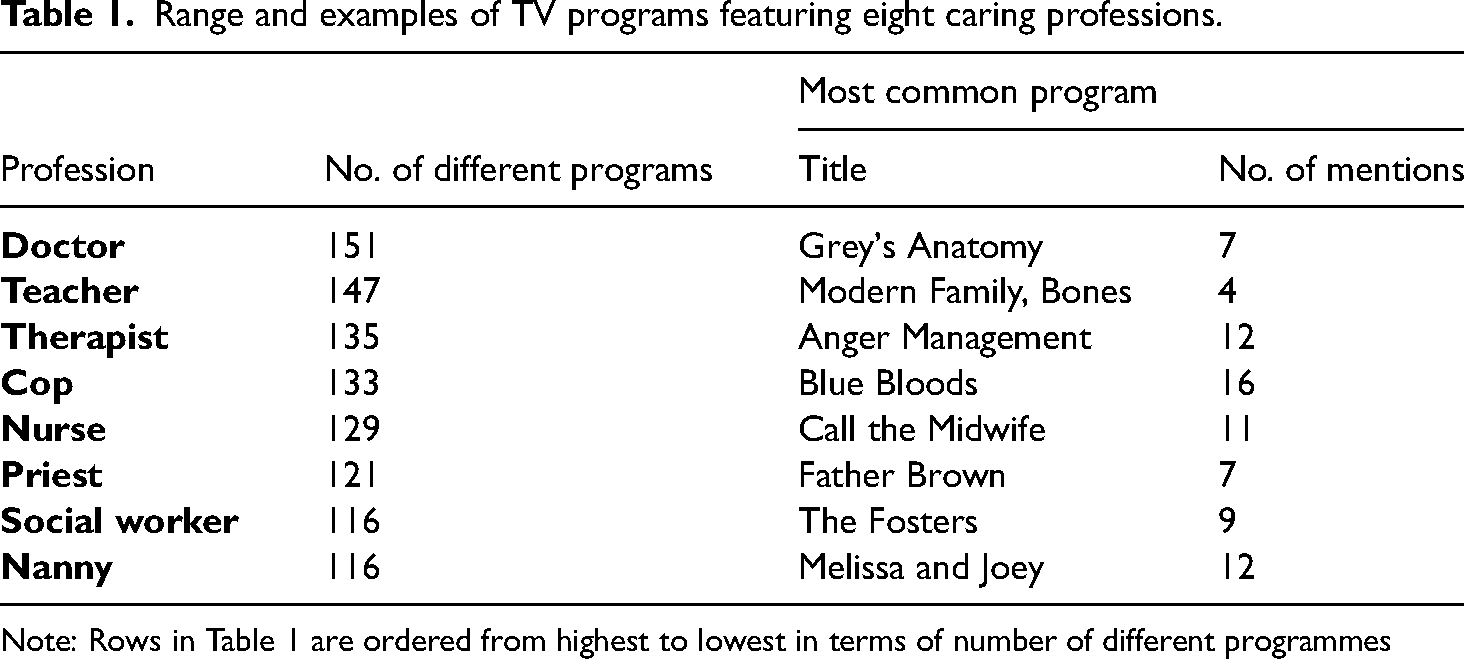
Note: Rows in Table 1 are ordered from highest to lowest in terms of number of different programmes
It is worth noting here that the range of shows depicting these characters are largely popular, mainstream dramas which seldom receive in-depth reviews in terms of their politics or levels of equality.
The following subsections detail the ways in which The TV Corpus was explored.
IMDb plot summaries
While the main part of the study concerns the language surrounding the job title social worker and those of the other seven caring professions, an overview of the ways in which these groups feature in TV programs was first sought through analysis of program plot summaries from 2010 to 2017 (the same time period as The 2010s TV Corpus). The English Corpora interface was used to access the Internet Movie DataBase (IMDb, https://www.imdb.com/) program plot synopses (Figure 1).
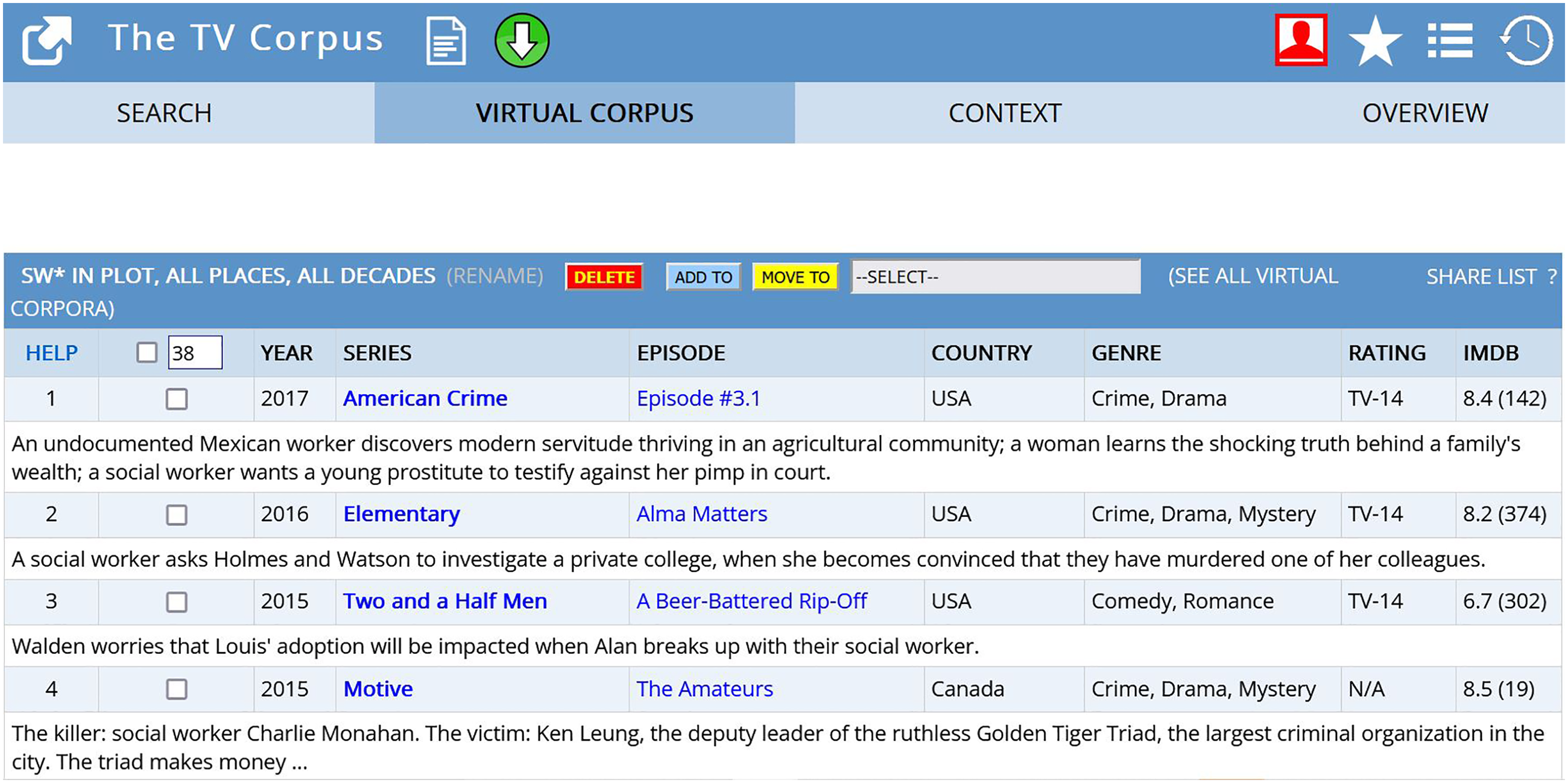
Social worker featuring in plot synopses in The TV Corpus.
To gain a sense of the overall database, mentions of each profession were extracted from IMDb plot summaries, and clicked through to read the plot description (see Figure 1 for initial short summaries though note that in all cases the fuller summary was used). These mentions of professions concern a character within an individual episode and illustrate the prevalence of characters important to episode plotlines. Each instance was first categorized as positive, negative, or neutral and further categorized according to its perceived function; instances were coded twice with a time interval of several months. For example, in Figure 1, number 4 was characterized as negative (“the killer: social worker”) and the remaining lines as neutral.
The main part of the study draws on the methodology of corpus linguistics and is outlined in the next section.
Searching and classifying
The procedure for finding occurrences of each profession within The 2010s TV Corpus was as follows. First, the search term (in each case the name of the profession) was entered into The TV Corpus database search facility, then filtered for the years 2010–2017 to find all mentions of the profession. The research thereby begins with all instances and uses a randomized set to select instances for further categorization, guarding against Tascón's (2018) claim that research into social workers on television seeks out TV programs which confirm the focus on child protection. Next, 200 randomized occurrences of the search term plus a small amount of surrounding text (“concordance lines”) were extracted and exported to Excel as this has greater functionality for sorting and categorizing. All concordance lines were manually classified independently by two raters (the author and a research assistant) using a five-point scale from highly positive to highly negative, with use of expanded context as required plus extensive discussion of conflicting categorizations. Further iterative passes through each dataset were made to ensure consistency of categories. The same process was conducted for each profession, resulting in a total of 1,600 concordance lines being classified by each rater.
Data lines from each randomized sample which did not concern a particular profession were excluded and replacement randomized lines were extracted. These excluded lines comprised program names (e.g., searches for doctor and nanny included Doctor Who, Nanny McPhee); titles or addressees (Nanny Smith, Nurse); references outside the profession (nanny meaning grandmother); profession name used as verb (nurse back to health, cop out); character profession given in transcript as stage direction (Priest: that explains why…); reference to non-person nouns (doctor's note, nurse's station); and fixed expressions (good cop, bad cop).
While the raters are not social workers, the author worked on the Writing in professional Social work Practice (WiSP) project (Lillis et al., 2019) and conducted interviews with and observations of social workers, and carried out extensive analysis of social workers’ writing (e.g., Lillis et al., 2017). At the time the study was conducted, the second rater was a doctoral student in psycholinguistics.
The next section recounts some of the issues raised in the coding process.
Difficulties in classification
The classification of each occurrence is a subjective process and this section discusses the inherent difficulties in coding concordance lines. Coding involved extensive discussion between raters around the rationale employed, and iterative re-reading of previously-coded lines in order to ensure the process was as consistent as possible. Differences in classification frequently resulted from raters focusing on varying aspects of a concordance line. Table 2 illustrates how the first rater read between the lines for this example whereas the second rater took a more literal meaning.
Example of differently coded line.
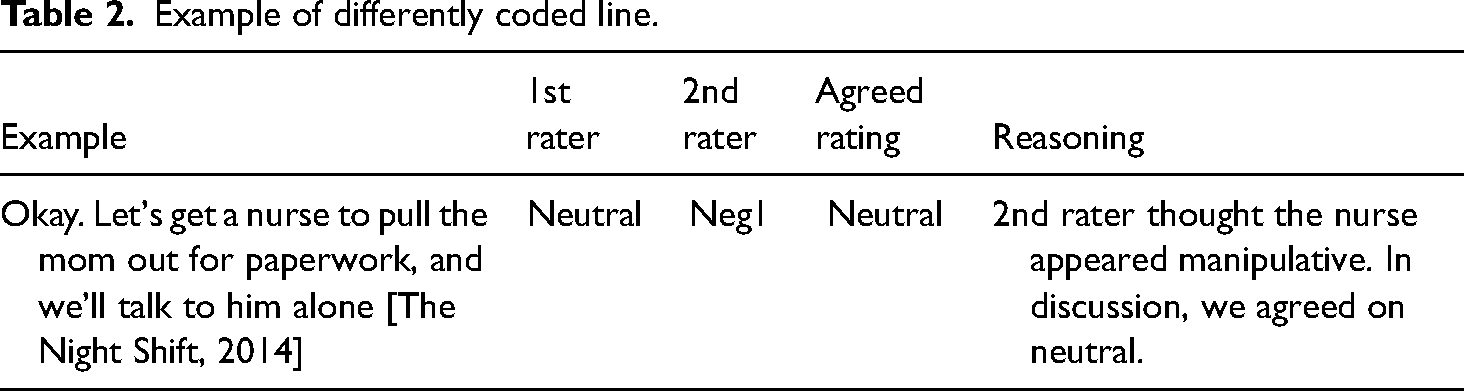
Note that in cases of disagreement, greater context was examined by double-clicking to obtain more data. Differences in coding were largely resolved from discussion; where agreement could not quickly be reached, it was difficult to avoid a tendency toward a “safer” neutral classification. A trial with Chat GPT3 (Open AI, 2023) was carried out on a sample of 20 concordance lines, but this did not give comparable results to those agreed by the two human raters, suggesting that artificial intelligence cannot yet cope with the inferences and contextual knowledge required to robustly classify the lines (Lei & Liu, 2021, report an accuracy range of between 65 and 90% in sentiment analysis studies).
The next section provides findings from the study.
Findings and discussion
This section first discusses the results from the analysis of plot summaries, before moving to the substantive part of the study: occurrences and functional categorization of the 1,600 extracted concordance lines.
Negativity surrounding social worker in plot summaries
The first stage of the investigation involved the exploration of IMDb plot summaries from The 2010s TV Corpus (see Data and Methodology for details of extraction and classification). This starkly reveals how seldom social work characters feature in TV programs: there were just 17 instances of social worker occurring in plot summaries compared to 392 mentions of doctor and 387 of cop (Figure 2, see raw counts below each bar). Social work characters are present for specific storylines within individual episodes of a series, whereas doctors, cops, and teachers have programs devoted to their professions (e.g., Grey's Anatomy, Law and Order, and Bad Education respectively), echoing Henderson and Franklin's (2007) claim that social work characters function as a plot device and are withdrawn once the storyline is resolved.
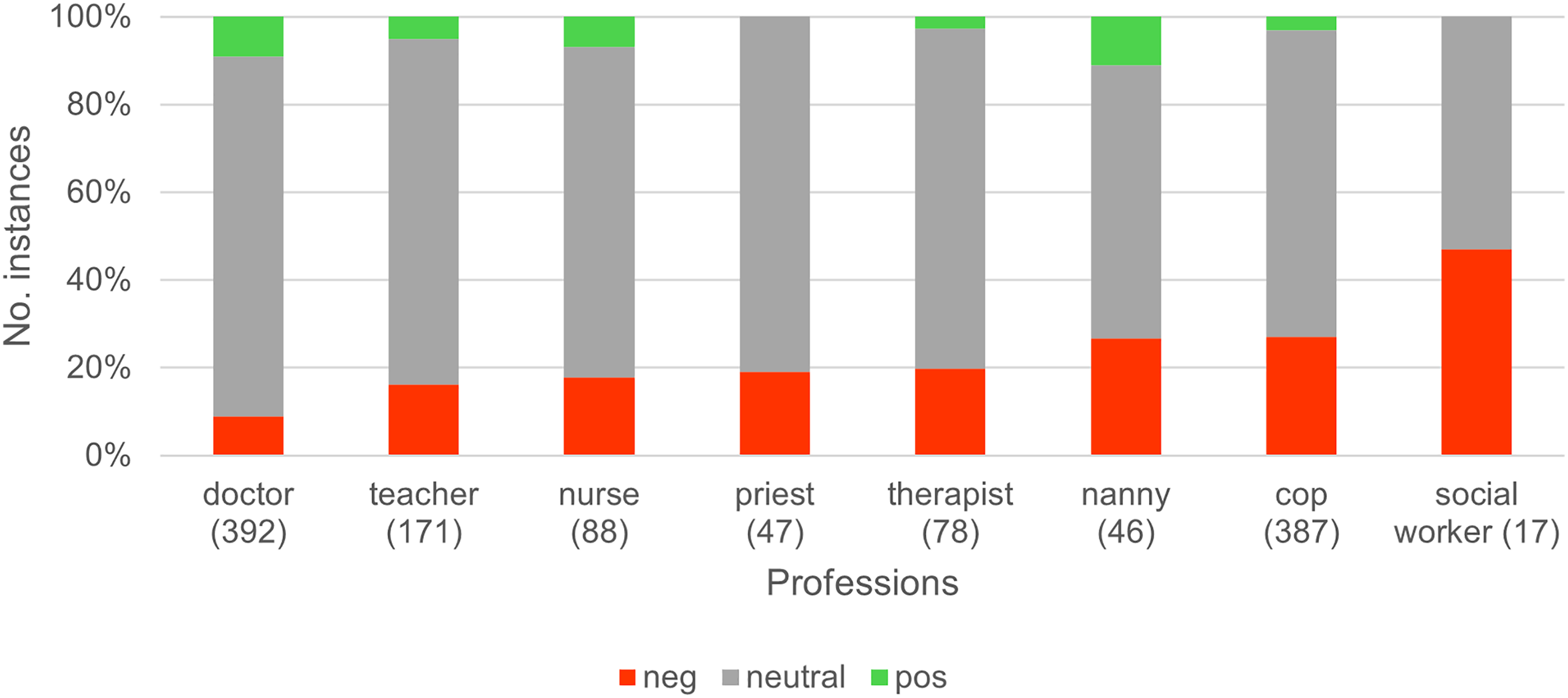
Classification of caring professions in IMDb plot summaries for The 2010s TV Corpus.
All instances of each profession within plot summaries were classified as negative, neutral, or positive, to a maximum of 100 per profession (thus for doctor, teacher and cop a randomized 100 instances were categorized); Figure 2 provides the proportion of negative instances as a percentage in ascending order from left to right. While the relatively low number of instances of social worker featuring in plot summaries should be borne in mind, the data suggests that these characters are by far the most likely to be negatively portrayed (8 out of the 17 raw instances are negative). Social workers featuring in TV programs were generally peripheral to the main character group and appear within an individual episode as a plot device—in only one case is a social work character named.
Notably, where the summary indicated a social care domain, this is always children's social work, reinforcing the perception that children's care—and in particular child protection—forms the entirety of social work practice. In general, social work as a profession appears to be highly misunderstood in terms of the function, scope, and diversity of the role (Beddoe, 2015; Dennis, 2018), and media portrayals of social workers solely within child protection—and often in a judgmental role—perpetuate such misunderstandings.
The classification of plot summaries for programs from 2010 to 2017 revealed zero instances of a social work character being mentioned in a positive way within a plot summary. Of the nine neutral occurrences, six depicted the social worker as simply carrying out their job (See Example 1 below) and two cases showed a social worker as a crime victim. Of the eight negative instances, four were mildly negative in their portrayal of a social worker sitting in judgment over a family, two showed the social worker in an inappropriate relationship (Example 2), in one case, the social worker was a killer (Example 3), and a further instance depicted a couple masquerading as social workers in order to abduct a child (echoing the widely held media view of social worker as “childcatcher”; e.g., Edmondson & King, 2016).
1) After the social worker signs off on them, a prospective birth mother visits Walden and Alan (Two and a Half Men, 2014). 2) A social worker assesses Tim's parenting skills, but she becomes a little too friendly (Spy, 2011). 3) The killer: social worker Charlie Monahan (Motive, 2015) After Lux and Bug are picked up by the police for a curfew violation, Lux's social worker decides it's time to meet with Cate and Baze to reevaluate their custody of Lux (Life Unexpected, 2010).
Often, there was a fine line between a categorization of neutrality, in which the social worker is simply getting on with their job, and a coding of slight negativity, in which the social worker is judging whether parents can keep their children. Example 4 was coded as neutral but it is clear the social worker's role is to “reevaluate” the adults’ capability to look after a child.
While the raw numbers for social worker are relatively low, the prevalence of negative portrayals and absence of any positive mentions starkly contrasts with the other professions featured in Figure 2. Examination of plot summaries from the entire TV Corpus from the 1950s to 2017 reveal that the time period covered by The 2010s TV Corpus is not an outlier in terms of either number of mentions or the level of negative categorizations. Plot summaries in the whole corpus contain just 38 mentions of social worker, contrasting with the hundreds of mentions of other caring professionals, for instance, doctor (1,412), cop (725), and teacher (386). Of these 38 mentions of social worker, 14 instances were negative and just three depicted social workers in a positive way as “caring,” “gentle,” or wanting to help.
Caring professionals in TV transcripts
The main study detailed in this article focuses on the language surrounding instances of each job title in The 2010s TV Corpus, with the primary focus on social worker (see Data and Methodology for the procedure followed). The bars in Figure 3 give the classifications for the 200 randomized instances from each of the eight professions, ordered left to right from least to most negatively classified concordance lines.
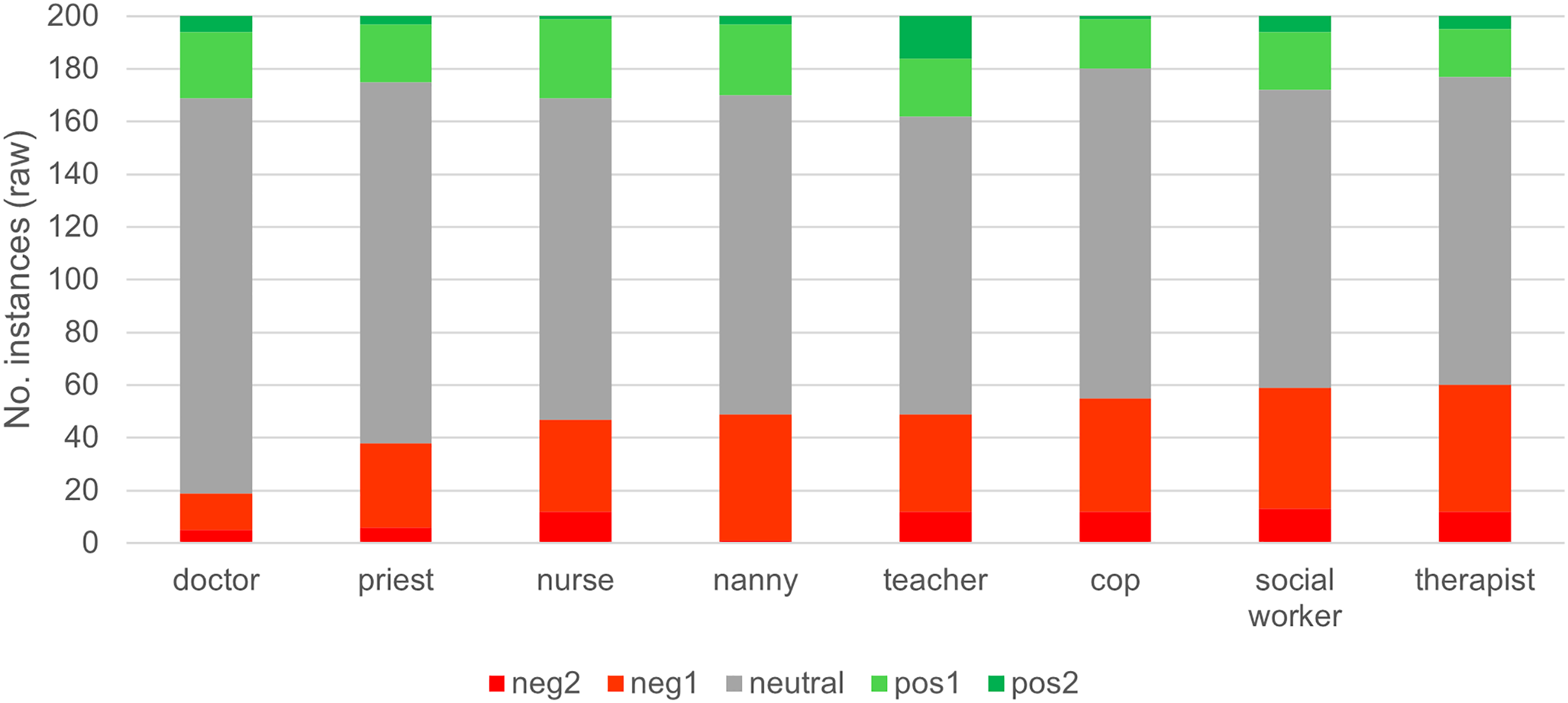
Negative, neutral, and positive mentions across eight caring professions.
The next subsection first provides commentary on noteworthy aspects of the overall data presented in Figure 3, before turning to a more detailed exploration of the categorizations for social worker.
Overall comments on the professions
Figure 3 reveals the profession of therapist to be the most negatively perceived profession of the eight (30% of instances or 60 of the 200 classified lines). The term therapist is a highly generic job title and is usually premodified with a category such as sex, massage, grief, speech. Much of the negativity around therapist relates to the sexualized nature of the references:
What's up, sexy lady? How you doin’? I am not a hooker. I’m a therapist (Necessary Roughness, 2011). You’re a therapist who has remarkably little insight into your own behavior (In Treatment, 2010).
It appears that the term sex therapist and innuendo around massage therapist color many of the more general mentions of therapist. Other negative comments cast aspersions on a therapist's professionalism:
The role of cop has the third highest number of negative categorizations at 27.5% (55 out of 200). Here it seems that the negativity is around the adjectives “dirty cop” or “bad cop” (excluding the phrase “good cop bad cop”) and features a rogue police officer. It is telling that negativity around (largely female) therapists concerns sexuality or lack of personal insight, whereas negative language toward (largely male) cops is restricted to their work behavior. The same patterning appears for doctor and nurse with women in each category often negatively described in terms of their appearance or sexual availability, whereas male doctors—where they are described negatively—are discussed in terms of a perceived lack of medical capabilities (male nurses are seldom mentioned); this resonates with Weaver et al.'s (2013) description of the outdated depictions of nurses on TV and Miracle's (2010, p. 165) claim that TV nurses are “sex objects.”
Also standing out in Figure 3 is the high number of positive classifications for teacher with 19% of lines (38 instances) given a positive rating, of which 8% (16 instances) are highly positive (the highest of any profession). Here, it seems that TV characters remember and praise teachers who have made an impact on them:
I made this place what it is and that's all down to my favorite teacher (Wolfblood, 2016). I want to be treated like an equal. Like a… like a teacher (Glee, 2013).
Characters also occasionally describe someone as a teacher in terms of the role they are performing rather than their profession:
A teacher is clearly regarded here as a positive role model and thus a job to aspire to.
The next two subsections focus on depictions of social workers.
Positive and neutral mentions of social worker
The majority of mentions of social worker, where a domain is given, concern child protection contexts, confirming findings by Henderson and Franklin's (2007) study of UK TV dramas and Edmondson and King's (2016) exploration of movies. As is the case with all eight professions, neutral mentions form the majority of occurrences (56.5%, or 113 out of the 200 lines). These include non-evaluative statements around a social worker carrying out their job (Example 9), mentions of social worker within an introduction (10), and instances of social worker as a crime victim (11).
What's your dad up to? He's with that social worker lady and the police (Remedy, 2014). I’m Jane Eason, the court-appointed social worker (Wentworth, 2015). October stabbed the social worker (Longmire, 2012). I’m not liking Mom's odds. I’m gonna call the social worker. Good thinking (The Night Shift, 2016). I’m no goon, Grimes. I’m a social worker (Ugly Americans, 2012). …you know, it inspired me to go to grad school, become a social worker. Right some wrongs, maybe (The Fosters, 2015).
Unlike the IMDb plot summaries from 2010 to 2017, occurrences of social worker in the transcripts contain some positive mentions: 14% of occurrences are positive and include descriptions of social workers as caring, helpful, and competent (Examples 12–13), and of social work as a “dream job” (14).
The “dream job” idea occurs across the caring professions, often highlighting the idea that caring is a vocation that some people are destined for.
Types of negativity around social worker
Almost 30% (59 out of 200) of instances of social worker in the extracted concordance lines were classified as negative (Figure 3), making this the most negatively-perceived profession after therapist. These 59 concordance lines were further categorized into nine distinct functional categories (with a few single instances placed together as “other”) (Figure 4).
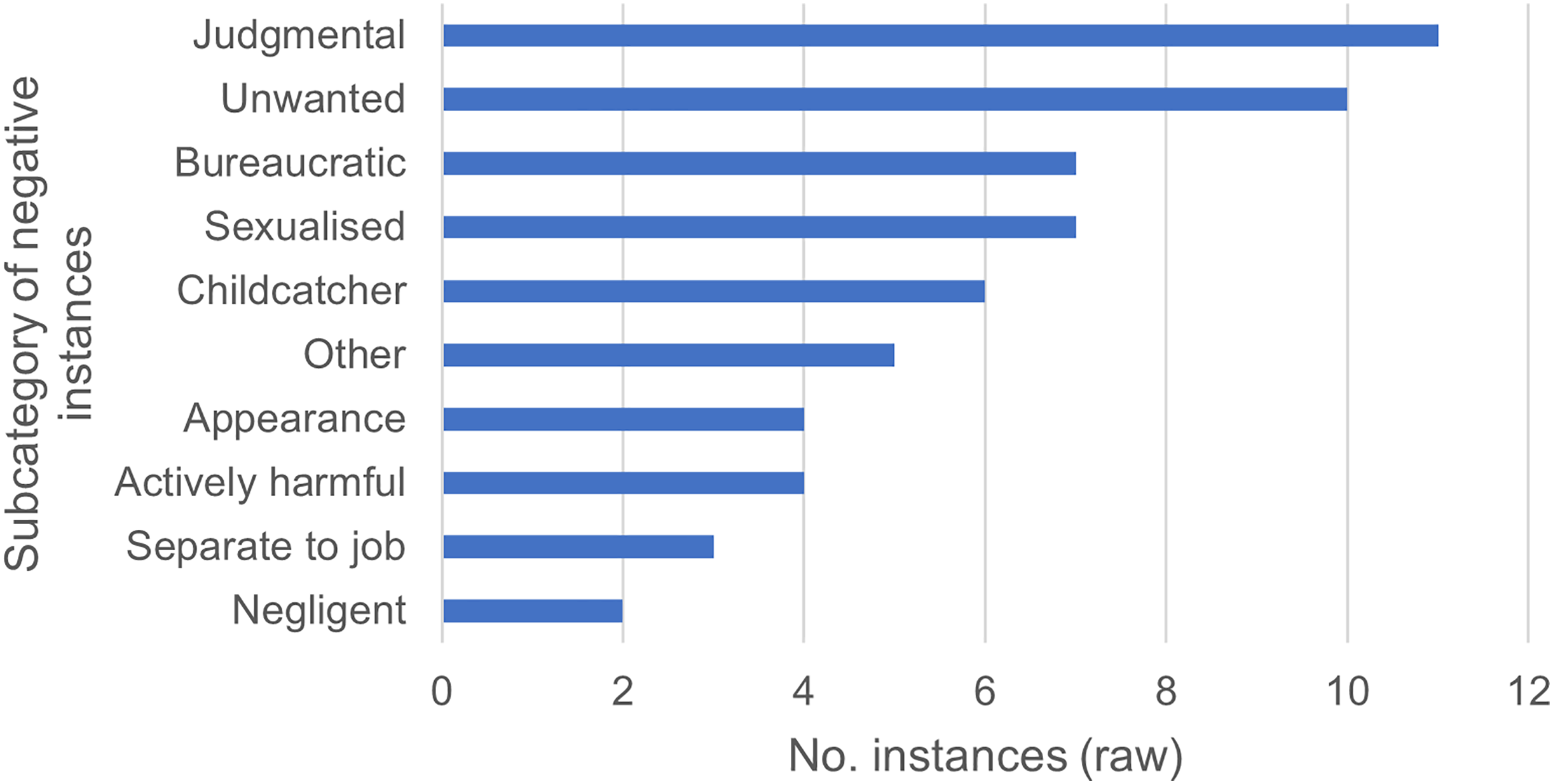
Functional categorization of negativity surrounding social worker.
Examples of each of the categories are shown in Table 3.
Examples of concordance lines for each negative category.
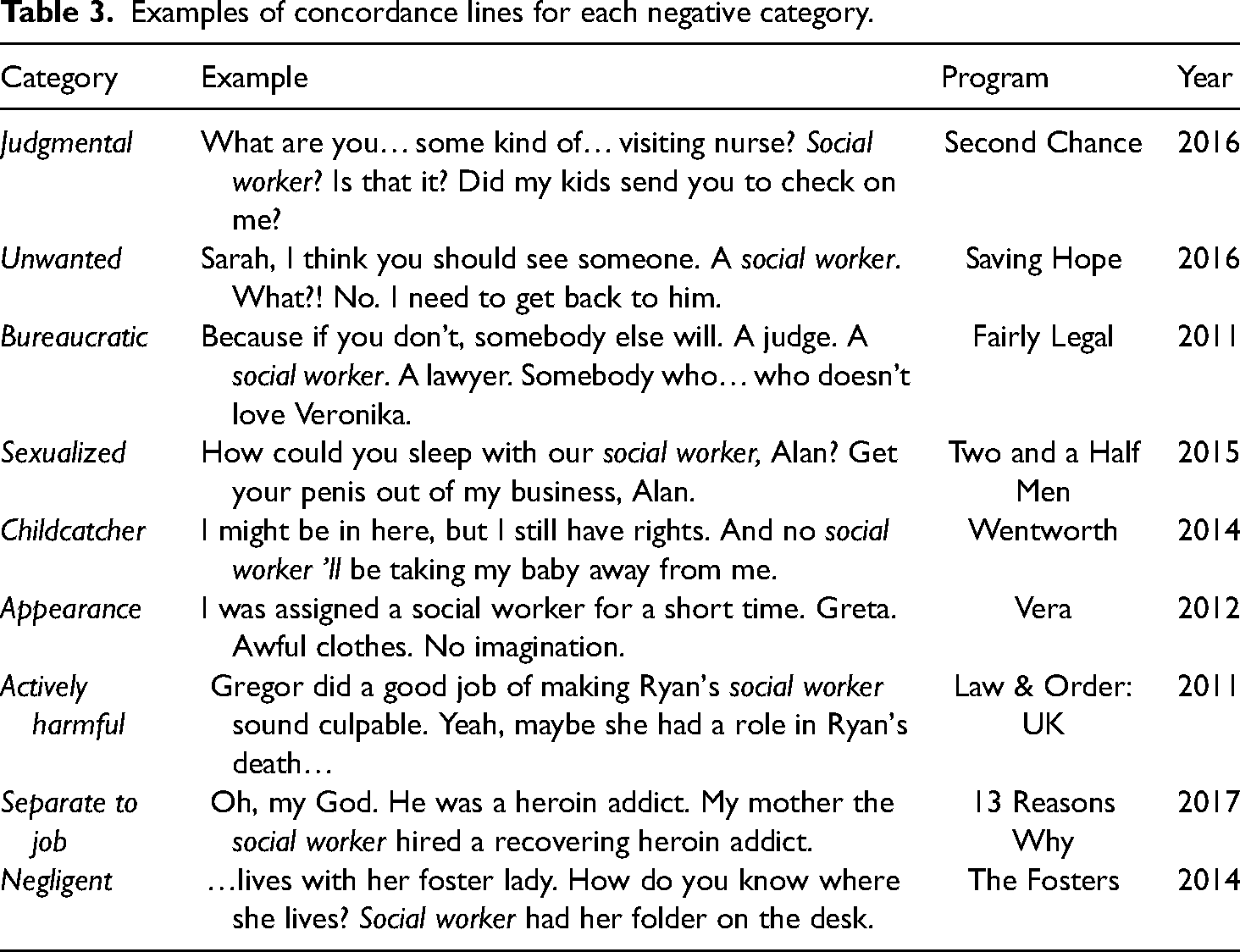
The most prevalent category in Figure 4 is “judgmental,” denoting instances where a social worker was perceived as unhelpfully watching over and evaluating a situation. Similarly, social workers are frequently unwanted and perceived as overly bureaucratic. Unlike a previous study of newspaper reporting around social workers (Leedham, 2021), descriptions of social workers removing children (“childcatchers,” cf. Edmondson & King, 2016) are higher than those commenting on perceived inaction (“negligent”), perhaps as TV shows rely on fast-paced action, are of course fictitious and allow for at least some happy endings, whereas newspaper reporting occurs after a death or case of abuse comes to light. The category “actively harmful” refers to the occurrence in TV programs of the social worker as murderer or abuser, and relates to characters brought in as a plot device. The “separate to job” category captures instances of a negative depiction of an individual where being a social worker appears secondary.
Finally, negative comments on social workers’ sexual availability and physical appearance include the casual assumption of a social worker “looking like” a lesbian and comments on who a character is sleeping with. In this respect, social workers—alongside women teachers, nannies, and nurses—appear to be viewed as female first and professional second (cf. Miracle, 2010; Weaver et al., 2013, on the representation of nurses on TV; Freeman & Valentine, 2004, on social work):
Or was it about him seducing the nanny? (Reign, 2015). If she was my social worker, I’d be calling her three times a night too (Law and Order, 2010). Cute doctor makes big splash on her first day (The Mindy Project, 2015).
Even when a profession is not dominated by women, references to female practitioners are frequently around their perceived attractiveness:
Such focus on physical appearance is almost exclusively around women, regardless of profession, and features the woman in the passive position of being talked about, rather than in an active role.
Limitations of the study
An important caveat in this research is that a small number of instances in the transcripts occur within historical dramas. The sentiment expressed in Example 18 is likely to strike a modern audience as perhaps amusingly old-fashioned (the series started in 2008 but is set in the late ninteenth and early twentieth centuries).
I’m very impressed. That a woman can be a doctor. That a doctor can be so beautiful (Murdoch Mysteries, 2011).
Depictions of midwives in “Call the Midwife” (beginning in the 1950s) and priests in “Father Brown” (1950s) are similarly historical, but were not considered further in the analysis.
While The TV Corpus provides a large set of informal, spoken data, no claim is made that the transcripts are fully reflective of contemporary discourse: TV is perhaps outdated in its portrayal of the female:male ratio of particular caring professions, and it may be the case that scriptwriters fall back on stereotyped language around such groupings (see Ward & Grower, 2020, for an overview of recent studies on gender role stereotyping in the media). A further limitation is the focus solely on verbal transcripts as this excludes characters’ intonation, facial expression, and gesture. Aspects of diversity such as ethnicity are similarly unavailable in a text-based analysis (excepting explicit mentions). A study focusing on such visual aspects, however, would be highly labor-intensive and could only deal with a restricted dataset. While use of the methodology of corpus linguistics in the study allows a large quantity of data to be searched, there may be a danger of failing to see the wider context as the dialogue lines are not read within the context of whole programs.
Also missing are the views of social workers themselves. While not including a specific question on the media, the WiSP project (Lillis et al., 2019) interviews with social workers (n = 71) include mentions of the media, many in the context of a fear of being named and shamed in high profile child protection cases.
Future research
A future study could counter some of the limitations described earlier, by including interviews with social workers and other professionals on how they are portrayed in the media (including television, press, and social media) and the impact they feel this has on recruitment and retention as well as overall morale. It would also be interesting to interview a range of people outside these professions and uncover their views on how particular groups are portrayed in TV dramas. In terms of corpus analysis, a division into country subcorpora would enable exploration of national differences; further coding could be carried out on the functions within positive and negative coding categories for other professions. The corpus could also be expanded to include programs beyond the anglophone world and thus have greater international reach with consideration of how media portrayal could impact service users (e.g., see Crist et al., 2013, describing a healthcare intervention using the widely popular Brazilian telenovela). Study of how the professions are portrayed on social media would also be a fruitful way forward, and could yield interesting comparisons. The methodological approach of analysis of plot summaries—to gain a broader picture of the prominence of social workers or other professionals—in combination with in-depth linguistic analysis of occurrences of each profession in transcripts contrasts with the usual methods employed to study television and could be extended beyond this subject area.
Conclusion
In this article, analysis of plot summaries revealed few mentions of social workers, suggesting the characters are brought in for single episodes to move the narrative along, and are mainly present in child protection cases. Findings in response to Research Question 1 on the proportions of positive, negative, and neutral mentions of social worker on TV confirm those of previous studies in revealing high levels of negativity around the depiction of social workers in the media. The inclusion of other caring professionals (RQ2) puts this into a broader context and uncovers particular types of negativity around female professionals. Exploration of concordance lines from TV transcripts featuring social worker indicates a frequently negative portrayal as either judgmental bureaucrats who intrude in people's lives, or as uncaring “childcatchers” (RQ3 on the nature of the negativity). The negative instances suggest that social work characters on TV—in common with those from other female-dominated professions such as nanny and nurse—are frequently referred to in terms of their sexual availability or physical appearance. The comparison across the eight caring professions revealed that other professions are also portrayed negatively more often than positively. This study both confirms the findings of Henderson and Franklin (2007) and extends these through the study's innovative methodology entailing a combination of analysis of plot synopses and a focus on the language surrounding each profession in TV dialogues.
The study furthers understanding of the ways in which social workers and other professionals are portrayed in television dramas, with practical insights for those interested in the recruitment, job satisfaction, and retention of practitioners and in reducing the stigmatization of such professionals and their clients. Negative portrayals of professionals in television dramas is likely to impact public perceptions, affecting recruitment, retainment, and the public's desire to interact with professionals; this is particularly the case for social workers as few members of the public have interactions with this group, meaning the press and entertainment media are many people's sole source of information (cf. Legood et al., 2016). The study's focus on exploring the extent to which TV depictions of social workers are negative, and analyzing the form this negativity takes, has the potential to support script writers and the general public to better understand the challenges facing the profession and thereby reduce the tendency toward a culture of blaming individuals for society's failings (e.g., Munro, 2010). A way forward would be to have closer collaboration between professionals and scriptwriters in order to reduce the “childcatcher” image and broaden the domains of social work depicted, and to raise awareness of stereotyping in the portrayal of social workers. An inspiring new initiative countering the widespread negative portrayal of social workers is the recently launched media award for positive representations of social work (BASW, 2023). This is turn builds on the recently launched recommendations for press and entertainment media (BASW, 2022). This study provides the theoretical grounding for such work to take place.
Footnotes
Ethical approval
Ethical approval was not required for this project as all program transcripts are available within the public domain.
Funding
The author disclosed receipt of the following financial support for the research, authorship, and/or publication of this article: I am grateful for funding from The Open University to complete this project. A (related) previous project on Writing in professional Social work Practice (WiSP) was funded by the Economic and Social Research Council (grant number ES/M008703/1).
Declarations of conflict of interests
The author declares that there is no conflict of interest.
Acknowledgements
This article has benefited from comments received on an earlier draft from my colleagues Dr. Gillian Ferguson, Dr. Lucy Henning, and Dr. Jackie Tuck, in addition to the feedback from the editor and three reviewers. I am grateful to Dr. Ernesto Roque-Gutierrez for his assistance in coding the data. The article draws on knowledge gained from the WiSP (Writing in professional Social work Practice) project. The research was carried out by Theresa Lillis (PI), Maria Leedham (Co-I), and Alison Twiner (Research Associate). We would like to thank the participating local authorities and the social workers who so generously took part in the WiSP project but who have to remain anonymous for confidentiality reasons.
