



Abstract
Summary
Social work practice has a history of collegial, intra-, and interprofessional discussions that take place backstage, that is, without the presence of clients. Because of their backstage character, these discussions may be considered even more important to examine than meetings at which clients are present and that are in a way already open to the public. The purpose of the present review was to provide insight into this practice by identifying and synthesizing recent empirical findings from existing studies using naturalistic data, published in English in peer-reviewed journals.
Findings
We identified four types of interaction among practitioners in relation to the case discussed and three types of content that were raised and shared, as well as an apparent mismatch between formal reasons for the discussions and the purpose they serve in practice. A lack of common vocabulary for conceptualizing the discussions and of attention given to their backstage character was identified in the included studies.
Applications
The review highlights an important area for further research and stresses the importance of not being blinded by formal purposes or ideological underpinnings in examining intra- and interprofessional discussions in social work; it shows that it is important to look into what is actually going on in practice.
Introduction
Social work practice has a history of collegial intra- and interprofessional discussions that take place without the presence of clients. For that reason, these discussions may be considered even more important to generate knowledge on than meetings at which clients are present and that are in this respect already open to the public. The purpose of the present review was to gain exploratory insight into the type of discussions we have chosen to call “backstage discussions in social work.” Goffman (1963) concept of backstage implies that the discussions in focus take place metaphorically, away from an audience consisting of clients or significant others (Ellingson, 2005; Lewin & Reeves, 2011). According to Goffman's (1963) conceptualizations, front-stage actions are those that are performed on stage, visible to the audience in question. Backstage actions occur when the audience is not around when the actors can relax and prepare for their next—frontstage—performance. Thus, according to Goffman's dramaturgical perspective, back- and frontstage are not tied to certain physical places or settings but relate to “the function that the place happens to serve at that time for the given performance” (p. 129). The concepts of front- versus backstage imply that we have two different modes of presenting ourselves: one when we are “on” for others, responding to standards and expectations regarding social performance (frontstage), and another when we let down our guard among fellow team members, separate from the audience (backstage). Consequently, conceptualizing the professional interactions in focus in the review as backstage discussions not only implies that these interactions take place away from clients but also suggests that professionals may interact in a different, more relaxed, manner than in meetings involving clients or patients. As Hughes (1984, p. 289 cited in Riemann, 2005) pointed out, behind the back of clients all professionals say things they would never have uttered if the person had been present.
Models, such as “group supervision,” that provides guidance for how social work practitioners “should communicate about their work, so as to become ‘more efficient’ and make better use of their ‘team’”(Riemann, 2005, p. 414) are receiving increasing scholarly attention. Another trend concerning collegial practices in social work is a growing interest in interprofessional teamwork (de Saxe Zerden et al., 2021). However, apart from a focus on discussions involving social workers, taking place without the presence of clients, the present review began by putting preconceived notions aside concerning the potential differences between discussions adhering to different models of teamwork (or no models at all). The exploratory approach was justified by the idea that if we want social work practice to change or improve, we first need to gain insight into its actual content(s), that is, what practitioners do in different working contexts and how they interact (Hall & White, 2005; Riemann, 2005). Our point of departure was that research “looking into professional practice” (Hall & White, 2005, p. 379), using naturalistic data in an attempt to grasp discussions and interactions as they happen in situ, is particularly relevant for this purpose. Naturalistic data are naturalistic in the sense that they include speech that would have taken place regardless of whether it was the subject of research or not (Potter & Shaw, 2018). Common in this area of social work research is discourse, narrative and ethnographic approaches using video- and/or audio-recordings and observations to gather data (Österholm & Taghizadeh Larsson, 2018). One advantage noted by Hall and White (2005) is that such work often signals solidarity with practitioners and does not undermine professional practice, while at the same time having the potential to assist in critical reflections on everyday work and routines.
Consequently, the aim of the review was to identify and synthesize recent empirical findings on backstage discussions in social work, based on existing studies looking into professional practice using naturalistic data. We were interested not only in what these studies convey about the interaction during the discussions and about their content but also about other important aspects that may emerge while reviewing and synthesizing the research.
Materials and methods
In conducting the synthesis presented in this paper, we sought to adopt a systematic, transparent and consistent process to identify and integrate findings from relevant empirical studies. Therefore, based on existing guidelines for qualitative synthesis (Saini & Shlonsky, 2012, p. 10), this section of the paper, together with the tables and figure referred to, includes: (a) the search strategy (e.g., search terms, criteria for inclusion and exclusion of studies); (b) the characteristics of included studies (e.g., methods used for data collection and analysis) (Table 1); and (c) a description of the final data analysis.
Presentation of included studies.
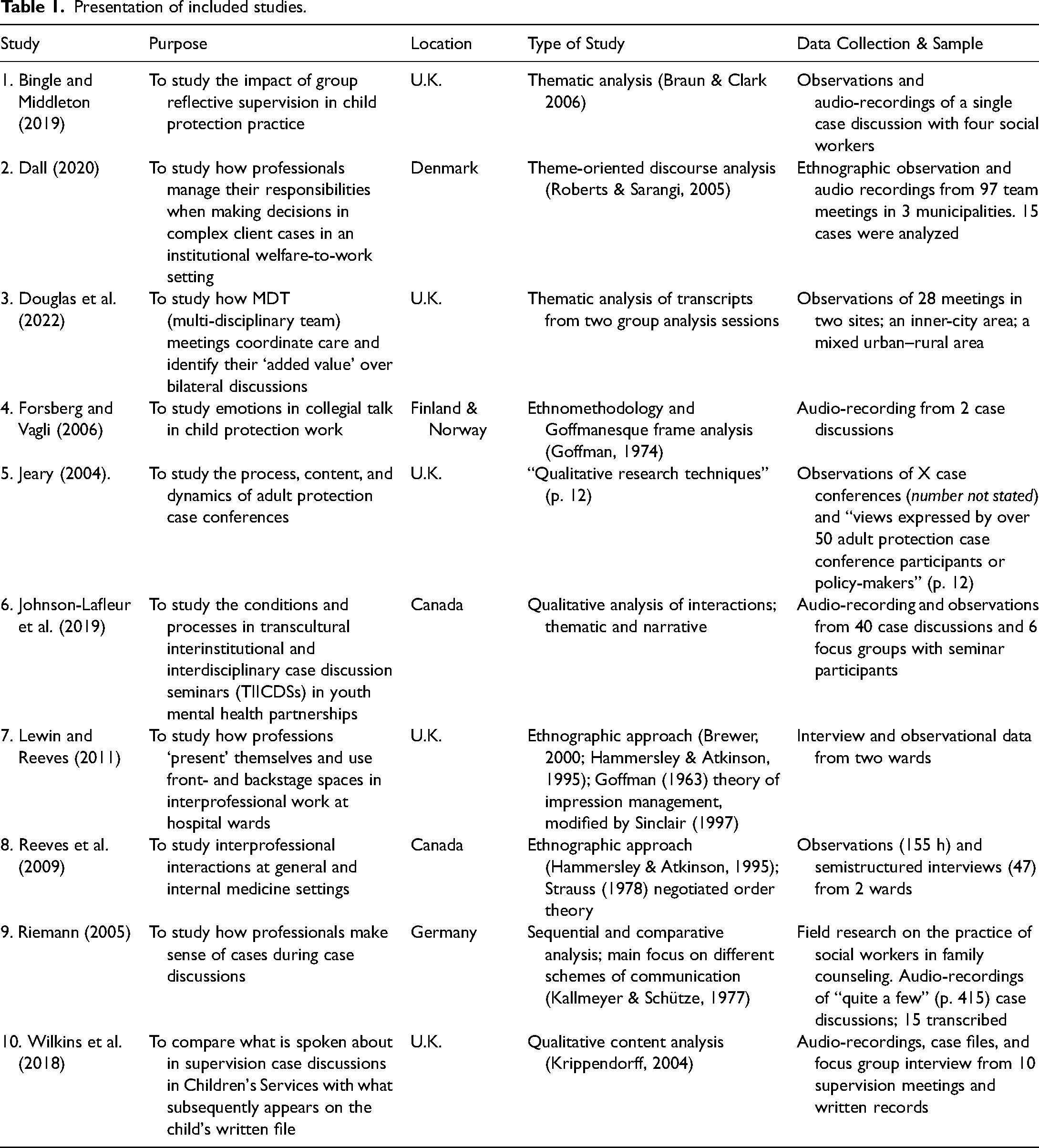
Search strategy
A systematic approach was used to search for relevant studies in PubMed, PsychInfo, Scopus, Web of Science, and Cinahl. The search was structured in two blocks. The first block contained (19) search terms related to the type of discussions in question. The second block contained (5) search terms related to social work. The search was conducted using free text search terms limited to title and abstract. Additionally, Medical subject headings were used in PubMed and Cinahl subject headings were used in Cinahl. Search terms within the two search blocks were combined using “OR,” and these blocks were combined with each other using “AND.” The search string was adjusted for each database (see Appendix 1 for the complete search string). The search was conducted on the 3th and 4th of February 2020, and a follow-up search was carried out on the 5th of August 2022.
Study inclusion
For inclusion in the review, a study had to meet the general criteria of being written in English and published between 2000 and 2022 in a peer-reviewed journal. A starting point of 2000 was deemed appropriate, as our focus was on contemporary social work practice.
For a study to be included in the present review, it also had to meet the following specific criteria:
empirical studies, based on naturalistic data; deal with backstage discussions; deal with discussions in which (one or several) social workers take part.
Studies were included or excluded by applying the inclusion criteria to titles, then to abstracts, and finally to the full text. The first author conducted this screening process alone to ensure that all criteria were dealt with in an equivalent manner. Throughout this process, uncertainties regarding the procedure of including studies as well as specific studies were discussed among all authors until a consensus was reached. The complete list of studies excluded following a full-text reading (n = 24) may be obtained from the authors.
The first search (see Figure 1) resulted in nine pertinent studies being included in the review (see Table 1). One additional pertinent study (Douglas et al., 2022) was identified in the follow-up search.
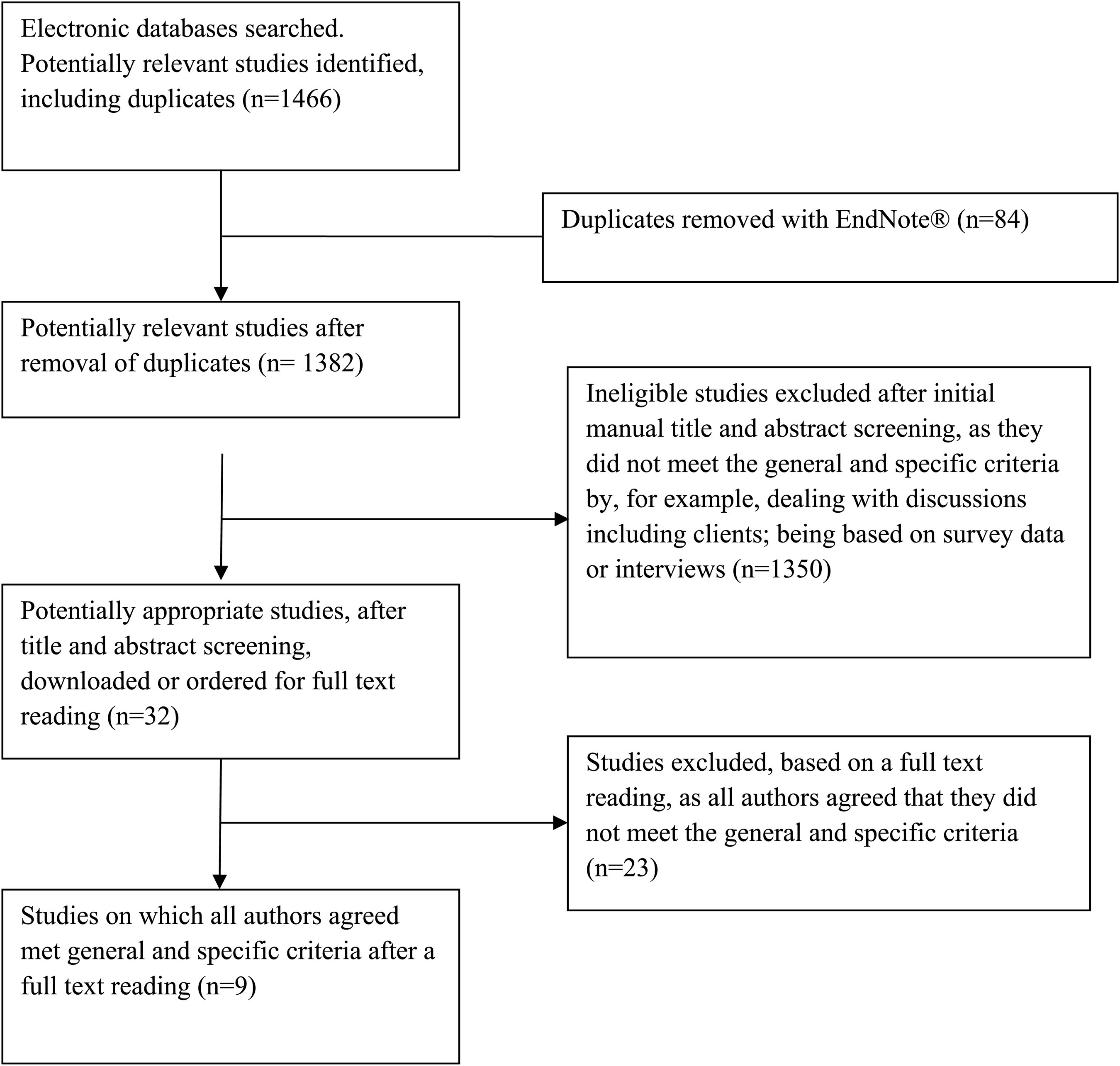
Presentation of the screening process.
A notable aspect that complicated the search, in the sense of consuming time, was that it was generally necessary to read the full article to determine whether the discussions analyzed took place without the presence of clients. Of the included studies, it is only Jeary (2004) and Lewin and Reeves (2011) that explicitly inform the reader of this aspect in the abstract.
Data analysis
The included studies were analyzed in accordance with an integrative approach to qualitative synthesis, which means that findings from qualitative studies are summarized with a view to developing conceptual descriptions of phenomena across studies (Saini & Shlonsky, 2012). The overall goal of the analytical process was to provide a final synthesis that is faithful to the primary studies, while also offering a more comprehensive interpretation than the descriptions and explanations from the individual studies (Meeker & Jezewski, 2008).
We read the papers several times and extracted data in the form of key phrases and concepts related to empirical findings using the original researchers’ descriptions and supportive quotations, as well as information about the backstage discussions in question, presented in the introductory sections of the papers. Consistent with the aim of the review, particular focus was placed on what the studies conveyed about the interaction in the discussions and about their content, but we were also attentive to—and extracted—other aspects that we found notable and that were deemed to capture something important in relation to the overall purpose of providing insight into social work practice. Five of the included studies are partly based on interviews (see Table 1). In line with the focus on naturalistic data, we only extracted data pertaining to observations or audio-recordings in these studies. The ethnographic studies by Reeves et al. (2009) and Lewin and Reeves (2011) deal with a variety of discussions among different professionals taking place in hospital wards. We extracted data only if it was clear that social workers had participated in the discussion in question. Consequently, as no findings regarding ad hoc intraprofessional discussions among social workers are explicitly included in the papers, these types of discussions are absent in the analysis presented in this paper. Furthermore, the study by Reeves et al. (2009) is not always clear on whether the interprofessional ad hoc gatherings in the ward analyzed take place in the presence of patients or backstage (before or after these rounds). We extracted the data if it was clear that the discussions take place backstage. These data were then coded, grouped, and compared in an iterative process, looking for congruencies and similarities. The process resulted in conceptualizations of the four types of interaction and three types of contents that are further elaborated on in the results section. Dimensions and variations of these types of interactions and contents were also identified as part of the comparative process and are included in the presentation of results to provide additional insights into the studied social work practice. In conducting the synthesis, we identified a mismatch between how discussions were formally justified, as described in the included publications, and what the studies conveyed about the purposes that these discussions serve in practice, which was included as part of the findings.
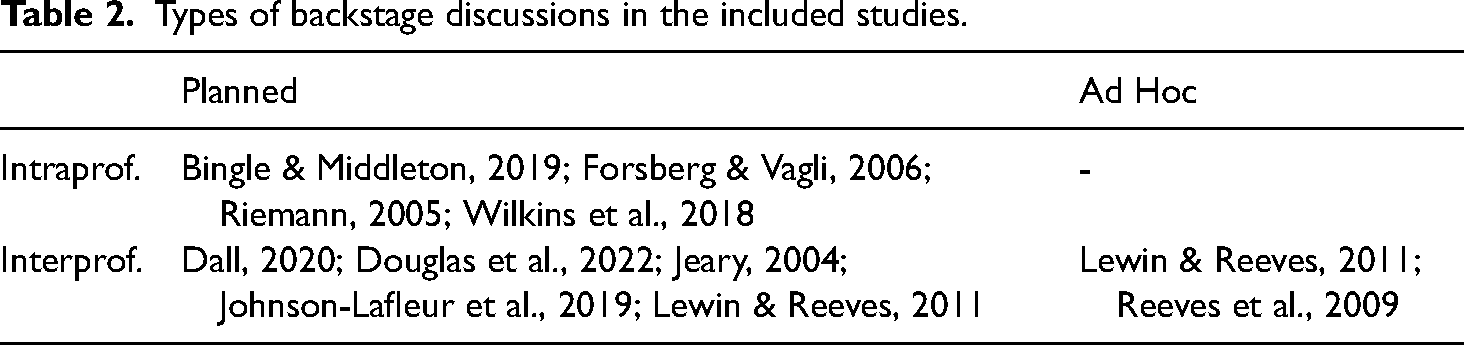
Based on available information in the studies, we also amended a model of interprofessional back-, front-, and offstage discussions in a hospital setting presented in the included study by Lewin and Reeves (2011, p. 1599), the goal being to provide an overview of the various types of backstage discussions identified in the studies (Table 2). Our main modifications of the original model involved dividing the two types of planned discussions into the categories intra- and interprofessional. Additionally, we excluded offstage discussions altogether, as none of the included studies deal with offstage discussions in which social workers take part. The model presented by Lewin and Reeves (2005), in turn, draws on a version of Goffman's front-/backstage model presented by Sinclair (1997).
Types of backstage discussions in the included studies.
Results
Various types of backstage discussions
One first observation made while going through the publications is that backstage discussions in social work include a variety of discussions named in different ways, which in turn indicates adherence to different models of teamwork (group reflective supervision, supervision case discussions, case discussion seminars, multidisciplinary team discussions) or the lack thereof (case discussions, collegial talk) (see Table 1). We also noted that the naming of backstage discussions in social work in published papers may not necessarily correspond to what the discussions are called in practice, by practitioners, but may be coined by the author/s of a paper (see Wilkins et al., 2018, p. 95).
As shown in Table 2, the backstage discussions in the included studies also vary in relation to whether the discussions are planned or take place ad hoc and whether they are intraprofessional talks with only social workers or interprofessional gatherings where social workers participate in discussions with other professions.
Variations not visible in Table 1 or 2 include how planned backstage discussions in social work may be formally justified. According to the studies in question, the discussions are justified in relation to education and/or supervision and/or improvement of (social) work practice (Bingle & Middleton, 2019; Johnson-Lafleur et al., 2019; Wilkins et al., 2018), shared case allocation (Riemann, 2005), managerial control (Wilkins et al., 2018), facilitating and maintaining interprofessional teamwork and communication (Dall, 2020; Lewin & Reeves, 2011), encourage health and social care service integration (Douglas et al., 2022), are oriented to a specific task (“to establish whether or not abuse had occurred and, to develop a protection plan, where required”; Jeary, 2004, p. 14), or no formal purpose is explicitly stated (Forsberg & Vagli, 2006).
Another variation not visible in Table 1 or 2 is that the included studies illustrate that discussions may be more or less distinct backstage discussions. All but two of the planned discussions in Table 2 are described as pure backstage discussions in the sense that they take place within recurrent meetings that are planned only to involve professionals, from beginning to end. In contrast, only part of the discussions analyzed by Dall (2020) take place backstage, as “clients are obligated to attend part of the meeting” (p. 32). The paper by Jeary (2004) reports findings from a study of adult protection case conferences. Even though “local practice guidelines in use at the time of the study stated that ‘the victim should be invited to attend or to nominate an advocate on their behalf’” (p. 13), this person was consistently missing from the meeting. Thus, this study illustrates that backstage discussions in social work do not have to be planned as such but may also occur at meetings where the client is formally supposed to take part.
The included studies also illustrate that backstage discussions in social work may take place in a variety of physical settings. All the intraprofessional discussions analyzed in the included studies (see Table 2) as well as the interprofessional discussions analyzed in four of the studies (Dall, 2020; Douglas et al., 2022; Lewin & Reeves, 2011; Reeves et al., 2009) took place at the participants’ regular workplace, or at the workplace of some of the participants. In contrast, the adult protection case conferences analyzed by Jeary (2004) took place in a variety of settings, illustrating that interprofessional backstage discussions in social work might take place outside the participants’ regular workplace. This also applies to the case discussion seminars analyzed by Johnson-Lafleur et al. (2019) that, in turn, provide an example of how a setting outside the institutions at which the participants’ work may be chosen to ensure a playful, creative, and trustful atmosphere that enables the participants to approach and apprehend a case from different perspectives and that contributes to partnership building. Another variation that is not visible in any of the tables is that one of the discussions analyzed by Forsberg and Vagli is a two-way discussion, while the rest are group discussions.
The frequency of the planned discussions is stated in some of the studies, varying from daily on weekdays (Douglas et al., 2022) or once a week/1–3 times a week (Bingle & Middleton, 2019; Dall, 2020; Lewin & Reeves, 2011; Riemann, 2005) to once a month (Johnson-Lafleur et al., 2019).
In the following sections, we will focus on what the included studies convey about the interaction during backstage discussions in social work, their content, and the purposes that the discussions serve in practice.
Types of interaction
Structured collaboration
The most frequently illustrated type of interaction comprises rather structured and fruitful collaboration among a team of practitioners concerning how to proceed on a case, after one of the participants introduces a case or a dilemma. This type of interactional pattern is explicitly described, or indicated in, six studies (Bingle & Middleton, 2019; Dall, 2020; Douglas et al., 2022; Forsberg & Vagli, 2006; Johnson-Lafleur et al., 2019; Riemann, 2005; Wilkins et al., 2018) and in relation to both intra- and interprofessional planned discussions. Our analysis also highlights variations of this sort of interaction having to do with the differing formal status of the agreements that are reached at the end of the collaborative process. In comparison to the agreements reached at the end of the discussions analyzed in the other studies, the interprofessional case discussion seminars in the study by Johnson-Lafleur et al. (2019) appear as more preliminary as decision-makers at the case presenter's home institution will make the ultimate decision.
Purposeless and unprioritized exchange
We have chosen to conceptualize a type of interaction identified only in the study by Lewin and Reeves (2011) as a purposeless and un-prioritized exchange. Characteristic of the planned interprofessional discussions in question, as described in the study, is the absence of meaningful interaction between different professionals (including social workers), in the sense of purposive collaboration on cases or tasks. Another characteristic is absent participants who are formally expected to take part in the discussions, but who choose not to participate. As described in the study, the absent participants were mainly doctors and nurses whose own explanation for not attending was their need to prioritize and deal with other duties.
Unidirectional communication
Unidirectional communication, encompassing interprofessional discussions dominated by one of the participants—and a specific profession—was identified in four studies (Johnson-Lafleur et al., 2019; Lewin & Reeves, 2011; Reeves et al., 2009; Riemann, 2005). Reeves et al. (2009) and Lewin and Reeves (2011) describe this type of interaction as being characteristic of exchanges between physicians and other professionals at the hospital wards, and they include the physicians either asking for information or requesting that a task be carried out. Other professionals avoid offering their perspective on the medical issues raised by physicians, and when they do so their contributions are largely ignored. In the study by Riemann (2005), this type of interaction is described as a particular “trap” identified in discussions among psychologists and social workers. Like the physicians above, the psychologists described seem less receptive to the social workers’ critical questions and suggestions, while the social workers “are especially reluctant to offer their observations and commentaries” (p. 425).
A dimension of this type of interaction is highlighted in the study by Johnson-Lafleur et al. (2019), which indicates that unidirectional communication may be less likely if the prerequisites for partnership building, regarding group stability and a competent resource person, are in place. If not, powerful participants will silence those professionals with less power and status and the latter will not dare to openly bring their perspectives into the discussion or share their experiences of failed interventions. Johnson-Lafleur et al. (2019) do not specify whether these powerful participants belong to a certain profession.
Informal talk structured by spatial–temporal constraints
Unsurprisingly, the (interprofessional) ad hoc conversations analyzed in two studies (see Table 2) are described as relatively informal and unstructured, but “shaped and structured by the spatial–temporal constraints of the performance environment” (Reeves et al.,p. 1601). The studies convey that as the interactions mostly took place in the hospital ward or other settings open for other people to attend, at times that were intended for other activities, they were likely to be interrupted and tended to be short and focused on single issues. The two studies also highlight the existence of variations within this type of interaction related to whether physicians participate or are absent. In comparing “the nature of unscheduled interactions between nursing and allied health staff” (including social workers) with the scarce informal social interactions between physicians and other professionals, Reeves et al. (2009) describe the former as “more rounded with good levels of discussion and negotiation” (p. 640).
Content(s)
Ideas, hypotheses, and reflections
Seven studies (Bingle & Middleton, 2019; Dall, 2020; Douglas et al., 2022; Forsberg & Vagli, 2006; Johnson-Lafleur et al., 2019; Riemann, 2005; Wilkins et al., 2018) illustrate how the (intra- and interprofessional planned) discussions encompass sharing of ideas or hypotheses and reflections.
The study by Bingle and Middleton (2019) provides the most insights into this type of content and its place in the discussions. The analysis focuses on social workers who are trained in a systemic approach in which forming hypotheses is described to play a significant role. As described by the scholars, hypothesizing dominates in both prevalence and proportion within the discussions analyzed and is given a specific timeframe within the discussion. Bingle and Middleton also note that the hypotheses raised do not include reflections on the social workerś own actions and roles in dealing with the case, but solely focus on identifying ideas about the client or family in question. The study by Wilkins et al. (2018) provides insight into another dimension related to the type of content in question, by conveying that managers may also take part in the probing and examining of cases in backstage discussions in social work. As stated in the paper: “[m]anagers and social workers might ask questions, speculate and form hypotheses within their discussions” (p. 101).
Emotions
Three studies (Forsberg & Vagli, 2006; Johnson-Lafleur et al., 2019; Riemann, 2005) explicitly highlight how (planned interprofessional seminar- and intraprofessional) backstage discussions in social work may encompass sharing of emotions, and in two studies (Douglas et al., 2022; Wilkins et al., 2018), this type of content is implicitly touched upon.
By a defined orientation toward “how emotions are part of child protection case discussions” (Forsberg & Vagli, 2006, p. 25), the study by Forsberg and Vagli provides the most insights into this type of content. By acknowledging the social workers’ use of words and metaphors that signal emotions, the scholars identify several emotional frames (i.e., constellations of meaning that inform how participants in a discussion understand situations and events) that are activated when the social workers discuss the case. Comparing how emotions are made topical or silent during the two discussions carried out in different countries, the study indicates that different contexts may encourage/discourage different emotions. The study by Riemann (2005) adds understanding, by conveying the different functions that sharing of emotions may have in backstage discussions in social work. Here, the sharing of reflections, information, and emotions going on in the case discussions analyzed are highlighted as supportive in relation to the case presenter and as a form of learning process for the other participants. In presenting a case a social worker may express uncertainty and helplessness about a case and on how to proceed, requesting reflective feedback and solidarity from colleagues. According to the study, this is considered as a legitimate request if presenters demonstrate “that they comply with the standards of good work that are valid in the team” (p. 418). As further stated, it is “by revealing something of one's own work one shows that one needs the critique and recognition of one's team members” (p. 418).
Linear statements
Six studies (Bingle & Middleton, 2019; Dall, 2020; Forsberg & Vagli, 2006; Johnson-Lafleur et al., 2019; Riemann, 2005; Wilkins et al., 2018), encompassing both intra- and interprofessional planned discussions, demonstrate that in backstage discussions in social work, the participants may share and raise linear statements. That is, the type of statement that “presents itself as a truth” (Bingle & Middleton, p. 399) and that contains simplified views about clients or factual assertions about “how things are” or “should be done.”
The individual studies provide insights into various dimensions of this type of content. The study by Forsberg and Vagli (2006) shows that talk about facts may be more or less prominent in backstage discussions in social work and may also be prominent during a particular phase of a discussion. Encompassing an explicit focus on “what could be improved or what can go wrong in case discussions” (p. 415), the study by Riemann (2005) highlights that social workers at times fail to keep “analytical distance” to clients with whom team members are very familiar. Instead, they too quickly presume that they (already) know “what the problem is” or what support the individual would or would not benefit from. Further noted in this study is that a problem presented as complicated by the case presenter may be simplified by team members to save the time needed for another issue. Johnson-Lafleur et al. (2019) describe the use of linear statements as a strategy applied by individual participants to provide legitimacy by adding strength to their utterances. Participants may draw on their access to restricted information, specialized training, having been in the field for a long time, or knowing the law when telling other participants “how things (really) are.” The study by Wilkins et al. (2018) further highlights that one consequence of requiring the production of a written record of actions and decisions agreed upon during a backstage discussion may be that time is spent on producing linear statements. This may mean, for instance, that spoken statements that make explicit the subjective nature of a judgment using an active form (e.g., “I believe”) are reformulated into a passive form (“is”) for the purpose of writing them down, thereby transforming spoken statements into something more like facts. As Wilkins et al. stress, participating managers are not required to produce the written record during the actual meeting, but the record should be produced following the case discussion. Still, in practice, this is more often done during the meeting.
Blurring boundaries
Three studies (Bingle & Middleton, 2019; Dall, 2020; Forsberg & Vagli, 2006) (on planned intra- and interprofessional discussions) provide examples of the blurring of boundaries between different types of content.
The study by Bingle and Middleton (2019) highlights that there may be blurred boundaries between hypotheses and linear, factual, and statements in backstage discussions in social work by conveying how some “hypotheses raised during the discussions analyzed ‘were constructed as fact, presuming certain beliefs about family members’” (p. 397). Forsberg and Vagli (2006) further notes that factual statements should not be considered as “synonym for unfeeling. Instead, it may be seen as a question of a certain kind of emotional relation that underlines social distance” which, in turn, “may be an important tool in child protection work, helping to carry out a certain kind of decision” (p. 27).
The findings from the study by Dall (2020), focusing on professional (“understandings of problems, treatments, and values pertaining to a given profession”) and institutional (“talk attributed to institutional practice, rules, and regulations”) (p. 33) discourse in interprofessional team meetings do not readily fit into the above-presented conceptualization of (separate) types of content. Instead, the study provides another example of blurred boundaries between different types of content, in this case between two discourses. One main finding from this study is that team members enact the two discourses in mutually informing, intrinsic ways, “shifting between professional and institutional discourses, with professional assessments being expressed between and in relation to references to the institutional order” (p. 38).
Function(s)
Supportive, team-building, and educational
One common feature of most of the planned discussions in the included studies is that they, based on the findings presented, indicate that backstage discussions in social work may serve a number of—supportive, educational, and team-building—purposes that are only partially, or not at all, mirrored in their formal aim. As for the study by Forsberg and Vagli (2006), no formal aim for the intraprofessional discussions analyzed is presented. However, according to Forsberg and Vagli (2006) on an overall level, the discussions analyzed function as an arena where social workers “share opinions, consult more experienced colleagues, co-evaluate work processes and their aims, and try to find direction with ‘difficult cases’” (p. 14). According to Riemann (2005), the discussions analyzed are motivated by shared case allocation. As different team members are involved and have to coordinate the further processing of a case, it is necessary to meet and share and exchange information. Riemann elaborates on the purposes that the discussions serve in practice. He describes the sharing of reflections, information, and emotions going on during the analyzed case discussions as supportive in relation to the case presenter and as a kind of learning process for the other participants. By taking part in the presenter’s narrative as well as the accompanying body language, tone of voice, etc., colleagues may “learn about the details and atmosphere of a conversation with clients or get an impression of the practices and strategies of the colleague who is introducing the case” (p. 418). The discussions may also play a supportive role for a team member who has difficulties in coping emotionally. Riemann also highlights how the discussions serve as an arena where social workers have opportunities to get positive feedback when they tell colleagues about successful parts of their work. According to Riemann’s analysis, the discussions also encompass dimensions of team-building by functioning “as a joint attempt to restore a collective ‘sentimental order’ that had become shaky” (p. 418). Johnson-Lafleur et al. (2019) suggest that, despite having originally been initiated as educational, evaluations have shown that, in practice, the transcultural interdisciplinary case discussion seminars (TIICDS) in question promote partnership building by clarifying different professionals’ roles and responsibilities; they also have a supportive function by offering continuity for participants in a working context characterized by administrative changes. However, for this to happen, the group must be stable over time regarding its participants, and the so-called resource person (who takes part in the discussions) should be “flexible, open, empathetic, and tactful” both toward clients and families and toward practitioners (p. 4). The importance of continuity is based on the finding that “TIICDSs participants express themselves more openly at the end of the meeting than at the beginning, and at the end of the seminar year compared to the first meetings” (p. 6).
Impression management
Like the discussions analyzed by Dall (2020), the hospital-based discussions in the study by Lewin and Reeves (2011) are described as formally justified in relation to facilitating and maintaining interprofessional teamwork and communication. However, as stated by Lewin and Reeves, the “meetings did not appear to serve any crucial health care function in this setting. Most decisions on patient care were taken elsewhere; the meetings were not prioritized for attendance by key staff, such as registrars or senior ward nurses; and the meetings were often cancelled” (p. 1601). According to Lewin and Reeves, the meetings instead served another, less concrete, purpose. In line with the high-held vision of the institution, the meetings demonstrated that collaborative, interprofessional activities were part of the daily work at the hospital and sharing of information was retained “as a form of impression management” (p. 1600). Furthermore, the discussions allowed plans that had already been made elsewhere to be formally “approved.”
Thus, there was a certain mismatch regarding how discussions were formally justified, as described in the included publications, and what the studies had to say about the purposes that these discussions served in practice. Intraprofessional discussions among social workers that were described as collegial talk and where no formal purpose was presented (Forsberg & Vagli, 2006), or as (merely) necessitated by shared case allocation (Riemann, 2005), were said to serve several important purposes in practice for the participating social workers. In contrast, discussions at hospitals among social workers and other professionals described as part of a vision to facilitate and maintain interprofessional teamwork at the hospital (Lewin & Reeves, 2011) were described as rather pointless for the participants in practice.
Discussion
The purpose of the present review was to gain exploratory insight into what we have chosen to call backstage discussions in social work by identifying and synthesizing recent empirical findings, based on studies examining professional practice using naturalistic data. The findings suggest that social workers engage in different types of backstage discussions including different types of interactions, contents, and functions. We argue that the identified heterogeneity of types of discussions, interactions, contents, and purposes is an important finding, adding to our understanding of this relatively unexplored social work practice, which has not yet been established as a particular field of research. We base the latter claim on the lack of a common vocabulary for conceptualizing these types of discussions that acknowledges their backstage character in the included studies as well as on the fact that their absence of clients is only explicitly recognized in the abstract of two of the papers. The findings also illustrate that some team meetings in social work might have diffuse boundaries between frontstage and backstage in the sense that clients may participate in part of the discussions, or be invited to participate but not show up for the meeting.
Concerning the planned intraprofessional discussions, we would argue that their homogeneity rather than heterogeneity deserves attention. Given that team discussions among colleagues seem to have received little recognition outside the arena of social work practice (Riemann, 2005; Ruch, 2006)—and that the data in this synthesis are from four different countries—it is surprising that both the structure and content of the discussions seem to be rather similar. During all the discussions, social work colleagues seem to collaborate in finding solutions for how to proceed with the cases that follow a certain, similar procedure. Additionally, all the discussions seem to include passages where ideas, reflections, and emotions are shared, as well as passages with more linear, unreflexive statements. Notably, this is true for discussions only justified by shared case allocation, discussions labeled as supervisory, as well as those meant to be underpinned by a systemic methodology. Although it is beyond the scope of the present review to evaluate the discussions, it is notable that the identified content of these types of backstage discussions is largely in line with what is considered integral to good social work practice. That is, the discussions provide colleagues with an opportunity to reflect on information about clients, bringing up multiple perspectives, which has been identified as a crucial dimension of decision-making in social work practice (e.g., Bingle & Middleton, 2019, p. 388; Cross et al., 2010; Dore, 2020). The opportunity to reflect on the emotional experience of working relationships with clients and families has also been highlighted as an important part of good practice (e.g., Ferguson, 2005; Ruch, 2006).
Another notable dimension is that, according to the present review, planned intraprofessional backstage discussions in social work seem to serve several similar purposes in practice that by far extend their formal aims. Previous ethnographic research, cited by Bingle and Middleton (2019, p. 388), indicates that these types of discussions have largely emerged “from below,” justified by the need to share information due to shared case allocation and in contexts where these were the only planned times for colleagues to meet as a team. This is in sharp contrast to the planned interprofessional, hospital-based discussions analyzed by Lewin and Reeves (2011), which similarly take place at the participants’ workplaces on a regular, weekly basis, but appear to serve little purpose in practice. Worth noticing here is that other interprofessional discussions analyzed in the included studies appear to be more purposeful. Lewin and Reeves (2011) themselves interpret the ritual function of the meetings in question as being related to the fact that they were introduced “from above” in the organization. The latter reflects the widespread notion that interprofessional partnership and collaboration in healthcare (and social services) are themselves effective, automatically leading to more qualified decisions and better care (Dall, 2020; Johnson-Lafleur et al., 2019). However, as illustrated in the present review, this idea ignores the tensions embedded in unequal power relations between professional groups as well as differing professional norms, values, cultures, and practices that are well-documented in the literature (see e.g., Kvarnström, 2008; Reeves et al., 2017). Several scholars (e.g., Banks, 2010; Hall, 2005; Johnson-Lafleur et al., 2019) have stressed the need to acknowledge and deal with these tensions, preferably early on as part of university courses, the goal being to establish well-functioning interprofessional teams.
Limitations
Although we have chosen to focus on studies that have been published in peer-reviewed journals, we are aware that other types of publications may contain additional knowledge on backstage discussions in social work, based on naturalistic data (see e.g., Nikander, 2003). As we base our findings concerning backstage discussions in social work on published studies in the area, they are inevitably dependent on the researcher‘s interpretations and focus on presenting and analyzing the discussions.
Although all the included studies are wholly or partly based on naturalistic data, they differ in terms of being based solely on audio-recordings, solely on observations—or on a combination of both. The studies based solely on observational data (Douglas et al., 2022; Jeary, 2004; Lewin & Reeves, 2011; Reeves et al., 2009) are less focused on and provide less detailed analysis of, spoken interaction. The analysis presented in the results section of this paper might, therefore, give a misrepresentative impression that the discussions analyzed in these studies differ more from the other studies than they do in practice.
In addition, our work indicates a lack of tradition in the research on team discussions in social work with regard to acknowledging or conceptualizing whether the study focuses on discussions in which the client is or is not present, as well as explicitly acknowledging whether a certain finding pertains to one or the other. In turn, this makes it complicated to identify relevant research and findings in the area and increases the likelihood of missing relevant studies and findings.
Suggestions for further research
Still, the small number of countries, as well as social work contexts represented in the included studies, suggests that there is scope for more research examining all of the types of backstage discussions we have identified—that is, for future studies that use naturalistic data to explore the discussions as such and that have the potential to offer insights into how social workers create knowledge about cases in interaction with colleagues as they go about discussing clients. That the intraprofessional discussions identified take place among social workers dealing with the welfare of children and their families indicates the particular need for studies investigating other social work arenas. Additionally, as we did not identify any studies at all of ad hoc intraprofessional discussions in social work, there would seem to be room for studies focusing on these more informal gatherings and, for example, their functions in—and for—practice. Other scholars have noted an increase in the number of studies on interprofessional collaboration (Reeves et al., 2009). The fact that relatively few studies on interprofessional discussions were identified in the present review could be viewed as indicating that most of these studies are based on interviews and that there is a need for more studies on the interaction going on during these discussions.
We would also like to suggest that scholars conducting research on team discussions in social work acknowledge and be explicit as to whether the discussions analyzed take place with or without the presence of a client. As highlighted by Goffman (1963) work on impression management, as well as later developments of Goffman’s work in the area of interprofessional interactions included in the present review (Lewin & Reeves, 2011), there are reasons to analyze these discussions as constituting a separate phenomenon. Although not commented on in the present results section, the study by Lewin and Reeves (2011) provides explicit examples of the blurring of boundaries between back- and front-stage discussions. In conducting the synthesis, we noted other implicit cases of such phenomena that could be explored in future studies.
Lastly, as the present review clearly indicates, formal purposes—or a lack thereof—may say little or nothing about the purposes that the discussions serve in practice. Thus, we suggest that the present review has highlighted an underdeveloped and important area for further research and that the presented synthesis could be used as a basis for a variety of studies explicitly dealing with meetings in social work where the client is not present—that is, studies that are not “blinded” by the formal purposes or stated methodological or ideological underpinnings of the discussions in question, but that examine what actually goes on and how the participants interact in practice.
Footnotes
Ethics
Ethical approval was not required for this literature review.
Funding
The authors disclosed receipt of the following financial support for the research, authorship, and/or publication of this article: This work was supported by the Swedish Research Council for Health, Working Life and Welfare (FORTE) (grant number 2019-00610).

Appendix 1: Complete search string
PubMed
Search conducted on 3th of February 2020 and updated 24th of May 2021 and 5th of August 2022
#1. patient care planning [MeSH]
#2. nursing care plans [TI/AB]
#3. case conferences [TI/AB]
#4. case analysis [TI/AB]
#5. case-talk [TI/AB]
#6. case talk [TI/AB]
#7. case discussion [TI/AB]
#8. case discourse [TI/AB]
#9. case negotiation [TI/AB]
#10. case conference [TI/AB]
#11. institutional discourse [TI/AB]
#12. care planning conference [TI/AB]
#13. client conference [TI/AB]
#14. client talk [TI/AB]
#15. institutional talk [TI/AB]
#16. client construction [TI/AB]
#17. intraprofessional [TI/AB]
#18. collegial [TI/AB]
#19. care conference [TI/AB]
#20. backstage [TI/AB]
#21. OR/#1-#20
#22. social work [MeSH]
#23. social service [TI/AB]
#24. social care [TI/AB]
#25. social welfare [TI/AB]
#26. social worker [TI/AB]
#27. social services [TI/AB]
#28. OR/#22-#27
#29. #21 AND #28