



Abstract
Summary
This study investigates family involvement and culturally informed social work in Native American communities. The study was conducted in Native American communities in Montana, USA. Twenty-three Native American social work professionals participated in qualitative interviews. Analyses draw on theory of historical trauma and family involvement in indigenous social. Throughout the study, indigenous methodology has been a central principle.
Findings
Among social workers, there is a common understanding that social work should involve family and community if it is to be culturally informed. Social work professionals talk of family involvement in indigenous social work as “common sense.” For the Native American social work professionals interviewed, the following tenets are all “common sense”: (1) family and community belonging are important aspects of Native American culture; 2) oppression and colonization had a negative impact on family, community, and tribal relations; and (3) social work has an obligation to restore family, community, and tribal relations.
Application
Social work has a responsibility to connect culture, trauma, and the resolution of trauma. Furthermore, family and community involvement plays a core part in restoration and resilience processes, healing historical trauma caused by the colonization. Hence, in order to provide culturally competent care, social work practices serving Native American clients should involve family and community. Mainstream social work does not sufficiently build on family involvement as an ideological foundation for qualitatively good social work. We argue that social work curricula impacting Native clients could benefit from the experience and knowledge of these Native American social workers.
Keywords
Introduction
This article seeks to reveal and highlight indigenous family involvement in decision-making within social service provision and child welfare in Montana. Internationaly, researchers advocate that family and community involvement is relevant for social work in indigenous communities (Belone et al., 2002; Drywater-Whitekiller, 2014; Gray et al., 2007; Henriksen, 2004; Herzberg, 2013; O’Neill & Gonzalez, 2014; Stewart, 2008). Throughout history, social work has contributed to the colonization and oppression of indigenous people, by removing children from their families (Godinet et al., 2010; Jones, 1995; Shamini et al., 2015; Sullivan & Walters, 2011), lack of culturally informed services (Herring et al., 2013; Lawler et al., 2012), and colonial structures undermining indigenous peoples access to and control over their social and physical health (de Leeuw et al., 2010; Lawrence, 2000). Worldwide, indigenous communities and researchers are searching for new ways of organizing social work to make it more culturally appropriate (Bennett et al., 2011; Gray et al., 2013; Herring et al., 2013; Järvensivu et al., 2016). This study is a contribution to this aim, specifically regarding the relevance of family and community involvement in indigenous social work. In this article, we investigate Native American social workers perceptions of the relevance of family involvement in cultural informed social services.
This study is part of a collaborative investigation of family involvement in social work based on interviews and dialogue with social workers and stakeholders in indigenous communities in Montana and Norway. This article is limited to analysis of interviews with Native American social workers and stakeholders in Montana and connection of those data to larger conceptual frameworks. Sámi data and analyses are presented in other academic works, see Nygård (2018) and Nygård et al. (2018).
The Native American social work professionals interviewed in this article hold a variety of roles in their communities and in their own families. Through focus group and individual interviews, we were able to access, appreciate, and analyze these unique and varied perspectives and to distill information into what we hope will be a useful tool for providers as well as a contribution to the conversation in international indigenous social work. We believe that our participants’ generous interviews can inform social service delivery for indigenous families constructively.
Context
Native American tribes in Montana
Montana is a state of mountains, plains, and expansive skies, located in the Northwest of the United States. The history of the Native American peoples in Montana is much more layered, complex, and intricate than described in most history textbooks. The state is home to seven reservations; 13 federally recognized tribes call Montana their legal or historical homeland. In addition, many other tribes are represented in urban centers and on reservations throughout the state (Montana Office of Public Instruction, 2009). The interviews in this study were conducted on the Flathead Indian Reservation and the Fort Peck Indian Reservation as well as in the urban center of Missoula. To learn more about the Native American cultures in Montana today, we recommend reading work published by the Montana Office of Public Instruction (2009) developed under former state superintendent Denise Juneau (Mandan, Hidatsa & Blackfeet) to meet the requirements of the Indian Education for All Act (MCA 20-1-501.
“Native Americans” do have in common their differentiation from the majority culture and history of colonization. However, hundreds of tribal traditions exist independently, and tribes today should be categorized according to their specific socio-cultural, linguistic, and historical values and traditions.
Family and community in Native American culture
According to both empirical and theoretical research contributions, Native Americans consider extended family an important cultural element (E. Duran & Duran, 1995; O’Neill & Gonzalez, 2014; Peers & Brown, 1999). John Red Horse (1980) argues that the family is a cornerstone in Native American culture. The family guides’ human behavior is center for life span socialization and is a catalyst for cultural revitalization.
For many Native Americans, identity is connected to previous generations as well as their tribal affiliations, histories, traditions, and values (B. E. S. Duran, 2002; E. Duran et al., 2008). Unlike many Americans of Anglo-Saxon descent with few connections to their ancestral lands and histories, some Native Americans today live in areas where their people have existed since time immemorial. Moreover, they may have a closer connection across multiple generations and oral traditions of their families and cultures, thereby influencing a more fluid and continuous cross-generational understanding of identity than their non-Native counterparts (Martin & Yurkovich, 2014).
The Indian Child Welfare Act
Native Americans’ history of oppression and colonization includes land loss, loss of language, loss of traditions, and significant cultural assimilation (Mann, 2016). The long-term negative effects have been severe for the Native American people. One contemporary example of consequences of colonization is within child welfare. There is still extensive removal of indigenous children by social services taking place today. In 1978, the Federal Government enacted The Indian Child Welfare Act (ICWA). The law was a response to the high number of indigenous children placed out of home caused by the social services lack of cultural sensitivity and hash assimilation of Native American families into the dominant society (George, 1997).
ICWA applies for state custody proceedings for children who are members or eligible for membership in federally recognized tribes. The law states than when children are placed out of home, a preference shall be given to first look for placement in extended family, second with other members of child’s tribe, and third with other Indian family. The law applies to children who are a member of or eligible for membership in a federally recognized tribe (Dumbrill, 2009).
Despite ICWA, indigenous children are still over-represented in the child welfare systems in the state of Montana and other areas including the Dakotas, Minnesota, Alaska, Oklahoma, and areas of Canada (Jones, 1995; Sullivan & Walters, 2011). Some call the removal of Native children by Child Protective Services (CPS) the new boarding school era, in that children are being taken from their homes and communities by systems which see their living conditions as unfit, neglectful, or poverty-stricken (Simmons, 2014). Indigenous children in foster care have disproportionately and continually increased in the United States over the last decade (Summers, 2015). The historical and contemporary oppression of Native families continues in spite of laws like ICWA, calling for continuing attention to how social services can contribute to family resilience and community restoration.
Theory
The impact of colonization on individual, family and community
The historical and contemporary oppression of indigenous peoples continues to manifest itself in people’s lives today (E. Duran & Duran, 1995; Wesley-Esquimaux & Smolewski, 2004). The concept of “historical trauma” refers to grief and trauma accumulating over one’s life span or across generations, resulting in personal or collective compounding of emotional and mental pain (Brave Heart & DeBruyn, 1998). According to Evans-Campbell (2008), the effects of historical trauma are visible at individual, family, and community levels. She claims that on an individual level, symptoms may manifest as anxiety, mistrust or guilt, depression, substance abuse, and difficulty handling anger. Historical trauma may affect families, as parents and grandparents raised in boarding schools may not have learned healthy parenting skills. Separation from their parents and communities denied generations of individuals the opportunity to learn traditional parenting. On the community level, the impacts include collective loss of culture, language, and belonging. Evans-Campbell (2008) argues that all these levels: individual, family, and community must be considered while addressing historical trauma.
Family involvement in indigenous social work
With the advent of indigenous-developed systems, employment of Native American social workers, and international comparative research in the field of indigenous studies, we find the concept of “authentization” useful. It conceptualizes local, specific, and value-based aspects of indigenous culture to develop practice and research (Gray & Coates, 2008). Authentization is social work practice rooted in local contexts (Megahead, 2015). Researchers highlighting international collaborating, globalization, and diversity challenge the concept and favor social, cultural, and ethnic interchange (Ferguson, 2005). However, social work models based on Native American perspectives ensure family involvement and cultural relevance. Practice that meets the cultural needs for Native families must embrace the families’ culture and facilitating for cultural attachment (Simard, 2019). Hence, local grounding in child welfare practice remains important alongside the international indigenous exchange of working models (Midgley, 2008). It is still important to challenge the indigenization; “the west to the rest,” where methods are based on western, hegemonic values (Gray & Coates, 2008). In order to implement culturally appropriate methods, the framework must be cultural integration. Lucero and Leake (2016) conducted a meta-synthesis on Native tribal child welfare, revealing four dimensions in the cultural integration model Native child welfare: developing culturally distinct definition of Native child welfare, tribal values, link between the child protection and cultural and community health, and specialized worker skills.
Shifting social services toward culturally informed methods often means including the family in decision-making at the systemic level (Price-Robertson & McDonald, 2011; McCrae & Fusco, 2010). One of these methods is Family Group Conferencing (FGC), developed by the Maori of New Zealand (Love, 2017; Maxwell, 2008). We use this loosely as a reference model to explore extended family inclusion in social work practices affecting indigenous families in Montana. The FGC model guides our questions, providing us with an alternative model when exploring family involvement in social service provision. FGC serves not as an ideal way of including families in social service cases but as a backdrop to working with extended families within the framework of indigenous child welfare. We question how Native American participants conceptualize family inclusion as a component of securing culturally appropriate care for families involved in social services.
To intervene in Native Americans families, cultural competence is important (Douglas & Walsh, 2013). The three-fold model, outlined by Weaver (1999), identifies values, knowledge, and skills as interactive components in cultural competence within child protection. In order to implement cultural competence, child protection services must use methods which address and seek to resolve historic trauma and consider how it affects Native American individual, families, and communities (Evans-Campbell, 2008).
Methodology and method
Indigenous methodology
Indigenous methodology has emerged as a reaction to imperialist research and knowledge production mired in the worldview of the colonizer. Indigenous methodology provides perspectives and tools to facilitate knowledge production from indigenous communities themselves (Smith, 2012). Dialogue with the indigenous communities and storytelling are vital dimensions in indigenous methodologies, as the narrative approach in Talanoa methodologies (Vaioleti, 2016) and in other Pacific methodologies as Kakala, Fa'afaletui, Fonofale, Tivaevae, ‘Ula, Fonua, Kaupapa Maori, and Vanua (McFall-McCaffery, 2010). In this study, we focus on two elements of indigenous methodology: situated knowledge production and giving back results.
The first is to situate knowledge production within the local context. Community dialogue during the research process establishes the relevance of research questions and validates interpretations and analyses (Goulding et al., 2016; Porsanger, 2004). Engaging with local community dialogue was ongoing from the start of this research project. In Montana, we spent time with elders and social workers seeking input on our research topics and strategies. Informal visits with participants and attending community gatherings were considered important to learning about culture within the local context. These interactions influenced final interpretations.
The second element of indigenous methodology found particularly important is the concept of “giving back” research results to the community (Porsanger, 2004). Indigenous methodology stresses that research should benefit the indigenous societies involved and the results are the indigenous society’s knowledge. In this study, we had two strategies of giving back: mini-seminars and joined narrative analyses. These strategies facilitated participation and sharing responsibility for knowledge production between participants and researchers. For in-depth description of our reflection on methodology and research design, see Nygård and Saus (2016) and Nygård et al. (2018). The first strategy is to give back during the phase of data construction. We did this by arranging interviews as “mini-seminars”. The second is to give back results during the phase of analyses. Participants and other relevant community members were invited to join narrative analyses and discussion of preliminary analyses as well as meetings presenting topics of mutual interest for the Norwegian Sámi and the Montana tribes societies.
Mini-seminars: Focus group interviews and individual interviews
The data collection methods for this study were focus group interviews and individual interviews. Focus group interviews are a way of exploring ideas and views shared by a group of people within a context (Wilkinson, 1998). Individual interviews are a way of exploring the ideas of an individual (Thagaard, 2002). This study focuses on social work professionals’ shared ideas about indigenous family involvement in social work. Interviewing social work stakeholders seeks to lift indigenous voices into the construction of social work knowledge internationally. The interviews had questions relating to culturally appropriate family involvement, addressing family inclusion in social work, and traditional values as related to social service provision.
We arranged our interviews and analyses as mini-seminars. The giving-back session was held during the analysis phase, alternating between indigenous communities in Norway and Montana. All interviews began with a short PowerPoint presentation explaining research goals, a short history on the Sámi of Norway, and our opinion on how a comparison of international indigenous voices in research could be beneficial. We served food at each session and explained that the participants were considered exactly that: participants and were therefore welcome to eat, speak, question, or, indeed, disengage from the process at any time. We discussed our non-indigenous status early on in each session, inviting participants to dialogue about being interviewed by “white” or “majority culture” researchers, which has historically been a problematic feature of research. All participants agreed to continue to participate in the focus group sessions and expressed interest in the international connection between Sámi social work practices, history, and colonization using this to reflect and expand on their own views and differences as indigenous social work stakeholders.
Focus group and individual interviews were conducted with a variety of group sizes in numerous locations. In total, we conducted 10 interviews, including two large groups, one with four participants at a tribal college and one with seven participants at their place of employment. Four interviews included pairs of participants, in locations including the private room of a restaurant, a workplace, and private homes. We had four individual interviews held in various locations. In several cases, indigenous children were present but not involved in the interview process.
Narrative analyses
In the giving-back sessions, we invited interviewees and community members to a presentation of our preliminary findings. The participators and researchers discussed the findings for further analyses. This means that reciprocal relationships between the researchers, the research participants, and community members did the interpretations of the data. We presented narrative analysis to the participant as a concept describing how we may understand the views shared by participants.
Years of social, ethnic, economic, and institutional oppression have silenced indigenous voices (Smith, 2012). In gathering themes and presenting this research, we seek instead to bring out those voices. The giving-back seminars were a key element in the narrative analyses and sought to involve participants in the analytic process. We investigated professionals’ perceptions of social work in their communities, identifying and highlighting common agreements among the participants, and key issues of debate. What are their ideas and experiences with involving family in social work decision-making? The overall goal of the narrative in this article highlights the combined voices of participants by telling their stories and speaking together as one.
In both focus group and individual interviews, family involvement is highlighted as important in social work practices affecting indigenous communities. During the analyses, we have searched for what participants did and did not talk about. The method of focus group interviews facilitates examination of disagreements and contrary opinions. We investigate professionals’ perceptions on social work in their communities, identifying and highlighting common agreements among the participants, as well as what is debated. What are participants’ ideas and experiences with involving family in social work decision making?
We have conducted thematic analyses of the data material, categorizing central themes. We distill results by citing examples from both focus group and individual interviews without making any distinctions between them. When highlighting participant quotes in this work, we identify the interview with letters and the participants with numbers.
Participants
In Montana, we interviewed 23 participants, the majority self-identifying as Native American (22 of 23). We sought to obtain a majority of Native American voices because these are usually under-represented in research. Research has shown that Native American social workers are better suited to understanding indigenous families’ cultural strengths and to enact the spirit of the ICWA (Cross et al., 2013). Nineteen women and four men participated. The gender imbalance is likely due to the female dominance historically found in American social work practice (Cross et al., 2013).
Recruitment was based on participants’ positions as social workers or as social work “stakeholders.” Stakeholders were considered people with influence and experience within the area of social work, although they did not necessarily have direct experience as social workers. Participants’ professions included child welfare workers, child welfare supervisors, professionals employed at an Indian Health Center, teachers at the social work department of the tribal college, and tribal council members. When discussing participants, we use the collective term social work professionals. Participants were invited into the project through personal, informal visits. Snowball sampling was used to gather sources for interviews (Faugier & Sargeant, 1997).
Ethical consideration and approval
The mini-seminars and the giving back seminars were a systematic way of involving community members and securing inclusion of indigenous voices in the research. The dialogue with indigenous community members is important for research relevance and validity.
The project is approved by ethical research systems in Montana and in Norway. In Montana, The Salish Kootenai College Institutional Review Board and the Fort Peck Tribal Institutional Review Board gave ethical approval for this project. The Tribal Institutional review boards request both internal and external ethical validation. Internal validation is granted through informed consent and securing data material sensitivity. External validity is obtained through questioning how research project dialog with and benefit community. Additionally, the project was approved by the Norwegian center for research data. For in-depth descriptions of the dialogue with the ethical research systems, see Nygård and Saus (2016).
Results and findings
In interviews with Native American social work professionals, we find that there is an agreement that social work should involve families. As social work professionals talked about family and community in social work, three distinct themes emerged: (1) family and community as an important part of tribal culture; (2) family, community, and tribal relations have been impacted by colonization and oppression; and (3) the ongoing restoration of the cultural role of family, community, and tribes in communities.
Based on these narratives, we identified three themes: (1) family and community belonging; (2) disturbance in family, community, and tribal relations; and (3) restoring the cultural role of the family, community, and tribe.
Theme 1: Family and community belonging
In interviews, participants talked of the central position of family and community in local and Native American cultures.
We divide the theme “Family and community belonging” into two parts. First, the participants spoke about the role of family, community, and tribe in their culture. We label this subtheme “Family, community, and tribe.” When describing concepts of family and community roles, participants commented that cultural belonging is often an important aspect of their own identity. We label this subtheme “Cultural belonging and identity.”
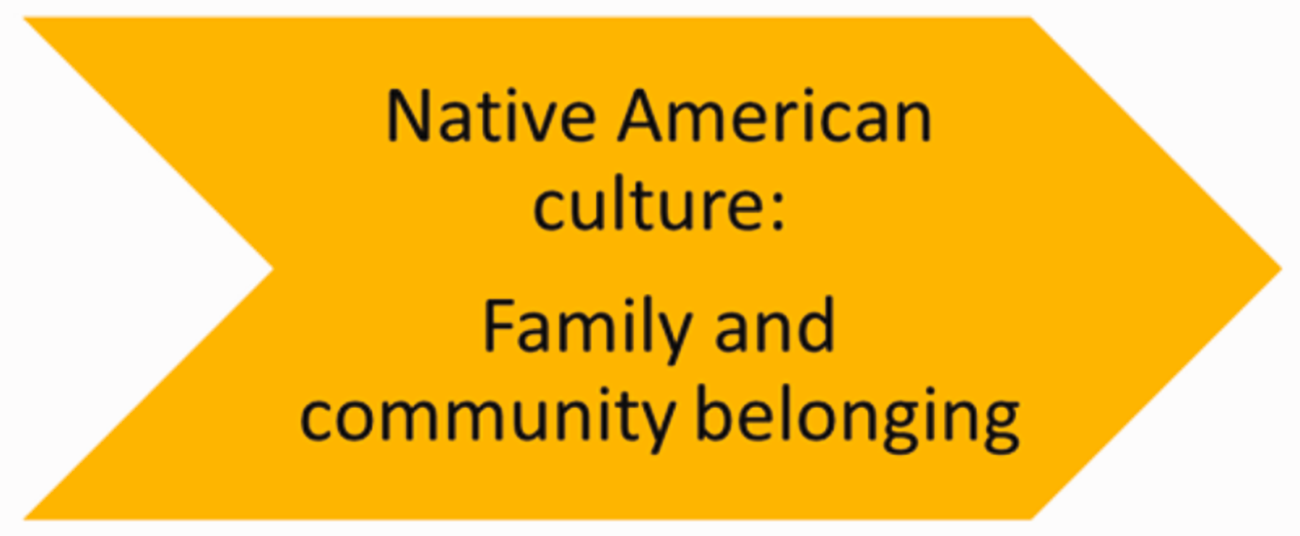
The yellow arrow represents cultural knowledge of interviewed Native American social work professionals valuing family and community belonging.
Subtheme 1a: Family, community, and tribe
Through personal stories, participants shared how they connect to their extended family and community. Participants stated that family is important in tribal cultures, although family dynamics varied and do vary among different tribes, bands, and families, including differences in protocol and familial roles. Participants spoke of family as a large and inclusive concept. Participants often described their immediate family as being comprised of parents, children, great-grandparents, aunts, uncles, and cousins.
In these participants’ narratives, child-rearing is not limited to the parents’ sole responsibility. Several participants reported that grandparents or other family members may hold child-rearing roles, either instead of or in addition to parents. In the interviews, participants also talk about child-rearing roles held in the community.
Subtheme 1b: Cultural belonging and identity
Participants discussed their current and childhood connections to their families and tribes. One participant stated, “I think culture is who we are,” (Interview H participant 1), linking culture and tradition to her identity. Another participant stressed the central place of family and community in by describing intergenerational belonging, understood as a component of identity, which includes herself, her family, and her community. Through all the interviews, the community has a central place in participants’ narratives. Several participants refer to the impact of being a part of family and community belonging. A participant formulates “Just being immersed in that huge family community is so powerful, you really learn a lot” (Focus Group Interview G, Participant 4).
Another participant talked about her identity as a Native American woman. She describes personal belonging to the Native American community she lives within. Furthermore, she described a sense of shared belonging and connection among people living within the community by using the word “spirit of the community” and stated that she can tell when the “community is hurting” (Interview H, participant 2). The participants talked of communities in which people take care of and look after one another. The interviewed described the community and the tribe as supportive and a source of strength.
Participants reported that they understood themselves as a product of their histories, their traditions, and their families. Additionally, they spoke of their own connections to family systems as a child, and how this has shaped them positively, or conversely, how intergenerational trauma had impacted their childhood, and personal and spiritual identities in a negative way.
Theme 2: Disturbance in family, community and tribal relations
As described above, family, community, and tribal relations are important elements of participants’ identities. During the interviews, participants reported that oppression and colonization have disturbed traditional connections within families, communities, and tribes.
In the interviews, participants discussed past and present disturbances in family, community, and tribal relations. We divide this theme into two parts; first, the historical and ongoing trauma caused by the oppression of Native American peoples. We label this subtheme “Historical trauma and contemporary resilience”. In the second subtheme, labeled “Removal of Native children” the participants speak of how social services, over decades, have removed Native American children from their homes and communities.
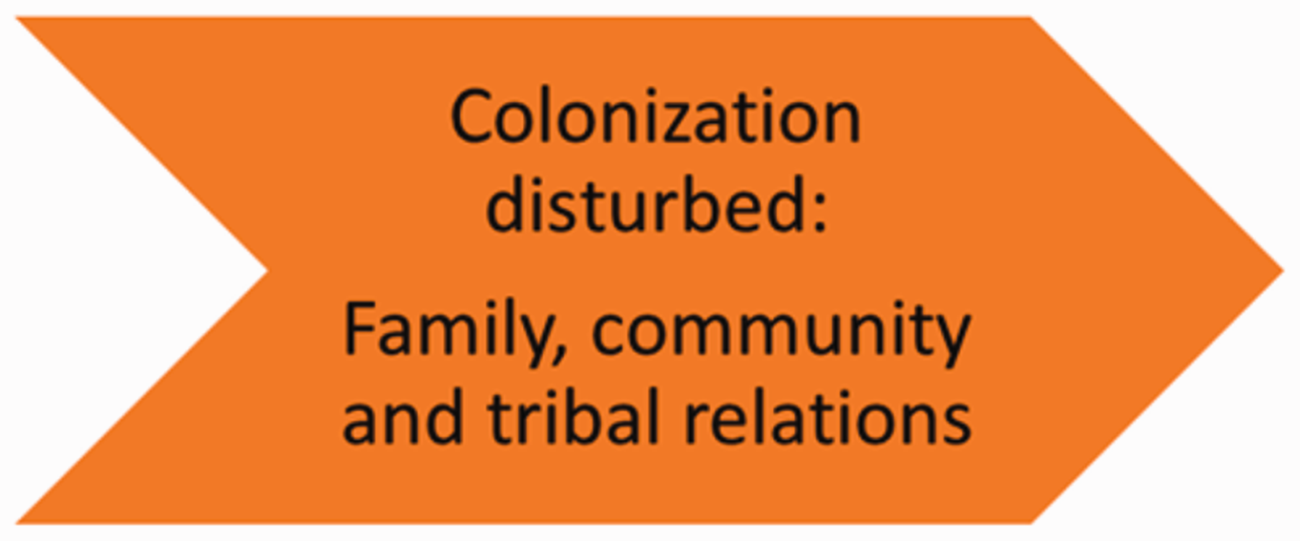
The red arrow represents contextual knowledge of Native American social work professionals; that the history of colonization and contemporary oppression disturbs current relationships.
Subtheme 2a: Historical trauma and contemporary resilience
Participants spoke about historical and intergenerational trauma throughout all of the interviews, both when discussing personal struggles within their own families and the greater traumas enacted on Native American peoples as a whole. Traumatic manifestations included sexual abuse, drug problems, and disrupted family relations but were always interwoven with stories of resilience and survival.
One participant discusses the impact of historical oppression on the existence of Native American peoples today saying that “when you annihilate every connection and every relationship you have to the world, you are going to end up with people who have quite a bit of dysfunction going on in their lives” (Focus Group Interview D, participant 4).
Participants see the influence of historical oppression on individuals, families and communities being manifested in families in the present. Many of the participants gave examples from their own family history to show how forced assimilation affected multiple generations in their families.
One participant describes generations of disruption in her family, which she attributes to forced boarding school and foster care. However, even while acknowledging dysfunction, she highlights the strength of the family to keep their children in the care of relatives and her own journey to “learn to become a parent” (Focus Group Interview G, Participant 2). She describes the resilience of cultural values that have survived generations of trauma. This is an example of a dynamic between trauma and resilience, which we observe throughout the interviews. The participants talk about individual, family, and community dysfunction; however, they also speak of individual, family, and community strength and resilience. We find the interplay of historical trauma and contemporary resilience intertwined in the narratives.
The participants tell numerous stories in which family and community members support and take responsibility for one another in difficult times. One participant describes a personal experience: “We had been hearing concerns about our nephews. (…) My sister went into the home (…) and she said, ‘they’re coming with me.’ Loaded up the kids, grabbed the clothing and brought them to her home” (Individual Interview B). Several participants tell similar stories in which family and community support each other through difficult times. We interpret these as narratives of resilience. In effect, they are re-creating what has been damaged, drawing on familial strength.
According to participants, another resilience factor is the re-connection with culture. In healing from experiences of enforced disconnection from culture, participants point to cultural re-connection. During several of the interviews, participants describe methods of social work that draw on traditional teachings and values. The “Mending Broken Hearts” curriculum is one example of culturally informed curriculum developed for and by Native Americans interested in addressing the “soul wound” related to cultural loss. Involving elders or connecting family to community are other ways of rebuilding cultural connections. These participants experience clients re-connecting with themselves and their culture through culturally informed social work processes.
Subtheme 2b: Removal of Native American children
Participants reported a history of losing children to “the system,” including boarding schools, institutionalization, and, more recently, foster care. Therefore, participants stated that keeping children within the family, the extended family, or within the tribe was extremely important for intergenerational transmission of knowledge and the personal identity of the Native American child. One informant stated, “We say ‘you can keep them home or bring them home in a coffin’” (Focus Group Interview A, participant 1).
The participants discuss the influence of the ICWA. They reflected upon the intention of the law, which is to keep Native American children within their cultural and tribal surroundings. The participants discuss the impact of the Act, describing an attitudinal change in social services. The participants also discuss ICWA limitations, arguing that there still is ways to go before tribal traditions and culture are fully integrated. Often participants argue that social services and courts do not make enough active efforts to prevent the removal of Native American children from their families, communities, or tribes, especially in situations where ICWA is not applicable.
Participants reflect that racism and the lack of cultural knowledge are reasons social services and courts do not exert themselves more strongly to keep children within their culture. One participant refers to people in the small towns surrounding reservations making claims such as “they don’t take care of their kids; we’re going to put them in a better place” (Focus Group Interview D, participant 3). This participant reflected that she thought that this attitude continues to exist in Montana even today.
Theme 3: Restoring the cultural role of family, community, and tribe
When a child and the child’s family need help from social services, the participants argue that the child’s extended family should be involved. By involving the extended family, social work contributes to the restoration of the cultural roles of families, communities, and tribes.
Elaborating on participants’ discussion of restoring cultural roles of family, communities, and tribes, the narratives fall into two subthemes. The first subtheme is “Families use of informal interventions in crises.” Participants described how families often take care of children in crisis without involving formal social services. The second subtheme is “Social services work with family, communities, and tribes”. In this section, narratives from participants highlight participants’ ideas of how family should be involved in social service provision.
Subtheme 3a: Families’ informal interventions in crisis
Participants discussed numerous informal interventions that took place within indigenous families when parents experience a crisis and are unable to care for their children. Several participants told stories of private interventions within their own families. The participants articulate an intention to keep Native American children, particularly grandchildren, out of the social service system, and within the care of the family. They describe how family members solve crises by coming together in the family or community.
According to participants these interventions were often “below the radar” of CPS/social services. The participants told stories of informal family problem solving within their communities. The participants’ knowledge of families’ crisis and informal processes of problem solving may be gained through personal and community knowledge rather than professionally shared information. Some participants argue that families’ informal interventions at times may offer more progress or be “safer” for the children when sorting out family problems rather than engaging with formal social service provision.
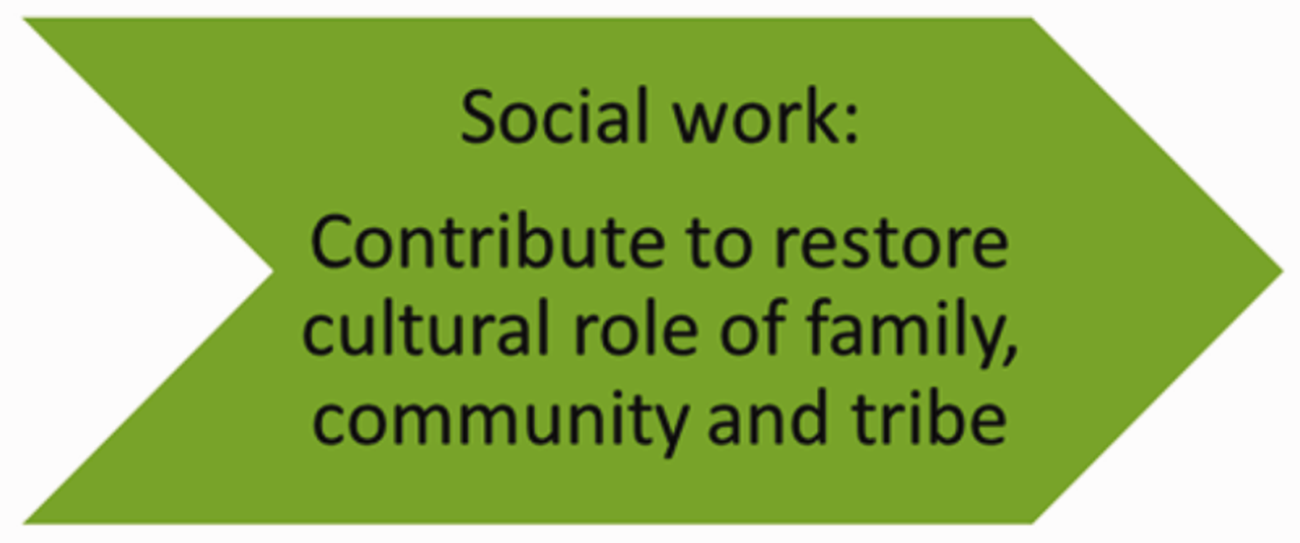
The green arrow represents the role of social work; to contribute to restore the cultural role of family, community, and tribe.
Subtheme 3b: Social services working with family, community, and tribe
Throughout the interviews, there was common agreement that extended families should be involved in social work with children and families. Participants talked about how, as social workers, they aim to include the child’s extended family and community. The participants discussed the involvement of family in problem solving not only for close family but also for community members. Participants described elders as a valuable resource when working with families and argued for more inclusion of community elders in social work service provision.
Several social service professionals argued for the usefulness of FGC or other methods of family involvement within a tribal context. However, they state that this way of working is not new to them. The participants describe involvement of family and community members in their daily work. The participants argue that Native American social workers and Native American-run agencies work in more culturally informed ways because Native American social workers often have locally rooted, cultural ways of thinking and have experience with informal decision-making from their own families and tribes. In these interviews, family involvement is discussed as being culturally relevant and is noted as being done well by some Native American-run agencies.
Some social workers discuss how social services do not understand the relevance of historical trauma in individual and family life today. “They [social services] don’t get the three [cultural, historical and generational] traumas. And that’s where you need elders included because they have the knowledge base that’s missing” (Focus Group Interview G, participant 4). The social workers argue the importance of addressing these traumas and point to community elders’ roles in contributing positively to rebuilding family and community relations. She suggests that this may be an avenue when including extended family in social service decision-making. The value given to family and community involvement in social work is shared across the range of interviews. Native American social work professionals describe the goal of involving and strengthening families and communities.
Participants also reflect that social work curriculum does not always fit the tribal context. One participant articulates: “Sometimes I wonder though what we are doing differently than the state. Truthfully, we learn this non-Native concept; social work” (Focus Group Interview D, participant 3).
The participants speak of social service provision in Native American run agencies as being either empowering or detrimental to Native American families. They argue that empowering social service provision involves family and community resources. This kind of social work can play a central role in rebuilding and restoring family, community, and tribal relations.
Discussion
Around the world, the long-term effects of the colonization are visible today and call for restorative healing processes (Kirmayer et al., 2014; Radke & Douglas, 2020; Waldram, 2014). One of the impacts of ongoing colonization is the high degree of child removal in indigenous families. Our participants discussed numerous personal and professional experiences of child removal. Facing and dealing with historic trauma is an imperative for modern societies (Hasan-Stein & Toki, 2017) and an ethical responsibility for the field of social work due to the active role social work played and continues to play during the colonization processes (Jacobs & Saus, 2012; Saus, 2019). The global definition of social work approved by International Federation of Social Work includes indigenous knowledge, and stresses that social work seeks to halt and reverse the scientific colonialism and hegemony by listening to and learning from indigenous peoples. It means that social work has a responsibility to connect culture, trauma, and the resolution of trauma.
Native American social workers participating in this study highlight families as the cornerstone in resilience approaches and in the necessary restoration of cultural values and practices. Resilience processes are necessary and should grow from the intimate knowledge of historical trauma. To overcome over-representation in child removal, Native American social workers encourage using practices that involve families and communities to a higher degree than majority culture social work. Authentization is a principle that can steer the social work toward local and regional grounding. This leads to processes that uncover how local knowledge can strengthen social work and contribute to more cultural appropriate practices. Basing social work within family and community belonging is strengthening for the involved families and enhances resilience processes. Furthermore, it gives room for restoration processes in the community (Ferguson, 2005). The Native American social workers interviewed see this potential, not due to the learning from the social work curriculum, but because the everyday experience has taught them these concepts.
Participants described culturally informed methods of social service provision by expressing the importance of involving family, communities, and tribes in social work processes impacting Native children. As Native American social work professionals, they advocate for family involvement in social work as “common sense.” Elaborating with the participants on the rationale behind this thinking, we argue that what is “common sense” for Native American social work professionals is the following rationale: (1) Family and community belonging are important parts of many Native American cultures; (2) oppression and colonization have negatively impacted family, community, and tribal relations to such an extent that people continue to suffer deeply in their lives today; and (3) social work has an obligation to contribute to restoring family, community, and tribal relations in all practices involving indigenous children. In fact, participants reported that for social work service provision to be successful with Native American individuals and families, there must be acknowledgment of and contribution to, restoration of cultural and family relations.
This study investigates narratives of family involvement in social work from perspectives of Native American social work professionals and stakeholders. All study participants had cultural and contextual knowledge of tribal communities and described the central role of family and community in Native American life during interviews. In the model, the yellow arrow represents cultural knowledge of interviewed Native American social work professionals valuing family and community belonging. The red arrow represents contextual knowledge of Native American social work professionals; that the history of colonization and contemporary oppression disturbs current relationships. Participants shared narratives of colonization negatively affecting family and community relations, while also highlighting contextual knowledge of resilience, such as resistance to oppression, and the re-building of cultural and family ties. The green arrow represents the role of social work; to contribute to and restore the cultural roles of families, communities, and tribes. Participants argued that social work today should address all three dimensions represented in the yellow arrow, the green arrow, and the red arrow. Participants expressed that bringing people back to their culture and restoring family ties is one way of repairing damage from colonization. Therefore, social work today must acknowledge and contribute to the re-building and restoring of family, community, and tribal relations, especially when considering the negative impacts the social work discipline has had on Native American peoples, particularly in connection with assimilation policies.

The figure visualize the connection between the levels; 1. cultural knowledge, 2. disturbance of colonization, and 3. Social work contribution in restoration.
Limitation of the study
The limitations of this study include the number of participants, and the lack of gender balance, with only four of the participants identifying as men. The participants come from a few indigenous societies/tribal backgrounds and do not represent all Native American nations or cultures in what is now called Montana or the United States. Both limitations give grounds to treat the conclusions with care and extra considerations.
Conclusion
In the interviews with Native American social work professionals, we found that there is a general agreement that social work should actively involve families. This approach to family involvement as fundamental in social work is not a core ideology recognized by mainstream social work. Family involvement is, according to these Native American social work professionals, “common sense” in indigenous social work.
Native American children often bond and attach to several adults in childhood, which may be misunderstood by social services involved with the family—because Western child development theories focus on bonding between the child and one primary caregiver (typically the mother). For Native American social workers involving family in social work is integrated in their professional habits as social workers.
Connections between the central role of family and community in Native American cultures, the extensive damage of colonization, and social work’s obligation to contribute to the re-building of family and community relations, is often dismissed or completely overlooked by mainstream social service provision. Involving extended family in social work is not an integrated part of most social work. This article argues that social work serving Native American families must embrace and champion cultural and contextual knowledge of Native American social work professionals, as the experts on themselves.
The three levels and the interconnections between these levels is a model visualizing how Native American professionals interviewed here consider family involvement to be “common sense” when practicing social work in indigenous communities. Furthermore, the wisdom these participants share, described in the three themes they identify, may be transferable to social work in other communities and countries because it creates a link between culture, trauma, and the necessity for social work to contribute in acknowledging and resolving generations of traumas.
Footnotes
Ethics
The Salish Kootenai College Institutional Review Board and the Fort Peck Tribal Institutional Review Board gave ethical approval for this project.
Funding
The authors disclosed receipt of the following financial support for the research, authorship and/or publication of this article: This research project was funded by the Sámi Parliament of Norway and Regional Centre for Child and Youth Mental Health and Child Welfare North, UiT The Arctic University of Norway and Department of Education, UiT The Arctic University of Norway.

Acknowledgments
We would like to extend our gratitude to Sheldon Spotted Elk, friend, and ICWA specialist for his time in reading and offering feedback. Many thanks to The Salish Kootenai College and Ft. Peck’s Institutional Review Boards who approved our research. Finally, and most importantly, thanks to the participants who shared with us their heartfelt stories and thoughts. Without each of you, this would not be possible.