



Abstract
Summary
The aim of the article is to increase interest in the social systems theory of Niklas Luhmann among practicing social workers. The enigmatic statement from Luhmann that only ‘communication can communicate’ is explained with reference to his autopoietic systems theory which identifies three distinct types of systems: systems of communication, systems of life and systems of consciousness. The article proceeds to describe the meaning and nature of autopoietic systems before discussing the place of the individual in Luhmann’s theory and how it is relevant for practicing social workers. The concepts of psychic systems, structural coupling and communicative codes are described and discussed.
Findings
The conceptual framework derived from Luhmann’s systems theory is applied to a description of the social worker/client encounter. Communication in social work practice is polyphonic: it is structured by a hybrid of communicative codes which the practitioner must draw on depending on the auspices of the communicative context. The key conclusion of the article is that Luhmann retains a conception of the individual as an active agent in systems theory aiming ‘noise’ at the function systems with which the individual interacts.
Applications
The article suggests that the systems perspective presented provides social workers with a useful and nuanced framework for reflective practice because it makes the components of the practice system explicit and visible.
Keywords
Introduction
The aim of this article is to increase understanding and interest in the social systems theory of Niklas Luhmann among practicing social workers and to aid the process of reflective practice by making the professional toolkit typically used by the social worker in the field more explicit. In the UK, in particular, understanding of Luhmann’s social systems theory is low compared with the high levels of interest in continental Europe (Hojlund, 2009; La Cour & Hojlund, 2008; Michailakis & Schirmer 2014; Schirmer & Michailakis, 2015, 2019; Villadsen, 2008). This is probably to be expected given the extensive history of systems theory in British and American social work which is replete with contested perceptions (see Payne, 2002a). Overcoming resistance to new ways of seeing established knowledge in such an intrinsically political context is challenging for a perspective which goes against the received wisdom of the profession. In addition, a counter-intuitive proposition lies at the heart of Luhmann’s theory of autopoietic social systems which might explain its faltering academic reception in the English-speaking countries: it is not human subjects who communicate but ‘communication which communicates’ and, further, ‘minds’ and ‘bodies’ are excluded from society. What follows is an attempt to clarify this enigmatic proposition and demonstrate the usefulness of Luhmann’s theory of autopoietic social systems for those researching and practicing social work.
Luhmann’s work is extensive, ranging over 70 books and 400 scholarly articles. While the focus of that work was on developing a scientific understanding of the evolution of society ‘in terms of an internal logic proper to social systems themselves, not psychic systems’ (see Stenner, 2004, p. 182), nevertheless he also conceptualised people as autopoietic systems, and in doing so began a paradigm shift in thinking about the individual in systems theory.
Luhmann recognised the particular complexity that human beings present for social analysis because they are the bearers of three autopoietic systems: systems of life (cells, brains and organisms), systems of consciousness (mind) and systems of communication (social systems). As a sociologist he acknowledges but leaves aside the biological system of human beings and instead focuses on the interactive relationship between their consciousness or psychic systems and the social systems with which they interact and exist as system and environment for each other (Luhmann, 1992). Given the premise that human beings are the bearers of three autopoietic systems, he argued that communication between psychic systems in autopoietic theory is not between whole persons. A thought or a feeling is connected to other thoughts and feelings, or as Moeller (2006) prosaically couches it ‘you cannot communicate with me with your mind or brain, you will have to perform another communicative operation such as writing or speaking’ (Moeller, 2006, p. 17). Mental operations are thoughts, emotions, and so on. A mental system is operationally closed in the sense that no mind can directly interfere with operations of another mind. One cannot continue someone else’s mental activities by thinking or feeling for him or her. It is also impossible to immediately think what someone else is thinking … We can hear what others say, or see an expression of pain or joy on their face, but we cannot literally think or feel what they do. Psychic systems are autopoietic. (Moeller, 2012, p. 57)
Autopoietic systems and allopoietic systems
The most common way in which systems theory has been applied to social work practice in child protection and family therapy settings is to regard family groupings as allopoietic systems which means that the system produces something other than the system itself. By contrast, autopoietic systems reproduce themselves. This observation requires clarification. For example, in social work practice problematic family functioning is typically treated as requiring social, environmental and professional stimuli external to the individuals within the family grouping, conceptualised as inputs to the family system, in order to create an outcome of unproblematic family functioning. The allopoietic system is conceptualised as an open system which operates to stabilise relationships between members inside the group and their exchanges with the social systems forming the family’s environment (see Payne, 2002b, pp. 8–21; Rodger, 1996, pp. 10–16). The key focus of social work with families is principally to understand how the system’s functioning impacts on the cognitive and behavioural performance of the individuals forming the family group in order to regulate it. The degree of integration in the family system is deemed to be determined by the extent to which members of the group adhere to a common set of social values and ways of construing the problems and events which impact on them, for example issues of responsibility, obligation and family solidarity (see Rodger, 1991).
However, from Luhmann’s perspective, this can be understood as a theoretical model which is determinist in that it risks prioritising the family system over the individuals who populate it. A sense of the individual as a creative being making sense of their family experience in their own terms may be lost. It is a conception of social system functioning which is focused on securing a mechanical form of solidarity because of its focus on normative integration. In a social work context, it could be argued that allopoietic models of family systems encourage what Dennis Wrong (1961) might have called an ‘over socialised conception of the human being’. In contrast, Luhmann’s social constructivist perspective recognises a ‘social’ rather than a ‘socialised’ human being at the heart of social systems who creatively constructs his or her own view of the world. He rejected the notion of integrative social values which are not anchored in the communicative process of sensemaking between people (psychic systems). This particular point is developed below in the section dealing with structural coupling where Karl Weick’s theory of sensemaking in complex organisations is described.
The emphasis on normative integration in allopoietic systems perspectives means that inside the family group those identified as in some way disruptive will inevitably become the main interest for those external to the family system seeking to ‘re-balance’ it. This approach is what criminologist David Matza (1969, pp. 15–40) called many years ago a ‘correctional’ approach to social work. However, in a modern context in which the profession has established a principle of humanistic practice which places identity, human self-determination and acknowledgement of diversity at the forefront, social intervention ought to be based on what Matza called an ‘appreciative’ approach to practice which accepts the plurality of people and their differences. Indeed, the very nature of what constitutes a family system today is generally acknowledged to be negotiable by individuals rather than prescribed by society. The concept of an autopoietic psychic system in Luhmann’s perspective facilitates such an approach because the individual is treated as an active and creative social agent constructively working on and processing their reality from outside in the environment of other systems including the family system. Autopoietic systems are more dynamic than allopoietic systems because they deal with an excess of complicating ‘noise’ from their environments (too much information that cannot be processed) by changing their structure (internal complexity) to allow in more communications: they have a built-in learning capacity. In contrast, allopoietic systems theory leads the observer to seek constancy and stability in system functioning because they are intrinsically conservative.
As Peter Gilgen, Luhmann’s translator, observes: … Luhmann’s insistence on placing human beings in the environment of social systems (rather than inside them) should not be taken as a sign of misanthropic or anti-human tendencies on the part of systems theory … On the contrary, human beings … are better off if their processes are not determined by society. The alternative would be the total social engineering of bodies and psyches, which is not only unrealistic but also undesirable. (Luhmann, 2013, p. xi)
Key aspects of Luhmann’s theory of autopoietic systems
Boundaries and meaning in autopoietic systems
Social systems are defined by their relationship to meaning. Luhmann’s contention is that social systems (and psychic systems) reduce the complexity of their environment through recourse to meaning. So, the boundaries of a social system are not defined physically, but by the border of what is meaningful and what is not. (Holub, 1991, p. 109)
A key socio-historical premise of Luhmann’s social systems theory is that modern western societies are distinguished by their differentiated structure of social systems within which separate institutional complexes have evolved over hundreds of years, each with their own systemic rationality and view of the world (Luhmann, 1982). For example, the main social systems constituting society (law, politics, economy, science, mass media and so on) select from their environments what is meaningful for the ongoing reproduction of their functional purpose by reliance on the use of symbolically generalised media which demarcate the system’s boundary between what is meaningful and what is not for the system. Luhmann argued that all social systems operate on a binary code determined by their sphere of interest which structures their communications with other systems. Communication with the legal system is organised by the code legal/illegal through the medium of law; with the political system by the code government/opposition through the medium of legitimate power; with the economy through money with the code pay/not pay; with science by the code true/false through the medium of evidential truth; with the mass media system by the code information/non-information through the medium of public opinion; and with the welfare benefits system by the code eligible/not eligible through the medium of citizenship status (see Luhmann, 1990, 2000; Rodger, 2019, pp. 99–107). Social work also forms a discrete social system as will be described below.
Psychic systems: Structural coupling and sensemaking
A core concept in Luhmann’s autopoietic theory relating to communication between social systems and between psychic systems is structural coupling. It describes the engagement and sensemaking processes that emerge when discrete autopoietic systems interlock in communication (see Rodger, 2012). This notion is described well by King and Thornhill (2005) Luhmann proposes the concept of structural coupling, first, to account for the continuing relationship between people, as conscious (or psychic) systems and social systems, consisting of communications. Although people clearly do not constitute social systems, they exist in the environment of these systems just as social systems exist in the environment of conscious systems … There is no causal relationship between the two; society does not cause consciousness to occur, neither do people consciously create and manage society … The relationship between the two is rather one of constant irritation with the one reacting to the other, but always on its own terms (italics added). (King & Thornhill, 2005, pp. 32–33)
Weick furnishes us with a useful conceptual vocabulary to describe the recursive processes which occur through the interlocking behaviour of people collectively making sense of their work or social environment in an ongoing way. Understandings are made and re-made in a contingent way, shaped by the social conditions and, importantly, the communicative codes framing the interaction. The key concept used by Weick to encapsulate this recursive system is loose coupling: people interact over interpretative meanings suddenly, occasionally, negligibly, indirectly and eventually (Weick, 2011, pp. 380–401). He is describing a flowing processual context within which the connections between the human components of a system are not rigidly dependent on each other. In such a context, internal system noise created by human interaction can be disruptive and sometimes problematic for a social system’s functional efficiency if collective sensemaking cannot be achieved. So, interpretation is understood as an ‘acceptable and approximate translation’ of meaning which is shared by a community of people through their interactions. Sensemaking is the construction of a frame of meaning by people in the face of surprising and unforeseen events in order to make them comprehensible where no interpretative framework exists and to create plausible understandings which everyone who is part of an interactive group can endorse. The import of Weick’s perspective is that by retaining a focus on the sensemaking process of interlocking psychic systems, we retain a well-defined view of the functions and limits of the human being in systems theory. In a social work context, social and family systems, like all social systems, should be seen as process-oriented fluid environments where there are no ‘ultimate values’ or ‘common will’ binding people together. The boundaries and structures of the family system are those which become ‘meaningful’ for the individuals who identify themselves as members.
The psychic systems of human beings and the social systems of society operate in similar ways: they actively select meaning from their environments that makes sense to them. While the dominant social systems of society will structure their communication with their environments in accordance with their evolved legal and established socio-political functional purpose, human beings draw on their embedded frameworks of meaning acquired during their lifetime. For example, in human beings there will be an already existing framework of meaning which they have acquired and learned in their life course, both formally in terms of attaining academic and abstract intellectual skills and informally through dealing with the focal concerns of their everyday existence. The latter process speaks to a lay normativity which grows out of lived experience and finds expression in what American anthropologist Ann Swidler calls a ‘cultural toolkit’ (Swidler, 1986). Drawing on this view, Duncan (1999, pp. 189–190) suggests, in a way similar to Luhmann, that culture is not a floating and detached set of values guiding behaviour but a grounded ‘tool-kit of symbols, stories, rituals and world-views’ that people assemble as they grow up and experience the world. Both the formal and informal learning experiences of the individual shape their framework of meaning and their understanding of real-world events (see Duncan, 1999; Turner, 1964). The meaning of socio-cultural mores is always interpreted from a given social position and context. Thereafter people will test their interpretation of events intersubjectively in pursuit of understanding by structurally coupling to those individuals with whom they routinely associate and interact. Social and psychic systems operate in accordance with their own logic and sphere of interest (the unique way that they construe the conditions of their existence) which is not coterminous with those of other people. No one social system is like another because no one social system can function like any other and no individual psychic system can function like any other.
How these preliminary insights build into a distinctive social systems theory as it might be applied to social work practice will be addressed in the remainder of the article.
The polyphonic role of social work
A quite basic but important observation about communication is that it is fundamentally about connectivity not only between people but also between people and the social systems and social organisations with which they interact. When we buy something in a shop we are ‘communicating’ as a customer as part of the economic system because we use money; when we attend our GP surgery we are communicating with the health system as a sick patient requiring medical intervention; when we vote we are communicating with the political system as a citizen through the ballot box; and when people engage with a social work or social services department they are communicating as clients because they possess a personal or family problem that requires caritas (a useful short hand way of bundling together the varieties of other-regarding values, emotional responses and dispositions embodied in the practice ethics of the helping professions). In other words, function systems (law, politics, economy, science, mass media and so on) can only recognise their own specialised image of the individual.
The social worker connects with clients by drawing on a number of communicative bases as this article will outline below. It is suggested here that Luhmann offers social workers a distinct ‘way of seeing’ the organisational systems with which they interact such as family systems, inter-personal communication with clients and professional peers and so on. In addition, by making the fine distinctions of their powers and functions more explicit, Luhmann’s systems perspective can be an aid in the process of reflective practice not only with respect to the legal, political and economic principles shaping their formal professional role, but also in relation to their informal engagement with the lay normativity of clients. Social work forms a social sub-system of the welfare state regulated by law and central and local governments. However, uniquely it is structured by a hybrid of communicative codes. Social systems and professional practitioners operating in fields of complex connectivity, where the ability to switch between different bases of communication is necessary, as in social work practice, are described as being polyphonic (Andersen, 2003; Hojlund, 2009; Rodger, 2012, 2013; Villadsen, 2008). For example, the social work practitioner system encompasses decision-making choices between caritas/not caritas relating to care, empathy and altruism grounded in its professional ethics; lawful/not lawful relating to the fulfilment of the practitioner’s legal obligations and powers; administrative discretion/no administrative discretion relating to the implementation of social and public policy; and involvement/detachment relating to the maintenance of system boundaries between practitioner and client ensuring that the feeling rules governing emotional engagement with clients are appropriately displayed (see Hochschild, 1979; Rodger, 2019, pp. 109–134).
Schirmer and Michailakis (2015, 2019) conceptually wrap these disparate codes in the distinction between inclusion/exclusion because they argue that social work has as its primary function the ‘exclusion management’ of clients as it impacts on their membership of and access to the complex differentiated structure of the function systems constituting society. While we think of modern liberal democratic societies as consisting of socio-economic systems and institutions open to all, in reality membership of the social systems of the modern world depends on meeting essential membership criteria. To be employed one has to be educated and meet the skill requirements of the employing organisation. To access welfare benefits, one should be regarded as eligible first by citizenship status and second by employment record. To access housing, either as a mortgage holder or a tenant, one has to establish creditworthiness and dependability in paying mortgage repayments or rent. As discussed in the introduction, the whole person is not recognised by the main social systems of society. Only that part of the individual which is recognised as relevant for a system’s ongoing function will be ‘addressed’. In this context, Schirmer and Michailakis observe, it is the function of the social work system ‘to work on the social addresses of the excluded with the aim of making them attractive to other social systems’ (Schirmer & Michailakis, 2019, p. 73).
In attending to their professional function, social workers have a public facing role which requires them to interlock communicatively with clients. Initially, those interactions will draw on their everyday sociability and lay normativity. The social worker will attempt to present an approachable, supportive and helpful demeanour to clients in order to engage them in reciprocal and ongoing discussion of whatever matter has brought the practitioner to the client’s door. Inter-personal interactions with clients and service users will be structured by a code which distinguishes between those present/not present, or present/the rest of the world, because only those present can be engaged in inter-personal communication. However, the social worker as the bearer of multiple professional roles can at any given time draw on those communicative codes which link to social work law, administrative protocols or welfare budgets if the tenor of the face to face meeting demands it. Due to the polyphonic aspect of their role, social workers are unique among professional groups in that they must address the many personae that a social work client may possess. The application of these particular codes will be illustrated in the context of social worker/client encounters below.
The interesting observation about distinguishing the boundaries of social systems in terms of ‘what is meaningful’ to them is that it requires that attention is given to communications based on the auspices underpinning the relationship (whether it is informal, formal, legal, monetary and so on) rather than to reified relational structures. For example, communications between a social work practitioner and a child client without a parent present will typically be friendly and unthreatening and generate understandings which emerge from those present (social worker and child client). The entry of a parent into a conversation between a social worker and a child client, for example, will end that exclusive connective system and a distinctive, and new, triadic system of communication will be created between the social worker, the parent and the child changing the mood of the meeting, perhaps based on more formality between the social worker and the parent. Giddens captured the fluidity of structure and process involved in inter-personal communication in his theory of structuration by observing that ‘the structural properties of social systems are both medium and outcome of the practices they recursively organise’ (Giddens, 1984, p. 25). Meaning is fluid and constantly being socially constructed and reconstructed as psychic and social systems connect and reproduce the communicative system in an ongoing way (this is what makes the communicative process autopoietic). The polyphonic role of the social worker must adapt to the changing bases of communication and the corresponding changing identities which are implied by the communication codes used in their relationships with clients. And, of course, unlike the banker, the lawyer, the retailer or the doctor, the social worker is interested in the assemblage of personae possessed by their clients (their employment status, their indebtedness status, their addiction and health status, their criminal justice status and so on).
Human agency in social work
Human agency in Luhmann’s theory is rooted in the problems of what he called ‘irritation’ and ‘noise’ when one social system prompts a communicative response from another. The operations of function systems are geared to recognise and select from the complexity of their environments only information and communications which are compatible with the system’s ongoing efficiency, integrity and functional purpose. While dealing with, or quietening, environmental ‘noise’ is what complex function systems are constituted to do, psychic systems should not be viewed as automatons in these processes. Social work clients routinely aim intractable family, personal, financial and addiction problems at many of society’s function systems (economic, legal, education, housing and so on) including the social work system. While the social workers tasked to deal with that ‘irritation’ may seek to ‘quieten the noise’ by following bureaucratic protocols which create a type of order that the system can process, frequently this does not provide a resolution of the human problem presented to the system. However, when social workers, both as practitioners and managers, respond to their client’s needs with creativity outside of the administrative constrictions imposed by the bureaucracy which employs them, they are demonstrating that system functioning ultimately depends on resourceful people to ‘save the system’ from organisational gridlock.
Human agency is the essential lubricant of the social systems of society. The environment of the social work or social services department will not only include those who make claims on the welfare system such as clients but also those who are employed as advisers and whose work practices as functionaries of the system can enhance or detract from the organisation’s efficiency and survival. Social workers, understood in this context as psychic systems, are employees who exist in the environment of their employer’s organisation charged with reducing the complexity generated by the wider environment of clients, service users and social problems. This task has a formal aspect which is discussed fully below. However, there is an important informal aspect to the way people as employees fit in to the operations of complex function systems which is worth noting. The literature on discretionary decision-making in street-level bureaucracy inspired by Michael Lipsky (1980, 2010) points up the importance of informal structures in reducing complexity in modern administrative practice. For example, incorporating the view from below is often avowed by the social work profession but it can be ignored by the policymakers upstream formulating law and social policy. This has led some in the profession to call for a more ‘radical’ approach to practice. The stimulus for this project is based on a critical rejection of neo-liberalism and austerity economics which has affected the social work clientele adversely. It has as its primary aim the widening of the profession’s gaze, specifically relating to how everyday practice can be adapted to combat managerialism and restrictive budgets. Ferguson and Woodward (2009, p. 153), for example, having chronicled the practice experience of a sample of social workers, define the radical approach using the language of ‘guerrilla warfare’, ‘collective action’ and ‘political campaigning’ (see Ferguson, 2008; Ferguson & Woodward, 2009). Talk of ‘guerrilla warfare’ is a colourful way of describing what the creative street-level bureaucrat has been doing for decades, as Lipsky (2010) described many years ago, and remains an informal part of the practice system.
Drawing on the language used by Gunther Teubner (1992), we can say that street-level bureaucrats, among whom we include social workers, create ‘soothing music’ out of the cacophony of ‘noise’ aimed at decision-making bureaucracies by clients and public groups. Teubner (1992) argues that we ought to understand autopoietic social systems as being more open and discursive with their environments than the notion of transitory disturbances as implied by the concept of ‘noise’ in Luhmann’s theory would suggest. To repeat and reinforce a key aspect of autopoietic systems theory, social systems are ‘operationally closed’ but, importantly, they are ‘cognitively open’ to their environments. What we should understand by this observation is that often the people who are employed in street-level bureaucracies, particularly social work practitioners, create informal structures (relationships, practices and grammars for interpreting events) which enable them to adjust innovatively to novel and ambiguous circumstances occurring in the organisation’s environments: they engage in sensemaking. They can compensate for system failures by using their discretion to overcome the inflexibilities that formal structures produce. So, following Teubner, we can say that those employed as street-level bureaucrats not only aim ‘noise’ at the social systems which employ them but also aim ‘soothing music’ at the system; creating order, increased learning capacity and, ultimately, more efficient practices that stabilise organisational systems such as social work departments. In this way, they reduce complexity and contribute to a more coherent ‘communication’ process between the social work system and the environment of troubled individuals. Communications pass between social systems and psychic systems recursively creating patterns which reproduce themselves and eventually create ongoing stable connections through the process of structural coupling between the communicating systems. ‘Structures of expectations’ become established through structural coupling over time, and social interaction becomes secure and predictable. Both clients and practitioners will ultimately learn to accept and use the communication codes appropriate for the institutional systems they wish to engage with: issues of law must be formulated in a way that requires an adjudication of either lawful/unlawful; matters of money must be formulated in a way that relates to the ability to pay/not pay and so on. And social work clients must be sufficiently biddable to accept the behavioural disciplines required of them by the social work system to allow practitioners to ‘manage their exclusion’ from the social systems of society in their best interests.
Balancing system imperatives and democratic discourse in social work
Having outlined the relevant conceptual framework of Luhmann’s systems theory as it might be applied to social work practice, its usefulness in making the elements of practice more visible can be explored. As a profession, social work must reconcile the formal legal and administrative authority of its function with the occupational commitment to draw on life experience and common sense in resolving the social problems of clients discursively. The tension which lies at the heart of professional practice is created by the competing demands emanating from the ‘system imperatives’ underpinning the practitioner’s professional role and the professional commitment to engage with clients expansively in an open and recursive way which acknowledges both their lay normativity and social lifeworld of community and family.
We can represent the tension between system and lifeworld as a seesaw balancing between the management of clients by recourse to the professional powers bestowed on the practitioner by law and the pushing back against that authority by clients who draw on their lay normativity to make sense of their predicament (see Figure 1). Lay normativity reflects the moral economy of a community as to what constitutes ‘natural justice’. It is grounded in the visceral feelings that are embodied in everyday knowledge which people draw on to validate their behaviour and shape their attitudes to responsibility, authority and sense of obligation. The challenge to the practitioner is that clients often express their complex needs in ways considered to be obstreperous, antisocial or simply pleas for help. Figure 1 represents the fragile equilibrium of this relationship.
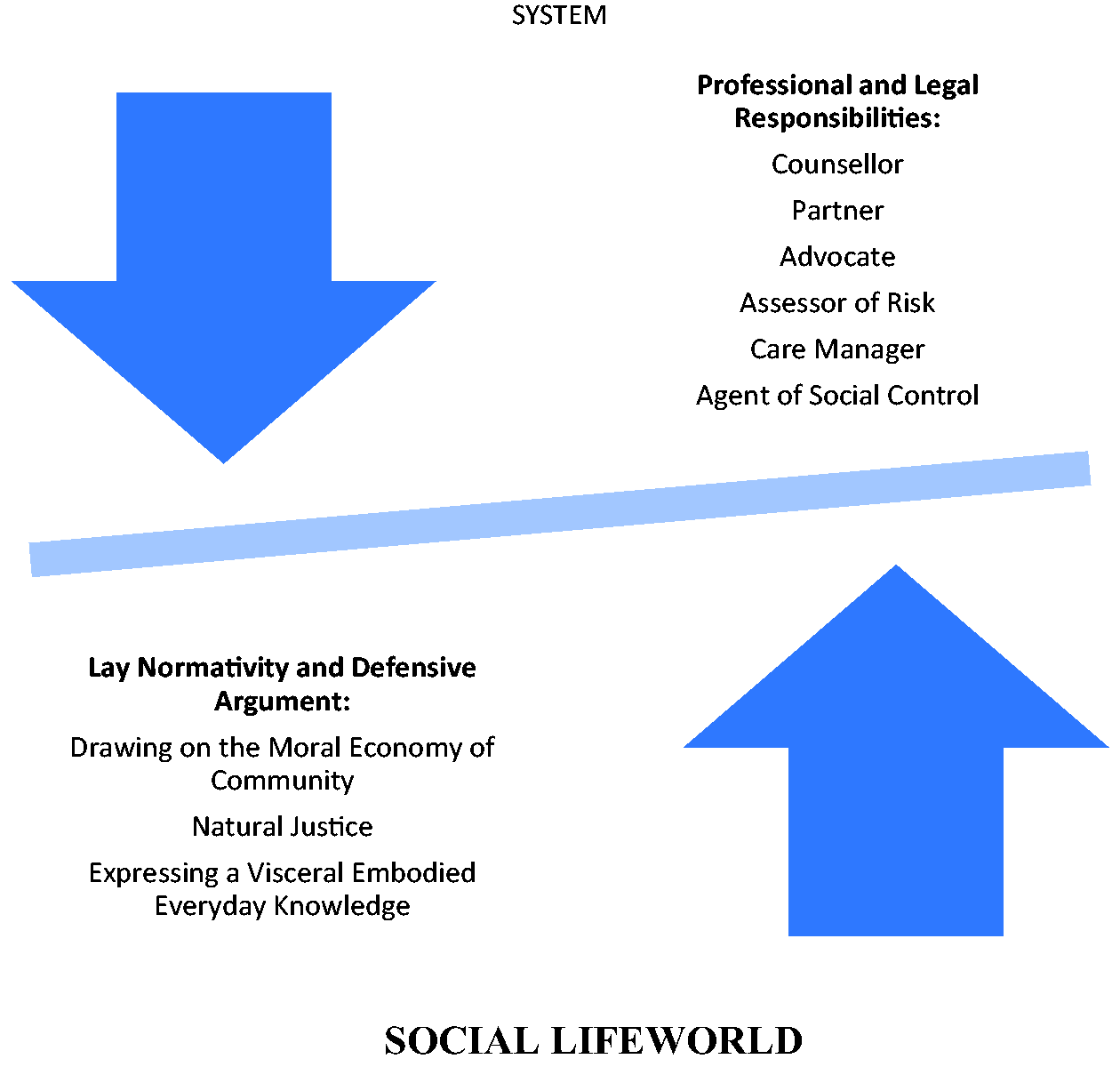
Balancing the social work system and the social lifeworld.
The systemic logic of the social work/client encounter
We can return to Luhmann to assist in making the logics at play in different types of social work encounter visible. He distinguishes between three discrete types of relational codes which structure connections between people: interactional, organisational and social (see La Cour & Hojlund, 2008). Each relational code gives rise to a distinctive system logic. As discussed above, social systems are defined by their relationship to meaning (Holub, 1991, p.109) and the boundaries of systems are defined by what is meaningful and what is not meaningful to them. As indicated in Figure 1, the client is embedded in a universe of meaning anchored in their social lifeworld of family, community and everyday routines while the state social worker is governed by a professional and occupational culture which defines the practitioner’s role formally. So, we can say that there are two sides to the social worker/client relationship: one side is structured by the social and interactional codes which shape the autopoiesis of everyday communication between interlocking individuals (psychic systems), the other by the plurality of organisational codes which intrude into that communication process from time to time at the command of the professional practitioner.
First, we can consider the informal side of the client/social worker encounter. Interaction, whether it is between two, three or more people, adheres to a set of presuppositions which establish the auspices under which the encounter takes place. In the context of an encounter between a social worker and client we must presume that the interaction is grounded in the principle that it is the best interests of the client which are given precedence in the face-to-face meeting. The individuals who are present decide what is relevant for their conversation. Initially, the interaction may operate on the basis of the code present/not present or us/the rest of the world because only those present can be part of the interaction and the interactional system exists only for the duration of the face-to-face meeting. Each will draw on their own experiences, problems and normative assumptions in making sense of the conversation between the parties to the interaction and each will contribute to its autopoietic movement. The logic of an interactional system between a social worker and client dictates that typically both parties can speak freely and that any issues relevant to the client’s circumstances can be discussed openly. Indeed, remedies for the client may be decided by agreement between the two parties alone without interference from those not present. The language of caring and concern may be expressed by the social worker not only to convey empathy and emotional engagement with the circumstances which have led to the meeting but also to signal understanding of the focal concerns and personal ways of construing problems which might be articulated by the client.
Second, we can consider the formal side of the social worker/client relationship. Behind the conviviality displayed by the practitioner’s emotion management (Hochschild, 1979; Rodger, 2019, pp. 109–134) is the ‘voice’ of the not present: the toolkit of powers which the practitioner possesses derived from the function systems underpinning the professional role. In reviewing the role of the social worker in the 21st century, Asquith et al. (2005, p. 2) reinforce the sense of dichotomy at the heart of the social worker/client relationship when they observe that the counselling, partnership and advocacy roles of the practitioner, which speak to a professional ethos of discursive openness, are in tension with the regulatory and sometimes judgemental aspects of practice which are part of the formal decision-making responsibilities of the professional role. While the client is relatively powerless, the state social worker represents the face of the welfare system and must adhere to the organisational logic which structures the professional role of the practitioner. The social worker may be required to draw on social work law to ensure that whatever remedies are to be implemented, or indeed imposed on the client, will have been approved in advance by both the organisational and legal systems to which the practitioner is accountable. The communication codes structuring professional discourse ensure that relationships with clients are always asymmetrical. While it may appear that the parties present are conversing in an informal and friendly way, engaging through the medium of caritas structured by the code us/the rest of the world, that code may change quickly to include the absent voices of the administrative and legal systems if an issue arises relating to problematic behaviour and the supervision of children. At that point, the logic of the encounter will be transformed from an interactional to an organisational logic operating on the code lawful/unlawful. If an issue arises which relates to the provision of a social service which requires to be funded, the conversation will become structured by the code payment/non-payment. The organisational logic will dictate that the social worker’s role must be subject to an established protocol relating to how interviews should be managed and decisions made. In exercising supportive functions on behalf of the client, practitioners must also acknowledge that they have explicit regulatory functions to execute: the social worker must be an assessor of risk, a care manager and an agent of social control helping to maintain the social system against the demands of individuals whose behaviour may be problematic (Rodger, 1996). The social worker becomes involved in ‘the policing of families’, to draw on the language of Jacques Donzelot (1980).
The social worker is a licensed, educated and trained professional practitioner of the welfare state system whose role is underpinned by the obligation to implement policy decisions established in law. However, they are part of a human service which seeks to balance life experience and common sense against those pressing formal powers. Managing the paradoxical nature of the social worker role requires high levels of emotional intelligence on the part of the practitioner to be able to respond to the demands of dealing with multiple problems, not all of which can be resolved by employing a sociable disposition and a supportive attitude. As described above, whenever there is a social worker/client relationship simultaneously, there is also a triadic relationship between legal, political and psychic systems because the interaction will be influenced by the communication codes which structure the interaction between these systems at a given point. Those codes can switch from background to foreground, depending on the tenor of the interaction process, but are always present behind the scenes. Figure 2 illustrates this circular and fluid situation. Whatever is not present at a given time can make a re-entry and transform the meaning of the initial interaction.
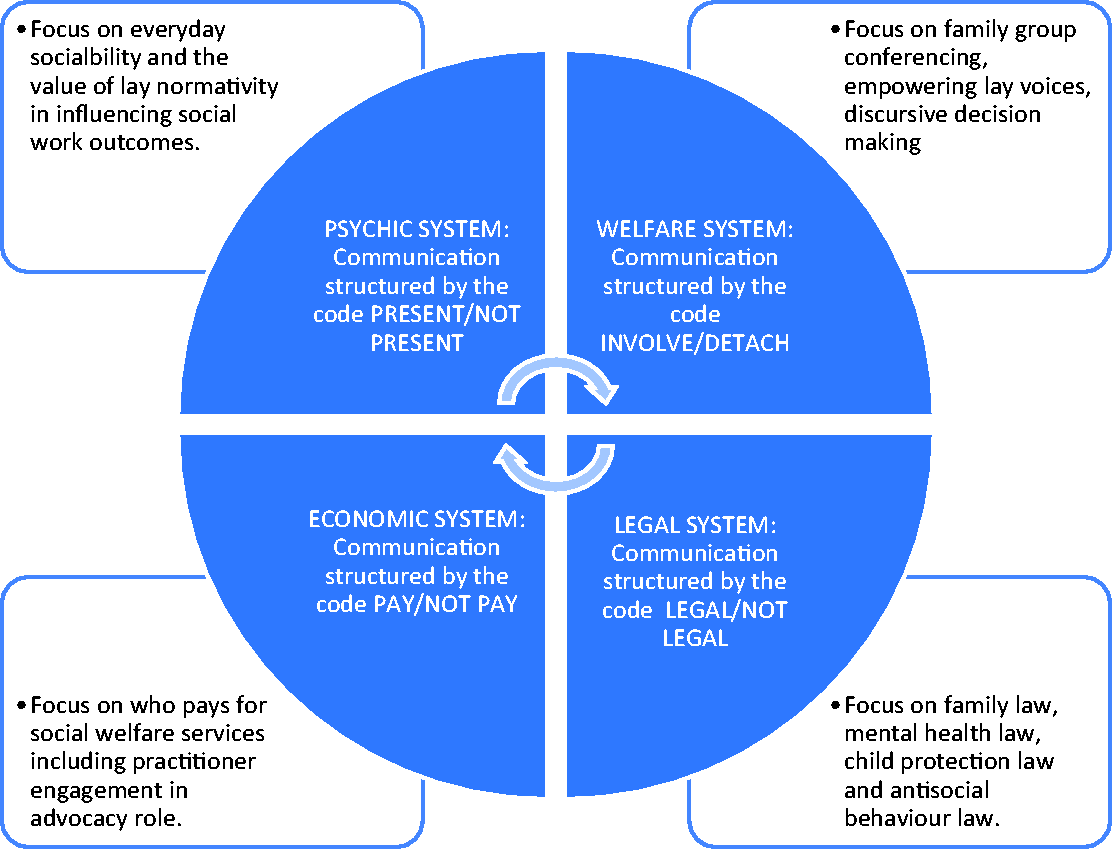
The bases of the social work/client encounter.
Concluding observations
What are the implications of Luhmann’s autopoietic systems perspective for social work practice? Because social work practice ‘builds on different kinds of relationships, from intra-personal, inter-personal, intra-organisational, inter-organisational to international’ (O’Leary & Tsui, 2019), it requires a perspective which can integrate the complexities of modern professional practice. The particular focus of this article has been on the relationship between the social worker and the client. However, it has also devoted space to placing that key relationship in the wider context of autopoietic social systems which shape and regulate social work practice. Social work is a value-based occupation which has a core commitment to humanistic practice while simultaneously being accountable to government and society for the decisions it makes in dealing with clients. As a consequence, the social worker has to consider a wide range of values: personal and spiritual, organisational, social, political and emotional. Sometimes of necessity the personal and emotional become less visceral and are usurped by the requirement that the social worker engage in what Arlie Hochschild (1979) calls emotional labour: when their counselling and befriending role has to give way to the implementation of law and public policy. The framework described here is intended to make the bases of those communications with clients more explicit and visible to aid reflective practice both in the field and at management level.
At the outset, I formulated the argument that the profession has tended to adopt an allopoietic input–output model of system functioning. Such theoretical models have a tendency to focus on attaining stability in social systems through the normative integration of the individual inside the system – individuals inside families, social workers employed inside organisations and so on – and are therefore inherently conservative. In contrast, Luhmann’s perspective places people outside the social and psychic systems they interact with. Social systems and psychic systems (people) exist in a relationship in which each exists in the environment of the other. For Luhmann this notion is not merely a theoretical convenience, it is an ontological reality. People can do no other than accept the facticity of other people, organisational systems and the complexities of how the real world operates in front of them in their cognitive environment. Some grapple with that complexity well while others are overwhelmed by it and need the support of the helping professions. This is a radical and dynamic view because it sees individuals as ‘social beings’ actively sensemaking and not as ‘socialised beings’ who, as Paulo Freire (1972) might say, are a depositary of knowledge and social values ‘banked’ in them by others. Social workers as street-level bureaucrats use discretion, exercise judgement and aim criticism at the bureaucratic systems which employ them. The humanist orientation of social work sits more comfortably with a view of the individual as a social being exercising free will whose individuality, identity and differences are to be appreciated rather as an under-socialised ‘deviant’ who requires to be corrected.
Footnotes
Ethics
No formal ethical approval was required for this article.
Funding
The author received no financial support for the research, authorship, and/or publication of this article.
Acknowledgements
The author wishes to thank the anonymous reviewers for helpful comments on a previous version of this article.
