




Abstract
This study investigates which critical success factors enable knowledge management activities in tourism SMEs and how organizational learning mediates the knowledge management-financial performance relationship. Using an online survey of tourism SME managers (n = 100, predominantly Finnish), we found that organizational learning fully mediates the relationship between knowledge management activities and financial performance, with no direct effect observed. Human resource management emerged as the most influential critical success factor, followed by strategy, resources, and information technology, while management leadership, culture, and measurement showed no significant effects. These findings extend the knowledge-based view of the firm by establishing organizational learning as the essential mechanism through which knowledge management generates financial returns in tourism SMEs, revealing contextual specificity in critical success factors within the tourism SME context and demonstrating that simplified linear models assuming direct knowledge-performance linkages may not apply universally.
Keywords
Introduction
“Knowledge is power” – Thomas Hobbes
Understanding knowledge management (KM) within small- and medium-sized tourism enterprises (SMTEs) specifically is critically important for several reasons. First, tourism is fundamentally a knowledge-intensive service industry where employee knowledge directly shapes service quality and customer experiences (Iqbal et al., 2023). Tourism relies on employees continuously applying, sharing, and updating their knowledge in real-time customer interactions (Nguyen and Malik, 2022). However, tourism, unlike manufacturing, is not able to embed knowledge into the products (Feng et al., 2017) but relies on people in delivering the service. Second, tourism SMEs face unique knowledge challenges including high staff turnover, seasonal employment patterns, and the need to integrate tacit experiential knowledge with explicit operational procedures (Duarte Alonso et al., 2022). Third, organizational learning represents a prerequisite for advancing tourism SMEs toward both digital transformation and sustainable development (Schönherr et al., 2023), yet the sector’s characteristically slow adoption of digital processes suggests systematic KM approaches are urgently needed. Fourth, the highly fragmented nature of the tourism industry, dominated by micro and small enterprises with limited formal management structures, means that KM practices developed for larger organizations may not be directly transferable, necessitating context-specific research (Durst et al., 2023).
In the digital age, organizational competitiveness depends much more on the management of knowledge than on the management of tangible resources (Payal et al., 2019). The knowledge-based view (KBV) of the firm claims that there is a wide range of variables relating to knowledge acquisition, conversion, application, and protection that may directly influence both a firm’s financial performance (FP) and other organizational outcomes (Stoian et al., 2024). Knowledge can, however, be understood as a resource that organizations can manage (Stoian et al., 2024). Indeed, knowledge management (KM) is widely considered to be a vital process for any organization. Successful KM can increase customer value creation (Duarte Alonso et al., 2022), innovation and FP (Kim and Shim, 2018). The effective use of KM is, however, considered a significant challenge for small- to medium-sized enterprises (SMEs), especially those in the tourism industry, primarily because they tend to lack the resources required to conduct KM activities effectively (Kim and Shim, 2018). Sima et al. (2024) highlight that while KM is well-studied in large organizations, SMEs are often neglected despite facing unique resource constraints.
While individually small, SMEs can generate a massive combined economic footprint (Rao et al., 2023). In Finland, where the present study is set, 54.1% (541 billion euro) of the total turnover of companies is generated by SMEs (Yrittäjät, n.d.). SMEs employ up to 74% of jobs in the tourism industry in Finland, and thus their success has a significant national impact (Visit Finland, 2023). The European Union (2024) considers SMEs to be the backbone of Europe’s tourism industry. At the same time, it is widely recognized that tourism SMEs are challenged by digital transformation and increasing sustainability expectations. It can be argued, however, that as long as it is correctly utilized, KM can help tourism SMEs meet these challenges.
It is already widely accepted that knowledge is important for FP in particular (Stoian et al., 2024). While KM rarely turns directly into FP, it is often mediated by factors such as innovation (Kim and Shim, 2018) or organizational learning (OL) (Obeso et al., 2020). The details of the KM process for tourism SMEs are, however, still not fully clear. What are the critical success factors (CSF) that enable KM to have a positive impact on FP? How do KM activities turn into FP? How is the connection between KM and FP mediated by OL? We answer these questions by combining CSF, KM activities, and OL into one model to explain the FP of tourism SMEs.
While OL has often been found to have a positive relationship with SME performance (Obeso et al., 2020), a recent study by Yang et al. (2022) found no such relationship. Thus, additional research is needed, especially from different contexts. While previous SME studies have examined KM, OL, and performance relationships (Mohaghegh et al., 2024; Obeso et al., 2020), this study makes a distinct contribution by integrating seven CSFs as antecedents of KM within a single model, specifically examining their differential importance in the under-researched tourism SME context. The aim of this paper is to contribute to the literature by providing further evidence on the importance of OL in mediating the connection between KM and FP. The paper also aims to expand on current research (Obeso et al., 2020) by incorporating critical success factors (CSFs) into the KM model to explain what kind of organizational functions in tourism SMEs support successful KM. Importantly, while previous research has typically confirmed the significance of established CSFs across general SME contexts, this study adopts an exploratory confirmation approach to test whether these factors apply equally within the specific tourism SME context, where service delivery characteristics and resource constraints may create unique dynamics.
Literature review
Knowledge-based view of the firm and knowledge management
KM is a management tool for organizations to develop strategies to ensure that individuals in the organization have appropriate knowledge (Iqbal et al., 2023). The role of knowledge in determining organizational performance has long been recognized (Durst et al., 2024). Studies have, however, tended to focus on large organizations (Sima et al., 2024). This is despite SMEs being widely recognized as key drivers of economic growth in many economies (Narayanan et al., 2023). More research is therefore needed to explore the specificities of KM within SMEs (Sima et al., 2024). It can also be argued that the relationship between KM and FP remains underexplored, especially in the context of tourism SMEs (Do and Mai, 2022).
The KBV of the firm posits that knowledge resides within individual people and the fundamental role of a firm is to integrate the specialist knowledge of its employees (Grant, 1996; Magno et al., 2017; Nonaka, 1994). This has significant implications for organizational capabilities, design, and ultimately, competitiveness (Stoian et al., 2024). Firm performance is thus intrinsically linked to an organization’s ability to create, store, integrate, apply, and absorb knowledge effectively (Magno et al., 2017). It is crucial to understand how organizations support the integration of knowledge (Stoian et al., 2024). Understanding these dynamics is especially crucial in the case of SMEs, as such organizations must strategically focus their limited resources on KM practices that yield the greatest value (Duarte Alonso et al., 2022).
The remainder of this section will consider the role of KM in an organizational context. A summary of the literature on the seven critical success factors of KM will then follow. The role of these factors as antecedents of KM activities forms hypotheses H1 to H7 of this study. A summary of the literature on the links between KM activities, OL, and FP will then be presented. The relationship between KM activity and the FP of the organization forms H8, while the relationship between KM activity and OL will be H9. These nine hypotheses are summarized in Figure 1. Theoretical framework.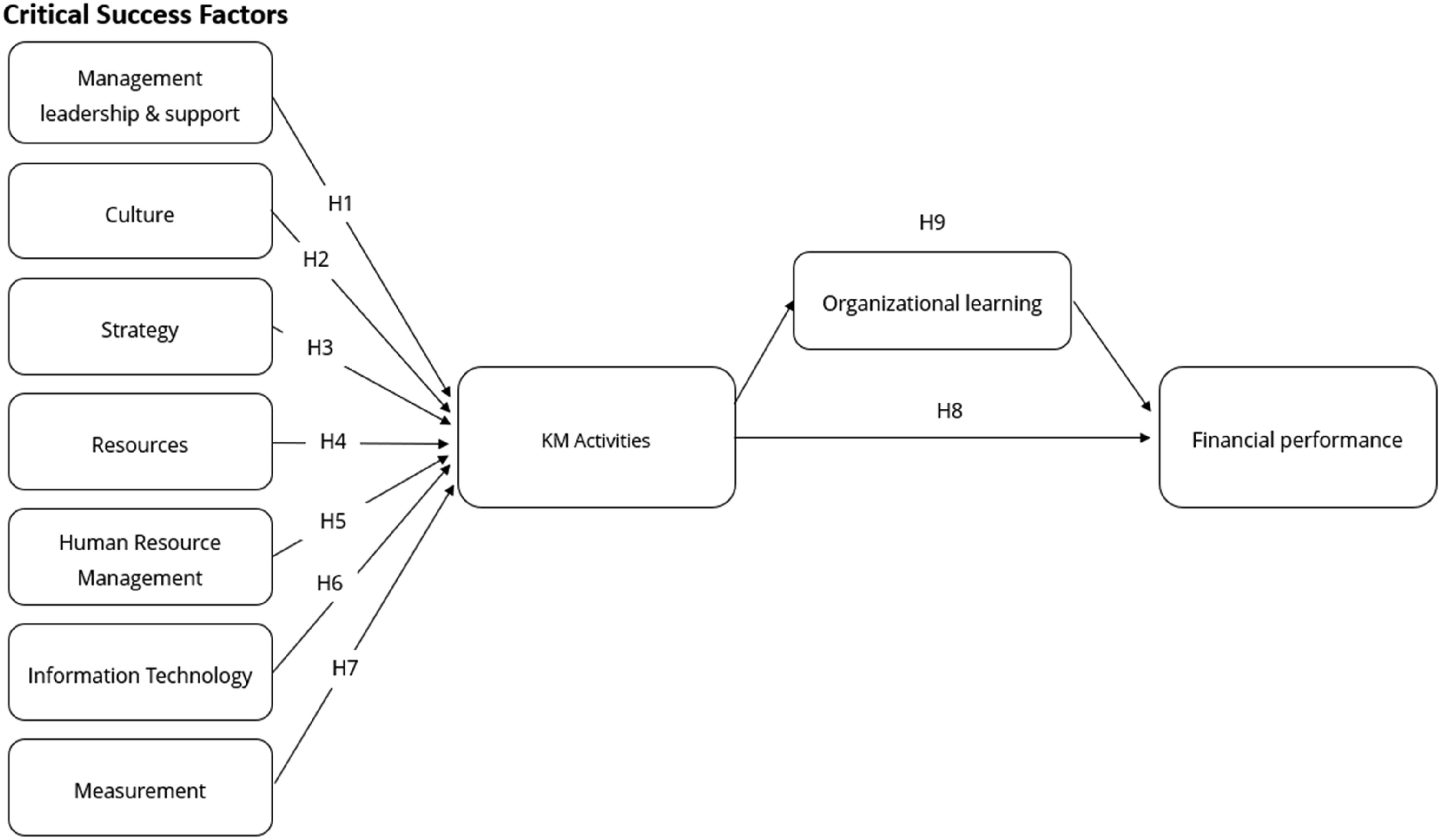
Critical success factors of knowledge management
CSFs (also known as KM success variables, see Alam, 2025) can be understood as organizational mechanisms that address the five fundamental characteristics of the KBV (Duarte Alonso et al., 2022; Rao et al., 2023). Alam (2025) identified 34 factors that support successful KM using a systematic literature review. This suggests that effective KM in SMEs requires simultaneous attention to multiple enablers that collectively address the various dimensions of knowledge as a strategic resource. Moreover, it implies that the absence or weakness of some enablers may create bottlenecks that have negative effects on KM activities. While there a significant number of enablers that could have been included in this study, the choice was based on those that have been found significant factors in earlier research (Alam, 2025). The remainder of this section, therefore, considers the 11 CSF variables for SMEs that were identified, tested and validated by Wong (2005) and also used in recent studies (Giampaoli et al., 2024; Jordão and Novas, 2024). This list has formed the basis of later studies that have found empirical support for such variables as significant determinants of KM success among SMEs (Rao et al., 2023). The present study sets out to test and verify their appropriateness in the more specific context of tourism SMEs.
Although these seven CSFs may exhibit some conceptual overlap in SME contexts, their retention in this model is justified on several grounds. First, Wong’s (2005) framework provides a theoretically grounded and empirically validated foundation that enables comparison with previous research. Second, retaining all factors allows the study to identify which CSFs are most relevant, specifically within the tourism SME context, where sector-specific characteristics may alter the relative importance of different enablers. Third, this comprehensive approach serves an exploratory confirmation purpose: rather than assuming which factors matter, the study empirically tests all established CSFs to determine which ones demonstrate significance in this particular context. This approach directly addresses the recognition that CSF importance varies across different organizational contexts and sectors (Alam, 2025).
Management leadership and support
Support and commitment given from senior management is widely understood to play an integral part in a company’s KM efforts. Leading by example is considered important, as company leaders often serve as role models (Rao et al., 2023). Shaik et al. (2024) emphasize that a leadership team committed to making KM a strategic priority is essential for fostering a culture that rewards information exchange. Past studies have shown that both monetary or non-monetary incentives can motivate employees to contribute to KM activities, and especially non-financial incentives can be effective (Vesal et al., 2024). Giampaoli et al. (2024) found that KM practices (which include management-led aspects like work design and culture) positively impact intellectual capital and performance in Italian SMEs. Ghasemi and Valmohammadi (2023) also identified that leadership commitment and support were among the top CSFs of KM implementation.
Management leadership and support have a positive effect on KM activities.
Culture
Previous studies have found organizational culture to be a key factor in the successful implementation of KM. It influences the beliefs, norms, values and behaviors that shape employee actions (Jordão and Novas, 2024). A positive culture can facilitate knowledge sharing (Alam, 2025). Research has identified various elements of organizational culture as being vital for effective KM, including trust, collaboration, a learning culture, and openness (Narayanan et al., 2023). Trust is considered foundational to KM initiatives, as the transfer of specialized knowledge is effectively promoted by relationships based on trust and reciprocity (Jordão and Novas, 2024). Collaboration, which is closely tied to trust, has been linked empirically to supporting KM activities in both SMEs and larger organizations (Giampaoli et al., 2024; Narayanan et al., 2023). Other key elements of a learning culture include tolerance of mistakes and openness to innovation (Shaik et al., 2024), as knowledge generation relies on a company’s ability to embrace new ideas (Lee and Wong, 2015). The following hypothesis is therefore proposed:
Culture has a positive effect on KM activities.
Strategy
Another possible success factor is a clear, well-defined KM strategy (Alam, 2025). This is needed to provide strong direction for how a company is to leverage its KM capabilities to best effect (Rao et al., 2023). An effective KM strategy outlines the needs, methods, and activities required to achieve specific goals (Shaik et al., 2024), and it must be aligned with the organization’s overall business strategy to promote long-term competitiveness (Alam, 2025; Lee and Wong, 2015). Without a clear KM strategy, organizations risk wasting resources on activities that fail to add value (Lee and Wong, 2015). A well-elaborated KM strategy will also serve to build awareness and commitment among the organization’s employees for its various KM activities (Lee and Wong, 2015). While strategy is widely believed to be a critical success factor for effective KM in SMEs, this hypothesis has rarely been empirically tested. A complicating factor is that many such studies include both SMEs and larger firms in their samples (Durst et al., 2023). The importance of strategy is also highlighted by Stoian et al. (2024), who discuss the strategic necessity of knowledge for international business and competitive advantage. The following hypothesis is therefore proposed:
Strategy has a positive effect on KM activities.
Resources
Successful KM requires adequate tangible resources (Rao et al., 2023). Developing KM infrastructure or systems often poses a financial challenge, however, and this is especially the case for SMEs, which typically face severe resource constraints (Lee and Wong, 2015). Beyond tangible resources, effective KM also demands the application of management effort and time: two intangible resources that SMEs often lack (Shekhar and Valeri, 2023). The task of implementing KM typically falls on already overburdened owner-managers or key employees (Lee and Wong, 2015). It is evident from the literature, however, that the role of resources has largely been overlooked in the context of SMEs with a focus on physical resources (Rao et al., 2023). Mohaghegh et al. (2024) claim that investing in organizational resources can enhance firm performance. The following hypothesis is therefore proposed:
Resources have a positive effect on KM activities.
Human-resource management
The KBV identifies people as the fundamental source creators of new knowledge. It is therefore important to recognize the value of effective HRM in the KM context (Rao et al., 2023). Recruitment can be considered a critical activity, as it brings new knowledge, skills, and expertise into the organization (Rao et al., 2023). Employee retention is also a critical area of HRM as it relates to KM (Battisti et al., 2022; Rao et al., 2023). The ability of business organizations to retain knowledge can be significantly undermined when key employees leave, risking the loss of valuable organization knowledge. Offering long-term career development opportunities can encourage employees who wish to develop their careers to remain, keeping their knowledge within the organization (Lee and Wong, 2015). Fostering a positive, rewarding work environment is important to ensure job satisfaction and encourage employees to remain committed, thus safeguarding core knowledge (Shaik et al., 2024).
Research on the role of HRM in enabling KM within SMEs remains limited. Islam (2014) found that knowledge-based human resources did not significantly affect hotel SME performance but had a significant positive impact on innovation. Kaldeen and Nawaz (2020) found that HRM positively impacted the KM process, but this did not have a direct impact on organizational performance. Petrov et al.’s (2019) study of SMEs examined the relationship between knowledge and three organizational pillars – marketing, strategy, and HRM practices – finding that all three positively influenced KM, with HRM having the strongest effect. Accordingly, the following hypothesis is proposed:
HRM has a positive effect on KM activities.
Information technology support
Studies generally support the view that IT is a critical component of effective KM. Over the years, the role of IT has evolved from it being a simple information repository to it becoming a powerful facilitator of human-to-information, information-to-human and human-to-human exchanges (Yan et al., 2023). IT enables rapid information search and easy access to knowledge, and fosters collaboration and communication among employees (Alam, 2025). IT can be essential in supporting and coordinating KM activities (Shekhar and Valeri, 2023). The KM activities of SMEs often occur informally, which, along with limited resources, might explain why SMEs often invest only in basic IT (Lee and Wong, 2015). Cerchione and Esposito (2017) found that even high-tech SMEs typically use traditional IT tools such as email, databases, document management, and cloud computing systems. More advanced tools such as data mining, collaborative filtering, and data-visualization are not widely used by SMEs, despite them being increasingly affordable and user-friendly.
Empirical studies consistently highlight the significant role of IT support in facilitating KM activities. Narayanan et al. (2023) demonstrated that IT support had a positive and significant impact on KM processes among SMEs across both small and large firms. Valaei et al. (2017) further explored the role of IT support for each specific KM activity (i.e. knowledge acquisition, conversion, application, and protection) in SMEs, concluding that IT was one of the most important enablers along with organizational structure. ICTs connect employees, facilitate conversations and reduce the perceived cost of sharing knowledge (Giampaoli et al., 2024). The following hypothesis is therefore proposed:
IT support has a positive effect on KM activities.
Measurement
Rao et al. (2023) state that the value of KM can be misjudged if it is not properly measured. Indeed, measuring KM can help organizations assess its impact and identify key success factors (Migdadi, 2009). Without measurement, organizations will struggle to make informed decisions about how to refine, expand or discontinue their various KM activities (Wong et al., 2015). Measurement not only helps to ensure continuous improvement but also to maintain owner-managers’ confidence in KM initiatives (Lee and Wong, 2015). While measuring the direct financial impact of KM can be challenging, it remains crucial in assessing how KM influences overall FP (Alam, 2025).
The role of measurement as an enabler of KM has largely been underexplored in the SME context. One reason could be Wong and Aspinwall’s (2005) findings, in which SME owners and managers ranked measurement as the least-important enabler of KM. Measurement may have been downplayed by SME owners and managers in Wong and Aspinwall’s (2005) study because it is typically applied after the implementation of KM, serving more as a monitoring tool than an enabler of such activities. SMEs may also have lacked the expertise to effectively carry out such activities. Measurement capabilities have, of course, advanced significantly since then, and their importance is now more widely recognized (Rao et al., 2023). However, Ramos Cordeiro et al. (2024) have recently identified that that there still are difficulties in the use of management tools. The following hypothesis is therefore proposed:
Measurement has a positive effect on KM activities.
Knowledge-management activities
The CSFs noted above provide the infrastructure for the smooth flow of knowledge within organizations, while KM activities – also referred to as the KM processes (Obeso et al., 2020) or knowledge process capabilities (Lee and Lan, 2011) – comprise the operations needed to manage knowledge within an organization (Obeso et al., 2020). These factors may enable or hinder KM activities (Alam, 2025). KM activities include tasks such as knowledge acquisition, creation, sharing, and utilization.
Various frameworks have been proposed to organize the dimensions of the KM activities variable (Battisti et al., 2022; Gold et al., 2001; Kamhawi, 2012; Obeso et al., 2020). It can be argued, however, that Gold et al.’s (2001) classification system is still relevant. The framework identifies four key dimensions of KM activities – knowledge acquisition, conversion, application, and protection – and has been validated for SMEs by Lee and Lan (2011). Narayanan et al. (2023) also used these dimensions to examine the relationship between KM enablers and KM processes, as well as their impact on organizational performance. The present study will therefore adopt these four components of KM activity. These are also fairly similar to Battisti et al. (2022), who define acquisition, creation, documentation, transfer and application as key KM activities or Hafeez et al. (2025), who describe the process as knowledge exploration, internalization, and utilization.
Research findings on the relationship between KM dimensions and organizational performance have often been ambiguous (Heisig, 2014). While some studies explore KM activities as a holistic variable and their effect on organizational performance (Narayanan et al., 2023), others examine the dimensions individually (Mills and Smith, 2011). The empirical evidence tends to be strongest, however, when KM processes are included as a single undifferentiated variable (Bharadwaj et al., 2015).
In the SME context, research on the holistic effect of KM on organizational performance remains limited (Narayanan et al., 2023), although recent studies have begun to address this gap. Islam (2014) and Kaldeen and Nawaz (2020) have examined KM among SME hotels. Their studies both conclude that KM process capability, when viewed as a single integrated construct, positively influences hotel performance. Kusa et al. (2024) investigated the impact of KM and information management on entrepreneurial orientation and SME performance, specifically distinguishing between competitiveness, growth, and financial outcomes. Their empirical results demonstrated that while KM had significant positive effects on ‘firm competitiveness’ and ‘firm growth’, it showed no direct significant impact on ‘financial performance’. As such, Kusa et al. (2024) suggest that KM activities do not necessarily directly enhance all aspects of organizational performance, particularly financial results in the short term. Thus, the following hypothesis is therefore proposed:
KM activities have a positive effect on an organization’s FP.
Organizational learning
Organizational learning is considered essential for any business organization to remain competitive (Ding et al., 2023). Those failing to cultivate OL will miss critical opportunities for improvement and growth and will struggle to remain competitive. Learning within an organization begins at the individual level but can occur simultaneously at both individual and organizational levels (Rehman et al., 2015). Learning at the organizational level focuses on the integration of knowledge that can be used to improve the organization’s performance (Wu and Chen, 2014). This is achieved by organizations ‘learning’ how to adapt their thinking and practices (Obeso et al., 2020). The relationship between KM activity and OL is considered complex. It has been argued that newly acquired knowledge must be effectively harnessed through a process of OL before it can be used to improve performance (Wu and Chen, 2014). Studies indicate that OL not only determines organizational performance (Rehman et al., 2015) but also mediates the link between KM activities and organizational performance (Yang et al., 2022). Accordingly, the following hypothesis is proposed:
OL positively mediates the effect of KM activities on FP.
Financial performance
Earlier studies on the impact of KM and FP can be divided into two groups. There are studies that examine the direct connection (e.g., Battisti et al., 2022). There are also studies that examine the connection between KM and FP or organizational performance through innovation (e.g. Singh et al., 2021) or other possible mediating variables, such as innovation capability, innovation speed, employee creativity, collaboration, competitive advantage, and OL (Obeso et al., 2020). In the tourism and hospitality context, Salem (2014) studied KM capabilities in hotels, finding that knowledge-based technology, structure, and culture all positively correlated with organizational performance, although human-resource-related KM was not statistically significant. Kaldeen and Nawaz’s (2020) study of the KM capabilities of hotels, meanwhile, found that culture and IT were positively linked to organizational performance, while human resource management (HRM) did not have a strong impact. Iqbal et al. (2023) showed that KM has no significant effect on tourism SME business recovery after a disaster. As there is no established set of metrics for assessing the impact of KM on firm performance, the existing literature has employed both financial and non- FP metrics (Stoian et al., 2024). Most studies adopt an aggregated approach, combining both financial and non-financial indicators into a single metric (Ha et al., 2021). Indeed, some scholars argue that financial indicators alone are insufficient to fully capture firm performance (Wong et al., 2015). When referring to an organization’s FP, the focus is typically on its economic and monetary status (Migdadi, 2020). In this study, FP will be evaluated using four key indicators drawn from the existing literature: profitability, financial results, net profit margin, and sales growth (Migdadi, 2020).
Methodology
Research method and sample
An online survey method was adopted to collect data from tourism SMEs. Online surveys are popular in KM literature due to their ease of quantification and suitability for statistical analysis (Lee and Wong, 2015). The target population comprised owners and managers of tourism SMEs. These individuals are typically ‘thought leaders’ within the SME in terms of KM and usually oversee key business operations.
Measurement and questionnaire development
Validated items from the KM literature were used to create a context-specific questionnaire. This approach not only enhances content validity and reliability but also allows for more consistent comparisons and clearer insights into the study’s contributions (Rehman et al., 2015). As such, the study employed measurement items adapted from Lee and Wong (2015), which validated scales for five of these constructs specifically in the SME context (i.e., ‘Management leadership & support,’ ‘Culture,’ ‘Strategy,’ ‘Resources,’ and ‘HRM’). Since Lee and Wong’s (2015) model did not include items for ‘Measurement’ or ‘IT,’ these were drawn from Lee et al. (2012) and Wong (2005) respectively. For the purposes of consistency, the measurement scales used by Lee and Wong (2015) were replaced with five-point Likert scales ranging from 1 = Strongly disagree to 5 = Strongly agree (as used, for example, by Obeso et al., 2020; Iqbal et al., 2023).
The high-order construct ‘KM activities’ (i.e., knowledge acquisition, conversion, application, and protection) was operationalized using established items and scales from Valaei et al. (2017). The mediating variable ‘Organizational learning’ was measured by adapting the four-items and scales from the SME study of Obeso et al. (2020). A five-point Likert scale was used instead of seven-point Likert scale to maintain consistency. For the ‘Financial performance’ construct, measurement items were adapted from Migdadi (2020), while answer scale options were sourced from Martin-Rojas et al. (2013) to assess the firm’s performance relative to key competitors. The answer scale used to evaluate FP relative to competitors comprised: 1 = Much worse, 2 = Somewhat worse, 3 = Stayed the same, 4 = Somewhat better, and 5 = Much better. Self-reported performance measures, while common in SME research due to difficulties in obtaining objective financial data, may be subject to perceptual bias as respondents may overestimate or underestimate their firm’s performance relative to competitors. This approach, however, has been shown to correlate reasonably well with objective financial measures in SME contexts (Vij and Bedi, 2016).
The survey was pretested by two academic researchers at University of Eastern Finland and three professionals working in a Finnish market research agency. Some modifications were made accordingly, including wording-style changes to some measurement items to increase their face validity. The questionnaire was released in both Finnish and English. The English questionnaire was first translated into Finnish and then translated back to check for consistency.
Data collection
The survey was administered online between February 14 and March 12, 2024, using a non-probabilistic sampling method. The survey was administered following the research integrity guidelines provided by the Finnish National Board on Research Integrity (TENK, 2024). Data collection involved sharing the survey in various professional groups on social-media channels such as LinkedIn and Facebook. The authors also advertised the survey on their own LinkedIn networks. Researchers utilized their networks among Finnish DMOs, municipalities and tourism companies agreed to distribute the questionnaire in their own social-media channels. Finally, the email addresses of companies listed on the websites of various Finnish DMOs were collected, and almost 1,000 emails were sent to management-level employees asking them to complete the survey. This data-collection approach heavily skewed the results towards Finnish tourism SMEs. Even so, the Nordic tourism industry is heavily dominated by SMEs operating in resource-constrained environments, thus providing a suitable context for the goals of this study.
We acknowledge that the predominantly Finnish sample means that findings should be interpreted as context-specific to this particular national and sectoral environment. Finnish tourism SMEs operate within distinct institutional frameworks, cultural norms, and market conditions that may differ from tourism SMEs in other countries. Consequently, while the findings provide valuable insights for similar Nordic and European contexts, generalization to other regions should be approached with caution. While 620 people opened the survey link, with 196 starting to complete it, 61 respondents abandoned the survey midway, implying a 31% drop-out rate. The responses from the 135 remaining participants were then entered into SPSS for the purposes of data cleaning, variable transformation, and to calculate the sample characteristics. Of the 135 respondents who completed the questionnaire, 35 were ineligible because they were not from tourism SMEs. The final sample, therefore, comprised 100 respondents: all from tourism SMEs.
Data-analysis procedure
Structural equation modelling (SEM) techniques are among the most widely used methods in KM research. SEM integrates two types of statistical analysis: exploratory factor analysis and structural path analysis. This allows SEM to simultaneously assess both a measurement (outer) model and a structural (inner) model (Hair et al., 2014). Partial least-squares structural equation modelling (PLS-SEM) was used in this study in preference to covariance-based SEM because it is considered superior for modelling complex structural paths. A minimum sample size of 100 respondents is recommended for PLS-SEM analysis. With such small sample sizes, the generalizability of the results may be limited but the results can nevertheless be robust (Willaby et al., 2015). PLS-SEM is also preferred when testing structural models with formative constructs (Hair et al., 2019), as is the case in this research. The analysis was conducted using Smart PLS 4.0 software. This included a mediation analysis to explore whether OL mediates the relationship between KM activities and FP. This study followed the approach outlined by Hair et al. (2017), which is widely used in PLS-SEM studies.
Results
The results of the study will now be set out, beginning with an exploration of the sample. The results of the analysis of the measurement model will then be presented, followed by an assessment of the structural model. The results of the mediation analysis will then be set out.
Structure of the sample
In terms of demography, slightly more respondents (57%) were females, which was expected since females tend to be well-represented in the ownership and management of tourism SMEs. Just over half the respondents (53%) were in the 35–54 age group, which again is to be expected given that being in a position of management seniority was a requirement of completing the questionnaire.
Given that the target population in the study was tourism SMEs, all were operating at least partially in the tourism industry. Tourism was the major source of revenue for 85% of companies and a minor source for the rest. The two most-frequently covered tourism services were accommodation (60%) and food and beverage services (53%), while a quarter of the companies provided sports and recreational services. In terms of company size, 79% were small-sized companies, while 21% were medium-sized companies. Given the highly fragmented structure of the tourism industry in most countries, this was not unexpected. Only 11% of companies operated in multiple countries. Almost all operated in Europe (95%).
Measurement model assessment
PLS-SEM analysis begins with the assessment and validation of the measurement model (Hair et al., 2019) and when all the required criteria in the measurement model assessment stage are met, the researcher can proceed to assess the structural model by testing the relationships between the research constructs (Hair et al., 2017).
Stage one: Validation of the lower-order constructs
Construct reliability and validity of the LOCs.
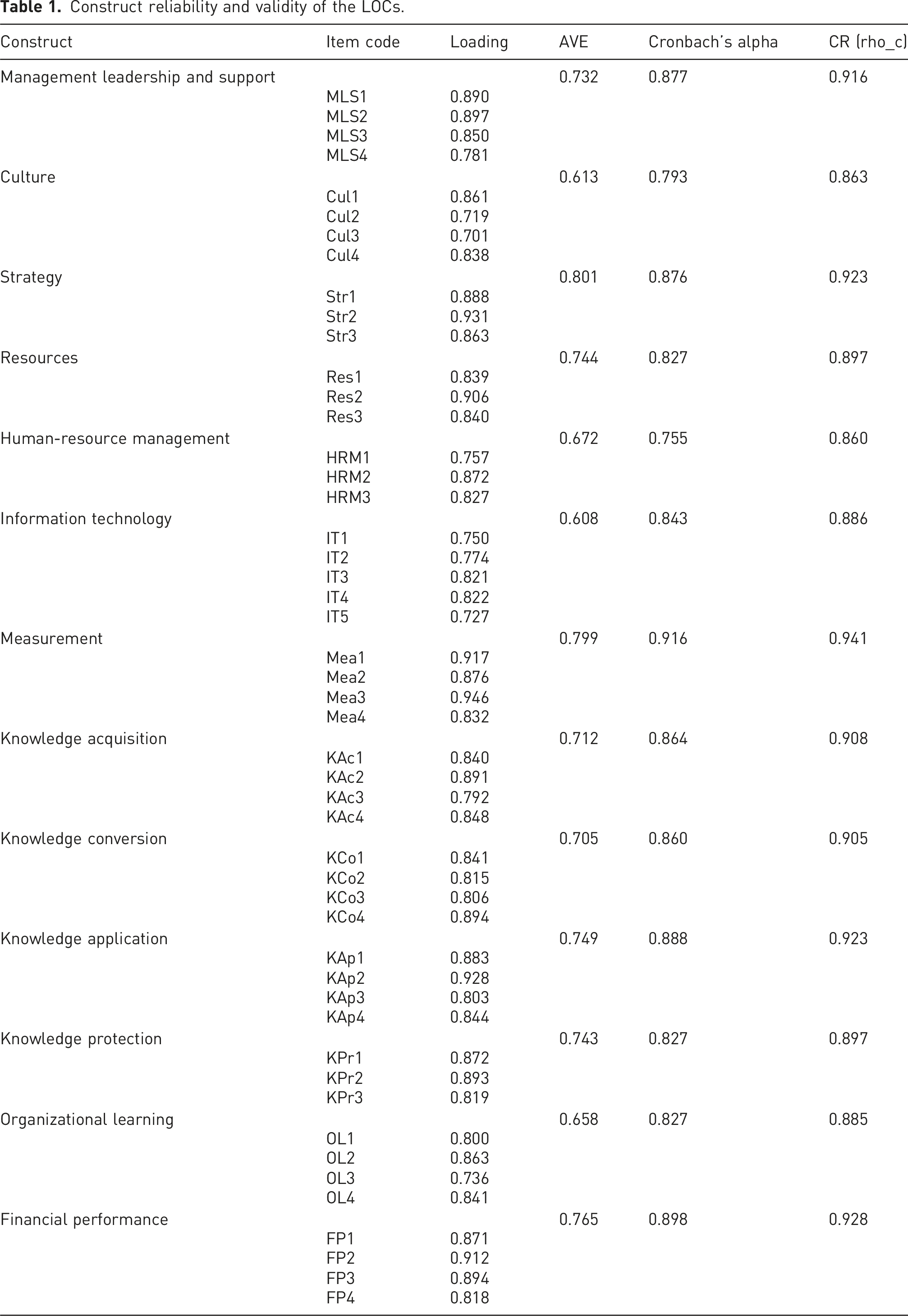
Henseler et al. (2015) argue that the heterotrait-monotrait (HTMT) ratio is the preferred approach for assessing discriminant validity in PLS-SEM studies. All the HTMT values of the lower-order constructs were less than 0.85, thus confirming discriminant validity of the measurement model (Hair et al., 2022).
Stage two: Validation of the higher-order construct
Higher-order construct validity.
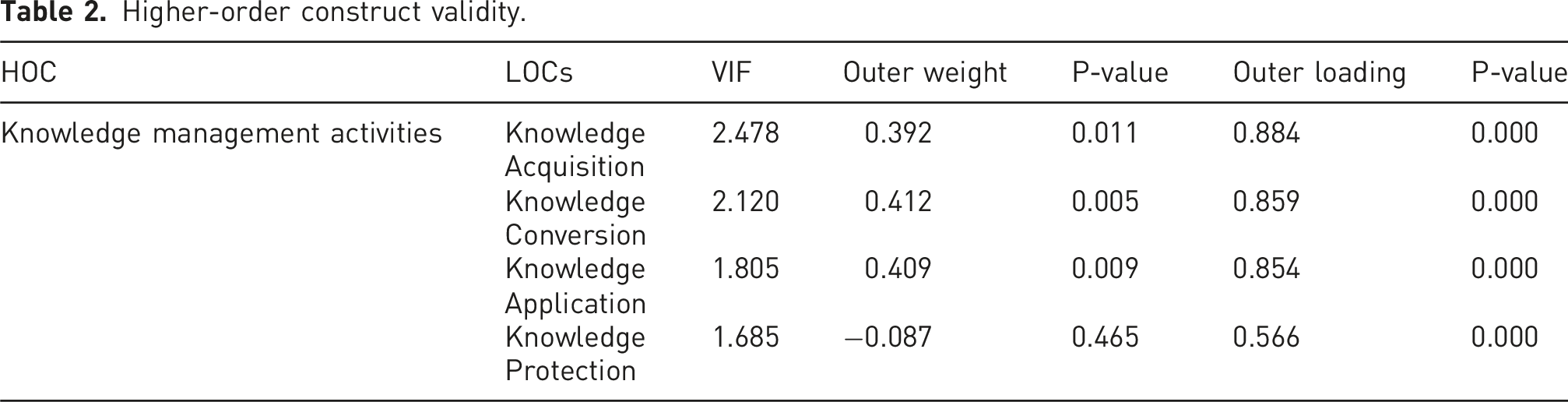
The outer weights of the model were assessed to evaluate the importance of each indicator in the formative measurement model. Bootstrapping was used to assess the statistical significance and relevance of the outer weights (Hair et al., 2019). The outer weights for ‘Knowledge acquisition’ (0.392, p = 0.011), ‘Knowledge conversion’ (0.412, p = 0.05) and ‘Knowledge application’ (0.412, p = 0.05) were found to be statistically significant (p < 0.05) and also their relationships with ‘KM activities’ was strong, while the outer weight of ‘Knowledge Protection’ (−0.087, p-value: 0.465) showed a weak negative relationship, with the weight not being statistically significant (p > 0.05). When an indicator’s outer weight is not significant, a case for its continued inclusion should be assessed. Hair et al. (2017) suggest that an indicator should only be removed if its outer loading is 0.5 or less. On this basis, ‘Knowledge protection’ was retained. Another supportive rationale is content validity, as ‘Knowledge protection’ has been included by several other studies in the literature (Narayanan et al., 2023). Removing one indicator from the domain of KM activities would risk compromising its content validity.
Structural model evaluation
Assessment of direct relationships.
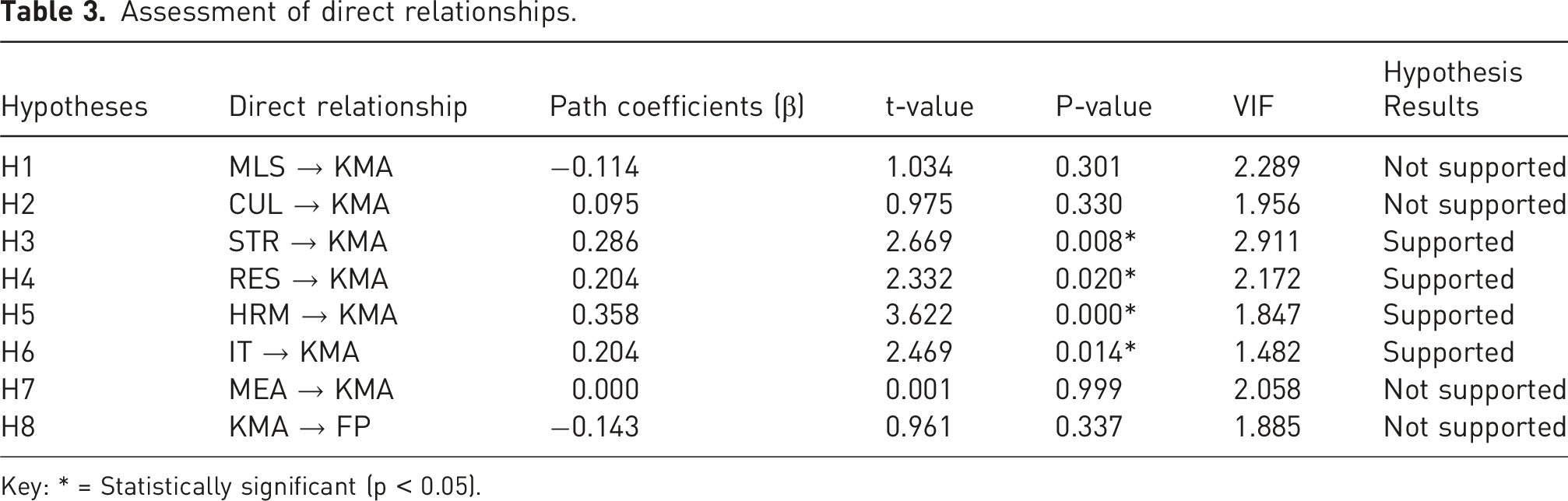
Key: * = Statistically significant (p < 0.05).
Following Sarstedt et al. (2019), bootstrapping was then undertaken in Smart PLS 4.0 using 5,000 subsamples, a two-tailed test, and percentile intervals. Following common practice, a significance threshold of p < 0.05 was applied (Hair et al., 2017).
The results indicate that ‘HRM’ has the highest path coefficient (β = 0.358), making it the strongest predictor with a positive relationship to ‘KM activities.’ The p-value was less than 0.05, supporting H5. Other predictors of KM activities that showed positive relationships, and statistically significant results comprised ‘Strategy’ (β = 0.286), ‘Resources’ (β = 0.204), and ‘IT’ (β = 0.204). Thus, H3, H4 and H6 respectively were also supported. Based on these results it can be said that the most important CSFs for predicting the implementation of KM are HRM, strategy, resources, and IT.
The other predictors, including ‘Management leadership and support,’ ‘Culture,’ and ‘Measurement’ did not demonstrate statistical significance. Thus, hypotheses H1, H2 and H7 respectively were rejected. The final direct relationship tested in the structural model was the impact of ‘KM activities’ on ‘Financial performance.’ The results suggested that the former had a negative relationship with the latter (β = −0.143). H8 was therefore rejected.
It is important to clarify that this negative but non-significant coefficient does not indicate that KM activities have a detrimental effect on financial performance. Rather, this finding reflects the absence of a direct pathway: KM activities do not directly translate into financial outcomes, but instead require an intermediary mechanism (organizational learning, as demonstrated below) to generate financial value. The non-significance of this path coefficient (p > 0.05) means the negative direction cannot be confidently interpreted as meaningful.
Before testing the mediating impact of ‘Organizational learning’ between ‘KM activities’ and ‘Finance performance’, the structural model’s explanatory power was tested by estimating the coefficient of determination (R2) (Sarstedt et al., 2023). A commonly applied rule of thumb in PLS-SEM studies is that R2 values of 0.75, 0.5 and 0.25 are considered as substantial, moderate and weak respectively (Hair et al., 2014).
The R2 values of the endogenous variables of the study are presented in Figure 2, which presents the entire structural model of this research. The critical success factors included in the model collectively explained 66.2% of the variance of ‘KM activities.’ This implies that their explanatory power was moderate. Results of the structural model assessment with path coefficients and R2 values.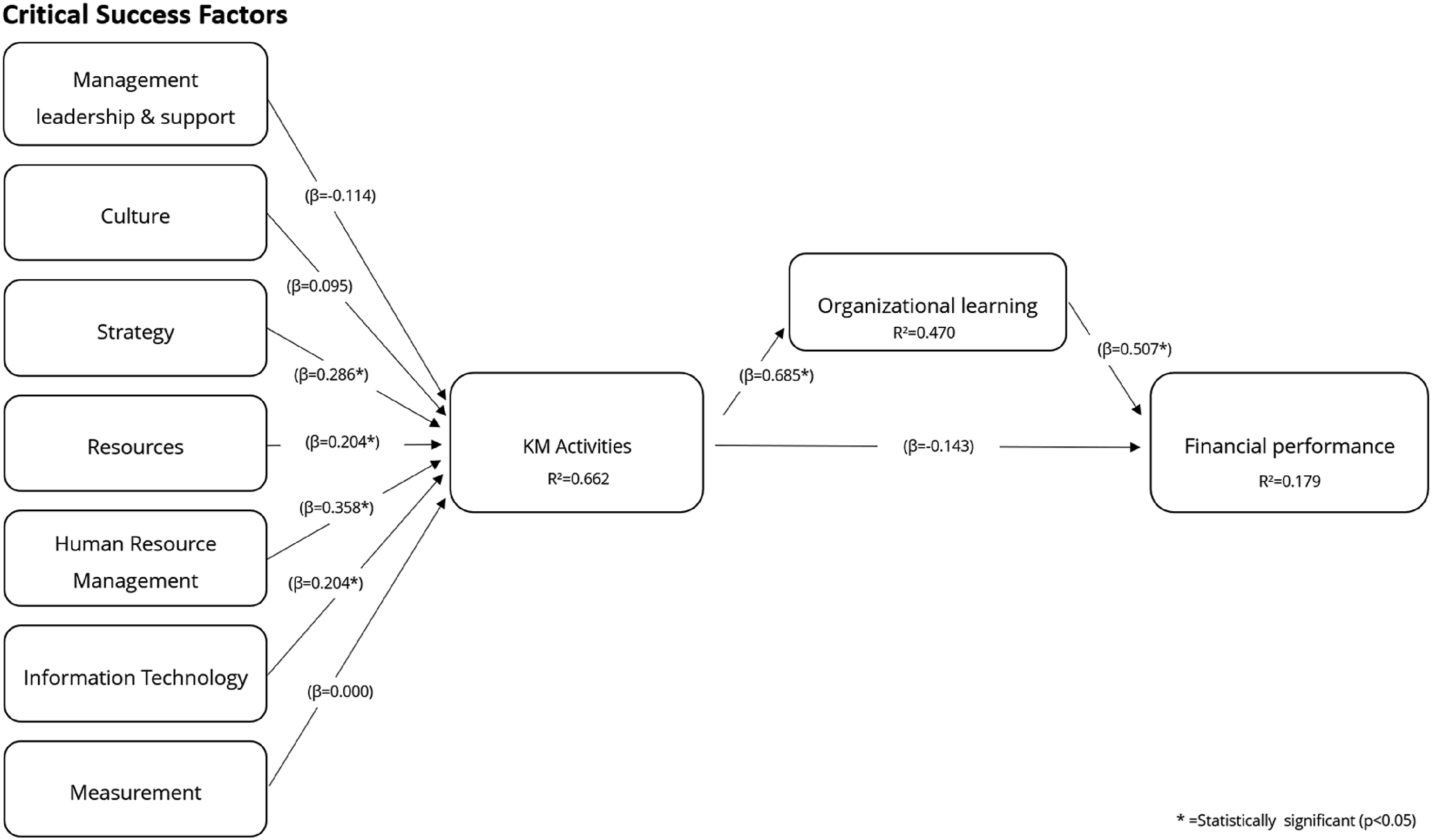
The R2 value for ‘Organizational learning’ (R2 = 0.470), meanwhile suggests a moderate explanatory power. The R2 value for ‘Financial performance’ (R2 = 0.179) was low, however, suggesting that the two predictors together have limited explanatory power for ‘Financial performance’. This was primarily due to the insignificant direct influence of ‘KM activities’ on ‘Financial performance,’ as indicated by the negative path coefficient.
Mediation analysis
Results of the mediation analysis.

Discussion and implications
Discussion
This study identified that, among tourism SMEs, not all CSFs are equally important for KM. ‘Strategy,’ ‘Resources,’ ‘IT’ and ‘HRM’ were found to be significant positive determinants of ‘KM activities,’ while ‘Management leadership and support,’ Culture,’ and ‘Measurement’ were not. ‘HRM,’ meanwhile, was found to be the most influential determinant of ‘KM activities.’ Earlier studies from SMEs have shown that in different contexts, different CSFs matter (Alam, 2025). Implementing KM in SMEs is particularly challenging due to inherent limitations such as a lack of resources (financial, time, and human expertise) and less formal processes compared to large organizations (Sima et al., 2024). Therefore, identifying and nurturing specific CSFs adapted to the SME context is vital (Shekhar and Valeri, 2023).
Notably, ‘Management leadership and support’ was not found to be a significant KM enabler, contrary to earlier SME studies (Alam, 2025; Rao et al., 2023). Similarly, ‘Culture’ did not emerge as significant despite recent findings positioning it as pivotal for KM success (Rao et al., 2023). These results warrant careful interpretation. In micro and small tourism enterprises where owner-managers often constitute the entire leadership, formal “leadership support” as conceptualized in larger organizational contexts may operate differently. It might be an embedded aspect of daily operations rather than a distinct enabler. Similarly, organizational culture in SMEs tends to be informal and personalized, potentially limiting the sensitivity of traditional measurement approaches. Alternatively, these factors may function as necessary but insufficient conditions, with limited variance across our sample constraining their statistical significance. The findings suggest that tourism SMEs may compensate for underdeveloped institutional support by relying on hiring competent personnel who succeed through factors identified as significant, such as effective strategy, adequate resources, and IT infrastructure. This compensatory pattern, rather than indicating leadership and culture are unimportant, highlights a potential vulnerability in how tourism SMEs currently approach KM.
The study did not find support for the hypothesis that ‘KM activities’ would have a direct, significant, positive effect on ‘Financial performance.’ ‘KM activities’ are typically considered crucial for organizational performance (Alam, 2025); and this study does not reject that notion: rather, it provides additional insights into how that happens. The study found that ‘Organizational learning’ fully mediated the relationship between ‘KM activities’ and ‘Financial performance.’ This aligns with the results about the importance of ‘Organizational learning’ in explaining FP (Do and Mai, 2022). Alam (2025) considers successful KM to lead to both financial as well as non-FP. The present research shows that in the context of tourism SMEs, KM might not lead directly to FP, but ‘Organizational learning’ is required to achieve FP.
This finding raises the critical question: why does OL fully mediate this relationship in tourism SMEs, with no direct effect of KM on FP? Several explanations can be advanced. First, as Obeso et al. (2020) argue, knowledge itself is inert until it is absorbed and transformed through learning processes. In tourism SMEs, where employees are the primary interface with customers, simply acquiring and storing knowledge does not automatically improve service quality or operational efficiency. The knowledge must be internalized, applied, and refined through continuous learning cycles before it translates into improved financial outcomes. Second, the service-intensive nature of tourism means that tacit knowledge is particularly important. Such knowledge cannot be directly leveraged for performance without the intermediary process of OL, which enables individuals to integrate, share, and apply this tacit knowledge collectively (Nonaka, 1994). Third, tourism SMEs typically lack formalized structures for translating KM directly into performance improvements. Unlike manufacturing firms where knowledge can be embedded into products or processes (Feng et al., 2017), tourism firms require their employees to continuously learn and adapt their behaviors, making OL the critical bridge.
Theoretical implications
This study contributes to the KBV of the firm in three ways: first, by clarifying the mediation mechanism between KM and performance; second, by challenging assumptions about universal CSFs; and third, by advancing context-specific KBV development.
Organizational learning as the essential mediator
The full mediation of OL between KM activities and FP challenges the dominant innovation-mediation pathway found in general SME research (Obeso et al., 2020). The results presented here support research showing that KM processes alone are often insignificant on performance unless mediated by knowledge utilization mechanisms (Mohaghegh et al., 2024). In tourism SMEs, where service delivery depends on employee-customer interactions, learning from knowledge appears to be a highly relevant pathway to financial outcomes. This study did not measure the role of innovations in the model utilized, but future research could potentially identify OL as crucial mediator for innovation in tourism SMEs. OL serves as a dynamic capability enabling tourism SMEs to leverage knowledge resources despite resource constraints (Stoian et al., 2024). Unlike larger firms with dedicated R&D functions, tourism SMEs tend to rely on embedded learning processes to extract value from KM efforts. While previous SME research often highlights innovation as the primary mediator (Singh et al., 2021), this study establishes organizational learning as the essential for tourism SMEs. This suggests that for service-intensive SME firms, the ability to internalize tacit knowledge through learning is more critical for financial returns than the mere existence of KM processes. Higher levels of organizational learning can substitute for missing KM processes.
Contextual importance of critical success factors
The findings presented in this paper challenge assumptions about universal KM enablers (Alam, 2025). The significant positive effect of HRM, strategy, resources, and IT and null effects for management leadership, culture, and measurement contrasts sharply with earlier research that positions leadership and culture as essential pillars (Alam, 2025). The emergence of HRM as the most influential determinant is particularly notable given conflicting findings in hospitality research, where some studies found HRM insignificant (Kaldeen and Nawaz, 2020). In tourism SMEs, where service quality depends on employee knowledge and customer interaction skills, human capital management may supersede culture or leadership as the primary KM lever. This supports calls for identifying domain-specific enablers (Alam, 2025). The insignificance of the ‘Measurement’ variable aligns with findings that SME managers view it as a monitoring tool rather than an enabler (Wong, 2005). The null effects of management leadership and culture contrast sharply with universalistic KM models (Alam, 2025; Giampaoli et al., 2024). More research is needed to understand why they were not significant predictors in this study.
Advancing the knowledge-based view
This study addresses the recognized fragmentation within KBV literature (Stoian et al., 2024). By establishing sector-specific variation among tourism SMEs, it moves the KBV toward more context-sensitive formulations. The model explained 17.9% of FP variance, demonstrating the importance of knowledge and learning while highlighting KM as one among several performance determinants. The findings reinforce the need for KBV to integrate more explicitly with organizational learning and dynamic capabilities theories, as knowledge resources alone do not create value without mediating mechanisms (Sima et al., 2024).
Managerial implications
This study has demonstrated how tourism SMEs must prioritize key critical success factors and especially OL to ensure that data turns into FP. This responds to the call from Durst et al. (2023) about insight that would guide business decisions regarding where and how to invest resources to maximize the benefits of KM. Tourism SMEs tend to struggle with limited resources. Being aware of the most crucial enablers of KM will allow for more efficient resource allocation. The findings of this study suggest that tourism SMEs should prioritize HRM, strategy, resources and IT when developing their budgets. The first of these has the strongest direct effect on KM, implying that it is the most important enabler for tourism SMEs. This highlights how important it is to invest in recruitment, retention, training, and structured knowledge transfer processes. Specifically, tourism SME managers and owners should implement comprehensive HRM practices including: (1) developing competency-based recruitment procedures that identify candidates with not only technical skills but also learning orientation and knowledge-sharing capabilities; (2) establishing exit interview protocols and documentation systems to capture tacit knowledge from departing employees before it is lost; (3) creating formal mentoring programs that pair experienced employees with newer staff to facilitate knowledge transfer; (4) investing in regular training programs that go beyond operational skills to include cross-functional knowledge and customer insight development; and (5) designing performance evaluation and reward systems that explicitly recognize and incentivize knowledge sharing and learning behaviors. Tourism SMEs have limited resources, but the results show that not investing in the employees can create significant barriers to financial performance development.
The study also suggests that KM activities do not directly influence a firm’s FP. The relationship is, however, mediated by OL. This finding supports the call for more research in hospitality and tourism context (Do and Mai, 2022) for increased firm performance. Consequently, another key recommendation of this study is that the role of OL in enhancing FP should be fully embraced. This means cultivating a learning-oriented culture among employees, which will support the continual acquisition and sharing of new knowledge and insights, allow experimentation and the development of new skills, and fully capture both tacit and formal knowledge for the organization to use. Managers should acknowledge the importance of creating organizational culture where people can be curious to learn new things and have management support in developing their capabilities.
Limitations and suggestions for future research
This section presents the limitations of the study, along with suggestions for future research. First, this study does not differentiate between micro-, small-, and medium-sized enterprises. Treating them separately would clarify whether firms of different sizes encounter different critical success factors for KM. Second, the model could be extended by adding further factors that could serve as KM enablers, e.g., organizational structure or SME network density. The finding that OL fully mediates the knowledge management-performance relationship warrants deeper investigation into the specific mechanisms through which this mediation occurs, including whether different types of OL have differential effects on financial outcomes. Third, the unexpected finding that management leadership and support, culture, and measurement did not significantly predict knowledge management activities among tourism SMEs contradicts much existing literature and requires further investigation, possibly through qualitative comparative analysis to understand whether these factors become significant only in specific combinations or certain organizational contexts. Fourth, given the study’s cross-sectional design, focus on just one country, and relatively small sample size (n = 100), longitudinal research with larger samples, more variability, and actual financial data would strengthen causal inferences and enable more robust testing of the proposed relationships.
Footnotes

Funding
The authors received no financial support for the research, authorship, and/or publication of this article.
Declaration of conflicting interests
The authors declared no potential conflicts of interest with respect to the research, authorship, and/or publication of this article.