



Abstract
Research seminars are a crucial aspect of academic careers and professional development, especially in the field of tourism and hospitality scholarship. The COVID-19 pandemic forced researchers into isolation and resulted in the cancellation of face-to-face academic seminars, conferences, and events. To continue academic knowledge transfer and research collaborations, an online seminar series called Iso-CHATS was created. The design of Iso-CHATS was theoretically informed by the Elaboration Likelihood Model (ELM), a framework focusing on maximising the uptake of messages through communication. The series became very popular and extended to a 2-year period throughout 2020 and 2021, attracting over 400 participants from 15 countries. This paper reports on the design of Iso-CHATS through the application of the ELM for academic knowledge transfer. The leaders of Iso-CHATS prioritised four factors for enhancing the uptake of messages: information quality, source credibility, interaction, and accessibility. This research challenges existing conceptions of the ELM, showing how messages are received and understood by participants in an online seminar environment. This study is important because it highlights how to design research events to enhance knowledge transfer outcomes and support wellbeing through collegial online connections.
Keywords
Introduction
Scholarly seminars and conferences are a hallmark activity of academic careers and a quintessential feature of professional development. In our field of tourism scholarship, academics travel the world to communicate their research to peers, with international conferences playing a vital role in academic knowledge transfer. Conferences offer a formal platform for disseminating research results and indispensable networking opportunities for academics to develop communities of practice. Attending conferences is particularly beneficial for higher degree students and early career researchers showcase their research projects to peers and colleagues. Such knowledge transfer activities positively impact employees (Lyons et al., 2016), including academics at all stages of their career (Hernaus et al., 2019).
The COVID-19 pandemic led to unprecedented mandatory lockdowns and border closures, forcing individuals to stay in their home cities and places of residence. The closure of workplaces, including universities, resulted in remote work from home, affecting international mobility in academia. This, coupled with travel restrictions and mobility limitations, has been linked to significant impacts of wellbeing and gender equity issues (López-Bonilla et al., 2023). To adapt to this situation, academic conferences shifted to online and hybrid formats, challenging researchers to rethink knowledge sharing and peer networking methods. Despite recognition of the challenges to academic knowledge sharing in the midst of pandemic related international travel bans (see, Viglione, 2020), there are few studies on how to design research events that promote knowledge creation and knowledge sharing while supporting wellbeing through online connections.
The Iso-CHATS (Collaborative Hospitality and Tourism Seminars) series emerged within this context. Iso-CHATS was created to promote knowledge transfer and foster connections and collaborations among researchers in extended periods of isolation throughout the years 2020 and 2021. To achieve this, we applied the principles of the Elaboration Likelihood Model (ELM) in designing the seminar series. This paper aims to answer the question: How can the (ELM) maximise academic knowledge transfer and foster connections in a virtual seminar environment? Specifically, we examine the impact of the four elements of the ELM – source credibility, information quality, accessibility, and interactivity – in promoting information uptake. Our findings challenge existing research on the ELM, and provide valuable insights for improving knowledge transfer in online seminars, symposia, and conference environments.
Literature review
Creating knowledge and knowledge transfer
Knowledge is created “through processes of selecting, connecting, and reflecting. Knowledge is always already predicated by existing knowledge, which means that knowledge involves interpretation and contextualization, and existing knowledge should be challenged” (Sheldon et al., 2011: 10). Knowledge comes in explicit and tacit forms (Tribe, 2018), and knowledge creation requires creativity, innovation, critical thinking, and communication (Sheldon et al., 2011). In academia, explicit knowledge refers to “scholarly knowledge (published theoretical concepts and methodological procedures) and academic information (scientific opportunities and events)… collaboratively shared public goods” (Hernaus et al., 2019: 599), whereby tacit knowledge is understood as “someone’s personal resource that represents a source of competitive advantage” (Hernaus et al., 2019: 600). Given the recent focus on the ‘impact agenda’ in academia (Hardy et al., 2018), these two forms of knowledge are important to understand in the context of knowledge creation and knowledge transfer by universities. Chase (1997: 83) defines knowledge transfer as the “encouragement of people to share knowledge and ideas to create value-adding products and services”. And, in the context of tourism, Hardy et al. (2018: 34) define knowledge transfer as the “sharing of knowledge and ideas between groups that results in the creation of innovative tourism products and services”.
This concept of knowledge transfer is not new; it emerged as an area of research interest in several academic disciplines in the 1960s (Tuomi, 2002). The literature on knowledge transfer examines the ways by which research knowledge can be diffused to industry practice, and spans many disciplines, including management, education, and health research (Thompson et al., 2006). Typically, knowledge transfer is applied in contexts where knowledge is exchanged within organisations, or between academia and industry (Hardy et al., 2018). Given that knowledge emerges in different forms, a significant challenge for knowledge transfer is the communication of different forms of knowledge from interdisciplinary environments in palatable and accessible formats (Hardy et al., 2018). While some research focuses on the transfer of knowledge between academics and their respective industries (e.g., Chapman et al., 2018; Cooper, 2006; Hardy et al., 2018; Hawkins, 2006), there is far less research on the processes of knowledge transfer between colleagues within academia. This gap in the knowledge transfer literature is intriguing given that knowledge creation and knowledge sharing is indispensable to advancing fields of research and contributing to community and society (Gerbin and Drnovsek, 2020; Hernaurs et al., 2019; Tribe, 2018).
One notable exception to the lack of research on how knowledge is transferred between academics is the work of Hernaus et al. (2019). These authors draw attention to some of the idiosyncrasies of knowledge transfer in academic settings and argue that while collaborative environments are vital to the sharing of knowledge, ‘knowledge hiding’ is common in academic work environments, fuelled by competitive pressures to publish and to outperform colleagues in an area of research (Hernaus et al., 2019). This competition, driven by key performance indicators and metrics, is an “undesirable organizational paradox” in academic contexts (Hernaus et al., 2019: 614). What is lacking is an understanding of how knowledge sharing frameworks can be applied in academia to encourage positive and productive sharing of explicit and tacit knowledge within purposely created academic networks, such as Iso-CHATS.
The role of academic conferences in knowledge transfer
Motivations for attending academic conferences are well documented as including professional and personal development through education and networking (Jago and Deery, 2005; Mair and Thompson, 2009; Rittichainuwat et al., 2001). The dialogues and networks emerging from conference attendance result in knowledge sharing, innovations in research, and facilitation of new collaborations (Hixson, 2012; Mair and Frew, 2018; Rogers 2012). The networks created at conferences form important and strategic components of academic careers and can result in enhanced job satisfaction and performance (Hixson, 2012; Layng, 2009). Repeated meetings and a supportive environment are conceptualised as core requirements for the development of personal and professional relationships to emanate from conferences (Foley et al., 2014). Mair and Frew (2018) contend that the contacts, networks and friendships formed at academic conferences commonly extend well beyond the actual event itself.
The COVID-19 pandemic posed a profound threat to the essential role that conferences play in terms of providing career-enhancing experiences for established and emerging academics (Power et al., 2020). The lockdowns of early 2020 forced many tertiary institutions to make a rapid pivot to videoconference environments, via platforms such as Zoom, Microsoft Teams and Skype (Correia et al., 2020). In the first weeks that the pandemic became global, during the week of 14–21 March 2020, 62 million videoconference apps were downloaded representing a 90% increase on pre-COVID-19 download statistics (Trueman, 2020). Videoconferencing is not a new phenomenon, with the technology invented in the 1960s, but not widely used in the higher education sector due to its high costs (Correia et al., 2020; Sondak and Sondak, 1995) until the new millennium. From a teaching and learning perspective, videoconferencing is recognised for its ability to provide real-time feedback, facilitate collaboration, and promote engagement through synchronous interaction (Smyth, 2005). Videoconferencing is also recognised as a support mechanism for the development of communities of practice in higher education settings (Reaburn and McDonald, 2017).
COVID-19 forced a pivot to online conferences that became dependant on videoconferencing. Since the start of the pandemic, literature has emerged from various academic disciplines with tips and guidelines for organising video conferenced academic events (e.g., Kolwer et al., 2020; Power et al., 2020; Reshef et al., 2020; Rose et al., 2020). These studies contribute to existing literature on the advantages and disadvantages of videoconferencing environments. Online conferences have inadvertently resulted in a sharing environment that tackles criticisms previously directed towards traditional academic conferences, such as, the carbon footprint of air travel (Jack and Glover, 2021), issues of economic and physical inclusivity and accessibility (Viglione, 2020), and gender imbalance in keynote presenters and conference delegates (Mair and Frew, 2018). Viglione (2020) sees the pivot to online conferences as presenting hopeful possibilities for improving accessibility to a wider variety of researchers, including those with disabilities or the carers of young children. Jack and Glover (2021) identify online conferences as democratising research by enabling interaction between geographically dispersed participants. In relation to sharing tourism knowledge online, Tolkach and Pratt (2021) outline the advantages of technological mechanisms, such as, recorded videos on YouTube as easily accessible ways to disseminate and transfer knowledge. This builds upon earlier work by Sheldon et al. (2011) who argue that social media facilitates opportunities for networks to form in an open and more democratic fashion. Similarly, Hernaus et al. (2019) explain that collaboration of this nature, involving the sharing of tacit knowledge, can prevent academic knowledge hiding and the paradox of the protectionism of ideas.
The sudden shift to fully online conferences during the COVID-19 pandemic amplified the challenges associated with the use of technology for knowledge sharing, particularly in terms of the ability of videoconferencing platforms to provide an atmosphere where knowledge can be absorbed, and networking could occur. Power et al. (2020) find the cognitive load required to maintain interest online is far greater than that required for face-to-face conferences. Other challenges of online conferences include the ability to maintain engagement, the selection of appropriate platforms, the establishment of rules of engagement, and the creation of opportunities for engagement and feedback (Power et al., 2020).
In pre-pandemic research on conference interactions, it was noted that communication styles differ greatly between cultures and genders (Tannen, 1995). Women are reportedly more reliant on non-verbal and often visual cues to determine when and how to speak (Johnson et al., 2017). Men are reported as tending to speak longer during meetings (Mendelberg et al., 2014) and be responsible for more negative interruptions (Huang et al., 2019). Considering these communications styles in relation to the rise in videoconferencing environment, Wang and Roubidoux (2020) recommend some actions to overcome these issues, such as, turning on videos to allow people to send and receive non-verbal cues, enabling a chat function to encourage dialogue, encouraging a supportive environment, and avoiding interruptions. They also recommend having a collegial and supportive moderator to make online participants comfortable and to encourage them to speak. Despite these recommendations, recent research highlights gender and culture as key indicators for why participants in online environments (specifically Zoom) choose not to turn on their video cameras (Castelli and Savary, 2020).
With these issues in mind, as creators of Iso-CHATS we sought to operationalise a framework to maximise knowledge transfer, professional development, engagement, and networking in an online videoconferencing environment. The Elaboration Likelihood Model (ELM), described below, was the theoretical framework that informed the seminar series design.
The elaboration likelihood model to maximise knowledge transfer
The ELM is a communication model to encourage cognitive elaboration of messages (Angst and Agarwal, 2009) and respond to the different types of that messages influence attitudes and behaviour (Hardy et al., 2018). The ELM is based upon the notion that the level to which recipients perceive messages relates to the level of cognitive effort required to absorb the message. The ELM posits that the greater cognitive effort required, the more likely messages are to facilitate attitude or behavioural change (Petty and Cacioppo, 1986; Yoo et al. 2017). Petty and Cacioppo’s (1986) seminal work describe two different routes – the central and the peripheral – that exist on a spectrum through which messages are received.
The central route requires recipients to cognitively process the quality of information and/or messaging. The central route requires logical persuasion and can result in greater cognitive outcomes and longer lasting impacts, such as, behavioural change. For example, if participants at a seminar listen to a speaker and evaluate the message that is being delivered, they are taking a central route. The peripheral route to persuasion involves recipients assessing the credibility of those delivering the message via a series of cues. Information and messages through the peripheral route require minimal cognitive effort and, while they can influence behavioural change in the short term, they are not likely to change attitudes or have long-lasting cognitive outcomes. For example, a peripheral route would be taken when a seminar participant decides whether to attend a seminar based upon the reputation of the host of the seminar series, the reputation of the speaker, and/or the body language of the speaker who was delivering the message.
Further to these messaging routes, the original ELM proposes two factors with major influence upon how messages are perceived. First, information quality, which is received via the central route, involves a message being delivered in a convincing way so individuals can absorb, evaluate and, possibly, alter their behaviour as result of the message sparking cognition (Petty and Cacioppo, 1986). Second, source credibility effects the peripheral route and can occur when the person delivering the message appears trustworthy and is clear in their messaging (Petty and Cacioppo, 1986). Yoo et al. (2017) assess ELM in a smart tourism technological environment and add two additional variables on how messages are perceived. These variables both influence the peripheral route and are interactivity and accessibility (Yoo et al., 2017). They find that when individuals struggle with technology and have low self-efficacy, they are more likely to absorb information via the peripheral route rather than the central route. This finding aligns with Fadel et al. (2008: 1) who argue that while information technology offers many opportunities for supporting knowledge transfer, caution must be taken for those not confident with technology. While the ELM has been applied to advertising, healthcare, marketing and commerce (see, Brown et al., 2010; Kitchen et al., 2014), it has rarely been used in tourism knowledge transfer contexts (see, Fadel et al., 2008; Hardy et al., 2018; Jun and Vogt, 2013; Sussman and Siegal, 2003; Yoo et al., 2017).
Given the overarching goal of Iso-CHATS was to maximise knowledge transfer in an online environment, the ELM provides a highly suitable model to design the delivery of information to both inspire and interest participants, as well as provide a space for connection and collaboration. The knowledge transfer project described in this paper does not attempt to assess whether the ELM is validated but, rather, how the ELM was applied as a framework to design the Iso-CHATS online seminar series and its potential outcomes. We did not expect that the same participants would attend all seminars and incorporate all topics into their research, instead we sought to ensure that the seminars were planned in such a way that they would be of interest to a broad range of researchers (information quality), were supported by our institutions and networks (source credibility), easy to understand (accessibility), and engaged with appropriate technology to achieve networking and connection (interactivity). The ELM provides a natural synergy with these goals, and its implementation in creating a successful online seminar initiative is now discussed.
The Iso-CHATS initiative: Collaborative hospitality and tourism seminars
The intersection between knowledge transfer and academic conferences and the cessation of corporeal conference attendance from early 2020 (and ongoing) provided the impetus for creating an online seminar series for tourism, hospitality, and events academics. Iso-CHATS was born in March 2020 when two Australian-based tourism researchers lamented the cancellation of a range of planned national and international conferences. We were motivated to connect with colleagues and create new connections as the world plunged into lockdowns. This seminar series was built upon the principle of mutual respect defined by Sheldon et al. (2011: 17) as: a value grounded in human relationships that requires attitudinal developments that are evolving, dynamic and involve acceptance, self-awareness of structural inequalities, open mindedness, empowerment, and ability to revisit ones’ cultural understanding of the world.
The objective of Iso-CHATS was to maximise knowledge transfer in an online technological environment by focusing on the sharing of both explicit and tacit academic knowledge as defined by Hernaus et al. (2019). Other priorities in our design of the seminar were accessibility for a wide range of researchers at all stages of their academic career, from postgraduate research students to established research professors, and the creation of an empowering sense of community in an unprecedented time of isolation. Considering these goals, we created a mission for Iso-CHATS to bring together tourism researchers from academia and industry in a co-created collaborative and social space to gather and share ideas (new, old, emerging) in a friendly and collegial way. To prioritise accessibility and collaboration, formal processes common to academic webinars and seminars (such as, registration) was not required. Our choice of acronym was purposeful to highlight the nature and purpose of the series (collegiality and collaboration) and the audience (hospitality and tourism research). As noted above, the name Iso-CHATS reflected the isolation (‘iso’) experienced by individuals worldwide due to governments safeguarding citizens with mandated lockdowns, and CHATS as an acronym for Collaborative Hospitality and Tourism Seminars.
There was no precedent for such an initiative. Therefore, the ELM was employed as a framework to guide the design of Iso-CHATS, given prior use of ELM by Hardy et al. (2018) in a tourism knowledge transfer context. To complement the ELM, we engaged with Reshef et al. (2020) to inform the specifics of the design, such as, the format, the infrastructure (i.e., choice of platform), the logo design, and choice of advertising mediums. Thus, following the creation of a vision, a series of nine speakers was planned to be held once a week, starting in early May 2020. The entire series schedule was released to allow participants to diarise their attendance, thus enhancing the likelihood that the series would succeed.
Iso-CHATS was initially intended as nine research seminars over a period of 9 weeks. We invited researchers from a range of interdisciplinary tourism fields to present in this first series. The initial nine speakers included seven well-known academics in tourism, hospitality, and events research, plus a presentation by each of co-convenors. The goal was to host a range of leading, mid-career and emerging scholars who could deliver interdisciplinary messages on tourism-related research. In line with the ELM informed design and our intended audience, speakers were briefed on the importance of delivering a presentation on a topic that could be discussed by colleagues at all stages of their careers, with easy to absorb academic content alongside their contribution to the creation of a collaborative and collegial researcher community.
Iso-CHATS topics and presenters.
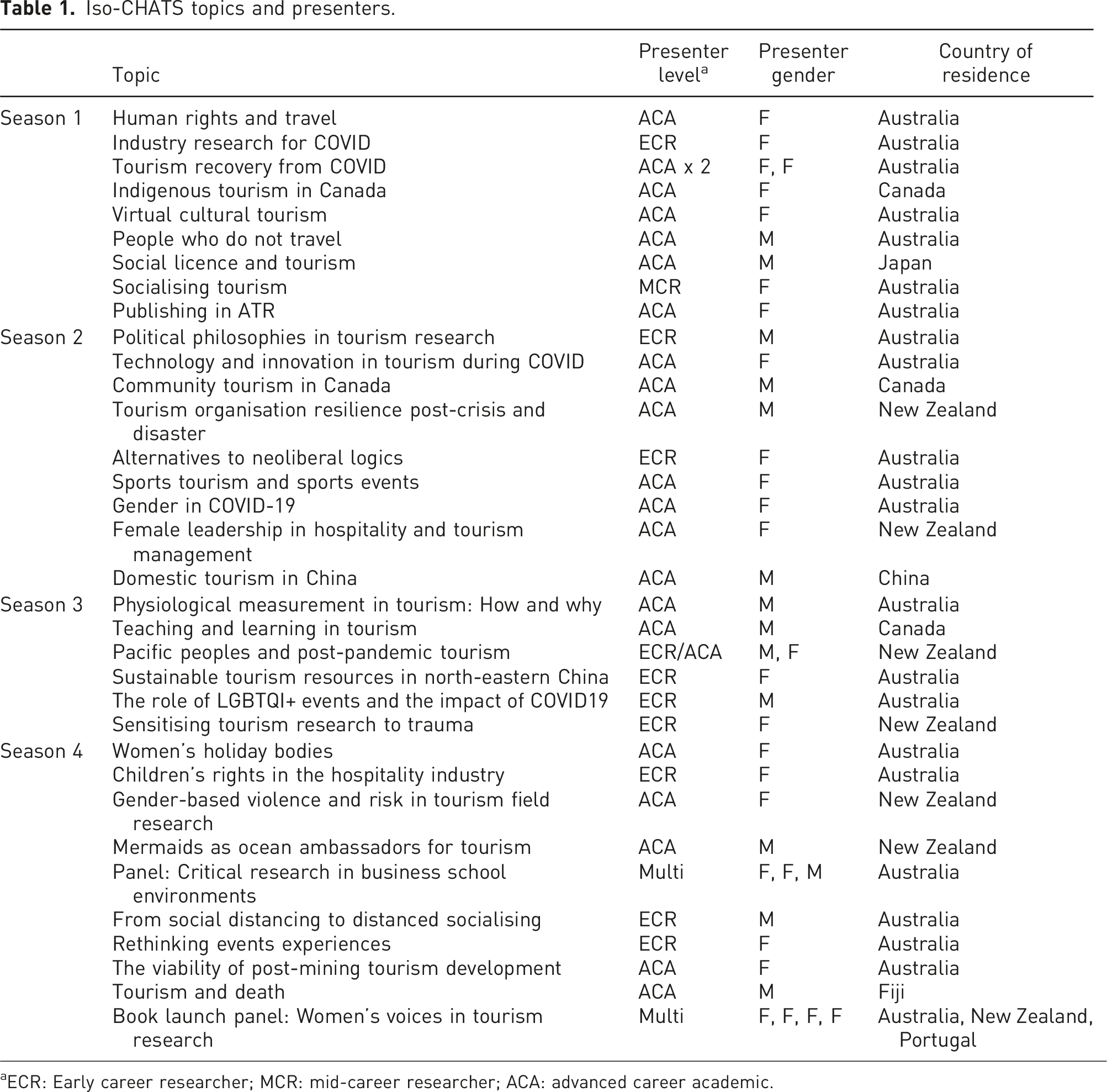
aECR: Early career researcher; MCR: mid-career researcher; ACA: advanced career academic.
The research approach
The primary method employed here is an autoethnography whereby we reflect on the application of the ELM, in terms of the Iso-CHATS design and observed outcomes. In his writing on the topic of tourism knowledge curation, Tribe (2018: 15) states “data analysis in autoethnography consists of critical reflection to connect the personal experiences to wider cultural, social and political practices and produce new understandings”. We regularly reflected on the outcomes of the series against our vision, with reflexivity in autoethnography a process of writing ourselves into the research. Reflexivity is necessitated by the personalised aligning of the seminar series to a vision and, through our curation and creation of tourism knowledge (Ateljevic et al., 2005; Tribe, 2018).
Our autoethnography is augmented with formal feedback from four experienced leading tourism scholars, all of whom had regularly attended Iso-CHATS, and three of whom had also contributed to knowledge transfer by delivering a presentation. We engaged these colleagues in formal feedback via email at the end of the first year (i.e., three seasons) of Iso-CHATS. Each expert offered personal insights into the benefits and challenges of the series. We also triangulate the autoethnography and formal feedback with informal feedback gathered from Iso-CHATS participants. These data were gathered during the seminars (transcribed in the meeting chat) and through social media engagement (on Facebook and Twitter).
As mentioned above, the ELM posits that recipients perceive messages in different ways, based upon the level of cognitive effort required to absorb the message (Petty and Cacioppo, 1986). If greater cognitive effort is required to absorb a message, via central cues, it is more likely that the message being delivered will result in attitude or behavioural change; and, accordingly if less effort is required via peripheral cues, then attitude and behaviour change is less likely (Yoo et al., 2017). The model argues information quality as an essential factor for influencing how messages are perceived through the core route; and source credibility, interactivity and accessibility as essential in terms of effecting how messages are received through the peripheral route (Petty and Cacioppo, 1986; Yoo et al., 2017). The process of the series design, and our observations of how the factor influenced peripheral and central cues is now explored.
Results
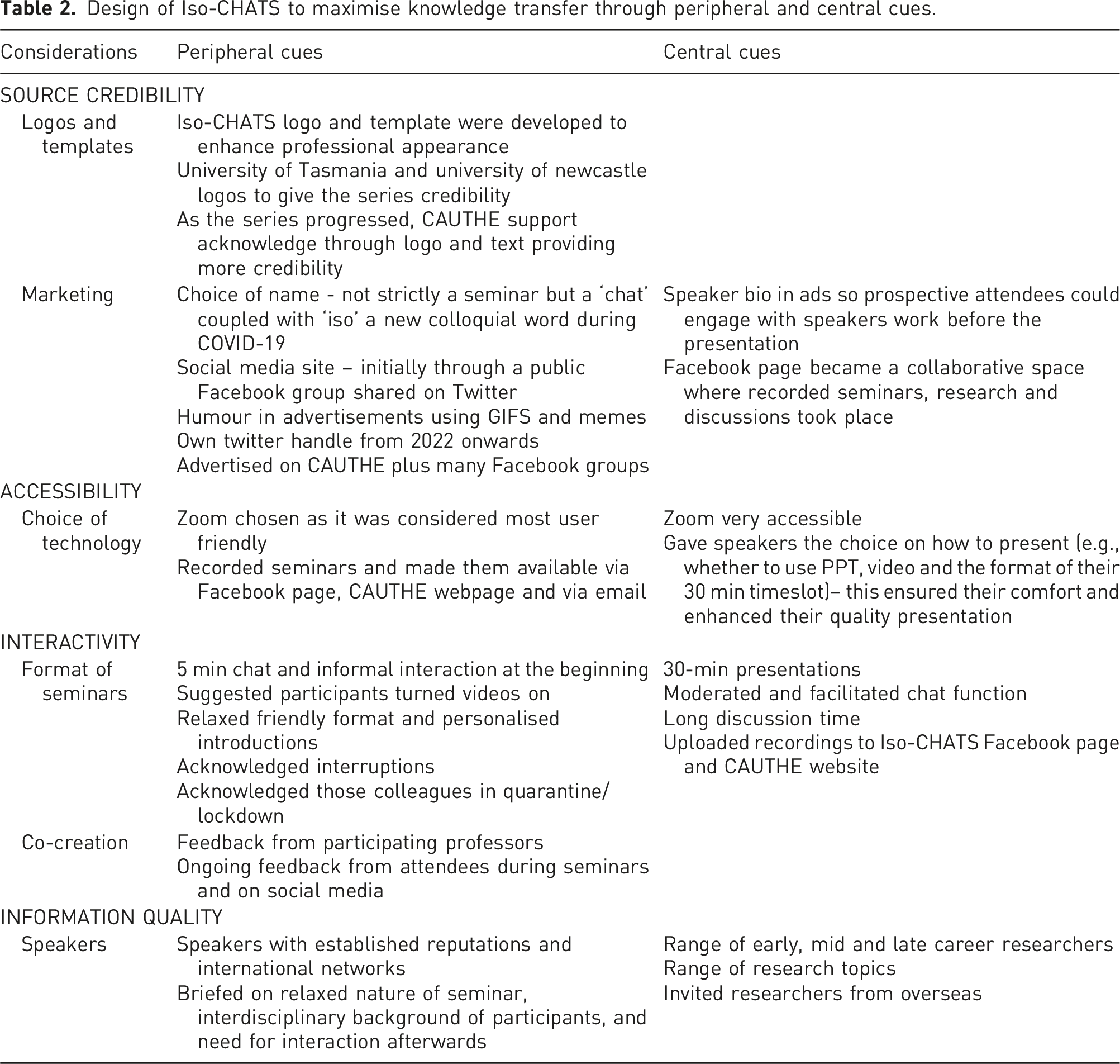
Design of Iso-CHATS to maximise knowledge transfer through peripheral and central cues.
Source credibility
Name and logo
To create peripheral cues and pique interest to attend Iso-CHATS, a range of measures were taken. Given that the series was designed to be a collaborative space where knowledge could be shared in a relaxed environment, we chose a name to reflect our vision. At the time, the word ‘iso’ was being used colloquially to refer to the act of being in self-isolation during COVID-19. 1 The acronym CHATS was created to represent our goal for a Collaborative Hospitality and Tourism Series and reflected objectives for a relaxed collaborative environment.
To elicit further peripheral cues and present the series as one of quality and significance, a stylised template and logo was chosen from a Microsoft Word template. However, as the first series gained popularity with an international audience, and a second series was planned, we designed a more professional and impactful logo to be used as a ‘tile’ for social media pages. Our logo design employed bold and consistent typography set over an image of clouds to represent blue sky innovative thinking, the familiar vision of looking outside an aeroplane window, and the virtual cloud environment of the seminar series.
The logos of co-founders’ universities were provided on all promotional material illustrating institutional support for the series. Following the success of the first series, Iso-CHATS gained recognition from the Council for Australasian Tourism and Hospitality Education (CAUTHE) endorsed as a network of research excellence so, thereafter, the CAUTHE logo added as illustration of this international organisational support. CAUTHE created a dedicated Iso-CHATS webpage adding further credibility to Iso-CHATS.
Marketing
To advertise Iso-CHATS, we initially created a public Facebook group to connect with an international network of tourism, hospitality, and events researchers. The co-founders invited colleagues from various professional networks (e.g., Facebook, Linked In, Twitter) to join the Facebook group. The page was designed as a community space to support and facilitate the network, be a repository for recorded seminars, and a place where research could be shared. At the end of the third series, an independent Iso-CHATS Twitter account was set up to provide further marketing for the series.
To promote seminars to our networks, 100-word biographies of speakers were provided to allow prospective attendees to engage with a speaker’s work before the presentation. To encourage peripheral cues, formal communications were coupled with humorous and playful language, images and GIFs and images to create a sense of Iso-CHATS being a collaborative and supportive environment, as well as being a seminar series that could provide a break from the monotony of working in isolation during the pandemic.
Methods such as these are recognised as being effective tools in disseminating and developing tourism knowledge. As Sheldon et al. (2011: 11) advocate, “social networks can create or assist in refining the use of knowledge”. Thus, while the marketing was designed to produce peripheral cues, we observed that the social and collaborative space that emerged on Facebook and via our advertisements that included speaker biographies, began to influence central cues.
Accessibility
Choice of technology
While early ELM research identifies accessibility as a factor to influence the take up of knowledge via the peripheral route (Petty and Cacioppo, 1986), recent work suggests that accessibility also influences central route processing (Yoo et al. 2017). When using technology to deliver messages, Yoo et al. (2017) suggest design as paramount. They argue that if individuals struggle with technology and have low self-efficacy, they are more likely to absorb information via the peripheral route rather than the central route. Therefore, we took several measures to encourage both peripheral and central route processing. First, we selected Zoom as the online platform for several reasons: user-friendly interface, ability to allow screen sharing alongside faces of participants in a ‘zoom room’, ability for a synchronous chat function, recording and transcribing capabilities. These measures were observed to influence peripheral cues.
We enhanced accessibility of the seminars by recording and uploading them to the Facebook group page. This sharing of the seminar recordings was important because the Australian time zone in which this series was held suited those colleagues based in the Indo-Pacific region and North Americas, but was not well suited to Europe, Africa, or the Middle East. Recordings are available on the Facebook group and, following their endorsement, uploaded to the CAUTHE website as well. We observed this action to influence central cues.
We allowed our speakers a choice in how they would like to present. The rationale for this was to ensure speakers were comfortable so they could deliver an engaging presentation that would trigger thought. One of our speakers chose not to use PowerPoint, and two speakers chose to co-present with a collaborator. Giving control to the speakers in their presentation format resulted in powerful presentations eliciting rich discussion in the chat function and during an extended question period.
Interactivity
Format of seminars
Iso-CHATS was designed in ways that allowed the seminars to differ quite significantly from the formal, one-way, non-interactive webinars that rapidly proliferated during the first COVID-19 lockdown. To engage peripheral cues, we commenced all seminars with a relaxed and informal chat led by a moderator, followed by an introduction that included introductions, acknowledgement of country, and acknowledgement of the challenges of hard lockdowns. Our introductions also recognised interruptions as part of working from home arrangements, to remind participants not to worry if these occurred, so to alleviate concern and relax participants. The collegial moderator role was designed to enhance the experience for all genders and cultures, and for those less confident and/or at earlier stages in their careers.
A chat function was enabled, and use was encouraged. We also encouraged participants to have their cameras on so that the speakers could see the faces of colleagues. These initiatives were made based on research by Wang and Roubidoux (2020) who suggest that actions such as these can decrease negative effects of videoconferencing, and Reshef et al. (2020) who suggest that lack of interaction (such as, applause) can decrease emotional engagement in videoconferencing environments. Evidence of the role that the chat function played in encouraging uptake of information via central was plentiful: “Extremely interesting presentation - thank you. You certainly point out the paradoxes! Can you explain a bit more the definition of 6-feet tourism products?”
We were also mindful that a lack of person-to-person engagement could contribute to a lack of emotional engagement (Reshef et al., 2020). To combat this issue, plus webinar fatigue, we asked speakers to limit presentations to 30 min of the 1 h time slot. This format differed from other webinars emerging during the first COVID-19 lockdown, where presentation lengths were often around 45–60 min. We observed this shorter format to be engaging to participants thus triggering knowledge uptake through central cues. This knowledge uptake was further enhanced through rich discussions held after each presentation. It was not unusual for the engaging discussion time go for the full 20 min following the presentation, and to also continue on Facebook, for example: “A great webinar. I really enjoyed it. Another thing I just thought of… What to do about the industry, e.g. cruise liners?”
Given that the Iso-CHATS creators are based in Australia, the choice was made to schedule seminars at a regularly occurring time suitable to the southern hemisphere. To ensure accessibility to the seminars and to maximise knowledge transfer, all presentations were uploaded to the Iso-CHATS Facebook page and the CAUTHE website. Through these uploads, and to contribute further to accessibility goals for inclusivity, viewers of the recordings could use subtitles and access transcripts. The presentation recordings remained available for ongoing accessibility for students, academics, practitioners, and those unable to attend due to time zone clashes. Unlike Reshef et al. (2020) who limit access to webinar recordings for 2 weeks, we did not nominate a timeframe and they continue to be available for open access. Participants appreciated this capability: “Sorry to have missed the presentation. I will catchup online later”. We asked all participants to appropriately cite the work of Iso-CHATS speakers if using seminars in their research and to let the speakers know where their work was being used. This process proved successful in maintaining the integrity of tacit knowledge, and speakers have learnt that their work has been used in classrooms and professional development settings. For some attending PhD students and early career researchers, Iso-CHATS allowed them to experience a conference-style setting for the first time. Ultimately, we observed that this function triggered uptake of knowledge via central cues.
Co-creation
Towards the end of 2020 as the series continued into the third season, we sought assistance from participants to guide the co-creation of the future of Iso-CHATS. The feedback from attendees was a desire for the series to continue but on a monthly rather than weekly basis as online commitments were increasing and webinar fatigue was becoming apparent. We gained feedback from a group of regularly attending Professors who suggested some additions to the format, including panels and book launches. These suggestions were incorporated into the fourth season of Iso-CHATS in 2021. We felt that this process contributed to the sense of community that Iso-CHATS had formed, thus acted as an important peripheral cue.
Information quality
Speakers
As peripheral cues, we hosted a range of speakers at various career levels and from different universities. We were aware that many conferences and academic fora tended towards inviting speakers advanced in their careers. We were keen to also showcase and support the research of early- and mid-career researchers to offset this trend and enhance accessibility and inclusivity. We were also aware of the substantial gender imbalance in tourism conference keynotes reported by Munar et al. (2015) as only 24% of keynotes to be delivered by women, so our bias towards women academics in the first series sought to offset this trend (see, Table 1). In the second series, rather than inviting individual speakers we called for expressions of interest and, interestingly, more women self-nominated. We concur this may be due to recognition of the inclusive and accessible nature of the first series.
In addition to the selection of speakers, we paid attention to their research interests. When we initially conceived the series, there were many webinars and emerging scholarly literature concerned with the impacts of COVID-19 on global tourism. This issue was not the focus of Iso-CHATS although some presentations, not surprisingly, focused on the way the pandemic was offering ways to consider the resilience of tourism to the pandemic (see, Table 1).
Discussion
An important initial outcome of the first series of Iso-CHATS was the creation of an online community of researchers: “You have done this thing that is in the spirit of academic community”. A core group of participants emerged as regular Iso-CHAT attendees, and the series organically took on a critical theory approach to tourism and hospitality research. Not all speakers were researchers in critical theory, but a strong theme of questioning society and structural norms became evident (see, Bianchi, 2009). Participants also got to know each other, and the ‘zoom room’ became a social and shared space and COVID-related anecdotes emerged as those undergoing lockdowns and hotel quarantine were recognised each week: “Look forward to seeing the Iso-CHAT community during our extended lockdown 6”.
We observed many friendships emerge, which are an often-overlooked aspect of academic collaboration (Mair and Frew, 2018). And, ultimately, research partnerships emerged, with several of the participants collaborating to initiate a themed session at the 2020 DevNet conference, with others collaborating on special issues, journal articles and joint research projects. At the time of writing, the co-founders are aware of at least five research collaborations that emerged exclusively because of Iso-CHATS. Thus, in addition to supporting academics within a collegial and supportive space, the learnings from Iso-CHATS contribute to our understandings of how knowledge transfer may be maximised in online academic environments.
The design of the series informed by the principles of the ELM was aimed at maximising the uptake of knowledge. By engaging knowledge transfer theory, we appreciate that the greater the cognitive effort required to process messages the more likely the message being delivered will be absorbed and result in attitude or behavioural change. The goal of the series was not to create a new wave of researchers but, rather, to maximise the quality of the messages being delivered. The ELM was well suited as a framework to achieve this goal. Our analysis of the Iso-CHATS design and outcomes challenge existing propositions about the ELM. Rather than information quality and source credibility being discrete factors influencing the peripheral and central routes, our experience of knowledge transfer design challenges these propositions and their relationship to specific cues. For example, it was anticipated that source credibility through our marketing would only influence uptake via the peripheral route. However, our findings reveal that the use of biographies and the rich discussion that emerged on social media pages suggests that source credibility is also influenced via the central route.
Similarly, it has been argued that accessibility influences the uptake of knowledge via peripheral routes. The high accessibility and low cost of zoom facilitated rich intellectual discussion via its chat function, thus constituting knowledge uptake via a central route. Our flexibility with speakers was also seen to influence uptake via the central route particularly because we allowed speakers to choose their presentation format making them comfortable and allowing for relaxed and engaging presentations. We also found that interactivity could encourage uptake of knowledge by both peripheral and central routes. The choice to have shorter presentations, encouragement of dialogue after the presentation, and our moderated and facilitated chat function (wherein we encouraged participants unmute and ask their questions), plus our uploading of the recorded presentations, all appeared to be actions that encouraged the absorption of knowledge via a central route. Consequently, our research builds upon ELM theory through challenging the propositions by Petty and Cacioppo (1986) and Yoo et al. (2017) that information quality influences only the central route, and source credibility, accessibility and interactivity influence only peripheral routes of knowledge transfer.
Conclusions
The Iso-CHATS series, initially created for knowledge transfer and to support the wellbeing of tourism and hospitality academics during the first global lockdown, became an ongoing international seminar series with 34 presentations with 41 speakers over 2 years. An emerging challenge is to transform this supportive online environment to one which can meet the needs of virtual and physical collaboration in a post-pandemic world. Our application of the ELM in an online seminar and conference environment suggests that knowledge transfer update differs in this context. However, our work also challenges traditional ELM notions that information quality and source credibility influence the peripheral and central route, respectively. Instead, we found that source credibility is also influenced via the central route. This research shows that seminar name, marketing style, video conferencing platform, and conferencing format, significantly impact knowledge transfer. This research also shows that knowledge absorption is enhanced by a relaxed and interactive format that encourages discussion, shorter presentations, a moderated chat function, recorded presentation uploads, and co-creation of series design.
Limitations exist in the research described in this paper. While the theoretical framework was prioritised in our design of Iso-CHATS, we did not intend to conduct research on the series, therefore, data on the impact of the seminars on participants, and the degree to which knowledge transfer was facilitated, is limited. The voluntary nature of the series and our position as creators may introduce personal biases. However, this approach has merit as it is similar to that of Hardy et al. (2018) in their unique study of knowledge transfer between academic and the tourism industry. The creation of Iso-CHATS posed a challenge for the co-facilitators as they had to quickly upskill in real-time videoconferencing and online knowledge transfer optimisation. Tolkach and Pratt (2021) highlight that the skills needed for online knowledge transfer are not traditionally required by academia but may well become inherent in the future as academic work seeks to create impact. The online seminar format presented in this paper provides cost-effectiveness, little bureaucracy, and co-creation opportunities for participants. But further research is needed to quantify its impacts on already high workload.
This project on the design of Iso-CHATS demonstrates that during a time of unprecedented work and social disconnection, the online environment offered crucial opportunities for academic knowledge transfer. These outcomes challenge existing research on the ELM and provide insights for online knowledge transfer in seminars, conferences and other academic events. In our now ‘post-pandemic’ world, these opportunities offer hope for continued collegial connections, both virtual and corporeal, within our academy.
Footnotes
Declaration of Conflicting Interests
The author(s) declared no potential conflicts of interest with respect to the research, authorship, and/or publication of this article.
Funding
The author(s) received no financial support for the research, authorship, and/or publication of this article.
