




Abstract
The tourism industry has been increasingly viewed as an essential component of development processes, especially in certain low-density territories and islands. In turn, it is clear that residents play a fundamental role in the quality of tourists’ experiences and, consequently, for the success of a tourism destination. In this research, a cluster analysis was used to segment the residents of the Azores Archipelago (Portugal) in function of their perceptions of the impacts of the tourism industry. The analysis revealed the existence of three clusters: Optimistic residents, which corresponded to the large majority of the respondents; Moderately Optimistic residents; and Unconvinced residents. The results are in conformity with the common findings in the empirical literature, in particular in the case of emergent tourism destinations. Regional and national authorities should be aware of these results when designing their policies, in particular when pursuing sustainable development strategies.
Keywords
Introduction
Multiple pull and push factors influence tourists’ choice of a destination (Crompton, 1979; Dann, 1977), including residents’ attitudes towards tourism and tourists (Ap, 1992; Dyer et al., 2007; Faulkner and Tideswell, 1997; Gursoy et al., 2019; Lopes et al., 2019; Malik et al., 2017; Martín et al., 2018; Nunkoo and Gursoy, 2012; Scalabrini and Remoaldo, 2020; Soares et al., 2022; Vareiro et al., 2013; Vargas-Sánchez et al., 2015). On the other hand, theoretical frameworks like Social Exchange Theory, Community Attachment Theory, Irridex Model, and Destination Development Life Cycle offer explanations regarding the role of residents in destination attractiveness. Although Social Exchange Theory is commonly used (Hadinejad et al., 2019; Rasoolimanesh et al., 2015; Vargas-Sánchez et al., 2011, 2014, 2015), its explaining capacity has been questioned (Hadinejad et al., 2019; Muler González, et al., 2023; Rasoolimanesh et al., 2015). Considering the unique characteristics of each destination, it is essential to view these theories as complementary rather than standalone (Malik et al., 2017; Martín et al., 2018; Omar et al., 2014; Reisinger et al., 2019; Vargas-Sánchez et al., 2015).
Residents play a key role in the success of a tourism destination, and involving them is crucial for creating sustainable destinations (Buhalis, 2000; Draçi and Demi, 2023; Rasoolimanesh et al., 2015). Emphasizing this role, Papastathopoulos et al. (2020) refer to residents as key stakeholders, while Draçi and Demi (2023) consider the local community the most influential factor in tourism development. Therefore, consulting residents’ opinions is essential for creating sustainable destinations (Cárdenas et al., 2015; Soares et al., 2022).
In this study, we focus on the Azores Archipelago and residents’ perceptions of the impacts of tourism development. We conducted a comprehensive analysis of these perceptions and explored the influence of sociodemographic factors using cluster analysis. Additionally, we investigated the connection between the tourism destination development life cycle and residents’ perceptions of industry impacts. The Azores, as an emerging destination highly dependent on tourism, highlights the significance of understanding residents’ perceptions for sustainable development. However, limited research is available on this topic, making this study valuable for local authorities and tourism stakeholders.
The paper is structured as follows: a literature review on residents’ perceptions of tourism impacts, an overview of the Azores Archipelago, the research methods used, empirical results and discussions, concluding with policy recommendations.
Review of literature about residents’ perceptions on the impacts of tourism
Residents’ perceptions on tourism impacts
The success of a tourism destination is significantly dependent on the hospitality from residents (Kim et al., 2021; Krishnaswamy et al., 2018; Lee, 2013; Martín et al., 2018; Renda et al., 2014; Vareiro et al., 2013), and, thus, its long-run economic activity maintains a close relationship with the level of residents’ commitment to the tourism industry, as one of the key stakeholders (Cárdenas et al., 2015; Draçi and Demi, 2023; Kim et al., 2013; Malik et al., 2017; Nguyen et al., 2022; Papastathopoulos et al., 2020; Ribeiro et al., 2017).
Tourism can generate benefits as well as costs (Draçi and Demi, 2023; Omar et al., 2014; Papastathopoulos et al., 2020; Vareiro et al., 2013). As such, one should expect that residents perceive, both, the positive impacts of tourism, of economic nature or other, together with a range of associated costs (Muler González et al., 2023). The literature tends to emphasize several benefits, such as the creation of new businesses and promotion of new investment, providing opportunities for small businesses, generating revenue for residents and governments, revitalization of downtown areas, more recreational opportunities, investments in communities’ infrastructures and public facilities, all of which lead to the improvement of residents’ quality of life and life satisfaction (Nejati et al., 2014; Rasoolimanesh et al., 2015; Ribeiro et al., 2017; Tuntipisitkul et al., 2021; Woo et al., 2015). As costs, the literature has identified several, including environment damaging, increasing of prices, loss of identity, crowding, rudeness of tourists, labor exploitation, and increasing of noise and crime (Draçi and Demi, 2023; Muler González et al., 2023; Vareiro et al., 2013).
As emphasized by Gursoy et al. (2019), based on a review of literature on this issue, several studies reveal that residents generally negatively assess the social and cultural impacts of tourism. There are also cases where respondents have expressed a stronger concern regarding the environmental impacts of tourism development when compared to the economic and socio-cultural impacts (Tichaawa and Moyo, 2019). Nevertheless, situations where residents seem to almost disregard the environmental consequences of tourism were also found (e.g., Papastathopoulos et al., 2020). If residents express concern on the effects of tourism, this undoubtedly affects the kind of relationship between residents and tourists that may be expected (Draçi and Demi, 2023; Gursoy et al., 2019; Renda et al., 2014; Vargas-Sánchez et al., 2014).
Residents’ negative attitudes can be a disadvantage in the sustainability of tourism destinations (Soares et al., 2022). For being sustainable, tourism development needs to be able to meet the requirements of present of tourists and host communities while protecting and enhancing opportunities for both (Draçi and Demi, 2023). Going futher, Draçi and Demi (2023) claim, even, that achieving sustainability may require an approach that “de-emphasizes” economic growth and highlights environment equilibrium and social performance as the main dimensions to pursue
The review of the literature, as mentioned by Vargas-Sánchez et al. (2014), also allows to conclude that low-to-moderate tourism development is commonly perceived by communities as being beneficial but, as the industry increases, residents’ perceptions can turn negative.
By using data from a survey conducted by SREA in 2005, Monjardino (2009) performed the first analysis of the Azores residents’ perceptions on the impacts of tourism. The results suggested that residents were aware of the potential economic and social benefits of tourism development. According to those results, they also seemed to ignore or did not value much of its potential negative impacts, in particular those of cultural and environmental nature, as experienced by several more mature tourism destinations (Monjardino, 2009). To correctly interpret these results, we must bear in mind that the data was collected at a moment when tourism development in the Azores was quite incipient.
Perceptions of tourism impacts and destination life cycle
The differences in residents’ attitudes towards tourism may be attributed to several factors, including the relative economic importance of tourism in each destination (Nejati et al., 2014; Vargas-Sánchez et al., 2014) and the development life cycle of the industry (Butler, 1980; Dogan, 1989; Malik et al., 2017; Martín et al., 2018; Reisinger et al., 2019; Vargas-Sánchez et al., 2015). For example, approaching the cases of Algarve (in Portugal) and Huelva (in Spain), Vargas-Sánchez et al. (2015) found that the higher the level of tourism development perceived by the residents in each destination, the more strongly the negative impacts of the industry were felt.
The Tourism Area Life Cycle model was first proposed by Butler, in 1980, and describes the development of tourism destinations in terms of a series of stages. The model determines the stages the destinations are undergoing by combining features of demand (preferences and visitors’ needs) and supply (e.g., facilities and infrastructures) (Omar et al., 2014). According to multiple authors, as cited by Vargas-Sanchez et al. (2015), the residents’ attitudes towards tourism tend to be more favorable in the early stages of development of the destinations. This assumption is more emphasized by the Irridex Model, from Doxey (1975). However, as claimed by Butler (1980), not all destinations experience the different stages of the cycle in the same manner. Despite the acknowledged virtuosities of the Tourism Areas Life Cycle model, there continues to be a lack of consensus about its degree of validity (Omar et al., 2014; Vargas-Sanchez et al., 2015).
A similar result to the one assumed by the Tourism Area Life Cycle and Irridex models was found by Vargas-Sánchez et al., (2014) when approaching seasonality in the case of the province of Huelva (Andalusia, Spain), that is, the empirical research as shown that a more favorable attitude toward tourism development was found in the low season than in the high season. This means that the tourist density indirectly affects the residents’ attitudes and perceptions towards the benefits and costs of tourism development in their sites.
Approaching the validity of the Tourism Areas Life Cycle model in the case of Cantabria, in North Spain, for example, Martín et al. (2018) argued that a key reason for the positive attitudes demonstrated by the residents regarding the tourism development of the destination could be related to the specific tourism model that has been implemented, which was not based on mass tourism. In the case of Guimarães - Portugal (Vareiro et al., 2013), a clear emerging tourism destination, it was found that skeptics were the smallest group, primarily comprising older and less-educated male residents. In another emerging destination, the region of A’Dhakhiliyah, in the Sultanate of Oman, Malik et al. (2017) also found a highly supportive attitude from local residents concerning tourism development. A similar result was found by Scalabrini et al. (2018) addressing the case of Joinville, in Brazil.
The results may have, of course, a close connection with the specific circumstances of the destination, as may be inferred from the research conducted by Tuntipisitkul et al. (2021) on the case of Phuket Island (Thailand), which has recently been suffering from over-tourism (Tuntipisitkul et al., 2021). The results found in Phuket Island to a large extent contradict the findings of the study performed by Nunkoo and Ramkissoon (2010). Approaching the case of Port Louis, the capital city of the island of Mauritius, these authors (Nunkoo and Ramkissoon, 2010) found that, even while recognizing the industry’s benefits, residents expressed some concern about its negative impacts.
The role of the context when assessing residents’ perceptions of the impacts of tourism was also detached by Gursoy et al. (2019), as well as by Krishnaswamy et al. (2018) and Vargas-Sánchez et al. (2011, 2014), as already mentioned.
Perception of tourism impacts and degree of tourism dependency
Residents’ perceptions and sensibility concerning the local effects of tourism may be strongly affected by whether or not residents work in tourism activities. According to the findings of the empirical literature, in general, residents tend to believe that tourism is beneficial for the local economy and the community (Cárdenas et al., 2015; Pal and Rawal, 2020; Renda et al., 2014; Ritchie and Inkari, 2006; Tichaawa and Moyo, 2019). In particular, residents whose household income primarily derives from tourism-related businesses tend to have a more favorable attitude towards tourism (Kim et al., 2021; Ribeiro et al., 2017; Tichaawa and Moyo, 2019; Vargas-Sánchez et al., 2014, 2015). This looks to be particularly true in the case of individuals who work in the tourism and retail sectors (Ribeiro et al., 2017; Tichaawa and Moyo, 2019), even if they can recognize that there may be negative impacts.
An interesting case is the one of Perhentian and Redang islands, on the east coast of the Peninsula of Malaysia, where Nejati et al. (2014) found that its residents harbored mainly positive perceptions towards tourism, i.e., they had more positive perceptions regarding the positive economic, social, and cultural impacts of tourism than negative ones. However, the perceptions kept by the residents of the Perhentian island tended to be more favorable, maybe because its residents played a more important role in running tourism services than those of the Redang island (Nejati et al., 2014).
In another empirical study, conducted by Ribeiro et al. (2017), that studied the Cape Verde islands, the researchers found that residents who had more contact with visitors were those who tended to be more prone to adopt a more positive outlook towards the impacts of tourism. Additionally, those who remained more concerned about the state of the local economy showed a more positive attitude towards the benefits of tourism.
Anyway, there are situations where the residents who obtain greater personal benefit from tourism have a less favorable perception toward it, as mentioned by Vargas-Sánchez et al. (2014), citing Teye et al. (2002), which could be related to the working conditions provided. The tourists’ behavior can also play a role on the positive or negative way residents’ perceive the effects of tourism on their community, no matter if they have a closer or farer connection to the industry, as stated by Woosnam et al. (2009) and Woosnam (2012).
Tourism impacts and residents’ sociodemographic profile
Other characteristics of residents, such as their levels of education, income, and gender, have also been identified as affecting residents’ perceptions of the impacts of tourism (Gursoy et al., 2019; Tichaawa and Moyo, 2019; Tuntipisitkul et al., 2021).
Commenting the results gotten from their empirical study, referred to Besalú, a small heritage town located in Catalonia, Spain, Muler González et al. (2023) conclude that their findings have confirmed the existence of a link between education and tourism impact perceptions, following the ones of several other scholars. According to that literature and their own results, residents with high and low levels of education tend to have a higher perception of the benefits of tourism, relating that with the fact that those with higher levels of education may be more empowered and better able to take benefit from tourism, while residents with lower educational levels may rely more on the industry.
Kim et al. (2021), approaching the case study of the Gamcheon Culture Village in South Korea, have claimed, also, that the residents’ levels of knowledge and empowerment can influence their perception of the impacts of the tourism industry. Concretely, following those results, residents who had more knowledge and experience with tourism development tended to be more able to identify its positive and negative impacts (Kim et al., 2021).
In a paragraph placed above, we have also referred to the perceptions kept by the residents of the Perhentian island vis-a-vis the ones of Redang island, and the way their role in running tourism services could be main reason for expressing a more favorable perception towards the tourism industry (Nejati et al., 2014).
Besides the residents’ personal characteristics and the social and economic features of the destination, the intensity of the residents’ perceptions of negative and positive impacts of tourism industry is, as well, affected by factors such as the amount and type of visitors, length of stay, diversity of economic power and social heterogeneity of visitors (Renda et al., 2014; Ribeiro et al., 2017; Tuntipisitkul et al., 2021; Woosnam et al., 2009; Woosnam, 2012).
Clustering residents based on their perceptions on tourism impacts
According to Gursoy et al. (2019), it did not take long for researchers to recognize that residents’ perceptions or attitudes towards tourism development within communities are not homogeneous. In various cases, as previously highlighted, it was found that residents who were economically tied to the tourism industry tended to show a higher level of support towards its development (Eyisi et al., 2021; Nejati et al., 2014; Nunkoo and Ramkissoon, 2010; Tuntipisitkul et al., 2021). However, there are other cases where the aforementioned relationship was found to be insignificant (e.g.: Liu and Var, 1986; Wan and Li, 2013).
For these different assessment of the impacts of tourism industry, another factor which can contribute a lot, is residents’ sense of attachment: the stronger their attachment to their communities, the stronger will be their reaction to tourism development when they harbor negative concerns about it (Kim et al., 2021). Relating Community Attachment and the period of time residents live in a specific destination, the longer that individuals live in a community, the more likely that their attitudes towards tourism will be negative (McCool and Martín, 1994; Renda et al., 2014; Ryan and Montgomery, 1994; Wang and Xu, 2015). Nevertheless, also in this case, inconsistent results were found (Papastathopoulos et al., 2020; Sinclair-Maragh, 2017; Vargas-Sánchez et al., 2015).
If, as mentioned, residents’ perceptions or attitudes towards tourism development within communities are not homogeneous, which should be attentive and frequently monitored by tourism industry planners and public authorities in order to pursue more sustainable tourism strategies, the complexity of managing the industry increases as, while dichotomous pre-coding of residents’ responses may be convenient and useful, it may fail to adequately incorporate residents’ views on the extent of changes verified and lead to a response bias. This is a remark which has been made by several authors, among them Tuntipisitkul et al. (2021). This is also why the Social Exchange Theory has been submitted to some criticism (Sharpley, 2014). Others have criticized its emphasis on residents’ rationality (Hadinejad et al., 2019; Ouyang et al., 2017; Rasoolimanesh et al., 2015).
As complex as it is to capture all the factors that can underlie the residents’ perceptions on the impacts of tourism industry development at a destination, and their intensity, a path which can be taken by researchers is, certainly, rely on a cluster analysis, connecting that way the various sorts of impacts felt by residents to their sociocultural and demographic profile. We do follow the claim of Muler Gonzalez et al. (2023) that tourism planners and managers should pay close attention to how different segments of the destination’s residents perceive how factors like scarcity or costliness affect their perceptions. It is not difficult to understand that “Residents have different understanding of how the tourism industry works, which leads them to reject or accept tourism based on their perceptions of the specific exchange” (Muler Gonzalez et al., 2023, p. 113). That was the path we have decided to take in the aim of this research on the Azores Archipelago.
We are aware that this was not the only methodological approach we could take and, in a matter of fact, we have undertaken others, like inquiring if the residents who maintained a closer contact with tourists and/or directly benefited from the industry tended to express stronger support towards it. However, we thought this, that is, segmenting Azores residents according to their perceptions, could be a valuable contribute to the literature on islands and emergent tourism destinations, and, of course, for helping local authorities in the design of policies able to address better the main objectives of sustainable tourism, which relate close to achieving the economic benefits that tourism can bring to residents and the improvement of their quality of life.
The case study
The Azores archipelago is located in the North Atlantic Ocean, 1,600 km far from the Portuguese mainland. It has nine islands: Santa Maria, São Miguel, Terceira, Graciosa, São Jorge, Pico, Faial, Flores, and Corvo. The total area of the territory is around 2,333 km2.
The Azores regional authorities began to look to the tourist industry as a potential instrument for development of the Region in the late 1970s (Castanho et al., 2020). This led them to commission a few master plans for tourism development in the following periods. However, the resulting projects were never implemented.
Finally, in 2001 that there was clear public commitment towards tourism development (Castanho et al., 2020). A few policy measures were implemented in this new context and the private sector began to invest in enhancing the local accommodation offer. An aggressive marketing promotion campaign for the tourism destination was also undertaken. However, it was only in the middle of the 2010–2019 decade that there was a dramatic increase in inbound tourism (SREA, 2021). This partially relates to when low-cost airlines began serving this market in 2015.
By 2018 and 2019 an unprecedented number of visitors was achieved, both, in terms of demand, mainly in terms of foreign demand, and also the offer of accommodation, mainly due to the explosion verified in the supply of guesthouses (SREA, 2021).
Due to the COVID-19 pandemic, there was a sharp fall in tourism demand in 2020, which to a large extent continued in 2021. This also resulted in a return to a situation where the national market was dominant, as had been the pattern until the early 21st century (SREA, 2021).
The Azores main tourist attractions include lagoons, volcanoes and volcanic caves, waterfalls and exuberant green landscapes, as well as several sorts of material and immaterial cultural heritage. Speaking of cultural heritage, it is worth to say that the Angra do Heroísmo city center, in Terceira Island, is classified by UNESCO as World Cultural Heritage since 1983. The same applies to the Vine Culture Landscape of Pico Island, which was classified in 2004.
The safety and quietness of the places, together with the uniqueness of each island and the hospitality provided by its residents are also Azores attributes deserving to be highlighted.
In what refers tourist arrivals, the Azores Archipelago surpassed in July 2022 the values achieved in 2019. This arrivals increasing was based, both, on domestic and foreigner visitors but, mainly, in international ones (SREA, 2022). This is also related with the opening of new airline connections, namely from Swiss, Lufthansa, Iberia, British Airways, and United Airlines, among others. The local airline company, Azores Airlines (SATA), played also a role in that process.
Regarding the Azores tourism strategy, we believe we most underline that in the Action Plan 2019–2027: Sustainability of the Azores Tourist Destination (SREA, 2019) one can find the statement from the Azores government that it was profoundly committed on the sustainable development of tourism. As a way of expressing this commitment on sustainability, it kept the intention of applying for the certification of the territory under a process able to meet the Global Sustainable Tourism Council criteria. This was recently achieved, turning it the world’s first sustainable insular tourist destination (Batista et al., 2022).
Methods
Participants and data collection
Given the objectives of this paper, the data used resulted from a survey conducted by SREA in 2018. The survey was applied to residents aged 15 or older, covering the Azores’ nine islands. The sampling frame consisted of family housing units (UA) that constituted the primary residence, with a telephone, and belonging to the National Housing File (FNA) (based on the 2011 Population Census). The sample of dwellings (704 UA) was selected following a probabilistic path, stratified by island, and all individuals residing in those UA of the Azores were considered (SREA, 2019).
One thousand and seventy individuals were surveyed, and 950 valid responses were obtained, based on telephone interviews, conducted by four interviewers from SREA endowed with specific training and experience in applying this data collection method.
Referring to the last data available on the Azores Islands population, as results from the 2021 general census (SREA, 2023), the relevant figures are the following ones: (i) total population, 236,440, from whom 115,492 were men and 120,948 were women; (ii) total population aged 15 years or older, 201,883; (iii) island with the larger number of inhabitants (133,295), St Miguel, and the one with the smallest (384), Corvo. Ten years before (2011), the total population attained 246,772 individuals (121,534 men and 125,238 women).
Instrument
As stated above, the questionnaire was based on one developed by the SREA for the 2005 Residents’ Survey on Tourism in the Azores (IRT). Since its first version (2005), the design of the questionnaire was rooted on the literature and its consistency could be tested repeatedly along the years, as several adapted versions of it where applied to other territorial and time contexts, either in Portugal (e.g., Vareiro et al., 2013) or in Brasil (e.g., Scalabrini and Remoaldo, 2020), namely.
In the version used in 2018, several items were added regarding assessment of satisfaction resulting from contacts established with the stakeholders of the regional tourism industry. This was complemented by a set of questions common to other surveys applied to households nationwide.
The researchers could have access to data collected in the survey based on a special demand submitted to SREA, via National Statistics Institute (INE), the Portuguese statistics authority.
The questionnaire included 23 questions, which began by collecting geographic and sociodemographic information (whether residents were born in the Azores, had always lived in the Azores, how long they had lived in the Azores, gender, level of education, and work situation). This was followed by questions on the interaction between residents and tourists, in particular their professional connection to tourism, how often they usually met tourists, whether this had led them to change their habits, whether there were specific types of tourists that they preferred or disliked, and whether there were places where they preferred not to meet tourists.
The following section contained one of the main questions (Question 17), which questioned respondents about their perceptions of 21 impacts of tourism development, trying to cover the main positive impacts (n = 12) and negative impacts (n = 9). Economic, socio-cultural and environmental impacts were analyzed. All the items included in this question were categorized according to a five-point Likert scale, ranging from “1- strongly disagree” to “5- strongly agree.”
In the final section of the questionnaire, there were questions on residents’ general opinions towards tourism and tourist flows, and three open-ended questions, where they could express their concerns towards tourism in the Azores, make suggestions for improvement, and leave any comments they felt were appropriate to present on the issue.
Data analysis methods
Based on the research objectives several statistical procedures were adopted, using the Statistical Package for Social Sciences (SPSS) Program (version 24), in four research steps:
As a first analytical procedure, univariate statistics were calculated for all items.
Aware that residents play a fundamental role in the quality of tourists’ experiences and, consequently, in the success of a destination, a cluster analysis was conducted that aimed to segment the Azores’ residents into different clusters, according to their perceptions of the effects of the tourism industry. In this way, as a second step of the data analysis, a non-hierarchical cluster analysis using the k-means cluster algorithm for the items measuring the perceived impacts was performed. In line with several authors (Aguiló and Roselló, 2005; Andriotis and Vaughan, 2003; Bieger and Laesser, 2002; Brida et al., 2010; Inbakaran and Jackson, 2006; Vareiro et al., 2013), we made use of this technique because, when dealing with to large data sets (n > 200), it can be more efficient than the hierarchical one (Brida et al., 2010; Johnson and Wichern, 1998).
Following the technique used by Aguiló and Roselló (2005), Brida et al. (2010) and Vareiro et al. (2013), we decided to implement a stepwise methodology allowing for the formation of two to four groups, based on the average scores of the 21 impacts of tourism development. Three clusters were retained to ensure the most interpretable results. Data show that clusters 1 and 2 present a greater level of disparity and clusters 2 and 3 a greater level of proximity, with clusters 1 and 2 harboring different opinions regarding the benefits, while clusters 2 and 3 show to be closer in terms of being less worried toward the costs.
In a third step, the socio-demographic characteristics of the residents included in the three groups of the cluster analysis were compared, assessing their profile. The same procedure was applied to identify the differences between the three clusters regarding interaction with tourists.
Finally, one-way analysis of variance tests was used to identify the differences between the three clusters regarding the global opinion on tourism development and tourist flows.
Empirical results
Residents’ perceptions of the impacts of tourism
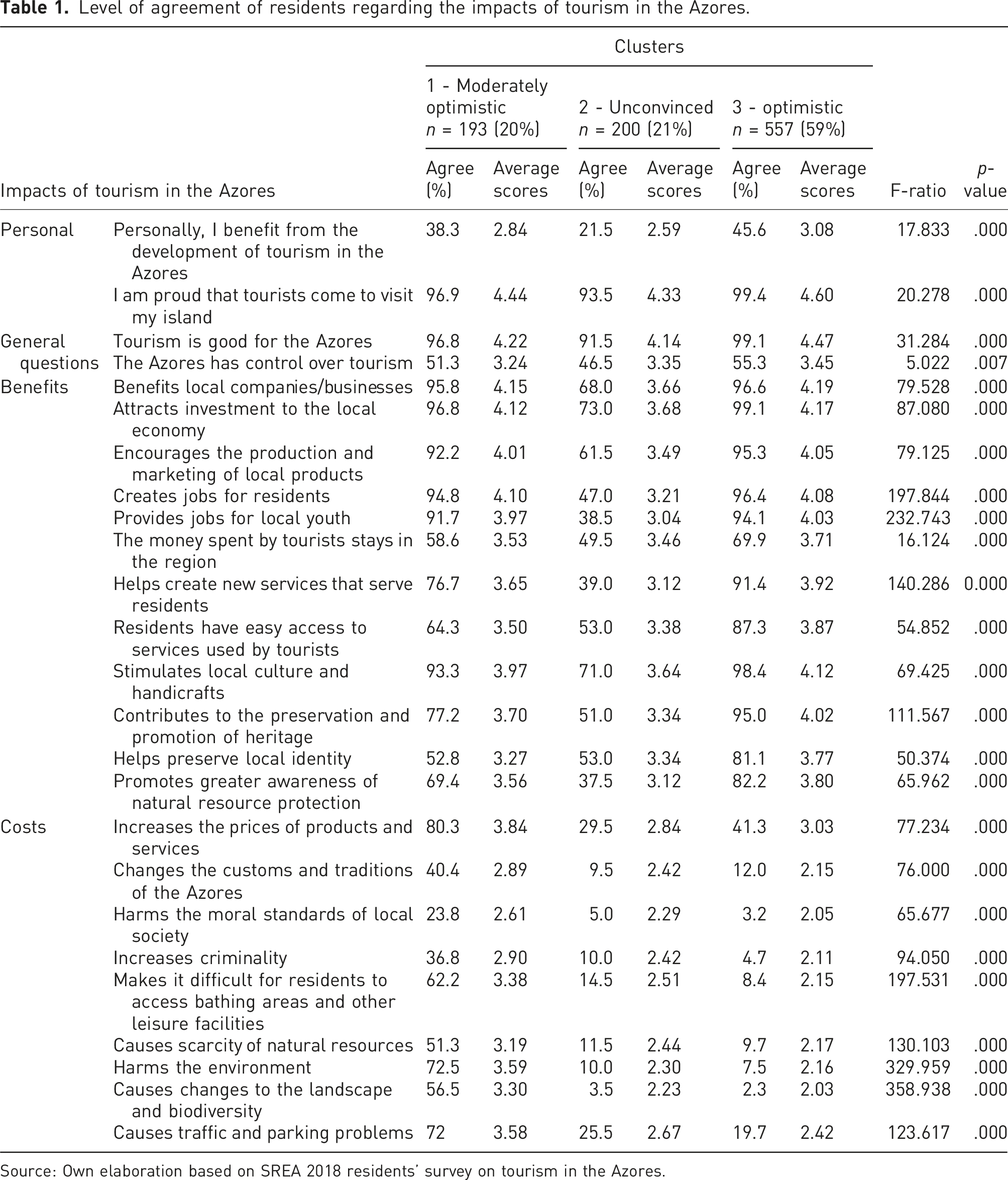
Level of agreement of residents regarding the impacts of tourism in the Azores.
Source: Own elaboration based on SREA 2018 residents’ survey on tourism in the Azores.
Two other general comments may be made: a first comment underlining the significant level of agreement on the benefits of tourism, since the majority (59%) of respondents expressed an optimistic perception of the impacts of the industry; and a second comment that emphasized the low average scores attributed to the costs associated to tourism even by the members of those clusters who have indicated a less favorable expectation about the contribution of tourism to the development of the Archipelago.
In summary, the results of the cluster analysis performed show: (i) a majority cluster (cluster (3) integrated by those residents that we can call Optimistic residents (who highlight the benefits and downplay the costs of tourism development); (ii) a cluster of Moderately Optimistic residents (cluster 1), integrating those respondents who perceive relevant benefits from pursuing a commitment to a tourism development strategy but express some concern about its potential negative impacts; and (iii) a third cluster (cluster 2), of Unconvinced residents (amongst the set of all respondents, those who have the lowest evaluation of the potential benefits of tourism but, at the same time, do not express major concerns about its costs).
Profile of the members of each cluster
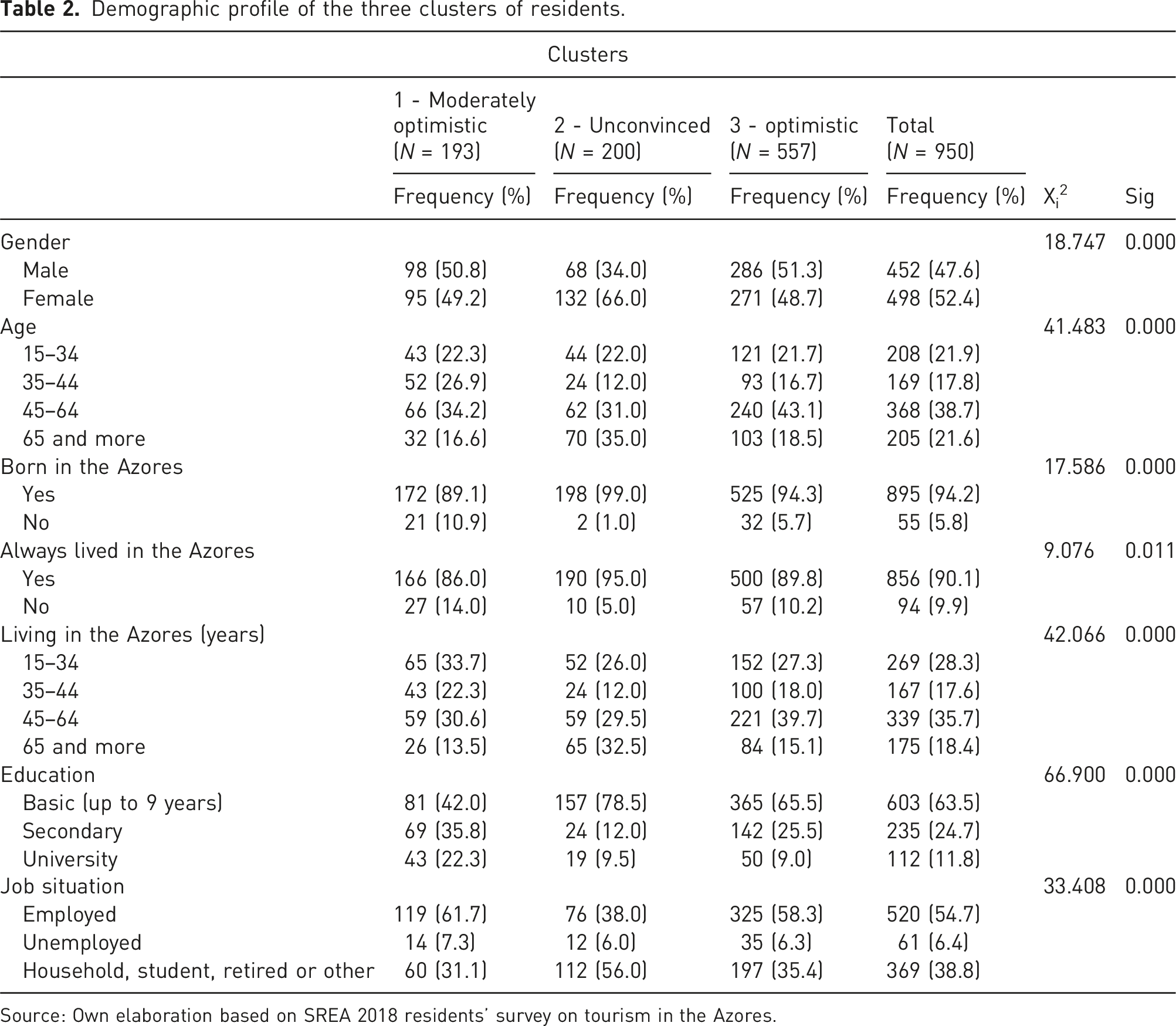
Demographic profile of the three clusters of residents.
Source: Own elaboration based on SREA 2018 residents’ survey on tourism in the Azores.
In relation to the results attained in each cluster, a few features should be considered, in particular: i) in the case of cluster 3 (Optimistic), it is interesting to note that it includes more males than females, even if the difference is small; and more people aged between 45 and 64 (43.1%), many of whom have always lived in the Azores, with basic education (65.5%), and employed (58.3%); ii) in the case of the Moderately Optimistic cluster (cluster 1), a few of their relevant characteristics are close to those of cluster 3 – slightly more males than females; the dominance of the age group 45–64 (34.2%). However, they differ significantly in terms of the proportion of individuals aged between 35 and 44 (26.9%), the number of individuals with basic education (42.0%), and, thus, with higher education levels, and employed (61.7%) or with the status of household, student, retired or other (31.1%); iii) the profile of cluster 2 (the Unconvinced) shows a sharp difference in the presence of woman (66.0%) and men, and differences towards the other cluster in the number of persons aged over 65 (35.0%). Of these, people born in the Azores account for 99.0% of respondents, 95.0% of whom who have always lived in the Archipelago. Other characteristics of the cluster members are: the higher presence of individuals solely with basic education (78.5%); and also a higher number of people with a job status of household, student, retired or other (56.0%).
Considering these results, it is possible to conclude that the perceptions harbored by the Azores’ residents are largely influenced by being male or female, the age cohort they belong to, their education level and their job status. In this regard, if we consider the differences of profile between the respondents who were seen to be optimistic vis-à-vis the tourism impacts and the ones we classify as Moderately Optimistic, and the concern among the members of these clusters on the costs associated to tourism development, we can conclude that the key for explaining the differences found were the proportion of individuals aged between 35 and 44, i.e. younger than the more representative age group of cluster 1, the education levels they were endowed with and the share of individuals with the job status of employed (61.7%). These findings are not particularly surprising. Generally speaking, the results are fairly consistent with those in the empirical literature.
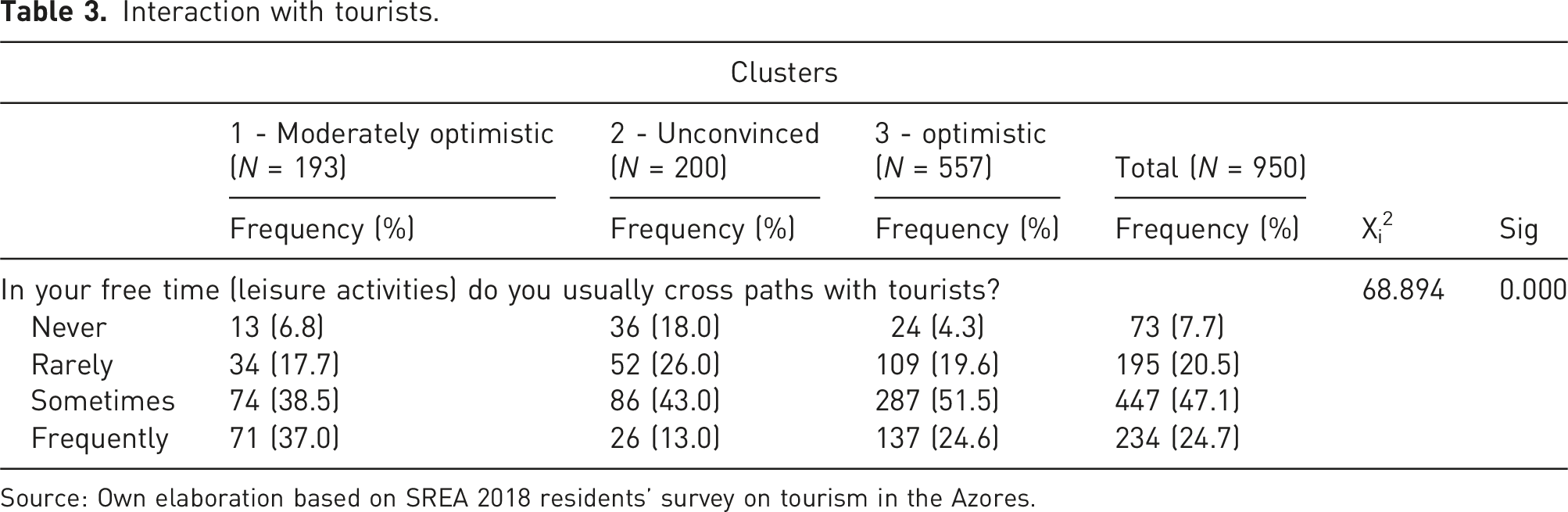
Interaction with tourists.
Source: Own elaboration based on SREA 2018 residents’ survey on tourism in the Azores.
Global assessment of the performance and future tourism flows
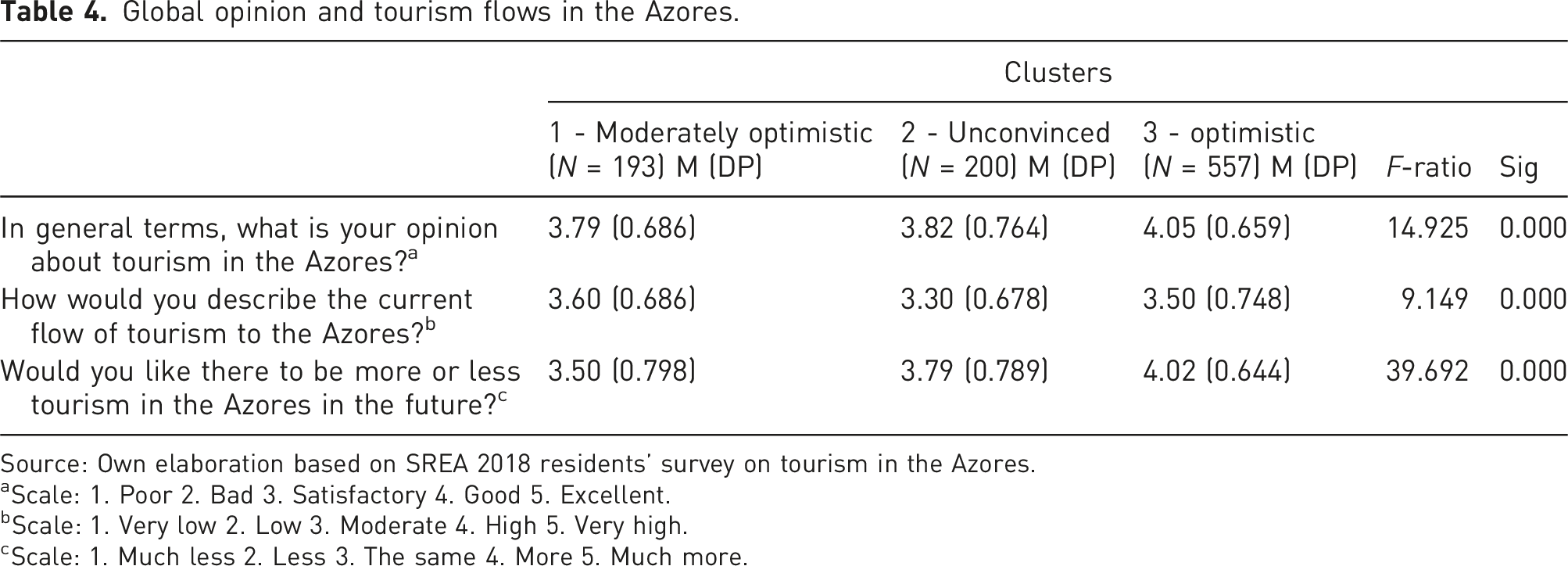
Global opinion and tourism flows in the Azores.
Source: Own elaboration based on SREA 2018 residents’ survey on tourism in the Azores.
aScale: 1. Poor 2. Bad 3. Satisfactory 4. Good 5. Excellent.
bScale: 1. Very low 2. Low 3. Moderate 4. High 5. Very high.
cScale: 1. Much less 2. Less 3. The same 4. More 5. Much more.
Before making more detailed analysis of the data in Table 4, we believe it is worthwhile adding that most respondents considered the tourism flows to be high or very high. In this regard, those residents who used to maintain direct contact with tourists presented a higher mean score. However, most residents stated that they wanted to see more or even far more tourists in the Azores.
Consistent with the optimistic approach towards the impacts of tourism in the Azores Archipelago, cluster 3 (see Table 4) expressed the highest general assessment of the destination’s tourism performance (4.05, in a five points Likert scale) and greater willingness to have more tourists in the Azores in the future (4.2). Somewhat surprisingly, cluster 1 (Moderately Optimistic) presented the lowest average scores in these two variables. These clusters were, also, in comparative terms, the ones that gave the highest evaluation of the flow of tourism to the Azores. This seems to be consistent with the concerns expressed by the members of cluster one concerning the costs associated to tourism development.
Discussion of the results
Generally speaking, our empirical results are consistent with previous studies, in particular those concerning islands or low-density territories and, of course, destinations in emergent phases of their tourism life cycle (e.g.: Guimarães, Portugal; Cantabria, Spain; Joinville, Brazil; A’Dhakhiliyah, Sultanate of Oman). The expectations of the economic gains from tourism development tend to be very high, and alternative strategies to attain better levels of community wellness are, often, fairly scarce.
If we look at the residents’ perceptions on the impacts of tourism, and, in particular, the results for cluster 1, as in the case of Nunkoo and Ramkissoon (2010), in Port Louis, Mauritius Island, the residents with greater contact with tourists seemed to be more concerned with the potential costs related to tourism development. Such costs are higher prices for goods and services, and the generation of traffic and parking problems. Fortunately, the issue of car traffic and parking is not yet a major problem in the Azores Archipelago.
The results obtained for respondents who said they had little or no contact with tourists and the cluster they are more associated with (cluster 2) seemed to correspond to the expected results for this profile. Individuals who solely have a basic level of education are, probably, those who find it hardest to interact with visitors, due to their lack of linguistic skills and the types of jobs performed. This result is in line with those obtained by Vareiro et al. (2013) for the case of Guimarães. On the other hand, residents with more frequent contact with tourists and who, in most cases, obtain economic benefits from the industry, seem to be more comfortable with interacting with visitors on a daily basis and may look at a larger number of places that may serve as tourist attractions and, thus, potential sources of tourism revenues. Bearing this in mind, the results also do not question the validity of Social Exchange Theory, which analyses social exchange between parties from a psychological and social perspective (Ap, 1992; Eyisi et al., 2021; Gursoy et al., 2019; Kim et al., 2021; Krishnaswamy et al., 2018; Rasoolimanesh et al., 2015).
Nevertheless, the destination’s residents who have the most frequent contact with tourists are also those with the greatest ability to gain a more accurate picture of the tourism impacts. These results are consistent within those in the empirical literature (Krishnaswamy et al., 2018; Nejati et al., 2014; Pal and Rawal, 2020; Papastathopoulos et al., 2020; Renda et al., 2014; Ribeiro et al., 2017; Ritchie and Inkari, 2006; Tichaawa and Moyo, 2019).
Additionally, we must add that the results are close to the findings of Monjardino (2009), using data from a survey conducted in 2005, and of Silveira et al. (2016) in the Graciosa and S. Jorge islands where respondents expressed their belief that tourism had a future in their islands.
As previously highlighted, the Azores only recently began to position itself as a tourism destination and the number of visitors remains low, notwithstanding the considerable increases over recent years. This also influences the way that residents tend to look at the costs and benefits of tourism development, and confirms the affirmation by, Gore et al. (2022), Reisinger et al. (2019) and Vargas-Sanchez et al. (2015) that residents’ perceptions and attitudes towards tourism can serve as an indicator of the development stage of tourism. In such circumstances, the high number of residents who look to tourism as beneficial to the Azores Archipelago, as a whole, and to their own well-being, in particular, is to be expected. As also mentioned, even if the Azores continues to be an emergent destination, it continues to be highly dependent on the tourism industry. Bearing this in mind, it seems to be too early to say that Butler’s Tourism Areas Life Cycle model entirely applies to the Archipelago.
Overall, this study can contribute to making Azores a more sustainable destination by providing local authorities and other tourism stakeholders with valuable insights into the local community perceptions and concerns. By using these insights to develop targeted and effective management strategies, tourism planners and public authorities can ensure that tourism development is sustainable, responsible, and beneficial for all stakeholders.
Conclusions and recommendations
Residents play a fundamental role in the quality of tourists’ experiences and, as a consequence, in the success of a destination. Aware of this key role, in this research we have explored data extracted from a survey of the Azores Archipelago’s residents, conducted by SREA in 2018. Using cluster analysis, we have segmented the Azores residents into three clusters according to their perceptions of the tourism impacts, establishing three clusters: Optimistic, Moderately Optimistic and Unconvinced.
Based on the empirical approach undertaken, and even if different perceptions of the tourism impacts were found, as results from the aforementioned clusters, we can conclude that there was a high level of agreement concerning the benefits of the tourism industry, given that 59% of respondents expressed an optimistic perception. Furthermore, even if most residents considered that the tourism flows experienced in 2018 were high or very high, they stated that they would like to see more or even far more tourists in the Azores in the future.
The study’s findings align with the Social Exchange Theory, which suggests that interactions between parties involve the exchange of resources and benefits. Residents who have frequent contact with tourists and derive economic benefits from the industry are more comfortable with interacting with visitors and may have more positive perceptions of tourism impacts.
Results also show that residents with basic levels of education may face challenges in interacting with tourists due to language barriers and limited job opportunities. Investing in education and skills development programs can empower these individuals to participate more actively in the tourism industry and benefit from associate economic opportunities.
Additionally, data suggest that the development stage of tourism in this destination, as the Azores Archipelago still is an emergent destination with a relatively low number of visitors, can impact residents’ perceptions and attitudes towards tourism.
This way, results are consistent with the common findings of the empirical literature, in particular when dealing with islands and emergent destinations in terms of the assumption that, at low or moderate tourism development levels, the industry is perceived as being beneficial to the community, although residents’ perceptions may become more negative if the industry becomes more mature.
These results are quite valuable in terms of providing accurate information to tourism planers and regional and national authorities regarding the feelings and concerns of local communities about tourism impacts and help them design policies that can better deal with perceived problems and achieve more sustainable development strategies.
Even if, in general, residents expressed no major concern towards the impacts of the tourism industry, it would be advisable to achieve a fuller understanding of the reasons behind those who expressed greater concern. Even if they are in a minority, they are also part of the tourism product offered by the Azores Archipelago. Bearing this in mind, policies which can be applied to avoid the increase of the number of individuals more skeptical on the benefits of tourism development will enhance the overall sustainability of the industry and the differentiation of the destination. This also involves showing that balancing economic gains with community well-being is a priority in the development of the tourism sector.
In this regard, the Tourism Areas Life Cycle model can play a role as a warning tool for undesirable developments of the industry. That requires implementing a continuous follow up and constant policy adjustments to prevent stagnation and ensure long-term inclusive and sustainable development. Adopting bottom-up approaches and involving residents in decision making processes seems to be the best way to achieve this.
The main limitation for the present research concerned the difficulty in determining whether or not the COVID-19 pandemic changed the residents’ perceptions towards the tourism activity. Nevertheless, given that the pandemic is slowing down in Portugal (including the Azores Archipelago), the coming years will reveal whether or not the eventual changes in the profile and motivations of tourists who visit the Azores will impact residents’ perceptions. It will be interesting to analyse this eventual new scenario in the future, as it was achieved 17 years ago, which was close to the starting point of tourism development in the Azores Archipelago. 2027 would seem to be a good year to conduct a new survey on residents’ perceptions considering that tourism started to recover in 2021–22, attaining similar numbers to the ones of the pre-pandemic period, and, thus, the survey would be applied after a cycle of recovery of around 5 years.
In 2027, there may be different samples which could be used to capture the situation in each of the nine islands of the Archipelago, which, in fact, are quite different in many characteristics and present different stages of tourism development. Additionally, due to their localization and transport facilities, they provide different levels of accessibility for potential tourists. Following the target results to be attained, the local authorities in each island could probably play a more active role in the design and implementation of policies capable of dealing with the concerns of residents and ensure sustainable tourism strategies in each case. The residents, themselves, may prove to be more committed on the tourism planning process since they can more easily understand the kind of effects the tourism industry may play on their lives.
Footnotes
Acknowledgements
Access to statistical data used in this scientific investigation was permitted within the framework of a Protocol signed on December 29th, 2014, between the Portuguese National Statistics Institute (INE), the Portuguese Foundation for Science and Technology (FCT), and the General-Board of Education and Science Statistics of the Portuguese Ministry of Science, Technology and Higher Education (DGEEC-MCTES).
Declaration of conflicting interests
The author(s) declared no potential conflicts of interest with respect to the research, authorship, and/or publication of this article.
Funding
The author(s) received no financial support for the research, authorship, and/or publication of this article.
