




Abstract
Tourism contributes to climate change through CO2 emissions, and stakeholders must work together to reduce the negative impact of the industry. Therefore, this study explores online travel discussions on Reddit to investigate consumers’ beliefs regarding self-efficacy and barriers to climate change mitigation. The study relies on combining machine learning and thematic analysis. The results show that the intersection of tourism and climate change fosters extensive online engagement, indicating that many users are aware that travel and climate change are connected. However, self-efficacy was low overall, or not manifested in users’ contributions. Further, at least 10 barriers to climate change mitigation were identified. Suggestions on how to overcome such barriers and increase efficacy beliefs are discussed, and directions for future research are given.
Introduction
The Intergovernmental Panel on Climate Change (IPCC) argues that the planet is becoming warmer at a rate that has not been seen in over 2,000 years (IPCC, 2021). Temperatures are increasing largely due to the emissions caused by human activities, and much of the observed effect stems from CO2 emissions. The World Tourism Organization (UNWTO) and the International Transport Forum (ITF) report that tourism was responsible for 5% of the global man-made CO2 emissions in 2016, and they predict levels of 5.3% by the end of 2030 (UNWTO and ITF, 2019). Lenzen et al. (2018) present a less optimistic estimate, claiming that tourism is responsible for 8% of global carbon emissions. Regardless, despite existing knowledge about tourism-induced climate change, the mitigation efforts of the industry have so far been insufficient (UN, 2019).
Some authors argue that large-scale systematic change or climate control introduced by governments and organizations will be needed to decarbonize tourism since voluntary actions are insufficient to cut down emissions as much as is needed (Becken, 2019; Higham et al., 2016). The actions of individuals are nevertheless important since previous research suggests that policy, regulation, and communication can be more successful if these measures are based on an understanding of what consumers are willing to support (Higham et al., 2016; Mkono and Hughes, 2022). Moreover, some studies suggest that consumers can initiate change which in turn can push governments, authorities, and organizations to act (Becken, 2019). However, consumers are unlikely to take initiatives unless they perceive themselves as capable of making a difference (Bandura, 1977). This is why increasing self-efficacy and removing barriers that may prevent individual action are vital parts of combatting climate change.
This study will investigate discourses about climate change from a travel consumer perspective based on naturally occurring data from Reddit. This is a way to collect consumers’ opinions without bias from the measurement instrument and the researcher’s point of view (Flick, 2014). The method relies on combining a machine learning technique called topic modeling with thematic analysis, a method combination that has hardly been used in tourism literature. This approach is used to gain insights into how consumers express their views on climate change and travel, to understand whether consumers feel that they are capable of mitigating climate change, and to understand what may prevent individual action. The findings aim to contribute to literature on tourism decarbonization, self-efficacy, and barriers to climate change mitigation. The following research questions are investigated:
What do consumers say about their own ability to contribute to climate change mitigation?
What are the barriers to climate change mitigation from a consumer perspective?
The following section sets out a review of literature that highlights key areas related to the research questions. Next, the methodology and the results of the study are described. The paper ends with a discussion and conclusions in which implications, limitations, and directions for future research are presented.
Literature review
Self-efficacy, climate change and tourism
Believing in one’s ability to contribute to climate change mitigation can be studied through the lens of self-efficacy. Bandura (1977: 3) defines self-efficacy as “beliefs in one’s capabilities to organize and execute the courses of action required to produce given attainments.” In other words, perceived efficacy is the belief that one can successfully act in ways that produce a certain outcome. Furthermore, Bandura (1977) suggests that people evaluate information about their own capacity and then decide whether they should engage in a given behavior, and how much effort to put into that course of action. This means that people are unlikely to try to solve an issue unless they believe that their actions will matter.
Self-efficacy has been part of several recent studies that focus on consumer behavior and environmental challenges such as climate change (see e.g., Brouwer et al., 2022). However, even if there is plenty of research on self-efficacy and environmental challenges, there have been few studies investigating environmental self-efficacy in tourism contexts. Doran et al. (2015) argue that their study was the first to address efficacy beliefs and environmentally sustainable tourism. They found that self-efficacy positively affects the willingness to pay for environmental protection. Later, Doran et al. (2017) learned that efficacy beliefs can partially explain intentions to choose travel options that are more environmentally friendly. Even more recently, Doran and Hanss (2022) concluded that self-efficacy mediates the relationship between expectations of others’ cooperation and willingness to sacrifice personal interests for the environment.
Other authors in the area are for example Strzelecka et al. (2018) who found that environmental self-efficacy matters for volunteer travel. Further, Lin et al. (2022) concluded that individuals who scored high on green travel involvement were more likely to share knowledge about green tourism with others and to support environmental sustainability, especially when self-efficacy was high. There is also research in which tourism scholars examine challenges related to environmental sustainability through social cognitive theory which includes self-efficacy (Font et al., 2016).
Only a few studies have examined self-efficacy in combination with climate change in tourism contexts. Verkoeyen and Nepal (2019) studied how divers adapt to climate change consequences (coral bleaching), and they discovered that self-efficacy was one of the strongest predictors of the intention to adapt where, when, and whether to dive. In their longitudinal study, Curnock et al. (2019) studied sentiments, perceptions, and values associated with the Great Barrier Reef and climate change. They discovered a decreasing sense of self-efficacy when comparing data from 2013 to 2017. The authors suggest that this decline in self-efficacy represents a barrier to effective climate change mitigation (Curnock et al., 2019).
Barriers to climate change mitigation
In addition to investigating self-efficacy, this paper will try to identify what barriers there are to climate change mitigation. Previous research has identified numerous barriers. For example, Blake (1999) explains that there are three barriers between environmental concern and pro-environmental behavior: individual barriers, responsibility barriers, and practicality barriers. Lack of interest in the environment and laziness, belong to the individual category. Feeling that there is no need to change, or feeling that one should not have to change, is included in the second set of barriers. Finally, practicality barriers include lack of time, money, information, or facilities (Blake, 1999).
Lorenzoni et al. (2007) identified barriers at two levels – individual and social. Lack of knowledge about the causes of, consequences of, and solutions for climate change is one of the individual constraints which can be manifested through confusion or low awareness. Uncertainty and skepticism about climate change and its severity, and distrust in information sources such as the media, are two additional individual barriers. Next, externalizing responsibility and blame, insofar as climate change is seen as someone else’s fault or responsibility, and believing that technology will save us, are also barriers that affect individual engagement with climate change. Thinking that climate change is a distant threat either in geographical terms or in time, and considering other things to be more important, also prevent individual action. The final individual barriers that Lorenzoni and colleagues describe are reluctance to change lifestyles, fatalism, and a “drop in the ocean” feeling. The first of these attitudes pertains to how living standards are seen as being threatened by environmental action, which could lead to changes in the perceived convenience and costs of such action. Fatalism refers to the perception that it is too late to do anything, that it is not possible to mitigate climate change, and that any effort is a waste of time. A “drop in the ocean” feeling concerns a sense of helplessness due to the magnitude of the problem (Lorenzoni et al., 2007).
Social barriers comprise lack of political action, lack of action by business and industry, worry about free-rider effects, social norms and expectations, and lack of enabling initiatives (Lorenzoni et al., 2007). Lack of political action refers to both inadequate climate change measures and distrust in governments’ capacity to take responsibility. Similarly, lack of action by business and industry is also characterized by inadequate measures and distrust in organizations. Worrying about free riders means that people refrain from trying to act in climate-friendly ways because they think that their actions will not matter, since not enough people are contributing. The next barrier, social norms and expectations, means that behaving in climate-friendly ways may contradict what is seen as desirable. Finally, lack of enabling initiatives refers to lacking the tools or choice alternatives for mitigating climate change (Lorenzoni et al., 2007). There is additional research on factors preventing climate change mitigation. For example, Gifford (2011) identified 29 psychological barriers which he calls “dragons of inaction”. However, Lorenzoni’s framework is useful for understanding both individual and social barriers which is appropriate for the collected data derived from individual users who share their views in an online social environment. This categorization of barriers will therefore be used as a guiding framework.
Methodology
This study was based on textual data which can reveal insights into discursive struggles and societal shifts (Flick, 2014). The following sections describe how the data was collected and analyzed.
Platform selection
Several social platforms were investigated before Reddit was selected. Two main choice criteria were used: (1) travel should be a frequently discussed topic and (2) the data collection should not violate any of the platform’s rules. Data collection on Reddit is possible via its application programming interface (API), and plenty of peer-reviewed articles have thus used the platform as a source of data (Proferes et al., 2021; Reddit, 2021). In addition, many groups on Reddit discuss travel-related topics, and Reddit has 52 million active users each day, making it one of the most visited websites in the world (Reddit, 2020).
Data collection & cleaning
The data collection started by coding a script in the programming language Python, used to access data from an API called Pushshift. Pushshift archives data from Reddit, and it is public and free of charge (Proferes et al., 2021). More than 90 studies have relied on the Pushshift API for collecting data from Reddit since it was created in 2015 (Proferes et al., 2021).
Submissions and comments from 2016 to 2021 were collected—subsequently referred to as “posts”, when the intention is to describe all the collected text fields. Each post had to include one of the following words: “tourism”, “travel”, “holiday”, “vacation” or “tourist”, as well as one of these terms: “climate change”, “global warming”, “emissions”, “carbon”, “CO 2 ”, “greenhouse gas” or “sea level rise.” 8,013 submissions and 40,308 comments were collected, resulting in 48,321 posts.
After the collection, the data had to be cleaned. The retained information included usernames, timestamps of when the posts were created, subreddit, title and text of submissions, and text of comments. From there, the cleaning process continued, whereby posts that did not include a timestamp were removed, as was content that seemed to have been generated by bots (i.e., text with formulations such as “I’m a bot” or the like). Spam was identified and removed by searching for duplicate data. When these steps had been performed, 45,564 posts remained.
Data analysis
The procedure for data analysis consisted of two stages. The first step involved machine learning, and for this purpose, the website www.bigml.com was used. The second stage was based on thematic analysis as outlined by Braun and Clarke (2006). Each stage is explained below.
Firstly, the machine learning task of interest was topic modeling, a technique that automatically analyzes text data by clustering words and expressions for the purpose of discovering themes (Blei et al., 2010). Topic modeling can be based on various statistical models; one of the most common is Latent Dirichlet allocation (LDA), the statistical model that BigML uses. Numerical digits, non-language characters, HTML tags, and words with no meaning were removed before running the topic model. The number of topics that should be returned was specified, and model application was repeated to find the most logical topic solution. There were approximately 20 rounds of configuration and interpretation before determining that the best model had 13 topics. Secondly, a thematic analysis was performed to obtain a richer understanding of three selected topics. Braun and Clarke (2006) explain that a thematic analysis can successfully follow six steps: (1) becoming familiar with the data, (2) generating initial codes, (3) searching for themes, (4) reviewing the themes, (5) defining and naming the themes and finally, (6) producing the report. This process was iterative, and the researcher went through these steps several times.
Ethics
The privacy policy for Reddit states that the data which a user provides through their service, including submissions and comments, are free and public (Reddit, 2021). Anyone can click on a username and see the posts made by that user (Proferes et al., 2021). In addition to solely using public data, the author of this paper followed the recommendations from Proferes et al. (2021), to the effect that displaying usernames and direct quotes in articles should be avoided to protect privacy. Therefore, no usernames are presented, and all quotes are slightly paraphrased while still conveying the same meaning.
Results
35,031 authors contributed to the discussion and their content was published in 4,899 unique subreddits. As mentioned, the dataset included 45,564 posts. Figure 1 shows the topic model that was generated via BigML. Topic model.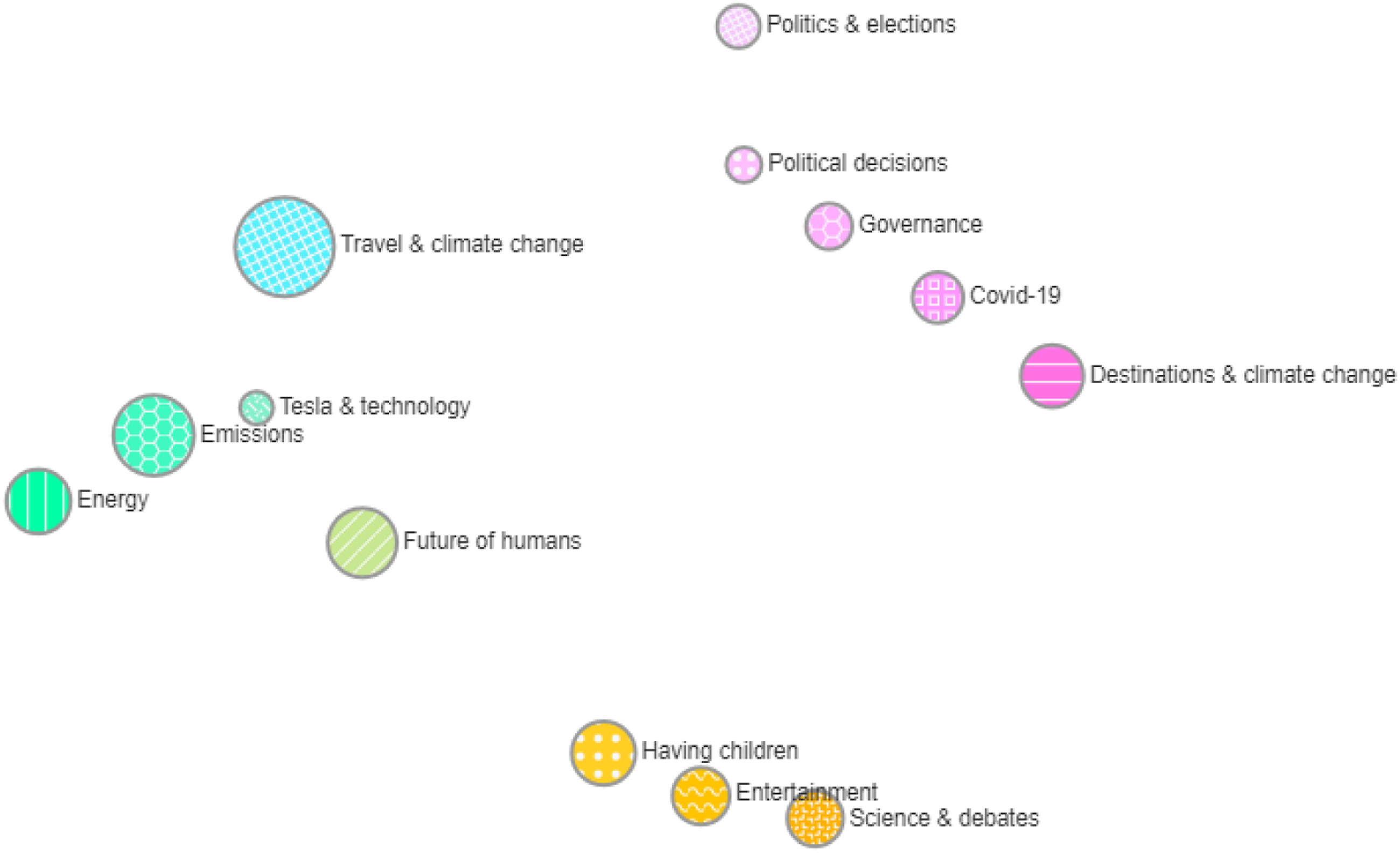
To identify the most relevant topics for the research questions and the thematic analysis, the researcher first examined 20 posts from all topics. This was achieved through BigML’s prediction technique called batch topic distribution, which assigned each post a topic probability score. Thereby, the posts that “loaded” high on each topic could be retrieved. The content revealed that three out of 13 topics were strongly connected to tourism and climate change, while the other 10 topics mainly discussed other matters while briefly mentioning some of the keywords that were required. The topics that were most associated with the subject under study were travel and climate change, emissions as well as destinations and climate change. Each topic was labeled by looking at the most associated keywords which were provided in BigML and by reading the randomly selected posts. This was an iterative task. All topics are displayed in Figure 1 where the size of the circles shows the prominence of each topic in the dataset. The distance between the circles represents the relationship among the various topics; circles that are closer to each other represent more closely related topics. The thematic analysis started with a selection of 50 posts from each topic, but the researcher then noticed that additional opinions and themes surfaced as more posts were added. Hence, the final sample included 100 posts from each topic, and this sample showed clear signs of data saturation.
Selected topics and identified themes.
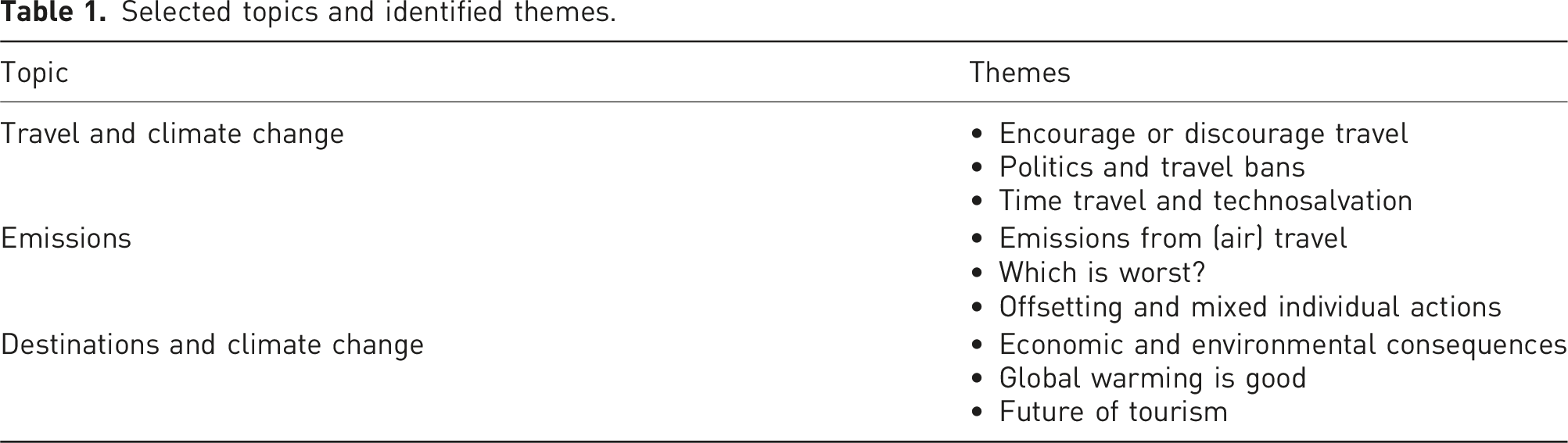
Topic 1: Travel and climate change
Encourage or discourage travel
The first theme encompasses contributions by users who express their views on travel in relation to climate change. The following posts are examples of those who want to see less travel: • “[…] If I didn’t care about the climate, I would think that more travel is better than less but climate change is real and we have responsibilities associated with it.” • “Sorry...why is no one going to stop taking holidays in Indonesia to fight climate change? Isn’t climate change a tiny bit more important than your vacation?” • “I’ll believe someone cares about climate change whenever they make the enormous sacrifice of having a Skype or Zoom meeting instead of having hundreds of people use private flights.”
On the other hand, not everyone agrees that we need to travel less. • “I respect anyone who wants to act towards combating climate change but f**k anyone who does it by causing major disturbance to travel.” • “We can’t do anything about climate change anyway. I just went on a vacation to travel as much as possible so I can see the world.”
Politics and travel bans
The second theme pertains to politics and travel bans. Many users discuss the actions of the Australian prime minister who served between 2018 and 2022: • “Oh you mean like going on a vacation to Hawaii and not coming back when the fires start? Or completely reflecting from his bad climate change policies f*****g the country?” • “Wow, seriously f**k Scott Morrison. He not only has the audacity to deny climate change while his nation is on fire (because he’s been bought out, clearly) but he goes on vacation too.”
Others describe what they think about the implementation of travel bans or what they think governments should do in response to climate change: • “Why not a travel ban to try to slow climate change? Seems more suitable.” • “Forbidding air travel because “climate change” is absurd, ignorant, unscientific, and ideological.” • “I wish my government would begin preparing for the consequences of climate change instead of ignorantly thinking we can stop it. Because we can’t. Not even by a bit. Air travel has doubled in the last 20 years.”
Time travel & technosalvation
In regard to this theme referring to time travel and technosalvation, users seem to believe that we can escape climate change. Some users suggest that time travel exists: • “It was a time traveler who told us how climate change can be stopped, nothing really important […]” • “She is a time traveler. We know that time travel was invented to make us believe in climate change, but we know better!” • “That Greta is a time traveler is certainly much more believable than climate change.” • “[…] these researchers have invented time travel and still can’t find a way to fix climate change.”
Others argue that time travel must be invented to act on climate change earlier, or they put faith in innovation: • “[…] It’s too late. We must invent time travel and go back 50 plus years in order to even start to address climate change.” • “Travel back 30 years in time and try to convince people to take climate change more seriously when we still had some wiggle room.” • “Something that will handle climate change, or significant developments in space travel.”
Topic 2: Emissions
Emissions from (air) travel
As in the first topic, users once again advocate less (air) travel, but the discussions focus more on emissions in this topic. The following quotes convey that emissions must be reduced: • “In what way is reducing our carbon footprint a bad thing? International air travel accounts for the highest per capita greenhouse gas emissions.” • “BOYCOTT air travel! Some people are doing that anyway, for the CO2 emissions and the Greta Effect, so that’s an improvement of a kind.” • “Air travel. Seriously, it’s one of the worst instigators of greenhouse gas emissions. People should quit flying. Or be limited to one flight per year, unless you can show a compelling need.”
However, there are also opposing views: • “Commercial air travel accounts for about 1.4% of worldwide carbon emissions. Even if it was completely banned, it wouldn't even put a dent in the problem.” • “[…] I wish them the best. We have done much to limit our carbon emissions, but travel is a guilty pleasure.” • “Let me rephrase my point - you can ban all air travel today, and the impact on carbon emissions will be negligible. Work big to small, not small to big.”
Which is worst?
Another sub-theme within this topic relates to comparisons between travel and meat consumption, where users tend to pick a side regarding which is worst for emissions and climate change. • “- The meat industry generates more emissions than the whole transportation industry. This is 100% entirely false. I’m all for a vegan/vegetarian diet but nobody should completely lie. […] You should cut down your carbon footprint by eating vegan, but if you go on more than one domestic flight per year, your carbon footprint is probably larger than someone who eats meat but doesn’t travel.” • “That’s incorrect. While a vegetarian diet does offset some carbon footprint, one round trip trans-Atlantic flight, or owning a car, is sufficient to totally negate it and then some […].”
Those who believe the opposite can be represented with the following examples: • “[…] Limiting how much you fly helps but you would achieve much more by reducing your meat consumption.” • “Livestock is responsible for 70% of deforestation in the Amazon and contributes 25% of greenhouse gas, surpassing all travel combined. […] All the other things you can do for the environment are a drop in the ocean compared to adopting a vegan diet. Even more so considering you can do those other things and eat vegan simultaneously.”
There are also posts in which emissions from travel are compared to other industries, as well as posts where types of transport are compared. • “Emissions from commercial air travel are also rather small compared to passenger cars, fashion, and power plants. There are several much easier places to reduce carbon emissions to focus on. You can phase out air travel altogether and have the same impact as making the fashion industry a bit less wasteful.” • “Whilst there are many factors to consider, generally I would say sea travel from Spain to Italy would have a lower carbon footprint than flying. Especially because high-altitude CO2 emissions (from air travel) typically have an even greater impact. Obviously, there are other ways in which traveling by boat is definitely more damaging e.g., NOx emissions.”
Offsetting and mixed individual actions
The final sub-theme within this topic relates to carbon offsetting and mixed individual actions aimed at reducing emissions and mitigating climate change: • “[…] I’ve been offsetting my travel and driving for years. You may sometimes want that steak or to go on that journey, the message shouldn’t be for everyone to sacrifice. If you buy $100 at [link] annually, the US could be carbon neutral in 5 years if everyone did that.” • “Re-use fabric bags instead of plastic bags (for groceries). Cut down meat and dairy in your diet (look up the carbon emissions for butter/beef/etc, it’s crazy). Get a travel mug instead of single-use coffee cups.”
Topic 3: Destinations and climate change
Economic and environmental consequences
With respect to the final topic, people seem worried about the economic and environmental consequences that climate change causes. The following posts indicate that users believe that tourism will be, or already is, greatly affected by climate change: • “[…] NOAA estimated that San Diego will have rain all through the spring to fall of 2019. You can kiss the tourism industry good bye if this will be a trend.” • “Bottom line, they used to have a tourist industry throughout the year. The lucrative half of that will now die. […] The fact that people living in ski destinations won't have to shovel snow that much is not really a concern when you consider the degree of destruction and disruption that is on the horizon.” • “Pretty convinced sea level rise will f**k beach tourism as existing resorts go bankrupt and the total number of sandy beaches declines. Sandy beaches don't develop overnight […].” • “They brought this on themselves. The west coast is destroying itself. It has some of the most vulnerable beaches in NZ to sea level rise and many towns depend largely on tourism.”
Many environmental consequences are discussed and posts about this tended to be extensive. The following example only represents a small selection of what was discussed: • “[…] It will lead to serious droughts in some areas. Drinking water will become less available in some regions. In other areas, especially in the northern hemisphere there will be an increase in rainstorms and flooding. There will be loss of biodiversity and species, there will be extinction of many species. Fires, extreme weather, and an increase of invasive species will occur. Sea levels and the temperature of the seas will rise. […].”
Global warming is good
Users bringing up this sub-theme seem to suggest that global warming is beneficial, either for the tourism industry or in general. • “[…] I like this since I don’t enjoy the cold and see that plenty of more northern regions becomes usable for growing stuff and travel is possible through open waterways […].” • “I’m eager for global warming to create new warm tourist destinations, simply so I don’t have to go back to Florida. Coastal cities just need to take one for the team and start pushing out CO2.” • “[…] 211 people work in the Svalbard tourism industry while 136,100 work in Miami’s tourism industry. Seems like most people like warm better than cold. […] Global warming is clearly noticeable in the Arctic areas and not in the tropics. This is especially advantageous because the Arctic is a cold and arid desert.”
Future of tourism
The final sub-theme is brought up by users who speculate what the future of tourism holds given the development of climate change. • “If global warming goes on, people will go on holiday for cooler weather instead of warmer. Instead of visiting the beach, maybe people will go to Canada to escape the heat?” • “By 2,100, Alpine ski destinations could lose up to 70% of snow cover. New research suggests global warming likely to replace snowfall with rain across the Alps, causing knock-on effects for villages dependent on tourism.” • “When global warming floods cities, people will almost surely turn them into tourist destinations with an ‘Atlantis’ theme.”
Barriers across all topics
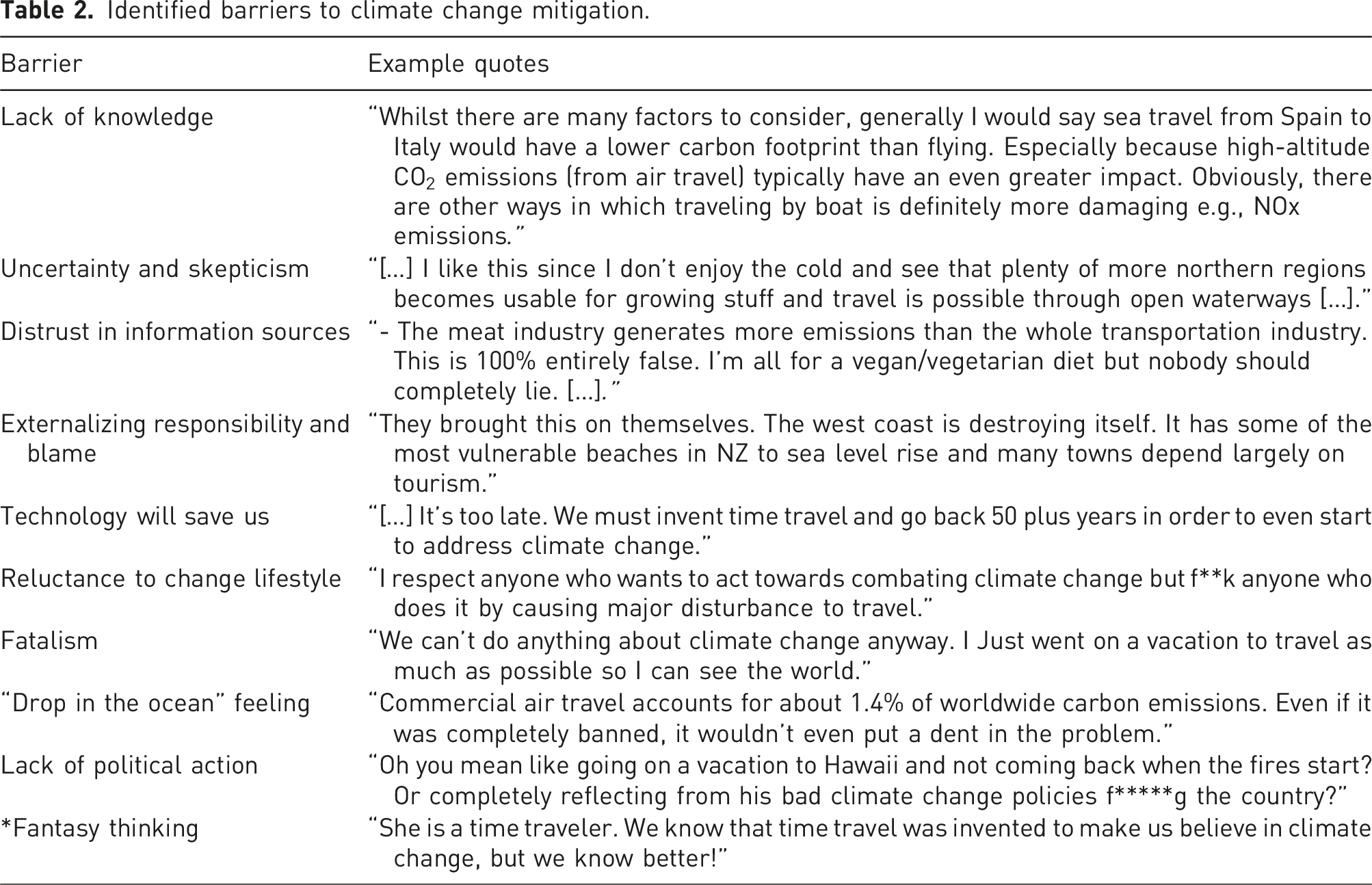
Identified barriers to climate change mitigation.
Discussion
Level of self-efficacy.
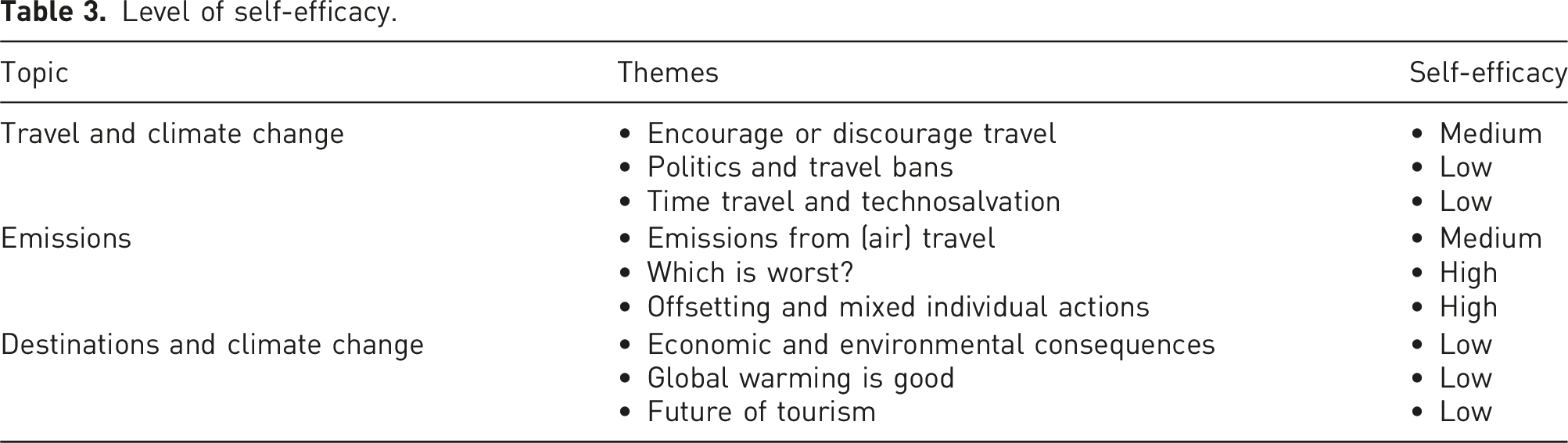
As can be seen in Table 3, two themes indicate that users have high self-efficacy to mitigate climate change as posts revealed various suggestions on how individuals can limit their negative climate impact. Flying was frequently compared to the climate impact of meat consumption—and, to a lesser extent, to the impact of other industries and modes of transport. Here, users seem keen to understand what the most effective mitigation actions are (Mkono and Hughes, 2022). Discussions about carbon offsetting and thinking twice about consumption choices also included posts that signaled a high sense of self-efficacy to limit climate change.
Two themes indicate that users have mixed perceptions of self-efficacy. In both the themes encourage and discourage travel and emissions from (air) travel, some users believe that travel must be reduced to mitigate climate change, while others do not think that limiting travel is effective or needed. For example, users call for boycotts of air travel or request a personal limit of one flight per year; others say that there is nothing to be done about climate change so you might as well travel, or describe how air travel has comparatively low emissions, making personal efforts in that area ineffective. Clearly, both the ethics of air travel and the impact one can make as an individual, are being questioned (Mkono, 2022). For both of these categories, it is important that self-efficacy can be maintained and strengthened. Brouwer et al. (2022) recommend three ways in which communication can succeed in increasing self-efficacy: (1) target people’s actions, not their character, (2) stress that people can change and that so can their capabilities, and (3) promote maximal moral standards. The last suggestion implies that communication should encourage incremental change rather than advocate radical change immediately (Brouwer et al., 2022). Thus, it seems reasonable to celebrate small steps and encourage progress instead of pressuring for full sustainability commitment at once, especially for those who are not convinced in what way they can contribute to climate change mitigation.
Five themes are composed of posts where the self-efficacy of the users was low, or not manifested in users’ contributions. In relation to politics & travel bans, users discuss what governments and politicians should or should not do, and limited focus is placed on the actions of individuals. Time travel & technosalvation relates to posts in which users seem to believe that time travel exists or needs to be invented to solve the climate crisis earlier. Users also express the belief that innovation is the solution. In economic and environmental consequences, posts mainly focus on explaining why and how the climate is changing and what will happen because of that. Users in this theme do not discuss how to deal with or mitigate climate change which is why self-efficacy is categorized as low. Perhaps most alarming are arguments in global warming is good, where users claim that climate change can be positive. These users do not seem to care whether they are capable of mitigating climate change, probably because they do not consider the problem to be a problem (Gifford, 2011). Finally, future of tourism shows that users recognize how climate change can affect the tourism industry which is similar to the findings related to the economic consequences of climate change. Some users anticipate that we need to adapt to quite extreme conditions, rather than believing that it is possible to limit climate change. Hence, they implicitly discuss self-efficacy in terms of adapting to climate change, but not self-efficacy in terms of mitigation.
What could be the reason for low self-efficacy? In contributions relating to politics and travel bans, economic and environmental consequences, and the future of tourism, the focus of the conversation is mainly on other matters than personal abilities. This does not mean that most users bringing up these themes necessarily have low self-efficacy, only that it could not be seen in their posts. However, low self-efficacy was manifested in quotes such as “I wish my government would begin preparing for the consequences of climate change instead of ignorantly thinking we can stop it. Because we can’t. Not even by a bit. Air travel has doubled in the last 20 years.” Such quotes suggest that the sustainability debate can be disempowering (Mkono and Hughes, 2022). A possible explanation for the low self-efficacy in quotes related to time travel and technosalvation, and global warming is good, may be constituted by lack of environmental knowledge, environmental concern, and overconfident beliefs in what technology can achieve (Gifford, 2011; Milfont, 2012). Users who believe that time travel will be the solution to climate change, and those who suggest that global warming is good, might not respond to any messages or incentives. Therefore, communication and structural change such as regulation, availability, and financial measures should work together to succeed with strategies of behavioral change (Steg and Vlek, 2009).
An analysis of the barriers to mitigative behaviors was carried out to further understand what may prevent individual action. Most posts were coded as not touching upon any barriers, but several of the barriers that Lorenzoni et al. (2007) identified could also be seen in this study (Table 2). Lack of knowledge is primarily visible in terms of confusion which is exemplified by one quote but it is really the combined data showing scattered, and sometimes polarizing views, that support widespread confusion on which actions are effective to limit climate change (Mkono and Hughes, 2020, 2022). The quotes signal that users want to understand the “net climate effect” of their choices. This would likely require a comprehensive and widely accepted standard, considering all stages of production and consumption, that is communicated in a credible and easily digestible way. One should, however, remember that a stable climate is only one aspect of sustainability. The barrier relating to uncertainty and skepticism is mainly noticeable in posts that argue that global warming is good, where users express doubt regarding the seriousness of climate change. For an audience like this, messages could favorably emphasize that climate change will not only lead to altered temperatures but also to more extreme weather patterns with environmental and economic consequences. Distrust in information sources is observed in posts that discuss whether transportation or meat consumption generates most emissions, or how much sea levels will rise in the future. Phrases such as “that’s incorrect”, “nobody should completely lie”, and “gross misinterpretation” indicate that users disagree with each other, and that they question whether claims are true. This also points to the need for clarity and transparency in sustainability messages.
One quote was coded as externalizing responsibility and blame in which the user suggests that one region in New Zealand brought the consequences of climate change on themselves. It is however unclear why the user makes this claim and what lies behind this barrier. Technology will save us is another theme brought up in surprisingly many quotes, wherein users express that they have lost hope that we can solve the threat of climate change. Therefore, they argue that time travel must be invented or that innovation and space travel must progress significantly for climate change to be thwarted. As mentioned, it is unlikely that these users will try to mitigate climate change since they believe that we can escape the crisis. Again, this suggests that more measures than communication are needed. Some are also reluctant to change their lifestyle, which is shown in posts where users express that they do not want to give up travel even if they believe in climate change. Communication that guides consumers on how they can travel in climate-friendly ways can still be successful if such behaviors are not perceived as lowering the standards experienced during vacations. Messages should be carefully designed so they are not perceived as being too “pushy”, threatening lifestyles and individuals’ freedom of choice (Kim et al., 2020).
Similarly to what is expressed about time travel and technology, fatalism is expressed by users who believe that nothing can be done about climate change and that it is too late to save the planet. Thus, communication aimed at behavioral change is probably more effective elsewhere. A “drop in the ocean” feeling is salient in posts related to the emissions of air travel. Here, users believe that it is meaningless to stop flying or to impose travel bans since the emissions from planes are such a small part of global emissions. Phrases such as “it wouldn’t even put a dent in the problem” and “work big to small, not small to big” signal that users think that it is better to focus on other mitigation measures.
Lack of political action is the final barrier that confirms the findings of Lorenzoni et al. (2007). This barrier is mainly referred to by users who discuss the Australian prime minister and how he was responsible for doing something about climate change but was perceived as reluctant to take that responsibility. Posts show disappointment with the lack of action and, frustration that the minister escaped the crisis by going on a holiday in another country. Not being able to trust politicians could potentially lead to decreasing efficacy beliefs – both in the sense of what individuals can do and what can be achieved collectively.
Fantasy thinking is a new barrier brought forward by this study, and it is prominent in the quotes about time travel. There is a difference between posts that convey that time travel must be invented and posts that describe that time travel already exists – it is the latter contributions that have been coded as fantasy thinking. Some users seem to believe in time travel but not in climate change, and they question that scientists have not been able to solve climate change but have been able to invent time travel; others seem to think that Greta (Thunberg) is a time traveler or explain that they have met and talked to people traveling in time. There is nothing that suggests that these posts are intended to be jokes. Once again, it is unlikely that these users would try to limit their impact on climate change, either because they are climate deniers or because they could find comfort in thinking that we can escape climate change.
In today’s digital environment, norms espoused in society and by people we deem to be important spread rapidly through social platforms, often via news pages, friends, or influencers. Research has shown that content that we engage with online can affect what we participate in offline and that influencers on social media can make people come together for political and social causes (Dekoninck and Schmuck, 2022). Thereby, voices on Reddit can not only give a snapshot of contemporary important topics but the discussions can also possibly fuel offline behaviors related to climate change mitigation. Even if self-efficacy varies both within and between the themes identified, and even if there are many barriers making climate change mitigation difficult, the results also show extensive engagement around travel and climate change – engagement which can lead to more visibility for environmental issues, and fuel even more engagement both online and offline.
Conclusion
This article has methodological, theoretical, and practical value. First, this study combines programming, machine learning, and qualitative analysis, in a way that is useful for researchers who wish to collect large amounts of text data and derive meaningful insights. Second, the qualitative analysis reveals insights into consumers’ perceived capacity to engage in climate change mitigation through travel consumption, and such analyses on self-efficacy are rare in tourism literature. Further, this paper reinforces the barriers to climate engagement as outlined by Lorenzoni et al. (2007). Nine of their barriers were confirmed in the present results, with new knowledge regarding how these barriers manifest themselves in relation to travel. A new barrier, fantasy thinking, was also identified. This barrier could be seen in quotes where users seem to be so immersed in imagination and optimistic thinking about time travel and what technology can achieve that it prevents them from taking climate change seriously.
Finally, the findings show that many consumers care about climate change since they readily discuss different areas of consumption and the associated climate impact. By reading this paper, managers and marketers can gain insights into what choices are important for consumers in their quest to behave in more sustainable ways and what is believed to prevent action now. Measures targeting voluntary actions might be more accepted and internalized in areas where individuals believe that their actions will matter. Tourism decision-makers can therefore use this paper to guide the development of policy, communication, and incentives.
This study is not without limitations. The results may be empirically skewed toward young men from the US, considering that most users on Reddit come from this group (Reddit, 2020). Further, this study only looks at English text data, possibly excluding many interesting and perhaps contrasting views. Future studies can account for these limitations and continue to study Reddit via topic modeling and thematic analysis for a variety of research questions.
Footnotes
Acknowledgements
The author would like to thank Prof. Maria Ek Styvén and Dr Kerry Chipp for their guidance and insightful comments along the research process.
Declaration of conflicting interests
The authors declared no potential conflicts of interest with respect to the research, authorship, and/or publication of this article.
Funding
The authors received no financial support for the research, authorship, and/or publication of this article.
