




Abstract
Despite the increasing interest in eudaimonic tourism experiences in recent years, research in tourism studies is fragmented. In addition, studies most often lack conceptualization, not clarifying whether the construct refers to state or trait level and what psychological mechanism is analysed, whether experience, functioning, behaviour or motivation. This pilot study aims to contribute to a better understanding of eudaimonia in tourism experiences by proposing the construct of Eudaimonic Feelings as a proxy for eudaimonia. Eudaimonic Feelings is considered a state-level construct defined as the cognitive-affective appraisals towards self-fulfilment, authenticity, truthful social interactions, and personal meaningfulness concerning a tourism experience. Adopting a multi-item approach, items found in prior research were adapted to explore and measure Eudaimonic Feelings through a survey using a convenience sample. Results support data unidimensionality, items’ reliability, and construct robustness and replicability.
Keywords
Introduction
The search for experiences is the raison d'être of tourism (Tung and Ritchie, 2011). This may explain why the study of the tourism experience remains to this day one of the most robust and important streams in tourism research as evidence consistently points to the tourists’ need to seek experiences (Chirakranont and Sakdiyakorn, 2022; Bloomstervik et al., 2020). Current tourists seek memorable experiences not only because they elicit positive emotions, but also because they allow them to feel authentic and aligned with self-development expectations (Hosany et al., 2022). Thus, there is need to better understand what characterizes the experiences that respond to tourists' experiential needs beyond pleasure. As a result, an exploration of the theoretical underpinnings of the tourism experience is proposed based on existing studies in psychology that discuss the search for experiences as rooted in the individual’s needs for authenticity and self-development and that only recently has sparked wider interest in the tourism academia.
Eudaimonia has been discussed in the sub-field of Positive Psychology (PP) as complementary to hedonia in the study of well-being (Demeter et al., 2022). While hedonia examines feelings and emotions, such as pleasure, enjoyment, satisfaction, and absence of pain/discomfort, eudaimonia analyses facets of human experience related to authenticity, meaningfulness, excellence, personal growth, and maturing (Huta, 2022). There is a growing interest in PP concepts and theories in tourism academia (Vada et al., 2020; Filep and Laing, 2018). However, application of PP theoretical frameworks in tourism studies is fragmented (Vada et al., 2020). Different measures are used as proxies for the same constructs, hindering comparisons across studies (Demeter, et al., 2022). In addition, conceptualizations of hedonia and eudaimoniaoften fail to clarify whether they apply to feelings/experience, or way of functioning, or behaviour or orientation/motivation (Demeter et al., 2022; Huta, 2022).
This limitation in conceptualization is highlighted by Demeter et al. (2022), who recently proposed pairs of definitions of hedonia and eudaimonia both as experience and orientation/motivation. Each definition in a pair is conceptualized as state or trait, following Huta and Waterman’s (2014) classification. In their study, authors concluded that both the hedonic and eudaimonic state/experience and orientation/motivation are higher in the vacation context than at home. However, the study’s research design did not include respondents in actual tourism settings, but self-reports of hypothetical scenarios related to vacation and everyday life at home. In addition, each construct was measured by a single-item.
Because of practical advantages, single-item measures are appealing for researchers (Demeter et al., 2022). Studies concluding the validity of single-item measures for concrete constructs (Bergkvist and Rossiter, 2007) encourage the adoption of single-item measures in social science research. Still, only under very specific conditions do single-item measures perform equally well as multi-item scales (Diamantopoulos et al., 2012). As a consequence, multi-item scales for measuring complex constructs are the recommended approach (Diamantopoulos et al., 2012).
Aiming at mitigating fragmentation in empirical research concerning the eudaimonic tourism experience, this study proposes the construct Eudaimonic Feelings (EF) as a proxy for eudaimonia based on the following assumptions: (i) authenticity/self-actualization is the core element of eudaimonia, directly related to true self (Smallenbroek et al., 2016; Schlegel et al., 2016); (ii) positive feelings should accompany eudaimonic activities (Waterman et al., 2008); (iii) tourism experiences are mediated by social interactions that provide a sense of community (Kirillova et al., 2017; Campos, Mendes, do Valle, and Scott, 2016); (iv) when one jointly experiences being self-actualized, socially connected, and authentic, a sense of life purpose and meaningfulness arises (Kirillova et al., 2016; Steiner and Reisinger, 2006).
Accordingly, EF is here defined as the cognitive-affective appraisals (subjective feelings) towards self-fulfilment, authenticity, truthful social interactions, and personal meaningfulness concerning a tourism experience. As such, the construct is conceptualised and analysed at state level or situational (Huta, 2022), when tourists engage in self-expressiveness activities in situations of disconnection from familiar social structures and routine-based roles.
Adopting a multi-item approach, items found in prior research were adapted to explore and measure EF. As EF is here considered as a broad sense of self, it is hypothesized that EF item’s structure is unidimensional. A pilot survey was conducted to a sample of attendees to a regional film festival in Brazil. The analysis examined preliminary construct validity based on internal structure (AERA, 2014). Results support data unidimensionality, items’ reliability, and construct robustness and replicability, pointing to a promising construct to be refined and used in future studies in tourism.
Methods
Data collection and analysis
In this study, a survey was conducted applying a self-administered questionnaire using a convenience sample of attendees at Penedo Film Circuit 2021, Brazil, during the last 3 days of the event (November 26–28, 2021). Items included were adapted from previous studies as follows: (i) authenticity/self-actualization feelings (Medeiros et al., 2020; Zatori et al., 2018); (ii) social interaction feelings (Zhang et al., 2021; Bloomstervik et al., 2020); (iii) recovery/refreshment feelings (Kim and Ritchie, 2014); and (iv) meaningfulness feelings (Medeiros et al., 2020; Wei et al., 2019; Lengieza et al., 2019). A five-point Likert scale (1 = strongly disagree; 5 = strongly agree) was used to measure all items.
A total of 97 valid questionnaires were collected with no missing answers. The sample size follows the recommendations of at least five responses per item (Hair et al., 2014). Significance of Kolmogorov-Smirnov and Shapiro-Wilk tests verified non-normality for all variables. Given data characteristics, the following procedures were requested for robust exploratory factor analysis: ordinal data were factor analysed through polychoric correlations matrix, and Robust Diagonally Weighted Least Squares (RDWLS) as the method for factor extraction (DiStefano and Morgan, 2014); optimal implementation of parallel analysis (Timmerman and Lorenzo-Seva, 2011) was the procedure for determining the number of dimensions; robust promin was the rotation method to achieve factor simplicity (Lorenzo-Seva and Ferrando, 2019); robust analyses trough bias-corrected and accelerated (BCa) (Lambert et al., 1991) was adopted, with the number of bootstrap samples of 500. Data analysis procedures were running in the FactorTM software (Ferrando and Lorenzo-Seva, 2017), version 12.01.02.
Three indices assessed the closeness to unidimensionality (Ferrando and Lorenzo-Seva, 2018): Unidimensional Congruence (UniCo), Explained Common Variance (ECV), and Mean of Item REsidual Absolute Loadings (MIREAL). Composite reliability and Cronbach’s alpha assessed reliability. RMSEA, CFI, and TLI assessed model fit (Brown, 2015). H indices assessed factor stability and replicability (Ferrando and Lorenzo-Seva, 2018). Four indicators assessed the quality and effectiveness of factor score estimates: Factor Determinacy Index (FDI), EAP marginal reliability (EAP), Sensitivity Ratio (SR), and Expected Percentage of True Differences (EPTD) (Ferrando and Lorenzo-Seva, 2018).
Finally, Item Response Theory (IRT) using Reckase’s parameterization evaluated items' discrimination (a-parameter) and items' difficulty (b-parameter). The b-parameter informs the latent trait level (θ) that is best measured by the item and the likely probability of expected response (Reckase, 2009). The b-parameter is interpreted as the point on θ where a respondent has a 0.5 probability of endorsing a particular response category (Bean and Bowen, 2021). The a-parameter indicates the item discriminating power to differentiate between subjects with high and low levels of latent trait (Reckase, 2009). The FactorTM package provides for this analysis.
Results
Analysis of the Mardia’s multivariate asymmetry skewness and kurtosis confirmed that data are non-normal (p < 0.05). Bartlett’s sphericity test (1022.7, df = 171, p < 0.000) and Kaiser-Meyer-Olkin sample adequacy test (KMO = 0.875) suggested interpretability of the correlation matrix. Parallel analysis suggested a single factor. Items' factor loadings ranged between 0.713 and 0.878. Composite reliability and Cronbach’s alpha found high items' reliability. High items' factor loading and reliability in addition to low number of factors and high number of variables lessen sample size concerns for exploratory factor analysis (Kyriazos, 2018; De Winter, Dodou, and Wieringa, 2009). Closeness to unidimensionality is verified, as well as factor replicability, suggesting a well-defined latent variable. Quality and effectiveness of factor score estimates is also verified. Fit indices found the model empirical plausibility.
Factor structure, reliability, model fit, and IRT parametrization.
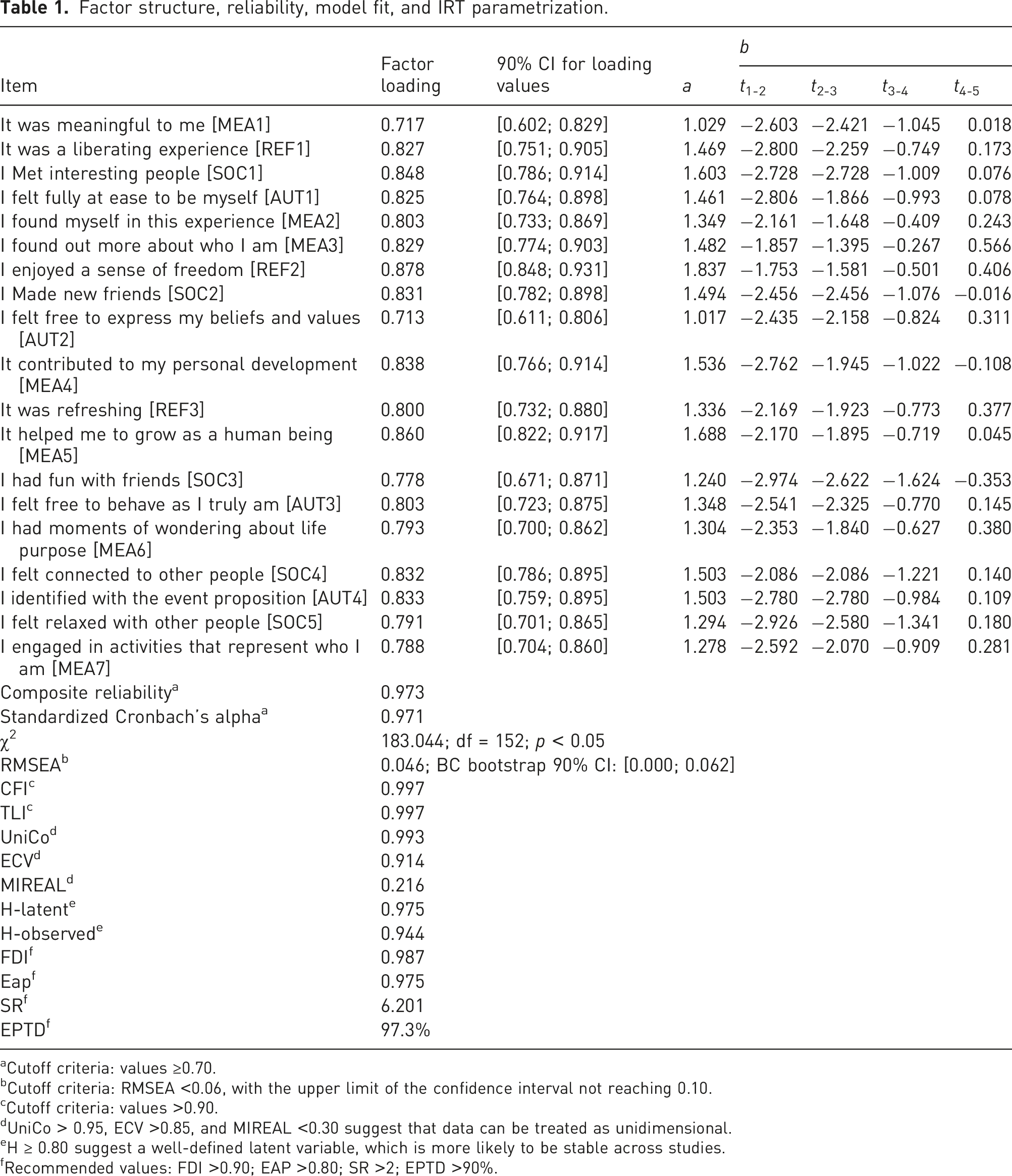
aCutoff criteria: values ≥0.70.
bCutoff criteria: RMSEA <0.06, with the upper limit of the confidence interval not reaching 0.10.
cCutoff criteria: values >0.90.
dUniCo > 0.95, ECV >0.85, and MIREAL <0.30 suggest that data can be treated as unidimensional.
eH ≥ 0.80 suggest a well-defined latent variable, which is more likely to be stable across studies.
fRecommended values: FDI >0.90; EAP >0.80; SR >2; EPTD >90%.
Discussion and conclusion
Due to its centrality in tourism practice, the study of the tourism experience continues to capture researchers’ attention, with evidence of new avenues being explored to this day. One such avenue links to the recognition of the importance of eudaimonia in the tourism context. This pilot study proposes a first approach to state-level conceptualization of the EF construct, shedding light on the fragmented research stream on eudaimonia (Demeter et al., 2022; Huta, 2022), therefore contributing to theory advancement. Conceptualization of EF as a state-level construct assumes that experiences (state-level) are psychological processes distinct from orientations and behaviours (trait-level) (Huta, 2014, 2022). Depending on how eudaimonia is conceptualized (whether orientation, behaviour, or experience) and measured (global or situational), the extent to which it is different from hedonia varies (Huta, 2022) and, at state-level, they are distinct constructs (Huta, 2022).
The results provide support to the exploration of the EF construct in the context of the tourism experience. Preliminary results show that the items' one-factor structure support EF as a broad sense of self, capturing four feelings (recovery and relief, truthful social interaction, self-fulfilment and authenticity, and meaningfulness) as perceived by the individual when appraising the experience. The study theoretically contributes to research in the tourism experience stream of research by proposing a comprehensive definition of EF as a proxy of eudaimonia that reflects tourists’ needs to experience authenticity and self-development during tourism activities, which is theoretically distinct from the hedonic experience. The construct may apply to a wide variety of tourism contexts.
Recent research argued for the link between tourism, personal growth, authenticity, and self-identity (Liu and Kirillova, 2021; McKay et al., 2019; Layland and Nelson, 2018; Grabowski et al., 2017; Hirschorn and Hefferon, 2013; Bagnoli, 2009). Future studies are expected to explore aspects of self-identity related to the tourism experience. Authors claim that conceptualization of EF is a first step in that direction.
As this is a preliminary study, the research presents limitations that will be overcome in a posterior stage. Despite item’s reliability and quality of factor score estimates, in addition to robustness of construct replicability, the small sample size imposes limits to generalization. Moreover, items are capable of measuring low to medium levels of the construct, failing in capturing higher levels of the latent trait. Aiming to build an accurate and valid measure for EF, future research should examine the stability of the one-factor item’s structure in larger and heterogeneous samples, preferably in different tourist settings, in addition to include new items
Assumedly capable of measuring higher levels of the construct. In order to do that, IRT models are strongly recommended as complementary data analysis to confirmatory factor analysis.
Footnotes
Declaration of conflicting interests
The author(s) declared no potential conflicts of interest with respect to the research, authorship, and/or publication of this article.
Funding
The author(s) disclosed receipt of the following financial support for the research, authorship, and/or publication of this article: This work was supported by National Funds provided by FCT, the Portuguese Foundation for Science and Technology through project UIDB/04020/2020.
