



Abstract
The year 2022 marks the significance of the Regional Comprehensive Economic Partnership (RCEP) as the agreement enters into force after nearly one decade of negotiations. While the pandemic exposed the vulnerability of the tourism industry to the changing market reality, it also created an impetus for Asia-Pacific regionalism. The RCEP marks the first time a monumental trade agreement is ratified virtually, and member states will be the primary beneficiary given the correct response and strategy. Thus, the Asia-Pacific is set to become one of the fastest-growing regions in the coming decade as countries agree to enhance trade and investment. Our study examines the potential economic implications of the RCEP on tourism. We offer four interrelated proposals rooted in the tenets of tourism-led growth. Tourism researchers are encouraged to refine the propositions.
Keywords
Introduction
The ratification of the Regional Comprehensive Economic Partnership Agreement in January 2022 marks a paradigm shift in international relations within the Asia-Pacific. The RCEP is a mega-regional trade agreement combining all existing bilateral free trade agreements among its 15 member countries. Member countries include ten ASEAN states (Brunei, Cambodia, Indonesia, Laos, Malaysia, Myanmar, the Philippines, Singapore, Thailand, and Vietnam), East Asia (China, Japan, South Korea), Australia, and New Zealand. The Asia-Pacific, which has a combined annual gross domestic product (GDP) of US$26.2 trillion or about one-third of the global GDP, also represents about one-third of the global population (ASEAN Secretariat, 2020a). With member states agreeing to enhance trade and investment in the region, the Asia-Pacific is set to become one of the fastest-growing regions in the next decade, with income gains of up to 0.6% (Park et al., 2021).
Generally, the economic narration of regional cooperation appears at the backdrop of tourism studies, and empirical research is lacking in this area (Calero and Turner, 2019; Koh and Kwok, 2017). The agreement is likely to impact tourism in various ways. Inbound tourism facilitates economies of scale, attracts institutions and resources (Liu and Nijkamp, 2018) and stimulates infrastructure investments (Brida et al., 2016). The spillover effect from regional cooperation is highlighted in an economically integrated region through interactions among stakeholders (e.g., tourism enterprises and institutions) (Paci and Marrocu, 2014).
We present the case for regional tourism development within this context and critically analyse how Asia Pacific countries can benefit from greater cooperation. With the region hoping to recover from the pandemic-induced recession, the agreement is set to strengthen multilateral ties and boost international trade among member states. As such, our study aims to advance research on these linkages through four interrelated propositions. Future empirical research in this area is highly encouraged.
Revisiting tourism-led growth (TLG)
Realizing that the tourism industry is a growth catalyst, the signing of the RCEP is timely for member countries to stimulate economic recovery in the region. The export-led growth hypothesis broadly postulates that growth is driven by expanding exports as it helps promote steady growth in other industries (Brida et al., 2020). Therefore, efforts to encourage regional cooperation will be beneficial for RCEP member countries to remain a preferred choice for investment, travel, and tourism.
The validity of the tourism-growth hypothesis is subject to debate as country-level studies have provided mixed evidence (Odunga et al., 2020; Tang and Abdullah, 2018; Wu and Wu, 2016), many of which did not pay sufficient evidence to regional tourism characteristics of the economy. The growth-enhancing effect of tourism development is mainly driven by the inflow of foreign currency led by the import of capital goods and multiplier effects on employment (Nowak et al., 2007). Tourist inflows also serve as knowledge diffusion channels to facilitate economies of scale, attract institutions and resources (Liu and Nijkamp, 2018), and stimulate investments in infrastructure (Brida et al., 2016). The spillover effect is even more significant in an economically integrated region through interactions among various stakeholders, i.e., tourism enterprises and institutions (Paci and Marrocu, 2014).
Accordingly, one member state’s growth will benefit the rest mutually, thus drawing more tourists into the region and between member states. Tourism also creates opportunities for labour-intensive businesses, i.e., restaurants, hotels, tour guides, and operators, by employing informal or semi-skilled workers in remote scenic areas. Most tourism enterprises will stand to benefit as they comprise small and medium-sized service providers.
PROPOSITION 1
Theoretically, the effect of increased trade integration on business cycle synchronisation is ambiguous. The growing interdependence among RCEP countries through trade flows (goods and services) and capital movement naturally gears efforts toward greater economic cooperation and promotes symmetrical business cycles. Frankel and Rose (1998) demonstrated that countries with closer trade links will have tightly correlated business cycles due to increased demand spillover effects. In contrast, reducing trade barriers can potentially increase industrial specialisation by country, resulting in less symmetry business cycles from industrial-specific shocks (Beck, 2021).
One of the implications of increased economic interdependence driven by the RCEP is the co-movements of economic factors, or, more formally, the symmetry of business cycles. As economic factors primarily influence inbound tourism demand in the source countries, a country’s tourism sector and even its macroeconomic performance inevitably depend on the external macroeconomic environment. A shock to the source market can have spillover effects on foreign economies. For example, a temporary positive shock to the source market’s GDP may increase tourist outflows as well as the number of inbound tourists and tourism income in the destination countries.
Business cycles and tourism demand tend to move conjointly (Cao et al., 2017; Smeral, 2012) or in the same direction with a lagged effect (Guizzardi and Mazzocchi, 2010). In the immediate term, policymakers have little to worry about unsynchronised business cycles as the disturbances will become more synchronised through tourism as regional economic integration advances through the RCEP. In the long term, tourism flows can act as a mechanism through which the region’s business cycles become more synchronised. Research proposition: Regional cooperation will lead to the symmetry of business cycles through tourism flows.
PROPOSITION 2
Business cycle symmetry will lead to greater economic and subsequent financial integration. Following Proposition 1, greater cooperation in the region will synchronise business cycles through tourism flows, moving the region closer toward adopting a regional currency. The feasibility of a common currency in Asia has been studied extensively (Lee and Koh, 2012), but was put on hold after the euro-debt crisis. However, the RCEP has revitalised interest in a more financially integrated region to facilitate trade. According to Guo and Zhou (2021), either the Japanese Yen or Chinese Yuan will be at the forefront of cross-border payment as a regional anchor currency. This may change the current dollar-denominated global financial system. Tourism services are increasingly traded and transacted online, as the emergence of e-commerce in trade and travel offers improved performance and efficiency for stakeholders (from suppliers to consumers). Although digitisation drives higher international travel and tourism expenditure, exchange rate regimes and controls remain a barrier (De Vita, 2014; Lorente-Bayona et al., 2021). According to Gunning et al. (2021), digital currencies (i.e., Central Bank Digital Currencies) could overcome barriers and simplify cross-border flows, although the acceptance of digital currency was relatively low because of the legal and financial challenges associated with its issuance (Bossu et al., 2020). However, with the rise of global crypto assets and further spurred by the acceleration of digital payment due to COVID-19, policymakers in Asia-Pacific are considering CBDC to promote financial inclusion (Jahan et al., 2022). The International Monetary Fund researchers found that regional initiatives can overcome interoperability issues of CBDC for cross-border payment (Jahan et al., 2022). Moreover, while cryptocurrencies are an exciting option for Asia-Pacific travelers (Treiblmaier et al., 2021), China has banned them in favor of e-CNY (digital yuan) (Gunning et al., 2021). Whether e-CNY will be at the forefront of cross-border payment and be adopted regionally, warrants further studies. Research proposition: Regional cooperation will accelerate the acceptance of digital currency.
PROPOSITION 3
The development of endogenous growth models provides a formal link between trade policies and long-run growth. Economic expansion within a region is likely to promote tourism development (Sokhanvar et al., 2018) since export-led growth improves tourism infrastructure, amenities, transport policy, and safety standards which encourages inbound tourism. Theoretically, economic growth spurred by export expansion will draw more tourists to the country.
The growth in tourism-related businesses stemming from initial tourist spending will also have indirect and multiplier effects on non-tourism industries (Stabler et al., 2009). Over the long run, businesses in the destination countries will be indirectly affected by spill over effects from tourism income. Regional trade policies, i.e., trade and investment liberalisation, may positively impact tourism as they provide an excellent currency earnings source. Furthermore, increased information exchange will reduce the cultural distance between countries (Santana-Gallego, 2016).
Drawing upon the tenets of endogenous growth models, we propose that trade agreements will indirectly affect trade flows as the reduction in trade barriers could increase tourism flows through economic growth. Given the importance of the agreement’s potential indirect impact on tourism flows, the RCEP should include agreements on tourism trade in the chapter dedicated to service. Research proposition: Regional cooperation will have an indirect impact on RCEP member states’ tourism flows.
PROPOSITION 4
The reduction in tariffs and non-tariff barriers is generally accompanied by rapid trade expansion among member states (Yang and Martinez-Zarzoso, 2014; Kwok and Koh, 2017). Increased trade within the free trade area (FTA) allows competition among members, promoting a more efficient (re)allocation of resources among the RCEP countries. This is associated with what is often referred to as trade creation. It is expected that tariff reductions will increase tourism consumption as the costs of imported goods related to the industry will reduce over time (Sugiyarto et al., 2003). From the supply side, the tourism network will benefit various public and private sector participants in the transportation, accommodation, distribution, and marketing of tourism products or services (Zhang et al., 2009). Through the ratification of RCEP, suppliers co-located within regional proximity will tend to consolidate, form better relationships, and exploit the opportunities presented by improved cross-border mobility.
Geographic proximity is also advantageous for Asia Pacific member states to cooperate in tourism development, including destination promotion and opening new travel routes. Facilitation of people’s movements will encourage tourists to travel to more familiar destinations. Trade in goods and services and cross-border mobility will promote business and leisure tourism (Liu and Nijkamp, 2018).
For businesses, tourism enterprises can expand their network within the region, gain access to labour and information, and provide customised services benefitting from tariff reduction and other RCEP measures supporting regional investment. For individuals, member states are committed to supporting the temporary movement of natural persons, including spouses and dependents related to business and investment (ASEAN Secretariat, 2020b). At present, extending ASEAN’s visa deregulation to include its three East Asian partners is possible, and Pacific trading partners can boost regional tourism (Koh and Kwok, 2018). Drawing upon our preceding discussion, we propose the following: Research proposition: Trade creation will increase tourism flows among RCEP members.
We offer an integrated framework to demonstrate how the above propositions are interrelated in Figure 1. Integrated framework of the potential economic implications of the RCEP on tourism.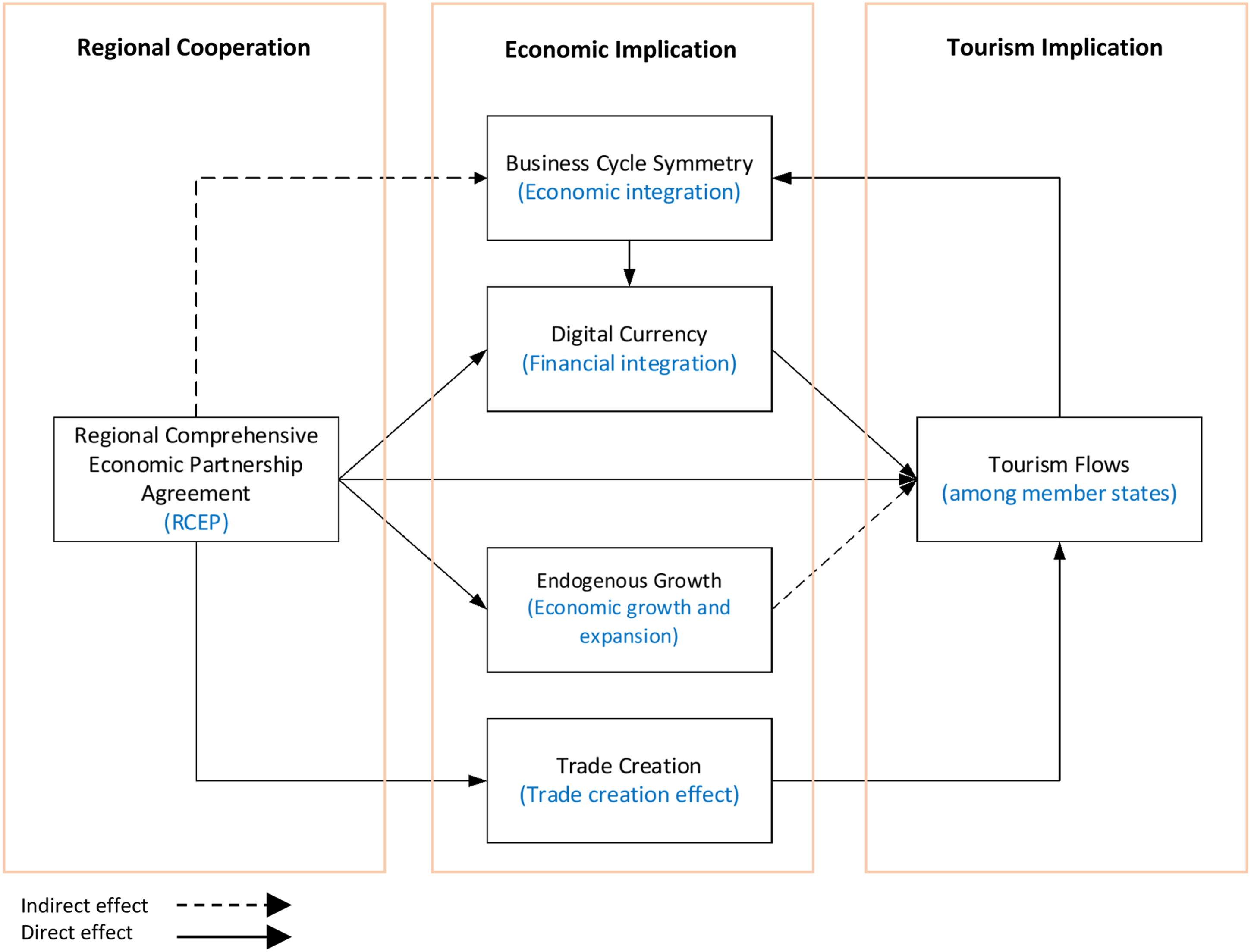
Final remarks and conclusion
Our study is one of the first few to conceptually present the economic implication of RCEP on tourism in an integrated framework. Regional cooperation will lead to greater economic and financial integration with potential implications for future tourism studies. Member states will be the primary beneficiaries of this integration, given the right response and strategy. The ratification is timely for export-driven Asia-Pacific countries to realise the Asian century—a projected dominance in economic position.
We addressed the dearth of research on the impact of regional cooperation on tourism flows and encourage tourism researchers to refine and empirically test the framework or each proposition separately. As this study’s focus is limited to the economic perspective, future research could consider broader inter-disciplinary areas linked to regional cooperation. We conclude that more research focusing on the complementarity between regional tourism and inbound tourism must be conducted.
Footnotes
Declaration of conflicting interests
The author(s) declared no potential conflicts of interest with respect to the research, authorship, and/or publication of this article.
Funding
The author(s) received no financial support for the research, authorship, and/or publication of this article.
